



Abstract
Over the past few decades, researchers have been trying to understand the career decision-making process from interpersonal and affective perspectives. Previous findings suggest that secure attachment is negatively linked to career indecision, but the extent to which other variables mediate this relation is less clear. The present study was designed to identify underlying mechanism in the relation between attachment and career indecision. This was done by examining a model which links secure attachment with career indecision through the mediating role of emotional intelligence. Participants included 362 female undergraduate students from a large Southern University. A path model was tested to investigate (a) the direct association of attachment to three dimensions of career indecision (lack of readiness, lack of information, and inconsistent information) and (b) whether emotional intelligence mediates the relations between attachment and the career indecision dimensions, while controlling students’ age. Results indicated a very good fit for the proposed path model. With two exceptions, results provided support for the study’s hypothesis regarding the direct and mediated links in the model; all paths were in the expected direction. Results of the study provide support for the notion that different antecedents may explain career decision-making difficulties, and therefore, college women may require diverse intervention approaches
Career indecision is defined as an individual’s difficulty or inability to identify and/or commit to a current or future occupational option (Osipow, 1999). While some people make career decisions with ease, others experience prolonged periods of career indecision (Amir & Gati, 2006). Career indecision has been associated with negative outcomes. For example, in a study with college sophomores, students who reported uncertainty about their career choices had lower GPAs than their more certain peers (Graunke & Woosley, 2005). Moreover, affective experiences connected to career indecision, such as anxiety and feelings of incompetence, tend to persist after a career decision has been made (Cavenagh, Dewberry, & Jones, 2000).
Over the past few decades, researchers have examined the career development process from interpersonal (Wolfe & Betz, 2004) and affective perspectives (Di Fabio & Kenny, 2015; Gati, Gadassi, et al., 2010). A secure sense of attachment to parental figures is a primary human need (Josselson, 1992) that, in turn, has been associated with mastering important developmental tasks including emotion regulation (Baumeister & Leary, 1995) and career decision-making (Mikulincer & Florian, 2001). Similarly, emotional intelligence, which refers to the ability to recognize and manage emotions, has been positively associated with effective career decision-making outcomes among college students (Brown, George-Curran, & Smith, 2003; Puffer, 2011).
The presence of felt security associated with secure parental attachment and the ability to manage negative emotions may facilitate making career choices by reducing anxiety and emotional stress elicited during the decision-making process (Braunstein-Bercovitz, Benjamin, Asor, & Lev, 2012). Although previous research has provided support for the negative relation between secure parental attachment and career indecision among adolescents and college students, precisely how secure attachment and career indecision are related remains unclear. Thus, the purpose of this study was to examine a path analytic model that proposes emotional intelligence as a mediator of the relation of secure attachment to career indecision among female college students.
Attachment and Career Indecision
Attachment refers to the emotional bond developed in the early child–parent relationship (Ainsworth, 1989; Bowlby, 1982). Bowlby (1982), who first introduced attachment theory, proposed that optimal psychological development occurs when infants have access to responsive caregivers who provide a trustworthy secure environment. In the context of these attachment experiences, children establish cognitive representations, or internal working models, of their relationships with others that for the most part are relatively stable across the life span (Cozzarelli, Karafa, Collins, & Tagler, 2003; Waters, Merrick, Treboux, Crowell, & Albersheim 2000).
Securely attached children typically develop a balanced sense of dependence and autonomy and the capability to self-regulate distressing emotions that extend into adulthood. In contrast, children who lack consistent external support and comfort often develop an insecure attachment orientation characterized by lack of trust in others and inability to effectively self-regulate distressing emotions. Research findings have provided support for the positive association of a secure attachment orientation to the ability to regulate emotions in children and adults (Borelli et al., 2010; Kim, 2005).
During the career decision-making process, individuals may experience fear of commitment (Blustein, Prezioso, & Schultheiss, 1995), uncertainty about the future, or perfectionism about making a choice (Gati, Amir, & Landman, 2010). However, an internalized sense of security from supportive parental relationships is likely to increase college students’ ability to manage negative emotions related to career choice and promote decision-making (Wright, Perrone-McGovern, Boo, & White, 2014). Consistent with this perspective, research findings with college students (Mojgan, Abdul Kadir, Noah, & Hassan, 2013; Tokar, Withrow, Hall, & Moradi, 2003) and adolescents (Emmanuelle, 2009) have indicated that students who report secure attachment orientations are less likely than their insecurely attached peers to report career decision-making difficulties.
Attachment and Emotional Intelligence
Emotional intelligence refers to “the ability to monitor one’s own and other’s feelings and emotions, to discriminate among them and to use this information to guide one’s thinking and actions” (Salovey & Mayer, 1990, p. 189). Emotional abilities may be arranged in four hierarchical domains that start with basic abilities and move toward more complex abilities: (a) accurately perceiving emotions in oneself and others; (b) using emotions to facilitate thinking; (c) understanding emotion, emotional language, and emotional signals; and (d) managing emotions to reach specific goals (Mayer & Salovey, 1997; Mayer, Salovey, & Caruso, 2008).
Consistent with attachment theory, secure individuals tend to utilize emotional management strategies that lower distress and enhance positive emotions, while insecure individuals are more likely to use emotional management strategies that perpetuate negative emotions and increase distress (Hazan & Shaver, 1987; Mikulincer & Florian, 2001; Shaver & Clark, 1994). Given that managing emotions is a key component of emotional intelligence, we can infer that secure individuals will likely demonstrate greater emotional intelligence abilities than insecure individuals. Several studies have reported links between attachment and emotion regulation-related components of emotional intelligence (Kafetsios, 2004; Kim, 2005; Mikulincer & Orbach, 1995). Compared to their less secure counterparts, securely attached individuals are more accurate in the perception and decoding of facial expressions of negative emotions (Magai, Distel, & Liker, 1995) and the perception of nonverbal messages from their partners (Kafetsios, 2004). Secure individuals also have demonstrated the capacity to regulate negative feelings (Feeney, 1995), avoid negative emotion bias (Magai et al., 1995), and access negative emotional memories without being overwhelmed (Mikulincer & Orbach, 1995).
Taken together, research findings suggest that securely attached college students are likely to demonstrate higher levels of overall emotional intelligence capacities than their less securely attached peers. Therefore, it seems reasonable to expect that among college students, secure attachment will be positively related to emotional intelligence. However, attachment and emotional intelligence may differ in their malleability. Only about 20–30% of adults are likely to report substantial changes in attachment orientation across time and factors associated with such changes have not been clearly identified (Cozzarelli et al., 2003; Fraley, 2002). In contrast, children, adolescents (Di Fabio & Kenny, 2011; Durlak, Weissberg, Dymnicki, Taylor, & Schellinger, 2011), and college students (Pool & Qualter, 2012) are responsive to emotional skills training. For example, an 11-hr intervention that included short lectures, role-plays, group discussions, and readings resulted in significant improvements in the understanding and managing of emotions among college students in England (Pool & Qualter, 2012). Therefore, an increased understanding of the extent to which emotional intelligence helps explain the observed association of attachment security to career indecision may provide useful avenues for the development of interventions to increase emotional intelligence and facilitate career decision-making among college students with unsecure attachment orientations.
Emotional Intelligence and Career Indecision
Gati, Krausz, and Osipow (1996) have identified three dimensions of career decision-making difficulties. One of these dimensions, lack of readiness, is encountered before the career decision-making process begins and includes lack of motivation, indecision, and dysfunctional myths. The other two dimensions refer to difficulties during the career decision-making process, including lack of information (about the process itself, the labor market, and oneself) and inconsistent information (regarding the self and occupations, external and internal conflicts). The career decision-making process often requires addressing conflicting issues that generate anxiety such as selecting between ones’ passions, considering the realities of the changing economy, and managing the expectations of loved ones (Di Fabio & Blustein, 2010).
Anxiety is a debilitating negative emotion that often keeps students from seeking career counseling or researching career information (Germeijs, Verschueren, & Soenens, 2006) and, therefore, hinders students’ ability to make career decisions (Fouad, 2007). Among college students, anxiety has been positively related to career indecision (Braunstein-Bercovitz et al., 2012; Corkin, Arbona, Coleman, & Ramirez, 2008) and negatively related to emotional intelligence (Extremera, & Fernandez-Berrocal, 2006). In turn, emotional intelligence has been negatively linked to the three dimensions of career decision-making difficulties identified by Gati et al. (1996): lack of readiness, lack of information, and inconsistent information (Di Fabio & Kenny, 2011; Di Fabio, Palazzeschi, Asulin-Peretz, & Gati, 2013). These findings suggest that during the career decision-making process, a higher level of emotional intelligence is likely to help individuals manage their anxiety and address, rather than avoid, career choice conflicts. Therefore, it seems reasonable to expect that individuals with higher emotional intelligence will experience less career decision-making difficulties than their peers with lower levels of emotional intelligence.
The Present Study
Theoretical approaches and empirical evidence (Bowlby, 1982; Mikulincer & Florian, 2001) suggest that individuals with secure attachment orientations are generally skillful at using emotional management strategies that lower distress and increase positive mood, which are the hallmarks of emotional intelligence. In turn, the ability to manage negative emotions may facilitate career decision-making, as the process commonly causes an increase in anxious feelings (Brown et al., 2003; Di Fabio & Kenny, 2015; Di Fabio & Palazzeschi, 2009). While the relation of attachment to global indexes of career indecision is well established, we know less about the paths that link attachment to dimensions of career indecision. Therefore, the purpose of this study was to examine to what extent emotional intelligence, which involves awareness of emotions and capacity to integrate emotions with thoughts and actions (Goleman, Salovey, & Mayer, 1990), mediates the observed relation of secure attachment to each of the three domains of career decision-making difficulties identified by Gati et al. (1996). Unidimensional attachment, rather than attachment styles (secure, anxious, and avoidant; Braunstein-Bercovitz et al., 2012; Tokar et al., 2003), was considered in this study because the focus was on level of security and not on patterns of attachment. Prior studies have indicated gender differences in attachment (Mulligan & Lavender, 2010), emotional intelligence (Brown et al., 2003; McIntyre, 2010), and career-related factors (Mau, Perkins, & Mau, 2016; Migunde, Othuon, & Mbagaya, 2015). Based on these findings and the disproportionate number of female students in our sample, the study focused on female college students.
To our knowledge, the current study is the first investigation of the indirect effect of emotional intelligence in the negative association between secure attachment and career indecision. Consistent with previous bivariate correlational findings, it was predicted that secure attachment would be directly associated to emotional intelligence and to the three dimensions of career decision-making difficulties. It was also expected that emotional intelligence would mediate the relation of secure attachment to the three career indecision dimensions. While attachment orientation, including attachment security, tends to be stable across the life span (Cozzarelli et al., 2003), capacities associated with emotional intelligence seem to be malleable through intervention (Pool & Qualter, 2012). Therefore, in addition to providing a better understanding of the mechanisms that may help explain the observed negative relation of secure attachment to career indecision dimensions, results of this study may provide support for the inclusion of emotional intelligence training in career-decision-making interventions.
Method
Participants
Participants in this study were 362 female undergraduate students at a large Southern University. Participants mean age was 21.72 years (SD = 4.69). The ethnic distribution of participants was Hispanic (n = 116, 32%), Asian (n = 100, 27.6%), White (n = 85, 23.5%), African American (n = 30, 8.3%), mixed (n = 21, 5.8%), and other (n = 9, 2.5%). In terms of year in college, 18.8% of participants reported being a freshman, 23.2% a sophomore, 35.9% a junior, 21.5% a senior, and two individuals did not report their year in college. Participants reported the following family of origin’s socioeconomic status (SES) distribution: poor/working class (n = 132, 36.5%), middle class (n = 153, 42.3%), and upper-middle class/wealthy (n = 76, 21%).
Measures
Demographics
Participants were asked to provide information about age, gender, ethnicity, and SES.
Attachment
The Inventory of Parent Attachment, a 28-item subscale of the Inventory of Parent and Peer Attachment (IPPA; Armsden & Greenberg, 1987), was used to assess the degree of parental attachment security that participants perceived. Students were instructed to respond to the items as they related to the parent or parental figure who had “most influenced” them. Item responses occur on a 5-point Likert-type scale ranging from 1 (never true) to 5 (always true). Participants’ scores were calculated by reverse scoring the negatively worded items and then adding responses to the items to calculate a total attachment score. Higher scores on the IPPA Scale indicate higher levels of perceived secure attachment to parents. The Inventory of Parent Attachment is comprised of three subscales labeled Trust, Communication, and Alienation. Sample items from each subscale include, “My parents accepts me as I am (Trust),” “I like to get my parents’ point of view on things I’m concerned about (Communication),” and “My parents expects too much from me (Alienation).” Armsden and Greenberg (1987) reported an internal reliability coefficient of .86 to .91 for the subscales for the parent scale. The measure showed evidence of good validity, as scores were related in the expected direction to self-esteem and life satisfaction. The present study found a Cronbach’s α of .95 for the IPPA.
Career indecision
The Career Decision-Making Difficulties Questionnaire (CDDQ; Gati & Saka, 2001) is a 34-item measure of career indecision, based on Gati et al.’s (1996) taxonomy of career decision-making difficulties. The questionnaire consists of three scales: (a) Lack of Readiness which includes items related to lack of motivation, indecisiveness, and beliefs regarding dysfunctional myths regarding careers; (b) Lack of Information about the career decision-making process, about the self, about occupations, and about the ways of obtaining information; and (c) Inconsistent Information which has items associated with unreliable information, internal conflicts, and external conflicts. Item responses occur on a 9-point Likert-type scale ranging from 1 (does not describe me) to 9 (describes me well). At the end of the measure, respondents rate the overall severity of their difficulties in making a career decision and report any additional difficulties that prevent them from making a career decision. A score for each of the three dimensions of career decision-making difficulty was computed by calculating the mean of the items included in each scale. Sample items include, “I find it difficult to make a career decision because I do not know what factors to take into consideration,” “It is usually difficult for me to make decisions,” and “I find it difficult to make a career decision because people who are important to me (such as parents or friends) do not agree with the career options I am considering.” Previous studies have shown internal consistency of .86, .90, and .92 (Di Fabio et al., 2013) for the three scale’s scores. In the present study, Cronbach’s αs for participants’ scores in the Lack of Readiness, Lack of Information, and Inconsistent Information subscales were .71, .95, and .91, respectively. Scores in the CDDQ shared concurrent validity with the Career Decision Self-Efficacy Scale—Short Form (Di Fabio & Blustein, 2010; Gati, Krausz, & Osipow, 1996).
Emotional intelligence
The Assessing Emotions Scale (Schutte, Malouff, & Bhuller, 2009) is a 33-item measure of emotional intelligence, based on the three branch model of Salovey and Mayer (1990). A factor analysis suggests a one-factor solution of 33 items. This one-factor solution assesses an individual’s self-reported abilities of (a) appraisal, expression of emotion, (b) regulation of emotion, and (c) utilization of emotion in solving problems. Sample items include, “I can tell how other people are feeling by listening to the tone of their voice,” “I know why my emotions change,” and “I help other people feel better when they are down.” Items are rated on a 5-point Likert-type scale ranging from 1 (strongly disagree) to 5 (strongly agree). Scores were calculated by summing the items, producing a single total score for the measure. Previous studies have shown internal consistencies between .87 and .91 and a test–retest reliability of .78, over a 2-week time period for the scale’s total score. This measure shares convergent validity with measures of attention to feelings and clarity of feelings (Austin, Saklofske, Huang, & McKenney, 2004; Gignac Palmer, Manocha, & Stough, 2005). The scale had a high level of internal consistency with the current sample, with a Cronbach’s α of .89.
Procedures
The study was approved by the institution’s review board. Students were recruited through in-class visits as well as an electronic participant sign-up board. The study was described as an examination of career indecision, emotions, and parental relationships in college students. Upon registering for the study, participants were directed to a Qualtrics online questionnaire. Students first were presented an online informed consent document that explained the risks and benefits of participating in the study, as well as the option to not participate or withdraw their participation. After completing the survey, students received one credit hour, which could be transferred to extra credit for a course of their choice.
Results
Data exploration procedures indicated low levels of missing data; 96–99% of cases had complete data in the measures of attachment and career indecision dimensions; 92% of cases had complete data in the emotional intelligence scale. None of the scales had more than 10% of the items missing; in most (82%) instances, cases were missing values for only 1 item per scale. Results of Little’s (1988) missing completely at random χ2 test was not statistically significant (χ2 = 89.983, df = 105, p = .85), which suggested that values were missing at random. In a study that compared various methods of handling missing data, Parent (2013) concluded that in data sets with low levels of item-level missingness, mean substitution and available item analyses (AIA) procedures yielded similar results (e.g., means, standard errors, and αs) compared to more complex multiple imputation procedures. Mean substitution refers to replacing a missing value in a scale with the mean of the respective participant’s nonmissing items in the said scale; AIA refers to using the mean of the available items on the scale to calculate a scale score. Given the characteristics of our data described above, we followed Parent’s (2013) recommendations in addressing missing values, which included a slight preference for AIA methods for scores based on the mean of the scale’s items. Because scores in the CDDQ (Gati & Saka, 2001) are obtained by averaging the items’ values in each subscale, the means of available items were used to calculate participants’ scores in each of the three career difficulties subscales. However, instructions for the calculation of scores for the attachment (Armsden & Greenberg, 1987) and emotional intelligence (Schutte et al., 2009) measures call for summing participants’ responses to each item. Therefore, mean substitution procedures were implemented before calculating the sum scores for the attachment and emotional intelligence measures.
A path model was tested using Mplus Version 7.3 (Muthén & Muthén, 1998–2015) to investigate (a) the direct association of attachment to the three dimensions of career indecision (lack of readiness, lack of information, and inconsistent information) and (b) whether emotional intelligence mediated the relation between attachment and each of the three dimensions of career indecision. As shown in Table 1, age was negatively related to career indecision; therefore, it was controlled for in the path model.
Correlations and Descriptive Statistics.
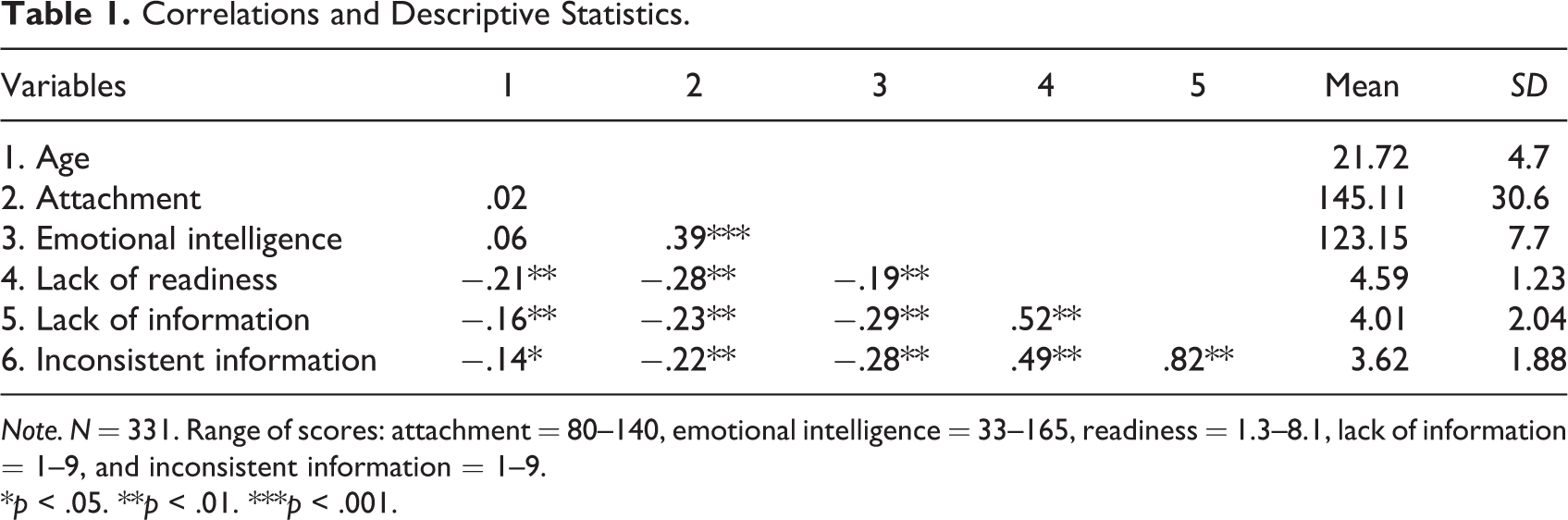
Note. N = 331. Range of scores: attachment = 80–140, emotional intelligence = 33–165, readiness = 1.3–8.1, lack of information = 1–9, and inconsistent information = 1–9.
*p < .05. **p < .01. ***p < .001.
The following criteria were used to assess model data fit as recommended by Hu and Bentler (1999): comparative fit index (CFI), Tucker–Lewis index (TLI), standardized root mean square residual (SRMR), and root mean square of error approximations (RMSEA) along with its associated 90% confidence interval (CI). CFI greater than 0.95, TLI greater than .95, SRMR below .08, and RMSEA less than or equal to .06 indicate strong model data fit, and CFI close to 0.90, TLI close to .90, SRMR close to .10, and RMSEA close to .08 indicate acceptable model data fit. Following the examination of model data fit and direct effects within the path model, we examined the mediation hypotheses using bootstrapped CIs to test the indirect effects with 1,000 samples.
Results indicated a very good fit for the proposed path model: χ2(1, n = 362) = 1.377, p > .05, CFI = 1.000; TLI = .992; SRMR = .011; RMSEA = .032 with CI [.000, .148]. Figure 1 displays a visual representation of the path model including parameters for the direct effects. In terms of direct paths, as expected, attachment positively and directly predicted emotional intelligence (β = .431, p < .001). In turn, students’ emotional intelligence negatively and directly predicted lack of information (β = −.191, p < .01) and inconsistent information (β = −.196., p < .01). In addition, attachment negatively and directly predicted lack of readiness (β = −.222, p < . 001) and lack of information (β = −.119., p < . 05). However, the direct paths from attachment to inconsistent information (β = −.109, p < .10) and from emotional intelligence to lack of readiness were not statistically significantly (β = −.054, ns).
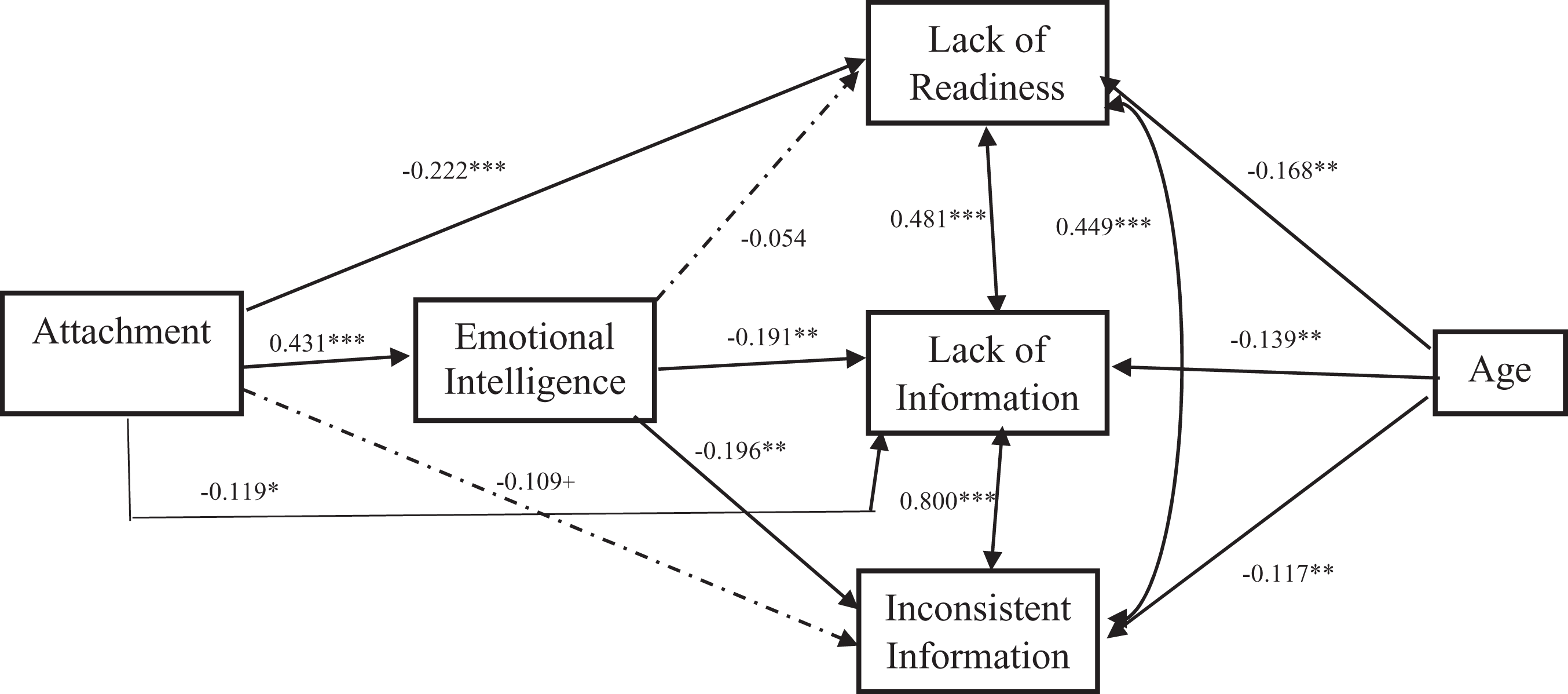
Accepted model with standardized path coefficients. +p < .10. *p < .05. **p < .01. *p < .001.
The results also provided support for the positive relations among the three dimensions of career indecision. Lack of readiness was positively related to lack of information (β = .481, p < .001) and inconsistent information (β = .449, p < .001). Lack of information was also positively related to inconsistent information (β = .800, p < .001). Students’ age was a statistically significant control variable. Age was negatively related to lack of readiness (β = −.168, p < .05), lack of information (β = −.139, p < .01), and inconsistent information (β = −.117, p < .01) dimensions. In the accepted model, attachment accounted for 18.6% of the variance in emotional intelligence (R 2 = .186). In addition, 9.8% of the variance in lack of readiness (R 2 = .098), 9.4% of the variance in lack of information (R 2 = .094), and 8.6% of the variance in inconsistent information (R 2 = .086) were accounted for by attachment and emotional intelligence while controlling for students’ age.
Mediation tests using bootstrapped standard errors yielded statistically significant indirect effects which indicated that emotional intelligence mediated the relationship between attachment and lack of information (β = −.082, p < .01), 99% bootstrapped CI [−0.010, −0.002]; emotional intelligence also mediated the relation between attachment and inconsistent information (β = −.084, p < .01), 99% bootstrapped CI [−0.010, −0.003]. In contrast, the indirect effect tests did not provide support for the role of emotional intelligence as a mediator of the associations of attachment to lack of readiness (β = −.023, ns, 99% CI [−0.004, 0.001]).
While the proposed model provided a good fit to the data, other mediation models may also fit the data (Frazier, Tix, & Barron, 2004). Given the study’s cross-sectional design, the relation between emotional intelligence and career indecision dimensions may be reciprocal. To test this possibility, we examined an alternative path model in which the three career indecision factors mediated the relation of attachment security to emotional intelligence, while controlling for age. Based on the fit indices, this alternative model, χ2(6, n = 362) = 506.97, p < .001, CFI = 0.217; TLI = −.856; SRMR = .202; RMSEA = .48 with CI [0.445, 0.516], did not meet the criteria for good fit. These findings provide support for the hypothesized indirect effect of emotional intelligence in the relation of attachment security to career indecision difficulties among college women.
Discussion
The purpose of this study was to investigate to what extent emotional intelligence mediated the relation of secure attachment to career indecision among college women. While previous findings suggest that secure attachment is negatively linked to career indecision (Bowlby, 1982; Mikulincer & Florian, 2001), the extent to which other variables explain the relation of attachment to dimensions of career indecision has been less studied. The proposed mediation path model demonstrated very good fit. With two exceptions, results provided support for the study’s hypothesis regarding the direct and mediated links in the model; all statistically significant paths were in the expected direction.
When controlling for all other variables in the model, attachment security was directly linked to emotional intelligence and to lack of career decision-making readiness; however, emotional intelligence was not directly linked to lack of readiness. Conceptually, the lack of readiness dimension approximates the construct of career indecisiveness, which captures difficulties that thwart students’ engagement in the career decision-making process, including lack of motivation, general indecisiveness, and irrational expectations. Researchers have proposed that career indecisiveness is linked to stable personality characteristics, while career indecision is a normative developmental stage that individuals typically navigate successfully by acquiring information about the self, the world of work, and the career decision-making process (Gati, Gatassi, et al., 2010; Tokar et al., 2003). In support of this perspective, personality factors (extroversion, neuroticism, and trait anxiety; Di Fabio et al., 2013; Mojgan et al., 2013) have been more strongly correlated to career indecisiveness than to career indecision. From this perspective, it makes sense that in the hypothesized model, attachment security, which is a relatively stable personality disposition, was directly linked to lack of career decision-making readiness while emotional intelligence, a more malleable disposition, was not. As expected by the results of the direct paths examined above, tests of indirect effects did not provide support for the role of emotional intelligences as a mediator of the relation of attachment security to lack of career decision-making readiness.
Consistent with previous research findings, attachment was linked directly to the lack of information dimension, which captures lack of knowledge about the self, occupations, and the career decision-making process. However, the link between attachment and inconsistent information, which refers to confusing information about the self, occupations, and conflicts with significant others, was not statistically significant. This last finding is difficult to explain because based on previous findings, one would expect that secure attachment would facilitate the integration of contradictory information in self-exploration and career exploration (Emmanuelle, 2009; Tokar et al., 2003). However, as predicted, emotional intelligence served as a mediator in the relation of attachment to both lack of information and inconsistent information career decision-making difficulties. An alternative path analytic model that posited career indecision as a mediator in the relation of attachment to emotional intelligence was not a good fit to the data, which suggests that the relation of emotional intelligence to career indecision difficulties is not reciprocal.
In sum, findings indicated that only attachment was associated to higher levels of career indecision due to lack of motivation and indecisiveness, while emotional intelligence served as a mediator in the relation of attachment to career indecision associated to both information deficits dimensions. Results of the study provide support for the notion that different antecedents may explain career decision-making difficulties, and therefore, college women may require diverse intervention approaches (Gati, Amir, & Landman, 2010, Kelly & Lee, 2002). Interventions that focus on learning about the self, occupations, and how to manage negative emotions during the career exploration and decision-making process may be helpful to college women presenting with information-related career difficulties. In contrast, college women presenting with career indecision associated to lack of attachment security will likely require, in addition to career-related information, interventions that address how affective disposition rooted in early relationships may interfere with the career decision-making process (Downing & Nauta, 2010; Kelly & Lee, 2002). For example, an insecurely attached client may be overly anxious about meeting a career counselor and hesitate to pursue career services on campus. In addition, insecure individuals tend to have difficulty interacting with peers and faculty, many of whom can be important interpersonal resources. Therefore, it would be important for the counselor to assist the client to establish new reattachment experiences by providing psychoeducation on interpersonal skills and allowing the client to practice these skills in a safe environment.
Empirical findings suggest that emotional intelligence can be improved through training (Pool & Qualter, 2012). Therefore, career interventions that incorporate emotional intelligence skill building may be effective in helping clients resolve career indecision difficulties not rooted in indecisiveness or lack of motivation. One of the first steps in strengthening emotional intelligence is to become aware of one’s own feelings. The use of self-awareness homework exercises, in which clients keep a log of their feelings, may be a first step in helping clients recognize and regulate their emotions. Once clients are better able to manage their anxiety related to making a major life decision, they will be more effective in focusing on the cognitive skills required in career decision-making. Furthermore, interventions such as biofeedback and deep breathing exercises may increase emotional regulation and decrease stress and anxiety related to career indecision. In sum, a better understanding of the direct and indirect relation of attachment security and emotional intelligence to career indecision difficulties may help counselors identify the most appropriate interventions in working with undecided college students (Diener, Oishi, & Lucas, 2002; Erdogan, Bauer, Truxillo, & Mansfield, 2012).
Limitations
There are some methodological limitations of this study, which need to be noted. First, variables were assessed by self-report measures, which may have been affected by subjective responding. Future studies could include multirater measures that would capture a more comprehensive assessment of an individual’s attachment security and emotional intelligence. Measures such as Adult Attachment Interview (Ravitz, Maunder, Hunter, Sthankiya, & Lancee, 2010) or The Bar-On Emotional Quotient 360 (Bar-On, & Handley, 2003) are some examples. Second, attachment security was operationalized as a unidimensional construct. However, in previous research, attachment anxiety and avoidance demonstrated differential associations with career indecision dimensions (Downing & Nauta, 2010; Tokar et al., 2003). Future research should take into account these differences in attachment styles. In the current study, participants were instructed to think of the parent who had influenced them the most, however, items on the IPPA questionnaire refer to parents. Thus, it is unclear if participants’ attachment scores referred to their experience with a single parent or both parents. Furthermore, participants were college women from a large, university in the Southwest United States; therefore, results may not extend to college men or college women in other parts of the country. Lastly, there may have been cultural differences in factors associated to career decision-making difficulties that were not captured in the current study. For example, Leong (1991) found that extrinsic (e.g., income, status, and prestige) and security factors were more strongly associated to Asian American college students’ career choice compared to their White counterparts.
Conclusions
Results of the present study help to elucidate the unique association of attachment and emotional intelligence to dimensions of career decision-making difficulties. Attachment was directly linked to career indecisiveness (lack of readiness), while emotional intelligence was not. In contrast, attachment was indirectly linked to both career indecision dimensions (lack of information and inconsistent information) through emotional intelligence. The identification of antecedents of career difficulty dimensions is of interest because career indecisiveness is typically more resistant to interventions than career indecision (Amir & Gati, 2006), which has implications for the career counseling process. The development of emotional intelligence, which seems to include malleable skills, may be useful in interventions designed to either prevent or address career decision-making difficulties among college women (Di Fabio & Kenny, 2015).
Footnotes
Declaration of Conflicting Interests
The author(s) declared no potential conflicts of interest with respect to the research, authorship, and/or publication of this article.
Funding
The author(s) received no financial support for the research, authorship, and/or publication of this article.