



Abstract
Intolerance of uncertainty (IU) refers to the tendency to fear the unknown and to worry excessively about potential future negative outcomes. In the career decision-making process, college students experience uncertainty regarding the future of occupational opportunities and the evolution of their interests and capabilities. Anxiety is a well-established predictor of career indecision. Therefore, this study examined the role of anxiety as a mediator in the relation of IU and rumination to three dimensions of career decision making difficulties among college students (N = 678). Results of path analyses indicated that as hypothesized, after controlling for age, intolerance of uncertainty was directly and indirectly (though anxiety) related to the three dimensions of career decision making difficulties: lack of readiness, lack of information, and inconsistent information. Results suggested that career choice interventions may be enhanced with a targeted emphasis on coping with the uncertainty involved in career decision making among college students.
The selection of a career path and related course of study, a major task faced by college students, is often a challenging and complex endeavor. At some point during the college years, most students experience indecision about their academic major and career path or dissatisfaction with the choices they have made (Daniels et al., 2011). Not surprisingly, career indecision is one of the most common presenting concerns among students who seek help from college counseling centers (Lipshits-Braziler et al., 2016). Timely resolution of career decision concerns, which often persist past the first college year (Daniels et al., 2011), may contribute to college success. Career indecision has been positively associated with lower grade point average (GPA; Graunke & Woosley, 2005) and college drop-out behavior (Habley, & McClanahan, 2004; Kahn et al., 2002). Therefore, research that seeks to identify malleable factors associated with career indecision may inform interventions to assist college students with career choice and college success.
Anxiety is a well-established predictor of career indecision, particularly among high school and college students who report being chronically undecided (Campagna & Curtis, 2007; Daniels et al., 2011; Fouad, 2007; Park et al., 2017; Saunders et. al., 2000). Intolerance of uncertainty is a cognitive vulnerability for anxiety symptoms and disorders that is amenable to change through cognitive behavioral interventions (Boswell et al., 2013; Carleton, 2016; Dugas & Ladouceur, 2000; Hewitt et al., 2009). Uncertainty is an inescapable aspect of life that tends to be most salient when individuals make major decisions like selecting a career and related educational paths (Trevor-Roberts, 2006). However, prevalent person-environment fit approaches to career choice, which primarily focus on information gathering to help students match interests and capacities to college majors and/or occupations, assume that both personal characteristics and the occupational world are relatively stable (Holland, 1997; Lent & Brown, 2020). In contrast, other less well known approaches to career development, like the chaos theory of careers (CTC; Pryor & Bright, 2006) and the planned happenstance approach (Mitchel et al., 1999), embrace uncertainty as the context in which all choices are made and emphasize decision makers’ capability to reframe unexpected events as opportunities and constructively respond to changes in themselves and their environments (Kwok, 2018). A few studies have demonstrated the efficacy of brief career interventions based on chaos theory in increasing career self-efficacy and decreasing irrational career-related thoughts among college students (Davey at al., 2005; McKay et al., 2005). These findings suggest that incorporating and normalizing uncertainty in the career development process may facilitate career decision making (Kwok, 2018). However, very little is known regarding the role of intolerance of uncertainty in career decision making. Therefore, the main goal of this study was to examine among college students the role of anxiety as a mediator in the relation between intolerance of uncertainty and career decision making difficulties, controlling for rumination (another cognitive vulnerability for anxiety).
In the next sections of the paper, we first provided a review of the theoretical and empirical literature regarding the relation of anxiety (the mediator) to decision-making difficulties in support of the hypothesis that anxiety symptoms would positively predict higher levels of career decision difficulties. Then, in the following two sections we reviewed research that examined the association of each of the two predictors, intolerance of uncertainty and rumination, to anxiety symptoms. Previous findings indicated that intolerance of uncertainty and rumination were precursors of anxiety symptoms. In turn, anxiety symptoms, which have been positively associated to career decision difficulties, also have led to risk avoidance and indecision in analogue decision-making tasks. Taken together, results of the literature review provided support for the hypothesis that anxiety symptoms would mediate the positive association between both intolerance of uncertainty and rumination to higher levels of career decision difficulties.
Anxiety and Career Indecision
Career indecision refers to the inability to choose and actively pursue a satisfactory educational, occupational and/or career path (Xu & Bhang, 2019). In early studies, researchers distinguished undecided students from indecisive students. Undecided students, who typically experience normative indecision, tend to respond to career interventions to arrive at satisfactory educational and occupational related decisions. On the other hand, indecisive students often experience chronic difficulties with decision-making and are less responsive to career counseling interventions that focus on moving students toward satisfactory educational and occupational choices (Crites, 1969; Gordon, 1998). Cluster analytic studies have consistently shown that compared to their undecided peers, indecisive students report significantly higher levels of anxiety (e.g., Fuqua & Hartman, 1983; Larson et al., 1988; Lucas & Epperson, 1990; Rochlen et al., 2004; Santos & Ferreira, 2012), which may explain indecisive students’ lack of response to career counseling interventions (Gordon, 1998).
Researchers also have developed theory-based, multi-dimensional models to capture antecedents of career indecision (Osipow, 1999) and identify career decision making difficulties (Gati et al., 1996) to guide career development interventions that can apply to both undecided and indecisive students. In the Career Decision Difficulties Questionnaire (CDDQ), Gati and colleagues operationalized career indecision in terms of three over-arching difficulty categories: lack of readiness, lack of information, and inconsistent information, which, in turn, encompassed 10 specific subcategories; (Gati et al., 1996; Gati & Saka, 2001). The first category, lack of readiness, assesses: (a) lack of motivation to engage in career decision making, (b) trait-like indecisiveness, and (b) dysfunctional beliefs including irrational expectations about the career decision making process. The second category, lack of information, refers to information deficits in four areas: (a) steps in the career decision making process, (b) oneself (e.g., career preferences, abilities), (c) available alternatives in the labor market, and (d) how to obtain additional information to facilitate decision making. The third category, inconsistent information, captures difficulties related to the available information, including: (a) unreliable information (contradictions in the information about self and/or occupations), (b) internal conflicts (e.g. contradictory educational versus occupational preferences), and (c) extremal conflicts (e.g. disagreement with significant others related to career pursuits). Gati and colleagues proposed that the lack of readiness difficulties hamper people’s ability to fully engage in the career decision making process, while the lack of information and inconsistent information difficulties are inherent to the decision making process (Gati et al., 1996; Gati & Saka, 2001). In the two studies located that examined the relation of anxiety symptoms to career decision difficulties, anxiety symptoms were positively associated with scores in the three over-arching CDDQ scales among college students in the U.S. (Lancaster et al., 1999) and students in a precollege preparatory program in Israel (Anghel, & Gati, 2019). To date, there are no identified studies that examined the association of cognitive vulnerabilities for anxiety, such as intolerance of uncertainty, to domains of career indecision.
Within the career development literature there is not an agreed upon theoretical or empirical framework that explains the nature of the association of anxiety to career indecision (Miller & Rottinghaus, 2014). Outside of the career field, cross-sectional, and longitudinal studies have indicated that in general decision-making tasks, higher levels of anxiety promote the expectation of potential negative outcomes and the tendency to avoid risky options and negative outcomes, regardless of the missed potential gains (Hartely & Phelps, 2012; Maner et al., 2007; Maner & Schmidt, 2006; Wray-Lake & Stone, 2005). Similarly, in an experimental analogue study with non-clinical participants, induced anxiety lead to greater risk aversion in hypothetical every-day type decisions (Raghunathan & Pham, 1999). Findings from these studies suggested that increased anxiety symptoms lead to greater risk aversion, which, in turn, may promote decision-making avoidance (Hartely & Phelps, 2012). Taken together, these findings provide support for the hypothesis that among college students, the risk-aversion associated with higher levels of anxiety symptoms may lead to career decision-making avoidance and related difficulties. A better understanding of the role of malleable cognitive vulnerabilities for anxiety, such as intolerance of uncertainty (Carleton et al., 2007), in the relation of anxiety to career decision difficulties, may inform the development of interventions to help college students overcome anxiety and facilitate the decision making process.
Intolerance of Uncertainty, Anxiety, and Career Indecision
Intolerance of uncertainty refers to the tendency to fear the unknown and to worry excessively about potential future negative outcomes, regardless of the probability of their occurrence. Researchers have proposed that excessive fear about potential future negative outcomes is a cognitive vulnerability for anxiety (Carleton, 2016). Consistent with this view, in cross-sectional, longitudinal, and treatment studies, intolerance of uncertainty has been associated with anxiety symptoms and anxiety disorders (Gentes & Ruscio, 2011; Jensen et al., 2016). Intolerance of Uncertainty targeted treatments (IUT) have been effective in decreasing both intolerance of uncertainty and anxiety (Dugas & Ladouceur, 2000; Dugas & Robichaud, 2007; van der Heiden et al., 2012). Furthermore, in several treatment studies, decreases in intolerance of uncertainty preceded reductions in anxiety (Boswell et al., 2013; Hewitt et al., 2009) and worry (Dugas & Ladouceur, 2000; Dugas & Robichaud, 2007), which suggested that intolerance of uncertainty may be a causal factor for anxiety symptoms.
In the process of making career decisions, college students often experience uncertainty regarding the future of occupational opportunities and the evolution of their own interests and capabilities (Kwok, 2018). Current characteristics of the labor market, including the emergence of the information economy, rapid technological changes, prevalence of independent contract and temporary work (gig economy), and globalization, have increased job market instability and uncertainty in the career development process (Hirsich, 2018; Oyer, 2020). Therefore, it is reasonable to expect that individuals characterized by higher levels of intolerance of uncertainty will experience higher levels of anxiety and career decision-making difficulties than their counterparts who are better equipped to deal with uncertainty. Yet, no studies were located that examined the relation of intolerance of uncertainty to career decision making difficulties. However, two studies with college students in Korea revealed a positive relation of tolerance of uncertainty (intolerance of uncertainty items reverse-coded) with career identity (Garrison et al., 2017) and career decision making self-efficacy (Kim et al., 2016). In previous studies, both career identity and career decision self-efficacy were positively associated with career decidedness (e.g., Gati et al., 1996; Prideaux & Creed, 2001; Santos & Ferreira, 2012).
Tolerance of ambiguity, a related but distinct construct from intolerance of uncertainty, has been negatively associated with career decision making difficulties. Tolerance of ambiguity refers to the ability to deal in the present with unpredictable, complex, and/or insoluble stimulus or situations perceived as threatening. Intolerance of uncertainty, on the other hand, refers to negative emotional reactions to unpredictability regarding future events (Grenier et al., 2005; Rosen et al., 2014). Among college students in the U.S., ambiguity tolerance was positively related to career decision-making self-efficacy and negatively related to career decision making difficulties (Xu & Tracy, 2015). Furthermore, ambiguity tolerance moderated the relation of career exploration to career decision difficulties (Xu & Tracy, 2014); higher levels of career exploration were associated with decreased information related difficulties only among students with higher levels of ambiguity tolerance. The moderation effect suggested that difficulty dealing with ambiguity may hamper students’ ability to analyze and integrate complex information to reduce career indecision. Findings regarding the association of tolerance of uncertainty and tolerance of ambiguity to career development variables suggest that intolerance of uncertainty may be positively related to career decision making difficulties. Research findings have indicated that rumination, a cognitive vulnerability for distress, also is a predictor of higher levels of anxiety (Nole-Hoekesema, 2000); therefore, rumination was included in the model examined in the study.
Rumination, Anxiety, and Career Indecision
Rumination refers to repetitive and recurrent thoughts about one’s concerns and experiences that are typically motivated by the desire to resolve gaps between one’s situation and desired goals (Martin & Tesser, 1996; Segerstom et al., 2003). In his comprehensive review of the rumination empirical literature, Watkins (2008) concluded that persistent self-focused introspection from a neutral or positive affective stance was typically associated with adaptive outcomes (e.g., reduced negative affect, increased positive affect, improved performance). In contrast, ruminative thoughts focused on negative emotions and self-critical judgments, consistently predicted maladaptive outcomes (e.g., depression, anxiety, problem-solving deficits, and general decision-making difficulties)
Cognitive processing theory proposes that individuals ruminate to attempt to cope with stress and find solutions to problems (Watkins, 2008). However, the passive and repetitive nature of negative rumination tends to keep people fixated in their problems, instead of motivating them to develop and implement solutions. The lack of action in turn, exacerbates distress and undermines confidence in one’s problem solving abilities (Nole-Hoekesema, 2000). Consistent with this perspective, in cross-sectional (Steil & Ehlers, 2000) and longitudinal (Hong, 2007; and Segerstrom et al., 2000) studies with non-clinical populations, negative rumination has been positively correlated with anxiety symptoms and with intolerance of uncertainty (Liao & Wei, 2011).
No studies were located that examined the relation of rumination to career development variables or career indecision. However, results of several analogue experimental and cross-sectional studies indicated that negative rumination was detrimental to decision-making processes (van Randenborgh et al., 2010; Ward et al., 2003). For example, community adults induced to ruminate about their negative affect reported greater decision-making difficulty and less confidence in decisions made during the experimental task, compared to participants induced to distract themselves with externally focused thoughts (van Randenborgh et al., 2010). In contrast, in a lab-experimental study, college students in the rumination and distraction induction conditions did not differ in their confidence regarding the effectiveness of the solutions they generated for a self-identified significant personal problem (Lyubomirsky et al., 1999). Therefore, it is not clear to what extent findings regarding the relation of negative rumination to lack of confidence in choices made in analogue tasks may generalize to real life situations. Negative rumination, was included as a predictor in the model examined in this study to elucidate if intolerance of uncertainty was uniquely associated with career decision difficulties in the presence of another cognitive vulnerability for anxiety.
The Present Study
In sum, previous research has indicated that intolerance of uncertainty and rumination can be precursors for anxiety symptoms (Boswell et al., 2013; Carleton, 2016; Hewitt et al., 2009; Nole-Hoekesema, 2000; Watkins, 2008) and intolerance of uncertainty is a potential risk factor for career decision difficulties (Kim et al., 2016; Xu & Tracy, 2014, 2015). Furthermore, anxiety is a well-established predictor of career indecision (Campagna & Curtis, 2007; Daniels et al., 2011; Fouad, 2007; Park et al., 2017; Saunders et. al., 2000). Longitudinal and experimental studies have shown that in analogue decision making tasks, higher levels of anxiety lead to risk avoidance and decision-making challenges (e.g., Hartely & Phelps, 2012; Maner & Schmidt, 2006; Raghunathan & Pham, 1999). Taken together, these findings suggest that intolerance of uncertainty may be associated with career decision making difficulties both directly and indirectly through anxiety symptoms. If that is the case, intolerance of uncertainty may be a fruitful target of career interventions to facilitate career decision making among college students. Therefore, we examined a path analytic model that predicted that anxiety symptoms would mediate the relations of intolerance of uncertainty to three domains of career decision difficulties (lack of readiness, lack of information, and inconsistent information; Gati et. al., 1996), while also accounting for rumination, another cognitive vulnerability for anxiety (Nolen-Hoeksema, 2000). Consistent with previous findings, we expected that rumination would be positively associated with anxiety symptoms (and with intolerance of uncertainty (e.g., Hong, 2007; Liao & Wei, 2011). However, due to lack of previous related research, no hypotheses were proposed regarding the direct or indirect association of rumination to career decision difficulties.
Method
Participants and Procedures
Participants included 678 undergraduate college students, aged 18–29 (M = 21.22, SD = 2.54) enrolled in an ethnically diverse major research university in a large city in the southwest United States. To avoid potential confounds related to older age, we retained for data analyses college students in the emerging adulthood age range, which typically extends from 18 to 29 years old (Arnett, 2000). Of the total 815 students who accessed the survey, 88 (11%) were excluded from the study because of excessive missing data. From the remaining 727 students, 49 (6.7%) were excluded because they were 30 years or older. Of the 676 participants who reported their gender, 567 (84%) were women and 109 (16%) were men. In terms of year in college, 86 (12.7%) students were freshman, 149 (22%) sophomores, 242 (35.7%) juniors and 201 (29.6%) seniors. Ethnically, participants self- identified as Asian (188; 27.8%), Black (69; 10.2%), Latinx (219; 32.4%), White (157; 23.2%), or other (43; 6.7%). Most students described their families of origin as either middle class (45%) or working class (26.2%) followed by upper middle class/wealthy (21.2%) and lower class/poor (7.4%). Investigators recruited students through a university electronic research participation sign-up board. Upon voluntarily registering for the study, participants read an online informed consent document that explained the risks and benefits of the study and their freedom to withdraw their participation at any time without negative consequences. Students received class credit from their instructors for their participation in the study. The Institutional Review Board of the academic institution where recruitment occurred approved the study protocol.
Measures
Demographics questionnaire
The demographic questionnaire requested information regarding age, gender, ethnicity, year in college, and social class of family of origin.
Career decision making difficulties
The abridged, 34-item version of the Career Decision Making Difficulties Questionnaire (CDDQ; Gati & Saka, 2001) was used to assess the following three dimensions of career decision making difficulties: lack of readiness, lack of information about the career decision-making process, and inconsistent information. Participants were asked to rate each item on a 9-point Likert-type scale ranging from 1 = does not describe me to 9 = describes me well, to indicate the degree to which they experienced each difficulty. A score for each of the three dimensions was computed by calculating the mean of the items included in each scale; higher scores indicated higher levels of career decision making difficulty. Internal reliability alpha coefficient for subscales scores with high school and college students have ranged from .60 to .86 for Lack of Readiness, 90 to .95 for Lack of Information, and .83 to .91 for Inconsistent Information (Di Fabio et al., 2013; Gati et al., 1996; Gati & Saka, 2001). Results of correlational analyses of students’ CDDQ scores with scores in the Career Decision Self-Efficacy scale-Short Form have provided evidence of the subscales’ concurrent validity (Di Fabio & Blustein, 2010; Gati et al., 1996). Consistent with earlier findings, internal reliability coefficient alphas for participants’ scores in the Lack of Readiness, Lack of Information, and Inconsistent Information scales were .74, .95, and .91, respectively.
Anxiety
The Generalized Anxiety Disorder Scale (GAD-7) was used to assess anxiety symptoms. Participants rated the scale’s seven items on a 4-point Likert-type scale that ranged from 0 to 3 (0 = not at all; 1= several days, 2 = more than half the days, and 3 = nearly every day). Total scores, which are obtained by summing responses to the seven items, range from 0 to 21. Factor analysis of GAD-7 items’ scores with clinical and non-clinical populations provided support for the instrument scores’ one-dimensional structure, factorial invariance for gender and age, and discriminant validity regarding depression symptoms. Correlations of the GAD-7 scores with scores in other measure of anxiety symptoms provided evidence of the GAD-7’s convergent validity (Kroenke et al., 2010). Internal reliability coefficient alphas for GAD-7 scores have ranged from .89 to .92. (Kroenke et al., 2010; Spitzer et al., 2006). The internal reliability coefficient alpha for the GAD-7 scores for participants in the study was =.90.
Intolerance of uncertainty
The Intolerance of Uncertainty Scale-12 (IUS-12; Carleton et al., 2007) assesses individuals’ cognitive, emotional, and behavioral negative reactions to anticipated unpredictability and avoidance responses when faced with uncertainty. The 12 items are rated on a 5-point Likert scale ranging from 1 (not at all characteristic of me) to 5 (entirely characteristic of me). Scores in the IUS 12 items were summed to obtain a total score; higher scores indicated higher levels of intolerance of uncertainty. Results of a confirmatory factor analysis provided support for the construct validity of a unidimensional intolerance of uncertainty factor (Hale et al., 2016). Internal reliability coefficient alpha for intolerance of uncertainty scores among college students have ranged from .83 to .91 (Carleton et al., 2007; Helsen et al., 2013). The internal reliability coefficient alpha for the intolerance of uncertainty scores for participants in the study was = .91.
Rumination
The12-item Rumination subscale of the Rumination-Reflection Questionnaire (RRQ, Trapnell & Campbell, 1999) was used to assess engagement in repetitive negative self-focused thoughts motivated by perceptions of threats to the self. In the RRQ, items were assessed on 5-point scales ranging from 1 (strongly disagree) to 5 (strongly agree). A rumination score was calculated by adding responses to the 12 items after reverse-coding negatively worded items; higher scores indicated higher levels of negative rumination. Previous studies with college students have shown good test–retest reliability and convergent validity for the Rumination scale scores (Trapnell & Campbell, 1999) and good internal reliability with coefficient alphas ranging from .89 to .91 (Joireman, 2004; Takano & Tanno, 2009). The internal reliability coefficient alpha for the rumination scores for participants in the study was = .91.
Results
Preliminary Analyses
Data exploration procedures indicated low levels of missing data. Of the 678 participants included in the study, 94 to 99% had complete data in the career decision difficulties, anxiety, rumination, and intolerance of uncertainty measures. None of the scales had more than 10% of items missing responses and in most instances, only one value per scale was missing. Consistent with Parent’s (2013) recommendations for relatively large data sets with low levels of item-level missingness, we implemented mean substitution (for scores based on the sum of the scale’s items) and available item analyses (for scores based on the mean of scale’s items) procedures to address missing data. For scales used to assess the predictors, (rumination, intolerance uncertainty and anxiety), prior to calculating sum scores we replaced missing values in each scale with the mean of each participant’s non-missing items in the respective scale. We used the mean of available items to calculate participants’ mean scores in each of the three career difficulties subscales. To determine to what extent the data met assumptions of normality, absolute values of skewness and kurtosis were examined. The values for kurtosis (1.02) and skewness were larger than 1 (1.13) only for age. The rest of the variables showed values within −1 to +1. Values for skewness and kurtosis below 2 fall within markers for approximate multivariate normality as recommended in the methodological literature (i.e., Curran, West, & Finch, 1996).
Bivariate correlations analyses were conducted to examine the relations among all variables of interest in the study including age. The relation of the predictors (intolerance of uncertainty, rumination and anxiety) to each of the three career difficulty variables were positive and statistically significant and ranged from r = .20 to r = .35. Age was negatively related to the lack of readiness career indecision dimension and, therefore, it was included as a control variable in the path analysis (Table 1, display bivariate correlations and mean and standard deviations for variables included in the model) Results of a 2 × 4 × 4 MANOVA indicated that gender Λ = .99 = 1.327, F(3, 631), p = .26, year in college
Bivariate Correlations, Means, and Standard Deviations.

Note. Potential range of scores variables 2–4 = 1 to 9; variable 5 = 0–21, variables 6–7= 12 to 60.
*p < .05. **p < .001.
Path Analysis
To test the study’s hypotheses, we examined a path mediation model containing two predictors (intolerance of uncertainty and rumination), one mediator (anxiety), three career indecision outcomes (lack of readiness, lack of information, and inconsistent information), and age as control variable. Four distinct sets of relations in the model were of particular interest (see Figure 1). The first two sets focused on the direct relation between intolerance of uncertainty and rumination to anxiety (paths a1 and a2) and the direct relation between anxiety and the three career indecision outcomes (paths b1 to b3). The third pathway assessed the direct relation of each of the two predictors (rumination and intolerance of uncertainty) to the career indecision outcomes (paths c11 to c13 and paths c21 to c23). The fourth pathway included the indirect effects (Paths a1b and a2b) from intolerance of uncertainty and rumination to the career indecision outcomes through anxiety (mediation effect). In addition, the path model controlled for age by regressing the three outcomes on the control variable.
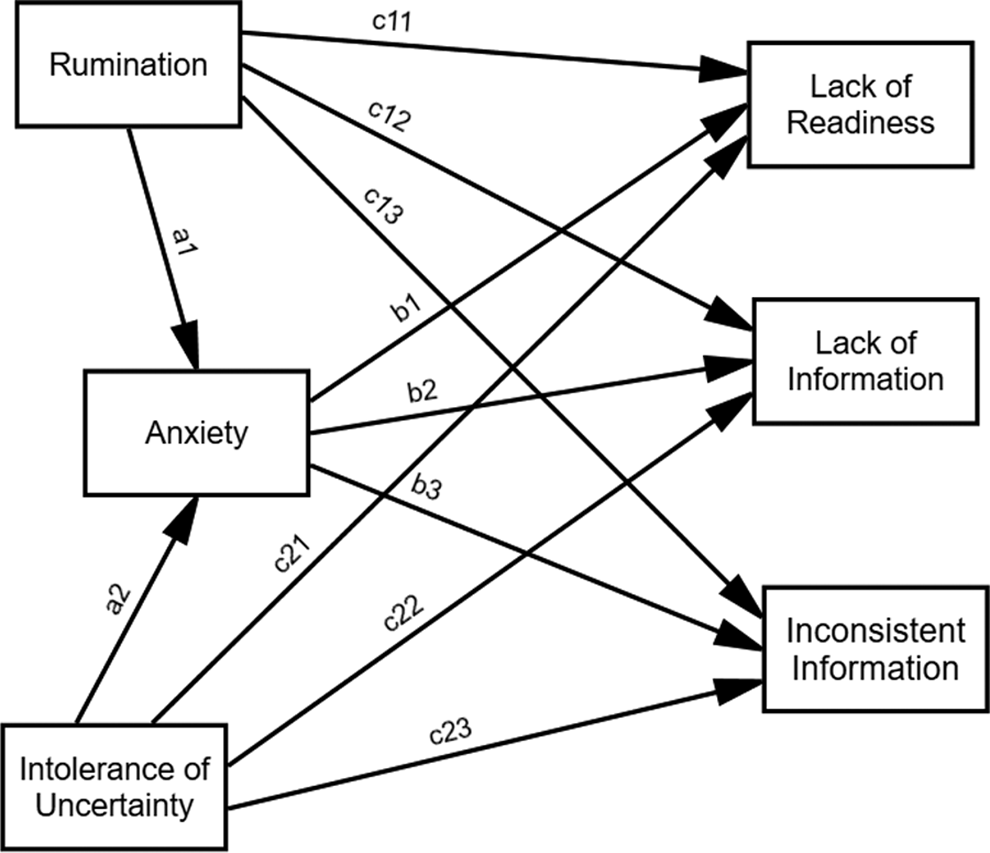
Mediation path model. a1 and a2 = associations between the predictors and the potential mediator; b1 to b3 = associations between the potential mediator and outcome variables; c11 to c13 and c21 to c23 direct association between the predictors and outcome variables.
Mplus Version 7.3 (Muthen & Muthen, 1998-2015) was used to conduct the path mediation analysis. CFI (comparative fit index), Tucker–Lewis index (TLI), standardized root mean square residual (SRMR), RMSEA (Root Mean Square of Error Approximations) along with its associated 90% confidence interval (CI) were used to assess model-data fit as recommended by Hu and Bentler (1999). RMSEA is commonly reported in statistical program’s outputs such as Mplus with a 90% confidence interval [ε ^ L,ε ^ U] where ε ^ L is the lower-bound estimate of ε, the parameter estimated by ε ^ , and ε ^ U is the upper-bound estimate. If ε ^ = 0, then ε ^ L, and the confidence intervals are considered one-sided where ε ^ U > ε ^ , which explains the use of a 90% confidence interval instead of the 95% more frequently used for two-sided confidence intervals (Curran et al., 2003; MacCullum et al., 1996). CFI greater than .95, TLI greater than .95, SRMR below .08, and RMSEA less than or equal to .06 were used as estimations of strong model data fit. To test the mediation hypotheses, we examined bias-corrected bootstrap confidence intervals for the indirect effects based on 1000 bootstrap samples.
Overall Model Fit and Direct Paths
The hypothesized mediation model fit the data well: χ2(3, n = 666) =6.869, p > .05, CFI = .997; TLI = .984; SRMR= .036; RMSEA = .012 with 90% CI of [.000, .088]. Figure 2 displays a visual representation of the model including the path coefficients. In terms of direct effects, rumination (paths c11 to c113) did not significantly predict any of the three career indecision outcomes directly including lack of readiness (β = .001, ns), lack of information (β = .048, ns), and inconsistent information (β =.008, ns). However, as expected, intolerance of uncertainly (paths c21 to c23) positively and directly predicted lack of readiness (β = .233, p < .001), lack of information (β = .192, p < .001), and inconsistent information (β = .181, p < .001). Both rumination (β = .314, p < .001) and intolerance of uncertainly (β = .379, p < .001) positively predicted anxiety (paths a1 and a2). Anxiety, in turn, significantly predicted lack of readiness (β = .193, p <. 001), lack of information (β = .127, p < .05), and inconsistent information (β = .178, p < .001; paths b1 to b3).
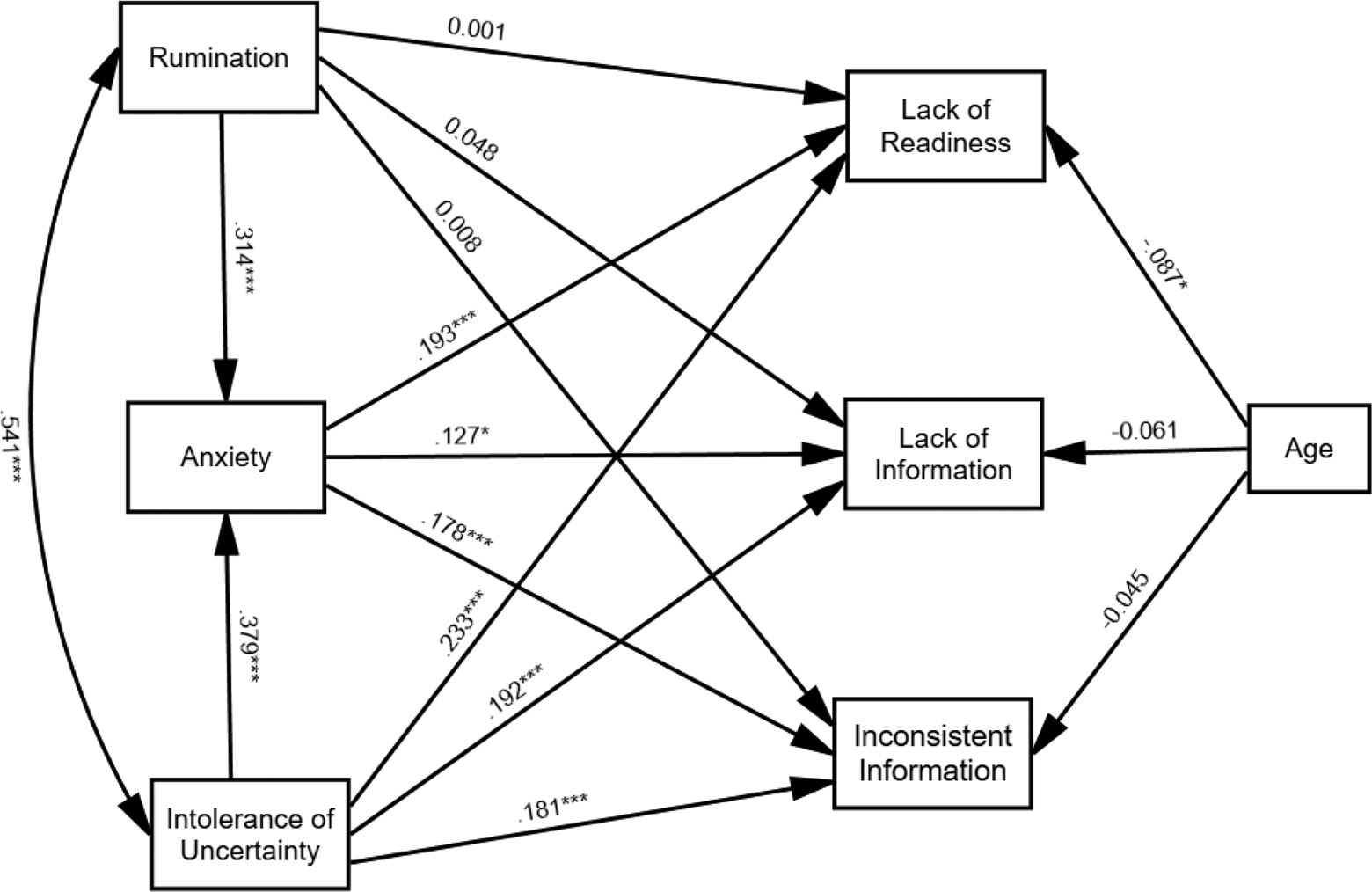
Mediation path model with path coefficients. Note. *p < .05. **p < .001. ***p < .001.
Mediation Analyses
Mediation tests using bootstrapped standard errors yielded statistically significant indirect effects between the two predictors and the three career indecision dimensions through anxiety. Results indicated that anxiety mediated the relation between rumination and lack of readiness (β = .061, p < .001), 95% bootstrapped CI of [.030, .091]; the relation between rumination and lack of information (β = .040, p < .05), 95% bootstrapped CI of [.008, .072]; and the relation between rumination and inconsistent information (β = .056, p < .001), 95% bootstrapped CI of [.023, .088]. Anxiety also mediated the relation between intolerance of uncertainty and lack of readiness (β = .073, p < .001), 95% bootstrapped CI of [.036, .110)]; the relation between intolerance of uncertainty and lack of information (β = .048, p < .05), 95% bootstrapped CI of [.009, .087; the relation between intolerance of uncertainty and inconsistent information (β = .067, p < .001), 95% bootstrapped CI of [.029, .105].
Age was a statistically significant control variable for lack of readiness (β = −.087, p < .05), but not for lack of information (β = −.061, ns), or inconsistent information (β = −.045, ns). In the path model, 14.9% of the variance in lack of readiness (R2 = .149), 10.2% of the variance in lack of information (R2 = .102), and 10.5% of the variance in inconsistent information (R2 = .105) was accounted for by intolerance of uncertainty, rumination, and anxiety while controlling for students’ age. In addition, 37.1% of the variance in anxiety (R2 = .371) was accounted for by intolerance of uncertainty and rumination.
Given the study’s cross-sectional design and the lack of experimental research regarding the temporal precedence of anxiety in relation to career decision difficulties, we examined an alternative path model in which the three career indecision factors mediated the relation of intolerance of uncertainty and rumination to anxiety, while controlling for age (Winer et al., 2016). The alternative model, did not meet the established criteria for good fit, χ2(6, n = 666) = 967.40, p < .001, CFI = .356; TLI = −.931; SRMR= .166; RMSEA = .49 with 90% CI of [.465, .517]. Findings from the post-hoc findings did not provide support for a reciprocal relation between anxiety symptoms and career decision difficulties.
Discussion
The purpose of the study was to examine the direct and indirect association of intolerance of uncertainty and rumination, known cognitive vulnerabilities for anxiety, to career indecision among college students. Findings provided support for the hypothesized model that predicted that anxiety symptoms would mediate the relations of intolerance of uncertainty to three domains of the career decision difficulties.
Intolerance of Uncertainty Anxiety and Career Decision Making Difficulties
Consistent with study hypotheses, results indicated that when controlling for age and rumination, intolerance of uncertainty and anxiety were positively and directly associated with career decision difficulties in the three domains: lack of readiness, lack of information, and consistent information. These findings are consistent with previous studies that found that career decision difficulties (Gati & Saka, 2001) were positively related to anxiety (Anghel, & Gati, 2019; Lancaster et al., 1999) and negatively related to tolerance of ambiguity (Xu & Tracy, 2014, 2015). The direct, positive associations of intolerance of uncertainty and anxiety to lack of readiness indicate that excessive fear and worry regarding future outcomes may hamper students’ motivation to engage in career development tasks by exacerbating dysfunctional beliefs about the career decision-making process and its potential outcomes. In addition, results suggest that cognitive distortions and behavioral paralysis associated with higher levels of intolerance of uncertainty and related anxiety are likely to interfere directly with students’ ability to acquire and integrate information about themselves and the labor market. Researchers have suggested that in the presence of negative expectations about the future, additional information is likely to overwhelm the person rather than facilitate career decision-making (Kelly & Shin, 2009). Therefore, interventions seeking to address career indecision should first assess to what extent difficulty dealing with uncertainty may hamper an undecided students’ readiness to engage in career exploration and information seeking activities.
In addition, as hypothesized, anxiety mediated the associations of intolerance of uncertainty to the three-career indecision dimensions. The mediation effect suggested that among career undecided college students, intolerance of uncertainty might be an antecedent of anxiety, which underscores the need to attend to undecided students difficulties with uncertainty in order to decrease their career decision related anxiety. While this interpretation is consistent with clinical intervention studies that demonstrated that decreases in IU preceded decreases in anxiety (Boswell et al., 2013; Hewitt et al., 2009), the cross-sectional design of the study does not allow for causal inferences (Winer at al., 2016). It is also possible that higher levels of anxiety will exacerbate students’ intolerance of uncertainty, which in turn may result in increased career decision difficulties. Nevertheless, consistent with study hypotheses, findings suggested that intolerance of uncertainty both directly, and indirectly through anxiety, are likely to interfere with students’ ability to resolve career decision difficulties.
Intolerance of Uncertainty Rumination and Career Decision-Making Difficulties
As expected, rumination was positively and directly associated with intolerance of uncertainty and with anxiety symptoms. While no hypothesis were made regarding the relation of rumination to career decision difficulties, findings indicated that rumination was not directly associated with any of the three dimensions of career decision difficulties. An earlier study indicated that self-identified ruminators believed that their rumination was helpful in gaining insight about themselves and solve problems (Watkins & Baracaia, 2001). However, our findings are consistent with other studies that suggested that negative rumination did not lead people to take action toward addressing problems. Instead, negative repetitive thinking tended to intensify negative affective states, particularly anxiety, and inhibited problem solving (de Jong-Meyer et al., 2009; Muris et al., 2005; Nolen-Hokesama, 2000; Ward et al., 2003). Consistent with this perspective, findings indicated that rumination was only indirectly related, through anxiety, to career decision-making difficulties.
The lack of direct relation of rumination to career decision difficulties is also consistent with a study that did not find a relation between rumination and college students’ confidence in the solutions they generated for a self-identified personal problem (Lyubomirsky et al., 1999). Taken together, findings suggest that undecided college students may engage in rumination as a means for coping with discomfort associated with career indecision and related uncertainty. While negative rumination did not seem to exacerbate career decision difficulties directly, the compulsory nature of negative rumination may have a paralyzing effect that exacerbate anxiety, which in turn, may increase career decision difficulties (Liao & Wei, 2011; Nolen-Hoekesema, 2000). Further research is needed to elucidate the association of positive and negative rumination to career indecision.
Implications for Career Counseling Practice
The role of anxiety as a mediator in the association of intolerance of uncertainty and rumination to career decision difficulties revealed in the current study is consistent with theoretical propositions and empirical findings that indicate that both cognitive vulnerabilities are precursors of anxiety symptoms (Boswell et al., 2013; Hewitt et al., 2009; Nolen-Hoeksema, 2000). To the extent that students are able to tolerate uncertainty and avoid negative ruminative thinking, they are likely to experience lower levels of anxiety and, in turn, may be more inclined to engage in the career decision-making process and better able to resolve information related conflicts to formulate a career choice.
A centerpiece of the widely prevalent person-environment fit approach to career counseling focuses on exploration of self and the environment (Holland, 1997). However, researchers have found that simply obtaining more information did not always lead to decreased indecisiveness (Fouad et al., 2009). For example, environmental exploration was related to lower levels of career information difficulties only for college students with higher levels of ambiguity tolerance (Xu & Tracy, 2014). Consistent with these findings, intolerance of uncertainty may be one of the reasons why increased exploration and information processing interventions do not always help undecided students resolve information deficits and conflicts.
Previous studies have documented the prevalence of anxiety among college students who present with chronic indecision and tend to be resistant to career counseling interventions (Lucas & Epperson, 1990; Rochlen et al., 2004; Santos & Ferreira, 2012). Addressing intolerance of uncertainty may open new counseling intervention possibilities to facilitate resolving career decision difficulties. For example, a manualized intolerance of uncertainty-targeted treatment that included worry awareness interventions (to help clients distinguish between worries that are and are not amenable to change) and problem solving training (van der Heiden et al., 2012) was effective in reducing both intolerance of uncertainty and general anxiety symptoms. Career counselors may implement such cognitive behavioral interventions to help undecided student’s decrease their fear of uncertainty and increase their readiness to engage in the career-decision making process. Studies are warranted that examine to what extent cognitive behavioral interventions designed to reduce intolerance of uncertainty result in decreased anxiety and career decision difficulties among undecided college students.
The chaos theory of careers (CTC), which incorporates and normalizes uncertainty in the career development process, is another promising approach to facilitate college students’ ability to manage uncertainty in the external environment (Kwok, 2018). Rather than attempting to eliminate uncertainty, CTC interventions reframe uncertainty as a potential source of opportunities and emphasize openness, flexibility, and readiness to take advantage of unplanned events that often surround career decision making (Pryor & Bright, 2006). Schlesinger and Daley (2016) developed and tested a model of career counseling (Explore, Prepare, Start, Adapt; EPSA) that integrated traditional career exploration activities with CTC interventions designed to increase students’ flexibility, comfort with unpredictability, and awareness of their capacity to adapt to unforeseen events. Compared with their peers who received traditional individual career counseling, a larger proportion of college students who participated in individualized EPSA career counseling reported increased comfort with the “uncertainty associated with career exploration and job searching” (Schlesinger & Daley, 2016). Future studies may examine to what extent increased comfort with uncertainty promoted by CTC interventions leads to decreased anxiety symptoms and facilitates career decision-making, particularly among those who present high levels of intolerance of uncertainty
Limitations and Conclusion
The study’s limitations must be considered in interpreting its findings. The cross-sectional nature of the study does not allow for causal inferences regarding the relation of rumination, intolerance of uncertainty and anxiety to career decision-making difficulties. While findings provided support for the proposed model, we cannot rule out that other models may also provide good fit for the data. For example, a plausible model would consider rumination as a mediator of the relation of intolerance of uncertainty to anxiety. Even though experimental intervention studies have supported intolerance of uncertainty as a precursor of anxiety, it is also possible that the relation between intolerance of uncertainty and anxiety is reciprocal and that intolerance of uncertainty may mediate the relation of anxiety to career decision difficulties. Longitudinal and experimental research is needed to determine the temporal relation of anxiety and career decision difficulties, even though findings from the post-hoc analyses did not provide support for a reciprocal relation between anxiety symptoms and career decision difficulties. Most participants in the study were women, therefore findings may not generalize to male college students. Findings need to be replicated with divergent samples and in settings outside of the context of a large, urban research university in the southwest region of the United States, where the study was conducted.
In conclusion, findings from the current study add to a growing body of literature that indicates that career interventions need to go beyond the traditional process of matching individuals to fields of study and occupations that align with their individual profiles of interests and values (Holland, 1997; Kwok, 2018; Lent & Brown, 2020). It is also important to address cognitive and emotional factors, such as intolerance of uncertainty and anxiety that can hinder students from engaging in and benefiting from career decision-making interventions. Addressing students’ difficulties in managing uncertainty can not only enhance the process of career decision making, but may ultimately lead to more satisfying career choices and increased readiness to adapt to unforeseen circumstances.
Footnotes
Declaration of Conflicting Interests
The author(s) declared no potential conflicts of interest with respect to the research, authorship, and/or publication of this article.
Funding
The author(s) received no financial support for the research, authorship, and/or publication of this article.
