




Abstract
The purpose of this study was to explore Social Emotional Learning (SEL) and its relevance to the career development of students from the perspectives of educators in Turkey. The participants included 69 educators (63% women). Data were collected by using a paper–pencil survey consisting of open-ended questions. Using a modified grounded theory approach, a three-stage data analytical procedure -open, axial, and selective coding, was followed. The analysis suggested two main categories: (a) SEL skills that students should be equipped with and (b) SEL skills that educators need to have, resulting in an SEL model that reflects the perspectives of Turkish educators. The findings were discussed within the Turkish context, including the education system and culture followed by implications for theory, research, and practice.
Keywords
The Link between Social Emotional Learning and Career Development
In response to economist concerns of a near global economic collapse (Turner, 2012), the United Nations established a list of Sustainable Development Goals (SDGs) to prioritize a range of economic and social transformation efforts around the world (United Nations (UN), 2015). Specifically, SDG 8 aligns with career development concerns by advocating for new program design and service strategies that result in individuals gaining access to “decent work” occupations that offer “sustained, inclusive and sustainable economic growth” (United Nations (UN), 2015). SDG 8 is especially warranted given that globally, an estimated 2.2 billion youth and adults aged 15 years or older are not participating in education or formal employment (International Labour Organization [ILO], 2019). Among young adults aged 15 to 24 years, an estimated 42% are not involved in work or attending education and training. It is estimated that 11.8% of youth who are actively looking for employment will stay unemployed in 2020 (International Labour Organization [ILO], 2019).
With the emergence of a 4th Industrial Revolution (Schwab, 2012, 2019), critical workforce readiness skills needed to compete with a highly technological world of work involve a wide range of deep human and career management skills (Cappelli & Tavis, 2018; Lim-Lange & Lim-Lange, 2019). For school age youth, deep human skills refer to a range of social emotional learning skills (Collaborative on Academic Social and Emotional Learning [CASEL], 2005). CASEL (2005) organizes SEL skills around five core competencies: (1) self-awareness—the ability to identify one’s own emotions, thoughts, and values and understand how they guide behavior, (2) self-management—the ability to master one’s thinking, feeling, and behaviors and to set and work toward their goals, (3) social awareness—the ability to empathize with others by perspective-taking, appreciating diversity, and respecting for others, (4) relationship skills—the ability to communicate, listen, cooperate effectively and deal with conflicts and social pressures, and (5) responsible decision-making—the ability to solve problems by making constructive choices with ethical responsibility. A large number of studies support the positive impact of SEL skills on adjustment (Ladd et al., 1996; Sklad et al., 2012), academic outcomes (Brackett et al., 2012; Durlak et al., 2011), and school engagement (Taylor et al., 2017). SEL skills have also been found to promote mental health and future well-being (Greenberg et al., 2001; Taylor et al., 2017), reduce emotional stress (Durlak et al., 2011), decrease engagement in risky behaviors (Elias et al., 2003; Thornton et al., 2000), reduce school dropout rates (Guerra & Bradshaw, 2008), and improve future employment outcomes (Hawkins et al., 2005).
In addition to supporting positive youth development, SEL skills represent the deep human qualities that youth and young adults need in order to pursue decent high wage, high demand occupational opportunities (Cunningham & Villaseñor, 2014; Lim-Lange & Lim-Lange, 2019; Yoder et al., 2020), especially within the rapidly changing and unforeseen world of work of the new era (Johnson & Wiener, 2017; Dymnicki et al., 2013). Problem solving, resilience, motivation, self-control, teamwork, initiative, confidence, stress tolerance, and flexibility are some of the SEL skills that have been identified as high demand skills (Guerra et al., 2014; World Economic Forum, 2020).
The Role of Educators
It is increasingly apparent that career professionals in schools alone cannot meet the demand for providing career development programs and services to youth; therefore, it is important to consider the role educators can play in facilitating career lessons, encouraging, and providing supportive mentoring as youth plan for their future (Hooley et al., 2015; Musset & Mýtna Kureková, 2018; Solberg, 2019). As the SEL competencies develop gradually over time (Schonert-Reichl & Hymel, 1996), many SEL interventions have been developed to support the students early from elementary school (Durlak et al., 2011). One of the recent efforts that integrated SEL and career development into elementary school is the SELCL model by Howard and Ferrari (2021). Considering that career development is a life-long process (e.g., Super, 1990), schools are ideal places to support students’ SEL development, with teachers being the primary agents of integrating and developing the SEL competencies (Jennings & Greenberg, 2009). In light of this, research teams from 18 countries created an SEL International Research Network (World Educational Research Association, 2019) to investigate whether connecting SEL and workforce readiness would encourage educators to engage in career development practices. This research program is an example of a new branch of research referred to as translation research (Wilson et al., 2011). The impetus for this new branch of science is the realization that evidence-based practice is taking too long to become effectively implemented that therefore research efforts need to more effectively explain the nature and value of the evidence in ways that are accessible to practitioners and the larger community. As a translation research program, the initial research of the SEL International Research Network was to conduct a qualitative study to learn from educators about their perceptions of the value and nature of SEL and its connection to workforce development.
This paper is specifically focused on Turkish educators’ perceptions of SEL skills. In Turkey, the history of career guidance goes back to the 1950s. The primary purpose of career guidance services was to help students to make vocational decisions (Yesilyaprak, 2017). Affiliated with the Ministry of Education (MoNE), the Assessment and Research Offices and the Guidance and Research Bureaus were established, applying interests and abilities inventories to help students self-assess and make an appropriate career decision. In 1951, the Turkish Employment Office was founded, delivering career services and job placement to all age groups. Currently, career guidance services are partially provided by psychological counselors and classroom guidance teachers from preschool to high school through the comprehensive developmental counseling curriculum, supported by the Guidance and Research Centers and operated under the MoNE General Directorate of Special Education and Guidance Services. For young adults, universities provide career guidance through university career centers, and the Turkish Employment Office has contact points at the universities. Moreover, the private sector and NGOs provide career guidance and counseling to adolescents, young adults, and adults (Yesilyaprak, 2017).
In Turkey, transition from high school to college is considered a critical time for students. According to PISA 2018 results, more than 85% of 15 years old students in Turkey expressed their occupational aspirations as completing an undergraduate degree (OECD, 2019). In response to this tendency, most career guidance services focus on helping students make their initial career decisions after high school (Korkut, 2007). On the other hand, Turkish Statistics Institution Youth Report (2020) indicated that the employment rate of young people aged between 15 and 24 is 30.4%, a decrease by 4.5 points compared to the previous year. Unemployment rate of young people is 25.9% while 29.8% of the youth is neither in education nor in employment (Turkish Statistics Institution, 2020). Moreover, 18.5% of the students who applied to university entrance exams were the students who either entered college before or had a bachelor degree (OSYM, 2019). Studies indicate that students are lacking in many areas of career preparedness, and there is a need for restructuring career development in terms of career decision-making (Bacanli, 2016; Karacan-Ozdemir, 2019a; Kırdök & Harman, 2018), career maturity (Akıntuğ & Birol, 2011), dysfunctional career thoughts (Hamamci & Esen Çoban, 2007), and career concerns (Nalbantoğlu Yılmaz & Cetin Gunduz, 2018). Along with these dramatic statistics and evidence, the world of work demands a highly skilled and qualified workforce with the technological advances. If the current K-12 education system has been mainly focusing on college readiness, it is crucial for Turkish educators to promote both college and career readiness, which requires long-term, collaborative, and systematic efforts among all parties that involve educators and policymakers (Lotkowski et al., 2004).
There are also professional development needs of school counselors who will design and lead comprehensive school counseling curricula in their schools. These professional development opportunities should provide knowledge on innovative, comprehensive, contemporary theory–based career guidance programs (e.g., Güven et al., 2016). In order to support school counselors and help them effectively design curriculum, they would also need an understanding of the educators’ perspectives. Grounded theory in this research can provide an understanding of the phenomenon of how SEL skills are being developed in the Turkish school setting and affected by the education system and culture. By obtaining a culture specific model, it is possible to have a deeper understanding of how SEL is connected to career development in Turkish schools, identifying areas for further training for in-service teachers. Within the cultural context, the viewpoints of educators can also be compared with the 21st century skills and the ones demanded in the 4th Industrial Revolution. The Education Vision 2023 published by the MoNE put special emphasis on the goals for improvements of career guidance services in schools, as well as professional development of educators, school counselors, and school administrators (MoNE, 2018). The present paper is aligned with the goals of the Education Vision 2023 and adds values to the translation research effort that would allow effective practices more accessible to practitioners, as well as the larger community.
Method
This study used modified grounded theory (MGT) to interpret the data and develop a theory using an iterative coding strategy (Strauss & Corbin, 1998). Grounded theory (GT) is a methodology to extend explanations about social phenomena, relationships, and events under systematic analysis (Glaser & Strauss, 1967; Strauss & Corbin, 1998). This differs from other qualitative inquires in that it does not focus on accepting or testing the existing theories or models (Charmaz, 1983). MGT, instead, focuses on unfolding concepts from interpretations of data based on an analysis worksheet (Kambaru, 2018). Although research has been done on SEL, and there are many existing models (e.g. CASEL’s five-dimension model, 2012), this study explores the relationships and generates a culture-specific model. It focuses on the voice of educators and takes socio-cultural contexts into consideration when discussing SEL. The themes emerged inductively from the data and will be discussed in depth as to how they contributed to generating implications and developing a theory (Thornberg, 2012).
Participants and Procedures
Participant Demographics.

The survey questions were collaboratively designed by the SEL IRN members. The sample questions include: “What programs does your school implement in relation to SEL and/or career development?” “What SEL skills do you believe educators should be using to effectively teach their students? How are these skills helpful as educators?”
Data Analysis
The international team held online meetings to showcase open coding on paper and via NVivo software. The guidelines provided by the convening countries (USA and Italy) helped each country to conduct data analysis independently, and additional support was provided to individual countries to discuss country codes and brainstorm together how the responses can be coded. In spring 2019, the Turkish researchers conducted data analysis together by following the three steps of coding in the grounded theory method—open, axial, and selective (Strauss & Corbin, 1998).
In the open coding phase, written responses of the participants were closely examined to reveal salient categories of information. The researchers coded the text line by line and used a constant comparative approach to saturate the categories and themes that characterize the topics explored. The identified categories were labeled, and an analysis worksheet (codebook) including emerging categories, their definitions, and direct quote examples from participants was produced. In the axial coding phase, the researchers examined the emerging categories to reveal any causal conditions. In the selective coding phase, the researchers generated a storyline that suggests a theoretical model and propositions that connect the categories in relation to the research topic. A diagram was created to illustrate the model (See Creswell, 2007).
There are several criteria used in this study to achieve internal and external validity (e.g., Creswell, 2007). A pilot survey was conducted with two educators prior to the actual study, and the data were collected from different education levels across three different cities of Turkey. The prior work of the researchers on the topic of SEL also ensures external validity, and the collaborative work with the international team provided an opportunity for a peer-review process.
Results
SEL Skills for Students and Educators from the Perspectives of Educators.
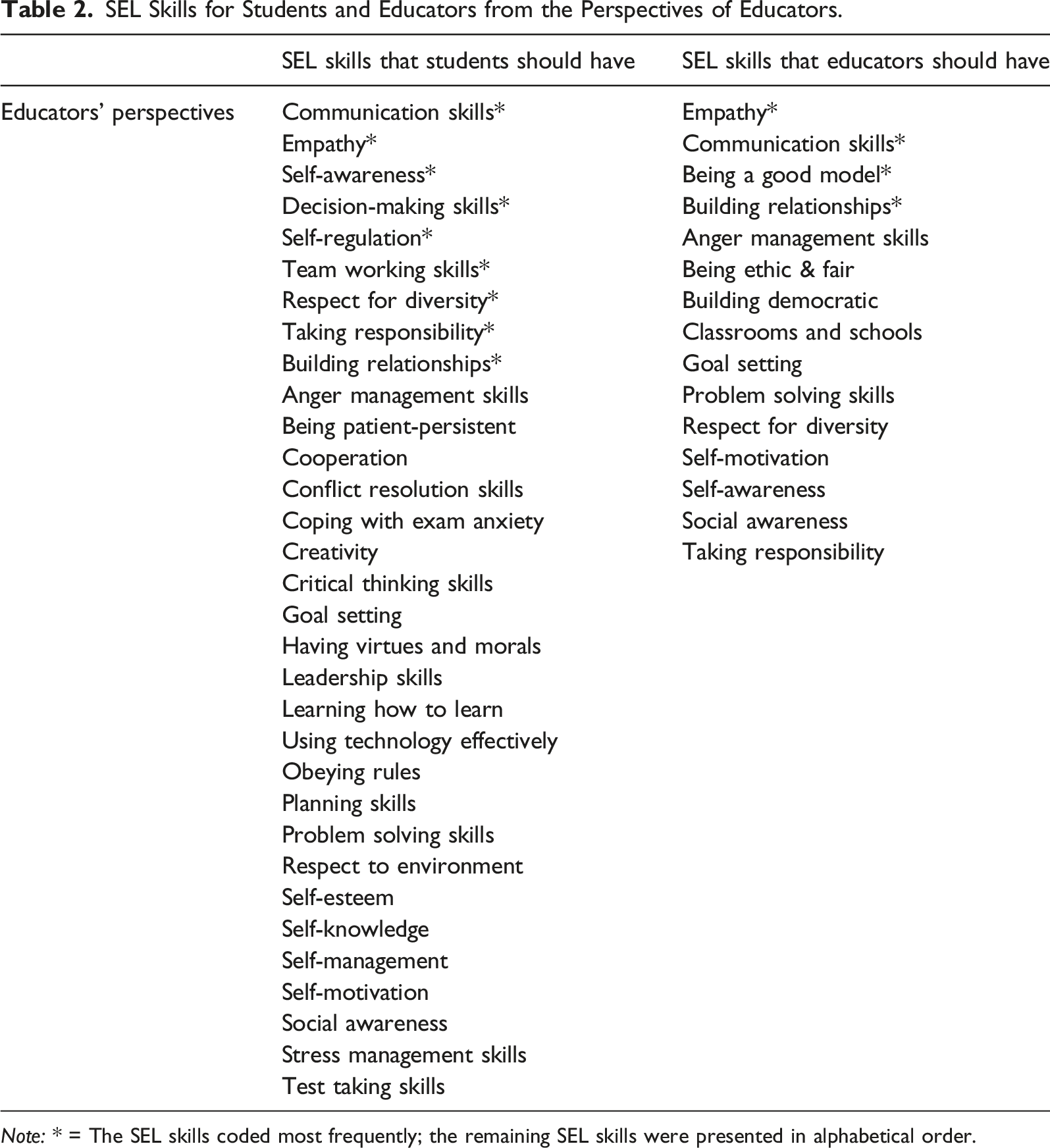
Note: * = The SEL skills coded most frequently; the remaining SEL skills were presented in alphabetical order.
The Analysis Worksheet.
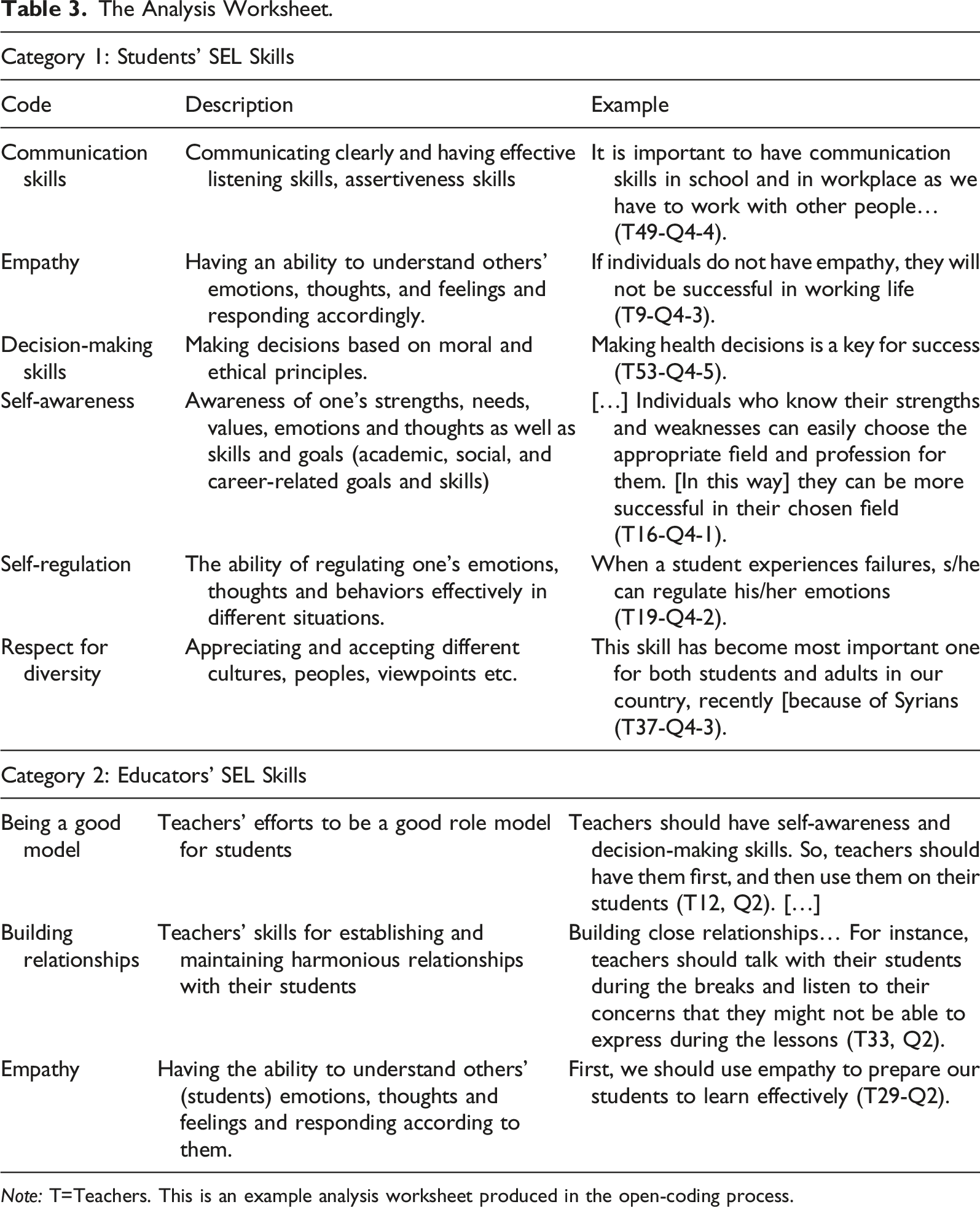
Note: T=Teachers. This is an example analysis worksheet produced in the open-coding process.
The axial and selective coding processes identified the four core SEL skills that educators should have and four core SEL skills students should have. These core skills include communication skills, building relationships, empathy, and respect for diversity for both categories. A deeper examination of these core skills revealed an underlying causal condition, presenting the first proposition to refine the results into a theory. A diagram was created to demonstrate the model grounded on the data as presented in Figure 1. SEL Model for Career Development of Students.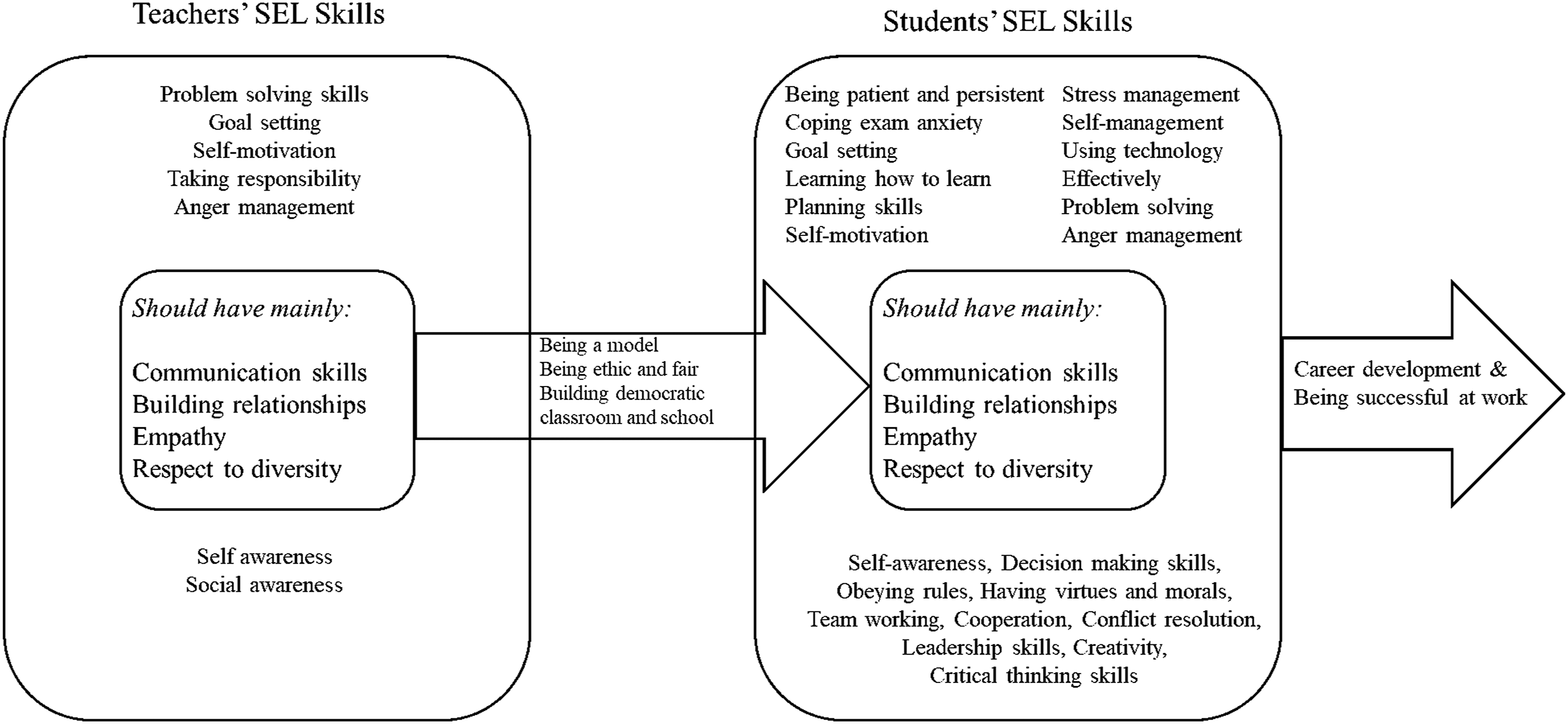
As shown in Figure 1, the first proposition assumes that educators should have communication skills, building relationships, empathy, and respect for diversity to promote students’ SEL skills and develop strong relationships with the students. On the other hand, students should have communication skills, building relationships skills, empathy, and respect for diversity to be prepared for and successful in the world of work. The analysis also revealed some SEL skills that encompass the remaining SEL skills and are particular to the Turkish context, leading to the second proposition - Educators should have a variety of self-regulative skills such as problem solving, goal setting, self-motivation, and anger management, based on aforementioned core SEL skills to promote students’ SEL skills in the Turkish context (See Figure 1). In turn, students will have a vast variety of self-regulative skills such as being patient and persistent, coping with exam anxiety, goal setting, learning how to learn, planning skills, self-motivation, stress management, self-management, using technology effectively, problem solving, and anger management to successfully transition to the world of work. The results also revealed that there is an intervening condition that requires educators to build additional SEL skills, such as being fair, building a democratic classroom climate, and being a good role model. The researchers identify this as the third proposition that connects the previous causal conditions.
Discussion
This study aimed at investigating the nature and value of SEL skills and its relevance to career development of students through the perspectives of Turkish educators. The results were developed through the three steps of coding in grounded theory—open, axial, and selective coding—and the theory grounded in the data is discussed below.
The first proposition. This proposition based on the revealed model presented in Figure 1 hypothesizes that communication skills, building relationships, empathy, and respect for diversity were the core SEL skills that both students and educators need to have. While educators should have these core SEL skills to build strong relationships with students and promote their own SEL skills, students should have these skills to succeed in the world of work. The characteristics of Turkish culture provide explanations for these results as some attributes can help understand social behaviors across cultures (Triandis, 1995). Historically, the Turkish culture has been characterized as both collectivist and individualist cultures (Kağıtçıbaşı, 1994), and it cannot be stated as purely individualistic or collectivistic (Singelis et al., 1995). Relationship building skills are considered critical among collectivist cultures as it is helpful for them to create and maintain their relationships with others (Kim et al., 1994). Turkish educators believed that communication and relationship building skills are essential not only for their students, but their own SEL skills that would allow them to create and maintain relationships. They also extended its importance to students’ career development and eventually their success in the workplace.
Turkish educators underlined the necessity of empathy, along with respect for diversity. This could be explained by the fact that the samples were chosen from cosmopolitan cities of Turkey (Ankara, İstanbul, and Gaziantep), which have a remarkable number of Syrian refugees (Ministry of Interior Directorate General of Migration Management, 2017). It was reported that there are 830,000 school-aged refugee children in Turkey (UNICEF, 2016). The learning environment has dramatically changed with an increasing demand for educators to build a more inclusive classroom. The educators are trying to integrate the Syrian refugees into the school system and help build healthy friendships among the students. Empathy and respect for diversity become important in this process. As it is assumed that Syrian refugees would stay permanently (Tüzün, 2017), conversations on building these SEL skills are not limited to elementary and secondary education but to postsecondary education and the world of work. These core skills are also consistent with the CASEL’s five dimensions model, in particular, the relationship skills dimension that includes communication skills empathy and the social awareness dimension that includes respect for diversity (CASEL, 2012).
The second proposition. This proposition hypothesizes that educators should have a variety of self-regulative skills, including problem solving, goal setting, self-motivation, and anger management to promote SEL skills of students. Students should also have a variety of self-regulative skills, including being patient and persistent, coping with exam anxiety, goal setting, learning how to learn, planning skills, self-motivation, stress management, self-management, using technology effectively, problem solving, and anger management which will ultimately help them build strong career management skills for themselves. The first part of the proposition was supported by the existing literature that underlines the importance of educators’ own social emotional competencies to promote SEL skills of students (e.g., Hemmeter et al., 2012). It was mentioned that students’ SEL skills are influenced by educators’ skills, requiring educators to be equipped with SEL skills and serving as a role model in the classroom (Schonert-Reichl, 2017). A vast amount of literature discusses positive results of SEL interventions and the role of educators in this regard (e.g., Brackett et al., 2012).
The second part of the proposition involves a large number of self-regulative skills for students—broadly self-management skills—that contribute to their academic success (e.g., Zins et al., 2007). The Turkish education system provides explanations for this result. Turkey has centralized national exams that are deemed extremely competitive (i.e. high school and university entrance exams). For instance, in 2019, over 2.5 million candidates completed the Turkey university entrance exam while there were less than 450 thousand undergraduate degree program openings (OSYM, 2019). Students are expected to overcome aforementioned competitive exams by using their planning, managing, and goal setting skills which can provoke a high level of anxiety. In this process, they need self-regulative competencies, such as anxiety and stress management and self-motivation. Similar to the current results, the previous findings indicated that the self-management dimension of SEL among Turkish university students is limited to academic self-regulation skills (Karacan Ozdemir & Büyükçolpan, 2021).
Turkish educators also emphasized that students should have self-awareness and decision-making skills (See Table 1), supporting the previous proposition to some extent. The Turkish education system requires middle school students to choose a high school and high school students to choose an undergraduate program based on their exam scores. This process that starts at the end of middle school requires students to have both self-awareness and decision-making skills (Bacanlı & Sürücü, 2006). Research indicated that the school-based career guidance interventions have focused on self- and occupational explorations (e.g., Karacan-Ozdemir & Ayaz, 2020) as exploration and inquisitiveness can lead to higher career adaptability among Turkish adolescents (Karacan-Ozdemir, 2019a). The previous studies, however, showed that middle, high and university students experience difficulty with general decision-making and career decisions (e.g., Bacanli, 2012; Karacan-Ozdemir, 2019b; Ulaş et al., 2015). It was found that significant others (e.g., parents, teachers, and friends) play an essential role in the career decision-making process of Turkish adolescents (e.g., Bacanlı, 2016; Hamamci et al., 2013), often resulting in conflicts and difficulty of reaching a final decision (e.g., Bacanlı, 2016; Karacan-Ozdemir, 2019b). This process that reflects socio-cultural contexts profoundly influences Turkish youth and young adults and suggests that there is a need to support the development of decision-making skills.
The third proposition. The last proposition hypothesizes that educators should have some critical SEL skills such as being fair, building a democratic classroom climate, and being a good role model. This proposition is consistent with the previous models that frame SEL skills in the educational settings (e.g., Jennings & Greenberg, 2009; Schonert-Reichl, 2017). According to the Prosocial Classroom Model of Jennings and Greenberg (2009), educators’ socio emotional competencies influence their efficacy to create a healthy classroom environment and climate, which in turn enhances students’ SEL skills and academic achievements. Moreover, various contextual factors such as school climate, education norms and policies, leadership styles, and values influence the interconnected elements mentioned in the model. Similarly, Schonert-Reichl (2017) suggests reciprocal relationships among students’ and educators’ SEL skills and the learning context in her framework. Consistent with the current proposition, it was stated that the learning context which encompasses a supportive, caring, and warm classroom climate enables students to acquire and practice SEL skills. Finally, being a good role model has been highlighted as a fundamental skill for promoting SEL skills of students (e.g., Hemmeter et al., 2006).
While interpreting the findings, several limitations of the study were raised. First, this study included a relatively small sample size. However, grounded theory suggests 20-50 participants as a rule of thumb to reach data saturation (e.g., Morse, 1994). This implies that more participants may not necessarily produce additional information for the study (Glaser & Strauss, 1967). Second, this study did not investigate gender or grade level differences in terms of how SEL skills are connected to career development across different demographics. Although it was out of the scope for this present research, future studies can consider these variables. Third, the data were collected from three cosmopolitan cities which might have invited different sets of data from different socio-economic backgrounds in Turkey. It should be noted that this limits the generalizability of the findings although it is not the primary aim of qualitative research. Fourth, this study focused on educators’ perspectives on SEL. Future research can explore ways to develop and implement SEL skill training for teachers, focus on the voice of students, and collaborate with parents, administrators, and school leaders in understanding SEL education and optimizing resources.
Conclusion
This study revealed a culture-specific model for SEL skills and career development of students grounded on the perspectives of Turkish educators. The findings suggested three propositions. The first proposition showed the four core SEL skills, including communication skills, building relationships, empathy, and respect for diversity. These skills help educators build strong relationships with students and enable students to succeed in the world of work. The second proposition indicated various self-regulatory skills that educators should have to foster students’ SEL skills, as well as self-regulatory skills students need to have for their career development. The last one suggested some additional SEL skills that educators should have, such as being fair, building a democratic climate, and being a good role model, ultimately building a bridge between the SEL skills of educators and students. This model is in line with the existing ones (e.g. Jennings & Greenberg, 2009; Schonert-Reichl, 2017) and adds values to the literature by providing information on culture-specific SEL skills in Turkish settings. Based on this culturally-sensitive model, programs and activities particular to career development of students can be developed. This study suggests that Turkish students need to improve self-regulation skills, self-awareness and decision-making skills for their career development, consisting with the previous findings (e.g., Yayla & Bacanlı, 2011). The model can be a foundation for developing in-service trainings that aim to foster educators’ SEL skills. Based on the model, it is possible to first evaluate teachers’ SEL competencies and self-efficacy in teaching SEL skills that students need to improve for their career development. Then, different approaches can follow to improve students’ SEL relevancy for their career development (Elias, 2006): (1) the skills can be incorporated into school curricula and lectured by teachers, (2) they can be taught explicitly by teachers through reading or math courses, and (3) school-based programs can be developed in collaboration with school counseling department. These approaches require in-service training programs for teachers, which can also be integrated into undergraduate programs. By using the model that our analysis proposed, school administrators can adopt a whole school approach, which aims to improve teachers’ skills, teach them how to design SEL-based classroom curricula, and develop evidence-based school-wide interventions for students and their parents.
Future studies can confirm these findings by assessing students’ perceptions on SEL skills and can compare the educators’ perceptions to employers’ demands to better prepare students for the world of work. Measurements for evaluating educators’ SEL skills and efficacy in teaching SEL skills are another area of investigation. Last, although the data of the current study was collected before the COVID-19 crisis, we all learned that self-regulatory skills, relationship skills, and empathy are even more relevant and crucial in the time of the world pandemic (CASEL, 2020). Due to COVID-19, most schools have been closed in Turkey since March 2020. With over 18 million children taking their lessons virtually, the impact on their academic performances and physical and psychological health is also significant. This suggests a need for interventions that helps students develop additional SEL skills such as time management, prioritization, and being focused. The reality is that 60% of Turkish students never registered to EBA TV, a nationwide television channel providing a distance education during the pandemic (Şahin-İpek et al., 2020). The current situation reiterates that there is a need to further examine SEL skills, how they impact students and educators, and how they can help students and educators to overcome the difficulty and advance in their education and career development.
Footnotes
Declaration of conflicting interests
The author(s) declared no potential conflicts of interest with respect to the research, authorship, and/or publication of this article.
Funding
The author(s) received no financial support for the research, authorship, and/or publication of this article.
