




Abstract
The current study examined associations of intersectional social identities on Black women’s (N = 126) career self-efficacy and interests at a Historically Black College and University (HBCU). Structural models examined associations of different aspects of gender and racial identity on Social Cognitive Career Theory (SCCT) predictors (i.e., learning experiences and self-efficacy) for each RIASEC career interest. Social Cognitive Career Theory paths from learning experiences to career interests, via self-efficacy, were supported for all six career interests. For gender norms, domesticity directly predicted learning experiences and indirectly predicted interests for enterprising, investigative, social, and conventional themes; however, primacy of work conformity was not associated with learning experiences or indirect effects for any career interest. Racial centrality only predicted learning experiences and indirect effects on career interests for social careers. Aspects of racial and gender identity may set forth educational decisions that have implications for the eventual careers that many undergraduates pursue.
Holland’s Theory of Vocational Personality Themes (Holland, 1997) and Social Cognitive Career Theory (SCCT; Lent et al., 1994) are vocational psychology theories with different foci, that together can provide important information related to the development and differentiation of career interests. Holland’s theory describes themes of individual and environmental characteristics that predict vocational outcomes via person-environment fit: realistic, investigative, artistic, social, enterprising, and conventional (RIASEC; Holland, 1997). That is, a person with realistic interests would be likely to feel congruent and satisfied in an environment that offered the opportunity to express those realistic interests. SCCT, on the other hand, focuses on how social identities and background contextual affordances impact vocational outcomes via self-efficacy. Integrations of these two theories can create a framework that examines both the “what” and “how” of specific identity-based inequities in vocational outcomes. Therefore, we utilized an integrative Holland/SCCT structural model to examine the extent to which gender norms and racial identity predicted different RIASEC career interests via SCCT pathways that included learning experiences and self-efficacy with a sample of Black women at a Historically Black College/University (HBCU).
Social Cognitive Career Theory
SCCT provides a useful framework for describing the development of vocational outcomes and focuses on interactions between a person’s cognitions and their environment. Person inputs (e.g., gender and race/ethnicity) and background contextual affordances (e.g., access to financial support for education) influence a person’s learning experiences, which in turn contribute to self-efficacy beliefs and outcome expectations pertaining to different career-related activities, and ultimately vocational interests, goals, and behaviors (Lent et al., 1994).
Self-efficacy, along with outcome expectations, is an important proximal predictor of career interests, goals, and behaviors (Fouad et al., 2002; Lent et al., 2002). In the SCCT framework and in the present study, self-efficacy is operationalized to reflect a person’s confidence in their ability to perform specific tasks related to a given vocational domain, such as fixing a broken faucet (realistic) or working in a biology lab (investigative; Cf. Armstrong et al., 2008). SCCT posits that learning experiences constrain the development of self-efficacy in different vocational domains (Garriott et al., 2014; Thompson & Dahling, 2012). In the SCCT framework and in the present study, learning experiences correspond to domain-specific learning experiences that mirror the four sources of self-efficacy from social cognitive theory: mastery experiences, vicarious experiences, verbal persuasion, and physiologic arousal (Bandura, 1997; Tokar et al., 2012). For example, realistic learning experiences may be composed of experience successfully making simple car repairs (mastery experiences), observing family members building things (vicarious experiences), being urged to learn how to fix things (verbal persuasion), and being relaxed while trying to repair something (physiologic arousal; Tokar et al.). As such, the present study examines SCCT pathways wherein female gender norms and racial identity centrality (i.e., person inputs) are linked to learning experiences (i.e., sources of self-efficacy), which are then linked to career-related self-efficacy beliefs, the most proximal predictor of career interests.
Gender Identity and the Development of Career Interests
Examining within-gender variability is essential to understanding gender-based differences in career decision-making because this variability accounts for a meaningful portion of the observed cross-gender differences in career interests. For example, gender roles such as expressiveness and instrumentality fully accounted for dichotomous gender differences in artistic and conventional interests, instrumentality partially accounted for gender differences in investigative and enterprising interests, and expressiveness and instrumentality partially accounted for gender differences in realistic and social interests (Ludwikowski et al., 2018). Furthermore, gender role conformity has been found to influence learning experiences that impact gender differences in social and realistic interests (Tokar et al., 2007). While some research has examined the link between gender norms and career interests for specific disciplines (Garriott et al., 2014; Navarro et al., 2014), less research has examined the process of how those gender norms may influence important predictors of the pervasive gender differences in career interests, such as learning experiences and self-efficacy (but see Ludwikowski et al., 2018; Su et al., 2009; Williams & Subich, 2006).
Distinct gender-related norms could differentially shape occupational choice (Mahalik et al., 2003, 2005). For example, the importance a person places on work (i.e., primacy of work) is a masculine norm (Mahalik et al., 2003), whereas the importance a person places on maintaining the home (i.e., domesticity) is a feminine norm (Mahalik et al., 2005). Such gender norms could illuminate the observed gender differences in career decisions. Primacy of work is related to “breadwinner” identification, having conflicts between work and family, and striving for success and power (Mahalik et al., 2003). In contrast, domesticity relates to gender roles that center around housekeeping and caring for children (Mahalik et al., 2005). As such, we identified these two variables as targets to further examine within Holland-based SCCT models. Together, primacy of work and domestic gender norms may potentially explain why Black women are underrepresented in higher prestige occupations (Scheuermann et al., 2014) and why they are paid less than men even when attaining similar education levels (Webber & Canché, 2015).
Racial Identity and the Development of Career Interests
On average, Black individuals tend to express higher levels of social, enterprising, and conventional interests and lower levels of realistic and investigative interests (Armstrong et al., 2010; Kantamneni & Fouad, 2011). This pattern is concerning because realistic and investigative themes typically correspond with perceptions of higher prestige (Sodano & Tracey, 2008). Although research has examined ethnicity/race for underrepresented groups within SCCT models, they have often focused on specific disciplines, such as engineering (Lent et al., 2010) and computer science (Lent et al., 2011). Therefore, the present research addresses this gap by extending these inquiries to SCCT constructs among all six RIASEC themes.
Within-group variability in identification with Black racial identity may also illuminate important racial differences in vocational interest and vocational outcomes (Duffy & Klingaman, 2009). Racial identity refers to a multidimensional, psychological construct that reflects the beliefs and attitudes that people have about their membership within ethnic/racial groups and the processes that influence the development of those beliefs and attitudes (Umaña-Taylor et al., 2014). The Multidimensional Model of Racial Identity (MMRI; Sellers et al., 1998) conceptualizes four dimensions of Black racial identity: salience (i.e., situational influence on race), ideology (i.e., belief system of how a race should behave), regard (i.e., positive and negative perceptions of one’s own race), and centrality (i.e., how central one’s race is to their overall sense of self). MMRI-based measurements of racial identity may allow for in depth examination of individual differences within a race, and may help explain why Blacks are not well represented in certain career paths (Quimby et al., 2007).
Centrality of one’s Black identity may be particularly relevant to career-decisions because it is a stable construct that influences many educational and vocational processes and outcomes (Chavous et al., 2003; Sellers et al., 1998). Individuals who place more importance on their Black identities possess greater awareness of social barriers and discrimination (Sellers et al., 2003). This awareness has important consequences for a person’s willingness to engage in particular learning experiences, which can set make certain career choices more likely, while circumscripting others (Gottfredson, 2002).
Some research has demonstrated which career interests the dual influences of gender and racial identity predict (Gushue & Whitson, 2006; Howard et al., 2011; Ro & Loya, 2015); however, it may be important to additionally examine how these constructs influence the development and emergence of different career interests (but see Arevalo Avalos & Flores, 2016; Flores et al., 2010). While there is a paucity of literature examining gender and race in a SCCT context, research from an analogous literature provides some insight. Flores et al. (2010) found that expressiveness, instrumentality, and orientation to Mexican culture predicted career self-efficacy. Specifically, expressiveness predicted higher levels of social and conventional self-efficacy and lower levels of investigative self-efficacy; instrumentality predicted higher self-efficacy in all RIASEC themes for both men and women, except for the realistic theme, where instrumentality only predicted realistic self-efficacy for men (Flores et al., 2010). Orientation to Mexican culture predicted self-efficacy beliefs in all RIASEC themes except the investigative theme. Relatedly, Arevalo Avalos & Flores (2016) found that instrumentality and expressiveness predicted greater social self-efficacy and interest for Mexican American men. Although gender roles and cultural identity predicted intervening processes that help explain career interests among Mexican American undergraduates, to our knowledge no work has examined analagous variables among Black women undergraduates at an HBCU.
Overview of the Current Study
To examine the processes by which gender and racial identity are linked to career interests, the current study examined the predictive roles of two important aspects of gender norms (primacy of work and domesticity) and racial identity (centrality of black identity) in predicting six Holland-based career interests via SCCT-based mediating variables of learning experiences and self-efficacy for Black women at an HCBU. The unique context of an HBCU may influence the decision to attend an HBCU as well as career development of Black women that matriculate. Black women with higher racial centrality are more likely to attend an HBCU (Dimes et al., 2017), and this centrality may influence career self-efficacy (Rollins & Valdez, 2006). There is evidence that, compared to PWIs, HBCUs may promote education attainment for Black women, and especially in STEM fields (Kim & Conrad, 2006). It is likely that HBCUs may provide environments that are adept at addressing barriers to career development such as inadequate academic achievement prior to college, stereotype threat, and low self-efficacy (Perna et al., 2009; Lent et al., 2005).
As such, we predicted that gender norms and racial identity centrality would influence the learning experiences that Black women at an HBCU encountered, that this would in turn influence their self-efficacy, and that self-efficacy would ultimately be linked to differential career interests (see Figure 1). We anticipated that primacy of work would predict higher levels of realistic, investigative, and enterprising learning experiences, whereas domesticity would predict higher levels of artistic, social, and conventional learning experiences (Arevalo Avalos & Flores, 2016; Flores et al., 2010; Ludwikowski et al., 2018; Tokar et al., 2007). We also expected that greater racial identity centrality among Black women would predict higher levels of social, enterprising, and conventional interests but lower level of realistic and investigative interest; and that these associations would be explained by associations with learning experiences and self-efficacy (Armstrong et al., 2010; Kantamneni & Fouad, 2011; Walker & Tracey, 2012). The hypothesized model results for all RIASEC themes. Bolded values represent statistically significant values at the p < .05 level.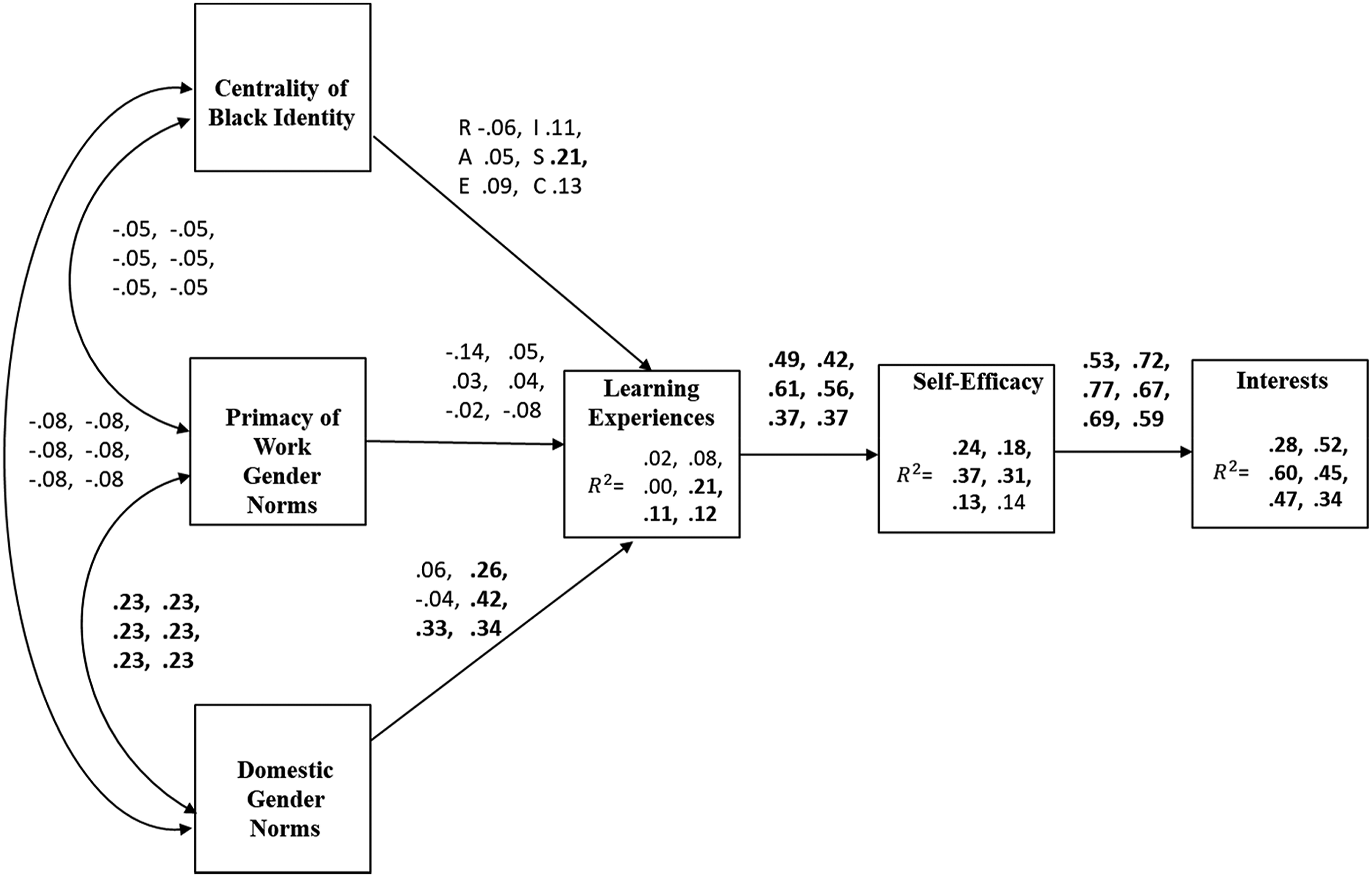
Method
Participants
One hundred and twenty six undergraduate women who identified as Black/African American at a private, Catholic HBCU participated in the study. Thirty one percent (n = 39) identified as first year students, 21.4% (n = 27) identified as sophomores, 23% (n = 29) identified as juniors, and 24.6% (n = 31) identified as seniors. The mean age of the sample was 19.72 (SD = 1.45) with ages ranging from 18 to 24.
Measures
Procedure
After receiving Institutional Review Board approval, we recruited participants through the Department of Psychology online recruitment portal (SONA) and campus flyer postings. Students accessed an online study where they electronically consented before completing the surveys, after which they were debriefed and given one credit for their psychology classes.
Results
Intercorrelation Matrix and Descriptive Statistics of Study Variables.
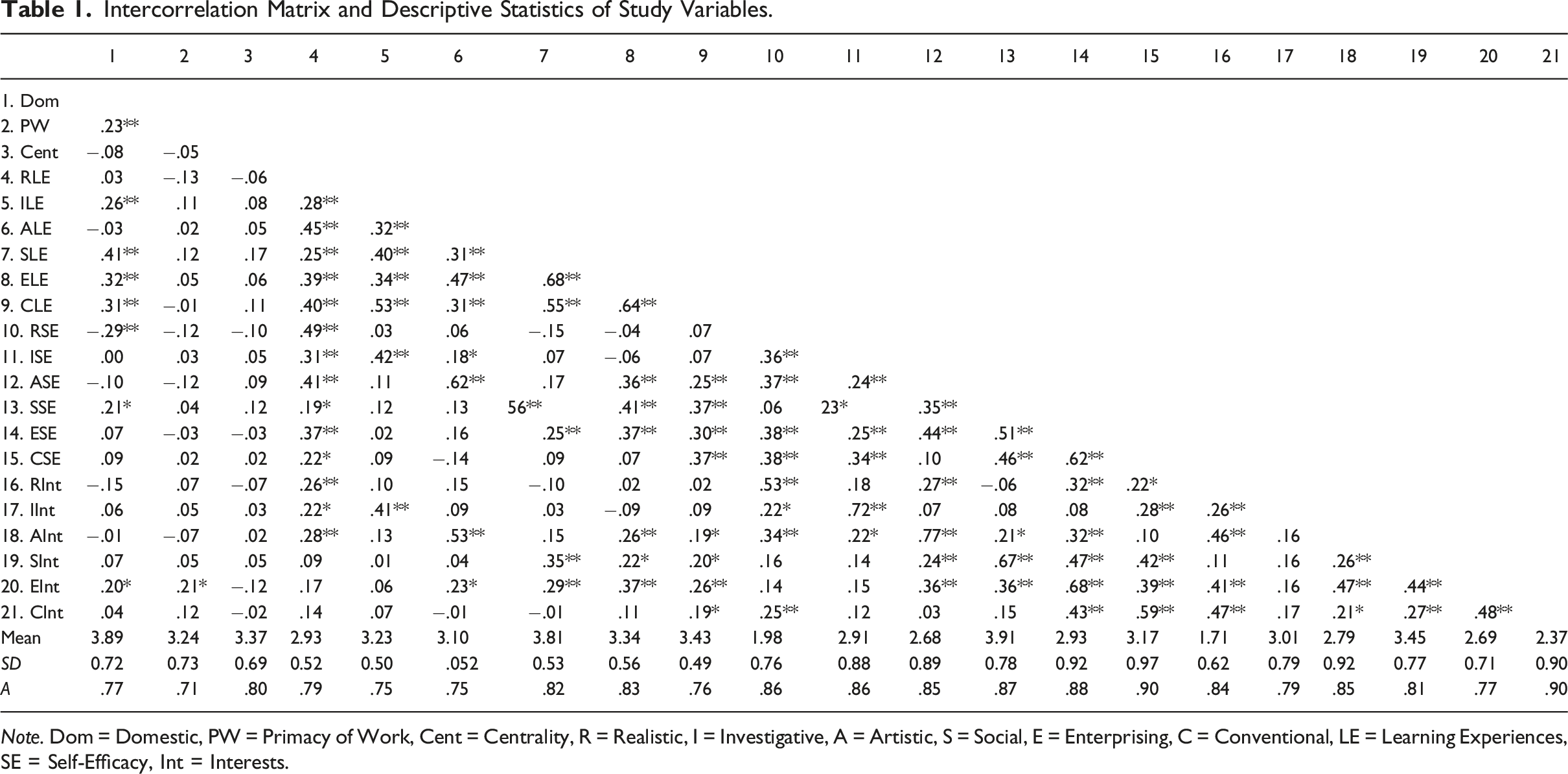
Note. Dom = Domestic, PW = Primacy of Work, Cent = Centrality, R = Realistic, I = Investigative, A = Artistic, S = Social, E = Enterprising, C = Conventional, LE = Learning Experiences, SE = Self-Efficacy, Int = Interests.
Goodness of Fit Indicators for Models.

Note. CFI = Comparative Fit Index; TLI = Tucker–Lewis Index; RMSEA = Root Mean Square Error of Approximation; SRMR = Standardized Root Mean Square Residual. Bolded values indicate best fitting model.
* p < .05, ** p < .01.
Primacy of work was not reliably associated with learning experiences across the career interests’ themes; however, somewhat unexpectedly, domesticity was associated with the majority of learning experiences across career interest themes, with the exception of realistic and artistic career interests. For example, women who reported greater domestic gender norms also reported greater investigative learning experiences (β = 0.26, SE = .09). All other significant paths were in the same positive direction. Similarly, racial identity generally demonstrated an unreliable association to learning experiences across career interest themes, with only social learning experiences demonstrating a reliable association with racial identity. Specifically, women who reported greater centrality of their Black identity reported greater social learning experiences (β = 0.21, SE = .08). In each career theme model, greater learning experiences were reliably associated with greater self-efficacy. Similarly, greater self-efficacy was reliably associated with greater interests across career interest models.
Indirect Effects for Models.
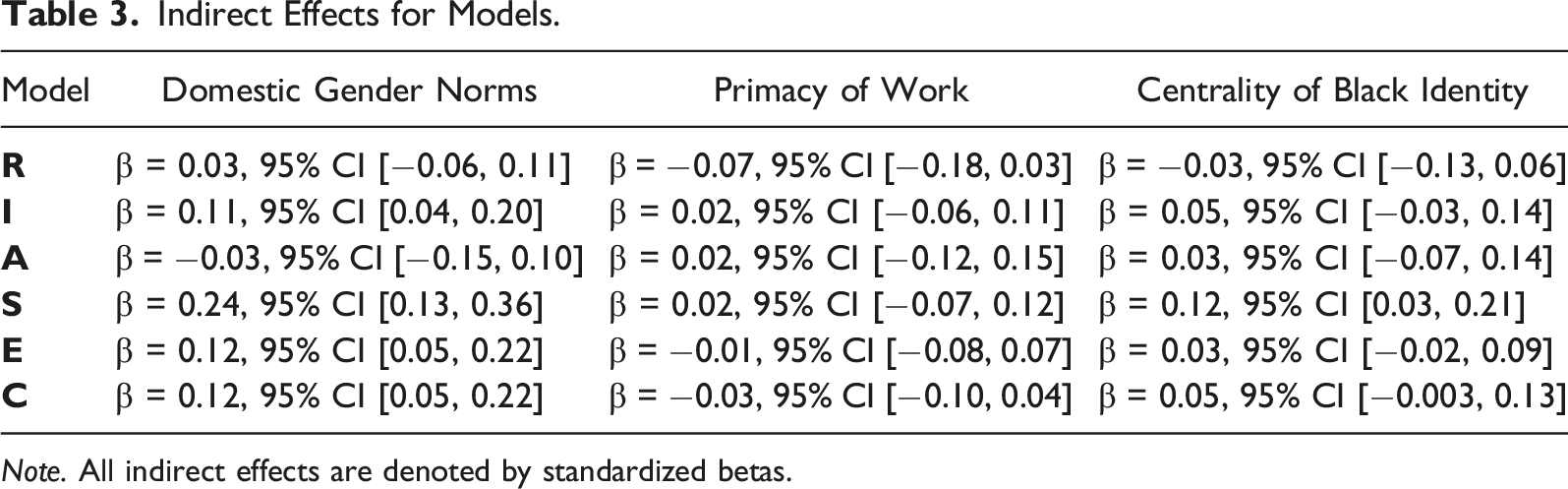
Note. All indirect effects are denoted by standardized betas.
Discussion
The present study examined the roles of gender norms (primacy of work and domesticity) and centrality of Black identity in predicting six Holland-based career interests via SCCT-based mediating variables of learning experiences and self-efficacy. Learning experiences were positively associated with self-efficacy, which then was positively linked to interests across all RIASEC career interests (Lent et al., 1994). This provides additional support to SCCT, and expands these theoretical predictions to Black undergraduate women at HBCUs. Importantly, it implies that Black undergraduate women’s learning experiences may be associated with their self-efficacy in all career domains, and that their self-efficacy is linked to their career interests.
The present study also adds to the literature by investigating how person inputs (e.g., gender and race/ethnicity) and background contextual affordances (e.g., access to financial support for education) are linked to sources of self-efficacy encountered in learning experiences. While we hypothesized that domestic norms would predict artistic, social, and conventional learning experiences, this was only partially supported. Domestic norms predicted higher levels of investigative, social, enterprising, and conventional learning experiences, but not artistic learning experiences. These links may partially explain why women tend to express more interest in social and conventional activities and occupations, and this coheres with past research (Holland, 1997; Schaub & Tokar, 2005; Tokar et al., 2007). It is ostensibly surprising that domestic norms predicted investigative and enterprising learning experiences; this link may be an artifact of the sample’s University, which graduates a high proportion of Black students into medical and pharmacy school (i.e., investigative careers). It is also conceivable that these undergraduate women learn to value and seek out investigative learning experiences, while also internalizing messages from society about the importance of domestic work. It is also possible that these results reflect the historical implications of Black women feeling responsible for enacting both masculine and feminine roles. In particular, Black women are often aware of the “Strong Black Woman” stereotype, which exemplifies many masculine characteristics that align with the enterprising theme, but also an implication of domestic caregiving, which is associated with feminine norm conformity (Donovan & West, 2015).
We also anticipated that primacy of work would predict higher levels of realistic, investigative, and enterprising learning experiences (Flores et al., 2010; Ludwikowski et al., 2018; Tokar et al., 2007), but the results did not support this. There were no significant associations between primacy of work and learning experiences for any career interests. This contrasts with previous work that has found masculine norm conformity to be a predictor of realistic and enterprising learning experiences in predominately White samples of both men and women (Tokar et al., 2007). It is possible that demographic characteristics or different masculine norms may account for the association between conformity to masculine norms and learning experiences that has been found in previous studies.
We found partial support for our hypothesis that racial identity centrality would predict higher levels of social, enterprising, and conventional learning experiences and lower levels of realistic and investigative learning experiences. Our results indicated that racial identity centrality only predicted higher levels of learning experiences related to social career interests. The link between racial identity centrality and social learning experiences may partially explain why individuals who identify as Black may express somewhat higher levels of self-efficacy in activities associated with these themes (Betz & Gwilliam, 2002). The social theme encompasses collectivist beliefs that Black identified groups value, such as generosity, teamwork, service to others, and community. Black communities often emphasize the collective instead of the individual, which may contribute to the connection between racial identity centrality and the social theme (Carson, 2009; Komarraju & Cokley, 2008).
Implications for Career Counseling
In the current study, Black women’s social identities were linked to their learning experiences, self-efficacy, and interest in investigative, social, enterprising, and conventional career interests. This suggests that career counselors may likely be most effective with their Black undergraduate women clients when considering multiple individual difference variables that compose their identity. Career counselors are tasked with learning about the marginalized backgrounds of their clients, while also recognizing that meaningful within group variability exists. The present research suggests that intersectionality of multiple identities may be especially salient when considering career exploration related to the social career theme, which was the only theme predicted by both racial and gender identity factors. Career counselors may help encourage clients to contemplate how their identity-related characteristics relate to their career choices given the different roles of the identity variables across RIASEC themes.
Career counselors may also benefit their clients by exploring learning experiences that relate to specific career interests because these experiences predict self-efficacy, which influences interests. Career counselors could indirectly influence interests by providing awareness of and access to learning experiences in unfamiliar domains. Social identities such as social class, gender, sexual orientation, ethnicity/race, and age may circumscript awareness and access to certain career domains (Gottfredson, 2002). Relatedly, it may be helpful for career counselors to provide a balanced examination of feminine norms, helping individuals determine the extent to which they want to pursue careers that align with their gender identity or to acquire additional learning experiences in domains that might be unfamiliar to them.
Limitations and Future Directions
The present study examined important predictors of career interests in an understudied population; however, given the present study’s relatively small sample size, larger samples may be necessary to replicate or refute the present study’s findings. Future research could also examine identities related to sexual orientation, more nuanced gender identities, additional aspects of racial identity (e.g., ideology, regard), and socioeconomic status (Budge et al., 2016). Another limitation was that coefficient alphas were low for some of the learning experience subscales, which aligns with past research (Tokar et al., 2012), suggesting the LEQ may require additional adjustment and validation with diverse populations.
The present study’s design was cross-sectional, suggesting that future research could expand upon the present findings by employing prospective longitudinal designs to illuminate how gender and racial identity formation influence the development of career interests throughout college and as students transition into careers. Finally, it must be noted that while gender norm conformity and racial identity centrality are conceptualized as indicators of social identity, gender norm conformity reflects prescriptive ideas about how individuals should behave, which are often based on stereotypes (Mahalik et al., 2003), while racial identity centrality does not reflect adhering to socially prescribed stereotypes. It may be important for future research to examine how the centrality of one’s gender identity influences the development of career interests through educational experiences.
Conclusion
The present study demonstrated that important aspects of gender and racial identity are linked to the development of Black undergraduate women’s career interests through learning experiences and self-efficacy. Adherence to feminine gender norms predicted sources of self-efficacy in learning experiences across several career interests, but racial centrality was only predictive in the domain of social careers. Importantly, for every RIASEC career domain, positive sources of self-efficacy encountered in learning experiences were linked to increased self-efficacy and ultimately greater career-interest. This highlights the importance for educational professionals to consider the connection between learning and self-efficacy. Important aspects of identity related to gender and race may set forth early educational decisions that have important implications for the eventual careers that many undergraduates pursue.
Footnotes
Declaration of Conflicting Interests
The author(s) declared no potential conflicts of interest with respect to the research, authorship, and/or publication of this article.
Funding
The author(s) received no financial support for the research, authorship, and/or publication of this article.
