



Abstract
This study integrated Holland’s themes within a modified social cognitive career theory (SCCT) model, exploring whether gender-related personality variables account for the relations between gender and vocational interests. Undergraduates (N = 452) completed expressiveness, instrumentality, and realistic, investigative, artistic, social, enterprising, and conventional (RIASEC)-based measures of learning experiences, self-efficacy, and interests. Through structural equation modeling, the paths via expressiveness and instrumentality fully explained gender’s effect on artistic and conventional interests, respectively. The paths through instrumentality partially explained gender’s effect on investigative and enterprising interests, while gender’s effect on social interest was partially explained through expressiveness and instrumentality when considering the path without self-efficacy. The paths through expressiveness and instrumentality partially explained gender’s effect on realistic interests. Adding direct paths from learning experiences to interests improved model fit for realistic, artistic, and social models. These results demonstrate the utility of concurrently assessing the RIASEC and SCCT frameworks to delineate factors that influence gender differences in vocational interests.
Career counselors often use interest inventories to help individuals choose academic majors and occupations because these measures predict vocational outcomes (Gasser, Larson, & Borgen, 2007). Clients report their interest in activities and occupations based on Holland’s (1959, 1997) theory of vocational personality types, which classifies individuals and environments according to six different themes: realistic, investigative, artistic, social, enterprising, and conventional (RIASEC). Gender differences in career interests are robust, with women often expressing greater interest in working with “people” (social and artistic) and men often expressing greater interest in working with “things” (realistic and investigative; Su, Rounds, & Armstrong, 2009). Gender differences in career self-efficacy mimic gender differences in career interests (Armstrong & Vogel, 2009; Betz & Hackett, 1981). For example, while men report higher levels of self-efficacy in realistic activities, women report higher levels of self-efficacy in social activities (Betz & Gwilliam, 2002). Certainly, gender may directly influence self-efficacy and interest development, but it may also impact the availability of and individuals’ willingness to engage in additional learning experiences, the latter of which may either encourage or discourage individuals toward certain careers. The present study examined underlying factors, such as personality characteristics and learning experiences, as variables that account for gender’s effect on career interests.
While many commercial career exploration tools are grounded in Holland’s theory (e.g., Strong Interest Inventory; Donnay, Morris, Schaubhut, & Thompson, 2005), social cognitive career theory (SCCT; Lent, Brown, & Hackett, 1994) provides a useful framework for describing the development of vocational outcomes (Sheu et al., 2010) and offers insight into why persistent gender differences occur in vocational decisions. Foundational SCCT research demonstrated that gender moderates the relation between career interests and major choice goals (Inda, Rodríguez, & Peña, 2013; Lent et al., 2005) and described how proximal variables, such as self-efficacy and outcome expectations, shape interest development (Fouad, Smith, & Zao, 2002). According to SCCT, learning experiences shape self-efficacy and may explain the gender differences in interests (Garriott et al., 2014; Tokar, Thompson, Plaufcan, & Williams, 2007; William & Subich, 2006). Specifically, gender may influence a person’s learning experiences, which in turn influence an individual’s self-efficacy and interest in a particular vocational domain (Williams & Subich, 2006). Indeed, evidence supports the notion that learning experiences at least partially mediate gender’s effect on self-efficacy (Gainor & Lent, 1998).
However, recent research has begun to examine the influence of variables that are more proximal to interests than gender, such as conformity to gender norms and perceived social status, despite being less proximal to interests compared to self-efficacy in SCCT models (Thompson & Dahling, 2012; Tokar et al., 2007). These variables, including gender-related personality traits, may offer more predictive power than gender alone, especially given the large within-gender variability (Hyde, 2014) and malleability of gender roles across time (Twenge, 1997). Masculine and feminine gender roles have been conceptualized as gender-related personality traits called instrumentality and expressiveness (Spence & Helmreich, 1980). In order to conform to preferred gender roles, individuals demonstrate motivation to maintain behaviors consistent with gender-related personality traits (Bem, 1974). Thus, gender-related personality traits may be more proximal predictors of career interests than gender. For example, men who possess high instrumentality express interest in masculine-typical careers. In contrast, women who possess a high expressiveness demonstrate more interest in feminine-typical careers (Dinella, Fulcher, & Weisgram, 2014), and men who work in traditionally feminine occupations tend to be more expressive (Chusmir, 1990).
Connecting gender-related personality variables to SCCT might provide greater insight into how gender influences career-related interests. Conformity to masculine gender role norms mediated the relation between gender and realistic, social, and enterprising learning experiences (Tokar et al., 2007), and instrumentality predicted men’s self-efficacy for engineering tasks and self-efficacy for realistic tasks (Flores, Robitschek, Celebi, Andersen, & Hoang, 2010; Navarro, Flores, Lee, & Gonzalez, 2014). In contrast, conformity to feminine gender role norms mediated the relation between gender and realistic, artistic, and social learning experiences (Tokar et al., 2007), and expressiveness is positively related to social and conventional self-efficacy but is negatively related to investigative self-efficacy (Flores et al., 2010). Gender is not a simple construct but one that influences personality traits, learning experiences, self-efficacy in certain tasks, and career interests. Therefore, more work is needed to disentangle the relations between gender, gender-related personality traits, and career outcomes.
The Current Study
The current study extends previous research by examining gender’s direct (Path a) and indirect effects (Paths b and c) on interests through gender-related personality variables, learning experience, and self-efficacy across all RIASEC themes in a modified SCCT model (without outcome expectations). We predict that—in line with SCCT hypotheses—gender will be associated with gender-related personality traits (Paths d and e), which in turn will predict learning experiences (Paths f and g), predicting self-efficacy (Path h), and ultimately predicting career interests (Path i) across RIASEC themes (see Figure 1).
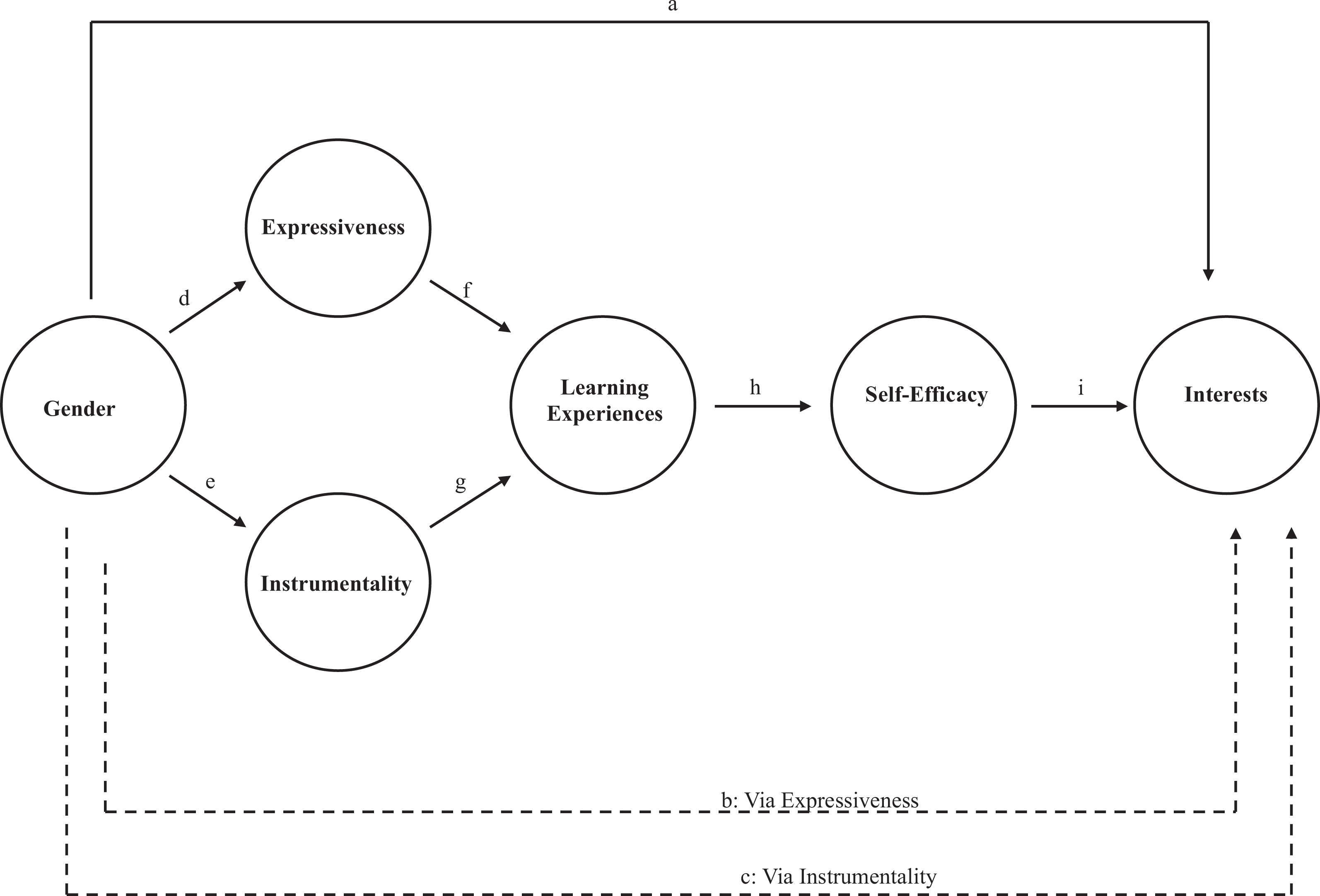
Hypothesized model.
Realistic model
We expect that gender’s effect on realistic interests will be partially explained by gender-related personality, learning experiences, and self-efficacy. Gender and gender-related personality will predict realistic interests with identifying as a man and instrumentality will predict higher levels of realistic interests. Consistent with previous research, we expect that gender’s direct effect on realistic interests will remain with men expressing higher levels of realistic interest (Su et al., 2009).
Investigative model
Similarly, the gender’s effect on investigative interests will be partially explained by gender-related personality, learning experiences, and self-efficacy. We expect that identifying as a man and instrumentality will predict higher levels of investigative interests. Additionally, we expect gender’s direct effect to remain, though the magnitude of this effect will be lower than in the realistic model.
Artistic model
Gender’s effect on artistic interests will be partially explained by gender-related personality, learning experiences, and self-efficacy. Both gender and gender-related personality will predict interests with women and expressiveness and identifying as a woman predicting higher levels of artistic interests. Additionally, we expect that gender will directly affect artistic interests, expecting women to express higher levels of artistic interests, but the magnitude of these coefficients is predicted to be weaker than in the social model.
Social model
Gender’s effect on social interests will be partially explained by gender-related personality, learning experiences, and self-efficacy. Both gender and gender-related personality will predict interests with women and expressiveness predicting higher levels of social interests. Consistent with previous research, we expect that the direct effects of gender on social interests will remain, with women expressing higher levels of social interest (Su et al., 2009).
Enterprising model
We predict that gender’s effect on enterprising interests will be fully explained by gender-related personality, learning experiences, and self-efficacy given the lack of support of gender differences existing in enterprising interests (Su et al., 2009; Tokar et al., 2007).
Conventional model
Gender’s effect on conventional interests will be partially explained by gender-related personality, learning experiences, and self-efficacy. Both gender and gender-related personality will predict interests with women and expressiveness and identifying as a woman predicting higher levels of conventional interest. We expect that gender will directly affect conventional interests, expecting women to express higher levels of conventional interests, but the magnitude of these coefficients is predicted to be weaker than in the social model (Su et al., 2009).
Method
Participants
Four hundred and fifty two students from a large, Midwestern university participated in the study. The mean age of the sample was 19.46 (SD = 2.00) with ages ranging from 18 to 37. The majority of the sample (59%) identified as women, with 88.9% identifying as White/European American, 5.3% identifying as biracial/multiracial, 2.2% identifying as Asian/Asian American, 1.8% identifying as Black/African American, and 1.8% identifying as Latino(a)/Latino(a) American. Approximately 44.2% were freshmen, 31.6% were sophomores, 16.6% were juniors, and 7.5% were seniors.
Measures
RIASEC interests and self-efficacy
Participants responded to the 48 Set A activity-based items from the alternate forms public domain (AFPD) RIASEC scales (Armstrong, Allison, & Rounds, 2008). Participants rated how much they would like to perform each work activity, such as “Installing flooring in houses,” using a 5-point Likert-type response format, ranging from 1 (strongly dislike) to 5 (strongly like). Following the procedures outlined in Armstrong and Vogel (2009), participants completed the 48 Set B activity-based items, using an alternative self-efficacy rating scale. Participants rated their self-efficacy in their abilities to perform each activity on a 5-point Likert-type response format, ranging from 1 (very low confidence) to 5 (very high confidence). Convergent validity between the activity-based scales and the 1994 edition of the Strong Interest Inventory ranged from .56 to .72 with a mean of .64 (Armstrong et al., 2008). Structural multidimensional scaling analyses of the AFPD scales support RIASEC order predictions for both scales (Armstrong & Vogel, 2009). Additionally, interest and self-efficacy scale correlations resembled commercial RIASEC interest and self-efficacy scales with a range between .60 and .72 with a mean of .70. Internal consistency estimates for these scales tend to range from .79 to .94 (Armstrong et al., 2008). In the current study, coefficient α ranged from .83 to .93 and from .81 to .93 for the interest and self-efficacy scales, respectively.
Gender-related personality variables
The Bem Sex-Role Inventory (BSRI; Bem, 1974) assessed gender-related personality variables. Sixty personality characteristics comprise the BSRI with 20 items for each of the Masculinity (Instrumentality), Femininity (Expressiveness), and neutral scales. Participants rated the degree to which adjectives accurately represent themselves on a 5-point Likert-type response scales, ranging from 1 (very inaccurate) to 5 (very accurate). Item examples of the Expressiveness and Instrumentality scales are “loyal” and “dominant,” respectively. The BSRI has good internal consistency, with α = .83 for the Expressiveness scale and α = .86 for the Instrumentality scale (Choi, Fuqua, & Newman, 2007). Also, test–retest reliabilities ranged from .56 to .68 in a sample of college-age women (Yanico, 1985). The BSRI has good convergent validity when compared to the California Psychological Inventory’s Femininity–Masculinity scale (Bem, 1974). In the current study, internal consistency was α = .87 for the Expressiveness scale and α = .86 for the Instrumentality scale.
Learning experiences
Participants completed the Learning Experience Questionnaire (LEQ; Schaub, 2004), which contains 120 questions that assess four types of RIASEC-based learning experiences: vicarious learning, performance accomplishments, verbal persuasion, and physiological/emotional arousal. An example of a realistic performance accomplishment item is “I have done well with building things.” A sample investigative vicarious learning item is “While growing up, I recall seeing people I respected reading scientific articles.” An artistic verbal persuasion item is “Friends have urged me to act in a play,” and a social physiological/emotional arousal item is “I have become nervous while developing new friendships.” The LEQ has good internal consistency with α ranging from .73 to .89 (Schaub, 2004). The LEQ effectively predicts self-efficacy beliefs, demonstrating construct validity evidence (Schaub & Tokar, 2005; Williams & Subich, 2006), and it demonstrates gender-based factorial invariance (Tokar, Buchanan, Subich, Hall, & Williams, 2012). In the current study, α ranged from .74 to .87.
Procedure
After the institutional review board approved the study, students participated for introductory psychology course credit. Students completed informed consent documents and demographic sheets, after which they completed a survey packet over the next week. After participants returned their survey packet, they were debriefed and were given course credit.
Results
Little’s (1988) omnibus missing completely at random (MCAR) statistical test suggested that the missing data were MCAR, χ2(5,128) = 5,275.29, p = .074. We removed 25 cases due to excessive (20%) missing data (Schlomer, Bauman, & Card, 2010), 17 univariate outliers with values above 3.29 (cf. Tabachnick & Fidell, 2013), and 8 multivariate outliers, leaving a total of 402 participants. To accommodate missing data and account for nonnormality, we used structural equation modeling with maximum likelihood estimation with robust standard errors in MPlus (version 6.11; Muthén & Muthén, 2010; Schlomer et al., 2010). We created latent variables for expressiveness, instrumentality, learning experiences, self-efficacy, and interests. Past research indicates that expressiveness and instrumentality are hierarchical, multidimensional constructs (Blanchard-Fields, Suhrer-Roussel, & Hertzog, 1994; Choi et al., 2007). Following procedures discussed by Blanchard-Fields, Suhrer-Roussel, and Hertzog (1994) and Choi et al. (2007), we created two observed indicators, interpersonal affect and compassionate, for the expressiveness latent construct and five observed indicators, decisive, shy (reverse coded), self-sufficient, athletic, and dominant, for the instrumentality latent construct. We created the observed indicators using only the 32 items used by Blanchard-Fields et al. (1994) and Choi et al. (2007) given psychometric improvements by removing eight items. The LEQ is a multidimensional construct, so four observed indicators, performance accomplishments, verbal persuasion, vicarious learning, and physiological arousal, were created across each RIASEC theme, following procedures discussed by Garriott, Flores, and Martens (2013). Examinations of scree plots, eigenvalues, and factor loadings from an exploratory factor analysis indicated that single-factor models fit the data best for the interest and self-efficacy constructs across the RIASEC themes. As such, items with high, medium, and low-factor loadings were parceled to balance the loadings across latent variables. We modeled gender as a latent variable with a single indicator (Anderson & Gerbing, 1988; Thompson & Dahling, 2012). Table 1 provides descriptive statistics, internal consistencies, and factor loadings for all parcels.
Means, Standard Deviations, and Internal Consistencies of Parcels Across Constructs.

Note. All factor loadings significant at the p < .001 level.
Based on the SCCT framework, we tested six models, one for each of the RIASEC themes. We analyzed four indices of model fit: the comparative fit index (≥.95), the Tucker–Lewis index (≥.95), the root-mean-square error of approximation (≤.06), and standardized root-mean-square residual (≤.08; Hu & Bentler, 1999). The models demonstrated at least adequately fit the data (see Table 2). The indicators adequately measured most of their latent variables: The measured variables’ factor loadings on latent variables were significant at p < .001 (Table 1). However, the artistic and social physiological/emotional arousal parcels did not load well on their latent constructs, demonstrating factor loadings of .27 and .39, while all other scales’ factor loadings across ranged from .44 to .94.
Fit Statistics for Measurement and Hypothesized Structural Models From MLR Analysis.
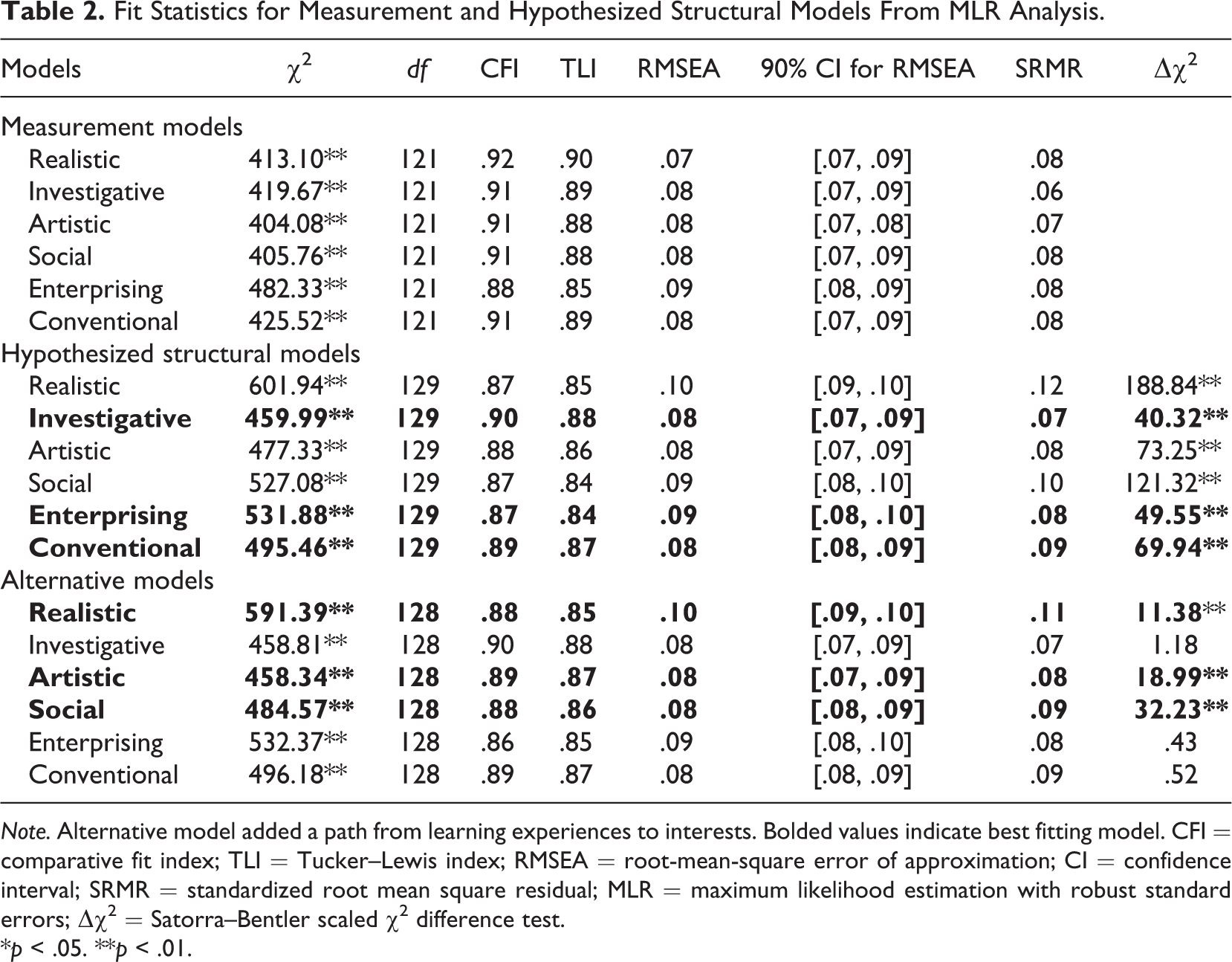
Note. Alternative model added a path from learning experiences to interests. Bolded values indicate best fitting model. CFI = comparative fit index; TLI = Tucker–Lewis index; RMSEA = root-mean-square error of approximation; CI = confidence interval; SRMR = standardized root mean square residual; MLR = maximum likelihood estimation with robust standard errors; Δχ2 = Satorra–Bentler scaled χ2 difference test.
*p < .05. **p < .01.
The hypothesized structural models fit the data well (see Table 2). Following the recommendation to examine comparative models against the hypothesized model (Martens, 2005), we systematically added theoretically relevant direct paths to the hypothesized model. Because learning experiences might directly influence interests (see Armstrong & Vogel, 2010), we added a direct path from learning experiences to interests in an alternative model. Results from χ2 difference tests indicated that adding a direct path from learning experiences to interests did not improve model fit for conventional, enterprising, or investigative themes, all ps > .05 (see Table 2). Therefore, we did not add the path from learning experiences in these models (see Figure 2). The results of chi-square difference tests indicated that the realistic, artistic, and social models’ fit improved with this pathway addition (see Table 2), all ps < .01. Therefore, we included this pathway in the final realistic, artistic, and social models (see Figure 3). To test the significance of the indirect effects for the final structural models, we utilized a bootstrapping procedure. We created 10,000 bootstrap samples of the data, generating bias-corrected bootstrap confidence intervals (CIs) for the indirect effects (Shrout & Bolger, 2002). The 95% CIs of indirect effects that do not include 0 indicate significant effects with a α level set to .05.
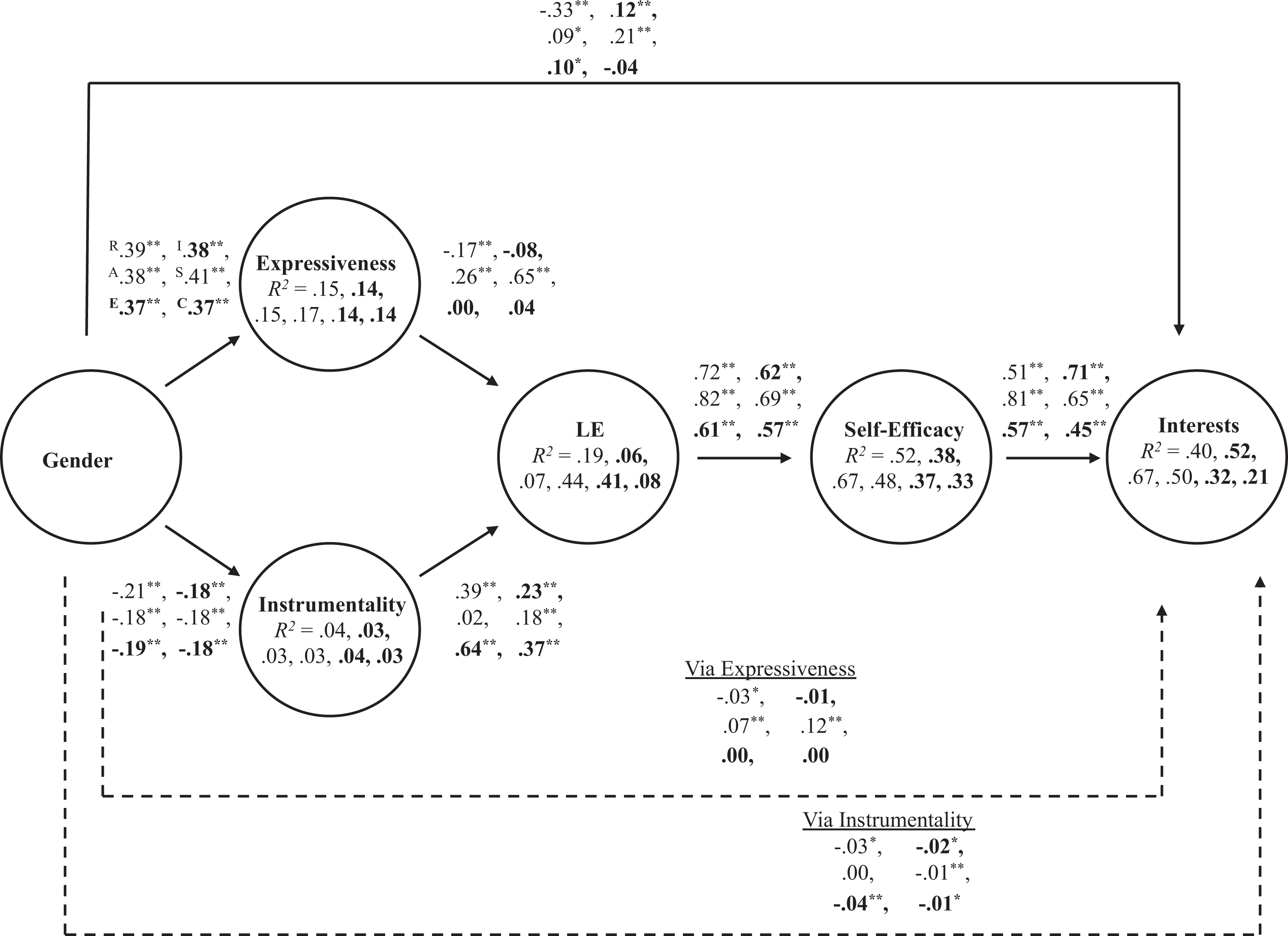
Results of the original structural model; The ordering of the values presented in the figure corresponds with the realistic, investigative, artistic, social, enterprising, and conventional ordering as displayed for the gender to expressiveness path. Bolded values represent the investigative, enterprising, and conventional models. LE = learning experiences. *p < .05. **p < .01.
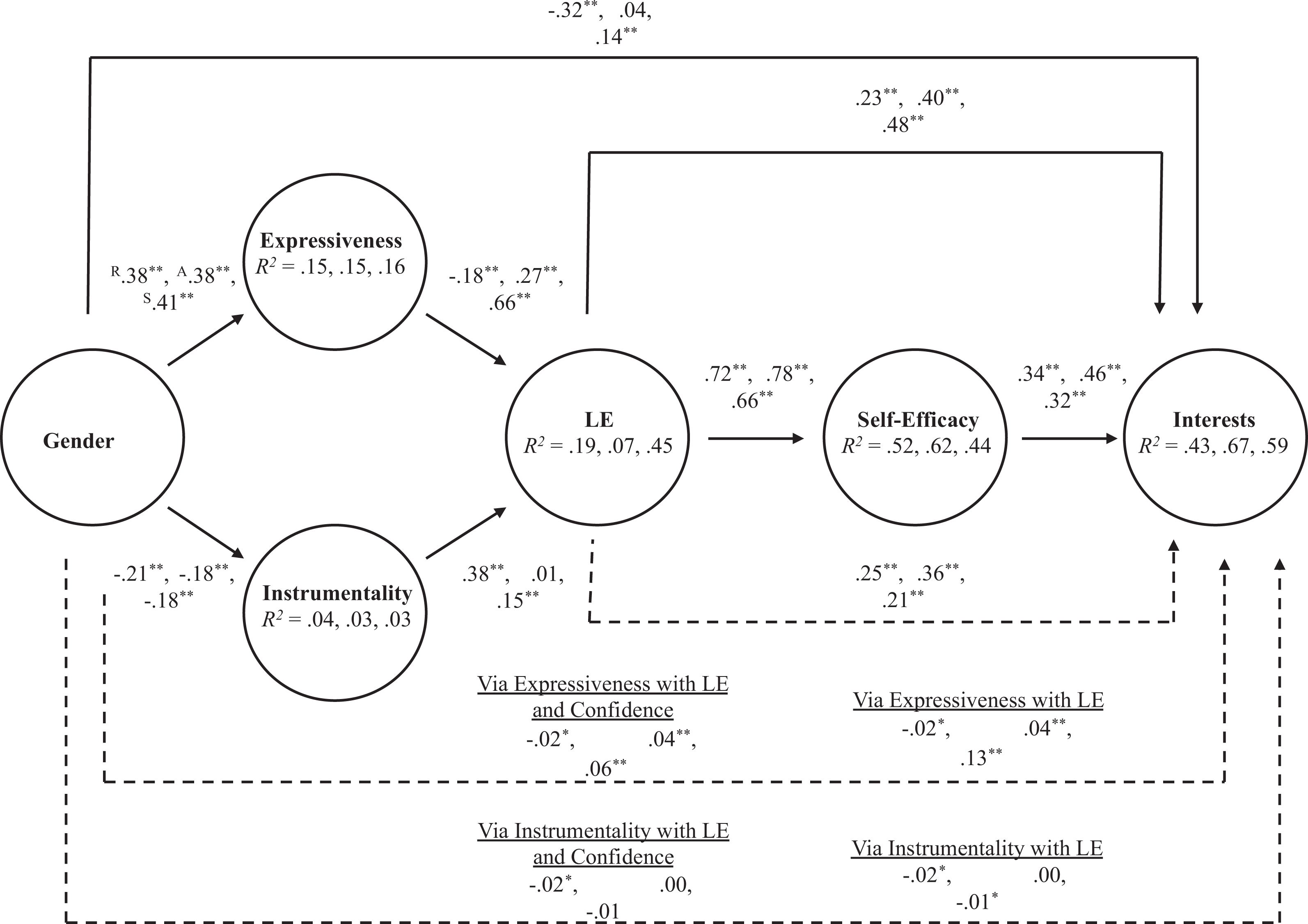
Results of alternative Model 1 for realistic, artistic, and social themes as displayed for the gender to expressiveness path. LE = learning experiences. *p < .05. **p < .01.
Realistic Model Results
The gender to expressiveness path was significant with women expressing higher expressiveness than men, β = 0.39, 95% CI [0.30, 0.53], and the gender to instrumentality path was significant with men expressing higher instrumentality than women, β = −0.21, 95% CI [−0.31, −0.10]. The paths from instrumentality and expressiveness to learning experiences were significant, β = 0.38, 95% CI [0.43, 0.95] and β = −0.18, 95% CI [−0.46, −0.08], respectively; furthermore, the learning experiences to self-efficacy path and the self-efficacy to interest paths were significant, β = 0.72, 95% CI [0.70, 0.94] and β = 0.34, 95% CI [0.16, 0.43], respectively. Gender directly affected realistic interests, β = −0.32, 95% CI [−0.67, −0.36]. In the alternative model (Figure 3), the direct effect from learning experiences to interests was significant, β = 0.23, 95% CI [0.07, 0.37]. The total indirect effect of gender on realistic interest was significant, β = −0.07, 95% CI [−0.19, −0.05]. The specific indirect paths were significant through instrumentality including learning experiences and self-efficacy, β = −0.02, 95% CI [−0.07, −0.01], and including only learning experiences, β = −0.02, 95% CI [−0.08, −0.01]. The specific indirect paths were significant through expressiveness including learning experiences and self-efficacy, β = −0.02, 95% CI [−0.06, −0.01], and including only learning experiences, β = −0.02, 95% CI [−0.07, −0.01]. The total indirect effect of learning experiences on realistic interests was also significant, β = 0.25, 95% CI [0.13, 0.35].
Investigative Model Results
The path from gender to expressiveness was significant with women expressing higher expressiveness than men, β = 0.38, 95% CI [0.29, 0.53], and the path from gender to instrumentality was significant with men expressing higher instrumentality than women, β = −0.18, 95% CI [−0.28, −0.08]. The paths from instrumentality to learning experiences was significant, β = 0.23, 95% CI [0.13, 0.43], though the path from expressiveness to learning experiences was not significant, β = −0.08, 95% CI [−0.26, 0.04]. The learning experiences to self-efficacy and the self-efficacy to interests paths were significant, β = 0.62, 95% CI [0.79, 1.16] and β = 0.71, 95% CI [0.62, 0.81], respectively. Gender directly affected investigative interests, β = 0.12, 95% CI [0.06, 0.36]). The paths through instrumentality explained gender’s total indirect effect on investigative interest, β = −0.03, 95% CI [−0.12, −0.01], but the paths through expressiveness did not, β = −0.01, 95% CI [−0.07, 0.01] (see Figure 2).
Artistic Model Results
The path from gender to expressiveness was significant with women expressing higher expressiveness than men, β = 0.38, 95% CI [0.30, 0.53], and the path from gender to instrumentality was significant with men expressing higher instrumentality than women, β = −0.18, 95% CI [−0.28, −0.08]. The path from instrumentality to learning experiences was not significant, β = .01, 95% CI [−0.14, 0.16], though the path from expressiveness to learning experiences was significant, β = 0.27, 95% CI [0.18, 0.48]. The learning experiences to self-efficacy and the self-efficacy to interests paths were significant, β = 0.78, 95% CI [0.74, 1.02] and β = 0.46, 95% CI [0.34, 0.72], respectively. Gender directly affected artistic interests, β = 0.04, 95% CI [−0.08, 0.20]. In the alternative model, the direct effect from learning experiences to artistic interests was significant, β = 0.40, 95% CI [0.28, 0.78], and gender’s total indirect effect on artistic interest was also significant, β = 0.03, 95% CI [0.06, 0.22], with significant specific indirect paths through expressiveness including learning experiences and self-efficacy, β = 0.04, 95% CI [0.03, 0.12], and including only learning experiences, β = 0.04, 95% CI [0.03, 0.13]. Neither the indirect path through instrumentality including learning experiences and self-efficacy, β = 0.00, 95% CI [−0.02, 0.01], nor the path through instrumentality including only learning experiences, β = 0.00, 95% CI [−0.02, 0.02], was significant. The total indirect effect of learning experiences on artistic interests was significant, β = 0.36, 95% CI [0.32, 0.65].
Social Model Results
The path from gender to expressiveness was significant with women expressing higher expressiveness than men, β = 0.41, 95% CI [0.30, 0.52], and the path from gender to instrumentality was significant with men expressing higher instrumentality than women, β = −0.18, 95% CI [−0.28, −0.07]. The paths from instrumentality and expressiveness to learning experiences were significant, β = −0.33, 95% CI [−0.44, −0.22] and β = 0.66, 95% CI [0.50, 0.72], respectively. The learning experiences to self-efficacy and the self-efficacy to interests paths were significant, β = 0.66, 95% CI [0.88, 1.35] and β = 0.32, 95% CI [0.15, 0.45], respectively. Gender directly affected social interests, β = 0.14, 95% CI [0.07, 0.35]. In the alternative model, the direct effect from learning experiences to interests was significant, β = 0.48, 95% CI [0.45, 1.04]. Gender’s total indirect effect on social interest was significant, β = 0.17, 95% CI [0.14, 0.35], with significant specific indirect pathways through expressiveness including learning experiences and self-efficacy, β = 0.06, 95% CI [0.04, 0.14], and including only learning experiences, β = 0.13, 95% CI [0.11, 0.29]. The specific indirect pathway through instrumentality including both learning experiences and self-efficacy was not significant, β = −0.01, 95% CI [−0.01, 0.00], but the pathway including only learning experiences was significant, β = −0.01, 95% CI [−0.04, −0.01]. The total indirect effect from learning experiences to social interests was also significant, β = 0.21, 95% CI [0.16, 0.50].
Enterprising Model Results
The path from gender to expressiveness was significant with women expressing higher expressiveness than men, β = 0.37, 95% CI [0.30, 0.53]. The path from gender to instrumentality was significant with men expressing higher instrumentality than women, β = −0.19, 95% CI [−0.28, −0.09]. The path from instrumentality to learning experiences was significant, β = 0.64, 95% CI [0.54, 0.89], though the path from expressiveness to learning experiences was not significant, β = 0.00, 95% CI [−0.09, 0.11]. The learning experiences to self-efficacy and the self-efficacy to interests paths were significant, β = 0.61, 95% CI [0.73, 1.20] and β = 0.57, 95% CI [0.41, 0.61], respectively. Gender directly affected enterprising interests, β = 0.10, 95% CI [0.01, 0.29]. The total indirect effect of gender on enterprising interest, β = −0.04, 95% CI [−0.07, −0.01], can be explained through the specific indirect path through instrumentality, β = −0.04, 95% CI [−0.07, −0.02], but not expressiveness, β = 0.00, 95% CI [−0.01, 0.01].
Conventional Model Results
The path from gender to expressiveness was significant with women expressing higher expressiveness than men, β = 0.37, 95% CI [0.30, 0.53], and the path from gender to instrumentality was significant with men expressing higher instrumentality than women, β = −0.18, 95% CI [−0.28, −0.08]. The path from instrumentality to learning experiences was significant, β = 0.28, 95% CI [0.15, 0.43], but the path from expressiveness to learning experiences was not significant, β = 0.04, 95% CI [−0.10, 0.18]. The learning experiences to self-efficacy and the self-efficacy to interests paths were significant, β = 0.57, 95% CI [0.77, 1.48] and β = 0.45, 95% CI [0.33, 0.54], respectively. Gender did not directly affect conventional interests, β = −0.04, 95% CI [−0.14, 0.05]. The total indirect effect of gender on interests was not significant, β = −0.01, 95% CI [−0.06, 0.01], though a gender indirectly affected conventional interests through instrumentality, β = −0.01, 95% CI [−0.05, −0.01], but not expressiveness, β = 0.00, 95% CI [−0.02, 0.03]: The SCCT paths through instrumentality fully explain gender’s effect on conventional interests.
Discussion
By seeking to better understand the complex manner in which gender influences the development of career interests, this study united Holland’s RIASEC themes within a modified SCCT model, while exploring the extent to which gender-related personality variables (expressiveness and instrumentality), learning experiences, and self-efficacy accounted for the relation between gender and interests. Integrating the RIASEC themes in SCCT helps conceptualize and delineate the development of interests. The study’s results support many of SCCT’s paths across the RIASEC themes, demonstrating that gender-related personality characteristics influence learning experiences, which in turn affects self-efficacy and ultimately interest development.
Interestingly, the SCCT paths with gender-related personality characteristics fully explained the relation between gender and interests in the artistic and conventional models, with the artistic and conventional models explaining 67% and 21% of interests, respectively. Specifically, the chain effect of expressiveness to learning experiences to self-efficacy path fully explained the relation between gender and artistic interests, while the chain effect of the instrumentality to learning experiences to self-efficacy paths fully explained the relation between gender and conventional interests. Individuals who exhibit higher levels of expressiveness, women in the current study, report more artistic learning experiences, which in turn predicted higher artistic self-efficacy, ultimately predicting higher their artistic interests. Also, expressiveness clearly relates to Holland’s conceptualization of the artistic theme (Holland, 1996): Individuals who align with the artistic theme value emotional expression, and individuals high in compassion within the expressiveness realm are likely to self-identify with being sympathetic and understanding. Whereas, individuals who demonstrate higher levels of instrumentality, men in this study, report more conventional learning experiences, which predicted higher conventional self-efficacy, and ultimately higher conventional interests. Perhaps, individuals who exhibit high levels of interpersonal expressiveness and compassion are directed into creative and imaginative pursuits, while individuals who demonstrate self-sufficiency and decisiveness are supplied data- and number-based activities.
The SCCT paths do not fully account for gender’s effect on realistic, investigative, social, and enterprising interests. That is, gender-related personality variables, learning experiences, and self-efficacy were predictive of these interests but did not fully explain gender’s association with those interests. The realistic, investigative, social, and enterprising models explained 43%, 52%, 59%, and 32% of the variability in interests, respectively. Gender retained the largest effect on realistic interest despite its effect being partially explained by both expressiveness and instrumentality. These results align with past research demonstrating the robust gender differences associated with the realistic theme with men exhibiting higher levels of realistic interests compared to women even after accounting for the effects of gender-related personality characteristics, learning experiences, and self-efficacy (Su et al., 2009).
Women expressed more interest in investigative, social, and enterprising interests, which is interesting because previously research suggests that men possess higher levels of investigative and enterprising interests (Su et al., 2009). Gender’s effect on investigative and enterprising interests was partially explained through the instrumentality path via learning experiences and self-efficacy. However, this effect was partially accounted for by higher expressions of instrumentality, such as task orientation and individualism. The current results illustrate that gender differences in investigative and enterprising interests might be attributed to men having a tendency to possess higher levels of instrumentality than women (as was found in the current study). Regardless of gender, individuals who enjoy independence and working to achieve individually set goals have a tendency to enjoy investigative and enterprising activities (Holland, 1996). In fact, instrumentality is connected to women choosing more stereotypically masculine occupations (O’Brien & Fassinger, 1993).
Gender’s effect on social interests was partially explained through the chain effect of the expressiveness path via learning experiences and self-efficacy. Additionally, gender’s effect on social interests was partially explained through instrumentality but only for the path that included learning experiences but not self-efficacy: This indirect effect was related to a decrease in the expression of social interest. Women possess higher levels of interest in social activities compared to men, though the effect is partially explained by expressiveness. Individuals who value connecting with others and maintaining group peace are likely drawn to activities where they can teach and care for people, which are hallmarks of the social theme (Holland, 1996). These compassionate and caring individuals might be directed into learning experiences that increase the development of self-efficacy and interest in the social domain.
The direct path from learning experiences to interests improved model fit for the realistic, artistic, and social models. Self-efficacy partially explained learning experience’s effect on interests in these models, though a direct effect of learning experiences remained. Learning experiences enacted their effects on interests via self-efficacy but also directly influenced interests. Perhaps, learning experiences provide additional benefits, such as enjoyment or the mere exposure of novel activities, which increases interest in certain careers, apart from self-efficacy and other SCCT constructs. In fact, Armstrong and Vogel (2009) argue that the SCCT model ordering does not always follow the proposed developmental processes, highlighting the possibility that learning experiences can directly affect interest development.
The current study makes an important contribution to the literature because so few studies have integrated Holland’s themes within SCCT, though progress is being made (Flores et al., 2010; Sheu et al., 2010; Tokar et al., 2007). The present study expands upon this past research by exploring gender-related personality characteristics as they relate to learning experiences within the SCCT model and RIASEC interests. In the current study, women possessed higher levels of expressiveness, which were linked with lower reported realistic learning experiences but higher levels of artistic and social learning experiences. In contrast, men possessed higher levels of instrumentality, which were linked with higher reported learning experiences in all RIASEC themes except artistic. This is somewhat unexpected. It is impossible to know whether individuals who identify with instrumentality either actually have experienced greater exposure to a wider variety of learning experiences or are just more likely to report that they have had these learning experiences. Individuals with high levels of instrumentality are more likely to report that they are self-sufficient and competitive, and therefore more likely to report more learning experiences. Additionally, men, who express higher levels of instrumentality, may have greater access to a wider variety of learning experiences nearly all Holland theme areas due to their male privilege (Falk & Needham, 2013).
Additionally, expressiveness seems to impact of direct path from learning experiences to interests in the realistic, artistic, and social models. Expressiveness directly decreased realistic learning experiences but increased artistic and social learning experiences, which in turn directly and indirectly influenced interests through self-efficacy. With women expressing consistently higher levels of expressiveness than men, we can clearly explain some of gender’s indirect and powerful effects on the two Holland themes, realistic and social, where gender differences are most pronounced.
Implications for Career Counseling
The current study provided further evidence that Holland’s model can be linked to SCCT. These findings should help career counselors provide RIASEC thematic feedback to their clients while attending to SCCT developmental processes that underlie career decision-making. Additionally, understanding the factors that influence gender differences in career interests helps address the underrepresentation of women in science, technology, engineering, and mathematics fields (Lubinski & Benbow, 2006). Given the strong links between learning experiences, self-efficacy, and interests, career counselors should be advised to continue helping their clients explore their acquired learning experiences in each RIASEC theme to help them understand the impact of these experiences on self-efficacy and interest development. However, career counselors need to direct clients to consider the role that their gender-related personality characteristics may relate to their career decisions.
Even though men continue to express higher levels of realistic interest and women continue to express higher levels of artistic and social interests, career counselors might be able to intervene earlier in these individuals’ lives in order to provide additional learning experiences across Holland’s themes given the links through which learning experiences directly and indirectly influences interest development. The present study suggests that instrumentality may offer individuals more freedom in their career interests, as instrumentality linked with more learning experiences in every model except artistic. Although the mechanisms for this are not addressed by the present study, it is possible that instrumentality is linked to values, such as independence and autonomy—values that may lead individuals to seek out learning experiences that are more numerous and more varied. If this is the case, it may be useful to encourage young women to “lean into” activities that engage the instrumental aspects of their personality. Similarly, encouraging instrumentality in girls and expressiveness in boys at early ages may deter early circumscription of learning experiences and careers. Although perhaps, the tide is already turning: Women expressed higher levels of investigative and enterprising interests than in previous research (e.g., Su et al., 2009), suggesting that perhaps the effect of broad-based gender categorization on interests is shifting with a need to further examine within gender variability more extensively to understand these results.
Career counselors may be advised to consider that learning experiences may influence career interests in ways other than through self-efficacy. Learning experiences enacted their effects on interests via self-efficacy but directly influenced the development of realistic, artistic, and social interests. For example, people may find certain learning experiences enjoyable because those experiences align with their values and provide them with intrinsic or extrinsic rewards. Therefore, clinicians should help clients seek out learning experiences, not only to increase self-efficacy, but also as a way of increasing interest in these activities.
Limitations and Future Directions
Although this study had many strengths, there were also limitations, the first of which is the lack of ethnic diversity in the sample: The results of the current study best apply to predominantly European American/White college students who may express gender-related personality characteristics differently than other racial/ethnic groups. The models should be tested across the spectrum of ethnic diversity while accounting for other multicultural and individual differences. Second, the data in the present study are cross-sectional, and SCCT posits cause and effect relations. Future researchers may utilize longitudinal data analyses, which could allow for better evidence of the causal relations in RIASEC-based SCCT models. Third, although the present study expanded upon previous work by integrating Holland themes within a modified SCCT model to predict career interests, future researchers should include outcome expectations and goals in their RIASEC-based SCCT models. Outcome expectations might further account for the relation between gender and realistic, investigative, social, and enterprising interests, though it is interesting to note that gender’s effect on interests was fully mediated in the artistic and conventional models without the inclusion of outcome expectations. Fourth, localized areas of ill fit on the instrumentality and Physiological/Emotional Arousal scales contributed to fit problems were found in the measurement model, which aligns with past research (Thompson & Dahling, 2012; Tokar et al., 2012). Future researchers should further examine the psychometric properties of these scales in order to determine how the items load on subscales and how the subscales relate to the broader construct. Also, the chosen parceling methods could contribute to model ill fit. We used a domain representative (unidimensional) approach for parceling the self-efficacy and interests scales, while using an internal consistency approach for the learning experiences, instrumentality, and expressiveness scales (Kishton & Widaman, 1994), though researchers have illustrated that each approach has pros and cons (e.g., Marsh, Lüdtke, Nagangast, Morin, & Von Davier, 2013). The current study’s results highlight how the internal consistency approach may contribute to ill fit, though the domain representative approach may obscure model ill fit. More research is needed to investigate the influence of parceling methods in RIASEC-based SCCT models. We also encourage researchers to investigate possible changes in gender differences in interests, considering women expressed higher levels of investigative interest in the current study. Researchers should test alternative SCCT models to understand the possible bidirectional relation between interests and self-efficacy and how learning experiences may directly influence interests in some RIASEC themes.
Conclusion
The current study demonstrated the utility in integrating gender-related personality variables across RIASEC-based SCCT models to explain some of the persistent gender differences in interests. The current study’s results offer possible methods through which gender differences in interests can be decreased to lessen occupational segregation and gender-based income disparities (DiDonato & Strough, 2013). Predicted SCCT paths between learning experiences and self-efficacy and between self-efficacy and interests emerged; however, even when considering gender-related personality traits’ roles in SCCT, substantial gender differences in interests remained, especially for the realistic and social themes. Men continued to demonstrate higher levels of realistic interest, and women showed higher levels of social interest. Constructs not included in the current model may interact with gender-identity development to account for gender’s effect on these themes. Interestingly, women expressed higher levels of investigative and enterprising interests in the current study, which might highlight possible changes in the landscape of gender differences in vocational interests. Overall, the SCCT framework explained RIASEC-based interests; however, the intermediate pathways do not fully explain gender’s effect on RIASEC interests, highlighting the need to understand how gender identity forms within the context of career development. While we are beginning to understand how gender differences in interests develop via examinations of gender-related personality variables, gender is a complicated construct that needs more research to fully understand its influence on career outcomes.
Footnotes
Acknowledgments
We thank members of the Identity Development Laboratory for assistance with data collection and Drs. Amy Bellone-Hite and Elliott Hammer for their feedback on the manuscript.
Declaration of Conflicting Interests
The author(s) declared no potential conflicts of interest with respect to the research, authorship, and/or publication of this article.
Funding
The author(s) received no financial support for the research, authorship, and/or publication of this article.