



Abstract
This study aimed to investigate whether and how university students with high psychological capital (PsyCap) experience more career growth. Based on self-determination theory, we examined the mediating role of self-concordance in choosing majors and the moderating role of career values in this relationship. Results from a two-wave lagged study of 705 Chinese university students over one year provided support for our model. We found that students’ PsyCap upon university entrance was positively related to their career growth one year later through the mediating role of self-concordance in choosing majors; extrinsic career values (external compensation and work-life balance values) mitigated the positive effect of self-concordance in choosing majors on career growth, as well as the indirect effect. We contribute by identifying PsyCap as an antecedent of career growth of university students and by revealing its influence mechanisms in a career choice scenario. Practical implications of the study are also discussed.
Introduction
The study of career growth has increasingly attracted research attention from organizational behavior and career scholars (Weng & Zhu, 2020). Career growth refers to the rate of career progression within organizations (Weng & Xi, 2011). For university students, career growth specifically refers to their career goal progress and professional ability development within the university. While research on university students’ career development in general has been fruitful in identifying a range of influencing factors, including but not limited to career aspirations and choices (Hiebert & Hoi, 2005), career-related self-efficacy (Wright et al., 2013), and sex-role socialization (Luzzo, 1995), research specifically focusing on their career development in terms of career growth remains limited. Making progress towards career goals and developing professional abilities at school, and thus achieving career growth, is essential in facilitating their future successful transition to work, as it helps young adults improve their employability and develop work role identification (Blokker et al., 2023). Therefore, students’ career growth before entering the workplace deserves more research attention.
Previous studies on employee career growth have shown that both individual (e.g., personal resources) and contextual (e.g., organizational climate) factors have a significant impact on career growth (Spagnoli, 2020; Weng & Zhu, 2020), among which a critical individual antecedent is psychological capital (PsyCap). PsyCap is a positive psychological state consisting of self-efficacy, optimism, hope, and resilience (Luthans, Youssef, & Avolio, 2007). Considerable empirical findings suggest that PsyCap is associated with employees’ positive work attitudes, behaviors, and performance, as well as career-related outcomes (e.g., career growth and success, career competency; Newman et al., 2014; Safavi & Bouzari, 2019; Wang et al., 2018). Theoretically, PsyCap should also contribute to the career growth of university students. However, to date, no empirical studies have tested the relationship between PsyCap and career growth in this population. Establishing the role of PsyCap in promoting university students’ career growth also has practical implications because PsyCap can be developed during adolescence and early adulthood (Luthans, Avolio, et al., 2007). Thus, our study aims to empirically examine whether PsyCap facilitates university students’ career growth.
In addition, we aim to further examine the underlying mechanisms by which PsyCap influences university students’ career growth and to identify the boundary condition of this relationship. Review articles on PsyCap have consistently pointed to a lack of empirical evidence on the mediators and moderators of PsyCap’s many positive effects (Luthans & Youssef, 2017; Newman et al., 2014). In terms of PsyCap’s impact on career outcomes, past studies have mostly focused on its influence mechanisms of increasing career resources (Kauffeld & Spurk, 2022) and positive cognition (Baluku, et al., 2021). In this study, we propose a new mechanism for PsyCap’s impact. Specifically, based on self-determination theory (SDT; Deci & Ryan, 2000, 2004; Ryan & Deci, 2000), we argue that PsyCap promotes university students’ career growth by increasing their self-concordant major choices (i.e., characterized by choices made to satisfy one’s interests and needs; Lin et al., 2015), and we further explore students’ career values as the boundary condition for this mediating effect. In doing so, we aim to contribute to the PsyCap literature by answering the call for more empirical studies on the mediators and moderators of its effects in general. More importantly, our study has the potential to expand the understanding of the theoretical underpinnings of PsyCap’s impact on career outcomes by adding career choice as a mechanism based on SDT. Our theoretical model is summarized in Figure 1. Hypothesized model.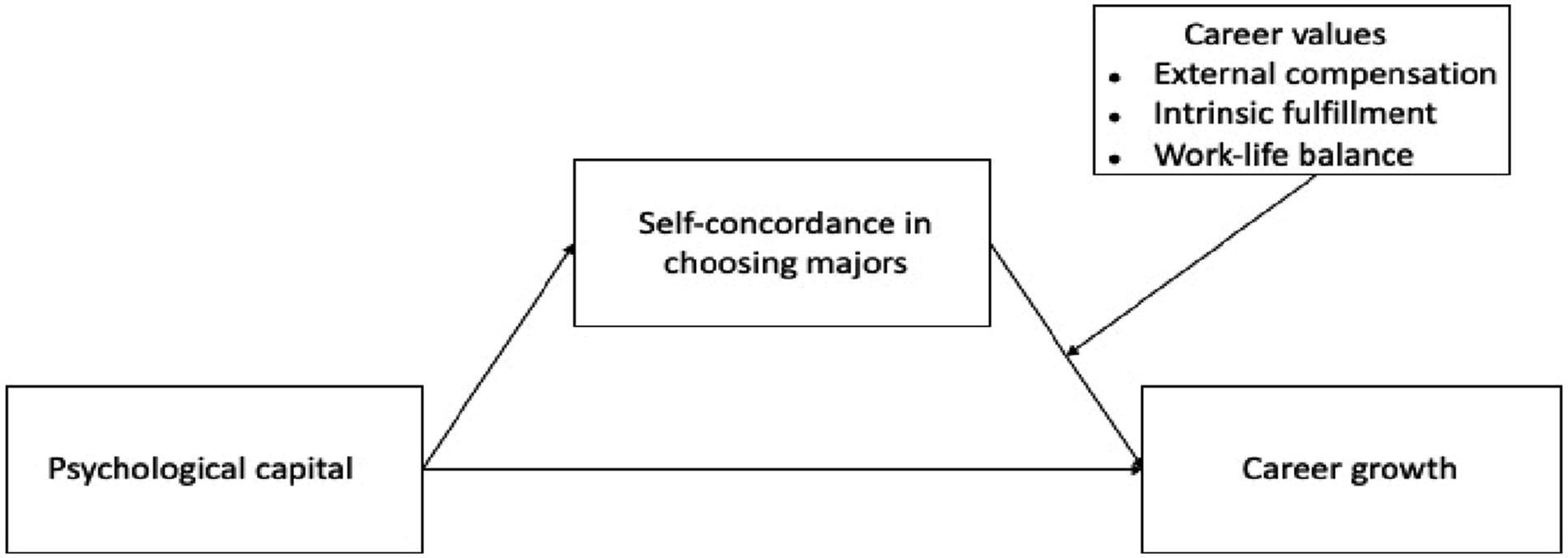
We tested our model in the Chinese context by following a sample of students for one year from their entry into university. Situating our study in this context has two further implications for its contribution. First, the Chinese context provided a setting in which the mediator, the level of self-concordance in choosing majors, was likely to vary and was of practical importance. Traditional career theories developed in the Western context (Super, 1980) emphasize the fulfillment of one’s interests and self-concept in career decisions, and it may be routine for university students in such contexts to choose their majors based on their interests. In the Chinese context, however, the choice of major is more complicated. Collectivist values (e.g., conformity, filial piety) and the educational environment (e.g., fierce competition for university entrance and constraints on major choice) constantly pressure Chinese students to consider external reasons for choosing a major, such as parents’ suggestion, social popularity, college entrance examination scores, and forced transfer due to insufficient scores (Fan & Chen, 2009). Thus, it is not taken for granted that Chinese students are able to choose a major that fits personal interest. In other words, the level of self-concordance of Chinese students in choosing majors may vary widely, making it possible to study its role. Because of the pressures they are likely to face in making major choices based on their own interests, providing empirical evidence on the long-term effects of such choices is important and informative for practice. The practical importance of examining the effects of major choice is further warranted by the fact that students in China choose a major before entering university, and once they have declared a major, they cannot easily change it.
Second, by using a Chinese sample, we further enrich the applicability of SDT and the concept of self-concordance in the collectivist culture. SDT is fertile for explicating the formation and influence of self-determination, even for those from non-Western cultures (Nerona, 2021). SDT-based studies from China have shown that psychological need satisfaction is essential for self-concordant motivation, which promotes optimal human development and well-being (Belle et al., 2022; Chang et al., 2016; Xu et al., 2021), supporting the application of SDT and self-concordance to collectivist contexts. However, research from these contexts applying SDT to students’ career choice and career development remains scarce (Nerona, 2021). Our study provides further evidence in this regard. The model of our study is developed in detail in the following part.
PsyCap and Career Growth of University Students
Career growth refers to the rate and chance of development and advancement in the current organization, which consists of the intrinsic (career goal progress and professional ability development) and extrinsic (promotion speed and remuneration growth) components (Weng & Xi, 2011). Since students’ career growth does not involve concerns about promotion and remuneration, this study focuses on the intrinsic components, which is consistent with Weng and Zhu’s (2020) recommendation to study the intrinsic and extrinsic components of career growth separately. Students’ career goal progress represents the extent to which academic study is relevant to and enables students to realize their career goals and aspirations, and professional ability development reflects the extent to which students acquire career-related knowledge and skills (Weng & McElroy, 2012; Xu et al., 2021).
PsyCap has been conceptualized as a state of positive mental development characterized by self-efficacy (i.e., the confidence to successfully complete challenging tasks), optimism (i.e., positive attributions for success), hope (i.e., positive attitudes toward setting and pursuing goals), and resilience (i.e., the ability to bounce back quickly from adversity; Luthans, Youssef, & Avolio, 2007). PsyCap represents the psychological capacity and motivational propensity to work diligently and implement adaptive behaviors, resulting in rewards for both individuals and organizations in different cultural contexts, including China (Luthans, Avolio, et al., 2007; Luthans & Youssef, 2017). Indeed, previous research has indicated that PsyCap can enhance positive psychological processes (e.g., empowerment, positive affect, effective goal setting) and produce well-being and positive workplace outcomes (e.g., positive coping, job satisfaction, innovative behaviors; Belle et al., 2022; Newman et al., 2014). PsyCap has also been associated with important career outcomes in employees. For instance, PsyCap was found to enhance employees’ career growth (Wang et al., 2018) and explain significant variances in objective and subjective career success (Zhou et al., 2015).
Although the relationship between PsyCap and career growth in student populations has not been directly tested, theoretically, there should also be a positive relationship. Based on the implications of PsyCap, students who are confident in taking on challenges, seeking alternative ways to deal with obstacles, believing in positive outcomes, and recovering quickly from setbacks will be motivated to work harder and not fear failure in goal pursuit. As a result, they have the motivation and resources to progress toward their career goals and develop relevant professional skills. Existing research has generally supported the positive impact of PsyCap for students, including increased study engagement, career engagement, and employability (e.g., Baluku et al., 2021; Belle et al., 2022). Based on these arguments and findings, we propose that:
PsyCap is positively related to university students’ career growth.
The Mediating Role of Academic Major Choice
Choosing an academic major upon university entrance in China is a challenging developmental task that requires students to consider several important factors. While traditional career theories developed in the Western context (Super, 1980) emphasize the satisfaction of one’s own interests in making career decisions, leading to self-concordant major choices, Chinese students consider many factors other than personal interest. They may choose a major to meet their parents’ expectations, or a socially preferred major leading to a prestigious career to bring honor to the family (Leung et al., 2011). They are also constrained in their choice of major by their college entrance exam scores (Fan & Chen, 2009). Since each major at a given university accepts a predetermined number of students each year, students are only accepted into their declared major if their scores are high enough to stand out among all the students who have declared the same major; otherwise, they may be transferred to other majors. Thus, students also tend to use their scores strategically when choosing academic majors. For these cultural and educational reasons, it is not taken for granted that students in China will choose majors in line with personal interest. Indeed, previous studies find that a high percentage of Chinese students show insufficient self-determination in their major choice, leading to major dissatisfaction and career decision-making difficulties (Leung et al., 2011; Ma & Yeh, 2005). Based on SDT, we argue that self-concordant major choices are also important for students’ long-term career development and the career growth they will experience, and that students with high PsyCap are more likely to endorse such choices. Therefore, we propose that self-concordant major choice serves as a mediator in the positive impact of PsyCap’s impact on students’ subsequent career growth within the university.
To elaborate, SDT holds that the satisfaction of basic psychological needs (i.e., competence, autonomy, and relatedness) can increase individuals’ self-determination in choosing goals and actions (Deci & Ryan, 2000, 2004). Since PsyCap represents “one’s positive appraisal of circumstances and probability for success based on motivated effort and perseverance” (Luthans, Avolio, et al., 2007, p. 550), people with high PsyCap may experience enhanced cognitive and motivational processes, feel more competent and autonomous to accomplish challenging tasks, and have more incentive to take proactive action toward their inner goals (Luthans, Avolio, et al., 2007). Thus, when it comes to the choice of major, students with high PsyCap may be in a better position to choose a major for self-concordance in the presence of external pressures. Indeed, empirical research has indicated that positive psychological states increase students’ self-determination in learning activities and career-related decisions. For example, Lin et al. (2015) found that Taiwanese students with high self-esteem had higher decision-making self-efficacy, which motivated them to choose a major based on their interests and abilities. Therefore, we predict that students’ PsyCap is positively related to self-concordance in choosing majors.
SDT also suggests that choosing goals for self-concordant reasons would motivate individuals to engage in goal-directed behaviors and contribute to self-actualization, better performance, and well-being (Ryan & Deci, 2000; Sheldon & Elliot, 1999). Therefore, choosing a major based on personal interest motivates students to engage in learning tasks, develop professional skills, and proactively seek information related to their future careers, all of which can enhance career growth. In addition, interest-major congruence is an indicator of person-environment fit that increases major satisfaction and academic performance (Nerona, 2021), which in turn can contribute to career growth. Indeed, Lin et al. (2015) found that students who chose a major that matched their interests and abilities were more involved in their major courses and consequently had higher career certainty. Hence, we predict that the level of self-concordance in choosing majors positively affects career growth. Taken together, we propose the mediating effect that:
Self-concordance in choosing majors mediates the effect of PsyCap on career growth.
The Moderating Role of Career Values
Career values represent individuals’ desired end-states and ultimate goals of career development (Rokeach, 1973), which guide their career activities and progress. In the Chinese context, three types of career values (i.e., the values of external compensation, intrinsic fulfillment, and work-life balance) were conceptualized in Zhou et al.’s (2013) model of career success criteria. The development of these success criteria was built on the existing career values model, but also captured context-specific career values in China. From a self-determination perspective, intrinsic fulfillment value represents the desire for inner satisfaction from a career, such as developing skills and engaging in challenging tasks, which can be categorized as intrinsic career values (Xu et al., 2021). In contrast, external compensation value (i.e., the desire for external benefits from a career, such as money and power) and work-life balance value (i.e., the desire for being able to take care of one’s family at work and having enough time to enjoy life) represent extrinsic career values, as both values reflect the tendency to achieve instrumental outcomes from one’s career (Zhou et al., 2013).
In this study, we further argue that the effect of students’ PsyCap on career growth via self-concordance in choosing majors may depend on students’ career values. First, we suggest that university students with high intrinsic fulfillment value may benefit more from choosing a major based on personal interest triggered by PsyCap. Since these students have a preference for deriving inner pleasure and satisfaction from career tasks, they are more likely to experience intrinsic motivation toward learning and career development activities that inherently interest them (Xu et al., 2021). According to SDT (Deci & Ryan, 2004), intrinsic motivation toward their academic and career activities further promotes persistence, engagement, and enjoyment in these activities (Lin et al., 2015), which leads to more progress in developing career-related abilities and achieving career goals, and thus career growth. Hence, we propose that:
Intrinsic fulfillment value positively moderates the relationship between self-concordance in choosing majors and career growth, such that the relationship is stronger when the value is higher.
Intrinsic fulfillment value positively moderates the indirect effect of PsyCap on career growth, such that the indirect effect is stronger when the value is higher. In contrast, extrinsic career values, including the values of external compensation and work-life balance, may mitigate the positive effect of choosing a major for self-concordance on career growth, as well as the indirect effect. Students with high external compensation value may not devote themselves to academic study simply because it interests them. Instead, the desire for external benefits may lead them to focus on performance goals rather than mastery goals in their academic and career activities (Xu et al., 2021). In other words, students who value external rewards tend to focus on achieving high grades or other accomplishments rather than mastering skills and knowledge in their learning and career development processes, thus weakening the positive effect of initial career interests on subsequent career growth. Previous research has suggested that extrinsic values can impede career-related activities and the development of professional skills (e.g., Xu et al., 2021). Similarly, students who place a high priority on the instrumental value of work-life balance prefer to establish a clear boundary between their work and life roles and may reduce extra work effort, which prevents them from fully utilizing their potential to pursue career goals and weakens the positive impact of intrinsic motivation on career growth. Accordingly, we propose that:
External compensation value negatively moderates the relationship between self-concordance in choosing majors and career growth, such that the relationship is stronger when the value is lower.
External compensation value negatively moderates the indirect effect of PsyCap on career growth, such that the indirect effect is stronger when the value is lower.
Work-life balance value negatively moderates the relationship between self-concordance in choosing majors and career growth, such that the relationship is stronger when the value is lower.
Work-life balance value negatively moderates the indirect effect of PsyCap on career growth, such that the indirect effect is stronger when the value is lower.
Method
Participants and Procedures
The data for this study were obtained from a longitudinal survey on the career development of Chinese university students. To increase internal validity and retention rate, the survey targeted students in business and management-related majors. The survey aimed to invite the participation of Chinese public comprehensive universities of different ranks (e.g., first-tier, second-tier) from various regions and cities that offer business and management-related majors. The design of the survey was longitudinal, aiming to follow students from their entry into university to their graduation, with a one-year interval between each data collection. The data used in this study were collected at two time points, with the first wave collected in 2021 (T1) and the second wave collected in 2022 (T2). Participants were at the beginning of their first year at T1 and at the beginning of their second year at T2.
Staff from the targeted academic department at each university helped recruit participants and conduct the data collection process. They invited students in their department to voluntarily participate in the study. Those students who agreed to participate signed the consent form and were informed of the general aim of the survey (i.e., to investigate students’ learning and career experiences). They were assured of the anonymity of their responses. Students also indicated at each round whether they were willing to participate in the next round of data collection and were assigned an ID for matching. At T1, 1351 valid responses were collected. After matching this sample with participants who provided valid data at T2 using the matching information, we obtained 705 matched cases (retention rate 52.2%) that were used for data analysis. We tested whether there were significant differences between the matched respondents and those who dropped out at T2. Results from the t test showed that there were no significant differences in PsyCap (t = −.27, p = .79) and self-concordance in choosing majors (t = .67, p = .50). In the final sample, 23.4% of the participants were male, which is consistent with the gender distribution of business and management students in China (Fan & Chen, 2009). The average age was 19.32 (SD = .71). Family income distribution (i.e., perceptions of one’s own family income status relative to other families in the same area) was: 12.6% low, 25.5% relatively low, 51.3% medium, 9.9% relatively high, and .6% high.
Measures
Unless otherwise noted, all measures used a 5-point Likert scale ranging from 1 (strongly disagree) to 5 (strongly agree).
PsyCap
Given the large number of questions in this longitudinal survey, PsyCap was measured at T1 using a short version of the PsyCap Questionnaire (PCQ; Luthans, Youssef, & Avolio, 2007), which consists of self-efficacy, hope, optimism, and resilience dimensions. In line with previous research conducted in Chinese samples (e.g., Zhou et al., 2018), items shown to have high factor loadings (e.g., “I always look on the bright side of things regarding my life”) were extracted from the full scale to reduce respondent burden. As a result, the current scale contained four items, one for each dimension. This scale showed good reliability in our study (
Self-Concordance in Choosing Majors
Consistent with previous research on academic major choice in the Chinese context (Fan & Chen, 2009), participants at T1 were asked to read an item stem (i.e., I chose this major…) followed by the possible reasons for choosing their majors: (1) personal interest, (2) parents’ suggestion, (3) social popularity, (4) college entrance exam scores, and (5) forced transfer to another major due to insufficient scores. For each of the five reasons for choosing majors, participants rated how true each reason was for them on a 5-point Likert scale from 1 (not true at all) to 5 (very true). According to SDT, the score on the item “I chose this major because of personal interest” was used to indicate the level of self-concordance in choosing majors. This one-item measure of self-concordant major choice has performed well in the education and career literature (e.g., Fan & Chen, 2009; Malgwi et al., 2005) and has been positively associated with theoretically relevant constructs such as academic major satisfaction (e.g., Fan & Chen, 2009). In addition, students’ levels of endorsement for the remaining four reasons were used as control variables in the data analysis (see also the “Control Variables” section).
Career Growth
At T2, career growth was measured by 7 items from a scale developed by Weng and Xi (2011). The scale was originally developed among Chinese employees with four dimensions and has shown good reliability (Cronbach’s alphas greater than .70 for all subscales) and validity (distinct from related but conceptually different constructs such as career success; positively related to its theoretical outcomes such as affective occupational commitment) in previous research (e.g., Weng & McElroy, 2012; Weng & Xi, 2011). Consistent with studies conducted among Chinese university students (e.g., Xu et al., 2021), we used the two intrinsic dimensions, namely career goal progress (3 items) and professional ability development (4 items), to measure university students’ career growth, as promotion and remuneration are irrelevant. Participants rated items for each dimension, such as “My learning experiences during university establish a foundation for the achievement of my career goals” and “My learning experiences during university encourage me to improve my professional abilities constantly.” The reliabilities of the career goal progress subscale (
Career Values
Career values were measured at T2 via a three-dimensional scale by Pan and Zhou (2015) consisting of external compensation value (3 items), intrinsic fulfillment value (4 items), and work-life balance value (3 items). This scale has shown good reliability (Cronbach’s alphas greater than .70 for the subscales) and validity (the three dimensions captured distinct values and were linked to career outcomes such as career adaptability and growth) in previous studies with Chinese samples (e.g., Pan & Zhou, 2015; Xu et al., 2021). Sample items for each dimension are “career success refers to that one can make a lot of money through his or her career,” “career success refers to that one is constantly engaged in challenging tasks,” and “career success refers to that one can have sufficient time to enjoy life after work.” Cronbach’s alphas in this study were .76, .74, and .81 for external compensation, intrinsic fulfillment, and work-life balance, respectively.
Control Variables
We controlled for gender, age, and family income to exclude the effects of relevant sociodemographic variables because previous research has suggested that these variables may affect career-related decisions and career development (Xu et al., 2021). In addition, because the other four reasons for choosing a major (parents’ suggestion, social popularity, college entrance exam scores, and forced transfer to another major) may also affect students’ career development (Leung et al., 2011), their levels were modeled as control variables for the effect of the level of self-concordant major choice on career growth. Analyses showed that the inclusion of the control variables did not influence the result pattern.
Data Analysis
We adopted path analysis to test the overall model and 5000 bootstrap replications with bias-corrected 95% confidence intervals to test the mediation and moderated mediation hypotheses (Edwards & Lambert, 2007) within Mplus 8.1.
Results
Descriptive Statistics and Confirmatory Factor Analyses (CFAs)
Descriptive Statistics, Reliabilities, and Correlations.

Note. N = 705. SC = self-concordance in choosing majors; OER = choosing majors for other external reasons; EXC = external compensation value; INF = intrinsic fulfillment value; WLB = work-life balance value. Gender (male = 1; female = 0). Family income (low = 1; relatively low = 2; medium = 3; relatively high = 4; high = 5). Cronbach’s alpha values are reported in bold along the diagonal.
* p < .05. ** p < .01. *** p < .001.
Before hypotheses testing, we conducted a series of CFAs to examine the validity of our multiple-item measures. Results indicated that the five-factor structure (PsyCap, three types of career values, and career growth) fitted the data well: χ2 (177) = 630.32, CFI = .91, TLI = .90, RMSEA = .06, SRMR = .06, and all the items loaded significantly on their intended factors (p < .001). We also compared the five-factor model with four alternative models (4-factor, 3-factor, 2-factor, and 1-factor), and results showed that our hypothesized model fitted the data significantly better than other models (comparisons available from corresponding author). Thus, our measures captured distinct constructs. As the single latent variable CFA model showed a poor fit to our data, common method variance was not a severe threat to our findings.
Testing Hypotheses
Results of Path Analysis for Models 1-4.

Note. Unstandardized coefficients are presented. Standard errors are reported in parentheses. Predictors are listed below each endogenous variable. H = hypothesis; SC = self-concordance in choosing majors; OER = choosing majors for other external reasons.
*p < .05. **p < .01. ***p < .001.
On the basis of Model 1, we further set Models 2–4, wherein we added career values and the interaction terms between self-concordance in choosing majors and career values to the model. Since the three types of values were correlated, we ran three models separately, including each value and the corresponding interaction term. As reported in Table 2, both the interaction term between self-concordance in choosing majors and external compensation value (Model 3: The Moderating Effects of Extrinsic Career Values in the Relationship Between Self-concordance in Choosing Majors and Career Growth. Note. SC = Self-concordance in choosing majors.
We further examined the moderated mediation hypotheses with the bootstrap method. Results showed that the values of external compensation and work-life balance, respectively, moderated the indirect effect of PsyCap on career growth through self-concordance in choosing majors. In particular, the indirect effect was stronger when the value of external compensation was lower (estimate = .05, 95% CI [.02, .08]), but not significant when the value was higher (estimate = .01, 95% CI [-.01, .04]). The difference between the two effects was significant (difference = −.04, 95% CI [-.07, −.01]). Similarly, the indirect effect was stronger when the value of work-life balance was lower (estimate = .05, 95% CI [.02, .08]), but not significant when the value was higher (estimate = .01, 95% CI [-.02, .03]). The difference between the two effects was significant (difference = −.04, 95% CI [-.08, −.01]). However, the moderating effect of intrinsic fulfillment value was not significant. Therefore, these findings offered support to Hypotheses 4b and 5b, but not to Hypothesis 3b.
Discussion
We aimed to contribute to the career literature by examining, for the first time, whether PsyCap leads to career growth among university students. We further proposed the mechanism of PsyCap’s effect on career growth in a crucial scenario for university students, the choice of academic major. Our hypotheses were tested in a two-wave study with a one-year interval across several universities in China. Results showed that PsyCap motivated students to endorse self-concordant major choices in the face of external impact, which further improved their career growth one year later. Moreover, extrinsic career values mitigated the positive effect of self-concordance in choosing majors on career growth, as well as the mediating effect.
Theoretical Implications
This study provides several theoretical contributions to the literature. First, although previous studies have shown the positive impact of PsyCap on career growth in employee populations (e.g., Wang et al., 2018), we were the first to find that students’ PsyCap upon admission to university improved their career growth one year later, thus extending the application of PsyCap’s positive influence on career growth to another important population (i.e., university students). In other words, we contribute by identifying an important personal factor that would affect this critical career outcome variable of university students, namely career growth.
Second, we make an additional contribution by revealing the mediating mechanism between PsyCap and career growth from the perspective of students’ career choices based on SDT. We found that students with high PsyCap were more likely to endorse self-concordant major choices in the face of external stressors. Choosing a major based on personal interest serves as a mediator between PsyCap and an important career outcome (i.e., career growth). Our findings extend the current understanding of the theoretical underpinnings of PsyCap’s impact on career outcomes based on career resources (Kauffeld & Spurk, 2022) and positive cognition (Baluku, et al., 2021) by adding career choice as a mechanism rooted in the SDT perspective. In doing so, we also contribute to the literature on PsyCap by answering the call for more empirical studies on the mediators of PsyCap’s positive effects in general (Luthans & Youssef, 2017; Newman et al., 2014).
Third, this study identified career values as a boundary condition. We indicated that career values would affect the benefit of using psychological resources to make a self-concordant major choice for students’ career growth. Our results provided empirical support for the negative moderating effect of extrinsic career values, adding to the literature by showing extrinsic values as a potential attenuating condition for the positive effects of self-concordance and PsyCap. However, the positive moderating effect of intrinsic career values was not supported. Specifically, we obtained a negative but not significant moderating effect. It is possible that the positive impact of PsyCap on career growth through self-concordance in choosing majors can be substituted by another motivational resource for achieving desired goals (e.g., intrinsic career values). Previous research has suggested that intrinsic career values would motivate students to find enjoyment in career tasks and to devote effort to career activities (Xu et al., 2021), thus probably providing a substitute benefit for the positive impact of self-concordance in choosing majors. Future research can examine which of the two hypotheses receives more empirical support, our original hypothesis that intrinsic values strengthen the positive effect of choosing a major that fits personal interest, or the competing possibility that intrinsic values weaken this effect.
Fourth, while many studies from collectivistic societies have examined the utility of SDT’s tenets and central variables (e.g., autonomy support, self-determined motivation, well-being; Belle et al., 2022; Chang et al., 2016), research from these contexts applying SDT to career choice and career development remains relatively scarce (Lin et al., 2015; Nerona, 2021). Thus, testing the mediating role of self-concordant major choice helps enrich the contextual applicability of SDT. In particular, we found that when other reasons for major choice in the Chinese context were included as controls, only choosing a major that matched personal interest significantly increased subsequent career growth. This provides strong support for applying SDT in a collectivist culture to guide the understanding of career choice and career development.
Implications for Practice
This study provides several suggestions for career professionals, parents, and teachers to help young adults cope with developmental challenges and attain career growth. First, given that PsyCap is a personal resource that can be developed, career professionals can provide programs to boost students’ PsyCap to increase self-determined choices and career growth. This endeavor is rewarding because it can raise awareness of the importance of psychological capacities for career development in addition to other traditionally emphasized abilities (Zhou et al., 2015). Moreover, since this study found the benefit of self-concordance in choosing majors for career growth, efforts should be made in the Chinese context to help students become aware of their own interests. For example, since Chinese students tend to fulfill their parents’ expectations, parents should be advised to support students’ autonomy in choosing majors to benefit their long-term career development. In this regard, career interventions aimed at effective major choice in collectivist cultures should involve both students and parents (Ma & Yeh, 2005).
Limitations and Future Research
This study has several limitations. First, although statistical analysis indicated that common method variance was not a serious threat to our results, the self-report nature of the measures is worth noting. Future studies may use objective indicators to measure our study variables, such as career growth. Second, because PsyCap was measured using a short scale, future studies can adopt the full scale to cross-validate our findings. However, the evidence of reliability and validity obtained in the pilot study provides some confidence in the use of the short scale. Third, our respondents were from business and management-related majors. Future research can examine whether the current findings apply to students from more diverse majors. Fourth, this study focused on the motivational mechanism between students’ PsyCap and career growth. As the results showed a significant direct effect of PsyCap on career growth, future research can explore other influence mechanisms (e.g., proactive behaviors) to deepen our understanding of the process. Finally, this study adopted a multi-wave design, and we encourage future studies to use a longitudinal or experimental design to further explore the causal relationships between our study variables.
Footnotes
Declaration of Conflicting Interests
The author(s) declared no potential conflicts of interest with respect to the research, authorship, and/or publication of this article.
Funding
The author(s) disclosed receipt of the following financial support for the research, authorship, and/or publication of this article: This work was supported by the National Social Science Fund of China; (21BGL142).
