




Abstract
An identifiable research gap in extant literature concerns how social institutions can develop more pro-sustainability attributes. Better collaboration is vital to enabling institutions to function effectively for sustainability. A conceptual scenario approach illustrates how multi-level institutions can be in fundamental conflict concerning sustainable development. A rich complexity of formal and informal institutions functions at global, regional, national, and local levels of human interaction in ways that influence both anti-sustainability and pro-sustainability behaviors, practices, and outcomes. The scenario approach underscores that the balance of anti-sustainability and pro-sustainability attributes is not readily assessed theoretically or empirically as a basis for improving social justice outcomes.
Keywords
Introduction
An identifiable research gap in extant literature is that scholarly understanding of likely conflicting relationships among formal and informal social institutions at multiple levels (global, regional, national, and local), generating negative impacts on sustainable development, is inadequate to address deteriorating global climate conditions. The specific research question addressed is why and how better alignment of these institutions and repurposing toward pro-sustainability attributes can be achieved, and more quickly. The paper proposes a conceptual scenario understanding of conflict among institutions concerning sustainable development.
The research gap concerns how conflicting, multi-level institutions affect sustainable development. Humans and their societies and communities have a marked long-term negative effect on the world’s ecological sustainability. This negative effect operates at least partly through the interactions of various likely conflicting institutions at multiple levels of human interaction. A negative effect has profound implications for social justice, as deteriorating environmental and social conditions will fall most heavily on poor populations. The research gap concerns our understanding of whether the set of social institutions in a particular empirical context generally helps support or helps resist sustainable development in that setting and, if the latter condition of resistance obtains, our understanding of what to do about the situation and how. ‘Relatively little is known about the structure of particular conflicts about global change at the local, national, and international levels or about which means will be most effective in dealing with them’ (Stern et al., 1992: 116). Stern et al. argued that forecasting human consequences of global environmental change requires information about future natural conditions, social and economic organization, values held by people, the effects of change on values, and the responses of people. Economic, political, cultural, and sociotechnical systems or social and economic organization as Stern et al. (1992: 102) use those terms are what this paper means by social institutions. Studies of individual behaviors tend to omit social and contextual influences within which behaviors occur (Hannibal et al., 2016).
International environmental governance arrangements are likely to prove insufficient without supportive social institutions. The Paris Agreement of December 2015, effective in 2020, is the first global legally binding climate agreement (UN Framework, 2015). The 195 participating governments agreed to a goal of keeping the future increase in global average temperature to 1.5 degrees centigrade above a pre-industrial level. However, the agreement extends for developing countries the time frame for undertaking steps to cause global emissions to peak as soon as possible. Once global emissions have peaked, the governments will undertake rapid reductions guided by scientific knowledge. Countries submitted, before or during the Paris conference, comprehensive national climate action plans titled ‘Intended National Determined Contributions’ (UN Framework, n.d.). Existing plans will not keep global warming below a 2-degree level (European Commission, 2015).
Deteriorating global climate conditions unavoidably place a heavy burden on conflicting social institutions. There is growing skepticism concerning whether we understand enough about sustainable development practices including sustainable consumption (John et al., 2016), and whether businesses can be expected to solve climate change (Minor, 2016; Oreskes and Schendler, 2015). Jones and Warner (2016) report pessimism concerning whether governments can achieve the Paris Agreement goal to limit global warming fast enough. World population and per capita consumption may increase through 2100. Half of increasing renewable energy needs must occur at 2028 to hold warming to 2 degrees centigrade. Governments have never met such challenges. Technology solutions may not prove sufficient, because value, institutional, and cultural changes are also needed (Beder, 1994: 19). Only a small set of future scenarios may even be available (Urry, 2010).
An ecological tipping point is a threshold at which a small change precipitates a sudden and irreversible negative change (Morello, 2012). Such a tipping point could be local, national, regional or global. What is widely debated is whether the planet as a whole is approaching such a tipping point, as well as how to define the global tipping point. A local tipping point would be when an animal or plant population disappears, or when sea level rises sufficiently to flood low-lying islands or coastal areas. The global tipping point will be a widespread collapse of conditions necessary for human life, or for a large human population.
The specific research question addresses why and how better alignment of these various institutions and repurposing toward pro-sustainability attributes can be achieved, and more quickly. Social institutions – in addition to exhibiting environmental resilience (Bednar, 2016) and adaptability (Chaffin and Gunderson, 2016; Koontz et al., 2015) – can either support or resist sustainable development (Dasgupta and De Cian, 2016).
The paper formulates a conceptual scenario understanding of conflict among institutions concerning sustainable development. Stern et al. (1992: 101) think of future human consequences of some specific change in the natural environment as dependent on assumed scenarios for society, human values, and human responses. A scenario is an analysis of conditions, whether current or projected to occur in the future (Godet and Roubelat, 1996). Scenarios have been used in sustainable development research including environmental and social dimensions (Boron et al., 2016; Kishita et al., 2016). The approach formulates key scenarios that help reveal what is involved in assessing whether a set of social institutions supports or resists sustainable development. This paper adapts the scenario approach to social institutions from the periodic National Climate Assessment (NCA), in which climate change scenarios are both analysis of current conditions and projections of trends into the future (USGCRP, n.d.).
Problems in Conceptualizing Sustainable Development
Sustainable development is a tension between sustainability and development that involves a poorly conceptualized and measured triple bottom line of economy, society, and environment. The tension involves measurement and then aggregation of indicators not on a common system (Slapper and Hall, 2011). Sustainability involves three related problems: climate change, population growth, and minimum per capita wealth. The latter measure addresses poverty as distinct from the average per capita wealth which may conceal considerable poverty within societies. Population growth and economic development to generate rising minimum per capita wealth place stress on climate change, and this stress may rise faster than either technological solutions or institutional improvements.
Sustainable development and sustainability are contestable ideas (Connelly, 2007). The term sustainable development has been used in various ways yielding multiple meanings, and thus it is difficult to pin down the concept with precision. Basically, the idea attempts to combine environmental concerns with socio-economic concerns, particularly about widespread poverty and inequality. The Brundtland Report (WCED, 1987: ch. 2) defined sustainable development as meeting ‘the needs of the present without compromising the ability of future generations to meet their own needs’. The ‘essential needs’ of the poor received overriding priority, and ‘limitations imposed by the state of technology and social organization’ received recognition. In a triple bottom line expression, material wealth should increase without damaging the natural environment and while increasing equity within societies. Institutionally, ‘Development involves a progressive transformation of economy and society’.
Hopwood et al. (2005) provide a classification and mapping of different approaches to sustainable development. Their emphasis is on the associated political and policy frameworks and the stance towards change and means of change. The authors argue that sustainable development needs greater clarity of meaning. Their view is that this meaning should concentrate on (1) sustainable livelihoods and well-being rather than on material ownership of goods and services, and (2) long-term environmental sustainability – in ways that link social and environmental dimensions to human equity. This definition emphasizes equity within a condition of environmental sustainability.
There are two fundamental debates concerning sustainable development. One debate is about whether sustainable development – meaning the combination of sustainability and economic development – is technically and politically feasible (Frugoli et al., 2015; The Economist, 2015). Arguably sustainable development is a desirable condition rather than a feasible condition. One consideration in resolving this debate is that sustainable development is a complex aggregation of multiple dimensions at global, regional, national, and local (that is, sub-national) levels. The other debate is about whether sustainable development is best achieved through relatively unregulated market processes or through detailed governmental guidance. There is an absence of consensus concerning the best path forward toward sustainable development, or at least improvements in sustainability and development.
The technical and political difficulties embedded in sustainable development are evident in the multiple goals advanced under that rubric. On 25 September 2015, the UN Sustainable Development Summit adopted a 2030 Agenda for Sustainable Development (UN Sustainable Development Goals, 2015). This agenda includes 17 Sustainable Development Goals (SDGs) to be achieved by 2030. Composition of the goals is revealing: the goals address growth, equality and justice, and sustainability. The first three goals seek to end poverty and hunger (including nutrition deficiencies), and promote health and wellbeing. The next nine goals address inequality, injustice, and sustainability in: education; gender; water and sanitation; energy; economic growth and employment (including decent work); infrastructure, industrialization, and innovation; intra-country and inter-country inequality; human settlements; and consumption and production. The final four goals concern climate change; marine conservation and sustainability; terrestrial ecosystem conservation, sustainability, and biodiversity; peaceful and inclusive sustainable development including ‘justice for all’ and ‘accountable and inclusive institutions at all levels’; and global partnership for sustainable development.
Rising average atmospheric temperature and rising sea levels are rough indicators of worsening environmental conditions. We do not have good, systematic measurements of various dimensions of sustainable development available in a way that permits estimation of trade-offs, and whether the causes might be attributable to developed or developing countries (Frugoli et al., 2015). Like the 1997 Kyoto Protocol, the Paris Agreement postponed emissions-reductions activities for certain developing countries such as Brazil, China, and India. The required indicators may have to be built from detailed local data (Mallampalli et al., 2016; Marnika et al., 2015). Disclosure and reporting efforts are steps in the required direction (Ganda and Ngwakwe, 2013). There are various approaches for sustainability measurement and development measurement (UN Sustainable, n.d.). The key difficulty with all these data efforts is that we have no cause-and-effect framework or model for how to aggregate for a more systematic picture of progress (or anti-progress) on key dimensions of sustainable development. It is possible that poverty is decreasing while sustainability is failing.
Barnett (2004) contrasts the competing approaches advocated by the World Business Council for Sustainable Development (WBCSD) and the International Forum on Globalization (IFG). The WBCSD supported economic (or market) globalization for generating opportunities (Holliday et al., 2002). The IFG criticized that approach as promoting global megacorporations at the expense of more desirable locally owned enterprises (Cavanagh and Mander, 2004). There is a fundamental difference between competing approaches and substitute approaches: the former are mutually exclusive or non-substitutable. For instance, in climate change skepticism, preferences for free enterprise and preferences for social order are mutually exclusive (Rossen et al., 2015). A global accord to cooperate against climate change and national policies to the same effect are substitutable: the purpose of the global accord is to alter national policies in the same direction.
Sustainable development will involve design of integrated approaches that can increase environmental sustainability, reduce environmental damage, and sustain social and economic prosperity (Khalili et al., 2015). This conception has broad scope of included dimensions and long-term time horizons; sustainable development may involve significant institutional and behavioral transformations (Khalili et al., 2015).
The Sustainable Development Impacts of Social Institutions
Society, environment, and sustainability are very general conceptions which can be defined and measured in varying ways, and interacting at global, regional, national, and local levels. Voluminous literatures include diverse fields of environmental governance (Baron and Lyon, 2011), environmental sociology (Longo et al., 2016; Stuart, 2016), political ecology (Scoones, 2016), social ecology (Hausknost et al., 2016), and sustainable development (Hopwood et al. 2005). Sustainability is the central concept across these literatures (Amui et al., 2017; Lockie, 2016; Montabon et al., 2016).
Lehtonen (2004: 199) maintains that: ‘The social dimension has commonly been recognised as the weakest “pillar” of sustainable development, notably when it comes to its analytical and theoretical underpinnings’. Hugé et al. (2016) call for research into how social institutions can restrict or enable sustainability, and how sustainable policies and practices can transform those social institutions. Purushottam (2016: 409) emphasizes that ‘addressing sustainable consumption … requires multiplicity of approaches, collaboration of multiple institutions and coordination, synergy and cohesiveness among various institutions’.
The research gap concerns whether social institutions are or can be more pro-sustainability as distinct from resilient or adaptive to coming environmental changes. Social institutions are embedded within and interact with other complex systems (Anderies, 2015; Fuenfschilling and Truffer, 2016). Lehtonen (2004) provides an assessment of two key approaches to addressing the social dimension: capabilities and social capital. The purpose of the assessment is to help explore the interfaces among society, economy, and environment – on the possibility that the synergies and trade-offs among these three ‘pillars’ of sustainable development are what will matter most. That author further argues that a full three-way analysis (economy-environment-society) is required, and that the several two-way analyses (economy-environment, economy-society, and environment-society) will be insufficient.
Figure 1 provides a depiction of the general conceptual framework for this paper. The first argument, shown at the left of the figure, is that social institutions function at multiple levels of human interaction: global, regional, national, and local. These institutions have multiple impacts on the various elements of sustainability and development, shown at the center of the figure. ‘Sustainability’ is the aggregation of the sustainability elements. ‘Development’ is the aggregation of the development elements. These impacts by element may be positive, neutral, or negative in sign. ‘Sustainable development’ shown at the right of Figure 1 is the aggregation of sustainability and development.
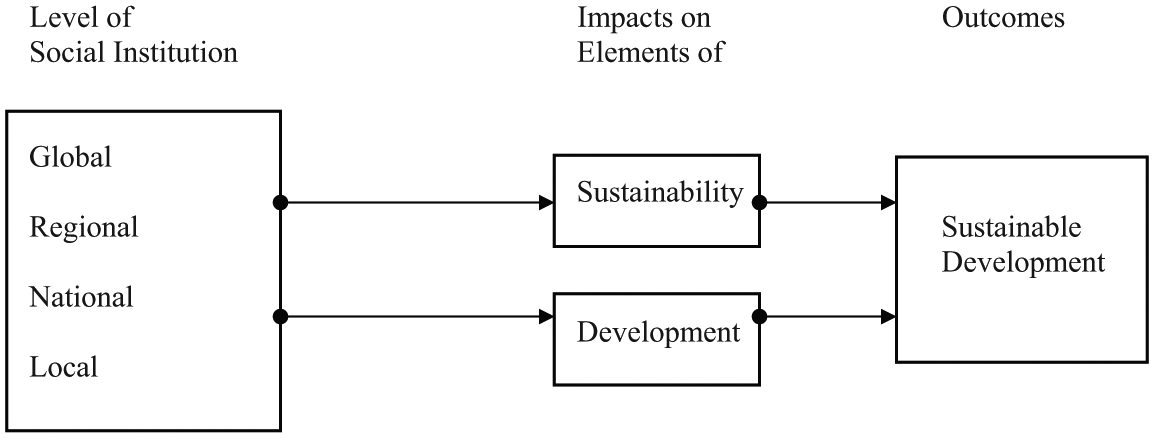
The relationship of social institutions to sustainable development outcomes.
Whether institutions are intervening variables or basic causal forces is not resolved (Young, 2002). A causal chain (X influences Y influences Z) is much easier to model and test than a causal cluster (X, Y, and Z mutually influence one another) (Anderson, 1983).
A model of these relationships will need a variety of key indicators. A problem with existing systems of indicators is that they may include unresolved conflict between sustainability and development. A system of key indicators should function approximately as follows. At each level of social institution, there should be indicators of change toward pro-sustainability behaviors and practices. Pro-sustainability alignment occurs when these indicators are sufficiently positive at all levels. If the levels are in conflict, it is difficult to ascertain whether influences on sustainable development or positive or negative. Key indicators of sustainability could include shifting toward higher proportion of renewable energy sources, lower energy consumption per capita, reduction of net population growth to zero and then decline in world total population, reduction of climate endangering emissions, lower non-energy consumption per capita, increased recycling per capita, increase in populations of endangered species, and similar measures. Key indicators of development could include increased real income per capita, reduced inequality of the distribution of wealth and income, increased health and longevity measures, increased individual happiness, and similar measures. Pro-sustainability attitudes and beliefs, behaviors, and practices could also be measured. Progress toward the 17 SDGs to be achieved by 2030 is also important.
Social Institutions
Relative importance of formal and informal social institutions in sustainability and development remains under investigation (Casson et al., 2010). A formal institution is regulatory of human behavior and readily recognized as such. Family regulates relationships among close kin. Not necessarily regulatory, an informal institution is more broadly human behavior that occurs regularly and may not be readily recognized as such except by the participants. Mutual help and family assistance is an example. This informal institution may be repeatable elsewhere if specific conditions are supportive. The term ‘social institution’ as used in social science literatures generally conveys a relatively stable social structure occurring in some form that organizes relatively stable patterns of human activity (Turner, 1997: 6). Structure and pattern have the general sense of ‘a complex of positions, roles, norms and values’ (Turner, 1997: 6). Institution implies ordered rather than chaotic. What makes a structure and pattern is positions and roles that are independent of the individuals in those positions and roles.
Beyond this general meaning of social institution, there is some very important variation in specification of the forms. A typical conception of basic or primary institutions specifies how a number of essential areas or needs of human life are handled. These basic or primary institutions are a natural or organic set of institutions evolving in a human society or community without deliberate planning. This natural set of institutions conventionally includes at a minimum: family and clan (concerning kinship); government (concerning legitimate authority and power); economy and work (concerning distribution of goods and services); education (concerning transmission of knowledge, including norms and values) to the next generation; and religion (concerning the supernatural or metaphysical). These institutions can be regarded as normative systems in the sense that they all embed norms and values. One might expand this set to include for instance health care, as provided in all societies in some way (OECD, 2010). The typical conception of basic or primary institutions does not as such specify form. Government might be a monarchy, or republic, or one-party dictatorship. Economy might be a system of relatively free markets not closely regulated by government, or a planned command economy tightly controlled by a one-party dictatorship. The theory of social institutions classifies human activity into different kinds, and accepts that such institutions can change over time and can vary both across and within different societies.
There is a secondary conception of what are often labeled institutions that are more deliberately planned rather than naturally evolved. Harre (1979: 97) notes such instances as schools, police forces, and the British monarchy. One can add churches and hospitals, as organizational instances of religion and health care. The conception is secondary in the sense that one can speak of the set of schools as the formal education institution (or system), or of the set of churches as the organized religion institution (or system) – bearing in mind that education and religion occur also within the family. I maintain the distinction between primary and secondary conceptions of social institutions, because deliberately planned change in the organizations (including positions, roles, norms, and values) may influence (positively or negatively) the functioning and impacts of the basic institutions which can be composed in reality of such organizations (Benn, 2009).
A typical concern in sociological investigation of institutions is the consequences for social inequality and social control. Positions, roles, and resources may be distributed in highly inequitable patterns. Social control may be highly concentrated. This paper addresses consequences of social institutions for sustainable development analogously. Outcomes of anti-sustainability practices tend to fall adversely and unjustly on the poor.
Effects of Social Institutions on Pro-Environmental Behavior
We know relatively little about how social institutions may affect pro-environmental behavior and consumers’ maximum willingness to pay for environmental improvements (Steg and Vlek, 2009). Substantive literature on these topics is not well integrated with study of social institutions. An empirical study, based on cognitive stress theory, found that environmental stressors (such as pollution experienced by the individual) mediated through individual appraisal processes can help activate problem-focused coping and increase pro-environmental behavior in various domains (such as social engagement, private conduct, or workplace conduct). The study also found support for the importance of collective efforts (Homburg and Stolberg, 2006). While there is reason to think that pro-environmental behavior can be increased, at the individual level there are multiple measures of pro-environmental behavior. Markle’s (2013) review of 49 studies found 42 unique measures of pro-environmental behavior.
Illustrating the Likelihood of Conflict among Social Institutions
Formulation of the key scenarios in this paper reveals that five considerations appear to be important. First, one must identify the kinds of social institutions that are relevant to sustainable development. Second, one must determine whether the specific institution supports or resists sustainable development. Third, one must identify the relative weights of these social institutions in impacts on sustainable development. Fourth, within each scenario, it proves useful to distinguish between effects on environmental sustainability and effects on economic development. Fifth, because the four considerations above are likely to context specific empirically, aggregation and disaggregation of effects among levels of analysis (global, regional, national, and local) can be important.
Three scenarios are sufficient to demonstrate the approach and its potential role in helping to address more effectively the identified research gap. A highly pessimistic scenario and a highly optimistic scenario are simply reverses of one another, such that a single table can be used to illustrate the polar-opposite scenarios. One can think of a continuum anchored at each end-point by these two scenarios. In a highly pessimistic scenario, all relevant social institutions in a particular empirical setting resist sustainable development. In this scenario, social institutions undermine environmental sustainability while promoting economic development. All social institutions are negative with respect to environmental sustainability. In a highly optimistic scenario, all social institutions in a particular empirical setting support sustainable development. All the institutions are positive with respect to environmental sustainability. In either a highly pessimistic or highly optimistic scenario, the relative impact weights have importance in informing how one might proceed to improve pessimistic conditions or to reinforce optimistic conditions. Lying along the continuum between highly pessimistic and highly optimistic scenarios is a potentially relatively large set of mixed scenarios in which with multiple possible variations some social institutions support and some social institutions resist sustainable development. In mixed scenarios, the relative impact weights are especially important in assessing future conditions and how to promote sustainable development. A separate table is necessary to illustrate a mixed scenario.
Tables 1 and 2 illustrate the likelihood of conflict among social institutions in hypothetical situations. Table 1 illustrates how social institutions might well work against one another. Since both positive and negative impacts on sustainable development are possible, negative impacts could outweigh positive impacts and additionally the aggregate or net sustainable development outcome can be difficult to estimate. Table 2 then illustrates how ideally the same social institutions might reinforce each other in ways that could have positive impact on sustainable development. The table uses selected examples of positive impacts. Both Tables 1 and 2 concern hypothetical illustrations.
Hypothetical illustration of the possible mixed effects of social institutions on sustainable development.
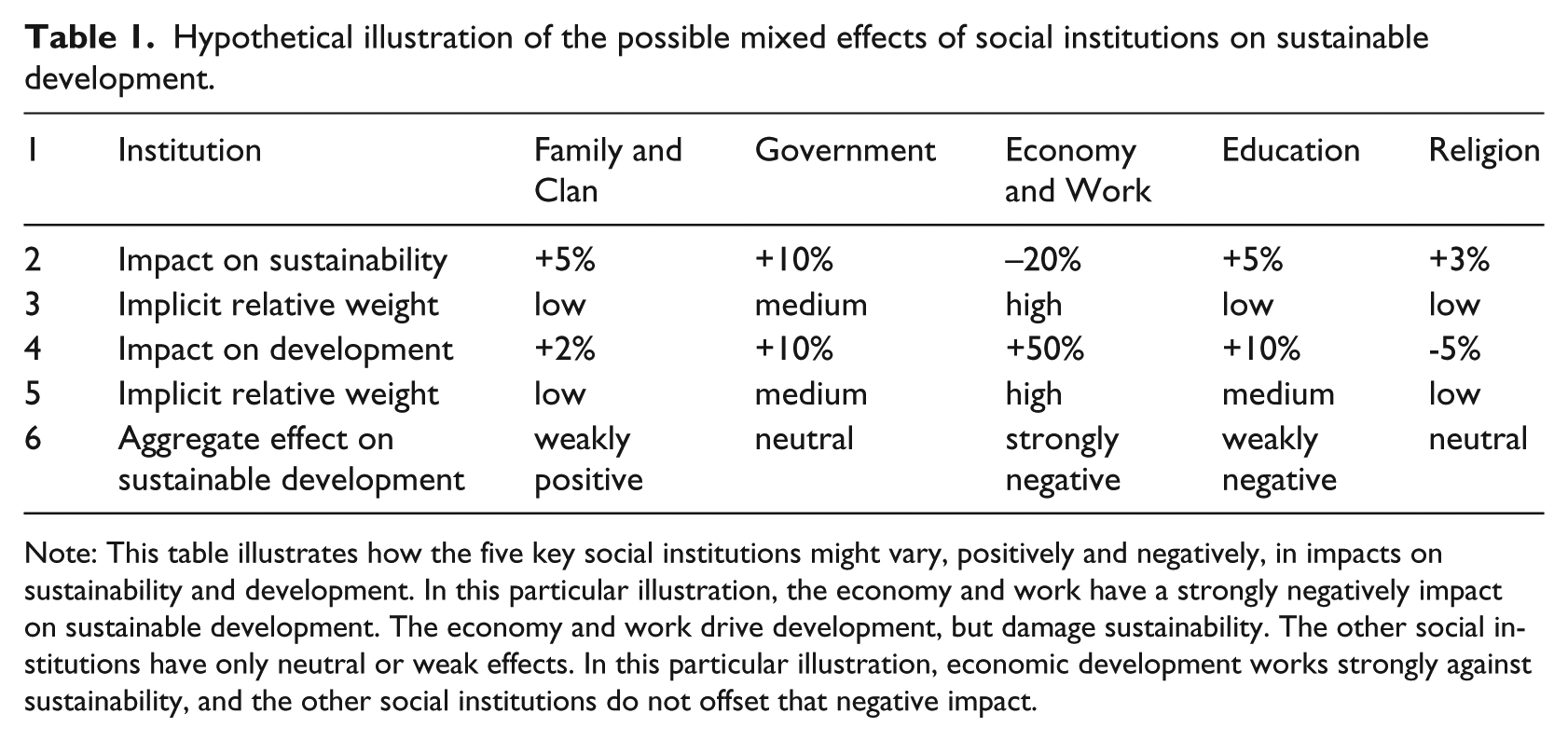
Note: This table illustrates how the five key social institutions might vary, positively and negatively, in impacts on sustainability and development. In this particular illustration, the economy and work have a strongly negatively impact on sustainable development. The economy and work drive development, but damage sustainability. The other social institutions have only neutral or weak effects. In this particular illustration, economic development works strongly against sustainability, and the other social institutions do not offset that negative impact.
Idealized illustration of fully positive impact of social institutions on sustainable development, with selected examples.
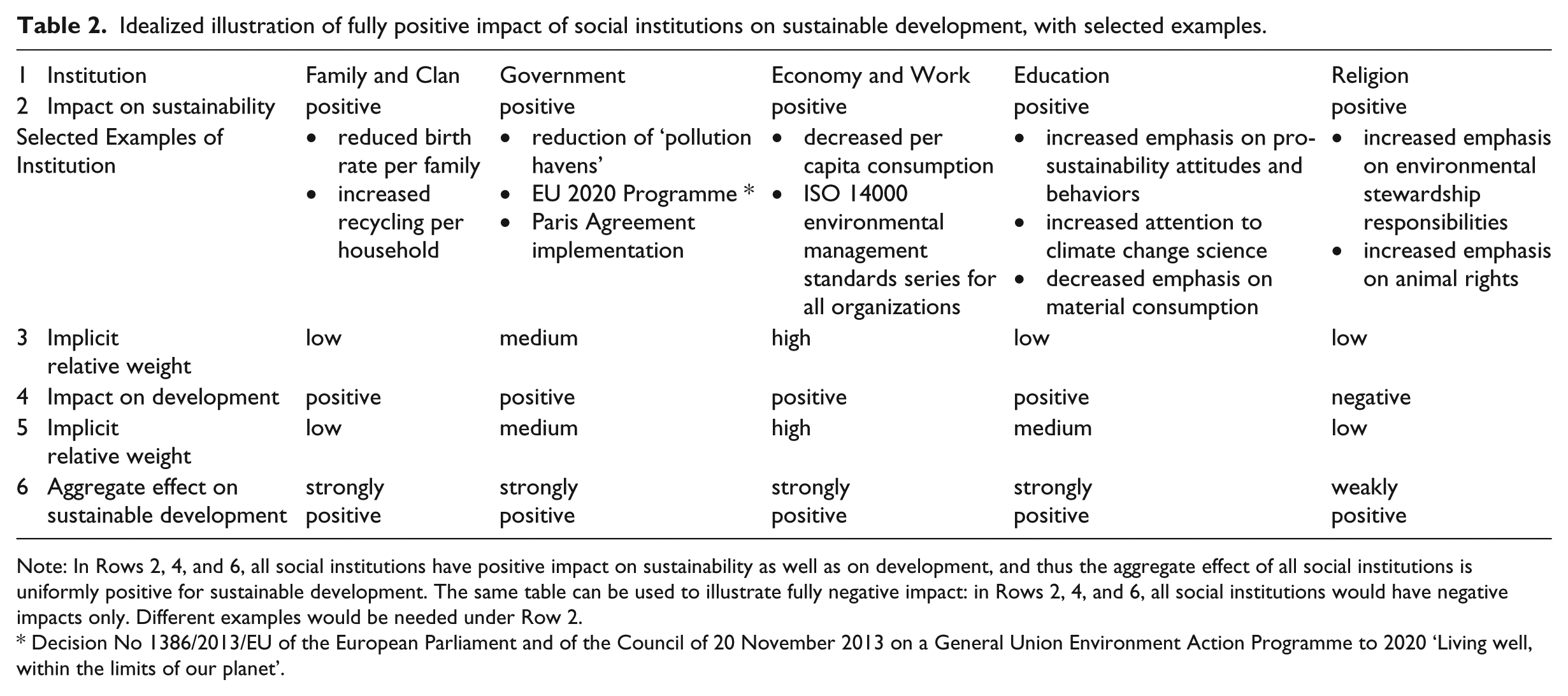
Note: In Rows 2, 4, and 6, all social institutions have positive impact on sustainability as well as on development, and thus the aggregate effect of all social institutions is uniformly positive for sustainable development. The same table can be used to illustrate fully negative impact: in Rows 2, 4, and 6, all social institutions would have negative impacts only. Different examples would be needed under Row 2.
Decision No 1386/2013/EU of the European Parliament and of the Council of 20 November 2013 on a General Union Environment Action Programme to 2020 ‘Living well, within the limits of our planet’.
For purposes of illustration, this paper posits a society of five basic or primary social institutions, more naturally evolved over time than deliberately planned. The five key social institutions affecting pro-sustainability and pro-development behaviors are likely to be family and clan, government, economy and work, education, and religion. One can reduce or expand the number of social institutions through refined theorizing and better evidence, but the object of Tables 1 and 2 is to illustrate the impact of social institutions on sustainable development.
To assess the consequences of these social institutions on sustainable development, it is necessary first to estimate impact of the institution on sustainability and on development separately, and then to estimate the aggregate impact of all the institutions on sustainable development. Impact includes the direction (sign) of relationship between a given institution and sustainability or development, and also weight of the relationship relative to other institutions.
The first row of Table 1 lists the classical five institutions. The second row provides hypothetical estimates of impact on sustainability, shown as sign (positive, neutral, or negative) and weight (a number). The third row provides the associated implicit relative weight, along a scale from zero through low and medium to high. In this illustration, economy and work have a strong negative effect on sustainability. The fourth and fifth rows provide hypothetical estimates of impact on development. In this illustration, economy and work have a strong positive effect on development. The sixth row estimates the aggregate effect on sustainable development. For this hypothetical illustration, economy and work is strongly negative, working against sustainability and working for development. Government and religion are both neutral overall. Family is weakly positive, and education is weakly negative. While the estimates in Table 1 are hypothetical, the estimates are selected to convey a baseline assessment in which the economy negatively affects sustainable development by undermining sustainability while promoting development. Government and religion are neutral; family and education are weak influences.
Table 2 provides an idealized scenario in which all institutions support sustainable development. There are two alternatives. Balanced sustainable development prevents further damage to sustainability, while maintaining development. Desirable sustainable development improves sustainability, by making sustainability more important than development.
The most general form of the problem under investigation can be illustrated by an estimation model with five social institutions (here labeled A, B, C, D, and E) and five corresponding weights (a, b, c, d, and e). The set of institutions can be reduced or expanded. SD (sustainable development) is the target or dependent variable; and X is the set of all other influences on SD (and the corresponding weight x). In the version shown below, all the influences on SD are positive. However, it is possible that X is the largest influence.

Both sign and weight can vary. Thus some signs might be negative or neutral (zero) rather than positive. The exact opposite of the version above is shown below. Combinations in between these two extreme cases could be indeterminate, meaning that the various dimensions are in conflict relative to effects on sustainable development. A significant consideration is that X may outweigh the social institutions in combination, and have the opposite sign (whether positive or negative).

Global, Regional, National, and Local Levels
A next step is to connect hypothetical illustrations in Tables 1 and 2 concerning five social institutions with real conditions in countries adhering to the Paris Agreement. Table 3 illustrates this connection for Germany in the European Union, and China in East Asia. These two countries are selected explicitly to illustrate extreme differences. The two countries are deliberately contrasted: Germany is pro-sustainability; China remains pro-development.
Illustration of the aggregation problem for a particular dimension of sustainable development, with examples.
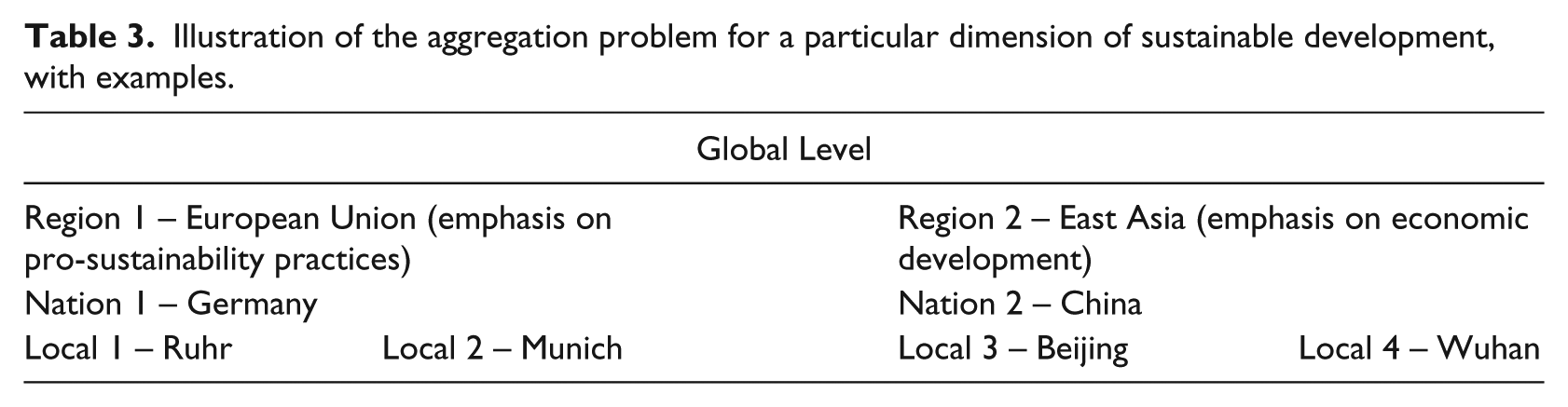
There are multiple institutions functioning at global, regional, national, and local levels. Local and even national institutions are more likely to have evolved than to be designed. Regional and global institutions are more likely to be designed in some way rather than to have evolved. Table 3 illustrates the aggregation problem in simplified terms. There are four localities (Depietri et al., 2016; Tan et al., 2016) – two in each of two countries, each of which is in a different region, Europe and East Asia (Simon, 2016). In one country, local 1 might have a positive effect on sustainable development, while local 2 has a negative effect. In another country, local 3 might have a negative effect, while local 4 might have a neutral effect. Aggregating these local effects to nation and then to region involves figuring out weights for which effects are more or less important. The same aggregation problem multiplies across countries and regions to the global level. Plainly, if all local effects are negative for air quality, then global air quality will worsen. If all local effects are positive for air quality, then global air quality should improve. New Delhi, India, reportedly has the world’s worst air pollution; and recently there have steps to control traffic usage in order to reduce the air pollution levels and effects.
Table 3 illustrates the aggregation problem, for any specific dimension of environmental sustainability, by a comparison of the European Union (basically Western Europe) using Germany as a key developed economy and East Asia using China as a key emerging economy. Both Germany and China are adherents to the Paris Agreement. The rationale in using Germany and China is explicitly that they are at relatively opposite ends of a continuum between pro-sustainability (Germany in the European Union) and pro-development (China in East Asia). Germany (like much of the European Union) is much further along in sustainability policies and practices than is China (like various other countries in East Asia) which is both much further behind and much more focused on economic development. This difference is likely detectable at the urban level, contrasting the Ruhr to Wuhan. Within each country, Table 3 points to a specific highly urbanized area.
The European Union is officially committed to sustainable development and pro-sustainability practices (European Council, 2009, No. 21). One would expect, ideally, to find relatively little local variation within Germany between the Ruhr (a manufacturing zone) and Munich (a major city). However, the kinds of air pollution and the costs to prevent or offset may vary locally. In Germany, the Ruhr Valley is a historically key coal and steel economic region that has restructured toward a more diversified economy, with possible lessons for China (Taylor, 2015). Restructuring and environmental policies have helped reduce air pollution (Gladtke, 1998; Goess et al., 2016). Within the European Union, Germany has been pro-active with respect to environmental responsibility policy and promoting green growth; Germany has a strong environmental framework; it has pioneered in environmental protection and sustainable development (OECD, n.d.[b]). More significantly, there is a strong pro-environmental policy framework and pro-environmental behaviors in Germany (Binder and Blankenberg, 2016; Moser, 2016). Sustainability improvements in Germany (Dimitriou and Kassomenos, 2017, Miehe et al., 2016) may be offset by sustainability reverses, or slowing pace of improvement. France, Italy, or UK might serve as illustrations in Table 3.
In a Germany-like setting, we can conceptualize a sustainable lifestyle encouraging anti-consumption behavior (Black and Cherrier, 2010). We can formulate a theory of consumer social responsibility (Caruana and Chatzidakis, 2013). However, much of ethical consumption discussion may be hortatory and prescriptive (Garcia-Ruiz and Rodríguez-Lluesma, 2014). Similarly, we can conceptualize sustainable business and formulate a theory of corporate social responsibility (Campos et al. 2015; Garcia-Rodríguez et al., 2013; Glavas and Mish, 2015; Kolk, 2016), including decomposition to various types of stakeholders affecting or affected by corporate sustainability (Antolín-López et al. 2016). There are case studies of such sustainability approaches in operation, as in tea (Mzembe et al., 2016), salmon (Iizuka and Katz, 2015), and partnerships (McAllister and Taylor, 2015).
In East Asia, China has a strong emphasis on economic development, although recently a signatory of the Paris Agreement with a postponement in compliance date (Albert and Xu, 2016; Stern and Zha, 2016; Zhang et al., 2016). Again, there may be significant variations within China, between for example the national capital Beijing (which suffers auto air pollution and is near the Gobi Desert) and Wuhan (a major manufacturing center). China is officially committed to ‘achieving a green economy’ (OECD, n.d.[a]). China is engaged in ‘rapid industrialization, intensified agricultural production and urbanisation’ with a growing population creating high demand for energy and other resources, ‘increased pressure on ecosystems’, and consequent adverse effects on health outcomes (OECD, n.d.[a]). Chinese urban pollution is bad (Wang et al., 2016). China is both the world’s largest polluter and the largest investor in green energy (The Economist, 2013). In China, there is government resistance to environmental activism – in part because any activism may be viewed as a danger to the Communist Party’s domination of government (Duggan, 2015); and Chinese sustainability efforts are much less developed at present (Jennings, 2016). India, Japan, or South Korea might serve as illustrations in Table 3.
Pro-sustainability actions might occur at global (Campbell et al., 2016), regional (Boeuf and Fritsch, 2016), national (OECD, n.d.[b]), and local (Shinn, 2016) levels. More such actions should be better than fewer such actions. What seems to be missing is evidence that the proliferation of pro-sustainability actions have had sufficient effect on improving sustainable development to date. Otherwise the Paris Agreement would not be so widely praised for finally making progress toward climate change control. Both sustainability and development may have stalled in much of the world. This conclusion does not necessarily rest on findings that existing governance regimes have failed technically and politically. A study of biodiversity efforts does conclude that there has been poor performance, and views improvement as challenging (Clement et al., 2015). Another possibility is that environmental improvements are not fast enough to match what is happening at the global level to atmospheric temperature, polar and glacier melting, and sea level rise. Environmental governance efforts can be improving but not achieving sufficient progress globally (Duit, 2016).
Environmental Governance Regimes
‘Contemporary global governance architecture has been described as fragmented, incoherent, and inefficient’ (Graham, 2017: 1). The December 2015 Paris Agreement and March 2015 Sendai Framework on Disaster Risk Reduction are key instances of negotiated international environmental policy regimes agreed to by multiple governments. The Sendai Framework (2015), a voluntary non-binding agreement, aims at reducing global disaster mortality by 2030 through various measures to be implemented. Increasing reliance on such policy regimes (Stattman and Gupta, 2015), by both governments and private parties, should lead us to regard the negotiated regimes as formal social institutions. The problem is that effectiveness of these regimes may depend on pro-environmental behaviors fostered by traditional social institutions.
A policy regime defines desired behaviors, practices, norms, and values which are accepted by regime participants. Such negotiations are understandably dominated by national governments. Witter et al. (2015) isolates the less transparent role of non-state delegates who may influence negotiations through various strategies and relationships. The authors emphasize the participation of indigenous peoples and local community delegates at the Tenth Conference of Parties of the Convention on Biological Diversity (CBD COP10), during October 2010 in Nagoya, Japan. The study’s broad implication is that diverse actors use multiple ways across networks to influence environmental governance negotiations and outcomes.
We can certainly conceptualize and theorize about environmental governance regimes (Kamigawara, 2015). However, a review of regime complexity in global environmental governance finds both regime fragmentation and fragmentation of the academic discussion (Visseren-Hamakers, 2015). There are multiple concepts. Visseren-Hamakers (2015: 136) lists: ‘inter-organizational relations, polycentric governance, integrated management, landscape governance, environmental policy integration, coordination, mainstreaming, coherence, policy mixes, governance architectures and systems, regime complexes, institutional interaction, metagovernance and the nexus approach’. That author argues that both academics and practitioners are increasingly calling for synergies – which that author labels as the need for ‘integrative environmental governance (IEG)’.
Global means international arrangements, such as the Paris Agreement and Sendai Framework. Regional means multilateral arrangements, such as the European Union or Organisation for Economic Co-operation and Development (OECD). Participants negotiate global and regional arrangements. National means social institutions within countries; local means social institutions within countries (or sometimes adjacent countries) restricted in spatial reach. National and local institutions tend to occur by evolution within societies. Alignment of these various institutions to address sustainable development positively is at best quite difficult.
At the global and regional levels, there are significant inter-country disagreements about environmental and population growth policies. The most obvious instance is the separation in the Kyoto Protocol between developed and developing countries. The idea of ‘differentiated responsibility’ postponed discussions of commitments by large developing countries – such as China and India – until after 2012, in a second phase. Developed countries are reportedly responsible for at least 75% of greenhouse gases, but postponement effectively accepted that developing countries could substitute greenhouse gas increases for decreases by developed countries. The fundamental defect in global and regional arrangements is that enforcement cannot be made effective against specific countries. In the US, which did not ratify Kyoto, the Obama Administration moved to using executive orders and agency actions to implement the details of climate controls in various ways. But US companies and industries routinely sue to delay environmental regulations. To assess global and regional progress – positive or negative – requires measurements which have not yet been effectively developed.
Conclusion
This paper identifies a significant research gap in extant literature. Scholarly understanding of the relationship among formal and informal social institutions at multiple levels – global, regional, national, and local – concerning impacts on sustainable development is inadequate to address deteriorating global climate conditions. We do not have a good theory of the relationship between social institutions and pro-environmental change. We do not know much about how pro-environmental change in social institutions can occur on the one hand, and how to foster such pro-environmental change on the other hand. There is skepticism concerning whether implementation of the 2015 Paris Accord will effectively address climate deterioration. A heavy burden will be placed on what are likely conflicting social institutions.
The specific research question addressed is why and how better alignment of these various institutions and repurposing toward pro-sustainability attributes can be achieved and more quickly in the face of deteriorating conditions. The paper’s value-added contribution is to propose a conceptual scenario understanding of conflict among institutions concerning sustainable development. The approach is to begin with a general conceptual framework linking multiple institutions to impacts on elements of sustainability and development as the key dimensions of sustainable development. The conceptual scenarios illustrate the possible mixed effects of social institutions on sustainable development. The likelihood of conflict among institutions is underscored. Selected examples are pointed out. The global aggregation problem is illustrated through a discussion of Germany as a pro-sustainability country in the European Union and China as a pro-development country in East Asia. Sustainability gains in Germany can be offset by sustainability losses in China.
There are significant implications for our understanding of environmental governance regimes. The scenario approach suggests two key levers for promoting pro-environmental behaviors and reducing anti-environmental behaviors. One lever is domestic and international public policies enacted by governments. The other lever is education. These levers in turn can influence family and clan, economy and work, and religion. Policies and education in combination, for instance, may help foster anti-consumption activities that would reduce environmental impacts. However, both policies and education may take a long time to deliver improvements: global climate conditions may deteriorate much faster.
Footnotes
Funding
This research received no specific grant from any funding agency in the public, commercial, or not-for-profit sectors.