



Abstract
This is the first of two articles that investigate Marx’s method of successive abstractions, an approach that merges dialectical sensibilities with scientific procedures. This first article explains Marx’s techniques of concept construction and use of constants and variables in his comparative analysis of modes of production. The second article applies the method of successive abstractions to a historical-materialist sociology of religion.
Introduction
In its classical tradition, Durkheim is usually credited for introducing the experimental method to sociology while model building is most often connected with Weber’s ideal type methodology. Marx is so closely and ubiquitously associated with dialectics that sociologists have generally missed how he used both techniques. One reason for this rests with Marx’s own depiction of his methods. For instance, when a reviewer of Capital claimed its analyses ‘move with rare freedom in empirical matter,’ Marx (1988: 528) called this ‘a paraphrase for the method of dealing with the material—that is, the dialectical method’ (emphases in the original). But if we limit our understanding of his approach to his dialectical method, we also limit our view of his scientific practice. Grasping how Marx bridged dialectical reason with conventional science is, therefore, necessary for a more complete understanding of his methods, theories and conclusions.
Though Marx (1992b: 95) sides with traditional scientific conventions when he criticizes one author for lacking in ‘clearness and precision of ideas and language,’ his dialectical sensibility is evidenced by how the meaning of his own words changes in altering his abstractive vantage point to set up ‘a perspective that colors everything that falls into it, establishing order, hierarchy, and priorities, distributing values, meanings and degrees of relevance, and asserting a distinctive coherence between the parts,’ and this accounts for ‘the flexible boundaries that characterize all his theories’ (Ollman, 2003: 100, 105). But, that said, in no singular place does Marx systematically clarify how he constructed models like ‘modes of production’ and the variables he used to do so, while his freedom in empirical matter leads to an unexpected presentational style. And with his planned work on (what he termed) ‘scientific dialectics’ going unwritten, his methodological directives remained scattered across his publications, in unfinished volumes, personal notes and private letters. As a result, his claim that Capital’s abstractive approach allows him to make ‘experiments under conditions that assure the occurrence of [a] phenomenon in its normality’ (Marx, 1992c [1867]: 19) has yet to be satisfactorily explained.
The Experimental Model and the Method of Successive Abstractions
Science requires that we avoid constructing concepts and variables whose ‘identity is illusory’ (Marx, 1975 [1843]: 82), while dialectical reason warns us against adopting a concept that ‘succeeds seeing differences, [but] does not see unity’ or ‘sees unity, [but] does not see differences’ (Marx, 1976 [1847]: 320). To address such concerns, one should use ‘the concrete’ as the basis ‘for observation and conception’ and construct ‘abstract categories’ (Marx, 1973: 101, 105) based on ‘common characteristics’ through a method that ‘fixes the common element’ while ‘the elements which are not general and common [are] separated out … so that in their unity … their essential difference is not forgotten’ (Marx, 1973: 85). With ‘general abstractions … one thing appears common to many, to all [and] ceases to be thinkable in a particular form alone’ (Marx, 1973: 104). But ‘an explanation which does not provide the differentia specifica is no explanation’, so overly broad frameworks risk leaving objects ‘uncomprehended’ (Marx, 1975 [1843]: 12; emphases in the original). Human activities occurring ‘within and through a specific form of society’ (Marx, 1973: 87), therefore, must be ‘sifted out by comparison’ in order to construct ‘categories [that] express … the characteristics … of this specific society’ (Marx, 1973: 85, 106). When we ‘single out common characteristics’, however, we must avoid ‘bringing things … organically related into an accidental relation’ (Marx, 1973: 87–88).
In using such provisos to construct objects of analysis, Marx (1973: 99) examines the ‘definite relations between these different moments’ via the experimental method of controlled comparison. In experiments, Very different combinations are clearly possible, according as one of the three factors is constant and two variable, or two constant and one variable, or lastly, all three simultaneously variable. And … when these factors simultaneously vary, the amount and direction of their respective variations may differ. (Marx, 1992b: 487)
Therefore, in order to isolate ‘phenomena where they occur in their most typical form and most free from disturbing influence’ (Marx, 1992c [1867]: 19), the introduction of variables must first ‘exclude all relations which have nothing to do with the particular object of the analysis’ (Marx, 1989: 545). Afterwards, inquiry will confine itself to … the comparison of a fact, not with ideas, but with another fact’ with the goal ‘to find the law of the phenomenon … [as well as] the law of their variation, of their development …. This law once discovered, [one] investigates in detail the effects in which it manifests itself in social life’ (Marx, 1992a [1873]: 27-28). 1
In sum, Marx uses concrete observations to typify categorical variables at controlled levels of specificity and compares such observations both within and between categories. With interrelations among variables changing their character over time and space—with some features retained, others lost and/or new ones acquired—he draws boundaries utilizing historical development, structural relationships, systemic processes, or a combination thereof. The qualities with which he fills such frameworks ‘serve individually or collectively as vantage points, just as other vantage points, organized around qualities from other levels of generality, are excluded’ (Ollman, 2003: 100–101). If data are unsuitable for a model (or vice-versa)—suggesting a model that is too broad or otherwise ill-fitting—this calls for re-abstracting observations and additional categorical specification of empirical detail.
Marx’s method of successive abstractions combines his previously mentioned categories into the general abstract, the specific abstract, the general concrete and the specific concrete (Paolucci, 2007: 159–171). The general abstract (Table 1) is constructed by sifting out a broad category from some totality based upon criteria derived from observation. Specific abstract categories are abstracted from these based on classes of objects they contain. General concrete forms are generalized realities expressing specific abstract categories in whole or in part. The specific concrete are more detailed and particular examples of the general concrete and are used for empirical observation, analysis and additional concept construction.
Conceptual doublets in Marx’s method of successive abstractions.

When comparisons within a category find salient differences, previous identities lumped together are re-abstracted into distinct categories. This could be for several reasons. In one, empirical observations initially placed under the same model are different enough to warrant separation (Figure 1). In another, after lumping empirical observations together, if more specific models are needed, then those cases are split into new categories as sub-forms of the original (Figure 2). In a third, rather than simply new categories developed for the specific concrete, the previous specific concrete is re-abstracted and used in a categorical way, calling for re-abstracting all other categories. In this process, the previous specific abstract category becomes the general abstract, with the previous general abstract category now assumed. Subsequent categories also shift: the previously general concrete is treated as the specific abstract, the previous specific concrete is treated in the general concrete and new specific concrete observations are made (Figure 3). This movement in material assists in improving one’s modeling by arranging categorical specificity, uncovering interconnections and/or fixing errors, e.g. positing equal applicability of data from multiple systems erroneously under the same model. 2 Should this method be successful, the subjected matter will appear ‘reflected as in a mirror’ though it should not be mistaken for a ‘mere a priori construction’ (Marx 1992c [1867]: 28).
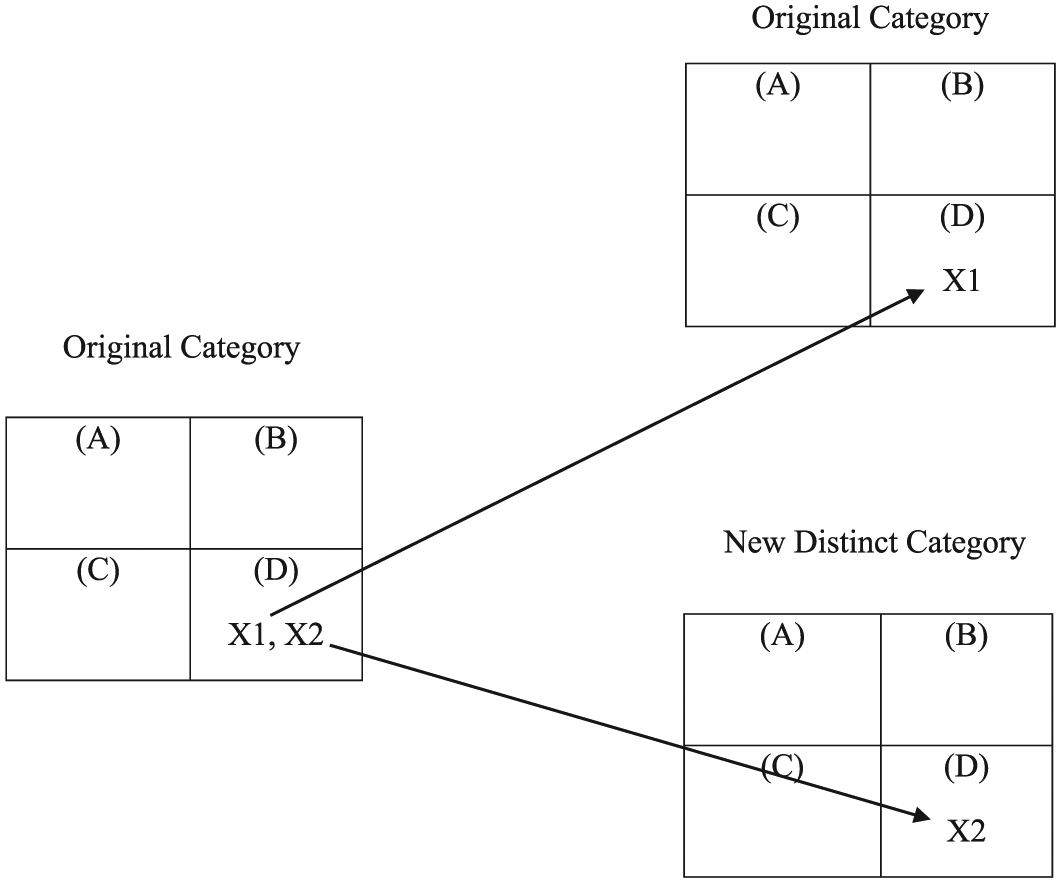
Splitting the specific concrete into separate categories.
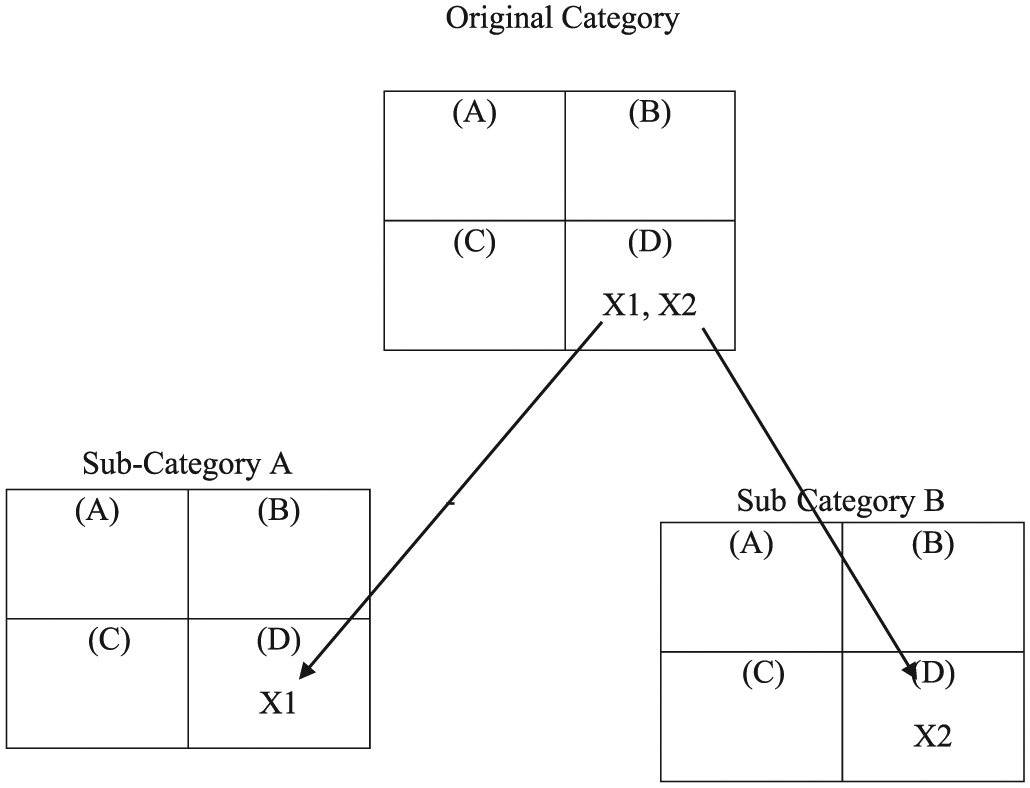
Splitting the specific concrete into sub-categories.
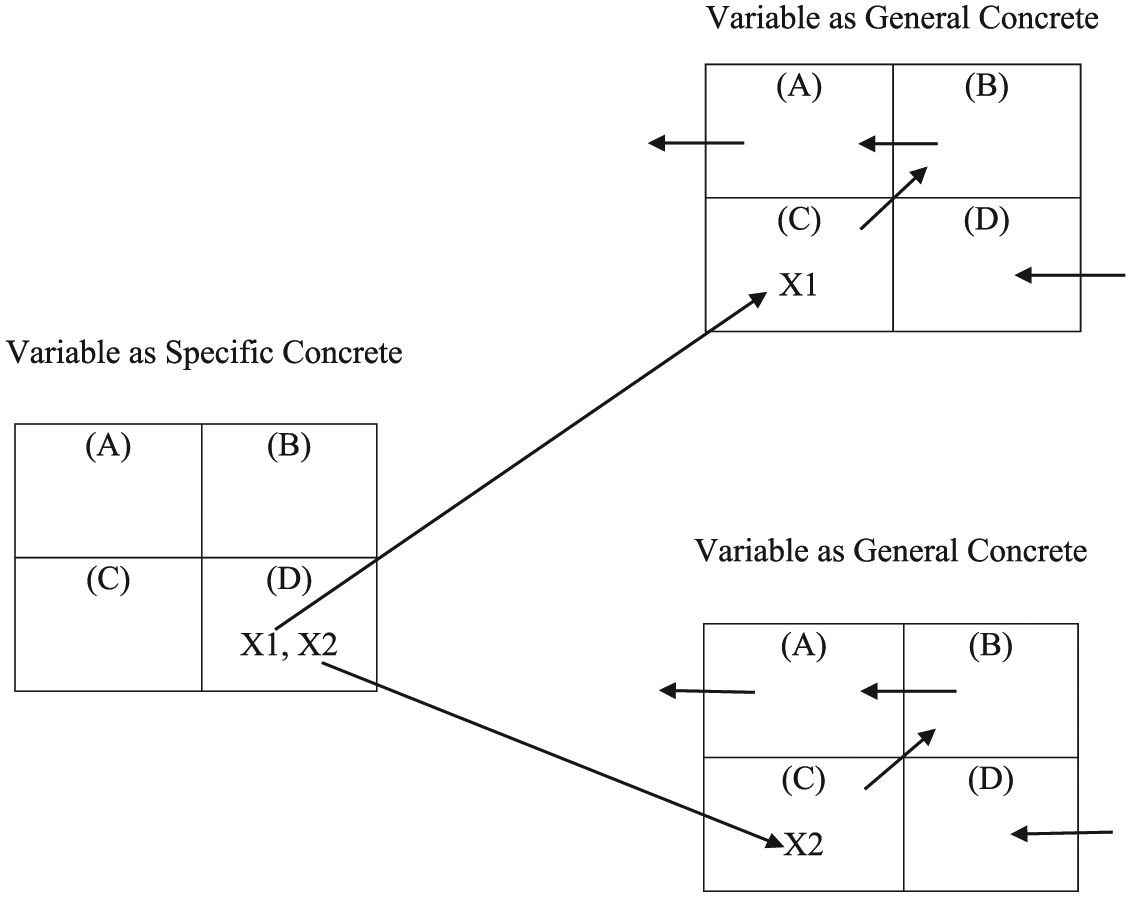
Splitting and re-abstracting the specific concrete into general concrete categories.
Though Marx’s explanations of his methods often lack sufficient detail and are fragmented across his studies, we are not without tools for their reconstruction. First, his general categories, sub-categories and how he uses examples for each demonstrate several of his method’s key aspects. Second, the right interpretive model—i.e. the method of successive abstractions—helps us to recognize how he isolates constants and variables across historical societies and compares their variations to differentiate objects of study.
Marx’s Method Applied to the Mode of Production 3
Beginning with society in general (Table 2), specific historical societies can be ‘considered from the standpoint of [their] economic structure’ (Marx, 1971a: 818). Though they have ‘production in general’ (Marx, 1973: 85) in common, ‘in the beginning of civilization … [d]ifferent communities find different means of production, and different means of subsistence in their natural environment. Hence, their modes of production … are different’ (Marx, 1992b: 332). Holding society in general constant and treating historical societies as a general abstraction (Table 3), Marx focuses on production in general as an element of all systems and prepares to differentiate and categorically arrange production modes in the general concrete via variations in the productive relations and economic processes constant across them.
From society in general to modes of production.

From historical social systems to relations and processes that cross them.

The importance of this analytical maneuver cannot be overemphasized. Here, a class of objects is lumped under a general criterion (or set of them), after which they are differentiated within that class. The method to do this is to find (1) the core, essential trait(s) they all share (unity) but that (2) vary in important ways in their specific functions across a series of general concrete examples (difference). Through comparing the specific variability between these general constants, new categories can be constructed, which is true for modes of production or other sociological realities, e.g. religion, the family, government and so on.
With production as the general abstract category (Table 4), Marx holds constant the commonalities all modes of production share: ‘land … and labour’ (Marx, 1971a: 816)—with the ‘elementary factors of the labour process [being] 1 … work itself, 2, the subject of that work, and 3, its instruments’ (Marx, 1992b: 174)—and the ‘division of labour in society at large’ (Marx, 1992b: 339). While these constants are not difficult to grasp, Marx’s variables are more complex. Some of his variables are interrelated, some are in the interior of others and still others are either emergent or acquire emergent properties absent in other contexts. Such variables and their features are easily missed in Marx’s writing, however, because he usually does not refer to them as variables at all (even when treating them as such) and because he sometimes uses different terminology when referring to the same thing or idea.
From production in general to relations and processes across them.
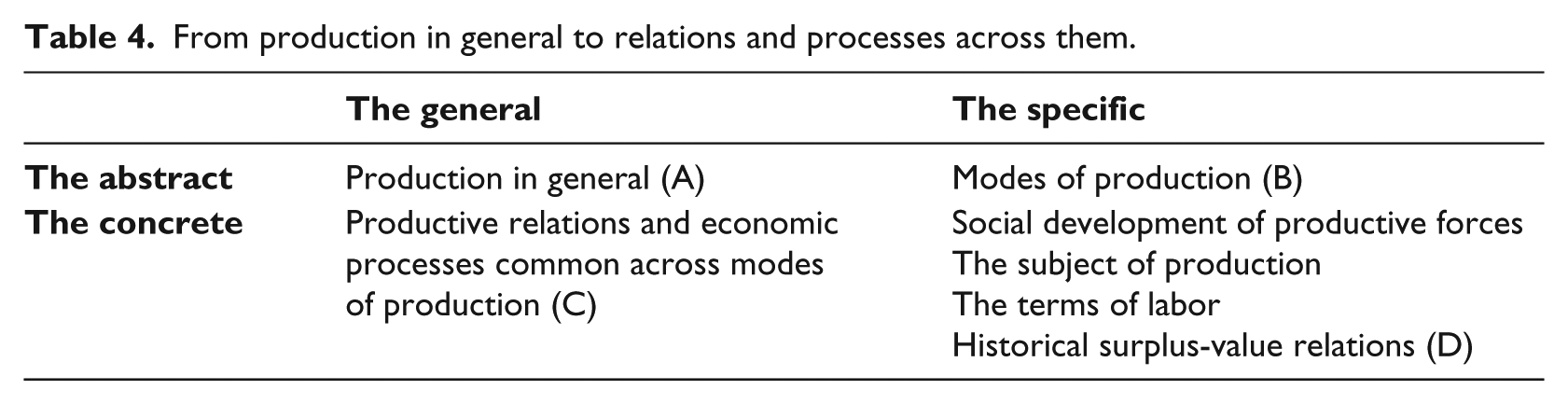
So, too, is it easy to miss the variables Marx prioritizes at particular stages of sorting out categories, given his non-linear presentation of this process. One such variable he uses to ‘distinguish different economic epochs’ is ‘how [things] are made and by what instruments’ (Marx, 1992b: 175), or what he often refers to as the (1) social development of productive forces. The (2) subject of work (or, of production) entails use-, exchange- and surplus-value. Interiorized into these categories are different (3) historical surplus-value relations and interiorized into these are systems’ relations to nature, the commodity form, the money form, hoarding, and merchant’s capital. The division of labor involves (4) the terms of labor under which labor is performed. Finally, all of these variables influence the roles of exchange and trade, which influence other variables in turn (and thus they return with added importance later in his analysis).
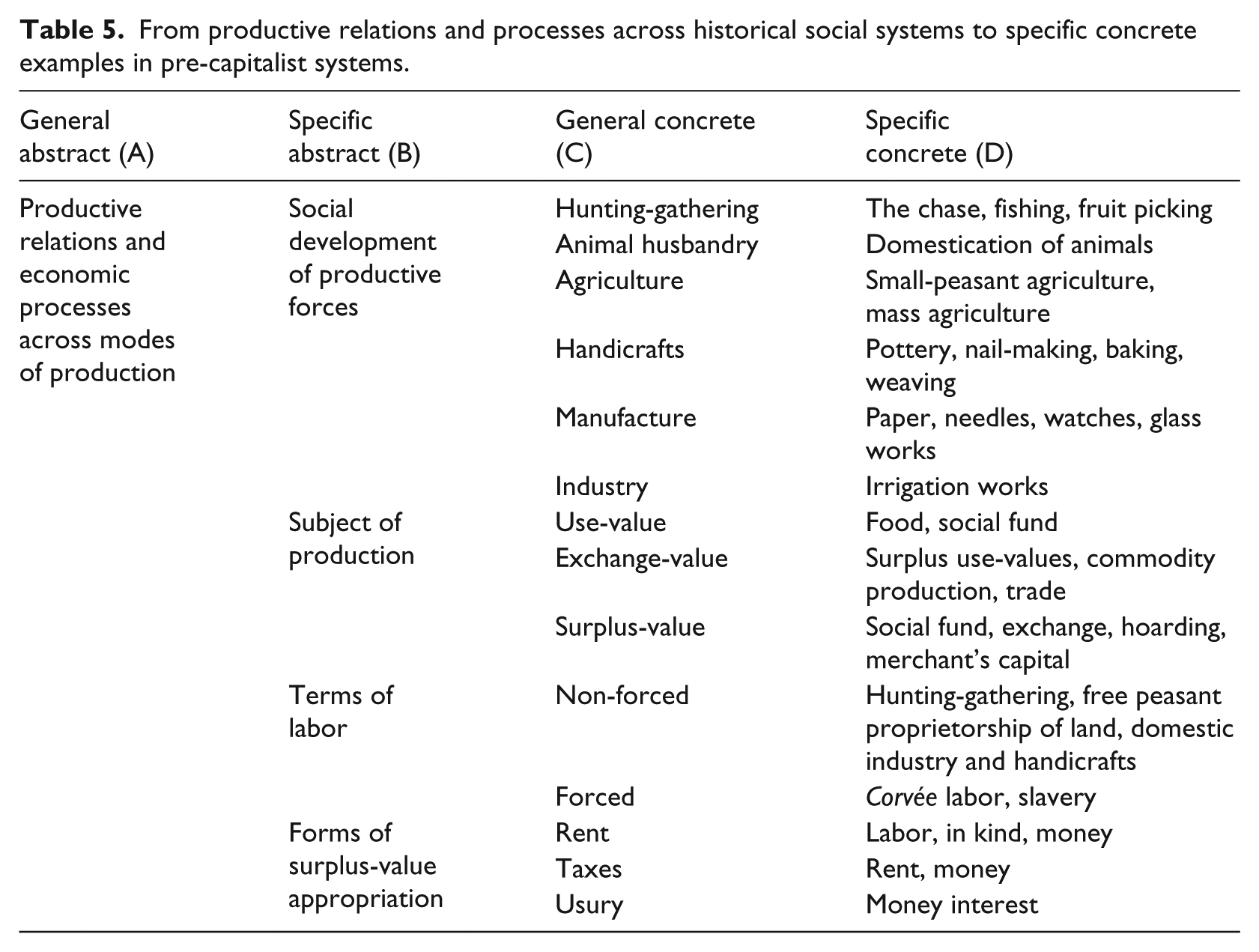
Marx examines these economic relations and processes (Table 4) in their historical expressions to differentiate modes of production via re-abstraction and controlled comparison. Here, those variables italicized previously in the paragraph above are the core essential ones Marx uses for this initial sorting. Marx does this sorting by examining real concrete historical societies and isolating and comparing their development of productive forces, their subject of production (and its interior variables), their terms of labor and the non-existence or the existence of the appropriation of surplus-value (and the latter’s various forms and relations), and then models modes of production based on how these variables are configured (though he also brings in other variable criteria later, as we shall see). He analytically uses these variables to decipher how their roles and causal forces vary within and between production modes because of their interrelations with other variables as well as with the system as a whole.
In the following I first explain Marx’s conceptualization of these four variables, interrelations among them and the variables he interiorized into them. Afterwards, I show how Marx used these variables, their interrelations, and their interiors to characterize modes of production.
Social Development of Productive Forces
Historically, the social development of productive forces has included hunting, gathering, and animal husbandry (Marx, 1992b: 175, 316), ‘small-peasant agriculture’ (Marx, 1971a: 614), ‘domestic industry’ (1971b: 445), ‘handicrafts’—e.g. pottery, nail-making, glass-making, baking, textiles (Marx, 1992b: 282, 322), ‘manufacture’ (Marx, 1992b: 318)—e.g. paper-, needle-, watch- and glass-making (Marx, 1992: 319, 320, 324, 328)—and ‘large-scale industry’ (Marx, 1968: 583). As this is not a universal linear model, such forms can coexist in multiple systems: communal property has existed in various societies (Marx, 1992b: 821); domestic industry emerged alongside ‘simple gathering, hunting, fishing and cattle-raising’ (Marx, 1971a: 632); industry existed in ‘irrigation works in Egypt, Lombardy, Holland, or in India and Persia’ and in ‘Spain and Sicily under … the Arabs’ (Marx, 1991: 481). How systems develop such productive forces is one key variable that characterizes them.
The Subject of Production
All production systems have a primary purpose (‘the subject of work’), whether use-value, exchange-value and/or surplus-value. Marx examines the interrelations among these value forms in terms of (1) the natural economy, (2) the rise of exchange, the commodity form, the money form and trade, (3) hoarding and accumulation, and (4) merchant’s capital.
The Natural Economy
‘To the extent that the labour-process is solely a process between man and Nature, its simple elements remain common to all social forms of development’ (Marx, 1971a: 883). This relation, ‘primarily and initially directed toward the … production of food,’ is the ‘natural prerequisite’ for ‘surplus-labour in general’ where ‘Nature must supply … the necessary means of subsistence’ for ‘an expenditure of labour which does not consume the entire working-day’ (Marx, 1971a: 632). Thus, ‘under all modes of production,’ labor must provide use-values for (1) ‘subsistence,’ (2) the ‘reproduction of its own operating conditions,’ and (3) a ‘surplus above the indispensable requirements of life’ (Marx, 1971a: 790), including a portion ‘to satisfy general social needs’ (Marx, 1971a: 877).
Exchange, the Commodity Form, the Money Form, and Trade
Even where production is mainly for use-values, ‘the exchange of products springs up at the points where different families, tribes, [and] communities come into contact’ (Marx, 1992b: 332; also see Marx, 1992b: 92). A feedback loop exists where the availability of exchange encourages more commodity production for additional exchange and this will tend to bring about the primitive money form, each of which then receive even more additional attention in productive activities — in societies in a ‘primitive condition,’ ‘in the ancient’ and ‘in the modern world,’ in societies ‘based on slavery and serfdom,’ ‘the guild organisation of handicrafts,’ and in ‘communist communities’ (Marx, 1971a: 177–178). As the commodity form develops, ‘money … becomes the commodity that is the universal subject matter of all contracts’ (Marx, 1992b: 139). And, ‘on the basis of every mode of production, trade facilitates the production of surplus-products destined for exchange’ and, therefore, ‘commerce imparts to production a character directed more and more towards exchange-value’ (Marx, 1971a: 325–326).
Hoarding and Accumulation
If trade encourages production for exchange and these lead to the commodity form and the money form, then ‘hoarding necessarily appears along with money’ (Marx, 1971a: 593). In pre-capitalist systems, hoarded money tends to result in over-consumption ‘beyond the bounds of the necessary means of subsistence’ (Marx, 1968: 528) but not in social development of productive forces.
Merchant’s Capital
‘No matter what the basis on which products are produced … whether the primitive community … slave production … small peasant and petty bourgeois, or the capitalist basis’ (Marx, 1971a: 325), the circulation of commodities, the money form and trade give rise to merchant’s capital — even ‘among unsettled nomadic peoples’—and merchant’s capital ‘gives rise everywhere to the tendency towards production of exchange-values, increases its volume, multiplies it, makes it cosmopolitan, and develops money into world-money,’ driving commerce with its ‘dissolving influence’ on simpler production forms, especially those ‘mainly carried on with a view to use-value’ (Marx, 1971a: 331–332). As a ‘system of robbery,’ when merchant’s capital ‘holds a position of dominance … its development among the trading nations of old and modern times is always directly connected with plundering, piracy, kidnapping slaves, and colonial conquest’ (Marx, 1971a: 331). And with slaves ‘the primitive material of money’ (Marx, 1992b: 92), slavery emerges on the heels of exchange, commodity production, and trade.
The Terms of Labor
Systems differ in the existence and kind of ‘forced labour’ (Marx, 1971b: 400). With non-forced labor, production is freely performed, usually domestically for use-values and sometimes for surplus-value for exchange or the social fund. Here, laborers search for ‘an independent field of employment,’ which is ‘the case in agriculture proper even under pre-capitalist modes of production’ (Marx, 1971a: 676) that exhibits some degree of ‘free self-managing peasant proprietorship of land’ (Marx, 1971a: 807). Forced labor exists where, whether by custom, law, or threat, laborers must provide uncompensated labor for others. In forced corvée labor, laborers work part of the day/week for themselves and part for their superordinate, while slave owners controls all of a slave’s labor (see Marx, 1971b: 93; Marx, 1992: 505). Corvée laborers usually own their means of production, while a slave is owned as ‘part and parcel of the means of production’ (Marx, 1992b: 668). This forcible surplus-value appropriation has historical origins.
Historical Surplus-Value Relations
Once the natural economy’s preconditions for ‘surplus-value in general’ are met—i.e. ‘The direct producer must 1) possess enough labour-power and 2) the natural conditions of his labour … must be productive enough to give him the possibility of retaining some surplus-labour over and above that required for … his indispensable needs’ (Marx, 1971a: 792); this holds for all societies (Marx, 1971a: 634-635)—some pre-capitalist systems contain surplus-value appropriation in the forms of ground rent, taxes and usury.
Landed Property and Ground Rent
Landed property ‘is based on the monopoly by certain persons over definite portions of the globe, as exclusive spheres of their private will to the exclusion of all others’ (Marx, 1971a: 615). Landowners may be an individual representing the community, as in Asia, Egypt … may be merely incidental to the ownership of the immediate producers themselves by some individual as under slavery or serfdom; or it may be a purely private ownership of Nature by non-producers, a mere title to land. (Marx, 1971a: 634)
Appropriation here comes from the landowner’s ‘economic realisation’ of this ‘exclusive right’ via ‘ground rent’, where ‘[a]ll ground-rent is surplus-value, the product of surplus-labour’ (Marx, 1971a: 634). Ground rent has three forms: labor, in kind, and money.
With labor rent, ‘the direct producer, using instruments of labour … which actually or legally belong to him,’ produces ‘a surplus above his indispensable necessities of life’ with their work split ‘into labour-time for himself and enforced labour-time’ (Marx, 1971a: 790; also see Marx, 1971a: 793). In this ‘brutal form of enforced labour’, surplus-value ‘consists directly in the appropriation of this surplus expenditure of labour-power by the landlord’ (Marx, 1971a: 792). With rent in kind, the laborer ‘is driven rather by … legal enactment rather than the whip’ (Marx, 1971a: 795) and labor’s ‘surplus-product itself’ (Marx, 1971a: 634) is appropriated, ‘no matter whether the landlord be a private person or the state’ (Marx, 1971a: 794). Money rent requires development of production where a commodity and money economy increasingly dominate. If it is introduced without such conditions, money rent will be difficult to accrue—e.g. as in Rome—or the system changed—e.g. Japan under the Europeans (see Marx, 1992b: 139–140).
Taxes
Taxes can function as rent (labor, in kind, or money) paid to a state that serves as a collector for the owning class or is the owning class itself (Marx, 1971a: 791).
Usury
Though ‘[t]he functions of hoards … arise in part out of the function of money’ (Marx, 1992b: 143), ‘the professional hoarder does not become important until he is transformed into a usurer’, a process ‘bound up with the development of merchant’s capital and especially that of money-dealing capital’ (Marx, 1971a: 593). As appropriation ‘in the form of interest’, usury’s influence ‘depends on the extent, the intensity, etc. of the accumulation process itself, that is, on the mode of production’ (Marx, 1971b: 303–304; emphasis in original). Where usurer’s capital appropriates all surplus-labor, as in pre-capitalist forms, it impoverishes the mode of production, paralyses the productive forces instead of developing them, and at the same time perpetuates the miserable conditions in which the social productivity of labour is not developed at the expense of labour itself, as in the capitalist mode of production. (Marx, 1971a: 595-596)
Also, in pre-capitalist modes, the usurer ‘wrecks the forms of property whose constant reproduction in the same form constitutes the stable basis of the political structure … leading to the disintegration of society—apart from the slaves, serfs, etc., and their new masters—into a mob’ (Marx, 1971b: 531).
Above, Marx treats productive relations and economic processes across systems as a general abstract category (Table 5), the social development of productive forces, the subject of production, etc. as specific abstract concerns, shifts previous specific concrete examples into general concrete categories, and brings in additional concrete detail. As Marx (1979 [1877]: 321–322) ‘studies each of these developments by itself and then compares them with each other’, specific concrete data points are examined, general models take shape, and their ‘inner connexion[s]’ are described (Marx, 1992c [1867]: 28).
From productive relations and processes across historical social systems to specific concrete examples in pre-capitalist systems.
Modes of Production Determined by Variables Isolated through Successive Abstractions
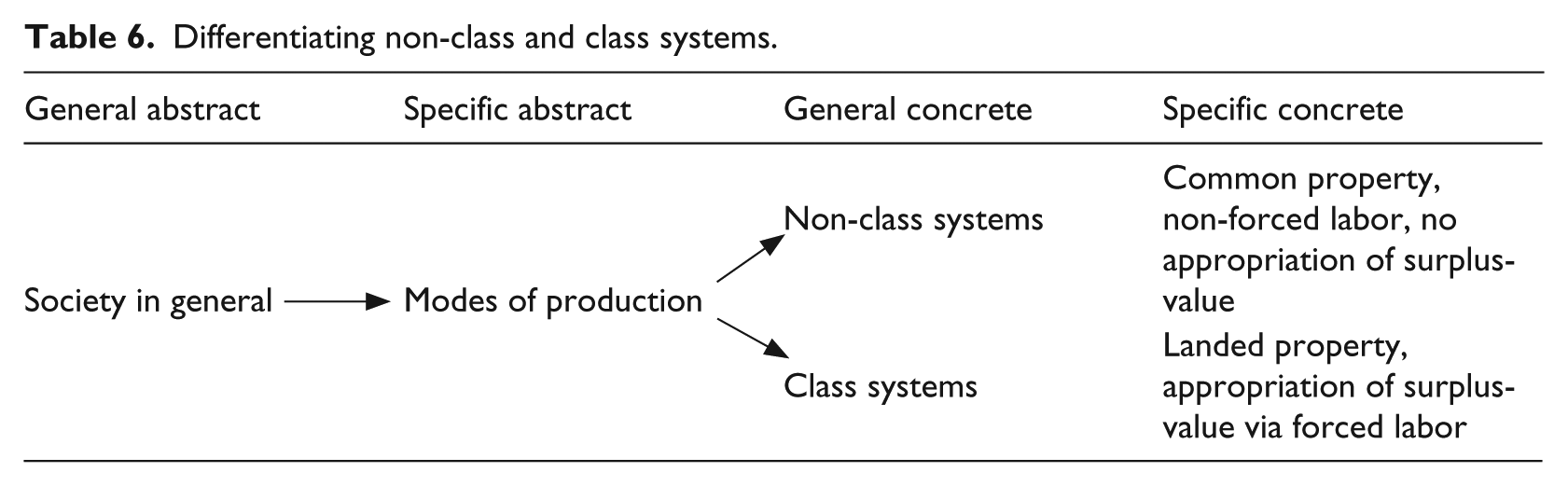
As he constructs constants and variables and uses controlled comparison through the method of successive abstractions, Marx develops categorical criteria for his taxonomy of modes of production. Divisions of labor (including labor terms), the subject of production, and the social development of productive forces vary with other variables now introduced as a result of the process of investigation —i.e. different property relations and their corresponding class and value relations. With ‘surplus-labour’ existing ‘in any given economic formation of society’ (Marx, 1992b: 226) and ‘all surplus-value [reducing] to surplus-labour’ (Marx, 1971b: 254), Marx holds the existence of surplus-value constant across all modes of production. In his initial differentiation, ‘landed property is a historical premise … in all previous modes of production which are based on the exploitation of the masses in one form or another’ (Marx, 1971a: 617) where there exists the ‘identity of surplus-value with unpaid labour of others’ (Marx, 1971a: 792). Thus, non-class systems are characterized by in-common property relations, unforced labor, and no surplus-value appropriation. Class systems rest on property owners who appropriate surplus-value from unpaid forced labor (see Marx, 1992b: 226, 479) (Table 6).
Differentiating non-class and class systems.
In comparing all systems with one another (Table 7), Marx (1992b: 209) splits class systems based on their ‘essential difference,’ i.e. ‘the mode in which … surplus-labour is in each case extracted from the actual producer, the labourer.’ The ‘specific economic form’ in which this occurs ‘determines the relationship of rulers and ruled’ and ‘reveals … the hidden basis of the entire social structure’ and ‘the political form of the relation of sovereignty and dependence,’ i.e. ‘the corresponding specific form of the state’ (Marx, 1971a: 791). Through comparing these different modes of appropriation, Marx mobilizes the variables and incorporates them as criteria into his taxonomic scheme. In the following I examine the variables he identifies with each mode and afterwards I present a summary view of that taxonomy.
Constants, comparing variables and constructing modes of production.

Primitive Communism
Society ‘at the dawn of human development … is based … on ownership in common of the means of production’ (Marx, 1992b: 316). These societies are ‘extremely simple’ with ‘narrow’ ‘social relations between man and Nature,’ where the ‘productive power of labour has not risen beyond a low stage’ (Marx, 1992b: 83–84). Here, the ‘production for the use-value, for immediate personal requirements, predominates …. In early communal societies in which primitive communism prevailed … it was this communal society itself … which appeared as the basis of production, and its reproduction … its ultimate purpose’ (Marx, 1971a: 831). Some portion of surplus-value ‘is directly consumed individually by the producers and their families,’ a portion ‘is productively consumed,’ and a portion ‘is invariably surplus-labour, whose product serves … general social needs’ (Marx, 1971a: 877–878). Labor is unforced and consists primarily of subsistence agriculture, household production, fishing and hunting, though trade might develop and move production toward exchange-values as opportunities arise. But without systemic reinvestment, this mode is ‘unfitted to develop labour as social labour and the productive power of social labour’ (Marx, 1971b: 422–423). Such societies include ‘nomad races,’ ‘a tribe’ (Marx, 1992b: 92, 316), ‘primitive Indian communities, or the more ingeniously developed communism of the Peruvians’ (Marx, 1971a: 877; see also Marx, 1992b: 91). Along with ‘ancient communal towns’ (Marx, 1971a: 831), ‘common property in its primitive form’ also existed among Romans, Teutons, Celts, India, Asia and later in Slavonia and Russia (Marx, 1992b: 821).
The Ancient Mode of Production
In Ancient society’s class structure—which rested on landowners, plebeians and slaves—the ‘free self-managing peasant proprietorship of land parcels … constitutes … the economic foundation of society’ (Marx, 1971a: 806), where ‘the conditions of production are the property of the producer’ and stood as ‘the basis of the political relationships, of the independence of the citizen’ (Marx, 1971b: 531). While an ‘Egyptian system of castes’ (Marx, 1992b: 346) existed and ‘Greek society was founded upon slavery’ (Marx, 1992b: 65), [p]easant agriculture on a small scale, and the carrying on of independent handicrafts … form the economic foundation of the classical communities at their best, after the primitive form of ownership of land in common had disappeared, and before slavery had seized on production in earnest. (Marx, 1992b: 3163)
Though corvée labor existed ‘partially in the Ancient World’ (Marx, 1971b: 417), slavery eventually formed ‘the broad foundation of social production’ (Marx, 1971a: 831). This was facilitated through merchant’s capital and the growth of commodity production and trade (see Marx, 1971a: 332).
Similar to Asia (particularly India) and feudal society (Marx, 1971b: 416), in ancient societies like Greece, peasants produced their labor fund for themselves, though a portion was subject to appropriation. Though commodity production and therefore exchange initially held a ‘subordinate place,’ their importance grew; similarly, ‘[t]rading nations, properly so called, exist in the ancient world only in its interstices’ (Marx, 1992b: 83) where ‘they acted the middleman’ (Marx, 1971a: 330) between producing nations. Increased exchange and trade resulted in hoarding that went to ‘unproductive expenditure on art, religious works and public works’ and ‘mad extravagance’ (late Rome and Greece), given that ‘the ancients never thought of transforming surplus product into capital’ and thus into the ‘development of the material productive forces’ because wealth accumulators ‘did not know what to do with it’ and, as such, systemic overproduction tended not to exist (Marx, 1968: 528). Technology and production, as a result, developed unevenly, where, ‘[a]ncient Rome, in its later republican days, developed merchant’s capital to a higher degree than ever before in the ancient world, without showing any progress in the development of crafts’ while ‘commerce was accompanied by highly developed crafts’ in Corinth and other Grecian towns (Marx, 1971a: 332).
Usury facilitated a slave and money economy in Ancient society. In the declining Roman Republic, ‘manufacturing stood far below its average level of development’ and ‘merchant’s capital, money-dealing capital, and usurer’s capital developed to their highest point’ (Marx, 1971a: 593). However, usury has a ‘destructive influence on ancient … wealth and … property … [and] it undermines and ruins small-peasant … production’ (Marx, 1971a: 596). Thus, ‘in the entire ancient world’—outside merchant cities ‘developed industrially and commercially’ such as ‘Athens and others’—high interest was ‘a means used by the big landowners not only for expropriating the small proprietors, the plebeians, but for appropriating their persons’ (Marx, 1971b: 538). And ‘[i]n all the forms in which [the] slave economy … of later Grecian and Roman times … serves as a means of amassing wealth,’ money ‘is a means of appropriating the labour of others through the purchase of slaves, land, etc.’ and ‘can be expanded as capital, i.e., bear interest, for the very reason that it can be so invested’ (Marx, 1971a: 594). As a result, ‘class-struggles of the ancient world’ were mainly ‘between debtors and creditors’ and, in Rome, this ‘ended in the ruin of the plebian debtors’ who ‘were displaced by slaves’ (Marx, 1992b: 135; also see Marx, 1971a: 595), while merchant’s capital facilitated further plundering, kidnapping slaves, piracy and colonial conquest (Marx, 1971a: 331).
The Asiatic Mode of Production
In the Asiatic mode, the class structure was rooted in small village communities, with ‘common property’ in places like India and Asia (Marx, 1971a: 831), land owned by the state elsewhere, and a combination of landed and communal property in still other places (see Marx, 1992b: 337, 6721). The foundation of production was in ‘the Asiatic communal system with its unity of agriculture and industry’ and home handicrafts (Marx, 1971b: 417; also see Marx, 1971a: 333–334). Such communities were usually ‘self-sufficing’ but often stagnant across political regimes (Marx, 1992b: 338–339). Beyond domestic use-value production, here ‘the conversion of products into commodities … holds a subordinate place,’ though this grew in importance as these communities dissolved (Marx, 1992b: 83). With most production done for domestic consumption or monopolized by a few trades (reducing market competition), some appropriation existed through selling products above the value of the labor they contained (see Marx, 1969 [1963]: 277), though this did not result in the almost unlimited extension of the working-day (see Marx, 1992b: 384).
As in Ancient society, growth of exchange, money and commodity production resulted in hoarding and personal consumption, especially in ‘Asia, and particularly … the East Indies’ (Marx, 1992b: 131). The general form of Asiatic surplus-value appropriation was rent, practiced on the largest historical scale and resting on ‘slavery, serfdom or political dependence’ (Marx, 1971b: 400). While some labor was non-forced (i.e. domestic handicrafts and agriculture with laborers in possession of their means of production, sometimes in a ‘natural production community’ such as in India), rent in kind was required (thus, forced labor) and often paid in taxes to the state who served as the landowner (see Marx, 1971a: 790–791, 796). Appropriation also existed with usury but ‘without bringing about real disintegration, but merely giving rise to economic decay and political corruption’ (Marx, 1971b: 531).
The Feudal Mode of Production
A class structure resting on monopoly rights of landed property, ‘the guild-bound handicrafts of the medieval urban industries’ (Marx, 1971a: 334), ‘[p]easant agriculture on a small scale, and the carrying on of independent handicrafts … form the basis of the feudal mode of production’ (Marx, 1992b: 3163). Though ‘the self-managing peasant’ owning smaller parcels of land and using their own tools and family handicrafts to produce subsistence served as a ‘basis for … personal independence’ (Marx, 1971a: 807), there also existed communal property alongside personal ownership of land (similar to the Asiatic mode) which was often transferred from peasants to landlords. Such a system of ‘Proprietorship of land parcels by its very nature excludes the development of social productive forces of labour’ (Marx, 1971a: 807) and gave rise to forced serf labor in the corvée, e.g. in Poland and Romania (Marx, 1971a: 803), while in other places the corvée lead to serfdom, e.g. the Danubian Principalities (Marx, 1992b: 227). Though most peasant labor went toward subsistence and surplus-value for the social fund, in the serf labor of the corvée (like slave labor), rent ‘is paid in labour not in products, still less in money’ (Marx, 1971b: 401). Such forced labor rent also existed in ‘the urban craft guild system of the Middle Ages’ (Marx, 1971b: 417), with ‘conceptions of professional duty, craftsmanship, etc.’ masking its ‘relations of dominion and servitude’ (Marx, 1971a: 831). Via in kind rent, landlords’ revenues came from agricultural products, domestic handicrafts, manufacturing and industrial goods (Marx, 1971a: 786–787), while feudalism stretched the working-day beyond that of earlier systems, e.g. Asiatic modes (Marx, 1971b: 434).
Unlike other systems, usury in feudalism existed ‘where the other conditions for capitalist production exist—free labour, a world market, dissolution of the old social connections, a certain level of the development of labour, development of science, etc.’—and this undercut landowners and small-scale producers and facilitated ‘the centralisation of the conditions of production in the form of capital’ (Marx, 1971b: 532). Similar to Ancient society, a combination of exchange, a money form, and trade lead to personal consumption of wealth and luxury and an increasing influence of merchants in piracy, plunder and colonial conquest under the Venetians, Portuguese and Dutch (among others) (Marx, 1971a: 331). This colonialism—combined with trade, usury, money rent and the transformation of landed property and the terms of labor—initiated ‘[t]he formation process of capital’, feudalism’s ‘dissolution process’ and the capitalist mode of production’s ‘historical genesis’ (Marx, 1971b: 491).
The Capitalist Mode of Production
‘A greater number of labourers working together, at the same time, in one place … in order to produce the same sort of commodity under the mastership of one capitalist, constitutes, both historically and logically, the starting-point of capitalist production’ (Marx, 1992b: 305). The capitalist, as ‘the owner of the conditions of labour,’ ‘can undertake the process of exploiting labour’ because ‘the labourer [is] the owner of only labour-power’ (Marx, 1971a: 41) and not ‘the land he cultivates nor the tools with which he works’ (Marx, 1971b: 530). Instead, ‘the means of production transformed into capital’ are ‘monopolised’ and confront ‘living labour-power as products and working conditions’ (Marx, 1971a: 814–815). Land, in ‘an idea [that] could only spring up in a bourgeois society already well-developed’ (Marx, 1992b: 92), becomes private property. The ‘nature of the capitalist mode of production—as distinct from the feudal, ancient, etc.’—reduces ‘the classes participating directly in production … to capitalists and wage-labourers, and the exclusion of landowners …. This reduction … reveals its differentia specifica …. [M]odern landed property is in fact feudal property, but transformed by the action of capital upon it’ (Marx, 1968: 152–153; emphases in original). ‘Here, then, we have all three classes—wage-labourers, industrial capitalists, and landowners constituting together, and in their mutual opposition, the framework of modern society’ (Marx, 1971a: 618).
While commerce and merchant’s capital in Ancient society facilitated a slave economy, in modernity, they brought about the capitalist mode of production, especially as they encourage commodity production (see Marx, 1971a: 332). With capitalism and wage-labor established, usury spurs on the development of the productive forces—e.g. larger, more centralized workshops, development of technology, etc.—but ‘usury can no longer separate the producer from his means of production, for they have already been separated’ (Marx, 1971a: 596). In this transformation, ‘the capitalist … has taken charge of agriculture just as he has of industry’ (Marx, 1968: 153), as well as manufacture, ‘by combining different handicrafts together under the control of a single capitalist’ (Marx, 1992b: 319). The same process also transforms production into ‘Modern Industry’ in ‘its most highly developed form … in a factory’ (Marx, 1992b: 372) where a new type of machinery ‘supersedes the workman,’ is ‘able to drive many machines at once,’ and ‘becomes a wide-spreading apparatus’ with the laborer ‘a mere appendage’ (Marx, 1992b: 355, 357, 364).
The exploitation of wage-labor makes capitalist commodity production ‘a particular species of social production’ (Marx, 1992b: 851). Being ‘indifferent’ to use-value or social needs, ‘capitalist production … is only concerned with producing surplus-value’ (Marx, 1971a: 195), the ‘self-expansion of capital, i.e., appropriation of surplus-labour, production of surplus-value, of profit’ (Marx, 1971a: 251), ‘and the reconversion of a portion of it into capital’—this is ‘the immediate purpose and compelling motive of capitalist production’ and its ‘specific character’ (Marx, 1971a: 243–244). This ‘continuous process’ (Marx, 1971b: 272) results in ‘a special form of development of the social productive powers’ ‘peculiar to the capitalist period’ (Marx, 1971a: 881). While slavery, serfdom and capitalism all presuppose ‘surplus-labour in general’ and the ‘complete idleness of a stratum of society’, capitalism’s ‘civilizing aspects’ stem from how it ‘enforces surplus-labour’ in a way that leads to ‘the development of the productive forces’ and makes possible ‘a higher form of society’ (Marx, 1971a: 819).
Like all class systems, in capitalism, ‘[s]urplus-labour in general, as labour performed over and above the given requirements, must always remain’ (Marx, 1971a: 819). But in other class systems, ‘[w]here all labour in part still pays itself (like for example the agricultural labour of the serfs) and in part is directly exchanged for revenue (like the manufacturing labour in the cities of Asia), no capital and no wage-labour exists in the sense of bourgeois political economy’ (Marx, 1969 [1963]: 157). While the use of large-scale co-operation ‘in ancient times, in the middle ages, and in modern colonies’ often lead to slavery (Marx, 1992b: 316), ‘Wage-labour…is only possible where the workers are personally free’ (Marx, 1971b: 431)—i.e., not owned as ‘slaves, bondsmen, &c,…free from, unencumbered by, any means of production of their own’ (Marx, 1992b: 668) and ‘free’ to search for employers to whom they must sell their labor-power or risk privation, even death. Wage-labor, then, ‘always remains forced labour—no matter how much it may seem to result from free contractual agreement’ (Marx, 1971a: 819).
In feudalism’s corvée, unforced versus forced uncompensated labor ‘differ in space and time in the clearest possible way,’ while ‘[a]ll the slave’s labour appears as unpaid labour. In wage labour, on the contrary, even surplus-labour, or unpaid labour, appears as paid’ as capitalism’s ‘wage form … extinguishes every trace of the division of the working-day into necessary labour and surplus-labour, into paid and unpaid labour’ (Marx, 1992b: 505). The ‘antithesis between the owner of means of production and the owner of mere labour-power’ results in the ‘servitude of the direct producers’ under ‘management and supervision’ (Marx, 1971a: 385) rather than ‘political or theocratic rulers as under earlier modes of production’ (Marx, 1971a: 881). Despite technology’s potential for ‘shortening labour-time,’ extracting surplus-value ‘for the purpose of expanding the value of his capital’ ‘becomes the most unfailing means for placing every moment of the labourer’s time and that of his family, at the disposal of the capitalist’ (Marx, 1992b: 384). And in colonial domains, landowners from ‘a conquering commercial nation’ can reduce laborers to a ‘minimum means of subsistence … e.g., the English in India’ (Marx, 1971a: 796).
The capitalist mode of production transforms previous forms of surplus-value appropriation into its own ‘special forms—rent, interest of money and industrial profit’ (Marx, 1971b: 254). As a system that transforms value forms into capital, the ‘ideal average’ of market forces operates in conjunction with ‘the world market, its conjunctures, movements of market-prices, periods of credit, industrial and commercial cycles, alternations of prosperity and crisis,’ that, when combined, ‘appear [to capitalists] as overwhelming natural laws that irresistibly enforce their will over them’ (Marx, 1971a: 831). ‘The capitalist system of production, in fact, has this feature—[i.e. that production is not subject to social control]—in common with former systems of production, in so far as they are based on trade in commodities and private exchange’ (Marx, 1971a: 574). However, ‘[i]n the pre-capitalist stages of society commerce ruled industry. In modern society the reverse is true’ (Marx, 1971a: 330).
Rather than local exchange or regional trade, ‘[t]he world-market itself forms the basis for this mode of production’ (Marx, 1971a: 333), which shapes the terms of labor and the subject of production. With commodity production ‘intrinsically bound up with the expansion of the market, the creation of the world market, and therefore foreign trade’ (Marx, 1968: 423), ‘it is forced to produce on a scale which has nothing to do with the immediate demand but depends on a constant expansion of the world market’ (Marx, 1968: 468). Exploitation of remaining pre-capitalist labor relations intensifies as production is thrust into a global search for profits, e.g., the corvée in the Danubian Principalities and slavery in the American South (Marx, 1992b: 226-227; also see: Marx, 1971a: 804). Given its form of accumulation and reinvestment, this profit search forms ‘the basis of modern over-production’ (Marx, 1968: 528) and leads to ‘over-production of capital’ and ‘general crises of the world market’ (Marx, 1968: 497).
Conclusions
In the following I provide an overview of Marx’s method of successive abstractions and the empirical domains he used for isolating the variables that identify modes of production. In Figure 4, Marx first starts with society in general and isolates production in general. Marx’s next treats production in the general abstract, examines specific societies and social formations, differentiates non-class versus class systems, and builds models of modes of production. Table 8 summarizes the results for both the final criteria in his taxonomic scheme and how the variations within its categories identify the different modes of production upon which Marx settled. Such a view gives us a better understanding of how Marx developed this taxonomic scheme and the theoretical and empirical justifications for it.
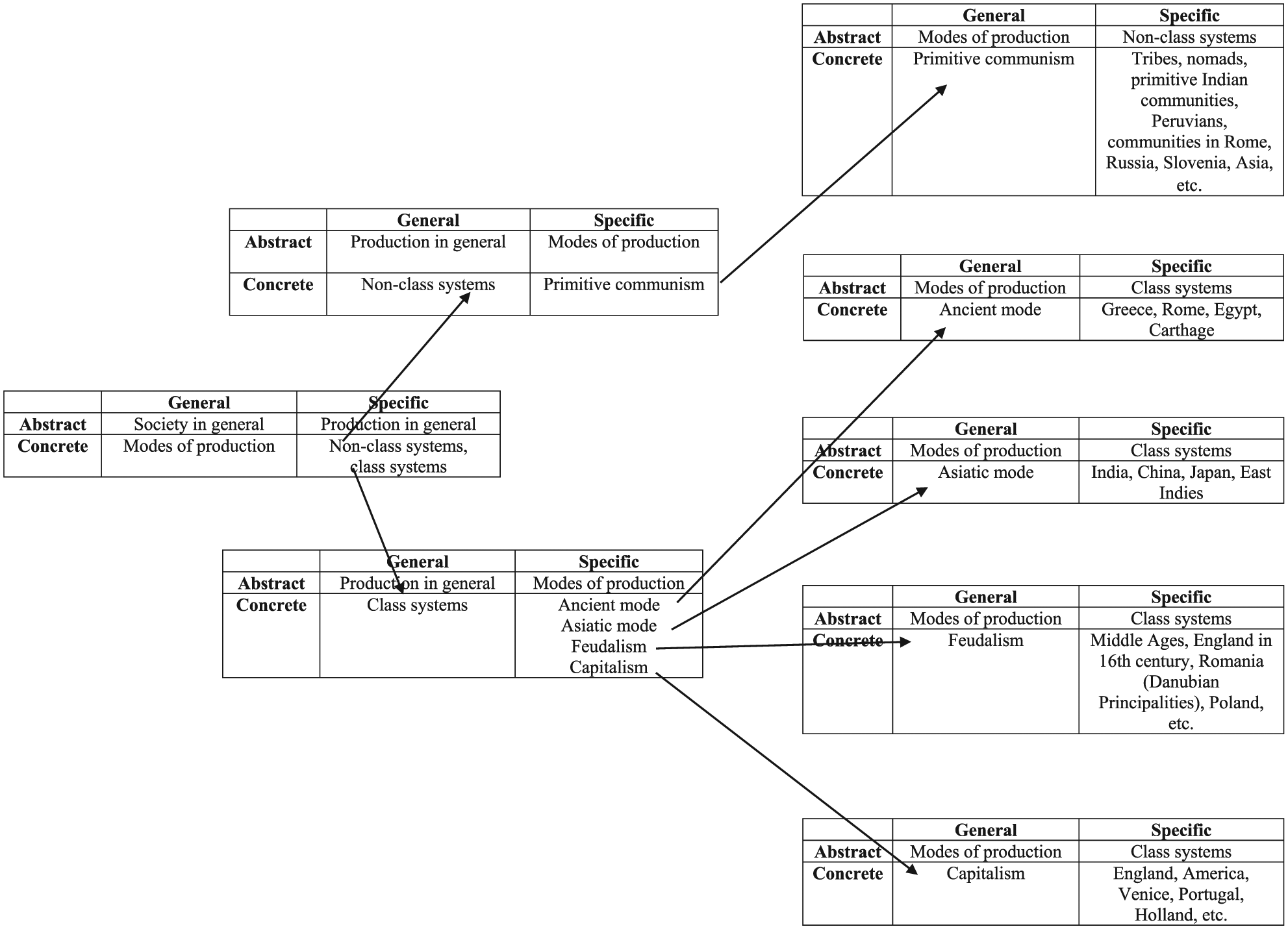
Modes of Production via Successive Abstractions.
Marx’s Taxonomy of Modes of Production.
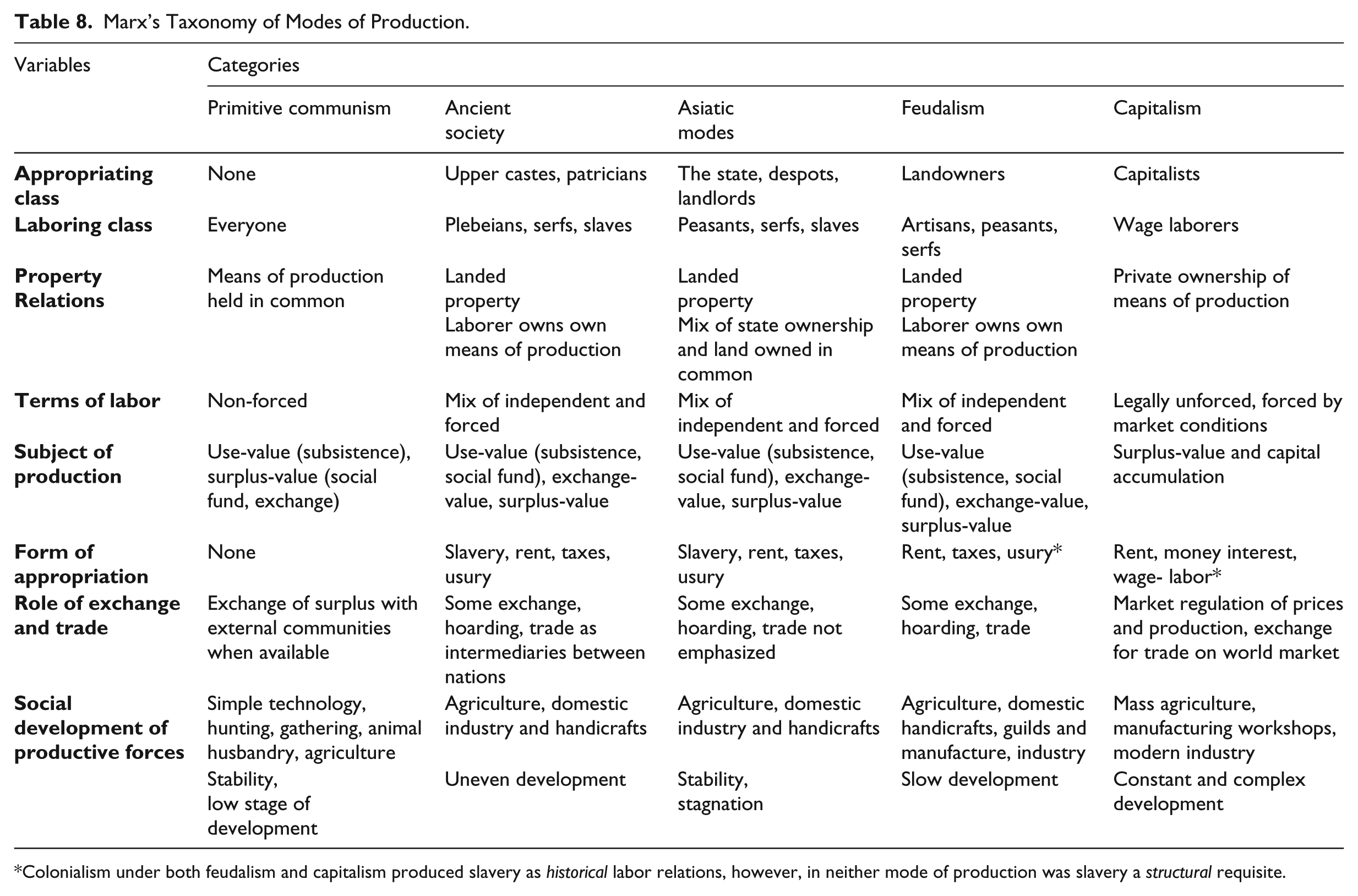
Colonialism under both feudalism and capitalism produced slavery as historical labor relations, however, in neither mode of production was slavery a structural requisite.
If some ‘determinants belong to all epochs, others only a few’ and others ‘will be shared by the most modern epoch and the most ancient’ (Marx, 1973: 85), then if one selectively isolates just one of Marx’s criteria, several different and incompatible taxonomies are possible. Isolating technology (i.e. social development of productive forces) produces hunter-gatherers, simple agriculture (including husbandry), handicrafts, mass agriculture, manufacture, and industry (a model similar to Lenski’s). The terms of labor results in legally non-forced labor systems (primitive communism and capitalism) and legally forced labor systems (Ancient society, Asiatic modes, and feudalism). Using class structure produces common property (primitive communism), landed property (Ancient, Asiatic, and feudal modes), and private property (capitalism) systems. And choosing methods of appropriation results in non-appropriating (primitive communism), slave-rentier (Ancient society, Asiatic modes), rentier (feudalism), and wage-labor (capitalism) systems. But each approach either leaves out essential traits (using technology omits class structure and appropriation), lumps together modes that are more different than similar (primitive communism and capitalism), or lumps when additional splitting is needed (combining Ancient, Asiatic and feudal modes into one category overlooks the lack of slavery structured into feudal society and omits the state as the appropriator in Asiatic systems).
Marx’s approach has several methodological and theoretical advantages. First, his variables provide a more complete set of taxonomic criteria and thus could be used to categorize newly discovered production systems and/or even entirely new emergent ones. Second, Marx’s models function as comparative ones, not indemonstrable universal linear-evolutionary ones, a claim he never makes and which would leave the Asiatic mode unaccounted for or anomalous. Third, his criteria are both descriptive and also explanatory; by plugging them into the comparative method Marx can better uncover and identify their causal effects within and between systems, e.g. ‘the economic law of motion of modern society’ (Marx, 1992b: 20). Fourth, by extension, this method negates the appearance of wage laborers as free agents compensated for each hour worked, when in fact they produce surplus-value via forced unpaid labor (see Marx, 1971b: 93; Marx, 1992b: 533–534), much like how ‘[t]he Roman slave was held by fetters [while] the wage-labourer is bound to his owner by invisible threads’ (Marx, 1992b: 538). This revealing of that which normally remains hidden is one form of the political fallout of social science done well.
Critics could argue that Marx isolated the wrong variables, omitted others, or poorly matched observations with misconceptualized models. This amounts to saying that Marx misapplied the method but it does not bear on the method itself. Using concrete observations to construct models and holding some variables constant while allowing others to vary and comparing the results in order to isolate causal mechanisms is the classic experimental model. Here, Marx’s approach and the resulting work, given the nature of the data available for it, sits somewhere between Einstein’s mental experiments and Pasteur’s laboratory. His unique contribution to scientific modeling for sociological inquiry comes from using successive abstractions—i.e. the free movement in empirical matter—to draw and re-draw his categories at levels of specificity appropriate for the data while maintaining the necessary degree of precision. By extension, combining both scientific procedures and dialectical sensibility provided Marx the ability to analyze variable interrelations and to further test their causal properties across real history. As such, this method is not limited to the uses to which Marx put it but can be employed for wider sociological considerations. The next step is to demonstrate how this is so.
Footnotes
Acknowledgements
My thanks to the reviewers of an earlier edition of this article as well as to Dr. Jen Koslow of Eastern Kentucky University, each of whom helped to improve its content.
Funding
This research received no specific grant from any funding agency in the public, commercial, or not-for-profit sectors.