



Abstract
This second installment continues my investigation of Marx’s research practice. I previously examined Marx’s method of successive abstractions in his analysis of modes of production. This article applies this method to a historical-materialist analysis of religion’s development across levels of historical generality. It concludes with a new taxonomy of religion based on that analysis.
Introduction
My previous article demonstrated how Marx employed a method of successive abstractions in his modeling of modes of production (see Paolucci, 2019). This article uses this method in a historical-materialist approach to examining religion across multiple levels of socio-historical generality. It concludes with a proposed Marxian taxonomy of religion. 1
Marx’s Method and Religion
How should a sociological account of religion proceed? Though religion can provide life meaning and facilitate social integration, using these functions to explain religion’s origins requires that either the socio-historical processes that account for its development happened (intended or not) to service such ends or this servicing occurred through repeated happenstance. But these explanations court an unfalsifiable teleological metaphysic and ‘regard religion as a causa sui’ (Marx and Engels, 1976 [1846]: 154). Furthermore, human ‘needs and their mode of production’ determine ‘a materialist connection of men with one another,’ which ‘is ever taking on new forms, and thus presents a “history” irrespective of … any political or religious nonsense which would especially hold men together’ (Marx and Engels, 1976 [1846]: 43). As a consequence, approaches that organize religious development through familiar religious taxonomies—e.g. animism, polytheism and monotheism—are simply ‘a summing-up of the most general results’ and only help with ‘the arrangement of historical material’ but are unfit as a ‘schema … for neatly trimming the epochs of history’ (Marx and Engels, 1976 [1846]: 37). In place of an ‘idealist view’ that assumes ‘a category in every period,’ ‘forms of consciousness, religion, philosophy, morality, etc.’ require ‘tracing the process of their formation from [their] basis’ in ‘the real ground of history’ and ‘from material practice’ (Marx and Engels, 1976 [1846]: 53–54).
Understood this way, ‘the only scientific’ approach to religion is to build models that ‘develop from the actual relations of life the corresponding celestialised forms of those relations’ (Marx, 1992 [1867]: 352, Note 2), where ‘Man makes religion’ (Marx, 1975 [1844]: 175) and ‘religious sentiment is itself a social product’ (Marx, 1978: 145) that is always ‘interwoven with’ and ‘the direct efflux of [human] material behavior’ (Marx and Engels, 1976 [1846]: 36). At the same time, religion is also a ‘historical product, the result of the activity of a whole succession of generations … its industry and its intercourse, and modifying its social system according to the changed needs’ (Marx and Engels, 1976 [1846]: 39). A sociology of religion must therefore ‘look for [the “essence” of religion] neither in the “essence of man”, nor in the predicates of God, but in the material world which each stage of religious development finds in existence’ (Marx and Engels, 1976 [1846]: 160).
Religion, Levels of Generality and the Method of Successive Abstractions
Marx grounds his investigations in and carves abstractions from multiple levels of generality—e.g. what humans share with animals, humans as humans (including society in general), our earliest societies, class societies, and capitalism in general and its historical evolution—while focusing on the past’s most salient elements that explain the development of the present, with elements not relevant to this understanding abstracted out of view (for discussion, see: Ollman, 2003: 86–126). Religion is ideal for such a treatment.
Humans as Animals
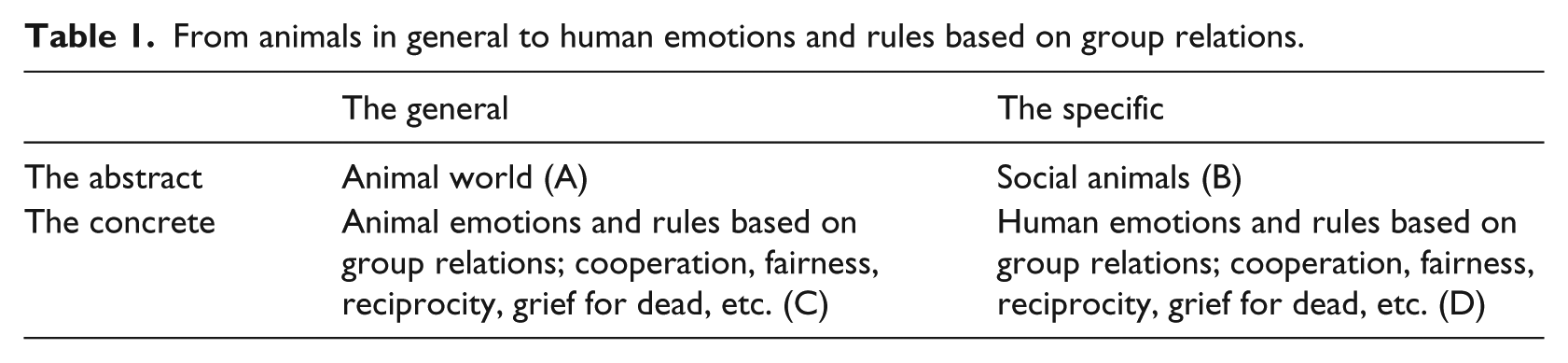
Among the animal world (Table 1), humans share group living with a sub-section of animals as well as certain emotions and behaviors related to that group membership—e.g. empathy (rhesus monkeys), taking revenge (tigers), grieving for the dead (elephants, chimpanzees, monkeys), gift exchange (crows), enforcing norms of fairness, reciprocity and cooperation (chimpanzees, rhesus monkeys and crows). This suggests an element of human rules of conduct are rooted in biological evolution (see Mendes et al., 2018; Sapolsky 2009 and citations therein).
From animals in general to human emotions and rules based on group relations.
Humans as Humans
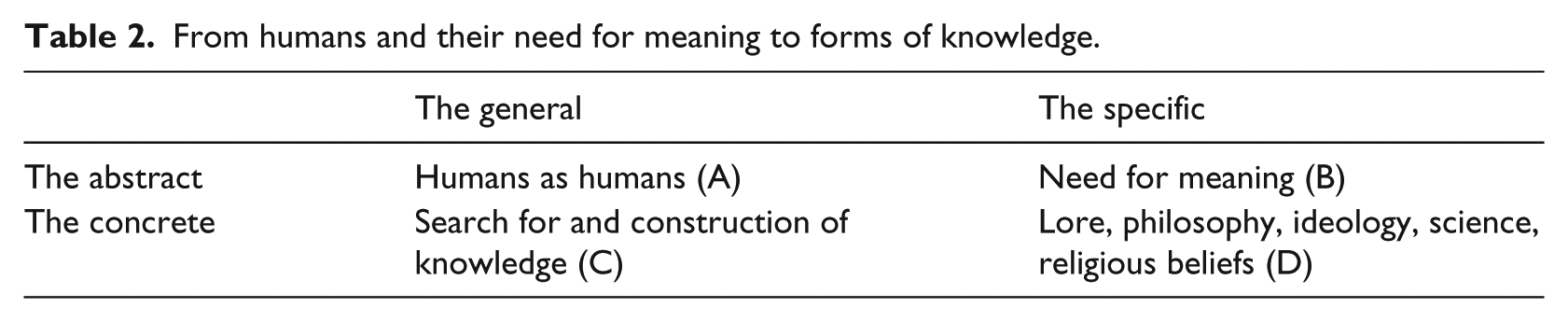
The human cerebral cortex facilitates awareness and memory and allows them to create symbolic communities and organize their social relations (Table 2). Given that their ‘instinct is a conscious one’ (Marx and Engels, 1976 [1846]: 44) involving abstractions which appear to have an existence beyond concrete life-activity, humans construct meanings for the world and their place in it—a ‘nomos’ and a basic need without which they experience ‘anomic terror’, a fear borne out of the prospect of existing in a meaningless world and thus a motive force in human life (Berger, 1967). Consequently, humans search for and construct meaning through creating forms of knowledge, one of those being religious beliefs.
From humans and their need for meaning to forms of knowledge.
Society in General: Identities
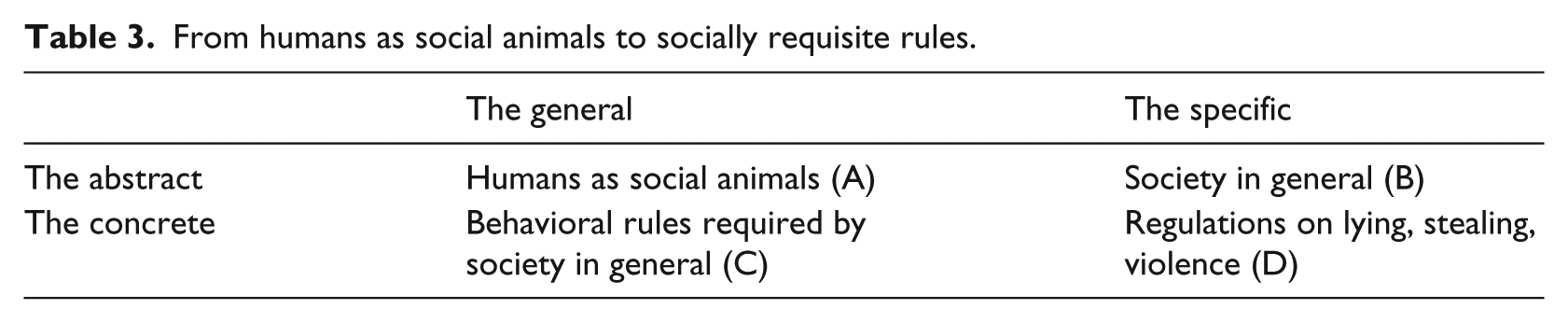
As humans engage in social behavior (Table 3), so arises both ‘man’s consciousness of the necessity of associating with the individuals around him’ and an awareness ‘that he is living in society at all’ (Marx and Engels, 1976 [1846]: 44). As such, rules necessary for sustaining any society are commonly enforced across systems—e.g. rules regulating interpersonal communications, security in possessions, and personal safety.
From humans as social animals to socially requisite rules.
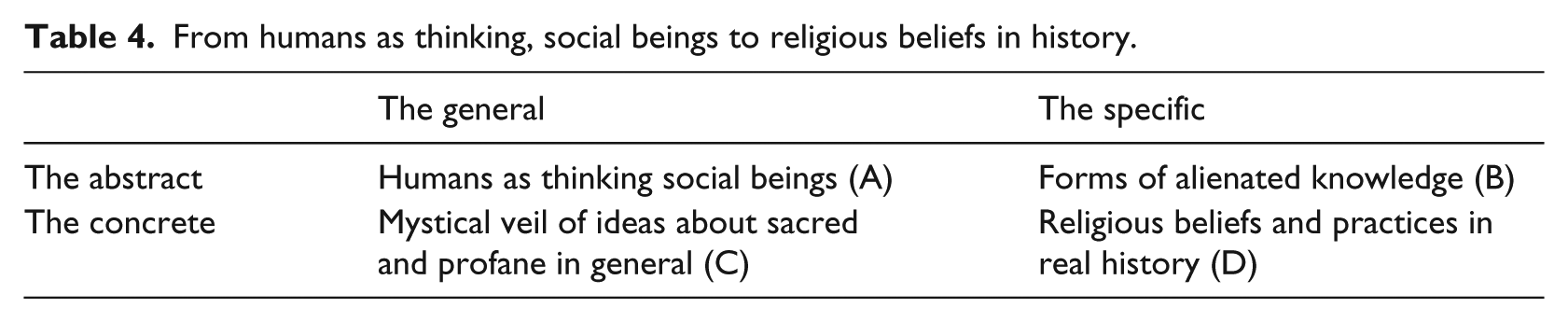
Humans, in ‘developing their material production and … intercourse, alter … their thinking and the products’ thereof (Table 4) and create ‘phantoms formed in the human brain’ as ‘sublimates of their material life-process’ in the form of ‘[m]orality, religion, metaphysics … ideology and … corresponding forms of consciousness’ (Marx and Engels, 1976 [1846]: 36–37). Why phantoms? Historically, human productive relations have been ‘a material power above [them],’ something ‘not voluntary … but as an alien force existing outside them, the origin and goal of which they are ignorant, which they thus are no longer able to control’ (Marx and Engels, 1976 [1846]: 47–48). In this state of ‘estrangement,’ ‘people make their empirical world into an entity that is only conceived, imagined, that confronts them as something foreign’ (Marx and Engels, 1976 [1846]: 48, 159). As a ‘mystical veil’ (Marx, 1992 [1867]: 84) and ‘the general theory of this world,’ religion juxtaposes a human ‘profane existence of error’ with a ‘heavenly’ one (Marx, 1975 [1844]: 175). In this theory of the world, ‘productions of the human brain appear as independent beings endowed with life, and [enter] into relation both with one another and the human race’ (Marx, 1992 [1867]: 77). As the ‘spirit of spiritless conditions’ (Marx, 1975 [1844]: 175), religion thus involves mystical meanings and ritual practices that regulate and integrate humans into systems and their sacred nomos. No matter if rooted in biology, society in general, or specific historical-material conditions, religion-as-knowledge depicts all such rules as sacred in origin and the universal level of the former two function as apologia for the latter ones, e.g. culturally specific rules on sex (or diet, etc.) are pitched with the same gravitas as universal rules such as fairness, reciprocity, or honesty.
From humans as thinking, social beings to religious beliefs in history.
Society in General: Differences
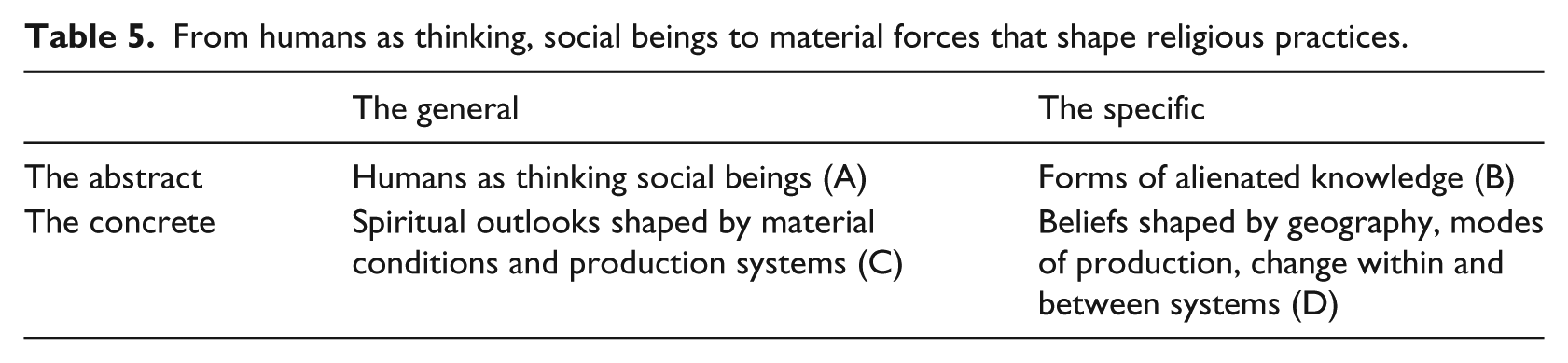
While geography influences what animals, plants, rivers and so forth become totemic, social forces assert themselves once there ‘emerges the difference between natural instruments of production and those created by civilization’ (Marx and Engels, 1976 [1846]: 63). The level of development of such instruments ‘discloses man’s mode of dealing with Nature’ and ‘lays bare the mode of formation of his social relations, and of the mental conceptions that flow from them’ (Marx, 1992 [1867]: 3522). Thus, as a form of alienated knowledge (Table 5), religion is shaped by ‘specific form[s] of material production,’ where ‘a specific relation of men to nature’ determines ‘their spiritual outlook’ (Marx, 1969 [1963]: 285). By extension, the general characteristics observed across modes of production—i.e. divisions of labor, property relations, the social development of productive forces, the subject of production, terms of labor, etc. (see Paolucci, 2019)—shape system-specific things like class hierarchies, the number and quality of social roles, rules, organizations, and forms of authority, knowledge of nature, patterns of exchange, trade, and communication, accessibility of material goods, the ability to defeat rivals, and so on. Such relations and processes influence the formation of new ideas or force older ones upon new subject populations, beliefs which nevertheless result from the extent to which humans remain subject to and/or do not understand forces outside their control. Also, as structural power relations and change within and/or between systems, religious ideas incompatible with a new system are likely to be transformed or ignored and those compatible with it are likely to remain.
From humans as thinking, social beings to material forces that shape religious practices.
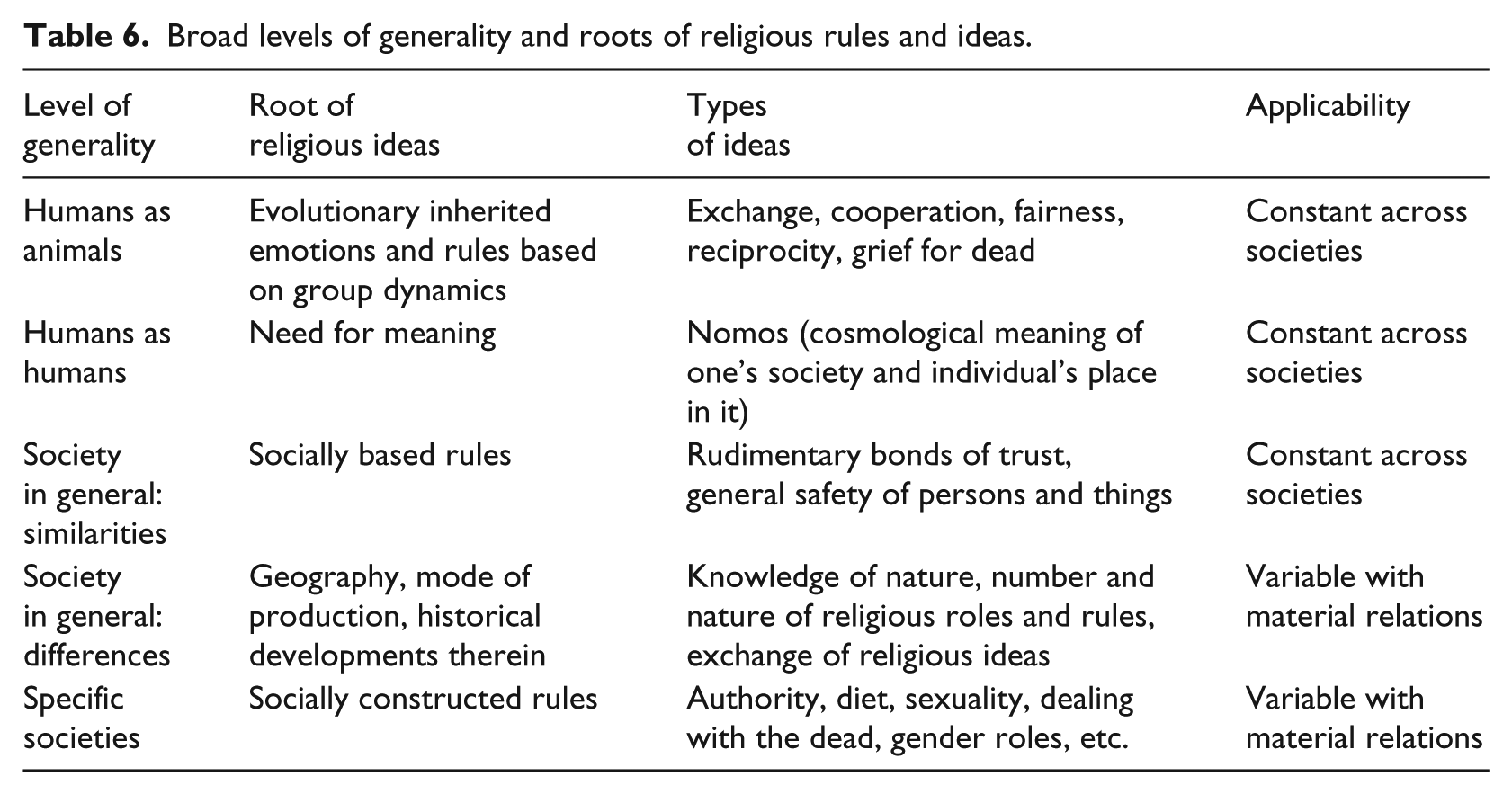
With these models in hand (Table 6)—and just as variations in the relations and processes economic structures share differentiates modes of production (see Paolucci, 2019)—variations in religion’s constants allows us to differentiate them. In terms of commonalities across them, religions assert that supernatural forces (spirits, gods, etc.) exist outside the observable world and their practices (prayer, rituals and so on) mediate these realities to target a range of humans whose lives the sacred realm is meant to shape. Special humans (shamans, priests, imams, etc.) have unusual access to the sacred through special training (meditation, monasteries, seminaries, etc.) and/or through special tools (revelation, holy books, a talisman, altars, incantations, etc.) to elicit desired effects (healings, blessings, answers to questions about the future, diet, sex, illness, death, and so on). With religion in general modeled as such, inquiry and analysis must grasp ‘material production … in its specific historical form’ in order to ‘understand what is specific in the spiritual production corresponding to it and the reciprocal influence of one on the other’ (Marx, 1969 [1963]: 285).
Broad levels of generality and roots of religious rules and ideas.
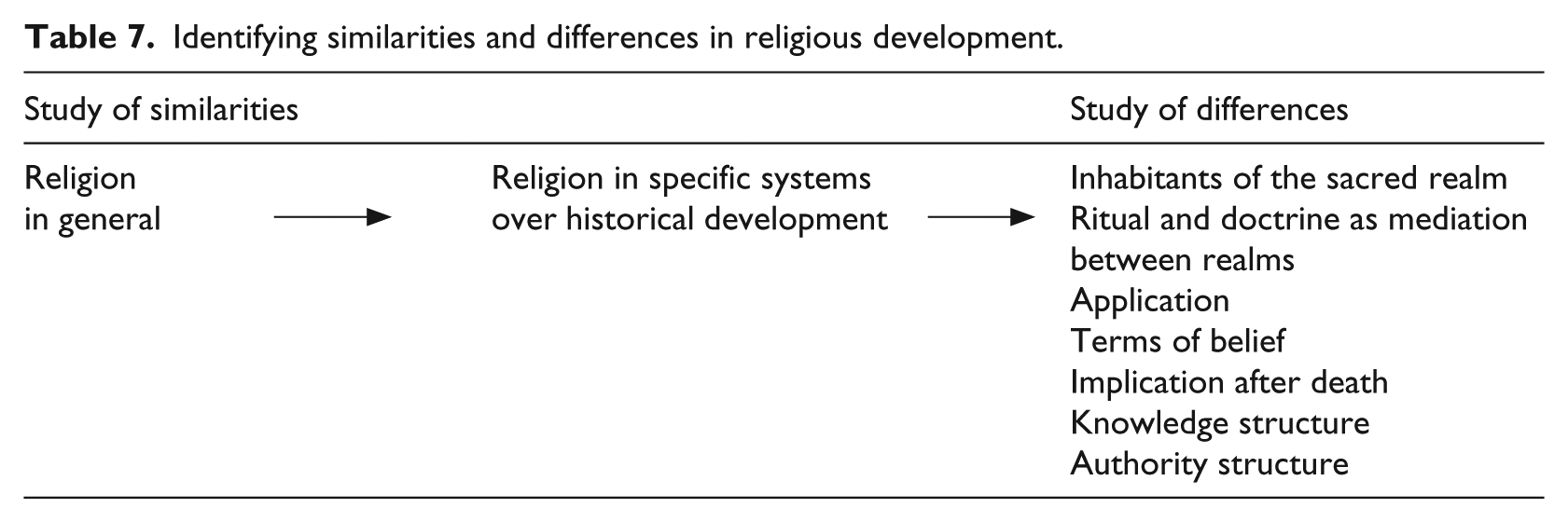
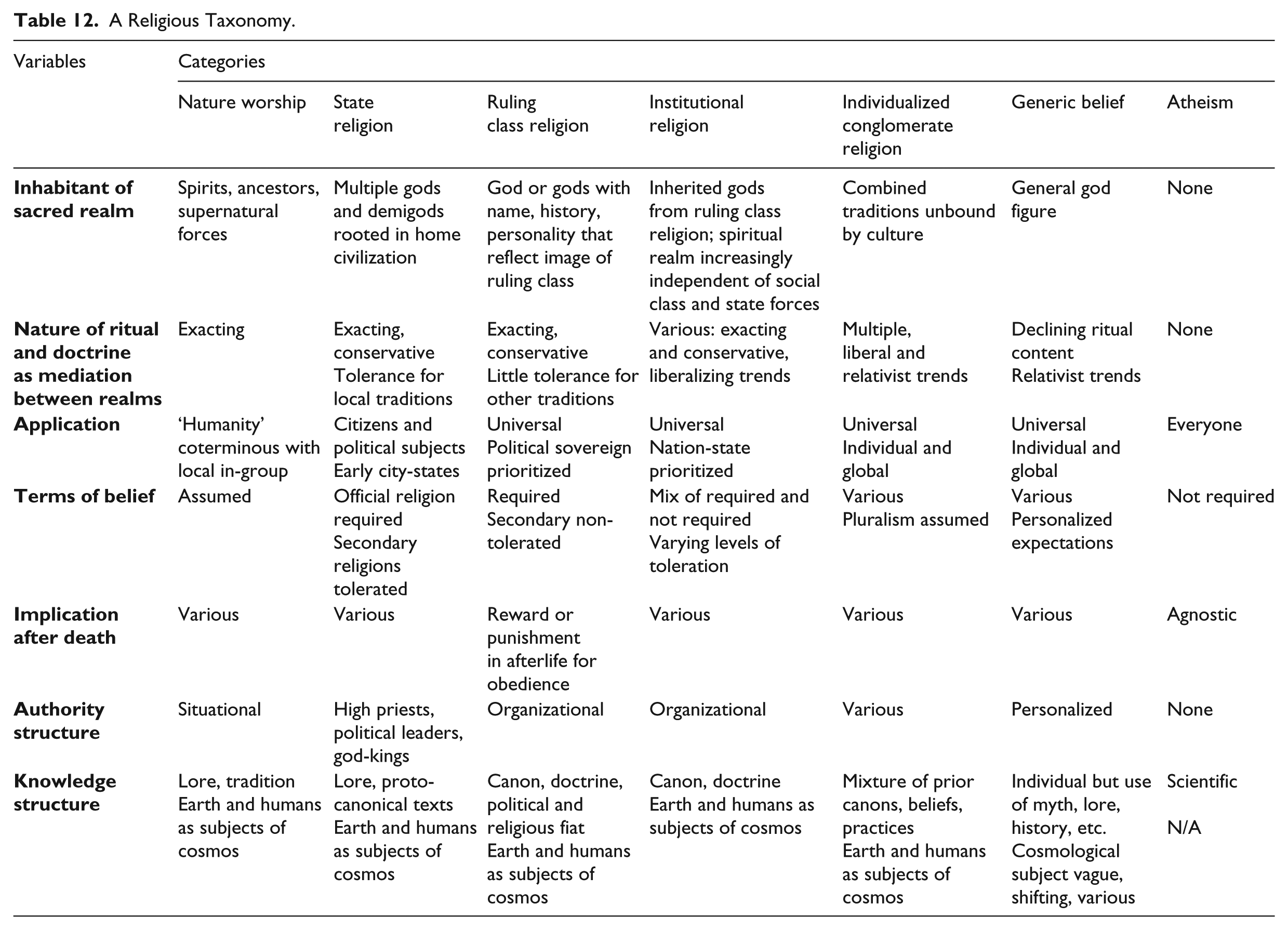
Given this starting point, specific religions in their historical forms, then, will differ on these variables
(1) what inhabits the sacred realm;
(2) the nature of ritual and doctrine as mediators between realms (the exacting level of ritual performance that is required to activate the sacred, conservative or liberal theology);
(3) to whom beliefs apply (in-groups, anyone, everyone);
(4) the terms of belief (required or not);
(5) what happens after death;
(6) knowledge structure (the subject of sacred knowledge and its location in lore, canon, and/or individuals), and;
(7) authority structure (situational, priesthood, bottom-up/top-down organizations, individual).
Comparison of these variables across historical systems (Table 7) allows for constructing a religious taxonomy.
Identifying similarities and differences in religious development.
Religion and the Earliest Societies
The ‘ancient social organisms of production’ are ‘extremely simple and transparent’ and ‘founded either on the immature development of man individually,’ as in a ‘primitive tribal community, or upon direct relations of subjection’ (Marx, 1992 [1867]: 83–84). In societies where human consciousness is rooted in their ‘limited connection with other persons and things’ and ‘the immediate sensuous environment … confronts men as a completely alien, all-powerful and unassailable force … and by which they are overawed’ (Marx and Engels, 1976 [1846]: 44), ‘the social relations between man and Nature, are correspondingly narrow’ and there exists ‘the ancient worship of Nature’ as well as ‘elements of the popular religions’ (Marx, 1992 [1867]: 84). As this ‘natural religion’ arises ‘precisely because nature is as yet hardly altered by history’ (Marx and Engels, 1976 [1846]: 44), nature worship is less a ‘religion’ one could adopt as would a convert but a nomos without a hard distinction between profane and sacred realms. Rudimentary technology translates into non-terrestrial bodies, the weather, crops, pregnancy, illness and/or death being explained by imagined non-material forces, with ritual often magic-based and requiring an exacting use of chants, charms, burnt offerings, sacrifices, etc. Religious authority is usually a shaman but is often situational, not institutional, and religious knowledge survives more through lore, practice, and tradition than through dogma.
Though exchange and trade result in exchange of ideas, the commonalities in beliefs here rest more in their form than in their content, which display a wide range of stories, spirits, forces, social rules about sex, marriage, kinship (etc.), and claims about what happens after death—e.g. non-existence, returning to a spirit form, or joining deceased ancestors. Terms of belief are not typically such where one can choose to believe or not, in that there are few to no other competing belief systems to compare one’s culture’s nomos to, and thus proto-religious beliefs are applicable to the local in-group, as true universality is not yet materially possible. And while spirits or forces may be simultaneously worldly and otherworldly, sacred knowledge posits humans and their lived-worlds as the cosmological subject and the ultimate relevance of sacred lore.
Religion from Class Societies in General to Feudalism
Compared with the earliest societies, class systems have more complex divisions of labor and technology, larger populations, and the first forms of landed property and surplus-value appropriation, i.e. forced labor, rent, and tribute. Exchange and trade increase and with them increase exchanges of ideas. The first city-states develop formal military, religious and political structures, though most people are peasants, plebeians, craftsman, traders, or slaves. Specialization puts religious ‘consciousness … in a position … to proceed to the formation of ‘pure’ theory, theology, philosophy, morality, etc.’ (Marx and Engels, 1976 [1846]: 45). Knowledge and authority structures shift to ascendant canonical texts, more formalized training, and a priesthood that monopolizes knowledge, such as ‘the Indian Brahmin who proves the holiness of the Vedas by reserving for himself alone the right to read it’ (Marx, 1964: 25).
Inhabitants of the sacred realm also shift from forces guiding nature to gods with names, characteristics, biographies, duties, and domains that interact with intention with the human world, i.e. the polytheist gods in Greece, Rome, India, who often influenced battles or mated with humans to create demigods. Such specialists and moral/theological codification are usually associated with the ‘class which has the means of material production at its disposal, [which] consequently also controls the means of mental production, so that the ideas of those who lack the means of mental production are on the whole subject to it’ (Marx and Engels, 1976 [1846]: 59).
As such, stratified class relations—e.g. landed property, labor obligations, states and citizens (political subjection), etc.—become encoded into laws; military duties to the state, duties of slaves to masters, stricter gender rules (patriarchy), and requirements such as taxes and tribute all become moral goods. Military victors and political leaders can determine religious practices of favor and often become god-kings (e.g. in Rome and in China, among other places), setting the foundation for officially adopted monotheism (e.g. after Constantine’s conversion). In these systems, ‘the “true religion” … [is] the cult of “their nationality”, of their “state”’ (Marx, 1964: 23), i.e. state religion.
As the consolidation of beliefs into more exacting canons and rituals delegitimizes competing proto-forms, mutual contrast with and conflict between other consolidated traditions becomes more likely, a ‘contradiction, arising not within the national orbit, but between this national consciousness and the practice of other nations’ (Marx and Engels, 1976 [1846]: 45). Canonical consolidation, however, does not eliminate breakaway cults, schisms, purges, or the rise of new nations, political-economic revolutions, demographic shifts, etc. that can eliminate, absorb, and/or produce other traditions. For instance, the consolidation of dynastic regimes in ancient China lifted Confucianism into orthodoxy over earlier, more local schools of thought. And although land was owned by both families and larger landowners, distribution of power in offices and taxes to government were the main locale of political-economic power and, as such, religion was an official state religion.
In state religions, the mode of mediation between realms remains relatively exacting where the proper execution of ritual ranks above faith, while individual duty is to social institutions and political-religious authorities. Such conservative beliefs and supplications apply mainly to political subjects, a growth beyond the simpler in-group thinking of the earliest systems and a step toward universality—i.e.
For each new class which puts itself in the place of one ruling before it is compelled … to present its interest as the common interest of all the members of society … to give its ideas the form of universality, and present them as the only rational, universally valid ones. (Marx and Engels, 1976 [1846]: 60)
For example, as one of many tribal religions, Judaism did not posit its belief system as universally required, though, as a breakaway sect, Christianity did (eventually). As such, in state religion’s maturation, terms of belief are required for citizens, as are obligations and devotional exercises, though other local traditions are often tolerated. Notions of an afterlife become more solidified but with variations (e.g. Valhalla, Nirvana, Elysium; different Judaic, Buddhist and Shinto traditions have no afterlife or are agnostic on the subject). Earth and humans as cosmological subjects remain, as do appeals to magic for blessings and guidelines on human affairs (both of which persist over time).
After ‘the downfall of the old states … brought the downfall of the old religions’ (Marx, 1964: 23), the Catholic Church remained the most influential organization on the Continent, out of which European feudalism emerged. ‘Christianity itself changed with every new phase of these world conditions’ (Marx and Engels, 1978b [1850]: 244). Becoming increasingly centralized, hierarchical, and wealthy in this system, monarchies and the Church dominated most land ownership and serfs were obligated to provide labor, rent, and tribute to landlords and tithes to the Church. While royalty were not gods per se, their rule was a ‘Divine Right’. Christianity became an arm of feudal class power and was no longer a faith of a downtrodden desert people, nor one enjoying more status and influence via the conversion of an emperor. Duty to a royal sovereign replaced duty to a culture or a civilization and political rulers increasingly enjoined with and at times usurped religious authorities over practice (e.g. the schism of the Church of England with the Roman Catholic Church). Specialization continued and increased, as did a monopoly over dogma and practice (reading the Bible was often banned). Rather than a theoretical universality—as in ‘anyone could participate’—monotheistic religion achieved a required universality corresponding to the new ruling class’s vision of its right to rule and was enforced as such. Thus developed ruling class religion. 2
European feudalism’s nomos was a religious one—i.e. being the children of Abraham and actors in a singular god’s earthly plan—and religious regulation of life proliferated—e.g. with conservative and exacting doctrine (texts on theological minutiae); rituals (church attendance, the elements of the Mass); behavioral requirements (rules on sexuality, diet, prayer); and rules on authority (death for heresy, religious or political). Heaven was for obedient believers, hell for sinners and non-believers, purgatory for those needing additional purification, and limbo for unbaptized babies. Forced upon an illiterate people by political-religious authorities, belief was required and non-Christian traditions from paganism to Judaism to Islam were treated as threats and enemies (e.g. the Crusades, the Spanish Inquisition, other religious pogroms).
The Catholic Church nevertheless faced challenges, e.g. disagreements over the Pope’s authority and objections to the sale of indulgences. The Protestant Reformation’s more individualistic outlook ‘shattered faith in authority’ by restoring ‘authority of faith’ and ‘turned priests into laymen … [and] layman into priests’ (Marx, 1975 [1844]: 182). After the telescope’s invention and the work of Galileo, Copernicus, and Kepler, the Ptolemaic model was overturned during the 16th and 17th centuries, though the ‘only Earth’ model of reality and humanity as the cosmological subject remained intact. Should monarchial authority change, those on the wrong side of the political-theological divide were often forced to convert and/or sometimes killed, setting the stage for religious development in modernity, with both Catholicism and Protestantism each positing their belief system was required and universally applicable.
Religion and Capitalism in General
One ‘innate necessity of [the capitalist] mode of production, [is] its need for an ever-expanding market’ (Marx, 1971a: 237) with the world-market as its ‘basis and vital element’ (Marx, 1971a: 110). With a structure beset with ‘polarization,’ ‘the complete separation of the labourers from all property in the means by which they can realize their labour’ is reproduced ‘on a continually extending scale’ (Marx, 1992 [1867]: 668). Thus, capitalism’s ‘characteristic features’ such as ‘mobility of capital and labour and continual revolutions in the method of production, and therefore in the relations of production and commerce and the way of life, leads to great mobility in the habits, modes of thinking, etc., of the people’ (Marx, 1971b: 444). With such material relations ‘contain[ing] … contradictory tendencies and phenomena … [that] counteract each other simultaneously’ (Marx, 1971a: 249), capitalism and religion promote and undermine one another, which we can see across their historical development.
Capitalism’s Historical Development
In capitalism’s period of primitive accumulation, maritime powers with an oceanic reach—e.g. Spain and Portugal, to name two—lead in colonizing foreign lands—i.e. Central and South America, the Caribbean, and the Philippines and Brazil, Indonesia, southern Africa, respectively—and set their required universalist monotheism the task of ‘Christianizing savages.’ In ‘destroying the former natural exclusiveness of separate nations’ (Marx and Engels, 1976 [1846]: 73), colonialism forged some religions together—e.g. Santeria and Voodoo in the Caribbean and North and South America. As the Christian god’s patronage shifted from monarchies to nation-states, biblical support for modern class relations was found—e.g. ‘Let every person be subject to the governing authorities. For there is no authority except from god, and those which exist are established by god’ (Romans, 13:1). Even with secular governments, the nation-state became exalted in anthems and its leaders transformed into a secular priesthood, a residue leftover from both state religion and ruling class religion (a residue found in modernity in multiple ways, as we shall see). Yet this developed unevenly and with contradictory results.
Given capitalism’s relations of private property and the legal individual (as opposed to family, clan, etc.), Christianity’s ideas of personal sin and individual salvation and ‘its religious cultus of abstract man, more especially in its bourgeois developments, Protestantism, Deism, etc., is the most fitting form of religion’ (Marx, 1992 [1867]: 83). And when not so fitting, Christianity adapted—e.g. endorsing both capitalism’s forms of appropriation in ignoring Biblical prohibitions against usury (see Marx, 1971b: 534) and its terms of labor in cultivating the work ethic. Unlike Rome’s state religion—which required a ritualistic gesture or gift to the gods while multiple traditions were tolerated, or in comparison to feudalism’s ruling class religion where belief and practice were required and non-favored practices squelched—Christianity’s required universalist monotheism struggled with the political and social pluralisms (and even non-required belief) of modern nation-states. For example, in Europe, cultures and politics grew more secular while still referencing god/providence in their constitutions; the US Constitution referenced not god but ‘the people’ as the source of its laws and legitimacy, while its culture was and remains one of the modern world’s most religious.
The conflicts in feudal Europe were the historical backdrop for the later separation of church and state. With this separation, ‘religion develops in its practical universality only where there is no privileged religion (cf. the North American States) …. The [modern] state declares that religion, like the other elements of civil life, only begins to exist in its full scope when the state declares it to be non-political and thus leaves it to itself’ and, therefore, after ‘the abolition of the state church’, religion ‘henceforth obeys its own laws undisturbed and develops to its full scope’ (Marx and Engels, 1956 [1845]: 156, 158; emphases in the original). Thus, ‘the separation of religion from all profane content makes it abstract, absolute religion’ (Marx and Engels, 1956 [1845]: 130; emphasis in original) and transforms ruling class religion into institutional religion, which leaves room for multiple beliefs, cults, sects, churches, denominations, and even non-participation.
With capitalism’s social development of productive forces, the populace grows increasingly literate, educated and mobile, which presents religion with a new possible social antagonism. In the industrial period, consolidated European nation-states intensified their expansionary efforts to secure cheaper resources and labor, which culminated in the ‘scramble for Africa’ and initiated additional Christian missionary penetration. By the early 20th century, several societies, including Russia and China, reacted to capitalist expansion and banned religion, though the need for meaning could not be banned and religion went underground. By the late 1950s and 1960s, postwar powers experienced challenges in their domains—e.g. Great Britain’s rule in India and Kenya ended; China underwent upheaval with the Cultural Revolution; France, humiliated in Algeria, withdrew; the USA signed a truce in Korea (with Christian missionaries leaving a lasting mark on the southern half of the peninsula) and its war in Vietnam reached its apex (ultimately ending in defeat in the 1970s). France, the USA, Japan, and Mexico all experienced cultural transformations as capitalism entered a transnational stage. Feminism challenged patriarchal rule. Vatican II’s reforms further loosened Catholicism’s grip on the requirements of faith. Financial and sex scandals beset innumerable Christian congregations worldwide. Western materialism left people unsatisfied as postwar euphoria receded. Church attendance almost everywhere in the West declined while new religious movements grew.
In the global period, all but a few modern states are driven to secure the bourgeoisie’s need for the ceaseless accumulation of capital to the exclusion of other, wider social needs (see Marx, 1971a: 264). From the vantage point of capital, there arises ‘not only … alienation and indifference’ towards the conditions of labor, but with modernity’s cultures intermingling, its popular knowledge unreliable, and [i]n line with its contradictory and antagonistic nature, the capitalist mode of production proceeds to count the prodigious dissipation of the labourer’s life and health, and the lowering of his living conditions, as an economy in the use of constant capital and thereby as a means of raising the rate of profit. (Marx, 1971a: 86)
Religions today struggle against modernity, others, and themselves, while people everywhere are confronted with forces they cannot control or understand. Three trends are indicative of this: (1) polarization and religious crisis, (2) religion as marketplace consumption, and (3) a new ‘generic’ god.
Polarization and Religious Crisis
Modernity—where ‘[a]ll that is solid melts into air’ and ‘all that is holy profaned’ (Marx and Engels, 1978a [1848]: 476)—regularly produces crises in meaning. It has elicited, on the one hand, liberal accommodations and religious reform and, on the other, conservative reaction to modernity and its reforms. Modern secular states can no longer compel belief or even require a gesture to practice and culture often mirrors this (if unevenly). But the participants in required universalist monotheisms are commanded to convert others. In relation to its institutional separation, its leaders have tried to return religion to its place of socio-political authority, attempting to either remain relevant to, or even dominate, secular institutions.
While modern Christianity and Islam have maintained their sacred realm’s inhabitants (the god of Abraham), application (everyone), and terms of belief (required), they have clashed with modernity in multiple ways. In the Middle East and the Arabian Peninsula, Islamic believers—e.g. Islamic Brotherhood (Egypt), the Islamic Revolution (Iran) and Wahhabism (Saudi Arabia)—rebelled against modern secularization, liberalizing trends in religion and external colonial interference (from Britain, the Soviet Union, and the USA, among others). Sometimes these religious movements were/are nationalist in nature and a significant number endorse fundamentalist doctrines and radical politics. Similarly, Christian ‘Dominion Theology’ (first merging in the 1970s) is nationalistic in flavor, wants the US Constitution interpreted on a biblical basis, denies the Enlightenment roots of American democracy, and aspires to limit citizenship to Christians. With both of these religious movements resting on a moderate form of hierarchical authority and each unable to harness an army of conquest with their own resources, their strategy is to take over secular/political institutions and transform them into a macro-authority over modern society.
For example, the Islamic State today wants to create a caliphate across parts of Northern Africa, Southern Europe, and the Middle East, reminiscent of Rome’s state religion. Both ISIS and other Islamic movements resemble feudal ruling class religion in other respects, such as violence against offenders of the faith and dogma and law dictated by political-religious leaders, e.g. Sharia. By contrast, as secular systems cannot require Christian faith or practice, Dominion Theology’s leaders strive to have themselves and biblical principles instituted among the ‘seven mountains’ (religion, government, the economy, the family, education, media, and arts and entertainment). The key knowledge structure for both rests on the inerrancy of religious texts and an eschatological vision of their civilization’s place in God’s cosmological plan (Islam’s Last Prophet versus Christianity’s End Times) and as such, both posit their doctrines apply to everyone, are required, and those who refuse them are destined for hell. What we are seeing with Christian and Islamic fundamentalisms, then, is their struggle with the gravitational pull of modernity’s institutional religion. Fundamentally rejecting modernity’s institutional inertia and secular social form, each desires a religion that combines both state religion (their period of origination) and ruling class religion (when they matured to dominance), where authorities are strong, institutions are religiously organized and regulated, belief and participation are required, and religious pluralism suppressed.
Pulling in the opposite direction, increasing numbers of people are leaving religion today through agnosticism and atheism (Bullard, 2016). 3 Populations liberalized and secularized by modernity turn away from religious dogmatism and its xenophobia, sexism, and homophobia. With advances in science, technology, and historical knowledge, there is less room to attribute what we do not understand to an otherworldly source (e.g. geocentrism, natural disasters and illnesses as god’s wrath, and so on). The Earth today is radically decentered to an arm of an average galaxy among hundreds of billions of them, thus religion struggles with and against its prior positing of Earth and humans as cosmological subjects. It is therefore likely that the numbers of those leaving religion will continue to grow with institutional religion’s loosened grip on individuals, with state enforcement of practice disabled, and with religions unable to require participation (even though their theologies do).
Religion as Marketplace Consumption
The above are not the only responses to modernity’s crisis of meaning or the internal crisis within institutional religion. Today, without centralized punishing power available to religious leaders, those who believe in the biblical monotheistic god and in Jesus-as-Christ can ignore aspects of Christian theology and ritual they find problematic—e.g. miracles, virgin birth, slavery, mandatory church attendance, rules on sex, divorce, etc.—and select what they like from it as if in a buffet line—a (pejoratively called) ‘Cafeteria Christianity.’ Though positing a god that applies to everyone, the belief system represents an unstructuring of tradition and this provides space for individuals to also accept nondoctrinal beliefs (e.g. astrology, fortune telling, karma) without cognitive dissonance. Others have discarded specific religious faith altogether while holding on to certain spiritual beliefs and practices (a practice common among modern Jewry). As global political-economic links and improved technologies brought cultural exchanges as well as environmental problems, Western affluent classes encountered ideas such as Buddhism, Taoism, various pagan traditions (e.g. Wicca), astrology, yoga and so on. By the late 1970s and early 1980s, a New Age movement emerged and persisted (even if not always by that name). Individuals—now free to ignore required institutional doctrine and organizations demanding obedience—assemble their own rituals and practices from the global marketplace, quasi-organizations, and the occasional cult or sect.
Both Cafeteria Christianity and New Age beliefs represent individualized conglomerate religion. While combining ideas from different traditions is not historically uncommon, the degree to which this is self-motivated, non-denominational, and organizationally unstructured is new. Still in need of meaning, modern people may not embrace specific religious dogmas and/or institutions but many still believe in a god, gods, or spiritual forces and they search for and find a variety of them. With the Earth and human life remaining the cosmological subjects, beliefs here posit their meanings are universal and thus apply to everyone (even if only in potential). Given their individual (rather than organizational) orientation, both approaches are unenforceable by either religious or secular authority and requiring others to believe doctrines is anywhere from difficult to impossible (thus, the occasional tendency toward sects and cults). And with no one view on what happens after death, especially reward or punishment, it is hard for such conglomerate messages to compel people to commit to them.
The New Generic God
With institutional religion represented by aspiring but failed monopolies in a competitive religious market, as individualized conglomerate religion grows as an alternative, and as capitalism integrates people and cultures while undergoing constant change, a new god analogous to George Herbert Mead’s (1962 [1934]) ‘generalized other’ has emerged. For most of history, gods were like significant others with names, biographies, and points of view (e.g. Odin, Zeus, Hera). Today, ‘god’ is increasingly detached from tradition and authority (i.e. Yahweh, the specific god of Abraham, is functionally dead) but still exists as ‘a superhuman being in the fantastic reality of heaven’ (Marx, 1975 [1844]: 175). This new general, abstract, and nameless god without a history and indifferent toward specific organizations or rites represents generic belief. And this new god is more personal than ever as believers base it on their preferences and even in their own image (Epley et al., 2009). Requiring no ritual or specific doctrine, this god is usually posited as universally applicable but, paradoxically, many such believers tend to be relativists and agnostic, both to the extent they believe theism is a requirement and on the afterlife. With belief personally rooted, there is no authority structure per se and knowledge is a patchwork of lore, tradition, and individual proclivity.
Discussion: Religion, Marx’s Scientific Dialectics, and the Politics of Abstraction
Science isolates objects and their interrelations in order to study laws, regularities and differences. Since ‘society’ is a broad concept covering all historical periods, we must be able to identify and conceptually capture specific structures and their relevant variables with the analytical flexibility required for studying systemic and historical change. But the study of religion usually proceeds on how it presents itself to us, i.e. starting with the nature and number of the gods or remaining on the grounds of the history of religious traditions (whether from apologists or critics). But if ‘all science would be superfluous if the outward appearance and the essence of things directly coincided’ (Marx, 1971a: 817), then in a proper scientific modeling of religion, ‘our difficulties begin only when we set about the observation and the arrangement—the real depiction—of our historical material, whether of a past epoch or of the present’ (Marx and Engels, 1976 [1846]: 37). And that material presents us the challenge of piecing together the ‘concentration of many determinations’ (Marx, 1973) that make the concrete up, with religion being no exception.
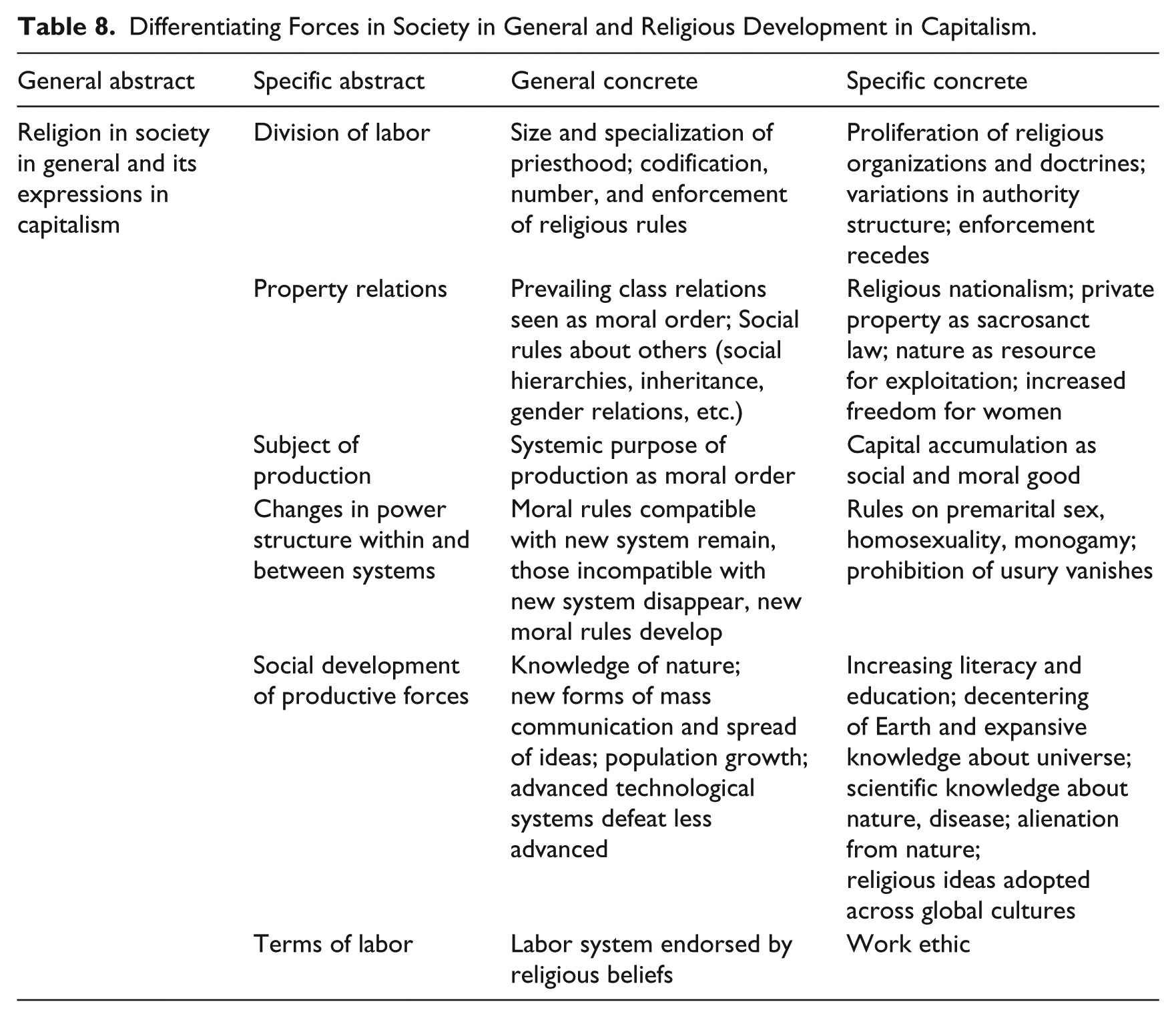
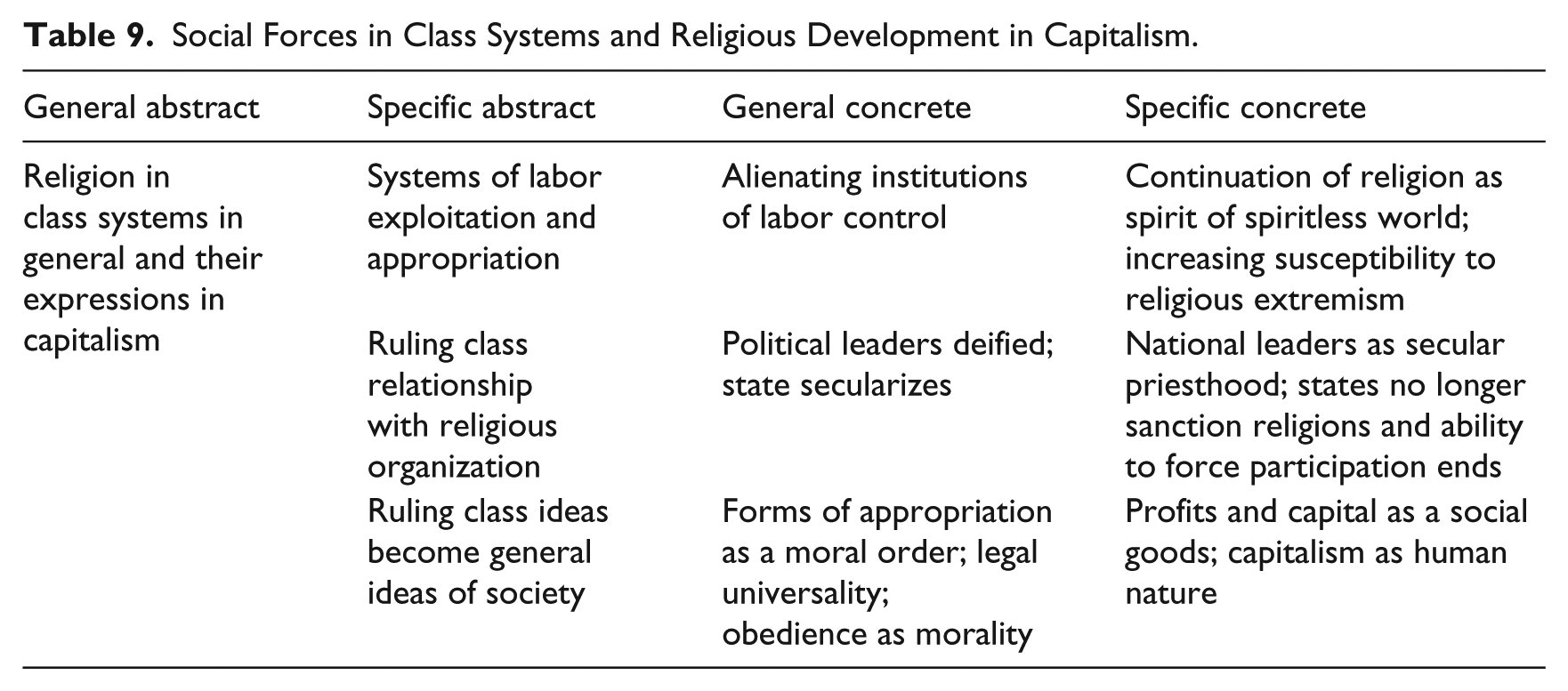
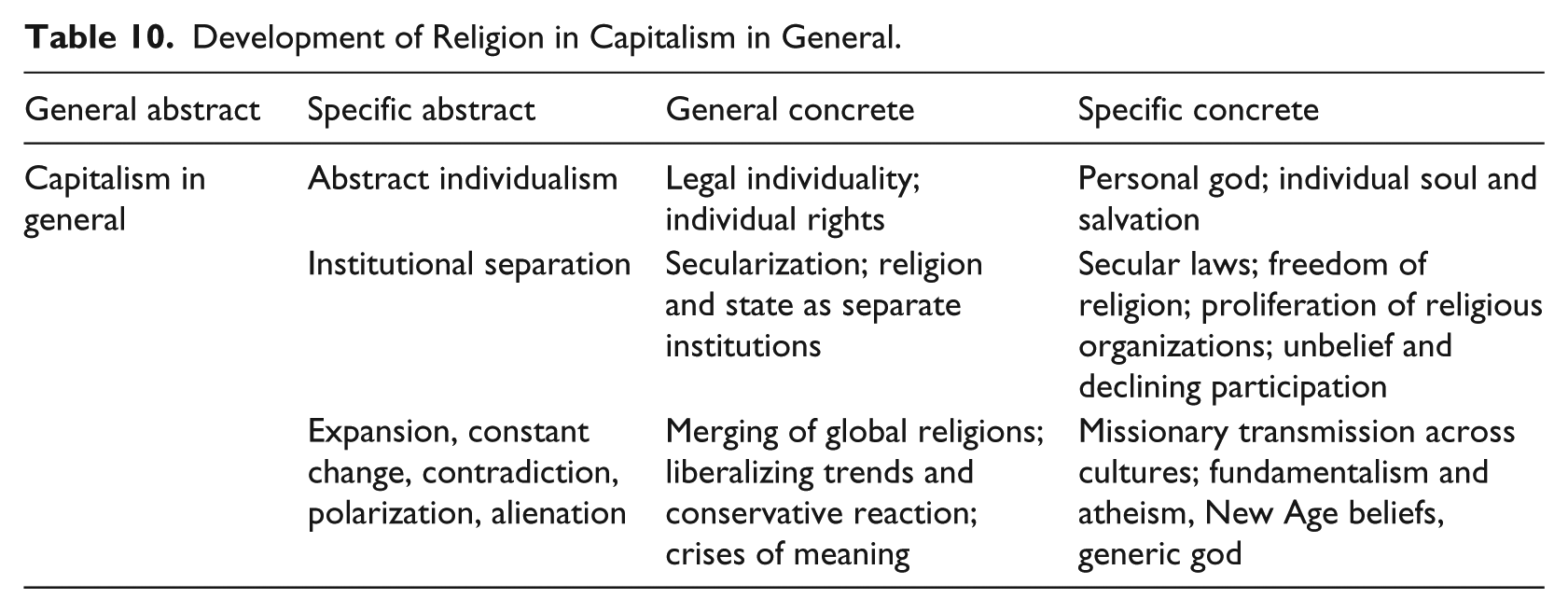
For this work, we first identify religion’s forms of development across multiple levels of generality as well as within and between real societies as shaped by their modes of production and other material forces (Figure 1). Afterwards, we are better prepared to piece together their interrelations. Second, we locate how the variables used to differentiate societies in general find expression in capitalist society and use them to isolate religion’s corresponding development there (Table 8). Third, we similarly isolate variables related to class systems in general and identify how these have influenced religion’s development in capitalism, as it too is a class system (Table 9). Fourth, we isolate the unique features of capitalism as a system and their influence on modern religious development (Table 10).
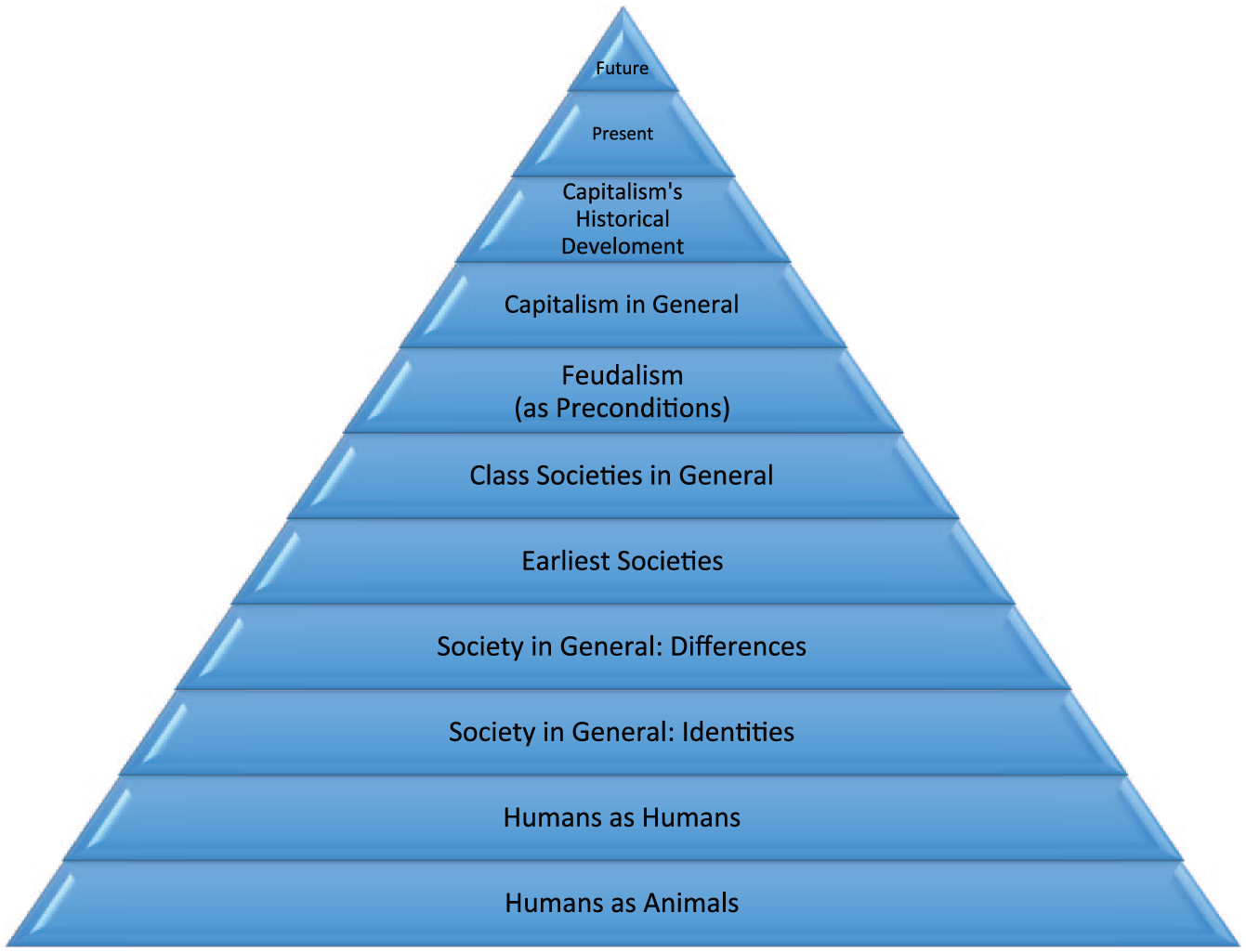
Levels of Abstraction for a Study of Religion from Broad to Narrow.
Differentiating Forces in Society in General and Religious Development in Capitalism.
Social Forces in Class Systems and Religious Development in Capitalism.
Development of Religion in Capitalism in General.
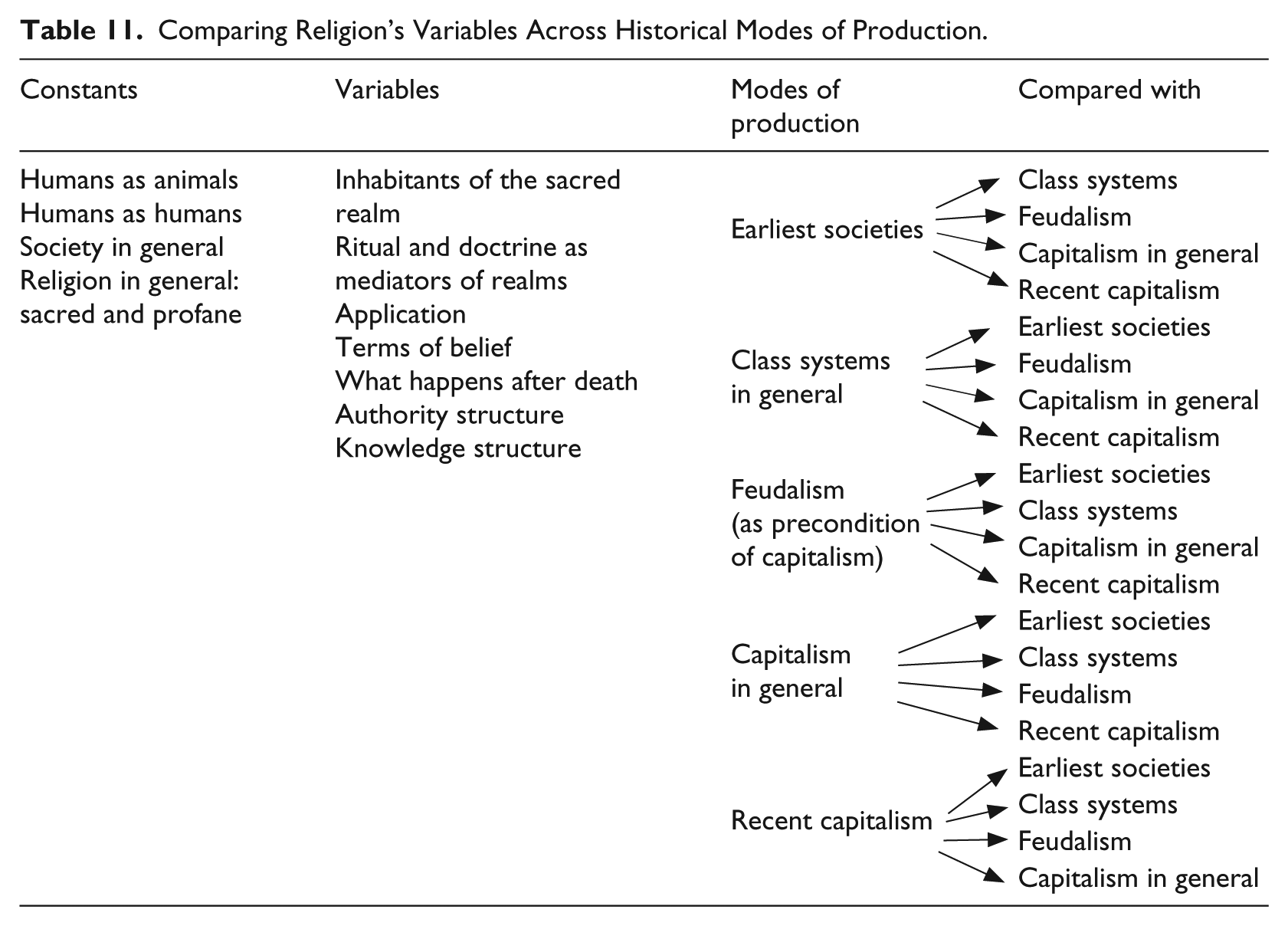
The previous analysis allows for a new taxonomy of religion. Starting with holding constant religious development at levels of generality of humans as animals, humans as humans and society in general, we compare religious practices observed across historical changes within and between modes of production (Table 11) and variations in their constants are used to differentiate religious categories (Table 12). So, while all religions make a distinction between the sacred and the profane, they posit different types of sacred realms. All traditions use ritual to connect these realms but differ as to its requirements, e.g. exacting and conservative versus more liberal and relativist doctrines. Other considerations include to whom a religious system applies (application); to what extent beliefs are required (the terms of belief); what awaits humans after death; a religion’s authority structure (top down, bottom up, or somewhere in-between); and its knowledge structure (the cosmological subject as related in lore, canon, personal beliefs). What this model reveals are the historical changes in religion across systems, its development into canon and organizational structure, and its current breaking apart.
Comparing Religion’s Variables Across Historical Modes of Production.
A Religious Taxonomy.
Conclusion
The conclusions to which Marx’s methods lead are where a dialectical approach to science meets the politics of abstraction (Paolucci, 2007, 2011). Static conceptions of religion—universal definitions that depict it as a historical constant, functionalist apologetics based on this depiction—fail to grasp religion’s real development in time, space, and social structure. Dialectical, historical, and materialist frameworks provide the flexible precision to do this and, correctly applied, force upon us a critical eye toward any dogma, religious or political, where ‘man is governed by the products of his own brain’ (Marx, 1992 [1867]: 582). Such ideologies return to that same cognitive home and leave people susceptible to similar methods of influence. But science done well demystifies a world where religion ‘is becoming senile and that it is more and more outlived’ (Marx, 1971a: 262). This conclusion does not necessarily require Marx’s approach, but that approach itself does lead to such conclusions, and this makes it a very political science.
Footnotes
Acknowledgements
My thanks to the reviewers of an earlier edition of this article as well as to Dr Jen Koslow of Eastern Kentucky University, each of whom helped improve its contents.
Funding
This research received no specific grant from any funding agency in the public, commercial, or not-for-profit sectors.