




Abstract
Gentrification’s racial consequences are garnering increased attention as the process advances into majority–minority urban neighborhoods. This study examines the EB-5 Immigrant Investor Program’s implementation in Brooklyn, New York to ground these trends in policies through which gentrification is promoted, histories of racism and uneven development against which they are unfolding, and their disparate impacts on Black communities. While the program purports to use foreign investment to promote job growth in high unemployment areas, its financing of multimillion and billion-dollar development projects facilitates the displacement of longtime residents of the very places the initiative was designed to improve. Central Brooklyn and its outlying areas, home to one of the largest contiguous Black communities in the United States, are host to numerous EB-5 projects that have failed to produce sustainable job growth for existing residents and heightened the growing crisis of unaffordability. My analysis shows how EB-5 projects have enabled investors to use distressed areas disproportionately inhabited by poor and working-class Black communities to qualify for funding, while redistributing benefits upward to wealthy developers and affluent residents and consumers. Ultimately, the EB-5 program and other neoliberal, colorblind urban development policies exacerbate existing racial inequalities in the organization and operation of urban space.
Keywords
Introduction
Gentrification—a process sociologist Sharon Zukin defined as “the conversion of socially marginal and working-class areas of the central city to middle-class residential use” (1987: 129)—has been a significant concern among urban residents, civic and business interests, and myriad other stakeholders for many years. Particularly during the final decade of the twentieth century and the initial decades of the twenty-first, its scope and scale have increased at an unprecedented speed. The phenomenon is no longer limited to the rehabilitation and revival of distressed housing and downtown business districts that characterized it as it gained traction in U.S. cities in the late 1970s (Hackworth, 2002; Lees et al., 2008; Osman, 2011; Smith, 1996). Today, it frequently entails the construction of luxury residential towers and professional sports arenas, as well as the creation of entirely new urban landscapes. Such changes have contributed to a staggering rise in the cost of living in cities across the nation, deepening longstanding crises of racial and economic segregation. They have also escalated affordable housing shortages and contributed to a rise in evictions, homelessness, and other forms of precarity facing already vulnerable people. These trends have raised urgent debates about the relationship between capital accumulation, dispossession, and displacement, particularly as they shape the current and future fragility of poor and other marginalized urban residents and communities.
Numerous scholars have attributed these shifts to the entrenchment of neoliberalism and neoliberal urban governance (Hackworth, 2002, 2007; Harvey, 1989, 2000; Mitchell, 2003; Smith, 2002). They argue that the rise of gentrification and private real estate investment as “global urban strategy” (Smith, 2002) has grown out of larger ideological and political-economic trends that have shifted the burden for the physical and social upgrading of cities from the public to the private sector. This climate has compelled municipal governments to increasingly serve as “market facilitators, rather than salves for market failures” (Hackworth, 2007: 61). It has also pushed city leaders to turn to international capital and foreign investors in their quest to locate funding sources and bolster economic growth. Members of the growing transnational wealth elite often view real estate, particularly in major global cities like London and New York, as a safe and stable haven to store capital (Fernandez et al., 2016). Landmark investments by these entrepreneurs have accelerated neighborhood transitions, pricing out poor and other vulnerable residents and increasingly the existing middle-class, including first-wave gentrifiers (Butler and Lees, 2006; Lees, 2003). Some scholars have compared these dynamics to earlier waves of colonial and mercantile expansion (Atkinson and Bridge, 2005; Jackson, 2017), which normalized dispossession, displacement, exploitation, and marginalization as simply the price of economic development.
A host of regulatory changes and incentives have facilitated investment by foreign entrepreneurs. Since 1990, the U.S. EB-5 Immigrant Investor Visa Program has been one such critical policy tool. In return for a significant capital investment into a job-creating enterprise, most of which are made through federally approved “regional centers,” it enables foreign investors to receive permanent U.S. residency for themselves and their dependents. The program’s popularity is evidenced through its usage in a wide range of infrastructure, residential, and commercial projects, including New York City’s $25 billion Hudson Yards project, the most expensive real estate development in U.S. history. This growing influx of international capital has coincided with gentrification’s spread deeper into majority–minority urban neighborhoods across the nation. In these areas, an enduring history of structural racism and chronic disinvestment has largely excluded Black and brown communities from the purported benefits of neighborhood revitalization. This has been especially critical for EB-5 investment, as the program incentivizes projects in areas that struggle with high unemployment and economic distress. These dynamics have produced a conundrum in which the communities programs like EB-5 were created to assist are the most vulnerable to displacement by the very capital flows and real estate speculation that such policies promote.
What matters for understanding the consequences of EB-5 and similar foreign investment incentives is not merely the spatial-economic changes that international capital has triggered. Rather, drastic racial and class transitions in the wake of such programs demand a deeper understanding of how they correspond with—and indeed depend upon—centuries of racially discriminatory planning and funding decisions. In this paper, I argue that, despite the race-neutral tenor of EB-5 and similar programs intended to attract international capital, the benefits of the investments they facilitate accrue along racial lines. In the context of deep and abiding racial and spatial inequality, reducing Black and other marginalized communities to an economic indicator like high unemployment or “distress” subordinates racial justice and equity concerns to the pursuit of profit. It also primes areas in which EB-5 projects are sited to go the way of the rest of the hypergentrified city, remade for the benefit of whiter and more affluent developers, investors, residents, and consumers, and largely inaccessible to everyone else. This study is exploratory in nature, building on research that documents the trajectory of gentrification and racial transition (Chronopoulos, 2016, 2020; Freeman, 2006; Hyra, 2017; Lees, 2016; Sutton, 2020), while underappreciating how the growing influence of foreign real estate investment intersects with historic and contemporary racial and spatial inequality. Since the EB-5 program is a prominent policy tool for attracting wealthy immigrant investors, and since New York City ranks highly among sites of transnational real estate investment and as a global symbol of gentrification and racial transition, it is appropriate to use the two in a single case study that illuminates connections between neoliberal governance, foreign capital, and gentrification’s racialized human toll.
This study seeks to answer such questions as: what is international capital’s influence on the gentrification process? How is the EB-5 Immigrant Investor Visa Program a tool of gentrification? How do colorblind redevelopment policies reproduce and legitimize racialized outcomes? How are Black people disadvantaged in the remaking of the multicultural city? In what follows, I first foreground the significance of foreign investment in the context of the gentrification debates and scholarship on neoliberal urbanism. I then conduct an empirical assessment of EB-5 and its impact on the racial and class composition of neighborhoods bordering Brooklyn, New York’s Atlantic Yards/Pacific Park megadevelopment with census data and other statistics. Inspired by the call by Black Studies and other scholars to pay attention to how race structures the organization and valuation of urban space and society (Dávila, 2004; Lipsitz, 2007, 2011; Mele, 2013; Pattillo, 2007; Summers, 2019), I propose a theoretical account for understanding the recent wave of EB-5 and other colorblind strategies of urban redevelopment, and how these mechanisms reinforce and build upon longstanding racial-spatial inequality. Taken together, this analysis illuminates vicious racial and class transition and displacement enabled by the capital flows, ideological currents, and power imbalances that mark the exclusionary remaking of the “new” New York.
Neoliberalism, Gentrification, and Foreign Real Estate Investment
For decades, scholars have theorized the temporal and spatial mutations of gentrification. Initially observed as the rehabilitation of decaying housing by middle-class outsiders in working-class London (Glass, 1964), the process has grown in complexity as well as geographic scale. Contemporary gentrification has extended well beyond house-by-house residential change completed with sweat equity and small-scale government funding to include multimillion- and billion-dollar developments facilitated by public–private partnerships and foreign capital. A number of critical geographers and other gentrification scholars have attributed these changes to neoliberalism, globalization, and the changing role of the state (Aalbers, 2018; Hackworth, 2007; Hackworth and Smith, 2001; Harvey, 1989; Lees et al., 2008; Smith, 1996, 2002).
Neoliberalism has been the dominant political-economic paradigm in much of the world for nearly half a century. It contends that human well-being is best advanced by privileging individual freedoms within free markets over and against interventions by the state (Harvey, 2005). The ideology gained steam globally beginning in the 1970s, when political, business, and intellectual elites sought solutions for a global economic recession and social movements that threatened the prevailing capitalist structure (Omi and Winant, 2014). These crises provided an opportunity for such elites to consolidate their power and intervene in monetary and social policy, creating an optimal climate for business and private capital accumulation while gradually untethering the state from its responsibility to provide social goods and welfare services to its citizens.
These shifts have transformed urban life and governance in a host of ways, including paving the way for contemporary gentrification. For example, while massive federal programs like urban renewal subsidized much-needed residential and infrastructure development in previous eras, since the 1970s cities facing crises of social unrest, physical decline, and fiscal insolvency have had to bear the responsibility for their own recovery. This shift from managerialism to entrepreneurialism in urban governance (Harvey, 1989) has compelled cities to move away from spending on public goods like education and healthcare, and toward greater investment in sectors that more directly produce economic growth, particularly finance, insurance, and real estate (Hackworth, 2007). In places like New York City, which remains an iconic example of the neoliberal turn in urban governance, officials slowed down on prior commitments to affordable housing and subsidies for people in need. Instead, they lured corporations and developers with tax abatements, lax zoning regulations, and a host of other incentives to attract private investment and to signal that the city was open for business. This neoliberal development strategy took such a hold that, by the 1990s, developers were frequently the first to orchestrate reinvestment in distressed areas of the city (Hackworth and Smith, 2001). This shift marked a stark contrast to previous waves of gentrification in which artists and middle-class residents were considered archetypal “pioneers.”
As cities increasingly embraced real estate development as a primary growth strategy, seemingly local projects became increasingly connected to global systems of real estate and banking finance. This change was facilitated by restructuring and globalization within the real estate industry, which enabled foreign firms and individual foreign entrepreneurs to seek out investment opportunities in the United States, and to thereby have a greater role in urban development and gentrification. Civic and business leaders took steps to incentivize foreign capital investments as well, many of which were unprecedented. For example, before the late 1980s, U.S. immigration policies largely focused on stopping illegal immigration and promoting family reunification. But, by then, the United States had begun to join other countries in considering how to attract wealthy foreign nationals who could help them remain competitive in the global economy (Rankey, 2017). While an investment visa option for foreign nationals had been in place since 1965, those applicants had simply been put into the general pool with others seeking “non-preference” visas. With the 1990 creation of the EB-5 program and similar initiatives, however, an official preference was established for high net-worth immigrants. This measure opened the flood gates for even greater capital investment and revenue generation, while facilitating higher levels of real estate speculation in previously disinvested urban areas.
Neoliberal development policies and incentives for foreign investment helped usher us into current modes of gentrification, driven by financialization and reduced affordable housing and tenant protections. As in previous eras, but now with greater speed and viciousness, these changes have resulted in the replacement of poor, working-class, and socially marginal urban dwellers with more affluent residents and consumers. They have also contributed to a climate in which property is increasingly being transferred from individual owners into the hands of private equity funds, asset management corporations, and real estate investment trusts. Local investment is still strong in many areas, but it is now supplanted by global investment, with real estate increasingly treated as an asset class by transnational wealth elites (Fernandez et al., 2016). In first-tier global cities, these individual investors do not buy super-prime real estate to benefit from rental income—they use it as a “safety deposit box” to store excess capital and generate reliable returns (Aalbers, 2018).
While many have benefited from this growth, for others these changes have come at a significant cost. Luxury developments continue to rise across New York and other cities, while homelessness and eviction crises are reaching record levels. Working-class and poor residents are being financially squeezed out. In some areas, the existing middle-classes are being replaced with wealthier residents as well (Butler and Lees, 2006; Lees, 2003). Renters have struggled to find affordable housing in markets that are already tight, and most urban dwellers have been effectively shut out from opportunities for homeownership. Sassen (2014) has called these displacements and inequalities “expulsions,” a nod to the severity and apparent irreversibility of these trends (Aalbers, 2018; Fernandez et al., 2016).
Such trends have been especially devastating for Black communities, which have historically been devalued through policies and practices of displacement and disinvestment (Fullilove and Wallace, 2011). For decades, racialized perceptions of threat and economic risk, coupled with the destructive effects of deliberate public and private neglect, ensured that Black neighborhoods and their inhabitants remained highly stigmatized even as capital and more affluent residents flowed into other areas of the city (Schaffer and Smith, 1986). In the contemporary climate of hyperinvestment and heightened real estate speculation, however, and as foreign investment has become increasingly prominent, depressed property values have turned these areas into a prime investment opportunity for entrepreneurs with access to increasingly high amounts of capital. In the following section, I explore how the EB-5 Immigrant Investor Program has facilitated unprecedented levels of investment into predominantly Black and other minority neighborhoods that have disproportionately been labeled “distressed.” I also make a case for further exploration of the role of foreign capital as a gentrifying force in its own right.
The EB-5 Immigrant Investor Program: Creating Cities for the Rich (and the Rest of Us?)
In 1990, the U.S. Congress created the Immigrant Investor Program to stimulate the economy through job creation and capital investment by foreign investors (U.S. Citizenship and Immigration Services, 2020). In exchange for a significant investment in a commercial enterprise that will create or preserve full-time positions for at least 10 qualifying workers (U.S. Citizenship and Immigration Services, 2020), the program enables immigrant entrepreneurs to gain permanent residence in the United States for themselves, their legal spouse, and their unmarried children under the age of 21. Though not limited to cities, the program has been an increasingly popular tool for attracting the funding necessary to complete major urban development projects associated with hypergentrification. Its roots in ideologies and processes of neoliberal governance—including casting the state in the role of “market facilitator,” reliance on the private sector for the physical and social upgrading of the city, and engagement in global circuits of capital—make it a revealing example of the nature and function of neoliberal urban development policy and the role of foreign investment as an engine of contemporary gentrification. The program’s usage skyrocketed after the 2008 recession, when developers’ demand for non-traditional funding sources breathed new life into it. Its shortcomings and consequences for longtime residents near sites developers choose for their projects illuminates the uses and abuses of colorblind neoliberal urbanism in the deeply racialized urban landscape.
Best known as “EB-5” based on the employment-based fifth preference visa that participants receive, the initiative requires a minimum capital investment of either $900,000 or $1.8 million. Those amounts are a sharp increase from the original $500,000 and $1 million thresholds, which the USCIS adjusted upward for inflation for the first time ever in November 2019. The lower investment option is for applicants who invest in a project located in a “targeted employment area” (TEA), which the government defines as a rural area or an area that has experienced a high unemployment rate of at least 150 percent of the national average (U.S. Citizenship and Immigration Services, 2020). Currently, there are 10,000 EB-5 visas available each fiscal year, with which the program generates billions of dollars annually.
The EB-5 visa has the distinction of being the largest investment-by-residence program in the world. Notably, investors from mainland China have historically dominated the number of EB-5 approvals, so much so that the USCIS website offers an explanation of the EB-5 program in “simplified Chinese” (2020). In fiscal year 2019, Chinese investors received 49.3 percent of the total EB-5 visas provided (U.S. Department of State – Bureau of Consular Affairs, 2020). Due to a quota limiting 7 percent of available visas to applicants from a single country each year, new applicants from mainland China face a 10- to 15-year waiting list. This overwhelming interest is consistent with Chinese investors’ record as the largest foreign buyer of U.S. real estate more broadly, having held that record since surpassing Canada in 2014, and having purchased $30.4 billion worth of U.S. residential properties from April 2017 to March 2018 alone (Research Group of the National Association of Realtors, 2018). Chinese nationals’ roles in EB-5 projects range from investing significant sums of capital to serving as sole or lead developer, or even serving as co-developer with a lead developer from the United States (Friedland and Calderon, 2017: 6). Some of the largest new projects are being sold and developed by Chinese companies relying on EB-5 capital to complete their development and construction (Friedland and Calderon, 2017: 6), and are primarily located in New York City and Los Angeles.
The EB-5 program and others like it around the world have come under fire for many reasons. A lack of transparency by regional centers, developers, and USCIS has made EB-5 data collection and verification difficult for scholars, the public, and other interested parties (Friedland and Calderon, 2017). The program is generally criticized for its loose oversight and lack of accountability, particularly due to the vast discretion given to resource centers in their management of capital and investors outside of the visa process. Some criticize the money-for-visas model on moral grounds, arguing that it permits immigrants who are motivated by their own financial bottom line rather than ideals like political freedom and patriotism (Rankey, 2017: 360). Others point to how the program offers a special pathway to citizenship for the wealthy and the global elite, while millions of foreign-born people with less financial means have to wait in line. That number includes immigrant entrepreneurs who have historically been the backbone of urban economies and communities, yet lack the abundant financial, political, and legal capital available to EB-5 investors. The program has been also plagued by fraud: in 2016, the U.S. Securities and Exchange Commission successfully brought enforcement actions against nearly $1 billion worth of EB-5 projects—a majority of them against individuals or companies that misuse investors’ funds (Zuckerman and Stock, 2017). Still others argue that the program amounts to corporate welfare that channels funds to politically favored projects, while leaving the needs and concerns of ordinary people unheard and unaddressed.
November 2019 changes regarding TEA designations are particularly noteworthy. First, the job of designating TEAs is no longer the purview of state and local governments—instead this duty has moved into federal oversight. This step could hasten the accumulation and transfer of capital depending on the development agenda of a particular presidential administration. In fact, a federal pro-development agenda was apparent in an additional change, which expanded the TEA designation to include cities and towns with a population of 20,000 or more outside of metropolitan statistical areas. Finally, “specially-designated high-unemployment TEAs” now consist of “a combination of census tracts that include the tract or contiguous tracts in which the new enterprise is principally doing business” (U.S. Citizenship and Immigration Services, 2020). This step broadens the scope of potential development and puts the government’s imprimatur on significant foreign investment in areas that are not, in fact, distressed.
With this change, areas that are not themselves TEAs—and which may be considered outright affluent—are able to openly utilize capital flows earmarked for distressed areas to bolster their local economy and otherwise upgrade their neighborhoods. This change is especially meaningful in a city like New York, where vast income inequality often exists within the matter of a city block, and where high-end housing and retail often appear “adjacent to but vigorously disconnected from poor, mostly minority neighborhoods” (Mele, 2013: 598). Ultimately, this move opens TEAs up for intensified exploitation by developers, who may use TEA residents’ socially and economically disadvantaged position to secure capital for projects that benefit areas that are already considered desirable. Numerous projects have come under fire for doing just that, including New York City’s Hudson Yards megadevelopment, for which developers and government officials reportedly strung together an extensive number of census tracts to obtain a qualifying TEA designation, including some containing low-income public housing miles away in Harlem (Capps, 2019).
In cases of TEA misuse, and in the face of EB-5 projects more broadly, unprecedented influxes of international capital have caused real estate prices to skyrocket. Even as these measures appear race-neutral, the deeply racialized nature of urban disinvestment—rooted in policies and practices that have most severely targeted Black neighborhoods—means that Black and other majority–minority communities are especially vulnerable to designation as TEAs due to historically high levels of unemployment and economic distress. Civic and business leaders suggest that external capital is just what these neighborhoods need to foster local development. However, capital alone does not fundamentally alter structures of racism and economic marginalization that disproportionately harm Black and other communities of color.
Programs that incentivize development in majority–minority areas mark a shift from previous eras in which racist exclusion cut Black communities off from investment outright (Taylor, 2019). However, they often do more to benefit developers, investors, and more affluent residents than to redress the root causes of inequality. In fact, they often double down on racialized patterns of uneven development, exacerbating unaffordability and pushing Black and other marginalized people out and into spaces of deeper disadvantage while remaking their historic neighborhoods to suit whiter and more affluent residents and consumers. In the truest sense of “accumulation by dispossession,” this demonstrates how the development of affluent urban areas is literally dependent on the conditions that concentrated and racialized disregard and disadvantage have produced. Rather than address the enduring and oft-expressed needs of longtime poor, Black, and other vulnerable residents, these dynamics create profit for elites, white and more financially well-off residents, and other parts of the city.
Colorblindness and Neoliberal Urban Development in Brooklyn
Even as scholars have acknowledged how the turn to neoliberalism and foreign investment has shaped gentrification and increased urban inequality, few have adequately analyzed the fundamental role that race and structural racism have played in this shift. This absence has been quite conspicuous given that, in popular discourse and conceptualization, pre-gentrified neighborhoods are mostly inhabited by Black and other people of color, while gentrifiers are typically understood to be white (Kirkland, 2008: 18). Economic relationships remain of the utmost importance, but they do not adequately explain geographies and degrees of disinvestment and reinvestment. They also fail to account for the acute vulnerabilities of people of color across the socioeconomic spectrum in the context of exclusionary redevelopment. I follow Black Studies and other scholars’ call to engage neoliberalism’s function as a racial project, one that disavows race and racial inequality while deepening the significance of both (Johnson, 2011; Omi and Winant, 2014: 211–244).
Critically, I understand the city as a space that is fundamentally structured by racial power and racial hierarchies that generate deep and lasting inequalities for which class-only explanations cannot account (Hackworth, 2019; Lipsitz, 2007, 2011) 1 . Thus, we cannot fully understand gentrification’s operation and impact unless we reckon directly with the role of race and structural racism at the heart of the urban political economy, in the organization and functioning of the urban landscape, and in the distribution of the burdens and benefits of urban redevelopment. As hypergentrification spreads deeper into the heart of racially disinvested areas, which today generally serve as the primary homeplaces of racially minoritized communities, these structural realities will be crucial in deciding some of the defining questions of urban life: who has the right to the city, and under what circumstances? “How is [that right] policed, legitimized, or undermined? And how does that right—limited as it usually is, contested as it must be—give form to social justice (or its absence) in the city?” (Lefebvre, 1968; Mitchell, 2003: 4).
I follow sociologist Christopher Mele (2013) in identifying neoliberal urbanism as an ideology and strategy that aims to “render exclusionary urban development legitimate, realizable and seemingly attractive to distressed cities” (p. 599). This certainly applies to programs like EB-5, which purports to offer a mutually beneficial quid pro quo, by which wealthy immigrants invest in urban development in exchange for visas, while cities and their residents reap the benefits. Mele contends neoliberal urbanism “does not retreat from race,” but rather reconstitutes racial dynamics to “accommodate processes of capital accumulation and uneven urban development” (2013: 598). This is also true for EB-5, which mobilizes the concept of economic distress while failing to name its roots in institutional arrangements that have a particularly damaging effect on Black and other people of color. This ultimately has the effect of obscuring the persistence of racial inequality and facilitating capital accumulation without fundamentally challenging the status quo.
Despite the use of colorblind racial discourses to legitimize neoliberal policy agendas—particularly to “deflect responsibility for problems of structural inequality from society to the individual and ignore the persistence of structural and systemic racism” (Bonilla-Silva, 2017; Mele, 2013: 601; Omi and Winant, 2014)—race persists as a fundamental organizing principle of U.S. society (Omi and Winant, 2014) and “continues to be the underlying ordering mechanism of urban development” (Mele, 2013: 613). Accordingly, centering racial matters in research on neoliberal urbanism in all its forms encourages us to interrogate how different visions of urban progress are enacted in this context, and how they impact the city’s most vulnerable economically and racially marginalized residents.
In what follows, I engage with the racialized nature of neoliberal urbanism through a case study of the EB-5 program and its use in a megadevelopment in Brooklyn, New York. Over the past decade, Brooklyn has become what many have called the “gentrification capital of the world.” The borough has risen out of Manhattan’s shadow to become the premier locale for real estate development, global capital investment, and cultural consumption in the New York City. It is also home to one of the largest contiguous Black communities in the United States. And, like similarly composed neighborhoods across the nation, the neighborhoods in which Black Brooklynites primarily reside have emerged as a “new frontier” for the ubiquitous phenomenon of hypergentrification.
Brooklyn’s trajectory of postwar migration, deindustrialization, and physical decline is echoed throughout the city. That narrative shares similarities with other major urban centers across the nation. However, the borough’s more recent experiences with exclusionary urban development are unique in many ways due to New York City’s status as financial capital of the world. Particularly in recent years, Brooklyn’s growing status as a “global city” (Sassen, 2018) in its own right has attracted a uniquely high level of international investment. These capital flows are closely linked to finance and banking, legal, and media institutions and economic processes whose effects ripple throughout the world. Accordingly, like other global cities, Brooklyn has become a “concentrated expression of the contradictions of wealth and poverty that typify globalization” (Lipman, 2002: 380; Sassen, 2018). These contradictions are underpinned by logics that create and seize upon racial differentiations, designating some people and places for production, while designating others for neglect, exploitation and disposal (Danewid, 2019: Lowe, 2015).
These power dynamics are perhaps most clearly apparent in the social and economic challenges that most severely plague Black Brooklyn communities, all of which are contending with the effects of historic and contemporary racial discrimination and institutional neglect. For example, in Bedford-Stuyvesant, the historic heart of Black Brooklyn, poverty and unemployment have been significantly higher than the city average for decades. The neighborhood of Brownsville is home to the highest concentration of low-income public housing in North America, as well as one of the highest concentrations of incarcerated or formerly incarcerated people in the country. In East New York, which is one of the poorest neighborhoods in the city, only 38 percent of renter-occupied homes are adequately maintained by landlords, free from heating breakdowns, cracks, holes, peeling paint, and other defects. Even Brooklyn’s black homeowners have not escaped the economic precarity that grows from the racial discrimination: five of the top 10 neighborhoods with the highest number of foreclosure actions at the height of the subprime crisis—Flatbush, Bedford-Stuyvesant, East New York, Canarsie, and Bushwick—are all home to majority-Black populations.
How, then, are we to understand the vulnerability of today’s Black Brooklyn residents to gentrification-induced displacement in the context of broader narratives of revitalization and renaissance? By all accounts, Brooklyn is booming: unemployment in the borough has fallen to a record low, entrepreneurs are opening more small businesses, the technology sector is growing, and property values are rising—albeit unequally—for homeowners across racial and economic backgrounds. Certainly, Black communities’ vulnerability is partly a reflection of neoliberal policies that have broadly increased wealth inequality and decreased the quality of life of poor and working-class people. But, more than this, I argue that Black Brooklynites’ vulnerability must be primarily understood in the context of racial capitalism, and the constant production and negation of value on the basis of race and racial differentiation. Most directly, following the work of Fullilove and Wallace (2011), these dynamics have been perpetuated through institutional means, by a key set of racialized government policies of serial forced displacement.
Over the course of the twentieth century and continuing into the twenty-first, policies like segregation, redlining, urban renewal, planned shrinkage/catastrophic disinvestment, mass criminalization, and the foreclosure crisis have subjected Black Brooklynites and other Black urban communities to “repetitive, coercive upheaval” (Fullilove and Wallace, 2011: 381). These critical policies have engendered consecutive, overlapping cycles of social, economic, and political dislocations which have deprived Black Brooklynites of stable social networks, opportunities for upward mobility, and long-term attachments to place (Fullilove and Wallace, 2011; Wallace, 2015). Critically, they have ensured that racism is spatially expressed, and that the disciplining, exclusion, and exploitation of Black people and the spaces they occupy remains crucial to the generation of value in other, more desirable parts of the city. This dynamic, which has essentially made racism and anti-Blackness a constitutive element of the built environment, is fundamental to current processes of hypergentrification.
As hypergentrification propels the city into a superficially cosmopolitan future, most ostensibly through the movement of capital and non-Black people into widely stigmatized Black neighborhoods, many argue that the ideologies and overtly exclusionary tactics that produced racialized space no longer apply. Accordingly, they argue that the notion of racialized space itself is no longer relevant, and that current processes of displacement are simply a natural occurrence, unfolding amidst a benign spatial equilibrium. By this account, these transformations are colorblind, simply driven by the logic of the unfettered free market, nothing more and nothing less. The EB-5 program offers us an opportunity to challenge this perspective, and to show how the racial logics at the heart of the city are ever present. They demonstrate the shift from policies that starve Black communities by denying them much-needed investment, to policies that threaten to crush them under the weight of capital. Certainly, such communities are worthy of investment. However, many questions remain over the destination and source of the investment, whose priorities the investment in line with, and who is going to ultimately bear the costs and reap the rewards.
EB-5, Atlantic Yards/Pacific Park, and the Investment Avalanche
In March 2019, the New York City Regional Center (NYCRC)—one of several regional centers operating in the five boroughs and the Greater New York City area—announced in a press release that, since its establishment in 2008, it had invested over $1.5 billion of EB-5 capital into a range of infrastructure and real estate projects. Of these investments, $767 million financed “ground-up, redevelopment, and infrastructure projects in Brooklyn,” including redevelopment at the storied Brooklyn Navy Yard, construction of the City Point retail complex in Downtown Brooklyn, and key components of the multi-billion-dollar Atlantic Yards/Pacific Park megadevelopment (New York City Regional Center, 2019). Consistent with the EB-5 program’s goal of job creation, the press release asserted that much of this capital had been invested in “underserved areas in need of long-term economic growth” (New York City Regional Center, 2019).
Although the NYCRC did not state this outright, many of these “underserved areas” merit such a designation due to longstanding crises of disinvestment and under- and unemployment rooted in structural racism. Instead, by placing finance, investor relations, and economic opportunity at the forefront of its agenda, and rendering silent the discriminatory policies and practices that created the conditions for significant investment, the NYCRC articulated a widely shared vision for the city that prioritizes real estate and capital accumulation over community resilience and equitable access. Due to the prevalence of that vision among gentrification’s boosters, there has been considerable debate over whether projects fueled by such staggering capital flows truly benefit existing residents of distressed areas at all. Based on experiences and observations with gentrification-related displacement and marginalization elsewhere in the borough, many reasonably speculate that such investment will harm longstanding residents in the short-term, recasting them as outsiders in the neighborhoods they and their families and communities have called home for generations and eventually pricing them out.
For all its merits and shortcomings, EB-5 capital has, without question, become a major force behind redevelopment projects scattered across Brooklyn. The largest and most visible EB-5 funded project in the rebounding borough is the Atlantic Yards/Pacific Park megadevelopment. Its crown jewel, the Barclays Center sports and entertainment arena, is, by many accounts, the flagship institution of the “new” Brooklyn. The project’s boosters packaged the arena and the development as a public good, with employment and affordable housing perks designated for poor and working-class residents of the neighborhoods near and across which the development is located.
The project was initially named “Atlantic Yards,” after the nearby Vanderbilt railyard and the adjacent Atlantic Terminal train station. It was proposed in 2003 by Bruce Ratner, chief executive officer of the Brooklyn-based Forest City Ratner Companies, one of New York City’s largest developers and once the most active developer in the five boroughs. In 2014, the development was renamed “Pacific Park” after a subsidiary of the Shanghai-based Greenland Holding Group, China’s second-largest property developer, quietly purchased a 70 percent stake in it. In 2018, Greenland’s stake increased to 95 percent, while Forest City Ratner held the remaining 5 percent. Intended as a $4.9 billion commercial and residential project, the heavily taxpayer-subsidized and highly embattled complex was initially proposed to contain 17 high-rise buildings, several of which are currently under construction. The project has been marketed as “Brooklyn’s newest neighborhood,” and, once completed, will spread for 22 acres between the low-rise Brownstone Brooklyn neighborhoods of Prospect Heights, Park Slope, Boerum Hill, Clinton Hill, and Fort Greene.
Although there was widespread agreement that some revitalization of the project site was needed, local opposition to the project after Ratner announced it was swift. Many balked at the notion that an arena was the sort of local economic development they needed, and pointed to the use of eminent domain, improprieties in the approval process, and unreliable cost and completion projections as just a few reasons to implement community-centered alternatives (Lavine, 2008). Early on, there were also concerns about the racialized implications and consequences of the development. Sizeable historic Black communities reside directly near the site—most closely in Fort Greene and Clinton Hill—and the area had already been experiencing intense racial and economic turnover for the previous decade. Many rightly anticipated these dynamics would only be worsened by the arrival of such a development and a massive influx of capital.
Led by New York City Council Member Letitia James—who was elected New York State Attorney General in 2018—hundreds of local residents, architects, and urban planners worked together to create an alternative to Atlantic Yards called the “UNITY Plan.” Its design included a hotel, new schools, a public library, and a senior citizen center, as well as retail and green space. Notably, the plan didn’t contain a sports arena, and no seizure or demolition of property was required to make it fit (DeMause, 2016). However, there were no developers actually offering to build it, and leading officials rejected the plan and affirmed their commitment to Atlantic Yards. Still, although Forest City Ratner and many civic leaders turned their back on the race-conscious needs and priorities of local communities, they quickly seized on conditions generated by persistent racial inequality to secure EB-5 capital for their seemingly race-neutral project. NYCRC would go on to raise $228 million from 498 immigrant investors in an initial round of funding.
Subsequent investigation into arrangements between government officials, developers, and the regional center intermediary has revealed misleading methods deployed to secure the TEA designation for Atlantic Yards/Pacific Park. In particular, at the request of the NYCRC, Forest City Ratner, and the Empire State Development Corporation (New York City’s primary entity for promoting economic development), the New York Department of Labor helped manipulate census data regarding local unemployment to ensure the project would qualify for EB-5 funding. It did so by omitting more affluent census tracts closest to the development, in neighborhoods like Park Slope and Prospect Heights, in order to skew employment rates downward. Similarly, it extended the TEA east of the development to encompass poorer tracts in majority-Black Crown Heights and Bedford-Stuyvesant (Figure 1) to significantly skew unemployment rates upward (Cause of Action Institute, 2013: 8; Oder, 2011).
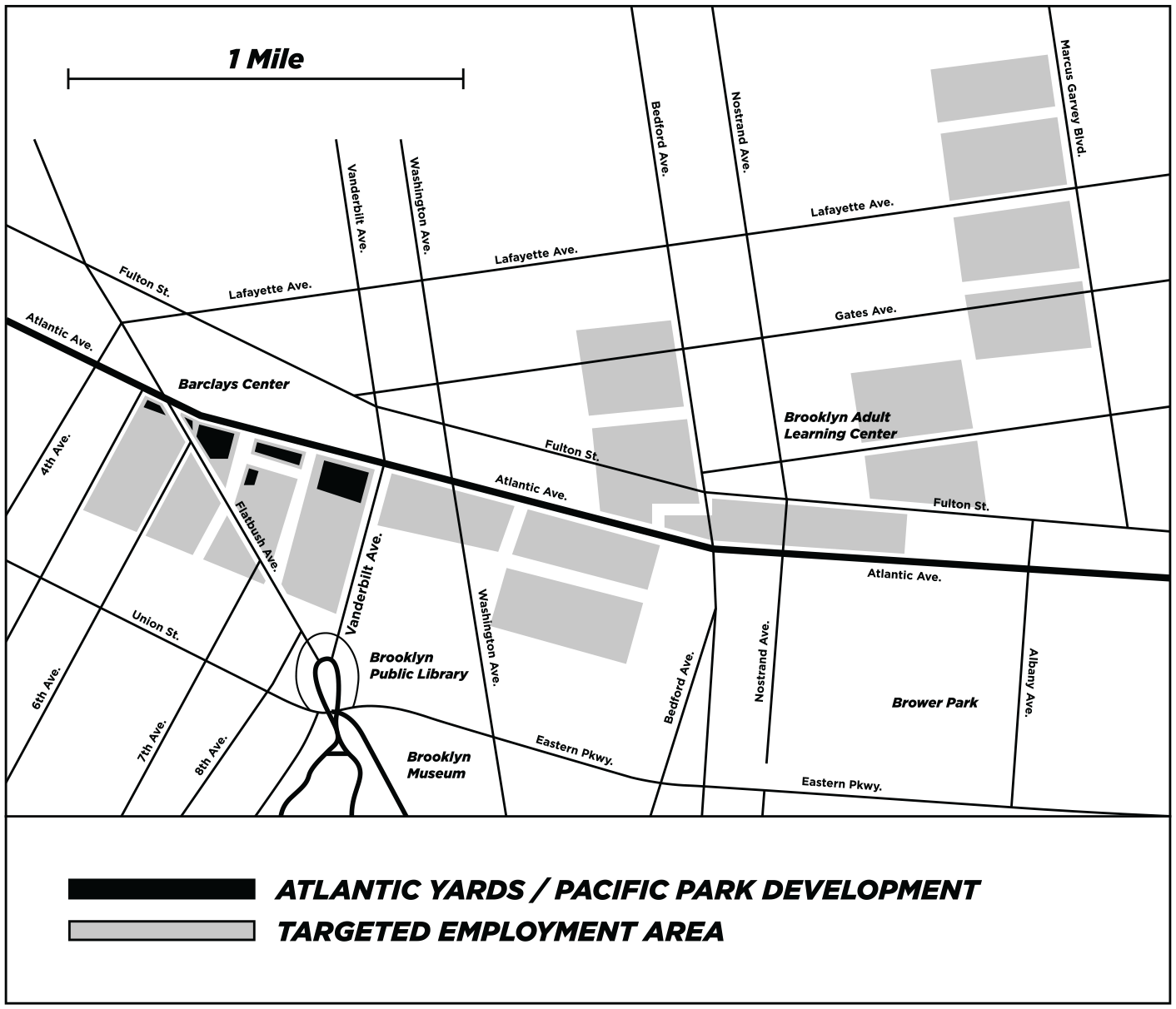
Atlantic Yards/Pacific Park Targeted Employment Area. Source: Adapted from Cause of Action Institute (2013: 8).
Developers and public officials at the helm of the project also exaggerated its economic benefits in order to attract foreign capital and investors. Despite their reliance on the consequences of racialized space and structural inequality to capitalize on a prime economic opportunity, the commitment to fulfilling initial promises of jobs and housing for local working- and middle-class residents has been unclear at best. Amidst a growing affordable housing shortage and skyrocketing rents, there is still a significant gap between the 782 affordable housing units developers had delivered by March 2019 and the 2,250 that it promised (Oder, 2019b).
Of the workers employed by the Barclays Center, there are significant numbers of Black employees on the frontlines. But the vast majority work on a part-time, event-driven basis, and are thus unable to earn a living wage or receive full-time employment benefits. Their concentration in facilities, food concessions, and housekeeping does not provide many opportunities for advancement or upward mobility.
Furthermore, data from the 2000 U.S. Census and the 2008–2012 and 2013–2018 American Community Survey has revealed drastic racial and class transformations in the five neighborhoods in and between which Atlantic Yards/Pacific Park is most directly nestled. Between 2000 and 2018, the neighborhoods of Prospect Heights, Park Slope, Boerum Hill, Fort Greene, and Clinton Hill collectively lost 15,743 Black residents (U.S. Census Bureau, 2000, 2013, 2019). This brought their total Black residency down from 43.7 percent all the way to 24.6 percent. During that same period, those neighborhoods experienced a significant influx in white residency, growing by 27,276 residents and moving from 32.2 to 49.6 percent. Notably the non-Latinx Asian population more than doubled, growing its share by 6,659 people, or from 4.3 percent to 9.1 percent of the population.
Trends in household incomes were also consistent with expected results of gentrification, with the number of households on the lower end of the income spectrum on the decline, and the number of households on the higher end of the spectrum experiencing significant growth. Consistent with research on super-gentrification, or replacement of middle-class households with increasingly more affluent ones, households with income matching the citywide median were also on the decline. The number of renter-occupied units fell from 74.3 percent to 65.7 percent, reflecting trends like the displacement of renters, conversion of rental properties to ownership properties, and the construction and purchase of condominiums and other homes. Meanwhile, the percentage of owner-occupied properties rose from 25.7 percent to 34.3 percent, suggesting an influx of more affluent residents with the means to purchase real estate in an increasingly tight market. And, finally, gross rent grew significantly, with housing units priced at $2,000 per month or more growing from 12.8 percent of renter-occupied units to 48.8 percent, while the availability of less expensive units declined across the board. Taken together, these figures suggest not only that the development itself has fallen short of the benefits it promised, but that it has helped usher in racial and class transitions nearby that have displaced and marginalized Black and poor communities and increasingly the middle class. In this climate, investors are hyperadvantaged, and stand to gain visas and millions of dollars in return for their investments—all while subverting the law—in exchange for a pittance of jobs and housing and on the backs of Black communities.
As recently as 2018, a full six years after the arena’s opening, investors were still expressing uncertainty regarding the status of Atlantic Yards/Pacific Park’s progress toward completion. Initially scheduled for a completion date of 2014, a Greenland spokesperson has since said that full buildout won’t be complete until 2035. Even the promised residential components are on hold—no new tower has begun since June 2015 (Oder, 2019a). And, although TEA designation was crucial to the project’s operation, EB-5 has no clear requirements for follow-up or assessment of the development’s community impact. With all this, it is clear that such a tool of neoliberal urbanism is not concerned with creating community assets, improving housing conditions, or providing commercial opportunities for local residents. Rather, it seeks to create conditions for capital accumulation that will benefit investors and open up “risky” areas to private investment. In this context, racial distinctions—and racialized communities—are only useful insofar as they provide value for elites. And, ultimately, this brand of neoliberal, colorblind urbanism will only heighten the marginalization, displacement, and erasure of Black communities, even if it occurs against the backdrop of a gilded metropolis.
Conclusion
Particularly in the last decade, growing foreign investment has cemented its status as a defining feature of contemporary gentrification. Scholars will be well-served by paying greater attention to the directions of transnational capital flows and how they shape the physical, social, and economic landscapes of cities. The connections between such investments and the deepening of racial-spatial inequality also merit consideration, as poor and working-class Black and other communities of color are most vulnerable to the whims of the market. This includes being disproportionately subject to displacement fueled by the real estate speculation that transnational capital underwrites.
The EB-5 Immigrant Investor Visa Program is one policy intended to harness the power of foreign capital and use it to power and provide public goods. However, the race-neutral program’s failure to directly name and address the sources of economic distress—policies and ideologies rooted in structural racism and neoliberal governance—prevents it from being most effective in remedying the conditions that created the need for the program in the first place. Furthermore, political and business elites’ appetite for unfettered capital accumulation has left the program open for abuse, often lining their pockets while failing to hold them accountable for the goods and services they promised to the public. All of this is consistent with the way that colorblind racial ideology has come to operate in neoliberal governance, deflecting responsibility for inequality away from the state and toward the individual and eliding the persistence of systemic inequalities.
The controversy with EB-5 and Atlantic Yards/Pacific Park captures how investors and developers are incentivized away from social service provision, and how loopholes are used and abused to facilitate private capital accumulation at the expense of communities with great need. It also shows the speed and viciousness of gentrification in the wake of multimillion- and billion-dollar investment, particularly in areas that were previously starved for capital. And, while cities’ economic fortunes appear to be reversing, their most vulnerable communities will remain canaries in the coal mine, warning us of what is at risk even for people with relative privilege, as the neoliberal impulse continues unabated.
Footnotes
Acknowledgements
The author thanks special editor Tamara K. Nopper, Tricia Rose, Matthew Pratt Guterl, Arlene Dávila, Ariana Valle, Zawadi Rucks-Ahidiana, and L’Heureux Lewis-McCoy for their thoughtful feedback and invaluable guidance throughout the writing and review process. The article also benefited from very useful comments from Gianpaolo Baiocchi and the Engaged Urbanists Working Group at New York University. Finally, the author thanks the anonymous reviewers for their critical comments on an earlier draft of this article, and Katie Wissel, Kiara Douds, and Cameron Etheredge for providing data assistance.
Funding
The author received no financial support for the research, authorship, and/or publication of this article.
