



Abstract
Settler colonial projects erase Indigenous peoples and their histories to justify expropriation of sovereign land. Educational curriculum plays a central role in settler colonialism by denying both long-standing connections to the land and dehumanizing those on it, relegating them to objects to be controlled or assimilated by colonizers, positioned as the colonized land’s rightful owners. This has long been the case for Palestinians. Violent expulsion from their land began with the settler colonial Zionist project in the late-19th century, a time of global colonization, and continues into the present, alongside the denial of Palestinian subjectivity and ‘permission to narrate’ their own history in public, political, and academic discourses. This paper examining US-based college-level introductory sociology textbooks finds that they replicate and perpetuate colonial narratives through Orientalist ascriptions and Palestinian de-Indigenization, while eliding the settler colonial and apartheid conditions under which they live, thereby contributing to the settler project themselves.
Introduction
Controversy regarding teaching accurate racial history is not new. In the aftermath of George Floyd’s murder in May 2020, and global Black Lives Matter solidarity uprisings, states are outlawing both Critical Race Theory, and the 1619 Project re-centering enslaving in US history. In May 2021, the world rose up again; this time in solidarity with Palestinians displaced by Israeli courts upholding Israeli settler claims to their homes in the Israeli-occupied Jerusalem neighborhoods of Sheikh Jarrah and Silwan, and Palestinians murdered in Israeli-occupied Gaza by the indiscriminate 10-day Israeli bombing campaign against its civilian population. Although Palestinian textbooks are subject to unusual global scrutiny (Brown, 2018), few studies address Palestine’s presence in US textbooks, particularly at the college-level. This paper does so using introductory sociology textbooks, finding that they replicate colonial narratives and, in doing so, are complicit in the ongoing Israeli settler colonial project in Palestine.
Literature review
Settler colonialism is predicated on two simultaneous and entangled phenomena—the violent dispossession of Indigenous people from and sovereignty in their own land and, epistemicide (cf. Grosfoguel, 2015), the epistemic erasure of Indigenous peoples and their knowledges from the historical narrative—both of which are imposed as an ongoing ‘structure, not an event’ (Wolfe, 2016: 33).
Across the globe, colonizers employed physical and epistemic violences to steal and then economically exploit colonies and people for material advantage: Settlers represented indigenous peoples as violent threats to be eliminated in ways that rationalized white settlement . . . they discounted native people as uncivilized or non-Christian, conflated inhabitants with land and nature, imagined them as removable or extinguishable, or rendered them as only existing in the past. (Lowe, 2015: 7–8)
By de-placing Indigenous peoples by describing their lands as terra nullis, empty, barren, or virgin, settlers dehumanize and erase sovereign peoples, simultaneously justifying or erasing murder or expulsion of these communities from their lands (Byrd, 2011; Tuhiwai Smith, 2012). Alongside this violent removal, settlers imposed normative ‘Western authority over indigenous lands, indigenous modes of production and indigenous law and government’ while annihilating ‘indigenous knowledges, languages, and cultures’ (Mignolo, 2000; Quijano, 2000; Said, 1994; Tuhiwai Smith, 2012: 67). Hira (2012) defines academia’s representation of colonialism ‘as a normal form of relations between human beings [rather than] a system of exploitation and oppression’ (p.53) as scientific colonialism.
Education, built on ‘research through imperial eyes’ (Tuhiwai Smith, 2012: 44), plays a central role in perpetuating scientific and epistemic colonialism. By refusing colonized peoples’ narration of their histories, cultures, and experiences, texts used by students of all ages in settler nations and empires erase and normalize colonialism’s violence (Said, 1984; Weiner, 2014; Willinsky, 1998). ‘Writing, history, and theory, then are key sites in which Western research of the Indigenous world have come together’ with Indigenous history ‘erased before your eyes, dismissed as irrelevant’ (Tuhiwai Smith, 2012: 30–31). Misrepresented colonial histories legitimize the racial order by producing an ‘epistemology of ignorance’ of both colonial violences and Indigenous histories (Mills, 1997: 18). Schools, therefore, represent a ‘racialized organization’ reinforcing settlers’ logic of elimination through ‘coinciding spirits of imperialism and scholarship that seek to possess the world’ (Ray, 2019; Willinsky, 1998: 73; Wolfe, 2016).
Palestine’s colonization
Violent settler colonization of Palestine began in the 1880s, with European Jewish Zionist leaders deeply influenced by existing Eurocentric colonial ideologies erasing Palestinians (Piterberg, 2008; Salaita, 2016): The Israeli political establishment has been committed since the earliest Zionist settlement, intensifying with the declaration of Israeli independence in 1948, not simply to deny Palestinian existence but also to make the claim true, to act in its name and on its terms. (Goldberg, 2009: 110)
As European leaders carved up Africa at the 1884–1885 Berlin Conference, European Zionists employed this logic toward Palestine, founding organizations such as the Jewish Colonization Association (Fischbach, 2003; Masalha, 2012). Alliances with European imperial powers allowed Zionists to consider Brazil, Argentina, Angola, Canada, Cyprus, and Madagascar, and Uganda, before settling on Palestine for its symbolic significance. Arguing that Jews have exclusive rights to Palestine based on religious texts, Zionists discursively erased Indigenous Palestinians using intertwined colonial logics resembling the doctrine of discovery and religious cosmologies to invisibilize Palestinians in public discourses while simultaneously uprooting them from their land (Masalha, 2012; Rodinson, 1973; Sand, 2012; Whitelam, 2001; Wolfe, 2016).
Early Zionists mobilized existing colonialist discourses in their ‘conquest of land’ and ‘conquest of labor’, colonizing Palestine by establishing colonial outposts (kibbutzim) and ethnically cleansing and occupationally segregating Palestinians (Masalha, 2020; Piterberg, 2008; Rodinson, 1973; Salaita, 2016; Sayegh, 1965; Shafir, 1996; Wolfe, 2016). Zionist leaders such as Theodore Herzl and Zeev Jabotinsky, respectively, advocated a Jewish nation as ‘a wall of defense for Europe in Asia, an outpost of civilization against barbarism’ ‘in defiance of the will of the native population’ (Hertzberg, 1997: 222; Masalha, 2012: 32). In public, Zionists claimed Palestine as a ‘land without a people for a people without a land’. A March 1918 Zionist directive read, ‘under no circumstances should they talk as though the Zionist program required expulsion of the Arabs, because that would cause the Jews to lose the world’s sympathy’ (Segev, 2000: 404).
British colonialism and the 1917 Balfour Declaration, ‘favor[ing] the establishment in Palestine of a National Home for the Jewish people’ (Khalidi, 2020: 24), legitimated and accelerated Zionist settler colonialism. The declaration, which the British military banned Palestinians from reading, referred to Palestinians, representing 94% of the population, only as ‘non-Jewish communities’ (Khalidi, 2020: 24–26; Regan, 2018). With Britain’s support, Zionist militias (the Haganah, Irgun, and Stern Gang, consolidated as the Israeli Defense Forces in 1948) terrorized Palestinians into leaving their homes and land (Morris, 2004; Shlaim, 2000). Palestinians continued their resistance, now against both British and Jewish colonization, particularly during the 1936–1939 uprising, primarily through strikes and boycotts (Kelly, 2017). Colonial authorities criminalized and equated this anti-colonial activism with terrorism, deploying tropes of Indigenous barbarity to violently suppress resistance (Kelly, 2017; Said, 1984).
In 1947, the UN partitioned Palestine, allotting 55.5% of the land to Jews (only 6% of the population) and 44.5% to Indigenous Palestinians. Dissatisfied and wanting all of British-ruled Palestine (including present-day Jordan), Zionists perpetrated what Palestinians refer to as the Nakba (catastrophe) between November 1947 and July 1949. Central to this was Plan Dalet, ‘a blueprint for the expulsion of as many Palestinians as possible’, with Ben Gurion stating, ‘We must do everything to ensure they never do return’ (Bar Zohan, 1967: 157; Masalha, 2012: 71). Zionist militias massacred Palestinians and burned homes to the ground in Deir Yassin, Ramle, Mejd al-Kroom, Lydda, and over 500 other villages, displacing at least 750,000 Indigenous Palestinians (approximately 87% of the population), before declaring independence from Britain (Khalidi, 1992; Masalha, 1992, 2012; Morris, 2004). 1 Palestinians displaced internally became second-class Israeli citizens and often ‘present absentees’, unable to reclaim their former homes, ‘killed off on the spot’ when attempting return (Morris, 1993: 432). Simultaneously, ‘Palestinian material culture, landscape, toponomy and geography, which had survived the Latin Crusades, were obliterated by the Israeli state’ (Masalha, 2012: 2). This cultural memoricide continues through the ‘systematic scholarly, political and military attempt in post-1948 Israel to de-Arabise the Palestinian terrain; its names, economy and religious sites; its village, town and cityscapes; and its cemeteries, fields, and olive and orange groves’ (Masalha, 2012: 89; Pappe, 2006).
Plan Dalet built on earlier and then foreshadowed ongoing Jewish colonization efforts including Israel’s refusal to declare its borders, instead preferring ‘facts on the ground’ to expropriate Palestinian land through military incursions and settlements. The 1967 war expanded Israel’s territory by annexing Gaza, the West Bank, and East Jerusalem from Egypt and Jordan. Palestinians now under Israeli military occupation found their history, culture, flag (and its colors, including watermelons), and Nakba Day commemorations completely banned (Masalha, 2012; Roberts, 1990).
After decades of colonizing existing homes, farms, offices, and factories, Prime Ministers Levi Eshkol and Golda Meir both declared in 1969, Jews ‘made the desert bloom’, and ‘there was no such thing as Palestinians, they never existed’ (George, 1979; Giles, 1969: A15). This epistemic erasure also facilitated Zionists’ positioning of Palestinians resisting colonization as non-Indigenous, terrorist invaders of their own land even as ‘Palestinian resistance and survival disrupt[ed] this [settler colonial] structure and shape[d] its transformation’ (Sabbagh-Khoury, 2021: 18).
Today, Palestinians face ongoing settler colonialism, comprised of historical erasure and apartheid, denial of equal rights to language, identity, social, political, and economic participation across historic Palestine. Zionists de-Indigenize Palestinians by referring to them as ‘Arab’, renaming towns, cities, streets, and natural sites such as springs, lakes, and mountains in Hebrew (Masalha, 2012). Israel appropriates historic Palestinian sites, neighborhoods, and buildings, including Muslim shrines, to construct narratives ascribing Jewish biblical significance absent of physical evidence (Benvinisti, 2002; Masalha, 2012; Sand, 2012; Whitelam, 2001; Zerubavel, 1997). To ensure this history remains buried, Israel often ‘greenwashes’ this cultural destruction by establishing segregated national archeological parks and planting invasive, non-Indigenous trees over destroyed villages, and/or confiscating Palestinian archives (Long, 2008; Masalha, 2012).
Removing Palestinians from ascribed historical Jewish places simultaneously facilitated their manufacturing of mythologies of historical ownership and Palestinian non-Indigeneity and orientalist Israeli narratives that their nation represents ‘the only democracy in the Middle East’. Scholars documenting long-standing discrimination against non-Ashkenazi (eastern European) Jews regularly challenge this assertion of democracy. African, Sephardic, and Mizrahi Jews today face structural inequalities limiting access to social, political, and economic equality alongside stereotypes not unlike those of Palestinians (Chehata, 2012; Mizrachi and Herzog, 2012; Shohat, 1988).
Apartheid policies, particularly the wall, fragment Palestinian communities in the West Bank into bantustans and separate Gaza from the West Bank, both physically and epistemologically. In Gaza, apartheid manifests as structural violence in the form of slow genocide, collective punishment, constant surveillance, regular bombing, and the 15-year-long siege (often described as an open air prison). Dozens of laws facilitating these phenomena across Palestine seek to permanently expropriate Palestinians’ homes, land, and natural resources (Adalah, 2017; B’Tselem, 2021; Clarno, 2017). The UN has condemned the wall, settlement building, and Palestinians’ inability to return to their homes, as illegal under international law and, combined, these violate ‘nearly all of 149 articles of the Fourth Geneva Convention, which governs the treatment of civilians in war and under occupation’ (Erakat, 2020; Lendman, 2010: 29).
Palestinian resistance to these phenomena has been robust, centering sumud, steadfastness in refusing to leave and to be colonized (Qumsiyeh, 2010). Earlier intifadas, featuring labor and tax strikes, alongside boycotts of Israeli products, have coalesced as the global Boycott, Divestment, and Sanction (BDS) movement and the 2021 Unity Intifada. Lacking a military, Palestinian resistance has always been primarily nonviolent, although the Geneva Convention supports colonized peoples’ resistance through all forms, including violence.
Palestine’s settler colonial present, embedded in the structure of colonialism imposed over a century ago, features mutually reinforcing phenomena, physical and epistemic erasure of Palestinian knowledges and cultures coalescing as racialized knowledge production and dissemination in both public and academic venues. Across the disciplines and in children’s textbooks, Palestinians are denied subjectivity and ‘permission to narrate’ their own history and experiences even as they enact ‘enduring indigeneity’, documenting history from their perspective (Kauanui, 2016; Said, 1984). This epistemic anti-Palestinian violence upholds the racial contract allowing Israeli colonizers to benefit from Palestinian dispossession (Al-Hardan, 2014; Mills, 1997; Sabbagh-Khoury, 2021; Williams and Embrick, 2020; Zureik, 1977).
Colonialized Palestinian history in textbooks
With settler colonialism predicated on historical erasure, textbooks, ‘designed to provide an authoritative pedagogic version of an area of knowledge’ (Stray, 1994: 2), play a central role in facilitating the imperial mission through global epistemic coloniality. Texts written from a Eurocentric perspective exclude the histories and cultures of oppressed and colonized groups and emphasize Western superiority thereby perpetuating colonialist ideologies and histories (Araújo and Maéso, 2012; Willinsky, 1998). In doing so, they both represent and facilitate racial knowledge production centering colonizers and delegitimizing Indigenous sovereignty. Scholars have long found texts read by Israeli children, Palestinian children across historic Palestine, and Jewish education students in the US complicit with the Zionist colonizing mission.
Israeli textbooks present Palestine as a barren space prior to Jewish invasion, denying the 1948 and ongoing Nakba, and positioning Palestinians as foreign terroristic interlopers in an exclusively Jewish Israel when resisting settler colonial genocide and Judaization that expropriates their homes, agricultural lands, and natural resources. Texts present Palestine before 1948 as barren land and empty territory, abandoned since biblical times, waiting for Jews to redeem it while expunging Palestinian history and culture transforming ‘Palestinian Arab students into “present absentees” as they learn about “the land of Israel”’ (Abu-Saad, 2008: 24) without them. These texts are ‘designed to “de-educate”, or dispossess, Indigenous Palestinian pupils of the knowledge of their own people and history’ (Abu-Saad, 2008: 17; Al-Haj, 2015; Mazawi, 2011; Peled-Elhanen, 2012; Raz-Karkotzkin, 2001). Textbooks construct Palestinians as ‘backward, unproductive and untrustworthy; or even more negatively as murderers or rioters’ while Jews engage ‘in a justified, even humanitarian, war against an Arab enemy that refused to accept or acknowledge the existence and rights of Jews in Israel’ (Abu-Saad, 2019: 101; Bar-Tal, 2001; Meehan, 1999). Maps erasing Palestine underpin ‘epistemic signatures of the land as Jewish national space, in which the “architecture” of military occupation and colonisation is complemented by an elaborate semiotic textbook architecture that preserves the hegemonic dominance of nationalist perspectives and reading plots’ (Brown, 2018; Firer and Adwan, 2004; Mazawi, 2011: 179). Jewish education curriculum in the United States similarly erases historical and contemporary Palestinians and idealizes Israel’s history as an egalitarian Jewish state (Chazan, 2015; Wertheimer, 2007).
Palestinians began designing their own textbooks in 1993, after the Oslo Accords granting Palestinians limited autonomy over their educational institutions. Prior to this, the Israeli military reviewed and ‘excised from textbooks references to Palestinian national history and identity and geographic terms that referred to Palestine were also removed’ ensuring ‘Jewish domination of all aspects of the curricula written for Arab schools’ (Al-Haj, 2015: 56; Mazawi, 2011: 172). Since Oslo, Palestinians have resisted epistemological and military colonization through education undermining settler colonialism as much as possible given the West’s scrutinization of their texts (Brown, 2018). Explaining consequences for the occupation’s ‘settlement expansion, confiscation of lands, poverty and unemployment due to Israeli control over the Palestinian economy and resources’, textbooks for Palestinian students feature a conscious effort to avoid presenting them as ‘strangers in their own land’ with a nationalist orientation centering Palestinian identity (Abu-Saad, 2008; Adwan, 2001: 60; Alayan, 2018: 93–94; Brown, 2018; Mazawi, 2011).
US sociology textbooks
Little scholarship exists addressing settler colonialism in US introductory sociology textbooks. However, research addressing race and racism finds they often conservatively segregate these topics rather than theorizing them as structures holistically shaping all aspects of social life while idealizing racial integration through an uncritical lens of racial progress (Clark and Nunes, 2008; Ferree and Hall, 1996; Manza and Van Schyndel, 2000; Manza et al., 2010; Puentes and Gougherty, 2011; Seamster and Ray, 2018; Stone, 1996). Texts addressing Indigenous peoples erase or misname Indigenous communities, languages, culture, and history, and feature negative images reinforcing stereotypes of Indigenous people as pre-modern, uncivilized, and ‘other’ (Carroll, 2019; Steckley, 2003).
Methods
To sociologically assess introductory sociology textbooks’ presentation of Palestine, I examined 26 texts published between 2010 and 2019 (see Appendix 1). This sample was drawn from previous studies, lists of top introductory texts published in Teaching Sociology, and their availability through interlibrary loan. I drew heavily on analytic techniques of scholars studying introductory sociology textbooks, texts in Palestine/Israel, and Jewish education texts in the United States described earlier. I read each book closely for discussion and images of, or references to, Palestine and Israel. Pages addressing these phenomena were photographed, typed, and imported, along with photos of images, into Atlas.ti (version 8.4.4) for analysis.
Content and discursive analytic strategies (Van Dijk, 1993) combined with inductive and deductive coding categories (Fereday and Muir-Cochrane, 2006) facilitated these texts’ holistic assessment. Deductive coding allowed me to generate coding categories based on scholarship addressing Palestine, Israel, settler colonialism, Palestinian history, apartheid, and other forms of racism and white supremacy, both in general and in textbook depictions. Inductive coding allowed the generation of new categories as they emerged. Discourse analysis allowed the discernment of the colonial and or accurate history and whether discursive erasure, scientific colonialism, or epistemic colonialism appeared in these texts and, if so, whether this occurs through implicit or explicit logics.
Findings
Overall, books feature far more attention to Israel than Palestine. Israel appears in 100% of the books, on 226 pages, while Palestine (itself, Jerusalem, the West Bank, Gaza, refugees, or Palestinians) appears in 84.6% of the books, on 109 pages, a page ratio of 2.1:1. Israel appears more frequently in indexes, and more often with sub-references, than Palestine.
Palestine and Israel in Introductory Sociology Textbooks (see Appendix A for full listing).
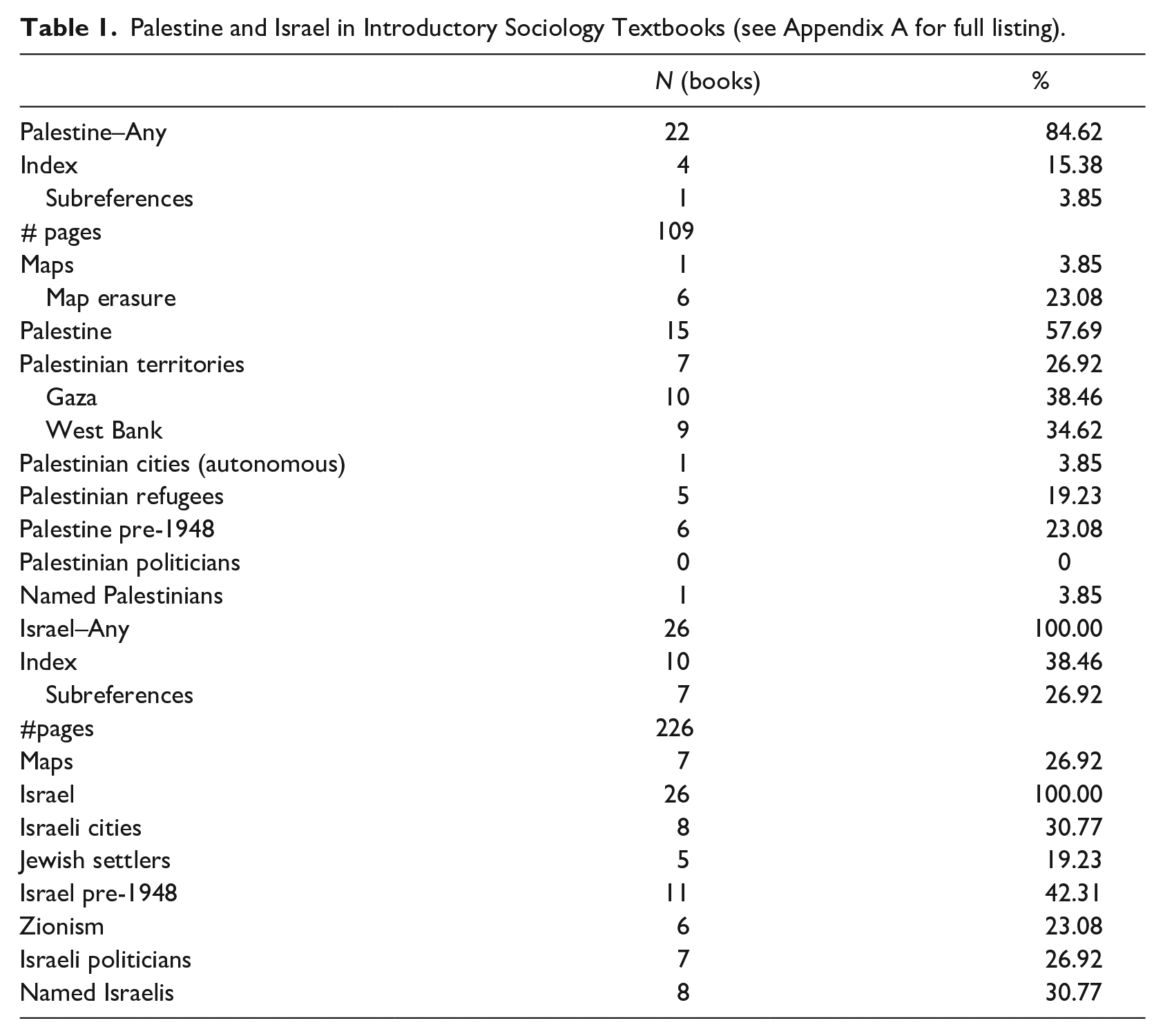
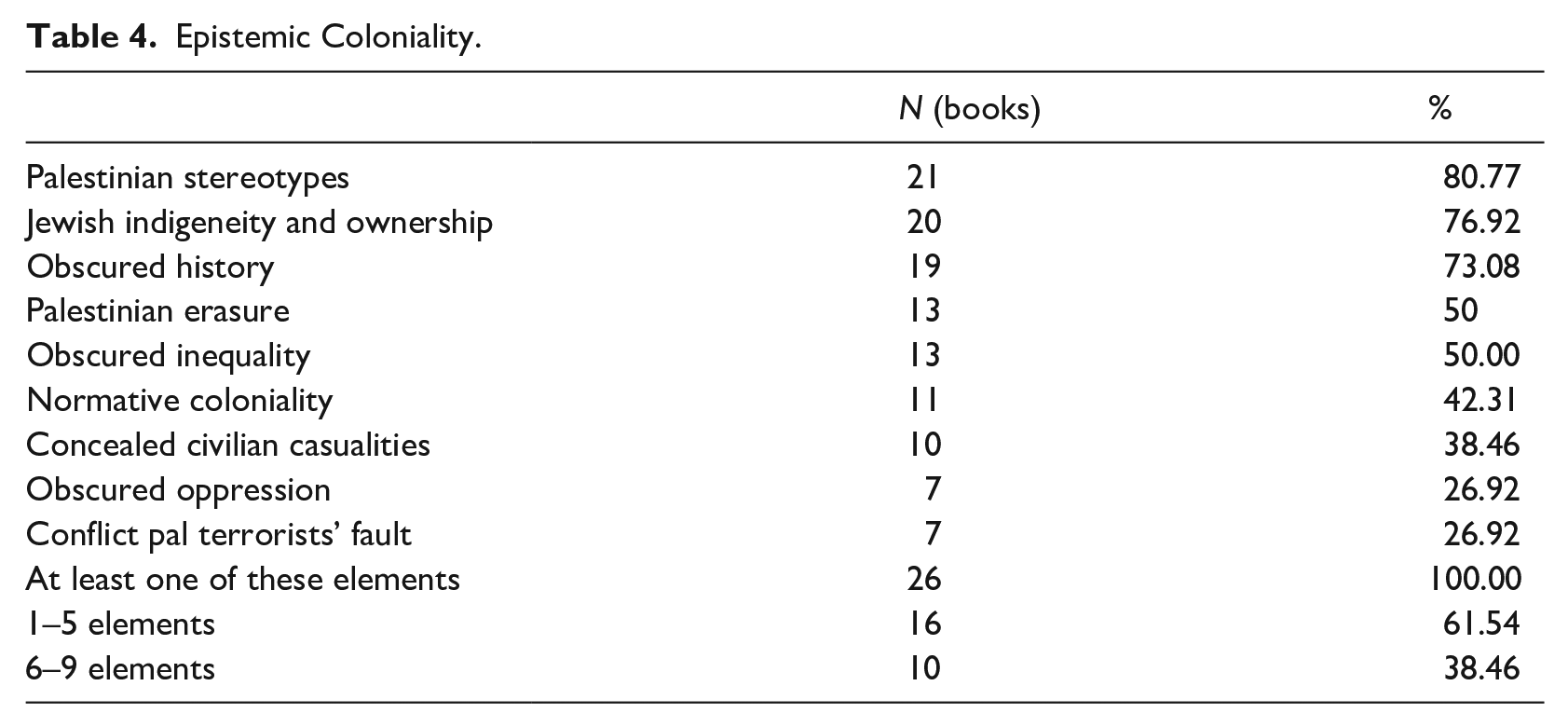
The majority of textbooks center Israel, its history, and its narrative of Palestinians as terrorists and of Israel as a modern (80.1%), technologically advanced (46.2%) democratic state (65.4%) that has always been Jewish (76.9%). Combined, 92.3% of all books feature at least one element of this Zionist narrative. Palestinian narratives are almost completely erased in this sample. Six books (23%) accurately address Palestinian history, one includes Palestine absent any stereotypes, and not a single one discusses Palestine exclusive of Israel or terrorism.
Colonizing Palestinian identity
Throughout this sample, texts simultaneously erase and dehumanize Palestinians. Over 80% of all textbooks (n = 22) depict Palestinians in stereotypical ways and half engage in Palestinian erasure, removing it from maps and/or referring to Palestinians as Arabs, alongside more subtle forms of discursive erasure described below.
Maps and place name erasures
Almost half of the books (42.3%) refer to Palestine prior to 1948 as Israel. Sociology states, ‘Zionists settled in Israel in the 1880s, and after the Second World War there was mass migration (the Exodus) by Jews to the Jerusalem area [with] continuing tension between Arabs and Jews since then’ (Macionis and Plummer, 2012: 561). In the 1880s, Zionists settled Palestine, not Israel, and this quote erases Palestinian history, Indigeneity, and elides long-standing settler colonial ethnic cleansing.
Texts erase present-day Palestine from 28 maps in six books, removing Palestinian place names, excising al-Quds (Jerusalem) from Palestine, or referring to Gaza or the West Bank—themselves dissociated from each other—rather than Palestine itself. Because ‘maps often play a role in not only visualising historical or present-day realities but also to frame the students discourse around certain issues’ (Alayan, 2018: 86; Peled-Elhanen, 2012), erasing Palestine replicates and contributes to the Zionist project of Palestinian elimination. For example, eight books mention Israeli cities and four mention Palestinian ones. However, three of those four describe them incorrectly as Israeli or are indexed under Israel. The only book that does not do this is in reference to Jesus’ birth in al-Nasra (Nazareth). As a result, ‘the indigenous landscape is erased from the curriculum, while it is simultaneously being erased by the curriculum’ (Abu-Saad, 2008: 25, emphasis in original).
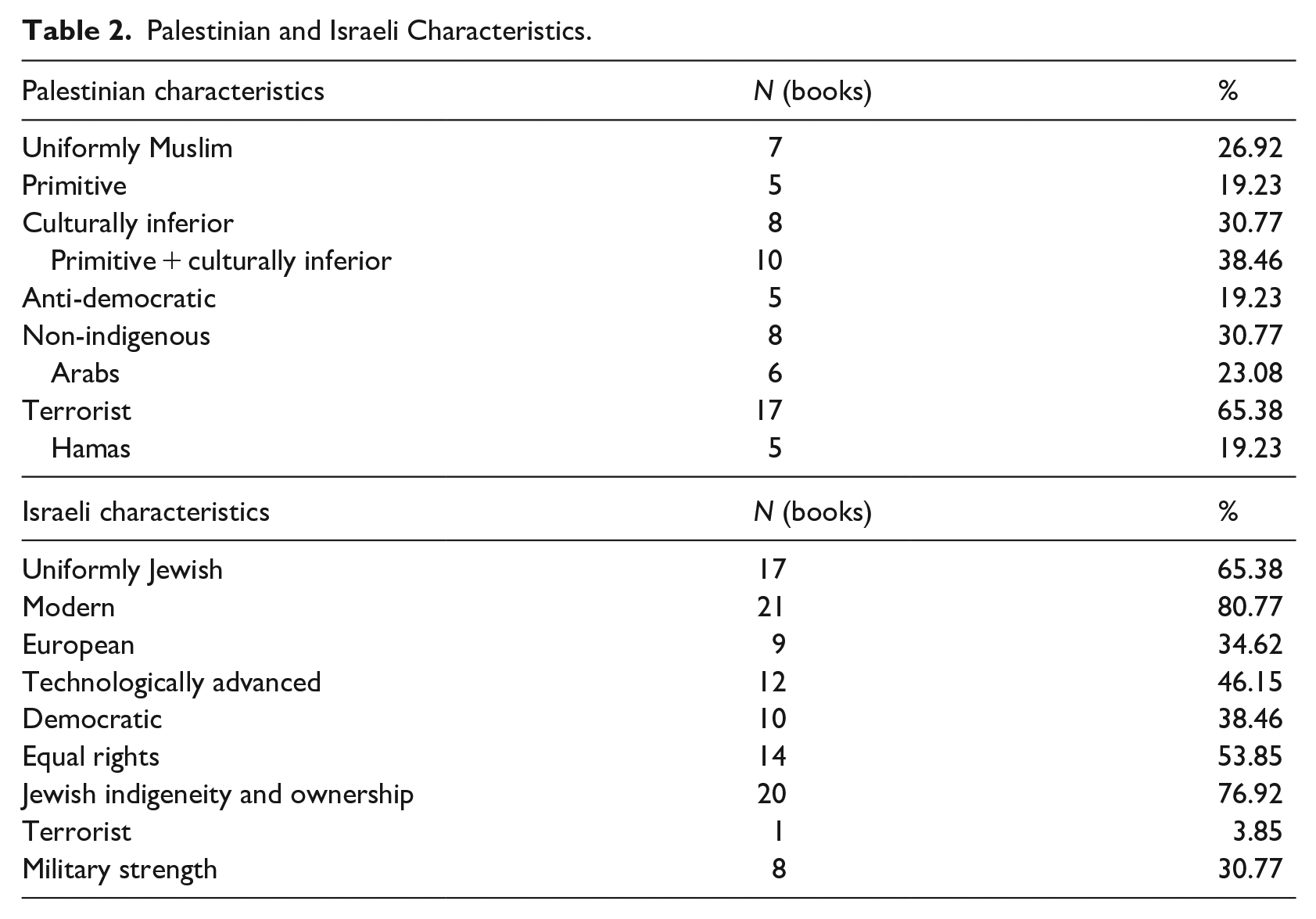
Palestinian and Israeli Characteristics.
Palestinian dehumanization
Roughly, one-third of books (30.1%) dissociate Palestinians from their land through orientalist labels, replacing ‘Palestinian’ with ‘Arab’ or ‘Bedouins’, thereby de-Indigenizing and dissociating Palestinians from their land, as Israel has long done. One textbook notes this discursive occlusion (before doing similarly later): Many Israeli Jews retaliate by calling Palestinians ‘Arabs’ – in effect a way of telling Palestinians that the ‘Palestinian’ people do not exist. By using the label ‘Arabs’, Jews are declaring that ‘Arabs’ do not need a state: they can simply live in one of the surrounding countries. (Ferrante, 2015: 79–80)
A discussion of the Arab Spring in Introduction to Sociology reads, Syria abuts Israel, which could be drawn into the conflict in various ways, especially if Islamic State fighters draw close to its borders and engage in direct conflict with the Israeli military. That could lead Arabs in Gaza and Israel’s Occupied Territories to grow more restive. (Ritzer, 2018: 507)
The correct language is Palestinians in Gaza and the occupied Palestinian territories. Referring to Palestinians as ‘Arab’ alongside the racist and colonial ‘restive natives’ replicates discursive and epistemological coloniality normalizing both colonialism and Jews’ ownership of the land and constructs Palestinians as essentially violent, emotional, irrational, and illegal usurpers, rather than rightful Indigenous owners of the land. This statement also invalidates real grievances against apartheid occupation and erases Palestinians from pan-Arab solidarity against neoliberal governmentality during the 2011 regional Arab mobilizations (Bogaert, 2013). Other books de-Indigenize and primitivize Palestinian Bedouins, dissociating them from their land and homes or describe Palestinians as an ‘imagined community’ ‘seeking to create a homeland in the Middle East’ (Farley and Flota, 2018: 438; Giddens et al., 2018: 420, 421; Ritzer, 2018: 417) rather than rightful owners or an actual community still living on their stolen homeland.
In contrast, texts depict Jews as the land’s native owners and members of Israel’s imagined community whether they live in Israel or abroad. Others equate Israel with Judaism, erasing 2 million Palestinians and suggesting a non-extant homogeneity. 2 Eight books (30.1%) include named Israelis, ranging from politicians to professors to taxi drivers. Only one book names a Palestinian, a terrorist. Five books reference Israeli politicians, none mention Palestinian politicians. Three books mention Edward Said’s (1994) theorization of orientalism without identifying him as Palestinian.
Orientalism constructs Arabs, particularly Palestinians, as terrorists. ‘Every Palestinian is automatically a suspected terrorist . . . a term which can be used to justify everything done and will do while simultaneously dehumanizing everything [Palestinians] do to resist their own oppression’ (Said, 1984: 37). The majority of textbooks do similarly, often alongside similar orientalist notions of Palestinian cultural primitivity. Seventeen books (65.4%) refer to Palestinians as terrorists and the only named Palestinian is a terrorist. Our Social World describes Wafa Idris, the ‘first female suicide bomber’ before asking, who would want a barren, divorced woman in a society that values women for their purity and childbearing ability? . . . Our question is this: Are such women deviant criminal terrorists, hapless victims of terrorist groups, mentally ill ‘crazies’, invisible victims in a patriarchal society, or martyrs that should be honored for their acts? (Ballantine and Roberts, 2018: 146)
While Idris’ story could have been used to center women in Palestinian liberation struggles (Elia, 2017; Naber, 2006), or discuss intergenerational revolutionary consciousness, the book instead mobilizes multiple sexist and orientalist stereotypes. Sociology (Henslin, 2017) includes a photo of a woman with the caption: ‘After kissing her daughter, this mother blew herself up at a crossing point in Gaza. For some she is a heroic martyr because she killed four Israelis. No one knows how to stop the hatred and killing’ (p. 452). Ending the occupation would likely end Palestinians’ resistance. Other books equate colonial and anti-colonial violence, stating, ‘both Palestinian bombing attacks on Israeli civilians and Israeli attacks on Palestinian refugee camps are properly classified as terrorism’ (Farley and Flota, 2018: 438).
Textbooks also mobilize the terrorist trope to blame Palestinians for Israeli violence, as described earlier or as in Sociology in a Changing World: The Israeli government’s negotiations with the Palestine Liberation Organization enraged many Jewish settlers living in areas that would be placed under control of Palestinians. This rage resulted in the shocking assassination of former Israeli Prime Minister Yitzhak Rabin in November 1995, and continues to dominate politics in the Middle East. (Kornblum and Smith, 2012: 313)
Beginning the discussion with the Palestinian Liberation Organization discursively suggests that a Palestinian killed Rabin, rather than an Israeli Jew living in an illegal settlement. Two other books reference Israeli terrorism but also refuse this designation, instead representing them as immigrant settlers or religious fundamentalists. These representations perpetuate ideologies of Palestinians as violent natives, in need of colonial discipline.
Israeli Modernity, Palestinian Primitivity, and Normalized Colonial Violence
Normalized Israeli colonial modernity
Compared to Israel, textbooks present Palestine among the ‘least developed’ nations with lower levels of educational and occupational attainment, gender equality, technology and maintaining ‘traditional’ religious and marriage practices compared to Israel. One book, Sociology: A Global Perspective, explicitly states, Some Jews also treat Palestinians as culturally primitive and incapable of managing their own affairs. They remind the Palestinians that Jews are responsible for turning the ‘worthless’ desert land occupied previously by a ‘backward’ Palestinian people into a modern, high technology state. (Ferrante, 2015: 79–80)
Most textbooks (80.8%) follow this quote’s logic, referring to Israel as modern, European, Western, and democratic, highlighting their medical, technological, and gender-based equality that conform to ‘Brand Israel’s’ self-marketing as the ‘only democracy in the Middle East’ (Hawari and et al, 2019; Meir, 2005). 3 This discursive positioning elides how Israeli society has accomplished these through Palestinian oppression and obscures the fact that ‘democracy’ exists only for Ashkenazi Jews there (Chehata, 2012; Mizrachi and Herzog, 2012; Shohat, 1988).
Textbooks discursively link Israel to Europe by positioning it alongside other European nations in both text and tables. Farley and Flota’s (2018) Sociology notes, ‘the most industrialized areas of the world are Europe, North America, Russia, Israel, Australia, and New Zealand, and parts of Asia’ (p. 368) without noting that these regions relied on colonial exploitation for their industrialization (Galeano, 2009; Rodney, 2011; Wolfe, 2016). Sociology had an opportunity to highlight legacies of colonial theft: A big question remains unanswered by research. If dependency theory locks former colonies into underdevelopment, why have some countries (South Korea, Taiwan, Singapore, and Israel) escaped underdevelopment in the past half century while others (China, India, Brazil) are now taking the same path. (Brym and Lie, 2013: 163)
Research has addressed this and students reading the book would be better sociologists if it discussed colonialism’s legacies.
Multiple books textually or visually (in tables) position Israel among high-income, high-education, low-poverty, low-unemployment nations in discussing democracy, modernity, industrialization, development without addressing how occupation impacts Palestinians’ economy or educational prospects. Similarly, numerous books testify to Israel’s military (30.1%) and technological (46.2%) advancement. However, only one roots this technological prowess in Israel’s weapons industry as one of the world’s largest exporters. Other books (30.1%) describe Israel’s health care and medical technology, leading to high life expectancy and low infant mortality, ignoring Palestinians’ exclusion from these (Asi, 2019).
Numerous books position Israel implicitly and explicitly as a democracy and a global leader of racial, gender, sexual equality. According to Society in Focus, A stable core of long-established democracies in Western Europe and a few former European colonies, such as Canada, Australia, New Zealand, and the United States, as well as Japan, India, Israel, and a few other nations . . . become representative democracies after World War II. (Thompson et al., 2019: 431)
Discussing Israel as a former British colony here and elsewhere elides its contemporary status as a colonizing nation and that Palestine, not Israel, was a British colony. Although described as a democracy, numerous books (65.4%) refer to Israel as a Jewish state, perhaps raising questions for students about how democracy exists for non-Jews. Israel’s alleged gender equality in the military, 4 on kibbutzim (settler colonial outposts that bar Palestinian residency), in the home, and women’s political or economic power appear in multiple (42.3%) books, as does gay rights. The international lesbian, gay, bisexual, transgender, queer (LGBTQ) community has condemned Israel’s ‘pinkwashing’ since the state only recognizes marriages performed by orthodox Jewish rabbis, barring both gay people and Palestinians from legal marriage (Blackmer, 2019; Puar, 2011).
These books discursively highlight Israel’s ascribed civilizational superiority alongside texts and tables ascribing Palestinian non-democracy and primitivity to obscure the historic and contemporary colonial reality of exploitation and dehumanization upon which Israeli modernity relies. Together, these books perpetuate the idea that ‘Israel is in effect a civilized, democratic country constitutively incapable of barbaric practices against Palestinians’ (Said, 1984: 28). Only one book hesitatingly suggests, ‘Very controversially, some see Israel as a theocracy based on the Jewish faith’ (Macionis and Plummer, 2012: 539).
Settler invasion and colonization
Only one book (Ferrante, 2015) mentions the catastrophic impact of 1948 on Palestinians. The rest evade Zionist responsibility for the Nakba, either directly or through passive voice, conforming with colonial and contemporary textbooks doing similarly (Weiner, 2014; Willinsky, 1998). You May Ask Yourself explains, ‘Many social changes occurred in the wake of World War II, such as the founding of the United Nations, the Marshall Plan, and the conflict that resulted in the creation of Israel’ (Conley, 2019: 786, 787). Essentials of Sociology reads, ‘The founding of Israel in 1948 marked an important turning point for Jews, and that nation’s population is now more than 6 million people’ (Ritzer and Murphy, 2019: 302), erasing approximately 2 million Palestinians in Israel. Like most books, Introduction to Sociology describes a ‘peaceful relationship between Zionists and their neighbors’ (Giddens et al., 2018: 571) in the early 1900s, ignoring centuries’ long Palestinian resistance to Zionist invasion. The five texts mentioning Palestinian refugees overlook how or why they became refugees. And the 15.4% of books describing immigration to Israel do not classify this as active settler colonialism, even when discussing Israeli politicians’ recruitment of global Jewry.
‘Conflict’, not settler-colonialism
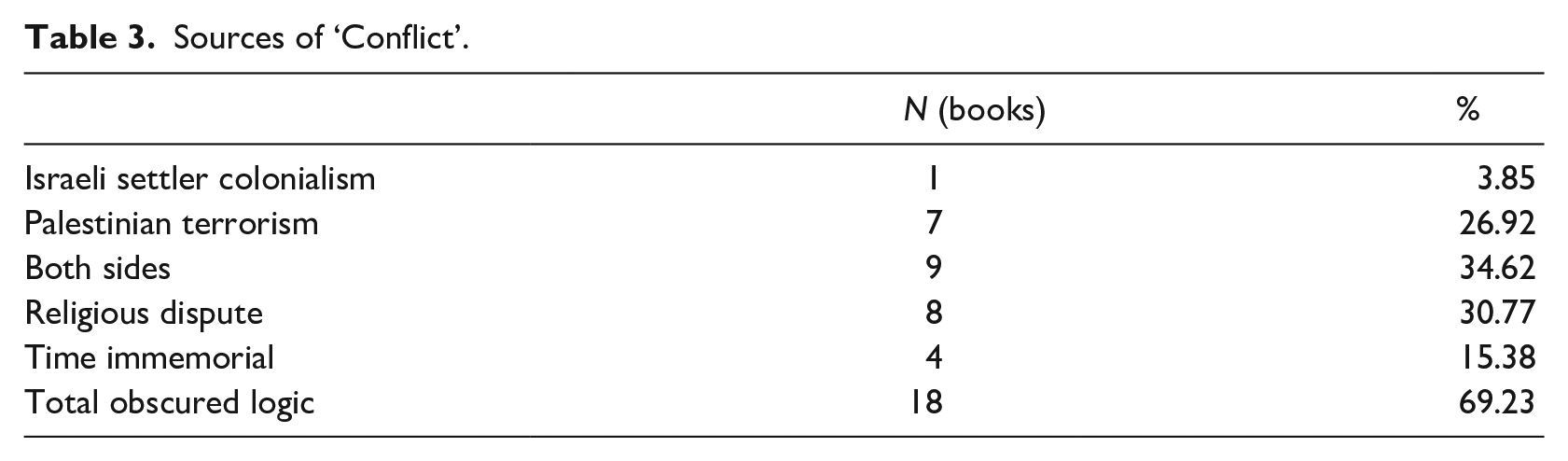
Throughout these texts, violent settler colonial occupation and apartheid in Palestine are presented either as a political or religious conflict between two equal rivals or due to Palestinian terrorism.
Sources of ‘Conflict’.
Sociology equates Palestinian and Jewish children’s experiences while reversing the actual availability of military resources. Palestinians have neither a military nor a nation-state while Israel’s regularly ranks among the world’s strongest, which many textbooks also recognize: As a case in point, consider that as these Palestinian children gaze through a bullet-ridden fence in their neighborhood and learn that Israeli soldiers fired the bullets, they also learn they are Palestinian. Likewise, as these Israeli children practice how to respond when Palestinians launch rockets into their communities, they learn they are Israelis. (Ferrante, 2015: 67)
In a paragraph describing global Judaism, Essentials of Sociology describes ‘conflict between Israel and its Arab neighbors over Palestine’ (Ritzer and Murphy, 2019: 302), erasing Palestinians from struggles over their own land.
In total, 30% of books describe settler colonialism as a religious conflict between Jews and Muslims, eliding the fact that today, Ashkenazi Jews, not Palestinians, seek an exclusive ethnonationalist state, and disappearing non-Muslim Palestinians. Discussions of settler colonialism as a religious conflict are often linked to dehumanizing and stereotypical depictions of Palestinians as terrorists, rooted in long-standing hegemonic Islamophobia, which has intensified post-9/11 (Bazian, 2015; Said, 1984; Selod, 2015). By failing to recognize Palestinian resistance as a rejection of settler colonialism and violent occupation, these texts discursively blame Palestinians for their own oppression. For example, In Conflict & Order states, Conflict itself can occur between religious groups (with the sanction of each religion). Recent events in Iraq, Lebanon, Palestine, Ireland, Nigeria . . . provide bloody evidence of this occurrence . . . Religious ideology is the source of tensions, political instability, terrorism, and wars. In contemporary times, there are many examples, such as . . . Muslims versus Jews in the Middle East. (Eitzen et al., 2017: 266–267)
In addition to assigning religion as the root of ‘tensions’ in Palestine, this quote positions Israel as a victim, embattled by its neighbors, rather than maintaining normalized political and economic relations as the region’s only nuclear power.
Obscured colonial violences
Not a single book mentions Israeli-imposed apartheid in Palestine. The three books mentioning Israel’s ‘security wall’ elide its apartheid and settler colonial connection while employing terrorist tropes to insinuate Palestinians’ responsibility for it. Juxtaposing Israel’s wall with the futility of that along the US–Mexico border, Essentials of Sociology reads, Similarly, it is not clear whether the wall between Israel and the West Bank (or the more recently erected wall between Israel and Egypt) will stop the flow of terrorists into Israel the next time hostilities in the Middle East flare up. (Ritzer and Murphy, 2019: 137)
Later in the book, this logic and Palestinian erasure, repeat.
Textbooks conceal Israeli violence toward Palestinians through the passive voice or blatantly ignoring Palestinian casualties. Sociology describes ‘Israeli-Arab wars’ in 2008 (Operation Cast Lead) as ‘the bombarding of Hamas. 1.5 million people are packed into Gaza, many of whom have been killed’ (Macionis and Plummer, 2012, p. 561). During this attack, Israel killed Palestinian 764 civilians, including 345 children (B’Tselem, 2009). Essentials of Sociology discusses ‘the 2014 war in and around Gaza’ (Ritzer and Murphy, 2019: 13). Gaza is not a nation and Israel killed 1462 Palestinian civilians, including 495 children, and 253 women during 2014’s Operation Protective Edge (United Nations Human Rights Council, 2015). Since Palestinians lack an army, these are not wars, but violent attacks on occupied civilian populations. In describing the 1994 Ibrahimi Mosque massacre in al-Khalil (Hebron), Essentials of Sociology states, ‘Dr. Baruch Goldstein’ shot ‘into a crowd of praying Palestinian boys and men’ (Henslin, 2017: 527), omitting the 29 and 125 people this settler murdered and wounded, respectively, while respectfully identifying him as a doctor. Finally, multiple books mention mandatory Israeli military service without explaining that it entails violent oppression of Palestinians.
Discussion and conclusion
Overwhelmingly, introductory textbooks replicate Israeli narratives to deny Palestinian history, culture, and subjectivity alongside narratives to deny Palestinian history, culture, subjectivity, and humanity. The scientific colonialism documented here replicates racist conceptions of Indigenous Palestinians and normalizes and justifies violent Israeli settler colonialism in Palestine. These sociology texts manufacture consent for Herman and Chomsky (1988), are complicit with, and actively participate in the Zionist settler colonial project by contributing to the settler colonial structure imposed over a century ago for ongoing expropriation and annihilation in Palestine. These texts fortify a ‘transnational white polity . . . constituted in opposition to their indigenous subjects’ and reify the racial contract through their ‘failure to denounce the great crimes inseparable from European conquest’ (Mills, 1997: 29, 94).
Epistemic Coloniality.
As other academic disciplines reckon with their relationship to colonial history, some sociologists are doing similarly, critiquing the field for contributing to and perpetuating historical and contemporary racism through its whiteness (Ladner, 1998), imperial entanglements (Steinmetz, 2013), lack of attention to slavery and settler colonialism (Go, 2016; Patterson, 2019), and the specific failure to engage with anti-Palestinian racism (Williams and Embrick, 2020). These findings suggest the critical importance of sociologists continuing to do so.
The discursive apartheid, colonialism, and anti-Palestinian racism evident in these textbooks suggest the necessity of deeply engaging with these disciplinary critiques to ensure introductory texts facilitate students’ understandings of, instead of contributing to, imperial settler colonial projects. Since ‘the settler colonial paradigm highlights the ways in which both hegemonic knowledge and colonial structures are organized to occlude alternative possibilities’ (Sabbagh-Khoury, 2021: 3), these texts inhibit students’ active solidarity with globally oppressed peoples and anti-racist and anti-colonial movements, such as Black Lives Matter, Standing Rock, and Kashmir, across the globe.
Footnotes
Appendix 1
Acknowledgements
The author is deeply grateful to Anaheed Al-Hardan, Juman Simaan, Saher Selod, and colleagues at the 2019 Association for Humanist Sociology meetings for their feedback on earlier versions of the manuscript.
Funding
The author(s) received no financial support for the research, authorship, and/or publication of this article.
