



Abstract
This paper seeks to decenter the academy as the gatekeeper of knowledge, while presenting a critique of ‘public sociology’ and ‘public-facing’ scholarship. I argue that public sociology’s aim to make research more ‘accessible to a wider audience’ presupposes that the university has something to offer to this audience in the first place. This not-so-tacit arrogance only further privileges the university as the primary site of knowledge production, while rendering invisible the many knowledge producers outside the academy. As public sociology continues to curry favor with mainstream media, politics, and policy institutes, it reveals a steadfast faith in the state and capital, while obscuring radical alternatives. In turn, public sociology functions as a counterinsurgency tool via professionalization. Conversely, a counter-public sociology refuses to comply with oppressive state protocols. Instead, it seeks to dismantle them. A counter-public sociology aims not to affirm the university, but to insist that this current academic enterprise remains untenable.
Introduction
The proliferation of ‘public sociology’ across the United States signals a field’s desire to engage a larger audience, beyond academic echo chambers. Many sociology programs now offer certificates and degrees in public sociology with emphases on ‘engaged scholarship’ and the dissemination of sociological knowledge to a wider audience. 1 Yet, this seemingly laudable subfield warrants an important question: ‘‘Public’, as opposed to what?’ The answer is clear because sociology told on itself. The ‘what’ refers to private, privatized, and gatekeeper sociology. When the field began promoting the need to recognize ‘public sociology’ as an essential part of sociology’s genealogy, this was also an admission of guilt—namely, sociology’s attempt to isolate that which it extracts from the public (Fatsis, 2017). Sociologists may refer to such extracted information as ‘data’ or ‘empirical evidence’. However, the bidirectional teaching and learning relationship between the university and community reveals that this extracted information is in fact knowledge.
This paper contributes to a lineage of critical university studies seeking to decenter the academy as the gatekeeper of knowledge, while presenting a critique of ‘public sociology’, and ‘public-facing’ scholarship more broadly. How does public sociology’s aim to make research more ‘accessible’ (Lareau and Muñoz, 2017) to a wider audience presuppose that there is something that the university has to offer to this wider audience in the first place? Moreover, who says that there are members of this so-called ‘public’ that even care what sociologists have to say?
By emphasizing the need to reach a larger audience, public sociology is once again telling on itself by centering public sociologists as experts and the audience as those in need of ‘advice and guidance’ (Bridger and Alter, 2010: 407). I argue that this not-so-tacit arrogance only further privileges the university as a gatekeeper of knowledge, while rendering invisible the many contributions of knowledge producers outside the academy. By definition, ‘accessible’ exposes the inherent inaccessibility of the university itself (Dolmage, 2017). Thus, public sociology acknowledges the privatization of knowledge and knowledge production, while doing little to dismantle privatizing systems. Instead, public sociology prizes the possessive individual capable of sharing exceptional talents and expertise with those deprived of knowledge (Kalleberg, 2005). Public sociology continues to distort reality by treating the public as a composite of benighted vessels in desperate need of enlightenment. 2 How convenient it is that public sociology forgets that there are a significant number of knowledge producers beyond the academy? If there were not, why are we still studying them? This is one admission sociology is unwilling to make.
Not only does public sociology privilege the university as the primary site of knowledge production and knowledge producers, it also privileges sociology as the principal harbinger of social transformation. The irony is that there are numerous fields that remain light years ahead of sociology when it comes to the study of race, gender, capitalism, and radical social movements. If sociology were truly committed to interdisciplinarity and an appreciation of the contributions of countless other fields make to bringing about a more just and sustainable world and ways of being, it would not allow a self-referential subfield, such as public sociology, to exist.
I further argue that calls for ‘accessibility’ are inextricably linked to what I describe as ‘the white sociologist’s burden’. I am referring to the burden of many white sociologists to leave the ivory tower and demonstrate a commitment to studying marginalized communities. Despite being simultaneously ubiquitous and a ‘hidden ethnicity’, whiteness is also a privatized identity. 3 In not being subjected to the (public) violence of racialization, white people lead privatized lives free from surveillance and epidermalization. 4 Hence, it makes sense why many white sociologists feel compelled to create ‘public-facing scholarship’. When white sociologists cannot fully identify with the experiences of those they study (the racialized, poor, unhoused, incarcerated, etc.), taking on the role of savior via public sociology can feel quite reassuring. Yet, there is a need to consider the implications of white public sociologists easing their conscience by carrying on civilizational missions to uplift the poor and ‘downtrodden’. In contrast, many racialized scholars, particularly those from marginalized backgrounds, write for audiences beyond the academy. The impetus behind such goals might emanate from a sense of survivor’s guilt, especially for those who leave many members of their community behind when embarking on their academic careers.
Who or what constitutes the ‘public’ in ‘public sociology?’ How does ‘public’ work flatten the difference between a diverse group of people, including those always already constructed as anti-public due to their ontological opposition to the Human? I am specifically referring to the way in which many black, Indigenous, and other people of color represent threats to the ‘public’, particularly public safety. I am also interested in exploring how legibility within mainstream media represents the accomplishment of public sociology’s mission. Why do we privilege ‘public sociology’ featured in the New York Times, Forbes, 5 or on CNN and NPR, when there are significant parts of the general public that do not rely on such outlets for news? Contrary to Herbert Gans’s (2002) claim, public sociology is not a ‘bridge’ between ‘intellectuals, academics and the rest of society’, because the ‘rest of society’ includes more than corporate media and political pundits. I argue that the ‘public’ in ‘public sociology’ comprises a privileged public—other academics, college-educated populations, policymakers, legislators, politicians, and so on. To curry favor with milquetoast media outlets, the state, and those already privileged along the lines of race, gender, and class is to obscure the bidirectional teaching and learning relationship between the academy and growing communities of counterpublics. In appealing to mainstream media, politics, and the state for publicity, sociology is yet again telling on itself. Public sociology reveals who and what it believes to be the primary site of social change—existing systems of power and domination, as opposed to the counterpublics subordinated by such systems. In turn, public sociology becomes a formidable counterinsurgency strategy used to discipline counterpublics and other political dissidents inside and outside the university. One of the greatest threats of public sociology then is to render organizing and activism meaningless, precisely because this subfield invests more time and effort into seeking recognition and legibility within what is, as opposed to thinking outside of these existing terms and conditions and prefiguring “otherwise worlds” (King et al., 2020).
I conclude the paper with a vision for a counter-public sociology. By ‘counter-public’, I am not simply referring to a subordinated group of people committed to transformative social change through counter-discourses and oppositional politics to the status quo. I am also referring to the diametric opposition and need to construct a counterforce to public sociology itself. In short, to be for a counter-public sociology is to be against public sociology. This sort of critique obliterates most alleged ‘debates’ within public sociology and ironically, remains quarantined by those most committed to the accessibility of ideas. The call to a counter-public sociology is then both an invitation and a provocation. I invite all to uphold an ethical commitment and orientation, albeit an antagonistic orientation, to sociology as a field and its attempted makeover—public sociology. A counter-public sociology has no interest creating a more refined image of sociology. Rather, a counter-public sociology represents both an internal and external accountability check. Thus, this paper is a provocation to engage in a counter-public sociology praxis. Although I provide examples of what a counter-public sociology might look like, asking how to uphold such a praxis will be an ongoing discussion. At the same time, if sociology is truly committed to not reproducing the same kinds of violence and oppressive logics it is opposed to, counter-public sociology must simply be done.
Disingenuous ‘debates’ over public sociology
Hegemonic discourse leads many to believe that the primary debate within public sociology is between the ‘keepers of the canon’ and those committed to more ‘public facing’ scholarship. Framing the debate as between righteous public intellectuals and the gatekeepers of the field, however, renders invisible more radical critiques of public sociology. In a 2016 address to the Midwest Sociological Society, Douglas Hartmann contributed to the provincialization of debates over public sociology, while eliding more substantive points of contention. According to Hartmann (2016), ‘Sometimes the engaged side of our discipline, whether in its most activist forms or more modest, reform-oriented manifestations, has marginalized those who seek to make sociology a more objectivist, detached model of science’ (p. 2). The problem with this claim is that it establishes the parameters of the debate without considering more valid critiques of public sociology. ‘Public sociology’ is not a problem because it bruises the egos of positivist sociologists, as Hartmann suggests. Last time I checked, those seeking to ‘make sociology a more objectivist, detached model of science’, comprised the mainstream which was largely responsible for inflicting the greatest harm against already marginalized scholars. As Gloria Anzaldúa (2007) writes: ‘In trying to become “objective”, Western culture made “objects” of things and people when it distanced itself from them, thereby losing “touch” with them. This dichotomy is the root of all violence (p. 59). Similarly, Patricia Hill Collins describes why positivism’s call for social research to be emotion-free and always distant from the ‘object’ of investigation is antithetical to black feminisms. Collins (2000: 271) identifies two criteria for producing knowledge: (1) knowledge claims evaluated by group of experts, and (2) experts must maintain credibility as defined by larger population in which it is situated. This ‘larger population’, as Collins notes, is controlled by ‘elite heterosexual men, holding US citizenship’, and thus the knowledge production process reflects their interest. Consequently, any scholarly community challenging the interests and beliefs of this elite group will inevitably be discredited and dismissed as ‘biased’. This is not to say that marginalizing the powerful is an impossibility, but to make clear that such marginalization would be utterly inconsequential for members of this elite group.
Yet, some scholars argue that before sociology can enter the realm of public-facing scholarship, it must first gain credibility relative to disciplines such as economics. In typical positivist sociology fashion, scholars such as Jonathan H. Turner suggest that the way to gain such credibility is through a cold, detached, and perfunctory approach to research. As Turner (2005) states:
If sociologists vent their morality, we will expose to the public our left-of-center political commitments; and we will immediately lose credibility with a public that is far more conservative. We will preach to our own choir of fellow sociologists, or seek self-satisfaction from reflexive gazes into our ‘looking-glass self’. (p. 30)
Turner refuses to acknowledge what makes this claim so disingenuous. Perhaps, Turner has never engaged with women of color feminisms, generally, or black feminist thought, more specifically. These epistemological traditions emphasize the centrality of connection, emotion, and biography to social research.
6
Consider Barbara Christian’s (1987: 21) cogent analysis of the intimate relationship between literature and lived experience and the way both represent the key site of not just knowledge production, but also self-preservation:
I can only speak for myself. But when I write and how I write is done in order to save my own life. And I mean that literally. For me literature is a way of knowing that I am not hallucinating, that whatever I feel/know is.
Despite positivist sociologists being largely responsible for Christian and other black feminists having to remind themselves they are not hallucinating, Turner and Hartmann both rush to the defense of those committed to a ‘detached model of science’. Turner diminishes the intellectual value of experiential evidence, while privileging competition between fields such as sociology and economics. In doing so, Turner ignores how this competition renders invisible those unable to compete because they are systematically marginalized by/within both disciplines.
Such alleged critiques of ‘public sociology’ do more to legitimate ‘public sociology’ than render it ineffectual. When debates center on defending against charges of ‘elitism’ to prove one’s commitment to public sociology, there is no room to critique the subfield itself. 7 Burawoy (2005b) participates in these disingenuous debates by suggesting that his critical critics ‘object to my depoliticization of public sociology brought about by hitching it to the disciplinary framework. For my critical critics I’m not radical enough’ (p. 381). If Burawoy’s interpretation is accurate, his ‘critical critics’ may not be all that radical if they are merely calling for public sociology to remain politicized. Politicizing public sociology is not enough, precisely because doing so allows public sociology to exist. These so-called ‘critiques’ further conscript debates to a narrow set of terms and conditions, which demand compliance. The lack of criticality in these debates is a sobering reminder of sociology’s limited capacity to embrace a radical praxis when it comes to questions of how to bring about a more just and sustainable world.
If ‘critical sociology can be viewed as the conscience of the discipline’ (Bridger and Alter, 2010: 407), it behooves critical sociologists to reckon with existing debates. Yet, the irony is that a commitment to criticality would require a critique of the notion of ‘conscience’ itself. The ubiquity of self-identified ‘critical’ sociologists is both distracting and misleading. So it is worth asking whether ‘critical’ still holds any meaning for those motivated by the mandates of conscience. Perhaps the overrepresentation of ‘critical’ scholarship has made ‘critical’ itself a vacuous term and quite confusing for those committed to radical struggle.
In turn, these sorts of debates become both hegemonic and simultaneously distractive and obstructive. I describe these debates as hegemonic because of the coercive role in convincing academics of the importance of protecting ‘public sociology’. The debates, however, are also distractions from more substantive conversations about how ‘public sociology’ comes to reproduce some of the same elitist and abstruse logics it claims to condemn. They are obstructive insofar as they establish the parameters of these ‘debates’, while precluding engagement with more substantive and radical critique. As public sociologists silence substantive dissent over their beloved enterprise, it is worth further questioning their commitment to ‘accessibility’.
The arrogance of ‘accessibility’
Public sociologists emphasize the importance of making their scholarship ‘accessible’
8
to a wider audience. Such a commitment derives from sociology’s awareness of the privatization and capitalization of knowledge. Public sociology then becomes a sign of the field’s attempt to humble itself by reconnecting with non-academic audiences. Despite woeful attempts at modesty, public sociology still manages to convey an air of conceit and paternalism. What appears to be a kind of benevolence and academic altruism is yet another example of academic hubris—academics privileging the academy as the gatekeeper of knowledge and primary site of knowledge production. What makes sociologists so confident that their scholarship is worth sharing with a wider audience? How does this question of how to make sociological insights more ‘accessible’ ignore Willie Jamaal Wright’s claim that: ‘The Public Is Intellectual?’ In an attempt to reconceptualize what it means to be a ‘public intellectual’, Wright (2018) notes:
Communities, political education groups, and political organizations are presented as models of public intellectualism that do not fit within present configurations. Nonetheless, within these groups, laypersons and professionals alike labor collectively to assess, analyze, and address the problems facing their immediate communities. (p. 5)
Perhaps public sociologists need to remember that there are plenty of people outside of the academy without extra initials (e.g. BA, MA, PhD) who can teach people inside the academy quite a bit. As Rose Brewer (2005) notes in a critique of Burawoy: ‘Theorists were not simply those in the academy trying to transform a field. The point was to remake the world, in the world, with the world’ (p. 354). We need only look at the countless marginalized communities that have become the subject and center of research agendas to recognize that knowledge production and knowledge producers are not confined to the academy. For Renato Rosaldo (1989), ‘the objects of social analysis are also analyzing subjects whose perceptions must be taken nearly as seriously as “we” take our own’ (p. 207). Public sociology’s aim of disseminating findings with wider audiences ignores the communities that helped produce these findings in the first place. What does it mean for public sociologists to extract knowledge from marginalized communities and then regurgitate this knowledge in the form of ‘data’ or ‘findings’ back to the exact people that produced the knowledge in the first place? What is worse is that some public sociologists might bypass these communities entirely and instead share their findings with another wider audience, namely, mainstream media.
A running joke in sociology is that many of us enter the field in order to ‘save the world’. Perhaps, public sociologists may benefit from restraining such a savior impulse and instead, recognize the expertise and knowledge of those outside their field and outside the academy. Failure to do so will only further expose public sociology’s role in reinforcing the myth of the university being the primary site of knowledge production and knowledge producers. The implicit hubris and saviorism embedded within public sociology also warrant a racial critique.
The white sociologist’s burden
As ‘inclusive’ as public sociology appears to be, it is worth examining public sociology’s eligibility criteria. When white people study those directly impacted by structural and racialized violence, they are ‘public sociologists’ or ‘engaged scholars’. When black, Indigenous, and other scholars of color do the same, they are intellectually ‘nativist’ and charged with being ‘too close’ to the subject of their research (Anzaldúa, 2007; Christian, 1987; Collins, 2000). This does not mean there are no black, Indigenous, or public sociologists of color. In fact, ‘public sociology’ has attracted a number of minoritized faculty. What, though, are the implications of this growing contingent of nonwhite public sociologists? I am alluding to the way these nonwhite scholars become part of a counterinsurgency strategy intent on suppressing other racialized faculty who refuse to participate in the self-aggrandizing nature of public intellectualism. Failure to produce ‘public-facing’ scholarship becomes another marker of academic deficiency, as opposed to a refusal to legitimate the academy itself.
How do white public sociologists reckon with studying issues that disproportionately impact nonwhite people? Do public sociologists only center the experiences of those directly impacted by structural violence to claim engaged scholarship points? If so, to what extent do public sociologists center marginalized groups when engaged in private sociology? As Orlando Patterson (2007) states:
. . . the insistence. . . that the [public] sociologist must be directly engaged is not only romantic nonsense but dangerous, for it implies that the sociologist need not be as alert to the publics he or she is likely to be engaging, however indirectly or unwittingly, when doing private work. (pp. 181–182)
Patterson is speaking of the limits of ‘engaged scholarship’, when engagement becomes situational and/or optional, as opposed to an indispensable aspect of all research. Do white scholars feel a sense of accomplishment in ensuring that their research is accessible to a wider audience? Perhaps the burden of private sociology and the whiteness of the ivory tower compels white scholars to seek out alternative sites of knowledge production beyond the academy. Yet, studying marginalized and racialized groups in the name of public sociology does not make white scholars ‘race traitors’. If, as Noel Ignatiev and Garvey (1996) suggest, ‘treason to whiteness is loyalty to humanity’, white scholars must consider what it means to betray not just whiteness, but white space(s), including the university.
What to many white sociologists appears to be an act of charity, is for many nonwhite scholars a deep and abiding commitment to solidarity. There is rarely a need for minoritized scholars to be intentional about reaching a broader public, because our biographies are intimately tied to public and counterpublic struggles. To be a racialized, marginalized, and insurgent intellectual obviates the need for ‘public engagement’, when the white gaze, racializing surveillance, systemic racism in publication processes reminds such scholars that they are always already seen and thus capable of being made invisible/un-seeable via rejection (e.g. fellowships, conference presentations, jobs, and manuscripts). I would be remiss not to acknowledge that neoliberal multicultural logics are less concerned with racialized exclusion and more committed to the incorporation of minoritized difference. 9 As Cherríe Moraga (2015) ably writes: ‘social change does not occur through tokenism or exceptions to the rule of discrimination, but through systematic abolishment of the rule itself’ (p. xviii).
Under global capitalism and empire, every difference is an ‘opportunity’ (Hardt and Negri, 2000: 151). For some academics of color, the selective recognition of difference via tokenization affirms their status as ‘exceptional’. Subscribing to narratives of exceptionality, however, works to legitimate Diversity, Equity, and Inclusion (D.E.I.) regimes and greater violence against other racialized scholars. So while we can appreciate the inordinate amount of invisible labor faculty and students of color perform on a regular basis, 10 not to mention the cumulative impact of racialized violence in the university, we must also refrain from presuming that, by dint of race, all faculty of color are ‘engaged scholars’. ‘Engagement’ requires solidarity, not ‘exceptionality’. Noura Erakat (2020) reminds us that solidarity is ‘produced through struggle rather than preceding it, underscoring a politics of location and engagement’ (p. 491).
Existing as a racialized subject, particularly as a black, Indigenous, and/or Latinx person within the academy is to be simultaneously hypervisible and invisible. We are public insofar as we are monitored, surveilled, and disciplined by the white gaze and existing power structures in the university. Sociology renders us invisible when we critique the field and fail to conform to the status quo, while subjecting us to academic ventriloquism by white scholars and ‘colonized intellectuals’ (Fanon, 2004[1961]: 158) alike. ‘Academic ventriloquism’ refers to the way certain ideas only gain coherence and/or legibility when uttered by those privileged along the lines of race, gender, and class. ‘Public sociology’ presupposes that all sociologists maintain a certain degree of privacy and protection from the public itself. However, such claims ignore the fact that many of those who lack privileges along the lines of race, gender, and class cannot seek refuge in private sociology, because they are always already public and visible to those inside and outside the academy. Hence, the question remains: Who is the public in ‘public sociology?’.
The privileged public of public sociology
In his 1976 Presidential Address, Alfred McClung Lee (1976), posed the question, ‘Sociology for Whom?’ Building on Lee’s question, Burawoy (2005a) asks:
Are we just talking to ourselves (an academic audience) or are we also addressing others (an extra-academic audience). To pose this question is to answer it, since few would argue for a hermetically sealed discipline, or defend pursuing knowledge simply for knowledge’s sake. (pp. 10–11)
I agree that few would argue for a ‘hermetically sealed discipline’. At the same time, it is worth considering who Burawoy and other public sociologists conceive of as an ‘extra-academic audience’. Even if we are not ‘just talking to ourselves’, it is still worth considering who we are talking to. Without recognizing the heterogeneity of ‘public’, we risk homogenizing difference and presuming that all members of this ‘public’ turn to corporate media and/or the state to make sense of their social worlds. When the most notable examples of public sociology are found on NPR, CNN, and in the New York Times, or through active collaboration with the state, including the Department of Defense, the Department of Justice, and the White House (Hartmann, 2016; Patterson, 2007), we must critically examine what constitutes the ‘public’ and whose publics count.
I argue that mainstream media, policy institutes, and federal agencies represent privileged publics, insofar as they are beholden to existing systems of power and capital. Federal agencies, such as the Department of Justice, are themselves sites of power and domination. Public sociologists justify their decision to promote research through such outlets by emphasizing the importance of ‘visibility’ and ‘impact’. In short, as public sociologists seek to reach the widest audience possible, mainstream media becomes the logical option. The problem with such logic is that public sociologists are once again telling on themselves by exposing their beliefs in the most promising sites for transformative change—namely, political elites and corporate power, which must never be conceived of as the ‘public’. Orlando Patterson (2007: 180), for example, described his work with Forbes as benefiting ‘large and important publics—minority and women aspirants to executive jobs’. When did executive aspirants become representative of a broader public? Patterson’s remarks are yet another example of (private) sociologists and sociology revealing how out of touch sociology is with actual publics and counterpublics—those subjected to the violences of capital accumulation and abuse by executives. Even Burawoy (2005b: 389) acknowledges the professionalization of ‘public sociology’ and how public-facing outlets such as Contexts fall short of its commitment to a broader public:
. . . Contexts magazine, seeks to make sociology accessible to wider audiences. It is not pop sociology, which would trivialize sociology, but the popularization of sociology. However, Contexts, so far at any rate, has made no attempt to engage in a dialogue with publics. It is, therefore, not public sociology but the public face of professional sociology.
It is clear that Burawoy is seeking to rescue the ‘essence’ of public sociology from the precise problems it is supposed to address. Aspirations for a purist public sociology, though, are futile because in its purist form, public sociology is problematic. Perhaps, Burawoy is struggling to reign in a monster of his own creation without recognizing the need for public sociology to self-destruct.
When the ‘public’ represents other academics and milquetoast media outlets, we might ask whether ‘private’ interests, are the new ‘public’. If the ‘public’ you serve are colleagues and corporate media, how do we attend to the needs of aggrieved communities constantly marginalized, exploited, and harmed by the university and distorted by corporate media? Too often, ‘public’ is wielded as a discursive tool to flatten difference and heterogeneity. Consider the way many ‘public safety’ complexes on college campuses find ways to effectively esteem some members of the ‘public’ over others. Colleges and universities embedded in majority nonwhite communities or cities construct students as members of an elite and privileged ‘public’ in need of protection from the ‘locals’. Not only are local residents not included in the ‘public’, but they actually come to represent a threat to a (privileged) ‘public’ (i.e. students). Racialized groups, particularly black and Latinx communities, constitute anti-publics or what I might call ‘counterpublics’. It then makes sense why black, Indigenous, and Latinx people strain the psychic coherence of concepts such as ‘public safety’. Are public safety complexes on college campuses committed to promoting ‘public safety’ or ‘private safety’ (i.e. the safety of privatized people – students, staff and faculty)? To what extent does the ‘safety’ of some require the un-safety of others? My aim here is to trouble the universalizing and homogenizing character of ‘public’. As inclusive as ‘public’ sounds, it is essential to continuously ask, ‘who constitutes the public?’ Just as ‘public safety’ is a misnomer to describe the protection of private interests and privatized people, public sociology instills greater trust and faith in the power of private institutions and in so doing, vindicates the intimate relationship between corporate power and political elites.
Public sociology as counterinsurgency
Responding to fears that public sociology will corrupt science, Burawoy (2005a: 15) suggests that ‘there should be, and there often is, respect and synergy’, between professional and public sociology. Burawoy’s claims about public sociology presuppose a commitment to criticality. ‘Critical sociology may be a thorn in the side of professional sociology, but it is crucial in forcing awareness of the assumptions we make, so that from time to time we may change those assumptions’ (Burawoy, 2005a: 15–16). However, Burawoy neglects how the critical scholar often functions as an ally of professionalization. As Stefano Harney and Fred Moten (2013: 32) write:
There is no point in trying to hold out the university against its professionalization. Yet the maroons refuse to refuse professionalization, that is, to be against the university. The university will not recognize this indecision, and thus professionalization is shaped precisely by what it cannot acknowledge, its internal antagonism, its wayward labor, its surplus. Against this wayward labor it sends the critical, sends its claim that what is left beyond the critical is waste. . . But in fact, critical education only attempts to perfect professional education. . . It [critical education] is more than an ally of professional education, it is its attempted completion. . . A professional education has become a critical education. But one should not applaud this fact.
Harney and Moten reveal how even the most critical scholars, including public sociologists, subscribe to the logics of professionalization and in turn discipline and disappear ‘waste’ (i.e. insurgent labor). Critical academics then come to represent ‘professionals par excellence’ (Harney and Moten, 2013: 38). As public sociology and public sociologists search for recognition as professionals within mainstream media outlets, politics, policy centers, and other privileged publics, they lose sight of the most promising sites of transformative change. Perhaps public sociologists conflate the charge of ‘studying up’ (i.e. studying the elite) with the notion that change occurs strictly through top-down mechanisms. Part of the dangers of public sociology and the relentless quest for legibility comes from an unwavering faith in the state and other systems of power and domination. In seeking to make itself accessible to a wider audience, public sociology inevitably relies on conventional modes of information dissemination, namely, institutions of power. It is then worth asking, to what extent does ‘public sociology’ work within the parameters of state protocols of oppression? How do ‘interventions’ within ‘public sociology’ expand state power, rather than work to dismantle it? To clarify this point, consider those public intellectuals and public sociologists lauded for testifying before Congress or visiting the White House to discuss police violence and/or ‘mass incarceration’.
Public sociologists may seek to bring greater attention to issues of sentencing, ‘felon disenfranchisement’, and/or the ‘overpolicing-underpolicing paradox’ (Rios, 2011: 54). Yet, in attempting to critique policing and the prison industrial complex, public sociologists manage to grant these systems further legitimacy. Christopher Lewis and Adaner Usmani (2022a) are two scholars who not only legitimate police but argue that ‘underpolicing’ is one of the reasons why ‘serious crime’ rates in the United States are significantly higher than comparably wealthy and ‘developed’ countries. Somehow the authors manage to ignore antiblackness, racial capitalism, and settler colonialism and many consequences of histories that hurt (i.e. the afterlife of slavery) as violent genealogies of the United States. In eliding such histories, the authors effectively render the ‘still-unfolding narratives’ of captivity and dispossession illegible (Hartman, 1997: 51). It is unclear whether Lewis and Usmani identify as public sociologists. Yet, their ability to reach a wider audience is clear. Had it not been for conscientious counterpublics, 11 Lewis and Usmani would have likely not been taken to task for their (1) misleading data about the total number of police in the United States compared with other countries; (2) glaring omissions related to the production of ‘crime’ by police, and (3) creation of a false baseline from which to base their core arguments. 12 Like many police apologists, Lewis and Usmani abdicate their duty to engage in the rigorous work of exploring ways to transform the social conditions in which ‘crime’ and violence occur. This is not only sloppy scholarship, but also highly irresponsible, disingenuous, and dangerous. Rather than accepting responsibility for their misleading scholarship, Lewis and Usmani (2022b) dismissed their critic, Alec Karakatsanis, as lacking rigor and ‘anti-intellectual’ (p. 7). Here, we see how sociologists eject members of an alleged public by attempting to equate counterpublics with anti-intellectual critiques from the political right. Make no mistake, this is a prime example of sociologists publicly engaged in counterinsurgency against those counterpublics and insurgent intellectuals committed to realizing the seemingly impossible. In doing so, they construct the academy and academics as a homogeneous group consistently under attack, thus legitimating the need for ongoing defense and protection. What I find most deceptive about such claims is how easily the authors point to attacks from those outside the university, without acknowledging their complicity in inaugurating new forms of racialized violence targeting so many denied access to the university itself by proposing an increase of 500,000 more cops, not to mention their flagrant omission of the racial–colonial violence within the university. This is a reminder that scholars must be taken to task for what they say and what they do not say.
As sociologists, we encourage our students to exercise their sociological imaginations to make the familiar strange, make the mundane matter, and/or reveal what is hidden in plain sight. Seldom do we ask, however, how sociology, as a discipline, remains complicit hiding what is hidden and often making the familiar natural. Rather than making the familiar strange, Lewis and Usmani make the familiar (i.e. police and the prison industrial complex) inexorable and legitimate. Discourse is/shapes action. As self-described ‘socialists’, Lewis and Usmani should know that hegemony entails the use of coercion to produce ‘consent’, and thus ‘common sense’. However, these scholars and many others committed to shaping public policy through research have failed to acknowledge their role in the reproduction of hegemonic discourse. Any academic attempt to distinguish between ‘good policing’ and ‘bad policing’ or ‘overpolicing’ and ‘underpolicing’ makes policing itself not just theoretically possible, but legitimate. Similarly, scholars who bring attention to ‘mass incarceration’ without acknowledging the solecism embedded in this phrase do more to legitimate the prison industrial complex than challenge it. As Dylan Rodriguez notes, critiquing ‘mass incarceration’ as an issue affecting all is insufficient, when the ‘masses’ are not being incarcerated. 13 In fact, the prison industrial complex is intent on containing those already captive, while exonerating the key architects of ‘white reconstruction’. 14 ‘Mass incarceration’ is not merely an issue of too many people being incarcerated (Rodriguez, 2021: 176). Incarceration itself is the problem. The word ‘mass’ summons calls to ‘reform’ the prison industrial complex by reducing the number of currently incarcerated people or sending fewer people to jail and prison. Thus, we see why Lewis and Usmani (2022a: 95) fall into a discursive trap of their own construction by proposing to address mass incarceration by reducing the prison population while increasing funding for policing. Not only do these proposals naturalize the prison industrial complex, they also vindicate it.
Public sociologists who fault police for failing to implement implicit bias training and/or D.E.I. initiatives show an utter disregard for the way D.E.I. regimes do more to legitimate racialized violence in policing than eliminate it. For example, sociologists who study ‘implicit bias’ in policing or rehearse D.E.I. proposals calling on local law enforcement agency to ‘diversify the force’ because when a nonwhite cop is brutalizing a black, Latinx, and/or Indigenous person, race can’t be a factor, right? Rodriguez (2021: 48) shows how inclusion initiatives such as ‘Join LAPD’ function as ‘counterinsurgency’ strategies used to incorporate minoritized difference, while simultaneously naturalizing state terror against members of the same racialized groups who join the ranks. Hence, the inclusion of more nonwhite cops will always come at the expense of marginalized communities, particularly black, Latinx, and Indigenous.
At a time when more and more public sociologists identify as disciples and protectors of D.E.I., I wonder whether D.E.I. regimes require our defense. Do we have the courage to let D.E.I. D-I-E? As a site of racial capitalism and academic opportunism, D.E.I. programs remain highly coveted and profitable for all those committed to establishing a false baseline from which transformative change begins. Yet, many public sociologists hold an unwavering commitment to the prospect of police reform. Perhaps, public sociologists prefer to till the soil of power and domination, rather than uproot systems of oppression. To be committed to a counter-public sociology requires an understanding of the etymology of ‘radical’—namely, ‘radix’ meaning ‘root’. Calls for police ‘reform’ are one of the most obvious examples of public sociologists tilling the soil of power and domination, rather than uprooting ‘rotten’ systems.
In relying heavily on ‘reform’ discourse, public sociologists treat the judicial system as a check on, rather than a conduit for, gratuitous violence. Charging officers who brutalize and/or kill people a higher insurance premium will not stop police terror. Here, I am thinking of the use of ‘police violence’ as a tool to ‘reaffirm the logic of policing itself’. In “The Avant Garde of White Supremacy”, Steve Martinot and Jared Sexton (2003: 170) write: ‘There are two possibilities: first, police violence is a deviation from the rules governing police procedures in general. Second, these various forms (e.g. racial profiling, street murders, terrorism) are the rule itself as standard operating procedure’. Similarly, calling on the state to end qualified immunity ignores that officers receive immunity after committing an act of racialized violence. Ending a particular policy after the harm has occurred is backwards. What makes more sense is to eliminate the possibility of police terror in the first place. Provincial calls to end qualified immunity exemplify the shortsighted goals of public sociologists, who seem more interested in making a living/killing off of life-taking systems (i.e. prison industrial complex) than creating more just and sustainable conditions to make police obsolete. Calls for ‘reform’ not only naturalize police and policing, but also silence dissenting voices, particularly those committed to transformative justice and abolitionist praxes. These dissidents are automatically ejected from the ‘public’ in ‘public sociology’. Despite their forced removal, many members of this excluded group find affirmation by the invitation to be in the company of a vibrant counterpublic.
Toward a counter-public sociology
I theorize counter-public sociology 15 in two distinct, yet complementary ways: (1) as a commitment to counterpublics—particularly dissenting voices inside and outside the academy and (2) as an opposition/counter to ‘public sociology’. Those committed to a counter-public sociology need not worry about making our research accessible precisely because our interlocutors/knowledge producers are already members of the (counter)public. Contingents of this counterpublic may not have extra initials behind their name, but because they are directly impacted by the structural violence sociologists claim to study, they are uniquely positioned to engage in a radical praxis toward transformative change. Burawoy (2005a: 7) might describe this as ‘organic public sociology’ where ‘the sociologist works in close connection with a visible, thick, active, local and often counterpublic. The bulk of public sociology is indeed an organic kind. . . ’. Yet, the problem remains that this type of public sociology obscures the counterpublic itself as a composition of knowledge producers. More importantly, Burawoy’s pollyannish vision of collaboration between scholars and the counterpublics presupposes a kind of mutuality that conceals significant power differentials between both groups. It is not enough for public sociologists to collaborate with counterpublics if such scholars are not held accountable for sociology’s (and the university’s) role in exploiting and extracting knowledge from racialized and marginalized communities.
How do we center and amplify the struggles of those so often constructed as ‘objects of analysis’, but who are in fact members of a perceptive counterpublic? Centering the voices of multiply marginalized communities in research/scholarship requires the decentering of the university as the gatekeeper of knowledge and the primary site of knowledge production. Some might look to collaborations between marginalized communities and scholars as an example of this kind of decentering. As Burawoy (2005a: 23) writes: ‘The development of public knowledge often comes about through multi-disciplinary collaboration as, for example, in “participatory action research” that brings communities together with academics from complementary disciplines’. Yet, we might ask whether community needs and grievances are legible insofar as they are amplified or first ventriloquized by academics. Do we only listen to demands that are echoed and endorsed by a college or university? Do we only recognize the needs of marginalized communities when they are printed on university letterhead?
Community-based participatory action research (CBPR), youth participatory action research (YPAR), participatory geography (PG), and participatory art (PA) each have tremendous potential to uphold some of the key principles of counterpublic sociology, particularly an emphasis on honoring the expertise of those directly impacted by the social problem under investigation. Each form of action research demonstrates a commitment to honoring the many knowledge producers and sites of knowledge production outside the university. Yet, I respectfully caution that bestowing the title of ‘researcher’ or ‘research assistant’ to members of marginalized groups for the purposes of investigating a scholar’s research question is very different from co-creating a topic worthy of study.
Thus, I am hesitant to formalize a counter-public sociology as a new methodology and/or research method. My hope is that there is never a need to ‘de-institutionalize’ counter-public sociology, precisely because it is too free to be institutionalized in the first place. As I have already established, a counter-public sociology emanates from the lived experiences of those outside and denied access to the university. Hence, there will be no minoring, majoring, or becoming certified in counter-public sociology. Instead, there will be a substantive commitment to reckoning with the extractive, exploitative, and predatory aspects of sociological research.
Some might suggest that I have offered a lengthy critique of what a counter-public sociology is not, rather than presenting a clear picture of what it is. I have heard this kind of critique articulated in various contexts and ways, particularly when it comes to the topic of abolition: ‘Abolitionists only say what they want to dismantle or destroy without offering any suggestions for what to build’. Or, ‘You keep saying what you are opposed to without offering any ideas on what you are for’. These critiques, however, fail to glean presence within absence. Expressing a desire to abolish oppressive systems cannot only be interpreted through a lens of negation. Rather, such desires are also affirmation—I am for living in a world free of police, prisons, and the civilizational logics bolstering both. Hence, I am not only opposed to public sociology. I am also for a field of study that does not create pipelines to the police academy. In other words, I am for a field that is not a cop shop. I am for a field whose practitioners do not collaborate with the state and naturalize concepts such as ‘terrorist networks’ and ‘counterterrorism’. I am for a field that does not only celebrate those students who pursue careers with the State Department. I am for a field that demands accountability for all scholars, particularly criminologists, who continue to make a living/killing off of life-taking systems. I am for a field that does not treat an invitation to the White House or an opportunity to testify before Congress as an indicator of ‘scholarly impact’ or other measures that legitimate the university as the primary site of knowledge production and knowledge producers. I am for a field that can tell the difference between radical critiques of D.E.I. regimes and right-wing attacks on ‘woke culture’. In short, I am for a field that does not comprise professionals who cosign racial–colonial world-making strategies. If this vision for a counter-public sociology still feels too nebulous, then sociology is once again telling on itself and revealing that it continues to suffer from an identity crisis—one that, without proper attention, will and must quickly morph into an existential crisis.
Sociologists must learn to recognize the presence in absence. A world free of systems of oppression is also a world rich with new forms of relationality, accountability, and communities of care. To dismiss such visions for otherwise worlds as unimaginable reflects a complacency with the status quo and what is, rather than what ought to be and what is possible. Foreclosing transformative possibilities is also symptomatic of the current episteme’s stranglehold on imagination itself. This is the same episteme that refuses to see and renders invisible the many ways counter-publics prefigure otherwise worlds through praxes of mutual aid, transformative justice, and healing justice.
My hope is that the trajectory of a counter-public sociology will be shaped by those who recognize the need to be accountable to themselves, others, and the field that they claim to represent. In a piece for an online publication known for its commitment to amplifying the work of organizers, activists, and counter-publics, I sketch some contours for a counter-public sociology praxis by exposing the academy to police academy nexus and the specific role criminologists play in profiting off of carceral curricula (Mahadeo, 2020). I describe my experience as a graduate student instructor and how I took sociology, especially criminology, to task for naturalizing the prison industrial complex and policing through a ‘law, crime and deviance’, discourse. In upholding a commitment to decentering myself and the university, my students learned from local organizers committed to an abolitionist praxis. After the guest speakers’ visits, I asked students to think critically about why I refused to invite cops to class to present a ‘different perspective’ and present ‘both sides’ of the debate. Students knew that engaging in this sort of debate is first a false opposition and that there was no need to bring cops to class because carceral curricula in criminology, copaganda in the media and pop culture, and the presence of cops on campus was evidence enough of the naturalization of police in everyday life. Hence, we must consider the impact of offering a platform to local activists who oppose police to a class, relative to the cumulative impact of the hegemonic status of police and policing on students’ worldviews. Yet, I remain committed to a counter-public praxis, which is why I continue to invite local organizers and activists as a way to unsettle existing understanding of how knowledge is produced and who produces it. In my courses, currently incarcerated and formerly incarcerated comrades serve as guest speakers and discuss the role of the prison industrial complex in producing racialized disablement, transmuting survival strategies into ‘crime’, and the importance of solidarity when it comes to inside–outside (i.e. prisons) organizing. In the spirit of action research, all guest speakers are compensated for. In the case of currently incarcerated comrades, I make sure the money is sent to a loved one who can then add the money to their commissary. These small gestures go toward maintaining a ‘criminal’ relationship to the university (Harney and Moten, 2013: 26), even though it may do little to make the university destitute. After such encounters, students find themselves lingering in a space of contradiction, while reckoning with the discordant relationship between firsthand accounts from those directly impacted by the prison industrial complex and the knowledge produced by its academic architects (criminologists).
There is no strict eligibility for engaging in a counter-public sociology. However, I will reiterate that this praxis is not limited to sociologists or academics, more broadly. In fact, it is my hope that a counter-public sociology will center the experiences and amplify the voices of those adversely impacted by sociology, specifically and the academy, more broadly. Here, I am considering those, largely nonwhite people, living in economically dispossessed and politically disenfranchised space. Members of this contingent see through the veneer of academic ‘benevolence’ and ‘community engagement’. They are also acutely aware of the way public sociology vulgarizes the ‘public’ through ventriloquization and the insulation of ideas to a privileged class (scholars, mainstream media, policymakers, etc.). I am reminded of Pierre Bourdieu’s (1997: 75–76) distinction between the vaunted speech of Harvard students and the high-tech dialect of black youth in the ghetto:
It was the same concern which encouraged Labov to try to show that the language of adolescents from the black ghettos can vehicle theological analyses as refined as the artfully verbose and euphemized, sometimes impenetrably obscure, discourse of students at Harvard. But this should not mask the fact that, for example, in contrast to the language of pupils of the elite schools, the inventive and colorful language (tending therefore to offer intense aesthetic satisfactions) of Harlem adolescents remains totally devoid of value on the educational market and all similar social situations, starting with recruitment interviews. The social world, with its hierarchies which are not so easily relativized, is not relativist. . .
Within counter-public sociology exists a vernacular dexterity and creative energy similar to the ‘inventive and colorful language. . . of Harlem’ youth. It is the kind of creativity capable of sabotaging research agendas, demolishing cherished theoretical frameworks, and effortlessly extinguishing scholars with caustic quips such as: ‘Who lied to you and said it was a good idea for you to become a professor?’ or ‘Your public scholarship smells like scholarshit’. It then becomes clear how fields such as sociology, and the university itself, produce their own counter-publics. Those disproportionately impacted by the university’s mutually constitutive campaign of gentrification and criminalization have no other choice but to fight back. So as the university introduces new ‘strategic plans’ predicated on community infringement, displacement, and the growth of private and privatized safety, there is a concomitant strategic plotting taking place among a percipient counter-public who know the university better than it knows itself.
The saying, ‘Who feels it, knows it’, is a popular aphorism in Jamaica and many other majority-black Caribbean nations. The phrase signifies the subjective side to oppression that only the oppressed can understand. Many sociologists, particularly urban ethnographers, ethnographers transmute ‘who feels it knows it’, to ‘who live vicariously through others knows it’. In disavowing the original adage, sociologists treat their research subjects as fungible and thus accumulable. They become nothing more than ‘abstract and empty vessel[s] vulnerable to the projection of others’ feelings, ideas, desires, and values’ (Hartman, 1997: 21). Conversely, a counter-public sociology affirms the aphorism and recognizes that it is often those without extra initials behind their name whose systematic exclusion from the university makes them uniquely positioned to take sociology and the university to task.
I am not alone in engaging in a praxis of counter-public sociology. Books such as The Death of White Sociology (Ladner, 1973) and White Logic, White Methods (Bonilla-Silva and Zuberi et al., 2008) have made important inroads in exposing not just the vestiges, but the roots of colonialism, antiblackness, and civilizational logics in epistemologies, methodologies/methods, and sociological thought, generally. Indeed, these texts illustrate a desperately needed antagonistic relationship to sociology. At the same time, the primary audience for both texts remains other academics, specifically sociologists. 16 There is less engagement with dissenting voices outside the academy. Consequently, these texts expose the racist pitfalls of sociological praxes, but still privilege the academy as the primary site of knowledge production, while obscuring the role of counter-publics in educating sociologists.
Accompanying the death of white sociology, white logic, and white methods must be an acknowledgment of the relationship between whiteness and public sociology. The white sociologist’s burden can no longer be the impetus behind ‘engaged scholarship’. Counter-public sociologists do not seek to uplift or save marginalized communities or make their research accessible to mainstream media, policy institutes, or the state. By first recognizing people outside of the academy as knowledge producers, a counter-public sociology need not make research accessible, because the subjects of research are also researchers. A counter-public sociology is not interested in helping marginalized groups find solutions to social problems. As aboriginal elder, Lilla Watson, reminds us: ‘If you have come to help me, you are wasting your time. But if you have come to help me because your liberation is bound up with mine, then let us work together’. As a praxis, a counter-public sociology seeks to amplify, not ventriloquize counter-public voices.
The extent to which public sociologists see their liberation bound up with those they study is unclear. For example, public sociologists who seek to bring greater attention to the issue of felon disenfranchisement cannot in good conscience claim to recognize their liberation bound up with currently incarcerated persons, especially when prisoners may gain the right to vote, yet remain locked in cages. In other words, it is not enough to study ‘felon disenfranchisement’ and advocate for voting rights among prisoners when liberation and abolition are never on the ballot.
A counter-public sociology seeks to remain in solidarity with socially, politically, and economically disenfranchised communities. Counter-public sociologists see their liberation inextricably linked to the liberation of those oppressed along the lines of race, gender, class, sexuality, ability, and other dimensions of social difference. In short, counter-public sociology is committed to solidarity, not charity. Unlike charity, solidarity does not set expectations or eligibility criteria for those yearning to be free. In short, there is no qualification for liberation. Neither does solidarity expect reciprocity. Hence, counter-public sociologists are committed to struggles, which they may never directly benefit from.
Solidarity in social research is not unheard of. In fact, there are important examples of scholars seeking to amplify the ideas and worldviews of counter-publics, including currently incarcerated people. In their research exploring the promises and pitfalls of Street Participatory Action Research (SPAR), Yasser Arafat Payne and Angela Bryant (2018: 461) suggest that SPAR members have the opportunity to challenge and overrule decisions made by formal leadership. ‘Scholarly interventions’ are not the only indicators of SPAR’s success. As Payne and Bryant (2018: 462), ‘activist-based agendas’ are at the core of most participatory action research. Such an emphasis on activism echoes counter-public sociology claims that the university cannot be the primary catalyst for radical social movements or transformation. Similarly, Laurence Cox (2019) emphasizes the need to decenter the academy as the primary site of knowledge production and instead center ‘theory from below’. As Cox (2019) states: ‘Why would it make sense to begin with advanced university students when trying to change the world?’ (p. 71). As a refusal of top–down knowledge production, Cox’s vision for a radical understandings of movement praxis requires meeting counter-publics where they are at.
Notwithstanding important efforts to destabilize the venerated status ascribed to the university, engaging in a counter-public sociology praxis is not without risk. Counter-public sociologists should be prepared to be stalled, rejected, dismissed, silenced, censured, censored, and experience various other forms of retaliation for speaking truth to power. Compared with public sociologists praised for their ability to make sociological knowledge ‘accessible’ to a wider audience, counter-public sociologists are more likely to be denounced for committing treason to the profession and amplifying the voices of dissidents whose lack of extra initials behind their names disqualify them from engaging in ‘intellectual debates’. In this paper, I have made a call to/for counter-public sociology. Whether or not the field of sociology will answer remains an open question. Silencing dissent is power, but we need not equate power with physicality. Sociology, as a discipline, is notorious for wielding power through deflection, ignorance, quietness, gaslighting, as well as cooptation and ventriloquization. Hence, there is a need to act in solidarity with counter-public sociologists. Faculty advisors, mentors, and colleagues must assure counter-public sociologists that they have students’ backs should they choose the path of sociological sedition. Solidarity might look like advocating for comrades in court, solidarity at student conduct hearings, posting bail, fighting academic suspension/expulsion/termination, and other consequences associated with threatening systems of power and domination.
Throughout this paper, I have made clear the limits of claims of a ‘public’, when such a ‘public’ comprises private interests and systems of power and domination. I believe there is a need for similar skepticism toward Burawoy’s emphasis on the promises of ‘civil society’. In a discussion and critique of Burawoy’s 2005 Presidential Address, Hartmann (2016) writes: ‘He [Burawoy] focuses instead on civil society and predicates his whole analytical scheme on a social scientific division of labor that posits ‘civil society’ as the key object of study and analysis for sociologists’ (p. 7). Burawoy’s (2005a: 25) emphasis on ‘civil society’ as the best ‘defense for humanity’ seems to negate the genealogy of ‘civil society’ itself. We cannot ignore the words of the late, Haunani Kay Trask, who offers this incisive critique of ‘civil society’. ‘For Indigenous people, civil society is. . . a creation of settler colonizers’ (cited in Wilderson’s, 2010; Red, White and Black 149). In other words, there is no ‘civil society’ without the construction of a ‘savage’ society. Trask helps us recognize how ‘civil society’ is rooted in settler–colonial and genocidal logics. Not only is ‘civil society’ a settler–colonial concept, it is also antiblack. According to Frank Wilderson (2003), ‘for Black people, civil society itself—rather than its abuses or shortcomings—is a state of emergency’ (p. 19).
When civil society is stable, this knowledge can be a comfort, for it helps non-Black people fashion self-hood (David Marriott’s lynchers) by way of a comparative calculus which reveals to them that they are safe on the shore of contingent violence rather than adrift in a sea of gratuitous violence. . . (Wilderson, 2003: 26–27)
For Wilderson, ‘civil society’ requires the social death of black people. It is then through black social death that non-black social life coheres. In other words, non-black people come to understand themselves as alive, through an awareness of black social death. How can Burawoy claim that ‘civil society’ is the ‘best defense for humanity’, when black and Indigenous peoples remain ejected from the concepts of ‘civil’ and ‘humanity’ themselves? Burawoy does acknowledge the gendered and racialized genealogies of ‘civil society’, but refuses to let these origins undo ‘civil society’:
The field of sociology is also divided. Civil society, after all, is not some harmonious communalism but it is riven by segregations, dominations, and exploitations. Historically, civil society has been male and white. As it has become more inclusive it has also been invaded by state and market, reflected in sociology by the uncritical use of such concepts as social capital. Civil society is very much a contested terrain but still, I would argue, in the present conjuncture the best possible terrain for the defense of humanity—a defense that would be aided by the cultivation of a critically disposed public sociology. (Burawoy, 2005a: 24–25)
Describing civil society as a ‘contested terrain’ presupposes a false equivalence between the contestants competing over this terrain. The invasion of the state and market in civil society should not obscure the permanence of antiblackness and settler colonialism in the roots of ‘civil society’.
Unlike ‘public sociology’, a counter-public sociology refuses to work within the parameters of state protocols of oppression. A counter-public sociology does not seek to expand state power. Instead, it seeks to dismantle it. As Ruth Wilson Gilmore reminds us: ‘Abolition requires that we change one thing: everything’. To this end, we can ask what might the abolition of civil society look like? In abolishing civil society, are we also abolishing antiblack institutions? Here, I am thinking with Moten and Harney (2004), who make this important clarification about abolition:
Not so much the abolition of prisons but the abolition of a society that could have prisons, that could have slavery, that could have the wage, and therefore not abolition as the elimination of anything but abolition as the founding of a new society. (p. 114)
Conclusion
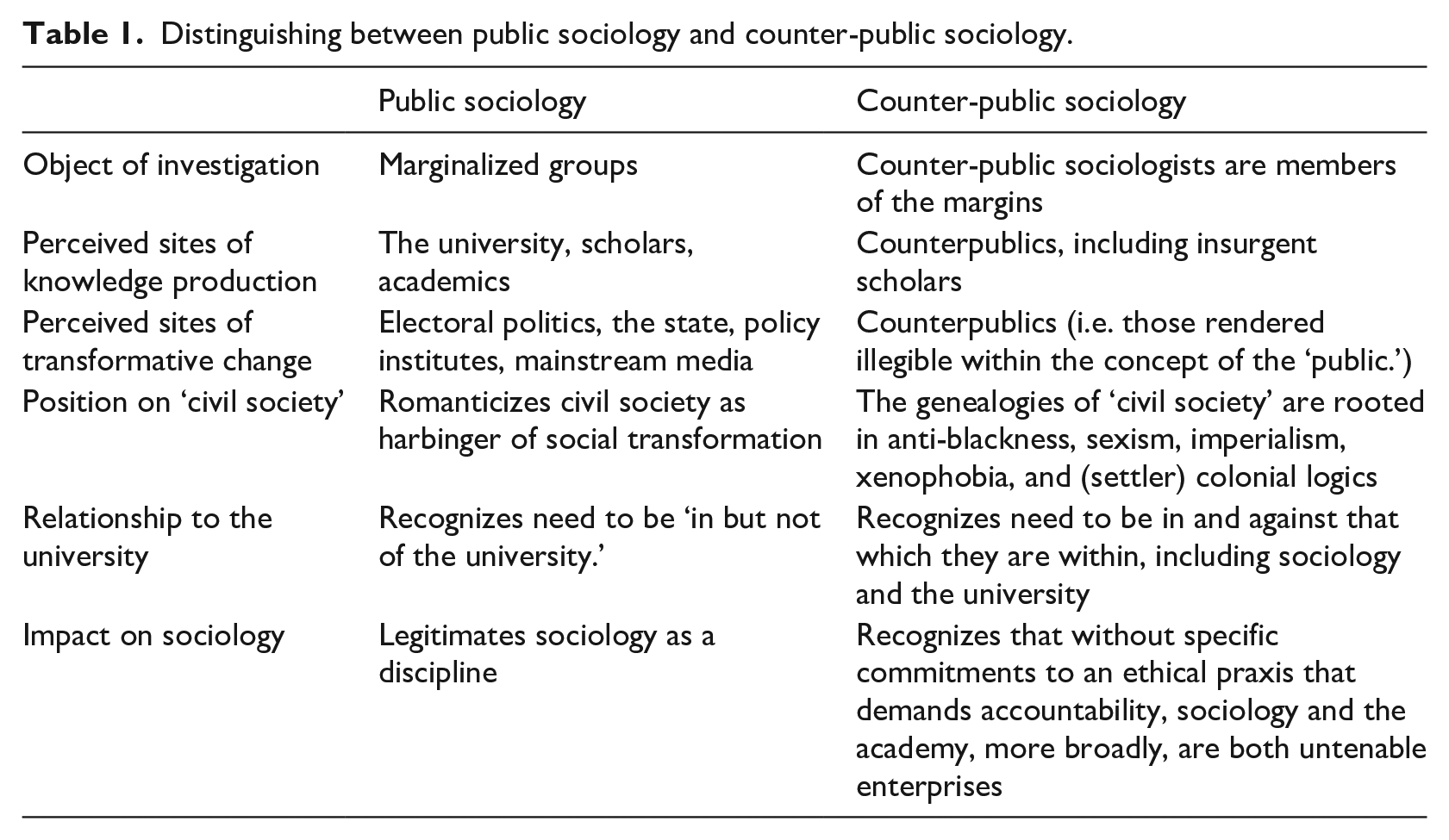
A counter-public sociology seeks not to affirm the university, but to insist that this current academic enterprise remains untenable (to help further distinguish between public sociology and a counter-public sociology, see Table 1). Public sociology has now become another benchmark for scholars to fulfill in addition to scholarship, teaching, and service. While there is certainly value to expanding the range of scholarly qualifications, adding public sociology to a growing list of high expectations for academics represents yet another ploy of the academy to legitimate itself, while appearing charitable to those seeking to reach wider audiences.
Distinguishing between public sociology and counter-public sociology.
As public sociologists seek to add new lines to their curriculum vitae (CV) under ‘engaged scholarship’ and/or ‘public scholarship’, they esteem themselves at the expense of those for whom the public spotlight is more likely to dim than shine. As public sociologists seek shine, counter-public sociologists are more remain in search of stealth. I would be remiss not to acknowledge that public sociology has served as an important platform for sociologists weary from the exhausting and torturous peer-review publication process, which tends to feel more like a racket. Although public sociology has the potential to amplify voices most marginalized within the field, it should never be seen as the only avenue for such recognition. 17 Two violent trends in the university, and sociology in particular, include the silencing of dissent and the insulation of critique. Once silenced, dissident sociologists, particularly racialized scholars, find themselves striving to prove their worth or value within a (racial) capitalist enterprise. In doing so, they end up legitimating the myth of meritocracy and the academy itself.
A counter-public sociology has no interest in giving any greater credence to the university or professionalizing criticality. Counter-public sociology does not seek self-aggrandizement by making research accessible to a wider audience, precisely because it is committed to what Fred Moten and Stefano Harney (2004: 11) describe as ‘study’—‘a mode of thinking with others separate from the thinking that the institution requires of you’. ‘Study’ exceeds the physical boundaries of the university. ‘Study’ takes place on the stoop, the stairwell, the kitchen (table), the corner, the block, the cell, the cell block, the salon, the barbershop, the bodega, the park, the court, the field, and other spaces beyond the boundaries of the academy. As a verb, not a noun, ‘study’ is done ‘with and for’ counterpublics, not the university.
Engaging in ‘study’ is not simply about resisting the hegemony of individualized knowledge production, but also a recognition that the university, in its current form, is an untenable institution. Is public sociology prepared to humble itself and recognize the bidirectional teaching relationship between the university and counterpublics? If public sociologists were to meaningfully reckon with this question and conclude that there is in fact a need to recognize this relationship, how might this unsettle their fealty to the academy? Would they direct their attention to counterpublics, as opposed to privileged publics? To acknowledge that the ‘public’ in public sociology often represents other academics and ‘privileged publics’ should lead all public intellectuals to question whether the knowledge they seek to make accessible is in fact becoming even more privatized, financialized, and thus inaccessible.
I began this paper by critiquing ‘accessibility’ as a concept often reduced to the dissemination of scholarly ideas to popular audiences. So long as the university continues to privilege itself as the gatekeeper of knowledge and the primary site of knowledge production, it will continue exposing the untenability of its epistemological and material foundations. Those who believe that the university is an untenable institution predicated on racialized violence, sexualized violence, racial capitalism, the incorporation and sequestration of minoritized difference, and the extraction and dispossession of intellectual, material, and social resources from poor and marginalized communities cannot believe in public intellectuals, let alone public sociology, precisely because the university, in its current form, cannot exist.
Footnotes
Acknowledgements
Thank you to the anonymous reviewers for tuning in so graciously to my wavelength and overall vision for this piece. You pushed me and this paper in all the right directions.
Funding
The author(s) received no financial support for the research, authorship, and/or publication of this article.
