



Abstract
Introduction
The aging population has led to a growing interest in determinants of successful aging. One important determinant of later life health is cognitive ability. Research suggests that people with higher ability live longer and retain their functional abilities better (Calvin et al., 2011; Pavlik et al., 2003; Stuck et al., 1999). These studies address consequences of the large differences in cognitive ability between individuals that can be observed at all ages, but over the life course, considerable changes in cognitive ability within individuals can also be observed (Baltes, Lindenberger, & Staudinger, 2006). To what extent these cognitive changes within individuals may be influenced by the social environment is still uncertain. In the literature, the focus of interest has been on the potential link between cognitive ability and early life socioeconomic position (SEP) as well as later life educational and occupational attainment. Parental SEP is thought to influence early life cognitive development through pathways of nutrition, health, resources, mental stimulation, and parenting practices (Bradley & Corwyn, 2002; Richards & Hatch, 2011). SEP early in life may also have long-term indirect effects on maximum attained cognitive ability through pathways of educational and occupational attainment, with the latter being suggested to improve cognitive ability by providing an environment characterized by increased mental complexity and stimulation (Richards & Hatch, 2011; Schooler, Mulatu, & Oates, 1999). Higher educational level and occupational status are additionally associated with a decrease in the risk of developing chronic diseases, which may have a protective effect on cognitive ability (Holland & Rabbitt, 1991; Schaie, 1994). Acknowledging the interplay between social factors across the life course, a growing number of studies are examining the direct and indirect association between dimensions of SEP at different ages and cognitive ability in later life (Fors, Lennartsson, & Lundberg, 2009; Gonzalez, Tarraf, Bowen, Johnson-Jennings, & Fisher, 2013; Haan, Zeki Al-Hazzouri, & Aiello, 2011; Horvat et al., 2014; Jefferson et al., 2011; Johnson, Gow, Corley, Starr, & Deary, 2010; Lyu & Burr, 2016; Osler, Avlund, & Mortensen, 2013; Richards & Sacker, 2003; Singh-Manoux, Richards, & Marmot, 2005; Staff, Chapko, Hogan, & Whalley, 2016; Turrell et al., 2002). In general, earlier studies find educational attainment and occupational status or income to be independently associated with cognitive ability in later life, whereas the association with childhood SEP is partially or fully explained by the former mediating SEP factors. In this study, we address two important methodological limitations that may affect results from prior work on the association between SEP across the life course and cognitive ability in later life.
First, only a few earlier studies have had the possibility to account for the effect of early cognitive ability (Johnson et al., 2010; Osler et al., 2013; Richards & Sacker, 2003; Staff et al., 2016). However, this may be an important confounder considering that cognitive ability in childhood has been shown to be associated with later educational and occupational attainment (Strenze, 2007) and between person differences in cognitive ability have been found to be very stable across the life span (Gow et al., 2011). Thus, without a measure of early life ability, studies of the influence of SEP across the life course on cognitive ability in later life cannot separate the effect of life course factors that add variance to later cognitive ability from variance that has persisted throughout life. Unlike earlier studies including measures of childhood cognitive ability, we show associations between life course SEP and later life cognitive ability both with and without adjustment for childhood ability to demonstrate the implications of accounting for early life ability.
Second, no earlier studies to our knowledge have additionally addressed the significance of accounting for measurement error in the measure of early ability. Cognitive test scores are likely to be an inaccurate measure of true cognitive ability, and adjusting for childhood ability may therefore introduce bias in the regression parameters of our model due to measurement error. Glymour, Weuve, Berkman, Kawachi, and Robins (2005) showed that when adjusting for baselinecognitive ability the regression parameter of this measure is likely to be attenuated while the regression parameters of other explanatory variables in the model positively correlated with baseline ability are likely to be inflated. A more detailed discussion of this challenge is available elsewhere (Dugravot et al., 2009; Glymour et al., 2005). In this study, we account for the bias created when adjusting for baseline scores due to measurement errors by estimating a latent factor for childhood cognition.
The objective of this study is to examine how indicators of SEP across the life course both directly and indirectly are associated with midlife cognitive ability when accounting for early life cognitive ability and bias due to measurement error in the early life ability test scores. We estimate and compare parameters from three different structural equation models: a model without adjustment for early cognitive ability, a model including a composite score measure of early cognitive ability, and finally a model including a latent measure of early cognitive ability. Birth cohort data on 2,479 Danish men who completed cognitive ability tests at age 12, 18, and 56-58 are utilized. The data are unique not only because they contain measures of cognitive ability from childhood and youth but also because they are longitudinal with prospective register-based information on childhood social position, educational attainment, and occupational skill level throughout adulthood.
Method
Data
The Metropolit cohort was initiated in 1965 and comprised 11,532 men born in 1953 in the Copenhagen Metropolitan area. The cohort and the data sources linked to the cohort have been described in detail elsewhere (Osler, Lund, Kriegbaum, Christensen, & Andersen, 2006). Data from birth registers including a measure of paternal occupational class were linked to all 11,532 boys in 1965. The same year, 7,987 (69.2%) of the boys (age 12) answered a school-based survey administered by their class teachers, which included a test of cognitive ability. The main reason for the attrition was absence from school on the test day. A smaller proportion was due to unwillingness of the school to participate (8%) or the boys having moved out of the area or died between the age of 0 and 12 (9%) (Osler et al., 2006). The boys who did not answer the school survey were more likely to be born to single mothers and have fathers with low social class at birth compared with the boys who did answer the survey (Osler et al., 2006). In 1971, when the cohort members were 18 years old, they were liable to participate in the conscript board examination, which included a cognitive ability test. The conscript data have retrospectively been digitalized and linked to the cohort (G. T. Christensen et al., 2015). In 2009-2011, when the cohort members were aged 56 to 58 years, those who were still alive and living in the eastern part of Denmark were invited to take part in the Copenhagen Aging and Midlife Biobank (CAMB) (Lund et al., 2016). Of the 7,750 eligible Metropolit cohort members, 2,479 (21.5% of the originally cohort) participated in a clinical examination including a test of cognitive ability. Furthermore, all cohort members invited to participate in CAMB have been linked to the Danish Registers at Statistics Denmark giving access to longitudinal data on educational and occupational attainment. Comparing the cohort members who took part in CAMB with the nonrespondents showed that the respondents in general were better educated and more likely to be employed as well as having a lower all-cause mortality in the period April 2009 to December 2012 (Lund et al., 2016). Ability test scores from the conscript board examination at age 18, which were available for almost all the cohort members invited to participate in CAMB, showed that the respondents scored significantly higher on the ability test compared with the nonrespondents.
Measurements
Cognitive ability in childhood, youth, and middle age
Cognitive ability at age 12 was assessed in school using the Härnqvist test consisting of three subtests comprising verbal analogies, number series, and geometric figures (Härnqvist, 1968). Each subtest had 40 tasks, and a correct answer gave one point (range: 0-40).
Cognitive ability at age 18 was assessed at the conscription board examination using the Børge Priens Prøve (BPP) (Teasdale, 2009). BPP consists of four subtests including letter matrices, verbal analogies, number series, and geometric figures. The subtests had, respectively, 19, 24, 17, and 18 items. Scores from the individual subtests were not recorded in the conscription board registers. Thus, only a composite BPP score summing the number of correct answers from the subtests (range: 0-78) was available.
Cognitive ability in middle age was examined at the CAMB follow-up with three selected subtests from the Intelligenz-Struktur-Test (I-S-T 2000 R) (Amthauer, Brocke, Liepmann, & Beauducel, 2001; Mortensen et al., 2014). The subtest comprised sentence completion, verbal analogies, and number series. Each subtest contained 20 tasks, and a correct answer gave one point (range: 0-20). Internal consistency analyses of the test showed that one of the items in the sentence completion subtest had very low correlations with the other 19 items in the subtest and with the total score of the remaining 59 items (Mortensen et al., 2014). This item was consequently left out resulting in a maximum possible score on the sentence completion subtest of 19.
Although the cognitive tests taken at age 12, 18, and 56-58 are not identical, they all include number series and verbal analogies subtests. The composite scores are strongly correlated with coefficients around .70 (see Table 2) suggesting that similar aspects of verbal comprehension and reasoning have been measured.
Childhood SEP
Information on paternal occupation from birth registers was used as an indicator of childhood SEP. Data were coded in five occupational social classes resembling the hierarchical classification developed in the late 1960s by the Danish National Center for Social Research (Hansen, 1984; U. Christensen et al., 2014). The classes were named I, II, III, IV, and V, with I referring to employments that require long educations or imply management control of big organizations and V referring to unskilled manual employments. In 139 cases where the information on the paternal occupation was missing from the birth registers but available from the school survey, the latter data were used.
Educational attainment
The highest level of education achieved at age 30 was obtained from the national registers and grouped into (a) lower secondary; (b) upper secondary technical, which primarily qualifies access to the labor market; (c) upper secondary general, which primarily qualifies access to higher education; (d) bachelor; and (e) master or doctoral.
Occupational skill level
A measure of occupational skill level from age 40 to 55 was created using yearly national register information classifying the cohort member’s occupation according to the International Standard Classification of Occupations (ISCO-88) (International Labor Office [ILO], 2012). For every year, the ISCO-88 codes were grouped into the four hierarchically skill levels embedded in the classification ranging from Skill Level 1 generally involving the performance of simple and routine physical or manual tasks to Skill Level 4 generally involving performance of complex problem solving and decision making (ILO, 2012). Managers were assigned Skill Level 4, and a small number of cohort members employed in the military were set to missing because occupations within the military cuts across the skill levels. Furthermore, a Level 0 was assigned to cohort members who were unemployed or outside the labor market. One composite measure of occupational skill level from age 40 to 55 was derived by assigning the skill level occupied most often (the mode) during the 16 years. If more than one mode existed, the highest value was assigned.
Data Analysis
First, the distributions and correlations of the study variables were assessed. Next, structural equation models were used to estimate the association between the social life course factors and midlife cognitive ability. Three models were estimated. Model 1 assessed how paternal occupation, own education, and own occupational skill level were associated with midlife cognitive ability. Direct paths from paternal occupation, education, and occupational level to a latent construct of midlife cognitive ability were specified together with paths leading from each of these variables to all the subsequent variables (Figure 1a). In Model 2, the composite score from the Härnqvist ability test taken at age 12 was included to assess the importance of accounting for childhood ability. Additional paths added to the first model went from paternal occupation to childhood ability and from childhood ability to own education, occupational level, and midlife cognitive ability (Figure 1b). In Model 3, a latent construct of childhood cognitive ability was included to assess the importance of accounting for measurement errors in the cognitive test scores. Compared with the second model, the only change was the inclusion of childhood ability as a latent factor measured using the three subtests from the Härnqvist ability test as indicators (Figure 1c). Finally, standardized coefficients from the three models were used to calculate indirect and total effects between the study variables and cognitive ability in midlife. In addition, 95% confidence intervals (CIs) for the indirect and total effects were estimated using bootstrapping with 200 replications. The direct and indirect effects describe, respectively, the associations which are and are not mediated through the other variables in the models.

Standardized coefficient from the structural equation models examining pathways between paternal occupational class, childhood cognitive ability, educational attainment, occupational level, and midlife cognitive ability, full information maximum likelihood estimation (N = 2,479).
The fit of the structural equation models was assessed using the root mean squared error of approximation (RMSEA), the comparative fit index (CFI), and the Tucker–Lewis index (TLI). In general, RMSEA values below 0.05 and CFI and TLI values above 0.95 indicate a good model fit (Little, 2013). All variables were entered as continuous in the models, and the full information maximum likelihood (FIML) estimation method was applied. This approach uses all the data available and gives less biased parameter estimates compared with listwise deletion under the assumption that the data are missing at random (Enders & Bandalos, 2001).
In sensitivity analyses, we reestimated the models (a) using maximum likelihood (ML) with listwise deletion; (b) including robust standard errors; (c) using diagonally weighted least squares (DWLS) with the three SEP measures paternal occupation, education, and occupational level entered as categorical variables; and (d) redefining the study sample to include all 7,750 cohort members for whom register data on one or more of the SEP measures were available. In addition, we tried to include the scores from the BPP ability test taken at the conscription board examination when the participants were 18 years old. Because we did not have access to the subtest scores from the BPP test, we used the two composite scores from the ability tests taken at age 12 and 18 as indicators of a latent measure of childhood and youth cognitive ability in Model 3.
Results
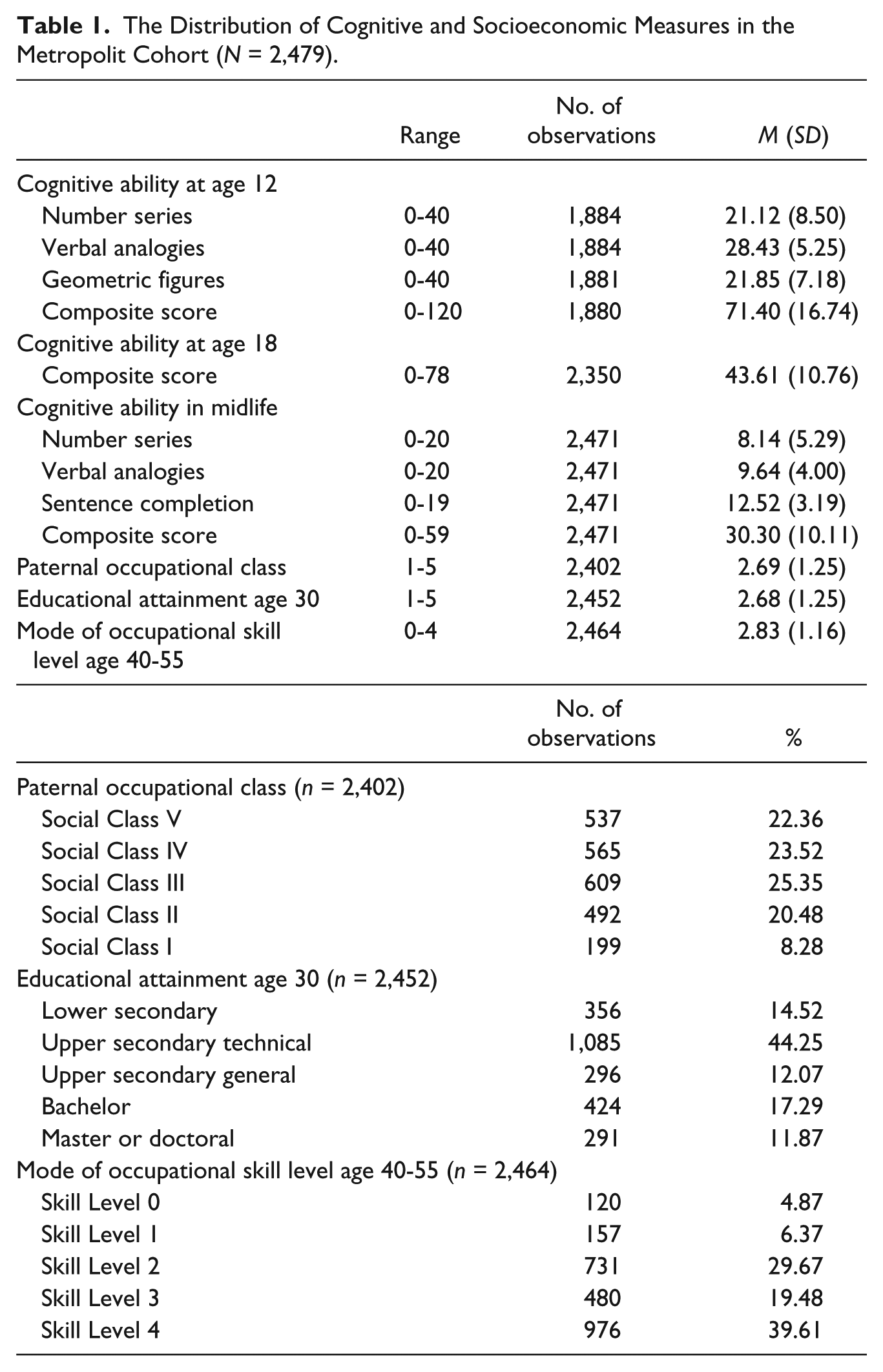
The study sample consists of 2,479 cohort members who took part in the CAMB clinical examination. Table 1 shows the range, number of observations, means, and standard deviations for all the variables in the study as well as frequency distributions for the variables with five categories. SEP measures were coded with higher value labels given to higher prestige classes of paternal occupation, higher educational attainment groups, and higher skill levels of own occupation. The proportion of missing data was low with the exception of cognitive ability tests completed at age 12 where information was missing for 24% of the study sample. Mean comparison t tests showed that the respondents with missing information on cognitive ability at age 12 had significantly lower scores on the age 18 ability test and had lower occupational levels compared with the nonmissing respondents. No difference was seen for educational level and paternal occupational class. Table 2 shows the observed correlations between the study variables with pairwise deletion of missing values. All correlations were statistically significant with p values below .001.
The Distribution of Cognitive and Socioeconomic Measures in the Metropolit Cohort (N = 2,479).
Observed Correlations Using Pairwise Deletion, the Metropolit Cohort.
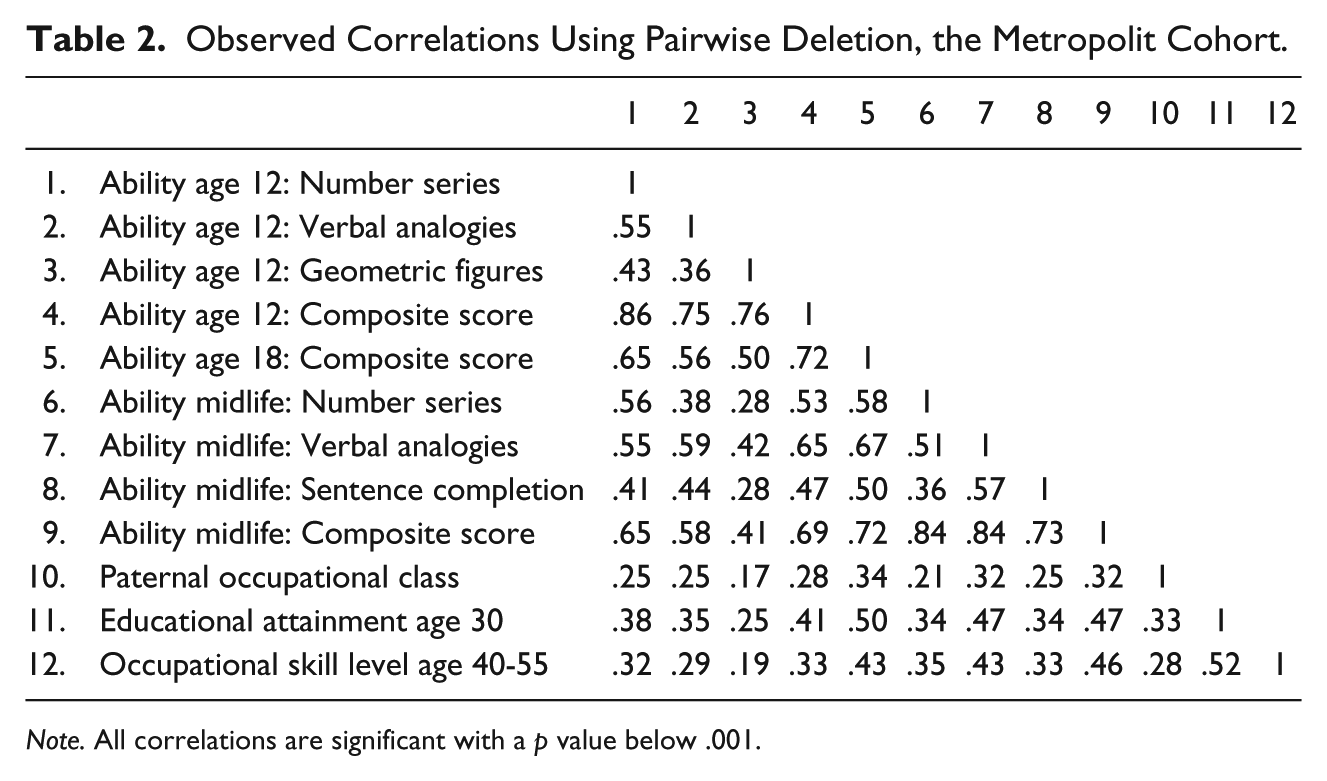
Note. All correlations are significant with a p value below .001.
Standardized coefficients from the first structural equation model examining the pathways between paternal occupational class, educational attainment, and occupational level and midlife cognitive ability are shown in Figure 1a. The coefficients for each path are measures of the associations between the two variables on the path adjusted for the effect of all other variables that are preceding the specific path. Being standardized, the coefficients reflect the impact on the outcome variable in standard deviations of a change of one standard deviation in the predictor variable. The fit statistics indicated that the model had a good fit (CFI = 0.996, TLI = 0.989, RMSEA = 0.033, 90% CI = [0.019, 0.048]). All paths in the model were statistically significant with p values below .001 (see CIs in Table 3). Own education and occupational level had direct paths to midlife cognitive ability of similar size (0.33 and 0.29, respectively) while the direct path of paternal occupational class was lower (0.18). Paternal occupational class was associated with own educational attainment (0.33) which furthermore was associated with own occupational level (0.48). A smaller direct association between paternal occupational class and own occupational level was also found (0.12).
Direct, Indirect, and Total Effects From the Structural Equation Models Showed in Figure 1.

Note. CI = confidence interval.
Figure 1b shows the standardized coefficients from Model 2 where cognitive ability in childhood was additionally included as a composite score. Again, the fit statistics indicated a good model fit (CFI = 0.991, TLI = 0.976, RMSEA = 0.049, 90% CI = [0.037, 0.061]). All paths remained statistically significant after adjusting for childhood ability (see CIs in Table 3); however, the direct paths from the different SEP measures to midlife ability were reduced. The smallest direct path to midlife ability was from paternal occupation (0.08), and the direct paths from own education (0.15) and occupational level (0.19) were also considerably smaller compared with the direct path from childhood ability (0.63). Paternal occupational class was significantly associated with childhood ability (0.31), own educational attainment (0.22), and to a less extent occupational level (0.10). Childhood ability predicted educational attainment (0.36) and occupational level (0.14), though the path going from educational attainment to occupational level was stronger (0.42).
Results from Model 3 where childhood ability was included as a latent measure using the subtests as indicators are shown in Figure 1c. The fit statistics indicated that the model had an acceptable fit (CFI = 0.971, TLI = 0.947, RMSEA = 0.062, 90% CI = [0.054, 0.070]). Comparing the standardized coefficients from this model to the one from the second model (Figure 1b) without correction for measurement errors in the childhood ability test, the magnitude of coefficients related to paths from any of the SEP measures in general decreased while the magnitude of coefficients related to paths from childhood ability increased. Most noticeably, this meant that the direct paths from paternal occupation (p value = .341) and own educational level (p value = .091) to midlife ability were no longer statistically significant at a 5% significance level and the coefficient of the direct path from childhood to midlife cognition was as high as 0.86.
Table 3 shows for each of the three models (Figure 1) standardized coefficients and 95% CIs of the direct, indirect, and total effects between the study variables and cognitive ability in midlife. The total effects of paternal occupational class and own education on midlife ability in Model 3 were calculated with the insignificant direct effects set to zero. The indirect effect of paternal occupational class increased when childhood ability was added to the model (Model 2) and again when adjustment for measurement errors in the cognitive ability tests were included (Model 3). However, as the direct effect decreased with each model step, the total effect of paternal occupational class on cognition in midlife was rather stable in the three models (0.36 in Model 3). In the case of education, both the direct and the indirect effect on midlife ability decreased across the models and the total effect went from 0.47 in Model 1 to 0.05 in Model 3. The same trend was seen for occupational level with the total effect on midlife ability decreasing from 0.29 in Model 1 to 0.13 in Model 3. The indirect effect of childhood cognitive ability on midlife ability was only minor compared with the large direct effect. In the last model where a latent construct of the cognitive ability tests were included, childhood ability had an indirect effect of 0.07 on midlife ability and a direct effect of 0.86 resulting in a total effect of 0.93.
In the sensitivity analyses, no noteworthy changes to the results were seen when estimating the models (a) using ML with listwise deletion, (b) including robust standard errors, (c) using DWLS estimation with the three SEP measures entered as categorical variables, or (d) using FIML and redefining the study sample to include all 7,750 cohort members for whom register data on one or more of the SEP measures were available (data not shown). Utilizing the cognitive test taken at the conscription board examination when the participants were 18 years old did not create significant changes to the results (see Supplementary Figures 1 and 2).
Discussion
In this study, we used prospective longitudinal data from a cohort of Danish men to estimate structural equation models of the relationship between SEP across the life course and cognitive ability in midlife. The results highlight the importance of controlling for childhood ability and measurement error in the ability test scores to prevent overestimating the associations between measures of SEP and cognitive ability in later life. Thus, direct paths from paternal occupational class and education to midlife ability decreased when including childhood ability in the model and additionally when taking measurement error into account. In the final model, paternal occupation and own education only had statistically significant indirect effects on midlife ability and for the latter the effect size was small. Likewise, the direct association between occupational skill level and midlife ability attenuated when controlling for childhood ability and measurement error, but it remained statistically significant. The association between childhood and midlife ability was by far the strongest, and as expected, it increased when accounting for measurement error in the tests.
A number of limitations apply to the results. First, the results cannot be used to draw causal conclusions. The longitudinal data are a strength of the analysis, limiting the risk of reverse causality, but unmeasured confounding between any of the study variables may still bias the results. One of the potential confounders we have not been able to control for is genetic background, and other possible omitted variables are chronic diseases that may influence both social position and cognitive ability. Second, due to a large attrition rate, the study sample is a selected group. Compared with the original cohort, it is characterized by higher parental occupational class, better cognitive ability in youth, greater educational attainment, and higher occupational skill levels. Although it is reassuring to see that the results do not change notably in the sensitivity analysis using listwise deletion and FIML including all 7,750 cohort members invited to participate in CAMB, we cannot rule out that the selection is attenuating the associations due to reduced variance. Because the study sample is selected on all study variables and the study variables furthermore are considerably correlated, we suspect an attenuation bias to be equally likely for all associations in the analysis. Third, the study only included men born in 1953 and results are therefore not generalizable to women and the generalizability may further be limited by specific cohort effects. Fourth, while the analysis included latent constructs of cognitive ability to account for measurement errors in the ability scores, it did not account for the potential bias due to measurement errors in the SEP indicators. Although all the SEP measures are based on high-quality prospective register data, it is likely that there are errors in the measures, especially when trying to capture more abstract concepts like childhood SEP and adult occupational skill levels. Such measurement error may have attenuated the associations between the SEP indicators and midlife cognitive ability. Nonetheless, the availability of prospective register data is also a great strength of this study when comparing with earlier studies that have used self-reported retrospective measures of SEP. Finally, it is worth noting that the measure of cognitive ability in midlife mainly reflects verbal reasoning ability, and other relations between SEP and different or more specific aspects of cognitive ability may exist. Despite these limitations, the study is highly valuable because it utilizes data from one of the few existing cohorts that have reached midlife and have information on cognitive ability tests from childhood.
Results from the first model (Model 1) show considerable effect estimate sizes for associations of educational and occupational attainment with later life ability. These results are generally in line with earlier studies using similar analytical structural equation modeling strategies and not adjusting for childhood ability (Horvat et al., 2014; Singh-Manoux et al., 2005). Results from the second model estimated (Model 2) resemble findings in similar earlier studies that have adjusted for childhood ability. Using data from the Lothian Birth Cohort 1936 to estimate path models, Johnson et al. (2010) found that the strongest predictor of later life ability was childhood ability and that childhood SEP only had an indirect effect on later life ability. In addition, they found both occupational class and educational level to have significant although small direct effects on later life cognitive ability. In a study by Richards and Sacker (2003), utilizing data from the British 1946 birth cohort and studying comparable variables in a path model, they found educational attainment and adult occupational class to have significant direct effects on scores on The National Adult Reading Test (NART) at age 53, while controlling for ability at age 8. In their model, the strongest predictor of NART was childhood cognition and no significant direct effect of paternal occupation on NART was found. Osler et al. (2013) have previously utilized Metropolit data to analyze the association between SEP and cognitive change using linear regression models and survey data on educational level and adult social class. They reported a significant association between a binary measure of education and the I-S-T 2000 R test score in a mutually adjusted model including the BPP test score. None of these earlier studies adjusting for childhood ability have additionally considered measurement error in the test scores as is done in the final model in this study (Model 3). Results from the final model show no clear direct association between education and later life cognition, which is contrary to what the previous studies have found. Examining sex differences, Richards and Sacker (2003) report that paths from education to midlife cognition were stronger in women and paths from occupational class to midlife cognition were stronger in men. This could be part of the reason we do not find any statistically significant direct effect of education on midlife cognitive ability in the final model in our study of men only. More specific differences between the tests could additionally play a role. However, we think the differences in the results are due to our use of a latent construct for early cognitive ability instead of a composite score. In a study of Swedish men, it was similarly found that years of schooling were not associated with midlife general cognitive ability after adjustment for a latent measure of early ability (Rönnlund, Sundström, & Pudas, 2017).
Results from this study suggest that the importance of education on later life differences in cognitive ability should be understood in terms of its impact on determining job possibilities. Considering the total effects, occupational skill levels are found to have a stronger impact than education on cognitive ability later in life. Characteristics of the occupation may be more influential because they are temporally closer to midlife cognition, and in midlife, most people have spent more years in the workforce than in the educational system. It could be that education will turn out to be more influential for later cohorts who have experienced better possibilities for intergenerational social mobility and who therefore have a more selected group of people with lower educational levels. In this study, occupational skill levels were defined based on the complexity and range of tasks performed and the direct association between this measure and cognitive ability in middle age is consistent with several earlier findings from the Kohn–Schooler research program showing that working a complex job improves cognitive abilities (Kohn & Schooler, 1983; Schooler et al., 1999). A relatively newer study testing this hypothesis using data on middle aged women and men from the Wisconsin Longitudinal Study found a moderate effect estimate of work complexity on abstract reasoning ability after controlling for adolescent ability test scores (Hauser & Roan, 2007).
In relation to the finding that individual differences in early cognitive ability have a substantial effect on differences in later life cognitive ability, it is important to consider potential predictors of individual differences in early life cognitive ability. The results indicate that childhood SEP plays a role. However, it is likely that the association between paternal occupational class and childhood cognitive ability reflects the father’s genetic makeup because it may influence both occupational class and the child’s ability. Nevertheless, there is also evidence of a causal link between childhood SEP and childhood ability with some of the more likely mediators being cognitive stimulation and the influence of parental stress on parenting practices (Capron & Duyme, 1989; Hackman, Farah, & Meaney, 2010). The indication that social causation and not only social selection contributes to explaining the association between childhood SEP and childhood cognitive ability appears central for our possibilities of influencing individual differences in later life cognitive ability. In our model, paternal occupational class has an indirect effect on midlife ability not only because it is associated with childhood cognition but also because it is associated with own educational attainment and occupational skill level. This suggests that the effect of childhood SEP on later life cognitive ability is likely to accumulate over the life course.
The strong association we find between childhood and midlife cognitive ability is not surprising. It is well established in the psychological literature that individual differences in cognitive ability are highly stable across the life course (Gow et al., 2011; Hertzog & Schaie, 1986; Mortensen & Kleven, 1993; Schwartzman, Gold, Andres, Arbuckle, & Chaikelson, 1987). The correlation coefficient of .7 between the standardized composite score of cognition at age 12 and midlife is similar to the correlation coefficient found in the Lothian Birth Cohort when comparing results from the Moray House Test taking at age 11 and 70 (Gow et al., 2011). In adulthood and later life, even stronger retest correlations of .9 have been found over periods of 10 to 40 years, suggesting that almost all of the variance in the cognitive test scores is consistent over time (Hertzog & Schaie, 1986; Mortensen & Kleven, 1993; Schwartzman et al., 1987). It is essential that the growing number of studies examining social inequality in cognitive aging acknowledge this literature. Whereas it may not be crucial to account for early life cognitive ability when studying social differences in later life cognitive change within individuals, it seems paramount when asking questions about social differences in cognitive levels between individuals in later life.
In conclusion, unique data enabled us to show that the association of educational attainment and occupational skill levels with later life cognitive ability will most likely be overstated if proper adjustment for early cognitive ability as well as measurement error in the ability tests scores is not considered. The inflated associations are mainly a consequence of not accounting for the stability in between person differences in cognitive ability across the life course. Although the results show that the association between life course SEP and cognitive ability is substantially weaker than the majority of the literature suggest, the results also indicate that life course SEP may still have an impact on differences in midlife cognitive ability. Especially the indirect effect of the early social environment and the direct effect of occupational complexity may influence later life individual differences in cognitive ability. Future research on social determinants of individual differences in later life cognitive ability needs to either include measures of early life cognitive ability or, if such measures are not available, implement quantitative bias analysis to consider the impact of stability in between person differences in cognitive ability over the life course.
Footnotes
Authors’ Note

Declaration of Conflicting Interests
The authors declared no potential conflicts of interest with respect to the research, authorship, and/or publication of this article.
Funding
The authors disclosed receipt of the following financial support for the research, authorship, and/or publication of this article: The research leading to these results was carried out as part of the Social Inequalities in Aging (SIA) project, funded by NordForsk, Project No. 74637. The research was additionally supported by a grant from the Center for Healthy Aging, University of Copenhagen, sponsored by The Nordea Foundation. The Copenhagen Aging and Midlife Biobank was funded by a generous grant from the VELUX Foundation (26145 and 31539).
References
Supplementary Material
Please find the following supplemental material available below.
For Open Access articles published under a Creative Commons License, all supplemental material carries the same license as the article it is associated with.
For non-Open Access articles published, all supplemental material carries a non-exclusive license, and permission requests for re-use of supplemental material or any part of supplemental material shall be sent directly to the copyright owner as specified in the copyright notice associated with the article.
