



Abstract
Keywords
Introduction
The pursuit of personally meaningful goals is crucial for well-being (Brunstein, 1993) and life satisfaction (Palys & Little, 1983). However, goals are situated within a system of constraints and changing resources, resulting in a need to adjust goals adaptively throughout the life span (Brandtstädter & Rothermund, 2002). Especially in later life, desired and factual circumstances can clash owing to age-related decrements in physical and sensory functioning, health problems, and the loss of loved ones. The negative effects of these life events are less pronounced in individuals who have good resources in sensorimotor, cognitive, personality, and social domains (M. M. Baltes & Lang, 1997). Nevertheless, resources at any given time point are limited, and thus choices have to be made when opportunities or losses occur (M. M. Baltes & Carstensen, 1996). People need to select which goals to undertake, optimize the allocation of resources to achieve the goals, and compensate to maintain functioning (B. B. Baltes & Dickson, 2001), for example, when facing functional decline.
When it comes to specific coping strategies, two distinct, but complementary, strategies have gained popularity: assimilation, which can be described as tenacious goal pursuit (TGP), and accommodation, referring to flexible goal adjustment (FGA; Brandtstädter & Renner, 1990). The dual-process model suggests that while active efforts can be made to change one’s life circumstances in accordance with one’s preferences, personal goals can also be abandoned or modified if these efforts prove to be ineffective (Bailly, Joulain, Hervé, & Alaphilippe, 2012). Controversy has arisen as to the most favorable profile in terms of the relative amounts of persistency and flexibility required in old age. On one hand, having both high TGP and high FGA has been associated with better health, life satisfaction, adaptation to changing circumstances, and lack of depression and hostility in later life (Heyl, Wahl, & Mollenkopf, 2007; Kelly, Wood, & Mansell, 2013). Our research group also has found that highly tenacious and flexible older people move in a larger life space and participate more actively in society (Siltanen et al., 2018). On the other hand, some researchers, citing evidence of an age-related shift toward the accommodative strategy, have proposed a more important role for flexibility than tenacity (Brandtstädter, 2009; Martinent et al., 2017). The majority of older people seem to have rather stable TGP and FGA trajectories, at least over 5- or 9-year study periods (Bailly et al., 2016; Martinent et al., 2017).
However, TGP and FGA have mostly been studied as predictors of psychological adjustment and well-being. Little attention has been paid to how TGP and FGA relate to physical functioning and especially to possible limitations in physical performance in old age. For example, while relinquishing goals in favor of more feasible goals can predict subjective well-being, it rarely predicts physical health outcomes (Wrosch, Scheier, & Miller, 2013). Moreover, TGP and FGA have been little studied in relation to active aging on the level of the individual, a process that we have described as “striving for elements of well-being through activities relating to a person’s goals, functional capacities and opportunities” (Rantanen et al., 2018, p. 2). Interviews with older people have highlighted the importance they attach to maintaining social activities and engagement in hobbies other than physical activity (Bowling, 2008; Gabriel & Bowling, 2004). Self-selected hobbies have also been shown to have beneficial effects on depressive symptoms (Dupuis & Smale, 1995), cognitive functioning (Fabrigoule et al., 1995; Schooler & Mulatu, 2001), survival (Lennartsson & Silverstein, 2001), and self-rated health and life satisfaction (Menec & Chipperfield, 1997; Ragheb & Griffith, 1982; Silverstein & Parker, 2002).
According to life span developmental theory (P. B. Baltes, 1987), engagement in leisure activities fluctuates over the life course. Some researchers suggest that involvement in leisure activities is quite stable until very old age (Lee & King, 2003), whereas others have found that individuals gradually decrease their leisure activities in later life (Armstrong & Morgan, 1998; Verbrugge, Gruber-Baldini, & Fozard, 1996). In a longitudinal study of people above 50 years old, Janke, Davey, and Kleiber (2006) found that especially functional limitations and depressive symptoms were associated with declines in leisure activity, and that health was more important than age in determining involvement in activities. Similarly, we have found that older people who have better health resources are more likely to report goals related to leisure-time, social, and physical activities (Saajanaho et al., 2016).
Over time, older people who do not engage in different activities have worse mental health outcomes than those who are more active, and highly active people gain benefits in both mental and physical health (Morrow-Howell et al., 2014). Lack of interest, problems with physical symptoms, and difficulties with access, however, pose major challenges for increasing older people’s participation in leisure activities (Crombie et al., 2004). Functional decline can lessen participation in leisure activities that could help maintain a larger life space (Saajanaho et al., 2015), but physical performance does not entirely explain the differences in older people’s leisure activity participation. There are people who are highly active despite their physical limitations because they have personal and social resources that enable them to maintain activities (Morrow-Howell et al., 2014). Studying the effects of coping strategies could help in identifying these personal resources in active aging, that is, whether it would be more fruitful to focus on supporting persistency or on promoting flexibility in relation to leisure activities.
Hence, the aim of the study was to find out whether assimilative and accommodative coping strategies moderate leisure activity participation of older people facing limitations in physical performance. Moderation deals with the question “when,” that is, under what circumstances, or for which types of people, functional decline exerts an effect. In this study, leisure activities were divided based on their type (solitary vs. group activities) and location (home-based hobbies vs. hobbies outside the home environment). As mobility limitations can result in the abandonment of activity-related goals (Saajanaho et al., 2014), we hypothesized that TGP might be more important than FGA as a strategy for maintaining leisure-time activities. Furthermore, we hypothesized that older people with good physical performance might not benefit from tenacity as much as those who have lower functioning.
Method
Participants
The present participants were drawn from those enrolled in a prospective cohort study Life-Space Mobility in Old Age (LISPE) at the University of Jyväskylä, Finland (Rantanen et al., 2012). Originally, 75- to 90-year-old community-dwelling persons (N = 848) living in Central Finland (Jyväskylä and Muurame) participated in the baseline interviews conducted in their homes. Follow-up interviews were conducted at 1 year (n = 816) and 2 years (n = 761). The present study uses the cross-sectional data obtained at the third follow-up, Mobility and Active Aging (MIIA) study, in which a subsample of 298 persons was contacted. Longitudinal perspective was not possible, because TGP and FGA were only obtained in this last follow-up.
We calculated that a sample size of 200 would suffice for correlations of r = .20 to become statistically significant (α = .05 and power 80%). First, we contacted all the participants who had taken part in additional measures of hearing, vision, and cognition at the second follow-up. Of these participants, 152 were still living in the study area. To reach 200 participants altogether, a random sample of 150 participants from the baseline cohort was drawn to complete the sample. Of this eventual sample of 298 persons, 15 could not be reached and 77 declined to participate in the study. Nineteen participants had insufficient data for the calculation of TGP and FGA sum scores (too much missing data to be imputed). The data for the analysis finally consisted of n = 187 community-dwelling older adults aged 79 to 93 years (M = 83.9).
Participants, who were selected for this study, had higher baseline scores in Short Physical Performance Battery (SPPB) and reported higher participation in outdoor activities and nongroup leisure activities outside home than those who were not selected from the original cohort. There were no differences in age, length of education, cognitive status, depressive symptoms, or self-reported health between these groups.
Procedure
Potential participants were first contacted with an information letter, followed up by a phone call. Inclusion criteria were living independently in the area of the study and being able to communicate with the researchers. For persons meeting the inclusion criteria and willing to participate in the study, a time for a home visit was scheduled. The face-to-face home interview began with signing of the informed consent form, after which the interviewer started asking questions and marking the answers on electronic forms using a laptop.
Physical Performance
The SPPB (Guralnik et al., 1994; Mänty, Sihvonen, Hulkko, & Lounamaa, 2007) was used to assess participants’ lower-extremity physical performance. The test consists of standing balance, walking speed over a 2.44 m distance, and the ability to rise from a chair. Each task is scored from 0 to 4 points, with higher scores indicating better physical performance. The total score for SPPB is the sum of the three subtests and thus ranges from 0 to 12 points (calculated when at least two tests are completed). This sum score was used in the present statistical analyses. SPPB has been found to have validity and reliability in diverse populations (Freire, Guerra, Alvarado, Guralnik, & Zunzunegui, 2012).
Assimilative and Accommodative Coping Strategies
Coping styles were studied with a questionnaire comprising two independent scales, one for TGP and one for FGA (Brandtstädter & Renner, 1990). The TGP scale is intended to measure the tendency to persistently pursue goals even in the face of obstacles or possible failure (e.g., “I stick to my goals and projects even in the face of great difficulties”). The FGA scale is intended to measure the tendency to reinterpret unpleasant outcomes positively and to easily abandon blocked goals (e.g., “If I do not get something I want, I take it with patience”). To decrease respondent burden (the study’s whole interview protocol took a few hours), we used short versions of the scales (Kelly et al., 2013), each comprising five items and requiring participants to rate their agreement on a 5-point Likert-type scale from 1 = “strongly agree” to 5 = “strongly disagree.”
The direction in which the TGP/FGA items are formulated has been suggested to be as important as the target of measurement (Henselmans et al., 2011). In line with this, we found that the reversed items correlated poorly with the other items (TGP: r = −.02 to r = −.18*; FGA: r = −.09 to r = −.21**) (*p < .05, **p < .01) and that the internal validity of the scales was lower with the reversed items (TGP: Cronbach’s α = .72 with and .77 without the reversed item; FGA: Cronbach’s α = .60 with and .67 without the reversed item). Hence, for the statistical analyses, we decided to remove the reversed item from each scale. The remaining four items in each scale were reverse-scored, higher values indicating more tenacious or more flexible goal pursuit (0-4) and summed. The sum score (range = 0-16) for each scale was used in the subsequent analyses. If a participant answered three of the four items on each scale, the mean was imputed for the missing item.
Leisure Activities
Participation in leisure activities was elicited with the five items shown in Table 1, in which participants were asked how often they did certain activities. Inspection of the items showed that the question about adult day care center activities (Q2) was not very consistent with the underlying construct of leisure activity (Cronbach’s α = .37 with the item). This was understandable, as persons who participate in adult day care center activities in Finland often have functional decline and can only participate in activities provided by the center. In the following step, the day care question was removed from the analysis, the scales were reverse-scored (higher points indicating higher activity), and a sum score calculated from the four remaining questions (range = 4-28).
Questionnaire on Older People’s Leisure Activity Participation.

Note. Each item was rated on a 7-point Likert-type scale: 1 = “Daily or almost daily,” 2 = “About once a week,” 3 = “Two to three times a month,” 4 = “About once a month,” 5 = “A few times a year,” 6 = “Rarely,” 7 = “Not at all.” Question 2 was discarded from the analyses after studying the scale’s reliability.
Internal consistency of the 4-item scale was α = .49, which can be considered acceptable (Taber, 2018), as Cronbach’s alpha tends to underestimate reliability of scales with fewer than 10 items (Briggs & Cheek, 1986; Clark & Watson, 1995). A better consistency measure for shorter scales can be the calculation of average inter item correlation, which was r = .20 in our study (optimal level is from .20 to .40; Briggs & Cheek, 1986; Piedmont & Hyland, 1993). Furthermore, in the principal component analysis, only one factor was found for the four items, and the loadings were high: .72 for nongroup hobbies outside the home environment (Q4); .67 for group activities outside the home environment (Q1); .61 for fishing, berry picking, and other outdoor activities (Q5); and .49 for home-based hobbies (Q3). It was decided that moderation effects would be studied first with the sum score and then with the score for each of the four items separately.
Statistical Analysis
To test the hypothesis that TGP and/or FGA moderates the relationship between physical performance (SPPB) and activity level in relation to different hobbies, observed variable ordinary least squares (OLS) regression path analysis was modeled using PROCESS macro for SPSS v24 (Hayes, 2017). Hence, TGP and FGA were tested both as separate and as simultaneous moderators. If a statistically significant moderation effect was found, it was probed using standardized values and the pick-a-point approach (Bauer & Curran, 2005; Rogosa, 1980) by regression centering, with the 16th, 50th, and 84th percentiles of the distribution of the moderator, described as “relatively low,” “moderate,” and “relatively high” (Hayes, 2017). In addition, Johnson–Neyman significance regions and bootstrapped 95% confidence intervals (CIs) were calculated for the results.
Gender, age, education, cognitive performance (MMSE; Mini-Mental State Examination; Folstein, Folstein, & McHugh, 1975), depressive symptoms (CES-D; Center for Epidemiologic Studies Depression Scale; Radloff, 1977), and the most common medical diagnoses (>30% of participants) were set as covariates in the analyses. If any of the covariates became statistically significant, their possible independent or moderating effect was also tested. As a final step, given that TGP and FGA could also be coping mechanisms through which physical performance influences leisure activity participation, we confirmed that TGP and FGA were not mediators in the observed model.
Results
Of the 187 participants, 103 were females (55%) and 84 males. Participants’ health, which was self-rated using a 5-point scale from “very poor health” to “very good health,” was mostly average (51%) or good (32%). The most commonly reported medical diagnoses (>30%) were hypertension or high blood pressure (59%), spinal disease/problem (37%), osteoarthritis (35%), and hearing loss (32%). Other descriptive data on the participants and the studied variables are shown in Table 2.
Means and Standard Deviations of Key Measures.

Note. Leisure activity scores were reverse coded, so that higher scores indicate more activity.
Analysis of Overall Leisure Activity Participation
Individually, SPPB accounted for much of the variance in relation to leisure-time activities, R2 = .212, F(1, 179) = 48.06, p < .001, whereas TGP also showed a small but significant association with leisure-time activities, R2 = .027, F(1, 184) = 5.02, p = .026. When both SPPB and TGP were added to the model as independent variables, the effect of TGP disappeared. In the next step, SPPB and TGP were means-centered and allowed to interact. In this model, SPPB was associated with leisure activity participation, b = .86, t(177) = 6.24, p < .001, whereas TGP was not, b = .11, t(177) = 1.12, p = .263, and the interaction between SPPB and TGP was statistically significant, b = −.12, t(177) = −2.63, p = .009. The lower and upper bootstrapped 95% CI for these results did not include zero. Hence, TGP was found to moderate the relationship between SPPB and leisure-time activities, R2 = .249, F(3, 177) = 19.51, p < .001. R2 change compared with the SPPB-only model was .037 and statistically significant (p = .015).
Gender, age, education, depressive symptoms (CES-D), or the most common medical diagnoses (>30% of participants) as covariates did not affect the results. Controlling for cognitive performance (MMSE) improved the model, F(1, 176) = 19.51, p < .001, R2 = .307; R2 change = .059, significant F change p < .001, resulting in a final model accounting for 31% of the variance in leisure activity participation (Table 3). Although cognitive performance did not moderate the association between physical performance and leisure activities or influence the moderation effect of TGP, it had an independent effect on leisure activity participation (higher cognitive performance was associated with greater activity in doing hobbies; b = .45, t(181) = 3.86, p < .001).
Moderation Effect of TGP on the Relationship Between Physical Performance (SPPB) and Total Leisure Activity Participation, Controlling for Cognitive Performance (MMSE).
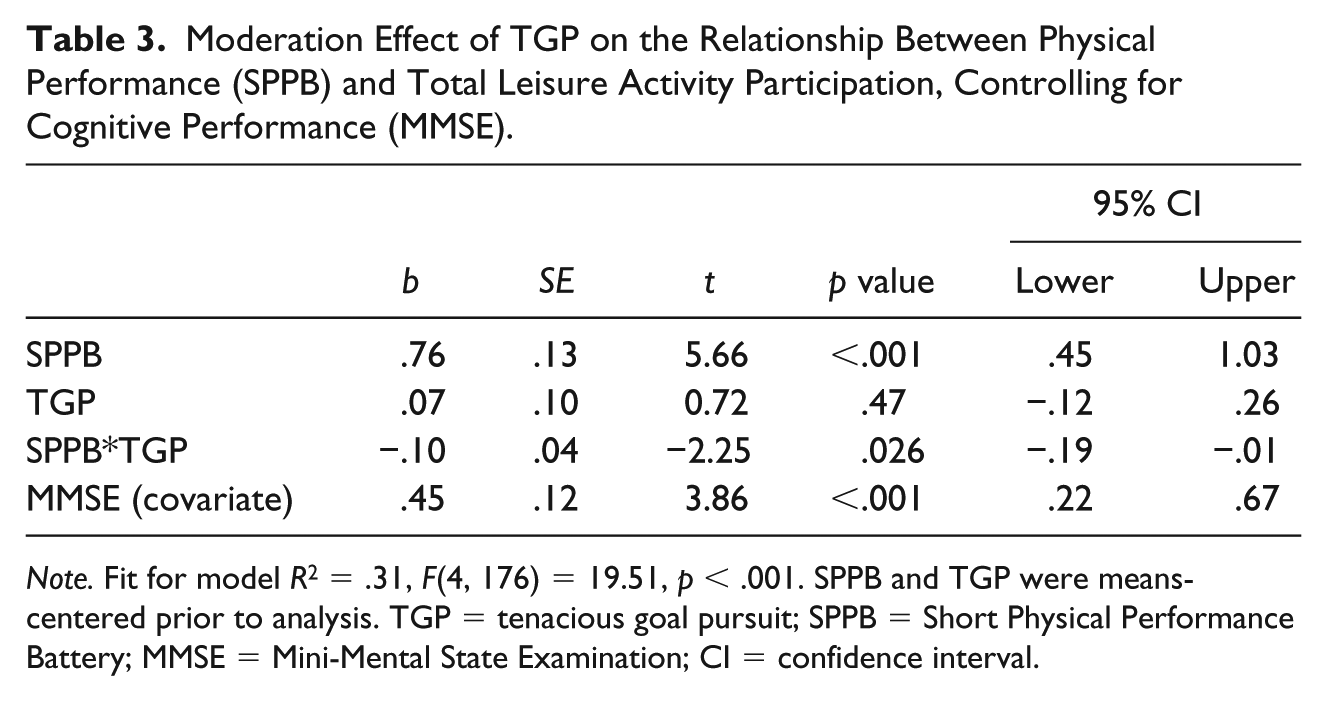
Note. Fit for model R2 = .31, F(4, 176) = 19.51, p < .001. SPPB and TGP were means-centered prior to analysis. TGP = tenacious goal pursuit; SPPB = Short Physical Performance Battery; MMSE = Mini-Mental State Examination; CI = confidence interval.
Probing of the moderation using standardized values and the pick-a-point approach showed the level of moderation to be statistically significant at all three TGP levels: relatively low, b = 1.13, t(176) = 5.74, p < .001, 95% CI = [0.74, 1.52], moderate, b = .73, t(176) = 5.36, p < .001, 95% CI = [0.46, 1.00], and relatively high, b = .43, t(176) = 2.04, p = .0426, 95% CI = [0.01, 0.85]. Figure 1 represents the moderation effect of TGP on the relationship between SPPB and leisure activities.
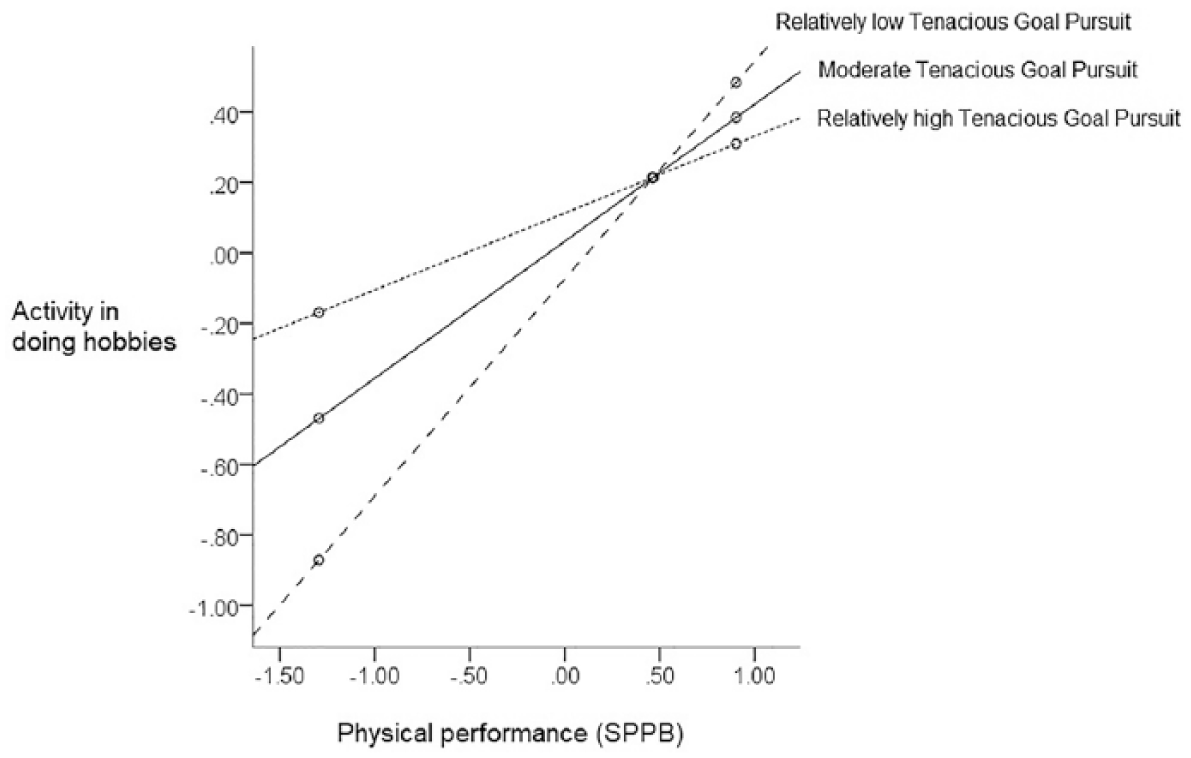
Slopes of physical performance predicting activity in doing hobbies for 16th (relatively low), 50th (moderate), and 84th (relatively high) percentiles of tenacious goal pursuit (TGP).
As indicated in Figure 1, the most prominent effects of TGP were observed at the point where physical performance started to fall below the mean. When physical performance was poor, low TGP resulted in very little leisure activity, whereas people with high TGP had a level of leisure activity closer to the mean. The moderator value defining the Johnson–Neyman significance region was 15.14 points in TGP, meaning that with the exception of the highest 9.9%, whose TGP scores were above 15 out of the 16-point maximum, the moderation was significant.
Analysis of Specific Types of Leisure Activities
Closer inspection of the four items of leisure activity participation showed that the moderating effect of TGP mainly applied to outdoor activities (fishing, picking berries, gardening, and other outdoor activities, for example, with a pet; Table 4) and group activities outside the home environment (activities or clubs, for example, choir, exercise groups, organizational, or congregational activities; Table 5). The conditional effects of SPPB at values of TGP were b = .41, t(177) = 4.97, p < .001, 95% CI = [.25, .57] for relatively low tenacity, and b = .23, t(177) = 3.99, p = .0001, 95% CI = [.11, .34] for moderate tenacity in outdoor activities. The corresponding values for group activities outside the home environment were b = .41, t(177) = 4.97, p < .001, 95% CI = [.19, .62] for relatively low tenacity, and b = .17, t(177) = 2.18, p = .0303, 95% CI = [.02, .32] for moderate tenacity. The Johnson–Neyman significance region in TGP for outdoor activities was 13.85 points, leaving 63.74% of participants below this value, and for group activities away from home 12.22 points, leaving 54.40% of participants below this value.
Moderation Effect of TGP on the Relationship Between Physical Performance (SPPB) and Outdoor Activities, Controlling for Cognitive Performance (MMSE).

Note. Fit for model R2 = .20, F(4, 177) = 11.19, p < .001. SPPB and TGP were means-centered prior to analysis. Outdoor activities included, for example, fishing, picking berries, gardening, and taking walks. TGP = tenacious goal pursuit; SPPB = Short Physical Performance Battery; MMSE = Mini-Mental State Examination; CI = confidence interval.
Moderation Effect of TGP on the Relationship Between Physical Performance (SPPB) and Group Activities Outside Home Environment, Controlling for Cognitive Performance (MMSE).
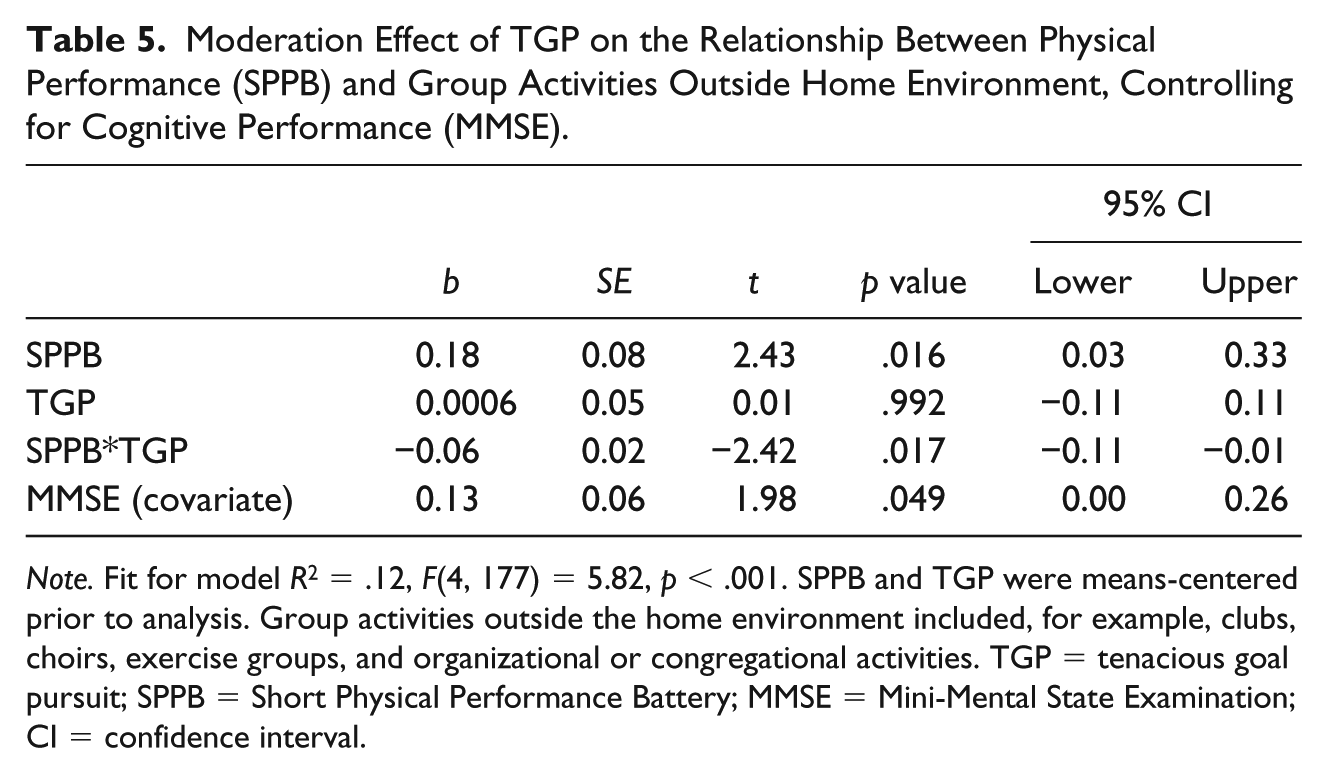
Note. Fit for model R2 = .12, F(4, 177) = 5.82, p < .001. SPPB and TGP were means-centered prior to analysis. Group activities outside the home environment included, for example, clubs, choirs, exercise groups, and organizational or congregational activities. TGP = tenacious goal pursuit; SPPB = Short Physical Performance Battery; MMSE = Mini-Mental State Examination; CI = confidence interval.
In conclusion, participants whose level of tenacity was not high showed less outdoor activities and group activities away from home. The effects were already visible when physical performance was on the average level but became increasingly prominent the lower the participant’s functioning was. The moderation effect of TGP was not significant for home-based hobbies (reading, playing an instrument, doing handicrafts, or visual arts) or for nongroup activities away from home (going to concerts, the theater, movies, art exhibitions, coffee shops, etc.). Nevertheless, physical performance (SPPB) and cognitive performance (MMSE) were each linked to all the different activities, except for home-based hobbies, which was only associated with cognitive performance.
FGA
The same moderation analyses were conducted for FGA; however, flexibility in goal adjustment was not found to moderate the relationship between physical performance and leisure activities. Furthermore, adding FGA as a second moderator alongside TGP did not improve the model.
Mediation Versus Moderation
TGP and/or FGA did not mediate the relationship between SPPB and leisure activity participation.
Discussion
The aim of this study was to find out whether assimilative and accommodative coping strategies moderate the relationship between physical performance and leisure activity participation in old age. Hence, the question was, in the presence of functional decline, is it better to be persistent or flexible in one’s goals to maintain activities? We found that only TGP had an effect on the association between physical performance and leisure activities. Despite poor physical performance, older people who were very persistent with their goals had close to mean level of leisure activity participation. Vice versa, low level of tenacity was associated with very little leisure activities in the presence of low physical performance. When cognitive performance was controlled for, the final moderation model explained 31% of the variation in leisure activity participation. More specifically, there was less outdoor and group activities outside the home environment in the absence of high tenacity.
From this study, it appears that persistency, rather than flexibility, is more crucial for being active in relation to hobbies. This finding is novel, as the combination of high tenacity and high flexibility has been suggested to be crucial for the well-being of older people (Bailly et al., 2016; Heyl et al., 2007; Kelly et al., 2013). Furthermore, the coping strategies of older people have mainly been studied in relation to psychological outcomes, such as subjective evaluations of well-being and life satisfaction (Bailly et al., 2016; Brandtstädter & Renner, 1990). As far as we know, the role of coping strategies in promoting older people’s leisure-time activity participation has not previously been addressed.
As this study demonstrates, the most favorable amounts of TGP and FGA and the balance between them depend on the outcome selected for study. Although flexibility in giving up unreachable goals can decrease psychological distress and lead to better well-being, it does not necessarily support the maintenance of activities that would decrease physical health risks and promote independent living. The SPPB used in this research has been shown to have predictive validity for functional decline and mortality risk, nursing home admission, and disability (Corsonello et al., 2011; Guralnik et al., 1994). Participants with SPPB scores of 10 or lower have a significantly higher probability of mobility disability in the years to come (Vasunilashorn et al., 2009), and we also found this to be a threshold score below which tenacity started to be connected with leisure activity participation.
The strengths of the present study lie in moving beyond mere causal associations by establishing boundaries that facilitate or inhibit the effects of functional decline on leisure activity participation, controlling for several potentially confounding factors, and having a power-calculated adequate-sized sample of participants. There is a large body of literature highlighting how problematic it is to transform continuous moderators into groups (e.g., reference list by Hayes, 2017), so we did not artificially divide the participants into, for example, “low” and “high” tenacity and flexibility subgroups. This type of grouping discards valuable information and reduces the power of statistical tests, and the resulting groups might not be psychometrically meaningful (e.g., similar participants who are close to the mean are treated as if they are maximally distinct). We did not merely stop at showing that there is an interaction effect, but probed this interaction to find out where in the distribution of TGP physical performance is related to leisure activities.
Limitations
One limitation of the study was that the questionnaire items were based on whether the activity in question was engaged in alone or in a group, and at home or outside the home environment, factors that made it hard to assess the specific effects of exercise. It is possible that tenacity moderates the effects of functional decline more with hobbies that require out-of-home mobility and physical activity. Home-based activities often require much less effort and can be performed at a lower level of physical capacity (e.g., reading) than activities outside the home environment. In future studies, the leisure activity questionnaire could be improved by further categorizing hobbies according to how much physical activity they involve. However, when we analyzed this possibility further, we found that tenacity did not moderate the relationship between physical performance and physical activity (extended and modified Finnish version of the Saltin–Grimby Physical Activity Scale; Portegijs, Rantakokko, Viljanen, Sipilä, & Rantanen, 2016), suggesting that exercise per se does not explain the observed results. Likewise, TGP did not have an effect on attending different cultural activities, meaning that out-of-home mobility is also not the crucial factor. Hence, a combination of both outdoor and physical activity might be required for tenacity to become useful.
Another limitation of the study was that TGP and FGA were measured only at the last follow-up of the cohort study, thereby disallowing a longitudinal perspective. Although most of the published work on mediation seem to be cross-sectional (Cole & Maxwell, 2003; Gelfand, Mensinger, & Tenhave, 2009), some researchers specifically advocate for longitudinal data for mediation analyses (Maxwell & Cole, 2007). However, moderation, the main analysis in this study, is not inherently defined as a process that unfolds over time; it reveals situations in which the effect is observable (in this study, when physical performance is lower than average).
Moreover, the problem of establishing cause and effect concerns with the studied concepts and their associations, not the data analysis per se (Hayes, 2017). The leisure activities in this study included physical activities such as attending exercise groups, fishing, picking berries, and walking, all of which can influence physical performance. Higher physical performance can also increase leisure activity participation; however, the study also included hobbies such as DIY, handicraft, visual art, and other activities that can be done at home even if there is functional decline. As TGP and FGA were not directly correlated with physical performance or leisure activity participation and have been found to remain quite stable in old age (Bailly et al., 2012; Martinent et al., 2017), using them as “trait” moderators seemed theoretically appropriate. Nevertheless, the limitations of correlational relationships must be acknowledged. Further restrictions of the study concern generalization of the results, because the participants were community-dwelling people and thus functional enough to live independently. The results of this study might not represent older people with low cognitive and health status or people with limited life space.
Conclusion and Future Directions
The present study offers novel insight into how staying flexible in the face of obstacles is not all that matters: tenacity, persistency in pursuing one’s goals, can promote successful active aging. It is important to note that we are not referring only to a physically active way of life. The contribution of physical activity to psychological well-being seems to be very modest in old age (Morgan & Bath, 1998), and thus it is vital to acknowledge other forms of leisure activities. With respect to future directions, our cross-sectional findings also lay a foundation for prospective and intervention studies. Although tenacity can decrease in old age (Bailly et al., 2012), tenacity and flexibility have nevertheless often been treated as stable characteristics. Hence, it would be interesting to see whether interventions aiming at supporting tenacity could increase older people’s leisure activity participation. The present results indicate the importance of focusing, in particular, on older people who have low physical performance but don’t have high tenacity, as this group reported very few outdoor and group activities outside the home environment.
Finally, based on these findings we suggest an exciting avenue for future research: Is FGA more important for psychological well-being (e.g., in giving up on unreachable goals without becoming depressed), whereas TGP supports physical and mental well-being by maintenance of activities (pushing the person to continue pleasant activities despite physical discomfort)? These divisions could explain the benefits of active use of both coping strategies in later life (Heyl et al., 2007; Kelly et al., 2013).
Footnotes
Declaration of Conflicting Interests
The authors declared no potential conflicts of interest with respect to the research, authorship, and/or publication of this article.
Funding
The authors disclosed receipt of the following financial support for the research, authorship, and/or publication of this article: This work was supported by the Finnish Ministry of Education and Culture (to T.R.).
