



Abstract
Individual differences in personality traits are associated consistently with health outcomes, including physical health (Weston et al., 2015), mental health (Kotov et al., 2010), and overall longevity (Jokela et al., 2013). In the five-factor model of personality (FFM; Costa & McCrae, 1992), lower neuroticism and higher extraversion, openness, agreeableness, and conscientiousness tend to be associated with more positive health outcomes in many domains (Strickhouser et al., 2017). One important health outcome associated prospectively with FFM personality traits is cognitive impairment or dementia (see Terracciano & Sutin, 2019). Types of dementia, like Alzheimer’s disease, are prevalent (Hebert et al., 2013), costly to the individual, their loved ones, and the healthcare system (Alzheimer’s Association, 2019), and they are the fastest growing cause of death in the United States, increasing by 145% from 2000 to 2017 (Centers for Disease Control and Prevention, 2018). FFM personality traits, particularly higher conscientiousness and lower neuroticism, are associated consistently with reduced risk of developing dementia (Kaup et al., 2019; Sutin et al., 2018; Terracciano et al., 2014, 2017).
Although the association between personality and risk of cognitive impairment is fairly well established, less is known about the interplay between personality and important life events on risk of impairment. A variety of external factors, such as impactful life events or different environments, may contribute to the association between personality and health outcomes. The association between low conscientiousness or high neuroticism and mortality, for example, is mediated partially by increased risk of divorce (Kern et al., 2014; Neyer et al., 2014). Additionally, the association between low conscientiousness and mortality is moderated by career success, such that low conscientiousness is associated more strongly with mortality among people with lower career success (Kern et al., 2009). When looking specifically at cognitive health, there is evidence that the association between personality and risk of dementia is moderated by the social environment. For example, the association between high neuroticism and greater risk of dementia is stronger among people living in an inactive or socially isolated environment (Wang et al., 2009) and among people who are not married or live alone (Sjöberg et al., 2020).
Perhaps one of the most significant life events for many older adults is retirement, which typically represents a substantial shift in daily activities and social environment. Although there are many positive aspects of retirement, there are also some important health risks. For example, controlling for prior health status, earlier retirement is associated with increased incidence of cardiovascular disease and cancer (Behncke, 2012; Moon et al., 2012). Earlier retirement is also associated with increased all-cause mortality, as well as cause-specific mortality for cardiovascular disease and cancer (Bamia et al., 2008; Kuhn et al., 2020). When specifically considering cognitive health, early retirement is often associated with greater declines in cognitive functioning, even after controlling for age, health, and socioeconomic status (Fonseca et al., 2017; Meng et al., 2017). However, this risk of cognitive impairment associated with retirement is partly ameliorated among retirees who regularly engage in mentally stimulating hobbies (Lee et al., 2019) and who maintain a strong social network (Börsch-Supan & Schuth, 2013).
It is clear from prior research that personality and retirement are separately associated with risk of dementia and cognitive impairment; less research has addressed the interplay between these two risk factors. There is some evidence, though, from research on other outcomes that personality and retirement may interact: The association between personality and subjective well-being is moderated by retirement status such that after retirement, there is a stronger association between greater subjective well-being and higher agreeableness (Henning et al., 2017) or higher conscientiousness and openness (Kesavayuth et al., 2016). Additionally, the relation between personality and cognitive impairment may be partially mediated by retirement. People lower on conscientiousness consistently retire earlier, and some studies find that lower extraversion, neuroticism, agreeableness, and higher openness are also related to early retirement (Angrisani et al., 2017; Blekesaune & Skirbekk, 2012; Hudomiet et al., 2018; Löckenhoff et al., 2009).
In summary, prior research has demonstrated that personality traits such as lower conscientiousness and higher neuroticism are associated with increased risk of cognitive impairment (Terracciano et al., 2014, 2017) and that retirement moderates the association between personality and other outcomes such as subjective well-being (Henning et al., 2017; Kesavayuth et al., 2016). Thus, retirement may moderate the association between personality and cognitive impairment. Additionally, other research has demonstrated that personality traits such as lower conscientiousness are associated with early retirement (Hudomiet et al., 2018; Löckenhoff et al., 2009), and early retirement is associated with increased risk of cognitive impairment (Fonseca et al., 2017; Meng et al., 2017). Thus, retirement may mediate the association between personality and cognitive impairment. Retirement is a significant life event, and it is important to understand how retirement decisions may impact health outcomes like cognitive impairment and the role that retirement plays in the association between personality and cognitive impairment.
Present Research
The present research examined whether the association between personality and risk of dementia and cognitive impairment not dementia (CIND) is moderated and/or mediated by retirement. We examine the associations of dementia and CIND separately to investigate whether the associations are similar or different for severe versus moderate cognitive impairment. We used survival analyses to examine whether retirement status moderated the relation between personality and risk of dementia or CIND over an 8–10 year follow-up. We analyzed all the FFM traits and six more specific facets of conscientiousness (facets of the other traits were not available), which have been shown to vary in their associations with dementia and CIND (Sutin et al., 2018). We hypothesized that higher neuroticism and lower conscientiousness would be associated with greater risk of dementia and CIND. Additionally, based on prior research indicating that the associations between personality and subjective well-being were stronger after retirement, we tentatively hypothesized that the associations between personality and cognitive impairment would be moderated by retirement, such that the associations would be stronger for retired participants. We also examined whether retirement status mediated the relation between personality and risk of dementia or CIND. Based on prior research, we hypothesized that lower conscientiousness would predict retirement, retirement would predict greater risk of dementia or CIND, and that there would be a significant indirect effect on conscientiousness via retirement status. No specific hypotheses were made regarding the facets of conscientiousness for either analysis, but they were generally expected to be similar to the overall conscientiousness measure.
Method
Participants and Procedure
Baseline Descriptive Statistics by Cognitive Status at Follow-up.
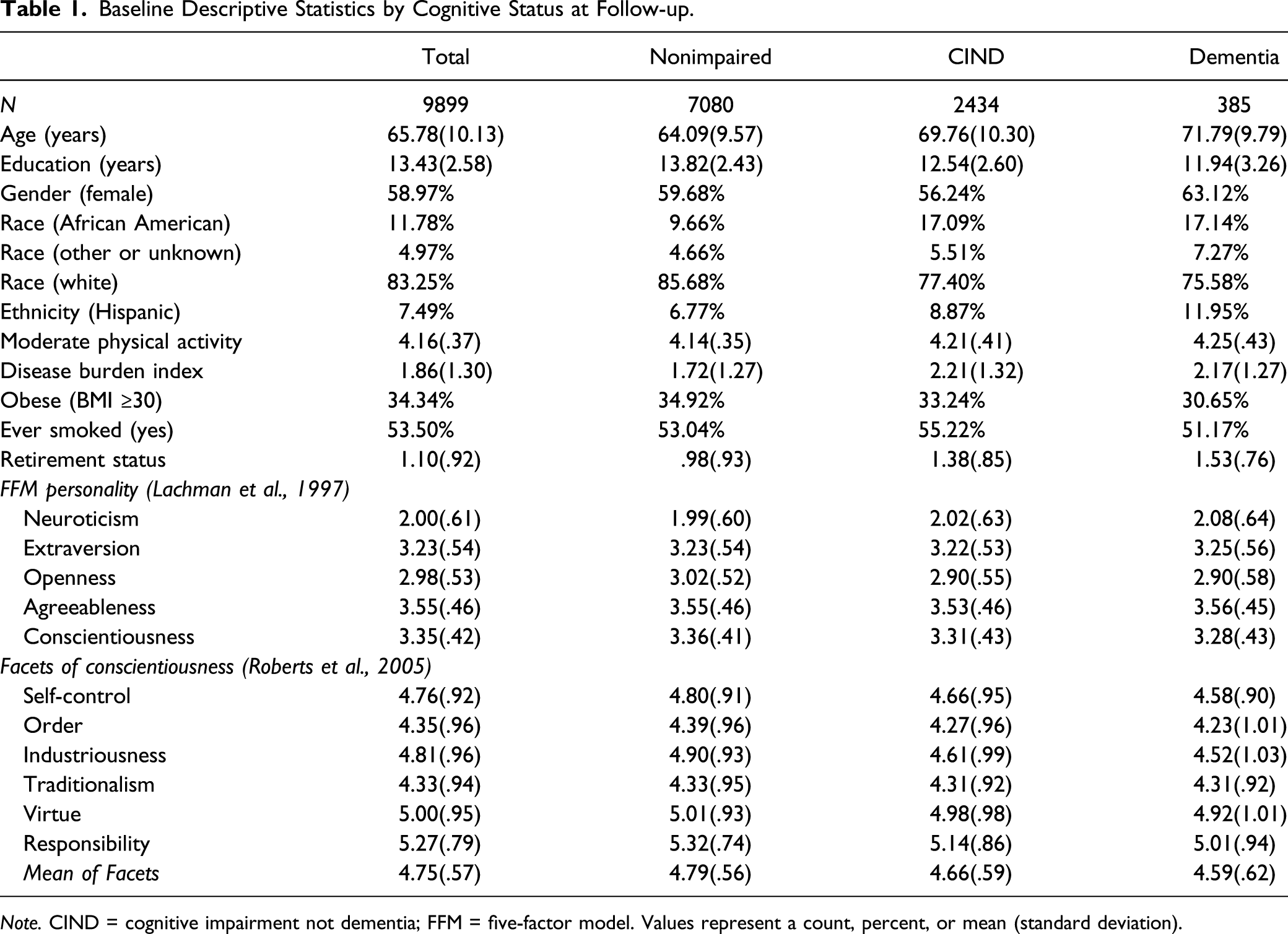
Note. CIND = cognitive impairment not dementia; FFM = five-factor model. Values represent a count, percent, or mean (standard deviation).
Measures
FFM personality
Participants completed the Midlife Development Inventory (Lachman et al., 1997), a 26-item measure of FFM personality traits. Neuroticism was assessed with four items (“nervous,” “moody,” “worrying,” or “calm”), extraversion with five items (“outgoing,” “lively,” “friendly,” “active,” or “talkative”), openness with seven items (“creative,” “curious,” “broad minded,” “sophisticated,” “imaginative,” “intelligent,” or “adventurous”), agreeableness with five items (“helpful,” “warm,” “caring,” “softhearted,” or “sympathetic”), and conscientiousness with five items (“organized,” “hardworking,” “thorough,” “responsible,” “careless”). Participants indicated how much each item described them from 1 (a lot) to 4 (not at all). Items were reverse scored when necessary, and the mean taken was in the direction of the trait label.
Facets of conscientiousness
Participants completed a 24-item measure of six facets of conscientiousness (Roberts et al., 2005). Four items measured each of six facets: self-control (e.g., “I rarely jump into something without first thinking about it”), order (e.g., “I hardly ever lose or misplace things”), industriousness (e.g., “I have high standards and work toward them”), traditionalism (e.g., “I support long-established rules and traditions”), virtue (e.g., “If the cashier forgot to charge me for an item, I would tell him/her”), and responsibility (e.g., “I carry out my obligations to the best of my ability”). Participants rated each item on a scale from 1 (strongly disagree) to 6 (strongly agree). Items were reverse scored when necessary, and the mean was taken in the direction of the facet label.
Retirement status
Participants reported their retirement status at baseline as “not retired at all,” “partly retired,” or “completely retired,” which we coded as 0, 1, and 2, respectively. Participants could also respond that the question was not relevant to them because they had never worked for pay; these participants (n = 616) were not included in the present analyses.
Cognitive status
Participants completed the modified telephone interview for cognitive status (TICSm; Crimmins et al., 2011) every 2 years. The total TICSm score is the sum of performance on the three cognitive tasks: immediate and delayed recall of 10 words (range 0–20 points), serial 7 subtraction (range 0–5 points), and backward counting (range 0–2 points). The total possible score is 27 points: participants who scored 12–27 were classified as cognitively normal, participants who scored 7–11 were classified in the CIND group, and participants who scored 0–6 were classified in the dementia group. These cutoffs have been validated previously against a comprehensive neuropsychological assessment and clinical diagnosis of dementia (Crimmins et al., 2011; Langa et al., 2005). Further, the TICSm in the HRS has been used to track national trends in dementia (Langa et al., 2017).
Covariates
Analyses controlled for four health status variables assessed at baseline: obesity (body mass index ≥ 30), ever smoked (yes/no), frequency of moderate physical activity (from 1 = “hardly ever or never” to 4 = “more than once a week”), and a composite index of disease burden (sum of seven self-reported physician diagnoses [yes = 1 and no = 0]: hypertension, diabetes, cancer, lung disease, heart condition, stroke, and arthritis). Analyses also controlled for year of baseline assessment and five sociodemographic covariates: age, sex, race (white, African American, other, or unknown), ethnicity (Hispanic and non-Hispanic), and years of education.
Statistical Approach
First, we examined whether retirement status moderated the relation between personality and risk of dementia or CIND using Cox proportional hazards regression models. We examined whether retirement status interacted with each of the five FFM personality traits and six conscientiousness facets, controlling for the covariates. All predictors were standardized before being entered. Time was coded in years from baseline to incidence of dementia or CIND. For participants who did not develop impairment, cases were censored at the last available cognitive assessment at which the participant did not score in the dementia or CIND range, respectively.
Second, we examined whether retirement status mediated the relation between personality and risk of dementia or CIND. We modeled the mediation analysis in Mplus (Muthén & Muthén, 2017) with the Monte Carlo method and 100 integration points. All effects in the mediation model controlled for the covariates. All predictors were standardized before being entered. Time to dementia or CIND was coded and censored using the same method as in the previous moderation analysis.
Results
Moderation
Dementia
Moderation: Interaction of Personality Traits and Retirement Predicting Dementia Risk.

Note. Values represent standardized hazard ratios [95% confidence interval], p-value. Models control for demographic covariates and health status at baseline. Bolded values are statistically significant α = .05.
Also similar to a previous analysis of HRS data (Sutin et al., 2018), participants who scored higher on most of the facets of conscientiousness were also at significantly lower risk of dementia (Table 2): self-control (19% lower per SD), order (15% lower per SD), industriousness (18% lower per SD), traditionalism (12% lower per SD), and responsibility (22% lower per SD). The facet of virtue was not significantly related to dementia risk. Additionally, the overall mean of the six facets was associated with significantly lower risk of dementia (25% lower per SD). Controlling for the facets of conscientiousness, retirement was associated with significantly increased risk of developing dementia, and retirement status significantly moderated the association for the self-control and industriousness facets. Post hoc analyses revealed that higher self-control was significantly associated with lower risk of dementia in participants who were not retired at baseline (HR = .71[.58, .86], p < .001) but was not significant for those who were completely retired (HR = .91[.81, 1.03], p = .13). Similarly, higher industriousness was significantly associated with lower risk of dementia in participants who were not retired at baseline (HR = .70[.57, .86], p < .001) but was not significant for those who were completely retired (HR = .93[.83, 1.05], p = .23).
CIND
Moderation: Interaction of Personality Traits and Retirement Predicting CIND Risk.
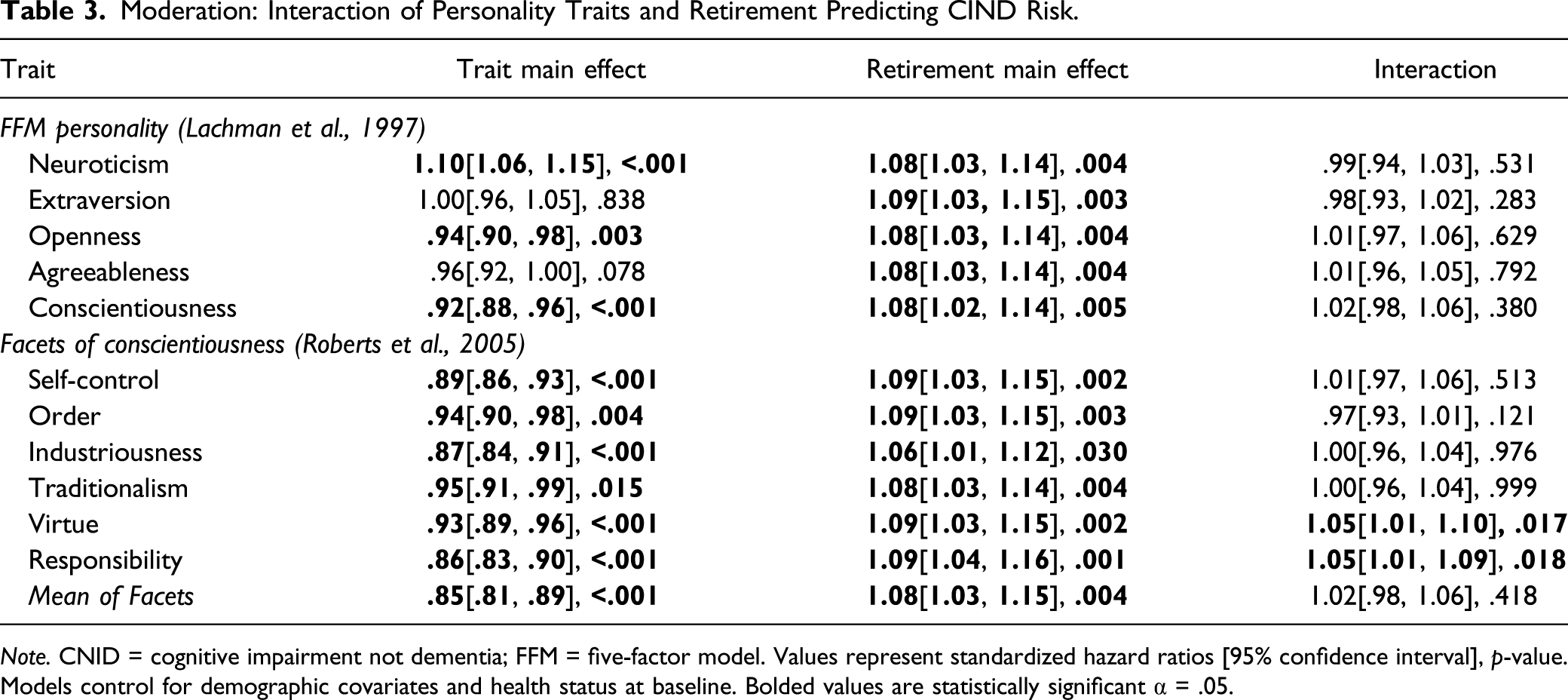
Note. CNID = cognitive impairment not dementia; FFM = five-factor model. Values represent standardized hazard ratios [95% confidence interval], p-value. Models control for demographic covariates and health status at baseline. Bolded values are statistically significant α = .05.
Participants who scored higher on any of the facets of conscientiousness were also at significantly lower risk of CIND (Table 3): self-control (11% lower per SD), order (6% lower per SD), industriousness (13% lower per SD), traditionalism (5% lower per SD), virtue (7% lower per SD), and responsibility (14% lower per SD). Additionally, the overall mean of the six facets was associated with significantly lower risk of CIND (15% lower per SD). Controlling for the facets of conscientiousness, retirement was associated with significantly increased risk of CIND, and retirement status significantly moderated the association for the virtue and responsibility facets. Post hoc analyses revealed that higher virtue was significantly associated with lower risk of CIND in participants who were not retired at baseline (HR = .87[.81, .94], p < .001) but was not significant for those who were completely retired (HR = .97[.93, 1.02], p = .29). Higher responsibility was more strongly associated with lower risk of CIND in participants who were not retired at baseline (HR = .82[.76, .87], p < .001) than participants who were completely retired (HR = .90[.86, .95], p < .001) but the association was significant in both cases.
Mediation
Dementia
Mediation: Personality Traits Predicting Risk of Dementia through Retirement Status.

Note. “A Effect” values represent standardized regression coefficients [95% confidence interval], p-value. “B Effect” and “Indirect Effect” values represent standardized hazard ratios [95% CI], p-value. Models control for demographic covariates and health status at baseline. Bolded values are statistically significant α = .05.
CIND
Mediation: Personality Traits Predicting Risk of CIND through Retirement Status.

Note. CIND = cognitive impairment not dementia; FFM = five-factor model. “A Effect” values represent standardized regression coefficients [95% confidence interval], p-value. “B Effect” and “Indirect Effect” values represent standardized hazard ratios [95% CI], p-value. Models control for demographic covariates and health status at baseline. Bolded values are statistically significant α = .05.
Discussion
The present research sought to examine the dynamics between personality and retirement on risk of both severe and moderate cognitive impairment. Similar to prior studies (e.g., Terracciano et al., 2014), including our prior work with shorter follow-up in the HRS (Sutin et al., 2018; Terracciano et al., 2017), we found that people who were lower on overall conscientiousness or its facets or higher on neuroticism were at greater risk of both dementia and CIND. Also, similar to prior work on other samples (e.g., Meng et al., 2017), we found that people who were retired were at greater risk of cognitive impairment. Contrary to our predictions, there was only sporadic evidence that the retirement status moderated the association between personality and dementia or CIND, and the very few significant moderations were in the opposite direction than we had hypothesized. In contrast, the mediation results supported our hypotheses that higher conscientiousness would be associated with lower risk of CIND indirectly via retirement, and there was a marginally significant indirect effect on conscientiousness and dementia. Higher extraversion and openness also had an identical pattern of indirect effects. It is important to note, however, that all of the indirect effects were very small and, despite their statistical significance, suggest that factors other than retirement explain the association between personality and risk of cognitive impairment.
Personality traits, particularly neuroticism and conscientiousness, are associated consistently with risk of cognitive impairment (Terracciano et al., 2014, 2017). Less is known, however, about the mechanisms of this association. Models of personality and health (e.g., Shanahan et al., 2014) identify life events as important mechanisms in the pathway from personality to health outcomes. Retirement is a major life event that has both positive and negative consequences for health (Bamia et al., 2008; Moon et al., 2012), including increased risk of cognitive impairment (Fonseca et al., 2017; Meng et al., 2017). Previous research has also linked personality to retirement (Hudomiet et al., 2018; Löckenhoff et al., 2009). As such, there is evidence for each segment of the model for retirement to mediate personality and cognitive impairment. And yet, there was only very modest evidence of mediation that ultimately indicated that retirement was not a major factor in explaining the relation between personality and cognitive impairment.
There was likewise no consistent evidence that the relation between personality and cognitive impairment was moderated by retirement status. Prior research found that the association between personality and subjective well-being was moderated by retirement, such that the associations were stronger after retirement (Henning et al., 2017; Kesavayuth et al., 2016). Thus, it was possible that a similar moderation would be found for cognitive impairment. However, in general, we instead found that the associations between personality and cognitive impairment remained consistent, regardless of retirement status. These findings suggest that previous research on personality and cognitive impairment among people who are retired should generalize to people who are not retired and vice versa.
There was clear evidence in this study that retirement was associated with increased risk of cognitive impairment, controlling for age and health status. These results agree with previous research demonstrating a link between early retirement and declines in cognitive functioning (Fonseca et al., 2017; Meng et al., 2017). There is some evidence from prior work that the negative impact of retirement on cognition may be reduced among people who are able to maintain strong social networks (Börsch-Supan & Schuth, 2013). However, the current study found the association between retirement and cognitive impairment was not reduced among people higher in extraversion, agreeableness, or any other traits, suggesting that the ability to maintain strong social networks in retirement may depend on factors other than individual personality.
In summary, contrary to our hypotheses based on prior research, this study found little evidence that retirement either mediated or moderated the association between personality and risk of either moderate or severe cognitive impairment. There are several potential explanations for these unexpected results. For example, regarding the mediation, previous research demonstrated that personality is associated with early retirement (Hudomiet et al., 2018; Löckenhoff et al., 2009), and early retirement is associated with risk of cognitive impairment (Fonseca et al., 2017; Meng et al., 2017), suggesting the possibility of mediation. However, in the present study, although we replicated some of those associations, the individual effect sizes were smaller than expected, and the combined indirect effects via retirement were so small as to be trivial. The reduction in effect size compared to similar previous studies might be due to differences in the samples, the measures, or perhaps the control variables. The present study was able to control for age, sex, race, ethnicity, education, and health status, but some of the previous studies were not able to control for all of these important covariates.
Regarding the moderation, previous research demonstrated that retirement moderates the association between personality and subjective well-being (Henning et al., 2017; Kesavayuth et al., 2016). However, the present study did not find a similar moderation on cognitive impairment; personality and retirement simply had independent associations. On the one hand, this result may be just due to differences in the outcomes. Subjective well-being is a self-reported composite variable that draws on many different socio-emotional aspects, while our measure of cognitive impairment was an objective assessment of task performance. Thus, subjective well-being may be more sensitive to the influence of complex interactions between predictors like personality and retirement. On the other hand, it is possible that the moderating relationships with cognitive impairment are more complicated than the models we tested. For example, retirement may simultaneously increase and decrease the association between personality and dementia via different mechanisms. The less organized and less restricted environment of retirement may leave space for personality traits to have a greater influence on cognitive impairment, as we predicted based on prior research on subjective well-being (Henning et al., 2017; Kesavayuth et al., 2016). However, retirement may simultaneously reduce the daily stresses and anxiety associated with work, decreasing the negative impact of high neuroticism, and may remove the motivation to maintain physical and cognitive abilities at a competitive level, decreasing the positive impact of high conscientiousness. If the effects of retirement in each direction are similar in size, then we would not be able to observe an overall moderating effect of retirement on the association between personality and cognitive impairment. Future research will be needed to determine whether there are more complex aspects to this person by environment interaction.
Our hypotheses were mostly based on the small amount of prior research on the interplay between personality and retirement. Research on lifespan models of personality, however, has also identified a number of other significant life events that mediate or moderate the associations between personality and important health outcomes. For example, experiencing divorce partially mediates the association between low conscientiousness or high neuroticism and mortality (Kern et al., 2014), and experiencing career success reduces the association between low conscientiousness and mortality (Kern et al., 2009). This adjacent research further bolstered our hypotheses that retirement would play a role in the association between personality and health outcomes because retirement is similarly a very significant life event. One widely used scale that quantifies the relative influence of life events on health (Holmes & Rahe, 1967) places divorce at 73 units, retirement at 45 units, and career success might be represented as a major improvement in financial state (38 units), a promotion (29 units), or an outstanding personal achievement (28 units). Nevertheless, unlike prior research on other significant life events, the present research did not find substantial mediating or moderating associations between personality and retirement for this health outcome. Further research on lifespan models of personality is needed to understand why some significant life events interact with personality to predict health outcomes, while other life events do not.
Strengths
These analyses utilized a large number of participants from a well-defined nationally representative longitudinal sample to conduct a novel analysis of individual and situational risk factors predicting a serious health outcome that has been rapidly increasing in prevalence. We examined relations for a wide array of personality predictors including the broad FFM traits and more specific facets of conscientiousness. The outcome measure of cognitive status has been repeatedly validated (Crimmins et al., 2011; Langa et al., 2005) and is commonly used to track national trends (Langa et al., 2017). Furthermore, our analyses examined up to 10 years of follow-up data on cognition, providing a relatively long-term perspective on changes in cognitive status over time. Additionally, we conducted analyses examining the associations separately for severe and moderate cognitive impairment, allowing a comparison of similarities and differences in the results. Finally, we examined separate possibilities for both moderating and mediating associations between personality and retirement to provide a more complete picture of how they might work together influencing risk of dementia and cognitive impairment.
Limitations
The measures of personality traits used in these analyses were self-reported. Observer ratings of personality have been found to predict important outcomes beyond self-report (Jackson et al., 2015) and thus would be worthwhile to test in future work. The models controlled for several potentially confounding health status variables, but it is possible that other unmeasured aspects of health influence the associations. The sample used in this study is focused on American adults of 50 years or older; therefore, the associations found in these analyses may not reflect associations in other countries.
Conclusion
Overall, these analyses demonstrate that personality and retirement each have strong, independent associations with risk of both dementia and cognitive impairment. The association between personality and cognitive impairment was not substantially moderated or mediated by retirement status. Despite the unexpected results, these findings are important because they indicate that personality and retirement can be treated as independent factors when interpreting past research and conducting future research. Research on the association between personality and cognitive impairment is relevant, regardless of retirement status, and research on retirement and cognitive impairment is relevant, regardless of personality. Furthermore, interventions to reduce the risk of cognitive impairment can freely target personality, retirement, or both without worrying about problematic interactions between the factors. Overall, these results provide valuable additional information that will help to better understand the mechanisms that do and do not lead to cognitive impairment. Ultimately, this work may contribute to making more accurate predictions of individuals’ risk of dementia and cognitive impairment and help to identify where to intervene for the healthiest cognitive outcomes.
Supplemental Material
Pers_and_Ret_Supplement_JAH2 – Supplemental Material for Personality, Retirement, and Cognitive Impairment: Moderating and Mediating Associations
Supplemental Material, Pers_and_Ret_Supplement_JAH2 for Personality, Retirement, and Cognitive Impairment: Moderating and Mediating Associations by Jason E. Strickhouser and Angelina R. Sutin in Journal of Aging and Health
Footnotes
Declaration of Conflicting Interests
The authors declared no potential conflicts of interest with respect to the research, authorship, and/or publication of this article.
Funding
The authors disclosed receipt of the following financial support for the research, authorship, and/or publication of this article: Preparation of this manuscript was supported by Grant R01AG053297 from the National Institute on Aging of the National Institutes of Health. The content is solely the responsibility of the authors and does not necessarily represent the official views of the National Institutes of Health.

Supplemental Material
Supplemental material for this article is available online.
References
Supplementary Material
Please find the following supplemental material available below.
For Open Access articles published under a Creative Commons License, all supplemental material carries the same license as the article it is associated with.
For non-Open Access articles published, all supplemental material carries a non-exclusive license, and permission requests for re-use of supplemental material or any part of supplemental material shall be sent directly to the copyright owner as specified in the copyright notice associated with the article.
