



Abstract
Objective
Scant research has focused on the role of sociohistorical changes in shaping intersecting early-life selection mechanisms and their impacts on racially stratified effects of education on health across cohorts.
Method
Drawing from the Health and Retirement Survey, this study fitted negative binomial regression models to assess the impacts of childhood socioeconomic status (SES) on the relationship between education and functional limitations for Black and White adults across birth cohorts (n = 16,269, born 1931–1959).
Results
The disparities between Black adults and White adults in impacts of childhood SES on both education and functional limitations were more pronounced in recent cohorts. The racial stratification in the impacts of education on functional limitations was documented across cohorts. However, after adjusting for childhood SES, this stratification narrowed considerably in recent cohorts.
Discussion
This study underscores the role of a sociohistorical context in shaping the effects of education on health at the intersection of race and cohort.
Introduction
Research documents the differential return of education on health by racial status, suggesting the impacts of unequal material conditions. With a few exceptions (e.g., Barnes et al., 2011; Ostrove et al., 1999), a growing number of studies have established racial stratification in the education-health gradient. Using both regional (e.g., Turner et al., 2017) and national data (e.g., Holmes & Zajacova, 2014), these studies have documented that education has a lesser impact on self-rated health, chronic diseases, body mass index, and activity limitations for Black Americans than White Americans (Assari, 2020; Braveman et al., 2010; Cummings & Jackson, 2008; Farmer & Ferraro, 2005). However, little attention has been paid to the role of intersecting early-life selection mechanisms (i.e., selection bias or confounding bias introduced by observed common causes such as childhood socioeconomic status (SES) that impact both educational attainment and health) in constituting racial stratification in the effects of education on later-life health. Scholarship on sociohistorical changes in intersecting early-life selection mechanisms and their contribution to racially stratified education-based inequalities in later-life health is virtually nonexistent. This study examines the contribution of childhood SES to racially stratified education-based inequalities in later-life functional limitations by situating them in a sociohistorical context.
This study is especially pertinent in the context of historical changes in race relations in the United States during the 20th century. Two major developments contributed to the transformation of racial stratification in schooling and employment that existed in the Jim Crow Era. First was Brown v. Board of Education in 1954, which outlawed racial segregation in the nation’s schools. The second was the passage of the Civil Rights Act in 1964. These reforms, monumental achievements of the Civil Rights Movement, heralded a significant shift in the organization of society, offering Black Americans greater economic opportunities and legal protections in areas such as schooling and the labor market (Jaynes, 1990; Smith & Welch, 1989). These historical changes likely impacted the relationship of early-life SES with both education and later-life health. Indeed, existing research suggests that expanded opportunity structures (i.e., social and institutional mechanisms that facilitate access to various opportunities such as higher education and labor market) played a role in the weakening of the relationship between parental SES and educational attainment among Black adults in recent cohorts. As a result, the extent to which early-life selection mechanisms contribute to the racial stratification in the effects of education on later-life health is expected to differ across cohorts.
This study employs an inverse probability weight (IPW) approach to first examine differences in the effects of childhood SES on educational attainment across races and cohorts, and then to determine whether the contributions of those early-life selection mechanisms to the effects of education on functional limitations varies across cohorts for Black and White Americans. The IPW approach fits this study’s aims due to its explicit interest in examining selection mechanisms. This approach accounts for the impact of early-life selection mechanisms by calculating a propensity score, which can then be used to determine the degree of overlap in the distribution of childhood SES across educational groups (Austin, 2011). By focusing on functional limitations, this study highlights the critical role of an intermediate health stage on the continuum of impairment and disability (Nagi, 1976; Verbrugge & Jette, 1994). Studies that examine education-based inequalities in later-life health by cohort have primarily considered health outcomes such as self-rated health, chronic diseases, disability, and mortality (Bhatta, 2021). More than 40% of non-institutionalized adults aged 65 and over in the United States report having some form of functional limitation or disability (Centers for Disease Control and Prevention, 2020). Functional limitations, which reflect the effects of both pathology and impairment, undermine older adults’ independence, reduce quality of life, increase disability, and serve as a strong predictor of mortality (Tomey & Sowers, 2009).
Racial Stratification in the Effects of Education on Health
Drawing inspiration from W. E. B. Du Bois’s (1899) influential book, The Philadelphia Negro: A Social Study, a considerable number of studies have examined the intersecting influences of racial and economic stratification on health (Farmer & Ferraro, 2005; Holmes & Zajacova, 2014; Turner et al., 2017). Consistent with Du Bois’s findings of higher death rates among Black Americans in neighborhoods with sanitation problems than their counterparts with better services (Williams & Sternthal, 2010), these studies have documented that higher levels of education offers health advantage for Black adults, including lower incidence of chronic disease and activity limitations. However, these “health returns” are lower for Black Americans than White Americans (Braveman et al., 2010; Colen, 2011; Turner et al., 2017). Contrarily, a few studies have observed greater benefits in physical function (Barnes et al., 2011) and measures of self-rated health (Ostrove et al., 1999) at higher levels of education for Black Americans than White Americans. Nonetheless, overall, the literature supports the “diminished gain” perspective, which asserts that Black Americans consistently receive lower health returns from socioeconomic resources than White Americans (Assari, 2018).
Recent studies have used the intersectionality framework to offer theoretical explanations for racial stratification in the effects of education on later-life health (Brown et al., 2016; Harari & Lee, 2021). Coined by Kimberlé Crenshaw, the term intersectionality refers to interconnectedness and interdependence between various social categories (e.g., race, class, sexuality, and gender) embedded in and shaped by interlocking systems of oppression and domination (Collins, 1993; Crenshaw, 1990). Social categories not only represent characteristics of the individual (e.g., identities) but also reflect “the social context inhabited by those individuals (i.e., social structures, institutions, and interpersonal interactions)” (Else-Quest & Hyde, 2016). Social differences (e.g., disparities in education and health) are constituted within a context of multiple interactive processes (e.g., racialization) and systems (e.g., racism, capitalism) that affords intersecting social groups (e.g., Black adults with college education) varying level of structural dis/advantages (Ailshire & House, 2011; Dhamoon & Hankivsky, 2011). Drawing from the life course framework, intersectional quantitative studies on later-life health disparities have also focused on the intersection of race with different life course SES statuses. Findings generally reflected diminished gain for Black adults with respect to health outcomes such as self-rated health and cardiovascular disease (Brown et al., 2016; Hargrove & Brown, 2015; Walsemann et al., 2016).
A crucial limitation of all of these studies is that they do not account for early-life selection mechanisms. Studies that employ the intersectional life-course framework have largely overlooked the interrelatedness of SES across early childhood, adolescence, and mid and late adulthood. Existing attempts to recognize this relationship over the life course have mainly aimed to explain racial/ethnic disparities in later-life health (Richardson & Brown, 2016; Walsemann et al., 2016). However, these studies have not used an intersectional lens (Harari & Lee, 2021). Nor have they addressed the impact of sociohistorical changes and their contribution to intersecting effects of racial status and education on later-life health in different cohorts. Given that the “multiple axes of differentiation (e.g., racial, economic) intersect in historically specific contexts” (Brah & Phoenix, 2004), the significance of intersecting social categories for educational attainment and subsequently for health are likely to differ across historical contexts, due, for example, to the developments of the Civil Rights era (Else-Quest & Hyde, 2016; Hulko, 2009).
Cohort Changes in Intersecting Early-Life Selection Mechanisms
Opportunity structures in schooling for Black Americans underwent profound changes during the 20th century. Prior to 1954, Black Americans—regardless of their social class—only had access to drastically underfunded segregated schools (Goldin, 1999). Black colleges were severely underfunded and what are now known as predominantly White institutions were largely closed to Black students (Turner & Bound, 2003). These structural disadvantages impeded Black Americans from reaping the benefits White Americans enjoyed from institutional reforms such as compulsory schooling, child labor laws, measures that made free public high school (HS) available nationwide and ultimately compulsory, and college education access under the 1944 G.I. Bill (Bound & Turner, 2002).
In addition to Brown and the Civil Rights Act, the Higher Education Act (HEA) of 1965 developed financial mechanisms (e.g., grants and loans) to support students from economically disadvantaged groups, including Black Americans, as well as women. The Civil Rights Act also ushered in significant labor market reforms to bar racial discrimination in employment. The establishment of the Equal Employment Opportunity Commission led to the intensification of efforts to enforce anti-discrimination policies in the 1960s and the 1970s. Notwithstanding significant political backlash (e.g., growing opposition to anti-discrimination and equal opportunity efforts and weakening of financial aid mechanisms established by the HEA during the 1980s), these institutional reforms significantly expanded schooling and economic opportunities for Black Americans (Bloome & Western, 2011).
Expanded opportunity structures in schooling may have an effect on early-life selection mechanisms. With respect to educational attainment, the effect of parental SES (e.g., parental education and income) is stronger for White Americans than Black Americans (Bloome & Western, 2011; Long et al., 2012). Recent studies across cohorts indicate that this difference remains. However, the effects of parents’ SES are even weaker for Black Americans in recent cohorts, while they have remained stable for White Americans (Bloome & Western, 2011; Long et al., 2012). With respect to health, research has not addressed differences across cohorts (Haas et al., 2017). Previous research indicates that childhood SES has a weaker effect on health for Black adults than for White adults as well, however (Richardson & Brown, 2016). A few recent studies that do not explore intersections with race have yielded inconsistent findings. For example, Masters (2018) documented a decline in the negative effects of in-utero exposure to adverse SES conditions on mortality in recent cohorts. In contrast, a recent study on functional limitations showed an increase in negative effects of adverse early-life SES across cohorts (Bhatta, 2021). These studies, while limited in their insight about race, show the possibility of cohort-based changes in early-life selection mechanisms for Black and White adults.
Contributions of This Study
The lack of scholarly attention to intersecting early-life selection mechanisms in the context of sociohistorical changes in racialized opportunity structures pertaining to schooling has precluded a comprehensive understanding of racially stratified life-course processes that shape effects of education on later-life health across birth cohorts. Cohort members face particular sociohistorical experiences (e.g., the Great Depression) at a similar point in their life course (Dannefer, 1987). This context shapes the effect of unequal material circumstances (as represented by the intersections of various social categories) on later-life health in a unique way. Therefore, the effects of intersecting life course processes on health in later-life are likely to be cohort-specific (Ang, 2019). This study synthesizes the theoretical assumptions of intersectionality, life course, and cohort differentiation frameworks to assess the potential impact of sociohistorical changes on intersecting life-course processes that contribute to racially stratified effects of education on health. Since the introduction of cohort analysis by Ryder (1965) and its elaboration by Riley (1973), this framework has relied on birth cohorts to interpret differences in education-based inequalities in health across cohorts as a direct reflection of sociohistorical changes (Lynch, 2003).
Previous studies have synthesized the cohort-specific differentiation framework with the fundamental cause of disease theory to examine cohort changes in education-based inequalities in health (Clouston & Link, 2021). The fundamental cause of disease theory is based on the recognition that educational attainment is a fundamental cause of disease because better-educated individuals benefit from material advantages in terms of employment and knowledge of and access to health care (Link & Phelan, 1995; Mirowsky & Ross, 2003). Individuals with a higher level of education are better positioned to achieve reduced functional limitations due to the advantages afforded by potentially interrelated material, behavioral, and psychological resources. Cohort studies that do not adjust for early-life selection mechanisms show weaker effects of education on health outcomes such as self-rated health and mortality for Black Americans than White Americans, but find an increase in education-based inequalities in health across cohorts for both racial groups (Liu & Hummer, 2008; Masters et al., 2012; Zajacova & Hummer, 2009). These findings reflect health impacts of starkly different material conditions for Black Americans (e.g., lack of good quality education and health care, an unfair justice system) than White Americans regardless of their SES. The legacy of unfair housing policies such as redlining continues to this day in the form of the massive wealth inequality between Black and White Americans (Massey, 2007; Oliver & Shapiro, 2006). The residential segregation that has remained strikingly stable since 1940 has significant material consequences in terms of wealth and health for Black Americans of all social classes (Massey, 2007; Williams, 1999). A growing wage gap by education following deindustrialization processes that accelerated in the 1970s and 1980s has also had devastating health consequences (Bluestone & Harrison, 1986).
Despite our understanding of race and cohort-specific patterns of education-based inequalities in health, little is known about the role of sociohistorical changes in intersecting early-life selection mechanisms in generating such health inequalities across cohorts (Bhatta, 2021). Although it lacks information about racial differences, a few studies have indicated that early-life selection mechanisms are significant by documenting a substantial decline in education-based inequalities in functional limitations (Bhatta, 2021) and mortality in recent cohorts (Dowd & Hamoudi, 2014; Hendi, 2015) after childhood SES influences were adjusted. On the other hand, as in previous research (Lynch, 2003), these studies showed that education-based inequalities in health and mortality have increased across cohorts. Given the weaker effects of childhood SES on education and functional limitations for Black adults, it is plausible that the contribution of these aspects to the effects of education on functional limitations is likely to be less for Black adults than White adults. In effect, when early-life selection mechanisms are considered, racial disparities in the effects of education on functional limitations are likely to narrow. Additionally, existing research indicates that the effect of childhood SES on education has weakened in recent cohorts of Black adults, potentially further diminishing impact on the relationship between education and functional limitations.
However, the effects of childhood SES on education and functional limitations are steady or have increased across cohorts of the population overall (Bhatta, 2021). This may reflect an increased impact among White adults. In this case, the extent to which early-life SES contributes to the effects of education on functional limitations is likely to be greater for White adults, and thus to contribute more to explaining the racial stratification in such effects in recent cohorts than in earlier cohorts.
Research Questions
This study offers a novel scholarly contribution by shining light on the relationship between intersecting early-life selection mechanisms and racially stratified education-based inequalities in later-life functional limitations across cohorts. Guided by the conceptual model shown in Figure 1, this study investigates the relationship between childhood SES and education as well as the relationship between childhood SES and functional limitations. It then determines whether these relationships—i.e., early-life SES-induced selection bias—differ across racial groups and cohorts. I then examine whether there are differences in the relationship between educational attainment and functional limitations across racial groups and cohorts without taking into account the influence of childhood SES. Finally, I evaluate whether early-life selection bias contributes to racial stratification in the effect of education on functional limitations across cohorts. Conceptual model representing the relationship between race, childhood socioeconomic status, educational attainment, and functional limitations.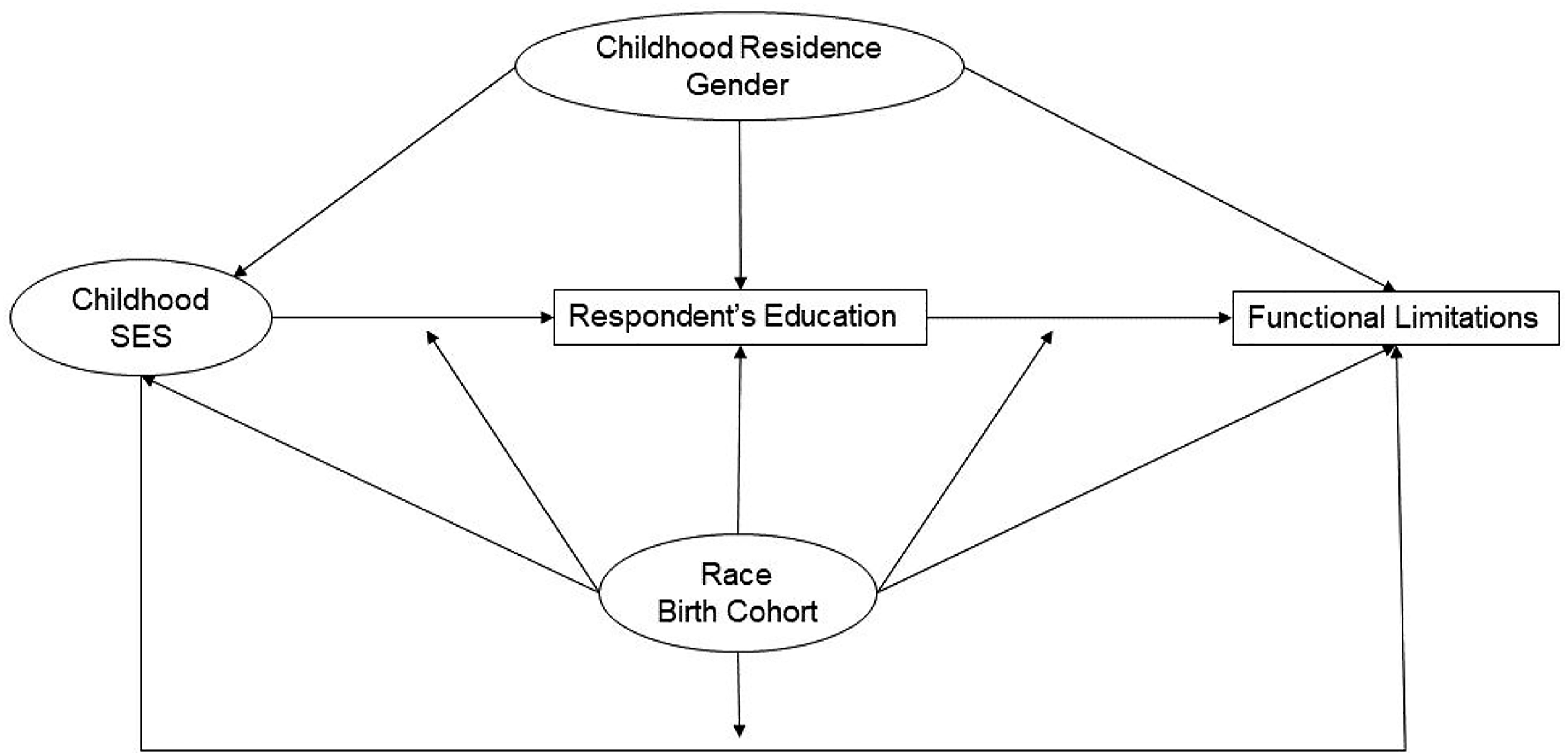
Specifically, I address the following three research questions: (1) Do the effects of childhood SES on educational attainment and functional limitations vary between Black and White Americans across cohorts? (2) Does the unadjusted effect of education on functional limitations differ between Black and White Americans across cohorts? (3) Does the effect of education on functional limitations (i.e., the total association between education and functional limitations) differ between Black and White Americans, and does this racial stratification vary across cohorts (e.g., intersection of education, race, and birth cohort), even after adjusting for the confounding effects of childhood SES?
Data and Methods
Data for this study were obtained from the Health and Retirement Survey (HRS), which was conducted to identify the determinants and consequences of retirement among individuals over 50 years of age (Heeringa & Connor, 1995). The HRS has been collecting extensive information about the health and functioning of older adults every 2 years since 1992 (The University of Michigan, 2008; Juster & Suzman, 1995). The HRS adopts a multistage area sampling design to draw eligible, community-dwelling adults; however, follow-up interviews are also conducted with respondents who are later institutionalized. This survey employs an unequal probability sampling approach to oversample Black and Hispanic adults, which helps secure their adequate representation in the sample (Heeringa & Connor, 1995). The present study is based on baseline data and uses the core public-use file from the University of Michigan’s Survey Research Center and the RAND HRS (V1) file. It does not include individuals born outside of the United States or those identifying as Hispanic. Because the objective of this study was not to conduct couple- or household-level analysis, spouses of age-eligible respondents who were selected in the survey regardless of their cohort eligibility were also not included (The University of Michigan, 2008).
Each of four birth cohorts (see the Supplementary Appendix) utilized in this study were introduced at a different point in time: the HRS cohort (born 1931–1941), first surveyed in 1992; the war baby (WB) cohort (born 1942–1947), first surveyed in 1998; the early baby boomer (EBB) cohort (born 1948–1953), first surveyed in 2004; and the mid baby boomer (MBB) cohort (born 1954–1959), first surveyed in 2010. Given that the survey began collecting data on childhood SES in 1998, we used that year as the HRS cohort’s baseline.
Measures
Functional Limitations
Functional limitations were measured using nine tasks (e.g., walking several blocks, getting up from a chair, climbing several flights of stairs) administered to capture aspects of physical functioning (see Table S2 in the Supplementary Appendix). This study’s focus on functional limitations stems from the recognition that they are considered to be less susceptible to role expectations and environmental changes (Freedman & Martin, 1998) than are activities of daily living (ADL) and instrumental activities of daily living (IADL). Men, for example, are more likely than women not to engage in IADLs (e.g., preparing meals) for non-health reasons. This is likely due to gendered expectations around household activities (Sheehan & Tucker-Drob, 2017). Gender expectations regarding domestic labor have shifted across cohorts. Thus, cohort changes in IADLs may reflect not just changes in disability, but also in social roles, expectations, and the larger environment (Sheehan et al., 2019). Similarly, environmental modifications (e.g., the use of assistive devices such as grab bars and bath seats) may have an effect on ADLs such as bathing, resulting in a decrease in difficulty performing such activities despite the presence of the same or increased level of other health problems (Freedman et al., 2006). Responses to all nine tasks were summed for each individual to assess their physical functioning. I used three responses (e.g., No Difficulty = 0; Some Difficulty = 1; Cannot Do = (2) to retain more variation in physical functioning than a summative scale based on dichotomized responses (Long & Pavalko, 2004).
Education
Educational attainment was the key explanatory variable. I used four education categories based on respondents' highest level of formal education for descriptive and bivariate analyses: less than HS; HS or GED; some college; and bachelor’s degree or higher. In all of my regression-based analyses, I included the number of years of formal education completed (up to 17).
Conceptual Model and Confounders
The conceptual model illustrated in Figure 1 depicts the influences of a set of confounders (i.e., Childhood SES, Gender, Race, Birth Cohort, Rural Residence, and Region) on both educational attainment and functional limitations. The conceptual model excludes variables along the pathway from education to functional limitations (e.g., mediators such as respondent wealth or health behaviors). The purpose of this study is to determine whether the total effect of education on functional limitations has changed across race and cohorts. It does not aim to estimate the direct effect of education (i.e., the effect of education beyond a particular set of mediators) on functional limitations. The direct effect is dependent on the number of mediator variables used and may vary across cohorts due to the changing relationship between education and mediator variables (Bhatta et al., 2018).
Childhood SES
This study assessed early-life socioeconomic disadvantage using potentially related but conceptually distinct constructs such as financial capital and human capital during childhood (Vable et al., 2017) because of their likely impact on both education and later-life health. Childhood financial capital was measured by five items (e.g., father’s occupation, father unemployment status, family SES; see Table S3 in the Supplementary Appendix). I utilized confirmatory factor analysis with weighted least squares estimation to generate childhood financial capital score for each respondent (Vable et al., 2017). I used a reflective measurement model to summarize indices of childhood financial capital, as the causal relationship between them and financial capital was ambiguous. Although indicators such as father’s occupation and unemployment status may contribute to financial capital (i.e., have a common effect), others such as family relocation for financial reasons may reflect a lack of financial capital (i.e., a common cause). Given the substantial loadings on a single factor (see Table S3 in the Supplementary Appendix), it was determined that a reflective measurement model would represent a more appropriate summary of those indices. I combined indices of childhood human capital using a formative measurement model. Although parents' educational attainment may not be explained by a common cause, it is likely that their education has a shared effect (i.e., parental education leads to increased human capital). The human capital index was constructed by summing z-scores for father’s and mother’s years of completed education. I combined factor scores for childhood financial capital and z-scores for childhood human capital to create a childhood SES index.
Additional Confounders
Confounders such as place of residence at 10 years of age and region of residence at birth helped account for the potential influence of social context in shaping educational attainment and functional limitations. Respondents were asked “Were you living in a rural area most of the time when you were (in grade school/in HS/about age 10)” to elicit information about rural childhood residence. Their responses (yes/no) indicated whether they lived in rural areas (Rural=1, Non-rural=0) during childhood. Three binary indicators were used to account for the confounding influences of region of residence (Northeast, Midwest, West, and South), with the South serving as a reference category. I also accounted for the potential influence of race (non-Hispanic Black = 1, non-Hispanic White = 0) and gender (Female = 1, Male = 0) on both educational attainment and functional limitations.
Analytical Plan
This study’s statistical analyses proceeded in three stages. In the first two, I examined whether early-life selection mechanisms differed between Black and White adults, as well as whether such racial stratification varied across birth cohorts. This included comparing the effects of childhood SES on educational attainment and functional limitations among Black and White adults across cohorts. The third stage of statistical analyses included taking into account the influences of childhood SES in estimating the effects of education on functional limitations for Black and White adults across cohorts. At each stage, I conducted analyses separately for Black and White adults in each cohort. I then pooled samples from both racial groups in order to assess the statistical significance of racial stratification in the effect of childhood SES on education and functional limitations, as well as the effect of education on functional limitations in each cohort. I then pooled samples from all cohorts to determine whether such racial stratification varied significantly across cohorts.
In the first stage, I assessed whether the effects of childhood SES (i.e., represented by combined factor scores for financial capital and human capital) on educational attainment differ between Black and White Americans across cohorts. I utilized a selection model to calculate the propensity for each respondent to obtain higher years of education by using confounders specified in the conceptual model (see Figure 1). Specifically, I used an ordinary least squares (OLSs) regression to predict years of formal schooling based on a set of confounders (e.g., childhood SES), subsequently obtaining the conditional density of years of schooling using a normal probability density function (Robins et al., 2000). I chose to calculate stabilized weights because the variance of estimates derived from unstabilized weights becomes infinite when a treatment variable is continuous (e.g., years of education) (Robins et al., 2000). The stabilized IPWs for each respondent (wi) is estimated by using a ratio of two propensity scores.
wi =
I estimated the numerator for stabilized IPWs using an OLS regression model without any confounding variables (i.e., with only the intercept). The marginal density of each respondent’s years of education was then computed using a normal distribution with μ=intercept (β0) and σ2 =the variance of the residuals from the regression model fitted above. The denominator for stabilized IPWs was estimated using an OLS regression model that uses confounding variables to predict years of education. The conditional density of each respondent’s years of education is derived by using a normal distribution with μ= β0 + β*C and variance of residuals from the OLS regression model (Robins et al., 2000).
The weighing by IPWs creates a pseudopopulation in which a set of confounders no longer predicts educational attainment. The rationale behind the construction of IPW is to create education groups that are approximately identical with respect to childhood SES. Specifically, the IPWs help balance education groups in terms of early-life SES so that the effects of education on functional limitations for Black and White Americans within each cohort do not reflect influences of early-life selection mechanisms. Changes in the correlation between childhood SES and education between the unadjusted and adjusted samples (HRS cohort: from –0.40 to 0.13; WB cohort: from –0.42 to 0.18; EBB cohort: from –0.40 to 0.12; MBB cohort: from –0.38 to 0.27) show that there was a substantial balancing of childhood SES across education groups in each cohort.
In the second stage, I investigated whether the direct effects of childhood SES on functional limitations differ between Black and White Americans across cohorts. A negative binomial regression model was used to estimate the direct or residual effect of childhood SES on functional limitations. The negative binomial regression model helped address the over-dispersion observed in the distribution of functional limitations. The second stage of analysis is not directly relevant to remainder of my analyses. The aim of this stage of analysis is solely to examine another element of early-life selection mechanisms, as selection implies a confounder’s relationship with both exposure and outcome. In the final stage, I used negative binomial regression models to assess whether the effects of education on functional limitations differ between Black and White Americans across cohorts, without adjusting for IPWs. Subsequently, I examined the role of childhood SES in explaining racial stratification in the effects of education on functional limitations across cohorts. I estimated IPWs adjusted negative binomial regression models to assess the extent to which childhood SES contributes to the effects of education on functional limitations for Black and White adults across cohorts.
Results
Descriptive Statistics of Study Variables at Baseline.

Note. ***p < .001, **p < .01, *p < .05.
The Intersection of Early-Life Selection Mechanisms with Race and Cohorts
OLS Estimates Representing the Influence of Childhood Disadvantage on Educational Attainment.

Note. ***p < .001, **p < .01, *p < .05, ^Reference = South.
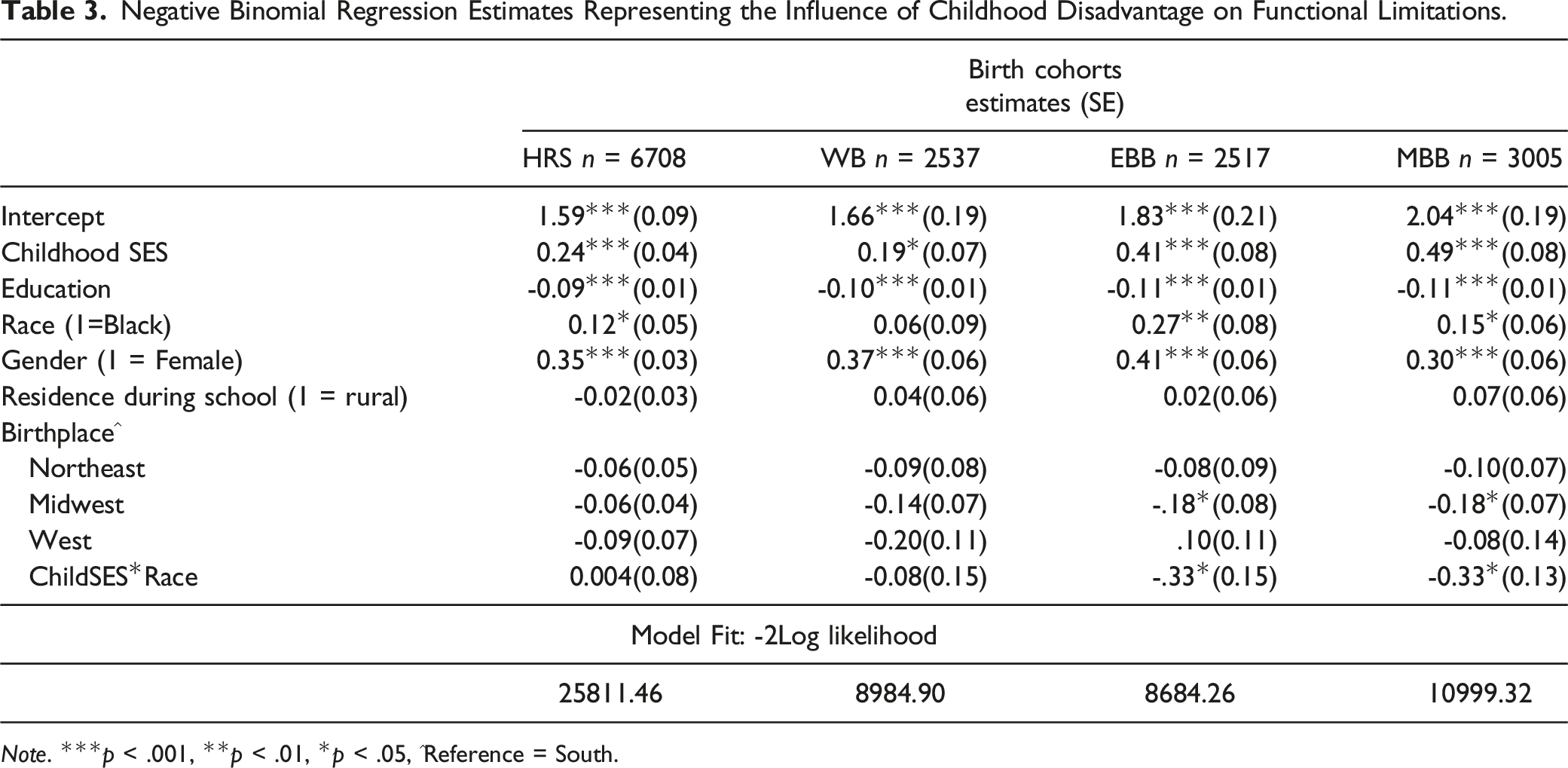
Negative Binomial Regression Estimates Representing the Influence of Childhood Disadvantage on Functional Limitations.
Note. ***p < .001, **p < .01, *p < .05, ^Reference = South.
The estimates from negative binomial regression models presented in Table 3 offer further evidence of the intersection of early-life selection mechanisms with race. The negative direct effects of adverse childhood SES on functional health were stronger for White adults than Black adults in the recent three cohorts, but such racial stratification was statistically significant only for EBB (
Intersecting Influences of Race and Education on Functional Limitations Across Cohorts
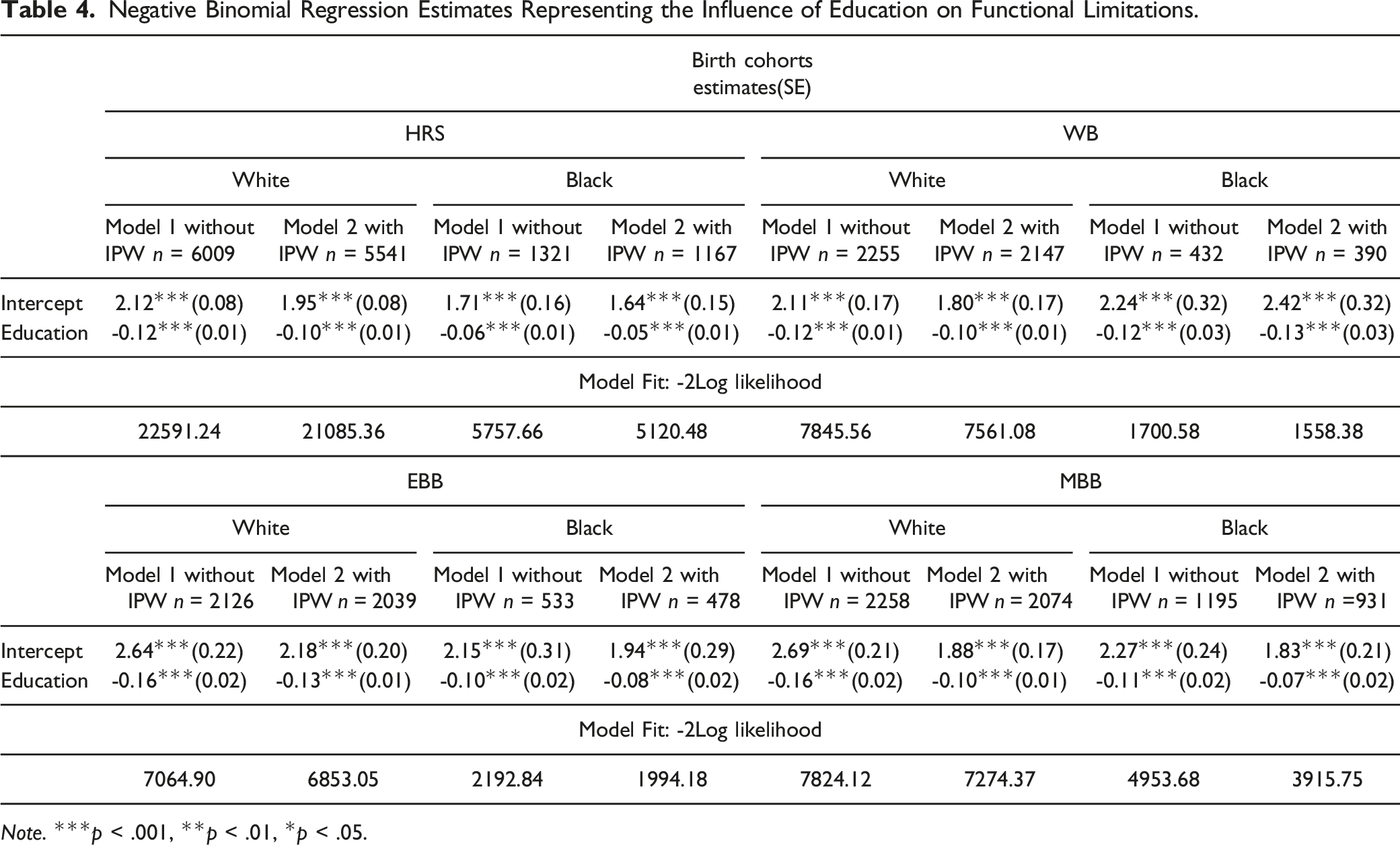
Negative Binomial Regression Estimates Representing the Influence of Education on Functional Limitations.
Note. ***p < .001, **p < .01, *p < .05.
The reduction in the effects of education on functional limitations was more pronounced in recent two cohorts. In the EBB cohort, adjusting for IPWs led the percentage decline in mean functional limitations with a 1-year increase in education to go down from 14.79% {[100(1 – exp (-0.16)], p < .001} for White adults and 9.24% {[100(1 – exp (0.097)], p < .001} for Black adults to 12.10% {[100(1 – exp (-0.129)], p < .001} and 7.60% {[100(1 – exp (0.079)], p < .01}. Corresponding percentage decline in the MBB cohort reduced from 14.70% {[100(1 – exp (-0.159)], p < .001} for White adults and 9.97% {[100(1 – exp (-0.105)], p < .001} for Black adults to 9.33% {[100(1 – exp (-0.098)], p < .001} and 6.67% {[100(1 – exp (-0.069)], p < .001} after accounting for IPWs (see Model 2 in Table 4). Despite reduction in the effect of education, the racial stratification in such effects persisted in the HRS and EBB cohorts. Only in the MBB cohort did the effects of education on functional limitations not differ significantly between Black adults and White adults (
Further analysis of the overall sample (i.e., all cohorts combined) shows a significant increase in the effect of education on functional limitations across cohorts for both Black and White adults (see Table S8 Model 1 in Supplementary Appendix). After adjusting for IPWs, statistically significant increase in the effect of education on functional limitations across cohorts (
Discussion
This study makes a unique contribution to research on later-life health inequalities by synthesizing ideas from intersectionality, life course, and cohort differentiation frameworks to examine the contribution of intersecting early-life selection mechanisms to racially stratified effects of education on functional limitations across cohorts. The significant racial stratification in the effects of childhood SES on education in all cohorts except the WB cohort and on functional limitations in the recent two cohorts reflects the intersection of early-life selection mechanisms with race. The accounting for intersecting early-life selection mechanisms led to a narrowing of the racial stratification in the effects of education on functional limitations, primarily in the two most recent cohorts (born 1948–1959). The narrowing reflects the strengthening of early-life selection mechanisms for White adults in those two cohorts relative to earlier cohorts.
The expansion of opportunity structures in schooling increased educational attainment for both racial groups. Similar to previous studies (Bloome & Western, 2011; Long et al., 2012), findings also indicate that such expansion may have weakened the effects of childhood SES on education across cohorts. In all cohorts, Black Americans' returns of parental SES were lower than those of White Americans despite changes in the effects of childhood SES. The unequal distribution of wealth, neighborhood resources (e.g., neighborhood SES), and school quality across races contribute to differential returns of parental SES (Gosa & Alexander, 2007).
This study indicates that the negative direct effect of adverse childhood SES on functional health has increased in recent cohorts, but only for White Americans. Although the negative effect of early-life SES on later-life health is well documented (Bhatta et al., 2018), studies on cohort-based changes in such effects are scant. Moreover, intersections of sociohistorical changes in early-life mechanisms with race have not been studied (Bhatta, 2021). Two previous studies based on a race invariant sample have offered conflicting findings. In my recent study of direct effects of childhood SES on functional limitations (Bhatta, 2021), I documented an increase in such effects in recent cohorts. These findings conflict with a study by Masters (2018), which showed a decline in the effects of in-utero exposure to adverse SES conditions on mortality across cohorts. The increase in the direct effect of childhood SES for White adults in recent cohorts could potentially indicate increasing advantages in income and wealth associated with childhood SES (Warren, 2016).
The weak or non-existent effect of childhood SES on health for Black adults could reflect the influences of historical contexts that shaped their childhood experiences. Black parents born before the 1920s had to confront Jim Crow Era institutional apparatuses during their schooling and while participating in the labor market. Very few of them were able to receive higher education, and those who did had to navigate overtly racist institutions. These institutions included the labor market, where there were minimal opportunities to obtain middle-class jobs (Hout, 1984). The vast racial differences in childhood SES reflect the material impacts of the Jim Crow era, with half of the Black adults in this study reporting disadvantaged childhood SES. The direct effects of childhood SES on later-life functional limitations did not materialize for Black adults, possibly because of the lack of substantial variation in childhood SES. In effect, the weaker association of childhood SES with health-promoting material conditions (e.g., income and wealth) could render it less relevant for later-life functional health of Black adults than that of White adults (Hargrove & Brown, 2015).
Consistent with previous studies (e.g., Hendi, 2015; Bhatta, 2021), education had a weaker impact on functional limitations after early-life selection mechanisms were taken into account. The racial stratification in the effects of education on functional limitations was substantially reduced in the recent two cohorts, where the reduction was more pronounced. Nevertheless, findings showed weaker effects of educational attainment on the functional limitations of Black adults than White adults, suggesting that their effects were racially stratified. Findings align with previous studies that reported lower returns for Black Americans from SES in terms of self-rated health, chronic disease, body mass index, and activity limitations (Assari, 2020; Braveman et al., 2010; Holmes & Zajacova, 2014; Hudson et al., 2013). These findings reflect detrimental health impacts of overtly racist practices against Black Americans before the Civil Rights Act, such as redlining, segregated schools, and the discriminatory labor market (Hout, 1984). Various forms of structural racism, such as poorly funded schools, residential segregation, deeply unequal wealth distribution, and discrimination in the labor market (Boen, 2016; LaVeist, 2000), are “not acts of God” (Williams, 1999, p. 185). They continue to have disproportionate adverse impacts on the health of Black Americans in their later-life.
This study documented that racial stratification in the effects of education on functional limitations persisted despite an increase in the magnitude of such effects for Black adults across cohorts. Parallel to this, White adults also experienced a significant rise in the effects of education. Previous studies have attributed a widening of educational-based inequalities in functional limitations to historical changes in material conditions (e.g., income, racism) that are likely to impact health returns of education (Liu & Hummer, 2008; Masters et al., 2012). Indeed, the progressive economic policies implemented after World War II elevated the economic status of both racial groups. There was an increase in the annual income of the median worker (doubled from 1950 to 1970) and a decline in earnings inequality. During this period, those at the bottom of the earning bracket also made substantial progress (Massey, 2007; Morris & Western, 1999). Members of recent cohorts entered the labor market when the differences in wages between those with a college education and HS education increased after the early 1970s (Jaynes, 1990). Although racial stratification in wages was maintained, college-educated Black Americans received greater economic benefits than their lower-educated counterparts from the less discriminatory labor market that emerged after the Jim Crow era.
The decline in manufacturing jobs that began in the mid-20th century and accelerated in the 1970s and 1980s exacerbated the income gap between college-educated persons and those with less than a HS education. The loss of manufacturing jobs had a disproportionate effect on wages for those with less than a HS education in general, and Black Americans felt the effects more acutely due to their greater likelihood of employment in those jobs (Newman, 2003). For instance, both Black and White workers with less than HS education showed lower mean weekly wages in 1984, adjusted for inflation, than in 1960 (Jaynes, 1990). A proliferation of low-wage jobs widened the wage differences between educational groups for both racial groups (Bluestone & Harrison, 1986).
Although the impacts of structural changes in the economy on population health are undeniable, this study’s findings also raise the possibility that sociohistorical changes in the composition of education groups in recent cohorts may have significantly contributed to the widening of education-based inequalities in functional limitations (i.e., increase in the effect of education) for both racial groups. After accounting for childhood SES, the greater reduction in the effect of education on functional limitations in recent cohorts than in earlier cohorts was documented. This finding suggests that the expansion of higher education may have altered the early-life socioeconomic characteristics of educational groups (Dowd & Hamoudi, 2014; Bhatta, 2021). Individuals who fail to attain a higher education despite the expansion of opportunity structures are likely to have had a more socioeconomically disadvantaged childhood. Recent cohort members with lower years of education are likely to have higher concentrations of people who experienced socioeconomically disadvantaged childhoods. This is more likely to be the case for cohort members from social groups that are structurally positioned to benefit more from the expansion of opportunity structures. Findings indicate that educational groups among White adults in recent cohorts may have experienced greater changes in terms of childhood SES. A greater contribution of childhood SES to the effects of education on functional limitations was documented for White adults than Black adults in recent cohorts. Given the increase in the effects of childhood SES on functional limitations for White adults in the recent two cohorts, accounting for its influence resulted in a greater reduction in the effects of education on functional limitations for White adults than for Black adults. That, in turn, helped to narrow the racial stratification in the effects of education on functional limitations in recent cohorts.
Despite significant substantive contributions, this study has several limitations worthy of note. Since the sample is limited to respondents 50 years and older, there is a possibility of selection bias. This left truncation may be more problematic for Black adults, especially those with less than an HS education, who experience lower life expectancy than White adults. The childhood SES scale could be strengthened by including additional indicators of early-life SES, such as neighborhood characteristics, parental income, and wealth. The residual confounding introduced by the failure to adjust for all potential simultaneous influences on educational attainment and functional limitations could bias the effect of education on functional limitations. Although the stabilized weights mitigated the bias, large weights due to lower variation (and thus possible violation of the positivity assumption) in childhood SES among older cohorts, particularly Black adults, may also have created bias.
Limitations aside, this study offers a novel approach to study sociohistorical changes in racially stratified effects of education on later-life health. Findings underscore the need for policy makers to recognize the historically specific intersectional context of an individual’s life course. The public policies informed by such understanding should identify ways life course SES mechanisms differs across race and birth cohorts. Those policies need to intervene at various points in the life course to redress intersecting structural disadvantages that contribute to later-life health inequalities. The public policies that aim to address racial stratification and widening education-based inequalities in health need to subvert structural mechanisms such as uneven wealth distribution, low wages, job insecurity, residential segregation, and lack of adequate health insurance that shape later-life health outcomes.
Supplemental Material
Supplemental Material - Intersecting Early-Life Selection Mechanisms: Socio-Historical Changes in Racially Stratified Effects of Education on Functional Limitations in the United States
Supplemental Material for Intersecting Early-Life Selection Mechanisms: Socio-Historical Changes in Racially Stratified Effects of Education on Functional Limitations in the United States by Tirth R. Bhatta in Journal of Aging and Health
Footnotes
Acknowledgments
I am immensely grateful to Jeffrey Albert, Jessica Kelley, Eva Kahana, Dale Dannefer, Jennifer Karas Montez, Nirmala Lekhak, Timothy Goler, the JAH editor, and anonymous reviewers for their constructive feedback and helpful comments on earlier drafts of this article. I am also thankful to Kate Epstein for her editorial assistance.
Declaration of Conflicting Interests
The author(s) declared no potential conflicts of interest with respect to the research, authorship, and/or publication of this article.
Funding
The author(s) disclosed receipt of the following financial support for the research, authorship, and/or publication of this article: The HRS (Health and Retirement Study) is sponsored by the National Institute on Aging (grant number NIA U01AG009740) and is conducted by the University of Michigan.

Supplemental Material
Supplemental material for this article is available online.
References
Supplementary Material
Please find the following supplemental material available below.
For Open Access articles published under a Creative Commons License, all supplemental material carries the same license as the article it is associated with.
For non-Open Access articles published, all supplemental material carries a non-exclusive license, and permission requests for re-use of supplemental material or any part of supplemental material shall be sent directly to the copyright owner as specified in the copyright notice associated with the article.
