



Abstract
Introduction
Little is known on the potential racial differences in latent subgroup membership based on mental health and cognitive symptomatology among older adults.
Methods
This is a secondary data analysis of Wave 2 data from the National Social Life, Health, and Aging Project (N = 1819). Symptoms were depression, anxiety, loneliness, happiness, and cognition. Multiple-group latent class analysis was conducted to identify latent subgroups based on mental health and cognitive symptoms and to compare these differences between race.
Results
Class 1: “Severe Cognition & Mild-Moderate Mood Impaired,” Class 2: “Moderate Cognition & Mood Impaired,” and Class 3: “Mild Cognition Impaired & Healthy Mood” were identified. Black older adults were more likely to be in Class 1 while White older adults were more likely to be in Class 2 and Class 3.
Discussion
Clinicians need to provide culturally-sensitive care when assessing and treating symptoms across different racial groups.
Introduction
The number of older adults aged 65 years and over is increasing every year, and it is expected to nearly double over the next 40 years, reaching 95 million in the world by 2060 (Mather et al., 2015). With the aging population, new challenges have emerged, such as shifting disease burden, increased degree of functional disability, and growing costs of long-term care and healthcare services (Bloom et al., 2015; Cristea et al., 2020). Further, older adults encounter unique physical, psychological, and social changes that significantly affect their mental health and capacity to live happily (Singh & Misra, 2009). Some of these changes include emerging age-related health concerns, direct experience of death of close friends and family members, bereavement, retirement from long-term jobs, and a sense of loss about the meaning of life (Min et al., 2023). Consequently, older adults are prone to experiencing mental health symptoms such as depression and anxiety that adversely affect their happiness (Singh & Misra, 2009). While current evidence states that younger adults, including youth, adolescents, and young emerging adults, are substantially experiencing high levels of loneliness (Cigna, 2018; Hawkley, 2022; Hawkley et al., 2022), loneliness has been associated with impaired health-related quality of life and overall well-being among older adults (Musich et al., 2015; Singh & Misra, 2009). In addition, aging accelerates the rate of structural and functional changes in the brain and leads to cognitive decline among older adults (Falck et al., 2018; Murman, 2015). Mental health symptoms and cognitive impairment are among the most common problems that interfere with healthy aging, which are often underdiagnosed or undertreated in clinical settings (Min et al., 2023; Petrova & Khvostikova, 2021).
Previous studies have used a person-centered approach (i.e., latent class analysis, latent profile analysis) to identify latent, homogeneous subgroups of older adults with similar symptomology based on a specific mental health symptom (i.e., depression) (Morin et al., 2019; Veltman et al., 2017). In contrast, the variable-centered approach (i.e., factor analysis) aims to explain the relationship among variables of interest (i.e., mental health symptoms) in a population (Laursen & Hoff, 2006; Yuan et al., 2021). However, this variable-centered approach often assumes the homogeneity of the population, which remains a significant limitation given the diverse sociodemographic characteristics of individuals within the population (Laursen & Hoff, 2006; Yuan et al., 2021). In addition, the assumption of population homogeneity could lead to overgeneralization of study findings (Laursen & Hoff, 2006; Yuan et al., 2021). These limitations are addressed by using a person-centered approach which allows for a closer examination of sociodemographic characteristics of latent class different symptom severity. For example, Veltman et al. (2017) found three latent classes based on depression diagnostic criteria among older adults (Veltman et al., 2017). These latent classes consisted of severe melancholic class, severe atypical class, and moderate class, all of which differed significantly on both severity and nature of depressive symptoms (Veltman et al., 2017). The severe atypical class had the highest percentage of female, childhood trauma index, current smokers, and body mass index compared to other latent classes. While these study findings offer critical insights into latent classes based on depression, they did not consider the concurrence of mental health and cognitive symptoms which often co-exist in older adults (Rączy & Orzechowski, 2021; Teasdale, 1983). The high correlation between mental health and cognitive symptoms could be further controlled by using a person-centered approach which considers their interactive association and controls Type I error through examining each symptom variable separately (Lanza & Rhoades, 2013). Such exploration is essential because this will allow us to determine which subgroup of older adults are at high-risk for experiencing both mental health and cognitive symptoms and to understand their associated sociodemographic characteristics. This new knowledge will allow clinicians to understand the sociodemographic characteristics of each latent class of older adults based on symptom severity and to deliver targeted symptom interventions to high-risk older adults for experiencing severe mental health and cognitive symptoms.
Racial differences exist in the prevalence and severity of mental health issues and cognitive symptoms among older adults (Compernolle et al., 2021; Hooker et al., 2019; Ojembe et al., 2022; Skarupski et al., 2005; Weuve et al., 2018). For example, Black older adults had a higher odds of screening positive for depression than non-Hispanic White older adults even after adjusting for covariates such as sex, marital status, and level of education (Hooker et al., 2019). This may be due to the different levels of racism, such as interpersonal, institutional, and structural racism Black older adults often encounter across generations and in daily life, which can result in poor access to healthcare services, unmanaged physical and mental health symptoms, and impaired health-related quality of life (LaFave et al., 2022; Paradies et al., 2015). In addition, Black older adults are likely to experience greater loneliness than White older adults due to the disproportionate disadvantages encountered throughout their lifetime (Ojembe et al., 2022). Similarly, there was a higher risk of cognitive impairment and Alzheimer’s disease with a faster rate of late-life cognitive decline among Black older adults than among White older adults (Luo, 2018; Weuve et al., 2018). In addition, a previous study has found that stress-related mechanisms, either acute or chronic, contribute to more rapid and severe cognitive decline among Black older adults (Zuelsdorff et al., 2020). Some of these stressors include neighborhood disadvantage, unmanaged chronic illness, and financial strain (Zuelsdorff et al., 2020). However, little is known on the potential racial differences in latent class membership based on mental health and cognitive symptoms among older adults. Thus, it is worthwhile to use multiple-group latent class analysis which provides a rigorous method to systematically and quantitatively assess the extent to which a latent class membership generalizes across different racial groups (Morin et al., 2016).
Thus, the purpose of this study is to (1) identify latent subgroups of older adults with similar mental health and cognitive symptomatology, (2) to examine the similarities and differences in latent subgroup membership across different racial groups, and (3) to examine and test for significant differences in the sociodemographic characteristics associated with each latent subgroup.
Methods
Conceptual Framework
The current study will use a conceptual framework adapted from The Theory of Symptom Management and The Theory of Unpleasant Symptoms (Bender et al., 2018; Lenz et al., 1997). Three key concepts are antecedents, symptom groups, and symptom outcomes. An individual varies in their physiologic, situational, and lifestyle factors that can affect their latent subgroup membership. Symptom groups refer to the clinically meaningful groups of individuals who share similar mental health and cognitive symptomatology which will be identified using latent class analysis. While this study does not explore the association between latent class membership and outcome, each symptom group may significantly differ on health outcomes such as quality of life, life satisfaction, and functional status (Figure 1).
Design and Data Collection
This is a secondary data analysis using the cross-sectional data of Wave I for demographic characteristics and Wave II (2010–2011) for mental health and cognitive symptoms from the National Social Life, Health, and Aging Project (NSHAP).
Description of the Data Set
The NSHAP is a longitudinal, population-based study of health and well-being of community-dwelling older adults residing in the United States. NSHAP is one of the most comprehensive study that examines multiple domains of health in older adults—physical, psychological, cognitive, social, and sexual health. A total of 3005 men and women between the ages of 57 and 85 were included at baseline (Wave I) conducted in 2005–2006 and followed up at Wave II (2010–2011), Wave III (2015–2016), and Wave IV (2021–2022) (Suzman, 2009). Wave II was selected for the current study to capture a greater number of older adults and data availability related to cognition.
Participants
Adults between 65 years and 84 years at Wave II who reported as non-Hispanic White and Black as their primary race were included. We included racial groups with a large sample size enough to conduct latent class analysis for the current exploratory study. For example, the racial group of Asian, Pacific Islander, American Indian, or Alaskan Native constituted less than 5% of the sample. We excluded participants with severe cognitive impairment due to their limited ability to complete symptom assessment. A total of 1819 participants were included for the current study.
Measures
The current study focused on several mental health and cognitive symptoms as main variables of interest, which were depression, anxiety, loneliness, happiness, and cognition.
Mental Health Symptoms
Depression was measured using the 11-item Center for Epidemiological Studies Depression (CESD-11) scale which has shown to capture the same dimensions of depression as the original 20-item CESD scale (CESD-20) with similar precision (Cronbach’s alpha = .80) (Pun et al., 2017; Shiovitz-Ezra et al., 2009). Participants rated the frequency of their depressive symptoms in the past two weeks on a 4-point Likert scale (0: “rarely or none of the time”-3: “most of the time”). The CESD-11 score ranged from 0 to 33 with a higher score indicating higher severity of depressive symptoms, and this score was converted to CESD-20 score ranging from 0 to 60 (Torres, 2012). Three categories based on severity were created: none-mild depression (CESD-20 score 0–15), moderate depression (score 16–24), and severe depression (score 25 or higher) (Moon et al., 2017).
Anxiety was measured using the 7-item Hospital Anxiety and Depression Scale (HADS). Participants rated the frequency of their anxiety symptoms in the past week on a 4-point Likert scale (0: “rarely or none of the time”-3: “most of the time”). The total score ranged from 0 to 21 with a higher score representing higher severity of anxiety. Based on previous studies, three categories based on severity were created: none (HADS score 0–7), borderline anxiety (8–10), severe anxiety (11–21) (Pun et al., 2017; Shiovitz-Ezra et al., 2009; Silverberg et al., 2019).
Loneliness was measured using the 3-item UCLA-loneliness scale that captures three dimensions of loneliness: relational connectedness, social connectedness, and self-perceived isolation (Cronbach’s alpha = .81). Participants rated the frequency of their feelings of isolation on a 3-point Likert scale (1: “hardly ever”-3: “often”), with the total score ranging from 3 to 9. A higher score indicates a greater degree of loneliness (Shiovitz-Ezra et al., 2009). While there is no optimal cutoff, three categories based on severity were created based on previous literature: none (UCLA score 3–5), moderate (6–7), and severe (8–9) (Liu et al., 2020; Payne et al., 2014).
Happiness was measured using a 1-item question on self-rated general happiness that asks the degree of happiness or unhappiness in general (Shiovitz-Ezra et al., 2009). This item was measured on a 5-point Likert scale (0: “unhappy unusually”-4: “extremely happy”) and reverse coded to derive three categories based on the severity (1: “very happy, extremely happy,” 2: “pretty happy,” 3: “unhappy usually, unhappy sometimes”).
Cognition
Cognition was measured using the survey-adaptation of Montreal Cognitive Assessment (MOCA) which has been a reliable measurement tool across different racial/ethnic groups (Cronbach’s a = .76) (Dale et al., 2018; Kotwal et al., 2016). The MOCA-SA scores have been converted into the original score ranging from 0 to 30. A higher score on MOCA indicates better cognitive function. Three categories were derived based on severity: normal (MOCA >25), mild cognitive impairment (18<=MOCA<=25), moderate or severe cognitive impairment (MOCA<=17) (Dale et al., 2018; Kotwal et al., 2016).
Sociodemographic, Lifestyle, and Clinical Characteristics
Sociodemographic, lifestyle, and clinical characteristics were obtained from the study-designed questionnaires and included in our analysis were age (“How old are you?”), gender (“Are you male or female?”), marital status (“Are you currently married, living with a partner, separated, divorced, widowed, or have you never been married?”), race (“What is your primary race?”), the highest level of education (“What is the highest level of education you have completed?”), current employment status (“Are you currently employed?”), annual household income (“Altogether, what would you say was approximately the income of your household before taxes or deductions?”), presence of hypertension, diabetes, emphysema or chronic obstructive pulmonary disease, thyroid, cancer (“Has a doctor ever told you that you have, for example, certain chronic condition?”), current smoking status (“Do you smoke cigarettes?”), current alcohol consumption (“Do you drink alcohol?”), level of physical activity (“How often do you participate in physical activity such as walking, dancing, gardening, physical exercise or sports?”), rested sleep (“How often do you feel rested in the morning?”), and social support. Herein, social support was measured on a 4-point Likert scale (0: “hardly ever or never – 3: “often”) based on six items that asks how often the participants could (1) rely on their spouses/partners, (2) rely on family members, (3) rely on friends, (4) open up to their spouses/partners, (5) open up to family members, and (6) open up to friends. The total score ranged from 0–18 with a higher score indicating a higher level of social support (Santini et al., 2020; Stephens et al., 2011).
Ethical Considerations
The NSHAP study database, codebook, and survey questionnaires are available for public access from the Inter-university Consortium for Political and Social Research (ICPSR) website. Only the de-identified information was archived and analyzed for the current study. The current study received Columbia University institutional review board declaration of exemption [IRB-AAAU4294].
Data Analysis
Descriptive statistics were conducted to obtain prevalence of mental health and cognitive symptoms as well as sociodemographic characteristics of the study participants. Multiple-group latent class analysis was conducted using PROC LCA in SAS, Version 9.4 to identify latent subgroups of older adults with similar mental health and cognitive symptomology and to examine similarities and differences in latent subgroup membership based on race.
A latent class model estimates several sets of parameters: latent class prevalence, latent class membership probability, and item-response probability (Lanza & Cooper, 2016). The latent class prevalence indicates the actual proportion of older adults that belong to each latent class (Lanza & Cooper, 2016). The latent class membership probability represents the proportion of participants expected to belong to the latent class (Lanza et al., 2010). The item-response probabilities indicate the likelihood of participants in each latent class to provide different responses to each variable (e.g., mental health and cognitive symptoms) (Lanza & Cooper, 2016). Furthermore, the item-response probabilities were utilized to interpret the latent classes of older adults and to assign meaningful labels to each class. Conceptual framework.
In multiple-group LCA, both the latent class membership probability and item-response probability may change across different racial groups (Morin et al., 2016). Often, measurement invariance is assumed to ensure that the class sizes and proportions (i.e., the inherent meaning of each status) across the groups are the same by constraining item-response probabilities. Thus, measurement invariance was assumed that the class-specific conditional item-response probabilities are equal between race (White vs. non-White) (Kankaraš et al., 2018). Models ranging from 1 to 5-class models were built and model fit of each class model was compared (Collins & Lanza, 2009; Weller et al., 2020). These model fits include Akaike information criterion (AIC), Bayesian information criterion (BIC), sample size adjusted BIC (SSABIC), log-likelihood, G-squared, and entropy (Mulaik et al., 1989). Goodness-of-fit of each model is evaluated based on the AIC, BIC, SSABIC, and log-likelihood with a lower value representing a better fit model (Min et al., 2022). A common measure of absolute model fit in categorical models is based on the G-squared value, and a low value represents a better fit model (Lanza & Rhoades, 2013). Then, race (White vs. Black) was used as the grouping variable for the latent class model. In consequence, the final model was selected based on the combination of statistical fit indices, clinical interpretability and meaningfulness of each latent subgroup, and clinical expertise of the researchers (Weller et al., 2020). In regards to missing value, latent class analysis handles missing data via maximum likelihood estimation and directly computes the parameter estimates using all information (Lanza & Cooper, 2016).
Then, inferential statistics (chi-square test for categorical variables, analysis of variance (ANOVA) for continuous variables) was conducted to test for significant differences in the sociodemographic characteristics among the identified latent subgroups.
Results
Latent Class Model Selection
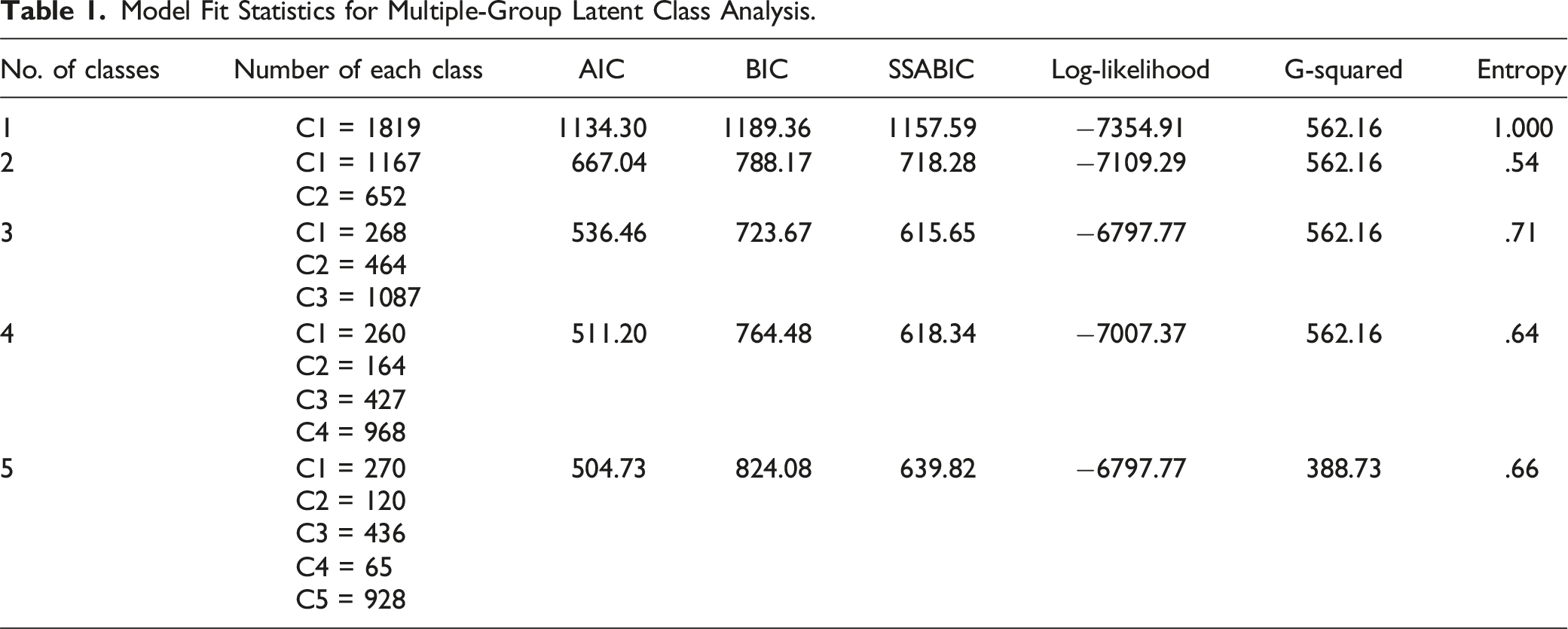
Models ranging from 1 to 5-class models were built for model fit comparison (Collins & Lanza, 2009; Weller et al., 2020). While the AIC was the lowest in 5-class model (AIC = 504.73), the other goodness-of-fit measures such as BIC, SSABIC, and log-likelihood were the lowest in 3-class model (BIC = 723.67, SSABIC = 615.65, log-likelihood = −6797.77). In addition, the G-squared value was the same across 1 to 4-class models (G-squared = 562.16) and had the lowest value in 5-class model (G-squared = 388.73). Entropy was the highest in 3-class model with a value of .71 while the entropy of 5-class model was .66. This has led us to select between the 3-class model and 5-class model. As the 5-class model did not have any clinically interpretable and meaningful subgroups, we selected the 3-class model as our final model.
Model Fit Statistics for Multiple-Group Latent Class Analysis.
Prevalence of Mental Health and Cognitive Symptoms
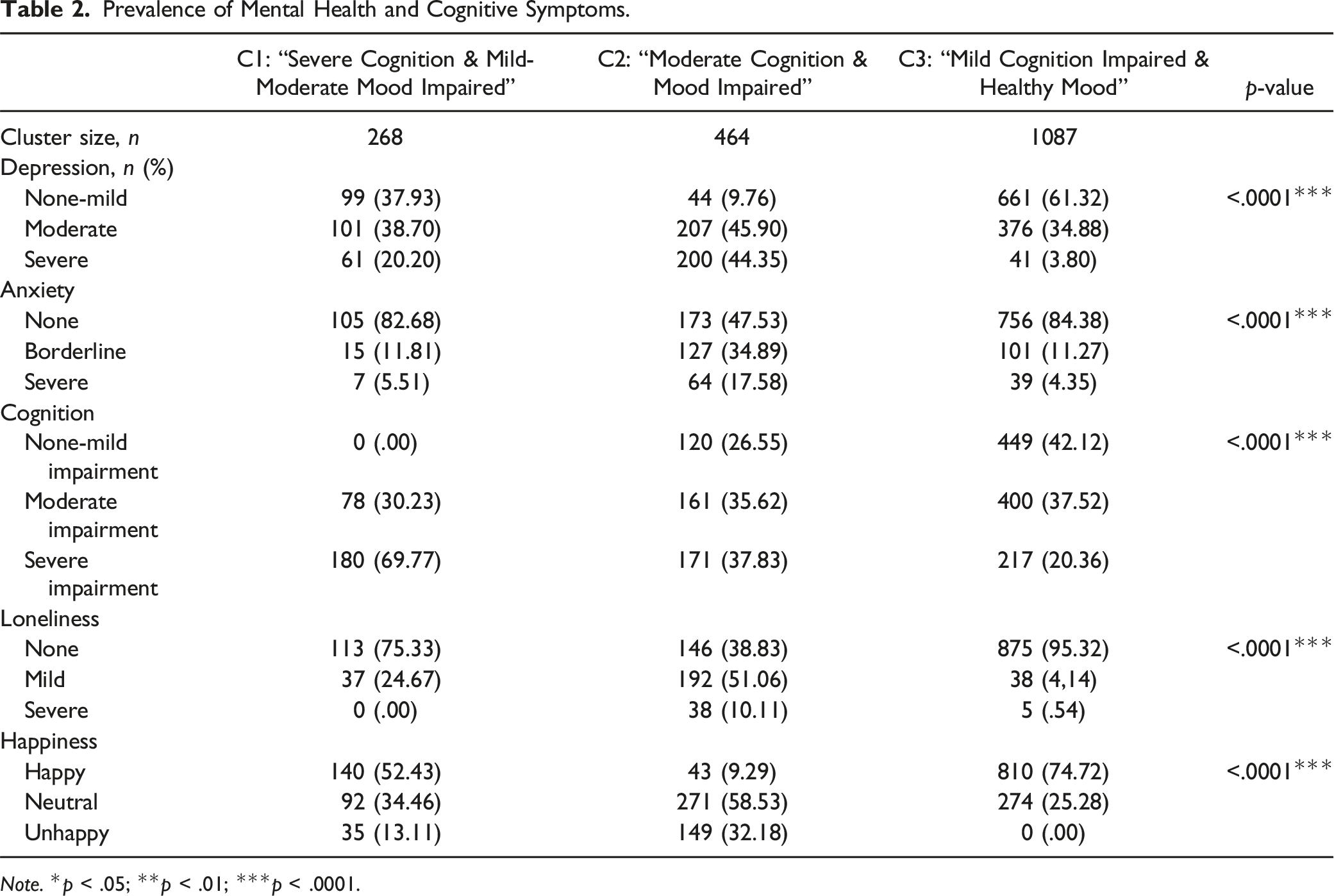
Prevalence of Mental Health and Cognitive Symptoms.
Note. *p < .05; **p < .01; ***p < .0001.
Latent Class Characteristics
Participant Characteristics at Baseline.

Note. *p < .05; **p < .01; ***p < .0001.
Multiple-Group Latent Class Analysis
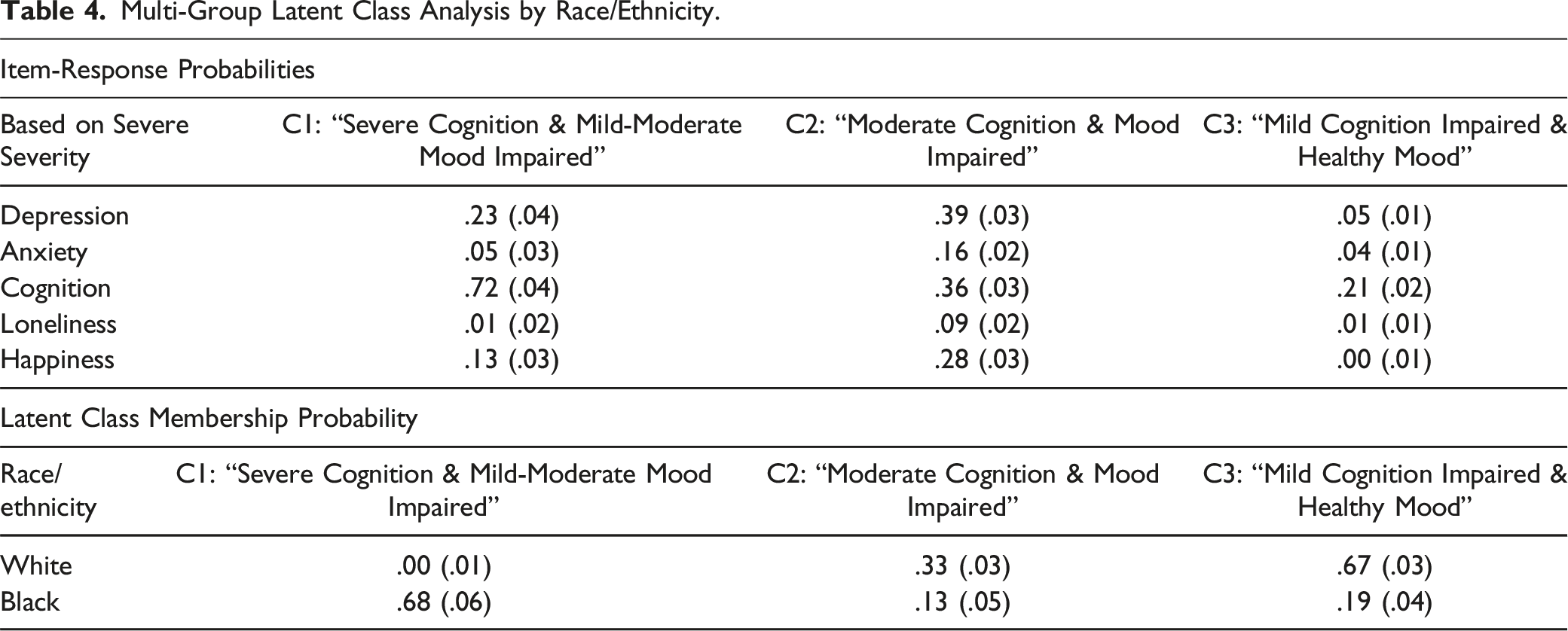
Multi-Group Latent Class Analysis by Race/Ethnicity.
Discussion
This is the first study to use multiple-group latent class analysis to identify latent subgroups of older adults with shared mental health and cognitive symptoms and to examine the similarities and differences in latent subgroup membership based on race. Our study found a total of three classes: Class 1: “Severe Cognition & Mild-Moderate Mood Impaired,” Class 2: “Moderate Cognition & Mood Impaired,” and Class 3: “Mild Cognition Impaired & Healthy Mood” based on severe severity. When comparing between race, Black older adults are more likely to be in Class 1: “Severe Cognition & Mild-Moderate Mood Impaired” and White older adults are more likely to be in Class 3: “Mild Cognition Impaired & Healthy Mood.” Significant differences were found in sociodemographic characteristics among the latent subgroups, some of which include age, gender, marital status, and highest level of education.
The use of multiple-group latent class analysis found that Black older adults are more likely to experience severe cognitive impairment compared to the White older adults. Our study findings support previous research where the incidence of age-adjusted dementia was the highest for Blacks, followed by American Indian or Alaska Native Americans, and Asians (Kornblith et al., 2022). In a similar study, Blacks were at a higher risk for mild cognitive impairment than Whites even after controlling for sex and education (Katz et al., 2012). Such racial disparities in cognitive impairment may be attributable to lifelong racism, early educational experience, differences in level of education, annual household income, occupation, health, or cultural factors (Katz et al., 2012). For example, Blacks are more likely to attend segregated and under-resourced schools, preventing some from obtaining high-quality education (Walsemann et al., 2022). Early educational experiences have been shown to affect cognitive function in later life especially among Black older adults (Aiken-Morgan et al., 2015; Walsemann et al., 2022). However, at higher levels of education, Black older adults showed a significantly more positive association between years of education and cognitive function which highlights future interventions to promote higher level of education for Black older adults to improve cognition at a later age (Barnes et al., 2011). In addition, Black older adults have been shown to perceive more discrimination than White older adults (Barnes et al., 2004) and such experiences of racism and discrimination have lead to a decline in subjective cognitive function and other adverse health outcomes (Coogan et al., 2020). Racial discrimination is commonly experienced by racial/ethnic minority groups throughout the course of lifetime, including Blacks and Asians, which adversely affects their cognitive function (Dixon et al., 2021). Cognitive impairment has been associated with impaired health-related quality of life, caregiver burden, and increased dependency in daily life (Christiansen et al., 2019; Stites et al., 2018). It is expected that the number of years to be spent with dementia has shown to be approximately three times more for Black older adults relative to White older adults (Gupta, 2021). Thus, it is important to routinely screen Black older adults for cognitive impairment and prepare family members for caregiving who are likely to recognize and report changes in cognition of older adults. If needed, early intervention including both pharmacologic and nonpharmacologic interventions such as acetylcholinesterase inhibitors and cognitive training should be offered to slow or prevent further decline in cognitive function (US Preventive Services Task Force, 2020).
In contrast, White older adults are more likely to experience relatively healthy state of mood such related to depression and anxiety relative to Black older adults. To date, there are mixed findings on the racial differences in prevalence and severity of mental health symptoms among older adults (Assari & Lankarani, 2016; Bailey et al., 2019; Skarupski et al., 2005). For example, Assari and Lankarani (2016). argues that White older adults have a high suicide rate because they experience high severity of depressive symptoms which are associated with more hopelessness than Black older adults (Assari & Lankarani, 2016). Other studies argue that Black older adults have higher rates of persistent depression than White older adults over time (Pickett et al., 2013; Skarupski et al., 2005). Our study findings suggest that White older adults experience healthy mood whereas Black older adults are more prone to experiencing mild to moderate mood impairment especially in terms of depression. However, mental health symptoms are often underdiagnosed or undertreated in racial minority groups (Bailey et al., 2019; Woodward et al., 2013). Barriers to accurate diagnosis and treatment include different symptom presentation, influence of religion, and cultural emphasis on holistic therapies (Sohail et al., 2014). When these symptoms are left underdiagnosed or undertreated, they can significantly affect health-related quality of life and daily functioning among older adults (Sohail et al., 2014). Thus, clinicians should understand the potential influence of culture in symptom reporting among racial minority groups and take a culturally-sensitive approach to accurately assess and treat mental health symptoms among older adults.
Our study found significant differences in sociodemographic characteristics among the latent subgroups of older adults. Class 1: “Severe Cognition & Mild-Moderate Mood Impaired” had the highest proportion of females followed by Class 2: “Moderate Cognition & Mood Impaired,” and Class 3: “Mild Cognition Impaired & Healthy Mood” had the highest proportion of males. Previous studies reported significant gender differences in cognition where female older adults have a greater cognitive reserve but experience faster cognitive decline than male older adults (Bloomberg et al., 2023; Levine et al., 2021). Female older adults experience biochemical changes associated with aging that leads to decline in their sex hormones such as estrogen and progesterone (Henderson, 2018; Russell et al., 2019; Sharma et al., 2021). Such decline in sex hormones cause changes in brain structure and function and results in impaired cognition and mood (Henderson, 2018; Russell et al., 2019; Sharma et al., 2021). These symptoms may present differently between male and female older adults, with female older adults more likely to report symptoms such as decline in global cognition and executive function, thoughts of death, loss of interest, and being tearful (Levine et al., 2021; Romans et al., 2007).
As a result, clinicians need to pay further attention to changes in cognition and mood especially among female older adults and understand the gender differences in their symptom presentation.
Furthermore, the highest level of education significantly differed in which Class 1: “Severe Cognition & Mild-Moderate Mood Impaired” and Class 2: “Moderate Cognition & Mood Impaired” had almost half of older adults with less than high school education and high school graduates. In contrast, Class 3: “Mild Cognition Impaired & Healthy Mood” had more than half of older adults with some college and college graduate or above education. Our findings support previous research on the relationship between level of education and cognition (Chen et al., 2019; Lövdén et al., 2020). A recent systematic review found the number of years of formal education to be positively correlated with cognitive function throughout adulthood and predicts lower risk of dementia in later life (Lövdén et al., 2020). In addition, high education in early life has shown to postpone cognitive and brain reserve decline among older adults (Chen et al., 2019). While the level of education is a non-modifiable factor, clinicians can promote health literacy for older adults with low educational attainment (Thomson et al., 2022). Health literacy, defined as the degree to which individuals have the ability to process and understand health information, is critical in allowing individuals to fully participate in their care related to treatment plans and medication (Thomson et al., 2022). Thus, clinicians need to first take a collaborative approach and provide short and simple educational materials tailored to older adults’ needs (Thomson et al., 2022). This approach will allow older adults to actively engage in care and enable tailored and efficient symptom management.
Our study has several limitations to consider. First, we dichotomized race as White versus Black older adults due to the lack of sample size of other racial/ethnic groups that is required to conduct latent class analysis. Future studies should be conducted with a larger sample size racial/ethnic groups to identify and compare latent subgroups of older adults with shared mental health and cognitive symptoms based on race. Second, cognition and depression are multidimensional constructs. Cognition consists of temporal, language, visuospatial, executive, attention, and memory domains, and depression consists of depressed affect, low positive affect, somatic symptoms, and interpersonal problems (Lee & Min, 2023; Sutin et al., 2019). Thus, it is worthwhile for future research to focus on multiple domains of cognition and depression, and to examine racial differences in their symptom experience. Third, mental health and cognitive symptoms are likely to change over time. The use of longitudinal data with multiple-group latent transition analysis will allow for an examination of changes in latent subgroups of older adults over time and racial differences in their transition probability. Fourth, survey weights were not used for the current study and thus our findings should be interpreted with caution as they may not be generalizable to the entire population. Future studies need to consider using survey weights to increase the generalizability of study findings.
Conclusion
This study identified three latent subgroups of older adults based on their mental health and cognitive symptoms and the similarities and differences in latent subgroup membership based on race. Significant differences in the sociodemographic characteristics were found among the three latent subgroups. While this is an exploratory study, it is worthwhile for clinicians to understand that there may be racial differences in the severity of mental health and cognitive symptoms of their patients. As such, it is important to provide culturally-sensitive care when assessing and treating these symptoms across racial groups.
Footnotes
Declaration of Conflicting Interests
The author(s) declared no potential conflicts of interest with respect to the research, authorship, and/or publication of this article.
Funding
The author(s) disclosed receipt of the following financial support for the research, authorship, and/or publication of this article: Dr. Se Hee Min is supported by the National Institute for Nursing Research training grant Reducing Health Disparities through Informatics (RHeaDI) (T32NR007969).
