



Abstract
Previous studies of membership associations identify differences between passive and active participation and also identify both sociodemographic and motivational factors as influencing participation. Extant research has, however, relied on cross-sectional survey data which does not capture the whole picture of an individual’s memberships. This article reports on a mixed-methods study of members of voluntary associations in the UK heritage sector to examine patterns of participation. The data reveals intensity of participation ranging from passive to active membership and we identify a new form of engagement: substituters. We find motivation to be the main influence on participation level and identify a new group of members based on their motivation: hobbyists. The data also reveals barriers to participation, including distance to the heritage site, aging, work and family commitments, and participation in other membership or voluntary associations. Last, members display varying levels of participation over time within the same association.
Introduction
Membership associations are receiving growing research attention since Putnam’s use of voluntary association membership as a proxy measure for social capital in his influential thesis Bowling Alone: The decline and revival of American community (2000). Putnam argues that both declining levels of membership and the increase in “mailing list organizations,” large-scale, professionalized membership associations with little social connectedness between members, are key contributors to the decline in community life and social capital. However, other countries, including Belgium (Hooghe, 2003), Spain (Garcia-Mainar & Marcuello, 2007), Sweden (Rothstein, 2001), and the UK (Hall, 1999) have not found the same trend in declining voluntary association membership.
Voluntary membership associations are diverse and include loyalty schemes, large charitable institutions, sports clubs, social clubs, pressure groups, and fan clubs. Individuals can belong to several associations and engage with these different associations in different ways (Garcia-Mainar&Marcuello, 2007; Wollebaek&Selle, 2003).Previous research on membership associations is limited by the use of quantitative methods including cross-sectional surveys and event history analysis, which prevent an in-depth analysis of members’ participation across their portfolio of memberships (Hooghe, 2003; McPherson & Rotolo, 1997; Rotolo, 2000). This article seeks to address this research gap using a mixed-methods research design to investigate different types of participation, including volunteering, across a range of membership associations. We also sought to find out if individual members’ participation is the same in small or large, secular or religious associations and if patterns of participation change over time. First, we review the extant research on different forms of membership association participation from passive to active and the factors which influence participation. Second, the research population, the UK heritage sector, is examined. Next the methods are presented, the characteristics of our sample followed by the findings drawing on the qualitative phase of the study.
Patterns of Participation
Forms of Participation
Participation in voluntary associations varies from active engagement such as committee membership or volunteering, to passive involvement, whereby the member pays their fees but remains a silent member. Active members can be divided into core and peripheral roles (Pearce, 1993), with core volunteers taking on committee roles and often volunteering within the organization for many years. In contrast, peripheral volunteers are steady contributors but less committed than core volunteers and take on occasional roles or assist for a finite period of time (Cuskelly, Hoye, & Auld, 2006). Researchers refer to these core volunteers as “stalwarts” (Nichols, 2005), “champions” or “activists” (Jones, 2002) and peripheral volunteers as “flexible workers” (Jones, 2002).
There are clearly differences between passive and active membership of associations, however, patterns of membership are not always dichotomous. Indeed, intensity of participation in voluntary associations is rarely examined (Hooghe, 2003). Hooghe (2003), for example, differentiates between nonmembers, former members, passive members who pay their dues and active members who participated in at least one activity during the past 12 months and are members of the board, whereas Garcia-Mainar and Marcuello (2007) distinguish between members, participants, donors, and volunteers. As such, we can envisage intensity of membership falling along a spectrum from passive to active (Wollebaek & Selle, 2002), with entirely passive at one extreme, simply paying the subscription and extremely active at the other, with the member taking on a major voluntary role such as chair of the association. In between, there are different levels of active and passive participation.
Few studies have examined these different forms of engagement. An exception is in the context of voluntary sports clubs, where two studies have identified that stalwarts take on committee roles and ensure the continued operation of the club (Cuskelly et al., 2006; Nichols, 2005) whereas the most passive members pay and play, without contributing anything more than their membership fee. Other membership associations may have even more passive members, who pay their membership fee but do not use any membership benefits. It is this form of membership which is referred to as “checkbook” activism. Although core or stalwart volunteers have received attention from researchers, there has been little examination of “pay and play” or totally passive members; this study aims to fill this gap by examining members that participate intently in contrast to other members that participate very little. Passive members may be the result of what Putnam (1995) describes as tertiary associations, that is, professionalized membership associations with paid staff, where members only have limited opportunities for active involvement (Garcia-Mainar & Marcuello, 2007; Lansley, 1996). Not all voluntary associations, therefore, enable all forms of participation by members and we expect that there will be variation in both participation and motivation for active involvement with larger, national membership associations compared to smaller organizations.
Participation in voluntary membership associations can vary, therefore in type, intensity, in the role that the individual chooses to take, for example as a committee member and also in scope as participation will depend on the size and governance of the association itself. In addition, many members have multiple memberships, within which they participate in different ways and intensities. Over time, their participation in one particular association may also vary. Past studies use event history analysis to examine the different memberships held by individuals (Hooghe, 2003; McPherson & Rotolo, 1997; Rotolo, 2000) and although event history analysis provides data on an individual’s changing membership portfolio over a period of time, it does not capture the nature or intensity of these memberships. In addition, event history analyses of voluntary association memberships offer little explanation of why individuals participate in membership associations in different ways.
Influences on Participation
Researchers examine a range of motivational factors related to voluntary association membership. Wollebaek and Selle (2003) find that level of participation is related to the individual’s motive for joining the association. Active members seek personal fulfillment and social contact whereas more passive members such as pay and players want to influence decisions and gain membership benefits. Motivation for participation in voluntary associations has been classified as Material, Purposive, and Solidary (Caldwell & Andereck, 1994; King & Walker, 1992). Material motives are the tangible benefits of being a member, such as discounts and information; Purposive motives are based on global concerns, such as civic responsibility; and Solidary benefits are those derived from social interaction and group status. Although material benefits are reported as the least important reasons for becoming involved in a voluntary association (Caldwell & Andereck, 1994), it would seem likely that passive members are more motivated by these as Slater (2003a) reports in a large UK museum. While in contrast, we would expect active members to be motivated by solidary and purposive benefits.
Although there has been little research on motivation for membership association participation generally (for example, Caldwell & Andereck, 1994; Slater, 2003a), researchers seek to theorize motivation to volunteer in associations. Studies examine why individuals volunteer and also analyzes their different time contributions. Leisure researchers (for example, Orr, 2006; Stebbins, 2007) examine volunteerism as a form of leisure, which may be appropriate for membership associations. Leisure volunteering can be casual, project based or serious (Stebbins, 2007). Serious leisure demands a sustained commitment from the individual, whereas project-based leisure volunteering is still demanding but of fixed duration. This differentiation of participation level with time commitment mirrors Handy, Brodeur, and Cnaan’s spectrum (2006) of volunteer participation in a series of festivals where they distinguish between long-term committed volunteers, habitual episodic volunteers (regular volunteering for a fixed period of time), and episodic volunteers. Although all three groups display similar motivations, habitual episodic volunteers are often prevented from becoming long-term volunteers because of time and other constraints.
Barriers to volunteering, therefore, have an impact on the ways in which individuals can engage with voluntary associations. Ringuet, Cuskelly, Zakusand, and Auld (2008) compare core and peripheral volunteers in sports clubs and find that level of engagement is due to structural factors, rather than motivation. In their study, the participation of peripheral volunteers is limited by barriers such as increased family commitments and the perceived high workload for core volunteers. These barriers reflect those reported in studies of volunteering more generally (Low, Butt, Ellis Paine, & Davis Smith, 2007; Musick & Wilson, 2008), thus level of participation in a membership association may not be a matter of choice. A further barrier can be religiosity, which can impact on participation in secular membership associations, as the religious organization demands all the time and commitment the individual has available for other associations (Schwadel, 2005). Multiple memberships can similarly affect participation levels, as active participation in one association may limit active involvement in others. Finally, Cress, McPherson, and Rotolo (1997) argue that intensity of participation has a negative correlation with length of membership. That is, long-standing core volunteers are more at risk of burn out than peripheral volunteers or passive members.
This review shows that engagement in membership associations is affected by a range of factors. These include the individual member’s motivation, the time they have available, the cost of participating, physical ability, proximity to the association’s headquarters, their engagement with other membership associations, and also the opportunities for participation within the association. Therefore, an understanding of the membership associations themselves is also needed.
Membership Associations in the UK Heritage Sector
As a population for this study, we use membership associations within the heritage sector in the UK. Previous research on membership participation includes a range of leisure contexts, particularly sports clubs (Cuskelly et al., 2006; Nichols, 2005; Ringuet et al., 2008) and to a lesser extent, parks (Jones, 2002), museums (Slater, 2003a), and heritage organizations (Lansley, 1996). Heritage membership associations offer a broad range of opportunities for member engagement from committee membership to active volunteering, through to passive, benefits-driven membership. There are more than 1,000 heritage membership associations in the UK with between four and five million members, which means they offer an appropriate sample for this study. Members of heritage voluntary associations typically pay a fee in return for benefits such as free admission. Internationally, membership associations are represented by the World Federation of Friends of Museums (WFFM; http://www.museumsfriends.com/). The WFFM has approximately 1,590 member groups and 1,339,500 individual members, mostly from Europe, the Americas, and Australia.
The UK heritage sector is a diverse grouping of attractions and organizations (Drummond, 2001), which includes museums and galleries, historic houses and castles, industrial heritage attractions, churches and cathedrals, historic libraries and archaeological sites. In the UK, there is no discrete national list of heritage supporter groups, but previous research within this sector reveals that many associations are small and entirely organized by a volunteer committee, drawn from the membership (Slater, 2003b). Members of supporting associations may choose to volunteer for the collection or site in addition to or instead of volunteering for the membership association as a committee member. There are a minority of larger, professional membership associations administered by paid staff, with little social connectedness between members. These are the tertiary associations described by Putnam (1995).
Although the management of heritage membership associations has previously been examined (Hayes & Slater, 2003; Slater, 2004) and volunteers in the UK heritage sector have been the subject of several studies (Edwards, 2005; Holmes, 2003; Orr, 2006; Smith, 2002), the behavior of members and the relationship between membership and volunteering remains underresearched. This is surprising as the most recent studies of volunteer participation report that 90% of UK museums involve volunteers (Resource, 2002), that volunteers outnumber paid staff by 2:1 and comprise an estimated 25, 000 individuals (Creigh-Tyte & Thomas, 2001). Volunteers in the heritage sector are often older, retired, and motivated by an interest in the subject matter of the site or the museum’s collection (Holmes, 2003). Although the lack of data means it is difficult to quantify this sector, there is evidence that heritage associations are actually increasing their supporters. For example, the National Trust has increased their volunteers from 38,900 in 2001 (Creigh-Tyte & Thomas, 2001) to 61,000 in 2009 (National Trust, 2010).
As membership associations within the UK heritage sector offer a range of opportunities for member engagement, they provide a useful population for examining different forms of participation. Drawing on data from a three-phase mixed-methods study, we examine patterns of involvement across an individual’s portfolio of memberships and seek to identify the key factors which influence level of participation.
Method
Mixed-methods research is a pragmatic approach, combining elements of quantitative and qualitative data collection (Cresswell & Plano-Clark, 2006). Our research design took an explanatory approach with three phases of fieldwork. Phases1 and 2 were quantitative and Phase 3 was qualitative. The study was designed in this way to enable recruitment of members for the later qualitative phase (Cresswell& Plano-Clark, 2006). As there is no existing sampling frame of heritage supporter associations in the UK, during Phase 1 (August-November 2006), existing networks and the Internet were used to compile a database of membership associations. We included historic houses, cathedrals, churches, museums, heritage transport attractions, parks, and open spaces. This database gave us a population of 1,000 membership associations and each association was surveyed by post or email. We acknowledge that the sample population may not include every membership association within the heritage sector, but as many membership associations are small, voluntary associations and no agency holds a comprehensive list of these associations, it is not possible to identify which associations were excluded.
The questionnaire instrument in this study uses predominantly closed questions to find out the characteristics and governance of the membership association and organization they support; methods for recruiting members; perceived motivation of members; opportunities for involvement, and trends in membership. This provides context on the supply side of participation as it identifies the different ways members can engage with the association. The primary purpose of the questionnaire, however, was to provide a means for reaching individual members. The organizational questionnaire enabled us to ensure our sample for the subsequent phases of this study included a variety of associations of different sizes and with different aims. The response rate from the questionnaire was 222 (22%) of which76 associations allowed us to survey their members. Phase 1 provides limited data on the supply side of participation but we report on the findings to contextualize the data from Phases 2 and 3.
In Phase 2 (January-March 2007), we surveyed 1,815 individual members across 32 different associations from the original list of 76. Although we did not have a discrete sampling frame for Phase 2, we sought to achieve a random, stratified sample of members based on the type of site or collection the association supports. Because of data protection legislation in the UK, we were compelled to ask membership associations to send out the questionnaires to their members on our behalf, using a systematic approach to sampling, for example, to sample every 10th member from their membership list, although we recognize there may be some bias if the association wavered from this in their gatekeeper role. This second questionnaire, again using predominantly closed questions based on the literature and the responses from the membership associations in Phase 1, asked individual members about their motivations for joining and retaining their membership of the sampled heritage organization; their level of participation in this membership association; their participation in other voluntary associations, religiosity as well as geodemographic data, such as age and work status. These questions enable us to build a picture of individual members’ membership portfolios and also identify how specific factors such as motivation and religiosity might impact on level of engagement. The response rate from this second questionnaire was 665 (37%) overall, but it varied from 24% to 94% across the different associations. The primary function of Phase 2 in this article was to provide a sampling frame for the final, qualitative phase of the study: Phase 3. We undertook descriptive analyses of the two surveys using SPSS PASW Statistics and report on these later in this article.
In preparation for Phase 3, we invited all questionnaire respondents during Phase 2 if they would be willing to participate in a face-to-face interview. A total of 358 of the 665 respondents provided their contact details. In this final stage (April-July 2007), we used maximum variation sampling (Miles & Huberman, 1994) to select 52 respondents for in-depth qualitative interviews. Maximum variation is a sampling technique which seeks to include the breadth of possible cases within the sample. This approach helped us to address possible bias in the sampling frame, by ensuring that a range of membership experiences were represented. Only eight respondents declined to participate after we contacted them, which gave us a response rate of 87%. The reasons given for nonparticipation include lack of availability, health problems, and lapsed membership of the association since completing the questionnaire in Phase 2.
The interviews were conducted as a conversation about the respondent’s membership associations. They began by exploring an individual’s responses to the Phase 2 questionnaire and asking for clarification as to members’ differing motivations for and level of involvement in these associations. In particular, we explore whether they have served as a committee member or volunteered for any association in the past and present, how this had come about, and why they became involved in one association and not another. The interviews enable us to build a profile of the respondent according to the breadth, types, and intensity of participation and their motivation for participation. The interviews lasted from 34 min to 1 hr and 47 min (mean = 63 min) and each was recorded and transcribed verbatim for analysis. Hierarchical thematic analysis was conducted using Nvivo 8. First a template for coding the data was established based on the literature (King, 2004); this was then expanded to allow new or more precise themes to emerge from the data. Following Miles and Huberman’s guidelines (1994), the coding was first completed by one researcher. The coding of the first four interviews was checked by a second researcher and then a further four interviews were checked later on in the coding process. The code checking led to some clarification of the initial categories but no major differences between the two researchers’ codes were identified.
The mixed-methods approach helped in checking the validity of the data. In each interview, the participant was reminded of their answers to the Phase 2 questionnaire and these could be compared with the interview responses. This approach also enables triangulation of data types. Last, the in-depth interviews contribute toward the internal validity of the study, by enabling exploration of respondents’ understanding of different forms of membership.
The findings, discussion, and analysis in this article focus on the qualitative interviews. Due to the sampling processes and response rates for Phases 1 and 2, it is not possible to generalize from the quantitative data. The interviews, however, use theoretical sampling, which enables theoretical assertions to be made from the data (Miles & Huberman, 1994).
Characteristics of Membership Associations and Their Members
This section of the article briefly reports on the membership associations, their recruitment of volunteers, and types of activities that members are involved in. This data provides background on the supply side of the heritage voluntary associations in this study, particularly opportunities for participation in associations. Due to the response rate of 22% in Phase 1, this data must be viewed as indicative, rather than representative of the population. Second, the characteristics of the sample from Phase 2 are described to provide a limited context for the data from the third qualitative phase, which forms the main part of the findings and discussion.
In our survey of membership associations, 90% report that volunteers either run, or assist in running their association and at nearly a quarter of the sites (23%) volunteers are also members. The size of the volunteer force varies according to the association’s needs, with just over half of our sample (56%) having 6 to 20 volunteers and 8% reporting more than 50 volunteers and most, but not all, volunteers are local to the site.
Volunteers are engaged in a variety of activities and these data are presented in Table 1. Due to our sample size, it is difficult to compare the opportunities for engagement in small and large membership associations as we had only 29 associations with more than 1,000 members. These larger associations are more likely to employ paid staff to administer the association, rather than rely on members as volunteers. All associations with 3000+ members employ at least one paid staff member. Yet these same associations also involve members as volunteers in some capacity.
Activities With Which Membership Associations Reported Their Volunteers Assist
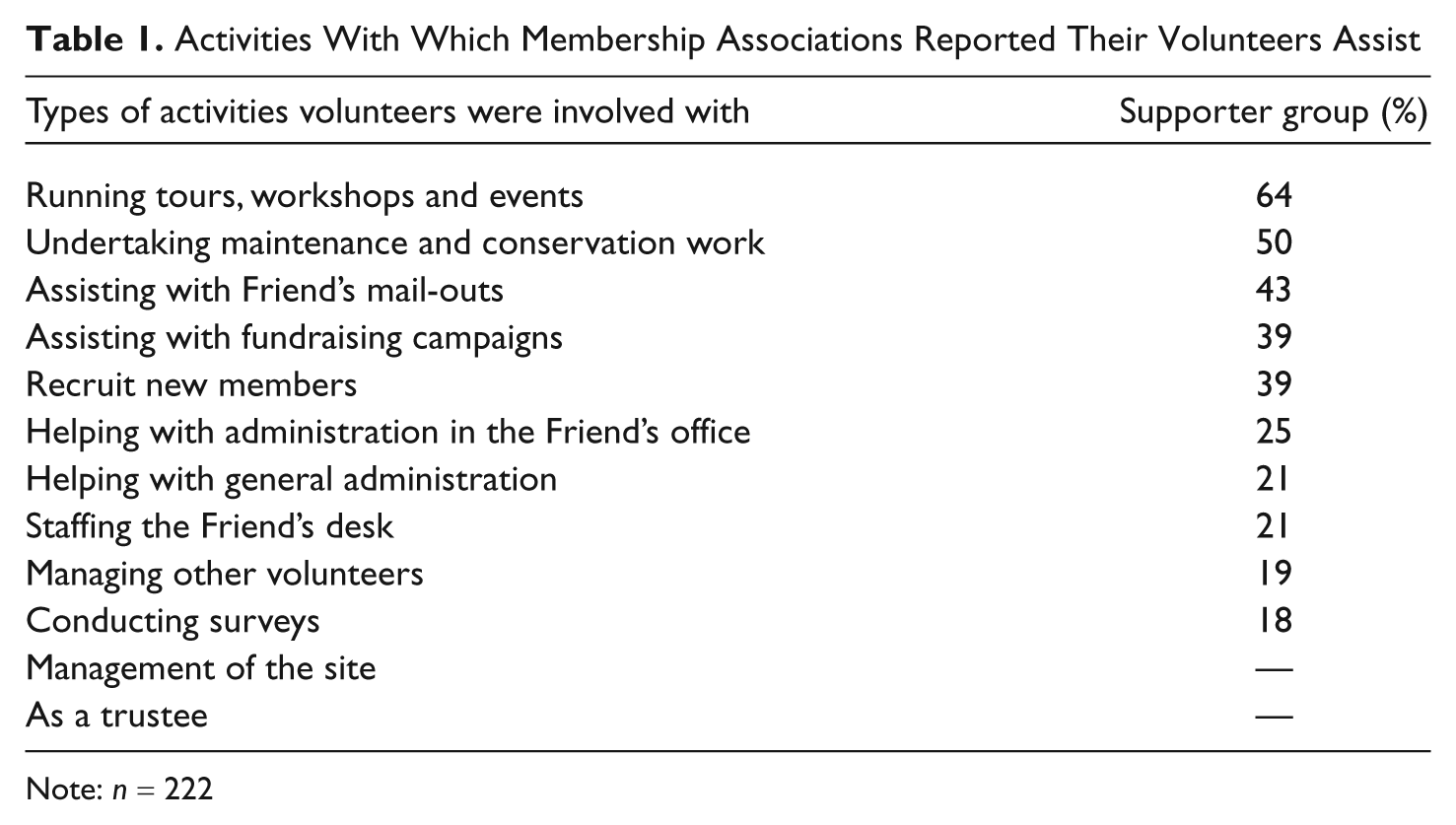
Note: n = 222
The respondents (n = 665) from our survey of members during Phase 2 are predominantly male (59%), older, with 83% aged above 55 years, and retired (67%). They have a high level of educational attainment, with 39% holding a tertiary qualification or higher, compared to 23% in the general UK population (Self & Zealey, 2008). The gender ratio is likely to be due to a number of associations within the sample, which are affiliated to transport collections. Previous research identifies a gender preference for specific sites and collections with transport museums more popular with male volunteers (Holmes, 1999). Although we cannot claim that our sample is representative of the wider population, the respondents in our sample did report a similar profile in terms of age profile, work status, and level of educational attainment to those of studies of heritage volunteers in the UK, who are generally older, retired people with a high level of educational attainment (Holmes, 2003; Smith, 2003). The lack of prior research on members across heritage organizations means that a comparison between our sample and the wider volunteer population cannot be made.
Most respondents have multiple memberships of associations including museums, galleries, heritage sites, arts organizations, and social, charitable or educational associations. The mean number of memberships was 4.7, with one person belonging to 24 associations. Only 9% of members belong solely to one association. These findings emphasize the value of examining an individual’s engagement with voluntary associations across their membership portfolio. Table 2 presents the types of associations to which respondents in Phase 2 belong.
Types of Associations to Which Members Belong

Note: n = 665
Extent and Patterns of Voluntary Involvement in Heritage Associations
A total of 53% of respondents can be described as passive members: they belong to, but do not volunteer for heritage associations. The remaining 47% of respondents can be described as core or peripheral volunteers having volunteered for the association and/or the affiliated heritage site. As identified in Phase 1, member volunteers are involved in a range of activities, including fundraising, tour guiding, and administration.
A total of 18% of respondents have served on the association’s committee. The majority of these (77%) have held one role, but 22% have taken on two or more roles. Many of this core group of volunteers is also long-term volunteers with 45% having volunteered for at least 6 years. In this case, our sample has different characteristics from those of wider studies for example, Cress et al. (1997) report that active volunteers move across different organizations. In fact, only a small proportion (17%) of our respondents have lapsed a membership in the past 5 years. Rather, our respondents accumulate memberships building their portfolio over time.
Of committee members, 83% currently volunteer for the site as well as the committee. These are Nichols’ (2005) “stalwart” volunteers. 28% of respondents’ have volunteered for the site only and could be described as peripheral volunteers. The remainder has never volunteered (53%).We also explore individuals’ volunteering in other associations to better understand their participation across their current membership portfolio. Just more than a quarter (26%) of respondents currently volunteer for other, nonheritage organizations and associations and 18% have in the past, a total of 44% of the sample.
Findings and Discussion
The primary discussion in this article is based on our qualitative interviews. The interviewees were chosen purposively to represent the maximum variation within the sample in gender, age, work situation, number of memberships, level of engagement, and geographical location. As such, the interview sample is not designed to be statistically representative of the wider population. The interviewees were sampled from 16 different membership associations across the UK and include 32 males and 20 females who were mostly retired, with 15 engaged in work, which reflects the wider sample that participated in the members’ survey in Phase 2. The 16 associations are profiled in Table 3. First, we discuss members by their type and intensity of engagement and then by their motivation. Next, we plot both engagement and motivation on a matrix to reflect the relative size and position of each group. We then discuss the barriers that inhibit participation and finally focus on one member to illustrate the diversity of an individual’s engagement.
Profile of Membership Associations for Phase 3

Forms of Membership
As anticipated, the data reveals a range of types and levels of participation across our sample. Our respondents could be classified into four different categories depending on their level of engagement. These categories include three already identified in the literature, core volunteers, peripheral volunteers, and pay and players. We also identify a new fourth group, which we called substitutors. Core volunteers are key volunteers and committee members (Jones, 2002; Nichols, 2005), often taking on a range of roles within the association. Many core volunteers are founder members of their associations and they are essential to the voluntary membership associations who rely entirely on volunteers to operate. Peripheral volunteers (Cuskelly et al., 2006) are less committed than core volunteers and may take on a committee role for a short time after attending an AGM, as one former committee member comments:
I think I just went on to the committee for a while. I can’t remember how I ended up being chairman. I think they were looking for volunteers again one year and I went along to the AGM again and they asked me. (Peripheral volunteer)
Peripheral members may not have the time to become core members or they may have multiple memberships, which limits their involvement in other membership associations.
We also identify a new category of more passive member: substituters. Substituters are those members who are currently unable to volunteer due to other commitments or lack of geographical proximity to the site and show their support in other ways:
We live here about 6 or 7 months of the year and the rest of the time we live abroad . . . So that limits our ability to really get involved hands-on, so as an alternative almost, I contribute to various things financially. (Substituter)
Finally, pay and players are members who have joined primarily for the benefits and their only involvement is to make use of the facilities and activities offered by the association.
Motivational Factors Influencing Participation
Motivation also has a significant impact on individuals’ participation in membership associations, as previously identified (Wollebaek & Selle, 2003).The data reveals four groups of members based on their motive for participation. The first three groups, cause servers, socialisers, and benefits seekers, correspond to the three groups of motivations identified in a previous study: Purposive, Solidary, and Material (Caldwell & Andereck, 1994). A fourth group also emerges within our sample. We label this group “hobbyists” as they were primarily interested in the subject or site supported by the association.
Hobbyists include respondents who have a life-long interest in the subject represented by the association. Some hobbyists describe themselves as “loners” but they join the association as it enables them to pursue their interest. Hobbyists are most likely to belong to more than one membership association linked to their area of interest.
I was coming towards retirement . . . and I thought it would be very interesting if I made some plans to occupy my leisure time. The exercise was to establish myself as a guide to the museum . . . with what has been a lifelong interest in aviation that was the natural direction to take. (Hobbyist)
Cause servers are primarily concerned with supporting and protecting a particular site, often one perceived to be under threat or a site in their community. Cause servers are purposive in their membership and more community minded than other members.
It’s a fifty acre of woodland and it’s bang in the middle of the area and there has been threats of development in the past and I don’t want anything to happen to it. It’s such an asset that people don’t really appreciate it here. (Cause server)
Socialisers are less intrinsically motivated by the subject of the association, rather they are interested in being part of a group, building relationships with other members, or are using their volunteering to have social interaction, for example, those recently retired and/or widowed or single. Socialisers also include people who have recently moved to a new area and are looking to become involved in their local community.
You understand my motivation for joining? What I now get out of it is I’ve got a lot more friends, we have a good time at the meetings, we have a good time at the committee meetings, I get to go on outings. (Socialiser)
Finally, benefits seeker members are interested in the benefits they derive from membership and most benefits seekers have limited participation in the association, preferring to be pay and players. These four different forms of participation and four motivations are compared against each other in Table 4, which shows the number of participants within each cluster.
A Matrix of Participation in Membership Associations

Note: n = 52.
Table 4 also reveals tentative patterns among the different clusters. Hobbyist members, those with the greatest personal interest, engage more with the association than the other groupings, with most members within the core or peripheral volunteer clusters. Perhaps, membership associations which attract hobbyists offer more opportunities for active participation in the association. Associations which attract substitute members may offer these members the opportunity to support the cause as they cannot do so directly and choose to support by proxy through the membership association, what Putnam (2000) calls “checkbook activism.” Level of participation, however, does not necessarily reflect the level of support a member feels for an association. Members may be highly committed to a site but unable to actively participate in the association.
Socialisers were more likely to be peripheral volunteers, so they are either less committed than core volunteers or peripheral volunteering meets their needs for social interaction and friendship. All pay and players are benefits seekers and all benefits-seeker respondents are pay and players, as would be expected given the nature of pay and play membership as a means of making use of the benefits with limited participation in the association. Of course, the sample size for Phase 3 of this study means that the relative size of each group in Table 4 is indicative.
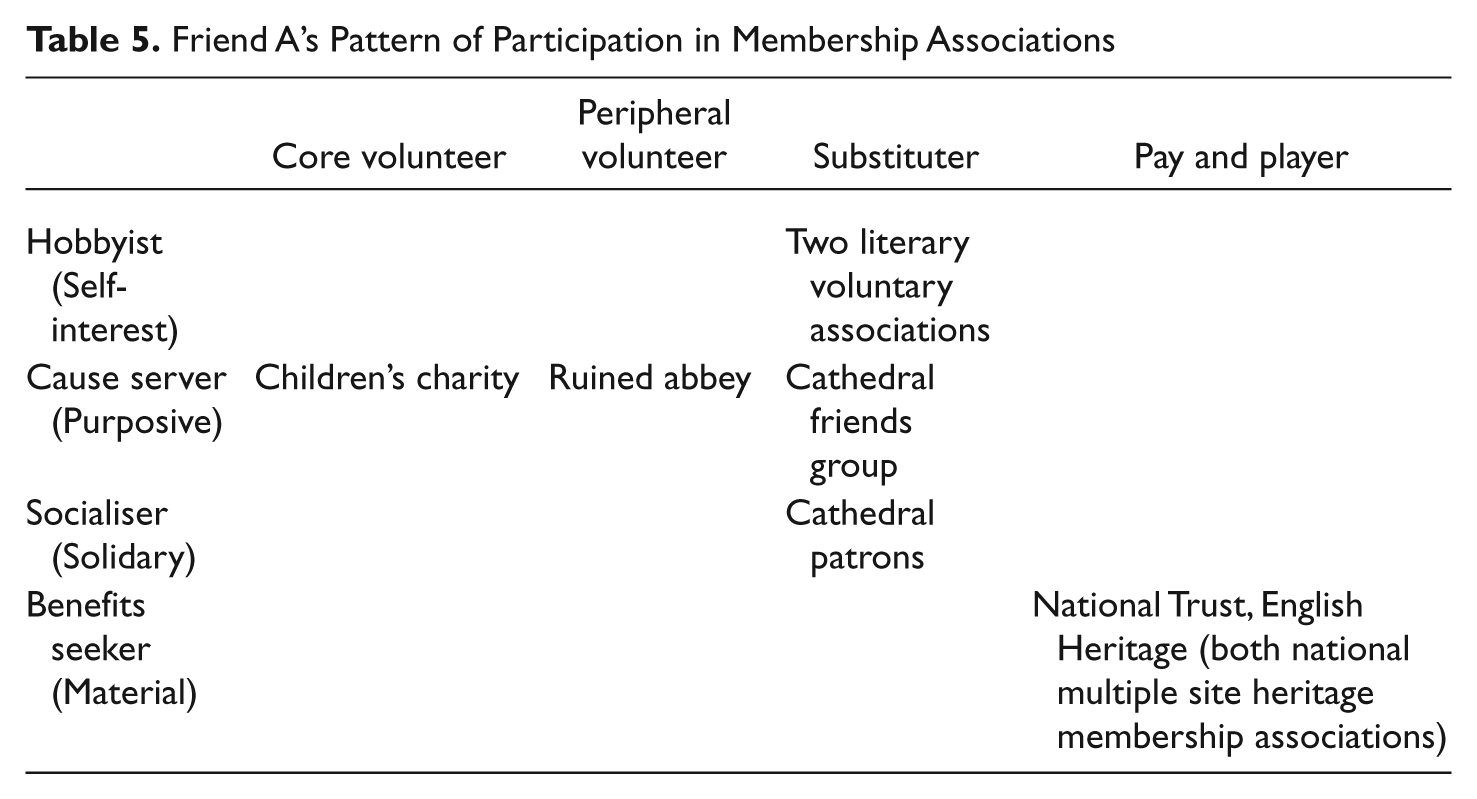
Respondents’ reasons for joining the associations in their membership portfolio also vary along with their level of participation. For example, we sampled Friend A through the Friends’ group of a cathedral. She is also a member of the patrons of the cathedral, which fundraises for the cathedral. Friend A is a regular church goer and spirituality is important to her. She belongs to her local church and volunteers as a chaplain at a nearby heritage attraction, a ruined abbey. She has a keen interest in literature and is a member of two associations which support the former homes of authors. She is a pay and play member of two large heritage membership associations which offer free entry to members. Her main passion is, however, a children’s charity, in which she has been active for 50 years and she is currently secretary of their local branch. The framework in Table 4 enables us to compare an individual member’s, such as Friend A’s, different participation levels across their memberships. This is presented in Table 5.
Friend A’s Pattern of Participation in Membership Associations
Other Factors Influencing or Inhibiting Participation
We have identified forms of participation and clusters of motivation which influence membership association participation. Our interviews reveal other factors, which influence participation across an individual’s membership portfolio. First, there are differences in the way members view small, local associations compared to large, national associations, for example, the location of the site and its proximity to the respondent. Local and smaller sites are perceived as needing more support, whether this was voluntary support from core volunteers or financial support from substituters. One respondent describes their membership of two associations supporting local cathedrals:
I realise that these larger buildings like [the local] Cathedral are struggling financially to maintain the fabric of the building . . . I do have a regular financial donation in favour of the cathedral. (Substituter) Religious sites clearly appeal to church goers. Rather than leading to greater participation, however, religiosity can reduce the respondents’ participation in membership associations outside of their church and church goers are often involved in voluntary activities at their church, as noted by Schwadel (2005).
Participation within the membership association depends on the time respondents’ had available (Ringuet et al., 2005). Core and peripheral volunteers in our sample are mostly retired, which contrasts with previous research where participation is higher among those in their middle years (Garcia-Mainar & Marcuello, 2007; Rotolo, 2000).The profile of our interviewees does correspond with that of heritage volunteers more generally, who are typically older, retired individuals (Holmes, 2003). Retirement can be both a facilitator and a barrier to participation, with older members having more time but facing mobility and health issues, which results in their being less active. Respondents in paid work are more likely to be substituters as they have limited time to commit as volunteers. One substituter is a keen member of the local cemetery membership association but cannot participate with Saturday clean-up days as it is the busiest day in her shop.
The type of membership association also impacts on respondents’ involvement. The larger, national associations are more likely to attract pay and players. First, respondents felt that these larger heritage sites were less in need of their time. Second, the larger associations often offer better benefits and are more attractive to pay and players. Finally, many larger membership associations employ professional staff and may not offer as many opportunities for volunteer participation. This last factor could be perceptual rather than actual, as even the largest associations in this study involve their members as volunteers in some capacity. The size of the membership association could also make it appear difficult to become an active participant, with one peripheral volunteer commenting on a larger membership association:
The Friends of course are more remote because they’re much bigger organizations so unless you’re part of the “inner circle” then you’re not so involved inevitably. (Peripheral volunteer)
Thus, aside from motivation, the key factors which influence participation in heritage supporter associations include life stage (age, time available), geography (proximity to the site), size of membership association (opportunities for engagement), scope of association and site (national/local), religiosity and scheduling of volunteer activities, and other personal commitments.
Conclusions
This article sought to explore the spectrum of participation by members of heritage supporter associations in the sampled organization, other heritage associations, charities, and causes they support using a mixed-methods approach to fill the current gaps in the extant research. Previous studies focus on differentiating volunteers and nonvolunteers, members and non-members, or classifying individuals according to their time commitment. In our study, we expand these categorizations according to level of engagement with the association and motivation. We also examine individuals’ participation across their portfolio of membership associations, whereas previous research has been limited to participation in one organization.
The article has highlighted the importance of members and volunteers to heritage associations and the range of activities they are involved in. Our findings suggest that individuals accumulate memberships rather than, lapse memberships. A significant group of members are active in at least one of these groups, and some are active in several. The findings also provide new insights into the nature of this participation. Previous research on volunteering (Cress et al., 1997) suggests that the most active volunteers move across organizations. Some members become more involved over time whereas others become less involved but rarely do they leave associations. They just change their role and intensity of participation.
We use motivation, rather than sociodemographic variables, to examine patterns of participation. Motivations influence how individuals became more or less involved. We identify four types of participation: core volunteers, peripheral volunteers, substituters, and pay and players. Core and peripheral volunteers and pay and players have been previously identified, but our fourth category, substititers, is a new contribution. Substituters are members who are unable to participate actively in an association and so appear to be passive members, although they are still committed to the association. We also identify four groups of members based on their motivations. Again, three of these groups have been previously identified. These are cause servers who have purposive motivations, socialisers that have solidary motivations and benefit seekers who are motivated by material benefits. We identify one new group, hobbyists, who have a strong personal interest in the subject matter of the affiliated site. By combining intensity of member participation and motivation into a matrix, we have created a research tool for exploring an individual’s membership portfolio and how their engagement with a membership association may change over time.
Our study, however, is limited by the low response rates in the surveys in Phases 1 and 2, so that we can only make tentative statements about the wider population of heritage supporter groups. Although we can use our interview data to generalize our findings theoretically to the wider population of heritage supporter groups, further research is needed, testing the matrix of membership engagements with other sectors, in other countries, and with larger samples.
Footnotes
Declaration of Conflicting Interests
The author(s) declared no potential conflicts of interest with respect to the research, authorship, and/or publication of this article.
Funding
The author(s) received no financial support for the research, authorship, and/or publication of this article.