



Abstract
Nonprofit organizations are facing increasing pressure to become more performance oriented. Most research in this area has focused on the effects of a variety of independent variables on performance with little research focusing on combinations of factors that impact on performance. This article focuses on sport governing bodies from Belgium and measures and assesses their strategic goals and potential determinants of performance. Due to the small N-sample and the causal complexity inherent in this research, a crisp-set Qualitative Comparative Analysis (csQCA) was carried out which highlighted three pathways associated with high performance. High performance could be delivered by sport governing bodies that develop innovative activities for their members and are proactive in elite sport services; or that develop innovative activities and involve paid staff in decision-making processes; or that involve committed volunteers in decision-making processes and delegate activities they are not able to deliver themselves.
Keywords
Organizational performance is a central theme in the analysis of organizations (Cameron, 1986; Fiss, 2007; Quinn & Rohrbaugh, 1983) as many managers assess performance for benchmarking purposes. Nonprofit organizations are not exempt from this; however, little research in this field has focused on ways of achieving high performance. Two main reasons explain this. First, it is difficult to understand how aspects of nonprofit organizations act and interact to produce performance and second, it is difficult to define what high performance is within nonprofit organizations due to their multiple goals (Cutt, 1998; Herman & Renz, 1998; Speckbacher, 2003). This article intends to address this gap by investigating the proposal that complex combinations of factors lead to high performance in the nonprofit sector (Cairns, Harris, Hutchison, & Tricker, 2007; Caldwell, Farmer, & Fedor, 2008; Schmid, 2002). In line with the suggestions of Wolfe, Hoeber, and Babiak (2002) this research aims to investigate combinations of organizational determinants that can be linked with high performance of nonprofit organizations.
This article considers the 49 competition-oriented sport governing bodies from the Wallonia-Brussels region in Belgium—the French speaking part of the Belgian Federal State. Each governing body is responsible for a single sport (e.g., tennis, basketball, swimming) and is required to organize sport activities and competitions for their membership. Due to their recognition by authorities, all regional sport governing bodies (RSGBs) have the same system of regulation, which enables them to receive grants. This makes it possible to compare these organizations.
This article begins with a presentation of organizational performance in nonprofit organizations and the sport governing body context to highlight the strategic goals and the potential determinants of performance of RSGBs. This is followed by a presentation of the methodology describing the Qualitative Comparative Analysis (QCA) approach and then the results showing combinations of key determinants observed in high performing sport governing bodies. Finally, we discuss the three pathways to high performance identified and the empirical findings of this analysis.
Organizational Performance of Nonprofit Organizations
There is a growing body of research that focuses on the performance of nonprofit organizations (Sowa, Selden, & Sandfort, 2004). Nevertheless, as stated by Herman and Renz (2008, p. 399) performance “continues to be an elusive and contested concept.” Indeed, according to researchers (Baruch & Ramalho, 2006; Kaplan, 2001; Speckbacher, 2003; Stone, Bigelow, & Crittenden, 1999) the definition of organizational performance of nonprofit organizations (NPOs) is complex. The purpose of such organizations are often hard to grasp and thus difficult to measure. Their financial context is a constraint as they strive for more financial stability and sustainability. Such organizations also have to meet the heterogeneous expectations and needs of their stakeholders. Finally, a conceptual difficulty that faces all organizations is that performance is a social construct, which does not exist independently of the beliefs and the actions of individuals (Herman & Renz, 1999). Consequently, there is no unique definition of what performance represents as it has different meanings for different individuals and thus is fraught with conceptual ambiguities and difficulties in measurement (Cameron, 1986; Quinn & Rohrbaugh, 1983).
Therefore, to obtain some consistency, for the purposes of this article the definition of organizational performance proposed by Madella, Bayle, and Tome (2005) for National Sport Governing Bodies (NSGBs) will be used. It requires a multidimensional approach, combining financial and nonfinancial measures, which is crucial in the NPO context (Herman & Renzm, 1999; Yavas & Romanova, 2005). It refers to “the ability to acquire and process properly human, financial and physical resources to achieve the goals of the organization” (Madella et al., 2005, p. 209). As a result, organizational performance should be understood as the combination of the “means and ends” of organizations. The means is made up of the determinants of performance, including human and managerial skills. The ends are the strategic goals of the organization. This traditional independent/dependent variable approach helps to understand the notion of organizational performance in nonprofit organizations, such as sport governing bodies.
Organizational Performance of Regional Sport Governing Bodies
In line with the above definition of organizational performance proposed by Madella et al. (2005) and based on the literature from the nonprofit organization and sport governing body contexts, the next section highlights the general strategic goals and potential determinants of success for governing bodies. Each one is adapted to the RSGB context.
Strategic Goals of Regional Sport Governing Bodies
The Decree of the 26th April 1999 from the Wallonia-Brussels region in Belgium assigns three strategic goals—elite sport, sport for all, and customer strategic goals—to the 49 sport governing bodies included in the study. The “elite sport” strategic goal is concerned with successful sport performance at the international level. The “sport for all” strategic goal refers to activities associated with mass participation. The “customer” strategic goal refers to the organization’s goal of growing the sport and spreading its values. These strategic goals reflect dimensions of organizational performance that are highlighted in the sport management literature (Bayle & Madella, 2002; Chelladurai, Szyszlo, & Haggerty, 1987; Frisby, 1986; Madella et al., 2005; Papadimitriou & Taylor, 2000; Shilbury & Moore, 2006; Winand, Zintz, Bayle, & Robinson, 2010). It is assumed that the attainment of these three strategic goals is the consequence of high levels of organizational performance, which can be achieved through key determinants, that is, the means.
Potential Determinants of Performance for Regional Sport Governing Bodies
Eleven potential determinants related to high levels of organizational performance of nonprofit organizations and sport governing bodies can be identified in the literature. These are justified and discussed below. The large number of determinants initially selected for this study comes from the fact that all relevant determinants that might play a role in high performance had to be considered. Following this initial selection, it should be possible to reduce the number to focus on key determinants. A focus group discussion involving four experts—two Chairs and one Administrative Director of RSGBs and the vice president of the Belgian Olympic and Interfederal Committee—were consulted about the potential determinants of high performance of RSGBs. Content analysis of the focus group transcript was carried out to confirm the relevance of each potential determinant of the organizational performance of RSGBs. Each determinant is now presented alongside the criteria that can be used to assess them. These have been derived from the nonprofit literature in general and the more specific literature on nonprofit sport organizations. We did not take into account the age of the RSGBs because the majority were created in 1977 or 1978 as a consequence of the organization and coordination of sport by regional public authorities. The experts involved in the focus group discussion confirmed the influence of the following determinants in the RSGB context.
Glisson and Martin (1980, p. 33) underlined that a “highly centralized human service organization is likely to be highly productive.” They highlighted the involvement of paid staff in the decision-making processes as a key criterion of governance. In line with this, Schmid (2002) linked the decentralization/centralization of management to the professionalization of the staff of human service organizations. Decentralized management is probably most appropriate when staff tend to be professional, so that the organizational structure and patterns of management are relatively informal and flexible. Centralized management is most appropriate where high levels of supervision are required and there is formalized decision making (Schmid, 2002). In addition, Crittenden, Crittenden, Stone, and Robertson (2004) showed that formal planning can be seen as an effort to rationalize managerial practices that lead to different reactions from staff members ranging from resistance to participation. Therefore, in RSGBs, the role of board members (usually volunteers) and paid staff in the decision-making process is crucial. Bayle (1999) identified that the character of the chair of a sport governing body, who is usually a volunteer, has an effect on performance whether or not he or she is the main decision maker. This leads to two possible determinants of high performance:
1. Centralization, which refers to the number of decision makers in RSGBs.
2. Staff involvement in decision making, which refers to whether the decision-making processes involve at least one paid member of staff or only volunteer(s).
The role played by technical paid staff, such as those in charge of sport activities, and the delegation of tasks has been the focus of research in the sport management field (Bayle, 1999; Papadimitriou, 2002; Thibault, Slack, & Hinings, 1991; Zintz, 2004). Because RSGBs are small organizations with few staff (60% have two or fewer paid staff) their organization chart is flat, which reduces formalization (Zintz & Camy, 2005). In line with the arguments of Schmid (2002) and Crittenden et al. (2004) the supervision of staff and the professionalization in terms of task orientation, may therefore be relevant factors. Thus a possible determinant of performance is
3. Task orientation and supervision, which focuses on the division of labor and supervision of paid staff by someone in charge.
Several researchers have pointed to the involvement of board members of nonprofit organizations in strategic planning and low conflict within the board as key factors related to performance (Bradshaw, Murray, & Wolpin, 1992; Ferkins, Shilbury, & McDonald, 2009; Siciliano, 1997). Brown (2005) has also identified the adherence of the board to the organization’s strategy as one factor of success. Strategic planning is needed to keep nonprofit organizations focused on their mission and goals (Giffords & Dina, 2004). In the sport organization context, Bayle and Madella (2002) and Madella et al. (2005) also underlined the organizational atmosphere created by board members and paid staff, and the involvement of sport club as being important. Brown (2005) has identified that the relationship with influential funders developed by board members of nonprofit organizations is important. In the sporting context Madella et al. (2005) and Papadimitriou and Taylor (2000) identified the relationship of sport governing bodies to national or international partners and their ability to promote their sport (Bayle, 1999) as dimensions that might affect their performance. Thus the next two determinants are
4. The vision of RSGBs, which refers to the strategy shared by the paid and volunteer staff of RSGBs and the relationship between them, and with sport clubs.
5. External relations, which refers to the strength of the external contacts of board members with local, national, international, and commercial partnerships. It also includes the promotion of their sport by the RSGBs.
The ability of board members of nonprofit organizations to attract resources has been linked with their effectiveness (Brown, 2005; Smith & Shen, 1996). In the RSGB context, this is demonstrated mainly by independence from public funds, because significant resources from sponsorship are rare (Zintz, 2004). Indeed, a RSGB that receives less than 40% of its funding from public resources can be considered as financially independent (Winand, 2009; Zintz, 2004). Thus the next determinant is
6. Financial independence, which refers to the amount of financial resources received by a RSGB from public authorities.
The technical competencies (e.g., financial or legal) of board members may affect the strategic direction that they provide and thus their performance (Brown, 2005; Crittenden et al., 2004). Balduck, Van Rossem, and Buelens (2010) highlighted that the commitment of board members of local sport clubs to their boards is essential. Furthermore, they should possess specific competencies (cognitive, emotional, and social intelligence competencies) that make them outstanding board members. Herman and Renz (1999) proposed that organizational effectiveness depends in part on the ability to be more effective at recruiting skilled board members although they noted that there is little evidence to prove this relationship. Nonetheless, the Deloitte and Touche Consulting Group (2003) also advised sport governing bodies to take an active role in recruiting and retaining board members. Therefore the next possible determinant of performance is
7. Developing competent Board members, which refers to the ability of RSGBs to attract, retain, and train skilled board members.
Nonprofit organizations like sport governing bodies provide services to satisfy their membership. The development of new services is of benefit to the organization as this can lead to higher levels of performance (Deshpande, Farley, & Webster, 1993; McDonald, 2007). This research focused on the innovative activities that RSGBs put in place to satisfy their members, which are referred to as service innovations (Damanpour & Aravind, 2012; Miles, 2005). An example of this is RSGB support services and programs to increase mass participation in sport and to develop sport activities (Madella et al., 2005; Slack & Parent, 2006). In addition, nearly all sport governing bodies have elite athletes as a specific category of membership. According to research (Deloitte & Touche Consulting Group, 2003; Madella et al., 2005; Papadimitriou & Taylor, 2000) the services that sport governing bodies provide to their elite are likely to facilitate elite performance although due to the size of RSGBs elite training structures are on a small scale. The next two possible determinants of performance are
8. Innovative activities, which refers to new and different services (sport or nonsport) developed by RSGBs to satisfy their membership.
9. Elite training structures, which refers to strategies and programs implemented to identify talented members, to develop their sport potential and to support their training.
Size has long been linked with performance and can be interpreted as the number of customers or staff (Papadimitriou, 2002; Slack, 1985; Smith & Shen, 1996). In the RSGB context, size is crucial, as is whether the sport they promote is an Olympic or non-Olympic sport. These criteria are essential because they are used by authorities to allocate grants (Decree of the 26th April 1999 from the Wallonia-Brussels region in Belgium). Thus the final two possible determinants of high performance are
10. Size of RSGBs, which refers to their number of members.
11. Sport objectives, which refer to whether the sport is an Olympic or non-Olympic sport.
Each of the determinants proposed can play a pivotal role in the achievement of the three strategic goals of the RSGBs and specific determinants might be a key success factor. Alternatively, a combination of a number of these determinants may also be a pathway to success. The aim of this research is to identify the pathways to high performance made up by these determinants, acting and interacting, within nonprofit sporting organizations. Therefore, the following research question guided the research:
Research Question 1: Which combinations of key performance determinants are related to highly performing regional sport governing bodies (RSGBs)?
To analyze the link between the potential key determinants and performance, Qualitative Comparative Analysis (QCA) was carried out as this is one method by which the exploration of the complexity of organizations can be conducted (Greckhamer, Misangyi, Elms, & Lacey, 2008; Kogut & Ragin, 2006). This approach is discussed in the next section.
Method
A mixed method design based on Qualitative Comparative Analysis (QCA) was used to analyze the organizational performance of RSGBs. To conduct this innovative method, first the achievement of the strategic goals of the 49 RSGBs was measured to identify high performing RSGBs. A sample of diverse RSGBs was then selected to assess the way they operate in terms of the determinants highlighted. Finally, a specific QCA technique, crisp-set QCA, was used to highlight combinations of key determinants observed in the high performing governing bodies that were selected.
The Qualitative Comparative Analysis approach
Qualitative Comparative Analysis (QCA) is a configurational comparative approach (Ragin, 1987, 2008) that develops a conception of causality that leaves room for complexity (Berg-Schlosser & De Meur, 1994; Rihoux & Ragin, 2008) and therefore it is a valuable method for strategic management research (Greckhamer et al., 2008). Fiss (2007, p. 1180) argued that configurational analysis takes a “systemic and holistic view of organizations, where patterns or profiles rather than individual independent variables are related to an outcome such as performance.” Furthermore, QCA is relevant in fields where the maximum number of cases is, of necessity, limited (Rihoux & Ragin, 2008). It identifies, according to “causal regularities,” key combinations of necessary and sufficient properties (independent variables termed conditions) that lead to a phenomenon (dependent variable called the outcome; Rihoux & Ragin, 2008). Thus it is appropriate for this research as it aims to highlight pathways to high performance in a limited number of RSGBs.
Performance Measurement of Regional Sport Governing Bodies
A quantitative measure, adapted from Madella et al. (2005), was developed to identify highly performing RSGBs. The “dependent” variable (outcome) studied was whether or not RSGBs were able to achieve their three strategic goals (elite sport, sport for all, and customers) in 2005. In line with the literature, the model included eight quantitative performance indicators, which are indicated in brackets below for each objective. Together they measured the achievement of the objective(s) of each strategic goal. The elite sport goal refers to the objectives “to obtain international sport results” (international sport results) and “to increase athletes’ participation in international sport competitions” (expenditure on elite athletes per international competition and number of participants in international competition). The sport for all goal includes the objective “to increase sport activities for membership” (sport trainers per member and sport services expenditure per member). The customer goal groups the nonsport objectives of RSGBs, which include “to sustain sport values in society” (percentage of members under 18 years old) and “to increase their membership figures” (the increase in members and the increase in female members). The validity of the performance indicators was considered and agreed on by a second group of four experts from sport or management who use performance indicator assessment techniques (vice president and the general secretary of the Belgian Olympic and Interfederal Committee and two professors of the Louvain School of Management). The year 2005 was chosen as it was the start of a new Olympiad during which the pressure on Olympic sport governing bodies was very high.
Data for all RSGBs was collected using the Regional Sport Agency database. The values of the indicators in 2005 were calculated for each of the 49 RSGBs. According to standard normalization, a performance score from “0” to “10” was obtained for each indicator: the higher score, the better a RSGB performed in comparison with the other RSGBs in 2005. The average performance score for each objective and then for each strategic goal was computed. Consequently, each RSGB obtained three performance scores showing their ability to reach each of their three strategic goals.
Finally, two complementary clustering methods were computed: Hierarchical Ascendant Classification with the Ward method and K-means (nonhierarchical) clustering (Fiss, 2009; Ketchen & Shook, 1996), to highlight clusters including high performing RSGBs. The point of this was to minimize the intragroup variance and maximize the intergroup variance. Therefore, RSGBs included in the same cluster showed similar performance scores but were different from the RSGBs included in another cluster. The number of clusters was determined according to the dendrogram resulting from the Ward clustering method and three clusters emerged. The degree of convergence between the Ward versus K-means clustering methods was very high (98.2%, one RSGB—Clay shooting—is distributed in different clusters). This means that high performing RSGBs, which achieve their strategic goals better than the other RSGBs, appear to have properties the others do not have. These can be considered as key determinants of performance.
Assessment of the Determinants of Regional Sport Governing Bodies
Eighteen RSGBs were selected to represent RSGBs with dissimilar combinations of determinants to enlarge the scope of the analysis, but still allow detailed study of the RSGBs. The sample of RSGBs covered different sizes, different sport objectives, and different levels of performance. An additional criterion was that the RSGBs were well known to the researchers (Ragin, 2008; Rihoux and Ragin, 2008). Semi-structured interviews were conducted with one volunteer (usually the chair) and one paid member of staff (usually the administrative manager) of each RSGB in the sample (36 interviews). Furthermore, an analysis of the annual reports from 2001 to 2005 of these 18 governing bodies was carried out.
Content analysis of the interview transcripts and the annual reports was carried out to assess the way the 18 RSGBs were operating before 2005 (the Olympiad 2000-2004). This was carried out using the 11 potential determinants highlighted in the previous discussion (hereafter called conditions for csQCA). A qualitative scale adapted for each determinant was developed and summarized by a unique standardized scale (strong-weak) wherever possible. Eight determinants were assessed following a scale from very weak to very strong: “Centralization [CEN]”; “Task orientation and supervision [TOS]”; “Vision [VIS]”; “External relations [EXR]”; “Financial independence [FIN]”; “Elite training structure [ETS]”; “Innovative activities [INA]”; “Developing competent Board members [DCB].”
The determinant “Staff involvement in decision making [SID]” was assessed according to the status of the individual(s) involved in the decision-making process. The determinant “Size [SIZE]” was assessed according to the threshold of 5,000 members established by the Decree of the 26th April 1999 from the Wallonia-Brussels region in Belgium. This threshold is used to distinguish large sized RSGBs from medium- and small-sized RSGBs. Finally, the determinant “Sport objectives [SPORT]” was assessed according to whether the sport was an Olympic sport or not. Following this, it was possible to analyze the link between (high) performance and potential determinants (key success factors) using csQCA.
Crisp-Set Qualitative Comparative Analysis (csQCA)
The QCA techniques are based on the matching and contrasting of cases, which eliminates negligible conditions (the phenomenon occurs no matter whether a condition is present or absent) or trivial conditions (a condition is present or absent for almost all cases) to highlight the minimum necessary and sufficient conditions that can “explain” the (non)occurrence of the outcome. This process of reducing complex expressions into shorter combinations of conditions, through Boolean or set-theoretic algorithms, is called “minimization” (Ragin, 2008; Rihoux & Ragin, 2008). Two main minimizations can be performed: with or without logical remainders. Logical remainders are logically possible configurations of conditions that researchers do not observe as empirical cases. This is because they are limited in their selection or because such cases do not (yet) exist (Ragin, 2004). Consequently, every possible configuration, according to the conditions considered, leading to the outcome can be analyzed. In most instances, minimizations with logical remainders lead to parsimonious (“short”) solutions.
This research focused on crisp-set QCA 1 (csQCA). It requires dichotomous data (1/0). Thus the quantitative and qualitative data obtained from the measurement of performance and the assessment of the determinants was transformed into dichotomous data. This information can be usefully synthesized in a dichotomous data matrix, called a “truth table.” This shows the configurations of the determinants (conditions) of the cases selected, linked with their performance (outcome). Each configuration refers to one or more RSGB. To be valid, each one must show only one outcome value ([1] or [0]), so that there is no contradictory configuration.
Three determinants already show dichotomous data. “Staff involvement in decision making: [SID]” (volunteer[s] and paid staff [1] or only volunteer[s] [0]), “Size [SIZE]” (threshold of 5,000 members splitting large size [1] from medium and small size [0]) and “sport objectives [SPORT]” (Olympic sport [1] or not [0]). The coordination dichotomies for the other eight determinants were all coded in the same direction with a score of (1) signaling the presence (very strong, rather strong, and partially) of the determinant and a score of (0) signaling its absence (none, very weak, and rather weak). Thus a dichotomous picture of the configuration of each RSGB was obtained.
The number of determinants should be reduced according to the number of relevant cases selected to obtain a theoretically valid model. The ratio between the number of variables (conditions + outcome) and the number of cases has to be limited to 0.33 or less (Marx, 2005). Therefore, a first csQCA aimed to highlight key determinants, whereas a second csQCA carried out only with the sufficient determinants, showed combinations of key determinants leading to performance.
Finally, face-to-face interviews were carried out with actors of RSGBs to discuss the results of the second csQCA. Interpretation of the results through the discussions of individuals and the fine-grained analysis of each RSGB helped to understand the sequence of conditions/determinants observed in high-performing sport governing bodies (Duckles, Hager, & Galaskiewicz, 2005; Pentland, 1999; Rihoux & Lobe, 2009; Rihoux & Ragin, 2008). Consequently, the richness of the data, the complexity of the cases analyzed, and the actors’ narratives are considered in the following discussion of the identified pathways to high performance.
Results
First, the results of the performance of the 49 RSGBs are presented to highlight high performing RSGBs. Second, the synthesis of the assessment of the 11 potential determinants for the 18 selected RSGBs is highlighted. Finally, the analysis of the key determinants of performance is shown according to the crisp-set Qualitative Comparative Analysis (csQCA).
Performance Clusters for Regional Sport Governing Bodies
Performance has been defined in this research as the achievement, in 2005, of the three strategic goals of RSGBs. Table 1 shows the performance scores for the three strategic goals for the RSGBs (with the exception of multisport adapted and labor table tennis as they do not have all three objectives) and the higher the score, the better the performance. Seven of the 18 RSGBs selected (athletics, jujitsu, archery, wheelchair sports, petanque, fencing, and swimming) achieved their goals in 2005 and are considered to perform highly. They are all part of Cluster 3. RSGBs included in Cluster 1 show relatively low levels of performance in achieving their strategic goals in 2005. RSGBs included in Cluster 2 performed relatively low on some strategic goals, such as elite sport, and highly on other(s). They are medium performers. Through this clustering, a clear picture of the performance of the 49 RSGBs was obtained. Following this, using researcher case knowledge, the performance data and the methodological imperative to analyze various types of RSGBs, 18 RSGBs were selected for detailed analysis on the basis of different levels of performance, different size and different sport objectives. These are identified by italics and bold in Table 1.
Performance Score of the Three Strategic Goals of the 49 Regional Sport Governing Bodies (RSGBs) in 2005.
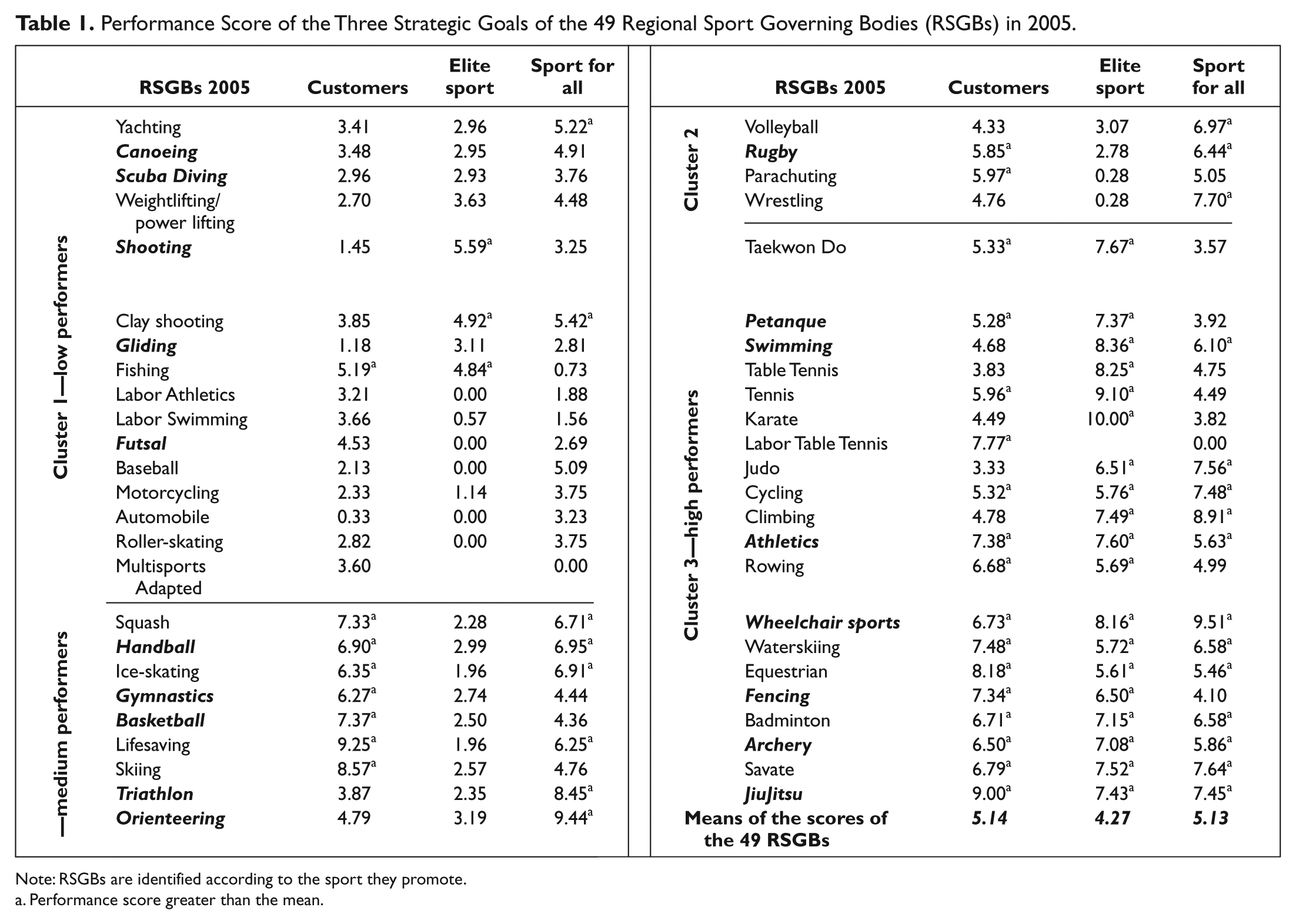
Note: RSGBs are identified according to the sport they promote.
Performance score greater than the mean.
Configurational Analysis
Table 2 shows a synthesis of the result of the primarily qualitative assessment of all the determinants for the sample 18 RSGBs. This is linked with the performance cluster in which they belong.
Configurational Data Matrix of the Determinants and Performance of the 18 Regional Sport Governing Bodies Selected.
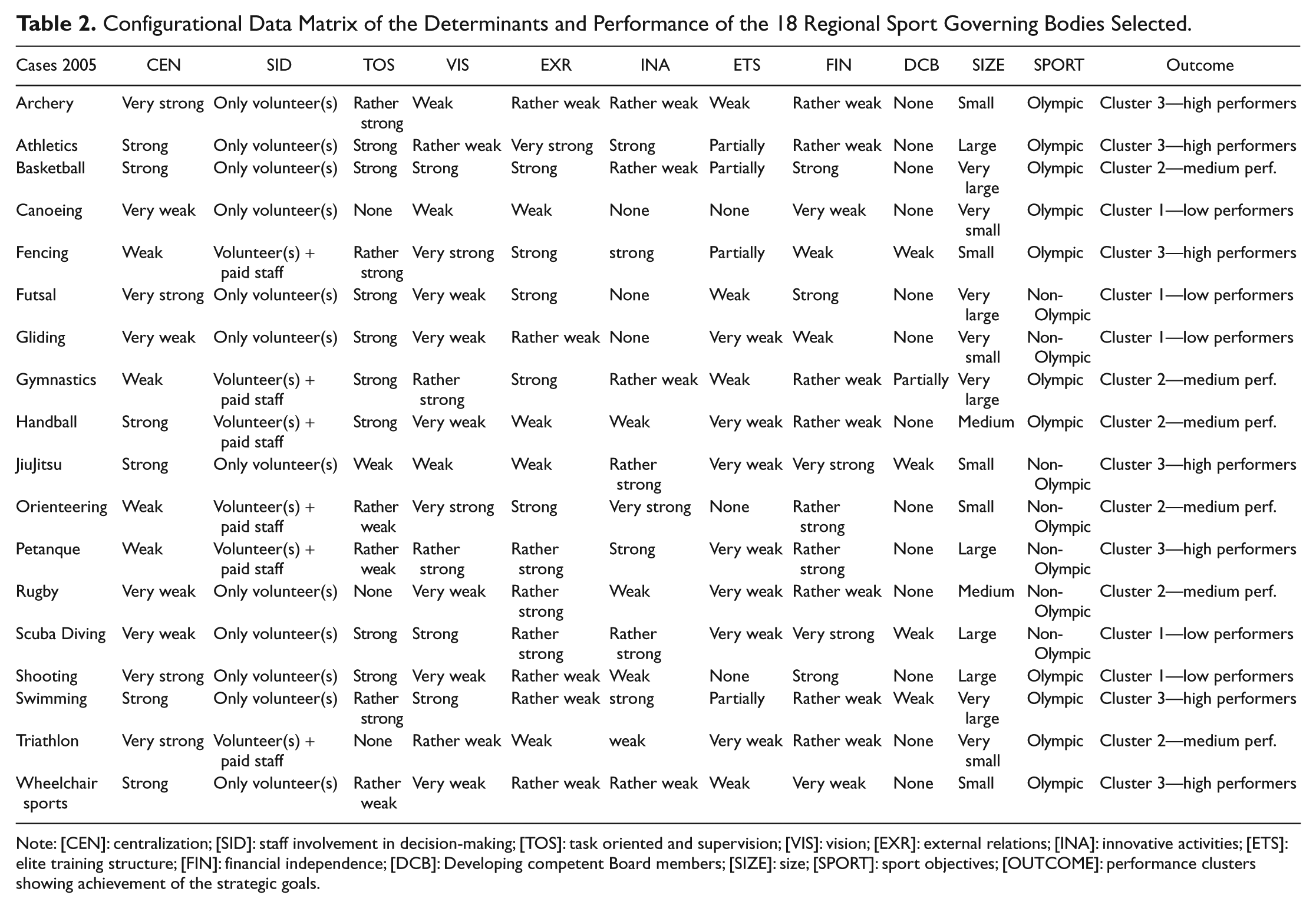
Note: [CEN]: centralization; [SID]: staff involvement in decision-making; [TOS]: task oriented and supervision; [VIS]: vision; [EXR]: external relations; [INA]: innovative activities; [ETS]: elite training structure; [FIN]: financial independence; [DCB]: Developing competent Board members; [SIZE]: size; [SPORT]: sport objectives; [OUTCOME]: performance clusters showing achievement of the strategic goals.
Eight RSGBs were governed by only one or two volunteers (the chair and/or the general secretary) without any paid staff being involved in decision-making processes. Amongst these, six showed a strong division of labor and supervision of staff. Three of them—archery, athletics, and swimming—are included in Cluster 3 and therefore performed highly.
Volunteers of seven RSGBs were involved in strategic planning and shared the same strategy as paid staff. Four of these showed strong external partnerships and the development of innovative activities for their members. Two of them performed highly: fencing and petanque.
In contrast, 11 RSGBs showed intraorganizational conflict or had a globally conflicting vision. Amongst these, six had a governance structure not involving paid staff and had weak external partnerships, partially due to a lack of financial and human resources. Nevertheless, three of them performed highly: archery, jujitsu, and wheelchair sports.
Seven RSGBs were somewhat financially independent from public funds, although no RSGB received appropriate resources from sponsorship. Five of them had more than 5,000 members, whereas 8 of the 10 small-size RSGBs were somewhat financially dependent. This shows the strong link between size and financial dependence on authorities.
Seventeen RSGBs showed no or weak development of board members as only gymnastics sought skilled board members. This makes this condition trivial (Ragin, 2008; Rihoux & Ragin, 2008). Indeed, the great majority of the RSGBs included in this phase of the research had no development of board members. Consequently, this was rejected from further analysis as it cannot be a key success factor.
Organizational Performance Analysis With csQCA
Building on the determinants of the sample of RSGBs and the achievement of their strategic goals, their organizational performance was analyzed. The outcome value of the seven high performing RSGBs is (1) (Cluster 3). The outcome value of 11 RSGBs (Clusters 1 and 2) performing at a low level is (0). The configuration of determinants presented by these 11 RSGBs cannot lead to high performance. This is discussed further below.
A first csQCA (minimizations with logical remainders with the software Tosmana 1.3) was performed to match and contrast the selected 18 RSGBs to eliminate negligible, redundant, and trivial determinants. Consequently, it identified determinants observed in high performing RSGBs, which are not redundant or trivial. QCA reveals five key determinants: (a) innovative activities [INA], (b) elite training structure [ETS], (c) centralization [CEN], (d) staff involvement in decision making [SID] and (e) size [SIZE].
The “truth table” (Table 3) with the five key determinants shows no contradictory configurations, and includes 12 configurations of conditions, each with a unique outcome value. Therefore, these key determinants might be sufficient, according to the cases selected, to “explain” the performance of RSGBs.
“Truth table” With the Five Key Determinants for the 18 Regional Sport Governing Bodies Selected.
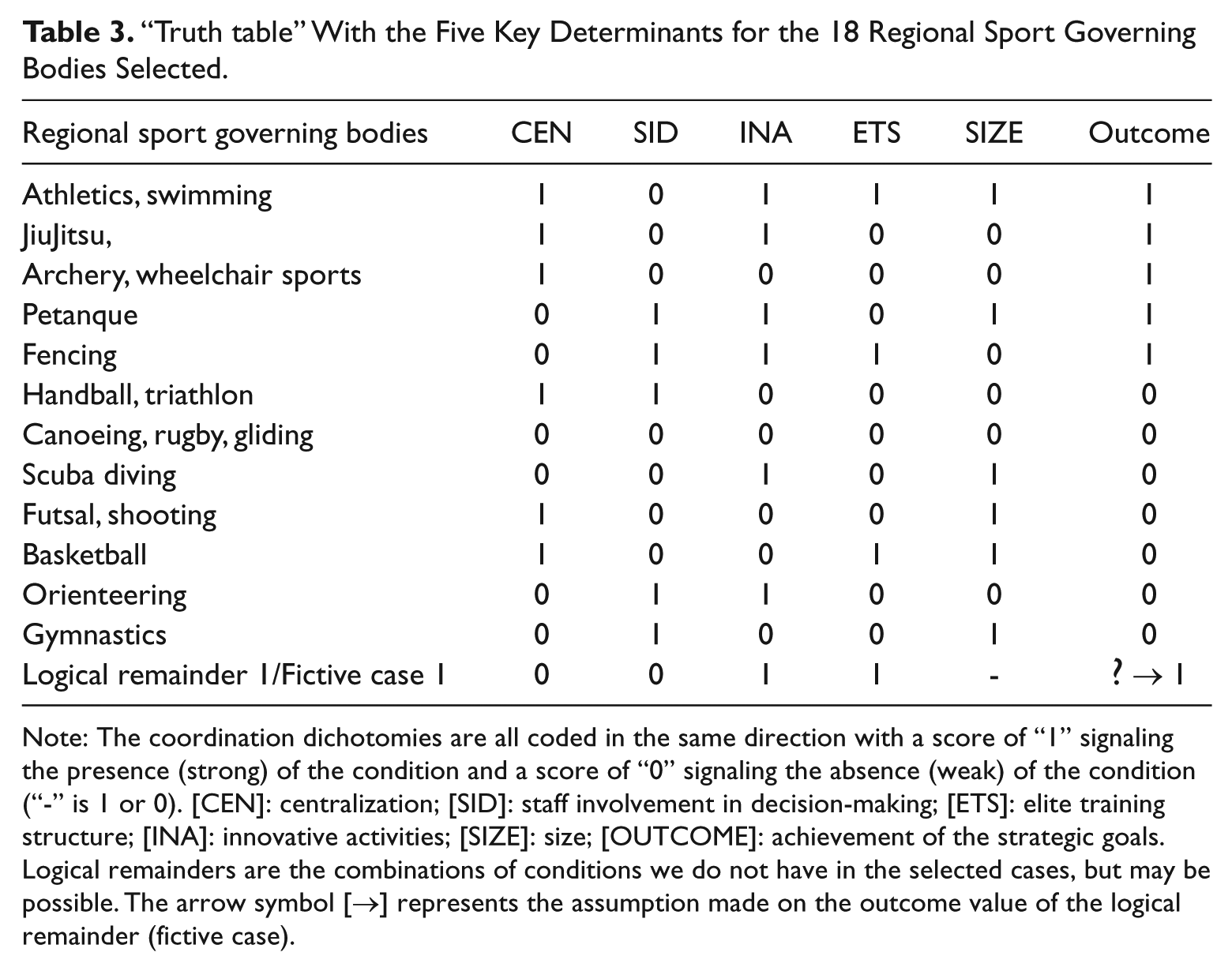
Note: The coordination dichotomies are all coded in the same direction with a score of “1” signaling the presence (strong) of the condition and a score of “0” signaling the absence (weak) of the condition (“-” is 1 or 0). [CEN]: centralization; [SID]: staff involvement in decision-making; [ETS]: elite training structure; [INA]: innovative activities; [SIZE]: size; [OUTCOME]: achievement of the strategic goals. Logical remainders are the combinations of conditions we do not have in the selected cases, but may be possible. The arrow symbol [→] represents the assumption made on the outcome value of the logical remainder (fictive case).
Figure 1 represents the solution for high performance of the second csQCA with the five key determinants. It results from minimizations with logical remainders and one fictive case 2 for which an outcome has been chosen. The determinants, expressed by their symbol, are followed by the values {1} or {0} according to the dichotomization. Basic logical operators are used to express the connections between the conditions. The [×] (multiplication) symbol represents the logical “AND.” The [+] (addition) symbol represents the logical “OR.” Finally, the arrow symbol [→] represents the link, usually causal, between the combinations of determinants and performance.
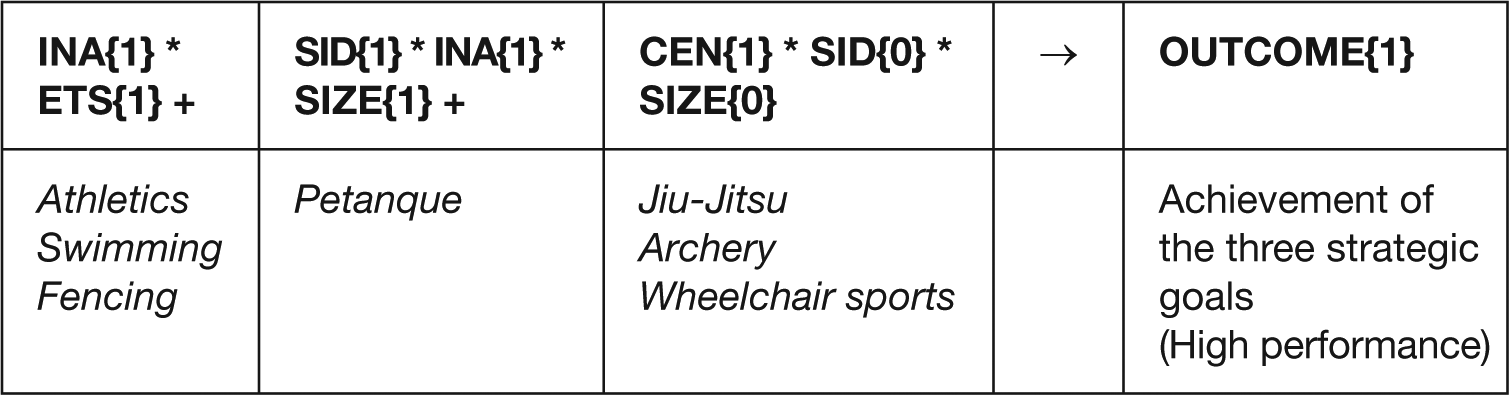
Solutions for high performance: minimization of the outcome value [1] with logical remainders.
The solution of the minimization for high performance can be read as follows: the outcome value [1], which is the high attainment of the three strategic goals, is observed:
in RSGBs that combine innovative activities [INA{1}] AND have an elite training structure [ETS{1}] OR involve paid staff in their decision-making processes [SID{1}] AND innovative activities [INA{1}] AND are large [SIZE{1}] OR centralization [CEN{1}] AND involve only volunteer(s) in their decision-making processes [SID{0}] AND are small [SIZE{0}].
This solution highlights three combinations of key determinants that are linked with high performance. First, it shows that RSGBs that develop innovative activities for their members and have an elite training structure are likely to achieve their strategic goals. Second, large RSGBs that develop innovative activities and are governed by volunteers with the involvement of paid staff may perform highly. Third, high performance can be associated with small RSGBs that are governed by one or two volunteers.
According to Marx (2005) the model combining six variables (five determinants and one outcome) to analyze the performance of 18 RSGBs is theoretically valid (ratio = 0.33). However, RSGBs also have several other determinants that impact on their internal functioning, which are considered in the following discussion.
Discussion
Interpretation of the results of this study through the face-to-face interviews with three of the selected RSGBs and a fine-grained analysis of each, led to the identification of three pathways to high performance (Figure 2). The three combinations of key determinants observed in high performing RSGBs (underlined and in bold in Figure 2) are the basis of these pathways. However, even though the key determinants are crucial in these pathways, they may only emerge under specific conditions and/or following specific determinants, which was suggested by the interviews and fine-grained qualitative analysis.
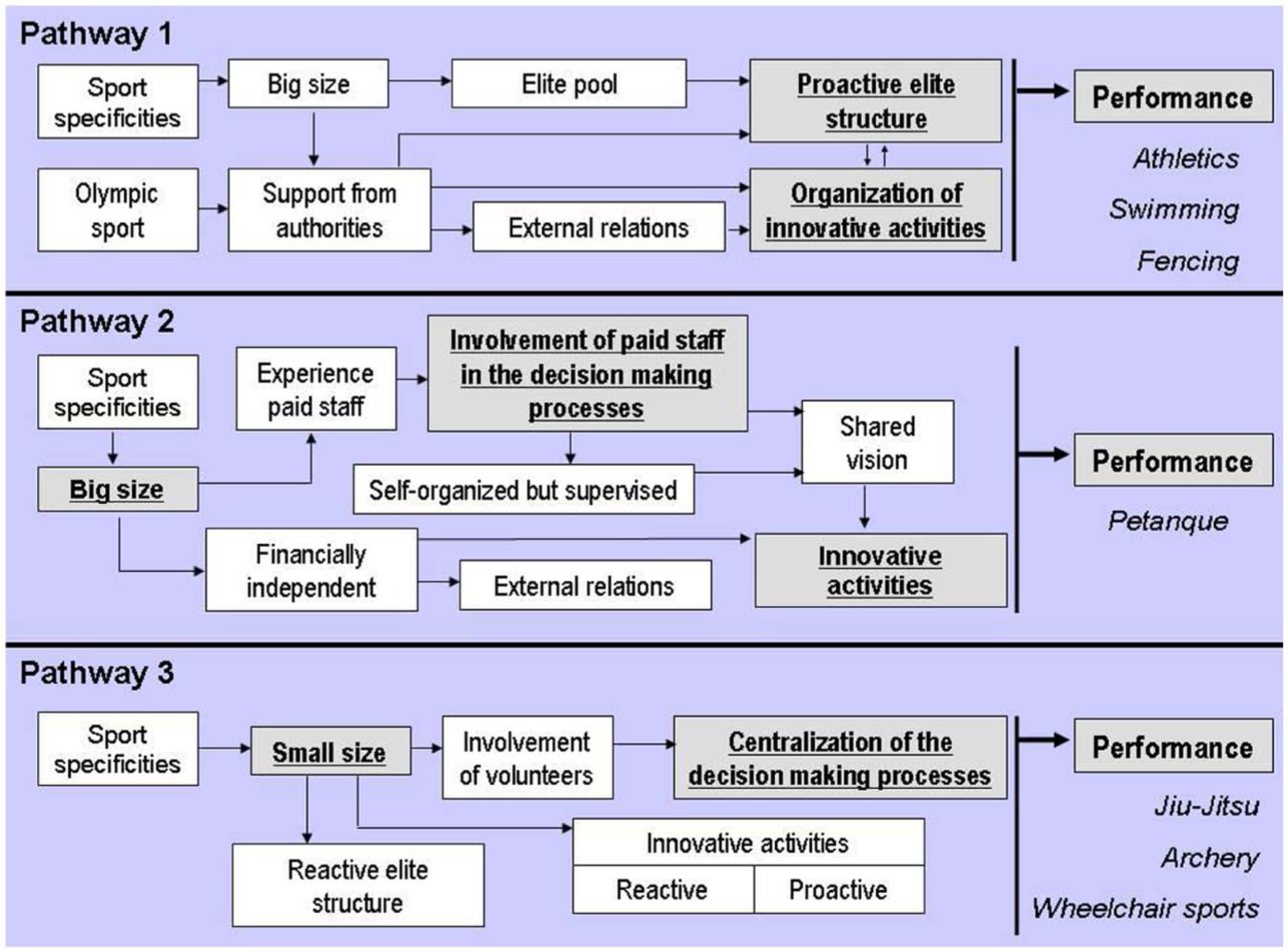
Pathways to high performance for regional sport governing bodies.
The first pathway is based on two key determinants: elite training structure and innovative activities (Figure 2, Pathway 1). The services RSGBs are able to provide to their members and elite athletes are considered crucial to performing highly. Athletics, swimming, and fencing develop systems to identify and develop talent as well as provide new sport services to satisfy their membership, such as organized active leisure in athletics. Thus they are proactive. The first two are large in size and the three of them are Olympic sports. Therefore, due to their sport characteristics, they receive large financial support from the authorities, which makes them financially dependent on public funds. They have sufficient revenue to invest in services for members as well as the identification of, and training structures for, their large elite athlete pool. Moreover, they can also invest in external relations to increase membership. In line with Madella et al. (2005) and Slack and Parent (2006) this first pathway highlights governing bodies that deliver new and different activities to satisfy their membership, while providing the necessary services to develop elite performance.
Petanque illustrates the second pathway and its key determinants are its large size, the involvement of paid staff in decision-making processes, and the development of innovative activities (Figure 2, Pathway 2). The two employees of this governing body have lengthy experience of 15 and 21 years, respectively. Consequently, the knowledge they have about the organization is often greater than the knowledge of the board. Thus they are involved in decision making and they organize themselves under the supervision of a Board volunteer. This trust between volunteers and paid staff results in a shared vision leading to the development of a common strategy realized through innovative services. Its large size allows petanque to keep experienced staff and to be financially independent so it is free to allocate resources for the strategy developed, which includes innovative activities. The reduced formalism (Zintz & Camy, 2005) and the crucial role experienced paid staff fulfill in the decision-making processes (Bayle, 1999; Glisson & Martin, 1980) argue in favor of the decentralization of management promoted by Schmid (2002). The development of innovative activities to satisfy and attract members seems to be particularly relevant for large-sized RSGBs. In addition, three RSGBs (handball, triathlon, and orienteering) performed highly against the sport for all strategic goal. Therefore, the involvement of experienced paid staff in the decision-making process is advised no matter the size of the sport governing body.
Jujitsu, archery, and wheelchair sports illustrate the third pathway of small size and governance led by one or two key volunteer(s) (Figure 2, Pathway 3). Due to their sport characteristics they do not attract a lot of members. Therefore, their financial and human resources are weak. They are not able to invest in an elite structure and/or innovative activities. However, contrasting with the arguments of Smith and Shen (1996) and Brown (2005), these RSGBs, with weak financial resources, achieve their strategic goals. They rely on committed volunteer(s) and delegate activities they are not able to deliver to their sport clubs. They are reactive in supporting their sport clubs. These small-sized RSGBs are governed by one or two leaders who are able to lead the whole organization despite some conflicts. As Bayle (1999) concluded, the presence of a strong leader can have an effect on performance and this might be particularly true for (very) small sport governing bodies.
Depending on financial and human resources, sport governing bodies need different approaches to achieve their strategic goals. If they have experienced staff and large or sufficient financial resources, they should be proactive and adapt services to membership as well as developing elite structures or involve paid staff in the decision-making process. If they have financial difficulties and/or nonexperienced staff, they should invest in specific activities and utilize the experience of their volunteer(s) and support their sport clubs to develop elite structures and innovative activities.
Conclusion
Based on a mixed-method design combining quantitative performance measurement, qualitative assessment, and crisp-set Qualitative Comparative Analysis (csQCA), three pathways to high performance for regional sport governing bodies in Belgium have been identified. Each pathway includes key determinants that have been observed in highly performing RSGBs:
innovative activities and an elite training structure;
large size, innovative activities, and the involvement of staff in the decision-making processes;
small size and great involvement of one or two volunteers in the decision-making process, and the delegation of some activities.
The services RSGBs are able to provide to their members and elite athletes are considered crucial to performing highly, particularly for large-sized RSGBs. However, not all RSGBs have the opportunity to provide many services because these need human and financial resources. The combination of size and paid staff involvement in the decision-making process has also been highlighted as critical. Depending on their size and the experience of paid staff, RSGBs should either focus on a creating a shared vision amongst the Board or rely on leaders. Large RSGBs should involve experienced paid staff in their decision-making processes and develop innovative activities, while small RSGBs should delegate activities they can not afford to offer. One leader of small RSGBs may be sufficient to manage them, but this is not advised for large RSGBs.
This study offers several implications for the managers of sport governing bodies (SGBs) who want to manage their organization in line with their financial and human resources. SGBs that have experienced staff and large or sufficient financial resources should be proactive in trying to achieve their goals. They should adapt their services to their membership needs and develop elite structures or involve paid staff in the decision-making process. Satisfaction of membership through the development of innovative sport services is seen as crucial to performing highly. SGBs that have financial difficulties and/or no experienced staff should invest in specific activities and utilize the experience of their volunteer(s). They should also support their sport clubs to develop elite structures and innovative activities. The presence of a leader is important for small organizations, whereas the involvement of experienced staff in decision-making processes, either by providing advice or taking part in decision-making, is seen as beneficial no matter what size.
Limitations and Implications for Future Research
There are two main methodological limitations to consider in this research. First, not all of the 49 RSGBs were analyzed in this research. This was so that in-depth interviews could be conducted. Second, every solution emerging from QCA has to be carefully interpreted. Even though this csQCA has highlighted five key determinants linked with high performance, the other determinants should not be neglected because they are part of the internal functioning of each RSGB. The dichotomous calibration should not be seen as a limitation and the assumption is that no information has been lost. Indeed, as Rihoux and Ragin (2008, p. 14) stated, it may be necessary to refer “back to the cases with all their richness and specificity.” Thus the fine-grained qualitative analysis of cases and narratives through interviews was used to give a reliable interpretation of the results investigating the pathways of high performance.
In spite of such limitations, QCA has proven to be an adequate method to understand which combinations favor performance in nonprofit sport organizations. The key success factors leading to high performance have been identified, as a consequence of the focus on combinations of the necessary and sufficient conditions of the QCA.
The results of this study suggest that researchers should analyze combinations of factors leading to performance and not just the net effects of variables. Indeed, this configuration analysis is useful to cover the simultaneous co-occurrence of possible multiple interaction effects, which infer some logically causal chains. It goes well beyond the net effects of independent variables and future research needs to take into account the way factors affect each other to produce results. Their presence (or absence) might lead to different results according to the factors with which they are combined. This is particularly relevant in the nonprofit (sport) organization context, due to the complexity of these organizations—combining volunteers and paid staff, multiple strategic goals, and mixed financing—which demands complex explanations.
Footnotes
Declaration of Conflicting Interests
The author(s) declared no potential conflicts of interest with respect to the research, authorship, and/or publication of this article.
Funding
The author(s) received no financial support for the research, authorship, and/or publication of this article.