




Abstract
This article follows Knoke in exploring how public incentives offered by professional associations (such as lobbying on behalf of collective interests) compete with private incentives (such as member networking opportunity) in promoting monetary gifts, voluntary coproduction of organizational outcomes, and commitment to the association. Olson’s contention that public goods do not motivate civic engagement has fostered several decades of research geared toward establishing the role of such goods in associational outcomes. Based on membership surveys of three engineering associations and two health care associations, the study concludes that private incentives are not universal motivators, while public incentives show some evidence of motivating engagement. Unexpected differences between the two fields of professional association are striking, prompting suggestions that current practitioners and future research give attention to field differences and resist overgeneralization regarding engagement motivations, outcomes, and commitment across professional fields.
In his landmark study of community engagement patterns of Americans over much of last century, Robert Putnam (2000) singles out professional associations. Putnam observes widespread disengagement from neighborhood and community association after World War II, and asserts that workplaces subsequently began to shape our patterns of engagement. In place of real connections, Americans joined more “tertiary” organizations (like the American Association of Retired Persons) where members had little opportunity or incentive to interact (Putnam, 1995; Wollebaek & Selle, 2002), and joined fewer associations. Professional associations, however, were unique because their membership numbers increased through the latter half of the 20th century, even though they were capturing smaller proportions of a burgeoning workforce. Although some members treat their professional associations as tertiary, others actively engage and coproduce content that enhances their career opportunities and develops the broader field. As secondary associations, professional associations mediate between individuals and institutions (Berger & Neuhaus, 1977; Cohen & Rogers, 1992; Tschirhart, 2006). Membership provides a means for political empowerment (Hooghe, 2003). Spanning tertiary and secondary space, professional association members enjoy a range of benefits, including purely private goods such as career advice and specialized field information, and public goods such as an amplified civic voice and the cultivation of normative standards of professional conduct.
Knoke (1988) recognizes the range of public and private benefits offered by professional associations and other “collective action” organizations. The “collective action” descriptor invoked another landmark study: Mancur Olson’s (1965) The Logic of Collective Action, which argues that individuals are singly motivated by their desire to maximize private gains, and that public gains are not enough to motivate association. According to Olson, collective action is best motivated as a “by-product” of private incentives. Although the importance of private incentives still strongly underlies economic treatments of voluntary association (Barbieri & Mattozzi, 2009; Page, Putterman, & Unel, 2005), Olson’s position became the straw man for a long line of research and theory aimed at demonstrating the independent value of public goods motivations. Knoke (1988) describes this line, and then adds to it. Based on a national (U.S.) survey of 20 membership associations and their members, Knoke documented the incentive structure and motivations of members to participate in recreational associations, women’s organizations, and professional associations. He reports that members with public goods motivations are indeed willing to participate in, give time or money to, or otherwise show commitment to their professional associations.
Twenty-five years later, no other studies have explicitly taken up Knoke’s public–private goods argument for why individuals are active (or inactive) in or committed (or uncommitted) to their professional associations. This article aims to do so. In addition to exploring the modern relationship between public or private incentives for member engagement, it explores the influence of simple lifecourse predictors (e.g., age, education level) that Knoke relegated exclusively to controls. Finally, it considers the implications of the study’s findings for practice, particularly for managers of professional associations who seek to engage their members and satisfy their collective desires for public goods.
Professional Associations
Professional associations are identification and organizing bodies for fields of professional practice. They are “professional” because they facilitate field knowledge, provide normative frameworks for practice, and serve as change catalysts (Rusaw, 1995). Friedman and Phillips (2004) go so far as to say that such associations are “an essential component of professionalism” (p. 187), providing the identity necessary for workers to gain standing in their field. They are “associations” because they serve members and rely on members for the coproduction of benefits. Gruen, Summers, and Acito (2000) note that members of professional associations create and deliver much of the value enjoyed by the membership (i.e., “coproduction”). Gazley (2013) defines this coproduction as volunteerism, as do Mook, Handy, Ginieniewicz, and Quarter (2007) who document the value of active members in the creation of identity and outputs for ARNOVA (Association for Research on Nonprofit Organizations and Voluntary Action).
Members ideally enjoy a range of benefits from their professional associations, although some members may value some benefits more than others. The reasons why they might choose to actively participate in, give money to, or otherwise show commitment to their association hinge on a variety of personal and environmental forces (Smith, 1994). The historical and environmental conditions of particular fields are likely sources of variation. Modern professional associations evolved from craft guilds (Vollmer & Mills, 1966), and some display the constraining and facilitating influences of those guilds. For example, in engineering fields, professional associations play an important role in certification and licensing. Tschirhart (2006) notes that before the U.S. Supreme Court ruled against it in 1978, the National Society of Professional Engineers banned its members from competitive bidding on engineering services. Still bound to that history, engineering professional associations have a particularly strong influence on the field and its members, structuring relationships and acting as a gatekeeper of professional identity.
In contrast, Rodenhauser (1999) characterizes typical professional associations in the health care field as less bureaucratic, although he points to the American Psychological Association (Crawford, 1992) and the Association of Canadian Medical Colleges (Carriere & Ryten, 1993) as counterexamples. A more typical example is nurses associations, which focus more on the promotion of health practices rather than enforcement of them (DeLeskey, 2003; Van Achterberg et al., 2006). Welchman and Griener (2005) describe nurses associations as increasingly weak instruments for advocating for needs of patients, abdicating collective action in favor of advocacy by individual nurses. Health professional associations vary, but they differ collectively in substantive ways when compared with the stronger hands of typical engineering professional associations. Exploration of the differences between engineering and health care associations is one of the topics of this article.
Public Engagement Motivations
Aside from environmental and historical forces, the assumption underlying the present study is that individual members choose to engage their professional associations for different personal reasons. Olson (1965) contends that collective action is privately motivated. However, among other competing motivations, a sense of fairness and fair play can override a single-minded focus on private goods (Marwell & Ames, 1979). Knoke (1988) demonstrates that collective (public) goods motivate collective action in professional association membership. Gazley and Dignam (2010) emphasize the public benefits of member participation in professional associations, from “building a profession that he or she cares about” to “the opportunity to improve society” (p. 5).
Public goods need not always be exclusively for others, however: de Tocqueville (1835/2000) popularizes the notion of enlightened self-interest, where individuals work for a common good so that they themselves can benefit from it. Professional field development is a public good where members are likely to benefit, which perhaps partially satisfies Olson’s contention that collective action is motivated as a by-product of self-interest. Following Knoke (1988), public goods are differentiated here from private goods to the extent that members value the collective benefits over individual benefits, regardless of whether individual members ultimately benefit or not.
Knoke’s primary public incentive was for the normative establishment of the field. A field will only become established when the members and public know its boundaries and accept its legitimacy. Writing about the establishment of the field of computer engineering, Nerland (2010) argues that associations are essential for establishing expectations among professionals and for shaping “their energies, efforts, and desire in certain directions” (p. 183). Greenwood, Suddaby, and Hinings (2002) contend that professional associations play a role in transforming fields by legitimating change and diffusing innovations. Normative expectations are established through promotion of the field and increase in public awareness of its contributions.
Second, Knoke describes the expectation that professional associations will lobby on behalf of the interests of the field, including the collective membership and those served by the field. Barbieri and Mattozzi (2009) recognize the strong influence of private goods motivations, but assert that the main purpose of associations is to lobby. When associations speak on behalf of their membership, they are fulfilling the primary purpose of secondary associations: providing a voice that mediates between ineffectual individuals and faceless institutions (Berger & Neuhaus, 1977; Frumkin, 2002; Mendel, 2003). Knoke (1988) includes under lobbying “trying to change the values and beliefs of the public” (p. 318), which might include such image mechanisms as establishing and promoting a code of ethics.
Private Engagement Motivations
While public incentives may motivate member engagement in professional associations, private incentives are expected to drive engagement (DeLeskey, 2003; Wilson, 1997). Knoke (1988) emphasizes affective bonding as an important motivation: Professionals join their associations for social and recreational activities and the opportunity to form friendships. Unfortunately, social incentive measures are not available in the present study’s data. Two private motivations, however, follow directly from Knoke’s incentive scales.
The first is occupational advantages, which Knoke (1988) describes as helping members with job searches, providing professional contacts, and improving members’ economic conditions. We add to this list the opportunity for members to gain leadership through coproduction of activities in their professional associations.
The second type of private incentive is informational. Knoke includes newsletters and journals, data services, and conferences and workshops as key information services valued by members. These benefits will be familiar to ARNOVA (2013) members, because the journal and conference dominate the list of benefits available to its membership. Collectively, occupational and information incentives are considered to be private motivations for greater involvement in coproduction of activities in and commitment to professional associations.
Lifecourse Drivers
Household income level, education level, age, and sex are “background” variables that have long been common in studies of associational membership and activity (Gazley, 2013; Knoke, 1986). Knoke emphasizes differences between men and women due to workplace changes stemming from the increase in the number and proportion of women in the workforce over the past century. Rotolo (2000) documents how the difference in how men and women experience life cycles affects renewal rates in membership associations. In sum, these lifecourse drivers provide the basis for evaluating the extent to which social position, socioeconomic standing, or stage of life influences engagement (cf. Penner, 2002).
Two additional background variables are more directly relevant to the study of member engagement. One is the number of years that someone has been a member of the association. Knoke (1988) documents a positive effect of tenure with one’s professional association and internal participation and degree of commitment. While he did not find statistically significant effects of longevity of association on the propensity to contribute money or volunteer with the association, these relationships are explored in the present study. Evaluation of the longevity question should be mindful of Cress, McPherson, and Rotolo’s (1997) finding that greater associational participation leads to shorter membership durations, ostensibly due to burnout of active participants.
Finally, a relationship unexplored in the Knoke (1988) study is how one’s career position level might influence one’s relationship with or commitment to one’s professional association. Entry-level professionals may have more to gain from job postings and advice available from their associations. Midlevel and senior professionals may also seek career advancement information, but may be more likely to get it from networks facilitated by the association rather than from job banks. Entry-level professionals may participate more in the coproduction of associational activities, whether as a rite of passage, for résumé building, or as a means of developing professional connections. Senior-level professionals may be in a better financial position and may face stronger normative expectations for making charitable contributions to their professional association.
Dimensions of Engagement
The present study explores three of Knoke’s five organizational involvement concepts: giving of money (charitable contributions beyond payment of dues), giving of time (volunteering for coproduction of organizational outputs), and commitment to the association. Giving and volunteering are not only important organizational inputs but also indications of engagement: Membership in greater numbers of voluntary associations is associated with a greater propensity to give and volunteer (Jackson, Bachmeier, Wood, & Craft, 1995). Giving to one’s professional association follows from identification with some dimension of its cause, regardless of whether that identification is associated with private or public goods. Schervish and Havens (1997) isolate identification with the cause as key in the decision to give. Membership precedes participation, which leads to relationships, to encounters, to identification, and ultimately to giving. Gazley and Dignam (2010) emphasize the development of long-term supportive relationships with members as a precursor to soliciting charitable contributions from members of professional associations.
Puffer and Meindl (1992) make a similar claim regarding the motivations of volunteers, emphasizing the relationship between the motives of individuals and their desire to contribute to a cause. “To ensure good performance,” they write, “volunteers should be given incentives based on how their motives fit with the organization’s values” (Puffer & Meindl, 1992, p. 433). Presumably, professional association members will not volunteer their time with the association unless their task directly aligns with their motives for joining the association. Gazley (2013) emphasizes the role of personal beliefs and values. These motivations can be private or public, with the coproduction of content generating either private or public goods.
Knoke’s (1988) study of member incentives considers how different motivations translate into commitment to the organization, measured by one question (“How committed do you feel to [organization name]?”) on a 5-point scale. However, he treats the concept of commitment more fully in earlier work, where he concludes that communication with members and having them participate in decisions are essential precursors of commitment (Knoke, 1981). Scholars have returned to this concept repeatedly over the ensuing decades (Roy & Berger, 2007). Gruen et al. (2000) offer a particularly appealing treatment, representing commitment as psychological attachment to organizations. They consider three different types: continuance commitment, which manifests as the perception of loss that would come from leaving the association; normative commitment, which manifests as moral obligation to the association; and affective commitment, which manifests as the degree of favorability that one feels about the association. Although the present study measures commitment differently from Knoke’s study, both focus on affective commitment. Knoke reports greater commitment from professional association members who valued public goods (normative and lobbying), and lesser commitment from members who valued private goods (principally on occupational measures). In a full analysis of how public and private goods motivations are related to engagement and commitment in professional associations, we seek to test these associations once more.
Data and Method
Data collected by the American Society of Association Executives (ASAE) in the spring of 2009 provide an opportunity to explore these questions. ASAE’s Decision to Give study featured a core survey instrument used to collect information from members of three professional associations in engineering and two in the health care field. Each association drew a sample of members and a subsample of lapsed or potential members.
The three professional associations representing different quarters of the engineering field are the American Society of Civil Engineers (ASCE), the Institute of Electrical and Electronics Engineers, and the American Production and Inventory Control Society. ASCE drew the largest sample (approximately 12,300), and had the lowest completion rate of the five associations (9.5%). Overall, the three engineering associations sampled approximately 30,400 individuals and garnered 3,464 surveys, a completion rate of 11.4%.
Two professional associations represent the health care field: the American Academy of Neurology and the American College of Healthcare Executives (ACHE). These two associations drew the smallest samples of the 6 participants, approximately 3,000 and 3,500, respectively. ACHE achieved the best completion rate of the five associations studied, at 17.5%. The two health care associations together achieved a completion rate of 13.9%, with 901 individuals responding.
Collectively, the five professional associations under study returned 4,365 surveys out of 36,900 sampled, an overall completion rate of 11.8%. This low rate of completion should raise fairly serious concerns about nonresponse bias (Hager, Wilson, Pollak, & Rooney, 2003), with more committed members more likely to complete the survey. We discuss this limitation in the conclusions, but also take it into account when operationalizing the commitment measure (see details below).
Decision to Give study respondents include nonmembers. Respondents claim membership in as many as 10 professional associations. The current analysis restricts the study to those respondents who claim to be current members of their respective professional association, and who consider that association to be their primary professional affiliation. The final study sample therefore numbers 2,879, including 2,271 across the engineering societies and 608 across the health care societies.
The three dependent variables are donation, volunteering, and commitment, all measured as simple binaries (yes/no). To measure donation, the survey asks whether the respondents have ever made any gifts of money to their subject professional association, not including membership dues and volunteer time. All professional associations in the study had an affiliate that allowed them to receive tax-deductible charitable contributions (Gazley & Dignam, 2010). Nearly a quarter of cases (23.2%) answered that they had made a charitable contribution; 67 cases skipped this question and fall out of analyses where donation is considered.
To measure volunteering, the survey asks whether respondents performed work for their subject professional association over the past 12 months. The survey provides a number of examples for guidance, with three in five volunteers serving on a committee or task force, and half actively recruiting someone else to become a member. Other volunteer duties include mentoring of junior members, conducting research on behalf of the association, raising contributions, speaking to groups, and conference planning. Similar to donation, approximately a quarter of cases (25.6%) answered yes on volunteering; one case is missing and falls out of associated analyses.
The third dependent variable is (affective) commitment, measured by a question that asks respondents whether they would recommend membership in their subject professional association to a friend or colleague. Respondents select a point on an 11-point continuum ranging from extremely unlikely (A) to extremely likely (K). Members tend to respond positively on such questions, but this effect is accentuated by the fact that happy and committed members are more likely to be among the smattering of respondents (selection bias). Some respondents did answer in the lower part of the scale (A-E), although each step includes only 1% to 2% of the cases. In creating a binary variable from this continuum, one strategy would be to break the respondents around the scale midpoint (F). However, due to concerns regarding bias, this measure conservatively includes only the top two categories (J, K) as an indication of commitment. This effectively breaks the respondents in half, with 50.3% of respondents falling onto the positive side of the commitment binary; 108 cases failed to select their spot on the commitment continuum, and therefore fall out of analyses where commitment is considered.
A quarter of respondents donate, and a quarter volunteer, and half display a positive level of commitment, raising the question of whether the committed donors and volunteers are mostly the same people. The Venn diagram in Figure 1 illustrates that this is generally not the case. One third of study respondents (33.4%) are passive members of their primary professional associations, displaying a low level of commitment and donating neither time nor money to its operations. The other two thirds, however, show some combination of engagements. That said, only 6.6% of respondents donate, volunteer, and claim a high level of commitment. They are more likely to be committed and donate only (11.1%) or be committed and volunteer only (10.2%); no respondent donates and volunteers without voicing a high level of commitment for his or her engineering or health care professional association.
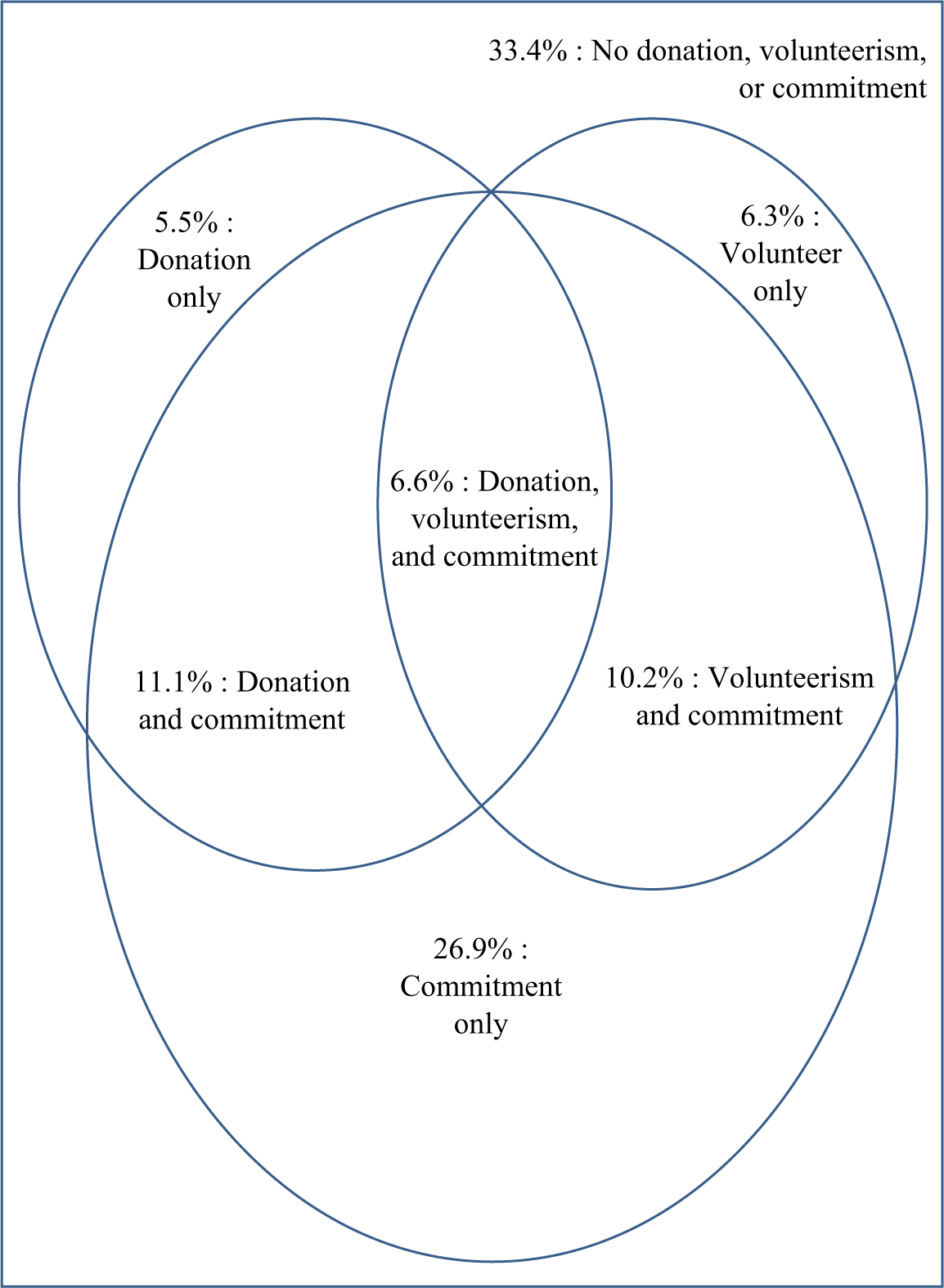
Overlap of respondents who donate, volunteer, and claim commitment to their engineering or health care professional associations.
With half the study sample displaying commitment and only a quarter claiming donations or volunteerism, we should already suspect that a large contingent of members will fall into the commitment-only space in the diagram. Indeed, they constitute 26.9% of the study sample. On the wings, a substantial minority donate only (5.5%) or volunteer only (6.3%) while voicing a relatively low level of commitment for their association. Figure 1 illustrates that our dependent variables overlap to some degree, but otherwise constitute three distinct behaviors or dispositions of engagement, at least among the engineering and health care professional associations under study.
The central analysis in this article concerns the theoretical relationship between those engagements (donation, volunteerism, and commitment) and two varieties of independent variables: public and private incentives generally modeled after Knoke (1988) and a variety of lifecourse variables. Incentives are motivations for engagement; association members participate more when they perceive more opportunities for influence (Wells, Ward, Feinberg, & Alexander, 2008). The incentive measures are derived from a series of eight motivation questions prefaced with “How important is it to you that [association name] deliver the following types of programs, benefits, and services to you or your profession?” Each is answered on a 5-point scale. Missing data was an issue on some questions, so their values were estimated to preserve the cases in the analysis. 1 The incentive items were then factor analyzed using the principal components method with varimax rotation, reported in Table 1. The two factors with eigenvalues more than 1.0 are selected, clearly differentiating public incentives from private incentives, as measured in this study.
Pattern Loadings From Principal Components Factor Analysis (Varimax Rotation) of Incentives for Members of Three Engineering and Two Health Care Professional Associations.
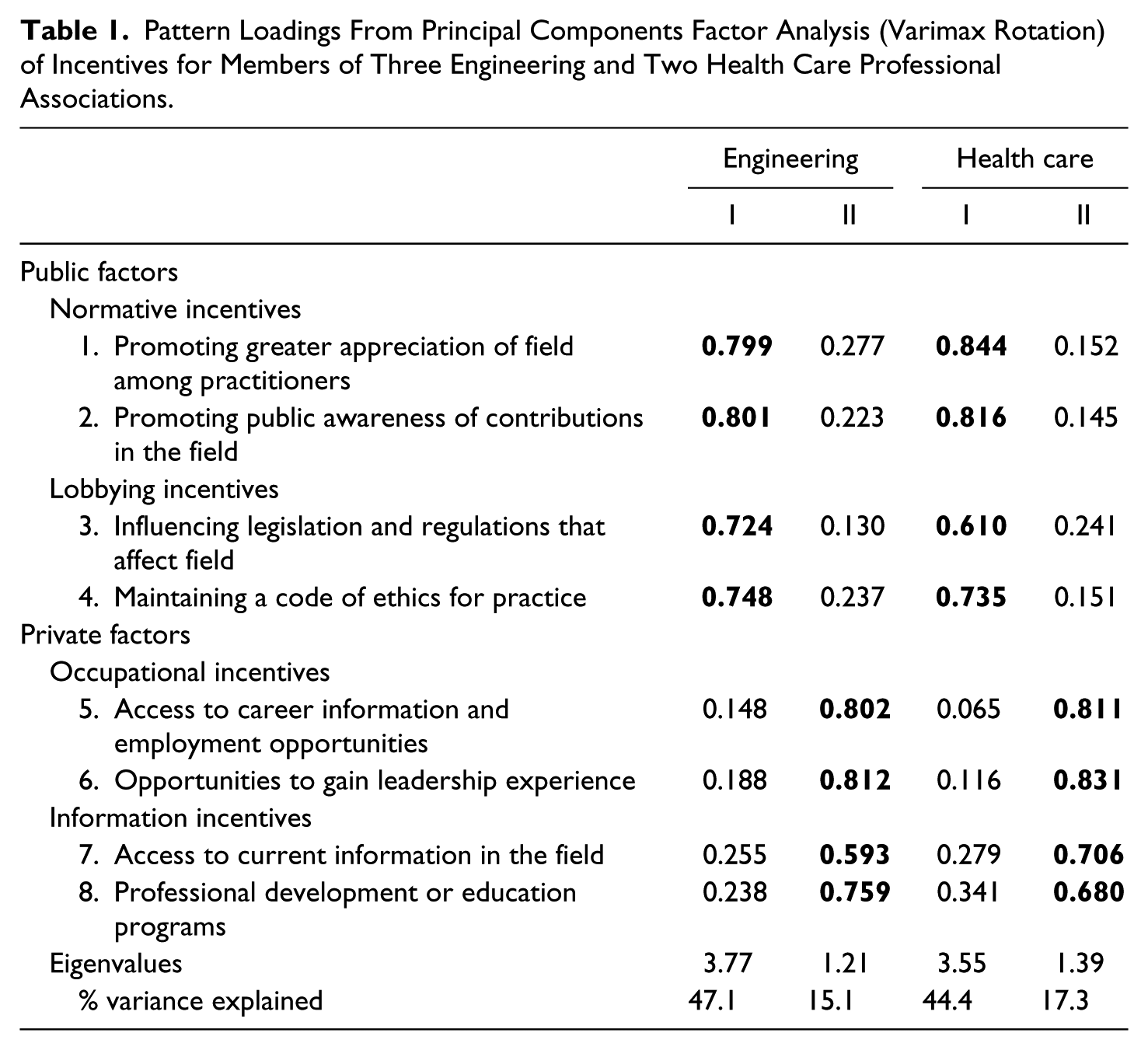
In Knoke’s (1988) study, normative and lobbying incentives are loaded onto separate factors. In the present study, the two normative and two lobbying measures load onto a single public factor, explaining 47.1% of the variance in the three engineering professional associations studied and 44.4% of variance in the two health care professional associations. Similarly, for Knoke, the occupational and informational incentives were sufficiently differentiated among the 35 associations studied to support distinct factors. In the present study, where only five associations represent two fields, the four measures for these two incentives load onto a single private factor. These private incentives explain an additional 15.1% of the variance in the engineering member factor structure and 17.3% for the health care respondents.
For analysis, single public and private measures are created by summing the Likert-type integers for the four questions in each factor. Means for the individual items and the public and private measures are provided in Table 4.
Knoke controls for an assortment of organizational characteristics, none of which are available in the Decision to Give individual-level data set. However, Knoke also controls for individual-level lifecourse characteristics such as years of membership, income, education, sex, and age, all of which are available for the current analysis. For years of membership, respondents write in the approximate number of years (“tenure”) that they have been a member of the subject professional association. Responses range from 1 to 50 years, with an average of 15.8 years for the engineering association respondents and 19.1 years for the health care respondents.
Household income is pretax 2008 income reported in one of six categories. For analysis purposes, less than US$25,000 is coded as US$20,000; US$25,000 to US$50,000 is set to the midpoint of US$37,500; US$50,000 to US$100,000 is set to US$75,000; US$100,000 to US$150,000 is set to US$125,000; US$150,000 to US$200,000 is set to US$175,000; and US$200,000 or more is set to US$225,000. The overall median response is US$125,000, and the mean is US$110,580 for the engineering association members and US$125,910 for the health care members.
For education, respondents select their most appropriate level of education. To create a meaningful ratio measure, each level is set to its approximate number of years of education. High school or less is set to 12; some college is set to 13; associates degree or equivalent is set to 14; bachelors degree or equivalent is set to 16; masters degree or equivalent is set to 18; PhD, JD, EdD or equivalent, as well as MD or DDS, are set to 21; 83 cases selecting “other” are arbitrarily set to 16. The overall median number of years of education is 18; the mean is 17.4 years for the engineering members and 18.9 years for the health care members.
Due in large part to the industries studied, the sample is disproportionately male: 83% male across the engineering associations and 73% male across the health care associations. The sex variable is coded as male = 1 and female = 0. Respondents are asked to report their birth year. Age is calculated as 2009 minus birth year, ranging from 19 to 99 years with a mean of 48.4 years for the engineering respondents and 53.5 years for the health care respondents.
Career level is self-reported in four levels: entry, mid, senior but not chief executive, and chief executive. For analysis, the latter two categories are collapsed into a single senior position variable (46% in engineering and 69% in health care). A midlevel dummy variable is constructed from those that reported mid (48% in engineering and 22% in health care). These two variables are entered into the models below, with entry level (6% and 9% in engineering and health care, respectively) as the reference category. All control variables except sex have missing data, due to the decision of respondents to skip particular questions; for these cases, missing values are estimated from other relevant variables. 2 Means for all variables (and tests for differences between means) appear in Table 4.
Results
Tables 2 and 3 report logistic regression models separately for engineering and health care professional associations. As the number of cases differs dramatically across the engineering and health care association respondents in the study, the engineering association cases in these models are weighted with a value of 0.267 so that the ns (and therefore any effects) are directly comparable across the two types of associations. Overall, the health care association models (Table 3) produce more statistically significant results, mostly among the lifecourse variables. As noted above, the engineering field relies more heavily on its professional associations for licensing and certification, and therefore for professional identity, than the health care field. The overall difference in effects across the two tables may indicate generally that engineering professionals are more likely to give, volunteer, and voice commitment to their professional association regardless of incentives, demographics, or status of career.
Logistic Regression of Involvement Measures on Incentive Scales for Engineering Professional Association Members.
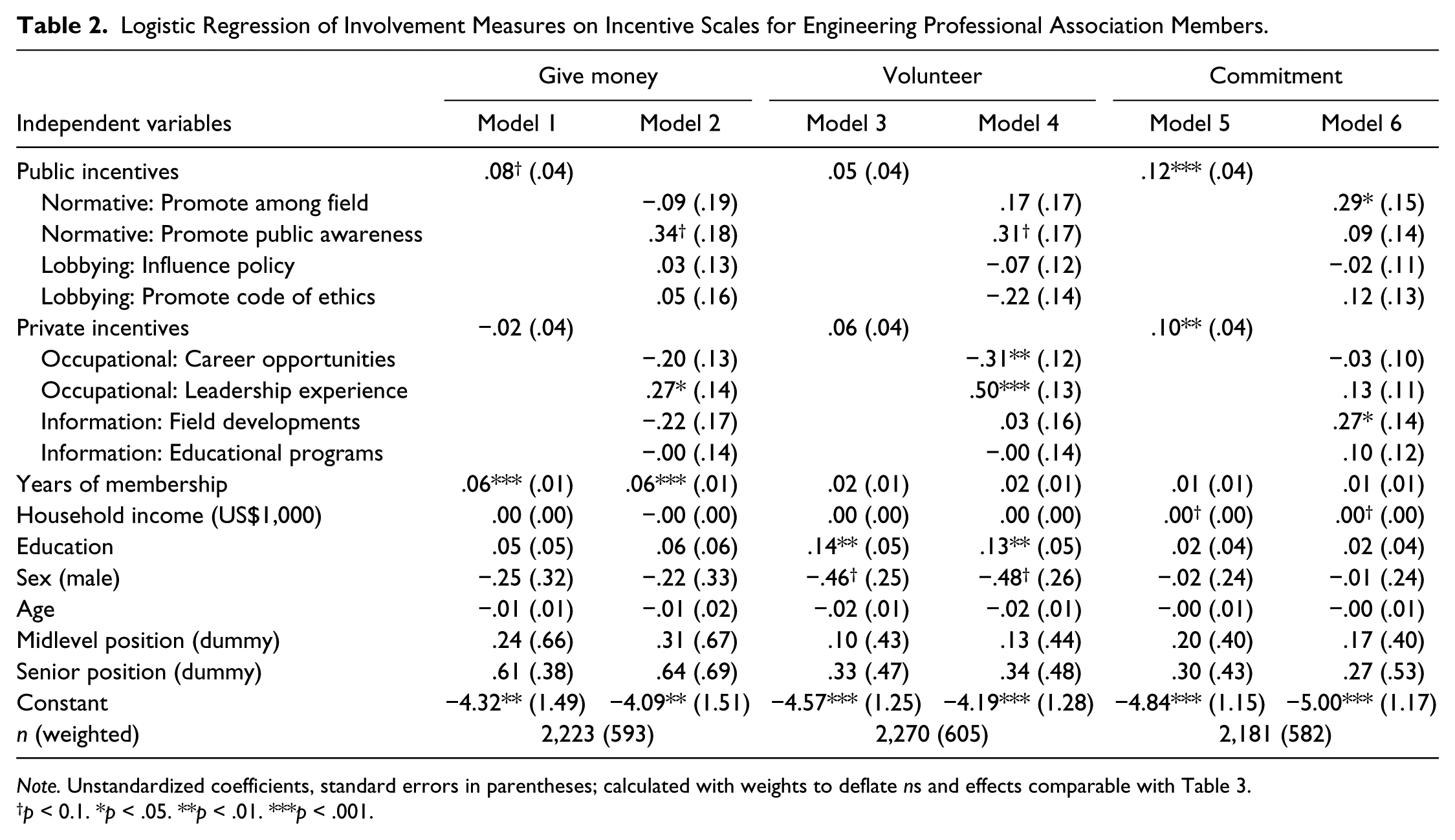
Note. Unstandardized coefficients, standard errors in parentheses; calculated with weights to deflate ns and effects comparable with Table 3.
p < 0.1. *p < .05. **p < .01. ***p < .001.
Logistic Regression of Involvement Measures on Incentive Scales for Health Care Professional Association Members.

Note. Unstandardized coefficients, standard errors in parentheses.
p < 0.1. *p < .05. **p < .01. ***p < .001.
Regarding charitable contributions, engineering association members give without regard to what they value in their professional association’s programming, public or private. Public incentives approach statistical significance in Model 1, ostensibly due to the value that engineering association members place on their associations’ efforts to promote public awareness of the field’s contributions (Model 2), but the effects are negligible. In contrast, despite the overall lack of influence of private incentives on charitable contributions to engineering associations (Model 1), those members who value opportunities to gain leadership experience are more likely to give money (Model 2). A similar result can be found in members of the health care associations (Table 3), where Model 7 reports the statistically significant value of private incentives on giving decisions, again due in large part to the valuation of leadership experience gained through involvement in the association (Model 8).
Most influential in charitable giving to the associations under study is tenure in the association: People who have been members longer are more likely to make contributions, regardless of income or career position. For health care association members, more years of education also translate into a greater likelihood of giving.
The conditions under which members are more likely to volunteer their time for the coproduction of association outputs differ markedly between engineering and health care professional associations. As with charitable giving, public incentives show little influence on decisions to get involved with coproduction of organizational outputs in either field. Private incentives also display little influence overall (Models 3 and 9), despite the influence of specific measures. In both fields, the overall influence is canceled by the strong positive valuation of leadership experience and the negative association between the valuation of career information and volunteer participation (in engineering; Model 4) or the negative association between valuation of access to current information and volunteer participation (in health care; Model 10). This observation provides qualified support for the value of certain private incentives in understanding voluntary coproduction in different professional associations.
Lifecourse drivers differ more noticeably in volunteering. For engineering associations (Table 2), members with higher levels of education are more likely to participate. The marginal influence of sex suggests that women are marginally more likely to volunteer in these associations than men; the effect is negligible, but the only time that sex shows potential for effect across any study model. In contrast, volunteering among health care association members is not associated with education or sex, but with longer tenure in the association and greater household incomes. The influence of age also makes its only appearance here, with younger health care association members more likely to volunteer in the health care organizations studied (Table 3).
The commitment models provide the greatest insights into the values of different public and private incentives. For engineering and health care associations, overall measures of public incentives (Models 5 and 11) are associated with greater commitment. In both cases, members who value the role of the association in promoting greater appreciation of the field among practitioners are themselves more willing to promote the field to their own colleagues (Models 6 and 12). Private incentives show overall influence for engineering associations (Model 5), but the effect is negligible for health care associations (Model 11). Model 6 suggests that the effect for engineers is driven by the value they place on their association’s role in providing them access to current information in the field. For health care members, the private incentive of leadership experience shows promise in explaining greater levels of commitment (Model 12).
The level of commitment reported by engineering association members is unrelated to any of the demographic measures. However, for health care association members, tenure of membership shows the same strong influence demonstrated for giving and volunteering decisions. However, other than the length of time that these members have spent in their association, commitment is unrelated to other lifecourse drivers.
Discussion
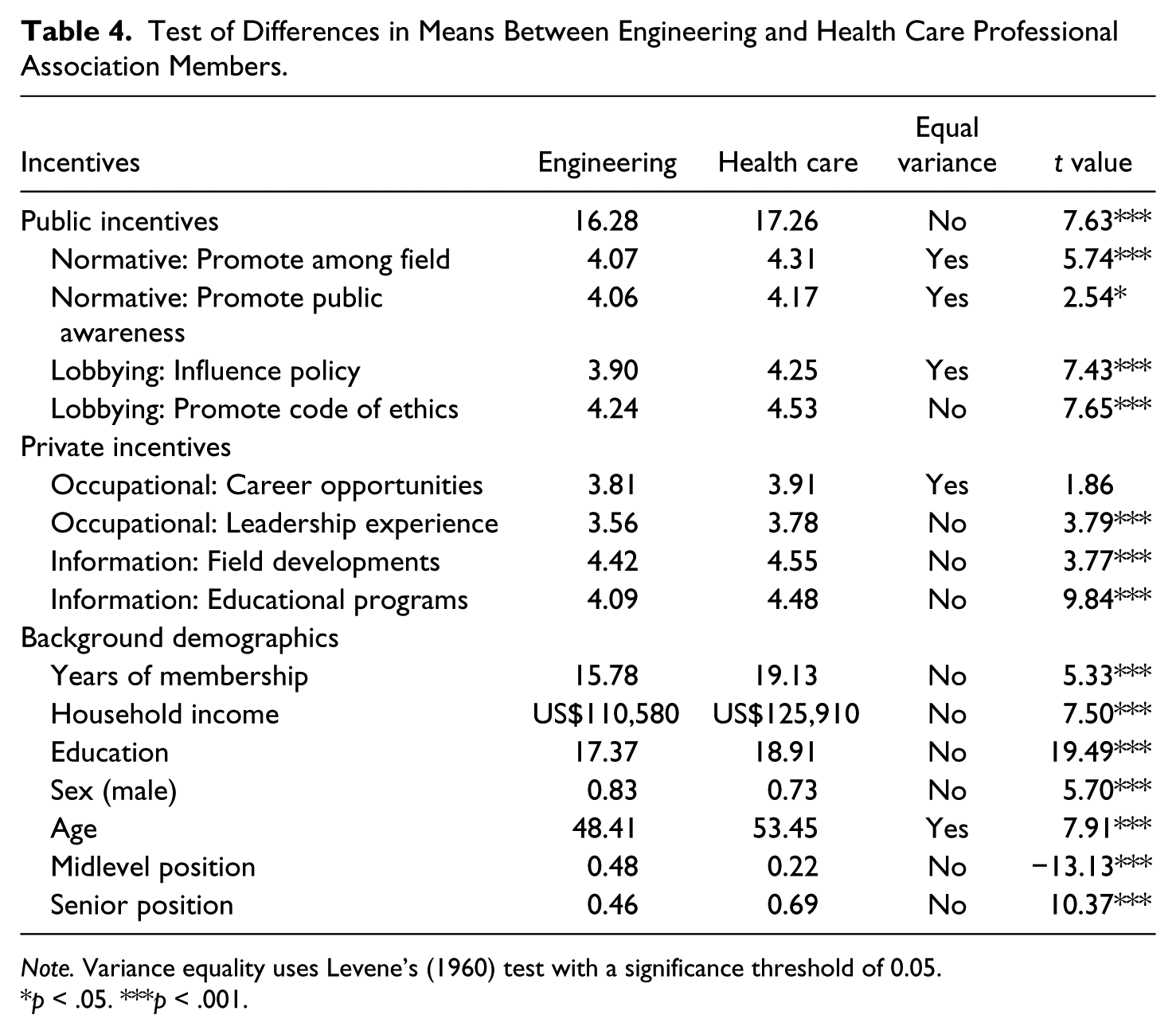
These observations about the differences between the engineering and health care association member models raise unexpected questions about the differences between their motivations and expectations of their associations. Moe (1980) first considers the difference between public- and private-member motivations in professional associations, but only considered economic associations. Knoke (1988) differentiates professional association motivations from recreational associations and women’s membership organizations, but does not consider variations within types of professional associations. Other research on professional associations, including Gazley and Dignam’s (2010) work with these data, generalize about organizational behavior and member motivations without exploring differences between various field associations. How different are the memberships of these two types of professional associations? The discussion above suggests that engineering associations are more bureaucratic than most health care associations, serving as professional licensing bodies and even controlling some aspects of the market for services. Table 4 documents differences between members in their response to the ASAE Decision to Give survey questions.
Test of Differences in Means Between Engineering and Health Care Professional Association Members.
Note. Variance equality uses Levene’s (1960) test with a significance threshold of 0.05.
p < .05. ***p < .001.
On average, when compared with engineering association members, health care professional association members assign higher levels of importance to all the incentives, both public and private, with the exception of the valuation of access to career information and employment opportunities (which they value equally, on average; Table 4). They have also been members longer, have higher household incomes, have more years of education, are older, and are much more likely to be senior-level executives. Even the variances of the distributions of the variables for these two groups tend to be unequal. The difference in findings across Tables 2 and 3 coupled with the t tests in differences between means reported in Table 4 point to a conclusion that engineering and health care association memberships are different enough (at least among the specific association cases studied here) to warrant separate analyses and conclusions.
Public, Private, and Other Motivations
The central question in this article concerns differences between public and private incentives in motivating engagement in professional associations. The broadest conclusion is that neither valuation of particular association functions nor lifecourse variables are strongly or consistently coupled with engagement outcomes in either type of professional association studied here. In engineering and health care professional associations, members value private leadership experience most consistently, at least as reflected in their decisions to give money to and volunteer for their professional associations. Other effects are sporadic. Public incentives are reflected in commitment to associations, and marginally in giving and volunteering decisions for engineering association members. Private incentives also underlie commitment, but not as clearly or consistently as found by Knoke or suggested by Olson.
The value the members place on the lobbying function of their association is unrelated to the participation and commitment outcomes in this study. Consistent with Knoke, however, normative benefits show at least the potential for the positive value among all incentives considered in this study, especially among engineering associations. Nerland (2010) observes that computer engineers understand themselves as participants in both a transnational and profession-specific world, hard to define and in need of mechanisms to translate the intersection between local space, global space, and knowledge production. Although normative field definition is valued no more than other incentives (Table 4), those who value it more are more likely to voice a higher level of commitment to the professional association.
Lifecourse characteristics vary, but appear to be more influential, generally, for health care associations than for engineering professional associations. Tenure in these health care associations is particularly telling. Contrary to the musings that less experienced members would be more involved for the purpose of career development, those with more years of membership are clearly more involved, in terms of making charitable contributions to their association and volunteering for the coproduction of organizational outputs.
Limitations
Four weaknesses compromise the analysis presented here. It seeks to use new data to engage central aspects of the analytical framework established by Knoke (1988), a condition that allows for empirical generalization of findings between the two studies and an extension of the original framework (Spraul, Helmig, & Tremp, 2012). However, two key types of measures are absent in the ASAE Decision to Give data that challenge direct comparisons of results. One is affective bonding measures: Members value the social and networking opportunities afforded by their professional associations, and Knoke showed that these motivate internal participation and commitment. Second, Knoke’s National Association Study measured (and then controlled) a variety of organizational-level characteristics, such as organizational complexity and political goals. Given the assertions in this article about the differences in bureaucratization between engineering and health care professional associations, some measure of complexity or institutionalization would have allowed for empirical observations of the differences between the associations under study. However, with only two engineering and three health care association cases under study, such organizational-level variables would have varied little between individual members.
A third weakness is that the engineering and health care “fields” are represented by five specific associations that do not represent their full breadth. Although the three engineering and two health care associations under study are representative of their fields, we should limit our assumptions that we can generalize from these specific cases to the full breadth of their respective fields.
The fourth weakness regards the low level of response among association members in this study. The likelihood of nonresponse bias is noted above, as well as efforts to take the concern into account when constructing the commitment measure. However, the question of whether nonrespondents might report different motivations and display different propensities to give and volunteer, and different levels of commitment, should give us pause. One clear implication of the expected bias is that the sample statistics reported in this study do not give us an accurate population estimate that can be generalized to the membership bases of the associations under study. For example, Figure 1 reports 33.4% of respondents who do not donate, do not volunteer, and report comparatively low commitment to their associations. This statistic describes the (biased) sample and cannot be used to describe the distribution of behavior and commitment of members in these kinds of associations generally. They provide context for the ensuing descriptive statistics and statistical models only.
Implications for Practice
The Decision to Give data were collected by professional associations for practical purposes: They want to understand their memberships better. Gazley and Dignam (2010) feature a variety of “takeaways” for the practitioner after summarizing these data, and note that association staff “who participated in the study . . . have already found numerous ways to act on the results” (p. 20). The conclusions drawn in this article have a different nature than those presented by Gazley and Dignam, and the three takeaways differ as well.
First, although the analysis does not begin with the presumption that members differ in terms of their motivations and expectations of their professional associations, it evolves into an appreciation for and warning about those differences. Our review of dozens of papers on professional associations, and most notably Knoke (1988), does not point to an expectation of difference—perhaps because such differences have not been explored in past work. However, separate analysis of the engineering and health care associations in the Decision to Give study revealed substantial difference in the degree of motivations and their influence on engagement outcomes and commitment. This observation should warn future research and the thinking practitioner from overgeneralizing findings to professional associations generally. Different work fields have different histories, environments, and makeup of members, leading to differences in how associations operate and what members expect from those associations. Engineering associations are not health care associations, and the findings from each of those cannot likely be generalized to other types of associations, or professional associations writ large.
Second, despite the appeal of the proposition that member appreciation of association functions (public and private) will translate into gifts, involvement, and commitment, this relationship is not clearly or consistently borne out in these data, at least for engineering and health care professional associations. The clearest finding is that members appreciate the opportunity to gain leadership experience in their professional association, as evidenced by their willingness to give money and time, and to encourage their colleagues to join. In contrast, members are less motivated toward engagement and commitment by the essential lobbying that these professional associations engage in. These findings point toward the potential of emphasizing the grander normative contributions of the association over its function in representing the membership in policy and other public circles.
Third, despite the loose coupling between motivations and engagement, and especially between lobbying and voluntary coproduction of organizational outputs, the work to foster associations, and particularly member engagement, has other important implications. One great danger is that professional associations will fail to engage their membership, fail to create opportunities for interaction, or fail to give them an amplified political voice. When this happens, professional associations will slip further into tertiary space, and further away from their role as secondary associations that facilitate member engagement and political participation. In a changing landscape of associational life in the United States, professional associations have become important and essential to civic engagement. Practitioners who enable that engagement facilitate the trust, voice, identity, and social capital directly associated with it.
Footnotes
Author’s Note
Special thanks to Beth Gazley for her work collecting the Decision to Give data.
Declaration of Conflicting Interests
The author(s) declared no potential conflicts of interest with respect to the research, authorship, and/or publication of this article.
Funding
The author(s) disclosed receipt of the following financial support for the research, authorship, and/or publication of this article: This research was supported by the American Society of Association Executives (ASAE) via the Institute for Nonprofit Research, Education, and Engagement at North Carolina State University. The author also received financial support as a faculty member at Arizona State University while writing this article.
Notes
Author Biography
References
Supplementary Material
Please find the following supplemental material available below.
For Open Access articles published under a Creative Commons License, all supplemental material carries the same license as the article it is associated with.
For non-Open Access articles published, all supplemental material carries a non-exclusive license, and permission requests for re-use of supplemental material or any part of supplemental material shall be sent directly to the copyright owner as specified in the copyright notice associated with the article.
