



Abstract
This study examines the social network ties, motivations, and experiences of high-stakes volunteers (HSVs): individuals who fulfill long-term, consistent, and intense time commitments providing medical, social, and/or psychological assistance. Interview, focus group, and observational data from three settings (volunteer firefighting, victims’ services/advocacy, outreach for at-risk youth) were analyzed using qualitative methods. Accordingly, five types of HSVs (stable lifer, imbalanced lifer, conventionalist, professional, crusader) are presented and discussed. These findings advance theoretical insight into the variety of individuals who take on HSV roles and contribute to growing scholarship on diversified approaches to volunteer management.
Keywords
Whether it is spontaneous volunteers who appear after disasters or microvolunteers who contribute in online spurts, episodic commitments are increasingly attractive to individuals who may not otherwise volunteer (Hustinx & Lammertyn, 2003). Thus, episodic volunteering is understandably “growing in popularity and taking the field of volunteer research and management by storm” (Handy, Brodeur, & Cnaan, 2006, p. 31). Nonetheless, “myriad service organizations that rely on an ongoing and permanent commitment of labor from volunteers” face distinct challenges in accommodating short-term arrangements (Brudney & Gazley, 2006, p. 263). Notably, organizations that pursue high-risk activities requiring extensive training, such as volunteer fire departments, may find it logistically and financially untenable to sustain their efforts with episodic volunteers. In addition, organizations founded on close client relationships, like hospice, critically depend on ongoing, intensive commitments. How will these organizations fare in an era progressively aimed at individual volunteer preferences (see Hustinx, 2005; Macduff, Netting, & O’Connor, 2009)? Furthermore, who will continue to volunteer for these organizations?
Spurred by these questions, the present study centers on organizations that require more long-term, time-consuming commitments because of the significant responsibilities imparted on volunteers to provide clients with medical, psychological, and social assistance. We refer to these as high-stakes volunteers (HSVs) given that the stakes or risks for individuals and organizations in these arrangements are amplified—that is, the power implied in HSVs poses heightened organizational liability and potential risks to their communities (e.g., in cases of volunteer negligence/abuse), and the distinct sacrifice of time and energy required also bears implications for HSVs’ own well-being. Several theories suggest that high-stakes volunteering is a costly endeavor posing significant challenges for recruitment and retention (see Haski-Leventhal & Meijs, 2011; Karl, Peluchette, & Hall, 2008) although previous research has also demonstrated that many HSVs remain highly committed despite significant costs (e.g., Lois, 1999; Perkins, 1989). Given the importance of HSVs and the unclear picture of why and how they engage their roles, special attention to dynamics affecting HSV recruitment and retention is warranted.
The present study entails an 8-month investigation of volunteers and supervisors in three settings where qualitative data were collected inductively and analyzed using a combination of deductive and inductive techniques (Miles, Huberman, & Saldaña, 2014). In response to calls for more systematic theories of volunteering (see Hustinx, Cnaan, & Handy, 2010), a central goal of this study is to promote explanatory and narrative theoretical insight into this area of volunteering. Specifically, we underscore the roles that HSVs’ social networks, functional motives, supervisor–subordinate relationships, and organizational support and socialization played in their performance and experiences. We adopted a qualitative approach given that there is limited research on this topic (cf., Fox, 2006; Lois, 1999; Sevigny, Dumont, Cohen, & Frappier, 2010; Yanay & Yanay, 2008), and, as Wilson (2012) recently contended, “more needs to be learned about the volunteer experience itself, including how volunteers relate to clients, paid staff, and other volunteers” (p. 201). By comparing three cases of HSVs, we also seek to advance practical insight into how organizations shape HSVs’ performances and experiences. The next section further elaborates on this concept of high-stakes volunteering by grounding it within broader scholarship on volunteering and previous studies of HSVs.
Conceptualizing HSV Roles
HSV roles are distinguished by two dimensions, beginning with time. Although time commitment has often been characterized by scholars in terms of what is self-determined by volunteers, we define it here as what is stipulated by the organization. Hustinx (2005) considered time as a structural distinction among volunteering styles, identifying it according to duration (short-/long-term), frequency (consistent/sporadic basis), and intensity (hours spent volunteering versus elsewhere). Within the lexicon of volunteer types and styles, then, HSV roles are aligned with core volunteers’ efforts, in that they are intended for participation of at least several hours weekly, and they are also meant to be regular or long-term arrangements (see Hustinx, Haski-Leventhal, & Handy, 2008).
The second dimension distinguishing HSVs is the type of activity: providing medical, social, and/or psychological assistance to clients, such as trauma/abuse victims. Of the volunteer styles identified by Hustinx (2005; episodic contributors, established administrators, reliable coworkers, service-oriented core volunteers, critical key figures), HSV roles are idyllically suited for individuals who embody service-oriented core volunteers, as they “form the vanguard when it comes to providing medical, social, or psychological assistance” and participate in “very frequent” (weekly or more) and “time-consuming” (at least 12 hr monthly) ways (p. 639).
Volunteer firefighters who serve “at considerable personal risk and without pecuniary reward” are one of the most widely studied volunteers exemplifying HSVs (Thompson, 1993, p. 156; see also Cowlishaw, Birch, McLennan, & Hayes, 2014; Huynh, Xanthopoulou, & Winefield, 2013; Wagner & O’Neill, 2012). Likewise, emergency medical service and permanent disaster volunteers (e.g., Britton, 1991; Thompson, 1995) and volunteers for chronically ill, vulnerable, and victim populations also typify HSVs with their frequent, consistent psychological, social, and/or medical assistance. Past studies of the latter have looked at volunteers for hospice patients (e.g., Sevigny et al., 2010; Starnes & Wymer, 2000), crime victims (e.g., Yanay & Yanay, 2008), inmates (Tewksbury & Dabney, 2004), and at-risk youth (e.g., Haski-Leventhal & Bargal, 2008).
In sum, HSV roles entail long-term, consistent, and intense time commitment toward clients’ medical, social, and/or psychological needs. Thus, while relief volunteers who serve in disasters, for example, engage in HSV activities, their episodic contribution does not fulfill the role’s time parameters. Furthermore, as HSV roles often require extensive training, they commonly have greater opportunities to affect clients’ well-being than do other volunteers. Given these demands and responsibilities, it follows that a scholarly focus has been on what spurs HSV service.
Motivations for HSV Service
Hustinx and colleagues (2010) delineated work centered on why people volunteer within the realm of explanatory theory and noted that this research typically draws on benefits-/motivations-based frameworks (see also, Clary et al., 1998; Mannino, Snyder, & Omoto, 2011). Advancing this form of mid-range theoretical insight has been a key focus of research on volunteers exemplifying HSVs, and many of these studies have been consistent with social-exchange theory (e.g., Rice & Fallon, 2011) and Haski-Leventhal and Meijs’s (2011) perceived net-costs view of volunteering (the position that continued volunteering is based on a cost-benefit analysis).
Often cited factors spurring HSV service include personal ties to the mission, desire to help, social integration, anticipated skill-development, religious values, and recruitment by organizational representatives and friends/family (Planalp & Trost, 2009; Thompson & Bono, 1993). For example, studies have revealed that chief motivations for hospice service include being directly recruited or affected by the mission, desires to help or learn about the field, and a sense of duty often stemming from religious values (see Starnes & Wymer, 2000). According to a net-costs perspective, these motives may help offset potential costs to HSV service, like time and threats to personal well-being. Nonetheless, studies have also suggested that the decision to serve is uniquely shaped by differing views of self/world and interactions with organizational members, family, and friends (e.g., Cowlishaw et al., 2014; Lois, 1999). To promote further insight into this explanatory dimension of high-stakes volunteering, we examine the following:
How HSVs Engage Their Roles and the Associated Implications
Hustinx and colleagues (2010) deemed narrative theory as illuminating how people engage volunteering and to what ends, and this scholarship has typically drawn from volunteer styles, management, and process frameworks (e.g., Haski-Leventhal & Bargal, 2008; Hustinx & Lammertyn, 2003). Thus far, there has been limited inquiry into how HSVs perform and understand their roles. However, there are considerable data on individual outcomes of HSV service suggesting that supervisor–subordinate relationships and organizational support and socialization critically shape these volunteers’ experiences.
Namely, survey research has cited decreased well-being as a cost of high-stakes volunteering (cf., Cowlishaw et al., 2014). For example, studies of first responders (Jaffe, Sasson, Knobler, Aviel, & Goldberg, 2012), firefighters (Wagner & O’Neill, 2012), and permanent disaster aids (Britton, 1991) demonstrated links to issues like post-traumatic stress disorder. Likewise, research on hospice, victims’ assistance, and at-risk youth volunteers demonstrated they are often vulnerable to secondary trauma and stress stemming from fears of abandoning clients (e.g., Starnes & Wymer, 2000; Thornton & Novak, 2010). In addition, conflict arising from competing volunteer and other work/life demands has been a frequently cited outcome (Cowlishaw et al., 2014) that, along with decreased well-being, has been linked with turnover. Firefighter data, for example, have named time conflicts as spurring turnover or turnover intentions (Cowlishaw et al., 2014; McLennan, Birch, Cowlishaw, & Hayes, 2009), and burnout is often documented among hospice volunteers (Starnes & Wymer, 2000). This research has suggested that high-stakes volunteering is a quintessential high-cost/low-quality role prone to turnover inducements like “burnout, secondary trauma, stress, and despair” (Haski-Leventhal & Meijs, 2011, p. 130).
By contrast, Huynh et al.’s (2013) “buffering hypothesis” of the job demands-resources model, which posits that work/nonwork resources mitigate the harmful effects of job demands on well-being, offers a more complex view of the relationship between HSV costs and (dis)continued service. Their research on volunteer firefighters concluded that family–friend support partially mitigated burnout and promoted organizational connectedness, even amidst emotional demands and home conflict associated with volunteering. Similarly, Cowlishaw et al.’s (2014) study found that organizational resources (e.g., training, leadership) positively affected work–family facilitation (the sense that skills/experiences from volunteering enhanced family-role abilities), and developmental gains from these resources increased volunteer firefighter satisfaction. These findings align with studies suggesting that group climate and leadership affect HSV satisfaction and turnover intentions (e.g., Rice & Fallon, 2011; Starnes & Wymer, 2000).
Although these studies have demonstrated that factors like organizational connectedness and family–friend support may critically buffer costs of HSV service, other studies have suggested that these factors may affect volunteers differently. For example, Lois (1999) found that some search/rescue volunteers socialized into a culture of self-denial and conformity defected because of the culture while others felt that the “esteem gained from developing such a selfless identity was ironically self-gratifying” (p. 132). Thus, it is apparent that supervisor–subordinate relationships and organizational support and socialization impact how volunteers enact and experience their roles, though precisely how is still unclear. As such, we examine the following:
Method
Sample
This 8-month investigation included interviews, focus groups, field observations, and document analysis of U.S. volunteers and supervisors. Multiple-case sampling of three HSV roles (volunteer firefighters, child victim advocates, at-risk youth workers) that represent a “range of similar and contrasting cases” was used (Miles et al., 2014, p. 33). Cases were similar, in that each role requires frequent, time-consuming participation over extended periods, with volunteers completing 30 or more hours of initial training, being highly accessible to clients and attending meetings and education. Each role also entailed medical, psychological, and/or social assistance, though a point of contrast was firefighters’ predominant emphasis on medical need, child advocates’ concentration on psychological need, and youth workers’ attention to social need. Cases also differed in whether volunteers worked individually (child advocates) or in teams (firefighters, youth workers), and each site had a unique culture and norms for volunteer support, supervision, and socialization.
Comparing similarities and differences across multiple diverse cases helped foster what Miles et al. (2014) referred to as analytic “precision, validity, stability, and trustworthiness” (p. 33). That is, the systematic comparison of varying HSV roles and settings provided insight into the extent to which volunteers’ motivations and experiences were bound by versus transcendent across particular contexts, which ultimately helped “deepen understanding and explanation” of the phenomena under study (Miles et al., 2014, p. 101). Participants were initially recruited from four sites whose leaders’ granted access: one volunteer fire rescue unit referred to as VFR, two child victims’ advocacy agencies called Child Watchdogs or CW, and one youth outreach program called Teen Ministry or TM (organizations/participants are pseudonyms). These participants then referred us to volunteers in other regions. In total, 64 volunteers and 12 supervisors participated in the study (20 firefighters, 35 child advocates, 21 youth workers).
Data
An inductive approach was taken to collecting data that attempted to capture a range of salient organizational dimensions affecting HSVs’ motivations and experiences (e.g., forms of support, supervisor–subordinate relationships, role/organizational socialization). As a chief data source, 44 semi-structured volunteer interviews (11 VFR, 24 CW, 9 TM) and five focus groups with 20 volunteers (one TM group, two CW, two VFR) were conducted. We also included 12 supervisors’ perspectives (interviews with 3 VFR chiefs, 3 unpaid TM leaders, 1 paid TM director, 2 CW supervisors; 1 focus group with 3 CW supervisors) to corroborate volunteers’ reports and augment our understandings of their motivations and sense-making. This yielded 83 hr of audio-recorded data transcribed for analysis.
We also collected documents and observations with the original sites, producing transcribed fieldnotes. The second author observed volunteer–supervisor meetings of a CW agency, VFR trainings, and videotaped VFR field exercises. The first author observed portions of TM training and client outreach events and, as a preexisting member of one CW agency, obtained permission to observe her program’s 30-hr training class and 3-day statewide convention. As someone who is “part of the world we study and the data we collect,” this author’s firsthand knowledge enhanced validity by augmenting the depth and veracity of our interpretations (Charmaz, 2006, p. 10). Nonetheless, given that such intimate positionality may introduce risks such as “going native” (loss of analytic detachment, see Gold, 1958), additional validity checks were used and are described in the next section.
Methods of Analysis
Utilizing NVivo software, data were analyzed following several deductive and inductive techniques (see Miles et al., 2014). To examine HSVs’ motivations (Research Question 1), the first author engaged deductively in provisional coding, which “begins with a ‘start list’ of researcher-generated codes, based on what preparatory investigation suggests might appear in the data before they are collected and analyzed” (Miles et al., 2014, p. 77). This coding focused specifically on functional motives and social network ties given their relevance in previous studies of HSVs. Given the limited qualitative data on HSVs’ experiences, answering Research Question 2 was facilitated by both authors’ inductive in vivo coding, which uses participants’ own words, phrases, and language in code formation.
With 22 first-cycle codes emerging, the first author then began the “interpretive act” of pattern coding them for themes, causes/explanations, relationships among people, and theoretical constructs, while acknowledging that this imprecise science lends itself to different researchers potentially “develop[ing] different pattern codes altogether” (Miles et al., 2014, p. 90). Cross-case analysis was conducted as part of this using the variable-oriented strategy of searching for themes across cases. This ultimately prompted the sorting of participants into five types based on their motivations and experiences. To generate more robust explanations and safeguard against validity threats stemming from the first author’s tie to one research site, negative case analysis of similarities and differences across cases (roles) was conducted by both authors to understand how HSVs’ experiences and motivations were “qualified by local [organizational] conditions” (p. 101). The resulting interpretation was strengthened by triangulating data sources (volunteers and supervisors, multiple organizations), methods (observations and interviews), and research (multiple investigators to account for validity threats posed by the first author’s involvement in the research).
Findings: A Typology of HSVs
Five distinct HSV types emerged that we label stable lifer, imbalanced lifer, conventionalist, professional, and crusader. This typology is rooted in two types of motivating factors analyzed during early analysis: social network ties to the role/organization prior to volunteering and functional motives spurring one’s service (Research Question 1). Network ties were coded as either direct (relationships with members of the organization served), indirect (relationships connected to the role and/or mission, but not the particular organization), or lacking (no preexisting relationship with members). Functional motives were coded as initially present, emergent over time, or lacking (not a substantial motivation for serving), and, in all, five motives were identified: values (expression of altruistic/humanitarian ideals), development (learning, exercising skills/knowledge), esteem (to feel good about oneself), protection (compensating for negative views of self or personal problems), and social (relationship development, interaction). Each type’s unique composition of network ties and functional motives are described in turn (Table 1, here). Utilizing data illustrations, the range of experiences and role-related performances reported for each type are illuminated, and their links to volunteers’ motivations are explained. Organizational factors affecting participants’ experiences and enactments of their roles are also addressed (Research Question 2).
Typology of High-Stakes Volunteers.
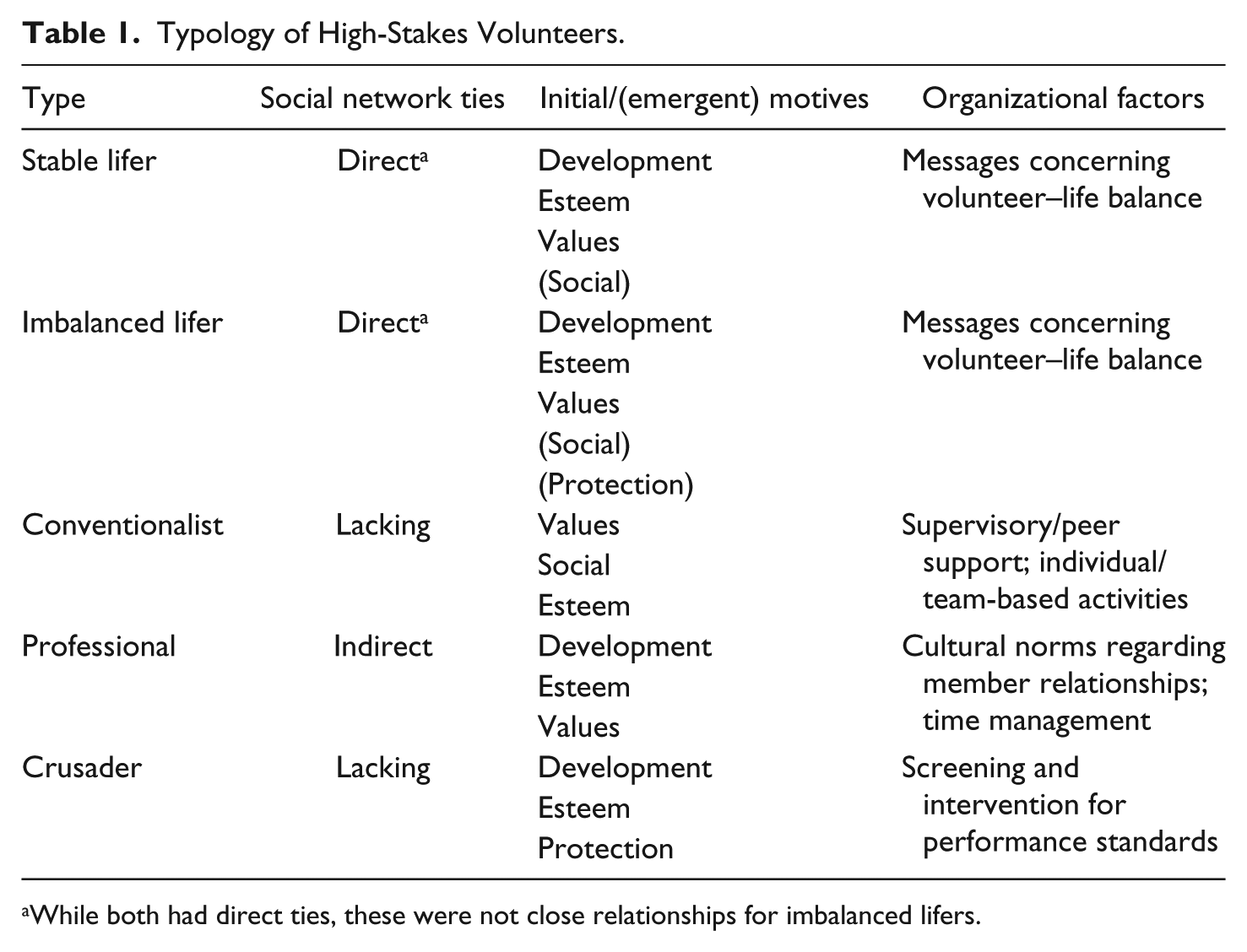
While both had direct ties, these were not close relationships for imbalanced lifers.
Stable and Imbalanced Lifers
Several HSVs exemplified lifers, a label bestowed on individuals whose commitment to their roles and organizations was unmatched. Lifers were viewed as conscientious volunteers, like VFR Thadd who attested that his unit “knew I was a responsible person, and if I committed to something I would do it.” Lifers perceivably adjusted to volunteering with relative ease and maintained realistic expectations of its rewards and demands. More than other volunteers, lifers were highly identified with their roles and organizations, so much so that they could not readily articulate why they volunteered and instead claimed it was just “part of who I am” (TM Harry).
Network ties and motives
Lifers’ direct social network ties explain, in part, their commitment and identification. Unlike other types, lifers were afforded early socialization and mentorship by friends/family who were also members. Through firsthand stories and direct organizational access, these ties “piqued [their] interest” (VFR Anthony) or played more critical roles in their devotion—like Cliff, who claimed that childhood ridealongs with his firefighter father instilled volunteering “in my blood.” Direct ties also helped lifers form realistic expectations, like CW Emma who, . . . had somewhat good exposure from my friend who had done it for years, so I knew that it was a lot of time . . . I knew that disconnect [between volunteering and personal life] was going to be there.
Anticipatory socialization afforded by these ties also fostered lifers’ initial motivations, which included (a) opportunities for knowledge/skill development, (b) expression of community-minded values, and (c) enhancement of self-esteem through service—all functional motives that were generally fulfilled. These motives were geared particularly toward one’s organizational mission because of lifers’ intimate exposure to it through network ties and, for some, their previous experiences as victims, at-risk youth, or disaster victims. For example, some participants acknowledged becoming CWs because, “I’d been there [as a victim], done that . . . so it was a really natural fit for me” (Jean). Similarly, firefighters like Carroll explained, “I guess I realized [after his parents’ home was saved by a VFR unit] what it was to help somebody . . . and I’ve been with it ever since.” For lifers like these, volunteering was a way to enhance their sense of self by serving those who encountered similar challenges. In addition, though they were not always initially motivated by social motives, lifers also eventually developed them—like Henry who was pleasantly surprised by his TM team camaraderie and Harry who came to cherish the VFR “brotherhood.”
Thus, all lifers had direct social network ties and initial motives of esteem, values, and development as well as emergent social motives. Nonetheless, two differences divided them into stable and imbalanced subtypes: (a) whether their direct ties were close, intimate relationships, and (b) whether they developed protection motives (volunteering to compensate for poor self-esteem or personal problems). Stable lifers’ intimate network ties enabled them to concomitantly spend time with loved ones and remain committed volunteers, so volunteering did not become a way to compensate for failures as a parent, spouse, or friend. Rather, becoming an HSV often made their loved ones proud, thereby fulfilling esteem motives—like VFR Bryan who reported an expectation to “keep the [family] tradition alive.” Alternatively, imbalanced lifers’ network ties were less intimate, and, therefore, volunteering and other life spheres were not easily integrated. Thus, as tensions arose in other areas of life, they reactively immersed themselves in the gratifying activity of volunteering. Steve exemplified this protection motive, insisting that, “When you sign up for [TM] . . . you should sacrifice your social life, your sleep, and many of those kinds of things, because you made this commitment.”
Organizational factors
A third element separating lifers was that stable ones’ organizations reportedly encouraged them to balance volunteering and other commitments while imbalanced ones’ organizations did not prominently espouse this (or these lifers were not substantively influenced by such messages). For stable lifers, when stresses arose from other commitments, fellow volunteers and supervisors reminded them of these priorities. For example, Bud’s VFR unit upheld the mantra, “Take care of yourself, your house, and your job, and if you’ve got time for the fire department, we’d appreciate it.” Alternatively, imbalanced lifers did not recall members encouraging volunteer–life balance, such as Julia who reported that CW supervisors kept urging further commitment. Consequently, she admitted, “It may be that I choose to not do this after a while, because my life is not very well balanced.” But while Julia’s commitment waned, most imbalanced lifers persisted in their devotion despite its negative effects. For example, firefighter Jake confessed, “I went through a divorce two years ago, and I’m pretty sure that my dedication to the fire service was probably was the big key in our relationship going the wrong way . . . I was always gone.”
Conventionalist
The third HSV type is labeled the conventionalist as it conjures stereotypical images of volunteers: altruistic, service-oriented “do-gooders” who often devote time to becoming more connected to their communities. Tabitha was among those who demonstrated this: I worked teaching . . . and after I retired I just wanted to do something that still sort of kept me involved but in a different way. I saw the ad in the newspaper for [CW] . . . so I thought I would give it a try.
In contrast to lifers, conventionalists often struggled to feel competent. For example, Tina admitted being self-conscious about her role-related abilities: “To make the decisions of what I think I should advocate for is a lot of pressure, because it’s so important. I really would not want to make a bad decision.” Similarly, conventionalists were vulnerable to feeling overwhelmed, like Jody who considered leaving CW because she didn’t anticipate how “heartbreaking” it would be. As Jody’s comment suggests, conventionalists also differed from lifers, in that they more often considered discontinuing service—a proclivity demonstrated by Annie, who volunteered with her husband but insisted, “If he said let’s quit [CW] . . . I would quit.”
Network ties and motives
Conventionalists’ lapses in commitment and perceived self-efficacy are partially attributed to the lack of preexisting social network ties to their roles and organizations. Instead, conventionalists often discovered the role independently or through organizational campaigns. They lacked early informal socialization to their roles, which may have helped manage their expectations and temper the shock that spurred their turnover intentions. (No VFR participants were conventionalists as nearly all had some social network ties prior to entry.)
Conventionalists came to their roles desiring to express community-minded values, a motive also shared by lifers. However, unlike lifers, conventionalists were not motivated by the prospect of skill development. Instead, conventionalists possessed social motivations, expecting that interactions and relationship-building with fellow HSVs, staff, and clients were chief aspects of volunteering. They did not seek volunteering to relieve their negative self-esteem or circumstances (protection motive); they simply desired to serve and interact with others, as demonstrated by Charlie who described his attraction to TM as a “calling” to work with students: I really feel like I can connect well with [them] . . . I had just finished that phase in my life and a lot of things that I wish a college-age guy would have done for me . . . I want to be that for these kids.
As Charlie’s words suggest, conventionalists were also initially spurred by self-esteem motives, seeing service as a means to feel good about themselves. However, this was not often the case. Without the socialization afforded by network ties, conventionalists often underestimated the complexities and challenges of HSV work and, in turn, viewed their efforts as failures.
Organizational factors
This negative attitude was also influenced by two related factors. First, adequate supervisory and peer support mitigated this view, but if support was perceived as lacking, it actually fomented this attitude and provoked turnover intentions. TM volunteer George captured this sentiment with, “If you don’t get the feedback, you don’t get the support you feel you need—why put in all that time?” Similarly, Charissa, who felt continually criticized by her CW supervisor, said, “You hear that over and over and over, [and] you begin to wonder whether you’re doing it right or not—especially if you never get any positive feedback.” Second, team-based volunteers, like TM, often expressed more positive views of their abilities and experiences than those whose activities were mainly performed individually, like CWs. As a rare exception to CW norms, Deborah volunteered with a partner and described the experience as “so great to work together.”
Professional
The fourth HSV type is deemed the professional for its steadfast, singular attention to client service. Professionals approached their volunteering as a “job” and, like lifers, felt a sense of self-efficacy in their functional tasks. Professionals identified with their roles, but they were not highly identified with their organizations like lifers. Unlike all previous types, professionals were largely unwilling or unable to participate in their organizations’ social activities. Many professionals expressed frustration for perceived social expectations and preferred to avoid ancillary activities, like Christopher who claimed, “I don’t think I’m the ideal [TM] leader, but I think I’m doing my job well . . . I just have this view of, I’m not here for [other members]. I’m here for these kids.” Other professionals’ outside responsibilities limited time for volunteering which caused them to abstain from activities beyond client service—like Cheri who disclosed, “I hardly ever can come to those because I am working. So it’s kind of hard, and I think [the CW staff] try hard to get us together.” Professionals like Cheri experienced guilt for not fulfilling perceived expectations for interaction with fellow volunteers and staff.
Network ties and motives
Prior to becoming HSVs, professionals had indirect social network ties. However, their ties were not currently involved with their specific organizations and, therefore, these people did not serve alongside them or socialize them to that particular environment. Thus, while professionals gathered accurate information concerning their role functions, they often failed to preemptively detect social expectations particular to their organizational cultures. Thus, some professionals experienced psychological contract violations, like TM Tammi who remembered feeling like, “I’m not here to socialize with you . . . I have a family and a social life.”
As this example conveys, professionals were not spurred by social or protection motives. Rather, professionals were initially motivated by the prospect of cultivating skills/abilities while also “making a difference” in others’ lives. Relatedly, many spoke of becoming HSVs because it seemed more consequential than other volunteer roles. For example, CW Jenny said, “That sounds important and, you know, a status type-thing. So I figured I would volunteer for something that was important . . . it had a different clout to it.” As Jenny’s comment suggests, professionals were also initially motivated by the possibility of enhancing their positive self-esteem through volunteering. This combination of development, values, and esteem motives promoted an independent volunteer persona consistent with their high role identification but low organizational identification.
Organizational factors
Two factors did, however, affect whether professionals’ organizational identifications deteriorated. For one, cultural norms stressing social interaction and member relationships further stifled their organizational identification. These norms were detected, for example, when members “get a little bossy or just pushy and kind of guilt trip you” (TM Cindy) for not prominently participating in relationship-building activities such as sharing meals. Likewise, firefighter Cody claimed he didn’t “fit in” with his unit because he didn’t “do anything with [them] outside of [volunteer] work.” A second factor affecting professionals’ organizational identification was the reported ineffective use of volunteers’ time by supervisors. CW Miriam commented along these lines, insisting, I would just want to hear from them if they have a relevant piece of information . . . a colleague-to-colleague conversation . . . time is wasted for me for socializing . . . I just want to take my time and make it productive so I can continue to do better work.
This is not to suggest that professionals were entirely opposed to member interaction, but they preferred to do so during task-centered activities. Still, thanks to their role identification, they were not vulnerable to attrition in the same manner as conventionalists.
Crusader
Volunteers exemplifying the fifth and final HSV type are referred to as crusaders for their zealous yet haphazard role performances. In various ways, crusaders were the antithesis to other HSVs: They were not conscientious or humble like lifers, timid or self-doubting like conventionalists, or dedicated to acquiring/exercising skills to help others like professionals. Instead, crusaders like Kay were passionate volunteers who (un)knowingly “crossed boundaries” by violating expectations for conduct and performance: I was trying to understand where I wouldn’t go outside my boundaries . . . getting creative . . . not manipulating the system necessarily but figuring out a way that you could come to the end result. There were lots of little things that happened that I really didn’t know that I was crossing boundaries.
Although Kay’s actions ultimately resulted in her termination from CW, other crusaders remained with their organizations but encountered conflict with fellow members and/or clients.
Network ties and motives
Crusaders’ insufficient understandings of and/or regard for their responsibilities are partially attributed to their lack of preexisting social network ties. Like conventionalists, they were not vetted by current members before entry and did not receive comprehensive understandings of the service requirements. Unlike conventionalists, though, participants indicated that crusaders were present in VFR. Several chiefs and longtime volunteers repeated stories of “those guys” who, as Howard said, just “show up at the firehouse one day and want to turn on the siren.”
Unlike other HSVs, crusaders did not espouse community-minded values motivations. Firefighter Walter underscored the disdain fellow volunteers often held toward crusaders: “There are some people that think that [being in fires] would be ‘cool,’ and I’d like to punch those people in the face. I don’t want to die in a fire.” Crusaders also did not initially express social motives for volunteering. They did, however, come in with (a) the development motive to acquire/exercise skills, (b) the esteem motive of enhancing positive self-image, and (c) the protection motive wherein volunteering is sought as means to compensate for feelings of inadequacy (e.g., powerlessness from being previously victimized and/or guilt for successfully escaping bad circumstances unlike other victims).
As this suggests, some crusaders were similar to lifers, in that they were intimately affected at some point by the organization’s mission (e.g., as a former victim); however, unlike lifers, they appeared to grapple with unresolved issues from these experiences and, therefore, became HSVs with predominantly self-interested motives rather than desires to help others. Thus, their development and esteem motives were aligned with expectations that HSV roles afforded the requisite power/status to overcome feelings of inadequacy. Consequently, their motives seemingly compromised their abilities to act responsibly. For example, CW supervisor Lanae described a former volunteer who had been sexually assaulted and “just really didn’t care” about following proper protocols: “she just feels jaded, and that’s a hard thing to overcome.” Similarly, several firefighters characterized volunteers who, in their opinions, simply wanted to “put a red light on their vehicle and drive 90 miles per hour” to compensate for their poor self-images (Paul).
Organizational factors
Given the potential liabilities that come with crusaders’ actions, it seems that organizations would attempt to actively identify and monitor them. Nonetheless, while many supervisors spoke of easily recognizing crusaders, few mentioned protocols for specifically overseeing them. More often, supervisors spoke of crusaders’ inevitable turnover. Some organizations did uphold strict criteria for entry, which barred perceived crusaders from becoming volunteers in the first place. For example, TM supervisor Eric was uncompromising in requiring that prospective volunteers must “care about and be able to be friends and love everyone else’s [TM team],” values-based and social motivations that crusaders lacked. In addition, some organizations communicated particular standards for crusaders, providing assistance and additional training for but also exacting reprimands of them when performance was substandard. Max’s mentorship of a firefighter he characterized as a crusader illustrates this: She made her first call with me . . . I go up to her and I’m like, “Take her blood pressure for me.” But if you sit there and say, “I don’t know how to do that,” I’ll kick you off my rig . . . until you can figure out how to do [it].
Discussion and Implications
In comparing them with the broader landscape of volunteers, this study suggests that HSVs are not entirely unlike individuals who pursue less time-consuming, intense roles. Many share similar motives, as was clearly demonstrated by conventionalists whose values-, social-, and esteem-centered motives typified those cited in scholarly literature (see Clary et al., 1998; Wilson, 2012). This continuity is somewhat intuitive given that volunteer expectations are significantly shaped by societal discourses of which individuals are often commonly exposed. However, HSVs are distinguished from other volunteers through the disparity between their motives/expectations for volunteering and their lived experiences. Study participants often underestimated the intensity of their responsibilities, the associated life strain, and/or the social expectations of their roles. Thus, HSVs disrupt some enduring notions of the performances and outcomes associated with volunteering. For example, the findings concerning imbalanced lifers, and to a certain extent conventionalists and crusaders, call into question the position that volunteering promotes well-being (see Kumar, Calvo, Avendano, Sivaramakrishnan, & Berkman, 2012). As such, HSVs may be usefully considered a distinct volunteer entity.
Still, given the assortment of social network ties and functional motives in this typology and the various experiences exhibited by those who comprise it, it is also clear that HSVs are far from a homogeneous group. Participants spanned a vast continuum from the direct and even intimate social network ties of lifers to the sheer absence of interpersonal connections of conventionalists and crusaders. They were equally diverse in their functional motives, with conventionalists and lifers desiring a social dimension to volunteering and, by contrast, professionals avoiding such activities. Furthermore, because of these ties, motives, and various organizational factors, lifers and professionals differed from conventionalists and crusaders, in that the former expressed moderate to high role satisfaction while the latter expressed less satisfaction.
Given this variability, we encourage scholars and practitioners to consider the diversity of perspectives/expectations that individuals carry into HSV work while also seeking to understand them at a macro level. We envision the HSV typology as explanatory and narrative theoretical insight intended to facilitate understanding of the range of individuals who engage in high-stakes volunteering and the distinct ways they approach their roles. Toward this end, we underscore two overarching implications of these findings for ongoing study, theorizing, and management of HSVs. For each implication, we highlight practical considerations and address the degree to which our position resonates with extant scholarship.
Social Network Ties in HSV Socialization
First, we contend that social network ties established prior to organizational entry are particularly critical to HSV socialization. Certainly, current volunteers are considered powerful recruiters, and this is especially relevant in HSV recruitment given the considerable resources expended on training and development and the need to retain competent, committed volunteers. By fusing time spent volunteering with other life commitments (e.g., stable lifers who volunteered alongside close friends/family), preexisting direct, intimate ties mitigate some of the potentially damaging effects of HSVs’ role demands. In short, these ties allay the volunteer–life conflict that may arise for HSVs who devote extensive time and energy to their roles. In addition, ties provide important realistic job previews to help facilitate alignment between volunteers’ role-related expectations and experiences (see Wanous, 1977). In cases where this anticipatory socialization begins early in adolescence, a form of “organizational osmosis” likely occurs where volunteers almost naturally adopt “the ideas, values, and culture of an organization” even before volunteering (Gibson & Papa, 2000, p. 79). Conversely, when these ties are lacking, this powerful socialization is absent—as seen with conventionalists and crusaders.
The benefits stemming from social network ties are consistent with Huynh et al.’s (2013) buffering hypothesis, which underscores the potential of various work/nonwork resources to allay negative outcomes associated with volunteer demands and volunteer–life conflict. Similar to their discovery that family–friend support enhanced volunteer firefighters’ organizational connectedness, our findings suggest that family/friends who act as network ties promote positive outcomes and diminish negative effects like stress and burnout. Although not specifically tied to HSVs, this is also consistent with Nesbit’s (2013) research, which cited significant links between living with volunteers and proclivities toward volunteering.
In practical terms, we contend that direct and indirect ties constructively provide role-related information to manage prospective HSVs’ expectations—as was evident with both lifers and professionals. However, direct ties are particularly beneficial as they also foster organizational identification. Furthermore, when current HSVs provide intimate direct ties by recruiting close family/friends to serve alongside them, this may also mitigate volunteer–life conflict and provide critical mentorship to facilitate the newcomer’s adjustment. Based on our own and previous studies, volunteer fire units often follow this practice and, therefore, provide a model for other HSV organizations to look to.
Organizational Resources and HSV Motives
The second overarching implication of this research centers on HSVs’ diverse motives and organizational management practices. As demonstrated with crusaders and imbalanced lifers, motives like protection (volunteering as means to compensate for negative views of self or life circumstances), which lends itself to volunteer stress and risky behavior may adversely affect both HSVs and their organizations. One may argue that motives like this are particularly inappropriate for the demands of HSV service. However, given that HSV organizations often struggle with recruitment and may not have the luxury to reject prospective volunteers, we contend that these organizations might consider how to tailor resources and support for HSVs’ differing needs and expectations.
This position resonates with recent theoretical work that embraced volunteer diversity and calls for varied approaches to recruitment and management (e.g., Brudney & Meijs, 2009; Haski-Leventhal & Meijs, 2011; Meijs & Brudney, 2007). Still, we depart from these frameworks and models to a degree, in that they presume organizations can/should adapt volunteer assignments in accordance with individuals’ preferred timelines (i.e., oblige episodic commitments). Given that HSV organizations uniquely rely on long-term, frequent commitment to sustain themselves, instead, we contend that these organizations must explore alternative means to flexibly accommodate volunteers’ assets and preferences.
This study provides insight by particularizing previously generalized knowledge of the motives and consequences associated with HSV service. For example, while previous quantitative studies have cited motives like sensation-seeking among HSVs (e.g., firefighters, Perkins, 1989), our analysis demonstrated that many HSVs are not motivated by this (e.g., conventionalists) and have different expectations from their organizations. By uncovering clustered motives, network ties, and organizational practices, we also underscore the conditions whereby outcomes like HSV satisfaction and turnover intentions may be affected. Our findings affirm studies that have cited negative outcomes like emotional/psychological stress in HSV work (e.g., Jaffe et al., 2012; Thornton & Novak, 2010; Yanay & Yanay, 2008), but we extend this knowledge by offering more systematic explanations of these outcomes.
Practically, we recommend that HSV organizations carefully screen prospective volunteers, identifying their motivations and expectations to determine optimal forms of support and interaction. For example, social/emotional support and team-based activities may be critical for lifers and conventionalists, whereas instrumental support and individualized activities are potentially more appropriate for professionals and crusaders. Acknowledging that organizations may be limited in their abilities to customize management practices to each HSV type, though, an alternative is to intermingle forms of support in volunteer activities to dually attend to professionals who are sensitive to how time is spent outside client service and other types who may benefit from more relational approaches.
Limitations and Future Research
This typology paves the way for future research to acknowledge the distinctiveness of high-stakes volunteering from other volunteer arrangements and to examine the commonalities among the seemingly disparate volunteer roles, like firefighters and advocates for abuse victims. Still, this analysis does not presume to represent an exhaustive, interminable view of antecedents, experiences, and outcomes of HSV service. Several study limitations should be addressed to further develop this typology. First, because the sample was limited to three U.S. settings, transferability of these findings is still in question. We encourage scholars to examine their applicability to other HSV activities—notably, long-term service to terminally ill groups, which has garnered particular interest in past research (e.g., Sevigny et al., 2010; Starnes & Wymer, 2000). Future studies should also examine the extent to which HSV types are present in countries with different norms for HSV service and views of volunteering—for example, global south regions that problematize binaries like volunteer and employee (see Cheney, Zorn, Planalp, & Lair, 2008).
A second study limitation is the narrow scope of individual factors (social network ties, functional motives) considered. Future studies should account for additional variables such as gender, age, ethnicity, and socioeconomic status in relation to the five HSV types presented. We particularly encourage scholars to explore the impact of sex given the gendered norms in various HSV roles, and recent studies such as Ainsworth, Batty, and Burchielli’s (2014) exploration into female volunteer firefighters that cited participants’ experiences of feeling ridiculed or “alien” as women demonstrate the possibility that sex may profoundly affect HSVs’ experiences. A third limitation also arises from our use of self-report interview data, as social desirability response bias may have affected the resulting typology (King & Bruner, 2000). For example, supervisors may have embellished management practices or volunteers may have downplayed less venerable motives like protection. As such, future studies should incorporate more participant observation to directly examine the behaviors and interactions of HSVs and leaders. Given its significance in this study, one important area for further inquiry is the ways in which managers attend to or neglect matters of social and instrumental support.
Despite these limitations, this study offers a useful foundation of explanatory and narrative theoretical insight to consider in future scholarship and practice. As Britton (1991) acknowledged in his exposition of permanent disaster volunteers, we cannot develop competent strategies for supporting these types of volunteers until we enhance understanding of “their role and function . . . and the organizational context” in which they work (p. 396). This typology provides such knowledge of HSVs, contributing to the growing scholarship on flexible approaches to volunteer management. Moving forward, we encourage scholars and practitioners to focus on how these volunteers may be developed in accordance with the particular expectations and knowledge they bring to their roles.
Footnotes
Acknowledgements
The authors would like to thank the journal reviewers for their comments and suggestions on earlier versions of this essay.
Declaration of Conflicting Interests
The author(s) declared no potential conflicts of interest with respect to the research, authorship, and/or publication of this article.
Funding
The author(s) received no financial support for the research, authorship, and/or publication of this article.