



Abstract
This article presents the emotional challenges of managing affectively committed volunteers and the associated impacts on the managerial task. Through a qualitative arts-based study at a U.K. nonprofit organization, the National Trust, dominant rhetoric positioning volunteering as positive is problematized. Paid managers find managing affectively committed volunteers emotionally demanding and are often reluctant to address what they perceive to be difficult volunteer behavior. This study conceptualizes the emotionally challenging behaviors of volunteers and the reluctance of their paid managers to address them, as a consequence of a variation in adherence to the organizational display and feeling rules that define their shared emotional arena. This is influenced by the existence or lack of an employment contract within the context of their affective commitment. Suggestions are made for further research and practice regarding the management of volunteers.
Introduction
The management of volunteers and paid employees should be approached differently due to fundamental differences in their organizational behavior, not least of which, as Pearce (1993, p. 11) finds, is that “unpaid labour . . . leads to a different pattern of affective reactions to the workplace.” While “affective reactions” is not defined, volunteers are positioned as creating additional “difficulties for those who are responsible for directing and coordinating their work” (Pearce, 1993, p. 12). This article addresses these difficulties and offers an enlivened account (Smith, Timbrell, Woolvin, Muirhead, & Fyfe, 2010) of the micro-interpersonal interactions of relationships between volunteers and paid employees. Pearce (1993, p. 177) characterized these relationships as “one of the unpleasant secrets of nonprofit organizations.” Adopting an emotions lens, this research challenges the dominant rhetoric in practitioner and academic literature that perpetuates an overly positive view of volunteer involvement and offers an alternative focus on the emotional challenges of managing volunteers.
Reluctance to address the dark side of volunteer involvement (O’Toole & Grey, 2016; Studer & von Schnurbein, 2013) has led to the emotional aspects of volunteer management being overlooked. O’Toole and Grey’s (2016) qualitative study of the Royal National Lifeboat Institution (RNLI) in the United Kingdom found that volunteers exhibited pride and respect for the organization and its wider cause, such that they regularly risked their own lives in their volunteering. Volunteers’ commitment was indisputable; however, this did not translate into being easy to manage. Volunteers engaged in contestation and resistance around institutional mandates, which was challenging to manage because of the volunteers’ strong commitment to the RNLI and its cause. Unlike the RNLI, in this article’s case organization, the National Trust, neither the volunteers nor their managers risk their lives in the course of their work. However, both are large institutions dependent on volunteers and both employ a comparatively small number of paid managers of volunteers. O’Toole and Grey (2016, p. 69) call for research that explores whether “for managers of voluntary organizations, can too much commitment be a bad thing?” In response, this article attends to the following research questions: What characterizes an affectively committed volunteer? How do paid managers experience the emotional challenge of managing affectively committed volunteers in the context of the National Trust? The findings then allow us to reflect on whether too much volunteer commitment can be viewed as a “bad thing” (O’Toole & Grey, 2016).
This analysis focuses on previously overlooked emotional aspects of volunteer management and affective commitment for three reasons: First, the “affective turn,” seen in the organization studies literature, seems to have bypassed nonprofit and voluntary sector research (Silard, 2018, p. 2). Consequently, less is known about the way emotions exist in and affect volunteers and their managers. Second, the transplantation of for-profit logics into the voluntary sector is becoming increasingly normalized (Nichols, 2013), especially in relation to managing volunteers, leading to considerable debate about appropriateness, particularly in relation to treating volunteers as paid staff. However, very few studies present relational accounts of how volunteers and their managers interact. Third, as voluntary organizations are required to play a larger role in the delivery of social and public services, a fuller understanding of what is involved in managing volunteers is needed. This study responds to Smith et al.’s (2010) call for more enlivened accounts, reflecting the situated, embodied, and emotional practices involved in how volunteer involvement is negotiated, maintained, and experienced.
The extant literature on managing volunteers, emotion in the voluntary sector, and affective commitment is reviewed before setting out the methodological approach, research setting, and methods of analysis. The findings present three contributions to current understandings of managing volunteers: First, empirical evidence acknowledges how paid managers often experience the management of affectively committed volunteers as emotionally demanding, complex, and difficult. Second, it is proposed that difficult volunteer behavior might be better understood by managers and organizations as a manifestation of volunteers’ affective commitment and, while acknowledging its emotional challenges, must be recognized as valuable. Third, this study conceptualizes volunteers’ emotionally challenging behaviors and their managers’ reluctance to address them as a consequence of a variation in volunteers’ and paid managers’ adherence to the organizational display and feeling rules that define their shared emotional arena. This is influenced by the existence or lack of an employment contract within the context of their affective commitment. Suggestions are made for what this means for research and practice regarding the management of volunteers within the voluntary sector.
Managing Volunteers
Work without explicit contracts or pay places considerable emphasis on the distinct nature of the psychological contract between manager and volunteer (Nichols, 2013; Vantilborgh et al., 2012). Managers of volunteers often lack the sanctions to discipline or reward behavior and performance (Pearce, 1993, p. 12). Despite academic research establishing that there are differences between managing volunteers and paid staff (Boezeman & Ellemers, 2009; Liao-Troth, 2001; Pearce, 1993), the characteristics of a paid employment relationship are often applied to volunteers, for example, policies and procedures around recruitment and selection, training and development, and performance review for managing volunteers (Alfes, Antunes, & Shantz, 2017). There are clear pressures for nonprofit organizations to become more like for-profit organizations in areas such as membership growth, managerial formalization, and professionalization (Hager & Brudney, 2004, 2015; Harris, 1998, p. 155; Sanders & McClellan, 2014). Pearce (1993, pp. 142-143), most often cited as highlighting the differences between managing volunteers and paid staff counter-intuitively supports nonprofits attempting to implement for-profit human resource (HR) approaches by arguing that many volunteers work as adjuncts to employees in organizations controlled by employees . . . volunteers
The literature bifurcates between the effectiveness of nonprofit adoption of HR policy and practice and a focus on volunteer motivations (and the ensuing psychological contract). To some extent, it could be argued that the field has been paralyzed by its desire to understand why adopting HR practices does not seem to have the intended outcomes with respect to managing volunteers. Nichols (2013) postulates that the volunteer psychological contract might be alternatively conceptualized as a social relationship, and understanding this more fully requires a juxtaposition of the expectations and experiences of managers and volunteers. There is, however, a noticeable lack of literature that explores the everyday realities of managing volunteers (Murray, 2008, pp. 245-246). Kreutzer and Jager (2011) identify ways in which the conflicting identities of paid staff and volunteers result in intra-organizational conflicts. However, they only provide an account of what managers and volunteers do and why, not also how it feels to engage in this relationship. The management of volunteers is therefore worthy of analysis attendant to the emotions and felt experiences of both paid managers and volunteers.
Emotions in the Voluntary Sector
Critical research on emotions and affect in the voluntary sector is scarce. Exceptions include Rowold and Rohmann’s (2009) and Boezeman and Ellemers’ (2007, 2008) work emphasizing how positive emotions are key to nonprofit leadership and volunteer commitment. Looking beyond nonprofit and voluntary sector literature, however, there is far more research that sees emotions informing and shaping organizational practices and experience. Organizations are “emotional arenas” which bond and divide their members. Workaday frustrations and passions—boredom, envy, fear, love, anger, guilt, infatuation, embarrassment, nostalgia, anxiety—are deeply woven into the way roles are enacted and learned, power is exercised, trust is held, commitment formed and decisions made. Emotions are not simply excisable from these . . . they both characterize and inform them. (Fineman, 2008, p. 1, emphasis added).
Recognizing organizations as sites of emotion leads to the need to manage one’s own emotions to influence the feelings of others in the form of emotional labor (Hochschild, 1983) as a key leadership skill (Iszatt-White, 2013). Fineman’s (2008) conceptualization of the “emotional arena” encompasses the feeling (Hochschild, 1979) and display rules (Ekman, 1973) at play within a given context; these rules determine how emotional labor should be performed. How these rules are defined, what affect they have on those who are subject to them and their level of adherence to them, depend on the context and the actors (Diefendorff & Croyle, 2008; Gosserand & Diefendorff, 2005).
For Frost (2003), organizations are sites of toxicity in which emotional pain is an inevitable by-product of organizational life (Ward & McMurray, 2016). Toxic contamination can accumulate to the point of a dramatic explosion or outburst, or it can corrode enthusiasm, self-esteem, and empowerment, potentially contaminating others who come into contact with it. Yet, in both nonprofit research and organizational practice, there is a prevailing “proscription of the negative” (Silard, 2018, p. 8). Silard (2018) argues that there is a tendency for nonprofit leaders to assume that their followers would react badly to displays of negative emotions because “nonprofit leaders form interpretive biases in relation to follower perceptions of how effective nonprofit leaders ought to express an emotion” (emphasis added). These interpretive biases are referred to as “metaperceptions” and leader assumptions regarding the metaperceptions of the followers become the display rules.
Drawing on Marx, Hochschild (1983) takes issue with organizations commodifying what was once seen as a private part of the self in exchange for a wage. In essence, the promise of pay coupled with the discretionary power of the organization to revoke that promise creates an increased commitment, or adherence, to the display and feeling rules at play within those particular “emotional arenas.” However, a key contribution of this article, and what has not been considered previously, is what happens when some workers are controlled by the wage–labor relationship, while others with whom they work, and indeed are responsible for managing, are not? This is a key feature of our research site. Volunteers managed by paid staff share the same physical workspaces, yet it cannot be assumed that they share the same commitment to the organizational display and feeling rules that define their shared emotional arenas (Fineman, 2008).
Affective Commitment
Meyer and Allen (1991) identify three components of organizational commitment: affective, continuance, and normative. Affective commitment is a sense of emotional attachment to a particular organizational focus. It refers to the extent to which a volunteer’s identity is shaped and informed by the organization, or part thereof. Dawley, Stephens, and Stephens (2005, p. 514) argue that affective commitment is an important and distinguishable dimension of volunteer commitment. Volunteers are not working for financial gain and, consequently, experience less continuance commitment, or economic resource dependency, than paid employees, although the social and emotional benefits of volunteering can translate into some level of continuance commitment. In addition, normative commitment, the feeling that one ought to maintain a relationship with the organization, is perhaps borne out of a commitment to the wider cause, for example, heritage, conservation, community, health, or education.
Organizational commitment is a multidimensional construct, in terms of its nature and its foci. Emphasizing the value of distinguishing between multiple foci (Morin et al., 2011), Becker and Billings (1993, p. 177) identify four employee profiles with distinct commitment foci: those who are locally committed to their supervisor or work group, globally committed to top management and the wider organization, committed to both the local and global elements of the organization, and demonstrating no commitment at all. Extant voluntary sector research has also sought to identify the antecedents to and consequences of varying levels of organizational commitment (e.g., Boezeman & Ellemers, 2007; Meyer, Stanley, Herscovitch, & Topolnytsky, 2002). In the case of board member volunteers, affective commitment has been positively correlated with perceived volunteer performance (Dawley et al., 2005; Preston & Brown, 2004). While being a board member is not necessarily generalizable to all volunteers (Boezeman & Ellemers, 2007), O’Toole and Grey’s (2016) analysis also found that high levels of organizational commitment are generally considered to be a good thing. Yet, despite the academic interest organizational commitment has enjoyed, there continues to be much to learn about how affective commitment is experienced by those tasked with managing it. Moreover, this article considers how managing affectively committed volunteers is experienced by those paid to manage them.
Method
Studies of organizational commitment are commonly based on variations of Meyer and Allen’s (1991) Commitment Scales and are therefore quantitatively driven. Nichols (2013, p. 994) states that research in the area of volunteers continues to be dominated by quantitative methods and a unilateral approach, referring to the empirical focus on volunteer expectations and experiences. He argues that this has inadvertently silenced the experiences of those tasked with managing them (see also Studer & von Schnurbein, 2013, p. 430). Nichols (2013) stresses the importance of adopting a “social relationship” perspective to understand the emotions and felt experiences involved in the everyday organizational realities of managing volunteers (Murray, 2008). Nichols (2013) makes a strong argument for researchers to adopt sophisticated qualitative bilateral approaches to capture the experiences of both volunteers and their managers, as is the case with the research design in this article.
An arts-based research design was implemented, in appreciation of the opportunities such methods offer to transcend the rational–emotional boundary that often limits the willingness and/or ability of research participants to push beyond what they think, to explore how they feel (Jensen, Voight, Piras, & Thorsen, 2007). Adopting these methods allowed exploration of participants’ feelings and thoughts on “doing” volunteer management (Smith et al., 2010).
Research Setting
The National Trust is a large conservation and heritage charity in the United Kingdom founded in 1895. Holding statutory legal powers to protect heritage spaces, its mission is to protect and open to the public over 350 historic houses, gardens, and ancient monuments, and also to preserve and maintain a variety of open spaces. The organization relies on a network of approximately 61,000 volunteers alongside a paid workforce of around 12,000 (National Trust, 2016). The work of volunteers is crucial to running the organization, and volunteers undertake a wide range of tasks and responsibilities, including administrative work, gardening, tour guides, estate maintenance, conservation, retail, and catering.
O’Toole and Grey (2016, p. 60) view the organizational vision statements and behavior policies as attempts to “discursively construct particular meanings in order to enact value and cultural realities for volunteers.” Similarly, within the National Trust (2010), for both volunteers and paid staff, significant emphasis is placed on the enactment of a number of “values and behaviours” (Figure 1). These are representational of organizationally prescribed display and feeling rules (Hochschild, 1983), adherence to which is part of the focus of this analysis.

National Trust values and behaviors.
Data Collection
This research project was specifically commissioned by the National Trust with an aim to understand the qualitative complexities of managing volunteers. The organization wanted to identify how managing volunteers is different to managing paid staff and improve how volunteers are managed, leading to better outcomes for both volunteers and volunteer managers. Two National Trust properties were involved, which shared a number of key structural features, including being medium-sized stately home locations, having a similar configuration of departments, and involving similar numbers of paid managers and volunteers.
Research methods included participant-produced drawing focus groups (Kearney & Hyle, 2004; Ward & Shortt, 2013), participant-produced photography (Schrat, Warren, & Höpfl, 2012; Vince & Warren, 2012), semi-structured interviews, and nonparticipant observation of managers interacting with volunteers. All research fieldwork was conducted by the authors, and all interviews and focus groups were digitally recorded and transcribed.
As set out in Table 1, 46 volunteers participated in nine volunteer-only drawing focus groups, whereas ten paid-staff participated in two paid-staff-only drawing focus groups. The numerical bias toward volunteers reflects the composition of the workforce at the properties. In addition, 16 paid managers were interviewed, of whom ten with direct line responsibility for volunteers were interviewed twice and, in addition, were asked to produce photographs (received from only nine of the interviewees). There was a representative spread of participants across the various departments and functions in the properties. To maintain the anonymity of property and participants, pseudonyms are utilized throughout the article.
Details of Research Participants.

Focus groups employed a method in which participants were asked to draw an individual response to the question “How does it feel to be a volunteer/paid staff member at the [property]?.” This activity was allotted ten of the 90 min total focus group time. For the rest of the time, participants were invited to describe what they had drawn to the rest of the group, and further discussion and reflection ensued, facilitated by one of the authors (for a detailed description, see Ward & Shortt (2013); for a wider discussion, see Guillemin & Drew, (2010). One of the advantages of participant-produced drawing focus groups is that they allow the participants to set their own agenda in response to how they feel (Ward & Shortt, 2013). Consequently, beyond the initial question and timings, the discussions were free flow and participant led.
Semi-structured interviews with managers followed a guide prepared in advance and explored a broad range of issues relating to their experiences of managing volunteers and their own feelings about their jobs, their properties, and their relationships with the National Trust. Managers were provided with disposable cameras for a participant-produced photography exercise (Shortt, 2015) and were asked to take a selection of images in response to “What does your job feel like?” The developed photographs were presented back to them at a second interview for discussion and sense making.
Nonparticipant observation of two managers in each property for half a day took place. The key focus was their interaction with volunteers, noting tone of conversation, instances of instruction and correction, communication methods, and expression/suppression of emotion. Detailed fieldnotes were taken and then shared and discussed within the research team.
Data Analysis
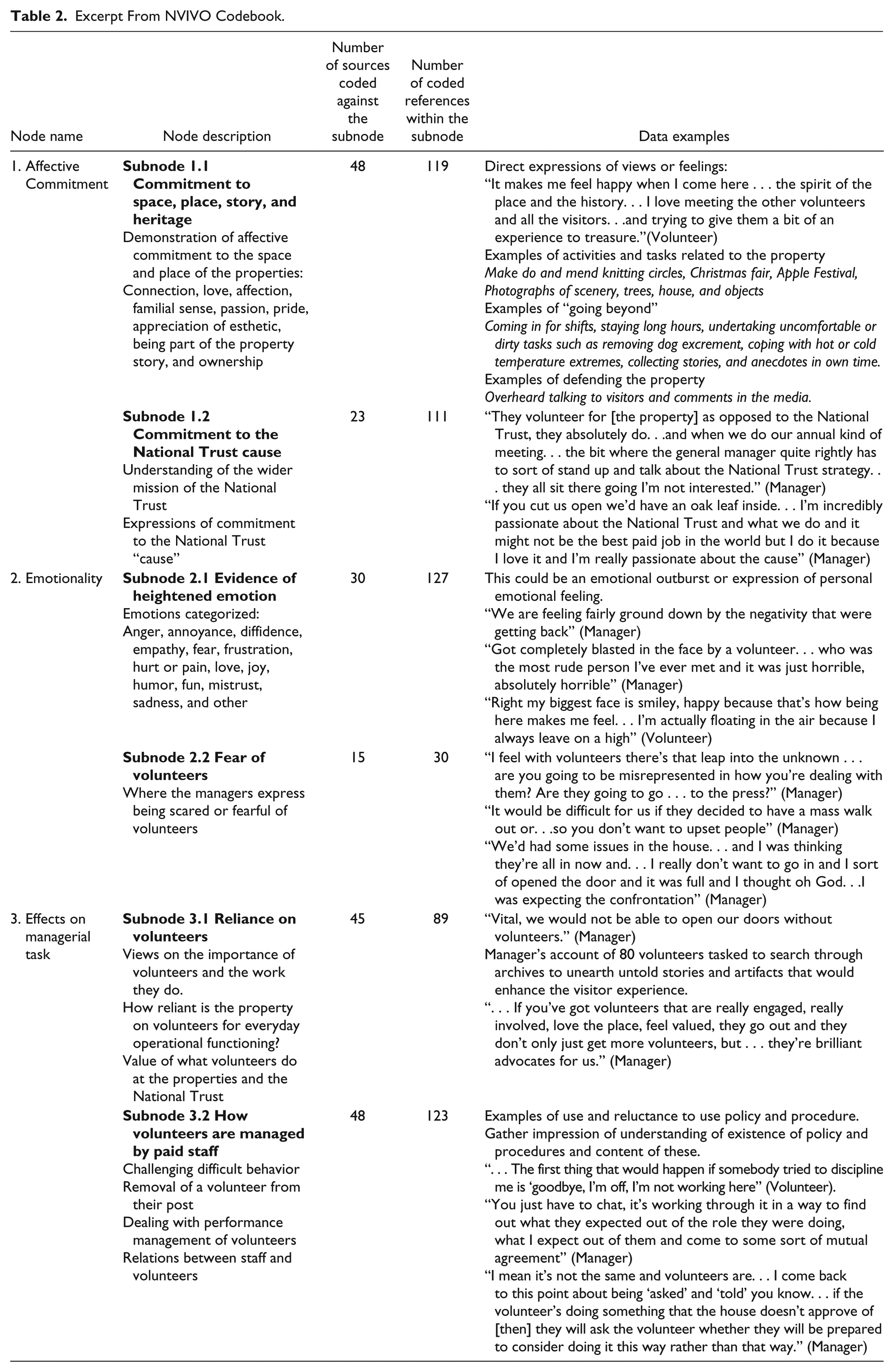
The analysis process started with constructing thematic categories (nodes) developed from both the interview guide and through a process of iterative sense making during the focus groups, interviews, and observations. All research data were coded against these nodes by the authors, both manually and using NVIVO software. Table 2 is an extract from the codebook configured for analysis of the data within this article; nodes that relate to the key research questions are presented for illustration.
Excerpt From NVIVO Codebook.
Findings
What Characterizes an Affectively Committed Volunteer?
Haski-Leventhal and Bargal’s (2008) study of volunteers working with at-risk youth note that at some point in a volunteer’s tenure with an organization, they develop a “deep emotional involvement” toward those they are tasked with helping, other volunteers, and the organization itself. This involvement is often expressed using the word “love” to describe the way they feel about aspects of the volunteering experience. This sense of “love” was no less prevalent in responses from volunteers at the National Trust properties (Table 2, Subnode 1.1). Taking Jane’s drawing and explanation as an example, where she drew herself smiling proudly dressed in Victorian costume (Figure 2), explaining I’ve just done a really quick scribble . . . of me in Victorian costume at the . . . Christmas festival . . . because I think it helps me sort of . . . step into the sense of the history of the place and to kind of . . . communicate that to other people and I’ve also done myself, you know . . . smiling because I like that it makes me feel happy when I come here volunteering and the sense of . . . the spirit of the place and the history and the fact that . . . I love meeting the other volunteers and all the visitors and putting a smile on their faces and trying to give them a bit of an experience to treasure. (Jane, Volunteer, emphasis added)
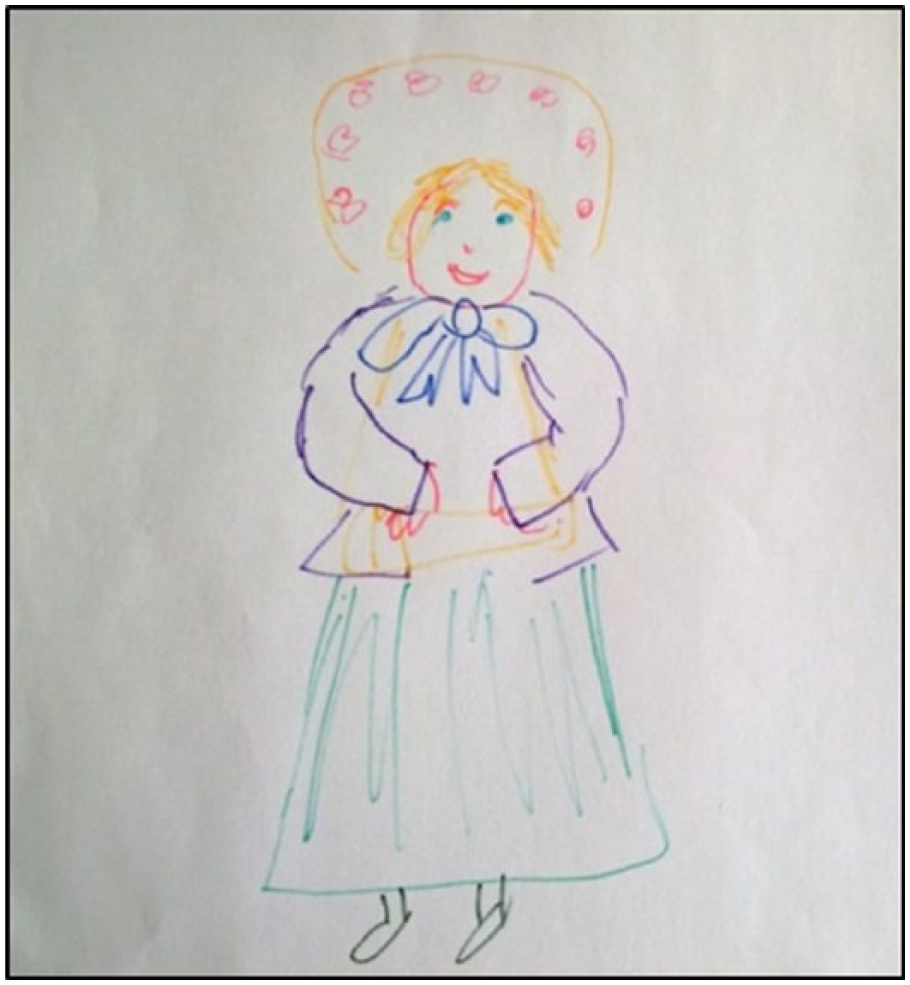
Participant drawing (Jane, Volunteer).
Wanting to provide visitors with “an experience to treasure” is testament to Jane’s affective commitment to the property’s success and also to keeping the stories and the history of the past alive. In terms of the National Trust’s Values and Behaviors (Figure 1), Jane is a volunteer who is clearly ‘valuing special places and the role they have in people’s lives’ and is working to “inspire people to love special places.” In another example, David offers a passionate account of his experience of embodying the character of a butler to “get things across” to visitors, particularly the children: I bought my own waistcoat, I bought my own pocket watch . . . and I stand there and they come in and I have a whole pantry full of them . . . and when the little children came in I’d kneel down and talk to them across the table . . . and I said “And what are you doing for Christmas? You’re going to have a nice time, aren’t you? But we’re not! No no, the Master has invited sixteen guests and I’m the footman that’s going to have to look after them!..” . . . and it’s all those little things that get things across to them, you know . . . (David, Volunteer, emphasis added)
Not only had David supplied his own props, he had also taken the time to research the period, to bring those stories, people and places alive, and to make them relevant to a range of ages and interests. David was clearly demonstrating an emotional attachment to the property and the stories, and also upholding the values prescribed by the National Trust.
All volunteers spoke passionately about their love for the house and the gardens to explain and justify the reasons why they continued to volunteer. This sense of pride in the spaces and places and their role in bringing them alive to visitors support Boezeman and Ellemers’ (2007, 2008) findings on the importance of pride in fostering volunteers’ organizational commitment. However interestingly, this research also showed that rather than attributing pride and love to various aspects of the volunteering experience (as in Haski-Leventhal & Bargal, 2008), or in relation to the wider organization, National Trust volunteers used it specifically in relation to how they felt about the spaces and places of the properties at which they volunteered (Table 2, Subnode 1.1).
Some managers demonstrated an equivalent sense of affective commitment to the property. Their love of the “space” was demonstrated through their strong desire and passion to engage in activities such as planting out the parterres and the terraces, pruning the ancient apple trees (Figure 3), opening the shutters, uncovering the furniture, finding a hidden diary entry; these were just a few of the myriad of images and experiences evoked by many of the managers in their interviews and photographs. Examples were found of managers who would work late at night to prepare signage, bake flapjack and perhaps most extraordinarily spend their day off on-site dressed as a 1940’s bride.

Participant photograph (Simon, Manager).
However, demonstration and articulation of affective commitment by paid staff were generally much less explicit than volunteers. Paid staff tended to focus descriptions of their experiences on processes and the task-based or broader conservation elements of their roles. Indeed, many managers did not embody or acknowledge their affective commitment to the properties at all. This became acutely apparent through the photography exercise in which many managers did not include representations of the properties at all, but instead chose to take a series of “selfies” behind their desks. During the interviews when the photographs were discussed, there was very little articulation of the importance of the space, place, and story of the property. In one more extreme example, a manager spoke of his contempt at volunteers who demonstrated their love of the past and the stories. Here, the “story,” the “place,” and the “spirit” to which volunteers often refer are constructed negatively as “ghosts of the past,” a form of resistance to change: You know we can all evoke ghosts, ghosts of the past to our cause . . . they’ve lost the sort of backward step of looking at it as “I’ve come here to volunteer and support whatever the Trust is doing” . . . they have an unhealthy sense of ownership about what we’re doing. (Charles, Manager)
Volunteers’ affective commitment in the National Trust is not targeted at the wider heritage organization but more specifically toward the properties where they volunteer, while often the opposite is true of paid staff. In terms of Becker and Billings’ (1993) distinct commitment foci, we suggest that the volunteers held a “localized” target of commitment. Their affective commitment manifests itself in custodianship of the social and cultural heritage of the properties, preserved by their love of the family, their stories, and their “things.” Volunteers become immersed in the spaces and places of the property over time and, as a consequence, become vehement in ensuring that their properties are cast as authentic representations of the past in the here and now, as presented in the next section.
The Emotional Challenges of Managing an Affectively Committed Volunteer Workforce
The National Trust Values and Behaviors (Figure 1) were spoken of by many participants, and it was expected that both volunteers and paid staff would commit to their demonstration. Yet, managers viewed that while paid staff often complied with the designated “values and behaviours,” volunteers were perceived as offering more variable adherence. For example, volunteers need to be held account to them as much as we are . . . we’re going to have to take solid steps towards . . . [volunteers] who are not performing and advocating those values and behaviours. (Charles, Manager)
This perceived unwillingness of volunteers to “toe the line” was used to frame certain types of volunteer behavior as negative. Volunteers would openly and publicly criticize managers and their implementation of organizational policy (often centrally determined), most often when they felt that it threatened the property. The emotional challenge of this was demonstrated by the fact that every manager interviewed characterized at least one encounter with a volunteer as painful (Table 2, Subnodes 2.1 and 2.2). For illustration, three accounts are offered in which managers were publicly berated by a volunteer. While the issues are different, the vehement nature of each encounter and the emotional resonance of this for the managers are similar to the point where the authors suggest that they threaten to become toxic. Sometimes, the volunteer was raising concerns over imminent changes to practice at the property: It can be difficult when they think they know best . . . “I’ve been here twenty-five years, this is the way it should be” . . . that is just absolutely ridiculous and I’m going to tell everyone it’s ridiculous! (Olivia, Manager)
For others, the issue was more personal in nature: I’ve had a volunteer . . . in the shop in front of visitors . . . shouting at me . . . saying . . . I’m the rudest person that they’ve ever met. (Joan, Manager)
In both these accounts, the intensity of the volunteers’ emotional outbursts on the managers is obvious. While not necessarily frequent, these incidents had a resonance that affected the managers long after the interaction—they were painful encounters (Frost, 2003). Stella’s story is particularly illustrative: [I] got completely blasted in the face by a volunteer who was the most rude person I’ve ever met and was just horrible, absolutely horrible . . . and I [was] almost gobsmacked. I didn’t know where to go . . . I’ve had a couple of incidents like that . . . after that incident initially it was like “I can’t do this job. I can’t manage volunteers.” (Stella, Manager, emphasis added)
Such was the intensity of Stella’s encounter with this volunteer, she was left feeling that she could not continue in her paid work. Charles too spoke of the ongoing impact that working with volunteers has had. During a particularly intensive program of property change, his encounters with volunteer negativity had become acute, with one volunteer writing in an email that Charles was an “egotistical bastard.” When asked how he coped, his response was imbued with pain which was slowly degrading his capacity to manage through a growing malaise: I tend to let it wash over me because I’m really determined that what we’re doing is the right thing and there’s going to be some natural resistance and it will pass. I feel that I’ve got broad shoulders, although it does, it does get you down particularly when you live on-site and you can’t get away from people. (Charles, Manager)
The impassioned behaviors displayed by volunteers illustrate a lack of adherence to the display (Ekman, 1973) and feeling rules (Hochschild, 1979) that “serve as standards for the appropriate expression of emotions” (Gosserand & Diefendorff, 2005, p. 1256) within organizational contexts. Volunteers are less concerned with regulating their own emotions in line with organizational expectations. Their lack of emotional compliance can be contrasted with their managers who more readily regulate their emotions, as described by Silard (2018), in line with the prescribed rules at play (Figure 1) within the emotional arena (Fineman, 2008).
The lack of response in the face of such difficult behavior fits with Silard’s (2018) observation that there is reluctance in the voluntary sector for nonprofit leaders to display what might be considered as negative emotions. However, what this research shows is that the challenging behavior exhibited by affectively committed volunteers when they felt their properties were under threat in any way results in their managers being exposed to residual emotional pain that often leads to paralysis. Affectively committed volunteers can, and do, have an impact on the managerial task. Yet, as Silard (2018) found, these negative emotional impacts remain an unspoken, yet, inevitable aspect of managing volunteers in the National Trust.
The Impact of Affectively Committed Volunteers on the Managerial Task
The National Trust invests time and resources into crafting discursive constructs (O’Toole & Gray, 2016) such as “values and behaviours” (see Figure 1) and extensive policies, procedures and training opportunities to aid in the management of volunteers, including detailed procedures and guidance on “how to manage a performance issue with a volunteer.” Yet, in practice, few managers put policy into practice. There is a lack of understanding about how this infrastructure is experienced in practice. We found that volunteers were unaware of the existence of much of the regulatory framework and, perhaps more importantly, managers, who were aware, were reluctant to utilize them, even in the face of breaches and extreme behaviors. Where incidents such as those recounted by Charles, Stella, Joan, and Olivia above occur, they mostly go unchecked and even unreported.
Part of the explanation lies in the fact that the National Trust needs volunteers, usually in high numbers, to keep properties open, to provide a service or complete a task. There is open acknowledgment and celebration of the contribution volunteers make to the conservation of, and public access to, these sites (http://www.nationaltrust.org.uk). There is also acknowledgment of the qualitative value of the “passion” and “love” (affective commitment) of volunteers (Table 2, Subnode 3.1) by most managers. The valued role volunteers played in the strategic re-presentation of one of the properties is evident in Sarah’s account of 80 volunteers tasked to search through archives to unearth untold stories and artifacts that would enhance the visitor experience. The willingness of volunteers to engage and “go the extra mile” is an invaluable resource for the National Trust, both in the work they are prepared to do at the properties and in advertising the property: . . . if you’ve got volunteers that are really engaged, really involved, love the place, feel valued, they go out and they don’t only just get more volunteers, but they’re just like “oh you need to come [to the property]..” . . they’re brilliant advocates for us. (Joan, Manager, emphasis added)
In this context, affective commitment of volunteers is very much a “good thing.” However, for those tasked with managing them, harnessing the benefits of affectively committed volunteers can be difficult. Managers often feel that they have very little control over how the volunteer contribution is executed. Caught in a paradox of dependency and lack of control, managers were often found to be paralyzed by the perceived power of the volunteers. This results in managers becoming impotent, particularly on issues of discipline.
Anxieties and fears about the potential consequences of upsetting one volunteer, or a small group, having a more widespread impact are largely the causes of this impotence (Table 2, Subnode 2.2). Possibilities that volunteers would walk out and stop the property opening or would go to the press and make negative comments about the properties or the National Trust were mentioned by almost all managers: I feel with volunteers there’s that leap into the unknown . . . are you going to be misrepresented in how you’re dealing with them? Are they going to go . . . to the press? Which does happen . . . do we press the accelerator and make that happen just so we are not left in that limbo of negativity? (Charles, Manager, emphasis added)
Charles’ feeling of being left in “limbo” described shared feelings of most managers. Hilary talked of “walking on egg shells” around volunteers and reported often working excessive hours and taking administration home because her day had been spent dealing with volunteer issues as a response to a latent fear of their collective power. Yet, in practice, the only time a coordinated volunteer resignation did occur, managers were able to mitigate its effects: Wednesday volunteers basically left, they were probably our most disengaged group anyway . . . but . . . they didn’t all resign at once . . . We’d get a letter from one and two weeks later from another and then a letter would appear from another. We just sort of handled them individually . . . we just had to ask other people to swap and we just communicated to our other volunteers that Wednesday was our critical day. (Bridget, Manager)
If more than one day’s rota had resigned, the impact on the property would have been felt more starkly. Yet generally, volunteers did not seem incentivized to take collective action, and walkouts were rare. However, the managers were not necessarily cognizant of this and, instead, regulated their own emotions and actions to comply with their appreciation of their volunteers’ “metaperceptions” (Silard, 2018, p. 8). This article argues that this results in a latent fear and paralysis for managers in executing their managerial tasks. There was a real sense from some of feeling intimidated by the volunteers as a collective: . . . You’re faced with what seems like . . . an army of people. (Charles, Manager) When they’re en masse they feel the power together.’(Alex, Manager)
For many, managing the volunteers had become “a daunting and intimidating thing” (Chris) or at the very least “the most challenging part of my job” (Hilary). Rather than utilizing volunteers to support paid staff with delivery of the organizational mission (Pearce, 1993, pp. 142-143), volunteers were often feared by paid staff and managers.
Discussion: Can the National Trust Be Viewed as Having “Too Much of a Good Thing”?
National Trust volunteers are affectively committed to the spaces and places in which they volunteer. In direct response to O’Toole and Grey (2016), such passionate commitment is difficult to conceptualize as “bad.” That being said, managing affectively committed volunteers is often experienced as emotionally challenging by those paid to carry out the task. Volunteer resistance and opposition to changes or practices they feel negatively affect either the narration of the property or the visitor’s experience are often delivered in an aggressive and personally insulting manner to individual managers. The resonance of such emotional encounters leaves managers paralyzed, unable to enact specific organizational policies and processes set out by the National Trust to manage volunteer performance.
Our analysis of the micro-emotional interactions of volunteers and their paid managers reveals previously undefined differences that confirm Silard’s (2018, p. 2) suspicion that “nonprofit organisations may be generative of emotions in unique ways that are different from other organisations.” It was found that for volunteers, their affective commitment is experienced and demonstrated predominantly in reference to the localized focus (Becker & Billings, 1993) of the property rather than to the wider organization. While those paid to manage volunteers may experience a similar affective commitment to the properties at which they work, this commitment is diluted by their continuance and normative commitments which are focused on the wider organization that is the National Trust as a consequence of their paid employment contract. In addition, paid managers often have a commitment to the wider heritage cause of the National Trust, whereas volunteers’ focus remains on the local property. These differences in the constitution of the organizational commitment experienced by staff and volunteers leads to a variability in these groups’ adherence to organisationally prescribed display and feeling rules.
This is arguably a consequence of their contrasting employment situation, which has an impact on the way they manage their emotions. Hochschild (1983) problematizes the commodification of emotion in organizations within the context of a paid employment contract, which increases adherence to the display and feeling rules at play within those particular “emotional arenas” (Fineman, 2008). This research has allowed consideration of what happens within a shared emotional arena where some workers are controlled by the wage–labor relationship, and others with whom they work, and are responsible for managing, are not. For-profit and public-sector organizations arguably do not ordinarily experience the same relational dynamics manifest by those constrained by their employment contract attempting to manage unrestrained volunteers. It cannot be assumed that paid managers and volunteers adhere to the organizational display and feeling rules that define their shared emotional arena (Fineman, 2008) in the same way.
Interpretation of the paid staff–volunteer relationship asserts that a set of display and feeling rules operating in a shared emotional arena can be experienced and adhered to differently. This offers new insights into the established literature on display rule commitment (Gosserand & Diefendorff, 2005), while also offering an appreciation of the emotional complexities involved in managing volunteers. While existing research has explored how conflicting identities impact on the management of volunteers (Kreutzer & Jager, 2011), this research explores how these conflicts feel and their impact on the managerial task, while also offering an additional view of why these conflicts occur. Affective commitment, in a context devoid of an employment contract, gives volunteers an autonomy to speak truth to power. These behaviors can be difficult and painful to manage. However, although the behavior might be difficult to manage, this does not mean volunteers’ affective commitment should be perceived as a “bad” thing, per se. A nuanced response to O’Toole and Grey’s (2016) question is therefore offered, suggesting that volunteers’ affective commitment can be perceived as too much of a “good thing.” As demonstrated, affectively committed volunteers are willing to go above and beyond for their properties. By recognizing the importance and value of volunteers’ affective commitment, organizations can begin to view it as an asset that requires investment as opposed to a “secret” (Pearce, 1993, p. 177) that needs to be hidden.
In light of our findings, we present two recommendations to the nonprofit and voluntary sector: First, there appears to be a preference for the adoption of for-profit policy and practice (Alfes et al., 2017). This often assumes that those who manage volunteers face the same challenges as those who manage paid staff. The findings of this research challenge this assumption and call for a more critical, specialized, and nuanced response to the management of volunteers. Adopting HR policy to manage volunteers is inappropriate, particularly where volunteers demonstrate strong affective commitment. Managing affective commitment without the controls and constraints imposed by an employment contract is emotionally challenging to the point where it can have detrimental effects on individual managers’ well-being, on their ability to carry out the managerial task, and therefore on the organization as a whole.
Second, we call for the sector to break the silence on the negative emotions that exist in relation to managing volunteers. We ask voluntary sector leaders to speak more openly about the everyday challenges of managing volunteers. Indeed, the National Trust is committed to not only investing in refining learning and development for volunteer managers and to making changes to systems and processes within their own organization but also increasing its reach across the voluntary sector. Our findings indicate that specific attention should be given within volunteer management training courses to the emotional challenges of managing affectively committed volunteers, specifically around the support that organizations provide for their volunteer managers and the specific skills, practices, and processes involved in managing volunteers. For example, we have been working with the National Trust to refine existing and develop new foundation training for new starters who manage volunteers, which specifically includes recognition of and support for emotional challenges identified in our research. Specific initiatives involve the development of a “Managing Emotions” toolkit for managers with specific training around the managerial performance of affective commitment. This includes supporting managers to feel more confident in challenging volunteers when necessary. In recognition of the localized nature of affective commitment and its effects, we have also been working on single-property interventions, offering support around difficult situations and managing emotions.
Going forward, further qualitative bilateral research that attends to the micro-felt experiences of volunteers and their managers is needed. We must understand more of the unspoken challenges of managing volunteers in a wide variety of organizational contexts and the diversity of their impact on the managerial task.
Footnotes
Acknowledgements
We would like to acknowledge the generous funding and participation of the National Trust in this research project.
Declaration of Conflicting Interests
The author(s) declared no potential conflicts of interest with respect to the research, authorship, and/or publication of this article.
Funding
The author(s) received no financial support for the research, authorship, and/or publication of this article.
