



Abstract
This article explores the dynamics of diversity and inclusion in the context of boards of directors in the nonprofit sector. Our multimethod study builds on current diversity research by exploring social microprocesses of inclusion in diverse governing groups. We consider functional and social approaches to inclusion within boards, and address the potential for more transformative inclusion. Our findings suggest significant opportunities for meaningful change by shifting focus from diversity to inclusive practices within diverse groups.
Groups, teams, and organizations attempting to become more diverse frequently struggle with issues of conflict and creativity, and the boards of directors of nonprofit organizations are perhaps most sensitive to these challenges. Dominant views of diversity on boards stress the business case for diversity (Jayne & Dipboye, 2004; Litvin, 2006) and the benefits attributable to having representation of the full range of external stakeholders (Brown, 2002; Cornforth, 2003), while others focus more on the integration and leveraging of differences for enhanced effectiveness. Valuing the importance of diversity to boards by either their functional and performative contributions or the satisfaction of stakeholder and constituent interests offers only a partial accounting of the role of diversity, omitting the role of board process in understanding how diverse governing groups perform. Some are stepping beyond diversity to examine board inclusion (Bourne, 2009; Fredette, 2012) and that is where our article picks up.
Bourne (2009) describes an inclusion breakthrough as “a powerful transformation of an organization’s culture to one in which every individual is valued as a vital component of the organization’s success and competitive advantage” (p. 263), which offers an alternative to seeing diversity as an end in itself or something to be managed or tolerated, but this claim has not been empirically examined. We address this oversight by conducting a multimethod study that considers both the functional and social aspects of diversity. Building on the results of qualitative interview data collected from board members actively engaged in the voluntary sector and committed to increasing diversity, we developed and administered a survey to boards of directors operating in Canada’s nonprofit sector, to examine the inductively developed model. Our findings demonstrate the nuanced, complex, and, at times, tenuous relationships among diversity, inclusion, and performance. The implications of these findings are significant for individual board members, as well as the governing groups within which they work.
Literature Review
In a meta-analytic review of work team diversity, Joshi and Roh (2009) suggest that we need to carefully and explicitly account for different contexts to better understand the consequences of diversity and, in that spirit, we are particularly examining inclusion and diversity on boards of trustees of nonprofit organizations. Among particularly impactful groups, such as those charged with governing complex activities, the group–diversity relationship has been considered as a function of composition (e.g., Galbreath, 2011; Goodstein, Gautam, & Boeker, 1994; Kesner, 1988; Konrad, Kramer, & Erkut, 2008), a matter of representational participation (Fondas & Sassalos, 2000; Jehn, Northcraft, & Neale, 1999; Moore & Whitt, 2000; Siciliano, 1996), and the intersection of multiple dimensions of power (Bradshaw, Murray, & Wolpin, 1992; Westphal & Ithai, 2006). In terms of organizational governance, perhaps none have been more influential than the recent integration of the stakeholder theory in the profit and nonprofit governance literatures (Brown, 2002; Cornforth, 2003). These have led to conflicting, and at times contradictory, prescriptions for leaders, managers, and board members.
Stakeholder theory nicely identifies the functional needs and benefits of diversity to boards, organizations, and clientele but largely overlooks social complexity inherent in any dynamic interpersonal relationship. Given the high degree of the interpersonal interaction required to successfully function as a board, the fact that we have not explicitly considered the relational implications of diversity on boards is striking. Proponents of stakeholder theory assert that a critical element of organizational success is the ability to identify, interpret, and integrate the interests of key environmental actors (Brown, 2002; Clarkson, 1995; Freeman, Wicks, & Parmar, 2004). Based on the concerns of stakeholders, boards of directors are expected to alter standing-practices and objectives to better benefit organizational outcomes (Freeman et al., 2004; Mainardes, Raposo, & Alves, 2011). Similarly, boards that are not adeptly aware of constituent interests may incorrectly interpret the environment in which they operate, thus resulting in the construction of wayward policies and programs (Brown, 2002). From this perspective, a diverse stakeholder-inclusive board can better understand its client base, thereby improving the degree to which both the board and the organization are able to adapt as new challenges evolve (Berthoud & Greene, 2001; Daley & Angulo, 1994; Daley & Marsiglia, 2001). This gives little attention to the group dynamics inside the boardroom, assuming presence of diversity is enough to spark engaged debate, critical reflection or creativity, and yet not enough heat to spark unnecessary conflict, discontent and distrust, or ignite destructive tensions. Seldom considered are assumptions behind seeking membership and the potential for organizational resources to be used in satisfying niche stakeholder agendas. For these reasons, managing the processes by which boards build diversity and inclusion are of particular strategic importance (Gonzalez, 2010; Yang & Konrad, 2011).
Inclusion is a concept which has robust meaning in practice, and has been described as an alternative to assimilation, in which all people are treated the same, or differentiation where differences are celebrated and are leveraged with the potential consequences of tokenism and exclusion (Fields, 2009). Inclusion has been less investigated in organizational research (Roberson, 2006; Shore et al., 2011), while previously, dynamics of exclusion, the opposite dynamic to inclusion, have been more fully examined (Elsass & Graves, 1997; Jackson, Joshi, & Erhardt, 2003; Stevens, Plaut, & Sanchez-Burks, 2008). As boards and organizations have grappled with issues of representation, diversity, and inclusion, investigation has all too frequently focused on these functional aspects, often ignoring the implications of social and relational dynamics between individuals acting within the framework of the board of directors. This is consistent with previous theorizing, which recognized the importance of considering the quality of interpersonal dynamics in decision-making workgroups as barriers to participation for members from diverse backgrounds (Elsass & Graves, 1997; Mannix & Neale, 2006; Nkomo & Cox, 1996; Van Knippenberg, West, Dawson, & Homan, 2010). By distinguishing between social and instrumental interactions, Elsass and Graves (1997) propose that the quality of each type of interaction would result in the formation of differing patterns of exchange for members of traditionally marginalized communities, when compared with members of the dominant group.
Concerns arising from social standing and status of membership in a valued group lead people to examine their encounters with current authorities for evidence that they are being treated with politeness and dignity, and that their rights are being respected (Lind & Tyler, 1988). Most striking is perhaps the acknowledgment of the degree to which issues concerning relationship to powerful others color the perception of justness and worth (Lind & Tyler, 1988). The individual-group relationship is based on exchange, obligation, and reciprocity, where acts of positive social inclusion contribute to the quality and desirability of a continuing relationship. An individual’s experience within a social collective and their commitment to it is clearly more than simply an issue of functional inclusion; it is also a matter of social and relational inclusion in the group (Blau, 1964; Cropanzano & Mitchell, 2005; Lind & Tyler, 1988).
The purpose of this article is to, first, expand our understanding of the notion of inclusion among complex governing groups through exploring the ways in which experienced board members make sense of their personal experiences with diversity and, second, to examine the contribution that the relationship between inclusion and diversity make to board effectiveness, cohesion, and commitment. Our theorizing suggests that the greatest gain in understanding of inclusion may be derived by combining both a functional and a social approach to creating inclusive groups. Our findings, however, illustrate the complexities associated with increasing diversity; in some contexts, increasing diversity reduces board viability; while in others, it enhances functional and social board performance by emphasizing inclusion of difference. This research was conducted in two phases, starting with a small number of qualitative interviews and moving to a national survey of Canadian nonprofit boards in which we test our working hypotheses.
Qualitative Research Findings and Emergent Hypotheses
The qualitative component of our research involved semistructured interviews with key informants in the nonprofit sector. Using snowball sampling, 18 respondents were included based primarily on their long-standing leadership and experience with boards of directors in the nonprofit sector, a common method used by researchers desiring information-rich cases (Patton, 1990). All were members of various underrepresented or marginalized groups, based on their race, culture, sexual orientation, and/or gender, and/or were known to be committed to increasing diversity on boards. Organizations ranged from small grassroots community groups to large institutionalized federations, across a variety of sectors including health and social services, human rights advocacy and activism, and organizations focused on arts and culture.
Interviews with each participant followed a semistructured interview guide, which ensured a consistent approach to understanding diversity in the context of the board of directors, while maintaining flexibility to allow a participant-driven conversation to develop (Kvale, 1996). Questions focused on the informant’s personal experiences as a board member as well as their efforts to increase the participation of other diverse board members. Each interview was recorded and later transcribed verbatim, which formed the basis for subsequent qualitative analysis. During analysis of the transcripts, a grounded theory approach was adopted in which transcripts were coded for themes and subthemes (Merriam, 1988; Strauss & Corbin, 1998).
Our analysis came to define inclusion as a matter of the degree to which individuals of diverse and traditionally marginalized backgrounds were engaged in the governance of their organization, consistent with previous understandings established in the nonprofit and voluntary sector literature. We had not anticipated that inclusion would be the key dynamic to emerge from the research, but given that these are people involved in practice, it is not surprising. Thematic analysis revealed that respondents make sense of efforts to create more inclusive boards in both functional and social ways. It also became clear from the interviews that dynamics of inclusion worked at both the individual level of analysis and the board level. Below, we develop the two views of inclusion and how our informants made sense of them. Although not using the language of functional and social inclusion, we found the two perspectives embedded in their discourses.
Functional Inclusion
Functional inclusion emerged as goal-driven and purposeful inclusion of individuals identified from diverse or traditionally marginalized communities (see illustrative quotes in Table 1). Informants describing their own and others’ behaviors as ensuring they are being heard and advocating for minority viewpoints, exercising personal influence, or shaping the organization’s decision-making practices to advance certain agendas. Participants described situations in which they and others had been successful in escaping the dynamics of tokenism. Tokenism is seen as a problem because the individual can be discounted and seen to either speak for everyone or be marginalized (Kanter, 1977). Respondents recounted incidents where they had acted with agency toward their own concerns and on their own behalf, as illustrated in the following: “If you get the right person, that person can start advocating and then do something. Sometimes tokenism backfires on the people that try to use it.” In many cases, having a seat at the table presented diverse board members with an opportunity to engage in advocacy and advance their individual interests and agendas.
Exemplars of Functional Inclusion From Individual and Board Perspectives.

In contrast, functional inclusion at the level of the board was described as inherently embedded in stakeholder views and was characterized by greater representation of diverse communities and deliberate efforts to modify the composition of the board through member selection. Functional inclusion, according to our informants, supports a conscious and purposeful inclusion of people from diverse and traditionally marginalized communities for the benefit of the constituents served by the organization. This approach to inclusion is predicated on being beneficial because it creates greater access and legitimacy to different constituents, helps the board appear forward thinking, attracts resources, and, to a greater extent, represents the communities being served by the organization. Respondents provided detailed accounts of purposeful inclusion ranging from the general, “Gender diversity was very consciously planned to make sure to maintain a balance,” to the scientific, “We had overall a good ratio of different ethnic backgrounds,” and finally toward the strategic, We tried to think of women that we were working within the community who were from more marginalized communities or traditionally marginalized communities, and decided to target them. We’re doing affirmative action recruitment, and I think that really made a difference.
Building on the notion of diversity as a resource or commodity for the board to manage, one particularly salient reason for attempting to include marginalized community members in the board structure is based on the expectations of powerful funding bodies. In a discussion of the rationale for changing the demographic composition of the board of directors, one respondent succinctly stated, “The boards will wake up if the funders ask for it.” Although these ideas differ, they share an approach to including diversity within the existing framework of the board based on the premise of change through inclusion in processes. In contrast, others offered more novel approaches to inclusion which stretched beyond simply providing a seat at the boardroom table.
They have an accountability committee, where everybody knows that these are the women who are consumers of the service or have been consumers of the service. They are identified, and they have power within the structure or outside the structure to influence the board.
Shifting focus from the value of appearance toward functional inclusion of people based on knowledge and experience, enhances the effectiveness of the board and its cohesion as well as the commitment of the board members. Based on this, we developed our first hypothesis:
Social Inclusion
Based on the thematic analysis of the interview transcripts, we came to define social inclusion as embeddedness in the social context and fabric of the board of directors based on relational bonds. Pressure for social inclusion is epitomized by an individual’s desire to be accepted as an integral part of the social team in the boardroom. In contrast to functional views, social inclusion stresses the value derived from social standing and relational acceptance within the context of the group (see illustrative quotes in Table 2). Reflected in this is the need for members of traditionally marginalized communities to be included in the social core of their boards, avoiding marginalization and alienation. Statements such as, “For me diversity, it’s definitely a sense of inclusivity of everyone and everything. I think that is inclusivity, respect, I think respect for different people’s beliefs and values are critical,” demonstrate an awareness of inclusion as existing beyond task or functional views. Respondents who spoke of overcoming feelings of alienation made comments such as, “I was feeling very uncomfortable but after some time of course, I had to assert myself, and I had the support of [a member of high social standing] so it was okay.” Similarly, another respondent spoke of the process of gaining inclusion, claiming, “I think I persevered and really enjoy the experience now, and the group is just very receptive to everyone’s ideas and we all encourage one another.” Although the process of becoming included in social aspects of the board may not be automatic, it seemed an essential facet of integration.
Exemplars of Social Inclusion From Individual and Board Perspectives.
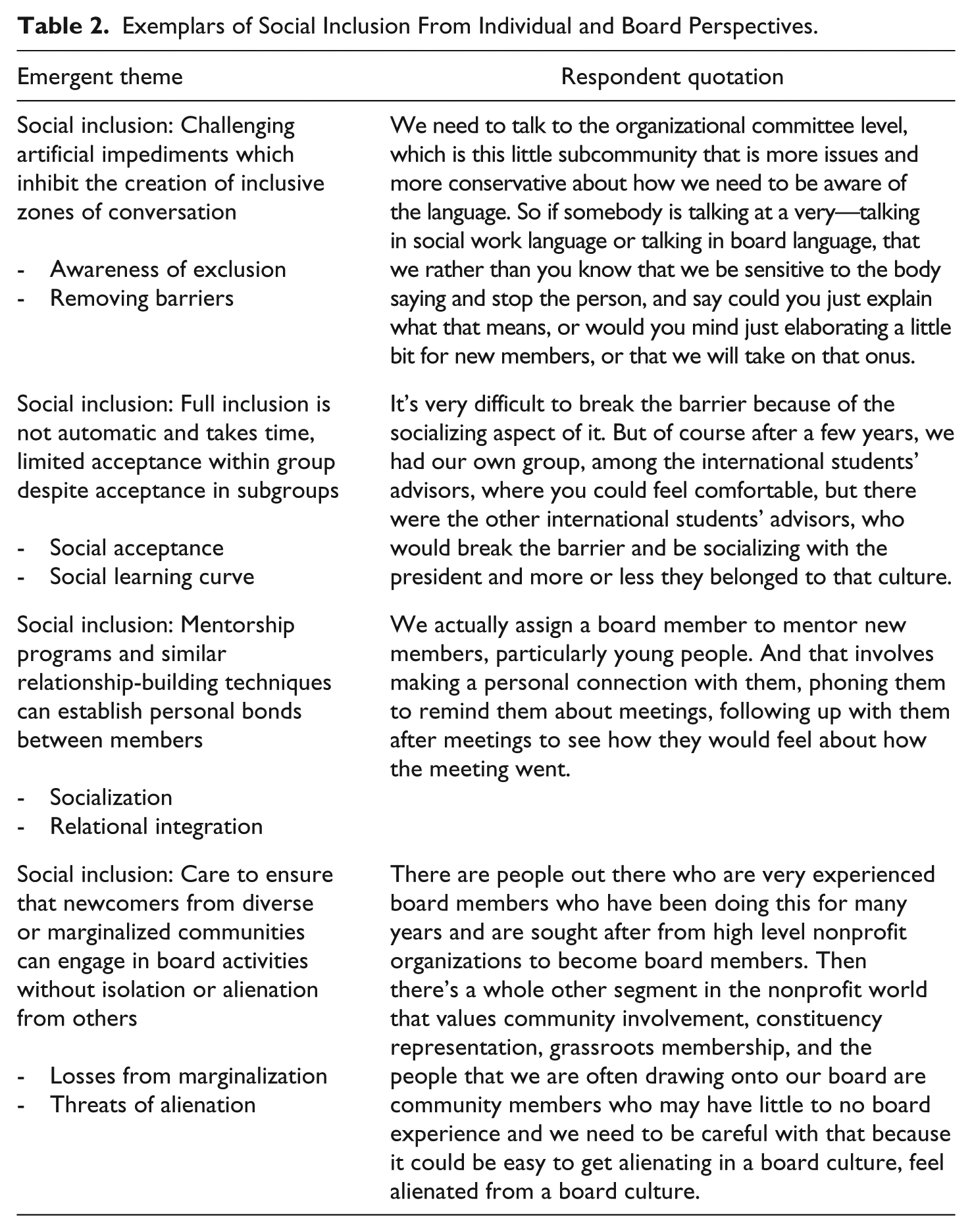
Our informants shared formalized board-driven efforts to improve social inclusion, including mentorship programs, orientation practices, and socialization processes such as retreats and relationship-building rituals. These initiatives illustrate the belief that strong social relationships are crucial to improving decision making and information sharing. Much of the discussion of social inclusion from the perspective of the board emphasized policies, practices, and procedures that had been institutionalized to reduce the tension between new members and old. Informants acknowledged the importance of using formal initiatives to create relational bonds, which contribute to the functionality of the board.
We did talk about the need for mentoring people and partnering people and giving people a friend on the board to provide extra support and translation. It’s like cultural translation for any new member, but particularly for new members who either don’t have a lot of experience or don’t know there’s a dominant culture at the board which is different from where you’re coming from.
The energies spent building the relationships that foster a shared understanding were considered by many to be important in attracting and maintaining an active membership within the board; one of our younger participants fondly recalled her introduction to the organization as a new board member, We had a full afternoon of orientation and there’s a board package. It was a really worthwhile afternoon, touring both facilities and getting to know what the term policy governance actually means. Now I have a mentor and she’s been really helpful.
A strong and welcoming organizational culture was depicted as one way of increasing feelings of inclusion, thereby reducing detachment and turnover. To us, the message was clear, if you want to have diverse boards, you need to find a way to speak with people from marginalized communities, support these members through the transition phases of board entry, and authentically engage them in social aspects that build strong relationships. One of the core findings of our investigation is the recognition that social relationships are recognized to have value in and of themselves. The added value of social inclusion results from the quality of relationships that exist among members of the board, allowing people to be thought of as more than the functional resource they bring to their boards. Based on this, we generated the following hypothesis:
While the thematic analysis revealed these two patterns of discourse around inclusion, there was a third theme that emerged from the transcripts, although not as clearly. This theme is reflected in this quote from one board member, “Recognizing that diversity brings richness. Diversity brings new ideas. Diversity brings growth. Diversity brings dynamism. Diversity brings energy. And lack of diversity means sameness, dullness, lack of growth.” Combining social and functional inclusion can lead to synergistic benefits for diverse boards, something we have come to call transformational inclusion or what Bourne (2009) describes as an inclusion breakthrough.
Building on our interview data, we hypothesize that functional and social inclusion will enhance the effectiveness of diverse nonprofit boards, and we expect both types of inclusion will independently affect board effectiveness. In essence, the interviews revealed that it is not enough for the board to provide a seat at the table for marginalized group members, nor is it enough for these board members to be included in the board’s social core. Our results suggest that functional and social aspects are uniquely important to understanding inclusion, and that in concert, the two dimensions possess transformative potential for boards that are composed of members from diverse communities. For these reasons, we hypothesize the following:
Quantitative Research Methodology
To test our hypotheses, we conducted a survey of the Canadian nonprofit sector. A total of 825 organizations were contacted based on their association with Imagine Canada; slightly more that 28% of the organizations responded by having a chief executive officer (CEO), executive director, or board chairperson (depending on organization structure) complete a lengthy questionnaire. This yielded a final sample of 234 organizations. Respondents were asked to provide information about the current demographic composition of their board. We also measured the boards’ orientation to functional and social inclusion. In the next section of the article, we describe how each construct was operationalized and measured, and then provide results of our analysis of the relationships among these constructs.
Of the responding organizations, most were relatively large with an average budget of CDN$10,117,321 (SD = $33,892,762) and a median number of full-time staff of 11. These organizations were primarily (66%) from large cities in Ontario, although we also had responses from most other regions of the country. Over half (65%) of the sample was composed of organizations with structures that were classified as legally independent, with the remainder (35%) comprised of nationally federated organizations. The average age of the organizations was 43 years (SD = 38 years). Over half of those that replied to the survey were in either the health (25%) or social welfare (27%) sectors. Our sampling, therefore, is representative of larger and more established organizations.
Of the individuals who completed the questionnaire, the average respondent had been with their organization for 10.3 years (SD = 8.24). Most of our respondents were White (87.5%), female (62.5%), and held the position of executive director or CEO of the organization they were representing (78.4%). Only 6.7% of our respondents identified themselves as disabled, and 7.7% of them identified themselves as lesbian, gay, or bisexual.
Variables and Measures
Diversity
We operationalized the concept of diversity in terms of the ethno-cultural composition of the boards of directors, more specifically, the range of diversity reflected on the board based on ethnic origin and visible minority status. Our measure of range of diversity is a composite measure in which responding executives were asked to identify the composition of their board of directors based on Canadian census categories of ethnic origin and visible minority status. Range of diversity was calculated as a count of the number of different demographic categories represented by members of each board (M = 2 categories per board). There are other ways of looking at diversity, and most commonly, people examine the proportion of a board that is made up of individuals from nondominant groups. We elected to look at the range of diversity or what Harrison and Sin (2006) call an inclusive constitutive definition of diversity (the collective amount of difference among individuals in a social unit).
Notwithstanding all of the other critical dimensions of diversity, we take ethno-cultural as our proxy for two reasons. First, contemporary nonprofit organizations continue to find it a challenge (Ostrower & Stone, 2005). In this survey, for example, the composition of board membership from our boards of directors was dominantly White (87% Caucasian). Second, the range of ethno-cultural diversity functions as a strong proxy for other dimensions of diversity as they relate to inclusion. For example, the relationship between a board’s range of ethnic diversity is significantly related to a board’s level of diversity in disabled members (χ2 = 12.46, p < .029, Cramer’s V = .27) and very significantly related to a board’s range of lesbian, gay, and bisexual diversity (χ2 = 19.08, p < .004, Cramer’s V = .34).
Functional and social exchange
To examine inclusion, we measured two dimensions of interpersonal interaction: functional exchange and social exchange. Building on Elsass and Graves’s (1997) differentiation between functional and social exchange, we used items that have previously demonstrated reliability (Graves & Elsass, 2005), adapting them to our research context.
Functional exchange reflects the quality of inclusion in the functional aspects of the boards. Here, we asked respondents to consider the four items dealing with the contributions of diverse board members to the functioning of the board and rate them on a 7-point scale ranging from 1 (not at all) to 7 (to a very great extent). For example, participants were asked to rate the degree to which “diverse members are influential in the board’s routine activities” or “diverse members participate in developing the board’s most important policies.” We averaged the four items to create a single measure (Cronbach’s α = .93).
In contrast, social exchange emphasizes relational aspects of board life by focusing on the development of friendships and interpersonal connections, or the sharing of personal details. Participants again rated their boards on a four item scale that included statements such as “diverse members become friends with the other members of the board” and “board members initiate social interactions with diverse members.” The measure was created by averaging the items and the measure demonstrated acceptable reliability (Cronbach’s α = .89).
Board-level outcomes
Building on our proposition that inclusive boards would also be more high performing, we chose to examine three facets of board performance: (a) governing effectiveness overall and safeguarding the mission, (b) board cohesion or integration as a reflection of member collaboration in the governing process, and (c) board member commitment.
Board effectiveness
Board effectiveness reflects the respondents’ views of the board’s overall effectiveness and the board’s capacity to perform the core function of governance, which is safeguarding the organization’s mission (Green & Griesinger, 1996; Ostrower & Stone, 2005). We operationalized effectiveness by asking the informants to assess board performance in terms of their perception of the effectiveness of the board overall and, second, in terms of the board’s ability to safeguard and fulfill the organization’s mission. The effectiveness scale was comprised of the mean of two items on a 10-point Likert-type scale (Cronbach’s α = .81).
Board cohesion
Our qualitative results suggest that board members want to participate fully in social and functional aspects of governing. We explore the relationships among diversity, inclusion processes, and social cohesion or togetherness using eight items from Smith and colleagues (1994) adapted to our context. All eight items (for instance, “the members of the board get along together very well” or “the members of the board are always ready to cooperate and help each other”) were measured using a 7-point Likert-type scale consistent with previous studies. Our measure of cohesion is an average of these eight items, which demonstrated good reliability in this study (Cronbach’s α = .77).
Board commitment
Nonprofit organizations continue to struggle with recruiting and retaining volunteers and unpaid staff, even at the board level. Moreover, even in compensated positions, diverse groups tend to encounter difficulties stemming from interpersonal conflict (Jehn et al., 1999; Pelled, Eisenhardt, & Xin, 1999), which increases propensities to exit the organization. Board commitment was evaluated with the mean of a 10-item scale (Cronbach’s α = .84, 7-point Likert-type scales) adapted from Mowday and colleagues’ (Mowday, Porter, & Steers, 1982; Mowday, Steers, & Porter, 1979) work with group commitment. In previous studies, versions of this scale have demonstrated strong reliability and appropriateness in the study of gender-process relationships similar to our approach (Graves & Elsass, 2005).
Control variables
Our analysis included examining the relationship of three organizational characteristics from within our sample and considered attributes of individual respondents with the main variables of interest. The first is the size of the community in which the organization exists. In the Canadian context, most visible minority community members are clustered in larger urban centers, and it is projected that in 2017, 95% of the visible minority population will live in a census metropolitan area (Statistics Canada, 2011), hence controlling for this is important. The measure of size of community is an ordinal variable with three levels: big city (population more than 200,000), small city (population of 100,000-200,000), and town/rural (population below 100,000). The second control variable is the size of the board (measured by the number of current board members), as larger boards seem to be able to attract board members with both the needed skills and representation from diverse communities (Bradshaw & Fredette, 2013). The third variable we are controlling for is the structural configuration of the organization which we operationalize as a nominal variable with two levels: legally independent nonprofit and national affiliate within a federated structure. We believe that boards that operate as a subboard within a federation (what we call nested governance models) have less autonomy in selecting board members, as other levels of boards determine appointment mechanisms, and as a result, there are constraints on opportunities to include diversity (Bradshaw & Toubiana, 2012). The inclusion of these variables adds control for confounding factors and improves the accuracy and practical significance of our models as a whole, even though not all of these control variables are statistically significant on their own.
Multivariate Outliers, Assessment of Common Method Variance, Multicollinearity Diagnostics
Nine organizations were removed from the sample prior to analysis as a result of initial exploratory data analysis, which revealed that their Mahalanobis distance flagged them as statistically significant multivariate outliers. The nine points removed all had statistically significant outliers at the p < .001 level and had unstandardized Mahalanobis distances ranging from 14.72 to 53.94 (Schinka, Velicer, & Weiner, 2003).
Following the recommendations of Podsakoff, MacKenzie, Lee, and Podsakoff (2003), we conducted a Single Method Common Factor approach analysis of the model. The Harman Single Factor test found approximately 7% of the variance to be related to a common factor. This is within the acceptable limits to proceed with the analysis using the assumption that our Type I and Type II errors will be robust. In addition, we found evidence of discriminant validity in relation to the single method by comparing the omnibus model with the unmeasured latent method factor model. The omnibus model has a chi-square of 173 on 21 df, a confirmatory factor analysis (CFI) of .224, a root mean square error of approximation (RMSEA) of .179 (.155-.204), and a nonnormed fit index (NNFI) of .254. The common latent factor model has a chi-square of 171 on 20 df, a CFI of .221, a RMSEA of .184 (.159-.209), and a NNFI of .256. The difference in chi-square for the two models was 1 on 1 df, p = .317. In this instance, a small change in both statistical (change in chi-square is not statistically significant) and nonstatistical (change in CFI = .002) criteria provide evidence for discriminant validity and a lack of problematic common method variance (CMV).
Variance inflation factors (VIFs), tolerance levels, and condition indices have been checked for all variables included in the models and are included in Table 3. These provide a standardized index of the effects of possible collinearity on the variance of the coefficients in a multiple regression. As illustrated in Table 3, all of our variables are well within acceptable levels (Allison, 1991; Fox, 2011).
Multicollinearity Statistics.
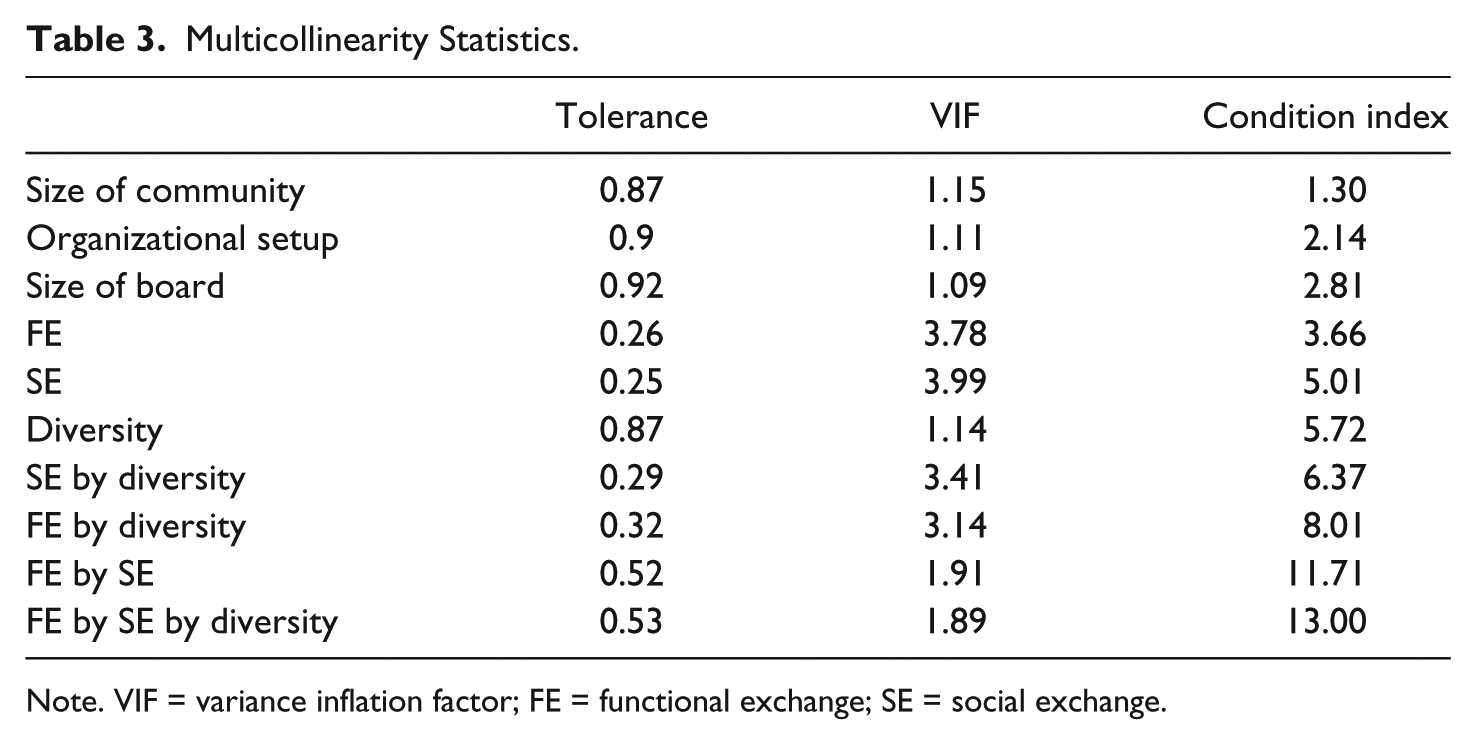
Note. VIF = variance inflation factor; FE = functional exchange; SE = social exchange.
Results
The means, standard deviations, skewness statistics, and zero-order correlations among the variables are presented in Table 4. The correlations demonstrate that moderate, significant correlations were found between functional exchange, social exchange, board commitment, and board effectiveness. Similarly, moderate to strong correlations were found between functional exchange, social exchange, and board commitment. Within the control variables, there is a moderate correlation between size of the community and the diversity of the organization. This is expected, as we consider size of community to be a proxy for the diversity of the community. There are no skew statistics greater than ±2, so they are all within acceptable levels for multiple regressions. The variables most skewed are included in the model as predictors, and higher levels of nonnormality in predictor variables are expected for regression. Importantly, our errors meet the assumption of normality (Field, 2009; McClelland, 1993).
Descriptive Statistics and Correlations of Measures.

p < .05. **p < .01.
Hypothesis Testing
To examine the hypotheses, a series of multiple hierarchical regressions were performed in which we first entered the control variables, followed by our main effects. To test the two- and three-way interactions between the main effects, interaction terms were created by calculating the product terms from the centered variables. This method reduces problems associated with multicollinearity (Aiken & West, 1991; Cohen, Cohen, Aiken, & West, 2003). Each of these steps was repeated with each of the three board outcomes as the dependent variable of interest (illustrated in Table 5).
Results of Hierarchical Multiple Regressions.
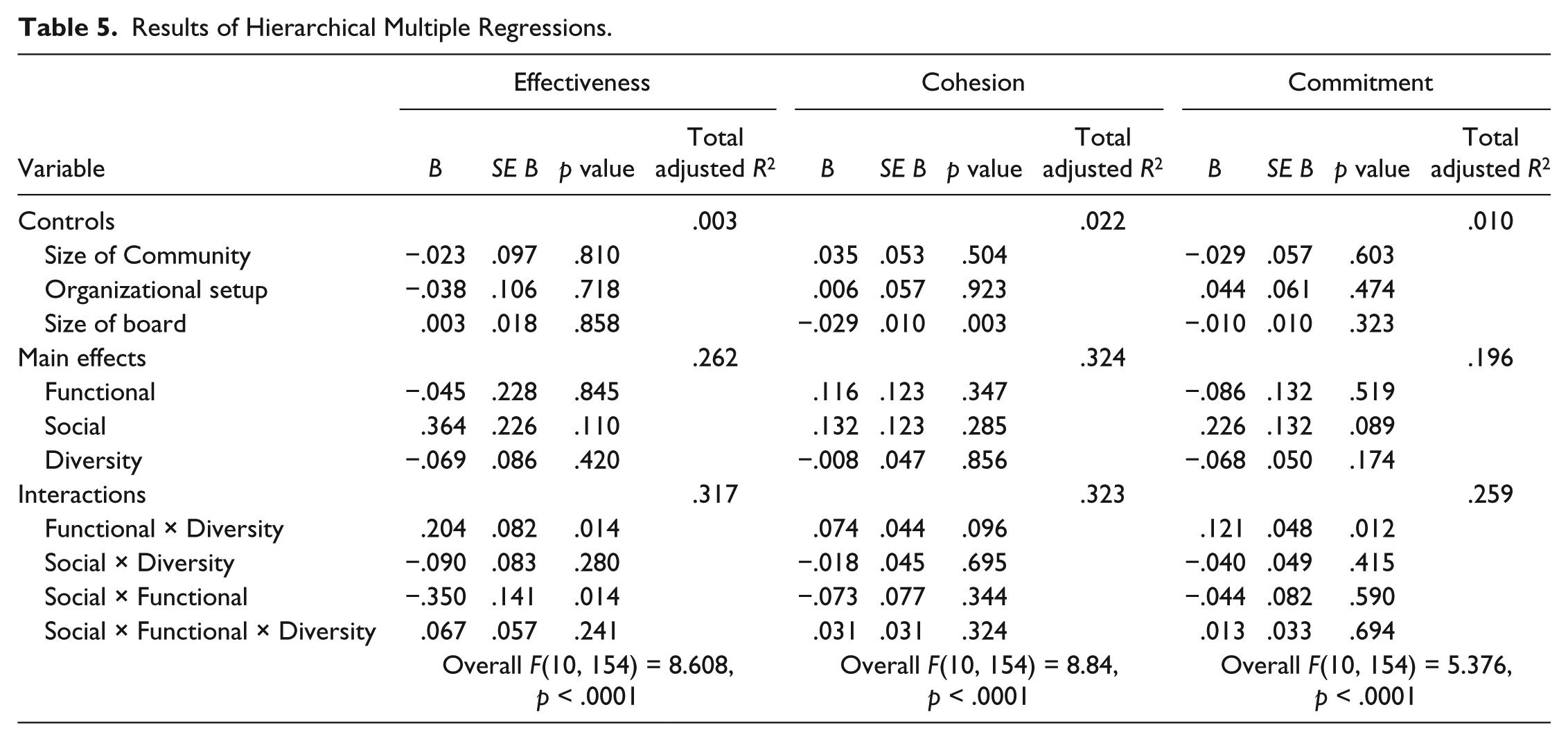
Hypothesis 1 predicted that nonprofit boards that have higher levels of functional inclusion will tend to be more effective, have higher cohesion, and have greater commitment than boards with low functional inclusion. In our final model, the main effect of functional inclusion is not statistically significant on its own.
Hypothesis 2 predicted that boards that have higher levels of social inclusion will tend to be more effective, have higher cohesion, and have greater commitment than boards with low social inclusion. None of the main effects for social inclusion are statistically significant. Although the p values are high, the coefficients are also quite large relative to the other betas. This could justify further research into the effects of social exchange on board outcomes.
Hypothesis 3 predicted that boards that are more diverse and have higher levels of functional inclusion will tend to have better board-level outcomes. This hypothesis was tested by including a two-way interaction between functional exchange and diversity in the models. For the dependent variables, board effectiveness and commitment, this two-way interaction is significant (β = .204, p = .014; β = .121, p = .01, respectively). This strong significance shows that how diversity affects these two board outcomes changes as the level of functional inclusion changes within organizations. For the dependent variable board cohesion, the beta is smaller (.074) and the p value is larger (.096), showing that this hypothesis is not supported for this outcome by our results, but does indicate that future research could be warranted.
Figure 1 illustrates that boards that have low functional exchange experience decreasing board effectiveness and board commitment as their diversity rank rises, and as the board’s functional exchange increases, the relationship between diversity rank and board effectiveness and board commitment changes. The relationship transforms from a negative one in the absence of functional exchange to a positive one in the presence of higher levels of functional exchange. This figure strongly supports Hypothesis 3 for the dependent variables of board effectiveness and board commitment. It shows how governing organizations that have low functional exchange experience decreasing board commitment as their diversity rank rises, and as functional exchange increases, the relationship between diversity rank and board commitment changes. The relationship transforms from a negative one in the absence of functional exchange to a positive one in the presence of higher levels of functional exchange.

Interaction patterns of functional inclusion and diversity for board effectiveness, board cohesion, and board commitment.
Hypothesis 4 predicted that boards that are more diverse and have higher levels of social inclusion will tend to have better board-level outcomes (effectiveness, cohesion, and commitment). This hypothesis was tested by including a two-way interaction in the models between social exchange and diversity. This two-way interaction was found to be nonstatistically significant in all three models; therefore, this hypothesis is not supported by our results.
Hypothesis 5 predicted that boards that are more diverse and have higher levels of both social and functional exchange will tend to have better board-level outcomes (effectiveness, cohesion, and commitment). This three-way interaction between all of our main effects is not significant for any of our dependent variables. As a result, this hypothesis is not supported.
Discussion of Findings
Our findings reflect the continued challenges of diversity, where the impact of increasing diversity on board performance and viability is largely contingent on the boards’ commitment to inclusion. Although previous research has illustrated that the risk of performance decline and destructive conflict tend to increase in association with diversity (Jehn et al., 1999), our results call inclusion into the foreground as an important mechanism in reshaping the diversity–performance relationship within nonprofit boards of directors. Meaningfully engaging members in the social and functional aspects of group work attenuates, and in many cases mitigates, this performance reducing result, avoiding the need to trade off effectiveness in building a more diverse composition. This is not to suggest that inclusion comes without conflict. Our interview data illustrate tension inherent in diversity and inclusion; tension to advocate and fit in, to remove barriers and represent community, to engage and to integrate. As a result, we chose to measure and distinguish functional inclusion from social inclusion to further examine our qualitative results. The results are somewhat underwhelming, in that the nuanced promise of our interviews was not fully captured by our quantitative findings. Telling however, are the partial results demonstrating the value of functional inclusion in the absence of social inclusion. That is, the potential conflicts arising from being more functionally included in the decision making and governance of the organization appear to be more impactful on the performance and viability of the board than practices associated with social inclusion among more diverse governing groups. Tangible gains from greater inclusion are possible, but transformation through inclusion requires designing and implementing a pragmatic program of practices that drive engagement and participation in governing to achieve the potential benefits.
It appears that neither functional nor social approaches to inclusion alone are sufficient to allow governing groups to be truly inclusive. Boards need to consider diversity in terms of inclusion, with potential to influence the group in its entirety, not only transforming composition but also transforming cultural and structural parameters. Years of study have demonstrated that diversity introduces complexity into group activities, and we believe our qualitative findings support this conclusion, but we also demonstrate that when efforts to include members in the functional and social fabric of organizations and boards are made, promised benefits of diversity can be obtained. Our respondents shared an acute concern for the performance of the board and its mission but tempered this with how they contributed to shaping these activities. Blending functional and social approaches to inclusion is essential to achieving more transformative inclusion.
We caution against instrumental motivations, wherein adding diversity is purposeful and deliberately undertaken for the explicit benefit of the organization. Stakeholder perspectives serve a strategic mandate to improve access to scarce resources, generate creativity and learning by incorporating new insight, or simply to enhance legitimacy by projecting a more inclusive image to constituents, such as funding organizations. However, without a structural and cultural infrastructure to support greater inclusion, they put at risk all of the benefits the organization sought to gain from greater diversity in the first place. Our findings bear some of this out in that functional and social inclusion frequently interact alone and with diversity in their influence on board effectiveness, cohesion, and commitment. Institutionalizing practices, processes, and routines that foster functional and social exchanges may well improve the performance and viability of group tasked with the complexities of organizational governance. Relational motivations focusing on building social standing and togetherness within the group may mitigate feelings of marginalization that often interfere with board effectiveness, a finding made prominent in our interviews, and this reflects awareness that boards must not neglect one dimension (social inclusion) in favor of focusing prominently on the other (functional inclusion). In our view, a significant improvement in social inclusion is required to shift from instrumental to more transformative orientations, even though reliance on social inclusion appears to bear less weight than functional inclusion in terms of board performance and viability.
Findings derived from multiple methods offer a unique perspective of the member–board exchange relationship as experienced and endured by respondents self-identified as constituents of traditionally marginalized communities in the first phase and of the effects of inclusive practices on diversity and board performance in the second. Our interviews centered on current situations and experiences for which respondents displayed emotional engagement, allowing us to capture vivid images of board life—salient among these was the participant awareness of the complexity of the relationship between social and functional aspects of governing within the boardroom. Our findings demonstrate the powerful influence of inclusion on the effectiveness, cohesion, and commitment of diverse governing groups. Future study into the areas that received qualitative but not quantitative support is warranted, as is the study of whether simply increasing diversity in number—but not ratio—similarly influences inclusion.
Conclusion
This research demonstrates that people simply do not experience diversity in a one-dimensional fashion, whether from the functionalist perspective of a stakeholder or the relational one of a group member. This finding is an interesting one, as it highlights the complexity of trying to “tap the benefits of diversity”; as boards seek to recruit and integrate desirable external stakeholders, they must be cognizant of the prospect’s ability to distinguish between attempts to enact tokenistic or representative inclusion from those of a richer nature. Indeed, taken together our qualitative and quantitative findings illustrate the importance of inclusion to both the boards and their members, as well as the complex relationship of inclusion to the health of diverse governing groups.
Our findings suggest significant opportunities for meaningful change by shifting focus from diversity to inclusion, not just in the boardroom but well beyond. Perhaps the most thoughtful—and as yet unmentioned—of these is to restore balance in the conversation of diversity and inclusion away from an overreliance on social inclusion and processes such as team building and cross-cultural training to also formally embed inclusion in the work plans and ongoing practices of the board.
Footnotes
Acknowledgements
We gratefully acknowledge the support of the Institute for Governance of Private and Public Organizations, Imagine Canada, and the Social Science and Humanities Research Council of Canada. Thanks also to Maytree Foundation, The Institute for Social Research at York University and particularly Liza Mercier, and Julie Ann Israel.
Declaration of Conflicting Interests
The author(s) declared no potential conflicts of interest with respect to the research, authorship, and/or publication of this article.
Funding
The author(s) received no financial support for the research, authorship, and/or publication of this article.