



Abstract
In this introductory essay to the special issue of Nonprofit and Voluntary Sector Quarterly on diversity, we begin by reviewing management research on diversity in nonprofits. The preponderance of this research focuses on demographic representation. While more contemporary approaches emphasize inclusion in decision making, even this approach falls significantly short because group categorization and identity have become increasingly complex and fluid. We ultimately explore a values approach to diversity, where the fact that people are inherently diverse is recognized and valued in all organizational activities. The final section of this introduction reviews articles included in the special issue. We conclude that the diversity concept must move well beyond a managerial approach to include broader social theories, giving deep consideration to concepts of identity, power dynamics and hidden interest conflicts in diversity efforts, and the ways that societal diversity affects the dynamics of volunteering and the structuring of nonprofit organizations.
Readers of this special issue of the Nonprofit and Voluntary Sector Quarterly will find a variety of articles representing approaches and conceptualizations of diversity that seem unusual. This partly reflects the way special issues are built. We editors had to work with the materials that were submitted. But the diversity of topics, approaches, and national contexts that are included in this issue also is intentional and reflects the approach we editors wanted to promote when we first got together to plan the issue and lay out our perspective on diversity. We were impatient with approaches to the topic that focused on essentialist properties of individuals that privileged certain underrepresented groups compared with others and that also did not deal with issues of identity in a careful or complex way. Rather than emphasizing an approach that asks whether organizations “are” or “are not” diverse, we wanted to build and emphasize an approach in which diversity would be a value concern, incorporated continually into all activities of organizations. Such a perspective allows for an intersectional view of diversity, recognizing that most of us are diverse in some way and that our diverse qualities might include a number of different personal and identity aspects—we might be Black, female, and disabled (Schalk, 2011), for example. Articles in this special issue reflect this kind of complexity in identities and diversity perspectives.
While this is where we want to come out, in terms of writing an editors’ introduction, we recognize that it is important to provide an intellectual roadmap that discusses the history of diversity scholarship and explains the steps we have taken in moving from a perspective that moves from a representational view to the values perspective we prefer. The preponderance of research on diversity related to nonprofit organizations focuses on familiar underrepresented groups, their presence in different organizational situations, and the outcomes that follow if these groups are more fully present in organizations and leadership roles. One approach we as editors took to capturing and characterizing the body of nonprofit scholarship on diversity was to carry out a formal literature review, the results of which are presented in Table 1, which lists empirical research on diversity.
Empirical Articles on Managing Diversity in the Third Sector.
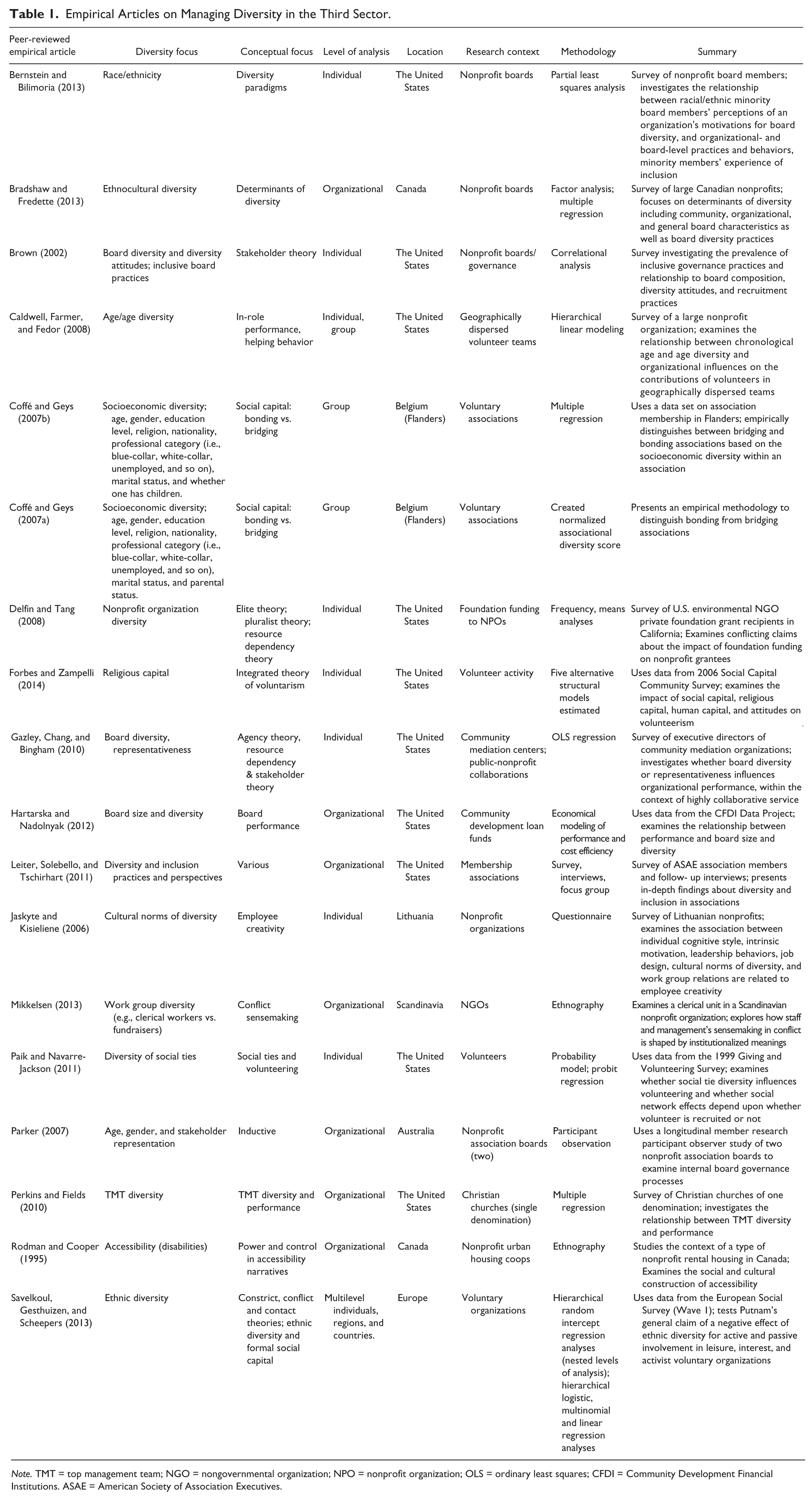
Note. TMT = top management team; NGO = nongovernmental organization; NPO = nonprofit organization; OLS = ordinary least squares; CFDI = Community Development Financial Institutions. ASAE = American Society of Association Executives.
In carrying out this review, we consulted the NVSQ journal database (1972 to June 2014), Wiley Online for Nonprofit Management & Leadership (1998 to June 2014), Voluntas (1997 to June 2014), and ABI/Inform Complete on Proquest (1986 to June 2014). We added the search term “diversity and NGO” in abstract when searching Voluntas, due to the common usage of that term in the non-U.S. setting. We searched using the following search terms as found in the abstract: “diversity and nonprofit,” “diversity and ‘third sector,’” “diversity and voluntary,” “diversity and volunteers.” Our search was delimited to articles classified as peer-reviewed and scholarly, and to articles specifically on the topic of diversity. Additional relevant articles that were not captured in the database search but that were referenced in some of these articles were also included in our review. We identified (a) the diversity focus of the research, (b) the conceptual framework(s) used by the author(s), (c) the geographic location of the study, (d) the research context, and for the empirical articles, (e) the level of analysis, and (f) the methodologies used.
A range of both quantitative and qualitative methods were used in these studies, as well as various conceptual frameworks, including social ties or social capital, stakeholder theory and conflict theory, among others. However, the preponderance of the empirical articles surveyed here were quantitative studies. As various facets of representational diversity are more easily codified as compared with aspects of inclusion processes, we find fewer articles focused on inclusion. An increased emphasis on this aspect of diversity likely would have involved more qualitative research and this would allow for a more nuanced understanding of complex diversity dynamics (Pitts & Wise, 2010; Tschirhart, 2008).
In the remainder of this article, we highlight various issues and challenges in researching diversity with the goal of generating a more nuanced understanding of its dynamics in nonprofit organizations.
Conceptualizing “Diversity”
Like many complex and contentious terms in social science, “diversity” is used in a variety of ways by different scholars, and those usages often are neither based on careful and precise definitions nor on the history of research and discourse. In this section of the introduction, we offer three conceptual definitions of the concept of diversity. The first is anchored in the legacy of equal employment opportunity (EEO) and affirmative action initiatives and led to a strategic view of diversity for enhancing organizational performance. The second relates to efforts to be inclusive in terms of involving minorities and protected groups in governing and operating processes in organizations. The third focuses on the politics of and the complexity of the concept of identity and oversimplifications and stereotypes that occur when we treat diversity as an objective attribute of individuals. Recognizing the complex and contextual nature of identities leads us to a perspective that emphasizes recognizing, involving, and serving multiple constituencies as a way of embedding consciousness of diversity in organizational values and in all aspects of functioning. Finally, we considered definitions that evolved from the adaptation and application of the concepts outlined above in the field of nonprofit management. During the last two decades, the initial streams of conceptualization, which largely evolved either in the private or public sector, have been adapted to the nonprofit sector. Conceptually, such synthesis has advanced the theoretical debate, especially in light of the increasing importance of large-scale nonprofits in providing goods and services to the population in a variety of contexts, the process often referred to as “hybridization.”
Diversity and the Legacy of EEO
It is helpful to trace the roots of the diversity concept beginning with EEO, which in the United States focuses on the legal imperatives set forth by Title VII of the Civil Rights Act of 1964, emphasizing the leveling of the proverbial playing field in employment for all individuals. EEO focuses on compliance with antidiscrimination laws.
Although affirmative action came into existence partly to respond to legal requirements, it also represents a moral imperative for organizations to more proactively recruit individuals from traditionally underrepresented groups to remedy past discrimination. Affirmative action has been viewed as a significant factor contributing to the rise in the United States of the African American middle class (W. J. Wilson, 2012) and in some higher education achievements of African American Women (Scientista, 2013). While it is widely known that affirmative action has provided significant benefits to White women in the workplace, and women of color have also enjoyed gains, African American men have benefitted the least (Moseley Braun, 1995).
The Hudson Institute’s Workforce 2000 report (Johnson & Packer, 1987) served as a wake-up call for employing organizations to look beyond the legal compliance requirements of EEO and affirmative action and toward novel ways of working with the changing workforce demographics. The report projected that by the year 2000, more than 80% of the net new entrants into the U.S. workforce would be women, non-Whites, and immigrants (Johnson & Packer, 1987). Consequently, organizations would need to start thinking more proactively about how to “manage” this workforce diversity. This led to the beginnings of a concept where diversity was viewed as voluntary rather than as legally mandated.
In this way, diversity emerged as an alternative, noncompliance focused pathway for dealing with demographic differences in the workplace. As opposed to the fair employment emphasis of EEO, the early emphasis in diversity was on recruiting individuals to increase heterogeneity, and then on celebrating or valuing differences once organizations began to diversify which ultimately did not do much to change the status of underrepresented groups such as women and minorities in organizations. However, understanding the role that new “diverse” organizational members could play in reaching previously untapped markets, or in creativity and innovation, led to the so-called “business case” for diversity that permeates many organizations today across sectors and around the world.
Many extant studies, originating in the private sector, have linked diversity to organizational performance. For example, Williams and O’Reilly (1998) reviewed 80 studies to examine the effects of demography on diversity and found that “variations in group composition can have important effects on group functioning” (p. 116). In their research review, Jayne and Dipboye (2004) found that the impact of demographic diversity on work group performance had mixed results. In a study of federal employees, Pitts (2009) found diversity management to be strongly and positively correlated to job satisfaction and to perceptions of work group performance. Kalev, Dobbin, and Kelly (2006) conclude that some diversity programs help women and African Americans to advance among the managerial ranks, although there was little evidence that “antidiscrimination” measures in these organizations actually increased organizational diversity. Cox, Lobel, and McLeod (1991) found that those from collectivist cultural traditions displayed more cooperative behaviors on a group task as compared with those from individualistic cultural traditions who were more associated with competitive behaviors. Similarly, McLeod, Lobel, and Cox (1996) found that ethnically diversity groups produced higher quality outcomes on a creative task as compared with homogeneous groups.
Challenges in defining “diversity.”
Defining diversity is a major research challenge, and the difficulties in conceptualizing diversity were noted early on by Nkomo and Cox (1996). Ivancevich and Gilbert (2000) define “diversity management” more broadly as “the commitment on the part of organizations to recruit, retain, reward and promote a heterogeneous mix of productive, motivated, and committed workers including people of color, whites, females, and the physically challenged” (p. 77). Roosevelt Thomas (1990) used the term managing diversity to refer to facilitating interactions among diverse members to achieve organizational effectiveness. In general, such diversity definitions capture two typical aspects of the concept in organizations: that (a) it has to do with a range of identity characteristics and (b) implies some mix of individual and organizational benefits.
Gazley, Chang, and Bingham (2010) suggest that although the terms diversity and representativeness are used interchangeably, they actually refer to different things. “Diversity” refers to variety or heterogeneity. Sometimes, the term composition has been used to define the degree of heterogeneity of members within a particular group, such as a nonprofit board (e.g., see discussion in Brown, 2002). Traditionally, diversity and composition concerned traditionally underrepresented groups (e.g., by race and ethnicity) but over time has come to include gender and other visible and nonvisible characteristics. Conversely, Gazley et al., citing J. L. Miller (1999), state that “representativeness” refers to the extent to which participants in the organization reflect the characteristics of its constituents. In practice, the term diversity is often used interchangeably with representation, implicitly if not explicitly. For our purposes, we use “representation” or “representativeness” to refer to the degree to which employees, volunteers, board members, and so on reflect particular demographic constituencies. We use the diversity term more broadly to refer to the range of activities reflecting issues of heterogeneity/composition, representation, and inclusivity.
While many nonprofit diversity studies are concerned with heterogeneity or representativeness as discussed above, both of these facets of “variety” imply a focus on identifying and quantifying individuals. That is, objective personal qualities are linked to people being studied and these qualities tell us whether or not they contribute to the compositional diversity or representativeness of an organization.
But beyond this, the question is raised as to whether diversity is a purposefully political (and some would add, morally) grounded concept that emphasizes the challenges of historically underrepresented populations and remedies for these challenges? If so, how do we include other “minorities” within a given context who are not necessarily “historically underrepresented”? On the other hand, we can ask whether diversity refers to all of the kinds of differences that occur among individuals and groups in an organizational setting? Is a common definition of diversity that applies across contexts even desirable? The foregoing discussion exemplifies the considerable challenges in defining the diversity concept.
Applying the concept of diversity
Another challenge has been with the application of the diversity concept. Many organizations have implemented policies and programs to increase the diversity of their participants and to increase sensitivity and understanding among organizational members. Diversity training is one such program that has become ubiquitous in organizations. One problem these activities encounter is the implication that people who are experts in diversity know more or are more sensitive than are organizational members who are not specially trained. Many people in nonprofits routinely serve or otherwise work with clients or colleagues who are members of underrepresented groups. Training programs run by experts are suspect if these individuals themselves may not have as much direct experience with the relevant populations as the staff members whose skills they claim to be improving. Training programs also are suspect because they tend to reify characteristics of underrepresented groups that inevitably apply to some but not all group members. The consequence is that efforts to increase sensitivity to minorities may stereotype those groups and may place members of those groups who are present in the organization in the situation of being token minority representatives (Kanter, 1977).
Both of these problems, who to define as minority and how to train organization members about diversity, encounter problems because diversity issues are contextually embedded. Without a deep understanding of the historical organizational context, short-term standardized approaches to enhance diversity are likely to fail. Failed diversity training often stems from an approach that minimizes the explicit and tacit knowledge of individuals working in the particular setting and instead treats them as a “blank slate” to be “filled” with knowledge by an “expert” trainer. As Leiter, Solebello, and Tschirhart (2011) state in their study on diversity and inclusion initiatives in associations, “these examples showcase how diversity and inclusion programs cannot be one-size-fits-all undertakings” (p. 22). If indeed diversity and inclusion have the capacity to positively transform organizations and enhance effectiveness, then they necessarily must involve contextually embedded processes.
The business case, the social justice case, and diversity paradigms
Cox’s (1991) pioneering diversity work emphasized gender, race, ethnicity, and nationality as the “cultural” boundaries of interest. Cox (1994) defined “cultural diversity” as “the representation, in one social system, of people with distinctly different group affiliations of cultural significance” (p. 6). He later clarifies that cultural diversity does not mean simply that everyone is unique, but rather
it means that people have differences of social group identity, such as differences in national origin, race, gender, work specialization and so on, that represent socio-cultural distinctions, and that have significant impact on their life experiences, and their work. (Cox, 2008)
He was also an early prominent advocate of what is now commonly called the “business case” for diversity—the idea that managing cultural diversity effectively can be a strategic competitive advantage in organizations (Cox & Blake, 1991). The “business case” for diversity reflects the view that diversity is critical to organizational performance and effectiveness. Konrad (2003) provides three arguments that proponents provide for the business case for diversity: competing for the best talent, acquiring marketing intelligence to meet diverse customer (or client) needs in a global economy, and diverse groups outperform homogeneous groups on problem solving and creativity. Interestingly, in their study on diversity in associations, Leiter et al. (2011) found that their interviewees rarely invoked the business case, and in fact many believed that using limited resources on diversity and inclusion initiatives was unfair. Tomlinson and Schwabenland (2010) argue, however, that the business and social justice cases in the voluntary sector can be seen as more complementary than competing, due to the nature of social justice work in the sector.
Challenging contemporary views of diversity, Linnehan and Konrad (1999) suggest that diversity definitions that focus solely on individual differences tend to “obscure issues of intergroup inequality” (p. 402). In their view, the business case does not adequately take into account intergroup inequality, often confuses cultural differences with inequality differences, and frequently relegates historically excluded groups to positions where they work only with those from their own community (Linnehan & Konrad, 1999). As such, management practice based on conceptualization of diversity as individual differences may be ineffective in the long run. Similarly, emergent research in critical studies has also highlighted the capacity for these contemporary diversity views to obscure unequal power relations in organizations (see, for example, Zanoni, Janssens, Benschop, & Nkomo, 2010).
Beyond these basic diversity definitions, several well-recognized diversity paradigms appear in the management literature, reflecting differing basic philosophical underpinnings of the diversity concept. Diversity as a moral imperative to correct societal and organizational injustice and inequity is reflected in the aforementioned “social justice” case for diversity (Tomlinson & Schwabenland, 2010). In the nonprofit sector, social movements related to the development, expression, and political representation of identities has an important presence. This is the case even though providing opportunities for self-development and free expression are not usually included in the diversity discourse.
D. Thomas and Ely (1996) introduce three diversity paradigms that are consistent with the trajectory of the diversity concept over time, although organizations can reflect predominantly any one of these approaches, according to the authors. The “discrimination-and-fairness” perspective is an approach to diversity that is focused on equal employment, fairness, recruitment, and compliance with antidiscrimination laws. The “access-and-legitimacy” suggests that it makes business sense for organizations in an increasingly multicultural society to diversify in order to reach new, previously untapped markets. Finally, the third “integration and learning” perspective reflects how diversity can create better organizations, not simply enhance competitiveness. While, D. Thomas and Ely (1996) state that the first paradigm is associated with assimilation on one end, and the second with differentiation on the other, this new model emphasizes integration and “lets the organization internalize differences among employees so that it learns and grows because of them” (p. 86).
Diversity and the nonprofit sector
As for the nonprofit sector specifically, (Hayes, 2012, para. 2), in Profiles in Diversity Journal paints the following picture of representational diversity in the nonprofit sector:
Currently, nonprofit employees are approximately 82 percent white, ten percent African American, five percent Hispanic/Latino, three percent other, and only one percent Asian/Pacific Islander. Employees of color make up about 14 percent of leadership or upper management roles, and less than six percent of specialized positions.
Clearly, the numbers of paid nonprofit staff do not closely reflect the increasingly multicultural total workforce. While these statistics describe cultural diversity in organizations, this diversity represents only one slice of the range of primary (visible) diversity characteristics at play, and does not include other secondary (invisible) characteristics, such as socioeconomic status or religion, which are equally important in many nonprofits. Carson (1993) brought early attention to race, gender, and culture in nonprofit research. Furthermore, various nonprofit studies focus on diversity, with particular attention to board diversity (cf., Bradshaw & Fredette, 2013; Brown, 2002; Duca, 1996; Parker, 2007; Rutledge, 1994; Siciliano, 1996; Steane & Christie, 2001; Widmer, 1987).
During the last decades, whereas some organizations (including the courts and the government) and parts of society have shifted their view to assert that affirmative action and the aggressive enforcement of EEO laws are no longer necessary, new contextual challenges seem to be emerging. These challenges speak to issues such as transformations in the labor force. These transformations include: that current “minorities” have become the majority of both workers and customers, the global circulation of highly skilled talent, the decline in “labor citizenship,” and expanded immigration patterns. Together, these transformations are changing the social distribution and geography of opportunity. In some parts of the United States, new entrants are overwhelmingly minority (and immigrant), young, and undereducated (Borges-Méndez, Jennings, Haig-Friedman, Hutson, & Roberts, 2009). Furthermore, in some occupational categories of health care in some states, such as New York and Massachusetts, the majority of workers are predominantly minority, foreign-born, or women. Moreover, in some locations such as The Bronx, New York, both the health care labor force and the patients are minority (and poor). Employers are aware of this, especially those employers that serve the Medicare/Medicaid population, and who also employ many workers from traditionally underrepresented groups.
Inclusiveness and Outcomes Research
Beyond representation, scholars have increasingly acknowledged the role of “inclusion” in organizational diversity efforts. Thus, we increasingly see the composite term diversity and inclusion to acknowledge the dual aspects of the broader diversity concept in management studies. According to Roberson (2006, p. 215), “inclusion is focused on the degree to which individuals feel a part of critical organizational processes,” representing “a person’s ability to contribute fully and effectively to an organization” (F. A. Miller, 1998; Mor-Barak & Cherin, 1998).
One reason the representational approach is a common focus in organizational diversity efforts is because measuring these aspects can be far easier than measuring or evaluating processes leading to organizational inclusiveness. Outcomes-based research on diversity has predominantly focused on groups or teams that have diverse memberships. As Fredette, Bradshaw, and Krause (IN PRESS) tell us, groups that merely have the appearance of diversity rarely show any gains on outcome measures of group effectiveness (e.g., creativity, innovation, decision making).
Important as representation is it also can potentially undermine strategic diversity efforts because the approach tends to limit and pigeonhole individuals from underrepresented groups in ways that do not take full account of their added value to the organization. This not only makes their day-to-day work difficult in ways Kanter (1977) demonstrates. Stereotyped understandings about their values, attributes, and concerns are also likely to hamper true inclusion processes that would value their knowledge, creativity, and unique interests. Unless minority members are intentionally involved in functional activities where their skills are put to work, there is minimal impact from heterogeneity of membership.
Roberson (2006) affirms that few research studies examine the “specific attributes and practices” of diversity and inclusion, and that inclusion is especially understudied in the field despite the fact the management practice already reflects a distinction between diversity and inclusive practice (pp. 213-214). Her in-depth study found strong correlations between factors associated with “diversity” and those associated with “inclusion,” thereby suggesting overlap between the two concepts. Acknowledging this interrelatedness allows us to avoid the binary “either/or” descriptions that mask the complexities of these concepts as practiced in particular contexts. Relatedly, Fredette, Bradshaw and Krause (in press) assert in their multiple method study of diversity and inclusion on nonprofit boards, “Our findings demonstrate the nuanced, complex and, at times, tenuous relationships among diversity, inclusion, and performance” (p. 2).
Different language for framing this idea comes from Weisinger and Salipante (2005) who distinguish “representational diversity” from “pluralistic diversity.” The dual foci are interrelated and conceptualizing diversity in this manner encourages us to view representativeness and inclusiveness as ongoing processes that can simultaneously inform each other in promoting pluralistic diversity. As we have said, representational diversity often focuses primarily on the presence in an organization of traditionally underrepresented groups. But just because such groups are present does not mean that an organization is pluralistic in its way of experiencing diversity. To be pluralistically diverse, the ideas and viewpoints of underrepresented groups must enter organizational discussions and decisions and these individuals must also have responsibility for organizational affairs and opportunities to do creative work that matters. Being pluralistic also means organizations are not homogeneous in terms of culture, social position, or background. Among members, there are many distinct histories, cultures, lifestyles, and situations of personal privilege. A pluralistic organization encourages incorporation of these multiple backgrounds and identities and values the process of blending them into a coherent organizational presence. Such an organization is intrinsically inclusive as well, although mere inclusiveness is a narrower concept. It just means that efforts have been made to allow minorities to participate meaningfully in the decision making and action processes of an organization that is dominated by majority culture. This notion of pluralism has a strong relational component, suggesting that improving diversity in general also involves a process of relational development (Weisinger & Salipante, 2005).
Thus, representational diversity in nonprofit and voluntary organizations does not guarantee that the presumed benefits of representationally diverse organizations, such as better decision making, increased creativity and innovation, and enhanced organizational effectiveness, are realized. In fact, much criticism of the diversity concept reflects a concern that an overemphasis on representation deflects from what is actually needed to capitalize on the benefits of diversity—that is, new ways of thinking about and carrying out the organization’s mission and its work that fully include the contributions of all organizational members.
Empirical research in our literature review that focuses on inclusion is relatively minimal, with notable exceptions from Brown (2002) and Leiter et al. (2011). For example, Brown examined the inclusive practices in nonprofit governance using a survey and profiles of two NPOs, finding that
[t]he organizational profiles provide a picture of boards that used different strategies to accomplish the goal of inclusivity. Boards that use more inclusive practices were not necessarily heterogeneous in board member composition. Inclusive boards were more inclined to be sensitive to diversity issues and used recommended board recruitment practices. The existence of a task force or committee on diversity was also significantly associated with a more inclusive board. (Brown, 2002, p. 369)
According to this research, inclusive boards need not be representationally diverse, and these boards also employed specific practices designed to enhance organizational diversity and inclusion. Although we acknowledge the need for more research on inclusion practices in nonprofit and voluntary organizations, we also recognize that current emphasis on the management of diversity in organizations focused on representational diversity and inclusion may unnecessarily limit discourse about the transformative capacity of this diversity not only within organizations but also in communities and in society.
Multiple Identities
A challenge of incorporating context into diversity projects arises from the dual nature of identities. As we have noted, representation and inclusion both place individuals in categories that are defined externally. However, to be relevant, people must feel that they personally fit into the categories. There often is an important process by which people connect the personal, internal aspects of self to affiliations with others who share emotional experiences related to attributes of self. Additional steps are required for connections of affiliations to be transformed so that members accept that they are part of a publicly recognized category and that they wish to act as members of the category.
There is an important literature in the social sciences about how private experiences become socially constructed identities as people have group experiences with others who share their life circumstances. These group identity experiences then can become politicized as group members recognize that they share with others an experience that can be called political oppression (Borkman, 1999; Sandstrom, Martin, & Fine, 2009; Schrock, Holden, & Reid, 2004). As their identities become politicized, they may become more willing to “come out of the closet” and to protest in ways that are overt and sometimes confrontational. This developmental process is well illustrated by the AIDS activist organization ACT-UP (Aronowitz, 1996) and also by disabled liberation organizations like A.D.A.P.T. (Golfus & Simpson, 1995).
One problem with this theory is that by linking social statuses to political oppression and claims for participation and redress, the theory reifies unidimensional conceptions of identity. In Northern Ireland, this treatment of identity led to complete power sharing between Protestants and Catholics. One consequence is that “minority” identities like “woman” or “disabled” or “gay” or “jazz musician” were subordinated so that all of these groups found it difficult to form cross-community interest groups that could effectively make claims in a pluralistic political system.
Another problem is the implication that identity issues are primarily personality-based, which suggests that oppressions can be rectified with better cross-group communication and shared understanding. This downplays the possibility that dominant and subordinate groups actually have serious political and economic interest differences that require political solutions rather than group-based, interpersonal ones. Where these interest differences exist and lead to activist political movements, injuries that happen as a result of conflicts may be understood as honorable consequences of political struggle rather than victimization related to identity oppression (Gilligan, 2007, 2009).
Following this perspective, we recognize that all individuals have multiple identities. Some are more primary or core than others. People may or may not want to publicly acknowledge aspects of their selves that they recognize as significant. If they recognize such an important feature of the self, they may or may not want to affiliate with a small group of others who share that identity. If they share, they and their group may or may not see that aspect of self as a feature they want to present in terms of membership in a socially meaningful category (like being gay). If they want to acknowledge membership in a category and if they feel social and political action are important, they may or may not affiliate with an action movement. The important management issue here is that organizations often (opportunistically) treat roles within the division of labor as segmental. Employees or members are expected to do their job in appropriate ways and pretend that other, sometimes complex and meaningful aspects of their identities are not relevant to organizational work. In some jobs, like being a low-paid nurse in a nursing home, the reason an individual accepted employment might be because their role allows them to express a larger and more important aspect of their identity—like a spiritual commitment to helping people who are in need.
In sum, we recognize the traditional diversity research discourse emphasizing the representation of social identity groups, particularly those that are historically underrepresented, and the emergent emphasis on inclusion as being critically important to ongoing dialogue within this domain. However, we nonetheless eschew binary conceptualizations of diversity and inclusion, and of identity, instead preferring to advocate for more complex and nuanced ways of examining these concepts and the relationships among diverse individuals and groups within particular organizational contexts. The “straight jacket” of binary conceptualizations, for example, hinders an understanding of the fluid dynamics and mutations of identity, diversity, and inclusion in the context of “network society” and the organizational topologies serving as the medium to new forms of collective action.
We acknowledge the critical role of individual agency in diversity efforts. Agency is anchored in and motivated by values. Beyond values being a personal commitment of individuals, organizations can develop collective evaluative frameworks that emphasize an appreciation of the benefits of difference, a commitment to cultural competence, and a variety of activities, programs, and styles that make incorporation of diversity in all activities a normal and important aspect of what the organization does. Through such organizational value orientations, there is a capacity for these efforts to bring about not only organizational transformation but also community transformation as well.
Finally, we believe that robust research on diversity and inclusion must examine the processes involved in increasing representation and inclusion, and their effects (whether positive or negative). Such research must also take into account the influence of context (organizational, community, societal) on individual and group action related to representational and pluralistic diversity. Diversity research is a multifaceted endeavor that explores processes that are historically and contextually embedded in particular organizations in particular communities in various places at a given moment in time. As such, more intricate research approaches are required, including more longitudinal and multistakeholder research.
Broader Theories of Diversity and Social Organization
So far in this essay, we have discussed diversity in a management framework in which someone or some group in an organization seeks to “do something” about diversity. Most of the articles in this special issue do not take a management perspective, however. In this section, therefore, we wish to consider broader social theory linkages to the concept of diversity. In doing this, we will begin by building off the perspectives introduced by articles provided in the following pages. The articles are not a systematic sampling of theories that might draw on diversity concepts; therefore, this section will also discuss perspectives that we encountered in the literature reported at the beginning of this essay. Let us consider the articles and ways they relate to broader social theories related to diversity.
1. Class Diversity in Youth Volunteering in the UK: A Bourdieusian Approach to Understanding Middle-Class Advantage
This article reports findings that most youth volunteers in the United Kingdom are middle class and that few are drawn from the working class. The article reflects concern about the lack of class diversity among youth volunteers and explores reasons for this outcome. One reason for this class difference has to do with the habitus or cultural context in which young people grow up and the middle-class preference for volunteering. However, there also are important structural sources of preference for middle-class young people. One is that those who run organizations that utilize volunteers prefer to recruit young people who are capable in terms of carrying out tasks that the organizations need to have done. Middle-class young people are more capable in part because of educational advantages that they enjoy. But there is also a closer cultural fit between the young people and staff members. Thus, staff members feel it is easier to get their work done effectively with middle-class young volunteers. Working class young volunteers do not feel as supported and they also look to different kinds of rewards in their work that middle-class staff members may not understand. Feeling that the work is relatively pointless, these young people stop volunteering, and this further increases the class division in the youth volunteering population.
2. LGBT Alumni Philanthropy: Exploring (Un)conscious Motivations for Giving Related to Identity and Experiences.
This article examines the willingness among lesbian, gay, bisexual, transgender, and queer (LGBTQ) college alumni to donate funds to their alma mater. Not surprisingly, willingness to donate has to do with experiences of support or rejection individuals felt while they were students, whether the colleges had current, strong programs that these alumni liked and supported, and whether development staff effectively reached out and recruited participation. The more important and surprising finding of this study has to do with whether individual alumni connected their LGBTQ identities to other identity linkages they might feel with the college. For example, while our stereotypes might say that LGBTQ students would not support football or other sports programs, this was actually an important point of identification for some of the alumni and they preferred donating to these programs rather than to LGBTQ programs.
3. Is Promoting Disability Rights Conducive to a Stronger Democracy in Brazil?
This article explores the development of the disability rights movement in Brazil. It relates the way groups advocating disability rights formed in Brazil, the growth of government support for disability rights, and the importance of the 2006 United Nations Convention on the Rights of Persons with Disabilities for Brazilian governmental recognition of disabled rights in 2008. While the article supports the importance of the social movements and governmental supports for the disabled, it also points to the limitations inherent in tying social gains to the ability of social movement groups to be well organized and strategically effective and for parties in government to choose to support this interest as opposed to other interests that make claims for power and resources.
Truly effective extension of rights to the disabled would require a values shift related to democracy in all of Brazilian society so that the perspectives, needs, and values of minority interest groups would be recognized, valued, and supported. Within such a context, specific interest groups that support disabilities might be successful or unsuccessful but they and other like groups would at least operate in a political environment where their expressions are considered important by government and their expressions of need would be taken seriously, even if they were not successful in pushing their desires forward on any particular issue. In the system that currently prevails, democracy tends to give rewards to majoritarian groups or to groups that can effectively advance their groups’ interests through the mobilization of powerful support (perhaps by outlandish protest tactics or by gaining the support of very wealthy factions in society). A different sort of democracy would recognize that society is inherently pluralistic and that the concerns and needs of minority interests need to be given meaningful standing in the political order.
4. Bridging Urban Diversity: Associations, Members, and Neighborhood Representation
This article explores the dynamics of bridging social capital and it grows out of a tradition in urban sociology that examines how heterogeneity or homogeneity affects urban neighborhoods (Blau, 1977). More diverse neighborhoods are related to lower levels of trust, tolerance, and civic engagement. In Putnam’s (2007) social capital perspective, people in homogeneous neighborhoods form bonding social capital, and this leads not only to high trust but also to high exclusivity. At the neighborhood level, direct social interaction seems to allow people to overcome the tendencies for isolation that flow from diversity, and some have suggested that this might allow voluntary associations to be a vehicle for building bridging social capital across neighborhoods. This article finds that individuals who are involved in common-interest associations and who live in separate neighborhoods may, indeed, bridge but primarily if they come from the same sociodemographic groups.
5. An Asset-Based Approach to Volunteering: Building and Leveraging Assets for Low-Income Volunteers
Working counter to the “Bridging Urban Diversity” article and the “Class Diversity in the U.K.” article, this one argues that strong bonding social capital in low-income urban neighborhoods is not so much a result of fear of other groups. Rather, the authors argue that the volunteering literature generally does not accurately measure “volunteering” when low-income neighborhoods are the focus of study. While formal, institutional volunteering is not common, voluntary mutual assistance and the development and strengthening of informal economic assets is constant. Sharing of these informal assets is vital to survival (Fitchen, 1981; Stack, 1974). Asset sharing also tends to be functional, so that if cross-group relationships fit into the need and process of mutual help, then we may see dramatic examples of bridging social capital at work as in Klinenberg’s (2002) explanation of why elderly Black people living in a Latino neighborhood survived while similar people died in the largely Black neighborhood a few blocks north.
6. From Diversity to Inclusion: A Multi-Method Examination of Diverse Governing Groups.
This article, mentioned earlier in this introduction, is the one we have included that truly has a management focus. Its main point is that most studies of diversity have a representational focus, and they report findings that the simple appearance of diversity has little impact on organizational outcomes. They report research on deeper inclusion both in organizational decision processes and the functional activities of organizations, and they find that this inclusion does have meaningful impact on organizational outcomes.
Summary and Conclusion
One goal of this essay has been to review the literature on diversity and diversity management in the third sector to provide a base-line accounting. We undertook the review, however, in the conviction that most previous research is inadequate in the sense that it neither addresses nor theoretically develops perspectives that recognize the importance of inclusion, the complexity of identities, or of a pluralistic approach to diversity. We sought to frame traditional managerial conceptualizations of diversity in ways that could allow them to address important complexities that we think are inherent in the idea of diversity. We also sought to create an analytic platform upon which to position the articles in this special issue, which collectively represent a theoretical agenda that goes beyond a management perspective.
From our review of the management literature and its shortcomings, we developed three themes that we think will be important for future research to develop and expand. They are contextuality, intersectionality, and multiplexity.
Contextuality
As we alluded to earlier, particular historically situated contexts impact diversity, inclusion, and pluralism processes. Therefore, diversity research must increase emphasis on the role that context (situational, organizational, community, national) plays in these processes and in the interactions among individuals. Rousseau and Fried (2001) define contextualization as follows: “Contextualizing entails linking observations to a set of relevant facts, events, or points of view that make possible research and theory that form part of a larger whole” (p. 1). The authors suggest several ways to accomplish contextualization, from rich description to “direct observation and analysis of contextual effects,” to comparative studies.
Intersectionality
The concept of intersectionality has its roots in Kimberlé Crenshaw’s (1989) Black feminist perspective. Crenshaw studied how extant antidiscrimination laws render invisible the Black woman’s experiences by emphasizing either race or gender in situations of subordination. The notion that U.S. courts did not recognize the discrimination experiences of “Black women” as a distinct social group, instead forcing plaintiffs in many legal cases to claim discrimination based upon race or gender, but not both, called into question the meaning of social categories in the quest for social justice for Black women. Since this seminal work, intersectionality has become a well-accepted conceptual framework in feminist and other critical scholars.
In a similar vein, recognizing that organizational and community members have intersectional identities calls into question traditional ways of approaching diversity in nonprofit organizations. Intersectionality opposes binary approaches to identity and renders more problematic the idea of “counting” heads for representational diversity purposes. Further intersectionality extends beyond race and gender also considers increasingly multiethnic and multiracial populations, gender fluidity, and a range of other intersectional identities. Researchers must grapple with how, methodologically, to capture intersectionality dynamics (McCall, 2005) in diversity research.
Multiplexity
Multiplexity refers to network relationships that are multistranded (Mitchell, 1969, 1974). Individuals or groups have relationships in several different settings, where the relationships may involve contrasting commitments or different substantive content so that the relationships themselves have several simultaneous meanings. Where diversity is concerned, traditional representational approaches tend to envision single-stranded relationships. Where multiplexity is the rule, people may bring both multiple identities and multiple group commitments to involvement in organizational life. What this tends to mean is that while individuals may be categorized in terms of an objective quality like race or gender they may also be acting in terms of hidden qualities like religious commitment or being affected by a disability or serious disease.
Multiplexity is becoming increasingly important because of the increasing power of networks, social media and communicational technologies serving to expand connectedness, and the opening for new spaces of diversity and inclusion. Where in the past individuals might have been trapped in organizational life in a unidimensional, minority identity social networks provide avenues for mobilization and escape. Individuals are not just what they appear to be (the objective measure of the minority status). They also connect to people in other settings who share multiple dimensions of identity. This allows legitimation and reframing in ways that encourages new, creative frameworks for identities that might once have been targets of exclusion, domination, and marginalization.
As we noted in reviewing the management literature, action on diversity issues often is politically inspired. It is a positive thing that constituency groups and government regulations are challenging nonprofit organizations to more effectively include underrepresented groups in all of their activities. Where there is political pressure for organizations to become more diverse, the emphasis in research tends to be on clear measures of where organizations stand at some origin point and how they are changing over time. Quantitative measures are the easiest to use, and to the extent they present clear-cut results, they can have important impacts on policy making.
Their shortcoming is that they tend to present essentialist definitions of diversity. Such definitions reify single, objective characteristics. We have a tendency to allow these unidimensional measures to shape the way we theorize about organizations, the nature of diversity, and what it might mean for there to be meaningful change. Our argument in this introduction is that it is essential to move toward complex understandings of identity and to understandings of diversity that view particular concerns and initiatives in terms of historical contexts that shift as we move from time to time and place to place. We also must have an understanding of diversity that places a pluralistic value orientation at the center of our ways of thinking both about what organizations are and how we should act within organizations.
Footnotes
Declaration of Conflicting Interests
The author(s) declared no potential conflicts of interest with respect to the research, authorship, and/or publication of this article.
Funding
The author(s) received no financial support for the research, authorship, and/or publication of this article.