



Abstract
Given that volunteers perform a diverse range of behaviors aimed at helping distinct causes, a more nuanced understanding of how types of volunteer behaviors are similar and different would enrich both basic and applied perspectives on volunteerism. We created and validated an inventory of individuals’ interests in eight different types of volunteering: administrative volunteering, helping animals, interpersonal helping (autonomy or dependency), donating, physical volunteering (built or natural environments), and political volunteering. Grouping these eight types of positions into two general categories (interpersonal and skills-based volunteer positions), we also examined convergent and discriminant validity, linking interest in these positions to constructs from the volunteerism literature (i.e., prosocial personality, volunteer motivations, and volunteer satisfaction). This research demonstrates that volunteer behaviors can be classified into types, certain individuals are interested in different types of volunteer behaviors, and volunteers engaged in behaviors that match their interests express greater volunteer satisfaction.
Among the aspects of volunteerism deserving of more attention are the differences and similarities between distinct types of volunteer behaviors. Given that little theoretical and empirical work has tried to systematically organize these types of volunteer positions, we set out to develop a volunteer interest typology (VIT) that would allow us to examine the distinct and common correlates of interest in different types of volunteer positions. Toward this end, we classified people’s interest in eight types of volunteer activities and linked key constructs from the volunteerism literature (i.e., prosocial personality and volunteer motivations) to interest in these different volunteer behaviors. We also extended prior research on matching effects (e.g., Clary et al., 1998; Stukas, Worth, Clary, & Snyder, 2009) by examining whether volunteers engaged in volunteer work that matches their interests (“matched volunteers”) report being more satisfied with their position, as compared to volunteers engaged in volunteer work that does not match their interests (“non-matched volunteers”).
Classifying Volunteer Behaviors
Volunteerism is a prevalent and complex form of prosocial action. Often defined as planned, non-obligated behavior aimed at community improvement, engaged in through established community organizations with no expected payment to the volunteer (Snyder & Omoto, 2008), volunteerism actually encompasses a wide range of distinct actions aimed at helping individuals and communities. Some volunteers offer their time to clean up litter at a park, while other volunteers spend their evenings tutoring children at a school. Volunteers might donate blood after a local disaster, and still others might send out weekly newsletters to community members interested in neighborhood updates. Although these actions are generally aimed at bettering society, they entail a diverse set of behaviors and responsibilities, they often target different populations or social issues, and they have the potential to elicit distinctive thoughts, feelings, and experiences from the volunteer.
Past research on volunteerism has examined volunteers in a wide range of positions, such as youth leaders (Cornelis, Van Hiel, & De Cremer, 2013), companions for people living with HIV/AIDS (Dwyer, Snyder, & Omoto, 2013), halfway house volunteers (Denney & Tewksbury, 2013), hospice visitors (Finkelstein, 2008), environmental volunteers (Dávila, 2009), and blood donors (Lee, Piliavin, & Call, 1999). This tradition of research has tended to ask who volunteers, what influences the initiation and maintenance of volunteer behavior over time, who tends to be satisfied with their volunteer experience, and how volunteering affects the volunteer’s subsequent psychological and physical health. However, this work has generally collected data from either volunteers in just one type of volunteer position, or it has collected data from volunteers from a range of positions but has ignored differences between these types of positions. These approaches limit our ability to draw clear conclusions about how interest in engaging in different types of volunteer positions might relate to important volunteerism constructs (e.g., personality, motivation, or satisfaction). Instead, a typology of interests in distinct volunteer positions would help guide both basic and applied research, considering issues such as how people vary in their interest levels across different types of volunteer positions and who tends to be satisfied in their volunteer positions.
Researchers have noted that many areas of human behavior, including prosocial and volunteer behaviors, could use new models that systematically classify and consider different types of behaviors (e.g., Funder, 2006). Researchers in the prosocial area have occasionally examined differences between helping behaviors more generally, such as Pearce and Amato’s (1980) classification of helping behaviors, and differences between volunteer behaviors more specifically. Houle, Sagarin, and Kaplan (2005) examined volunteer task preferences, asking participants to indicate their preferences for a range of volunteer behaviors such as entering data, developing brochures, reading to the blind, and typing letters. These researchers found that different volunteer tasks (mainly administrative in nature) are perceived by participants to satisfy different types of motivations. In addition, past national survey research has suggested that different motivations are linked to distinct volunteerism efforts, such that health and environmental volunteers are more interested in making a difference in their community (values motivation), and people volunteering for a private foundation are more concerned about volunteering as a way to get a foot in the door for a future job (career motivation; Clary, Snyder, & Stukas, 1996).
Although this work has provided a good first step toward thinking about the similarities and differences between types of volunteer behaviors, more systematic exploring and organizing of types of volunteer behaviors, and the interest individuals have in these behaviors, would be of clear benefit to the volunteerism literature. Given the great variety in types of volunteer positions, we aimed to not make an exhaustive list of all volunteer activities per se, but instead to provide a useful and conceptually-driven way of organizing interest in different types of volunteer activities. Toward the creation of such a volunteer behavior interest typology, we first reviewed the types of volunteer positions commonly listed on popular volunteerism websites (i.e., VolunteerMatch, HandsOn Network, and United Way). Drawing upon the distinctions made on these websites, as well as past research on volunteerism, we developed a typology of interest in eight volunteer behaviors (VIT; see Figure 1). Using these sources, we grouped volunteer behaviors according to the goal of the volunteer behavior, including helping other people (autonomy or dependency volunteering), helping animals (animal volunteering), taking care of the physical environment (built and environmental volunteering), trying to enact or change organizational or governmental policies (administrative and political volunteering), or offering indirect support through other organizations (donating).
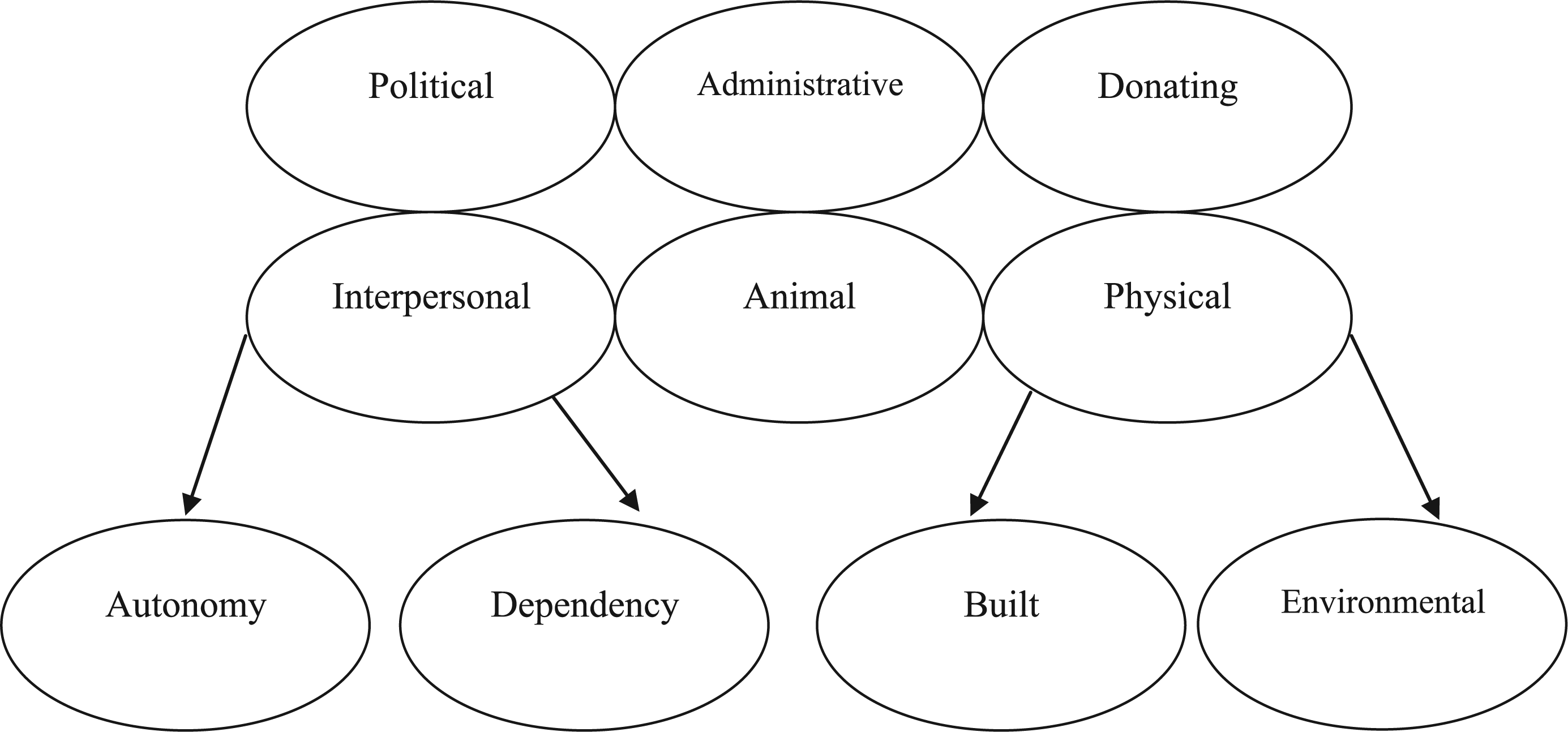
Proposed typology of volunteer behaviors.
Thus, we suggest two types of interpersonal volunteering: autonomy volunteering (i.e., helping someone arrive at a solution to a problem themselves, so they can address the problem if it comes up again in the future) and dependency volunteering (i.e., offering someone an immediate solution to their problem, without providing the skills or insight necessary to address the issue next time; Nadler, 2002). Somewhat related to these two types of helping would be volunteering to help nonhuman animals, such as walking dogs for an animal shelter. Volunteering with physical tasks is also a common form of volunteering, and our model includes both volunteering to create or maintain built structures, such as building a disability ramp for an office, and volunteering to help the natural environment, such as planting trees in a local park. We also consider volunteering aimed at addressing the administrative needs of a nonprofit, educational, or government entity (administrative volunteering; similar to many of the tasks examined in Houle et al., 2005). Finally, we include two behaviors that are sometimes considered volunteer behaviors: political volunteering (e.g., voting or attending a political rally) and donation behaviors (e.g., donating blood or money in support of a social cause). In total, we propose eight types of volunteer behaviors that encapsulate the range of volunteer activities highlighted on volunteerism websites and examined in the scientific literature (i.e., administrative volunteering, volunteering with animals, autonomy and dependency interpersonal volunteering, volunteering to improve built or natural environments, donating, and political volunteering).
Although these eight types of volunteer behaviors have characteristics that make each unique, some of these volunteer behaviors share several characteristics, making it possible and useful to group them into more general categories. First, some of the behaviors involve interacting with other individuals or nonhuman animals, including animal, autonomy, and dependency volunteering. We consider autonomy and dependency volunteering to be interpersonal volunteering, and when appropriate, we also include animal volunteering in that category. Second, certain types of volunteer positions more intimately require a working knowledge of certain skills (e.g., building construction or maintenance, care for trees or plants, or computer/marketing abilities; HandsOn Network, 2014). Thus, we considered administrative, built, and environmental volunteering to be skills-based volunteering. We used these two volunteer behavior groupings (i.e., interpersonal volunteering and skills-based volunteering) to guide our predictions about how these categories of volunteer behaviors relate to constructs from the volunteerism literature.
Linking the Typology to Relevant Volunteerism Constructs
We set out to create an inventory of interests in different types of volunteer behaviors and also link interest in these positions to personality and motivation constructs from the volunteerism literature, helping us understand the similarities and differences between the eight types of volunteer behaviors.
First, we wanted to examine how aspects of one’s prosocial personality (e.g., empathy, perspective taking, sense of social responsibility; Penner, Fritzsche, Craiger, & Freifeld, 1995) relate to interest in each of these types of volunteer behaviors. Aspects of prosocial personality have been tied to volunteer experiences and outcomes such as general volunteer interest, satisfaction, and behavior (Clary & Orenstein, 1991; Finkelstein, Penner, & Brannick, 2005; Penner, 2002; Penner et al., 1995; Unger, 1991). We expected that empathy and perspective taking, given the interpersonal nature of these constructs, would be linked to more interpersonal and interspecies types of volunteer behavior (i.e., animal, autonomy, and dependency volunteering) and would be less important to behaviors more removed from interacting with others (i.e., administrative, built, and environmental volunteering). We also expected that certain constructs from the prosocial personality approach would correlate with interest in all of the volunteer positions, such as self-reported altruism (past instances of helping behavior), social responsibility (belief that people should help others), and mutual-oriented and other-oriented moral reasoning (the extent to which people are concerned about others and concerned about doing what is right). Finally, we did not expect personal distress (the extent to which a person is emotionally/physiologically aroused during a helping interaction and must attend to their own needs, not the needs of the potential helpee; Cialdini & Kenrick, 1976) to relate to any of the volunteer positions, as volunteers should express a willingness to assist other individuals or help address pressing social issues.
Second, we also wanted to focus on the functional approach to volunteerism, which targets the motivational antecedents to volunteer behavior (e.g., Clary et al., 1998; Dwyer, Bono, Snyder, Nov, & Berson, 2013; Finkelstein & Penner, 2004; Omoto & Snyder, 1995). This model draws upon past work in social psychology concerning the functions of attitudes and motivations, demonstrating that different people often hold the same attitudes or engage in the same behaviors for vastly different reasons and sometimes a single individual might have numerous motivations for engaging in a given behavior (Katz, 1960). Commonly reported motivations for volunteering include feeling compassion toward and helping those in need (values motivation), learning a new skill, using an established skill, or learning something new about a cause or a group of people (understanding motivation), fitting in with one’s social network (social motivation), improving one’s resume and work-related skills (career motivation), feeling good about oneself (enhancement motivation), and reducing guilt over feeling better off than others (protective motivation). Just as Clary et al. (1996) explored, we hoped to link each of these motivations to our eight types of volunteer positions, expecting that values and social motivations would be more relevant to interpersonal volunteering (i.e., autonomy and dependency volunteering) and that understanding and career motivations would be linked to skills-based volunteering (i.e., administrative, built, and environmental volunteering). We also expected that enhancement and protective motivations would not relate to the eight types of volunteer positions.
Finally, implicit in our characterization of the value of a VIT is the notion that the typology should tell us something about volunteer experiences, specifically that individuals who choose to engage in volunteer activities that align with their volunteer behavior interests should be more satisfied. Similar types of “matching” effects have been examined in the social psychology and personality literature generally (e.g., Rothman & Salovey, 1997), as well as the volunteerism area specifically (Clary et al., 1998; Clary, Snyder, Ridge, Miene, & Haugen, 1994; Stukas et al., 2009). We predict that people engaged in volunteer behaviors that they have more interest in will report feeling more satisfied with their position, as compared to people engaged in a volunteer behavior that they do not have interest in.
Study 1: Developing the VIT
To develop the VIT, we first generated items that pertained to each of the eight proposed types of volunteer behaviors (e.g., administrative, animal, autonomy, dependency, donating, built, environmental, and political volunteering). Initially we created 48 total VIT items, six items originally designed solely for each of the eight scales. However, through early exploration of factor structures and correlations between items in each scale, we ended up with four items per scale, for a total of 32 items, as some items had high cross-loadings on numerous factors or sufficiently lowered the Cronbach’s alpha. All of the following analyses, across the four reported studies, use this 32-item version of the VIT.
Method
Participants
Participants were 330 online survey takers (165 females, 135 males, 30 did not report gender; Mage = 34.73, SD = 13.59). We recruited participants from Amazon.com’s Mechanical Turk service (see Buhrmester, Kwang, & Gosling, 2011, on the usefulness of this service for psychological research) for a study investigating beliefs about social behavior, offering payment upon completion of the survey. Participants were able to select more than one race if appropriate, and most participants identified as White (72%), although some participants identified as Latino (5%), African American (9%), Asian American (6%), Native American (1%), or Other (1%; 30 participants did not report their race). Some of the participants reported currently being a volunteer (24%), and most participants reported engaging in volunteer behavior in the past (61%).
Procedure
Participants were asked to indicate “How much interest do you have in this activity,” using a response scale running from 1 (not at all interested) to 7 (very interested). The eight scale scores were derived from the average across the four items (see Table 1 for the scales and items).
Factor Pattern Matrix (Principal-Axis Factor Analysis, Oblique Rotation, Greater Than 1.0 Eigenvalue) for VIT Items, Study 1.

Note. Factor loadings greater than ±30 are shown in bold. VIT = volunteer interest typology.
Results and Discussion
We first investigated the factor structure of the 32-item scale. We ran a principal-axis factor analysis with an oblique rotation (promax) to allow for the correlation of factors (Kim & Mueller, 1988), as we expected that all eight scales would be positively related to each other. We report results for the largest 12 factors, first reporting the eigenvalue, followed by the cumulative percentage of variance accounted for in parentheses: 11.46 (36%), 2.66 (44%), 2.02 (50%), 1.87 (56%), 1.45 (61%), 1.11 (64%), 0.91 (67%), 0.86 (70%), 0.84 (72%), 0.76 (75%), 0.64 (77%), and 0.63 (79%). In addition, examination of the scree plot suggested between six and eight factors (Cattell, 1966). Using the eigenvalues and scree plot, we report the six-factor solution in Table 1.
Results indicated that four of the eight proposed scales clearly loaded onto separate factors (i.e., administrative, animal, autonomy, and political volunteering). The other four scales loaded onto two factors, as dependency and donating loaded onto one factor and built and environmental loaded onto a separate factor. To further examine these two factors, we ran follow-up analyses to determine whether these two factors separated out into four factors when independently analyzed from the other factors.
A follow-up principal-axis factor analysis with an oblique rotation (promax) and forced two factors of the built and environmental items indicated that all four built items loaded the highest on the first factor (factor loadings of .81, .72, .70, and .57), and three of the four environmental items loaded the highest on the second factor (factor loadings of .98, .48, and .48). The only item to cross-load on the opposite factor was the “plant flowers in storefronts in your neighborhood shopping area,” an environmental item loading .72 on the built factor. These results suggest that there is some independence of the environmental and built factors. In addition, a follow-up principal-axis factor analysis with an oblique rotation (promax) and forced two factors of the dependency and donation items indicated that all four dependency items loaded the highest on the first factor (factor loadings of .89, .74, .50, and .39), and all four of the donation items loaded the highest on the second factor (factor loadings of .84, .51, .40, and .38).
Using a diverse, online sample, our initial factor analysis showed six factors, and follow-up factor analyses revealed that the dependency and donation items largely loaded onto separate factors, as did the built and environmental items. This early support for the VIT gave us confidence that interests in the proposed eight volunteer positions were not redundant, and thus, it would be valuable to validate the factor structure of the measure.
Study 2: Validation of the VIT
Method
Participants
Participants were 317 students (241 females, 63 males, 13 did not report gender; Mage = 20.77, SD = 4.13) at a public university in the Midwestern United States. We recruited participants for a study investigating beliefs about social behavior, offering partial course credit upon completion of the survey. Participants were allowed to identify as more than one race if appropriate; most participants identified as White (69%), but participants also identified as Latino (3%), African American (2%), Asian or Asian American (24%), Native American (1%), or Other (1%; 13 participants did not report their race). Many of the participants reported being a current volunteer (45%), and most participants reported being a volunteer in the past (87%).
Procedure
The same 32 VIT items from Study 1 were used in Study 2 as part of an online survey.
Results and Discussion
Using SPSS AMOS (version 20.0.0), we ran a number of confirmatory factor models, comparing fit statistics between the models. We expected that our proposed eight-scale model, with four items per scale, would fit the data best. Just like in Study 1, we allowed the factors to correlate in our primary model, as we expected that interest in different volunteer behaviors would all be positively related. We compared this model with a one-factor solution, which would be interpreted as the VIT measuring a general interest in volunteering, and thus being unable to differentiate between interests in the eight proposed types of volunteer positions. We also compared our proposed model with a different model that allowed for the eight scales with four items each, but did not allow for the eight factors to correlate with each other. In our confirmatory factor analyses, we removed participants who were missing any data points on our measure (n = 63 participants removed for the confirmatory factor analyses). 1
We compared models according to a number of fit statistics. As Table 2 indicates, our proposed model with eight scales, four items per scale, with correlated factors, indeed fit the data the best. Figure 2 shows our proposed model, which was the best fitting model and had adequate fit statistics. Perhaps the most appropriate comparison between the models is the Bayesian information criterion (BIC) statistic (Schwarz, 1978), which suggested that our proposed model was the best fit for the data. Overall, the confirmatory factor analyses suggest that our proposed eight scales, when allowed to correlate with each other, is the optimal model provided the data. Given the confirmed factor structure, we also report the interscale correlations between the eight scales in Table 3; the average interscale correlation was .37.
Model Fit Statistics for Three Proposed VIT Models, Study 2.
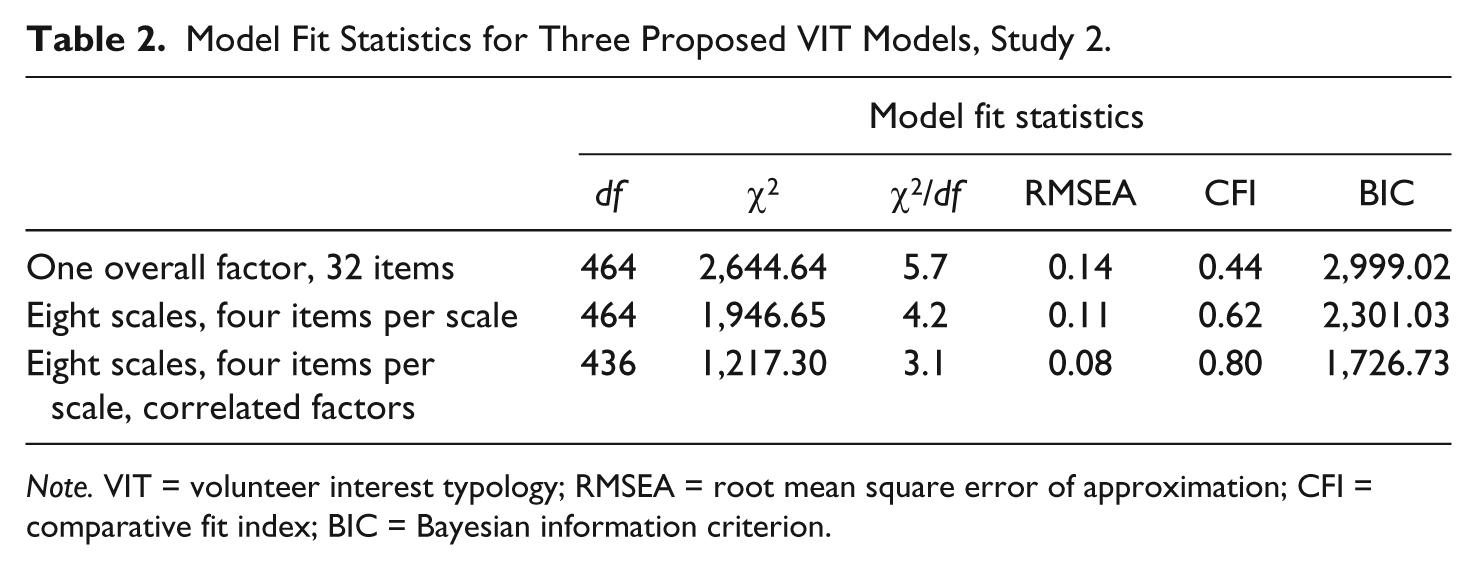
Note. VIT = volunteer interest typology; RMSEA = root mean square error of approximation; CFI = comparative fit index; BIC = Bayesian information criterion.

Confirmatory factor analysis model, with eight scales, four items per scale.
Correlations Between the Eight VIT Scales, Study 2.
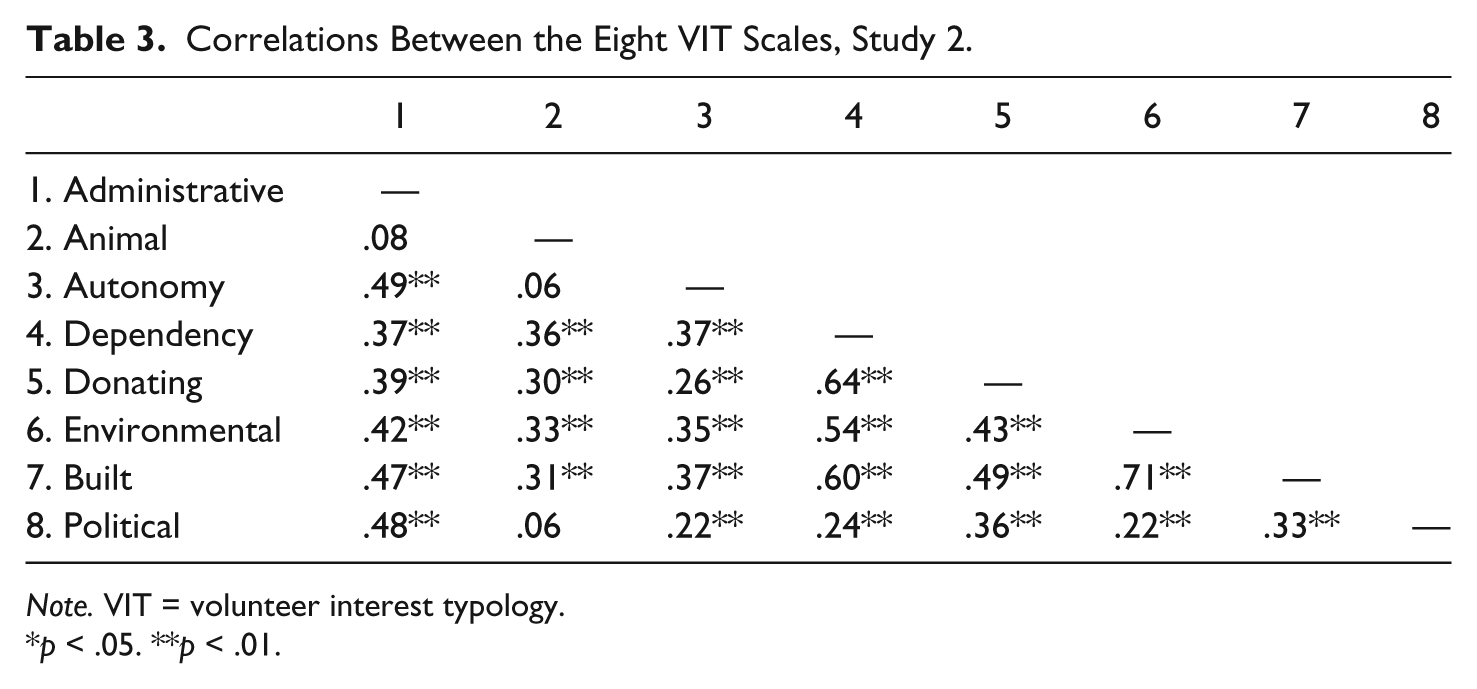
Note. VIT = volunteer interest typology.
p < .05. **p < .01.
Study 2 replicated and extended results from Study 1, demonstrating that our proposed model with eight separate scales was an adequate fit for the data. Satisfied with the overall properties and structure of the VIT, we next turned to examining convergent and discriminant validity by investigating the relationship between our eight scales and previous personality and motivation approaches to understanding volunteer behavior.
Study 3: Convergent and Discriminant Validity
To examine convergent and discriminant validity of the eight scales, we relied upon two established approaches to understanding volunteer behavior. We first drew upon the interpersonal helping and prosocial personality area (e.g., Penner, 2002; Penner & Finkelstein, 1998; Penner et al., 1995), using such constructs as empathy, perspective taking, social responsibility, and personal distress. We also used the motivational/functional approach to link specific volunteer motivations to interest in the eight volunteer positions (e.g., Clary & Snyder, 1991; Clary et al., 1998; Omoto & Snyder, 1995). We conducted these analyses by running separate regressions for each model (i.e., personality and motivation) explaining interest in each type of volunteer position (two volunteer models × eight types of positions, for 16 regressions in total). This regression-based approach is similar to approaches taken elsewhere in the volunteerism literature (e.g., Finkelstein et al., 2005; Omoto & Snyder, 1995; Penner & Finkelstein, 1998) and leads to results easier to interpret as compared with simply examining correlations between all of the measures.
We expected that variables such as empathy and perspective taking, given the social nature of these constructs, would be linked to more interpersonal and interspecies types of volunteer behavior and would be less important to behaviors more removed from interacting with others. We also expected that self-reported altruism, social responsibility, and moral reasoning would correlate with interest in all of the volunteer positions. Finally, we did not expect personal distress to relate to any of the volunteer positions. We also expected that values and social motivations would be more relevant to interpersonal volunteering, and understanding and career motivations would be linked to skills-based volunteering. We did not expect enhancement and protective motivations to relate to volunteer interests.
Method
Participants
Participants were 398 online survey takers (167 females, 133 males, 98 did not report gender; Mage = 36.65, SD = 12.71). We recruited participants from Amazon.com’s Mechanical Turk service for a study investigating beliefs about social behavior, offering payment upon completion of the survey. Participants were able to select more than one race if appropriate, and most participants identified as White (60%), although some participants identified as Latino (4%), African American (8%), Asian American (5%), Native American (1%), or Other (1%; 98 participantd did not report their race). Some of the participants reported currently being a volunteer (22%), and half of the participants reported engaging in volunteer behavior in the past (50%).
Procedure
Participants filled out an online survey, where they first completed the VIT, followed by the Volunteer Function Inventory (Clary et al., 1998), and, finally, the Prosocial Personality Battery (Penner et al., 1995).
Measures
VIT
Participants completed the 32-item VIT. The Cronbach’s alphas (and means and standard deviations in parentheses) for each of the scales were as follows: Administrative, .85 (M = 3.52, SD = 1.65); Animal, .92 (M = 4.71, SD = 1.88); Autonomy, .73 (M = 3.61, SD = 1.47); Dependency, .82 (M = 4.34, SD = 1.54); Donating, .81 (M = 4.81, SD = 1.43); Built, .83 (M = 3.79, SD = 1.54); Environmental, .81 (M = 3.83, SD = 1.55); and Political Advocacy, .71 (M = 3.81, SD = 1.50).
Prosocial Personality Battery
Participants completed the Prosocial Personality Battery (Penner et al., 1995), which measures a number of personality components that relate to interpersonal helping. We chose to focus on the seven basic scales from the battery: Empathy, Perspective Taking, Social Responsibility, Other-Oriented Moral Reasoning, Mutual-Oriented Moral Reasoning, Personal Distress, and Self-Reported Altruism. All of the scales except for the Self-Reported Altruism scale used a response scale ranging from 1 (strongly disagree) to 5 (strongly agree). The Self-Reported Altruism scale instead had a response scale ranging from 1 (never) to 5 (very often). Empathy was measured with four items (Cronbach’s α = .77; M = 3.87, SD = 0.78); perspective taking was measured with four items (Cronbach’s α = .77; M = 3.67, SD = 0.75); social responsibility was measured with seven items (Cronbach’s α = .70; M = 3.46, SD = 0.69); other-oriented moral reasoning was measured with three items (Cronbach’s α = .82; M = 3.58, SD = 0.83); mutual-oriented moral reasoning was measured with three items (Cronbach’s α = .74; M = 3.83, SD = 0.67); personal distress was measured with three items (Cronbach’s α = .84; M = 2.18, SD = 0.87); and self-reported altruism was measured with five items (Cronbach’s α = .81; M = 2.90, SD = 0.87). Responses across all relevant items were averaged to form each participant’s scale scores.
Volunteer motivations
Participants reported their specific motivations to volunteer using the 30-item Volunteer Functions Inventory (Clary et al., 1998). To indicate how important each motivation was to them, participants used a scale ranging from 1 (not important) to 7 (extremely important). Career motivation was measured with five items (Cronbach’s α = .93; M = 4.13, SD = 1.78); social motivation was measured with five items (Cronbach’s α = .90; M = 3.50, SD = 1.61); values motivation was measured with five items (Cronbach’s α = .92; M = 5.41, SD = 1.39); understanding motivation was measured with five items (Cronbach’s α = .91; M = 4.91, SD = 1.50); enhancement motivation was measured with five items (Cronbach’s α = .90; M = 4.43, SD = 1.60); and protective motivation was measured with five items (Cronbach’s α = .86; M = 3.72, SD = 1.54). Responses across all relevant items were averaged to form each participant’s scale scores.
Results
We used the prosocial personality and volunteer motivations approaches to volunteer behavior to separately explain interest in each type of volunteer position (i.e., administrative, animal, autonomy, dependency, donating, built, environmental, and political volunteering). We first report the ability of prosocial personality constructs to explain interest across types of volunteer behaviors (Table 4). Starting first with similarities across interest in volunteer behavior types, self-reported altruism was a significant correlate of interest in seven of the eight position types (all except animal volunteering). The measures of empathy and perspective taking had some success as well, the former explaining interest in three of the eight positions (i.e., animal, dependency, and donating), the latter explaining interest in four of the eight (i.e., administrative, animal, built, and environmental). Personal distress, other-oriented moral reasoning, and mutual-oriented moral reasoning were largely unable to explain interest in any type of volunteer behavior. Finally, social responsibility only explained dependency interest. We also examined explained variance in each interest type, revealing that the prosocial personality approach explained more variance in interest in some positions (e.g., dependency, donating) than other positions (e.g., animal, political).
Constructs From the Prosocial Personality Battery (Penner, Fritzsche, Craiger, & Freifeld, 1995) Explaining Interest in Each of the Eight VIT Scales, Study 3.
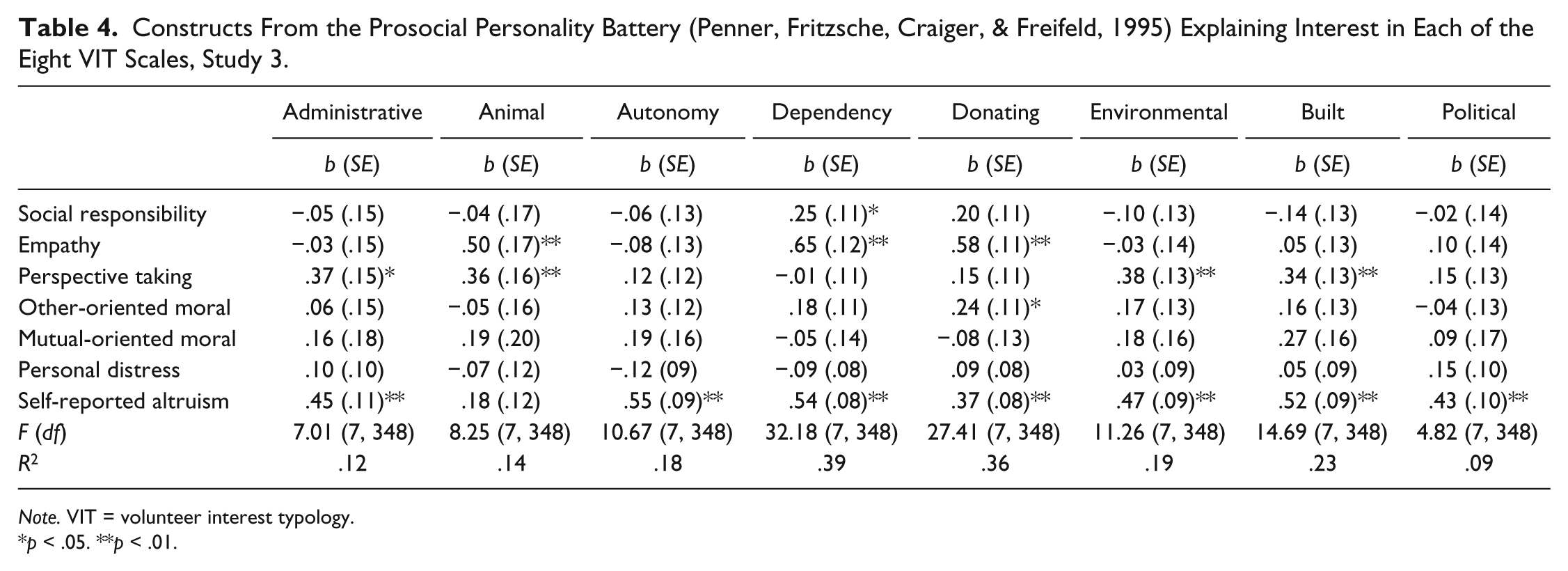
Note. VIT = volunteer interest typology.
p < .05. **p < .01.
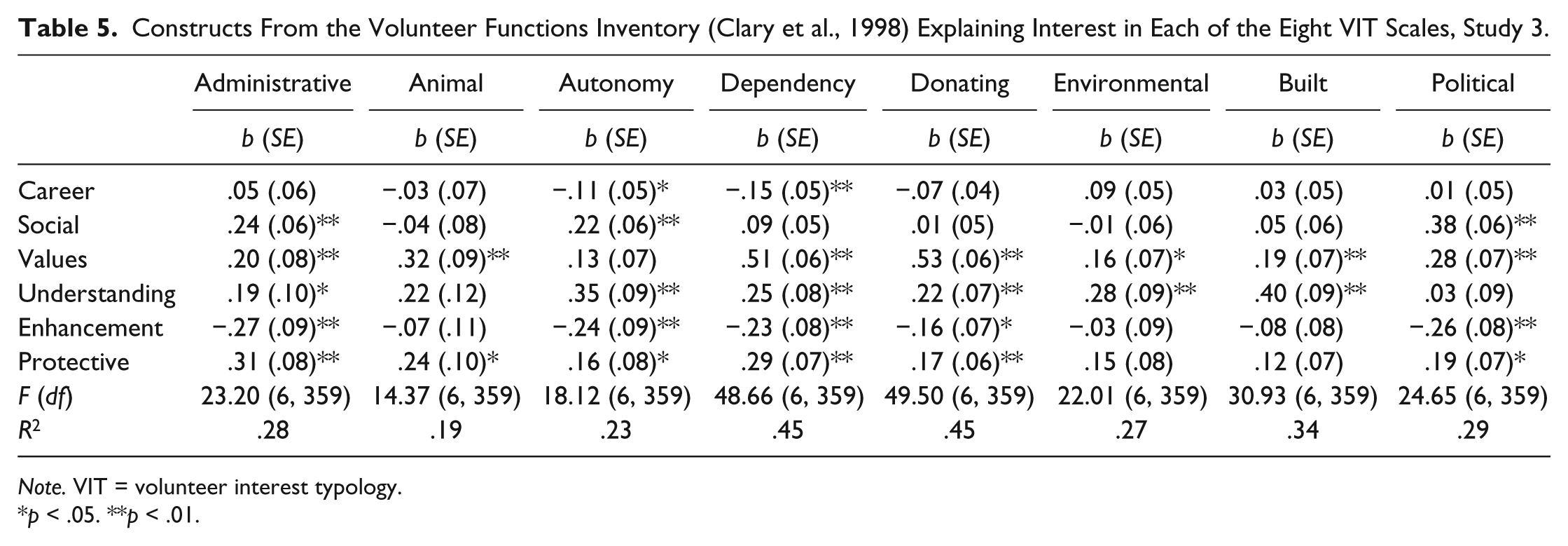
Switching to the volunteer motivations, all of the motivations were able to explain interest in at least two types of volunteer positions (Table 5). Career motivation negatively related to interest in both autonomy and dependency positions, while social motivation related to interest in administrative, autonomy, and political positions. Enhancement motivation negatively related to interest in five of the eight positions (i.e., administrative, autonomy, dependency, donating, and political), whereas protective positively related to interest in six of the eight volunteer positions (all except built and environmental). Finally, the understanding motivation explained interest in all but animal and political volunteering, and the values motivation explained interest in all but autonomy volunteering. Examining explained variance in each interest type revealed similar trends to the prosocial personality approach (dependency and donating had the highest explained variance; autonomy and animal had the lowest). Overall, the volunteer motivations model explained the greatest amount of variance per interest type (on average 31%), followed by the prosocial personality approach (21%).
Constructs From the Volunteer Functions Inventory (Clary et al., 1998) Explaining Interest in Each of the Eight VIT Scales, Study 3.
Note. VIT = volunteer interest typology.
p < .05. **p < .01.
Discussion
Study 3 demonstrates that the eight VIT scales are largely independent from each other, as well as generally useful, as constructs from two approaches to understanding volunteer experiences and outcomes (i.e., prosocial personality and volunteer motivations) were related to interest in types of volunteer positions. When examining individual constructs from each model, it is not surprising that, taken from the prosocial personality approach, self-reported altruism, empathy, and perspective taking were all related to a number of interest types. It is worth noting that the only nonexistence of a link between self-reported altruism and an interest type was with interest in animal volunteering. Because the types of behaviors reported in the Self-Reported Altruism scale all deal with helping humans, it makes sense that this construct failed to relate to one of the two volunteer interest types that explicitly does not involve helping humans (the other position being environmental volunteering).
Although our predictions regarding empathy were largely correct (empathy explained two of the three interpersonal and interspecies types of volunteering, and only one of the five non-interpersonal types of volunteering), perspective taking was a less consistent correlate of interpersonal and interspecies types of volunteering. It is surprising that neither empathy nor perspective taking were linked to interest in autonomy volunteering, as it would seem that volunteering to become more involved in someone’s life, such that you are teaching them skills to take care of themselves in the future, would require more empathy and perspective taking than most position types. Unexpectedly, social responsibility only explained interest in one type of position (dependency volunteering), and, as expected, personal distress did not explain interest in any type of volunteer position. Surprisingly, moral reasoning was only linked to interest in one type of volunteer behavior (other-oriented moral reasoning explained interest in donating).
Finally, the volunteer motivations model results demonstrated that interests in some types of volunteering are linked to many distinct motivations (e.g., interest in administrative and dependency volunteering), and interests in other types are only linked to a couple of motivations (e.g., interest in animal and environmental volunteering). Interest in animal, built, and environmental volunteering were each only linked to one or two motivations (values for all three, and understanding for the built and environmental positions); however, interest in administrative, autonomy, and dependency were each linked to five of the six motivations. The career motivation was unable to explain interest in skills-based volunteer positions, but the understanding motivation did correlate with interest in all three of the positions (i.e., administrative, built, and environmental). Furthermore, the social motivation was associated with interest in autonomy volunteering, and the values motivation was associated with interest in dependency volunteering. Surprisingly, both the enhancement and protective motivations proved frequent correlates of interest across a range of behavior types. Taken as a whole, the results from Study 3 highlight that the VIT indeed demonstrated convergent and discriminant validity.
Study 4: Temporal Stability of the VIT and Testing the Matching Hypothesis
In Study 4, we wanted to extend the previous results in a number of ways. First, we wanted to examine the temporal stability of the eight VIT scales over the span of approximately 1 month. Second, we also wanted to test the matching hypothesis, as we predicted that people who are engaging in volunteer behaviors that they have more interest in (“matched volunteers”) will report feeling more satisfied with their position, as compared to people engaging in a volunteer behavior that they do not have interest in (“non-matched volunteers”).
Method
Participants
Participants were 244 students (165 females, 70 males, nine did not report gender; Mage = 20.28, SD = 2.76) at a public university in the Midwestern United States. We recruited participants for a study investigating beliefs about social behavior, offering partial course credit upon completion of the surveys. Participants were allowed to identify as more than one race if appropriate; most participants identified as White (74%), but participants also identified as Latino (3%), African American (4%), Asian or Asian American (16%), or Native American (1%; nine participants did not report their race). Many of the participants reported being a current volunteer (49%), and most participants reported being a volunteer in the past (84%). Of the 244 participants, 216 participants completed both Time 1 and Time 2 surveys (89%).
Procedure
We used a two-wave panel design to measure participants’ volunteer beliefs and behaviors over the course of a month. During the first time point, participants completed the VIT measure, and during the second time point, they completed the VIT and reported their past and current volunteer behaviors, as well as volunteer satisfaction with those past or current volunteer positions. Both surveys were completed online, and 3 to 5 weeks passed between the first and second surveys.
Measures
VIT
Participants completed the 32-item VIT; the Cronbach’s alphas, means, and standard deviations for each of the scales are reported in Table 6.
Means, Standard Deviations, Cronbach’s Alphas, and Test–Retest Stability Each of the Eight VIT Scales, Study 4.

Note. VIT = volunteer interest typology; T1 = Time Point 1; T2 = Time Point 2.
Volunteer behavior and satisfaction
At just the second time point, participants reported current and past volunteer behavior, listing the type of volunteer activity, the responsibilities entailed, and how satisfied they were with the position. Participants were able to report more than one volunteer behavior, but to test for matching effects, we examined the first volunteer behavior that they reported, which was usually their current or most recent position. Of the 216 participants who completed both surveys, 170 of them reported engaging in at least one volunteer behavior. Volunteer activities were coded as belonging to one of the eight volunteer types captured in the VIT, and six of the eight volunteer types were represented (none of the participants reported engaging in donation-based or political volunteering). Participants reported how satisfied they were with the volunteer position by providing a satisfaction rating on a scale ranging from 1 (not at all satisfied) to 7 (completely satisfied). Finally, participants who were engaged in a given type of volunteer behavior, and were also above the mean on that respective interest scale, were coded as being “matched,” and participants engaged in a volunteer behavior but not above the mean on that respective interest scale were coded as being “non-matched.”
Results and Discussion
All eight scales had strong test–retest stability, ranging from .71 (autonomy) to .85 (animal), meaning that interest in these types of volunteer positions is relatively stable over the course of a month (see Table 6). 2 With test–retest stability established, we next examined the matching hypothesis, expecting that volunteers above the mean in interest in the same type of volunteer position that they actually reported engaging in would report more satisfaction than volunteers below the mean in interest in a type of volunteer position and engaging in that type of volunteer position. Matched volunteers reported higher rates of satisfaction compared to non-matched volunteers (n = 100, M = 6.03, SD = 0.98, and n = 70, M = 5.29, SD = 1.36, respectively). A t-test revealed that matched volunteers were indeed more satisfied compared to nonvolunteers, t(168) = 4.14 (mean difference confidence interval [CI] = [0.39, 1.10]), p < .001, d = .64. 3 Overall, the results clearly support the matching hypothesis, such that volunteers interested in the volunteer position they reported holding were more likely to be satisfied in that position, as compared with volunteers in positions that they did not have interest in.
In summary, Study 4 demonstrates a number of key findings of importance to the VIT. First, participants completing the VIT twice over the course of a month reported comparable levels of interest in a given volunteer type, demonstrating test–retest reliability. Second, we found strong support for the matching hypothesis, indicating that volunteers who engage in the types of volunteer behaviors that they have interest in, as compared to those who engage in volunteer behaviors that they do not have interest in, report feeling more satisfied in their volunteer positions. In particular, this finding demonstrates the value of the VIT for explaining volunteer experiences and, thus, highlights the important role that the VIT is poised to play in future basic and applied research in the volunteerism area.
General Discussion
The current research clearly demonstrates the value of systematically organizing interest in types of volunteer positions. We proposed eight types of volunteer positions (i.e., administrative, animal, autonomy, dependency, donating, built, environmental, and political volunteering), finding psychometric evidence for the distinction between these types of volunteer positions. Furthermore, discriminant and convergent analyses provided further support for the value of distinguishing between these eight types of positions.
Through use of exploratory and confirmatory factor analyses, we discovered some support for an eight-factor structure and validated the structure across both student and community samples. Although we found some overlap between dependency volunteering and donating, as well as built and environmental volunteering, follow-up analyses highlight the distinctiveness between interests in these eight types of positions. Furthermore, a confirmatory model allowing for correlations between positions further validated the factor structure. Although all eight scales had sufficient variability across individuals, there were also noticeable differences between the means of interests in the positions (e.g., people tended to have the most interest in donating, animal, and dependency volunteering, and people tended to have the least interest in autonomy and administrative volunteering). Each of the eight scales also had strong internal consistency, as well as strong test–retest reliability. Although we found significant correlations between many of our scales, our original aim was to not to make an exhaustive list of all volunteer activities in categories completely discrete from one another but instead to provide a useful and conceptually driven way of organizing interest in different types of volunteer activities. The present results suggest the VIT is indeed such a step forward for the literature.
We found moderate support for our validity hypotheses. We found that empathy and perspective taking, given the social nature of these constructs, tended to be linked to more interpersonal and interspecies types of volunteer behaviors. We also found that self-reported altruism was related to interest in all but one of the volunteer positions (animal volunteering), although social responsibility only related to one type of volunteering (dependency volunteering). In addition, personal distress and mutual-oriented moral reasoning were not related to interest in any of the volunteer positions, and other-oriented moral reasoning was only linked to donating behavior. Considering the volunteer motivation approach, values and social motivations were related to interest in interpersonal volunteering, and the understanding motivation was largely linked to skills-based volunteering (although career motivations were not linked to interest in these types of positions). Finally, we found that people engaged in volunteer behaviors that they have more interest in (“matched volunteers”) reported more satisfaction with the position, as compared to people engaged in a volunteer behavior that they did not have interest in (“non-matched volunteers”). The evidence for this matching effect was strong and demonstrates that the VIT is a valuable tool for understanding important volunteerism outcomes, including a volunteer’s satisfaction with their position.
The current findings open up possible future research directions in a number of important areas. Future research should randomly assign volunteers to matched or non-matched positions, and longitudinal data assessing matching versus non-matching effects on downstream volunteer identity, satisfaction, intentions, and actual behavior maintenance over time would provide a strict test of this hypothesis, as well as suggest possible mechanisms through which matching effects could lead to volunteer behavior maintenance over time (satisfaction being one possible mechanism). Future research should also explore why volunteers would choose to get involved in a volunteer position that they do not have interest in. Maybe these volunteers do not have other options or are unaware of other available positions. Future work should also look to replicate the current findings by using samples consisting solely of volunteers; even though our samples included current volunteers, differences could emerge in volunteer-only samples.
The present typology can also help us understand previous findings in the volunteerism literature. For example, this structure for organizing volunteer behaviors would prove useful in qualitative or quantitative reviews of volunteerism research, helping to guide hypotheses and analyses when considering past findings. In addition, the present classification of volunteer behaviors can guide future efforts to understand and influence volunteer behavior, helping researchers to think deliberately about the types of volunteer samples in which they seek to test their research questions. Researchers looking to test the importance of empathy to volunteer behavior maintenance, for example, might choose to examine volunteering in the interpersonal or interspecies areas, as examining the role of empathy in the built or environmental domains might prove a fruitless or difficult endeavor (although constructs such as specific empathy for, and connection with, the environment might prove useful to researchers; Mayer & Frantz, 2004). Alternatively, interventions to increase interest or engagement in certain types of volunteer behaviors should target constructs of importance to specific volunteer behaviors. For example, given the current results, focusing on social motivations may more effectively increase interest in administrative, autonomy, and political volunteering and might prove less effective at increasing interest in positions such as animal, built, and environmental volunteering. Finally, future research could also compare volunteers in different positions on personality, experiential (e.g., identity, satisfaction), and demographic variables, creating a sort of personality psychology of volunteer positions themselves. This could include the types of skills or knowledge each position requires of potential volunteers, as volunteers might be drawn to positions that match their level of knowledge or expertise.
The present results also have implications for volunteer management practices. The VIT can be a tool for volunteer managers to measure the interest of their volunteers, as well as serve as a springboard to advance discussions between managers and volunteers surrounding fit between the volunteer and the available volunteer positions. Furthermore, marketing of different types of volunteer positions might be more successful to the extent that they target the factors linked to interest in a given type of volunteer position. Finally, more successful linking of volunteers to the positions that match their interests, personalities, and motivations has the potential to increase not only volunteer satisfaction but also retention rates.
Research that either considers additional nuance to types of volunteer behaviors or further contextualizes the positions would also be useful. Similar to the method that Houle et al. (2005) took when considering administrative volunteering, other types of volunteering behaviors might still have useful distinctions within each type. For example, dependency helping includes such target populations as helping children, helping homeless individuals, helping returning war veterans, and helping recent immigrants. Perhaps different types of individuals are drawn to, and are satisfied with, interpersonal helping that supports specific groups of people. Appreciating group or organizational contexts would also prove fruitful, as organizations might tend to create volunteer positions in specific volunteer behavior domains. Habitat for Humanity focuses on built volunteer positions, while Big Brothers Big Sisters tends to have positions in the interpersonal volunteering area. The systematic differences between organizations that tend to create certain types of volunteer positions might implicate a number of important processes, such as the amount of training or support provided by the organization, or the availability of resources to thank volunteers with free appreciation or socializing events.
Footnotes
Authors’ Note
The authors acknowledge and thank Keven Joyal-Desmarais, Patrick Dwyer, Will Johnson, and Joseph Vitriol for providing feedback on an earlier draft of the article.
Declaration of Conflicting Interests
The author(s) declared no potential conflicts of interest with respect to the research, authorship, and/or publication of this article.
Funding
The author(s) disclosed receipt of the following financial support for the research, authorship, and/or publication of this article: This work was supported in part by the National Science Foundation through a Graduate Research Fellowship to Alexander Maki.