



Abstract
Ostrom’s social-ecological systems (SES) framework infrequently has been applied to civil society research. But its focus on collective action may help explain why some national parks are more successful at attracting philanthropic resources to supplement stagnant public funding. We examine two types of charitable supporting organizations: “Friends of” Groups (FOGs), which typically emphasize fundraising, and Cooperating Associations (CAs), which typically emphasize visitor support. We identify their partnership patterns across more than 300 national park units. Our findings suggest that FOGs and CAs fill different niches. CAs are drawn to more popular parks or memorials, and FOGs are found in parks with smaller budgets or offering fewer activities. Actor characteristics play a secondary role in explaining nonprofit incidence. The holistic approach of the SES perspective demonstrates the importance of connecting resource systems to institutional settings and actor attributes.
Keywords
Introduction
Within both the natural resource management and nonprofit literatures, a key question is how people work together to provide public goods (be it voluntary fire protection or conservation of productive fishing ground, etc.). In this article, we combine these lessons with a structure provided by one of Ostrom’s later insights, the social-ecological systems (SES) framework (McGinnis & Ostrom, 2014; Ostrom, 2007, 2009). The purpose is to demonstrate how the SES framework can be used in conjunction with the existing nonprofit literature. Specifically, we explore the key issue of nonprofit formation by examining what variables in both the SES and the civil society literatures best explain the presence of nonprofits created to support national parks. In this process, we explicitly draw on lessons about the governance of common-pool resources (Ostrom, 1990) and how situational variables affect the likelihood of cooperation (Poteete, Janssen, & Ostrom, 2010).
Philanthropic Support for the National Park Service (NPS)
For some time, public parks have looked beyond government appropriations for philanthropic and voluntary support. While some efforts reflect public policy shifts (such as the privatization era), they also reflect government responses to fiscal stress (Brudney & Warren, 1990). For example, considerable scholarship about citizen coproduction 1 of public services including parks maintenance was generated from the economic recession of the early 1980s (e.g., Brudney & England, 1983). More recently, in 2011, California law was changed to facilitate charitable support for state parks by allowing nonprofit organizations to bypass competitive bidding (Soares, 2011).
At the national level, the NPS’s experience offers a noteworthy example of a federal program that has built inter-sectoral philanthropic relationships under a stagnant budget. According to the NPS (2009), appropriations decreased from 1999 to 2008, producing a deferred maintenance backlog of US$11 billion (U.S. Senate Committee on Energy & Natural Resource Management, 2013). Altogether, the NPS is responsible for 401 park units, representing a budgetary responsibility of US$2.98 billion dollars in Fiscal Year (FY) 2012, situated across 84 million acres of land in all U.S. states and territories, and employing approximately 22,000 permanent, temporary, and seasonal workers (NPS, 2013).
The National Park Foundation (NPF) serves as the “official charity of America’s National Parks” and a source of nearly US$20 million in cash and in-kind support in 2011 (NPF, 2013). One of the newest National Park sites, the Flight 93 National Memorial in Somerset, Pennsylvania, would not exist without US$9 million in private support from the NPF. As part of its mission, the NPF makes grants to national parks, monuments, preserves, recreation areas, historical battlefields, libraries, and other sites.
The NPS also actively encourages park sites to create or attract “friends” organizations, whose support can supplement appropriations and user fees (NPS, 2013). Organized as individual 501(c)3 charities, some operate through Cooperative Agreements (CAs) as the interpretive associations for national parks and provide program support funded largely from bookstore and gift shop sales inside parks. Others serve as “Friends of” Groups (FOGs) with broader missions to support their park through membership and volunteer recruitment, external fundraising, and advocacy, in addition to or in lieu of income generation inside parks. These sites vary widely in their experiences attracting philanthropic and voluntary support. Of all national parks, most have CAs but less than half have FOGs. 2
Ostrom’s SESs Framework
While Elinor Ostrom’s work is primarily associated with natural resources, the nonprofit literature and Ostrom’s research both address the same fundamental question: How do groups of people manage to voluntarily work together to overcome collective action dilemmas and work together for a larger common good (Crawford & Ostrom, 1995). Thus, Ostrom’s fundamental insights have already been applied to topics of relevance to civil society such as child care (Bushouse, 2011), charitable fundraising (Christensen,Clerkin, Nesbit, & Paarlberg, 2009), and open-sourced projects (Schweik & Kitsing, 2010). Scholars also have observed that Ostrom’s work has strong connections to the study of nonprofit governance as a form of collective action (Stone & Ostrower, 2007).
The SES framework itself is grounded in Ostrom’s earlier work on the design principles for long-lived institutions and the Institutional Analysis and Design (IAD) framework. Ostrom is perhaps best known for the eight design principles of the multilayered IAD framework she and her colleagues outlined in the 1990s (e.g., Crawford & Ostrom, 1995; Ostrom, Gardner, & Walker, 1994). This IAD framework is useful because it emphasizes the careful consideration of contextual factors. It draws attention to the full range of transaction costs. It contains no normative biases and does not presume a priori that one type of institutional arrangement is preferred to another. It also uses a variety of criteria to assess institutional performance. (Imperial & Yandle, 2005, pp. 502-503)
The SES incorporates Ostrom’s more well-known IAD framework, and develops it into a comprehensive set of variables researchers can use to explain relationships between human (social) and ecological systems.
In laying the groundwork for the SES framework, Ostrom et al. (2007) warned of the dangers of panaceas or “recommendations that a single governance-system blueprint . . . should be applied to all environmental problems” (p. 15176). They argued that scholars should understand the particulars of each problem they are studying, using a consistent set of criteria (the SES framework) to “diagnose which deeper-tier variables are relevant to a particular class of problem” (p. 15177). To do this, Ostrom (2007) argues, “one needs to build upon the work of scholars who have undertaken careful, well-documented and theoretically sound” work (p. 15181). The SES framework offers such a structure by “building a common vocabulary and a logical linguistic structure that would facilitate communication among scholars all of whom confront the daunting problem of developing a coherent mode of analysis to apply to complex, nested systems operating at multiple scales” (McGinnis & Ostrom, 2014, p.1).
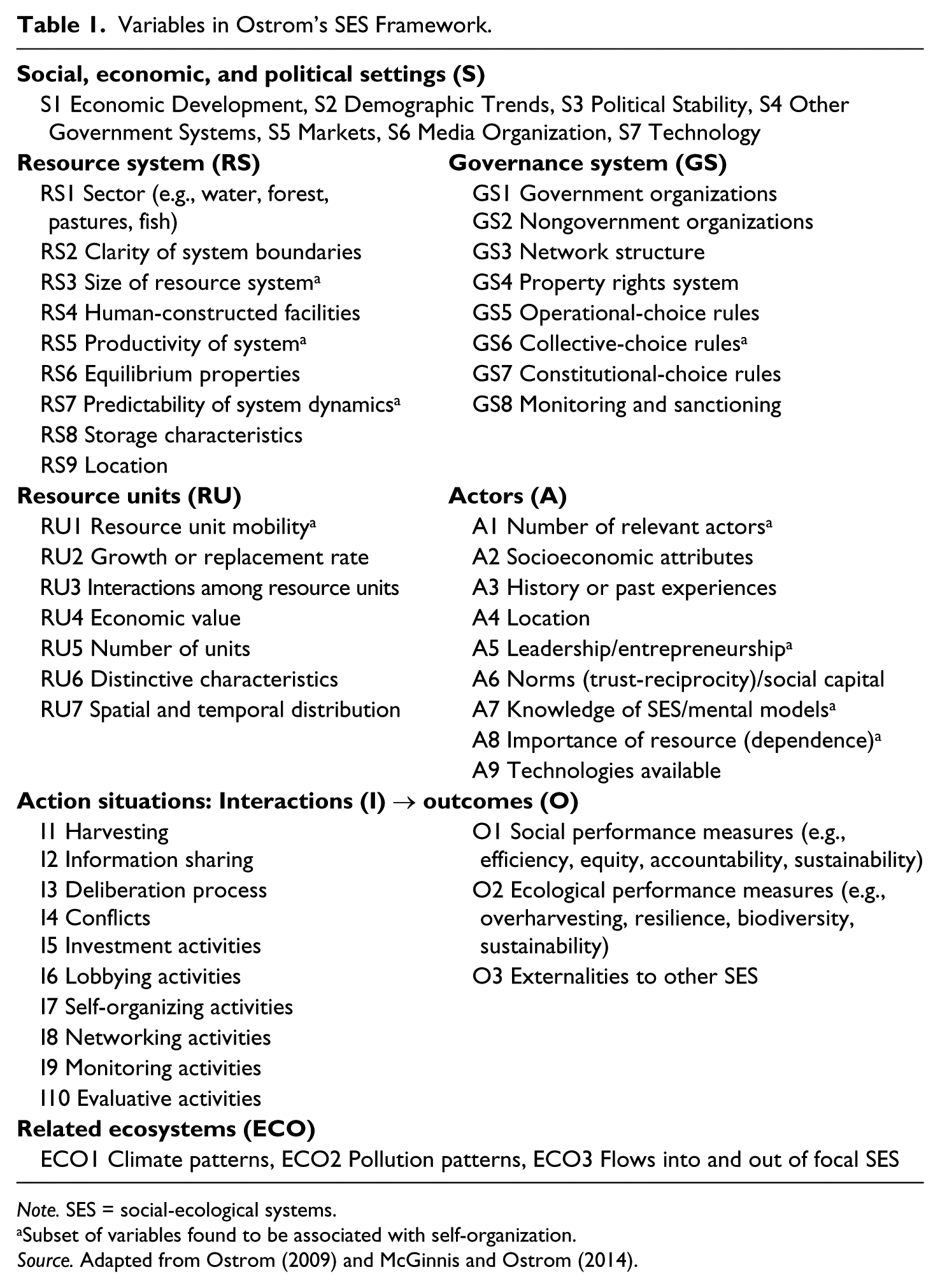
Table 1 summarizes the variables included in the SES, combining Ostrom’s (2007, 2009) original conceptualization with a more recent modified framework (McGinnis & Ostrom, 2014). The SES shares the nonprofit scholarship’s interest in community-level, organizational-level, and human-level dynamics (e.g., Gazley, 2008), but conceptually and analytically this interest is differently framed as a series of related subsystems. The SES envisions that within a particular setting, four subsystems (resource systems, resource units, governance systems, and actors) interact and produce various outcomes which themselves continue to influence the subsystems in an ongoing cycle (Ostrom, 2009). The result is a theoretically grounded comprehensive systems model that incorporates not only the sociodemographic variables most often explored in the social sciences but also key physical and biological characteristics of the natural environment that previous research has shown to be vital to understanding how groups of people interact with natural resources (e.g., Agrawal, 2001). These characteristics are described as “first-tier” variables (settings, related ecosystems, resource systems, governance systems, actors, resource units, interactions, outcomes) as illustrated in Figure 1, and “second tier” variables are contained within each first tier.
Variables in Ostrom’s SES Framework.
Note. SES = social-ecological systems.
Subset of variables found to be associated with self-organization.
Source. Adapted from Ostrom (2009) and McGinnis and Ostrom (2014).
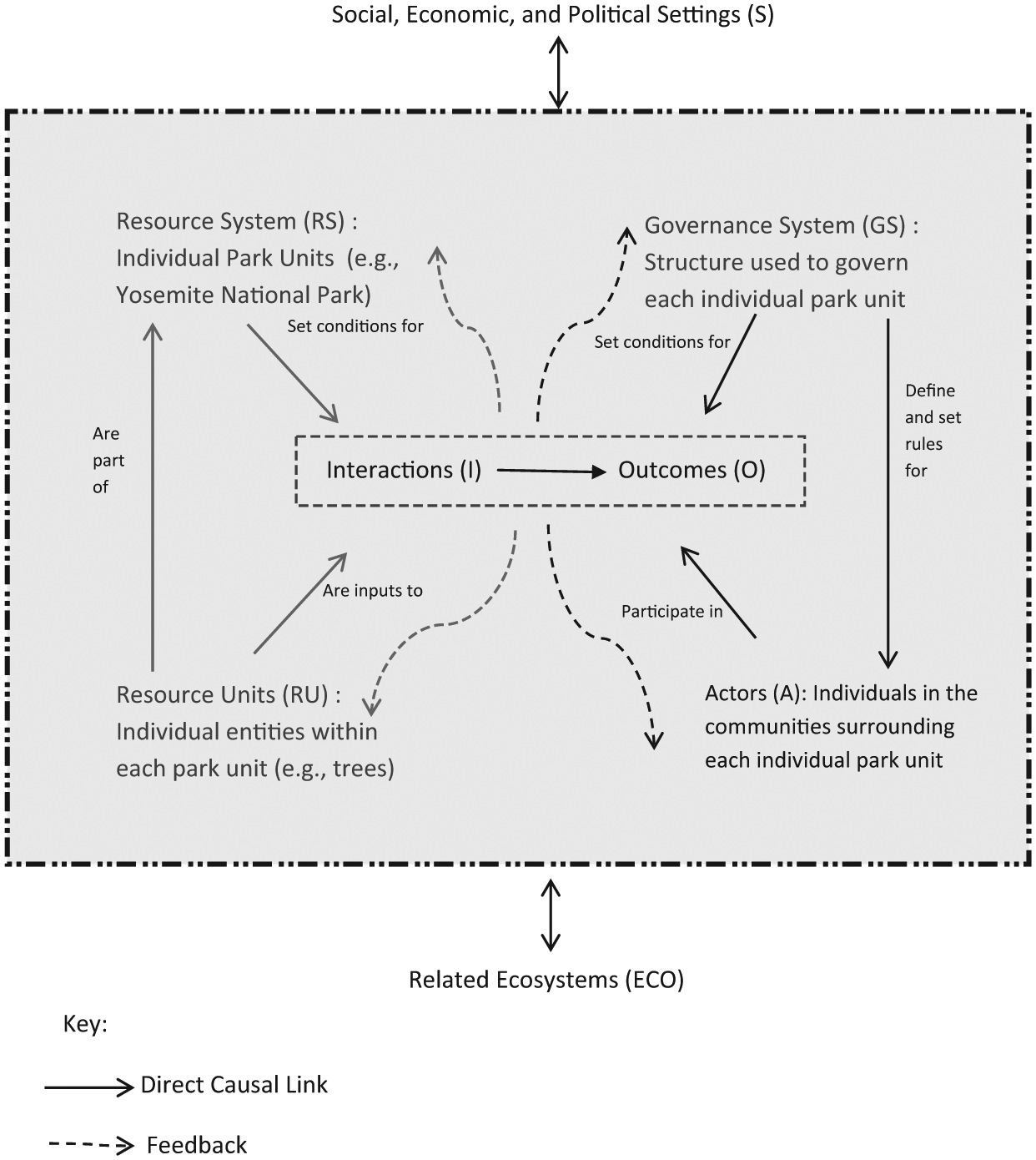
Visualization of first-tier SES variables (McGinnis & Ostrom, 2014; Ostrom, 2007) as applied to the friending of national parks.
The SES framework can be used to more readily identify which variables are broadly similar or different between cases under analysis, allowing studies to be designed in a way that helps explain differences in outcomes. For example, [A] social scientist may want to hold the resource system and its units constant for a particular study . . . while . . . trying to understand the impact of diverse rules on user behavior leading to outcomes. An ecologist, on the other hand, might want to hold governance systems and attributes of users relatively constant in choosing cases to study so that differences in the resource systems can be examined without substantial simultaneous interactions with social structure. (Poteete et al., 2010, p. 235)
It is also important to note that no single study could effectively incorporate all variables into its analysis. Instead, researchers draw on earlier work to select appropriate cases and variables.
As a framework, the SES provides an organizing structure in which to test theories and hypotheses. Poteete et al. (2010) observe that a list of variables is not a theory. The intention of developing the SES framework is to help scholars, officials, and citizens understand the potential set of variables and their subvariables that can be important in analyzing diverse theoretical questions related to the governance of resources. (p. 236)
Thus, in this study, we are using the SES framework in concert with prior nonprofit research framed by coproduction theories to guide us in the development of our questions and selection of variables.
Applying the SES Framework to Civil Society Questions
Scholars have argued that coproduction’s traditional definition as citizen involvement in public service provision through volunteerism should be extended to include the participation of entire nonprofit organizations (Jetté & Vaillancourt, 2011; Nelson & Gazley, 2014). Modeling coproductive nonprofit organizational activity requires an understanding of complex community dynamics, as it is driven by both governmental and community needs as well as community resources (Paarlberg & Gen, 2009). The advantage of the SES framework in this context is its flexibility, its ability to analyze systems at different spatial and political levels—from cross-national relationships to very small localized communities (Ostrom, 2007).
Although the SES is not widely recognized in nonprofit and civil society literature, its systems perspective on organizational behavior is most definitely of broad contemporary interest in the social sciences. A systems perspective offers a holistic strategy for understanding the related dynamics of human and organizational behavior (Von Bertalanffy, 1950). For example, scholars have been actively applying systems views of nonprofit behavior to the context of governance, where board performance can be understood as a contingent function of human behavior and both internal and external organizational capacity (e.g., Cornforth, 2012).
From a systems perspective, of particular public policy value is the ability to identify both the external and internal drivers of nonprofit activity. Andrews, Ganz, Baggetta, Han, and Lim (2010) found that variances in Sierra Club chapter performance reflected differences not only in community social capital and other conditions that could generate committed members but also each chapter’s capacity for effective leadership, a strong local network, and successful fundraising. In the context of public–private partnerships between parks and charities, external drivers might include citizen demand for services while internal drivers might include the organizational and managerial capacity to collaborate. The SES framework is helpful here in its ability to account for both internal capacity and external variables such as sociodemographic differences that explain nonprofit formation and growth. For example, scholars have ascribed differences in nonprofit activity to rural/urban differences (Komp, van Tilburg, & van Groenou, 2012), educational attainment (Grønbjerg & Paarlberg, 2001), and income (Isham, Kolodinsky, & Kimberly, 2006). Determinants of volunteering rely generally on similar external conditions (Musick & Wilson, 2008).
Thus, the SES framework is well suited to an examination of the collective action that happens in the context of national parks management, where voluntary nongovernmental organizations (coded GS2 in Table 1) must work alongside public managers of important natural resources such as parks. The framework also incorporates relational dynamics such as governance systems, which have also been found to influence the health of nonprofit–government partnerships (Babiak & Thibault, 2009). It is within this SES framework that we test whether the presence of charities to support park operations is a function of characteristics of the park’s resource system and institutional setting as well as the sociodemographic characteristics of park users that traditional nonprofit formation studies would emphasize.
Research Model
The substantial variation in local conditions, actors, and park characteristics, whose missions and operations are each geographically bound, offers an ideal opportunity for a multivariate analysis. A place-based analysis also contributes to our understanding of the drivers of place-based volunteering, where citizens have finite choices about how their labor is used.
One of the immediate challenges we encountered in applying the SES framework is that some of the first-tier variables (Table 1) do not have data available in this context (e.g., A7) or are not relevant to this study (e.g., RU2). But they illustrate the flexibility of the SES framework and its complementarity to the existing nonprofit literature. In addition, many variables are effectively held constant in this study, such as the fact that all parks operate within the United States. Using the SES framework, Poteete et al. (2010) identify 12 “most frequently identified variables in empirical studies as affecting whether users will self-organize” (pp. 238-239). Table 2 displays the variables used in this study, which combine some of Poteete et al.’s key variables with others from the nonprofit literature (e.g., mission complexity) to enhance comparability across other studies in the future.
Mapping Study Variables to SES Framework and Nonprofit Literatures.

Note. SES = social-ecological systems; NPS = National Park Service; FOG = “Friends of” Group; CA = Cooperating Association; FTEs = full-time employees.
Identifies key variables from Poteete, Janssen, and Ostrom (2010).
The abbreviated mapping of these relationships displayed in Table 2 emphasizes governance system variables, which is also where our dependent variable resides, and (federal) government investment activities in the park units. Variables can map into multiple categories, such as the Antiquities Act indicator. Parks created via presidential proclamation under authority derived from this 1906 Act may have qualitatively different histories where locals often initially resist national park designation (because it limits their access or control). Especially for earlier parks, the different property rights and autonomy issues this situation generates fall under the GS category. Naturally, causal inferences should not be made as some variables operate concomitantly.
Data
The unit of interest is each national park unit, whether they have the name “National Park” in their title or not. Sites operating under other NPS-administered programs such as National Heritage Corridors are excluded. 3 Variable definitions and descriptive statistics for these data are summarized and mapped to their first-tier variables in Table 4. Note that “DV” denotes the dependent variables found in the “Governance System” section of the table. This illustrates how the dependent variables are an integral part of the SES.
National Park, FOGs, and CA Characteristics
Data from several sources measure various characteristics of each NPS unit. The NPS Public Use Statistics website, now reorganized as the Integrated Resource Management Applications (IRMA) Portal, provided data on key park attributes such as acreage, budget, employees, and visitation. The NPS.gov website lists park units by various themes and activities in each park (e.g., Civil War themes, camping activities, and others mentioned in Table 4). Park unit websites and NPS histories available through IRMA provided important background history information on parks, including the year and mechanism of their creation. Founding date refers to the year the park was “set aside” or specially designated, even if it had not yet formally joined the NPS system. The analyzed count is 308 U.S.-based parks after accounting for closures, parks extending beyond the 50 states (e.g., Virgin Islands), and jointly administered and reporting parks (e.g., the National Mall parks).
FOGs and CAs were found in the directories and membership lists of the NPS (2011), the Association of Partners for Public Lands (appl.org), and the NPF through their Friends Alliance as well as contacting many national parks directly. Although some parks may have more than one such organization, mapping the supporting organizations to each park unit yields the following cross-tabulation (Table 3):
Cross-Tabulation of National Parks With and Without Supporting Organizations.

Note. FOG = “Friends of” Group; CA = Cooperating Association.
Surrounding Community Characteristics
Community characteristics derive from the 2007-2011 American Community Survey (ACS) 5-year averages provided by the U.S. Census. With park size ranging from 0.02 acres to 13 million acres, park units’ relationships with their neighboring community—and what defines that community (especially in the context of a park mission that is overtly national in its audience)—resist simple approaches. The analysis here begins with the smallest available geographic unit with relevant Census data, the block group, 4 and builds from there. Each park is in one or more block group; most are in multiple counties and some in multiple states. Accordingly, each park is assigned the demographic characteristics of its immediate surroundings as an aggregation of the characteristics of the block groups it crosses. Several alternative aggregations are explored, including a (population- and area-weighted) mean, median, maximum, and minimum. Although weighted averaging is a conventional approach, the context of voluntarism for national parks suggests the possibility that the tails of the distributions of demographic characteristics may be more relevant. For instance, overall average community income may predict active FOGs, but the income of the wealthiest neighborhood may be a better predictor.
In addition to assigning each park the demographics of its attached block groups, a parallel approach is taken for each park’s host counties. Alternative geographic scales (block group or county) and aggregations (population-weighted mean or maximum) were explored as they embed different notions of “community.” They also pose a degrees-of-freedom problem, with each demographic characteristic being measurable in numerous plausible ways. The results are sensitive to which construction of “community” is chosen, and not all constructions can be included in the same model. The results presented here are the result of extensive specification searches and reflect the most parsimonious models that also fit the data well. In the end, county-level measures of community perform the simplest and best. The article’s “Conclusion” section revisits what these results imply about defining parks’ “communities.”
Data Analysis
The data in Tables 3 and 4 indicate that considerable variation exists. FOGs and CAs are both common but hardly universal—about one eighth of parks have neither. Parks range widely in themes (nature, wildlife, history), age, budget, staffing, and character of surrounding populations. The t tests, as displayed in Table 5, indicate that parks with and without supporting organizations are significantly different across many dimensions, and the presence of FOGs and CAs is predicted in different ways. For example, in terms of park acreage (lnacres), parks with CAs tend to be much larger than other parks, while parks with FOGs are not significantly larger on average.
Definitions and Descriptive Statistics (N = 308).

Note. NPS = National Park Service; FTEs = full-time employees.
Comparison of Means for National Parks With and Without FOGs and CAs.

Note. Two-sample t test for difference in (unequal) means between group of parks with friends (FOG, CA, or both) and other parks. FOG = “Friends of” Group; CA = Cooperating Association.
Significance at the 5%, 1%, 0.1% levels indicated with *, **, ***, respectively.
Table 5 reveals some important patterns. Parks with FOGs are more popular, have larger staffs, tend not to be created via presidential decree (or to be memorials) or managed in a group, and are in wealthier and more populous areas. Their communities tend to be older and more educated. Parks with CAs are much bigger, more natural, more rural (and thus have older parks and were more likely to be designated via the Antiquities Act powers), and are surrounded by poorer and less educated residents.
Next, multinomial logit models estimate (with robust errors) which factors are associated with greater likelihoods of having a FOG, a CA, both, or neither. In Table 6, Model 1 offers a more parsimonious set of predictors of having a FOG, a CA, or both (omitted variable is “neither”). Model 2 provides results for a less restricted model with additional covariates. Individually, many variables are insignificant at the 5% level, but collectively they do possess substantial explanatory power. Even with this limited set of variables describing the parks, their actors, and their governance systems, most variables are significant predictors in at least one model.
Determinants of NPS Unit “Friendship.”

Note. NPS = National Park Service; FOG = “Friends of” Groups; CA = Cooperating Associations; LR = likelihood ratio; AIC = Akaike information criterion; BIC = Bayesian information criterion.
Indicates block-group-level data.
Significance at the 5%, 1%, 0.1% levels indicated with *, **, ***, respectively.
The strongest indicators of nonprofit support involve the content of the resource system itself and the resource units. Nonprofits—both FOGs and CAs—are mobilized to support park missions when the park is less recreation oriented, possibly because more support is needed. CAs are particularly drawn to more popular parks or memorials, consistent with their docent services, whereas FOGs tend to be found alone in parks offering fewer activities. This connection points to a “preservation” rather than “use” orientation for FOGs, away from commercializable recreational activities. Model 2 results clarify how recreation themes, rather than exercise (e.g., skiing, hiking) options, matter, while remoteness does not.
Table 6 also reveals that while higher average incomes are not associated with more FOGs or CAs, an upwardly skewed income distribution does provide actors more likely to engage in FOG activities. But in contrast to studies finding higher education associated with more voluntary activity, community education levels are not associated with FOGs or CAs. (Only in predicting “Both” relative to “None,” in Model 2, are eduyrs and eduyrs2 jointly significant.) Communities with more children are less likely to host CAs alone or CAs and FOGs. Greater surrounding populations and a greater percentage of unemployed both predict the presence of CAs, with or without FOGs, relative to no support organizations—a result consistent with CAs’ dependence on available labor supply. Interestingly, White race is significantly related to the incidence of FOGs but not the absolute probability of parks having CAs. Newer housing and older parks predict CA formation, with or without FOGs, relative to no supporting organizations.
More popular parks in terms of numbers of visitors (but not acres) predict CAs (with or without FOGs) relative to no support organizations. Joint governance of park systems (consortia) is also negatively related to the existence of FOGs and CAs. But government resources poured into the park itself, FTEs or budgets on a per visit basis, play a complicated role in explaining FOG and CA formation. They are not associated with greater relative probabilities of FOG formation but CAs (alone or with FOGs) appear drawn to larger budgets. In absolute terms, however, smaller budgets and larger staffs are associated with greater likelihood of FOG (alone) formation, and larger budgets increase the odds of hosting both types of organizations. In a sense, poorer parks and FOGs tend to go together, while richer sets of “friends” organizations and better funded parks go together.
Whether the park was originally created via the president declaring it a national monument and exercising his powers under the Antiquities Act of 1906 does not predict the presence of “friends” groups relative to no groups. Interestingly, the possibility that Antiquities Act parks lack local stakeholder support, and hence the need for presidential rather than congressional designation, manifests clearly in the large difference in the antiquities coefficient between the FOG and CA columns when compared horizontally (antiquities is associated with a lower likelihood of having a FOG alone rather than a CA alone, p < .05 in Model 2). Having been established via the Antiquities Act, ceteris paribus, significantly lowers the predicted probability of having only a FOG. If it is the case that existing FOGs help build support for parks to eventually become officially designated, then it appears that these FOGs achieve national park status through Congress and not through presidential decree.
Discussion and Implications
From an academic perspective, employing the SES framework was productive because it helped frame variables already found to be important in other civil society studies. When our findings are mapped to the SES first-tier variables, surprising patterns emerge. Across both FOGs and CAs, Actor (A) characteristics are (on the whole) less likely to be significant and have smaller substantive effects. However, variables for resource systems (RS), resource units (RU), and governance systems (GS) explained the bulk of the variation and frequently had larger substantive effects. Our finding is therefore consistent with a dominant theme in nonprofit scholarship, where organizational behavior is too complex to ascribe to any single agent (Herman & Renz, 2008), or is dependent on a range of both internal and external characteristics such as market dynamics, client demand, demographic characteristics of a community, or financial or organizational capacity (e.g., Baruch & Ramalho, 2006). Thus, taking a more holistic “systems perspective” allows us to incorporate both the nature of any resource (broadly interpreted) and the institutional setting in which users are acting. Using the SES framework shows the importance of opening our thinking to new variables.
The nonprofit FOGs and CAs offer an excellent empirical application of SES to better understand what conditions foster voluntary organizations forming to support public goals of conservation and education. The empirical setting is rich with variation across park units (as “resource systems”) but is conveniently embedded in a larger system that provides useful structure for analysis. The FOGs and CAs as nonprofits conform to certain common legal standards. Moreover, national parks possess some universally common features, such as operating rules, funding sources, and hierarchy. National parks have the same mission and bureaucracy, enhancing comparability across otherwise rather different resources. Across hundreds of ostensibly equivalent units in the greater national park system, we can leverage the variation in their local characteristics to explain why some have partner nonprofits and others do not.
The analysis reveals some important distinctions between parks with nonprofit “friends” groups and those without. First and foremost, the parks with FOGs differ greatly from those with CAs. Parks with FOGs or CAs differ from parks without any supporting organizations. FOGs follow preservation-oriented nonrecreational parks located in areas with more wealthy residents.
CAs are, however, drawn to popular, well-funded historical parks surrounded by abundant labor. They have ample opportunities to raise funds and provide interpretive services. Likewise, the fact that 95% of presidentially created monuments have CAs is consistent with CAs stepping in to provide visitor center services when the NPS could not, because invoking the Antiquities Act does not necessarily bring funding as Congress often only reluctantly supports Antiquites Act-created parks (Rettie, 1995).
The divergence between FOGs and CAs is particularly striking in the broader context of the NPS mission, history, and politics. The tension between preservation and use was built into the Organic Act of 1916. (The NPS’s “ purpose is to conserve the scenery and the natural and historic objects and the wild life therein and to provide for the enjoyment of the same in such manner and by such means as will leave them unimpaired for the enjoyment of future generations.”) Over the years, the NPS and its units became increasingly urban and faced mounting recreational and consumptive pressures. It also expanded its holdings, often far faster than its budget, and portrays itself in a constant state of funding “crisis.” The dual roles of FOGs and CAs identified here fit into these themes. FOGs can advocate for preservation against more commercial pressures while assisting with capital funding shortfalls (Rettie, 1995). Meanwhile, CAs can provide services for visitors streaming through their gift shop, especially in parks lacking Congressional support.
From the nonprofits’ perspective, the results reflect circumstances that better accommodate voluntary solutions to collective action problems. Some parks have more need (e.g., few employees), some have more valuable public goods (e.g., not recreation parks), and some parks have more able volunteers (e.g., very wealthy, unemployed, adults). One of our strongest findings is how important the resource and governance systems are for explaining the ability of volunteer organizations to overcome collective action problems in national parks.
The insignificance of some “actor” results underscores the challenge of identifying the community of actors engaged with national parks as resource systems. Measuring community characteristics at the neighborhood level or at the county level may be capturing the “wrong” community. As national parks, it might well be that variation in local demographics ought not explain much about these supporting organizations. Or, statistics may be too highly aggregated to detect those rare individuals who drive the organizations. Some parks’ communities might be very local while others are much larger.
Conclusion
Why are some national park units more successful at attracting philanthropic and volunteer resources to supplement stagnant public funding? Our findings have significant implications from both academic and applied perspectives. The academic implications are discussed above and focus on the value added by the SES framework and the importance of carefully examining resource characteristics (broadly construed) and institutional setting. In this study, these variables were often more important than the “actor” variables on which studies of civil society often focus. For example voter turnout, a common proxy for civic engagement or social capital, was never significant.
The SES framework provides a structure or a common language in which research can occur. It enhances communication of results across research communities and increases the chances that cumulative progress can be made across disciplines (McGinnis & Ostrom, 2014). The cross-fertilization of ideas supports more rapid advance in the development of theory. The SES framework can also be used to generate questions that may otherwise be missed in a more narrowly defined field of research. But the broader scope of this framework also introduces some variables that are difficult to quantify for analyses such as these. Here, qualitative research holds the potential to provide insight. We hope that in the future, ethnographic, observational, or other studies can explore the roles of these variables in the nonprofit sector and will provide the basis for more sophisticated quantitative research based on collected case studies.
Our findings also help parks’ managers understand where productively they can find voluntary support. They also suggest that FOGs and CAs fit different niches. FOGs appear to serve as advocates and gift-givers to support the preservation goals of parks as public goods, whereas CAs offer (and generate funding from) volunteer staffing of visitor centers to enhance parks’ educational services.
These findings should be taken with some caution. Results are based on a large-scale statistical, cross-sectional analysis with rather limited scope. We are studying where “friends” groups are found not their impacts on funding, volunteering, park quality, or other outcomes. But our analysis helps understand the broad pattern and which major variables appear to be important, and helps guide future qualitative or mixed-methods research to provide richer details on the formation of these groups and their dynamics. Care should be taken about generalizing beyond this subsector. Future work would do well both to broaden the inquiry by applying this approach to nonprofit formation beyond the NPS and to deepen the investigation by further enriching the measures of nonprofits to include size, longevity, and functions (e.g., content of support agreements) beyond the limited measures used here. Additional application of this SES framework can improve our understanding of coproduction and charitable activities in public parks and other sectors (e.g., libraries, schools, disaster relief).
Footnotes
Acknowledgements
The authors would like to thank Michael Page, geographer at the Emory Center for Digital Scholarship; Kristan Majors, research librarian at the Emory Woodruff Library; and Lauren Jonas, undergraduate research assistant at Emory University. They also thank the anonymous reviewers for their thoughtful comments.
Authors’ Note
All mistakes remain the responsibility of the authors.
Declaration of Conflicting Interests
The author(s) declared no potential conflicts of interest with respect to the research, authorship, and/or publication of this article.
Funding
The author(s) received no financial support for the research, authorship, and/or publication of this article.