



Abstract
Can the “associational revolution” improve authoritarian government responsiveness? If it can, what kind of nongovernmental organization (NGO) can successfully lobby the government? Based on different theoretical perspectives, I develop three hypotheses: a pluralist hypothesis that focuses on resource exchange between such organizations and the government, a corporatist hypothesis that focuses on government institutional control and policy consultant intention, and a clientelist hypothesis that recognizes the underinstitutionalization of the policy-making process and emphasizes the informal network. I then test these hypotheses with a quantitative study of survey data of registered NGOs in three Chinese provinces. I find that the corporatist hypothesis is largely supported; the pluralism hypothesis is also somewhat supported while the clientelist hypothesis is not supported. The data reflect a hybrid pattern of policy advocacy that I term pluralized state corporatism, which fits China’s recent social-economic transformation and lagged political reform.
Keywords
Introduction
China has achieved three decades of rapid economic growth and decades of associational revolution in which nongovernmental organizations (NGOs) 1 have proliferated (Wang and He, 2004). 2 According to the Ministry of Civil Affairs, which is in charge of NGO registration and supervision, the number of registered social organizations in China increased very rapidly after 1990, as shown in Figure 1. Given the difficulties of registering an NGO, there are likely very many unregistered NGOs in the country as well. 3
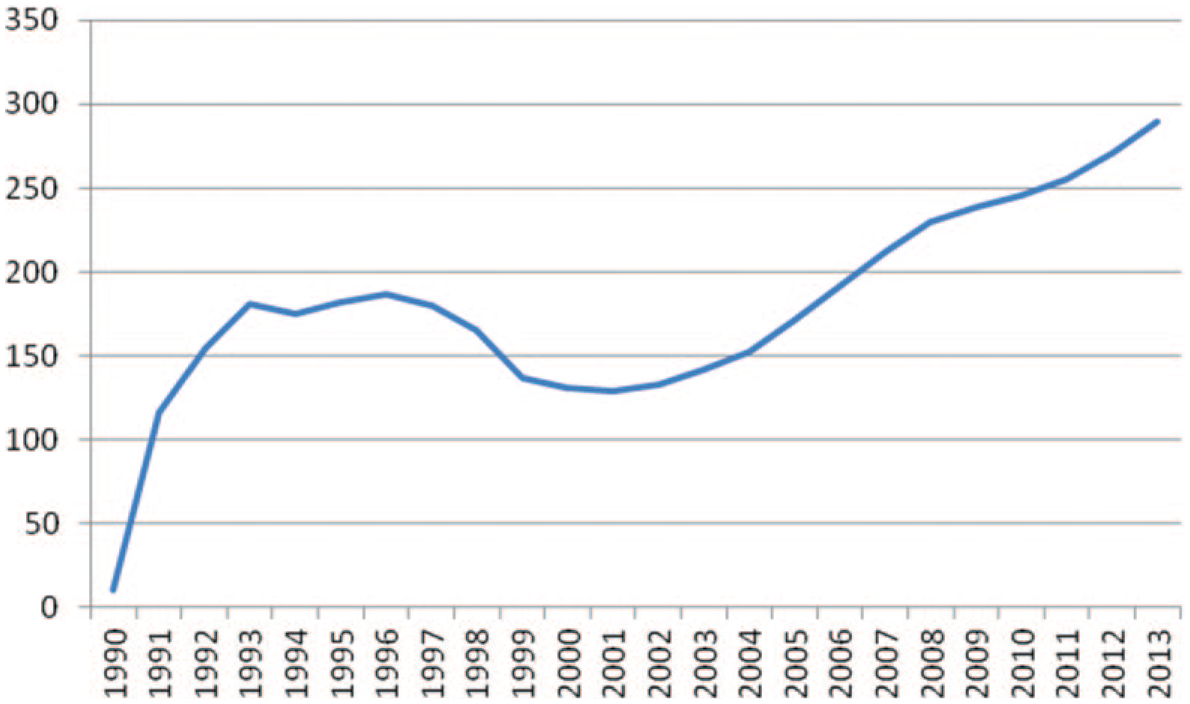
Growth of NGOs 1990-2013. Unit: 1,000.
This article considers whether the associational revolution has brought any political changes to China. Have NGOs created an emerging civil society in which many independent, autonomous, and powerful social organizations constrain state power? 4 At the other extreme, it is possible for NGOs to be only nominally nongovernmental; as de facto extensions of the government, they may be dependent on the government for resources and function only to help the government implement policies that support state power. Specifically, this article examines whether the associational revolution has made authoritarian government more responsive to citizens, or even more democratic. As Dahl (1971) notes, organized lobbying is an important component of democracy and means of achieving responsiveness to citizen preferences (Dahl, 1971; Malesky and Schuler, 2012), because of their collective action. This article examines whether an organized lobby can improve government responsiveness under a strong authoritarian regime, and if so, how.
Modernization theory and state corporatist theory both suggest that an associational revolution can lead to authoritarian responsiveness, but with different understandings of the likelihood of responsiveness. Modernization theorists argue that economic development, associated with urbanization and expansion of the middle class, leads to the emergence of social organizations, which in turn may check government power and promote democratic governance (Lipset, 1959). 5 Modernization theory supports Tocquevillean theories that social organizations play an important role in improving democratic governance quality including responsiveness. State corporatism theorists argue that authoritarian states use social organizations as instruments for governance and social control (Spires, 2011). NGOs can be used as policy compromise tools for the authoritarian rulers. In other words, NGOs may serve primarily as the “bridges and belts” between the authoritarian state and the society, but government could be selectively responsive to demands from some privileged social organizations. The recent institutional explanations of authoritarian resilience argue that some authoritarian regimes intentionally use some democratic institutions, including legislature and election, to make policy concessions as a means to sustain their power (Gandhi, 2008; Svolik, 2012). However, scholars neglect NGOs and organizational advocacy even though Dahl (1961) rightly proposes they are an important component of democracy (Almog-Bar & Schmid, 2014).
This article seeks to test the effects of the increase in Chinese registered NGOs through an empirical study of the following questions: Does government respond to NGOs’ policy advocacy? Why do some NGOs have political influence in an authoritarian regime while others do not? What kinds of NGOs influence government policies? Through this reframing, I seek to bring key issues to the forefront, such as who gets what in policymaking (Fung, 2003; Hojnacki et al., 2012). It seeks to respond to Andrews and Edwards (2004), whose critical review of studies of advocacy in American politics calls for a reorientation of scholarship on advocacy: “Researchers should pose questions about the interactions between advocacy organizations and political institutions to understand better the patterns of influence and to answer core questions about democracy and government responsiveness” (p. 501). I argue this call should apply to studying government responsiveness under an authoritarian regime, which has high despotic power 6 by definition, as well. In fact, the line of inquiry may be even more fruitful in relation to China than it is to the United States: Examining the stereotype of nonresponsive authoritarianism and the different causes of government responsiveness under authoritarianism will provide a better understanding of authoritarian regimes’ strategic use of democratic-looking institutions to sustain their power.
A large body of research explores how the associational revolution affects state–society relations in China, but most studies use case studies, and scholars have drawn contradictory conclusions. Some present evidence of improved responsiveness with an emerging civil society (White, Howell, & Shang, 1996) and more pluralized policymaking (Kennedy, 2005; Mertha, 2009), while others attribute authoritarian rigidity to state domination of NGOs or state corporatism, arguing that the state leads rather than responds (Foster, 2001, 2002; Gu & Wang, 2005; Pearson, 1994; Unger & Chan, 2008). Though these studies provide significant insights, most share two weaknesses: They focus on the institutional arrangement of NGO-government relationships rather than on policy-making and implementation processes, and they rely on comparative case studies rather than quantitative studies. As to the former, classic definitions of both pluralism and corporatism consider policy-making and implementation processes the key component of organizations’ influence on government. For example, Wilson defines neocorporatism as a “a political system in which organizations representing major economic interests . . . are granted privileged opportunities of participation in the formulation and negotiation of public policy, in particular economic policy” (Wilson, 2003, pp. 102-103). As to the latter, scholars have been unable to generate representative samples and generalizable conclusions. Besides, despite the huge amount of literature on Chinese NGOs and civil society, 7 NGOs’ advocacy, and whether it leads to more responsive government “remains significantly unexamined,” as Zhang and Guo (2012) claim in a recent study. 8 One exception is Zhang’s (2015) comprehensive study of NGOs’ policy advocacy in China, which found mixed evidences of corporatism, civil society and clientelism models. What has changed after ten years of rapid economic growth and NGO development? Based on a higher quality dataset, this paper attempts to reexamine NGOs’ policy advocacy with an improved theoretical framework and analytical model(s).
This article aims to supersede existent research by using a recent survey of registered NGOs in three Chinese provinces (for details, please refer to the “Data and Method” section) conducted by the Center for Civil Society Studies of Peking University. My analysis proves neither pluralism nor state corporatism fully captures registered NGOs’ policy advocacy and state–society relationships in China. I therefore propose pluralized state corporatism as a hybrid model that represents the current situation as revealed by the data analysis: Other things being equal, Chinese local governments tend to consult with NGOs led by government appointees, staffed by government employees, and in receipt of some level of government funding, as well as with those NGOs with larger annual budgets. In contrast, local governments tend to consult government-organized NGOs less. While annual budget size also leads to greater policy advocacy effectiveness, NGOs with a greater proportion of their funding from government tend toward less policy advocacy effectiveness. Local governments also tend to consult more with NGOs having a greater number of members, but the opposite is true with regard to policy advocacy effectiveness where NGOs with larger numbers of members are associated with less policy advocacy effectiveness. Overall, however, NGOs engaged in government consultancy tend to show greater policy influence. Pluralized state corporatism reflects the broad institutional context under it: The state retains domination of society even after more than three decades of market transition and economic development, which have led to increased pluralization. Interestingly, the analysis does not support the clientelism hypothesis.
This article is organized into six sections. First, in the section “The Pluralism-Corporatism Debate and Beyond,” I will review the pluralism-corporatism debate in relation to NGOs’ advocacy in general and in authoritarian regimes, emphasizing their contributions and limits. I will also introduce clientelism as a third perspective. The second section introduces the “Data and Method.” The third section “Institutional Background of NGO Advocacy in China” frames this debate in the institutional context of NGO development. The fourth section “Variables and Measurements” conceptualizes and lists the measures for the variables. The fifth section shows the “Findings.” The sixth section “Conclusion and Implications” draws a conclusion and discusses wider implications and their limitations.
The Pluralism-Corporatism Debate and Beyond
Theoretical perspectives on NGOs’ policy advocacy and government responsiveness fall into three general categories: pluralism and its revised version neo-pluralism, sometimes affiliated with civil society literatures; corporatism and neo-corporatism 9 ; and clientelism, which claims pluralism and corporatism erroneously assume a high level of institutionalization when informal connections or Guanxi, which measures clientelism, have greater influence than they allow.
Pluralism and Neo-Pluralism
The pluralist tradition defines U.S. politics as the outcome of group struggle in policy-making process (Dahl, 1956; Mcfarland, 2007). This body of research later developed into studies of interest groups’ advocacy (Andrews & Edwards, 2004; Baumgartner and Leech, 1998). Later, community power studies such as Robert Dahl’s (1961) introduced pluralism into the interest group literature. In the pluralism tradition, power and influence and their sources are the key issues; policy process is the major focus.
According to pluralism, interest groups and other lobbying organizations, including corporations, can influence government policies in two ways: persuasion and resource exchange. While persuasion focuses on pursuing and providing more information, which require time and professional work, it can also be regarded as a subtype of resource exchange in which organizations offer information in exchange for politicians’ attention to the information they select. Politicians need votes, campaign funding, information, and other resources to make policies. Politicians supply access and even policy influence. Tsujinaka (1989) describes an organization’s resources in terms of its number of members, financial resources, social influence, leadership, and its number of staff and their education level and skill. Researchers have developed an exchange model to explain this dynamic. 10
Research in the pluralism tradition generally neglects both the bias of representation and state autonomy. LaVaque-Manty (2006) argues in a review article: “The government’ is constitutively defined as the (more or less) sustainable state of equilibrium between competing interests, mediated through a set of institutions” (p. 13). Though pluralists recognize the autonomous role of government, he also admits that they treat the government as personalized instead of institutionalized. This deficiency makes the pluralist tradition particularly weak in studies of authoritarian states, as these governments have particularly strong autonomy.
Studies of China’s NGOs rarely use the pluralism framework because China does not have an open, horizontally separated political system like in the United States. The only similarity in the political system is that both countries are vertically decentralized. The civil society literature, which resonates with pluralism in many ways, also admits the importance of resources out the control of state and the horizontal social capital embodied within and among NGOs. 11 Scholars who have applied civil society theories to analyzing China’s NGOs expect independent and autonomous NGOs to constrain or even confront the government or make the political system more democratic (Saich, 2000). However, some other empirical studies on China’s NGOs have found that China only has a state-led civil society (Frolic, 1997).
Corporatism
Philip Schmitter (1974) defines state corporatism as “a system of interest representation in which the constituent units are organized into a limited number of singular, compulsory, noncompetitive, hierarchically ordered and functionally differentiated categories,” and that the state grants these units a monopoly on particular issues, in exchange for which each unit must conform to state rules in terms of leadership and other operational issues. Both Schimitter and Wilson’s definition of neocorporatism, which we cited in the last section, suggest that under (neo)corporatism, the state can selectively provide advocacy accesses to NGOs.
While corporatism shares some basic assumptions with pluralism—for example, both recognize the growing importance of formal associational units of representation—unlike pluralism the corporatism literature emphasizes the importance of “contextual variables,” especially state autonomy and political institutions. As Hojnacki et al. (2012) suggest, researchers should examine the context in which organizations operate to affect policy more closely than they have to date, to connect the study of interest groups more closely to the context of policymaking and politics. As they point out, the state plays an important role in determining the kind of socioeconomic resources groups can transform into political resources to have real influence; as Salisbury (1975) argues, the state’s characteristics also influences the activities, demands, and even preferences of an interest group.
Corporatism also revises pluralism’s assumption of a political system that is open to external influences; (neo)corporatist systems include closed political systems that have very limited and selective access points. Under a corporatist order, the state creates new organizations and has many institutional arrangements to control new social groups and to improve its governance capacity. NGOs’ policy influence under these conditions depends more on bureaucratic structure and political institutions than on the organizations’ characteristics or social networks (Kaufman, 1999).
Because China is an authoritarian state and its political system is relatively closed, a number of studies have used corporatism to explain its relationships with NGOs (Hsu & Hasmath, 2014; Unger, 2008). However, China does not have hierarchically organized NGOs and therefore does not conform to a classic model of state corporatism (Yep, 2000). Rather, it is a huge country of de facto federalism under which authority is decentralized and fragmented (Zheng, 2007). As Kennedy describes it,
“meso-corporatism” prevails at the section and region levels China, that is, a partial set of associations in a system or even a single association that has a jurisdictional monopoly over a functional issue, whose membership is involuntary, and whose decisions are binding on all of its members.
12
This implies that a full understanding of the government–NGO relationship in China requires taking the levels of government into consideration. In this article, I take it as a control variable.
Clientelism
Scholars who believe clientelism explains China’s regime find that the assumption, common to pluralism and corporatism, that a high level of institutionalization prevails in policymaking is unrealistic, given the blurring of the boundary between state and society (Zhang, 2005). According to Roniger (2004), a system in which clientelism prevails “involves asymmetric but mutually beneficial relationships of power and exchange, a non-universalistic quid pro quo between individuals or groups of unequal standing” (pp. 353-354). These groups or individuals have privileged access that they gain by virtue of winning the favor of others through measures like subordination or compliance with requirements. China is a guanxi (personal connection) society where informal rules are very important (Lo & Otis, 2003), which makes clientelism highly relevant to NGOs’ policy lobbying. Clientelism argues that informal connections and patron-client ties have more influence on policymaking than institutionalized channels. In nondemocratic regimes where the clients cannot exchange votes for political consideration, clientelism tends to prevail, and a couple of studies have found strong evidence of its role in Chinese politics (Spires, 2011; Walder, 1986). Most of the leaders of registered NGOs I have interviewed explicitly or implicitly referred to the importance of personal connections in registering the NGO and keeping it functioning. 13
Hypotheses
Based on the above theoretical debate, this article will examine the following hypotheses.
Pluralism Hypothesis:
Corporatism Hypotheses:
Clientelism Hypothesis:
These three hypotheses could be competing or complementary in China, given the complexity of its governmental system.
Institutional Background of NGO Advocacy in China
China has had an authoritarian regime and a fragmented authoritarian political system since the early 1980s (Lieberthal, 1992). The Party-state selectively promotes, represses, and incorporates social organizations (Kang & Han, 2005; Saich, 2000). Reflecting fragmentation, bureaucratic bargaining between the central and local governments influence the policy-making process; at times, the central government consults local governments in policy matters, and in others local governments selectively implement policies in pursuit of their own interests (O’Brien & Li, 1999).
Mertha (2009) suggests that decades of rapid economic growth and social change have altered the fragmented authority system, because NGOs, the media, and individual activists “have successfully entered the political process precisely by adopting the strategies necessary to work within the structural and procedural constraints of the FA [fragmented authority] framework” (p. 996). He argues, further, that “the aggressive lobbying of pressure groups or the changing expectations of the citizenry” is the demand side reason and limited government revenue and personnel resources are the supply side reason (Mertha, 2009, p. 996). 14 The economic development and social pluralization in the last decade empower NGOs in many ways, especially increased economic resources and improved professionalization. At the same time, the Chinese government is committed to provide more public services but is unable to provide them effectively and efficiently. Besides, Teets (2013) argues that local government officials’ learning and ideas also create spaces for NGOs and collaboration between local government and NGOs. All these make it possible for the state corporatism model to be more open to social demand, make the evolution from state corporatism to a pluralized state corporatism possible.
The present study puts NGOs’ policy advocacy under the institutional context as a means to get a better understanding of the nature and evolution of state–society relations in contemporary China. I find that while state corporatism is still a dominant model, the relationship between the state and organization has evolved to a more pluralized model, giving resource-rich NGOs policy influence.
Data and Method
The data used here come from a survey of the registered NGOs 15 of two provinces and one municipality in China: Beijing (the capital and a municipality), Zhejiang (a province in east China), and Heilongjiang (a province of northeast China). 16 The Center for Civil Society Studies of Peking University gathered the data in 2010 (Beijing and Zhejiang) and 2012 (Heilongjiang). These three regions each have a distinctive attribute that makes the NGOs in it appropriate to this study. Beijing is the capital of China and the local government should therefore have stronger control over NGOs than other provinces. Zhejiang province is the richest area of China with the most active private sector in the country; it seems like Zhejiang’s NGOs have the greatest chance of having political influence of any province. Heilongjiang province provides contrast because, as a former planned-economy province, it is considerably less developed than Beijing or Zhejiang. Mainland China has 32 provinces, and in 2011, Beijing, Zhejiang, and Heilongjiang ranked the second, sixth, and 17th, respectively, in terms of gross domestic product (GDP) per capita. Funding limits made it impossible to cover more regions.
The research team used a stratified random sampling method to sample NGOs that proceeded as follows: At the province level, we randomly sampled the registered NGOs. Then, we randomly chose two prefectures from Zhejiang and Heilongjiang and a district and a county from Beijing based on level of economic development, and three counties (or county level city, including a county level district) from each prefecture. Then the research team selected 1,979 registered NGOs at random to receive questionnaires from among these administrative units. Well-trained graduate and undergraduate students administered the self-administered questionnaires to the NGO leaders and we also administered about 600 questionnaires through face-to-face interviews. Table 1 depicts the sample size and response rates of the survey.
Distribution of Cases and Response Rates by Regions and Administrative Levels.
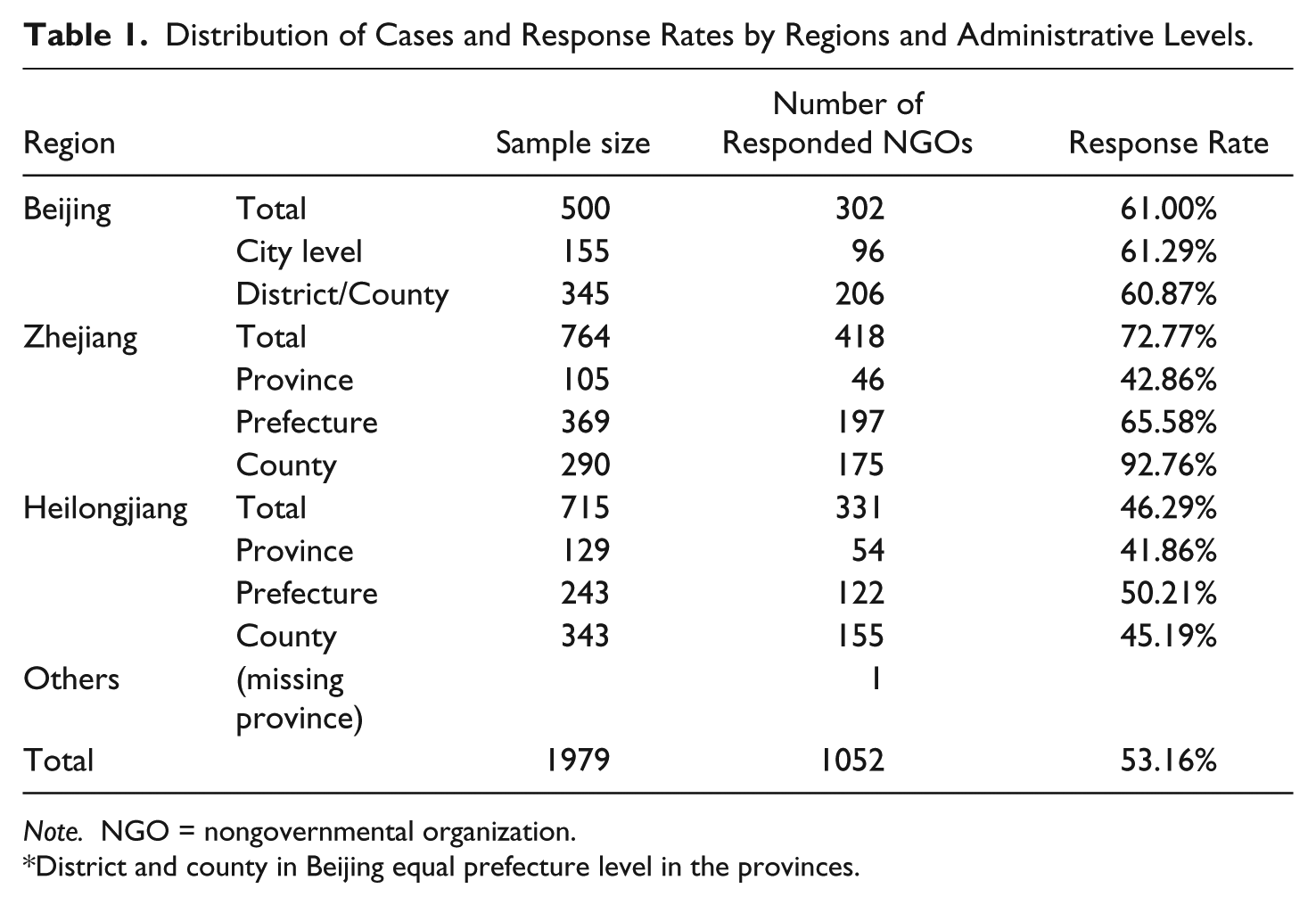
Note. NGO = nongovernmental organization.
District and county in Beijing equal prefecture level in the provinces.
The research team conducted interviews with government officials in the Bureau of Civil Affairs who are in charge of NGO registration and supervision. We learned that many NGOs are inactive, that is, they only exist on paper. I believe the response rate of 53.16% in part reflects that some of the 1,979 selected only exist on the paper. Therefore, the final sample included sufficient responses to provide a representative sample for each of the three regions. I used multiple variable logistic regressions to test the hypotheses.
Variables and Measurements
Dependent Variable
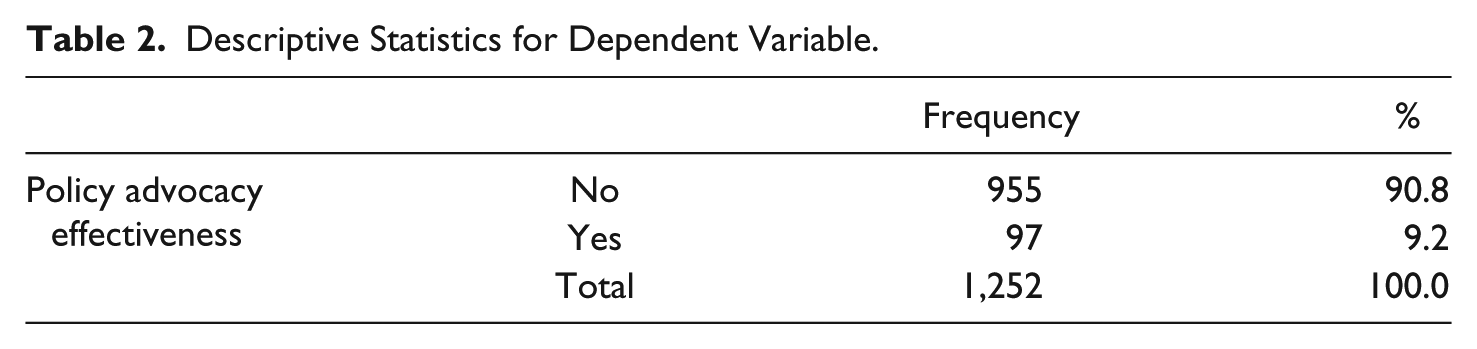
This study measures government responsiveness as a dependent variable. This article focuses on three of the five major categories of influence Andrews and Edwards (2004) to identify agenda setting, the achievement of desired policies, and monitoring and shaping implementation of policy. This study measures advocacy effectiveness by whether the NGO has successfully initiated, changed, and/or stopped a government policy. 17 I assigned a dummy variable to this question: 1 means effective advocating, while 0 is ineffective advocating. I coded the missing value as 0 (no effect), on the assumption that NGOs who have successful advocacy efforts are likely to respond (see Table 2).
Descriptive Statistics for Dependent Variable.
The Chinese government asks parties it terms democratic (minzhu dangpai in Chinese) and mass organizations (qunzhong zuzhi in Chinese) to give suggestions and even critiques to the government, so being a government consultant in itself could be regarded as a dependent variable measuring policy influence. Likewise we could expect this to be a similar phenomenon in registered NGOs; indeed, we find government consulting is highly associated with advocacy effectiveness (see Table 3), so it could be best regarded as an intervening variable and therefore treated as an independent as well as a dependent variable. Given my use of a dummy variable (1 means acts as a consultant and 0 means does not), it is hard to use the Structural Equation Model to model government consulting. Therefore, I develop three models. The first model includes government consultant as an independent variable and the second excludes it, while the third takes government consultant instead of advocacy effectiveness as the dependent variable.
Cross Table of Advocacy Effectiveness and Government Consultant.

Independent Variables
We have a set of independent variables to measure variables in three hypotheses.
Measuring pluralism variables
To test the pluralism variables, I measure each NGO’s social resources by five indicators. The study uses the logged values of each of the first four listed:
Whether the NGO is autonomously organized from bottom up.
Number of members. The NGO studied here are membership organizations. Larger membership may increase influence.
Number of staff. The more staff a NGO has, the higher its capacity and professionalism, and the greater its potential influence on government policy.
Annual budget. The more financial resources an NGO has, the greater its ability to expend resources on influencing government policy.
Government fund ratio: The greater percentage of government funding in its annual income, the lower the potential for independence and policy influence.
Measuring corporatism variables
To test the corporatism hypotheses, I measure each NGO’s autonomy by six indicators. The first four are dummy variables with “Yes” coded as 1 and “No” as 0 and no answer coded as 0 on the basis that those respondents who did not answer consider a particular question to be a null question:
Whether the NGO is autonomously organized by the government (top down).
Whether an NGO is considered to be a government branch or public service unit (shiye danwei), as well as an NGO.
Whether an NGO has staff: Some NGOs have government and/or public service unit staff (bianzhi) and are under the direct control of the government through personnel control.
Whether the government appointed the leader of the NGO. This can happen independently of the government staffing the NGO, although it often coincides.
Government funding: (a) whether the NGO receives funding from the government and (b) the percentage of government funding in its annual income. Two indicators may have different impact on different dependent variables.
The sixth indicator of corporatism is the policy consultancy indicator that I previously discussed relative to the dependent variable.
Measuring clientelism variables
An NGO’s vertical social network is measured by two indicators, both of which I measured as a dummy variable with “Yes” as 1 and “No” as 0:
Whether the NGO’s leader served in the government before taking leadership of the organization. Some NGOs have both a chairperson and a secretary, but only one has the primary leadership power. We asked the respondents to report the background of their real leader.
The gap between the NGO leader’s official status within the government when he or she served there and the level at which the NGO is registered. If the leader did not serve in the government before took the NGO position or the question was not answered, it is coded as 0.
Control Variables
NGO’s age: An organization that has been in existence for a longer time should be more influential, either because of its reputation effect or a proxy of professionalization (Zhang & Guo, 2012).
The NGO’s intention of influencing policymaking and assisting government policy implementation when it was established: Some NGOs, even very large ones, have no interest in policy advocacy, and their resources will not be mobilized or transformed into political resources. Some NGOs are only interested in assisting government policy implementation. I code them as dummy variables.
Administration level of the NGO’s registration: The federalism theory suggests that decentralization brings the government closer to the people and therefore makes local governments more responsive. I code administration level as a dummy variable to show whether the NGO is registered under the county level or higher, and labeled “county level” in the findings.
Locality: I used two dummy variables, one each for Beijing and Zhejiang. Zhejiang has the most active private economy and therefore may have more active NGOs than Beijing, where the presence of the central government decreases NGO influence. 18
Field of operation: I recode these fields into five categories: (a) science, education, sports, and culture (n = 384); (b) social services (n = 97); (c) business (n = 196); (d) rural issues (n = 141); and (e) law, environmental, religious, and foreigners related (55). The fifth category of NGO is particularly sensitive to the party-state.
Table 4 shows the descriptive statistics of these variables.
Descriptive Statistics of Independent and Control Variables.
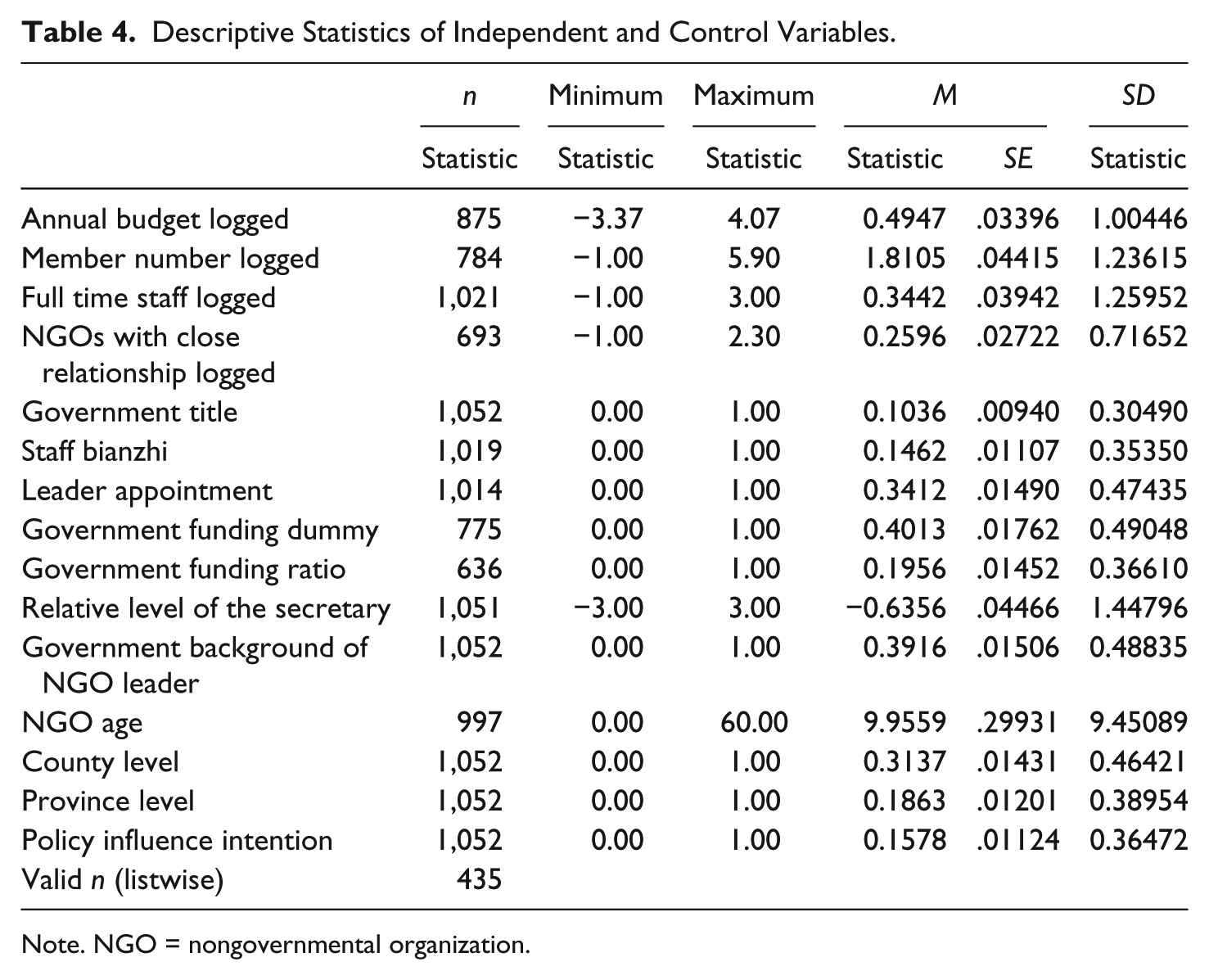
Note. NGO = nongovernmental organization.
Findings
I use a multivariable logistic regression model to test the hypotheses.
Comparing three simplified models, 1s, 2s, and 3s (see Table 5), 19 reveals that the data support the corporatist hypothesis that whether NGOs serves as a government consultant has a strong effect on its ability to change, initiate, and/or stop policy. Adding this variable to Model 1s improves the explanatory power substantially (.146) compared with Model 2s. This suggests that this institutional arrangement, which is part of what Leib and He (2010) terms China’s deliberative democracy, does confer policy lobbying effectiveness on NGOs. It is possible this influence is confined to the policy on which the government consulted with the NGO, but it is also possible that the government’s consultation reflects a general attitude that the NGO is a reliable collaborator and that the NGO can therefore influence other policies.
Logistical Regression Model of NGO’s Policy Lobby Effectiveness and Government Consultancy.
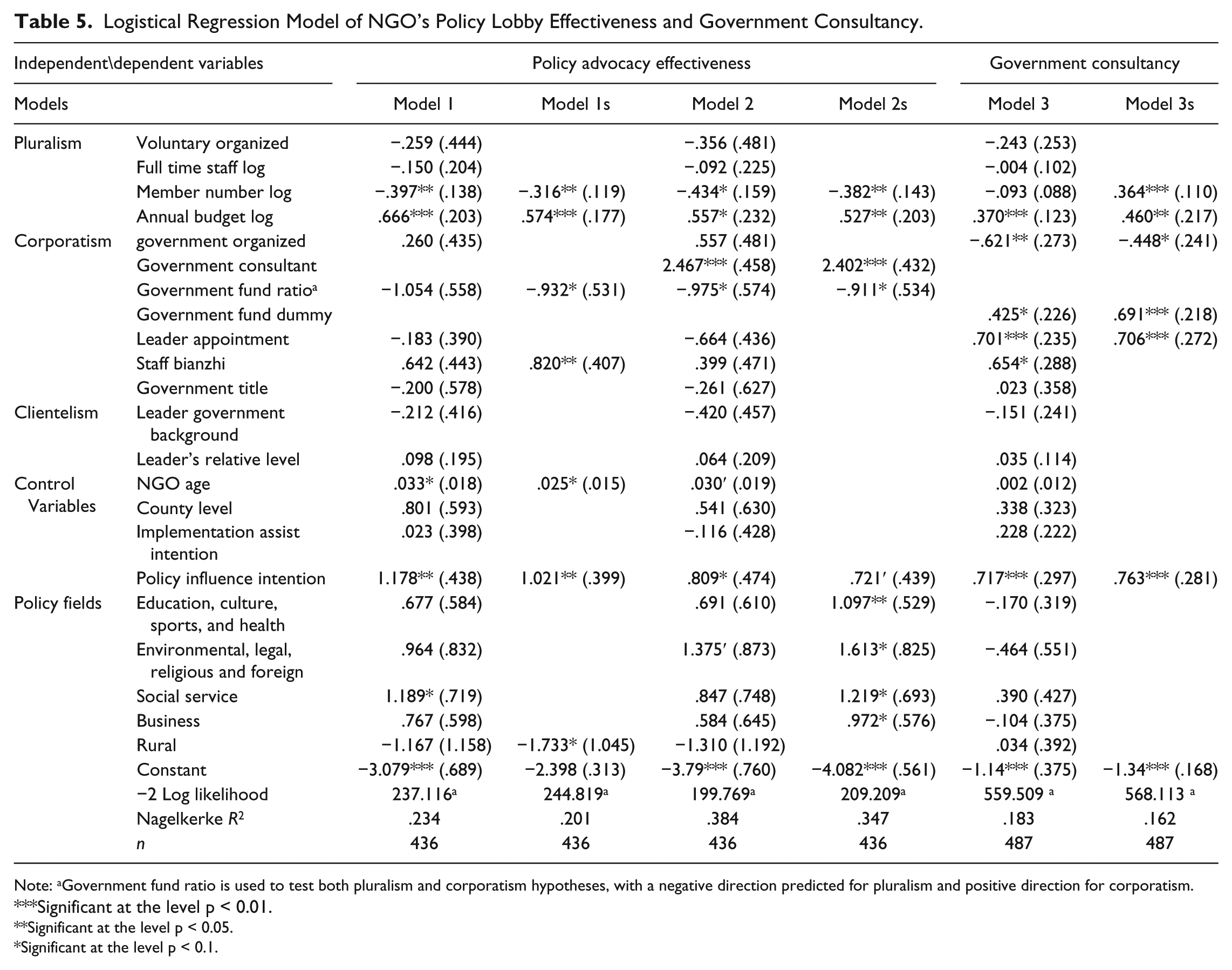
Note: a Government fund ratio is used to test both pluralism and corporatism hypotheses, with a negative direction predicted for pluralism and positive direction for corporatism.
Significant at the level p < 0.01.
Significant at the level p < 0.05.
Significant at the level p < 0.1.
In additional results that support the corporatism hypothesis, the staff bianzhi indicators have a positive effect while government fund ratio has a negative (but government fund dummy has no) statistically significant effect on advocacy effectiveness. Staff bianzhi, government fund dummy, and whether the government appointed the leader all have statistically significant effects on whether the government chooses to consult with the NGO, according to Model 3. These results suggest that the state corporatism hypothesis is generally supported.
The influence of the NGO’s financial resources and the negative effect of government fund ratio also somewhat support the pluralism hypothesis. The size of the annual budget correlates with greater policy influence in all three models.
None of the findings support the clientelism hypothesis. Neither the NGO leader’s formal position in the government 20 nor the NGO’s relative level has any effect on an NGO’s apparently ability to lobby effectively or to be called on to consult with the government.
Some of the control variables I tested show significant correlations: An NGO’s age and inclusion of an intention to influence policymaking as core mission are positively associated with policy lobbying effect. The Beijing local government consults with NGOs less than the two provinces. Rural NGOs tend to have less policy influence. 21
Conclusion and Implications
To examine NGOs’ role in policy-making process in China, this article tested three hypotheses: the pluralist, corporatist, and clientelist patterns of government-NGO interactions. Using random sample survey data from three provinces, the quantitative analysis largely supports the corporatist hypothesis and somewhat supports the pluralist hypothesis, which illustrates the central role of authoritarian government and its intention to consult with NGOs and utilize their resources while maintaining its political control. While local governments are responsive to social demand to some degree, they are still typically closed to most but a few NGOs—a typical state corporatist arrangement. Furthermore, local government is more responsive to and consults more frequently with resource-rich NGOs, those NGOs with more financial resources and greater financial independence from government funding. However, NGOs with more members have less influence. This partially supports the pluralism hypothesis and resonates with Teets’s (2013) case study findings that “more professional and high capacity” NGOs have more influence, or an elite pluralism found in the United States (Schattschneider, 1960). Surprisingly, this article finds guanxi or clientelism has no significant impact on NGO’s policy advocacy effectiveness, either measured by government consultant or real effectiveness. Given that prior research finds clientelist ties mattered in NGOs’ policy advocacy at the beginning of 21st century (Zhang 2015) this research suggests that the institutionalization of policymaking has improved in the intervening time. Guanxi, which is informal in its nature, can help a group gain access to the political process, but it is not enough on its own, especially in formal government consultant around 2010.
Ultimately, the findings support a hybrid model of that state–society relationship, which has the characteristics of both pluralism and state corporatism. I call this hybrid model “pluralized state corporatism.” On the one hand, the fundamental nature of the state–society relationship in China is still state corporatism, meaning that limited political reform has taken place since 1989; fragmented authoritarianism still dominates policymaking. On the other hand, two factors “pluralize” the state–society relationship: First, policymaking has become more, albeit, selectively open to social demand; and second, NGOs with greater financial resources and financial independence from government, and to some extent, those with human and/or social capital resources can influence government policies, which suggests the exchange model is at work. The hybrid model differs from pluralism in terms of government intentionally collaborating with them in service to mutual aims as case studies reveal (e.g., Spires, 2011).
This hybrid pluralized state corporatism model differs from social corporatism in several ways, most importantly the political system in which it is embedded. As Schmitter (1974) proposed in his seminar work,
Societal corporatism is found imbedded in political systems with relatively autonomous, multilayered territorial units; open, competitive electoral processes and party systems; ideologically varied, coalitionally based executive authorities—even with highly “layered” or “pillared” political subcultures . . . state corporatism seems to be a defining element of, if not structural necessity for, the antiliberal, delayed capitalist, authoritarian, neomercantilist state. (p. 105)
Many of the findings of recent qualitative studies, including Teets (2013) 22 and Spires (2011), 23 support pluralized state corporatism. However, there are some major differences. First, both Teets’ and Spires’ findings relate to public service delivery, rather than policy advocacy. Second, “pluralized state corporatism” departs from Teets’s finding on the regulatory model of “combination of social pluralism and differentiated social control” by emphasizing that “pluralism” is the adjective and “state corporatism” or social control is the subject. It also resonates with Mertha’s fragmented authoritarianism version 2.0: More and more NGOs get involved in policymaking under an authoritarian regime but the concept of pluralized state corporatism specifies what kind of NGOs get more of a chance to influence government policy. This answer to “who gets what” is the third difference between pluralized state corporatism and “consultative authoritarianism.”
What is the implication of pluralized corporatism for further political change? Under these conditions, the authoritarian state has been effectively using consultation with NGOs to improve governance quality and citizens’ satisfaction without making fundamental change. Like China’s legislatures, pluralized corporatism is a mechanism that helps the authoritarian government to co-opt the wealthiest social-economic elites. 24 That is, it sustains authoritarian rule rather than weakening it, at least in the short term. The Chinese Communist Party’s central committee realized this; thus, it called for “socialist consultative democracy” with NGOs in 2015. 25 This study also reveals the limits of Chinese government responsiveness: It tends to privilege those with close links with the government, the elites, and the resource-rich NGOs, rather than ordinary citizens. This resonates with Lowi’s critique of pluralism in the United States for its over representation of the elites (Lowi, 1969).
As an early quantitative study, it has several limitations. First, the data treat any change to policy, no matter which policy and to what degree, as equivalent. Further research may measure the effectiveness of policy advocacy in a better way. Second, because the sample only includes registered NGOs in three provinces, the findings cannot be applied to all NGOs in China, although the range of provinces included gives it some power value to illuminate NGOs in other provinces. Finally, Xi Jinping has taken a hostile attitude toward civil society since the conclusion of the survey, as the state’s crackdown on unregistered NGOs in 2015 reflects. 26 However, registered NGOs have not been subject to such measures, and the state council had even encouraged NGO development by simplifying registration of four types of NGOs since 2014. 27 Therefore, under the “differentiated control system” (Kang & Han, 2006), the relationship between the state and registered NGOs the present study identifies likely remains intact.
The two new NGO laws, that is, The Charity Law and Foreign NGO Law, reflect CCP’s concerns and strategies toward NGOs: selective control and selective empowerment at the same time. On the one hand, the party-state needs social resources to provide better public services (as this article’s model suggests). On the other hand, being afraid of potential threats from some NGOs, especially the foreign NGOs and those receiving foreign funding, the Ministry of Public Security replaces the Ministry of Civil Affairs to take the charge of these potentially “dangerous” NGOs. All of these suggest a hybrid model will sustain in the future.
Footnotes
Acknowledgements
The author wants to thank Ruijun Yuan and Susan Whiting, two anonymous reviewers and the editor of NVSQ for their valuable comments and suggestions. All errors are mine.
Declaration of Conflicting Interests
The author declared no potential conflicts of interest with respect to the research, authorship, and/or publication of this article.
Funding
The author disclosed receipt of the following financial support for the research, authorship, and/or publication of this article: The author receives research funding from Chinese National Social Science Funding (14BZZ044).