




Abstract
Recent high-profile scandals suggest the potential for a crisis of trust in charities, which could have negative consequences for the nonprofit sector as a whole. Although widespread, this crisis narrative has not yet been subjected to empirical examination. To assess the extent to which public trust has changed over time, we examined trust in nongovernmental organizations within 31 countries over nine consecutive years using data from the Edelman Trust Barometer (N = 294,176). Multilevel analysis revealed that, after allowing for differences in absolute levels of trust and trends across countries, there was actually a small increase in global trust in the nonprofit sector. This increase was sharper among men, people aged below 40 years, and people with higher education, income, and media consumption. Overall, we find no evidence of a crisis of trust in nonprofits; scandals within individual organizations have not affected sectoral trust.
Evidence of falling trust in various institutions (Gallup, 2020), combined with the emergence of high-profile charity scandals, has contributed to a growing narrative that the public have also lost trust in nonprofits (e.g., Keating & Thrandardottir, 2016), a broad category that includes charities, community groups, and nongovernmental organizations (NGOs; Salamon et al., 1999). However, this idea has not yet been subjected to empirical testing. If such a crisis of trust exists, it could have negative consequences for the nonprofit sector, which relies on trust for donations and community support (Gaskin, 1999). However, if the crisis is not an empirical reality, it could mean that scarce resources are being misplaced to fend off nonexistent risks.
For this article, we accessed multinational, longitudinal data from the Edelman Trust Barometer to examine whether trust in nonprofits has changed over time. The current study is the first temporal examination of trust in nonprofits to take a global perspective. Below, we conceptualize trust in nonprofits, highlight the importance of trust for the sector, and elaborate the crisis of trust narrative.
Trust in Nonprofits
Although many definitions of trust exist, most scholars agree that trust is a willingness to be vulnerable to the actions of others based on positive expectations of the intentions or behavior of the other party (Mayer et al., 1995; Rousseau et al., 1998). Three key factors influence perceptions of an organization’s trustworthiness: ability, benevolence, and integrity (Gillespie & Dietz, 2009; Mayer et al., 1995). Ability refers to the organization’s skills and competencies relevant to their sphere of operation. Benevolence refers to the perception that the organization wants to do right by the trustor, for reasons beyond motivated self-interest. Finally, integrity refers to the organization’s adherence to principles that the trustor considers to be appropriate.
The ability-benevolence-integrity model outlined above (Mayer et al., 1995) suggests that nonprofits will be trusted to the extent that they are competent, well-intentioned, and principled. In turn, Sargeant and Lee (2004a, 2004b) propose that donor trust in nonprofit organizations is best evidenced by four behaviors: (a) relationship investment, or the willingness to offer time, attention, or resources to the organization; (b) the belief that they can both influence and be influenced by the organization (i.e., mutual influence); (c) communication acceptance, or a willingness to receive communication from the organization; and (d) actively resisting opportunities to invest in competitors (i.e., forbearance from opportunism).
These approaches to organizational trust assess trust toward specific organizations. However, it is proposed that trust in the nonprofit sector—which includes various organizations, including charities, community groups, and NGOs (Salamon et al., 1999)—should affect behavior toward any organization that falls within that category (Bekkers, 2006; Burt, 2014; Hager & Hedberg, 2016). According to Burt (2014), this kind of category-based trust can occur on either a superordinate level—based on the organization’s status as a nonprofit—or at a subordinate level—based on the organization’s status as a particular subtype of nonprofit (e.g., international, higher education, or religious). This article focuses on the superordinate level of category-based trust, or trust in nonprofits in general.
Empirical investigations of trust in nonprofits traditionally focus on antecedents of trust (e.g., Sargeant & Lee, 2002), consequences of trust (e.g., Alhidari et al., 2018; Liu, 2019), or both antecedents and consequences (e.g., Furneaux & Wymer, 2015; Sargeant & Lee, 2004a, 2004b). The question of whether or not trust in nonprofits is changing over time has rarely been considered. Yet trend data are essential to determine whether or not there is a crisis of trust in nonprofits. If such a crisis exists, we must consider the potential consequences for the sector.
Importance of Trust for the Nonprofit Sector
Trust is theorized to be especially important to nonprofits for three reasons (see Gaskin, 1999). First, a trusting public is more likely to engage in civic life. Given that many charities work to promote social harmony and often rely on volunteers, trust may therefore help nonprofits achieve their social goals. Second, campaigning and lobbying efforts are undermined if charities do not have a strong supporter base, meaning trust allows nonprofits to cultivate the political space they need to have a wider impact on society. Third, trusted organizations are more likely to receive financial support and goodwill. In short, trust is important for charities and nonprofits.
Various studies have shown a link between trust and charitable giving. People with higher trust in charities or nonprofits are more likely to be donors and are more generous when they do give (e.g., Alhidari et al., 2018; Bekkers, 2003; Bourassa & Stang, 2016; Liu, 2019; Vázquez, 2011). Thus, it is reasonable to expect that global trends in trust will directly influence the extent to which nonprofits can do their work. Increases in trust could contribute to a virtuous cycle of donations and social good. If trust is in decline, however, this could have repercussions for nonprofits and the beneficiaries they serve.
The nonprofit sector contributes a significant percentage of Gross Domestic Product (GDP) in many countries, for example, 0.8% in Thailand, 3.4% in Brazil, 4.9% in Australia, 6.7% in Mozambique, and 8.1% in Canada (Casey, 2016). A significant portion of these economic resources is contributed by individuals in the form of private donations (Salamon et al., 1999), presumably on the promise that they fulfill their mission to increase inclusiveness, preserve equality, and protect the interests of the most vulnerable members of society. Any decline in trust over time is therefore likely to be damaging to nonprofits’ ability to continue this good work.
Trust in Decline
Globally, the decline of public trust in a range of institutions has been well documented. These include reduced trust in the media, government, business, the medical system, and organized religion (Gallup, 2020; Edelman, 2020). However, institutions are a broad umbrella and trends in trust across different institutions vary widely—from declining trust in banks, for example, to increasing trust in the military (Gallup, 2020). Public trust in institutions may not tell us much about public trust in nonprofits. Indeed, broad institutional trust has not been found to be relevant to charitable giving (Hager & Hedberg, 2016). Instead, as highlighted above, trust in nonprofits is likely to be most relevant.
After 9/11, some evidence emerged that U.S. citizens were less confident in their charities (Light, 2004, 2008). Light proposed that the general population had lost confidence in the entire charity sector because of the American Red Cross’s slow disbursement of the Liberty Fund to victims. However, responding to Light’s claims, Michael O’Neill (2009) reviewed historic evidence from surveys of public confidence in American charities and data on charitable donation tax claims. By “eye-balling” descriptive data from these diverse sources, he concluded that the popular crisis of confidence narrative could not be substantiated. In short, O’Neill found no evidence that Americans’ attitudes toward charities had become more negative between 1988 and 2008. However, that work has three key limitations in relation to the current question about global trends of trust in nonprofits. First, O’Neill’s approach was to “eye-ball” polling data rather than conduct statistical tests to determine trends. Second, his analysis was limited to the United States and therefore cannot speak to global trends. Third, the data are now more than a decade out of date and can tell us nothing about the contemporary state of affairs.
In the intervening decade, media around the world have frequently claimed declining trust in charities (e.g., Booth, 2018; Garton, 2016; Keating et al., 2018). Headlines have claimed, for example, that “Trust in charities is at an all-time low” (Shawcross, 2016) and that “One in three worldwide lack confidence in NGOs” (Younis & Rzepa, 2019). According to media headlines, trust in charities is declining on several continents: for example, “Australians losing trust in charities” (Williams, 2018), “Only one in five Americans ‘highly trust’ charities” (Philanthropy News Digest, 2018), and “China’s charities confront public trust crisis” (Tan, 2015).
This popular narrative around a crisis of trust has also been adopted by some scholars. Some research on antecedents or consequences of trust, for example, uses this apparent crisis of trust to set the stage for the importance of their work (e.g., Herzlinger, 1996; Hind, 2017; Keating & Thrandardottir, 2016). In sum, the crisis of trust narrative has been broadly adopted.
A contributing factor to this perceived crisis of trust is the emergence of high-profile, one-off scandals engulfing individual nonprofits, including incidences of fraud (Burt, 2012; Gibelman & Gelman, 2004; Holtfreter, 2008), controversial fundraising practices (DiGangi, 2016), false claims (Marks, 2014), inappropriate handling and spending of donations (Vedelago & Houston, 2016), and sexual exploitation (S. O’Neill, 2018). Another possible reason for the perceived crisis is a general increase in the accountability of nonprofits and the corresponding negative press coverage of practices that fall short of community standards. In Australia, for example, the national regulator revoked registrations for 26 nonprofit organizations in 2017 alone, following investigations of concerns raised by members of the public (Australian Charities and Not-for-Profits Commission, 2018). This regulatory response perhaps indicates that nonprofits are held to high community standards and may be punished if those standards are breached.
Moral Disillusionment Theory
A new approach to understanding public responses to charity scandals has recently been proposed: Moral Disillusionment Theory (MDT; Hornsey et al., 2020). Hornsey and colleagues argue that because nonprofits have moral reputations, the public hold them to higher standards than commercial organizations. Across three experiments, the authors considered public responses to ethical transgressions (fraud, sexual exploitation, and exploitative labor practices) occurring within either nonprofits or commercial organizations. Hornsey and colleagues demonstrated that nonprofits are penalized more harshly than commercial organizations who commit the same transgressions. Specifically, nonprofits suffer steeper declines in trust and consumer intentions after a scandal, precisely because the public have higher expectations of them.
MDT was formulated to understand responses to scandals within specific organizations: to understand how scandals affect trust in the transgressing organization itself. Nevertheless, if MDT holds for the sector as a whole, it is possible that highly publicized charity scandals could indeed be eroding public trust in nonprofits around the globe. If true, this erosion of trust could have dangerous consequences for the viability of the sector as a whole.
The Current Study
In light of media reports of reduced trust in nonprofits around the world, and the troubling repercussions that could have for the sector, the aim of this study is to examine empirically trends in global trust in nonprofits over time. That is, we seek to understand to what extent the public’s trust in the nonprofit sector is in decline around the world, as suggested by diverse media reports.
Since O’Neill (2009), a development has made it possible to analyze global trends in trust in nonprofits. Specifically, we were able to access data from Edelman’s Trust Barometer, offering a unique opportunity to conduct linear modeling of changes in trust in NGOs over nine timepoints (2011–2019) in 31 countries. Edelman collect data from across the world for their annual “Trust Barometer” (Edelman, 2020). The Trust Barometer originally sampled only from what they call the “informed public”: college-educated people, aged 25 to 64 years, who are in the top 25% of their country’s household incomes for their age, and report significant business and political media consumption (Edelman, 2020). In 2011, however, Edelman began surveying the general population. This improved sampling procedure allows us to assess changes in trust within the wider public over time.
Although Edelman releases annual reports from their Trust Barometer, these report data in aggregated form. First, people who respond six through nine on the original 9-point response scale are coded as trustors. Then the percentage of trustors in each market is used to categorize countries into either “trust” (where 60%–100% of the population were classified as trustors), “neutral” (where 50%–59% were classified trustors), or “distrust” categories (where less than 50% were classified as trustors). Finally, comparisons are made based on descriptive comparisons of the percentage of respondents who fall into each category (see Edelman, 2020). This approach makes results easier for members of the general public to comprehend, but may also obscure subtle variations in trust, while possibly exaggerating small changes that happen to occur on the boundary between categories or that appear meaningful but are not statistically significant. We contacted Edelman and asked them to share their raw data files to enable statistical examination for scholarly purposes, and they agreed. Anonymized data were shared with the researchers free of charge. The researchers received no compensation for our work with this data set. Our study drew on this unique data set to track changes in average levels of trust in NGOs across diverse countries over the period from 2011 to 2019.
Method
People aged 18 years and over were surveyed from 31 countries, with respondents drawn from the general online population and with quotas applied based on age, gender, and region. Typically, 1,150 people were sampled per country per year. Within developed countries the sample is representative of the general population. In developing countries, the sample is more affluent, educated, and urban than the general population.
The particular sample analyzed for this project was 51% male and 49% female. Participants ranged in age from 18 to more than 65 years (25% aged 18–29 years; 24% aged 30–39 years; 20% aged 40–49 years; 16% aged 50–59 years; and 15% aged 65 or more). The educational background of respondents ranged from primary school equivalent or less up to completion of a postgraduate degree. Education level was captured using seven ordinal categories. To summarize, 21% had completed secondary school or less, 29% had completed a technical qualification or some university study, 38% had completed a university degree, and 12% had completed a postgraduate degree. Finally, 78% of participants were sampled from the general population, and the remaining 22% were sampled by Edelman from a population with higher-than-average education, income, and media and business consumption. We refer to this latter group as the high education, income, and media (HEIM) sample.
We analyzed 294,176 responses to a single question (“Please indicate how much you trust NGOs in general to do what is right,” 1 = do not trust them at all, 9 = trust them a great deal). Although NGOs represent just one of the many types of organizations that comprise the nonprofit sector (Salamon et al., 1999), the general public is unlikely to meaningfully distinguish between different organizational types. Thus, we expect results to reflect trust broadly in the nonprofit sector—charities, NGOs, and other nonprofit organizations. Data on trust in NGOs were available across nine time points (annually from 2011 to 2019) and from 31 countries.
Results
The average levels of trust in NGOs among all respondents to the Edelman Trust Barometer survey are plotted in Figure 1. These reflect responses from all participating countries. Over the 9-year period, data show small year-on-year fluctuations in people’s trust in NGOs globally but no discernable trend.
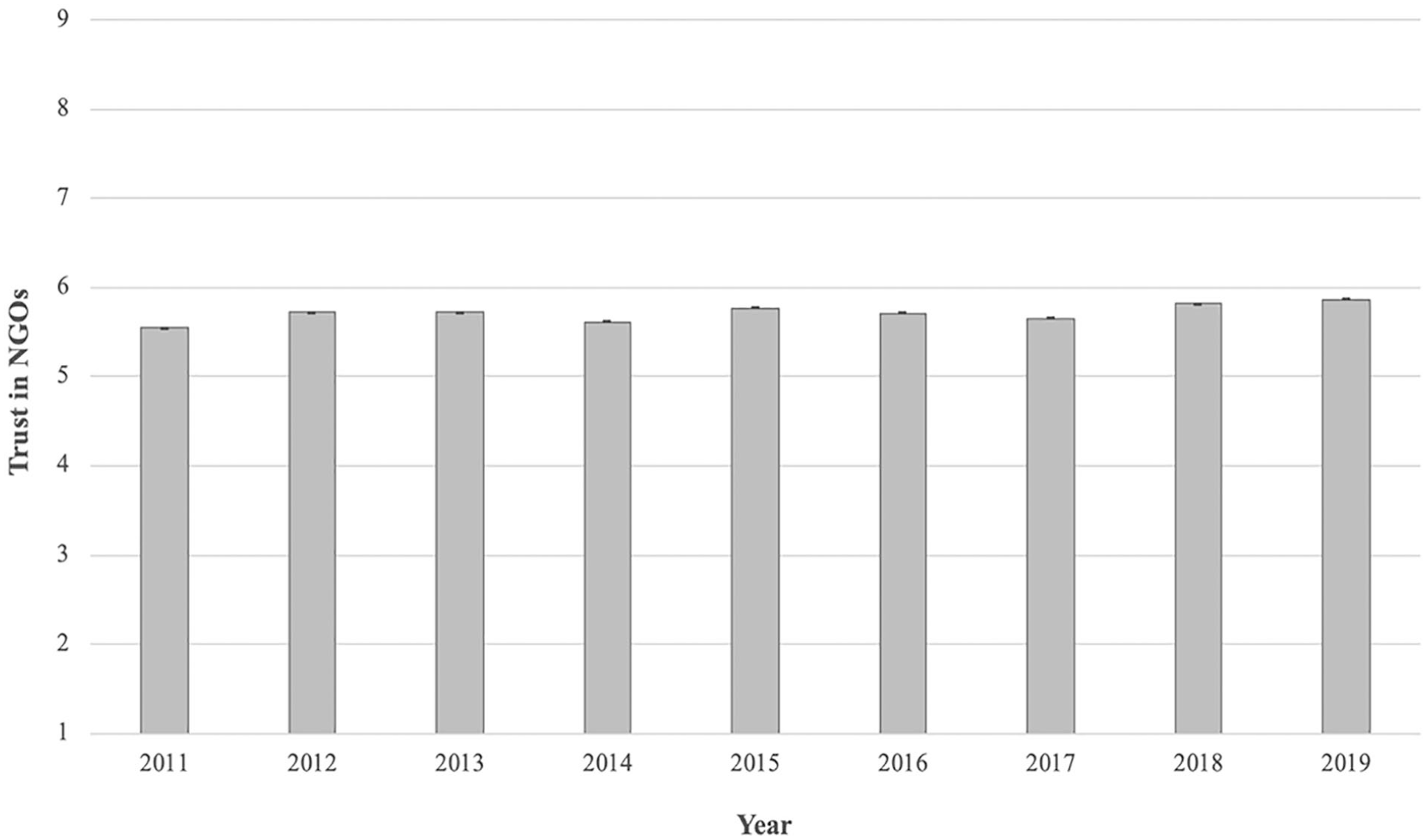
Overall Level of Trust in NGOs Averaged Across 31 Nations.
Given the nested nature of the data (respondents nested within countries), we also conducted multilevel analysis using the nlme package in R (Pinheiro et al., 2018) to assess global changes in trust over time, after accounting for country-level differences. Useable longitudinal data from a total of 292,213 respondents were nested within 31 countries.
We calculated a series of models adding random intercepts, the fixed effects of time, random slopes, and then considering the direct and interactive effects of several demographic variables. Significant variance was accounted for at the country level, χ2(1) = 15,586.77, p < .001, indicating that countries differed in their starting levels of trust in NGOs. Of more relevance to the current article, however, adding time significantly improved the model, χ2(1) = 164.05, p < .001, indicating a very weak trend of increasing trust over time, b = .01, SE = .00, p < .001.
The relationship between time and trust varied across countries, χ2(2) = 573.81, p < .001. A series of simple regression analyses were conducted on a country-by-country basis to investigate the effect of time on trust in NGOs within each of the 31 countries (full results of these analyses are presented in Table 1). Of the 29 countries where more than 1 year of data were available, 13 showed small increases in trust, 13 show no significant change in trust, and only three showed small decreases in trust over the 9-year period of the study. In all instances, however, time explained almost no variance in trust (see final column of Table 1). Indeed, for only two of 29 countries did time explain 1% of the variation in trust or more: India (R2 = .02) and Indonesia (R2 = .01). Both these countries showed increases of trust in NGOs over time. For all other countries, time explained less than 1% of variance, and for 15 countries time explained no variance at all. These effect sizes indicate that, despite statistical significance, linear patterns over time were not practically significant for understanding trust.
Country-Level Analyses Regressing Trust in NGOs On Time.
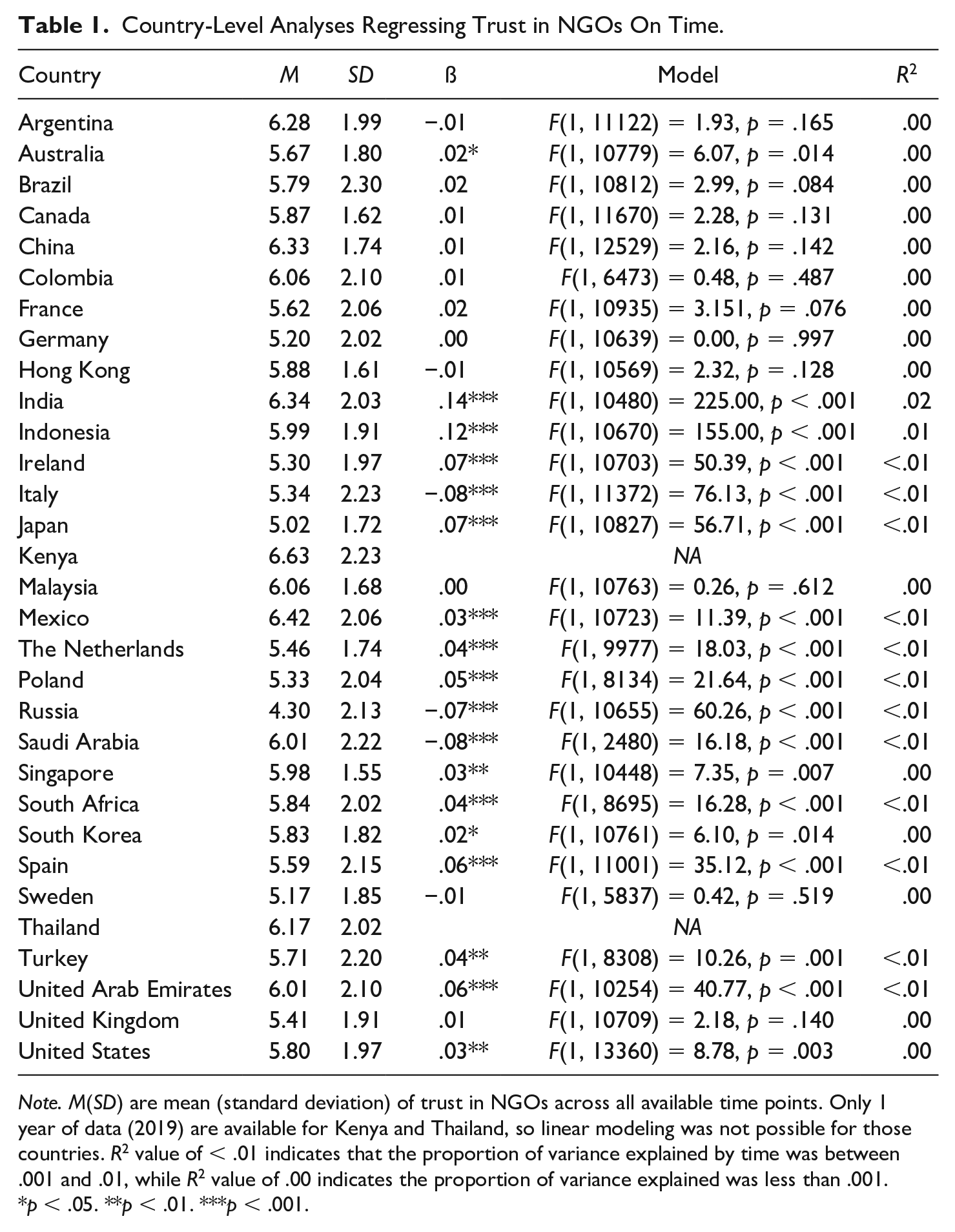
Note. M(SD) are mean (standard deviation) of trust in NGOs across all available time points. Only 1 year of data (2019) are available for Kenya and Thailand, so linear modeling was not possible for those countries. R2 value of < .01 indicates that the proportion of variance explained by time was between .001 and .01, while R2 value of .00 indicates the proportion of variance explained was less than .001.
p < .05. ** p < .01. ***p < .001.
Next, we considered several sociodemographic variables that could help account for changes in trust. Adding participant gender, age, education level, and sample (general population vs. HEIM) significantly improved the model, χ2(4) = 4,818.77, p < .001. Finally, the model was further improved when we considered these demographic factors as moderators of the relationship between time and trust, χ2(4) = 173.93, p < .001.
This final model—which fit the data best—assessed the overall relationship between time and trust, while (a) allowing both the relative levels of trust and the relationships between time and trust to vary across countries and (b) considering the direct and interactive effects of participant demographics. These results are summarized in Table 2. In this model, a significant positive effect of time on trust in NGOs was found, b = .07, SE = .01, p < .001, again indicating an increase in public trust in charities over time. We elaborate below the effects of the four sociodemographic variables: gender, age, education level, and sample.
Summary of the Series of Multilevel Models That Considered Trends in Trust in NGOs Over Time.
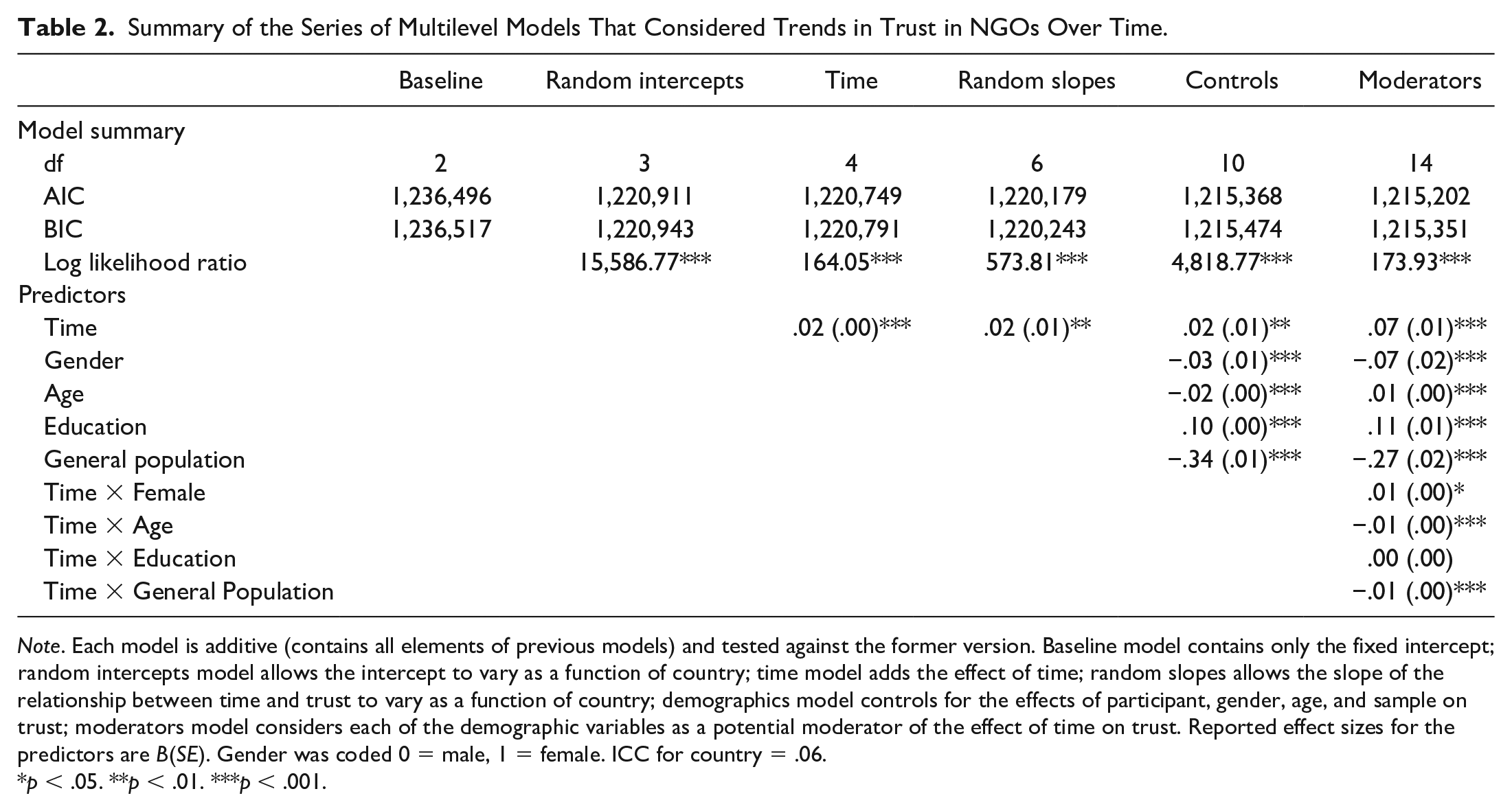
Note. Each model is additive (contains all elements of previous models) and tested against the former version. Baseline model contains only the fixed intercept; random intercepts model allows the intercept to vary as a function of country; time model adds the effect of time; random slopes allows the slope of the relationship between time and trust to vary as a function of country; demographics model controls for the effects of participant, gender, age, and sample on trust; moderators model considers each of the demographic variables as a potential moderator of the effect of time on trust. Reported effect sizes for the predictors are B(SE). Gender was coded 0 = male, 1 = female. ICC for country = .06.
p < .05. **p < .01. ***p < .001.
Gender
A direct effect of gender was observed, whereby women reported slightly less trust in NGOs overall, b = −.07, SE = .02, p < .001. Gender also significantly moderated the effect of time on trust, b = .01, SE = .00, p = .015. Simple slopes analyses revealed that both men and women showed increases in trust of NGOs over time. However, men gained trust at a slightly faster rate, b = .08, SE = .01, p < .001, than did women, b = .07, SE = .01, p < .001.
Age
Overall, older participants reported greater trust in NGOs than younger participants, b = .01, SE = .00, p < .001. However, this direct effect was qualified by a significant interaction, b = −.01, SE = .00, p < .001. Simple slopes analyses showed that, for participants aged below 40 years, trust in NGOs was significantly increasing over time, b = .07, SE = .01, p < .001. However, participants aged over 40 years showed no significant change of trust in NGOs over the 9-year period, b = .01, SE = .01, p = .616.
Education
Participants who had higher levels of education reported higher trust in NGOs overall, b = .11, SE = .01, p < .001. However, education did not moderate the effect of time on trust, b = .00, SE = .00, p = .211.
Sample
Overall, participants drawn from the general population sample reported less trust in NGOs than did participants drawn from the HEIM sample, b = −.27, SE = .02, p < .001. The effect of sample was further qualified by an interaction, b = −.01, SE = .00, p < .001. Inspection of the simple slopes revealed that, among the general population, trust was increasing over time b = .05, SE = .01, p < .001. However, among HEIM participants, trust was increasing at a faster rate, b = .12, SE = .04, p = .004.
Discussion
Drawing on a longitudinal global survey—the Edelman Trust Barometer—we provided the first international assessment of whether trust in nonprofits has declined. Overall, there was no evidence of a global crisis of confidence in charities over the 9 years from 2011 to 2019. Instead, results show a small increase of trust in NGOs around the globe. This increase was more pronounced in several countries, among men (vs women), and especially among people aged under 40 years, and those with higher levels of education, income, and media consumption.
In light of the broad range of high-profile charity scandals that have been making headlines around the globe over the past decade, it is perhaps surprising to find that global trust has actually been increasing (albeit weakly). One explanation is that the effects of one-off scandals may be localized to the particular organizational context (e.g., the impact on trust of a scandal at a specific organization is restricted only to that organization), and that there is little meaningful spillover to the sector as a whole. In other words, scandals may shake trust in a particular organization—and may even temporarily influence trust in related charities—but may not reduce trust in the broader nonprofit sector. It is also possible that the public is able to contextualize isolated scandals as exceptions to the rule, unfortunate one-off events that play out in the media against a backdrop of a general commitment of the charity sector to integrity. For example, the 26 Australian charities that were de-registered in 2017 are situated within a sector that includes over 56,000 registered charities, representing a 1:2000 ratio (Australian Charities and Not-for-Profits Commission, 2018). It is possible that the actions of each of those scandalous organizations taint the public’s perceptions of the other 1,999. However, our data suggest that the public is capable of appraising these scandals in a balanced and proportionate way, leading them to maintain stable levels of trust over time.
Theorizing a Sectoral “Trust Bank”
Applying the MDT lens (Hornsey et al., 2020), our findings suggest that global coverage of charity scandals may not be affecting trust in the nonprofit sector as a whole. Hornsey and colleagues (2020) found that the public lost trust in specific organizations that committed ethical transgressions. We potentially highlight a boundary condition of the MDT approach: trust losses may be suffered at the organizational level but not at the sectoral level.
To reconcile the current findings, we propose that the strong moral reputations of nonprofits may function as a kind of “trust bank” that buffers them from the effects of scandals. Perhaps over time the sector makes deposits in the community trust bank through their good works in society. When scandals emerge within individual organizations, this may draw down some of the community trust that has built up over time but have comparatively little impact on reserves of overall trust in the sector. At the same time, trust repair efforts from the sector may not only help recover lost trust but also create new deposits in the community trust bank. The notion of a trust bank for nonprofits relates to evidence showing that corporate social responsibility initiatives can have insurance-like qualities in some cases, protecting organizations from public reprimand for future bad behavior (e.g., Barnett et al., 2018; Flammer, 2013; Godfrey et al., 2009; Janney & Gove, 2011). Future studies could test explicitly the trust bank hypothesis generated by the current research to develop a new theory of the sectoral consequences of scandals.
Community Trust Trends
Results also indicate different trends or rates of change among different samples. Only three countries showed declines of trust over time, compared with 13 showing increases and 11 showing no significant changes in trust in NGOs. Although we found a variety of trends within different national markets, these changes were mostly very small. Time explained no more than 1% of the variance in trust in all but one of the countries studied, meaning that comparison of national trust trends is unlikely to be of practical concern for the sector. Similarly, although gender moderated the effect of time, trust was increasing for both men and women, with only slightly steeper increases for men. This gender difference is therefore unlikely to be of practical concern.
More convincing were the differences in rates of change based on age and sample. Older people trust NGOs more but are showing no change over time, while younger people are showing increases in trust over time. These patterns may reflect the natural advance of age—that is, as younger people age they become more trusting—or may reflect real generational differences in trust in NGOs. Participants with higher rates of education, income, and media consumption are also more trusting of NGOs and increasing in trust at a faster rate. This corroborates a growing reported gulf between the attitudes of those who occupy positions of wealth or status in society and the wider population (see also Edelman, 2020). Future research would benefit from investigating why these different groups are showing different patterns of changing trust over time.
Strengths, Limitations, and Future Directions
A perennial caveat of cross-national research is that the samples may not adequately reflect the cultural matrix of a nation. In this case, however, the Edelman Trust Barometer used nationally representative samples, making these data as a reliable proxy for the broader cultural landscape as can be reasonably expected. We also actively control for and consider the interactive effects of various demographics and types of sample.
The ability to track changes in trust over time using a diverse, representative, multinational sample is a clear strength of the current study. However, the advantages of empirical scale and reach also come with trade-offs in terms of psychometric sophistication. Inevitably, our conclusions are bounded by the operationalization of trust available within the survey. The single-item scale used in the current study is a face valid measure of trust that has been designed to have maximal cross-cultural currency. It would nonetheless have been preferable to have used a more psychometrically sophisticated measure.
This is the first study examining trends of trust in nonprofits around the world. The findings may therefore inspire new research on which factors influence the development of trust banks or affect trust-related responses to scandals. For example, future research may want to consider overall levels of generalized trust as a potential moderator: countries with a relatively low disposition to trust may lose trust in the nonprofit sector at a greater rate after scandals. Another potential moderator is the type of nonprofit where the scandal emerges. It is possible, for example, that scandals occurring in larger, global nonprofits would have larger implications for sectoral trust than scandals occurring in smaller, local nonprofits. These ideas remain to be tested in future research.
Practical Implications
The key finding of the current study is that—contrary to media portrayal and a dominant public narrative—there is no global crisis of trust in nonprofits. Although specific nonprofits that are embroiled in scandals will suffer trust losses (Hornsey et al., 2020), the effects of scandals do not seem to spillover and damage trust in the sector as a whole. Instead, global trust in NGOs has been observed to be increasing slightly over the 9-year period examined here. It is easy to see how a “crisis of trust” narrative could have gained traction within the sector: there have been well-documented collapses of trust in other institutions (such as government and the media) and this trend has emerged at the same time as several high-profile cases of improper behavior by charities. However, our data suggest that this crisis narrative is not grounded in reality.
Whenever there is an assumed wisdom that is disconnected from the data, it suggests the potential for misplaced strategic energy. Therefore, one important implication of the current data is that focusing on attempts to buffer individual charities from a non-existent sectoral crisis of trust may be a waste of energy. For example, based on narratives of declining public trust, nonprofits may feel pressured to invest more in transparently documenting their work and risk management strategies, or investing in marketing campaigns to reassure the public of their integrity and trustworthiness. Such strategies can divert scarce resources away from the organization’s central mission. Instead, management could invest their time and energy on achieving their important missions and serving vulnerable populations in need. This advice is particularly relevant to managers working in international NGOs with global operations and donors in various countries.
Our trust bank hypothesis as an explanation for the stable and increasing levels of trust in charities over time remains to be tested. If the good deeds of charities cultivate trust banks from which they can safely draw on in times of crisis, a key strategy will be to ensure all successes are communicated both to the supporter base and to the wider public. Nonprofit leaders should also encourage other organizations within the sector to do the same. When the nonprofit sector works together to highlight their good works, the entire sector may benefit in the future when unexpected scandals erupt within the community.
Footnotes
Acknowledgements
The authors wish to thank Edelman for generously sharing their anonymized data for scholarly purposes. We acknowledge that Hong Kong is a region rather than a country. For simplicity, and given all other geographies in the analysis refer to nation states, we continue to use the term country in reference to these groups.
Declaration of Conflicting Interests
The author(s) declared no potential conflicts of interest with respect to the research, authorship, and/or publication of this article.
Funding
The author(s) disclosed receipt of the following financial support for the research, authorship, and/or publication of this article: The current research was funded by a Discovery grant awarded by the Australian Research Council to the second and third authors.
