



Abstract
In recent years, arts and culture nonprofits have sought to make themselves more relevant to community issues by engaging in advocacy. Based on survey data drawn from a national sample of arts nonprofits, this study compares the different levels of advocacy carried out by all arts nonprofits and by minority-led arts nonprofits. To explain the varying levels of advocacy, this study focuses on the diversity of an organization’s constituents and its surrounding community, as well as the ethnic or racial identity and the professional background of its leader. Our results indicate that constituent and community racial and ethnic compositions are associated with the level of advocacy at arts nonprofits. Also, arts nonprofits with leaders who have been in the arts industry for a significant time are more likely to be engaged in advocacy than otherwise similar organizations. We discuss the implication of diversity and professional leadership on arts nonprofits’ advocacy.
Introduction
Nonprofit organizations play a critical role in improving community well-being, in part because such organizations deliver goods and services that are desirable, yet underprovided by the market and government. Nonprofits also serve to empower traditionally underrepresented and marginalized populations, including people of color, the poor, and children (Berry & Arons, 2005; Frumkin, 2005; Guo & Musso, 2007). Specifically, nonprofits can play a central role in political and policymaking arenas, building bridges between individuals and the state (Edwards, 2009) by advocating for important policy issues or facilitating civic engagement. They also are seen as better able to understand community concerns than other organizations, which they can bring to policymakers (Berry & Arons, 2005; Jenkins, 2006). Advocacy itself can involve educating the public about laws or policies or urging policymakers to take specific policy positions on issues important to the organization and its members, clients, and constituents. As such, nonprofits “correct imbalanced political representation by ensuring that a broader set of interests are voiced” (Jenkins, 2006, p. 308).
Recently, the nonprofit arts and culture sector, specifically, has made itself more relevant to broader community issues. Some arts and culture nonprofit organizations act as active civic partners and work with other community groups to address quality-of-life issues. In addition, a growing number of researchers now recognize arts and culture nonprofit organizations as facilitators of community-building or places where a diverse mix of people come together to promote social capital (LeRoux & Bernadska, 2014; Putnam & Feldstein, 2003; Rushton, 2013). However, nonpolitical arts and culture nonprofit organizations may not hold adequate expertise to engage in advocacy or may not even know the extent to which they could be engaged in advocacy, including lobbying.
Given the growing interest in the role of arts and culture nonprofit organizations as important community organizations, we explore the extent to which these organizations are engaged in advocacy and explore the determinants of the levels of advocacy they undertake. Specifically, we examine how the racial and ethnic makeup of organizational leaders, along with their professionalization, effects the levels of the organizations’ advocacy. We also explore the interplay of diverse constituencies and communities on organizations’ advocacy. We ask (1) Is the racial and ethnic makeup of an organization’s leader related to the level of the organization’s advocacy activities? (2) Does the level of an organization’s advocacy differ depending on the diversity of the community and people served by the organization? and (3) How does the professionalization of organizational leaders (i.e., their specialized management education or training (Hwang & Powell, 2009)) effect an organization’s advocacy activities? Theory suggests that professionalization may increase expertise and knowledge of advocacy tactics and strategies among nonprofit leaders (Mosley, 2010; Oliver, 1983); however, professionalization may also cause leaders to become disconnected from their constituents (LeRoux & Goerdel, 2009; Mosley, 2010; Piven & Cloward, 1979).
This study is among the first to empirically examine the effects of race, professionalism, and other leadership characteristics on the advocacy involvement of arts and culture nonprofit organizations. In the following section, we briefly review the literature on nonprofit advocacy, diversity, racial representation, and professionalization. Next, we describe a national survey of arts and culture nonprofit organizations, which provided the data for this study, along with 990 tax returns and county-level census data. We then present our empirical results and discuss implications for nonprofit managers and policymakers.
Advocacy in Arts and Culture Nonprofit Organizations
The nonprofit sector is often seen as a mediating community structure that helps individuals connect to larger, more formal political institutions, learn about policy issues, and express their values in the policymaking processes (Berger & Neuhaus, 1996; Berry & Arons, 2005; Berry & Wilcox, 2009; Guo & Musso, 2007; Jenkins, 2006; Leroux, 2009; Nicholson-Crotty, 2007, 2011; Verba, Schlozman, & Brady, 1995). Nonprofit organizations that interact closely with community members often understand well the local social demands and public opinion, including the needs of marginalized and traditionally underrepresented communities, allowing them to effectively inform elected officials and suggest relevant policy solutions (Ainsworth & Sened, 1993). Nonprofits also help their constituents participate in policy decision-making processes (LeRoux, 2007, 2009) by encouraging them to attend public meetings, providing assistance in contacting legislators, or informing them about important policy issues. Given the nature of their stated missions, some nonprofits engage in more advocacy than others, while some do not engage in advocacy at all (Child & Grønbjerg, 2007; Guo & Saxton, 2010; Suárez & Hwang, 2008). Nonprofit organizations that are heavily engaged in advocacy may take a 501(c)(4) status; however, 501(c)(3) public charities can also engage in limited cause-related advocacy although they are prohibited from participating in political campaign activities.
The arts and culture sector, one of the major nonprofit subsectors, is not easily thought of as a civic intermediary and, as such, the sector’s engagement in advocacy has been understudied. Certainly, most arts and culture nonprofit organizations exist for a primary purpose other than political or social issues. Even so, the arts and culture sector is also often committed to advancing social and community issues. More so than before, communities and arts organizations recognize that arts nonprofits contribute to social capital by providing opportunities for civic and public participation, and making their programs more relevant to policymaking (e.g., community development, social justice, cultural equity; Guetzkow, 2002; Jeannotte, 2003; LeRoux & Bernadska, 2014). Putnam and Feldstein (2003) argue that arts nonprofits have great capacity to bring people from diverse backgrounds together and to open up public conversations about significant yet sensitive issues. LeRoux and Bernadska (2014) empirically show that individuals engaged with arts nonprofits are also more likely to participate in other civic engagement activities. Taken together, the current literature suggests a powerful role for arts nonprofits in shaping community outcomes by engaging in advocacy. However, it remains largely unknown what types of organizational characteristics, if any, define advocacy-active arts nonprofits.
Descriptive Representation and Diversity
If arts nonprofits are to engage in advocacy, how can they best represent community and client needs to policymakers, especially when they serve marginalized and traditionally underrepresented communities? To answer this question, we must make clear the distinction between “diversity” and “representation.” Diversity in organizations speaks to the variety, or heterogeneity, in the backgrounds and perspectives among board members or staff, including race/ethnicity, gender, immigration status, and economic status (Gazley, Chang, & Bingham, 2010). Increased diversity, through the mix of different perspectives and backgrounds, has been seen to enhance organizational performance and innovation (Brown, 2002). Arguably, then, greater diversity among nonprofit leadership would help nonprofit organizations attract donors, volunteers, and a talented workforce (Hunt, Layton, & Prince, 2014; Lehman, 2014), and ostensibly be more open to represent the interests and needs of diverse perspectives before decision makers. However, a number of recent studies indicate that there is a stark lack of diversity in nonprofit leadership and discuss the difficulties organizations have in achieving inclusivity among board members (R. Cohen, 2012; Devor, 2015; Lehman, 2014; McCambridge, 2014; Taylor, 2014; Tempel, 2007; Thurman, 2011).
Representation, on the other hand, means that leaders have characteristics that match those of their clients or constituencies (Miller, 1999). While some scholars distinguish between an employee’s inactive and active representation of marginalized communities (Mosher, 1968), Pitkin (1967) identifies multiple dimensions of representation in nonprofit or community-based organizations. Symbolic representation means that an organization is trusted as a legitimate representative of marginalized or community interests. Formal representation captures whether internal organizational structures, such as how board members are elected, help support representation. Descriptive representation means the leadership of organizations reflects the composition of communities they serve. Finally, substantive representation is acting directly on the constituents’ behalf.
A growing body of research in public and nonprofit management suggests that descriptive representation supports substantive representation. In other words, when the leadership of an organization is representative of the served community, the organization is more likely to advocate for the needs of those groups (Carroll, 2017; Guo & Zhang, 2013; Leardini, Rossi, Moggi, & Zardini, 2017; Mansbridge, 1999; Phillips, 1995; Smith & Fernandez, 2010; Weare, Musso, & Jun, 2009). In the nonprofit context, LeRoux (2009) shows that organizations with staff who are racially representative of their served communities are more likely to speak for their clients on policy matters affecting them, as well as provide education, mobilization, and political assimilation, than are nonprofits with nonrepresentative staff. As such, we would expect an organization with a leader who is a person of color to be more engaged in advocating issues such as access to the arts or expanding arts education for every student than would an organization with a White leader.
The literature also suggests that nonprofits embedded in underrepresented populations are more likely to undertake political and civic activism to advance the interests of those populations. For instance, Leroux (2007) finds that those organizations who work in urban areas with higher Black populations tend to be more likely to encourage their clients to vote. On the other hand, studies find that minority-led organizations or those in ethnically diverse communities tend to be underfunded (Sidford, 2011; Tseng, 2015), and capacity and organization size are determinants of advocacy (Child & Grønbjerg, 2007; Mosley, 2010). In other words, while groups serving marginalized communities may be more inclined to engage in advocacy, their relative size or limited capacity may constrain advocacy activities. Therefore, controlling for economic conditions of the organization and its communities, we would expect that organizations serving mostly people of color to be more engaged in advocacy. Based on this line of literature on the role of representation and advocacy, we offer a set of hypotheses as to the link between nonprofit advocacy efforts and racial and ethnic diversity.
Nonprofit Professionalism, Capacity, and Advocacy
While an arts nonprofit’s increased diversity or representation of the community it serves may influence the extent to which the organization engages in advocacy, the nonprofit sector in general is also becoming increasingly professionalized (Drori, Meyer, & Hwang, 2006; Hwang & Powell, 2009; Suárez, 2011). The growing trend of professionalism also may have implications for advocacy efforts. Professionalization is evidenced by “specialized higher education, [which] can bring opportunities, resources, and knowledge to an organization” (Mosley, 2010, p. 61) and professionals are “individuals who derive legitimacy and authority from their formal education and claims to specialized expertise” (Hwang & Powell, 2009, p. 268). Professionalized staff may have specialized training in advocacy strategy and tactics, increased ties to professional and elite networks, or general knowledge of policy processes (Mosley, 2010; Oliver, 1983).
To date, there is no consistent finding or theoretical argument on the relationship between professionalization of the nonprofit sector and advocacy although it is generally accepted that the growing professionalization of the field overall influences the way nonprofits engage in advocacy. It is possible to argue that experienced leaders may likely have more knowledge about the overall policy and political environment of their communities, may take on more leadership roles in their local arts community generally, and have more personal capacity to be involved compared with relatively new leaders. Child and Grønbjerg’s (2007) study shows that salaried staff size and the use of communication technologies are positively related to nonprofits’ advocacy activities. Yet, Nicholson-Crotty’s (2009) study showed that the amount of organizational funds spent on professional staff—one proxy for professionalization—is negatively related to whether organizations claim an “h-election,” a filing that signifies more active engagement in lobbying activities; although, she did not find evidence of a relationship between the budget spent on staff and an organization’s level of advocacy activity. Similarly, LeRoux and Goerdel (2009) find no relationship between advocacy efforts and the ratio of staff to volunteers—another measure of professionalization. Nonetheless, their study revealed that having a professional lobbyist in a management position is positively related with the level of advocacy.
However, other empirical studies suggest that professionalized staff may distance themselves and the organization from those they serve (Piven & Cloward, 1979)—mitigating descriptive or active representation. In other fields, descriptive representation has been found to be contingent upon several contextual and institutional factors related to professionalization, including employee training and socialization among leaders as well as employees. In a study of racial profiling by police, Wilkins and Williams (2008) suggest that organizational culture and employee socialization can mitigate active representation. Watkins-Hayes (2011) also finds that bureaucratic constraints may prevent racially diverse employees from engaging in active representation. More recently, Lu (2015) provides empirical evidence for a negative impact of professionalization on advocacy in that any positive effect of professionalization is offset by bureaucratization of the organization.
Given these mixed results, this study focuses on identifying patterns for the relationship between arts nonprofits’ advocacy and the professionalization of leaders. Despite the fact that the executive director of an arts nonprofit plays an important role in allocating the organization’s resources and guiding the organization’s approaches toward community issues, these leaders remain understudied. We explore the competing arguments that increased individual capacity, tenure and expertise may support an increase in advocacy with the suggestion that professionalization could reduce community or client representation. We will also test the interaction between these variables and ethnic identity of leaders and constituencies:
Data
This study draws on data from a national survey of arts and culture nonprofit organizations that was conducted in March 2014. In this survey, the target population was 501(c)(3) public charities in the arts and culture category. The sample was randomly selected from the National Center for Charitable Statistics (NCCS) 2011 core files that include all arts and culture nonprofit organizations registered with the IRS and that filed 990 forms. The sample excludes historic sites and service agencies that do not directly serve the general public.
We collected survey data from the executive directors or equivalent leaders (e.g., board presidents, executive/artistic directors, other senior managers) of sampled arts nonprofits (hereafter referred to as “leaders”). The survey items were generated after conducting qualitative interviews with a small number of leaders of arts nonprofits and reviewing previous survey instruments. The instrument was refined through a pretest. Leaders at 3,129 randomly selected organizations received invitations.
We collected target recipients’ email addresses from each organization’s website, and the survey used Dillman’s (2008) data collection strategies to maximize the response rate. By the close of data collection, 1,049 arts nonprofits participated out of the 3,015 that received the survey (114 emails bounced back). Of those, there were 909 fully completed responses, covering organizations in 50 states. As a result, the survey achieved a response rate of 30%, which is relatively high for an online survey targeted to organizations (Dillman, 2008). After dropping observations with missing values in any of independent variables and those with obvious errors, the final sample consists of 867 observations.
To minimize self-report bias, an introduction to the survey described its confidential nature. With regard to the organizational size, funding structure, and field of activity, the sample shows no significant deviation from the target population, which supports the generalizability of this study’s findings. To provide additional information about the sample organizations, we augment the survey responses with the NCCS 2011 core data files. We have also drawn a number of county-level socioeconomic variables from 2010 census records to account for the community context in which organizations operate.
Variables and Descriptive Findings
Independent Variables
Table 1 presents the independent variables for this study. First, we include a set of explanatory variables that account for the racial and ethnic diversity of communities and constituents. 1 To identify community demographics, we use census data for the county in which the nonprofit is located. To identify constituent demographics, we use respondent self-reports of the racial and ethnic makeup of individuals who attend their organization’s programs. Respondents were also asked to report their own racial and ethnic background.
Description of Independent Variables.

Note. The “Other” category includes Native American or American Indian, Asian or Pacific Islander, and others. NPM = nonprofit management; NCCS = National Center for Charitable Statistics.
Second, to explore professionalization of the organization, we measure respondents’ professional and educational backgrounds. Specifically, the survey asked the leader to respond to three questions related to professional and education backgrounds to determine the prevalence of having (a) a degree in the arts; (b) a graduate degree in nonprofit management (NPM), public administration, political science, or social work; and (c) work history in social service agencies, political groups, or community development corporations. Because we expect that individuals with longer tenures in the field are more likely to assume leadership roles in the nonprofit arts sector, our empirical model includes an indicator of a leader who has been in the nonprofit arts sector for more than 10 years. Furthermore, because we expect that older leaders are more likely to have been in the industry for a longer period of time, we control for age. As additional controls, we include the share of government funding and whether an organization has worked with public agencies in the past 12 months. Our model also controls for the level of funders’ influence, the share of earned program revenue, organizational age, budget size, and type. Given the focus of this study, we present the descriptive statistics of each variable by the racial and ethnic group of the leaders at sample organizations.
Table 1 shows that the majority (84.3%) of arts nonprofit leaders in the sample are White, while 59.7% of residents in the surrounding communities are White; this indicates overrepresentation of Whites in the primary leadership position at arts nonprofits. Among all leaders in the sample, only 3.8% are Black and only 3.1% are Hispanic, indicating significant underrepresentation of non-White populations in primary leadership positions at arts nonprofits compared with the demographics of the surrounding communities. Such skewed racial and ethnic distribution among the primary leadership of arts nonprofits reflects the observations of other reports (e.g., Sidford, 2011; Tseng, 2015).
According to Table 1, minority-led organizations serve in less White-dominated communities and serve more constituents. Table 2 also shows high correlations between Black leaders and the percentage of Black constituents, between Hispanic leaders and the percentage of Hispanic constituents, and between leaders of other races or ethnicities and the percentage of constituents of other races or ethnicities. Generally, then, in terms of organization leadership, nonprofits that serve Black, Hispanic, and other minority populations are more likely to be representative of the communities they serve.
Correlation Matrix.
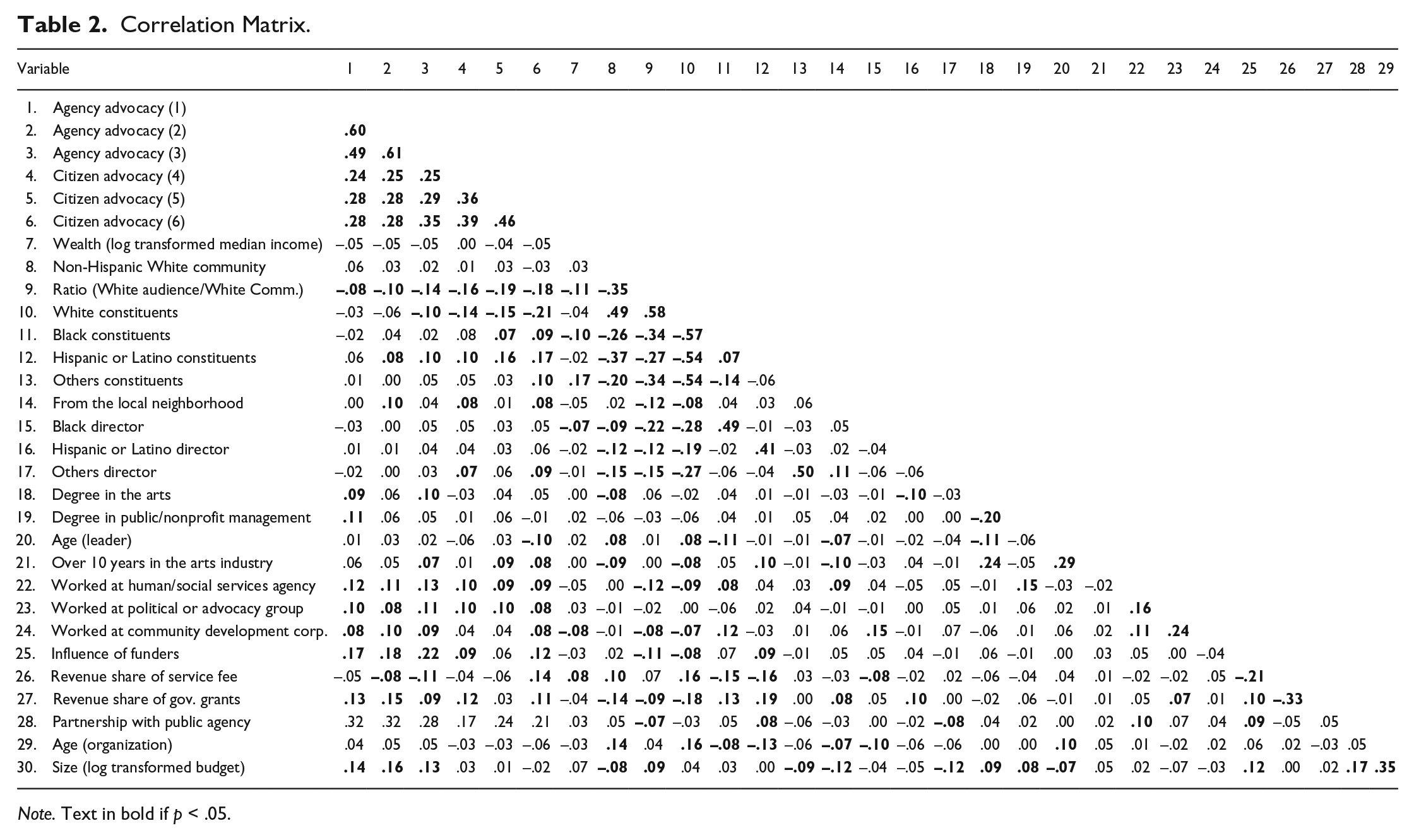
Note. Text in bold if p < .05.
It is worth noting that arts nonprofits with leaders who are Black or Hispanic seem to rely on public funds for a slightly greater portion of their revenues compared with organizations with leaders who are White. However, this perceived difference could be weighted by a few organizations in the sample, considering the relatively smaller sample sizes of the groups of organizations with Black and Hispanic leaders. In terms of community context, there are no noticeable differences across the groups, except that organizations headed by Black leaders operate in slightly less affluent communities.
Table 3 describes the 10 types of arts nonprofits in the sample and divides the proportion of each type by the leaders’ racial and ethnic groups. As the number of minority-led organizations is relatively small, it is hard to make a meaningful interpretation of the number of different organization types presented here. Still, it is worth mentioning that a relatively larger percentage of ethno-cultural and folk arts organizations are headed by people of color, whereas the majority of leaders at all other types of arts organizations are White.
Type of Arts Organizations.

Measuring nonprofit advocacy
Nonprofit advocacy is a broad term that encompasses activities used to influence government decisions, shape institutional culture and policies, or encourage citizen participation (Jenkins, 2006). In this study, advocacy is measured in two ways: agency advocacy, measuring the extent to which organizations make the voices of their constituents heard to influence policy issues (i.e., organizations’ direct advocacy), and citizen advocacy, measuring the extent to which organizations promote citizen engagement in policymaking (i.e., organizations’ indirect role in advocacy).
Agency advocacy is measured with three items: (a) participating in government committees or commissions, (b) meeting with public officials and staff or providing testimony on policy issues, and (c) participating in coalitions with other organizations for the purpose of influencing policy. Similarly, citizen advocacy is measured with three items: (a) participating in or promoting voter education and participation, (b) participating in or promoting public education campaigns (e.g., against teenage drinking), and (c) community organizing around social issues. These six items were asked with 12 additional items that measure other aspects of nonprofit practices with the question, “To what extent would you say your organization has been involved in . . . ?” The final 18 items were presented to participants after being randomly assigned to three blocks, which were also displayed in random order. Respondents utilized a slide bar with 0 representing “not involved” and 100 representing “highly involved.” If a respondent left any item unanswered, we recoded the nonresponse to zero, following common practice to treat missing values in this way (Allison, 2002; J. Cohen & Cohen, 1983). We believe that participants whose organizations regard an item irrelevant to their primary mission left it unanswered instead of choosing zero for noninvolvement. The behaviors of nonresponses seem to be consistent; only a few observations (11 out of 867) contained zeros to some questions leaving others blank, and no observation has missing data for all questions (i.e., simply skipping the section). 2
Using a 0 to 100 slide-bar scale, our measure determines the absence of activity at zero and the intensity of activity at any point above that, which provides a higher measure of specificity than commonly used Likert scales. Such 5- or 7-point Likert scales do not present equal changes in attitudes for all respondents (Bendixen & Sandler, 1994; Dawes, 2008; Kennedy, Riquier, & Sharp, 1996); for instance, the differences between “highly involved” and “somewhat involved” may be slight for one respondent and great for another. Using a larger point scale is also likely to produce more accurate results: For instance, compared to a 10-point scale, a 5- or 7-point scale produces higher mean scores relative to the highest possible score (Dawes, 2008).
Alternatively, we could consider using an ordinal scale including answer options such as “never,” “occasionally,” and “often,” or asking respondents to report the number of times their organization had participated in an activity over a certain time frame. However, each of these approaches has methodological challenges. For one, a 3-point ordinal scale leaves answer options open to the respondent’s interpretation; respondents may define “often” differently. Furthermore, Hall (2001) found that asking respondents to remember activities in the past can lead to a downward bias in the reporting of such activities.
Table 4 presents the average levels of involvement in each type of advocacy actions, grouped by leaders’ race and ethnicity. Not surprisingly, the arts nonprofits in our sample are modestly engaged in advocacy. Of the 867 organizations, 721 (83%) of the organizations’ leaders reported participating in at least one type of advocacy activity; however, the intensity of activity is not high, which is likely a function of the organizations’ 501(c)(3) status and primary missions to deliver arts and cultural programming. The sample organizations reported engagement in community organizing at the level of 21.60 out of 100 and participating in coalitions with other organizations at the level of 21.71. To a somewhat lesser degree, the sampled organizations provide support to public officials on policy issues (18.97), promote public education campaigns (16.16), and participate in government committees (13.74). Organizations seem to be least engaged in promoting voter participation (7.35). Despite these modest averages, a nonnegligible number of arts and culture nonprofit organizations reported a high level of advocacy engagement in general—a finding that warrants further investigation into the characteristics of those organizations.
Description of Dependent Variables.

Note. Respondents were given a slide bar with 10 intervals ranging from 0 (not involved) to 100 (highly involved) along with the flexibility to choose any number between 0 to 100.
Table 4 also indicates that organizations with minority leaders show different levels of engagement in advocacy compared with organizations with White leaders. Organizations with minority leaders promote voter participation at a substantially higher rate than organizations with White leaders and also have higher participation in coalitions with other organizations that influence policy or organize communities around social issues. We will discuss these important findings in additional detail in the following section.
Analytic Results
In this section, we estimate the involvement of arts nonprofits in advocacy as a function of community, constituent, and leader racial and ethnic identity, as well as leaders’ professional background. The results in Table 5 describe the relationships among the selected variables and the scope and intensity of organizational engagement in advocacy, following the approaches Guo and Saxton (2010) had taken to measure nonprofit advocacy activities. We created a measure of the scope of advocacy; scores range from zero to six, depending on the number of advocacy activities the nonprofit engages in, regardless of the intensity. Figure 1 presents the frequency of this count measure. To measure the intensity of advocacy, we combine the six measures of advocacy (each ranging from 0 to 100) into a summative index, which shows good internal reliability (Cronbach’s α= .77). The values of this summative index range from 0 to 99.5, with a mean value of 16.6. Table 5 presents the regression results of the count measure (scope) and the summative index (intensity).
Regressions on Scope and Intensity of Advocacy in Arts Nonprofits (N = 867).

Note. “Scope of advocacy” is the number of the six types of advocacy activities in which an organization engages. “Intensity of advocacy” is the summative index of the six types of advocacy activities (scale reliability coefficient: 0.7743). For Tobit model, 146 out of 867 observations are left-censored but no observation is right-censored. LR= Likelihood Ratio.
p < .1. **p < .05. ***p < .01.

Scope of advocacy.
As the scope of advocacy is a count measure based on the six types of advocacy activities, we adopt the negative binomial regression (NBR); the data are overdispersed and thus violate the assumption for a Poisson regression. For intensity of advocacy as the summative measure of the six types of advocacy activities, 146 out of 867 observations are truncated at zero. To accommodate the dependent variable censored at zero, we performed a Tobit regression model. Both of our empirical models include a set of control variables to address capacity and resources. We examined the possible issues of multicollinearity and found no unusually high correlations (see Table 2).
In Table 5, the first column presents the results of the NBR for the scope of advocacy, and the second column shows the results of Tobit regression for intensity of advocacy. The empirical estimations do not show that organizations led by people of color are different in their advocacy activities from organizations with White leaders (H1). When interpreting these findings, one should bear in mind that a leader’s racial and ethnic group is closely related to the racial and ethnic makeup of the organization’s constituents (audiences) and surrounding communities (see Tables 1 and 2). Indeed, results confirm that an arts nonprofit is more likely to engage in advocacy when it serves more people of color (H2). We must acknowledge the difference between serving mostly people of color and serving diverse groups of people. Even if we take such differences into consideration, the results are meaningful in that arts nonprofits are more likely to act as civic intermediaries when serving more people of color.
The racial and ethnic makeup of their communities (H3), inversely measured by the share of non-Hispanic White residents, matters to both the scope and intensity of the advocacy activity undertaken by arts and culture nonprofit organizations. For each 1% increase in non-Hispanic White residents in the community, the expected log count of the number of advocacy activities in which an organization engages increases by 0.005. In more intuitive terms, the difference in the predicted value of the scope of advocacy, which ranges from 0 to 6, is 1.09 as the non-Hispanic White population changes from its minimum value (10.9%) to its maximum value (94.4%), holding all other variables at their mean values. For the intensity of advocacy, which ranges from 0 to 100, there is a 1.54-point increase in the predicted value when the percentage of the non-Hispanic White population in a community increases by 10%. Although the degree of impact is not large, the result is statistically significant. Considering that involvement in advocacy activities depends on the specific type of arts and culture nonprofit organization, this small yet statistically significant result suggests a meaningful implication: An arts and culture nonprofit organization is more likely to be broadly and intensely engaged in advocacy when it operates in a community with a larger share of the non-Hispanic White population. Figure 2 presents this relationship between the predicted scope of advocacy and communities of color. 4 Notably, these findings are counter to our prediction. One possible explanation could be related to resource availability and infrastructure conditions for organizations in such communities: Nonprofit advocacy activities require human and financial resources, and arts nonprofits in those communities may face high competition over limited resources, which puts them in difficult positions for engaging in advocacy. Future research should gather more data to fully explore this possibility.

Predicted probabilities of the scope of advocacy with 95% CIs and the share of non-Hispanic White population.
Turning to the variables relevant to nonprofit professionalism (H4), organizations with leaders who hold degrees in the arts and who have been in the arts and culture industry for over 10 years are more likely to engage in advocacy—that is, the scope of the organization’s advocacy is broader and the intensity of engagement is stronger. Leaders with these qualifications are likely to be well-versed in the industry and may be more concerned about issues that go beyond artistic endeavors in their own organizations. As a result, they may advocate for the needs of the industry and encourage their own and other organizations to become more involved in civic issues. In addition to broadening the scope of advocacy, a leader with an arts degree and tenure in the industry also increases the intensity of advocacy, by 3.713 and 3.143, respectively. Interestingly, a leader having an educational background in public management curriculum or having a professional background in socially conscious fields (i.e., worked in human services, political, or a community development group) makes a statistically significant difference for an organization’s approach to advocacy, especially for the level of intensity. However, a relatively small number of leaders in the sample have these qualifications and, as such, subsequent research should explore these findings further.
To address the potential tension between ethnic identity and professionalization (H5), we tested an extended model that includes the interaction terms between the variables measuring these two characteristics. We found no statistically significant evidence to support that the effect of professionalization on the level of advocacy varies at different values of racial and ethnic identity of the leader and vice versa. (Results of this analysis are available upon request.) This helps to offset concerns that professionalization may disconnect organizations from served communities and constrain advocacy.
As shown in Table 5, we also find evidence that government funding is positively related to advocacy and that organizations are more likely to engage in advocacy when they work with public agencies. These results further substantiate resource dependency arguments repeatedly tested by previous studies (Mosley, 2012; Neumayr, Schneider, & Meyer, 2015). Table 5 also indicates that arts nonprofits operating in more affluent communities 3 and having larger budgets are more actively engaged in advocacy. These factors suggest the importance of having sufficient resources to support nonprofits’ advocacy efforts. Finally, the empirical estimations show a significant difference in the level of involvement in advocacy among different types of arts nonprofits. Organizations such as arts services, media, arts, and nonarts museums are more likely to advocate issues important to their clients, which is not surprising given that these organizations have an effective medium for facilitating public campaigns and other engagement activities.
Discussion
This study offers an empirical snapshot of how arts and culture nonprofit organizations engage in various types of advocacy activities and how such activities relate to the racial and ethnic identity of an organization’s leader, its constituents, and the surrounding community. Other scholars have explored the issues of diversity and professionalization in nonprofits and their relationships with organizational advocacy activities; however, prior studies have not specifically focused on arts nonprofits and interplay of diversity and professionalization.
The descriptive findings of this study indicate that arts nonprofits with people of color in leadership capacities tend to serve more people of color and serve in racially and ethnically diverse communities. However, we find that the racial and ethnic identity of the leader is not related to an organization’s advocacy when controlling for other factors; rather, the facts that the leader works for a more diverse clientele and is situated in more ethnically diverse community are the more significant determinants of advocacy. Given that both constituent and community racial and ethnic compositions are significantly associated with the level of advocacy, the results have implications for the relationship between descriptive and substantive representation. The findings also call for additional research focusing on potential causal relationships. Are leaders who are interested in supporting advocacy efforts drawn to arts nonprofits with diverse clienteles or that are located in diverse communities? Or is it that arts nonprofits based in more ethnically diverse communities tend to be more intentional in hiring individuals who reflect those communities?
This study contributes to the existing scholarship on professionalism as well by showing that some aspects of professional training in the field are associated with advocacy activities carried out by arts nonprofits. As discussed earlier, this may be because leaders who have longer tenures, or have specialized degrees or training, may have better knowledge of the overall policy or political environment relevant to the field, policy processes, or their organization’s role in a wider policy network. They may also have a better understanding of the legal rights and opportunities arts nonprofits have to engage in advocacy.
Several limitations of this study should be noted. First, because our analysis is cross-sectional, we cannot claim causal relationships for any of the factors identified. For example, results indicate that the intensity of involvement in advocacy is significantly associated with an arts nonprofit having a leader with a background in human services, political, or community development organizations. It is plausible that these leaders choose to join organizations already engaged in advocacy activities or that organizational attitudes toward advocacy changed under their leadership. Second, the analyses rely on self-reported responses; even though respondents were assured of the survey’s confidentiality, actual organizational behavior could differ from those reported in the survey answers. Third, the current analyses do not measure board leadership, which has an important leadership and governance role in nonprofit organizations. Future analyses should include the racial and ethnic demographics of board directors at each organization.
Finally, and perhaps most importantly, this study does not capture what, exactly, organizations are advocating for. That is, are organizations advocating for issues of concern to marginalized groups or issues that may benefit only a small segment of arts patrons? Even though the analyses are consistent with theories of representation and show interesting patterns of engagement in advocacy based on racial and ethnic makeup, they are certainly not conclusive. Future studies should incorporate a measure that more precisely assesses the purpose of advocacy activities so that researchers can draw clearer links to dimensions of diversity representation and advocacy.
Despite these limitations, this study contributes to the literature by providing the first empirical analysis of advocacy efforts among arts nonprofits. One of the notable findings is that arts nonprofits that serve more people of color are more active participants in advocacy and go beyond simply serving arts programs to serve as a civic mechanism. As communities become more and more diverse, public managers need to recognize such potential and find ways to partner with local arts organizations. Given the earlier reports that arts nonprofits serving mostly people of color tend be financially weaker compared with those serving mostly White constituents (Sidford, 2011; Tseng, 2015), donors and grant-makers may want to pay more attention to the financial challenges faced by organizations that are led by people of color and serve minority constituents; allocating more funds to such organizations could help raise racial and cultural equity and promote civic activism. Many know intuitively that diversity within and around organizations matters for success. Our study provides the first statistical evidence that racial and ethnic diversity holds for the civic activism of arts nonprofits.
For some nonprofits, especially those in the arts and culture, education, and health care sectors, a primary concern will always be how to provide the highest quality services in the most efficient and effective way. However, many of these organizations increasingly realize that engaging in advocacy activities to influence public policies or facilitate citizen participation can ultimately help them reach their long-term goals. For example, a symphony orchestra can promote the arts through its programs; however, it would perhaps be more effective if it also collaborated with other local organizations to effect policy changes ensuring that every child in the community has access to music education. The findings of this study suggest that promoting diversity in the arts nonprofit sector could be the first step toward making the sector more relevant to important community issues.
Footnotes
Acknowledgements
The authors appreciate three anonymous reviewers and Editor Chao for their careful reading and valuable comments.
Declaration of Conflicting Interests
The author(s) declared no potential conflicts of interest with respect to the research, authorship, and/or publication of this article.
Funding
The author(s) received no financial support for the research, authorship, and/or publication of this article.