



Abstract
Funding for England and Wales’ Charity Commission has been cut by 48% between 2007 and 2016, affecting its ability to deliver its core regulatory functions. Conversations around what charity regulation should look like and how it should be funded have, therefore, gained momentum. These debates, however, are not limited to England and Wales, and in this article, we contribute to them by exploring public attitudes to these questions, presenting the findings of four focus groups. We find that although public knowledge of charity regulation is low, people are, nonetheless, clear that charities should be regulated. There is no clear preferred method of funding a charity regulator and a significant amount of complexity and nuance in public attitudes. People trust charities, but this can be eroded if they do not have confidence in how they operate. A visibly effective regulator supporting and supported by charities is central to maintaining trust.
Introduction
In many countries, the role of charity regulators has undergone substantial change in recent years, as a result of both the creation of new regulators and of funding cuts in the United States, the United Kingdom, and beyond (Breen, Dunn, & Sidel, 2016; McGregor-Lowndes & Wyatt, 2017). How regulators remain sustainable and credible is, therefore, a live issue.
Nowhere is the issue more live than in England and Wales, where in the 2015 Joint Spending Review and Autumn Statement, then Chancellor George Osborne announced that Charity Commission’s budget will be frozen at £20 million per year until 2020. This constitutes a 48% fall in the Commission’s budget since 2007/2008. Conversations around what charity regulation should look like, and who should pay for it, have, therefore, gained momentum. The Charity Commission’s Chair, William Shawcross, stated in January 2017 that he is “convinced that agreeing some form of contribution from charities is the only way to secure adequate long term funding for the Commission, and to develop the key services from which charities benefit” (Shawcross, 2017, p. 1). Nonetheless, the promised consultation on charging charities had by May 2017 not yet been announced.
Given the cuts to the Commission’s funding and debates about how this can be addressed, this work is timely. The 2015 Trust and Confidence in the Charity Commission report presents some challenging findings for the regulator and the sector as a whole. In particular, it finds that “two-thirds (69%) of the general public support charity regulation being partly or fully funded by a charge to charities” (Populus, 2015, p. 7). This finding would seem to be in tension with the long-held view that donors want to see as much of their donation as possible go to the front line of a charity’s work. It is this tension that we explore in this article. By taking a qualitative approach, in this article, we provide necessary nuance to the existing research. Through focus groups comprised of individuals from a range of backgrounds, this research explores the complexities of public opinion, particularly around what sort of regulation they want to see and whether any or all charities should have to pay for it.
The concept of charity has a long history in England, Wales, and beyond. Charity regulation too has a long history in England and Wales: The basic principles of charity law and regulation date back to the 1601 Charitable Uses Act. Charities today receive their income from a range of sources—from donors, national and local government, fees paid by service users, grants from foundations and trusts, private sector organizations, and from other sources. They provide a range of services for all groups of the population, and the central role that charities have in all our lives means it is important that they are operating effectively and that they are seen to be doing so. Although we consider the English and Welsh context—considered by Phillips and Smith (2011) to have “set the standard” (p. 13) in charity regulation—it is also relevant to other national contexts. The issue of whether charities should pay for their regulation is a live issue in many countries (see Cordery, Sim, & Zijl, 2017), while the nature of what regulation should look like has been considered in Canada and elsewhere (see Phillips, 2011). The very purpose of regulation is itself the subject of international debate. Irvin (2005) argues that in the United States—where charities contribute to the cost of the regulator—the primary purpose of regulation is to avoid fraud. This contrasts to England and Wales, where the regulator seeks to increase public trust and confidence in charities.
In this article, we contribute to key theoretical debates around regulation. We make an original contribution to debates on charity regulation by seeking to answer three interconnected questions:
In approaching the analysis this way, we ask whether the public see charities funding their own regulation as being in the interests of charities and their beneficiaries.
This article begins with a literature review, which looks at the purpose of charity regulation and how it is conducted in England, Wales, and elsewhere in the world, at why charities need to be demonstrably efficient and, how this might be expected to affect donations. Next, the methodology this work used is outlined, explaining how conducting qualitative focus groups with individuals from a range of backgrounds enables us to explore complex attitudes toward charities and how they are regulated. The findings are presented next. Although existing knowledge of charity regulation is low, we found widespread support for charity regulation. Views were more mixed on how regulation should be funded, but the most common view was that charities should make some contribution but that this should be alongside, rather than instead of, government funding. Participants felt that if they could see that charities bought into regulation—both literally and symbolically—they would be inclined to donate more. The difference between stated and actual donor behavior however means we need to treat this with some caution. It concludes by outlining what these findings mean for the future of charity regulation in England, Wales, and beyond.
Existing Literature
How and Why Are Charities Regulated?
The regulation of charities in England and Wales requires registered charities to provide the Charity Commission with (mostly financial) information about the running of the charity. This, in theory, makes them transparent and accountable and allows donors to make informed decisions about future donations (Cordery, 2013). Regulation (in principle) allows charities to demonstrate their efficiency and effectiveness and allows for the growth of confidence in organizations and trust in the sector as a whole, growth that will potentially leverage higher donations (Breen, 2009; Cordery et al., 2017). As applied to the charity sector, public interest theory suggests that an effective regulator helps to encourage charities to be more transparent (Cordery, 2013). This leads to resources—in the case of the nonprofit sector philanthropic donations—being distributed to those organizations, which use them in the most efficient and effective way to meet their stated goals (Gaffikin, 2005).
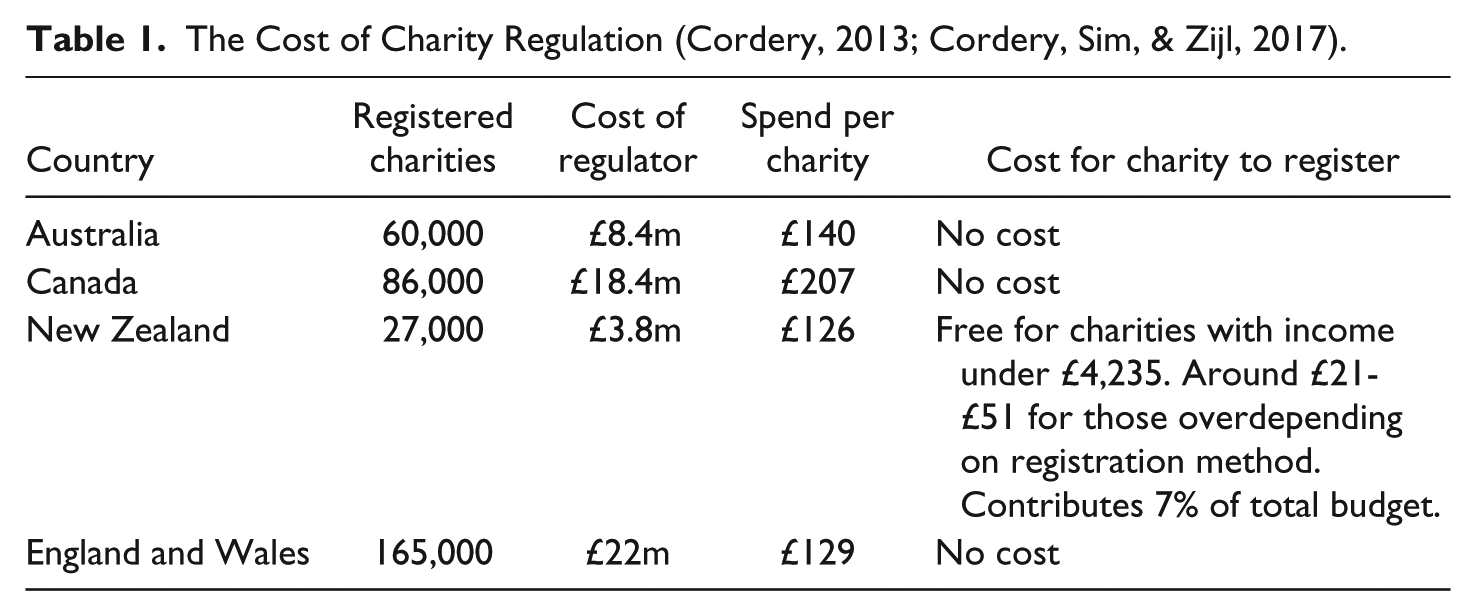
Across the world, how to ensure nonprofits act accountably has received significant attention (Bies, 2010). Although the nature of charity regulation varies from country to country, the principle of regulation is relatively widespread. Table 1 shows the cost of regulation in Canada, Australia, New Zealand, and England and Wales, countries with broadly similar charity sectors to England and Wales. The current spend on charity regulation per charity in England and Wales is similar to New Zealand, lower than in Australia, and significantly lower than in Canada (Cordery et al., 2017).
The Cost of Charity Regulation (Cordery, 2013; Cordery, Sim, & Zijl, 2017).
The England and Wales Charities Act 2011 requires the Charity Commission to “inspire public trust and confidence in charities,” to “enhance the accountability of charities to donors, beneficiaries and the general public,” and to “promote the effective use of charitable resources” (Cordery, 2013; Morgan, 2011). The independence of the Charity Commission—from both government and charities—is crucial to its ability to achieve this (Cordery, 2013). The Commission provides advice and support to registered charities (albeit not as much as they once did, due to declining finances), while registered charities must submit annual financial returns to the Commission and conform to a range of other hard and soft law controls (Cordery, 2013; Morris, 2011), with charities reporting income of below £250,000 submitting simplified accounts. Since 2008, charities have been required to provide reports on the activities they have undertaken to accomplish its stated public benefit (Cordery, 2013; Morgan & Fletcher, 2013).
There is some evidence that overregulation in England and Wales has in the past placed a particular strain on registered charities—research by Morgan (1999) analyzing the Charities Act 1993 found that the imposition of new requirements led to a number of charities’ volunteer administrators and treasurers resigning. It is crucial, then, that the benefits that charities receive from being regulated outweigh the cost to them, just as it is crucial that the benefits that the government—which when all the different national and local sources of government funding are considered constitutes by far the largest single funder of charities in England and Wales—receives from regulating charities outweigh the cost to them (Cordery, 2013; National Council for Voluntary Organisations [NCVO], 2017).
Is Regulation Important to Donors?
When people donate to charity, they do so because they want the cause they are giving to—whatever it is—to benefit and to thrive (Bekkers & Wiepking, 2011; Duncan, 2004). To deliver these benefits, donors want their financial gifts to be used effectively (Furneaux & Wymer, 2015). This means that when donors are deciding which charity to give to, one of the factors they consider is the perceived performance of the charitable organizations that they are considering donating to (Gaskin, 1999; Sargeant & Jay, 2010). Donors are more inclined, unsurprisingly, to give to charities who have a reputation for being efficient and well run (Bekkers, 2003; Beldad, Snip, & van Hoof, 2014; Breeze, 2010; Furneaux & Wymer, 2015; Meijer, 2009). Efficient use of donated funds by charities is attractive to donors and may result in further, potentially larger, donations (Breeze, 2010). Research on English donors has found that decisions to give are often based on factors such as how well run the charity is, how efficiently it uses its resources, how much they pay their staff (particular senior staff and CEO), and what proportion of charity spending is on overheads (Breeze, 2010).
Perceived mismanagement by those running charities may affect negatively on donations, with Breeze (2010) finding that in interviews with donors, numerous unprompted mentions were made of fears that charities inefficiently spend resources. Furneaux and Wymer (2015) find that the public want charities to be transparent about how they spend their money. Donors may be less likely to give if they believe that an unacceptable proportion of their donations will be spent on administrative or fundraising costs (Hibbert & Horne, 1997; Sargeant & Jay, 2010). Research in Canada by Hall, Goulbourne, and McKeown (2001) of nearly 15,000 Canadian adults found that 46% would give more donations if they were confident that the money would be used efficiently. Bowman (2006) states that numerous studies have sought to find a relationship between actual rates of giving and the overhead ratios of nonprofits and that the results are inconclusive. As a result, Bowman (2006) suggests that donors do care about overhead ratios and changes in them, but only as one of many factors they consider when making giving decisions and not one of the more significant ones.
McDougle and Lam (2014) state that we do not at present have a good understanding of what public attitudes are to the nonprofit sector, beyond broad measures of trust and/or confidence in charitable organizations. They cite Schlesinger, Mitchell, and Gray (2004) who state that, “research on public attitudes to the nonprofit sector has been limited” (p. 675). The best of that limited data in England and Wales are from polling organization Ipsos Mori, which found that charities in England and Wales on the whole benefit from high levels of trust—more than any group of private organizations and lower only than doctors or the police (Ipsos MORI, 2015). Yet, this trust cannot be taken for granted. Indeed, it is worrying that between 2014 and 2016, the overall level of trust and confidence in charities in England and Wales fell from 6.7 out of 10 to 5.7 out of 10 (Populus, 2016). Over this period, 33% of respondents said their trust and confidence in charities had decreased (Populus, 2016). Seen alongside steep cuts in Charity Commission funding, this suggests a worrying trend.
Effective regulation can help to build both confidence in individual charities and trust in the charity sector as a whole. Some pieces of work have looked at trust and confidence and volunteering (Bekkers & Bowman, 2009; Bowman, 2004; Taniguchi, 2013) with varying results, but few have looked at the relationship between trust, confidence, and charitable giving. The relationship is best summed up by O’Neill (2009) in stating that, “the relationship between trust and behavior is complex” (p. 243). What work there is finds that regulation does have an impact, albeit not the clearly positive one that public interest theory suggests. Sloan (2009) finds in the United States that, high accountability ratings for nonprofits lead to higher donor contributions, but that lower ratings do not lead to lower contributions. Hyndman and McDonnell (2009) find that regulation, which results in increased information in the form of simplified accounts, annual reports, and other easily accessible documents about charities being available, may help to build donors’ trust and confidence in charities. However, regulation may have unexpected consequences, with Desai and Yetman (2005) finding that the requirements for charities in the United States to return financial information results in charities paying their staff less to spend more on their beneficiaries. Paying staff less may result in less able/experienced staff being hired who will not run the organization as effectively (Cordery, 2013).
From this review, we can see that although there is not wholly clear consensus on the consequences of regulation or of public perceptions of charity management, in England and Wales, a recent steep reduction in funding for the regulator has been accompanied by a similarly steep reduction in public trust and confidence in charities. This research, therefore, contributes to ongoing national and international debates at a time when the Charity Commission is under significant pressure, and trust and confidence in the charities it regulates are at an all-time low. Charging registered charities for their regulation has been proposed by the Chair of the Commission as a means of addressing these issues—we explore whether nuanced public attitudes support this view. Little previous research has explored whether public attitudes to regulation and its outcomes affect their plans to donate—this research seeks to fill this gap. By identifying this gap and approaching the analysis in this way, we ask whether the public see charities funding their own regulation as being in the interests of charities and their beneficiaries.
Method
This research arose out of a recognition that large-scale quantitative studies can only tell us so much about public attitudes on an issue as complex as the regulation of charities. To address the lack of nuance in previous studies and to explore the intricacies of public attitudes to charity regulation and its funding, this research utilizes a qualitative focus group method. In November 2015, we ran four focus groups in London, which explored public awareness of existing charity regulation, attitudes toward what regulation should look like, and perspectives on how charity regulation should be funded and how this would affect decisions to donate. We carried out focus groups because we wanted to understand the complexity of public attitudes and how these are negotiated between people from a range of backgrounds and with a range of attitudes toward charities as they discuss and learn from one another (Bryman, 2012).
Each focus group had 10 registered participants, of which
five were men and five were women;
two were aged 18 to 29, two aged 30 to 39, two aged 40 to 49, two aged 50 to 59, and two aged 60 plus; and
two were socioeconomic group A or B, four were group C1, and four were C2 or D. 1
Attendees were told in advance that they would receive an incentive of £40 to take part, to be paid in cash on the night of the focus group. We had 5 nonattendees over the four groups—an issue recognized by Bryman (2012) as “almost impossible to control for” (p. 351)—meaning that our final sample of 35 was as follows:
18 were men and 17 were women
8 were aged 18-29, 7 aged 30-39, 6 aged 40-49, 6 aged 50-59 and 8 aged 60 plus
8 were socioeconomic group A or B, 16 were group C1 and 11 were C2 or D
Therefore, due to nonattendees, we had an age profile slightly skewed toward older and younger participants and a socioeconomic profile skewed toward higher and middle income people—all five nonattendees were from the lower socioeconomic groups. As a piece of qualitative research, we do not make claims to generalizability and rather seek to provide nuanced analysis based on a sample, which broadly represents the population of England and Wales.
Consistent with data on England and Wales (Cabinet Office, 2015), a short prefocus group survey found that all but a small number (three out of 35) of focus group participants had donated to charity at some point in the last year. However, it is important not to simply accept at face value what people say about the charitable giving—the only way to know this for sure is to measure what they actually do. We, therefore, make no claims as to past or future donor behavior, only to what participants have stated they do or plan to do. Furthermore, we found no difference in attitudes between the three who had not donated in the last year and the 32 who had. Although a relationship between engagement with charities and trust in them has previously been observed by Australian Charities and Not-for-profits Commission [ACNC] (2013), we did not find evidence of it here.
Each focus group followed the same structure guided by a small number of key questions, with the direction of the discussion dictated by the attendees. As such, each group was quite different. The structure that each group followed was as follows:
What do you know about how charities are currently regulated?
Do you think that current levels of regulation are sufficient?
If more regulation is introduced, what do you think this should look like?
Who should pay for the regulation of charities?
Would changes to the way that charity regulation is paid for affect your own charitable giving?
The focus groups were led by two experienced researchers who allowed discussion to develop and flow and only asked follow-up questions when conversation fell dry or when a particularly salient point risked being bypassed (Bryman, 2012).
Each focus group was recorded and the audio was transcribed by a professional transcriber, assisted by the researcher to ensure accuracy. The approach to coding the transcripts was broadly inductive—rather than start with areas which data could be coded to, instead a first review of the data lead to topics being identified for coding. A second review then checked that the data had been accurately coded to these topic areas. The analysis was thematic, seeking to understand public attitudes to charity regulation and its funding by coding and looking at the key themes that emerged (Braun & Clarke, 2006).
Findings and Analysis
In this article, we explore public attitudes to charity regulation: How is charity regulation perceived by the public? What are donor perceptions of how (and how much) regulation is funded? and What impact changes in its funding might have on stated donation intention? This analysis considers these three questions in turn. In approaching the analysis this way, we ask whether the public see charities funding their own regulation as being in the interests of charities and their beneficiaries.
Is Regulation a Good Thing?
As the recent decline in public trust and confidence in charities in England and Wales shows (Populus, 2015), it cannot be taken for granted and work must be done to maintain and grow trust and confidence (Beldad et al., 2014). This discussion between Paldeep (female, 40s) and Greg (male, 30s) illustrates this general high level of trust in charities,
When you say charity I think most people automatically would associate that with trust anyway and those words are kind of big in our minds so I think we would kind of have a level of trust.
I think most charities are sort of trusted anyway, aren’t they.
Yeah.
Elsewhere, Hugh (male, 40s) spoke of his trust in the “integrity” of charities, whereas Thomas (male, 60s) explained how the public associate charities with “good morals and principles” and expect them to “do the right thing.” There was consensus that charities as a whole are trustworthy.
These high expectations mean that participants felt particularly let down when they perceived that charities were slipping below the high standards that were expected of them. There were two main areas in which participants felt that charities were not trusted or where trust was weak: fundraising and efficiency and core costs. Both these are identified by Bekkers and Wiepking (2011) as key factors in perceptions of charity efficiency. However, although more regulation in these two areas was deemed desirable, there was also discussion as to whether it was possible to regulate these activities.
In each of the four focus groups, there was an unprompted debate around the ethics of fundraising.
2
Fundraising was seen to be particularly important because it is the way in which charities most often interact with the public. As Jai (male, 30s) explained, they are “probably most people’s direct experience of charities,” and as such, if fundraising is conducted in ways that anger or upset the public, then that risks giving “a bad impression of charities.” However, there was recognition that fundraising is necessary to pay for the work that charities do, and that without it, they would not be able to achieve their charitable aims. This tension, between a reasonable concern that fundraising practices risk harming trust and confidence in charities and the need for charities to fundraise their income was summed up by George (male, 50s), But they’re trying to make themselves visible so how else would they make themselves visible to the good work that they do?
Although the nature and funding of fundraising regulation is not what is being discussed in this article, it is clear that it has a real impact on public perceptions of charities, as Hibbert and Horne (1997) and Sargeant and Jay (2010) have previously noted.
We know that donors want charities to be efficient (Breeze, 2010; Furneaux & Wymer, 2015; Sargeant & Jay, 2010), and that when they perceive that they are, they may be more likely to donate. There was debate, however, in the focus groups over whether measuring efficiency was the role of the regulator and, even if it is, whether this would be possible in any meaningful way. This is illustrated by Thomas (male, 60s), who explained how he felt that transparency and efficiency were something that charities need to be seen to have. He stated that this is something he would like to see the regulator involved in, arguing that it is, “quite important, especially for big charities.” However, reflecting on this, he stated that he did not “know how they could do it really.”
Although people want charities to be transparent in how they operate and see regulation as a means of ensuring this (Furneaux & Wymer, 2015), they are pragmatic and realistic about what regulation can achieve. However, participants were not particularly clear what current regulation looks like. As Keith (male, 30s) stated, “I just assume it’s regulated like all other things but I’ve never looked into it.” Knowledge of the role of the Charity Commission was not widespread, but in the two focus groups where it was brought up by one respondent, others then discussed having heard of it. Even when it was discussed, there was little knowledge of what the Commission does, as this quote from Jai (male, 30s) explains, The Charity Commission sort of regulates the charities but I’m not too sure they look at things like the finances, whether they make companies [sic] submit an annual financial return.
There was more awareness of the registered charity numbers, which demonstrate that charities have been registered with the Charity Commission. Given the requirement of registered charities in England and Wales to put this number on their websites and on any fundraising or publicity materials they produce it should not be surprising that this is the piece of charity regulation that is most visible to the general public. This awareness was only of the existence of numbers and that they signified registration, however, and not of what being registered entailed.
Although there was little awareness of what being a registered charity entails, there was an assumption that being registered means that a charity has had to satisfy and will have to continue to satisfy some kind of criteria, as Martin (male, 30s) explains, I assume by getting a number you will have gone through quite vigorous testing or you have to overcome certain thresholds to be eligible for that status. I assume that that is regulation, isn’t it? I don’t know.
This suggests that we need to be clear when discussing public attitudes to charity regulation, what it looks like and how it is funded that people do not on the whole know a great deal about how charities are regulated.
However, although they knew little about charity regulation, we found widespread support among participants for a charity regulator, which ensures that charities are doing what they say they are doing and that they are doing it in a transparent and accountable way. Having a regulator working in such a way helps to build trust and confidence. Stuart (male, 40s) felt that if charities are not regulated then, “people who might otherwise put money in your bucket might be more hesitant to do so,” whereas Melissa (female, 20s), saw the role of regulation as being to ensure that charities are . . . doing what they’re meant to be doing so if somebody’s donating to some cause I think the regulator should make sure that the charity’s actually doing that and using the money in the way it said it would use it.
Although we found widespread public support for charity regulation, there was also an argument that regulation should not go too far. Participants particularly wanted to see larger charities being regulated. Smaller charities working at the local level were seen as needing to be protected from overly onerous regulation, which would prevent them from operating. Jai (male, 30s) was one of those who went one step further, arguing that “the little ones may not even need regulating” and that they should be left to “get on with it.” Shaun (male, 30s) summed up the views of a number of participants on this subject when he said that smaller charities, often without any paid staff, “already have enough to deal with.”
As well as regulating the activities of charities and ensuring that they adhere to rules, which ensure their transparency and trustworthiness, there was a feeling that part of the regulator’s role should be to educate and advise charities on best practice. The preferred model of regulator that emerged is one that is clear and transparent but which is not burdensome and which provides guidance to support charities and help them comply with clear regulations, which help to build public confidence. Therefore, although participants did not know a great deal about current charity regulation, they saw it as being important in supporting charities and those who support and benefit from them.
Who Should Fund the Regulator?
Opinion is divided on who should pay for the regulation of charities. Currently the Charity Commission in England and Wales is wholly government funded, but in the focus groups, there was no clear consensus on who should pay. The most widely held position was that a mix of government funding and charity contributions should make up the budget of the regulator; however, participants also argued for an entirely government-funded regulator and an entirely charity-funded one. Those who felt that both the government and charities should contribute discussed how even a nominal fee from each currently registered charity would make a significant contribution to the charity regulator’s budget.
Although the charges made on charities could be small, it was felt by those who favored charities contributing that this could be a means of growing trust and confidence in charities. Martin (male, 30s) and Janet (female, 60s) discussed how this might work,
I don’t think it’s criminal to ask them to pay for their own regulation. At the end of the day it’s only serving their own industry . . . making it more what was the word? Believable. Not believable.
Confidence.
Confidence, yeah. It builds confidence.
These benefits will only come, though, if the public are aware that charities contribute to paying for their own regulation and that charities buy into the idea and spirit of regulation. Not everyone though was happy that charities should have to contribute to funding their own regulation, arguing that it is the government’s responsibility to pay. It was felt that continued government funding of the Charity Commission would show that the government is, in Craig’s (male, 60s) words, “taking regulation seriously and funding it.”
Although there was limited support in each focus group for the idea of a wholly government-funded charity regulator (i.e., the status quo), there was very little support for a wholly charity-funded regulator. Most of those who felt it makes sense for charities to contribute to their own regulation felt strongly that the government should also contribute—by both doing so they each signal their commitment to regulation and best practice. Given the clearly expressed view that participants want charities to be regulated, and want the process and outcomes of this regulation to be transparent and publically available, there were fears expressed that if charity regulation were to be wholly funded by charities, then the regulator may lose its independence and, therefore, its trust. To some extent, this is a contradictory view—part of the argument for charities contributing to the funding of their regulation is that it will mean they are seen to be buying into the principle and process of regulation. Despite this apparent contradiction, it was clear that although the buy-in of charities—both literal and symbolic—in their regulation was seen as a good thing, participants also wanted to see continued government support in the shape of funding and oversight. This would ensure that the regulator is perceived as being independent of charities and avoid the perception that, as Hugh (male, 40s) puts it, “the charities will be licking their own lollipops.” As Hugh went on to explain, You want them to have some kind of oversight from somebody who is independent from the charities.
It did not seem that there was a belief that a wholly charity-funded regulator would generate the confidence in the regulatory system that participants want to see.
There was a widespread view that smaller charities should contribute less to the funding of the regulator than larger charities. Participants were clear that any charity contribution to the regulator should take the form of a graded level of contribution depending on charity size, rather than a flat fee. As O’Neill (2009) argues, when discussing trust and confidence in nonprofits, we must differentiate between different types of nonprofits as people may trust certain types but be skeptical of others. The distinction between small charities and the larger “big brand” charities was made in a number of ways by different groups, and emerges as a clear message in relation to who should fund regulation. As Isobella (female, 20s) argued, I think as well depending on the size of the charities, the smaller charities, realistically I think they should have to pay less than those with a large budget who can afford to pay that.
This could be achieved by using a tiered or graded system, as Hugh (male, 40s) outlined, It should be a percentage of income so that each charity is paying the same percent, not the same amount. So if you’ve got a multi-million pound charity it’s going to be paying a lot more than a little charity with just two people in the office.
Although the percentage method would potentially be prohibitively expensive to administer, a graded system would seem to have support. In particular, the idea of a charity income bracket in which no contribution is required and then of bands of income with increasing contribution amounts was proposed by a number of focus group participants and widely supported.
Would a Change in Funding Lead to a Change in Donations?
Participants did not feel that charities having to contribute to their own regulation would negatively affect charitable giving. They can even envisage it leading them to donate more. A key reason people give to charity is because they want to make a difference to a cause they are passionate about. We know from previous research that because of this, they care about how charities spend their money and how effective their work is (Bekkers & Wiepking, 2011; Breeze, 2010). Given that registered charities contributing to their own regulation would divert some funds away from the work they do, it is interesting that participants were, nonetheless, clear that knowing the charities contributed financially to and, crucially, symbolically bought into regulation is unlikely to change how much people give in any significant way, as the following conversation indicates:
If you found out that charity regulation was paid for by just charities or a mixture of charities and government, would that change the amount that you would give?
No.
No.
It won’t change for me.
I don’t think anyone knows how it’s funded now so I don’t think it would make much of a difference.
I think when it comes to deciding which charities to give to, it wouldn’t make any difference because the proportion of money that was going, that was leaving the charity to go to the Commission was the same.
It is necessary to remember though that what people say and what they do are not always one and the same, and that, therefore, this stated expectation that their giving would not change or would increase may not translate into an actual increase. However, these findings, nonetheless, show that participants did not on the whole disagree with the principle of charities making a contribution to the cost of their regulation.
It should be noted that although this attitude was common among participants, there were a few who disagreed and did not want their donations to go toward funding the regulator. This is particularly the case among those who felt that it should be the government’s responsibility to fund the regulator, as this exchange between Paldeep (female, 40s) and Martin (male, 30s) illustrates:
When you give money, if the charity was going to do 50% and government did 50%, the charity regulator’s going to get their money from government bodies anyway or from the public so then it’s like you’re donating to the regulator. To me it just doesn’t make sense.
Yeah, but why wouldn’t you contribute to regulating your whole industry?
But then for the charity to give to put money towards regulations then that’s money that they could use to actually do the work that they said they’re going to do.
It was perhaps striking that this attitude—that donors did not want any of their donation going to fund the regulator and that if it did they might be less inclined to give—was rare.
Conclusion
In this article, we have presented and discussed attitudes to charity regulation, making an original contribution to debates around what regulation should entail, how it should be funded, and how this might change donation habits. Drawing on data from four focus groups, it finds that public attitudes in this area are complex. Charities hold a special place in civic life and are valued and trusted to be a place of strong values. It is important that this trust is respected and that charities are seen as being effective, efficient, and transparent (Bekkers & Bowman, 2009). It is this that makes the role of the charity regulator so important (Cordery, 2013). Although the day-to-day workings of the Charity Commission are unknown to most, the presence of effective charity regulation is seen as important—the public do see charity regulation is a good and necessary thing.
Given this important role that the public see the charity regulator as playing, the way in which it is funded is a significant consideration. Its significance is twofold—practical and symbolic. In practical terms, who funds the body that regulates charities and how much they pay directly translates into its budget and, therefore, what it is able to achieve. If a charge were to be levied on charities—and this research finds by no means unanimous support for this—it should be in addition to government funding for the regulator rather than as a replacement to it. Public support for robust and visible regulation clearly reflects this. This way, the regulator can increase the effectiveness of its regulatory activities and, hopefully as a result, public confidence in charities. This research suggests that there would also be a symbolic impact of charities making a contribution to the funding of the regulator, as the public would see that charities are buying into not just the cost but also the spirit of regulation. It would need to be seen though—current awareness of charity regulation is low and for the benefits of this public awareness to be achieved, effort needs to be made to improve public knowledge of the activities of the charity regulator.
On whether a change in the way that the Charity Commission is funded would change the amount that people donate, this study suggests that it is unlikely to have a negative impact, although those who were particularly against the idea of charities making a contribution to regulation costs were more likely to indicate they may donate less if they know a percentage of their donation is being used to fund the regulator. Given parallel debates about concerns that charities overspend on overheads, this view is not surprising—paying for the regulator would represent a further overhead. However, the majority of participants did not think it would make much difference to their donating and some felt that if a better funded regulator with broad charity support were able to increase efficiency, effectiveness, and transparency across the sector, then they might be inclined to donate more, even though this is a further overhead. This would seem to fit with previous research by Meijer (2009), Breeze (2010), and Beldad et al. (2014), who find that donors are more inclined to give when they see that charities are efficient and well run—it is not overheads per se that are objectionable, rather when they are perceived to be unnecessary. The views presented here highlight the active role that a regulator can play in supporting this process (Cordery, 2013).
This finding, however, needs to be treated with caution—what people say and what they actually do are often quite different. Whether a proportion of the donation is not going directly to the cause and even how efficient a charity is are just two of a wide range of different factors people consider when they donate to charity (Breeze, 2010). Donors’ own values, beliefs, and experiences have far more impact. It would, therefore, be simplistic and dangerous to assume that because people say they may be inclined to donate more in the event of charity contributions leading to a better funded and more effective regulator, this would result in an actual increase.
This research concludes that charities making a financial contribution toward the funding of the charity regulator would not be seen as unreasonable by the public, a finding that has international relevance given ongoing debates about how charity regulation should be funded (Cordery, 2013). There is a suggestion that donations may increase if charities’ contribution to the regulator results in clear and transparent regulation, which increases trust and confidence in charities. However, anything that takes money from the frontline services that charities provide needs to be considered extremely carefully.
Footnotes
Declaration of Conflicting Interests
The author(s) declared no potential conflicts of interest with respect to the research, authorship, and/or publication of this article.
Funding
The author(s) received no financial support for the research, authorship, and/or publication of this article.