



Abstract
The development of social enterprise initiatives within nonprofit organizations is a complex activity and the disruptive challenges of accommodating commercial processes within social organizations are often underestimated. This article is based on research that tracks four nonprofit organizations as they endeavor to develop their first social enterprise activities. Using a lens of institutional logics with the emerging empirical findings, six discernible differences are identified between nonprofits and for-profits which usefully inform our understanding of the challenges of accommodating both commercial and social logics. Building upon existing theory, this article offers a typology of structural options for a social enterprise that nonprofits might consider, with illustrative examples from the research findings.
Introduction
With uncertain income available from both governments and the public alongside growing levels of social need to meet, nonprofits are increasingly exploring innovative ways to generate funding and increase financial certainty (Weisbrod, 1998). Many feel drawn to develop commercial revenue streams to increase their autonomy (Morris, Coombes, Schindehutte, & Allen, 2007), and are often attracted to social enterprise because of its dual commercial and social focus (Defourny & Nyssens, 2010). However, while many nonprofits may have considered this option, few are commercially successful (Foster & Bradach, 2005; Oster, Massarsky, & Beinhacker, 2004). The disruptive challenges of bringing commercial processes into nonprofit organizations are often significantly underestimated (Kirkman, 2012).
Although many writers reserve the term “social enterprise” for a stand-alone hybrid organizational model (Battilana & Dorado, 2010; Emerson, 2003), social enterprises can and do exist within nonprofits (Kerlin, 2010; Young, 2001). With their existing social missions, infrastructure, and networks, nonprofits might be considered useful conduits for innovative social enterprises to flourish. However, there is still much to learn to fully understand how, within the context of nonprofits, social enterprises might be successfully generated and sustained. We suggest that institutional logics, as a theoretical lens, can assist in developing this understanding.
Institutional logics encourage an exploration of the broad belief systems, values, and organizing frameworks that actors use to assign meaning and organize the workplace. Such a lens is useful for exploring how nonprofits might accommodate significantly different ways of working, as it might be that divergent logics contribute to the high failure rate of social enterprises within nonprofits.
This explorative article is organized in four parts. First, the relevant literature in the field of institutional logics is explored and key differences between nonprofits and for-profits are offered to help to clarify the process of combining both social and commercial logics. Second, a brief outline of the methodology and research context is provided and four illustrative case studies introduced. Third, the question of “how social enterprises might be structured?”, is considered as a means by which dual logics might be managed. Specifically, two theoretical contributions (institutional logics and organizational identities) are recombined to provide a multidimensional typology that delineates four options nonprofits might consider in structuring a social enterprise, identifying the structure that each case selected. Finally, some concluding remarks are provided on the theoretical and practical implications for understanding and (re)positioning social enterprises within nonprofits. The contribution of this article and further research implications are presented.
Institutional Logics
Institutional logics refer to the overarching principles of how an institution or organization essentially works (Greenwood, 2008). Friedland and Alford (1991) suggested that the overarching, and at times contradictory, institutional logics underpinning Western society include the capitalist market, bureaucratic state, democracy, nuclear family, and Christianity. These societal-level logics are refracted through organizational fields and attributes, including structure, ownership, and identity, often influencing organizational decisions and responses (Greenwood, Raynard, Kodeih, Micelotta, & Lounsbury, 2011). Emerging over time through social interaction, these logics are defined as “socially constructed, historical patterns of material practices, assumptions, values, beliefs and rules” that shape behavioral choices (Thornton & Ocasio, 1999, p. 804). The ingrained nature of institutional logics lead organizational personnel to commonly respond unconsciously to different logics and prescriptions (Greenwood et al., 2011).
It is for this reason that legitimacy (Suchman, 1995) is widely considered critical for social enterprises. Due to the emerging and potentially conflicting cultural norms and beliefs (Clegg, Rhodes, & Kornberger, 2007), it appears that nonprofit leaders are willing to accommodate different logics if they believe the need for the social enterprise is supported by key stakeholders. This is important where incompatibility in values or beliefs may arise (Pratt & Foreman, 2000). Depending on their level of familiarity with and the strength of each of the logics, individuals may potentially ignore, reject, comply, combine, or compartmentalize the two logics (Pache & Santos, 2013a). Given that there is often a high level of staff and volunteer involvement in nonprofit decision making, without their acceptance of both logics, organizational conflict may occur (Billis, 2010; Christiansen & Lounsbury, 2013).
Conceptualizing the institutional logics of organizational forms is possible (Greenwood, 2008) and sheds light on how underpinning values and beliefs drive behavior. This research focuses on exploring possible distinctions between the social and commercial logics within social enterprise. We recognize that a binary articulation of logics is overly simplistic and pure forms will rarely occur (Boschee, 2006; Thornton, Occasio, & Lounsbury, 2012). However, these archetypal tendencies and distinctions provide a useful sense-making framework from which to explore the complex transformation required by nonprofits developing a commercially generated revenue stream.
The extent to which there are clearly distinct logics or identities for nonprofits and for-profits remains unclear. Some writers argue that there is no absolute distinction between the social and economic roles of organizations and that all organizations, to some extent, demonstrate both commercial and social traits on a continuum, rather than a duality (Battilana & Dorado, 2010; Dees & Elias, 1998). Not unexpectedly, there are many overlaps in the way nonprofits and for-profits function, including governance, strategy, finance, operational management, and staff development (Dees & Elias, 1998; Drucker, 1989).
Nevertheless, there is a strong argument that for-profits and nonprofits have fundamentally different motives that warrant further understanding if we are to explain how nonprofits might combine both commercial and social logics in an innovative manner (Battilana & Dorado, 2010; Peattie & Morley, 2008a). By exploring representative archetypes as nonprofits embrace social enterprise, some generalizations can be posited that usefully depict inherent differences in approach and help identify emerging changes. Enhanced understanding of these may allow nonprofit managers to choose suitable organizational configurations with greater clarity and confidence or understand better the choices made (consciously or unconsciously).
Because they are both mission and market focused, social enterprises sit at the intersection of the for-profit and nonprofit sectors that have often been considered distinct and incompatible (Besharov & Smith, 2014). The dual logics of social purpose and commercial pursuit that underpin social enterprises can be challenging to balance as several authors note (Cooney, 2006; Garrow & Hasenfeld, 2012) Unlike stand-alone social enterprises, those that emerge from within existing nonprofits are often created with the purpose of developing an alternative revenue stream or to extend the original mission of the nonprofit, and as such may be significantly smaller than the existing nonprofit and peripheral to its core functions (Besharov & Smith, 2014). Nevertheless, these smaller and emerging social enterprises, like other social enterprises, are expected to adopt some form of commercial activity to generate revenue in pursuit of social goals (Doherty, Haugh, & Lyon, 2014; Peattie & Morley, 2008b). This hybridity of combining the evolving commercial logic, alongside their dominant social logic, must be managed internally.
Institutional logics have been considered a nebulous ideal, but through discourse the prevailing logic(s) become more visible and known to various actors (Hasselbladh & Kallinikos, 2000). These discourses help manifest actors’ tacit understanding of the logic into a more durable and communicable social artifact. Such discourses are maintained in the organization through various elaborate techniques of control, such as documentation or measurement systems (Hasselbladh & Kallinikos, 2000). This article suggests that structure also may be a useful mechanism for understanding and potentially managing the compatibility and diffusion or spread of logics within a nonprofit.
Drawing on extant literature and research data, this next section outlines the key logics of social and commercial organizations. While institutional logics as a term is not always explicitly invoked, much of the social enterprise and related literature considers common practices, values, and beliefs, which underpin and capture the field of institutional logics.
Logic Differences: Social and Commercial Logics
As illustrated in Table 1, social and ethical values, beliefs, and practices typically lie at the heart of nonprofits (Social Enterprise Alliance, 2010). These often include strong stakeholder communication, democratic governance, shared consensus and commitment to the organization’s cause, and behaving ethically (Diochon & Anderson, 2009; Harris, Mainelli, & O’Callaghan, 2002; Thornton et al., 2012). Profit may be viewed negatively and, in some instances, as a generic source of social problems (Dees, 2012; Knutsen, 2013). To support the mission, nonprofits are frequently supported by government contracts in addition to donations and grants. Public service funders often demand reliable and safe service delivery, thus influencing nonprofit practice (Young & Grinsfelder, 2011). Unity of will and purpose among key stakeholders tends to drive collective efforts and legitimizes the mission (Thornton et al., 2012). The operating logic in social organizations such as nonprofits is therefore typically underpinned by their values and ideology, the funding sources available, and their sources of legitimacy (Cooney, 2006).
Logics Summary.

In contrast, a competitive market orientation and profit maximization are the primary features of commercial organizations. Market position therefore becomes a critical source of legitimacy (Thornton & Ocasio, 1999). As market needs and competition continually change, for-profits often adapt their offerings of products or services or methods to engage customers (Dees, 2012; Stull, 2009).
Many nonprofits, in comparison, are established as a result of market failure and frequently no direct financial exchange occurring with service or product users (Anheier & Ben-Ner, 2003). Nonprofits may prioritize and closely engage with their clients, but they often do not have the same influence or choice as a paying customer (Dann & Hollis, 2011; Wallender & Newman, 1978). Furthermore, “customer satisfaction” can be understood quite differently within a nonprofit that seeks a broad and long-term benefit to society, and may in fact be targeting customer or public behavioral change (Austin, Stevenson, & Wei-Skillern, 2006; Shaw & Carter, 2007). One outcome of having higher demand than available funding can satisfy (Knutsen, 2013) is that nonprofits are likely to collaborate with other providers to meet the identified need and direct competition is rare (Liao, Foreman, & Sargeant, 2001). Consequently, typical for-profit market disciplines are not required or might look quite different within a nonprofit context (Liu & Ko, 2012). However, these disparate conditions do not preclude entrepreneurial activity occurring as nonprofits seek to expand services, change systems, or build a new organization to innovatively enhance social value (Harris et al., 2002; Haugh, 2007).
For social enterprises emerging from existing nonprofits, elements of both social and commercial logics need to combine in a way that befits the host (Smith, Gonin, & Besharov, 2013). The primary focus may be on social innovation but social enterprise, as defined in this research, involves commercial performance as a means to provide social value. Combining both collaboration and competition, along with being both market and mission focused, social enterprises endeavor to achieve a delicate balance between for-profit and nonprofit operational behavior. For example, a market and profit orientation may involve cross-subsidizing client fees or other programs and attract multiple funding sources (Galaskiewicz & Barringer, 2012; Haugh, 2007).
In summary, while all organizations have to manage vision, aims, resources, staff, finances, and much more, nonprofit and for-profit organizations typically have very different underlying assumptions, norms, and practices. For the purpose of exploring social enterprise in this research, social and commercial logics have been condensed to a values-based mission and market focus respectively. Young, Searing, Brewer, and Edward Elgar (2016) suggest these two organizational forms can be considered different organizational species. Social enterprises straddle both species, sometimes uncomfortably, with many possible responses to the dual logics (Billis, 2010; Dart, Clow, & Armstrong, 2010).
Research Method and Case Context
The findings in this article are drawn from a broader research endeavor exploring how social enterprises that emerge from nonprofits accommodate some form of commercial logic alongside their social logic. Because theoretical development in social enterprise is still nascent, this research adopted a qualitative approach and an abductive strategy within a case-based research method (Daft, 1983) to better understand the complex phenomena involved.
With relatively little social enterprise development among nonprofits in New Zealand, four heterogeneous cases were selected to explore whether emerging features and themes were prevalent or unique (Denzin, 2002). The nonprofits included were all well-established (operating for over 10 years) and experienced contractors to government. Each nonprofit had been actively developing social enterprises in the previous one to two years prior to this research and were still in the development process. All were looking for ways to generate market revenue, but profit was not a requirement, at least in the short term. More immediate success was perceived by organizational stakeholders as financial survival and for three of the cases, there were a range of more intangible benefits, such as increased linkages with the public or business community. In choosing the case organizations, variability was sought across sectors and their length of history. No legal framework specifically designed for social enterprise exists in New Zealand so all of the cases were either a charitable trust or an incorporated society (Department of Internal Affairs, 2013), as shown in Table 2 below.
Case Overview.
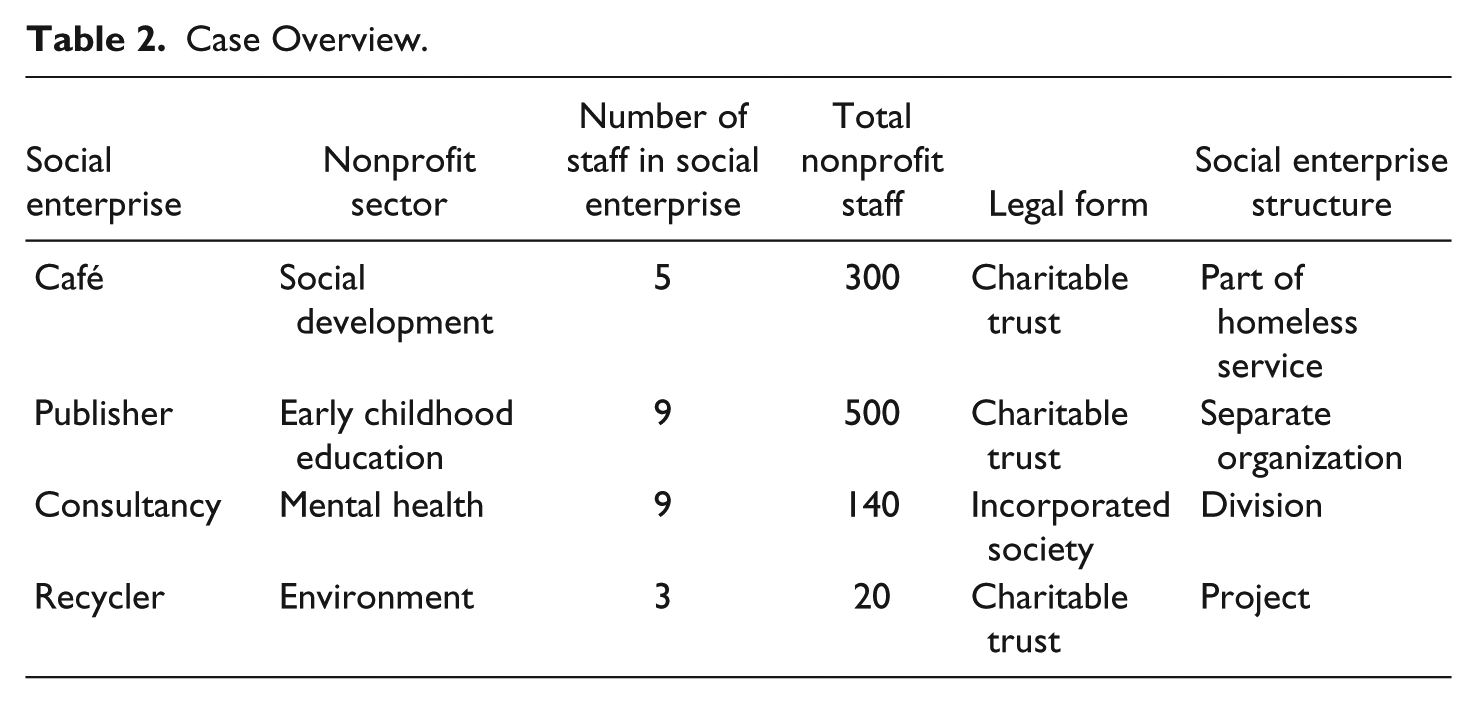
At four discrete time periods over an 18-month period, 59 individual interviews or focus group discussions were conducted alongside key document analysis across the four organizations to develop an in-depth account of each case (Bryman, 2003). Codes were developed in an iterative manner and this analysis included the exploration of key concepts drawn from the literature on institutional logics (as outlined in Table 1 above), and compared and contrasted with research participants’ descriptions (Eisenhardt, 1989). The empirical data from the four cases was analyzed to better understand each of the case organizations’ decisions on how they structured the social enterprise and how they endeavored to combine in some manner both social enterprise and nonprofit thinking.
The analysis comprised sense-making of the rich accounts and pattern exploration within each case organization, followed by cross-case analysis (Yin, 2009). Emerging themes were tabulated, mapped, and checked for co-occurrence within each case and then triangulated in follow-up interviews and discussions with research participants. One of the second-order themes that emerged (Tracey, Phillips, & Jarvis, 2011) was organizational structure, with some participants raising the subject of how best to organize people, resources, and activities. This theme was then explored in further detail through the data collected at each time point in conjunction with extant literature and then tested finally with research participants to ensure the researcher’s conclusions resonated with the participants’ viewpoints. To provide some background context on the logic variances and structural choices, each of the four illustrative cases will be briefly described.
Case Outlines
“Consultancy”
The consultancy is a social enterprise within a well-resourced 50-year-old regional mental health agency (herein referred to as MH) with 120 full-time staff operating across 10 sites. MH offers a wide range of government contracted services to 750 clients. Its management style was self-described as empowering and participative to encourage and support innovation. Leaders sought possibilities for further income generation to both increase organizational financial sustainability and considered ways in which MH could adopt a broader role encouraging positive mental health in local communities. MH management hoped the consultancy initiative would be the first of many MH social enterprises.
Involving all MH staff, a grant-funded review explored possible MH offerings and presented to management the idea of a corporate consultancy based on a tool developed and used internally to encourage client readiness for change. While the existing tool had a strong theoretical base, it was adapted and rigorously tested for corporate use. Funded by MH reserves, the consultancy was formally launched in late 2010, offering the marketplace a tool and expertise that could help individuals, teams, and organizations move successfully through change. The consultancy provided workshops, coaching, and training to organizations undergoing changes in role, structure, process, or technology. The service aimed to strengthen the customer organizations’ existing change strategies and provide practical management recommendations. A detailed competitor analysis positioned the enterprise as a niche provider of training and consultancy. As a division, the consultancy was separately branded but shared MH’s internal resources, such as reception and management.
A commercial advisory board was hand-picked from the wider business community to support the consultancy and a commercial manager was recruited to MH to imbue commercial skills and acumen within the organization. Working with some large corporates, the consultancy has been able to break even financially but growth has been slow with ongoing resources from the parent body of MH being invested cautiously. Nevertheless, the consultancy continues to be strongly connected to MH through internal appointments and their commitment to MH’s values of keeping it real, doing whatever it takes, doing the right thing, and being all you can.
During the period of this research, the consultancy did not provide additional revenue to MH; however, it was seen to bring MH multiple benefits. These benefits included developing financial awareness and entrepreneurship within MH, building constructive connections with business, doing preventive work in the wider community, and using the program for internal change initiatives. Initial staff resistance to investing scarce resources in the consultancy has eroded over time as these benefits have been witnessed and experienced.
“Cafe”
The café is a social enterprise that is part of a large regional church-based social development agency (herein referred to as SD). “Turning lives around” is the essential purpose of this 160-year-old agency that employs more than 300 staff. For 80 years, a soup kitchen for homeless people had operated in a large central city hall, but in 2008, with staff support, newly appointed managers decided to try something different. And in 2010, a café was leased in a central city street. In addition to providing good food at reasonable prices and the opportunity for integrating homeless people with other members of the community, the café also aimed to attract homeless people to its attached social work support services that worked closely with a large range of community agencies.
Mixed funding sources included commercial income earned by a property arm of the Church and a 5-year grant from a philanthropic funder that sought to support self-sustaining social services. Although SD is well resourced, it does not like to “waste money” and resources have been tight for the café with organizational leaders frequently working additional unpaid hours to establish systems and improve the environment.
Unlike the soup kitchen, where food was free, a small charge was made for basic meals. This change was seen as compatible with the SD core values of encouraging interdependence, community, and connectedness. Counter food was also offered at just below market rates for the local business and residential population. During the research period, the café was contributing around 40% of its costs and remained heavily subsidized by SD and its funders.
SD management recognized that employing staff with hospitality expertise was essential to the success of the social enterprise in creating a financial contribution to its operation. Café expertise was therefore brought into the organization to assist and train the service manager, a highly experienced mental health social worker. He found that managing the cafe required a very different approach than his more autonomous social work team.
Trying to combine the different business models and at times competing approaches resulted in the two parts of the homeless service operating more separately than initially envisaged by senior decision makers within SD. Some tensions emerged between those supporting traditional social work approaches (some staff and managers) and those seeking a self-funding café (some managers and consultants). Some social workers have seen the rise in the cafe meal pricing as too high for the homeless population but also too low for the general population. Questions of how much financial contribution the café should generate for SD and how commercially focused the café ought to be were keenly debated. The whole organization (both the traditional SD nonprofit and the social enterprise café) have learned from this initial social enterprise and lessons are now being applied to other parts of the service that are looking for ways to further innovate and commercialize parts of the services they offer.
“Publisher”
The publisher is a social enterprise established by a large but financially stretched 75-year-old parent-led early childhood organization (herein referred to as EC) that has sought to create social change through education, empowering both adults and children to play, learn, and grow together. This national service supported over 15,000 children from birth to school age in 490 centers.
EC started to publish books in 1974 primarily for members through a dedicated volunteer management committee. However, declining volunteer support in recent decades led to a reduction both in publications and income. In 2006, after extensive internal consultation, EC agreed to establish a limited liability company for charitable purpose to raise money for its owners, and a publishing social enterprise emerged.
The publisher shared many EC values, including the importance of community along with minimizing rules and bureaucracy. However, the publisher also saw the limitations of EC’s commitment to consensus when rapid commercial decisions were needed and sought to compartmentalize itself structurally from EC, the parent organization.
Following a rebranding exercise, the publisher underwent a further restructure, employing new people with commercial experience to develop and implement a marketing plan, rationalize pricing, and design fresh service systems, including an e-commerce website, with a stronger customer focus. However, due to intense resource constraints, break-even was not reached in the research period. Generating sales, and therefore cash flow presented the greatest challenge to survival for the social enterprise.
“Recycler”
The recycler is one of many projects underway in a small 13-year-old environmental agency (herein referred to as EV). Employing 20 staff and many volunteers, EV sought to be an innovative and business-like operation that makes a difference for communities and the environment.
Responding to a request from a commercial company to partner with them in recycling of electronic and electrical appliances, EV aimed to reduce the hazardous waste sent to landfills, and also reduce its reliance on contracts that came from local or central government grants. Nevertheless, initially, the recycler scheme accessed government funding for the removal of obsolete analog televisions.
The recycler received, packaged, and dispatched the electronic waste goods to its partner, who then took care of the dismantling of the components. The project charged people for disposing of e-waste items, bringing both social and commercial realities to EV. Most of this income was passed onto the commercial partner, retaining some for the recycler, which only sought to cover additional material costs and a contribution to labor.
The growing public awareness to take some responsibility for environmental issues and “do the right thing” was at the basis of this business model. However, few people were willing to bring in goods and pay, especially because other scrap merchants accepted items from households for free, and then sent unusable components to landfill. A removal of government subsidies has since made prices even less attractive for customers, making financial success challenging for the recycler.
Discussion
Determining the appropriate structure of a social enterprise is a key decision for key nonprofit stakeholders, because structure both influences and is influenced by logic compatibility and diffusion. For example, structure significantly influences how decisions are made or how resources are allocated, including the type of employees deployed in the social enterprise. Battilana and Dorado (2010) argue that developing a hybrid workforce, with a dual allegiance to both social or commercial goals, can avoid tensions between differently focused workforces. However, such a stance is unlikely to be achieved in a nonprofit that primarily employs expert social service staff and where the social enterprise is a small part of the parent organization. This article suggests that a number of structural options are available to nonprofits, and considering the most appropriate structural option to meet the needs of both the nonprofit and its emerging social enterprise is a valuable exercise.
Drawing from institutional logics and organizational identity literatures, this section builds on and explores ways to recombine the conceptualizations offered by Besharov and Smith (2014) and Pratt and Foreman (2000). In applying a conceptual lens to emerging empirical data, we offer a typology that suggests four ways a nonprofit might structure a social enterprise and in what circumstances they might occur.
How institutional logics manifest in social enterprise has been the subject of recent research and various authors have drawn divergent conclusions. Besharov and Smith (2014) and others view most social enterprises as “contested,” which may explain why many social enterprises “wobble” toward one or other of the logics (Young & Kim, 2015). Furthermore, Teasdale, Kerlin, Young, and Soh (2013) argue that many nonprofits find greater stability in pursuing either predominantly commercial or donative revenue, but not both. This suggests that the perfectly balanced hybrid is difficult to achieve. Yet other research evidence suggests that social enterprises not only exist but can thrive within nonprofits (Dees, 2002; Unzueta, 2004).
This article accepts both views and posits that social and commercial characteristics can materialize in numerous ways in nonprofits with social enterprises beyond the standard dichotomous options frequently assumed. That is, hybridity can take various forms and there is no single approach for managing tension, and conflicts arising from the existence of dual logics. A broader range of structural responses may be available than perhaps are commonly considered, with equally balanced social and commercial logics just one of many options that are neither mutually exclusive nor static. As illustrated in Figure 1 and the options below, organizations may vary their structural response over time and may locate themselves in any position within the quadrant and possibly spanning more than one of the permeable quadrant boundaries at any given time.

Structural options and examples for incorporating a commercial logic within a social organization.
The two primary dimensions that impact the structure of a social enterprise, and therefore the management of dual logics, are first logic compatibility (Besharov & Smith, 2014) and, second, how the logics are structurally diffused. That is, whether the organization chooses to combine or separate the logics internally or externally to the nonprofit (Pratt & Foreman, 2000).
The higher the assessed compatibility or acceptability of logics within the nonprofit, the more likely the social enterprise is accommodated within the nonprofit through structural options we label as integration or aggregation. Integration occurs when both the commercial and social logics are compatible and they combine to form one blended logic. Aggregation results from both commercial and social logics being managed simultaneously as dual logics within the nonprofit and social enterprise. Alternatively, if there is low logic compatibility, the structural alternatives include compartmentalization which occurs when the social and/or commercial logic of the social enterprise is maintained within a separate organization to the parent nonprofit. When there is low logic compatibility but dual logics evident, then the peripheral commercial logic may be subordinated as a minor logic to the dominant social logic.
Integration involves organizations finding a balance in a blended logic, that is perceived by personnel within the nonprofit as legitimate and allows sense-making of any inconsistencies (Besharov & Smith, 2014; Pratt & Foreman, 2000). Most commonly it involves the integration of both mission (social) and profit (commercial) goals and values to project a legitimate and consistent identity (Battilana & Dorado, 2010; Dees, 2012). Merged key features can develop (Pache & Santos, 2013a), such as both profit targets and the use of volunteers.
The consultancy is illustrative of an integrated social enterprise. During the formation stage, and then subsequently in the ongoing existence of the consultancy, there was an explicit endeavor to integrate both commercial and social logics into a blended logic seen as broadly compatible with MH. The consultancy was seen as strongly connected to MH through the staff appointed in the consultancy and their collective commitment to MH’s values. As one of the participants noted, [The consultancy] may just become the commercial arm of (MH) instead of being a separate organization, because the values of (MH) have been reflected in what [the consultancy] is doing.
Although the social logic remained dominant, and the social enterprise operated differently to the rest of the organization in, for example, marketing and pricing services, strands of the commercial logic, such as entrepreneurialism and money awareness, were woven into a blended logic within the whole organization. The board initially thought that the consultancy might be later separated from MH when it became profitable. However, the integration process enabled an internal view that the consulting arm could continue within MH as a commercial division that added value to the whole organization.
Aggregation occurs when an organization retains two logics internally. The nonprofit and social enterprise are seen separately but of equal value as composite parts of the whole organization, and linkages are forged to generate positive synergies among staff and volunteers who accept the importance of both logics (Pratt & Foreman, 2000). There may be some hierarchical importance of the logics or decisions may vary depending on the logic’s importance at any given time. Staff may be employed separately in the social enterprise or could work in both the nonprofit and social enterprise and simply switch between the commercial or social logics as context demands (Jarzabkowski, Smets, Bednarek, Burke, & Spee, 2013).
The commercially oriented café conformed to this definition of an aggregated social enterprise, as it provided a pivotal part of a homeless service, with commercial logics in the café that starkly contrast to those in the connected social work service. Both parts of the service needed to work together to a certain extent to deliver the total food and homeless support service sought by the agency. As noted previously, the logics were not completely compatible for all staff members with some concern from social workers over the more commercial approach of the café, even though the nonprofit always expected to financially subsidize the café.
It’s a shop front for a bigger support service. So there needs to be a real strong connection between the two.
However, at a management level, and among some staff, the logics were accepted as broadly compatible within the organization, and the differences acknowledged as a useful tension because they contributed both financial value and the opportunity for another of the agency’s goals, that of increased community integration and awareness, as noted in the quote above.
Compartmentalization involves developing a separate organizational unit in which a different set of logics and mind-sets are located. This creates a separate context for the various logics to exist, thereby avoiding the likely logic clash that might arise if there was an attempt to locate divergent or conflicting logics within the larger organization. In this research, this term is only assigned when a separate organization is formed as a subsidiary of the nonprofit, with its own governance and typically a blended logic within the social enterprise.
The publisher is an example of a compartmentalized social enterprise. A separate entity enabled rapid commercial decisions and also limited the level of EC’s financial risk and commercial logic diffusion within the nonprofit. As noted by an employee of the publisher, By developing the company, it’s just the board that make decisions now. We don’t have to keep going back [to the nonprofit].
While the parent nonprofit (EC) was supportive of the emerging social enterprise, with few available resources, EC was undergoing significant restructuring and so was aware it did not want to be distracted in time or attention by the new publishing service. There was little interdependence with the staff of EC and the publisher operated a separate blended social and commercial logic internally, which, according to some research participants, became more commercial overtime.
Subordination involves retaining a minor logic in spite of it not being embraced within the wider organizational setting. At one extreme within this structural option, a logic may be removed because it is essentially incompatible or not offering sufficient value to the organization (Pratt & Foreman, 2000). However, in the situation where a social enterprise has been consciously developed by the organization, subordination may be a more likely response. This option may equate to the dominance or estrangement of logics described by Besharov and Smith (2014).
Subordination can involve ostensibly endorsing but not fully implementing the practices required of one logic, while retaining the practices of another that is more aligned with the goals of the organization (Boxenbaum & Jonsson, 2008; Pache & Santos, 2013b). While sometimes viewed as deceptive, this strategy can allow the organization to present a legitimate façade, while not requiring staff to change practices. Should a nonprofit experience unintended subordination, we argue that managers could consider other structural options that they have available to them.
Within the environmental agency (EV), the profit-seeking logic was subordinated, with the recycler tending to match the social logics in the organization. The recycler was seen as simply another project that involved some staff and was managed similarly to other projects, using primarily social logics.
I don’t think there’s too much difference in our approach to [the social enterprise] actually.
Its business model was not profitable, and resources for marketing and much-needed capital items were unavailable. The project was considered an experiment and there had been insufficient stimulus to develop a strong commercial culture. The project, however, continued on the basis that it was considered by EV to be a good thing to do, took little time, and did not affect any other part of the service.
Conclusion
While each of these four case studies all had quite different offerings to the market, they shared a number of similarities and differences. For example, unlike Garrow and Hasenfeld’s (2012) findings, this research found that all four nonprofits were determined to uphold their mission and key values within their social enterprise. Each of the emerging social enterprises supported the strong values-based mission of the nonprofit, which influenced their commercial decisions and minimized cultural clashes.
Despite strong social missions, extensive networks, and the inherent need for finance shared by each of the nonprofit case organizations in this research, the empirical evidence presented here suggests that establishing a social enterprise within an established nonprofit is challenging. Most had taken a number of years to develop and none were making a profit during the research period. For social enterprises to thrive within an existing nonprofit requires the adoption of different technologies, rules, assumptions, and skills of commercial organizations, at the same time as it continues to manage its established social services.
Logic compatibility is impacted by the manner in which varying logics are diffused, that is, whether they are integrated or in some way separated to allow both logics to exist without undue conflict. Whether a social enterprise from within a nonprofit ends up being integrated, aggregated, subordinated, or compartmentalized is influenced by a variety of drivers, including the level of logic compatibility and its diffusion. Logic compatibility and diffusion affect and are affected by the structure selected by the organization.
Where there is higher legitimacy for the social enterprise from multiple stakeholders within the nonprofit, commercial logics may be more diffused throughout the organisation using the options of integration or aggregation. Where it is important to maintain dual logics separately, but collaborations are possible between the social enterprise and nonprofit, aggregation of the two logics might be preferred. This may be cost effective, using existing overheads and allows for clear but different roles and responsibilities. The key disadvantage is that conflict may be more common, when different styles of operation work together closely and comparisons of different conditions and approaches are visible.
In nonprofits that have lower levels of compatibility with commercial logics, and there is little need for interdependence between staff, compartmentalization as a subsidiary with a blended social and commercial logic may be appropriate. Because there are costs in establishing a separate organization, including governance and facilities with related overheads, compartmentalizing is likely to be the best option where the social enterprise has some legitimacy and when resource constraints are lowered through grant donations, the use of reserves or sharing overheads. The main advantage of compartmentalization may be that different ways of operating do not necessarily cause conflict, as this approach could result in less contact between the social enterprise and nonprofit personnel. As such, there is less influence on the existing culture of the not-for-profit, and a stronger commercial focus may be taken, even if blended with social logics to some degree.
Alternatively, commercial logics might be retained as a minor logic or subordinated within the nonprofit to minimize any clashes with a dominant social logic. If the social enterprise has low levels of legitimacy, compatibility, and does not need to be profitable, subordination may be the most appropriate choice.
Contribution and Implications for Further Research
This article highlights the essential differences between the social logics of nonprofits and commercial logics in social enterprises. By recombining some theoretical concepts from institutional logics with empirical data on the ways commercial logics are embedded and diffused in nonprofit organizations, this article contributes to the field of institutional logics by exploring structural management options within the specific context of a nonprofit.
This article suggests that structure may be a tool to help manage the tensions that arise in a nonprofit attempting to operate within a commercial market. With further testing and refinement by researchers, this explorative analysis may provide greater clarity for nonprofit organizations considering the compatibility of logics within their organization and the implications of various social enterprise structures available to them. If the structure does not suit the context, either the structure or the environment might be adapted. Perhaps more resources are needed to increase legitimacy and familiarity with commercial or sectoral logics and its benefits among staff and volunteers, so that integrated or aggregated structures are feasible. Decreasing levels of contact between social enterprise and nonprofit staff to reduce clashes in logics may also be valid options through a compartmentalized social enterprise. Greater awareness of these structural options may lead to more comfortable accommodations of social enterprises for nonprofits. However, larger-scale research is required on whether structural choices emerge from common circumstances or whether their implementation has an impact on financial or other forms of success valued by the nonprofit.
Footnotes
Declaration of Conflicting Interests
The author(s) declared no potential conflicts of interest with respect to the research, authorship, and/or publication of this article.
Funding
The author(s) received no financial support for the research, authorship, and/or publication of this article.