



Abstract
While institutional logics and organizational identity become effective theoretical lenses to analyze hybrid organizations, the literature often focuses on tensions between multiple logics or multiple identities and remains relatively silent regarding how logics and identities simultaneously constrain organizations and how organizations respond to incompatibilities as well as compatibilities between logic and identity. To address this gap, the present study draws from burgeoning research that theorizes identity as an integral part of the mechanism from which logics shape organizational decision making. I examined how social-welfare/commercial logics and social/businesslike identities directly and indirectly shape 138 organizations’ practices of venture philanthropy—a hybrid approach combining philanthropy and venture capitalism. The findings confirm identity’s overall mediating effects and offer new theoretical insights into organizational responses to logic–identity incompatibility, especially the dominant role of social identity in consistently suppressing external pressures from commercial logic, whereas businesslike identity overcomes social-welfare logic only associated with the nonprofit status.
Keywords
Introduction
The emergence of social enterprises—organizations that integrate market-based approaches with socially beneficial goals—has invoked fervent scholarly dialogue over the hybridity manifest in their diverse structures, practices, and goals (Battilana & Lee, 2014; Fitzgerald & Shepherd, 2018; Skelcher & Smith, 2015). To unveil this complexity, scholars have increasingly applied institutional logic (Battilana & Dorado, 2010; Pache & Santos, 2013; Zhao & Lounsbury, 2016) and organizational identity (Miller & Wesley, 2010; Young, 2001) as effective theoretical lenses. Both theories recognize that multiple, and often competing, logics and identities are at play within social enterprises. Existing studies often focus on logic or identity as a focal analytical point, examining organizational responses to tensions between multiple logics or between multiple identities (Battilana & Lee, 2014).
While prior studies offer critical insights into how logic and identity affect social enterprises, the literature remains relatively silent regarding how logics and identities simultaneously impact organizations and how organizations respond to incompatibilities between logic and identity. External stakeholders’ diverse interests (logics) do not necessarily align with organizational members’ internal goals (identities) (Albert & Whetten, 1985). Social enterprises thus must balance multiple logics and identities to reconcile external pressures while maintaining internal consistency (Jay, 2012).
The current study addresses this gap by analyzing the impacts of both logics and identities on organizations with the following research questions:
This study draws from burgeoning research that theorizes organizational identity as an integral part of the mechanism from which logics shape organizational decision making and behavior (Glynn, 2008; Greenwood, Raynard, Kodeih, Micelotta, & Lounsbury, 2011; Kodeih & Greenwood, 2014; Kraatz & Block, 2008), thus highlighting the interplay between logic and identity (Besharov & Brickson, 2016). Organizations graft institutional elements onto their identity to garner legitimacy (Glynn, 2008), while identity filters institutional demands and affects the way logics are infused into organizations (Kraatz & Block, 2008). As such, “logics shape organizational identities and practices and vice versa” (Thornton, Ocasio, & Lounsbury, 2012, p. 17).
By applying this new line of inquiry into the roles of logic and identity, my research makes several contributions. First, the focal case is venture philanthropy (VP) organizations that integrate ideas and practices of commercial venture capitalism (VC) into philanthropy—a relatively rare subject of scholarly research (Moody, 2008). I investigate how social-welfare and commercial logics (Im & Sun, 2015; Pache & Santos, 2013) shape organizations’ social and businesslike identities (Miller & Wesley, 2010), while their identities mediate the logics’ influences. This study, therefore, responds to recent calls (Battilana & Lee, 2014; Skelcher & Smith, 2015) for more research exploring logics and identities together to illuminate how hybrid models emerge in social enterprises. This study is also distinguished methodologically from prior social enterprise research, which dominantly uses qualitative methods (Battilana & Dorado, 2010; Cooney, 2006; Jay, 2012; Pache & Santos, 2013). To analyze practice variations among VP organizations, I follow Lounsbury (2007) and Zhao and Lounsbury (2016), who quantitatively investigated how competing logics generate heterogeneous practices in a given field.
The following sections begin with a literature review of the impacts of multiple logics and identities and the mechanisms of identity–logic interplays, followed by hypotheses development. This article then discusses the findings and implications for future research.
Literature Review
Multiple Logics, Multiple Identities, and Practice Variations
Social enterprises are hybrid organizations in which multiple logics and identities are at play (Battilana & Lee, 2014). Institutional logics are “the formal and informal rules of action, interaction, and interpretation that guide and constrain decision makers” (Thornton & Ocasio, 1999, p. 804). The logic perspective assumes that organizations’ responses to institutional pressures can be heterogeneous (Kraatz & Block, 2008; Thornton et al., 2012), rather than isomorphic as neo-institutionalism theorized (DiMaggio & Powell, 1983), because a field is often penetrated by multiple logics signaling different rules and meanings. From this perspective, social enterprises are governed by two logics with markedly different content: social-welfare logic prescribes a nonprofit form and commitment to mission, whereas commercial logic prescribes a for-profit form, profit-maximization, and efficiency (Im & Sun, 2015; Pache & Santos, 2013).
The way social enterprises experience social-welfare and commercial logics is not uniform. Some organizations balance discrepancies between two logics and integrate them into one hybrid logic (Battilana & Dorado, 2010; Jay, 2012). Still, these logics are traditionally considered to be incompatible (Cooney, 2006; Pache & Santos, 2013). When conflicts between multiple logics create a legitimacy threat, organizations undertake strategies to mitigate tensions (Besharov & Smith, 2014) and choose the way that makes the most sense to them (Lounsbury, 2007). Organizations may prioritize one logic over the other (Besharov & Smith, 2014; Fitzgerald & Shepherd, 2018), using elements drawn from the logic perceived to be dominant (Im & Sun, 2015), or selectively couple elements from each logic (Pache & Santos, 2013).
Organizations’ decision making and behaviors are influenced not only externally by logics but also internally by organizational identity. Organizational identity represents what organizational members collectively view to be the central, distinctive, and enduring features of their organization (Albert & Whetten, 1985). Social enterprises are conceptualized as hybrids that encompass two diverging identities, social identity values mission and altruistic motivations, whereas businesslike identity desires market ideas and tangible returns (Jäger & Schröer, 2014; Miller & Wesley, 2010).
While a powerful member’s (e.g., a founder) individual identities may affect his or her organization’s identities (Wry & York, 2017), organizational identities must be defined and shared by other members to be “organizational” and thus distinguished from individual identities (Pratt & Foreman, 2000). Facing external and internal pressures, organizational identities may also change during the course of organizational development (Albert & Whetten, 1985).
Scholars observed the integration of these identities into a new common identity achieved through fostering staff open to hybrid ideas (Battilana & Dorado, 2010) or sensemaking (Jay, 2012). However, dual organizational identities create internal conflicts among members, who bring different perceptions regarding what their organization’s central identity should be (Pratt & Foreman, 2000). Inconsistent values of dual identities then hinder identity integration for organizations and create enormous organizational challenges (Young, 2001). Accordingly, the extent to which identities are synergistic, along with the chosen central identity, determines organizational behaviors (Glynn, 2008). Miller and Wesley (2010) underpin the notion that social and businesslike identities of social enterprises lead to different practices, depending on which identity is core.
How Multiple Logics and Identities Affect Organizations: Different Perspectives
While scholars agree on organizations’ diverse responses to institutional pressures, how and why organizational responses, even with the same logic, vary remains undertheorized (Thornton et al., 2012). To answer this, scholars have conceptualized organizational identity as a vital link between logics and organizational actions (Glynn, 2008; Kodeih & Greenwood, 2014; Thornton et al., 2012). The intricate mechanisms through which logics and identities interplay to affect organizations have been theorized from various perspectives (Besharov & Brickson, 2016).
One prominent perspective argues for logics’ dominant role in determining organizational identity and behaviors (Glynn, 2008; Kraatz & Block, 2008). Organizations construct identity by drawing on values and symbolic elements from their institutional environment to secure stakeholder support and resources (Miller & Wesley, 2010; Thornton et al., 2012). Many empirical studies confirm that social enterprises construct and change their identities as strategic responses to competing logics (Battilana & Dorado, 2010; Jay, 2012). With this reasoning, values between logic and identity are possibly aligned. Pache and Santos (2013), for instance, witness that social-welfare logic promotes social identity among social enterprises whereas the commercial logic projects businesslike identity.
Other scholars characterize organizational identity as a central source of influence over organizational decision making and behaviors. In this view, members play an agentic role in actively constructing, managing, and altering their organizations’ identity (Gioia, Price, Hamilton, & Thomas, 2010; Pratt & Foreman, 2000). Because members bring their personal identities (Wry & York, 2017) to the construction process, the values organizational identity represents may be partially, if not completely, independent from institutional logic (Besharov & Brickson, 2016).
Yet, a critical question arises when we acknowledge both perspectives: how do organizations respond when facing rivalry between logic and identity, the situation particularly pertinent to social enterprises—organizations destined to confront competing demands from both logics and identities? Here, an alternative, and more recent, perspective theorizes organizational identity as a “filter” mediating the way members experience logics (Besharov & Brickson, 2016; Greenwood et al., 2011). Organizations construct identity by drawing on a particular logic to gain legitimacy, yet members interpret institutional demands, and select elements, from the logic (Gioia et al., 2010). With two distinct logics and identities at play, when logics instill certain meanings into organizational fields, they are translated into each organization differently through identity, leading to behavioral variations among organizations (Glynn, 2008; Greenwood et al., 2011; Kraatz & Block, 2008; Thornton et al., 2012). I argue that this alternative perspective is critical when examining external (logic) and internal (identity) influences on hybrid organizations. Indeed, Besharov and Brickson (2016) recently indicated significant potential for adapting social enterprises to this growing line of research.
Empirical Setting
VP emerged in the mid-1980s among high-tech entrepreneurs and venture capitalists, who applied VC models to philanthropy. Combining philanthropy and VC, VP organizations are governed externally by social-welfare and commercial logics (Battilana & Dorado, 2010; Im & Sun, 2015; Pache & Santos, 2013) and internally by social and businesslike identities (Miller & Wesley, 2010). Introduced out of criticism of traditional grantmaking (Letts, Ryan, & Grossman, 1997) and aggressively promoted by business media and people who were novices to philanthropy, VP became arguably the most influential, yet controversial, idea in the recent history of philanthropy (Frumkin, 2008).
Early documents (Tuan & Emerson, 2000; Venture Philanthropy Partners [VPP], 2000) show that mirroring VC practices, pioneers conceptualized VP as increased terms and amounts of funding, market-based investment tools, hands-on involvement in fundees, provision of non-financial support, rigorous metric-based performance measurement, and exit strategies. Moody (2008) found significant diversity among VP organizations in their forms and VP models. He listed the following as prominent VP organizations: 501(c)(3) nonprofit funds (Acumen Fund, VPP); giving circles (Social Venture Partners); divisions of community foundations (Center for Venture Philanthropy, SV2); private foundations (Skoll Foundation); and nonprofit-LLC hybrids (Omidyar Network). Standlea (2006) also documented influential foundations’ (Carnegie, Hewlett, James Irvine, Kellogg, and Rockefeller) experimentation with VP. Miller and Wesley (2010) observed that some nonprofit, as well as for-profit, VP organizations used commercial investment tools. Although whether VP is truly novel was debatable, VC’s cultural influence on the emerging VP field was evident (Moody, 2008). Aspiring organizations eagerly identified themselves as businesslike alternatives to traditional grantmakers and deliberately used VC terms for grantmaking activities despite the unchanged meanings (e.g., “investment” substituted for “grants”).
Such business influence of VP eroded after the dotcom bubble burst (Moody, 2008). Some of the earliest advocates began using more modest language and refining their approaches to better suit mainstream philanthropy. Without a major association that would mediate tensions between philanthropy and VC (e.g., European Venture Philanthropy Association), VP in the United States lacked an opportunity to reconcile competing logics. The original group of VP organizations subsequently divided into subgroups, each of which was dominated by either social-welfare logic (e.g., VPP) or commercial logic (e.g., Acumen Fund). VPP compiled its 2004 publication with nonprofit leaders under the banner of “high-engagement philanthropy” instead of “venture philanthropy” used in previous reports. Their goal also changed from “greater return from nonprofit organizations, whether social, financial, or both” in the 2000 publication (p. 6) into “addressing a large societal challenge” in the 2004 publication (p. 18). Conversely, Acumen Fund continued to expand market-based approaches entailing the use of equity and debts. Where did differences between the two organizations originate? This study investigates the underlying mechanism through hypothesis testing below.
Hypotheses
My hypotheses postulate direct and indirect effects of competing logics and identities on VP practices by following the perspectives discussed above: logics externally shape identities; identities affect practices; and identities filter logics’ influences over practices.
To investigate how institutional logics shape organizational practices, Thornton et al. (2012) stress the importance of recognizing that logics operate at multiple levels—organizations, networks, organizational fields, and societies. Institutional logics also encompass coercive, normative, and symbolic dimensions (DiMaggio & Powell, 1983). Scholars have discussed competing logics in hybrid organizations being manifest in organizational forms (Pache & Santos, 2013), laws and regulations (Im & Sun, 2015), demands from resource providers (Besharov & Smith, 2014), networks and associations (Moody, 2008), and professional training (Battilana & Dorado, 2010). Guided by these implications, my research model focuses on four institutional elements relevant to VP organizations: legal structure regulated by governments (society-level), demands from donors and investors (network-level), affiliation with professional associations (field-level), and management teams’ professional training (organization-level).
Government promulgates state logics coercing rule-following behaviors (Friedland & Alford, 1991; Thornton et al., 2012). As a state designates incorporation rules and the Internal Revenue Service regulates tax-exempt status for nonprofits, organizations’ legal structure embodies state logics and then provides the “cultural materials that organizational members assemble to formulate essential identity elements” (Glynn, 2008, p. 426). Studies about hybrid funders (Im & Sun, 2015; Pache & Santos, 2013) reveal that nonprofit forms and for-profit forms are governed by social-welfare logic and commercial logic, respectively. Resource providers for hybrid organizations include philanthropic donors who seek social impacts and market-oriented investors who demand financial return (Battilana & Lee, 2014). Greenwood et al. (2011) add that organizational identity emerges from reciprocal interactions with resource providers. Demands from philanthropic donors and profit-seeking investors thus lead to VP organizations’ social and businesslike identities respectively.
Professionalism represents an important institutional order guiding organizations to professional norms and legitimating practices in a field (Friedland & Alford, 1991; Thornton & Ocasio, 1999). Professional associations instill prescriptions from field-level logics to organizations (Besharov & Smith, 2014; DiMaggio & Powell, 1983) and set logic-defining identities for organizations (Greenwood et al., 2011). Moody (2008) documented an important role of Silicon Valley–based professional networks in gathering high-tech entrepreneurs and facilitating their efforts to develop and spread novel VP ideas. Leadership team’s training also represents professional logics (DiMaggio & Powell, 1983). Many managers came to VP organizations from the nonprofit sector (e.g., foundation officers and graduates from nonprofit management programs) or the business sector (e.g., investment managers and MBAs) (Moody, 2008). Managers’ cognitive views developed during their prior professional experiences in nonprofit or business management thus affect their organizations’ social versus businesslike identity (Lee & Lounsbury, 2015).
A comparison between two nonprofits pioneering VP (VPP and Acumen Fund) illustrates how institutional logics have shaped and altered these organizations’ identities across a long course of time. Established by a high-tech entrepreneur, Mario Morino, VPP initially formed its businesslike identity as a “social venture fund” (VPP, 2000, p. 11) and actively incorporated VC elements into their VP model. This approach, however, drew sharp criticism from philanthropic circles. As Morino began working with “a variety of nonprofit and community-based organizations” and attended the Council on Foundations’ (COF) meeting (Morino, 2004), VPP’s self-identification changed, reflecting in their frequent use of the words “nonprofit” and “philanthropic” (VPP, 2004, p. 4). Acumen Fund took a contrasting path: it actively interacted with business communities, once being listed as a forefront VP organization on the National Venture Capital Association’s website, and the management team was composed of many MBAs and other business professionals. Naming itself as a nonprofit global “venture fund” on its website, Acumen today is a vital part of the impact investing community along with for-profits. I thus posit the following hypotheses:
Organizations’ identities guide their behavior (Albert & Whetten, 1985; Kraatz & Block, 2008) and signal what practices are legitimate (Kodeih & Greenwood, 2014). As such, VP organizations’ social and businesslike identities determine how, and the extent to which, they implement VP. Yet, these identities represent intrinsically conflicting values (Miller & Wesley, 2010): businesslike identity endorses VC-influenced commercial elements, while social identity avoids highly commercial elements. The conflicting values between these identities hinder members from reaching an agreement and create internal dissonance (Pratt & Foreman, 2000). To reduce internal tensions, organizations may choose practices consistent with the identity the majority of members deem to be central (Albert & Whetten, 1985; Glynn, 2008; Kodeih & Greenwood, 2014), thereby creating practice variations among organizations. For instance, Acumen Fund incorporated many VC elements in its VP model, including equity investment. Conversely, VPP engaged in philanthropic grantmaking and its VP model was limited to VC’s capacity building practices. I thus offer the following hypotheses:
Scholars propose that the compatibility between institutional logics and organizational identity determines the way logics, through identity, affect organizations’ engagement with new practices (Besharov & Brickson, 2016). The multiplicity of logics and identities makes the logic–identity relationship more complex for hybrids, including VP organizations, than is theorized in the extant literature, as they experience conflicts not only between logics or between identities but also between logic and identity.
Still, organizations’ decision regarding the adoption of VP is more predictable if identity and logic are compatible because the strong logic–identity alignment makes members more amenable to the logic prescription, which drives organizations to engage in practices governed by this logic. If organizations are embedded in commercial logic and members view businesslike identity as central for the organizations, they are more likely to implement VP. Conversely, the adoption of VP is likely to encounter significant resistance if organizations are deeply embedded in social-welfare logic and members also define their organizations’ central identity to be social.
An organizational identity’s mediating effect is highly unpredictable when identity and logic are incompatible. The multiple less-integrated identities create divergent interpretations of institutional demands and dissonance regarding what an appropriate organizational response to the logic–identity incompatibilities should be among members, who bring different personal perspectives to the interpretive process (Kraatz & Block, 2008). Organizational responses also vary considerably; demands from institutional logics are highly coercive and may suppress members’ decisions, or internal forces from members are strong and persistent enough to defy logics (Glynn, 2008; Kodeih & Greenwood, 2014). I then posit the last sets of hypotheses:
Method
Data Collection and Scales
To capture variances in the extent to which competing logics affect funders’ practices, I adopt a broad definition of VP, including both for-profits and nonprofits (Miller & Wesley, 2010; Moody, 2008). Lacking a universally agreed-upon definition of VP makes constructs difficult to develop and measure. I took extra caution in forming a proper sample and generating survey items (Hinkin, 1995). I used both scholarly and practitioner-oriented sources, including interviews with four industry experts. To maximize a search result for a sample, 16 sources, both self-identified (e.g., directories) and those identified by a third party (e.g., Moody, 2008), helped identify 528 organizations. This primary population was screened on the characteristics of formal incorporation, U.S.-based, funding as a primary activity, an explicit social intent, and availability of contact information, yielding 291 organizations as the final population.
I distributed the survey to CEOs or directors of funding divisions at 291 organizations between November 2011 and May 2012 through mixed-mode methods (Dillman, Smyth, & Christian, 2009), using e-mails, mailings, and telephone calls. The solicitations were personalized with each recipient’s name and address to reduce non-response errors. I chose to use the single-informant method for my survey, due to concerns that a multiple-informant method could engender more non-responses and reduce the sample size. However, the single-informant method can introduce common method biases. My procedures thus followed Podsakoff, MacKenzie, Lee, and Podsakoff (2003) for protecting respondent anonymity, separating measurement, and improving scale items as procedural remedies for common method biases. Scale items were carefully constructed through deductive and inductive methods (Hinkin, 1995), including a content analysis of interviews (as described above). During August to October 2011, a pretest was conducted with nine organizations purposely chosen to represent variety in prima facie characteristics. The use of negatively worded or reverse-scored items in the questionnaire attenuated response pattern bias inherent in Likert-type scales, and an Internet survey mode was chosen for its greater sense of neutrality.
My survey received 146 responses out of 291 survey recipients, yielding a 50.2% response rate. An archival analysis compared respondents with nonrespondents (Rogelberg & Stanton, 2007) to assess nonresponse error through independent-sample t tests (.05 level) on variables for key organizational characteristics that may affect the pattern of survey responses (legal structure, age, revenue, assets, and geographic region). The results revealed no significant differences (p > .05) between the two groups, suggesting that nonresponse bias was not a factor in the sample. Consistent with prior VP research (Moody, 2008), my sample of 146 organizations constitutes a much larger nonprofit subgroup (84.9%) than for-profit subgroup. Among the nonprofits are 110 public charities, eight private foundations, and six other nonprofits (e.g., 501(c)(4), 509(a), and CDFI). I further ran missing value analysis and deleted eight cases with over 80% of the missing values, which resulted in 138 cases for statistical analyses.
Measures
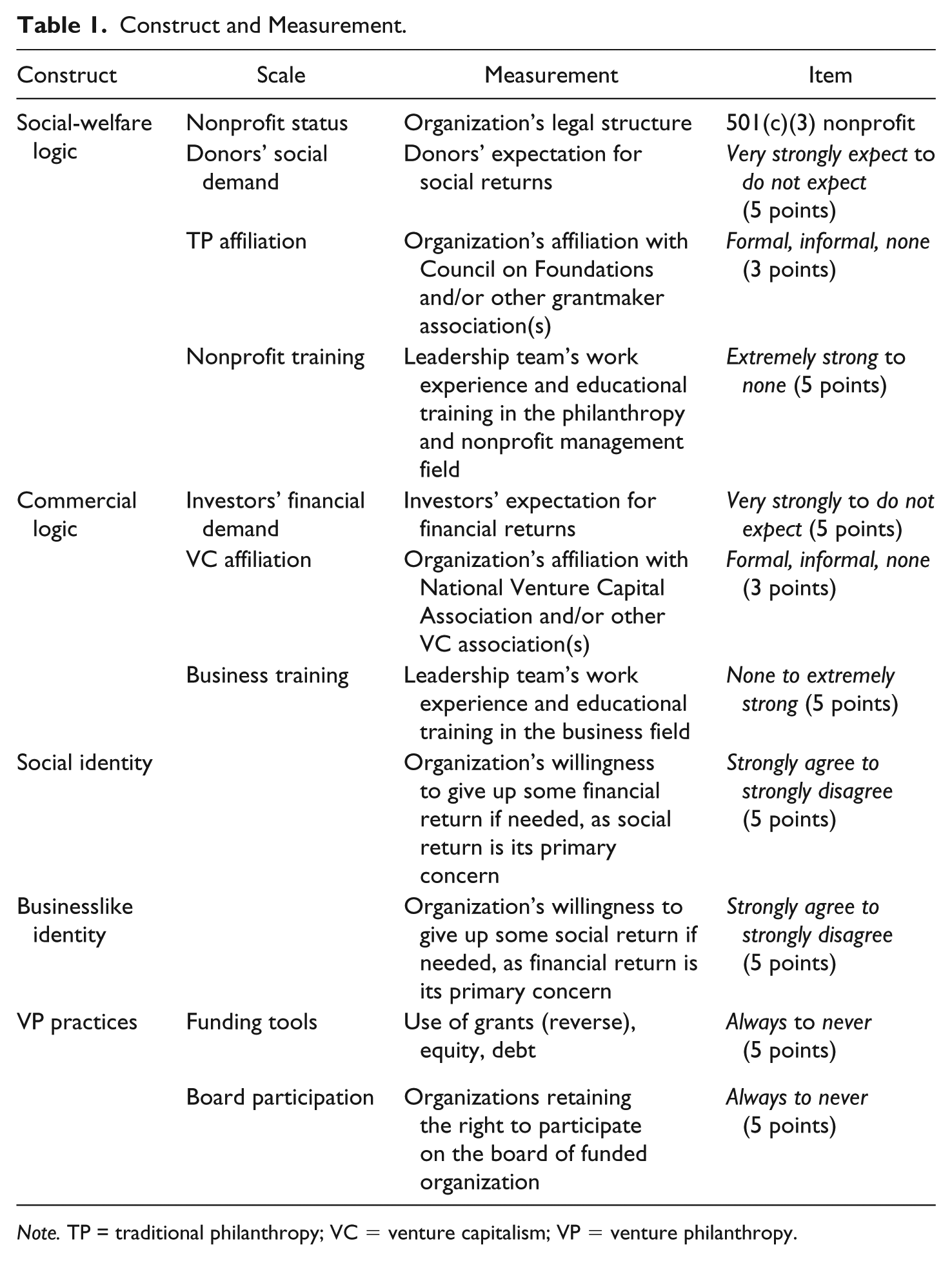
Table 1 illustrates the measurement scales and indicators used in this study. Three indicators (identity, legal structure, and donor/investor demand) are single-item. To address the cautions surrounding single-scale (Sarstedt, Diamantopoulos, Salzberger, & Baumgartner, 2016), I used global single-items established by previous studies and summarized the essence of constructs for most of the single-item indicators. I also followed three expert raters specializing in social entrepreneurship or methodology, and those interviewed for historical research, to identify the best item to measure as a single-scale.
Construct and Measurement.
Note. TP = traditional philanthropy; VC = venture capitalism; VP = venture philanthropy.
Social-welfare and commercial logics are the latent variables constituting multiple constructs built upon the bibliometric review. As Table 1 presents, legal structure is measured as a dummy variable, following Baum and Oliver (1992). Available data from the National Center for Charitable Statistics (for nonprofits) and organizational websites (for for-profits) were reviewed to confirm sample organizations’ legal structure as much as possible. Donors’/investors’ demands for funding returns is an original scale measured. Aldrich and Zimmer (1986) used a dichotomous variable representing interconnectedness between organizations, which occurs through formal and informal means (DiMaggio & Powell, 1983). Hence, I measured affiliations with professional associations as the presence or absence of VP funders’ affiliations at three levels (“Formal,” “Informal,” and “No” affiliation). Following Dimov and Shepherd (2005), I measured leadership team’s educational and work training to form a composite training scale in the nonprofit and business sectors.
According to institutional scholars, organizational identity relates to goals (Greenwood et al., 2011). I thus adopted a scale by Miller and Wesley (2010) measuring VP organizations’ identities as their funding goals, that is, social or financial return focus. VP practices is measured by investment tools that represent typical venture capital practices (Miller & Wesley, 2010; Moody, 2008): funding instruments (equity, loans, and reverse-coded grants) and board participation. The pretest participants noted that performance measurements (e.g., United Way evaluations) were used even before VP emerged. Therefore, although performance measurement has been discussed as a typical VP practice, my research model excluded it.
Analytical Methods
To estimate causal, as well as correlational, relationships, I used the partial least squares (PLS) latent path model developed by Wold with the software application SmartPLS. PLS is better suited than traditional structural equation modeling (SEM) for this sample, because it is small and observations for legal structure are not normally distributed. My model also contains several single-item scales, which are not problematic in PLS, but they may cause identification and convergence programs in covariance-based SEM (Sarstedt et al., 2016). Following Hair, Hult, Ringle, and Sarstedt (2016), I ran a complete bootstrapping procedure with 300 iterations and 5,000 bootstrapping samples.
Results
Measurement Model Evaluation
My model includes a formative model in which the construct is a combination of indicators (legal structure, donor/investor demands, affiliations, and training), and a reflective model in which the construct is considered to cause indicators of the construct (identities and VP practices). The evaluation distinguishes between reflective and formative models.
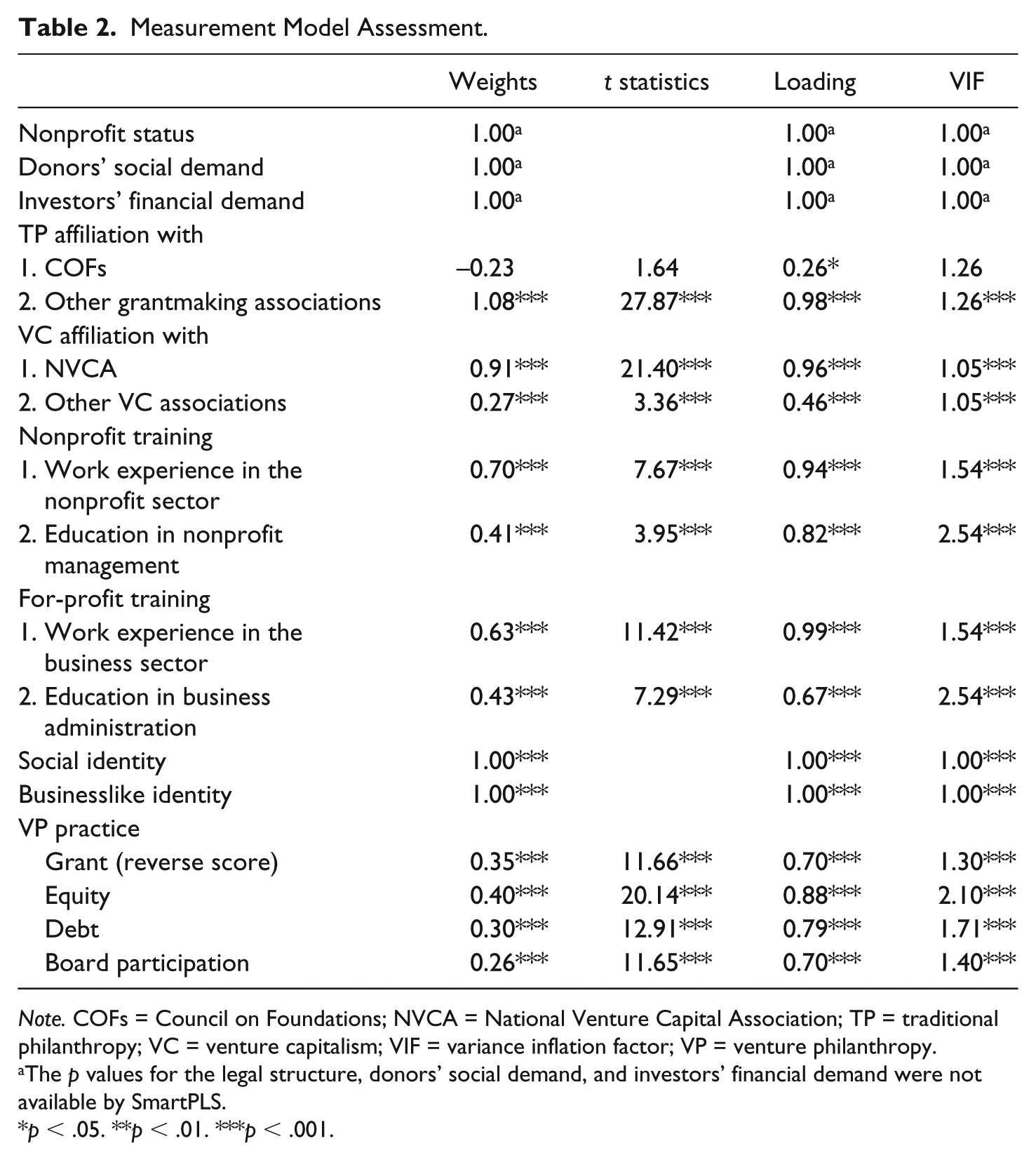
Table 2 confirms that the weights of all formative constructs are highly significant, except for the negative and insignificant construct on affiliation with COF (–.23, p = .101). The t values, except for affiliation with COF, are greater than the cutoff values, 2.58 (p < .001) (Hair, Ringle, & Sarstedt, 2011). Most factor loadings are significant and reach the threshold value of .7 (Hair et al., 2016), except affiliation with COF, affiliation with VC associations, and management team’s business education. Following Chin (1998), I retained affiliation with COF due to its theoretical importance and significant loading, and affiliation with VC associations and management team’s business education due to their high and significant weights and t values. Variance inflation factor (VIF) values for all indicators are far below 5, the threshold for PLS-SEM (Chin, 1998), indicating that multicollinearity problems did not materialize.
Measurement Model Assessment.
Note. COFs = Council on Foundations; NVCA = National Venture Capital Association; TP = traditional philanthropy; VC = venture capitalism; VIF = variance inflation factor; VP = venture philanthropy.
The p values for the legal structure, donors’ social demand, and investors’ financial demand were not available by SmartPLS.
p < .05. **p < .01. ***p < .001.
The reflective model was assessed based on composite reliability, indicator loadings, the average variance extracted (AVE), and discriminant validity (Hair et al., 2016). The composite reliability of VP practices is .75, exceeding the threshold of .70 to confirm its internal consistency reliability (Hair et al., 2011). Table 2 presents the loadings of grant, equity, debt, and board participation, all of which exceed the critical value of .70 and are highly significant (Hair et al., 2011). The AVE for the latent variable of VP practices was .58, over the threshold of .50 (Hair et al., 2011), indicating a sufficient degree of convergent validity, that is, the latent variable of VP practices explains more than 50% of the indicator’s variance. To confirm discriminant validity, the AVE of each latent construct should be higher than the construct’s highest squared correlation with any other latent construct (Hair et al., 2011). VP practices’ AVE was .76 and greater than the construct’s highest squared correlation with other latent constructs (Fornell & Larcker, 1981), which range from –.46 (affiliation with TP associations) to .52 (financial demand). Furthermore, Table 3 shows that the cross-loading values for the VP practice construct (grant = .70, equity = .88, debt = .79, and board participation = .65) are greater than the loadings with all remaining constructs, suggesting indicator reliability (Fornell & Larcker, 1981).
Cross-Loadings Results.

Note. Loadings and cross-loadings for the measurement model are shown in bold. TP = traditional philanthropy; VC = venture capitalism; VP = venture philanthropy.
p < .001.
Structural Model Assessment
To examine direct effects of logics and identities, I estimated the structural model by using the complete bootstrapping procedure of 5,000 samples, as recommended by Hair et al. (2016). The R2 values for social identity (.486***), businesslike identity (.492***), and VP practices (.581***) are greater than the cutoff value of .25 (Fornell & Larcker, 1981).
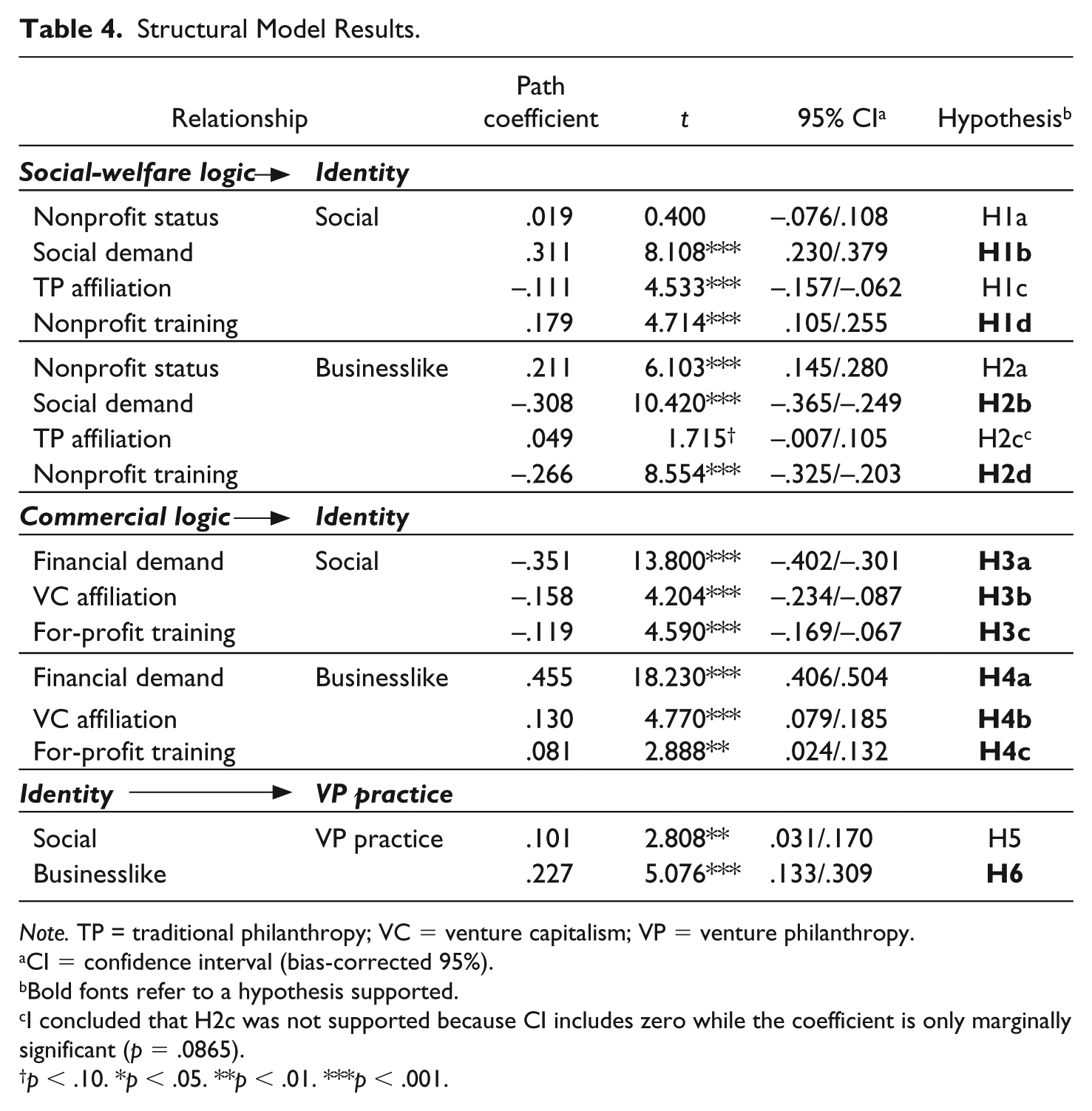
Table 4 shows that multiple hypotheses were supported. Notably, this study found significant and hypothesized effects of all commercial logic elements on both social and businesslike identities, and of businesslike identity on VP practices, rendering support to H3, H4, and H6. Conversely, results for hypotheses postulating effects of social-welfare logics and social identity were mixed. The coefficients for nonprofit status and affiliation with philanthropy professional associations were either insignificant (H1a/H2c, 95% confidence intervals included zero) or failed to demonstrate the hypothesized direction (H1c/H2a). Social identity was not negatively related to organizations’ engagement in VP practices (H5), either.
Structural Model Results.
Note. TP = traditional philanthropy; VC = venture capitalism; VP = venture philanthropy.
CI = confidence interval (bias-corrected 95%).
Bold fonts refer to a hypothesis supported.
I concluded that H2c was not supported because CI includes zero while the coefficient is only marginally significant (p = .0865).
p < .10. *p < .05. **p < .01. ***p < .001.
Mediation Assessment
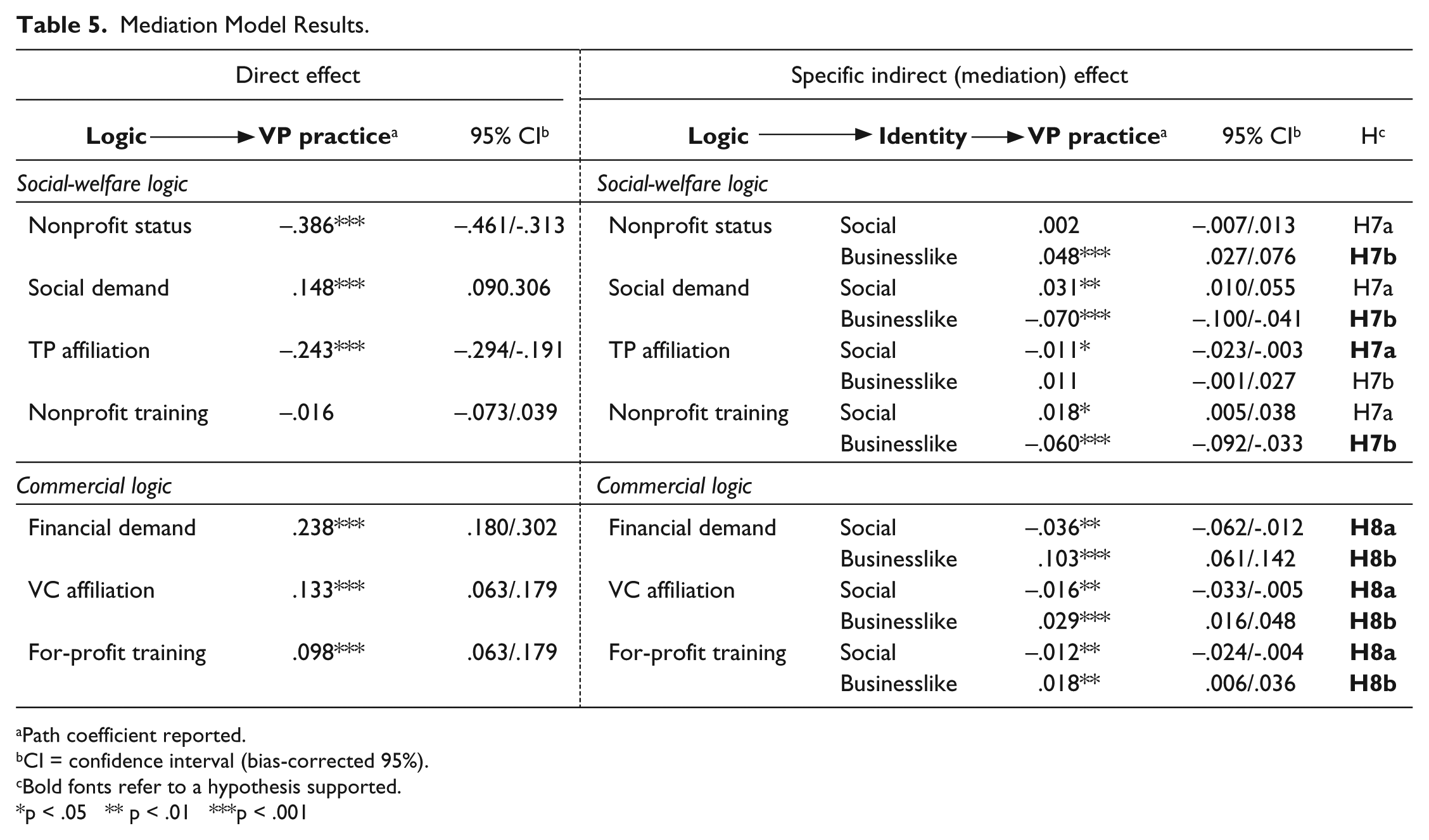
To determine the mediation effects of identity, I tested a mediation model assessing direct and indirect effects through bootstrapping. As a nonparametric resampling procedure revealing the underlying mechanisms of mediators, bootstrapping does not assume normality of the sampling distribution (Preacher & Hayes, 2008) and well applies to smaller sample sizes without a loss of power (Hair et al., 2016). Therefore, bootstrapping is more appropriate for my sample than Baron and Kenny’s (1986) causal steps approach and the Sobel (1982) test. The bootstrapping test demonstrates mediation when indirect effects are significant, determined by the confidence interval that does not include 0 (Preacher & Hayes, 2008). Table 5 shows that most indirect effects are significant, except the nonprofit status × social identity and TP association × businesslike identity, suggesting identities’ overall mediation effects.
Mediation Model Results.
Path coefficient reported.
CI = confidence interval (bias-corrected 95%).
Bold fonts refer to a hypothesis supported.
p < .05 ** p < .01 ***p < .001
Table 5 specifies a mediation pattern for each hypothesis, showing how the degree of compatibility between logic and identity affects organizational practices. H7a and H8a postulate that when logic and identity are compatible, organizational members comply with logic’s prescription; organizations with social identity and social-welfare logic implement VP to a lesser degree (H7a), whereas organizations with businesslike identity and commercial logic actively implement VP (H8a). Indirect effects of all commercial logic elements × businesslike identity are both significant and positive, rendering strong support for H8a. Conversely, H7a receives mixed results. Among social-welfare logic elements, only affiliation with TP associations × social identity shows a significant negative indirect effect as hypothesized.
H7b and H8b theorize that facing logic-identity incompatibility, organizations’ VP practice is unpredictable. Significant negative indirect effects of all commercial logic elements × social identity suggest that social identity is a dominant force over commercial logic and reverses the logic’s prescription at all levels, resulting in avoidance of VP (H8b). Social-welfare logic × businesslike identity presents more complex pictures of how businesslike organizations respond to social-welfare logics (H7b). On one hand, a significant positive indirect effect of nonprofit status × businesslike identity indicates businesslike organizations resist constraints associated with nonprofit status to implement VP. On the other hand, significant, yet negative, indirect effects of businesslike identity × donors’ social demands and of businesslike identity × nonprofit training suggest organizations still complied with social-welfare logic despite businesslike members’ interests.
Robustness Checks
Additional tests were performed to confirm the validity of the model (Hair et al., 2016). First, I used the post hoc G* Power 3.1 to calculate a statistical power. The obtained power of .998 (f2 = 0.15, probability level = 0.05) is well above the minimum threshold of 0.8 (Cohen, 1992), justifying the sample size’s adequacy. I also assessed common method biases (Podsakoff et al., 2003) through both procedural remedies to mitigate bias (discussed in the “Method” section) and statistical remedies to assess the severity of bias. The full collinearity analysis (Kock, 2015) found that the values obtained for AFVIF (1.1575-1.7665) were less than the cutoff value (3.3), indicating that the model could be considered free of common method biases (Latan, Ringle, & Jabbour, 2018).
Discussion
Contributions and Theoretical Implications
By linking mission and market-based approaches to resolve complex societal ills, social enterprises must manage competing demands from external and internal stakeholders. This study investigates an intricate mechanism through which social-welfare/commercial logics (external pressures) and social/businesslike identities (internal forces) affect the way organizations implement VP. Through PLS and mediation analyses, this study makes several contributions. It analyzes the effects of logic and identity in the same analytical model—the approach advocated by many scholars (Battilana & Lee, 2014; Greenwood et al., 2011; Skelcher & Smith, 2015)—and confirms identity’s overall mediating effects. Some notable studies quantitatively analyzed organizations’ responses to conflicting demands between multiple logics (Im & Sun, 2015; Lee & Lounsbury, 2015; Lounsbury, 2007) or between multiple identities (Miller & Wesley, 2010). Yet, findings from my model provide a more comprehensive picture of how hybrid organizations respond to complex demands coming simultaneously from both logics and identities. This study also offers more generalizable results for social entrepreneurship research, which has progressed predominantly through rich, qualitative research (Battilana & Dorado, 2010; Jay, 2012; Pache & Santos, 2013).
The central theoretical contribution of this study addresses how organizations behave when they face compatibility (H7a/H8a) and incompatibility (H7b/H8b) between logic and identity and what role organizational identity play in “filtering” institutional logic (Besharov & Brickson, 2016; Glynn, 2008; Greenwood et al., 2011; Kraatz & Block, 2008). As hybridity often emerges from nonprofits, how logic compatibility or incompatibility generates different organizational consequences has become an important topic for nonprofit scholars, too (Fitzgerald & Shepherd, 2018; Skelcher & Smith, 2015). Yet, with competing identities as well as logics, hybrid organizations must navigate all demands induced by the logic–identity multiplicity. Jay (2012) unpacks this complexity, offering a process model, where the identity–logic incompatibility first creates organizational members’ paradoxical views toward outcomes, yet eventually synthesizes competing logics through members’ sensemaking. Nevertheless, other studies have documented that competing logics remain unintegrated in many organizations, creating organizational dysfunctions (Battilana & Dorado, 2010; Cooney, 2006). This underscores the vital importance of further research investigating how hybrid organizations react when conflicts among competing logics and identities are unresolved. My mediation analysis addresses this need through statistical analyses on 138 organizations.
Table 6 summarizes implications drawn from the results of my mediation analysis initially presented in Table 5. Following Zhao, Lynch, and Chen (2010), who argue that comparison between indirect and direct effects offers deeper theoretical implications of mediating effects, I closely examined patterns between direct effects (logics → VP practice) and indirect effects (logics → identity → VP practice).
Implications from the Mediation Analysis.
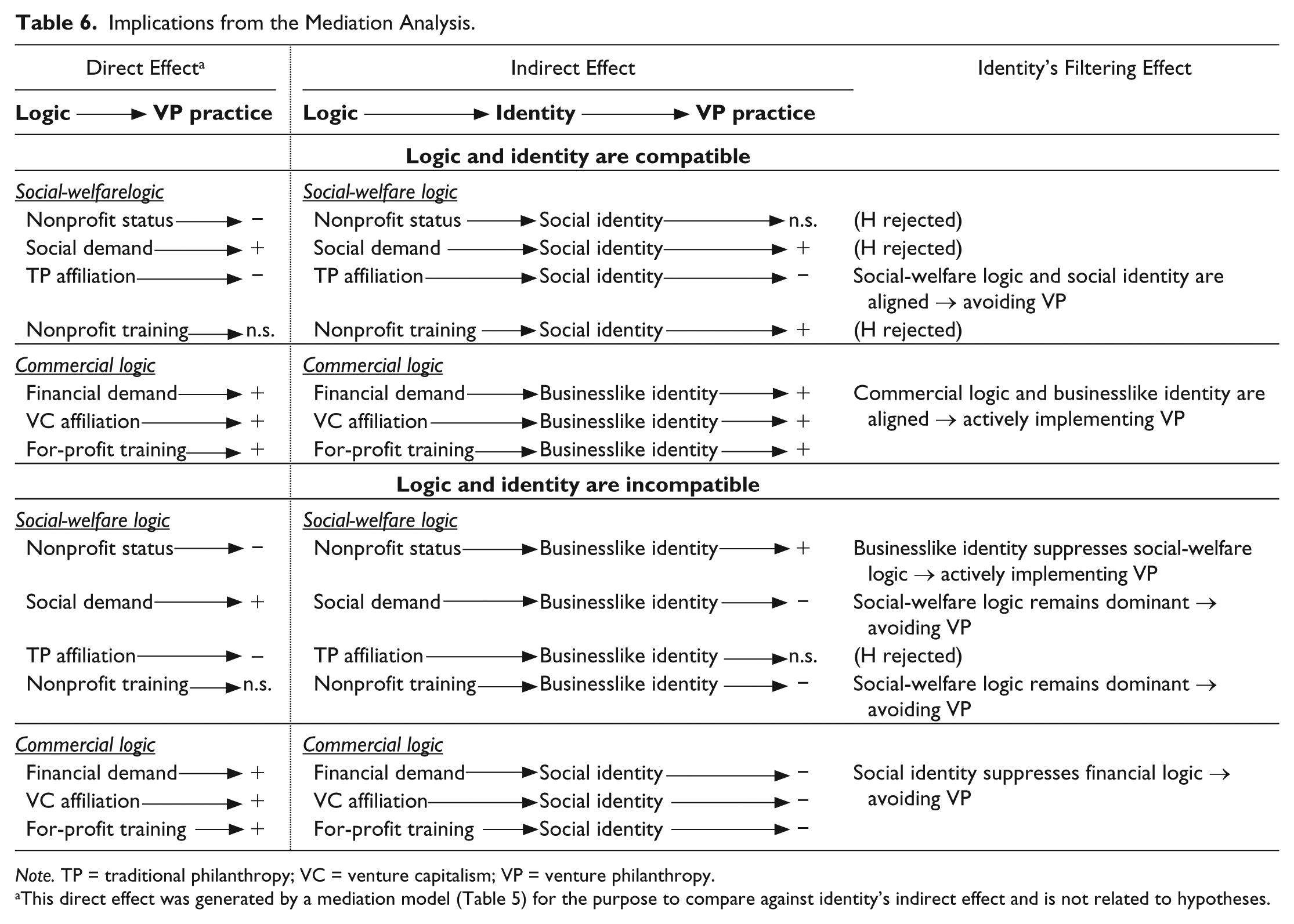
Note. TP = traditional philanthropy; VC = venture capitalism; VP = venture philanthropy.
This direct effect was generated by a mediation model (Table 5) for the purpose to compare against identity’s indirect effect and is not related to hypotheses.
My mediation analysis finds that perceiving compatible values between logic and identity, members of businesslike organizations consistently embrace market-based elements and actively implement VP (positive indirect effects), following the prescription of commercial logic (positive direct effects). However, direct and indirect effects for social identity and social-welfare logic show uneven patterns, indicating social identity’s mediating effects are insignificant when organizations are already deeply embedded in the philanthropic community.
The mediating role of social identity, however, is consistent and consequential when organizations face commercial logic. Analysis of the logic–identity incompatibility offers theoretically intriguing insights. Table 6 shows that while commercial logic promotes VP (positive direct effects), internal forces from social identity consistently suppress external pressures from commercial logic, thereby their organizations avoid active implementation of VP (negative indirect effects). When organizations experience severe tensions between logic and identity, social identity appears to become more enduring than businesslike identity within VP organizations. Consequently, they are less influenced by commercial logic and proceed with what socially oriented members agree on to maintain internal harmony. Standlea (2006) found that long-standing foundations began implementing VP, but eventually curtailed this effort. With findings from this study, we can interpret that the foundations’ well-established social identity was more enduring than influences from growing commercial trends promoting VP. Or, founded by a high-tech entrepreneur, VPP was a forefront organization promoting VP in the early days, but later refined their VP approaches suited for mainstream philanthropy as the organization increasingly viewed itself as part of the nonprofit community.
In contrast, businesslike identity does not always suppress social-welfare logic. Results in Table 6 indicate that although members wanted to portray their organizations as businesslike entities, they could not override pressures from philanthropic donors’ demands, and professional norms that the management team brought from the nonprofit sector (negative indirect effects). Yet, these members could resist constraints associated with nonprofit status (positive indirect effect) against social-welfare logic (negative direct effect). A strong financial identity seems to enable some nonprofits (e.g., Acumen Fund) to defy constraints from social-welfare logic and expand their VP approaches, while many other nonprofits decide otherwise, following the public perception of how nonprofits traditionally operate. Consistent failures to support H1a/H2a (the nonprofit status → social/financial identities) in Table 4 also imply that legal structure might no longer be effective enough to suppress members’ interests in defining their organizations to be businesslike in the hybrid context. Future research should explore conditions in which logic becomes dominant over identity and vice versa.
Limitations and Future Research
As with all social science research, this study has its limitations, which also provide opportunities for future research.
A first theoretical issue concerns causality as founders’ individual identities influence identity construction of their organizations (Pratt & Foreman, 2000). The causality of this study accords with many empirical studies (Battilana & Dorado, 2010; Jay, 2012) as well as theories from organizational scholars (Glynn, 2008; Kraatz & Block, 2008). Still, is there any possibility the causality that this study proposes could be reversed? Might the founders’ individual identity remain influential, driving their organizations to choose elements guided by logic? Could VP practice shape identity rather than identity shaping practice? Potential directions for research, in fact, were pointed out by Thornton et al. (2012), who argued that logic, practice, and identity are loosely coupled and intertwined. As they suggest, directions of causality should be “a matter of empirical investigation and a topic on which we need further research and theoretical development.”
Second, results from the mediation analysis also pose limitations and future research opportunities alike. Many mediation effects in this study were “partial mediations” as both indirect and direct effects were statistically significant; that is, mediation was accompanied by a direct effect. Partial mediations imply the likelihood of an additional omitted mediator in the direct path (Zhao et al., 2010). Thus, future research should consider other mediators as filters of institutional logics.
Finally, I acknowledge data and sample issues of this study; research should improve future data to advance the scholarship. The for-profit sample of my data is disproportionally small. Although this reflects the conditions of the VP field, it hinders us from fully investigating practice patterns between nonprofits and for-profits. A more robust sample of for-profits would allow for deeper investigation. Another major limitation lies in my cross-sectional research design relying on single informants’ self-reported data, which are prone to methodological bias, although this method was widely adopted in previous studies and I also followed suggestions to minimize threats of common method biases. Referring to the type of data used by institutional logic scholars, a third limitation involves a lack of statistical data on historical transitions of social enterprises and VP. Longitudinal statistical data would allow us to advance nonprofit and social enterprise research built on logic perspectives.
Footnotes
Acknowledgements
I would like to thank editor Chao Guo for his guidance and the anonymous reviewers for their constructive feedback throughout the review process. I deeply appreciate invaluable comments I received from Wolfgang Bielefeld, Curtis Child, Michael Lounsbury, Gregory McAvoy, Evelyn Micelotta, Richard Steinberg, Takayuki Yoshioka, and the participants of the University of Missouri–Kansas City 2016 Research Colloquium on Social Entrepreneurship; advice on an earlier version of my work from Dwight Burlingame, Jeffrey G. Covin, and Janet P. Near; and the funding support from Indiana University Lilly Family School of Philanthropy and the William and Flora Hewlett Foundation.
Declaration of Conflicting Interests
The author(s) declared no potential conflicts of interest with respect to the research, authorship, and/or publication of this article.
Funding
The author(s) received no financial support for the research, authorship, and/or publication of this article.