



Abstract
This study examines whether the agency cost component referred to as “residual loss” differs between nonprofit and shareholder-owned microfinance organizations and whether such costs are further influenced by CEO power. We use operating expenses, asset utilization, liquidity, and tangible asset intensity to proxy for residual loss. Using 374 microfinance organizations located in 76 countries, we find evidence that the residual loss is higher in microfinance organizations incorporated as nonprofits, but only if the CEO is powerful. Our empirical evidence illustrates the importance of installing proper governance mechanisms to minimize costs caused by high managerial power in the nonprofit sector. When CEOs are not powerful, nonprofits appear to have lower residual loss than for-profit organizations do, consistent with a motivated agent perspective. An important message of our study is that traditional agency theory perspectives might be ill-suited to analyze residual loss as a function of the nonprofit versus for-profit organizational form.
Introduction
Are agency costs in the form of residual losses higher in nonprofit organizations (NPOs) compared with shareholder-owned organizations? In the governance literature, the NPO is often presented as an inferior organizational form compared with the shareholder-owned organization. In this article, we test this assumption. Moreover, we test whether residual losses are influenced by the power of the CEO.
To test our research questions, we use data from the microfinance industry. Microfinance organizations (MFOs) provide banking services for low-income families and entrepreneurs (Hudon & Meyer, 2016). The microfinance sector aims to reduce poverty by offering microloans, insurance, and saving services. Providers of these banking services are traditionally incorporated as shareholder firms (SHFs; commercial banks and nonbanking financial institutions) or not-for-profit firms (ownerless firms: nongovernmental organizations [NGOs]; or member-owned firms: cooperatives and credit unions; Servin, Lensink, & van den Berg, 2012).
These different types of ownership operating within the same industry provide a distinctive setting to test whether ownership type affects agency costs, in our case residual losses, of organizations (Ben-Ner, Hamann, & Ren, 2018; Duggan, 2000; Servin et al., 2012). Moreover, CEO duality (same person being the CEO and the president of the board) is a common occurrence in the microfinance industry; thus, managerial power is a potentially important additional dimension in the analysis of agency costs (Galema, Lensink, & Mersland, 2012).
Agency costs are known to stem from the separation of ownership from management (Fama & Jensen, 1983; Hansmann, 1996) and originate because managers take actions that are difficult or impossible for stakeholders to observe. This issue is called the hidden action problem (e.g., Steinberg, 2010) and is often referred to as moral hazard. Ownership theory predicts differences in agency costs between ownerless NPOs and firms owned by shareholders because owners in SHFs have better control mechanisms to protect their interests (Hansmann, 1996). An alternative but related line of reasoning is that NPOs “may not care sufficiently about cost minimization because financial surplus cannot be distributed” (Steinberg, 2010, p. 102). However, studies in microfinance find minimal performance differences between nonprofit and shareholder-owned MFOs operating in similar markets (Mersland & Strøm, 2008), which is somewhat puzzling and motivates the research of this article. Another motivation for the study of agency costs is the relatively high frequency of powerful CEOs in the microfinance industry; differences in agency costs may not only stem from differences in ownership incorporation but could also be related to the CEO’s discretionary power.
According to the traditional Jensen and Meckling (1976) definition of agency costs, these costs can be decomposed into three components: monitoring expenditures, bonding expenditures, and residual loss. The residual loss component is the cost incurred if an agent uses a company’s resources for his own benefit—despite implemented monitoring and bonding mechanisms. In our study, residual loss is defined as costs associated with management diverting resources for personal gain (e.g., consuming a perquisite excessively or overstaffing to secure an “easier life” for the CEO) that would otherwise have been used to grow the firm or been distributed to its owners as dividends. The residual loss is an often-ignored aspect of agency costs, most likely because this loss is notoriously difficult to measure. Residual loss cannot be identified directly from the financial reporting of a firm or organization. In practice, residual loss components can be part of several cost items reported in an accounting statement. Therefore, proxy variables expected to be correlated with the underlying, “true,” residual loss are needed. Nonetheless, we consider the analysis of residual loss important: the generally poorer governance structures of nonprofit enterprises (Hansmann, 1996) can make this component considerable. Moreover, residual loss can be a costly consequence of managerial power because powerful managers might be able to extract rent (see, for example, Bebchuk & Fried, 2003). Overall, we believe residual loss is an underinvestigated area in the research on NPOs, and we therefore devote our study exclusively to this component of agency costs. We operationalize residual loss through four metrics: operating expenses, asset utilization, liquidity, and tangible asset intensity.
Generally, although there is already voluminous empirical evidence—concerning both nonfinancial firms and commercial banks—about the relationship between ownership form and agency costs, we have little knowledge of such relationships within hybrid organizations with multiple objectives, of which MFOs are an important example (Ang, Cole, & Lin, 2000; Frank & Obloj, 2014). Within the microfinance industry, both SHFs and NPOs are considered mission-oriented organizations. Nevertheless, also within this sector, Mersland (2009) suggests that ownership practices and market contract costs differ between SHFs and NPOs. Unfortunately, empirical evidence on the relationships between ownership type, CEO discretionary power, and all aspects of agency costs for MFOs is virtually nonexistent. Understanding such relationships is important for practitioners and policy makers seeking to improve both the financial sustainability and the effect on poverty eradication of the microfinance industry.
According to Hansmann (1996), the nature of markets should define whether nonprofit or shareholder organizations will become dominant. In markets in which there is an increased risk of clients being exploited, and in which competition is limited not-for-profit, “ownerless” firms enjoy an advantage. Hansmann’s (1996) line of reasoning can be applied to the microfinance industry. Economically speaking, low-income families in need of banking services have little negotiation power, and the competition among MFOs in most markets remains weak (Mersland, 2009). Moreover, donors constitute a significant share of MFOs’ funding and prefer donating to nonprofit firms (Ledgerwood, Earne, & Nelson, 2013). There is thus a strong theoretical explanation for the existence of nonprofit microfinance providers.
For nonprofit firms and similarly for shareholder corporations, agency costs in the form of residual loss are a major concern. Greed or idleness rather than altruism can be a driver of agents’ behavior, including in NPOs. In fact, the advantages that nonprofit MFOs might enjoy with respect to contracting in the market could be outperformed by larger residual loss compared with shareholder MFOs due to weaker governance structures in the former (Mersland, 2009). Furthermore, the theoretical benefits of adopting a nonprofit ownership form in the microfinance market are expected to decrease in the coming years as competition increases. Thus, public regulators are increasingly demanding customer-protection measures. Similarly, donors constitute a steadily decreasing proportion of MFOs’ funding (Ledgerwood et al., 2013), and MFOs often need a shareholder structure to attract investors. Thus, overall, if agency costs for nonprofit MFOs are higher than for shareholder MFOs, we can most likely expect shareholder MFOs to achieve a larger share of the microfinance market (at the cost of nonprofit MFOs) in the years to come. The first research question of our study, whether agency costs in the form of residual loss are higher for nonprofit MFOs compared with shareholder MFOs, should therefore be relevant for policy makers and microfinance practitioners.
This point is also true for our second research question—whether agency costs in the form of residual loss for MFOs are influenced by the CEO’s discretionary power. According to empirical evidence from commercial banks, managers with superior firm-specific human capital engage in excessive consumption of perquisites (Frank & Obloj, 2014). However, until now, few studies of hybrid organizations have established a connection between such residual loss and managerial characteristics. This lack of information is unfortunate because residual loss stemming from managerial power might directly affect an MFO’s ability to fight poverty. An analysis of managerial power and its possible relationship to residual loss should be of interest to microfinance stakeholders such as lenders, donors, and owners and to development organizations. Moreover, we acknowledge that managerial power can interact with ownership type. Thus, this study additionally investigates the combined effects of managerial power and legal incorporation on residual loss (Cornforth & Macmillan, 2016).
In the total sample, we find no evidence of larger residual loss in nonprofit MFOs compared with shareholder MFOs. In fact, the initial analysis indicates lower residual loss among nonprofits. However, when the power of the CEO is considered, the results are reversed; NPOs managed by CEOs who are also chairs of their boards have higher residual losses compared with SHFs. The fact that we initially find lower residual loss among nonprofits than for-profits can be regarded as inconsistent with traditional agency theory; more modern theories of “mission orientation” that regard the manager as a “motivated agent” appear to provide better guidance when the governance structure of a nonprofit MFO is to be developed (cf. Van Puyvelde, Caers, Du Bois, & Jegers, 2012). Nonetheless, in accordance with conventional agency theory, our results suggest that excessive CEO power should be avoided. Overall, from a residual loss perspective, the nonprofit organizational form can be superior to the for-profit organizational form as long as the CEO is not granted excessive power.
Following this introduction, section “Theoretical Background, Hypotheses, and Residual Loss Measurement” presents the theoretical background, the research hypotheses, and the residual loss proxies. Section “Research Design” describes the research design and the data set. Section “Results and Analysis” outlines the results of the empirical analyses. Finally, section “Conclusion” concludes the study.
Theoretical Background, Hypotheses, and Residual Loss Measurement
Hypothesis Development
Our hypotheses are developed from a traditional principal–agent perspective (Alchian & Demsetz, 1972). After presenting the hypotheses, we include an alternative view in which the motivated agent perspective is introduced (Besley & Ghatak, 2005). By doing so, we obtain clear, one-directional hypotheses, whereas, at the same time, we signal that with a different theoretical viewpoint, different results can be expected.
A principal–agent relationship exists when a person or group-controlling authority (the principal) delegates power to the manager (the agent) to be in charge of the daily operations of a firm or organization. Quite often, the relationship is associated with agency problems because agents do not always act in the best interests of principals. Agents perform their duty in an environment that principals cannot fully grasp (Ben-Ner, Ren, & Paulson, 2011). In such contexts, principals apply sets of institutional mechanisms such as board monitoring and incentives that aim at inducing the behavior of agents to fulfill the objectives of principals.
Whereas the owners typically are the principals, and the manager(s) serves as the agent in for-profit organizations, the roles are less obvious in NPOs (cf. Steinberg, 2010). Our point of departure is that the principal in the agency relationship for a nonprofit MFO is the board of directors (Ben-Ner et al., 2011). The board of a nonprofit MFO is largely composed of people from social networks, founders, clients, and development organizations. In contrast to boards in investor-owned MFOs, participation on nonprofit boards is based on volunteerism rather than on financial rewards (Ben-Ner et al., 2011). A traditional view on governance therefore predicts boards of nonprofit MFOs to be less effective compared with boards of shareholder-owned MFOs (Glaeser, 2003; Mersland, 2009). Moreover, easier access to donations in nonprofit MFOs (Mersland, 2009) is another characteristic that can exacerbate agency costs for these MFOs relative to for-profit, shareholder MFOs.
In addition, it is important to keep in mind that the social development goal (i.e., poverty reduction) and the financial sustainability objective of MFOs are often in conflict. Notably, poverty reduction is notoriously difficult to measure compared with the easily observable financial data related to the financial sustainability objective (Armendariz & Morduch, 2010). Nonprofit MFOs, more than for-profit MFOs, can incur excessive expenses because outcomes that relate to the development mission are not easily quantifiable (Freedman & Lin, 2018). Specifically, excessive spending can be camouflaged as a “fight against poverty.” Overall, based on traditional agency theory (Alchian & Demsetz, 1972) and the characteristics of the microfinance industry, we hypothesize that (all hypotheses are formulated as alternative hypotheses to the null hypothesis of no association).
We now move on to a discussion of managerial power. CEOs in the microfinance industry have greater decision-making power because of a complex business model pursuing both social and financial objectives combined with generally weak boards (Galema et al., 2012). Thus, agency costs are likely to prevail over time in this industry because weak governance structures increase the potential for managerial opportunism—managers obtaining personal gain at the expense of shareholders or other stakeholders. Such opportunism, when it exists, might result in unnecessary investments, perquisites, or overpaid staff.
Furthermore, a CEO with a great deal of managerial discretion might unreasonably spend the available firm’s profit on an expansion strategy, staff costs, and other related administrative expenses of the firm (Blair & Placone, 1988). To demonstrate their prestige and satisfaction, at their own discretion, powerful CEOs might spend the firm’s resources on pricey perquisites, unnecessarily frequent journeys and entertainment, and/or unproductive assets (Ryan & Wiggins, 2001).
Overall, weak governance structures, the frequent existence of significant managerial discretion, and opportunities to hide excessive costs such as spending on social performance in the microfinance industry create the potential for managerial opportunism. We therefore hypothesize that
In contrast to ownerless NPOs, Hansmann (1996) argues that shareholder ownership has a potential to reduce managerial opportunism and hence to lower agency costs. Shareholders are generally interested in reducing costs because of their right to residual earnings. Consistent with this reasoning, Ang et al. (2000) find evidence that the ratio of operating expenses to annual sales is lower when a firm’s manager has stock ownership—something that is impossible in NPOs because they do not issue shares. Moreover, board members’ fiduciary duties toward owners and stakeholders are normally stricter and better defined for shareholder organizations compared with NPOs (Hansmann, 1996). In general, boards of NPOs might have few incentives to monitor their managers (Van Puyvelde et al., 2012), whereas boards in SHFs do have a clear incentive to monitor managers.
Thus, ownership theory predicts that shareholders are more likely to induce the alignment of their goals with those of the manager (Hansmann, 1996), even in cases in which the manager is considered powerful. The key argument here is not that the managers of SHFs are less likely to seek power but rather that the possibility to exercise such power is simply lower if an organization has shareholders. Thus, we expect ownership form to interact with CEOs’ discretionary power in the microfinance industry and hypothesize that
We end the hypothesis discussion with a caveat related to both Hypothesis 1 and Hypothesis 2. As mentioned, these hypotheses are developed based on the conventional view in governance research that predicts that the shareholder structure is superior to nonprofit structures concerning reducing agency costs in principal–agent relationships (Alchian & Demsetz, 1972; Hansmann, 1996; Mersland, 2009). However, this conventional view has emerged in traditional industries; it might not apply to the microfinance industry in which NPOs prevail. Actually, we cannot rule out the possibility that the relationship between residual loss and both ownership type and managerial power can be the opposite of what we suggest. According to Besley and Ghatak (2005), mission-oriented organizations such as NPOs are assumed to be staffed with motivated workers, and intrinsically motivated managers in a nonprofit setting might be particularly highly “motivated agents” (also see Ben-Ner et al., 2011).
Thus, we could argue—in a rival alternative hypothesis to the classical entrenchment-based hypotheses often relied on in the academic literature thus far—that NPOs are more committed to fulfilling their missions. This statement could be called the “mission-motivation” hypothesis. According to this view, NPOs have intrinsically motivated managers and should therefore have lower residual loss or, in general, agency costs. Moreover, in this school of thought, the positive association between CEOs’ discretionary power and agency costs should be weaker in nonprofit MFOs than in shareholder-controlled MFOs. These theories have an appealing logic. The idea of applying such other perspectives to nonprofit governance is not new, neither empirically nor theoretically (see, for example, Van Puyvelde et al., 2012), but mission-motivation approaches are less applied in studies of agency costs than is the classical principal–agent theory on which the hypotheses are based.
Residual Loss Measurement
In the aftermath of the classical Jensen and Meckling (1976) article, abundant theoretical research on the relation between agency costs and ownership has been published. However, we agree with Ang et al. (2000) that the actual measurement of agency costs has lagged behind. Ang et al. (2000) provide one of the first studies that aims to measure the magnitude of agency costs, and they use two alternative efficiency ratios that frequently appear in the accounting and financial economics literature: operating expenses scaled by total sales and total sales to total assets. We base our measurement of residual loss on the Ang et al. (2000) study. Although they claim to use the metrics to proxy for total agency costs, we contend that the metrics are more suited to capture the residual loss component of agency costs. For instance, with respect to the operating expenses proxy, Ang et al. (2000) maintain that the variable “captures excessive expenses including perk consumption” (p. 82). Regarding the sales-to-assets ratio, the authors state that this “measure of agency costs is a proxy for the loss in revenues attributable to inefficient asset utilization” (Ang et al., 2000, p. 82). The underlying reasoning behind the choice of metrics reflects the fact that these proxies are designed to capture residual loss rather than bonding and monitoring expenditures.
Acknowledging that the theoretical construct residual loss is difficult to operationalize in empirical investigations, we supplement the conventional metrics of Ang et al. (2000) with two additional residual loss proxies to further test the robustness of our findings. Based on Core, Guay, and Verdi (2006), we propose that liquidity, or what they denote as excess cash, could be correlated with an organization’s residual loss. The key argument is simply that a higher liquidity ratio might provide an avenue for excessive expenditure by management. Finally, inspired by Mester (1993), who studied the savings and loan industry in the United States, we use the level of tangible assets as a residual loss proxy. This variable is designed to capture excessive investment in fixed assets. Investments in fixed assets may reduce the MFO’s investments in its core activity, which is to lend money to economically poor families and their business activities. In addition, a high ratio can allow the management to spend more on perquisites from the available cash flows generated from fixed assets. Overall, we consider it a strength of this study that we collected reliable data for several alternative residual loss proxies (more on this below).
We investigate both nonprofit and for-profit entities, and an important question in empirical agency cost research is whether the same agency cost proxies can be applied for both sets of organizations. The Ang et al. (2000) study analyzes for-profit entities, but their efficiency measures have been used in studies of NPOs as well (for instance, by Callen, Klein, & Tinkelman, 2003). Liquidity (or excess cash) is frequently used in studies of for-profit corporations, but the above Core et al. (2006) reference is a study of nonprofit entities. We are not aware of nonprofit studies applying the tangible asset proxy of Mester (1993), but we include this metric because of its previous use in the savings and loan industry. Although we rely on high-quality studies in our measurement of residual loss, we propose that future research could devote more attention to the discussion of suitable proxies in the nonprofit relative to the for-profit sector. When measuring, for instance, efficiency in NPOs, there is a risk that spending related to the achievement of social performance goals erroneously is interpreted as agency costs. However, to develop new agency cost metrics is beyond the scope of this study, and because few, if any, have studied agency costs in the microfinance industry, we choose to rely on conventional metrics from prior research.
Research Design
Data and Sample
Following the rapid growth of the microfinance industry, an increased need for independent MFO information has led several firms to offer specialized rating assessments of MFOs. These rating assessments are much wider than traditional credit ratings because they claim to be able to measure MFOs’ ability to reach their multiple sets of objectives simultaneously (Reille, Sananikone, & Helms, 2002). Our data set was constructed from these rating reports. We made use of rating reports from the five leading agencies, MicroRate, Microfinanza, Planet Rating, Crisil, and Micro-Credit Ratings International Limited (M-Cril), which are also the ones providing the most comprehensive information.
MFOs requesting to be rated, whether NPOs or SHFs, are normally interested in communicating with impact investors, donors, and other international stakeholders (Beisland & Mersland, 2012). Rating reports include information on a wide range of characteristics, such as governance, management, financial performance, and operations. Importantly, the variables used in this study are identically defined by all five agencies, and it is standard practice to pool the data from these rating agencies in microfinance research (e.g., Hudon & Traca, 2011). The rating reports further reveal that MFOs have relatively similar business models. Thus, our sample should be viewed as homogeneous and one from which meaningful inferences can be drawn.
Three or 4 years of information is typically reported per rating, and several MFOs have been rated more than once. The sample consists of 374 microfinance institutions from 76 countries in the period from 1997 to 2011. The use of the information collected by professional rating agencies addresses the selection bias problem encountered when using self-reported sources of data, for example, those on the MIX (Microfinance Information Exchange) Market website (www.themix.org). Moreover, the sample excludes smaller development efforts (often referred to as “loan funds”), very small cooperatives, and large commercial banks offering microfinance services. Thus, our sample MFOs are typical examples of microfinance providers worldwide.
Dependent Variables
Agency costs in the form of residual loss are not directly observable; therefore, one should be careful in drawing strong conclusions based on individual variables. Thus, as explained above, we include four proxy variables, each unique but significantly correlated (see below), to study the “underlying” residual loss of the MFOs. Obviously, these dependent variables are expected to vary across MFOs for reasons other than organizational form and managerial power. Control variables are included to capture such variation (cf. Ang et al., 2000).
The residual loss proxies are
Operating expenses, defined as total operating expenses scaled by total loan portfolio (cf. Ang et al., 2000)
Asset utilization, defined as the ratio of loan portfolio to total assets (cf. Ang et al., 2000)
Liquidity, defined as the sum of total cash and short-term investments divided by total assets (cf. Core et al., 2006)
Tangible assets, defined as the ratio of net fixed assets to total assets (cf. Mester, 1993).
Independent Variables
NPO (MFO’s ownership form)
We operationalize ownership form with a dummy variable equal to 1 if the MFO is a nonprofit and 0 if it is a shareholder corporation (Mersland, 2009). Following standard practice in the microfinance literature, credit unions, cooperatives, and NGOs are categorized as nonprofits, whereas for-profit MFOs are shareholder-owned commercial banks and nonbanking financial institutions (Galema et al., 2012). Galema et al. (2012) thoroughly describe the differences between nonprofit and for-profit MFOs. Here, we only summarize the main points: for-profit MFOs may distribute profits to owners, their governance is tied to ownership, they have clearer fiduciary duties, and they have more-explicit financial performance goals. Beisland and Mersland (2014) conclude that for-profit MFOs have more advanced governance structures than do nonprofit MFOs. Notably, none of the SHFs in our sample are listed. In fact, very few MFOs worldwide are publicly listed. We hypothesize a positive association between nonprofit ownership and residual loss; see Hypothesis 1. Hence, we expect a significantly positive coefficient on the NPO variable when residual loss is measured through operating expenses, liquidity, and tangible assets, and a significantly negative coefficient when residual loss is measured through asset utilization.
CEO duality (CEO power)
CEO power is not observable, but we follow prior microfinance literature and measure the power of the CEO with a dummy variable equal to 1 if the CEO is also the chairperson of the board, and 0 otherwise (Galema et al., 2012). This binary variable implies greater managerial power because the board is less independent with such CEO duality (Galema et al., 2012). Moreover, such a duality affords a higher discretion to the CEO concerning decision-making and the human resources of an organization, for instance, concerning staff recruitment and the appointment of members of the board of directors (Krause, Semadeni, & Cannella, 2014). We hypothesize a positive association between managerial power and residual loss; see Hypothesis 2a. Hence, we expect a significantly positive coefficient on the CEO duality variable when residual loss is measured through operating expenses, liquidity, and tangible assets, and a significantly negative coefficient when residual loss is measured through asset utilization.
Interaction variable
To study Hypothesis 2b, we apply an interaction variable to examine the relationship between CEO power and ownership form with respect to residual loss for MFOs. Specifically, CEO duality × NPO is equal to 1 if an MFO is an NPO and its CEO is also the chair of the board (0 otherwise). We hypothesize a positive association between the interaction variable and residual loss; see Hypothesis 2b. Hence, we expect a significantly positive coefficient on the interaction variable when residual loss is measured through operating expenses, liquidity, and tangible assets, and a significantly negative coefficient when residual loss is measured through asset utilization.
Control Variables
The control variables are intended to control for systematic differences between the investigated entities; they cover the characteristics of the MFOs, their markets, and country-level geographical location. We would like to highlight that we include several governance-related control variables to capture differences in other components of agency costs, which may be correlated with residual loss. Specifically, we control for the following features.
Stakeholder representation on the board can influence agency costs (Mersland, 2009) and is measured as a dummy that equals 1 if the board has one or more representative(s) from donors, employees, or clients, and 0 otherwise (Galema et al., 2012).
Board size
Larger boards, and occasionally particularly small boards, can be ineffective in monitoring the firm’s management (Galema et al., 2012). We measure board size as the total number of board members. (Note that the possible nonlinear effect of board size has been tested for in our study [unreported], with no effect on the reported results.)
Internal auditor
An internal auditor who reports directly to the board (dummy variable) is likely to be a good means of monitoring and limiting the possibly opportunistic behavior of a CEO (Beisland, Mersland, & Randøy, 2014).
Creditor and the respective country’s central bank authority incentives for monitoring the management of MFOs can affect costs (Ang et al., 2000; Mercado-Mendez & Willey, 1995). Hence, we use the following variables to control for this aspect. First, we use a dummy variable equal to 1 if the MFO accepts voluntary savings, and 0 otherwise. The second variable is leverage, measured as the ratio of total debt to total assets. The third measure is bank regulation, a dummy variable equal to 1 if the MFO is placed under the relevant country’s bank regulation, and 0 otherwise.
Urban lending
Focusing on urban or rural markets can lead to differences in the MFO’s costs (Hannan & Mavinga, 1980). Hence, we control for such geographic focus using a dummy variable equal to 1 if the lending market focus is urban, and 0 otherwise (Galema et al., 2012).
MFO size is measured as the natural logarithm of total assets to capture economies of scale (Blair & Placone, 1988).
Average loan size
The literature on MFOs indicates that small loan size (Armendariz & Morduch, 2010) is associated with higher transaction costs. Thus, we control for the average loan size measured as the natural logarithm of the loan portfolio divided by the number of active credit clients.
MFO age
Experience can reduce costs; hence, we control for the MFO’s age (Ang et al., 2000).
Human development index
Because our data include MFOs from different countries, we also control for macroeconomic factors that can affect costs due to differences in the price of inputs across MFOs’ markets (Arnould, 1985). Therefore, we use the human development index, which, among other country-specific factors includes gross domestic product per capita, to account for price differences of inputs.
Regional and year controls
We control for macroeconomic factors using indicator variables for the regions of Africa, East Asia and the Pacific, Eastern Europe and Central Asia, Latin America and the Caribbean, Middle East and North Africa, and, finally, the region of South Asia (Galema et al., 2012). In addition, we control for years using indicator variables.
Method
To examine the relationship between MFO type, CEO power, and residual loss in a multivariate setting, we apply panel data methods, using random-effect regressions (Wooldridge, 2010). This approach is consistent with Singh and Davidson (2003), who have used the random-effect regression method to investigate agency costs and ownership structure. Notably, the presence of time-invariant binary dummy variables does not allow us to apply fixed effect regressions. In our data, the dependent variable (proxy for residual loss) is repeatedly measured within each MFO on an annual basis. Hence, we cluster the model at the MFO level to account for possible correlations in panels (Baltagi, 2008). The following is the general random effects model:

where
The dependent variable y is the residual loss metric, and we run one regression for each of our four proxies. The explanatory variables, the x vector, consist of test variables and control variables. The four regressions are run for each hypothesis. The control variables are the same in all analyses, but the test variables vary. Specifically, the test variables include a binary variable for nonprofit versus for-profit MFOs (Hypothesis 1), a measurement of CEO power, that is, CEO duality (Hypothesis 2a), and the interaction of these two variables (Hypothesis 2b). The control variables are to capture variations in our agency cost proxies that are not caused by differences in the test variables. However, because MFOs in a few cases can change their ownership form (D’Espallier, Goedecke, Hudon, & Mersland, 2017), this variable is a “choice variable”; hence, we cannot rule out an omitted variable bias. We perform several robustness tests to address this issue. First, in the test of Hypothesis 1, we follow a procedure outlined by Roodman (2009), in which a one-step system GMM that includes the 1-year lagged dependent variable is applied. Next, we follow Glejser’s (1969) two-step procedure for a heteroscedasticity test to investigate our second hypothesis. All of these untabulated robustness tests provide similar results to the main analysis and therefore are not further referred to in the rest of this study.
Descriptive Statistics
Panel A of Table 1 reports summary statistics for the dependent variables. On average, operating expenses constituted 30% of the loan portfolio. In our sample, the mean size of the loan portfolio, liquidity, and fixed assets were 74%, 17%, and 5%, respectively, when measured relative to total assets.
Summary Statistics.

Note. NPO = nonprofit organization; MFO = microfinance organization.
Panel B of Table 1 shows summary statistics for the independent variables. First, we should note that 16% of the MFOs in our sample were headed by CEOs who also chaired the board. Even when this number is dramatically higher than in other commercial, financial service industries, the relatively low proportion (in absolute terms) of dual CEOs makes it more difficult to observe statistically significant results; in fact, observing any significance would imply conservative results (Galema et al., 2012).
Next, Panel B shows that 58% of the MFOs in the sample were nonprofits and 63% had at least one representative from donors, clients, or employees sitting on the board, which on average had seven members. Thirty-three percent of the sampled MFOs had an internal auditor who reported directly to the board, and 23% collected deposits from the public. The leverage variable indicates that 59% of the total assets were financed with debt. Banking authorities regulated 28% of our MFOs, whereas 30% of the MFOs in the sample focused their activities on the urban market only. The average total assets were approximately US$11 million, and the average loan size was US$716. On average, the entities had 11 years of experience with microfinance services, and the human development index score was 62%, indicating that our sample generally involved MFOs in low- and middle-income countries.
Panel B indicates that most of the MFOs in our sample are located in Latin America and the Caribbean—42%, whereas the region of the Middle East and North Africa has the least MFOs in our sample—5%.
Panel A of Table 2 presents the correlation matrix for our explanatory variables. Correlation coefficients’ moderate levels are confirmed by an analysis of variance (ANOVA) inflation factor (not reported). Multicollinearity is thus not considered a problem.
Correlation Matrix: Panel A: Explanatory Variables.
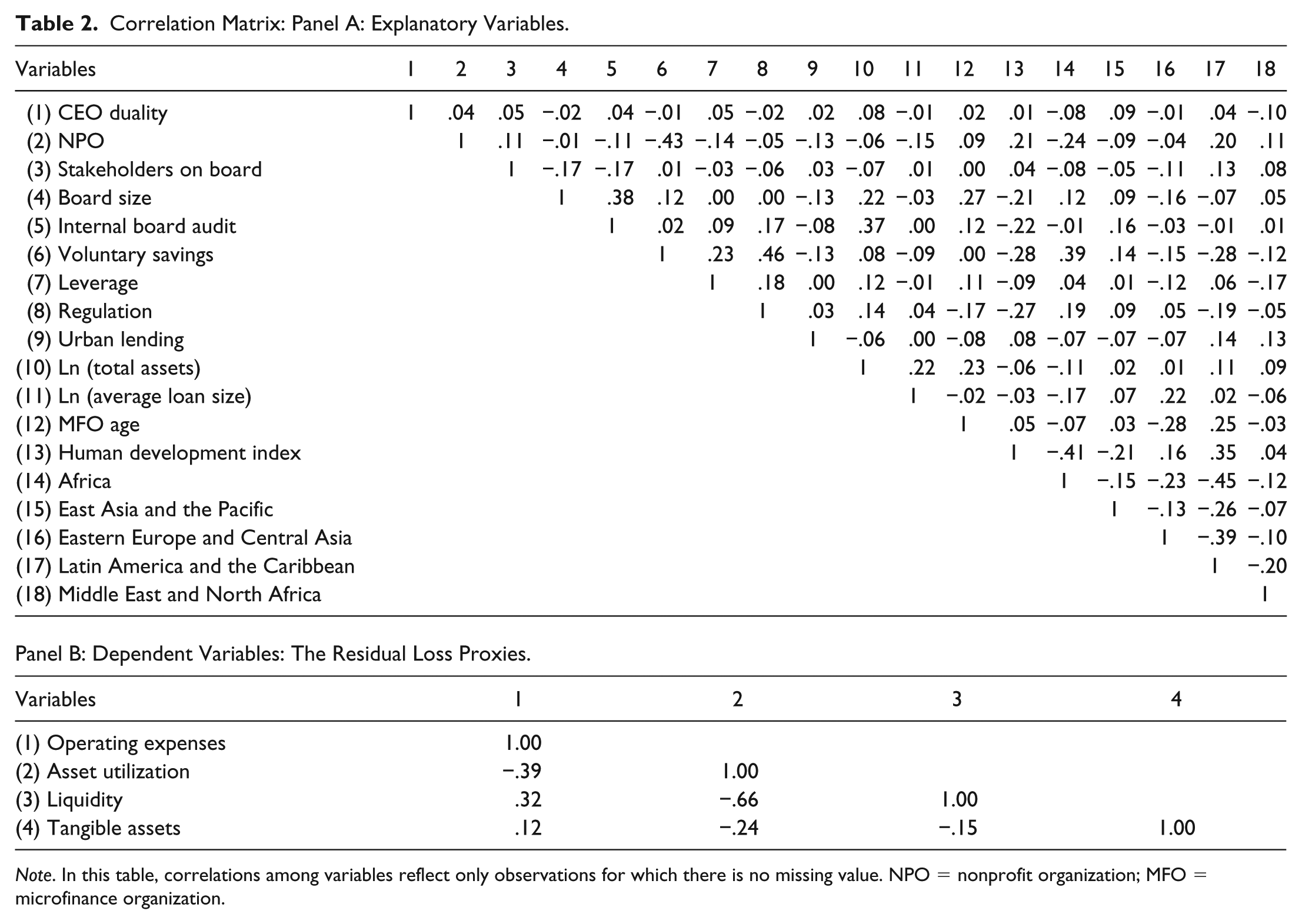
Note. In this table, correlations among variables reflect only observations for which there is no missing value. NPO = nonprofit organization; MFO = microfinance organization.
Panel B shows not only that the metrics for residual loss are highly correlated (p < .01—not tabulated) but also that they capture different aspects of the residual loss component of agency costs. On a stand-alone basis, the metrics are imperfect proxies, and we therefore maintain that we must examine aggregate results to draw conclusions. Note that higher asset utilization is expected to be associated with lower residual loss—hence the negative coefficients with the other proxies.
Results and Analysis
Residual Loss as a Function of Ownership Status
In Table 3, we test the relationship between residual loss and MFO ownership status in a dynamic panel data setting.
Random Effects Regression: Residual Loss as a Function of Microfinance Nonprofit Organization Status.

Note. In this table, we report coefficients. Robust z statistics clustered at the MFO level are given in parentheses. NPO = nonprofit organization; MFO = microfinance organization.
,**, and * denote .01, .05 and .1 significance levels, respectively.
We are only reporting on the full models, including all control variables. Nevertheless, to test the stability of the results, we also introduced the explanatory variables successively (unreported). In all tests, our results appear to be stable and robust to different regression specifications and a varying number of observations.
In Model 1, we observe a significantly negative association between microfinance NPO status and operating expenses. The traditional view has been that residual loss is higher in NPOs. However, our findings are consistent with the “mission-motivation hypothesis” (Besley & Ghatak, 2005); NPOs might be more committed to fulfilling their mission, and this dedication to the mission has a positive effect on the level of operating expenses.
Model 2 shows that asset utilization has a significantly positive association with MFOs’ nonprofit status. The higher asset utilization rates might suggest that NPOs deploy their assets more efficiently to grow their loan portfolio. In Model 3, we observe a significantly negative association between liquidity and nonprofit status.
Thus, the first three residual loss proxies, studied in Models 1 to 3, all provide identical results; agency costs as measured by residual losses appear to be lower in NPOs than in SHFs. Only Model 4 reports results consistent with Hypothesis 1, indicating that the absence of residual claimants in NPOs might encourage the acquisition of more fixed assets (Mester, 1993).
Overall, three of four proxies suggest higher residual loss in SHFs than in NPOs, in contrast to Hypothesis 1. In accordance with the conventional firm-ownership literature, we argued that the nondistribution of retained earnings, less strict fiduciary duties, and access to donations in nonprofit MFOs were characteristics, among others, that might exacerbate residual loss. However, the results concerning operating expenses, liquidity, and asset utilization metrics provide support for the alternative mission-motivation hypothesis; in other words, NPOs incur less residual loss because they are more aligned with their missions (Besley & Ghatak, 2005). Their managers might be intrinsically motivated, leading to less severe agency problems in NPOs (e.g., Ben-Ner et al., 2011), an issue discussed in more detail below. Overall, this empirical evidence suggests that microfinance NPOs might be more committed to fulfilling their social missions (e.g., curtail operating expenses and grow loan portfolio) than are microfinance SHFs.
These results should prove interesting to microfinance stakeholders and practitioners and to governance and ownership scholars. Our findings instructively illustrate how the relationship between the for-profit versus nonprofit dimension and residual loss can be highly influenced by the mission of the firm (Battilana & Dorado, 2010). From a theoretical point of view, our findings support Steinberg (2010) and others claiming that the starting point of conventional principal–agent theory that agency costs are higher in NPOs than in SHFs might be premature and “. . . neglects other factors that motivate nonprofit boards to perform well” (Steinberg, 2010, p. 113). It appears essential to consider ideas of intrinsic motivation and mission alignment in addition to traditional agency theory approaches when analyzing the role of agency costs in NPOs.
We stress that our focus on residual loss does not capture all aspects of agency costs. Effective monitoring and bonding also come at a cost. If such costs are higher for nonprofit MFOs than their for-profit counterparts, total agency costs might not be lower for the nonprofits. However, given the conventional view that for-profit, shareholder organizations have implemented stronger governance structures; this possibility might not be particularly probable. Nonetheless, as discussed in the “Conclusion” section, more research on all components of agency costs is called for.
Residual Loss as a Function of Both CEO Power and Ownership Status
In Table 4, we test the association between managerial power and residual loss.
Random Effects Regression: Residual Loss as a Function of CEO Power.

Note. In this table, we report coefficients. Robust z statistics clustered at the MFO level are given in parentheses. MFO = microfinance organization.
,**, and * denote .01, .05 and .1 significance levels, respectively.
With respect to CEO duality, Table 4 presents strong and consistent results. In accordance with Hypothesis 2a, a high level of managerial power appears to be associated with increased residual loss in the total sample of MFOs. MFOs with CEO duality have higher operating expenses, higher liquidity, and more tangible assets. In addition, asset utilization is lower. Overall, therefore, we obtain solid support for Hypothesis 2a that increased managerial power—when evaluated in isolation—is associated with higher residual loss. The results are a good fit with traditional expectations based on agent theory.
Nevertheless, results that are even more interesting emerge when CEO power is interacted with ownership status (see Table 5). Here, we find no evidence that CEO duality is associated with higher residual loss in SHF. However, we find a positive association in NPOs between managerial power and operating expenses, liquidity, and tangible assets. In addition, asset utilization appears to be poorer when the CEO is also the chair of the board. All results are consistent and point in the same direction; CEO duality appears to be associated with excessive residual loss when MFOs are incorporated as NPOs.
Random Effects Regression: Residual Loss as a Function of CEO Power and Microfinance Nonprofit Organization Status.

Note. In this table, we report coefficients. Robust z statistics clustered at the MFO level are given in parentheses. NPO = nonprofit organization; MFO = microfinance organization.
,**, and * denote .01, .05 and .1 significance levels, respectively.
To summarize, the negative effect of managerial power is thus limited to NPOs in the microfinance industry. The most likely explanation is that shareholders of SHFs set up better agency cost-mitigating governance mechanisms in comparison with what stakeholders do within NPOs. Thus, the main message coming out of these results is that stakeholders of NPOs should avoid handing over too much power to CEOs. When evaluated in isolation, the nonprofit organizational form appears to be associated with lower residual loss and we can therefore not conclude that SHFs are preferred to NPOs in the microfinance industry. NPOs’ motivation for mission accomplishments appears to restrict residual loss, but excessive managerial power appears to limit the gain. In practice, this point implies that NPO stakeholders must install better governance in the organizations in which they have a stake. Although a microfinance study of agency costs resulting from a high level of managerial power has not previously been conducted, our results are consistent with the study of Galema et al. (2012), which, in general, found evidence that the financial performance of microfinance NPOs (as measured with return on assets [ROA]) was worse when the CEO was also the chairperson. Our study suggests that costs associated with management diverting resources for personal gain (directly or indirectly, for example, in the form of consumption of excessive perquisites) might explain the results of Galema et al. (2012).
We conclude the empirical section by summarizing an untabulated robustness test. Residual loss can come in several forms; pricey perquisites are one example, and overstaffed MFOs or overpaid employees are another. The multiple and divergent types of residual loss that exist can lead to operating expenses being a crude measure for such loss, simply because too many cost components are gathered in one item. Inspired by, for example, the study of nonprofits of Callen et al. (2003), we have split operating expenses into their two underlying components; administrative expenses and personnel expenses. Personnel expenses is the sum of all staff-related costs, whereas administrative expenses cover all nonstaff operating costs including depreciation. The results on this untabulated test mirror those presented; both administrative expenses and personnel expenses are significantly negatively associated with the NPO variable, significantly positively associated with the CEO/chair variable, and significantly positively associated with the interaction of these two variables. These results illustrate that residual loss in MFOs most likely come in different forms and should motivate future research to investigate more deeply the specific drivers of the loss.
Conclusion
In this study, we test the common assumption that agency costs in the form of residual loss are higher in NPOs compared with shareholder-owned organizations. Moreover, we test whether organizations managed by powerful CEOs experience higher residual loss. Finally, we test whether there is a difference between a powerful CEO managing an NPO and a powerful CEO managing an SHF. These questions are theoretically interesting because the NPO is often presented as an inferior organizational form compared with the SHF in the conventional principal–agent literature (Hansmann, 1996). Lately, however, alternative theories have emerged, indicating that agents in NPOs can be intrinsically motivated, which should result in relatively lower residual loss in such organizations (Besley & Ghatak, 2005). Using data from the microfinance industry, we find that NPOs experience lower residual loss compared with SHFs. However, if their CEOs are too powerful (i.e., they are also the chairs of the boards), then the residual loss is higher in NPOs compared with SHFs. Thus, the evidence shows that NPOs can be efficient providers of microfinance services if the CEO is not granted excessive power. Accordingly, the role of stakeholders in NPOs should not necessarily be to transform NPOs into SHFs (D’Espallier et al., 2017) but rather to limit the power of the CEO.
Notably, our study illustrates that an important challenge in analyzing the functioning and governance of NPOs lies in applying agency theory together with other perspectives (cf. Van Puyvelde et al., 2012) such as the motivated agent or mission alignment perspective. Monitoring is important in both NGOs and for-profit organizations, but the choice of specific governance mechanism might be dependent upon whether the monitoring is founded on a traditional principal/agent framework or a motivated agent point of view. For example, there can be significant difficulty in applying agency theory–based control mechanisms when managers are intrinsically motivated because, in this case, a too strong focus on implementing these mechanisms can crowd out intrinsic motivation or reduce work effort. We see this as an interesting avenue for future research. Specifically, we believe in-depth studies of management behavior are needed to further investigate residual loss in for-profit compared with nonprofit entities, and we propose that case studies and qualitative research approaches may provide valuable new insight into the governance literature.
We conclude the study with caveats. Notably, we measure CEO power with the CEO duality variable. Such a proxy can capture the CEO’s structural power within the organization rather well; however, the proxy might not capture elements of informal power emanating from managerial characteristics due to loci of control, entrenchment level, and/or aspiration level (Krause et al., 2014). Studies that use other proxies for CEO power are therefore needed. Moreover, residual loss is notoriously difficult to measure. We cannot completely rule out the possibility of systematic differences between MFOs that are unrelated to ownership and managerial power but not captured by our set of control variables.
Importantly, our study focuses on agency costs in the form of consumption of excessive perquisites. We do not have good data on agency costs that arise to prevent such consumption, that is, monitoring costs. Although our extensive use of control variables is intended to capture differences in other agency cost components, extensions of agency cost metrics to include direct monitoring costs is undoubtedly an interesting avenue for future research. Moreover, we do not analyze agency costs borne directly by the stakeholders (i.e., costs that cannot be measured based on MFOs’ official reporting). Future studies should also seek to address this aspect. Likewise, further research on proxies for agency costs in NPOs is needed and may draw upon some of the ideas we mention in this article.
Finally, we also note that the direction of causality is not obvious in our study. Cost-efficient organizations with moderate levels of assets might attract a certain type of manager. Although our test methodology, high-quality control variables, and robustness analyses seek to address this issue, we cannot ignore the fact that reverse causality might represent a challenge in studies such as ours. In any case, we have observed statistical relationships that should prove interesting to both academics and practitioners and serve as a basis for future research. We would like to stress that all statistical findings can be related to and explained from theory and previous empirical studies in other industries.
Footnotes
Acknowledgements
We would like to thank Editor Chao Guo for his guidance and the anonymous reviewers for their very useful input throughout the review process. We thank the discussant and participants for the comments at the 20th EBES Conference—Vienna, Austria, September 28-30, 2016.
Author’s Note
Daudi Pascal Ndaki is also affiliated to the School of Business, Mzumbe University, Morogoro, Tanzania.
Declaration of Conflicting Interests
The author(s) declared no potential conflicts of interest with respect to the research, authorship, and/or publication of this article.
Funding
The author(s) received no financial support for the research, authorship, and/or publication of this article.
