



Abstract
Local nongovernmental organizations (local NGOs) based in less economically advanced countries suffer from a “liability of foreignness” in attracting international funding: They are geographically, linguistically, and culturally distant from funders in more economically advanced countries. As a result, although U.S. foundations gave 27,572 grants to support programming occurring within less economically advanced countries between 2000 and 2012, only 10.4% went to local NGOs within those areas. We argue that while favoring NGOs in more economically advanced countries minimizes funder-NGO foreignness, or the distance between the foundation and the grantee NGO, it increases NGO-programming foreignness, or the distance between the grantee NGO and the site of their programming, creating crucial trade-offs. We draw upon organizational theory to predict under what conditions U.S. foundations would fund local NGOs, finding that local NGOs receive more support from older foundations and those with greater geographic and program area experience. Furthermore, local NGOs receive larger, longer grants but with lower probabilities of being renewed. These results identify the conditions under which foundations “go the extra mile” and fund local NGOs.
Keywords
Private funders in more economically advanced countries increasingly direct funding overseas. While state governments can be a preferred recipient of international support (Brass et al., 2018), funders also funnel significant support through nongovernmental organizations (NGOs; Aldashev & Navarra, 2018; Smith & Lipsky, 1993). This choice occurs as NGOs are sometimes perceived to be more trustworthy and effective (Cooley & Ron, 2002), given reports of corruption, weak governance, and poor transparency among the governments in less economically advanced countries. Furthermore, NGOs have demonstrated an ability to promote human rights and policy change in complex environments (Murdie, 2009), to build institutions (Hulme, 2009), and to create technical problem-solving networks and epistemic communities (Shiffman et al., 2015). However, which NGOs do funders select?
As practitioners and scholars search for more effective ways to identify and evaluate the highest quality programming (Ebrahim, 2019; Gugerty & Karlan, 2018), our project offers a complementary analysis of the NGO actors themselves. We conceptualize NGOs, not simply as the implementer of a programmatic initiative, but more broadly as a crucial component of domestic capacity to respond to a diverse array of challenges and opportunities for democratization and development (Edwards & Hulme, 1996), particularly in an era of dismantled colonialism and an emerging global civil society (Longhofer & Schofer, 2010). Viewed through this lens, funders’ grantee selection decisions actively shape the population of organizations that constitute civil society within less economically advanced countries (Hammack & Heydemann, 2009; Wiepking & Handy, 2015).
Analyzing NGO actors requires classifying both global economies and NGOs, each tremendously complex endeavors (Gubbay, 2017; Vakil, 1997; Winsbury, 2014). With respect to the former, we rely upon the World Bank’s economic classifications wherein low-income and middle-income countries are included as less economically advanced, and high-income countries are classified as more economically advanced. With respect to the latter, we classify NGOs based upon their relative geographic location vis-à-vis the location of their programming. Restricting our analysis to grants that support programming in less economically advanced countries, we identify four categories of NGOs. First, we use the term “global NGOs” to denote organizations that are headquartered in more economically advanced countries. Second, we use “domestic NGOs” to denote organizations based in the country where the programming is occurring. Third, we use “regional” NGOs to classify organizations based within the geographic region that the programming is occurring. Collectively, we consider both “domestic” and “regional” NGOs to be “local NGOs.” Finally, we classify “transregional” NGOs as those that are based in less advanced economies, but that target beneficiaries outside of their region, in a different less advanced economy. Given their limited prevalence, and unique characteristics, we include analyses of “transregional” NGOs in Appendix A, but focus in this article on “global” and “local” NGOs, disaggregating local NGOs into domestic and regional.
Under what conditions do U.S. foundations mitigate those perceived liabilities and choose to fund local NGOs in less economically advanced countries instead? This question has previously been difficult to investigate for both conceptual and methodological reasons. First, the conceptual apparatus in both organizational theory and nonprofit studies has not provided sufficient guidance for an analysis of transnational work, focusing solely on the assets and liabilities of foreignness between funders and NGOs and ignoring the additional assets and liabilities of foreignness between NGOs and their programming. Second, empirical analyses have not sufficiently disentangled funder preferences for programming in a particular location, as opposed to preferences for NGOs located within a particular location. In the current study, we overcome both of these challenges.
Analyzing 27,572 grants to support programming occurring within less economically advanced countries between 2000 and 2012, we find that local NGOs receive more support from older foundations and those with greater geographic and program area experience. Furthermore, local NGOs receive larger, longer grants but with lower probabilities of being renewed. In the discussion section of the article, we theorize these results by introducing a new facet of foreignness that creates unique liabilities previously unaccounted for in research: NGO-programming foreignness, or the distance between the grantee NGO and the site of their programming. This conceptual contribution complements previous work on funder-NGO foreignness, or the distance between the foundation and the grantee NGO, and provides a new framework for scholars and practitioners to examine the trade-offs that funders face when selecting NGO grantees to undertake transnational work.
Advantages and Liabilities of Foreignness
Philanthropists interested in supporting programming in less economically advanced countries must decide which NGOs to fund. As they make grantmaking decisions, multiple streams of research offer robust evidence for prioritizing local NGOs, organizations based within the countries or regions where the funded programming occurs, given their multiple advantages over their global counterparts (Balboa, 2014; Bebbington & Perreault, 1999; Beckfield, 2008; Brass, 2012; Fowler, 1991; Platteau & Abraham, 2002). First, programming run by local NGOs benefits from contextual knowledge and social capital that arguably increase the efficacy of the programming (Bebbington & Perreault, 1999). Second, strengthening local NGOs has long been considered a crucial component of shifting asymmetrical power relationships between more and less economically advanced countries (Beckfield, 2008; Fowler, 1991; Platteau & Abraham, 2002). Third, some research has found that local NGOs are located in areas with greater need (Brass, 2012), and reinforced by research on global NGOs that has emphasized that more geographically and culturally distant organizations are constrained in their abilities to create sustainable local change (Balboa, 2014).
Finally, notwithstanding the difficulty in calculating NGO population estimates, the number of local NGOs in less economically advanced countries dwarfs the number of global NGOs available to implement programming in these countries, thus eliminating a supply-side restriction of local NGOs (see Brass et al., 2018; in addition, for an example from Russia, see Evans et al. 2006; for an example from India, see Mahapatra, 2014; for an estimate on global NGOs, see Brubaker et al., 2019). Taken together, this body of literature identifies the advantages of local NGOs “foreignness” and suggests that funders would most effectively enact their aspirations to support programming in less economically advanced countries through support for local NGOs based within those regions.
Funders’ grantmaking patterns fail to support this hypothesis, however. Local NGOs receive a disproportionately smaller share of international funding, when compared with global NGOs. The most recently published analysis identified that only 11.7% of the U.S. funds to support programming overseas went to local NGOs based in the country that the grant was serving (Needles et al., 2018). Funding NGOs in less economically advanced countries at such a low rate may reinforce existing global power inequities by diverting significant aid dollars toward more economically advanced countries (Beckfield, 2010). These patterns can result in the field of international grantmaking recipients becoming increasingly centralized and unequal, exacerbating social stratification in a process that some scholars classify as an “allocative failure” (Kallman, 2017).
Despite the shortcomings of this approach to international grantmaking, organizational scholarship provides a host of explanations for why it occurs. First, organizations almost always face some uncertainty due to incomplete information about potential collaborators (Podolny, 1994). Furthermore, organizations are driven, at a basic level, to reduce uncertainty in critical areas of operation (Meyer & Rowan, 1977; Powell & DiMaggio, 1991). Therefore, with less information about potential partners, transaction costs increase and the likelihood that decision-makers will select those partners decreases (Schildt & Laamanen, 2006).
Compounding the general uncertainty of partner selection, international grantmaking layers additional uncertainty resulting from cultural and institutional differences (Hofstede, 2001; Reus & Lamont, 2009). Furthermore, geographic distance increases the cost of seeking and integrating knowledge (Borgatti & Cross, 2003) and reduces the quality and the flow of information (Jaffe et al., 1993). And finally, uncertainty is exacerbated when partners do not share a common language (Boli & Thomas, 1999; Clark & Smith, 1979; Laurent, 1983). Collectively, scholars refer to these social costs of doing business abroad as the “liability of foreignness” (Zaheer, 1995). In addition, some organizations also face a “liability of origin,” wherein organizations originating from stigmatized regions carry negative perceptions or stereotypes (Amankwah-Amoah & Debrah, 2017).
In contrast, global NGOs based within more economically advanced countries likely receive the vast majority of grants from U.S. foundations because they are more culturally and linguistically similar (Collet & Philippe, 2014; McPherson et al., 2001), they operate on a timeline concomitant with funder expectations (Platteau & Gaspart, 2003), and they exhibit norms of managerialism that appeal to donor interests (Roberts et al., 2005; Suárez, 2010). All of these features mitigate perceptions of a liability of foreignness, leading to a grant environment that favors these more proximal global NGOs located within wealthy countries.
Although funders overwhelming support global NGOs, this paper examines under what conditions U.S. foundations are able to mitigate perceived liabilities of foreignness and choose to fund local NGOs in less economically advanced countries instead. We investigate under what conditions funders prefer to support organizations that are more geographically proximate and culturally similar to themselves, thus selecting global NGOs in the effort to minimize the “liability of foreignness” and under what conditions they prefer to support NGOs that are based more proximally to where the work is occuring, thus selecting local NGOs. We now review literature that hypothesizes how different facets of foundation experience and grant design influence when and how U.S. foundations fund local NGOs in less economically advanced countries.
Mitigating the Liability of Foreignness
Funder Experience
All grantmaking decisions are made with limited, vague, and unreliable information, thwarting funders’ efforts to accurately differentiate between potential grantees (Galaskiewicz & Wasserman, 1989; Grønbjerg et al., 2000; Paarlberg et al., 2017). Furthermore, the potential future success of a recipient NGO is difficult to predict (Grønbjerg et al., 2000). Finally, evaluating the efficacy of programming that is intangible and long-term is complex and ambiguous, exacerbated by the fact that foundations are not the direct consumers of NGO services (Leat, 2006; Paarlberg et al., 2017). Amid these multiple challenges, however, foundations make decisions to fund particular NGOs, while others are left unfunded.
Research has identified that both “hard” and “soft” information provide data that reduce uncertainty and therefore aid in this decision-making process (Liberti & Petersen, 2018). Hard information in a grantmaking context consists of standard performance metrics (i.e., reports and disclosure statements, performance assessments and evaluations, and social audits), which are easier to transmit across long distances. This hard information serves as reassuring signals of NGO quality (Ebrahim, 2003), thus decreasing transactional uncertainty (Jenkins, 1998; Ottaway & Carothers, 2000). Global NGOs are more likely to have the training, capacity, and managerial norms that enable them to collect and transmit hard information, as compared with their local NGO colleagues, thus reducing the latter group’s visibility to funders (Hwang & Powell, 2009).
Alternatively, soft information (i.e., vision, motivation, goals, expectations, ideas, opinions, and team dynamics) is context-specific, difficult to quantify, easily distorted at a distance, and particularly difficult to attain in the early stages of a grantmaking relationship. Over time, however, foundation decision-makers can build a repertoire of soft information that mitigates perceptions that foreignness is a liability, instead highlighting the potential advantages (March & Simon, 1958; see Golledge & Stimson, 1997, for a synthesis). Building on prior research, we identify three forms of experience that foundations may draw upon to build this repertoire of soft information and, thus, mitigate the liability of funding a local NGO.
Grantmaking experience
Through experience with grantmaking over the years, foundations improve their information-gathering ability (Green & Cromley, 1984) and their selection skills (Bruton et al., 1994). The gradual accumulation of grantmaking experience can lead to greater domain-specific knowledge, networks, and heuristics that can assist in navigating unfamiliar domains. Moreover, with increased grantmaking experience, foundations generate routines that help them assess information regarding distant grantees, judge the value of grantees’ resources, and assess how a grantee fits within their own strategy. Given that local NGOs are often advantageous in achieving long-term impact, we assume that foundations with more grantmaking experience will have more opportunity and motivation to fund local NGOs. Thus, we hypothesize the following:
Geographic experience
Likewise, organizations with a history of working in a particular geographic region develop a familiarity that increases their comfort and helps them differentiate between real and perceived risks. Examining geographically distant decision-making in the for-profit domain suggests that as organizations gain direct experience in a particular region, they can combat the uncertainty that encourages a risk-averse, more proximal geographic search (Baum et al., 2000; Delios & Henisz, 2003). Foundations can similarly accumulate knowledge about the political climate and cultural norms, as well as basic linguistic skills, which reduce the risks of funding local NGOs. In contrast, foundations lacking those experiences may be more inclined to fund grantees that are headquartered in more economically advanced countries and who serve as a more comfortable intermediary. Hence, we hypothesize the following:
Program experience
Foundations with greater experience in a specific program area also develop soft information regarding legitimate and effective interventions that can reframe local NGO’s “foreignness” as an advantage, rather than as a liability. As foundations develop more experience implementing grants to support a particular programmatic focus, we anticipate that this deepened technical expertise will encourage partnering with local NGOs to implement grants within that programmatic area. Some research has identified an exception to this trend, wherein grantmaking to support policy advocacy may be better served through funding global NGOs (Longhofer et al., 2016). However, on average, we hypothesize the following:
Grant Design
Facets of foundation grant design may also be differentially employed when U.S. foundations fund local NGOs in less economically advanced countries. Donors of all kinds have long utilized various conditionalities to mitigate the risks of international aid funding, including grant size and duration (Azam & Laffont, 2003). When uncertainty is high, funders may offer short-term grants for discrete projects so that they can define measurable deliverables that are easier to evaluate (Krause, 2014; Smillie, 1995). Hence, we hypothesize the following:
In addition, renewal grants are often contingent on the ability to monitor grantee performance (Faulk et al., 2017), which is less feasible with local NGOs. Furthermore, local NGOs may be less likely to collect and report on monitoring criteria in a manner that funders perceive as credible or sufficient (Spires, 2011). As a result, we conjecture that local NGOs may be less likely to receive renewal grants than their global NGO counterparts. Hence, we hypothesize the following:
Data and Methods
Selecting NGO grantees who carry out programming in less economically advanced countries is a global phenomenon, particularly relevant for funders from more economically advanced countries (Schraeder et al., 1998). We take the case of funders from the United States as an example of private grantmaking from a more economically advanced country to investigate when and how foundations support local NGOs in less economically advanced countries. We obtained data from the Foundation Center, which manages a grants database containing records on the majority of grants over US$10,000 in size from U.S. foundations, both private foundations and regranting public charities. Our dataset represents a subset of the Foundation Center database, covering all U.S. foundation grants that are intended to support causes outside the United States for the period 2000 to 2012. The original, full dataset consists of 161,688 unique grants, which we reduce to serve the purposes of the article. The unit of analysis for all of our models is the grant.
From the entire Foundation Center international grantmaking database, 48,208 grants targeted programming in specific countries, while the remaining grants were given to supranational regions, to “global programs,” or to areas that did not include a country, such as Antarctica. Of the 48,208 grants to specific countries, 61.8% (n = 29,775) supported programming in less economically advanced countries and formed the initial object of our analysis. To classify countries as less economically advanced, we rely upon the World Bank’s 2020 economic classifications wherein low-income and middle-income countries are included as less economically advanced and high-income countries are classified as more economically advanced. (The list of these countries is available in the Online Appendix.) These grants total US$8.0 billion and came from 953 different foundations giving to 7,605 NGOs, resulting in 23,208 unique dyadic ties between a foundation and a NGO.
While we obtained country location data on both NGOs and foundations from the Foundation Center, we augmented these data with additional foundation characteristics from the National Center for Charitable Statistics (NCCS) Core Trend panel of IRS 990 data, including attributes such as foundation assets, revenues, and program spending. As a result of this merging, we removed grants from the data set where the NCCS data was missing (n = 2,052 grants). An additional 151 grants were removed that were edge cases (further explained below), resulting in a final data set of 27,572 grants from 2000 to 2012, which we used to test the extent of grantmaking to domestic, regional, and global NGOs, as displayed in Table 1.
Dependent Variable Descriptives (2000-2012; Number of Grants = 27,572).
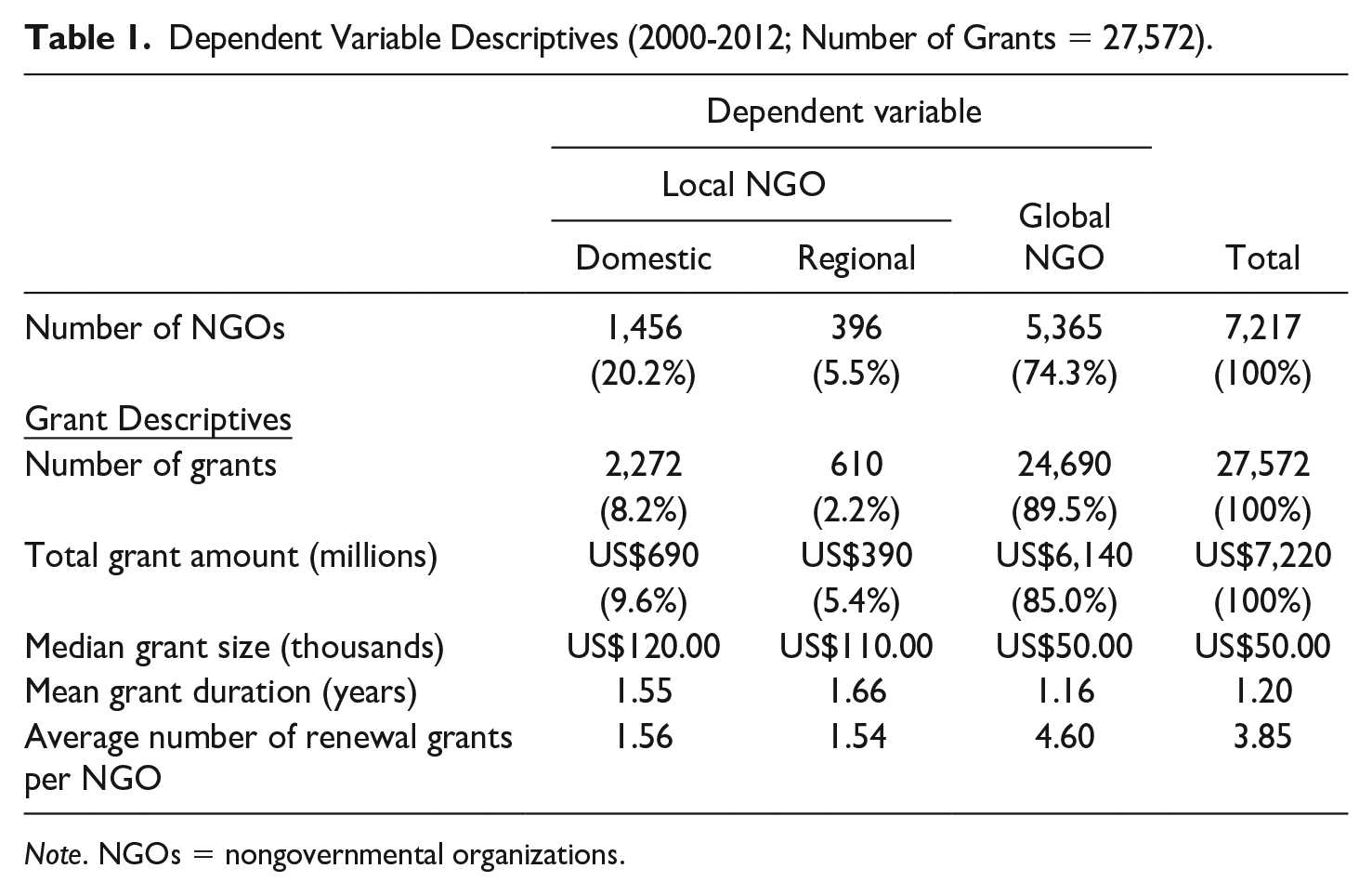
Note. NGOs = nongovernmental organizations.
To test our hypotheses, we created measures of foundation experience and renewal funding that require we hold aside the first 3 years of the data set to use as a baseline; thus, we removed grants given in these first 3 years (2000–2002, n = 4,195 grants), resulting in 23,404 grants for our regression analyses. We ran sensitivity tests and found that holding out more than 3 years has no impact on our results.
Dependent Variables: Local NGOs
A local NGO is an organization that is based near its beneficiaries, in this case beneficiaries in a less economically advanced country. However, operationalizing what it means to be “near” is a question layered in geography, history, and culture. It is clear that an NGO based in St. Louis that serves schoolchildren in Hanoi is not a local NGO, while an NGO based in Hanoi that serves children in Hanoi is local. Given that understanding, how might we differently classify an NGO based in neighboring Bangkok, or even Beijing? “Near” is a relative term; an NGO in Bangkok arguably shares greater geographic, linguistic, religious, and cultural similarities with Hanoi than does St. Louis. However, a simple binary coding would interpret both the St. Louis NGO and the Bangkok NGO as nonlocal. To create our dependent variable, we produce a more nuanced, relative understanding of what it means to be local.
To identify the alignment between the beneficiaries’ location and NGO location, we coded each grant with one of three mutually exclusive types of NGO classifications—domestic, regional, or global—where the most specific category takes precedence. Our data set provides reliable country-level information on (a) the intended destination of the grant’s programming, and (b) where the recipient NGO is headquartered. When these match, we code the grant as domestic.
To identify regional NGOs, we code each grant destination and NGO location with a regional classifications, constructed using a combination of the supranational regions from the Foundation Center data and the United Nations’ regional classification resulting in coding seven regional classifications: Africa, Asia, Europe, Former USSR, Latin America, Middle East, and Northern America.
Finally, NGOs located outside of the region of grant implementation are coded as global NGOs. We conceptualize global NGOs as NGOs based in more economically advanced countries, either in the United States or any other country considered high-income by the World Bank, that are given grants to do specific work in a less economically advanced country. To aid in the precision of what we refer to as global NGOs, we removed the grants from our data set that were neither domestic, nor regional, nor to NGOs in the more advanced economies. (These consisted of 0.5% of the dataset of grants supporting work in less economically advanced countries.) These “transregional” NGOs were located in less advanced economies, but targeted beneficiaries outside of their region, in a different less advanced economy. These grants are an unusual, though potentially consequential, part of the international grantmaking landscape. We could expect U.S. foundation grantmaking to these transregional NGOs to reflect many of the patterns that we hypothesized regarding giving to local NGOs, but due to the NGOs not being within the same broad region as their beneficiaries, we could alternatively expect them to take on similar features to the global NGOs. We replicate our models for just the transregional grants in Appendix A, and while the sample size is too small to generate much statistical significance, preliminary results indicate the need for further research. To maintain the integrity of this unique transregional category, we removed them from our final models (n = 151 grants in the whole data set, n = 124 grants in the data set without the first 3 years). Before removing them, we ran a sensitivity check where we included these transregional grants in the global NGO category in the main article models, and their inclusion did not change the results.
In summary, a Vietnamese NGO helping Vietnamese beneficiaries would be coded as a domestic grant (i.e., the NGO headquarters and intended beneficiaries are in the same country), but not also as a regional grant, while a Cambodian NGO helping Vietnamese beneficiaries would be coded as a regional grant (i.e., the NGO headquarters and intended beneficiaries are in the same region). We consider both domestic and regional NGOs to be “local NGOs,” though obviously the domestic NGO is more local than the regional one. An Australian NGO helping Vietnamese beneficiaries would be coded as a “global NGO.” And a Ghanaian NGO helping Vietnamese beneficiaries would be coded as “transregional NGO,” though is excluded from this analysis. Figure 1 displays a map illustrating the difference between each dependent variable through examples of grant programming in two different locations—China and Brazil—as it is undertaken by a domestic, a regional, and a global NGO. From 2000 to 2012, there were 2,272 grants to domestic NGOs (8.2% of the data set), 610 grants to regional NGOs (2.2% of the data set), and 24,690 grants to global NGOs (89.5% of the data set). 1
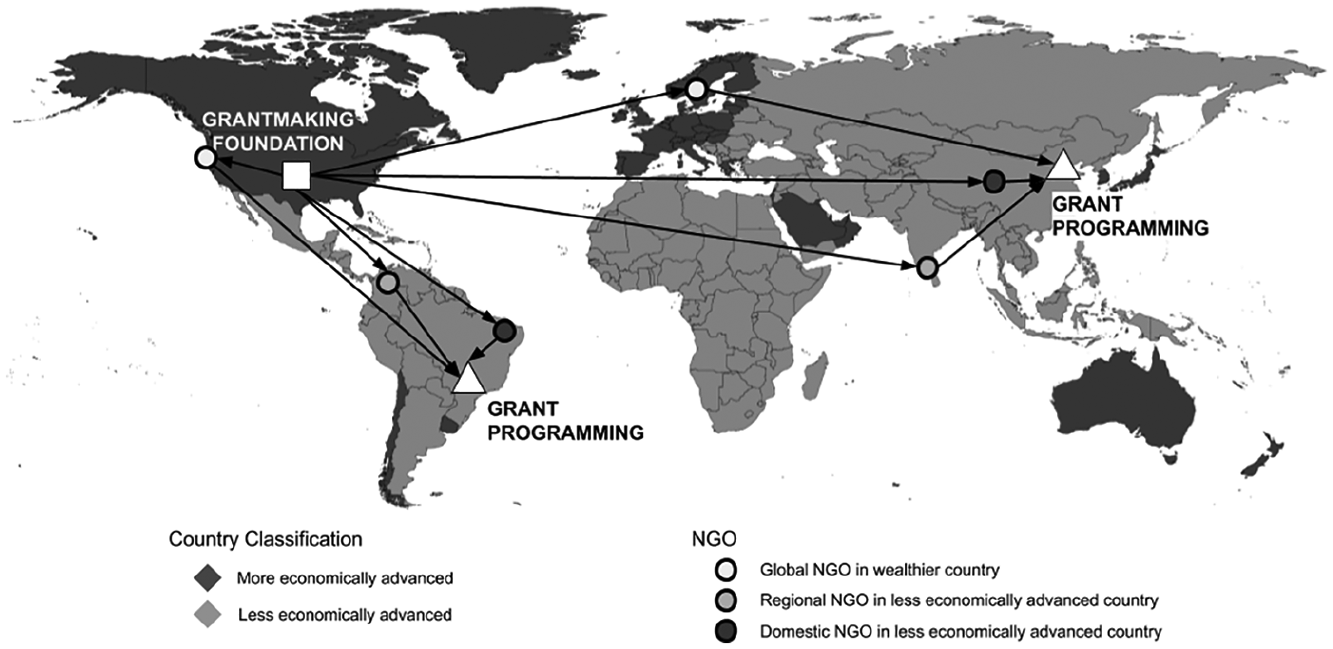
Examples of domestic, regional, and global grants.
Independent Variables: Foundation Experience and Grant Design
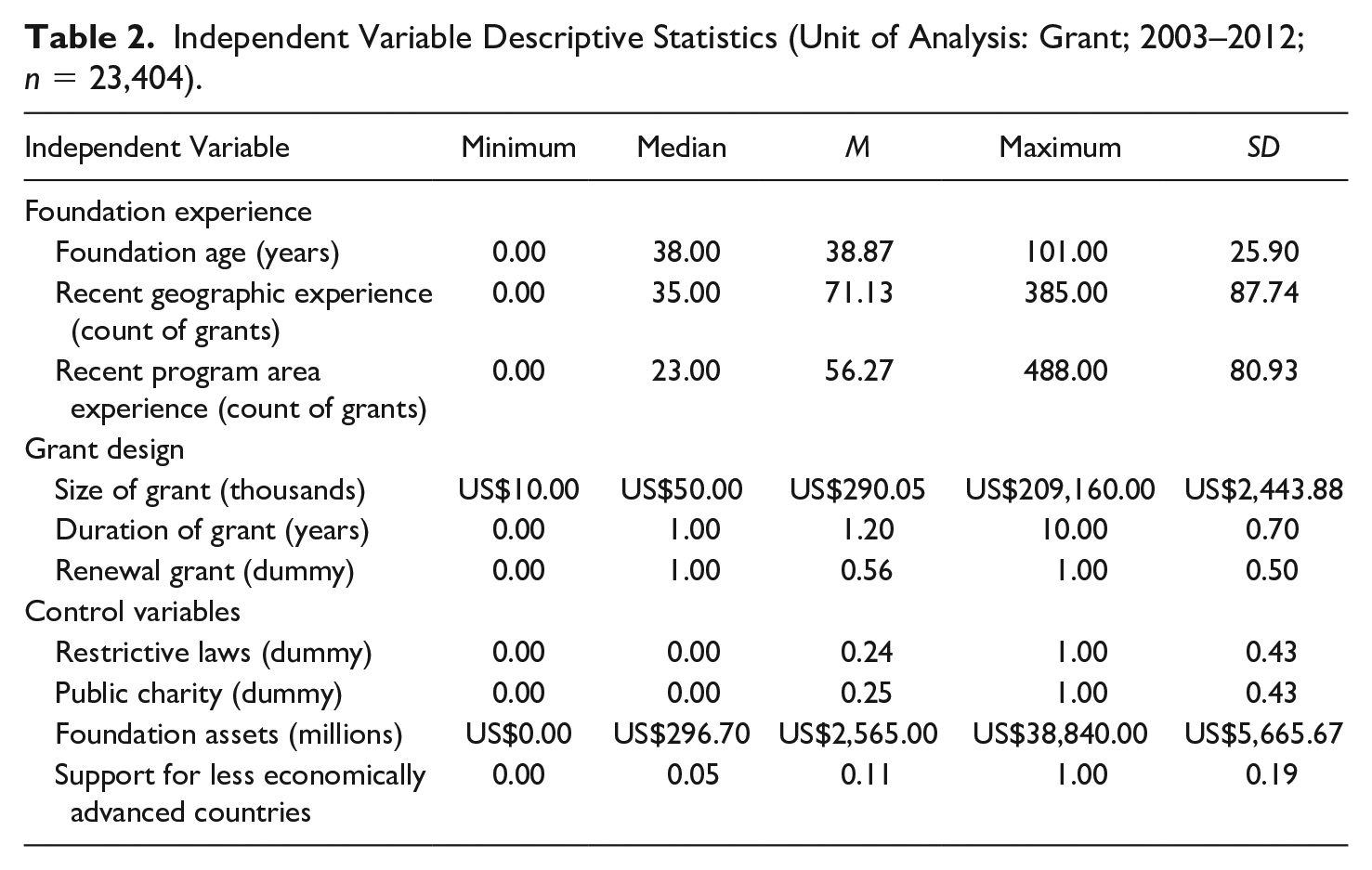
Independent variables for each grant are used to test the hypotheses, reflecting what we believe may influence the propensity to fund a more local versus a more global NGO. Descriptive statistics for all independent variables used in the regression analysis are presented in Table 2 (n = 23,404). A correlation matrix can be found in Appendix B.
Independent Variable Descriptive Statistics (Unit of Analysis: Grant; 2003–2012; n = 23,404).
Foundation experience
First, foundation grantmaking experience is measured as the age of the foundation in the year the grant was made. The median foundation age in the sample is 38 years old (considering age at the time of grant, with grant as unit of analysis), but age ranges from zero to 101 years, with a standard deviation of 26 years. Second, geographic experience is measured as the count of all grants the foundation allocated to the region of the grant’s intended beneficiaries over the 3 years prior to the grant year. The median geographic experience for foundations is 35 (maximum of 385). Geographic experience is logged to account for skew due to the large variance and heavy tail in distribution of the number of grants foundations make. We use a region-level experience measure over a country-level experience measure to limit autocorrelation, enhance replicability, and show that geographic experience appears to be portable across various countries, though the results are identical using the country-level experience measure. Third, program experience is measured as the count of all grants the foundation allocated to a particular program area over the 3 years prior to the grant year. This program area coding is done by the Foundation Center. Program areas include arts and culture, education, environment and animals, health, human rights, human services, religion, science and technology, social sciences, society benefit, and other. For a given grant, foundations granted an average of 23 grants to the same program area in the 3 years prior. Programmatic experience is logged to account for skew due to the large variance and heavy tail in distribution of the number of grants foundations make.
Grant design
Grant design is measured through three variables. First, grant size measures the grant amount, in dollars, which is logged to account for skew. Next, grant duration measures the length of the grant in years. The typical grant in our study allocates US$50,000 (maximum of US$209 million) and lasts 1 year (maximum of 10 years). Finally, renewal grant is a dummy variable that represents whether the given foundation has made a grant to the same NGO in a previous year. We begin counting the possibility of renewal grants from 2,000. In total, 55.7% of the grants in the data set were renewal grants.
Controls and Fixed Effects
Controls
To isolate the effects of our independent variables of interest—foundation experience and grant design—we include four control variables. First, we rely upon Dupuy et al.’s (2016, p. 302) data to include a binary variable indicating whether the country of the grant’s intended programming has imposed restrictive laws on foreign funding to domestic NGOs, which is the case for 24.1% of our grants. This helps to control for a demand side restriction on giving to local NGOs. Second, we include an additional binary variable indicating whether the foundation is a private foundation or a public charity, as coded by NCCS. The distinction indicates whether the grant giving organization is endowed (i.e., a private foundation) or if they regularly seek and redistribute funds (i.e., a public charity). This may capture divergent behavior among potentially diverse institutional fields. About 25.0% of the grants in the data set were given by public charities. These include community foundations, some corporate foundations, and pass-through organizations that receive revenue from private individuals. Third, we operationalize foundation assets, the foundation’s total assets in the year the grant was awarded, as a continuous variable logged to account for skew. The median grant was given by a foundation with assets of US$297 million. Fourth, support for less economically advanced countries is measured as the proportion of all grant dollars that the foundation allocated to support programming in less economically advanced countries in the prior 3 years out of total grantmaking in those 3 years. The grantmaking commitment of a foundation ranges from less than one percent of total giving to 100 percent of total giving, with a median of 5.2% of the foundation’s total recent grant portfolio going to the less economically advanced countries. Unfortunately, given that domestic and regional NGOs do not register with the IRS, the only NGO-level covariate we include in our analysis is country location.
Foundation preferences
We omit foundation-level fixed effects because of concerns about collinearity and variance inflation given the complex interaction between foundation patterns of grantmaking, regions, and program areas. We instead adopt an alternative approach to modeling foundation-specific preferences by measuring the proportion of grants given to the relevant dependent variable (i.e., domestic NGO, regional NGO, or global NGO) by each foundation within the full data set. As adding a fixed effect is mathematically equivalent to group-mean deletion of dependent and independent variables, adding the foundation-level mean as a control variable has a similar effect on addressing endogeneity without the deleterious loss of degrees of freedom. This foundation-specific preference variable also controls for grants that require equivalency determination, an IRS regulation to determine whether NGOs are equivalent to U.S. public charities (Reis & Warren, 2016). As foundation preferences directly reflect the capacity and capability of foundations to grant to NGOs requiring equivalency determination, these controls ensure the results are based on the independent variables of interest.
Program–region fixed effects
We include a dummy variable for each grant to represent the unique combination of program type and geographic region (i.e., health grants in Africa, health grants in Asia, education grants in Latin America, etc.). We use these fixed effects to ensure that the results are not due to issue- and/or region-specific phenomena that may influence local or global partner preferences. These fixed effects allow our interpretations to extend to broad patterns as opposed to localized perspectives that may overly influence our findings.
Analysis and Models
We analyze grantee selection at the grant level using a linear probability model with robust standard errors. While this model tends to produce similar estimates as logistic regression, its advantage is in ease of interpretation. Linear probability models are much simpler to interpret because coefficients represent changes in probabilities, whereas logistic models require link functions. 2 We analyze the following model for each dependent variable:

Y is a binary dependent variable with the three binary estimations for local, regional, and global grants. X represents the set of grant-level characteristics, such as size and duration. The matrix Z represents the foundation characteristics such as size, age, and experience. The θ represents the grant program-region fixed effect.
Findings
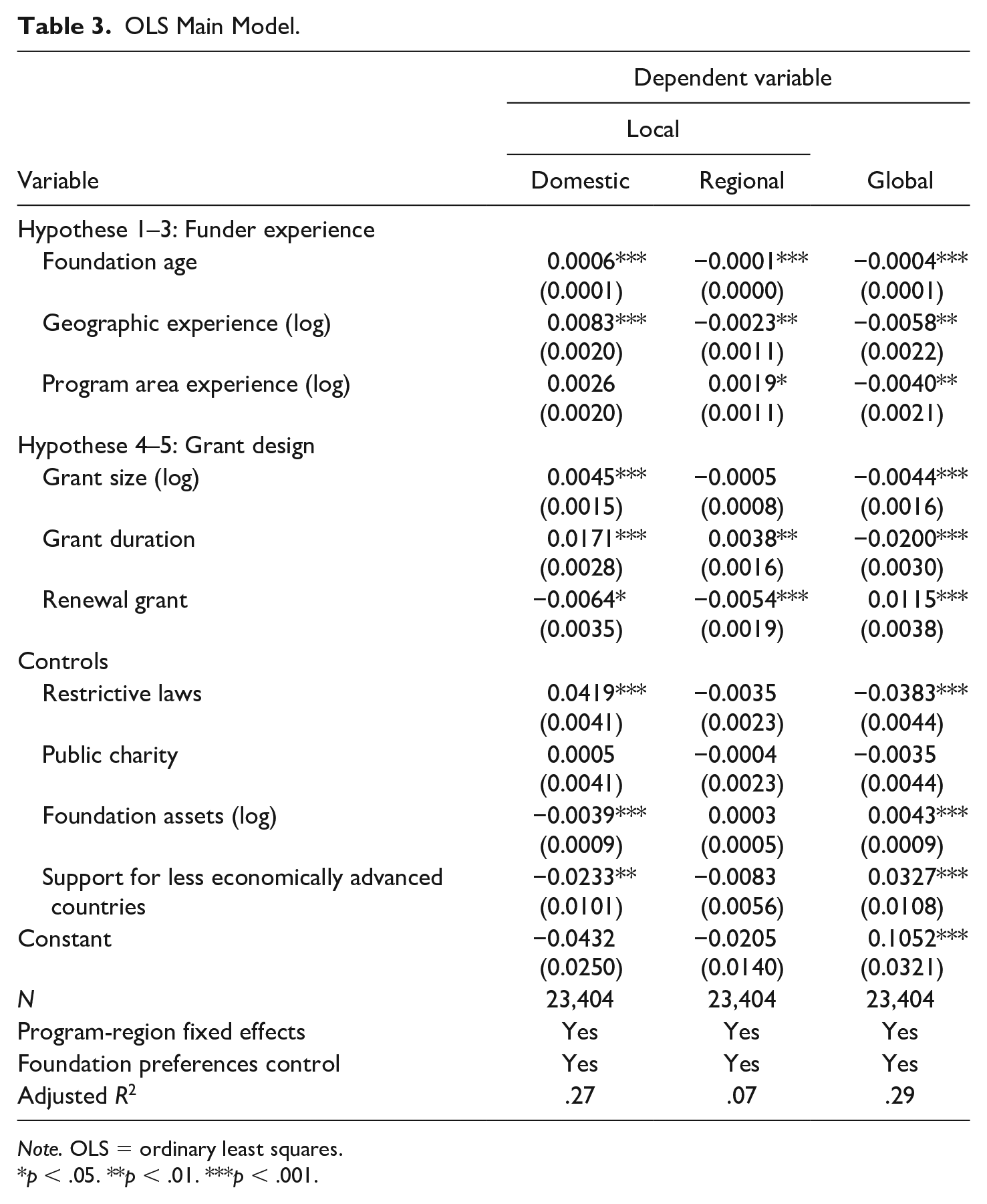
We find that 10.5% of grants from U.S.-based foundations to support programming in less economically advanced countries go to local NGOs, capturing 15.0% of all funds targeting less economically advanced countries (see Tables 1 and 3.) Both grants and grantmaking dollars disproportionately flow to global NGOs in more advanced economies, substantiating and providing additional nuance to prior research (Needles et al., 2018). Significance tests show that the number of grants and dollars is far lower than would be expected by chance (p < .001), given the number of domestic and regional NGOs funded. In summary, foundations are more likely to select global NGOs when choosing an NGO partner. Of note, we also find that local NGOs make up 25.7% of the organizations funded, suggesting the limited funding directed to local NGOs is spread across a wider array of organizations, when compared with their global NGO colleagues who make up 74.3% of the organizations and capture 89.5% of the grants.
OLS Main Model.
Note. OLS = ordinary least squares.
p < .05. **p < .01. ***p < .001.
Given this disproportionate giving, what differentiates funders that select local versus global NGOs? Table 3 demonstrates initial support for Hypotheses 1, 2, and 3: Foundation grantmaking experience—measured by age, geographic experience, and program experience—is associated with fewer grants to global NGOs. Furthermore, both general grantmaking experience and geographic experience predict significantly more giving in the form of grants to domestic NGOs, while program experience predicts significantly more giving in the form of grants to regional NGOs.
In contrast to the support for the experience hypotheses, our results show mixed support for the grant design hypotheses. Grant size and duration are negatively associated with grants to global NGOs, while positive and significant for grants to domestic NGOs, which is opposite to our predictions. In addition, grant duration is positively associated with grants to regional NGOs. Therefore, it appears that larger and longer grants are associated with local NGOs, in contrast to Hypothese 4a and 4b. Our findings for the second grant design hypothesis demonstrated more support. Renewal grants are positively associated with grants to global NGOs, and negatively associated with grants to domestic and regional NGOs, offering support for Hypothesis 5.
Finally, the control variables indicate that larger organizations and those who support more programming in less economically advanced countries are positively associated with grants to global NGOs. These findings could result either from being entrenched in global economic and political systems (Aksartova, 2003) or because it may be more financially efficient for larger funders to seek economies of scale or scope (Bryant, 2019). In addition, we find that grants to countries with restrictive laws are in fact positively associated with giving to domestic NGOs and negatively associated with grants to global NGOs.
Discussion
The number, size, and influence of international grantmakers have grown significantly over the past 25 years (Hammack & Heydemann, 2009). However, this growth has not distributed funds equitably across the globe. Discrimination against less economically advanced countries exists on two levels. First, the majority of funding supports programming outside of less economically advanced countries. Of all international grantmaking efforts from foundations within the United States, less than one fifth of the grants supported programming in a less economically advanced country, with the vast majority targeting causes occurring across multiple countries and regions or within more economically advanced countries.
Second, when funders do send money to support causes in those areas, most of the resources continue to be channeled through organizations based in the most economically well-off regions of the world, thus diluting the impact of those dollars in the intended regions. We analyzed the subset of all international grants that supported programming in less economically advanced countries and found that a mere 10.5% of the grants go to domestic or regional NGOs in those countries, further exacerbating global inequalities. The vast majority (89.5%) of grants supporting programming in less economically advanced countries are funneled through global NGOs based in more economically advanced countries, illuminating strong tendencies to mitigate the liability of foreignness with grantee selection decisions. Our analyses further illuminate the conditions under which foundations do support these local organizations, both with respect to their own experience and with respect to how they design their grants to those organizations.
Despite the significant front-end work to identify, evaluate, and fund local NGOs, funders appear reluctant to renew their commitments to these organizations. Perhaps funders anticipate they will be unlikely to renew the relationship due to greater difficulties monitoring local NGOs; as a result, they choose to give one-time grants that are larger and for longer time periods, in the hope that this will provide some additional stability to the NGO, even if temporary. Regardless of foundation intentions, the lack of renewable investment likely stifles opportunities for the development of robust local NGO infrastructures in less economically advanced countries.
While we suggest that funders are channeling their resources toward their peers in more economically advanced countries to mitigate a liability of foreignesss, an alternative explanation for low rates of funding local NGOs is that many national governments are actively working to reduce foreign influence, by both restricting access for global NGOs and limiting grantmaking for local NGOs (Dupuy et al., 2016; Jalali, 2008). However, we find that the majority of funds still target global NGOs, even when controlling for restrictive laws. In addition, we continue to find support for this discrimination, both when we exclude countries for periods when they have restrictive laws and when we only examine funding to countries for periods when they have restrictive laws. As a final test, although the binary variable of having a restrictive law is positively associated with grants to domestic NGOs and negatively associated with grants to global NGOs in our model, we get a null result when we run a difference-in-difference statistical design to see if the rate and amount of funding of global versus local NGOs changes after passage of the restrictive law. These results imply that restrictive laws may correlate with other unexplained factors, or may even be caused by above average preferences for domestic over global NGOs, but restrictive laws do not, by themselves, cause changes in the mix of global versus local NGO funding. We feel confident in concluding that foundations display a clear preference for global NGO grantees which is not driven by a fear of funding local NGOs in countries with restrictive laws.
Contributions to Theory and Practice
Our study proposes a more nuanced conceptualization of the liability of foreignness. In particular, we suggest that two complementary dimensions of foreignness exist in a grantmaking context, producing two corresponding liabilities. The first dimension, and that which the organizational literature has traditionally focused upon, recognizes the challenges in working with an organization that is geographically, culturally, or linguistically distant. In grantmaking, these are the geographic, cultural, and linguistic differences between the foundation donor and the NGO grantee (“funder-NGO foreignness” for shorthand). Our results indicate robust support for the finding that foundations are acting to mitigate the risks that arise in a partnership from the liability of funder-NGO foreignness.
Our study offers a novel contribution in differentiating a second dimension of foreignness. NGOs also experience difficulties implementing programming in a context that is geographically, culturally, or linguistically distant (“NGO-programming foreignness” for shorthand). Given that research has demonstrated that decreasing NGO-programming distance may enable project staff to better understand and facilitate work that meets the needs of beneficiaries (Bebbington & Perreault, 1999; Beckfield, 2008; Brass, 2012; Fowler, 1991; Platteau & Abraham, 2002), introducing this new conceptual terminology will hopefully assist in more fully considering the dual aspects of foreignness that donors must consider when supporting work overseas.
These findings have crucial conceptual and practical implications. First, the majority of research on the liability of foreignness has focused on contexts in which relationship formation is the end goal of the partner selection process. As a result, this research has generally focused on a single dimension of foreignness—that between the ego organization and the alter organization—with the main liability occuring within that relationship. In contrast, investment relationships involve the selection of an alter organization as a means to an alternative end goal, in this case bolstering local civil society or providing programming that addresses a social need. This additional layer of complexity requires greater conceptual nuance to facilitate an accurate analysis of the trade-offs presented by differing liabilities. Though the framework developed in this paper arises from a context of interantioal grantmaking, this conceptual advance has utility in examing the multiple liabilities presented in other investment relationships, both domestic and international, where differences offer competing liabilities. Second, we find that foundations tend to minimize funder-NGO foreignness, by making more grants to global NGOs, while generally passing up on minimizing NGO-programming foreignness. As past research suggests that local NGOs may be more effective than global NGOs (Bebbington & Perreault, 1999; Beckfield, 2008; Brass, 2012; Fowler, 1991; Platteau & Abraham, 2002), 3 the contradiction between what we know about effective institutions and foundation behavior is concerning for the efficacy of international grantmaking efforts. Furthermore, the lack of support for local NGOs is potentially a lost opportunity to support the development of crucial economic, political, and social institutions where programming is undertaken. Funding local NGOs can improve the character and strength of crucial institutions of civil society (Benjamin & Quigley, 2010). Lacking the institutional supports of civil society creates barriers to achieving the very social and environmental change foundations seek, and which they have the financial and social capital to develop. Despite the general tendency toward global NGOs, we do identify that when foundations have substantial information about an issue, location, and/or grantmaking process, they are able to mitigate the liabilities from increased funder-NGO foreignness, enabling them to capitalize on the demonstrated benefits of decreased distance between the NGO and the programming. It is within each foundation’s power to focus and direct their resources toward these outcomes, should they wish to do so.
Limitations and Directions for Future Research
Notwithstanding these contributions, our study does hold some limitations. Our analyses assume that the funder location and the programming location are fixed and examined the linear trade-offs between funder-NGO foreignness and NGO-programming foreignness. We encourage future research to analyze when and how funders potentially target locations for programming such that they can simultaneously minimize both funder-NGO foreignness and NGO-programming foreignness, perhaps through selecting programmatic work in more proximal geographic locations to the foundation.
In addition, we did not have the data to investigate variation in the degree of presence any global NGO has in the areas where it operates, ranging from being an intermediary that grants funds to local NGOs to establishing a permanent presence in the region through the hiring of local staff. 4 We are not overly concerned about this limitation, because it is likely that even if a global NGO has a local office, it will still be beholden to a set of norms and standards reflective of the parent organization, in contrast to the local locus of power and leadership that characterizes local NGOs. That said, it would be interesting to explore how the varying operation of foreign offices could eliminate, mitigate, or perhaps perpetuate differences in this implementation distance. In addition, scholars should investigate the path distance, in terms of the number of NGOs that serve as regranting organizations, between a funder and the ultimate site of programming.
We also encourage scholars to investigate competing hypotheses that rely upon a more in-depth understanding of grantee characteristics, in particular NGO age, size, and equivalency determination status. First, lacking data on NGO age, we were not able to investigate competing hypotheses grounded in theories around the liability of newness (Stinchcombe, 1965). We leave to future work to differentiate the liability of newness from the liability of foreignness investigated in this article. Second, size differences between local and global NGOs may explain some of the observed foundation preferences for global NGOs, though past research has shown competing results regarding a preference for smaller versus larger NGOs (Faulk et al., 2017; McGinnis Johnson, 2016). Finally, given that the U.S. Internal Revenue Service requires that funders perform “equivalency determination” to determine that foreign NGOs are equivalent to U.S. public charities, NGOs in less economically advanced countries may have a harder time passing the equivalency determination test. However, given that the process of filing for equivalency determination can be supported by an interested funder, equivalency determination is not fully exogenous to our model. We encourage scholars to further examine how equivalency determination impacts international grantmaking to test this hypothesis, as well as investigating whether and how these patterns hold for private grantmakers from other more economically advanced countries.
We also encourage caution in interpreting these results. First, the current article is not attempting to make any claims to ascertain the quality of programming. Rather, we are suggesting that differential patterns of grant support from international funders to local or global organizations can influence the capacity of these organizations themselves, as actors within local civil society. Second, while decreasing NGO-programming distance can assist in multiple aspects of project design and implementation, local NGOs remain embedded within the complicated institutions and structures of inequality that frustrate attempts to reenvision power and resource relationships (Aldashev & Navarra, 2018). For example, even when international funders support local NGOs in Uganda, they tend to choose the local NGOs who act as subcontractors for international development agencies, which may not be the most altruistic organizations or those who hold the highest capacity to empower a local charitable sector (Fafchamps & Owens, 2009). Even local NGOs become constrained in their abilities to generate social capital and strengthen civil society when they do not develop strong relationships with the communities they work to represent (see, for some examples, Banks et al., 2015; Bano, 2008; Bebbington, 1997), highlighting the additional complexity of simultaneously addressing power relationships within nations and communities (Gugerty & Kremer, 2008). As a result, while a strong case can be made for including local NGOs as part of international grantmaking efforts to foster local civil society, these arguments should not preclude the ability to also critically analyze their operations.
Finally, through differentiating between domestic and regional NGOs, we illuminated the utility of breaking down the process of what it means to be a “local” NGO in the global marketplace of grantees, looking at it categorically rather than as a simple binary. As our regression results demonstrate, it is not uncommon to have domestic and regional NGOs show differing results for a given covariate. Our preliminary analyses of transregional NGOs, in Appendix A, further substantiate this point. Ultimately, the “local-ness” of an NGO is best conceived of as a continuous, and perhaps multidimensional, variable. We encourage future research to build on our rough categorization to better inform what it means for an NGO to be local, global, or anywhere in between, and how this identity bears on their propensity to receive funding.
Conclusion
Foundations tend to select the least uncertain path that will facilitate channeling funds toward programmatically desirable projects. While this may be the most effective decision in some instances, for example with respect to environmental grantmaking, the rate at which it is happening sacrifices the demonstrated benefits of building local social capital and bolstering civil society within less economically advanced countries. This article introduces a more nuanced understanding of two distinct dimensions of foreignness and the differential advantages and liabilities that they each present. We hope this conceptual framework will prove useful to future researchers and practitioners interested in partner selection decisions. And we hope that the empirical results presented will build our collective knowledge about foundation behavior in the uncertain and highly consequential world of international grantmaking.
Supplemental Material
Supplemental_material – Supplemental material for Going the Extra Mile: The Liability of Foreignness in U.S. Foundation International Grantmaking to Local NGOs
Supplemental material, Supplemental_material for Going the Extra Mile: The Liability of Foreignness in U.S. Foundation International Grantmaking to Local NGOs by Carrie R. Oelberger, Jesse Lecy and Simon Y. Shachter in Nonprofit and Voluntary Sector Quarterly
Footnotes
Appendix A
Main OLS Models Replicated With Transregional Grants.
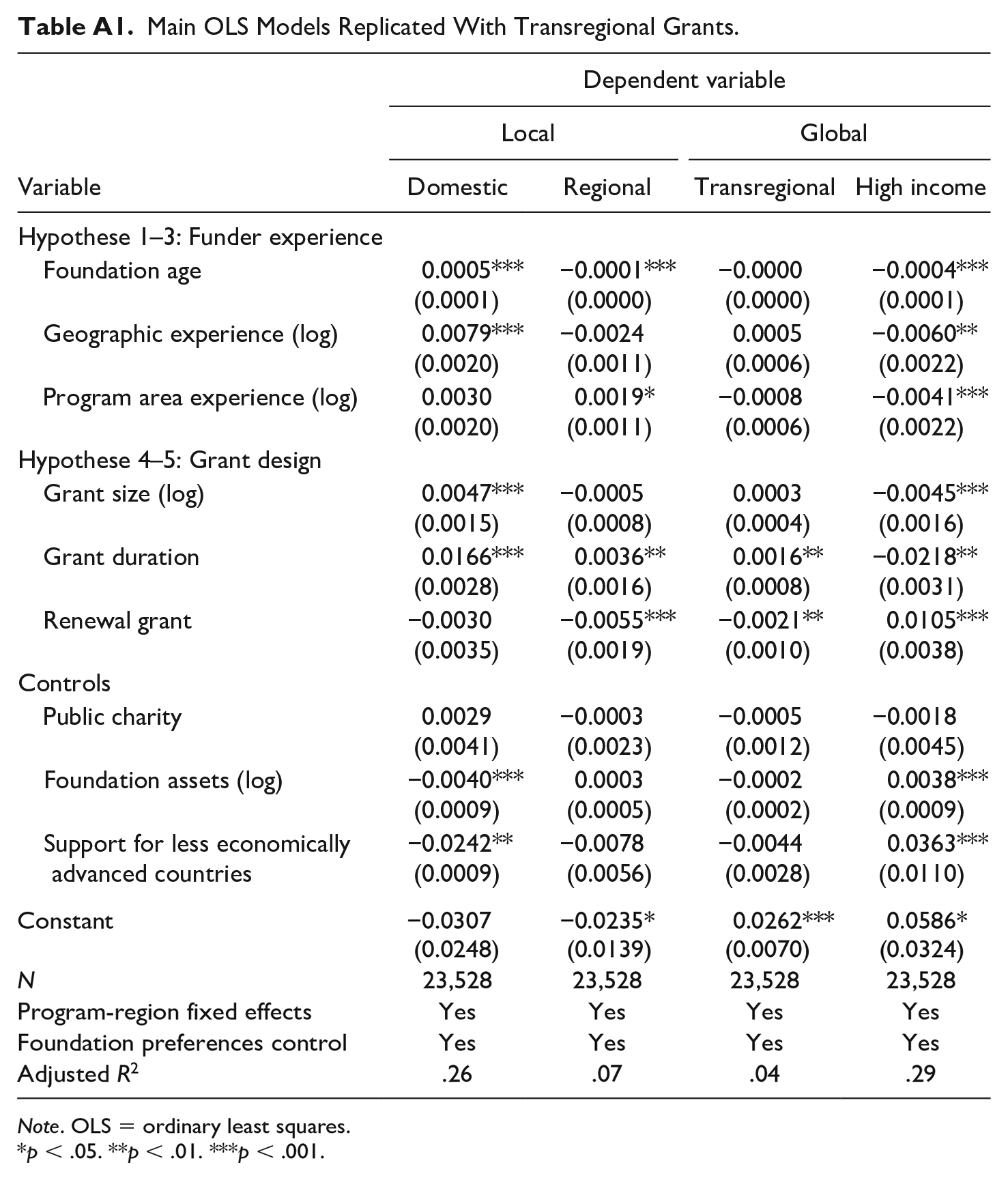
| Variable | Dependent variable | |||
|---|---|---|---|---|
| Local | Global | |||
| Domestic | Regional | Transregional | High income | |
| Hypothese 1–3: Funder experience | ||||
| Foundation age | 0.0005***
(0.0001) |
−0.0001***
(0.0000) |
−0.0000 (0.0000) |
−0.0004***
(0.0001) |
| Geographic experience (log) | 0.0079***
(0.0020) |
−0.0024 (0.0011) |
0.0005 (0.0006) |
−0.0060**
(0.0022) |
| Program area experience (log) | 0.0030 (0.0020) |
0.0019*
(0.0011) |
−0.0008 (0.0006) |
−0.0041***
(0.0022) |
| Hypothese 4–5: Grant design | ||||
| Grant size (log) | 0.0047***
(0.0015) |
−0.0005 (0.0008) |
0.0003 (0.0004) |
−0.0045***
(0.0016) |
| Grant duration | 0.0166***
(0.0028) |
0.0036**
(0.0016) |
0.0016**
(0.0008) |
−0.0218**
(0.0031) |
| Renewal grant | −0.0030 (0.0035) |
−0.0055***
(0.0019) |
−0.0021**
(0.0010) |
0.0105***
(0.0038) |
| Controls | ||||
| Public charity | 0.0029 (0.0041) |
−0.0003 (0.0023) |
−0.0005 (0.0012) |
−0.0018 (0.0045) |
| Foundation assets (log) | −0.0040***
(0.0009) |
0.0003 (0.0005) |
−0.0002 (0.0002) |
0.0038***
(0.0009) |
| Support for less economically advanced countries | −0.0242**
(0.0009) |
−0.0078 (0.0056) |
−0.0044 (0.0028) |
0.0363***
(0.0110) |
| Constant | −0.0307 (0.0248) |
−0.0235*
(0.0139) |
0.0262***
(0.0070) |
0.0586*
(0.0324) |
| N | 23,528 | 23,528 | 23,528 | 23,528 |
| Program-region fixed effects | Yes | Yes | Yes | Yes |
| Foundation preferences control | Yes | Yes | Yes | Yes |
| Adjusted R2 | .26 | .07 | .04 | .29 |
Note. OLS = ordinary least squares.
p < .05. **p < .01. ***p < .001.
Appendix B
Correlation Matrix.
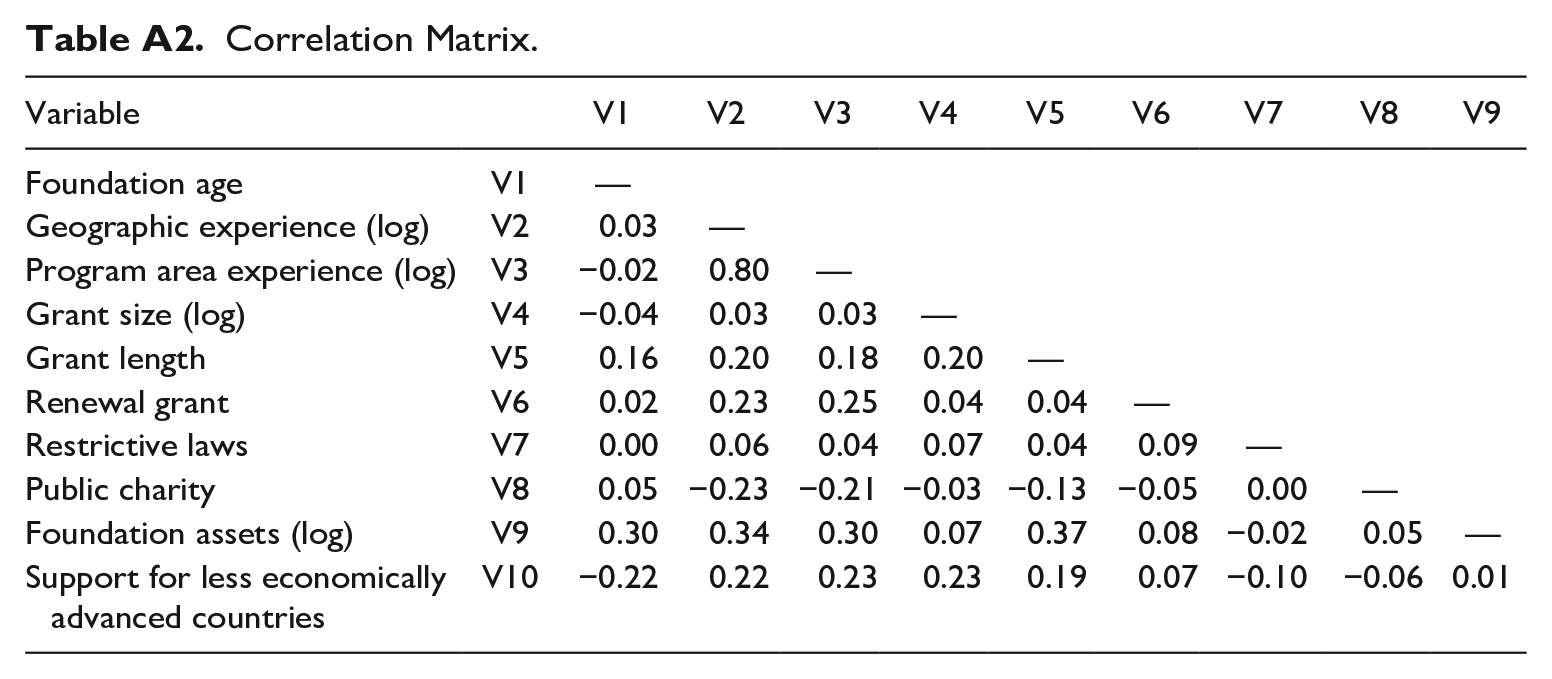
| Variable | V1 | V2 | V3 | V4 | V5 | V6 | V7 | V8 | V9 | |
|---|---|---|---|---|---|---|---|---|---|---|
| Foundation age | V1 | — | ||||||||
| Geographic experience (log) | V2 | 0.03 | — | |||||||
| Program area experience (log) | V3 | −0.02 | 0.80 | — | ||||||
| Grant size (log) | V4 | −0.04 | 0.03 | 0.03 | — | |||||
| Grant length | V5 | 0.16 | 0.20 | 0.18 | 0.20 | — | ||||
| Renewal grant | V6 | 0.02 | 0.23 | 0.25 | 0.04 | 0.04 | — | |||
| Restrictive laws | V7 | 0.00 | 0.06 | 0.04 | 0.07 | 0.04 | 0.09 | — | ||
| Public charity | V8 | 0.05 | −0.23 | −0.21 | −0.03 | −0.13 | −0.05 | 0.00 | — | |
| Foundation assets (log) | V9 | 0.30 | 0.34 | 0.30 | 0.07 | 0.37 | 0.08 | −0.02 | 0.05 | — |
| Support for less economically advanced countries | V10 | −0.22 | 0.22 | 0.23 | 0.23 | 0.19 | 0.07 | −0.10 | −0.06 | 0.01 |
Appendix C
Main OLS Models Replicated With 2012 Office Data.
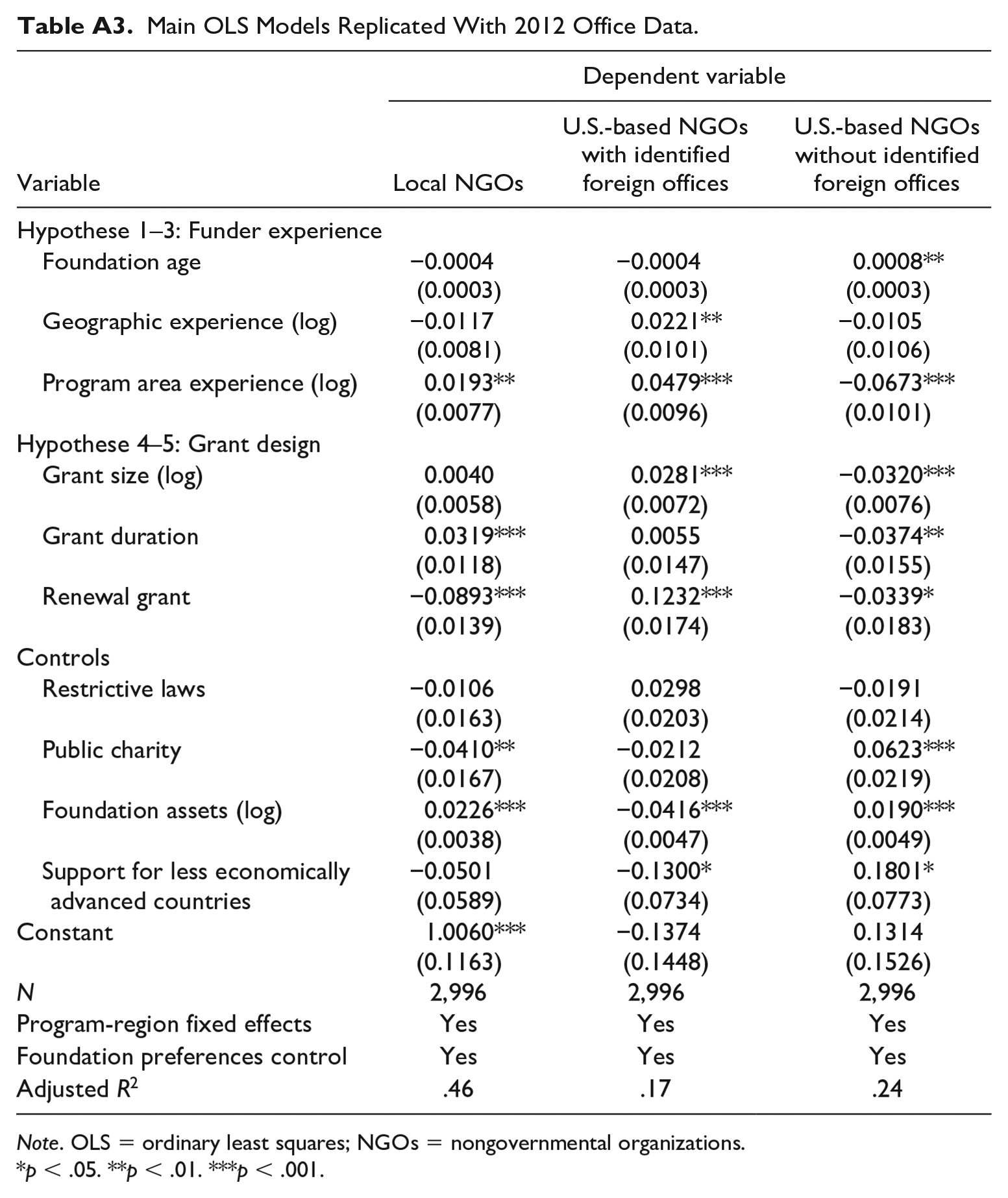
| Variable | Dependent variable | ||
|---|---|---|---|
| Local NGOs | U.S.-based NGOs with identified foreign offices | U.S.-based NGOs without identified foreign offices | |
| Hypothese 1–3: Funder experience | |||
| Foundation age | −0.0004 (0.0003) |
−0.0004 (0.0003) |
0.0008**
(0.0003) |
| Geographic experience (log) | −0.0117 (0.0081) |
0.0221**
(0.0101) |
−0.0105 (0.0106) |
| Program area experience (log) | 0.0193**
(0.0077) |
0.0479***
(0.0096) |
−0.0673***
(0.0101) |
| Hypothese 4–5: Grant design | |||
| Grant size (log) | 0.0040 (0.0058) |
0.0281***
(0.0072) |
−0.0320***
(0.0076) |
| Grant duration | 0.0319***
(0.0118) |
0.0055 (0.0147) |
−0.0374**
(0.0155) |
| Renewal grant | −0.0893***
(0.0139) |
0.1232***
(0.0174) |
−0.0339*
(0.0183) |
| Controls | |||
| Restrictive laws | −0.0106 (0.0163) |
0.0298 (0.0203) |
−0.0191 (0.0214) |
| Public charity | −0.0410**
(0.0167) |
−0.0212 (0.0208) |
0.0623***
(0.0219) |
| Foundation assets (log) | 0.0226***
(0.0038) |
−0.0416***
(0.0047) |
0.0190***
(0.0049) |
| Support for less economically advanced countries | −0.0501 (0.0589) |
−0.1300*
(0.0734) |
0.1801*
(0.0773) |
| Constant | 1.0060***
(0.1163) |
−0.1374 (0.1448) |
0.1314 (0.1526) |
| N | 2,996 | 2,996 | 2,996 |
| Program-region fixed effects | Yes | Yes | Yes |
| Foundation preferences control | Yes | Yes | Yes |
| Adjusted R2 | .46 | .17 | .24 |
Note. OLS = ordinary least squares; NGOs = nongovernmental organizations.
p < .05. **p < .01. ***p < .001.
Declaration of Conflicting Interests
The author(s) declared no potential conflicts of interest with respect to the research, authorship, and/or publication of this article.
Funding
The author(s) received no financial support for the research, authorship, and/or publication of this article.

Supplemental Material
Supplemental material for this article is available online.
Notes
Author Biographies
References
Supplementary Material
Please find the following supplemental material available below.
For Open Access articles published under a Creative Commons License, all supplemental material carries the same license as the article it is associated with.
For non-Open Access articles published, all supplemental material carries a non-exclusive license, and permission requests for re-use of supplemental material or any part of supplemental material shall be sent directly to the copyright owner as specified in the copyright notice associated with the article.
