



Abstract
This study examines place-based philanthropy in public ancillary funds (PubAFs) in Australia. While PubAFs vary greatly in their purposes, stakeholders, and operating models, place emerges as a strong element of foundations’ perceived identity, strategic focus, and grantmaking. This article advances the understanding of philanthropic giving by investigating and identifying the perceptions of place by PubAF managers and trustees, contributing to a novel and valuable “insiders” perspective on PubAFs. Drawing on Agnew’s three elements of place, namely location, locale, and sense of place, key findings highlight PubAFs’ ties to place in multiple contexts and dimensions. This qualitative study contributes to understandings of the ways in which place shapes and defines giving by public foundations, overlaps and interacts with foundations’ mission and strategy, and affects philanthropic impact.
Keywords
Introduction
There is a growing body of conceptual literature, which highlights the importance of place in foundations’ grantmaking, and increasing awareness that ties to “place” are a significant aspect of foundations’ identity (Pill, 2019). However, little empirical research exists on this issue, particularly from countries other than the United States and the United Kingdom. Accordingly, this study seeks to address this gap, exploring conceptions of place in Australian foundations, specifically, public ancillary funds (PubAFs). We extend prior research in this area by specifically examining how conceptions of place influence and reflect PubAFs’ mission, operations, and giving.
PubAFs are a particularly interesting context for this study being a diverse group of philanthropic foundations with little homogeneity in their missions and operating models, and their public benefit purpose (Murray, 2019) contrasted with limited public detail or understanding of this foundation form. They include community foundations, corporate foundations, single organization fundraising foundations (such as for hospitals or schools), and foundations established by financial or wealth advisers (Ward, 2016). PubAFs are established to make grants to charitable organizations endorsed by the Australian Taxation Office (ATO) as deductible gift recipients. Although they cannot grant directly overseas, they can make grants to charities registered in Australia that work overseas.
While foundations may focus their giving on causes or locations, place-based implications of giving are essentially relevant to all PubAFs by virtue of where they give to or who they give to (i.e., recipients’ location or focus) but are positioned and prioritized in different ways. However, there is a limited systematic exploration of this in the literature. Accordingly, this study’s objectives are to first consider the understandings from the literature of the relationship between philanthropic foundations and place, and second to examine different perceptions of “place” within PubAFs’ operations, how these relate to its mission, and the importance of place for PubAFs’ grantmaking.
Adopting a qualitative research design, a purposive sample of 28 PubAFs was recruited, considering variables including size, category, and location. In-depth, semistructured interviews were undertaken in late 2017 and early 2018, capturing detailed and nuanced perspectives from managers and trustees. Rare access to this group of organizations enabled rich insights to be gained.
This study contributes to empirical understandings of how place shapes and influences giving by public foundations, by drawing on Agnew’s (1987) three elements of place (location, locale, and sense of place) in a philanthropic context. Findings highlight that while geographic places are the easiest to define and communicate, giving often encompasses multiple dimensions such that several grantmaking foci are considered in funding decisions based on geographic places, social relationships, and emotional ties. Thus, Agnew’s framework is used as a platform to explore perceptions and conceptions of place. We further develop this framework through bringing visibility and understanding to multiple and pluralistic (overlapping) perceptions and conceptions of place, and through considering the associated implications in terms of grantmaking agenda and issues.
The remainder of this article explores the study’s background and context, defining basic concepts, reviewing the institutional philanthropy landscape in Australia, and overviewing PubAFs as a giving structure. The literature and theory on conceptions of place relating to place-based giving are then considered. Findings from semistructured interviews are next presented. The integration of the study’s findings with the literature is then discussed, and the article concludes by detailing contributions to theory and practice, and recommendations for future research.
Background and Research Context
Philanthropy in Australia is characterized by complexities and contradictions. These include a historical and cultural tradition of government welfare and support and recent growth in foundation numbers and size (Scaife et al., 2015). Liffman (2008, p. 4) states “. . .giving in Australia reflects our history of apparent unease about extravagant wealth, our sense of privacy about personal convictions, and our expectations of a significant role for government in the provision of basic services.” Thus, while foundations have increased in number, they have traditionally sought and received high levels of privacy and have often been reluctant to make public disclosures (McGregor-Lowndes & Williamson, 2018).
Over the past decade, several regulatory reforms relating to foundations have been implemented, including the establishment of an independent regulator, the Australian Charities and Not-for-profits Commission (ACNC), which created and maintained a public charities register; and the introduction in 2011 of legislated Public Ancillary Fund Guidelines (Ward, 2016). Furthermore, a gradual attitude change by some high net worth philanthropists toward “public disclosure of their foundation activity” (McGregor-Lowndes & Williamson, 2018, p. 1760), and a democratization of structured giving through giving circles and PubAF subfunds are changing the public face of Australian foundation philanthropy.
Australia’s geography also influences its philanthropy. The concept of “place” in an Australian context is intrinsically linked with distance or remoteness, regarding both location and conditions (Marsh et al., 2017). The vast scale of the landscape finds the population (and also philanthropists and foundations), located mostly in Eastern coastal cities. As such, foundation giving tends to focus on these areas rather than targeting regional or rural locations (Anderson, 2013), and this is similar in other geographically large countries (see, e.g., Phillips, 2018 on Canadian foundations). There is, however, a general understanding of the difficulties of living in regional and rural areas, and several foundations actively focus on those communities “to address the particular challenges they face due to their geographic location” (Tim Fairfax Family Foundation, 2019).
While some foundations’ giving is focused primarily on “place” in terms of geographic location, many adopt other criteria for their grantmaking, with place-based implications. These include giving to a particular cause (e.g., a health condition or medical research), or a particular organization (e.g., a school, museum, or hospital). Thus, place may be a primary or secondary consideration; direct or indirect function of giving. Yet as giving decisions change “place” is ultimately affected (Irvin & Kavvas, 2019).
Overview of Characteristics of PubAFs
PubAFs are charitable trusts established and maintained through a will or trust deed understate or territory law. PubAFs must fundraise from the public and receive gifts from a wide donor group, which distinguishes them from private ancillary funds, established and exclusively funded by a small, tightly held group such as a family.
Most PubAFs are small, with 71% having revenue less than US$50,000 per annum; however, some of the Australia’s largest foundations are PubAFs (Cortis et al., 2018). As of August 2020, there were 1,355 registered PubAFs (Australian Business Register, 2020); however, their collective size and current distributions are unknown. Donations received by PubAFs in 2017–2018 (the most recent data available from the ATO) were US$638.60 million (compared with US$691.67 million the previous year). A total of US$394.95 million was distributed in 2017–2018, leaving US$3,483.32 million in net assets (McGregor-Lowndes et al., 2020).
Subfunds are donation management accounts that can be established within a PubAF and enable the separate recording and reporting of donated funds. Subfunds may be offered to major donors who maintain an ongoing interest in the PubAF’s work. While the trustees of the PubAF must retain independent control over decisions about beneficiaries of grants, subfund donors may recommend grants be made from their designated account, and in practice, these recommendations are followed. Subfunds closely resemble donor-advised funds in the U.S. context (Colinvaux, 2017; Seibert, 2019).
Ward (2016) and Timmons (2013) refer to five PubAF categories (community foundations, charitable endowment funds, those for fundraising events, those linked with a corporate body or celebrity, and those associated with particular charities or public institutions). However, a detailed analysis of publicly available data on the 991 PubAFs registered as charities with the ACNC (Williamson et al., 2020) reveals a more refined profile or taxonomy of the sector incorporating PubAFs’ grantmaking focus and scope as well as their origins and mission. The taxonomy is summarized in Table 1 and involves seven categories plus “other” for which insufficient operational information was available to enable categorization of a PubAF.
Categories of PubAFs.

Note. ACNC = Australian Charities and Not-for-profits Commission; PubAF = public ancillary funds.
These size categories are based on annual revenue, consistent with the ACNC’s categorization (small referring to annual revenue less than US$250,000, medium referring to annual revenue of US$250,000 to US$1 million, and large referring to annual revenue greater than US$1 million).
Literature Review
Conceptualizations of Place
Within the wide body of literature on nonprofit organizations, many concepts such as regulation (Madanipour et al., 2017), firms as funders (Marshall et al., 2017), and voluntary welfare (Milligan & Fyfe, 2004) may be aspatial or not contextualized to specific place-based contexts. Yet geographic perspectives and approaches are relevant to philanthropy, as inter-relationships in geographic spaces can either support or hinder services development and provision. Thus, there is a growing interest and critique of multiple forms of community philanthropy and place-based giving (Colinvaux, 2018; Marshall et al., 2017; Pill, 2019). Geographic boundaries also have policy development implications, given geographic approaches “. . .argue that where events occur matter to both their form and outcome” (Milligan & Fyfe, 2004, p. 73).
There are several definitions of geographic or place-based giving in the literature, including the “close identification of philanthropic endeavour, both giving and receiving, in a community or locality” (Harrow, 2011, p. 2). Place-based philanthropy is also known as local philanthropy (Harrow, 2011) and embedded philanthropy (Karlström et al., 2009; Pill, 2019), indicating close or strong community ties. Mack and colleagues focus their definition around concentration “. . .investments that concentrate resources and activities in particular neighbourhoods, cities and regions” (Mack et al., 2014, p. 31). This idea of contraction or concentration is linked with the dynamic between philanthropic growth on both a global and a local scale, sometimes resulting in or from conflations between research on global, national, and local philanthropy (Jung et al., 2018).
The term “place” encompasses multitudes of definitions and descriptions. “In a diverse society. . .places are not ‘singular’ in the meanings given to them. They are given different meanings in different relational contexts” (Madanipour et al., 2017, p. 7). Three major elements of place are identified (Agnew, 1987), namely location, locale, and sense of place; and are adopted in this study given their perspectives on place go beyond geographic, recognizing multiple conceptions, both objective and subjective, as well as underlying motivations.
Location refers to place in the geographic sense such as a neighborhood, town, city, region, state, or country. Locations have geographic boundaries, often defined by someone else, for example, suburbs or towns defined by cartographers, and these existing boundaries are widely accepted. Institutions or organizations can also be bound to places, especially those such as schools or hospitals, which are physical gathering places for large numbers of community members. Giving to a school or hospital foundation (commonly established as PubAFs) provides an indirect way of giving to a geographic community where the beneficiary organization has linked geographic boundaries.
Locale refers to a place connected with particular relationships or events. Locale has a social element and is linked to the concept of belonging. A locale is the setting in which people conduct aspects of their lives and relate to the understanding of being “local.” Locale is most easily understood in terms of social places where family and friendship networks are (Dahl & Sorenson, 2010). These social foci include close groups to which individuals belong where social relations are prioritized that cannot be defined only in terms of physical geography (Feld, 1981; Rivera et al., 2010).
Sense of place refers to subjective relationships with places, including feelings, identity, perceptions, and memory. A sense of place conveys emotional and philosophical meaning (Harper et al., 2012) and can be linked with journeys, both physical and metaphorical. “. . .the land through which we are traveling has a psychological and spiritual dimension that no ordinary map would show” (Lindfield, 1986, quoted in Harper et al., 2012, p. 321). Thus, sense of place is linked with special places and places of the heart. Places in this context can also be remembered, with real or imagined dimensions. Such places are inhabited with artifacts and experiences and can be spaces in one’s mind where experiences and memories are grouped or associated with a particular setting (Mayerfeld Bell, 1997).
Thus, in their simplest, most pared-back understanding, locations are geographic places, locales are social places, and sense of place refers to emotional places. Agnew’s conceptualizations of place are adopted in a U.K. study by Jung et al. (2013, p. 413) as “a useful lens to understand community foundations, their activities and potential.” Burns and Brown (2012) examine place-based philanthropic initiatives, noting these vary in response to unique local conditions, challenges, and opportunities, or locale as defined by Agnew (1987). This framework was drawn on in the study of PubAFs as it provides a simple yet useful beginning for exploring perspectives on place that recognize multiple dimensions, conceptions, and motivations.
Implications of Place for Giving
Describing the geography of philanthropy as a “burgeoning research area in philanthropic studies,” Ashley (2014, p. 686) examines philanthropic preferences and activities generated in response to characteristics of place and proposes a standard using three measures to assess geographic equity and equality of distributions to rural versus urban communities. The three measures are representation (share of total grants), merit (effectiveness of beneficiary organizations), and need (conditions and demographics of a place) (Ashley, 2014). This research into geographic distribution is expanded by Mohan and Breeze (2016) who map charitable activity and the number of charitable organizations per capita across the United Kingdom as well as income sources and mission. However, such mapping studies (Ashley, 2014; Irvin, 2007; Mohan and Breeze, 2016) broadly consider the distribution of resources, rather than the inter-relationships between place and giving at a conceptual level.
A different framework or typology of approaches to philanthropy of place is proposed by Pill (2019), distinguishing between philanthropy that is place-targeted (multiple locations), or place-based (single location). Five types are identified, four of which are place-based, including embedded philanthropies as well as host-led initiatives, localist leverage, and community ownership (Pill, 2019, p. 185). Embedded philanthropies are defined as “local (private or public) foundations with long-term engagement with neighbourhood-based communities with the ambition to diminish power differential” and PubAFs such as community foundations fit best within this category. Geographic criteria for grantmaking can give rise to questions around power and equity, including who is eligible and who is excluded (Ashley, 2014; Ferris & Hopkins, 2015; Phillips, 2018). The balance between equity and equality in grantmaking is a challenge faced by all philanthropists, and geographic targeting is one way to make resource allocation decisions (Cisneros, 2015). However, as noted by Agnew, geography is only one conception of place, and place-based giving may be conceived more broadly through locale (social ties) and sense of place (emotional ties).
Glückler and Ries (2011) contrast physical and networked copresence. They find physical copresence or “being there” is a necessary but not always sufficient condition for philanthropic support, and relationships are also important in securing funding. Table 2 summarizes the different frameworks for place, created or adapted in the context of philanthropic funding, comparing how Agnew’s notions of location, locale, and sense of place overlap with or interrelate to other frameworks. In particular, it highlights that conceptions of place go beyond geographic boundaries to include, for example, consideration of fairness and equity (Ashley, 2014), actors and agents (Thomas & Cross, 2007), and multiplicity of place (Pill, 2019).
Frameworks Regarding Place and/or Philanthropy.

Collectively, the literature outlines a critical and increasing role for place-based giving in structured philanthropy. However, there is little empirical evidence, particularly outside the United States and the United Kingdom, regarding how public foundations understand place, and how those understandings influence their philanthropic strategy and grantmaking “. . .research on generosity and giving is often blind with respect to the underlying geography of giving” (Glückler & Ries, 2011, p. 516). Accordingly, this study investigates the importance of place, bringing visibility and understanding to multiple different conceptions and associated implications. In the following section, the research design and methods employed to investigate these issues in PubAFs are briefly summarized.
Method
A qualitative methodology was chosen for this exploratory study. In a research context where large gaps exist within theory-driven, empirical work, the research design, therefore, focused on obtaining rich and diverse insights. As part of a broader study on Australian PubAFs’ identity, mission, and giving, matters surrounding place-based giving emerged as a strong recurring theme. It is recognized that findings based on individuals’ perceptions of place cannot be generalized to the whole PubAF population or other foundation types. This specificity is described as the “highly subjective, highly particular, highly unreplicable evidence about the experience of place” (Mayerfeld Bell, 1997, p. 830). A detailed and systematic approach to data collection, analysis, and presentation was adopted, allowing readers to see the link between data and analysis, and form their own assessments of the findings and conclusions drawn through the inclusion of excerpts or quotes directly from interviews (Stake, 2005). The themes identified through engagement with practitioners both support and extend the academic and practitioner literature on place-based giving.
The sampling frame for this study was approximately 1,000 PubAFs registered as charities with the ACNC at the time of data collection in late 2017 and early 2018. Purposive sampling was used to target PubAFs across a range of categories, building on the taxonomy developed by Williamson et al. (2020). Organizational size and locations were also considered such that participants from five Australian states (Queensland, Victoria, South Australia, New South Wales, and Western Australia) were included. Recruitment is recognized as problematic in philanthropic foundation studies. “Grantmaking foundations are notoriously reluctant to open their processes to study, thus reducing the opportunity for primary research on their decision-making” (Diaz, 2001, p. 214). Participants were accessed through email invitation using publicly available contact details from websites and the ACNC Register. University ethics approval was received, and written consent was obtained from all participants, who remain anonymous. The final sample is summarized in Table 3.
PubAFs Interviewed, by Category and Size.

Note. PubAF = public ancillary funds.
In-depth interviews captured detailed and nuanced perspectives from this rarely accessed group. Semistructured interviews are appropriate for exploratory research as participants are guided through a sequence of questions (in this study, 10 framing questions with several reflexive subquestions), which still allow emphasis and discussion from individual participants’ perspectives. Before the interviews, websites and Annual Information Statements of participating PubAFs were reviewed for background information. Interviews were then conducted in-person and by telephone, by the lead researcher. The average interview duration was 63 min (range 45–95 min). Audio recordings of interviews were transcribed using Trint (an artificial intelligence voice-to-text transcription service), and thematic coding was then undertaken using NVivo (Version 11 for Windows). The data were coded using both theory-driven codes and open or thematic coding as an iterative process, categorizing phenomena by theme and searching for patterns.
Findings
Place was perceived and understood in nuanced ways, and the importance of place in the work of PubAFs emerged in various forms. The language used by participants reflects both their understanding of place-based concepts, and possible shared sources of philanthropic practitioner knowledge such as foundation reports and blogs. Findings around place-based giving are presented below, based around location, locale, and sense of place (Agnew, 1987). Overlapping themes within these elements of place-based foundation philanthropy are also examined, exploring their underlying rationales. While findings reveal PubAFs in six of the seven categories expressed that locale, location, and sense of place were all relevant to their operations, wealth-adviser foundations indicated only location as relevant. This suggests a more pragmatic, functional focus regarding place from these organizations’ perspectives, given their awareness of location (but not necessarily underlying motivations of locale or sense of place) based on donors’ recommendations. The broad scope of wealth-advisor foundation giving may also reflect the prevalence (both in number and combined assets) of subfunds within this PubAF category. A greater number of subfunds and discussions with subfund donors may increase wealth-adviser foundations’ awareness of location, locale, and sense of place as drivers that influence donors’ grantmaking recommendations.
Location
Location is defined by Agnew (1987) as a geographical area linked with social and economic processes on a wider scale. Table 4 examines subthemes and associated rationales of giving primarily based on location.
Giving Based on Location.

Note. PubAF = public ancillary funds.
A PubAF’s grantmaking area was able to be described using geographic boundaries by half of the respondents, resulting in some potential grant applications being ineligible based on location “. . .five local government areas and the boundaries within those” (PubAF13, independent public foundation). Boundaries included those delineated by planning or regulated areas (e.g., suburbs, shires, and states), by distance for rural and regional areas, by faith-based areas (e.g., dioceses), or by combinations of these. One foundation’s giving locations were influenced by the scope of natural disasters and associated government decrees. Limiting geographic scope could also be a pragmatic choice “. . .based on the fact that we had limited funds” (PubAF3, issue or identity-based foundation).
A committed physical presence, for example, an office in a geographic location was important to several PubAFs’ engagement with place. “. . .we do try and focus. . .on charities with projects that are near our offices because we want to consistently give back to our own communities. . .” (PubAF14, corporate foundation). Several PubAFs referred to areas being outside their grantmaking scope because they had no physical presence there. Only one foundation was disinterested in physical location. “. . .we’re on a website, and we operate remotely. So where the office is located is immaterial” (PubAF25, independent public foundation).
Beneficiary communities’ demographics informed by research and data influenced how trustees exercised their discretion around grants. Some foundations maximized their impact by directing distributions to places experiencing economic and structural disadvantage “. . .[we] create a bias towards people who are living in those areas with high unemployment, high joblessness” (PubAF13, independent public foundation). Hence, for some, place was determined by reference to equity.
Such connections between fairness and location-based giving were discussed “. . .[it’s] a conscience vote in a sense. . .being fair and equal. . .a reasonable sort of geographic dispersal” (PubAF9, community foundation). One interviewee reported “. . .we do have a focus on cold-spot areas and sectors, so sectors and states which. . .aren’t heavily distributed to” (PubAF21, wealth-adviser foundation). A balance between urban and regional funding was important to some PubAFs’ trustees, who preferred applications from regional places. “. . .they like to do roughly 50 percent outside of metro. . .” (PubAF7, independent public foundation).
Engaging with a larger or wealthier geographic location with greater financial capacity for PubAFs’ own fundraising was seen as an option to widen their potential donor base. “. . .we wanted to broaden our horizons and work in other places. . .which gave us opportunity for a bit of growth. . .from a fundraising point of view” (PubAF13, independent public foundation). One interviewee reported their location in western Australia hindered their fundraising. “. . .most [large corporations’] head offices are over in the eastern states” (PubAF27, single organization fundraising foundation). PubAFs’ fundraising might also be pragmatically tied to beneficiary organizations’ geographic operating areas. “. . .we’ve mapped the state. . .looked at the opportunities and [how] they align with different [operating] areas. . .That sounds terribly clinical, doesn’t it?” (PubAF26, independent public foundation).
Several respondents acknowledged donors in wealthy regions as important for their sustainability “. . .most of the sub-fund donors would live in Sydney or Melbourne. . .reflective of where populations are, and where wealth is in the country” (PubAF10, wealth-adviser foundation). “. . . [our foundation] borders on the highest per capita income postcode in the whole country. . .and so yes, I like to say that we are helping take some of that” (PubAF26, independent public foundation). However, a disparity was also noted between socio-economic profile, and need for grant funding. “. . .it’s one of the wealthiest areas in the state, in the country. We do not have to have [the] levels of disadvantage that exist there” (PubAF12, independent public foundation).
Locale
Locale is described as the everyday settings in which social relations and connections take place (Agnew, 1987; Warren, 1990). While these connections may benefit from shared or close geographic location, they are driven predominantly by social ties. Table 5 shows subthemes and associated rationales identified from interviews in relation to locale-based giving.
Giving Based on Locale.

Note. PubAF = public ancillary funds.
A PubAF’s locale sometimes reflected the operations of a closely linked partner organization. “It starts closest to home, which is our grateful patients” (PubAF26, independent public foundation). For some PubAFs, local ties or locale meant being able to meet in-person. “I would see representatives from a lot of our [beneficiary] organizations weekly” (PubAF9, community foundation). For others, locale is related to benefiting from an existing network of volunteers. Motivators for the locale of corporate foundation giving included representing a company’s interests and promoting staff engagement. “. . .a whole lot of engagement with staff, either sweat equity, fund raising, volunteering or skilled volunteering” (PubAF5, corporate foundation). A mutual benefit was thus gained through leveraging from organizations’ shared places of operation and, importantly, the resulting social networks.
Giving reflected relationships and connections and creating local awareness and goodwill were important for foundations “. . .we’ve worked really hard at getting the [PubAF’s] name in our region becoming really strong. . .It’s got high visibility, high awareness” (PubAF13, independent public foundation). Visibility and community goodwill were linked with legitimacy and PubAFs’ ability to fundraise.
Trustees and donors were significant people in building knowledge and familiarity with the initiatives occurring in a place. Building connections was a shared responsibility, which the foundation staff and trustees could not shoulder alone. “. . .we want to connect with your community, but we need your help because it is a huge, massive area. . .we need community champions. . .to understand what it is we can do” (PubAF6, community foundation). Prioritizing locale meant developing an understanding of the people and organizations living and working in a particular area. “. . .we know the community extremely well, we know who knows who, who does what. . .and we can make really, really effective grants because of that local knowledge” (PubAF12, independent public foundation).
Site visits were an important episodic form of engagement which enhanced social connections and shared understandings for both donors and beneficiaries. “I take donors to visit projects and meet people, all the time” (PubAF12, independent public foundation). “. . .it’s really important. . .for all people involved in it to be out in the field actually seeing what is happening” (PubAF12, independent public foundation).
Some PubAFs shouldered a level of responsibility for impact as the main or sole funder in a community, viewing place as predominantly about the importance of social ties.
. . .if we don’t contribute to the [beneficiary nonprofit] organisation. . .it may ultimately result in the closure of that facility. Which means that people who age within that regional location have to leave their families, their friends, their connections, their support group to move to the next town (PubAF1, issue or identity-based foundation).
Referring to locale, several respondents described bringing beneficiaries together in new collaborations and networks “. . .we’re seen as a connector and one of the groups in the town that can bring people together” (PubAF9, community foundation). However, social relations and connections also had drawbacks, with one respondent mentioning the challenges of working in a close group of people. “. . .in a small regional community. . .everybody knows everybody. . .that can be sometimes difficult” (PubAF6, community foundation).
Cofunding between foundations could be motivated by locale and local area knowledge. “. . .if people had a desire to contribute [in a place] they. . .ask us what’s going on. Because we were out there at the coalface” (PubAF12, independent public foundation). Cofunding could thus result in synergies and efficiencies in funding based on shared interests and values.
Sense of Place
Sense of place is concerned with emotional ties, feelings or subjective perceptions linked with belonging and identity (Agnew, 1987; Warren, 1990). While these ties often led to an association with location or locale, decisions guided predominantly by emotional ties were considered as being based on a sense of place. In Table 6, subthemes and associated rationales of sense of place identified from the analysis are summarized.
Giving Based on “Sense of Place.”

Note. PubAF = public ancillary funds.
A strong sense of local identity, belonging, or parochialism among donors was noted whereby PubAFs were seen as retaining funds to benefit a specific place, based on emotional ties. Expressive attachment to a place was motivating in fundraising, with some donors seeking “. . .an ironclad guarantee that all of the money that we would raise in our region, would stay in our region” (PubAF13, independent public foundation). This sense of tribalism, belonging, or loyalty was also critical to a PubAF’s identity. “. . .the most enduring thing will be the parochialism. . .the sense of community. . .it’s part of the region. . .it always has been. . .it will continue to be” (PubAF13, independent public foundation). Hence certain PubAFs were responsible for retaining and redistributing a community’s resources, based primarily on the attachment or emotional ties, prioritizing sense of place in their giving.
A founder’s connection to a particular area (however broad) had motivated the establishment of several foundations, and all of their grants focused on the ultimate benefit to that area, at city or state level “. . .[we] decided to stick with [state] activities and not try and get into the national space” (PubAF24, issue or identity-based foundation). Although a PubAF’s trust deed might specify geographic boundaries or locations, these were often determined by the founders’ life story, personal ties, or sense of place. “. . .because that’s the area in which our founding donor operates, but also where, as a [profession]. . .the managing director spent most of his career” (PubAF22, corporate foundation).
A PubAF’s degree of engagement with a place was strongly linked to community development. Sense of place was often viewed as a shared, collective agenda, based on attachment and shared values. “. . .we don’t see ourselves as acting in isolation. . .let’s try and build this sense of feeling in the community and our region” (PubAF9, community foundation). Several PubAFs noted grants created self-value and could engender a sense of belonging . . .many of these young people, they're the first in family to go to university. And almost equally as important as the money, is the fact that someone has taken an interest in them. They feel a sense of connection with their community and a sense of responsibility (PubAF9, community foundation).
The following section discusses these findings and their implications.
Discussion
The interviews raised subjects underexplored and under-specified in the literature. Collectively, the findings reveal the importance of place to PubAFs’ operations through the three elements of location (based on geography), locale (based on social ties), and sense of place (based on emotional ties) examined above (Agnew, 1987). However, viewing each of the three elements in isolation is only a first step in understanding the conceptions of place for these foundations, as the language used by respondents clearly shows the overlap and entanglement between them. This overlap was particularly noted for PubAFs working in rural and regional areas, where respondents spoke of social and/or emotional ties and were acutely aware of their foundation’s importance to particular geographic communities. It is also noted in terms of grantmakers’ knowledge and expertise of all three elements of a place, understanding the natural and built environment, the social networks, and the attachment and belonging to place.
Thus, while the individual elements of place presented by Agnew (1987) were emphasized by participants, there was often convergence in practice, where prioritizing one element had relevance and implications for others. Figure 1 illustrates the overlapping and blurred boundaries between location, locale, and sense of place, extending and developing Agnew’s framework to acknowledge the interrelated and overlapping conceptions of place within PubAFs’ operations. While these three conceptualizations of place are distinctly defined, their operationalization nevertheless converges in a philanthropic, grantmaking context. Hence it is important to bring this convergence to the fore in understanding and appreciating the complexity and facets of place within philanthropy.

Overlapping and blurred boundaries between three elements of place.
As shown in Figure 1, single elements of place are as follows:
Location only—funding decisions based solely on geographic boundaries (e.g., projects within a defined boundary on a map).
Locale only—funding based solely on social relations (e.g., a network or group of people).
Sense of place only—funding based solely on emotional ties (e.g., a history or identity-based project).
However, overlapping elements of place were commonly noted and include the following:
(a) Location/locale overlap—funding driven by social relations in a specific area (e.g., a community space where groups of people gather).
(b) Location/sense of place—funding driven by geographic area and emotional ties (e.g., a place of importance in a donor’s lifetime).
(c) Locale/sense of place—funding driven by social relations and emotional ties (e.g., a group of people with a shared identity).
(d) Location/locale/sense of place—funding driven by geographical area, social relations, and emotional ties (e.g., an Indigenous or multicultural group center).
Exploring this overlap expands the awareness of the diversity and multiplicity of characteristics of place influencing foundations’ decisions and behaviors. Findings highlight how the multiple elements or conceptions of place are almost always interconnected. While geographic places are the simplest to define and convey, giving also based on locale and sense of place results in multiple grantmaking foci being considered simultaneously (whether planned or otherwise).
Key themes and associated rationales regarding location are pragmatics, physical presence or occupancy (Thomas & Cross, 2007), and equity (Ashley, 2014). Furthermore, a focus on location was relevant for both grantmaking and fundraising, where a foundation is working in the same geographic location as its beneficiary organizations that are delivering services. A decision to restrict the geographic scope of grantmaking creates greater outcomes for a smaller number of beneficiaries (Mack et al., 2014) but was also noted as developing both a sense of community and the community itself.
Key themes under locale are that foundations build local knowledge and goodwill by being present in a place, talking with beneficiaries and thus learning what local organizations are doing, and what is effective (Pill, 2019). Here, a foundation’s perspective on the place they are funding may influence local people’s own views and understanding of their place (e.g., through interpersonal connections and comparisons with other places) (Cisneros, 2015), as well as changing the place itself through the outputs and outcomes of grant(s) (e.g., facilities, projects, and services) (Agnew et al., 2003) and strengthening the community.
Key themes around sense of place and associated rationales are the depth of commitment and loyalty to a place, a feeling of shared identity and mutual responsibility, and founders and donors’ deep engagement with significant places in the context of their lives (Pill, 2019; Thomas & Cross, 2007). While the three key themes were noted across six of the seven categories of PubAFs, the diversity of understanding within these themes is highlighted within Tables 4–6. Thus, motivations and associations with location, locale, and sense of place were contextualized and individualized, yet their relevance was broad across the PubAF sample.
Place and PubAF Subfunds
For PubAFs where the majority of their grantmaking is done from sub-funds (e.g., community foundations, wealth-adviser foundations) and where grants are recommended nation-wide (or internationally via Australian charities working overseas), the relationship with place may be diffused. PubAFs with subfunds (nine in this study) typically comply with donors’ intentions, such that decisions around cause or place are effectively at donors’ discretion. Hence, in this context, PubAFs become facilitators or vehicles for giving, subject to others’ motivations and conceptions of place whether expressed or latent.
Subfunds could also be used internally to distinguish funding earmarked for separate places, programs, or beneficiary organizations. They provided PubAFs and their donors with a way to target different proportions of their distributions to issue(s) (such as educational scholarships), or place(s) (such as a donor’s childhood hometown). For example, in one PubAF, donations from a smaller geographic area within their scope were returned to that same area through grants from a subfund, facilitating giving based on location, local, and/or sense of place. Thus, PubAFs with subfunds may utilize them to simultaneously adopt multiple approaches to place.
The strong connections between place and donors make place an important part of many PubAFs’ identity, or what is central, enduring and distinctive about an organization (Albert & Whetten, 1985). However, while place-based giving can be considered through the (at times intersecting) three elements of place, there were also tensions and trade-offs of giving or grantmaking that was place-based. Difficulties and challenges in grantmaking decisions that arose from the analysis of interviews included:
A perception of bias or preference, which could be either opposed to or supporting neutrality or perceived fairness.
The futility of giving within human-made geographic boundaries when the issues at stake were far broader. This was relevant to advocacy on policy matters affecting multiple geographic regions, and to environmental challenges and causes (e.g., drought, natural disasters).
A tension between grants made for specialized fields, for example, medical research, and whether those fields were sufficiently represented within geographic boundaries, for example, Australian states.
Replication is problematic in place-based philanthropy, as the characteristics of one place may be too context-specific to be transferrable to others (Mayerfeld Bell, 1997). This embeddedness is an inherent limitation in scaling up place-based philanthropy.
Collectively, these challenges indicate that Agnew’s three elements of place when considered as discrete elements are insufficient to understand place-based giving. In particular, multiple motivations and convergence between these elements (as detailed in Figure 1) are an important theoretical development. Furthermore, consideration of multiple motivations for giving and their association with place highlight a far more complex reality. There is variation in underlying rationales regarding giving (such as equity and fairness), and an understanding of place in a traditional (geographic) sense provides only a partial explanation of place-based giving, requiring the interaction between place and giving to be further examined and theorized in a philanthropic context. This interrelationship between grantmaking agendas and the related elements or concepts of place is illustrated in Figure 2.
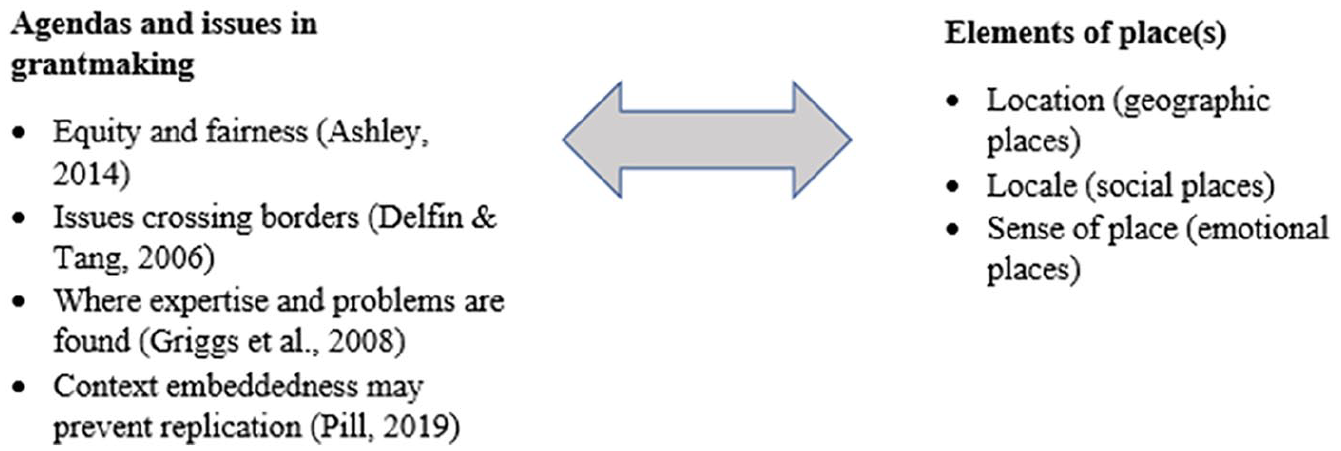
Elements of grantmaking and elements of place.
These elements group themes around giving and place at a conceptual level (building on Agnew’s theoretical perspective on elements of places themselves) and reflect public foundations’ values of equity and public benefit through their grantmaking. However, Figure 2 also acknowledges that factors influencing giving decisions and grantmaking agenda, such as where expertise or problems are found and issues without borders, have implications for place. This is consistent with the summary presented in Table 2, highlighting the diversity of emphasis and focus in the literature on place-based understandings in a philanthropic context, when mapped against Agnew’s three dimensions of location, locale, and sense of place.
The extended understandings of giving to place gained through this study provide a more nuanced awareness and appreciation of the complexity of place within philanthropy in terms of whether emotional ties or location, for example, govern grantmaking decisions.
The findings emphasize the relevance of place as a valuable construct in policy and practice for a broad number of actors, including the public sector, philanthropy, nonprofit organizations, and charities. It is important to explore conceptualizations that influence actors to drive or collaborate on place-based change, as well as their decisions’ impacts on places and people, noting varying degrees of inclusion, exclusion and/or marginality in those decision-making processes.
Conclusion
For philanthropic foundations, place-based giving offers a practical and easily understood alternative to a narrowly defined focus whereby philanthropic foundations fund insular issues. A focus on geographic boundaries in philanthropy is possibly a legacy from paper-based, geographic maps, but is less relevant in an interconnected, complex world. Boundaries can mean people are limited in how they are able to understand and support something, when they are not encouraged to look on “the other side of the fence” or from other perspectives.
This research highlights the ways internal factors affect foundations’ strategic focus, suggesting an important role for locale and sense of place in understanding foundations’ grantmaking motivations. It also acknowledges that grantmaking agenda have implications for place based on a range of issues, perceptions, and conceptions of place. Place-based giving is one of the factors that shapes and is shaped by a foundation’s identity and felt sense of responsibility to place (Agnew et al., 2003). Applying an exploratory lens drawing on Agnew’s (1987) conceptualizations of place, multiple interpretations, dimensions, and confluences of place within PubAFs are recognized, from systematic approaches such as pragmatics and postcodes to emotional approaches to places in need, places of the heart and memory. Hence conceptions of place may be a primary or secondary factor in decision-making processes and agenda and go far beyond geographic in nature.
Reflecting on these findings, this research contributes to the literature by providing empirical evidence of complex and nuanced understandings of both place and giving that go beyond location or geography. We find location is inextricably entangled with locale (social connections) and sense of place (emotional connections) in ways that are reflexively influenced by a foundation and its founders’ and donors’ identities. The areas of overlap between Agnew’s three elements of place are more significant than currently recognized in the philanthropic literature and an important contribution of this article, suggesting that appreciating the inter-relationships between the elements is as relevant for PubAFs as distinguishing between them.
Despite the wide variation in their chosen operating models, PubAFs are collectively distinct in their requirement to fundraise from the public, while unable to deliver services (Ward, 2016). Other foundation types also cannot deliver services, and other charity types depend on public fundraising, but none share both of those characteristics with PubAFs. This study serves the public interest by enhancing our knowledge of PubAFs as nonprofit organizations that perform important public roles in acting as aggregators and enhancers of giving, bringing donors together around a place or community. Agnew also observes this reflexive element of place: “Places are thus made by the people who inhabit them at the same time that the places help to make them” (Agnew et al., 2003, p. 612).
As revealed in Table 2, the literature on philanthropic geographies and place-based giving is dominated by research in a U.S. context. The focus of this article and the findings from an Australian context are therefore an important contribution to a broader Anglophone understanding. International comparisons of Australian philanthropy (McGregor-Lowndes & Williamson, 2018; Scaife et al., 2015) describe significant cultural differences that impede the international generalizability of findings. Differing public perceptions about the appropriate role of the state mean research on philanthropy often has to be “retrofitted” to suit another place or country (Phillips, 2018, p. 156).
There is a wide and rich field for future research on place-based giving. Environmental giving is a particular form of place-based giving involving different understandings of location. Geographic places are defined by natural rather than human-made boundaries, for example, supporting habitat preservation or water quality is place-based but defined by climate, terrain, and topography (Delfin & Tang, 2006). Furthermore, giving to environmental issues may involve giving to rural and remote areas for foundations otherwise not active in those places. “In general, rural and remote communities are also virtually ignored (outside of land conservation and some Arctic research)” (Phillips, 2018, p. 166). Linked with environmental giving, natural disaster giving is strongly place-based but only briefly touched on in this article and remains underexplored in an Australian context.
Globalization forces and phenomenal rates of economic change are causing increased anxiety and insecurity, to which individuals and societies respond in part by contracting their world to what they know and feel some control over. “. . .place/territory as a concept reflects a situatedness and fixity. But in our current era of dynamic globalisation, this fixity is in continual tension with movement and mobility” (Madanipour et al., 2017, p. 7). Local, place-based identities are noted to be the strongest forms of identity (Albert et al., 1998; Madanipour et al., 2017) and offer a collective focus in times of transition and fragmentation. A focus by foundations on place-based giving may thus be an opportunity to establish a sense of belonging and self: People look for clusters that they can get their mind around: family, peer groups, school, work organization, church, whatever. . . we’re trying to make sense of it at the local level with the people that we interact with. . .So I think identity, to really stick, has got to be something that you enact in a very local, tribal context (Albert et al., 1998, p. 279).
Thus, a focus of future research might be a deeper exploration of motivations and issues that lead a foundation to fund in a place or location. The literature has also noted distinctions tensions between place-based and issue-based giving, and future studies might explore ways in which these are perceived, managed, and interrelated to consider aspects of complementarity in achieving foundations’ missions.
Footnotes
Declaration of Conflicting Interests
The author(s) declared the following potential conflicts of interest with respect to the research, authorship, and/or publication of this article: Dr Craig Furneaux is an area editor for Nonprofit and Voluntary Sector Quarterly.
Funding
The author(s) received no financial support for the research, authorship, and/or publication of this article.
