



Abstract
This article seeks to explain how a dramatic new program of financial and technical assists to nonprofit organizations managed to surface on the active policy agenda of Russia’s government between 2009 and 2013 at precisely the same time the Russian government was suppressing foreign-funded nonprofit organizations as “foreign agents” and earning for itself a reputation as the perpetrators of a “global associational counter-revolution.” To answer this question, the article brings to bear the multiple streams framework (MSF) widely used to explain policy-agenda-formation in the United States and other countries and finds it sheds useful light on the agenda-setting dynamics recently at work in the evolution of government–nonprofit relations in Russia and, possibly, in other transitional societies.
Keywords
The definition of the alternatives is the supreme instrument of [political] power (E. E. Schattschneider; 1960, p. 68). We know more about how issues are disposed of than we know about how they came to be issues in the first place (John W. Kingdon; 1984/2011, p. 1).
Introduction
Duality has long been a central feature of Russian governmental policy, at least as viewed from the outside. But in few areas has this feature been more recently evident than in the country’s policy toward the nonprofit sector. Widely viewed in the West as the poster child of a “global associational counter-revolution” because of its crack-down on foreign-funded nonprofit organizations (NPOs) (European Foundation Centre, 2016; Rutzen & Shea, 2006), the active Russian policy agenda has also recently featured a dramatic new “tool kit” of nonprofit supports that seems to be aimed at moving Russia toward the pattern of government–nonprofit cooperation in the provision of social welfare services widespread in much of Western Europe and the United States, a pattern that has come to be known as “welfare partnership” (Rhodes, 1996; Salamon, 1987a, 1987b, 1995; Salamon & Anheier, 1996; Salamon & Toepler, 2015).
How did this tool kit initiative come about? And what does it possibly tell us about the evolution of government–nonprofit relations not only in Russia, but in other transition societies as well?
To answer these questions, this article views the recent emergence of a bold program of state supports for NPOs on Russia’s active policy agenda through the lens of the Multiple Streams Framework (MSF) originally formulated in a 1984 book by political scientist John Kingdon (1984/2011) drawing on a celebrated “garbage-can” theory of organizations advanced by Cohen et al. (1972). As this framework was initially developed to account for how issues make it onto the active policy agenda in the United States, its application to the far more centralized and authoritarian realities of contemporary Russia may seem far-fetched. But the Kingdon framework has been fruitfully utilized to explain policy agenda-setting in other (mostly democratic) political systems, been judged to be “applicable” to nondemocratic regimes as well (Herweg et al., 2018, pp. 35–38; Zhu, 2008), and has already been brought to bear fruitfully to explain agenda-setting in at least one field of recent Russian policy (Bindman et al., 2019). In this article we explore what help it can provide in explaining the dynamics involved in the recent broader evolution of government policy toward the nonprofit sector in Russia. Lending credence to this effort is the observation made by Zhu (2008, p. 319) calling attention to the relatively recent emergence in China of “forces . . . outside the government that are powerful enough to . . . question . . . [governmental] policies . . .” In Russia, these external forces may be even more firmly established than in China, including a variety of think tanks like the Center for Strategic Development, which authored the bold “Gref” reform program in 2010; the Levada Center, a prominent and highly regarded independent polling organization; the Gaidar Institute, created by the architect of the early post-Soviet reform agenda and serving as a prod to continued reforms; and the Higher School of Economics, a prominent and influential educational institution with a strong tradition of academic independence and substantial links to scholarship in the West across a broad front.
More specifically, this article assesses the light that the MSF framework can shine on the answers to two important questions about recent government policy toward NPOs in Russia: First, why did Russian policymakers not embrace the widespread pattern of government–nonprofit interdependence already widespread in Western Europe and the United States in shaping the agenda of government–nonprofit relations during the reform-oriented early post-Soviet period running roughly from late 1991 through early 1997 before stalling in the wake of an economic slowdown? And second, how did an ambitious strategy for promoting such interdependence make it onto the active Russian policy agenda a decade later, during which the country was in the midst of apparently “closing the spaces” for the operation of its nonprofit sector?
To answer these questions, the discussion here proceeds in four steps. First, we briefly recount the evolution of Russian policy toward the nonprofit sector during the 20-odd years leading up to the 2009–2013 appearance on the country’s policy agenda of a bold new “tool kit” of nonprofit supports. Second, we introduce the key elements of the MSF theory that hold promise of helping to explain the divergent trends of government policy toward nonprofits that this recounting reveals. The next two sections then bring the MSF approach to bear to help us explain two divergent realities: first, in section three, “Applying the MSF I: The Early Post-Soviet Reform Period,” why a fuller embrace of government–nonprofit cooperation did not surface on the active Russian policy agenda in the first part of this 20-year period; and then, in section four, “Applying the MSF II: The Climb to Agenda Status,” how it managed to make it onto the agenda in the latter part of this period when a far less supportive policy environment seemed to prevail.
Throughout, the discussion here draws on a rich array of sources, including official governmental and quasi-governmental publications, press accounts, interviews with key governmental and nonprofit leaders (See Table A1 of Appendix), and the informed insights of one of the authors who was a firsthand observer of these developments as a Russian NPO leader and then a senior researcher. What emerges is a picture strikingly similar to the one Kingdon portrays of a highly diffuse process characterized by “separate streams of problems, solutions, and politics,” becoming “coupled” only when a window of opportunity opened, and even then, only when a collection of “policy entrepreneurs” and a skillful combined “policy and political entrepreneur” came together to take advantage of the openings that resulted.
The Duality of Post-Soviet Russian Policy Toward the Nonprofit Sector
The Early Post-Soviet Period: 1991 to latter mid-1970s
The Russian nonprofit scene already apparent in the early post-Soviet period was far from monolithic. Russia had long been the site of a sizable array of citizen-focused, Soviet mass organizations, created by the state or party and designed to tie different constituencies to the regime (Kulmala & Tarasenko, 2016). As the perestroika period gave way to the collapse of the Soviet Union, these “legacy organizations” transformed themselves into regular nonprofits and attached themselves to increasingly autonomous regional governors, trading political support for financial subsidization (Cook & Vinogradova, 2006; Kulmala & Tarasenko, 2016). In addition, however, Russian citizens began forming their own, often-volunteer, organizations to serve a variety of unmet or under-met social needs (Jakobson & Sanovich, 2010; Pape, 2014). Finally, thanks in part to a significant surge of Western aid, a host of human rights, democracy promotion, environmental, and nonprofit support organizations took shape.
The governmental response to these developments was generally facilitative. Special laws were enacted to authorize establishment of multiple types of NPOs: public associations (May 19, 1995), youth and children social associations (June 28, 1995), charitable organizations (August 11, 1995), NPOs (January 12, 1996), and organizations for the protection of people with disabilities (November 24, 1995). Other legislation authorized the private provision of health and education services (Federal Laws N3266-1 and N 5487-1, respectively).
Although the result was a legal framework for NPOs similar to that in developed Western countries, no meaningful move was made to put in place the substantial “welfare partnership” model of nonprofit activity characterized by widespread reliance on NPOs in the provision of government-financed social welfare services that was by then widely evident in much of Western Europe and the United States (Salamon & Abramson, 1982; Salamon, 1987a; Salamon, 1995; Salamon et al., 2004, pp. 43–44; Salamon et al., 2017). Rather, the dominant attitude of the Russian government in the 1990s was one of well-wishing noninterference in third-sector affairs. Most Russian nongovernmental organizations (NGOs) seemed satisfied with this, very likely because noninterference was far superior to the outright hostility that typically confronted them in the past, and because they had access to substantial public and private funding from abroad and therefore could operate without state support. In addition, as noted more fully below, by the end of this period a number of them had succeeded in initiating fruitful partnerships with local political elites and businesses.
The Putin period
With Vladimir Putin’s accession to the presidency in May of 2000, however, a significant stiffening of government policy toward NPOs took shape, and this intensified following the Beslan school hostage crisis in Chechnya, which provided authorities with a convenient rationale to reclaim powers earlier surrendered to regional governors and nonprofit groups (Skokova et al., 2018; Toepler et al., 2019). Thus tax privileges extended to nonprofits in the previous period were canceled or reduced. A new NGO Law enacted in 2006 went after external funding of nonprofits, requiring government approval of external sources of nonprofit support and establishing cumbersome registration and reporting requirements for indigenous organizations receiving such assistance. Further restrictions were imposed through the so-called Foreign Agents Act in 2012, and a subsequent 2015 “Undesirable Organization” law that authorized officials to close down foreign organizations considered threats to state security.
Side by side with these restrictive measures, however, the Putin government also took a number of supportive actions, convening in 2001 a highly visible Civic Forum providing a venue for nonprofit, government, and business dialogue on pressing national issues; institutionalizing this in 2004 and 2005 with the creation of a network of regional “public chambers” offering regular venues for government–nonprofit-business discourse; and launching in 2006 a program of “presidential grants” to operating NPOs.
Although generally supportive at least of human service nonprofits willing to steer clear of overt political action, these initiatives hardly foreshadowed what came next on the active Russian policy agenda concerning nonprofits: a bold and comprehensive new “tool kit” of nonprofit support initiatives packaged together in a Concept Note released to the public in 2008 (Salamon et al., 2015, pp. 2190–2199) and including the following:
Establishment of a separate class of Socially Oriented Nonprofit Organization (SONPOs) eligible to receive various tax and budgetary benefits, including some canceled by the 2006 law;
Matching grants to regional authorities willing to establish their own nonprofit support programs;
Substantially broadened support for nonprofit training centers;
SONPO access to free or reduced-price space in state-owned properties;
Set-asides for SONPOs in social service contracting; and
Information resources and training to equip SONPOs to access expanded government social service outsourcing.
These initiatives signaled a paradigmatic shift in government–nonprofit interaction, moving such interaction from a small side-show to a far more fundamental component of the country’s social welfare policy strategy. As such, they call to mind the similar shift in social policy strategy initiated in France in the early 1980s, when a newly installed socialist government, departing from a long-standing French distrust of associations and sole reliance on a state social welfare delivery system, initiated a significant experimental delegation of such provision to nonprofits (Ullman, 1998).
How can we explain the appearance of this apparent paradigmatic shift in government–nonprofit relations on Russia’s active social policy agenda and why did it happen during a particularly restrictive turn in Russian policy toward nonprofits, and not in the earlier period of widespread policy reform? To answer this question, it is instructive to turn to the MSF elaborated by John Kingdon (1984/2011), and subsequently refined by a number of other analysts (Herweg et al., 2018; Zahariadis, 2003; Zhu, 2008, pp. 317–318) since it is precisely this type of question that this theory purports to address.
MSF
Prior to the empirical work undertaken by political scientist John Kingdon, American study of public policy was dominated by the “decision analysis” school of thought, which generated a comforting image of American society as a “pluralist democracy” characterized by multiple players shaping government decisions (Dahl, 1961). Scholars such as E. E. Schattschneider (1960) challenged the methodological assumption of this pluralist orthodoxy, arguing instead that real power lies not in what takes place on the overt policy agenda, but in keeping issues off the government agenda, thereby moving “agenda-setting” and “nondecision analysis” into prominence (Bachrach & Baratz, 1962; Crenson, 1971). Although agenda-setting was included in the early stages model of the policy process developed by Harold Lasswell (1951), it fell to John Kingdon (1984/2011) to identify its basic dynamics. Kingdon’s insight was to picture a far more diffuse and chaotic process than previously assumed, but one not wholly unstructured. That structure incorporates the following six key features.
First: The Garbage-Can Model
First and foremost, Kingdon found a useful metaphor for America’s agenda-setting process in the “garbage-can model” of organizational dynamics identified by Cohen et al. (1972). According to this model, certain complex organizations display “organized anarchy,” that is, their participants have ambiguous and contradictory preferences, imperfect knowledge about how organizational processes work, and uneven engagement in organizational decision-making. All of this produces enormous ambiguity and unevenness, precisely the conditions Kingdon found operating in America’s official agenda-setting process, and that others have found operating elsewhere as well (Herweg et al., 2015, 2018, pp. 35–36).
Second: A Distinction Between Processes and Participants
Implicit in this garbage-can model is a distinction between actors and actions, between participants and processes. In addition, both the participants and processes are numerous and diverse. Different participants can come into and out of different processes at different times.
Third: Three Families of Processes
More concretely, Kingdon (1984/2011, pp. 15–18) identifies three “process streams” that flow through the agenda-setting system: a problem stream, a policy stream, and a political stream. Each of these, moreover, has its own complexities, as Kingdon and subsequent elaborations of the MSF have shown. Thus problems are not simply objective phenomena, but “social constructs” that may need “problem brokers” to identify (Kingdon, 1984/2011, p. 110; Knaggård, 2015, p. 452). Policy alternatives are formulated within various policy communities, draw on both domestically and internationally generated ideas, and are dumped into a policy “primeval soup” (Kingdon, 1984/2011, p. 116; Lovell, 2016). To surface, proposals must at least meet prevailing “criteria for survival” involving technical feasibility, value acceptability, and financial viability (Kingdon, 1984/2011, pp. 113–116, 131–134; Lovell, 2016). Finally, the political stream thrusts its own considerations, and its own participants, into the mix—national mood, interest groups, government officials, political ideologies, and the media. This necessitates the engagement not only of what Kingdon characterized as “policy entrepreneurs,” but also of what Herweg et al. (2015, p. 446) characterize as “political entrepreneurs” with the connections, skills, and clout to package and sell both problems and policies to political elites.
Fourth: The Idea That These Processes Operate Separately of Each Other Until They Are “Coupled”
Importantly, Kingdon found these three streams operating largely independent of each other most of the time, subject to their own dynamics and engaging their own participants. To get a topic onto the policy agenda, therefore, some explicit “coupling” of these streams must occur.
Fifth: The Concept of Policy Windows
The coupling of the three steams is far from automatic, however. Rather, it often requires what Kingdon (1984/2011, p. 165) referred to as “policy windows,” and other scholars have referred to more narrowly as “agenda windows” (Herweg et al., 2015). These are shifts in governmental authorities, “focusing events” such as natural disasters, new indicators of social or economic problems, or similar shocks to public confidence that create opportunities for advocates to pull ideas from the policy primeval soup and link them to problems and political support.
Finally: The Role of Policy Entrepreneurs
Even when a window of opportunity opens, however, it typically requires the intervention of “policy entrepreneurs,” individuals who are invested in particular policy solutions, problems, or political persuasion, to move topics on to an active policy agenda. Such individuals have the incentives, and the skills, to take advantage of the opportunities that agenda windows provide to attach problems to particular policy solutions; and who locate political actors willing to advance the resulting package to the active government policy agenda.
Applying the MSF I: The Early Post-Soviet Reform Period
To explain what help the MSF can provide in explaining the path that the integration of the nonprofit sector into Russia’s social policy delivery system took in ultimately gaining active agenda status, we look first, in this section, at the elements identified in the MSF that might have been missing in the early post-Soviet reform period and kept this topic from achieving agenda status. This then serves as the backdrop for identifying, in the subsequent section, which of these may have appeared later to help propel this topic onto the country’s active agenda.
Hopes ran high in the West in the immediate aftermath of the Soviet Union’s demise that Russia was on the verge of a powerful political and economic revolution involving not only the privatization of the Russian economy but the destatization as well of the country’s social welfare system. To be sure, as noted previously, NPOs gained the legal right to form and were provided tax advantages to encourage hoped-for domestic private contributions. But no meaningful strategy was devised, and no meaningful steps taken, to “nonprofitize” human service provision as had been done decades before in Western Europe and the United States. No steps were even taken to capture some of the proceeds of the enormous sale of the country’s state-owned enterprises to seed charitable foundations that could finance independent NPOs into the future, as was done in the Czech Republic and, to a more limited extent, in Poland (Salamon, 2014). Rather, in practice the reform push in Russia left the country’s emerging nonprofit sector essentially in a “no-man’s land,” dependent on local volunteers and the good graces of newly privatized local businesses and international funders.
What clues does the MSF approach offer to help explain this outcome during what was, by all accounts, a dynamic reform period?
Not a Problem Stream Oversight
Viewed through the prism of the MSF, one thing that seems clear is that the inability to get active government–nonprofit cooperation in the provision of human services onto Russia’s active policy agenda during this period was not a lack of problems to be solved. Russian citizens had long since become highly dissatisfied with the performance of the bureaucratized Russian social welfare apparatus and this survived into the post-Soviet period, exacerbated by a sharp decline in government funding for health and education (Gaidar, 2003, p. 751). One of the earliest post-Soviet independent public opinion surveys, taken in 1998, thus found only 5% of respondents agreeing that “the state lives up to its obligations to the citizens” (Levada Center, 2014, p. 46).
A Distracted Policy Stream
The real barrier to bringing a serious program of government–nonprofit cooperation in the provision of social welfare services onto the active policy agenda lay, rather, in the MSF’s “policy stream.” For one thing, no real “nonprofit policy community” had yet gelled during this period to advance workable proposals. Even if it had, however, the proposals would have encountered significant push-back on grounds of “technical feasibility.” In a word, Russia’s nonprofit sector was not yet in a position to take on a major role in social welfare provision. Even the far more substantial Soviet legacy organizations were hardly equipped for such functions and other service-providing components of the sector were embryonic at best. As one prominent resource center leader conceded: The civil society was quite weak at that time . . . Only a very few experts . . . could envisage that the civil society [could] become an important force. (Interviewee 8)
Meantime, the policy community in effective control of the policy agenda during this period, while quite aware of the social-sphere problems, had other priorities. As one expert noted, “the absolute priority for the reformers was to achieve an economic break-through. First, the market sector had to emerge and begin developing . . . When some fruits are generated [by the market sector] they can be utilized” (Interviewee 2).
Implicit in this formulation, and in the hands-off attitude toward nonprofits during this period, was a fairly constricted image of the nonprofit sphere. Nonprofits, in this view, were useful accouterments of advanced societies, enriching citizen life through culture, sports, and hobbies; providing premier services for those able to pay; facilitating political engagement and human rights; but not assuming primary responsibilities for human service provision.
On the contrary, the only social-sector reform ideas percolating in the policy primeval soup at this time focused on preserving, not dismantling, the prevailing state-dominated system of direct social welfare provision. Reflecting this, the 1993 Russian Constitution proclaimed Russia a “Social State” and delineated an impressive list of social and economic guarantees the State owes its citizens. Reformers considered such guaranteed state social welfare provision to be one feature of the Soviet system worth preserving because its investments in human capital would offer Russia a crucial comparative advantage in its transition to a market economy (Gaidar, 2003, p. 36). Their policy ideas therefore reflected concepts embodied in the New Public Management and its Thatcherite “quasi-market” cousin calling for injection of business-type performance indicators into state-dominated social welfare bureaucracies and a shift to consumer-side subsidies that would force state-run service establishments to compete for “customers” against for-profit providers in the market (Borins, 1995; Gref Program, 2000, pp. 7–11, 25; Lane, 2000; Tullock, 1965). Little attention was paid, however, to notions of government–nonprofit interdependence or the “welfare partnership” pattern evident in much of Western Europe and the United States.
Significantly, this constricted image of the nonprofit sphere was reinforced by the external agencies funding Russia’s nonprofit development during this period. Far from encouraging nonprofit engagement in human service provision, the United States, for example, focused its energies on democracy promotion (Quigley, 2000, p. 198). This focus was shared, moreover, by other Western donors, which concentrated their aid on organizations involved in “democratic consolidation” (Carothers & Ottoway, 2000). The notion that civil society could be actively engaged in the delivery of social welfare services, or that such involvement could strengthen their advocacy activity, was never effectively integrated into this substantial support strategy.
Political Stream Challenges
Further complicating possible agenda status for the idea of a deeper partnership between government and the nonprofit sector was the likelihood that any such proposal would fail Kingdon’s “value acceptability” test, and therefore its political viability. Despite their strong misgivings about the quality of state-provided human services, the 1998 Levada survey revealed that more than 70% of Russia’s citizens remained firmly convinced that “most people will not be able to survive without tutelage from the state” (Levada Center, 2014, p. 46). The strong public push-back during this period to the possible replacement of direct state-provided health care with a private health insurance scheme further confirmed that tampering with the Communist regime’s comprehensive social safety net would be “underappreciated” by the population and hence a nonstarter in the political stream.
Finally, the value acceptability of greater reliance on NPOs was also put at serious risk during this early post-Soviet period by growing reports of widespread abuse of the new nonprofit laws. Because the new laws granting tax and other benefits to nonprofits were not accompanied by sufficient enforcement of the nonprofit-distribution constraint under which such organizations were supposed to operate, far too many registered nonprofits turned out to be for-profits “in disguise,” tainting the reputation of this sector (Jakobson & Sanovich, 2010, pp. 285–287; Kuzminov, 2007).
In short, Kingdon’s MSF offers useful insights pinpointing why the possibility of integrating nonprofit providers into Russia’s human service delivery system never made it on to the active reform agenda during the first decade of post-Soviet policymaking. This is all the more striking in view of the social welfare crisis that the transition to a market economy triggered by eliminating a key component of the former regime’s social welfare system: the state-owned enterprises that actually provided many of the crucial social welfare services (Wathen & Allard, 2014). Nor did the more systematic plan for coping with this crisis that emerged from the so-called “Gref Center” at the turn of the century acknowledge a significant role for NPOs. While identifying nonstate providers as essential elements for a fully “modernized” social welfare system, the Gref Program did not single out nonprofits as a subsector especially crucial to such modernization. As late as 2007, therefore, a prominent independent Russian think tank, itself a nonprofit, could publish a broad overview of the history of Russian welfare reforms that faulted “civil society institutions,” such as NGOs, for “playing essentially no role in social policy formulation,” due to their “overall weakness” and inability “to formulate their own constructive proposals . . .” (Maleva, 2007, p. 15).
Applying the MSF II: The Climb to Agenda Status
In actuality, however, complex streams of activity were already under way that would soon change this situation in ways that the MSF approach would recognize. In a word, important new “streams of problems, solutions, and politics” were emerging along with important “windows of opportunity” and “policy entrepreneurs” in a position to take advantage of them. As a result, within 2 years of Maleva’s (2007) report, Russia’s central government had issued an official Decree outlining a robust strategy of government–nonprofit cooperation in the provision of social welfare services, and launched a 4-year sequence of laws and decrees to implement it. How did this rise to agenda status occur, and what help does the Kingdon/MSF approach provide in explaining it?
An Opening From the Problem Stream
One factor at work is what Kingdon would recognize as the evolving “problem stream” facing Russian policymakers in the latter 1990s and into the first decade of the new century. In particular, the disastrous virtual collapse of the Russian economy in this period, coupled with the disappearance of the previous prop for the country’s social welfare system provided by state-owned enterprises, created a budgetary crisis for Russian policymakers. Not surprisingly in this climate, attention came to focus on the “very big [government] funds” flowing into the social policy sphere (Interviewee 4). Worse yet, the substantial funds being absorbed by this sphere did not seem to be relieving popular dissatisfaction with the quality of available services. Well into the first decade of the new century, over half of the population still rated the state’s medical care and social services as “bad,” and only 5% rated them as “good” (National Research University Higher School of Economics, 2011, p. 2). Policymakers were therefore on the look-out for ways to address this situation, creating an opening for nonprofit policy entrepreneurs.
Constructing a Nonprofit Presence in the Policy Stream
Fortuitously, in regions spread broadly across the country, embryonic NPOs were busily at work during the latter 1990s and early 2000s filling this void. Faced with the loss of important elements of the previous social welfare delivery system, and with help from many of the support centers initially sponsored by Western donors, a new breed of indigenous NPOs moved into the breach, providing tangible aid to a host of populations never served, or left underserved, by the state social welfare system. More than that, in a number of regions—Novosibirsk, Archangelsk, Yaroslavl, Krasnoyarsk, and St. Petersburg—they successfully reached out to recently empowered regional authorities for support and persuaded local businesses to kick in as well. Slowly but surely, the indigenous NPO communities began to develop a reputation for technical competence, innovative programming, and the ability to work with local authorities and generate business support. The city of Krasnoyarsk thus launched a municipal grant competition for NPOs working with youth in 1999, and the regional government followed up with a broader “Social Partnership” grant competition for NPOs in 2005 (Interviewee 7). NPOs in the Novosibirsk region reported establishing interactions with authorities in that region as early as 1997–1998 that led to regional government funding of NPO-originated hotlines for women experiencing violence, family crisis centers and other services” (Interviewee 8). A nonprofit support center leader in Arkhangelsk Oblast explained clearly how the process of stimulating the creation of early regional nonprofit support programs took place: We ourselves designed [this regional government support program]. We worked with the regional Parliament and with the Arkhangelsk City Administration to persuade them . . . We had experience making grants to nonprofits with funding from regional businesses—grants to support orphans, the elderly, and other categories of disadvantaged citizens. We accumulated positive experience with such social projects [and] were able to demonstrate both efficiency and effectiveness. (Interviewee 9)
Regional nonprofit leaders were not content to operate only in their separate regions, moreover. They reached out to the Presidential Representatives in their respective regions to report their achievements to Federal authorities (Interviewees 8 and 9). They co-organized Social Project Fairs through which to advertise and disseminate these regional experiments. The Presidential Representative in one of these districts, who later emerged as the First Deputy Head of the Presidential Administration, was so impressed by these developments that he began holding annual events to learn about, and publicize, NPO social innovations (Interviewee 9). NPOs were thus on their way to establishing what Kingdom would term the “technical feasibility” of their contributions to social welfare policy. As one regional nonprofit leader put it: “At first there are individual projects in the regions. The practice is tested, then it jumps to the federal level. I think this is an understandable mechanism” (Interviewee 9). It is also a mechanism easily recognized as a critical step in the agenda-setting process identified by Kingdon and other MSF analysts. In Kingdon’s terms, local nonprofits were effectively constructing a nonprofit “policy/solution stream” from the ground up.
New-Found Prominence in the Political Stream
A further crucial boost to active agenda status for the concept of state–nonprofit cooperation came, surprisingly enough, from the third of the key process streams identified by Kingdon: the political stream. This dimension of agenda-dynamics is particularly difficult to assess in the context of Russia, but it seems clear that certain political and economic calculations were involved in what ultimately led to the break-through moment of NPO access to the policy agenda in 2009. For one thing, because of the NPOs’ success in tapping business contributions, increased cooperation with NPOs offered one potential avenue for addressing the problem stream issue of inadequate budgetary resources for the social-sector. Noted one official close to the discussions: “[O]ne could use the NPO’s resources. The state did have such an interest [in that] . . .” (Interviewee 4).
This feature of the pre-2009 regional NPO support programs was well understood by the programs’ designers. “Our main argument, built into the design of the program,” explained one such NPO leader, “was that for each ruble from the [region’s] budget, the program would raise a ruble from the business community. Fundraising from business sources was our responsibility . . . The program generated extra-budgetary resources for the social sphere” (Interviewee 9).
This possibility naturally attracted the attention of the Presidential Administration, confirming the MSF’s suggestion that links to an on-going problem stream can be enormously helpful in gaining agenda status for an idea. Whether for this or other reasons, steps were initiated in the early years of the Putin era in Russian politics to “turn the third sector into an ally in solving social problems and, at the same time, prevent its politicization.” (Jakobson & Sanovich, 2010, p. 294; Interviewee 3). The strategy for achieving this was to curry favor with those segments of the NPO community willing to work with the state without posing fundamental political challenges to its legitimacy. It was this strategy that likely led Vladimir Putin, newly elected as President in 2000, to follow the suggestion of his Presidential Administration to convene a Civic Forum in 2001 to begin a national dialogue to see what this newly visible citizen sector could contribute to the state’s social welfare activities. The result was a pivotal event not only for what it accomplished but also for what it set in motion. The Moscow Forum legitimized the nonprofit sector as a partner for government and served as a template for similar events in the regions. Ultimately, this led to legislation creating a network of “Public Chambers,” giving nonprofits a platform through which to demonstrate their readiness for cooperation with authorities and showcase the useful innovations they were capable of providing. This was then supplemented in 2005 by the launch of a modest program of “Presidential grants” to third-sector organizations. By the latter 2000s, therefore, this political stream had developed to the point at which more active state-civil society cooperation in support of shared social welfare goals became politically viable. As one NPO leader explained, “only after the Forum, did NPOs become noticed and recognized . . . The situation changed, and the development began” (Interviewee 2).
Creation of a Nonprofit Policy Community
As one of its most consequential outcomes, the establishment of formal venues for government–nonprofit dialogue in the regions helped form another crucial component identified in the MSF as a precursor to active agenda status: that is, a nonprofit policy community made up of newly emboldened “policy entrepreneurs.” Included here was a network of effective support center directors, NPO leaders, and academics, who naturally began to incubate ideas for policy steps that could help encourage and expand these NPO contributions.
The Higher School of Economics under the leadership of Rector Kuzminov and Vice Rector Jakobson assembled one such significant group of experts from several leading universities, think tanks, and NPOs (Interviewee 2). These experts in turn found their way to officials in the Government who were receptive to such ideas, including particularly in the Ministry of Economic Development (MED), which had been charged with formulating a “mid-term development program” for the government. In what the MSF would identify as a “softening up” process (Kingdon, 1984/2011, p. 127), this led, by 2004, to a shift in the venue for developing a concrete agenda of ideas for engaging civil society in the solution of social problems from external institutions to the MED and the formation within this Ministry of a working group drawing heavily on the recently established external nonprofit policy community (Interviewee 3). The nonprofit sector was now near to being incorporated into the official agenda of the government.
Two Additional Policy/Solution Stream Assists
Also helpful to an item’s prospects for reaching agenda status according to the MSF are the item’s consistency with ideas already “floating” in what Kingdon referred to as the policy “primeval soup”; and the item’s consistency with key societal values. In both cases, developments in the policy/solution stream during this early- to mid-2000s proved helpful in advancing the idea of government–nonprofit collaboration in the provision of social welfare services to active agenda status.
The first of these built on the New Public Management reform ideas advanced in the 1990s to introduce market logics into the social welfare system by authorizing outsourcing of service provision to nonstate, mainly for-profit, institutions (e.g., Government of the Russian Federation [GRF], 2005, 2010). As part of these measures, reform advocates successfully pushed for special set-asides to enable small and medium-sized business enterprises (SMEs) to participate in the embryonic social welfare outsourcing market. In the process, however, they provided what would become a convenient rationale for advocates of nonprofit involvement to press for comparable supports for nonprofits.
Similarly, important steps were taken to overcome the value deficit that had impeded earlier fuller nonprofit access to agenda status. Well into the 2000s, the regional branches of the state human service bureaucracies fought a rear-guard battle against the entire outsourcing strategy (Interviewee 8), complaining in particular about any suggestion that nonprofits be involved on grounds that nonprofit were “primarily political actors” fundamentally “working against” governmental agencies (Interviewees 7 and 1), and that “the people’s money” will get “lost” if it is “given” to NPOs (Interviewee 9). Complicating matters further, elements within the nonprofit sector itself, such as human rights NGOs, took issue with any move toward cooperation with public authorities on grounds that this would lead to a loss of nonprofit autonomy, mute the sector’s advocacy voice, and give state authorities undue control over the sector (Interviewee 2).
The sector’s demonstrations of technical competence, innovativeness, and effectiveness in handling regional grants went a long way toward undercutting such criticisms. Beyond this, however, scholars at the Higher School of Economics came forward in 2000 with a reconceptualization of the contemporary Russian nonprofit scene that offered a halo of sorts on the newly emerging nonprofit service-providing organizations. The heart of this reconceptualization was the identification of a distinctly new class of Russian NPOs, helpfully labeled “rooted” organizations. This distinguished the service-oriented organizations from both the fundamentally political organizations “imported” into Russia from abroad, from the “fake” nonprofits that surfaced in the 1990s, and from the pseudo-nonprofits that the surviving Soviet mass organizations had become (Jakobson & Sanovich, 2010). According to this reconceptualization, these “rooted organizations” were the true heirs to Russia’s many prerevolutionary charities, exhibiting “altruistic aspirations” and dedication to the actual service needs of the Russian people, thus legitimizing their significant involvement in the delivery of contemporary social welfare services.
A Useful Policy Window
Against this backdrop of potentially converging problem, policy/solution, and political streams, the formal end of the Putin presidency and the election of Dmitry Medvedev to replace him in 2008, though partly contrived, nevertheless seemed to provide just the extra impetus needed to move the discussion of incentives to promote government–nonprofit cooperation in the social welfare field into a more active phase (Interviewee 2). In Kingdon’s terms, it opened a “window of opportunity” to “couple” the three streams of problems, solutions, and politics and achieve formal agenda status for a program of state-NPO cooperation.
The Coupling Process: Emergence of an Effective “Policy/Political Entrepreneur”
According to Kingdon (1984/2011, p. 20), the fortuitous co-existence of advantageous separate streams of problems, solutions, and politics along with the opening of a window of opportunity, while necessary for an issue to gain agenda status, is still not sufficient. Also needed is what Kingdon termed a “policy entrepreneur,” that is, a person in a position to “coupl[e] solutions to problems, and problems and solutions to politics.”
In the case of Russia, at least in the case examined here, the term “policy entrepreneur” does not quite do justice to the actual role performed. This is so because here the agenda-setting phase of the policy process seems much more tightly tied to the policy decision phase, with actions in both spheres carried out in tandem, and, in this case, in the same institution. In a sense, unlike the suggestions of Herweg et al. (2015, p. 446), the roles of “policy entrepreneur” and “political entrepreneur” are almost merged in Russia as the policy entrepreneur tests policy ideas against the political appetites of higher ups in the bureaucracy as they are formulated.
Unfortunately, the closed nature of government decision-making in Russia makes it difficult to penetrate this aspect of the agenda-setting process. What is clear, is that such an effective policy-cum-political entrepreneur surfaced in the process leading to the rise of government–nonprofit cooperation to agenda status in the person of Artem Shadrin, an unassuming former researcher at the reform-oriented Gaidar Institute of Economic Policy and later at the Higher School of Economics (HSE), who assumed the position in the mid-2000s as Deputy Director of the Department of Analysis and Monitoring of Priority Programs in Russia’s Ministry of Economic Development (MED). In the words of one close observer, Shadrin treated the promotion of a substantial role for NPOs in human service delivery as “some sort of personal mission” (Interviewee 2). Shadrin was “the ‘true motor’” behind this move to bring NPOs into the provision of publicly funded human services, noted another (Interviewee 4).
Shadrin’s job was both to forge a consensus among the think tank, academic, and NPO support center figures that formed the informal “nonprofit bloc” already identified, and a key set of quite senior governmental leaders whose support would likely be needed to advance this idea through the MED and the powerful Presidential Administration. As a former researcher at the well-regarded Gaidar Institute and the HSE, Shadrin had immediate credibility with the “nonprofit bloc” of academics and practitioners. In his role as “political entrepreneur,” Shadrin had the benefit of key potential allies strategically located within the MED and the Presidential Administration. Included here were prominent Presidential Representatives in Russia’s regions, such as Sergey Kirienko in the Privolzhsky Federal District, who supported the NPO social project fairs that helped boost NPO credibility and who later became Deputy Head of the Presidential Administration; and Vladislav Surkov, Deputy Head of the Presidential Administration in the early 2000s, who oversaw the 2001 Civic Forum and headed a work group on the reform of NPO law. What is more, within the Ministry of Economic Development to which Shadrin was appointed in 2004, a succession of Deputy Ministers—Dimitriev, Levitskaya, Popova, Klepach, Fomichev, and ultimately MED Minister Nabiullina—articulated support for the promotion of a substantial role for NPOs in human service delivery.
In making the case to these officials, Shadrin was able to reference the problem stream concerns and potential solutions already attracting attention among his ministry colleagues: the enormous budgetary costs of the state-dominated human service delivery systems, the evidence of continued citizen dissatisfaction with the quality and quantity of the resulting services, the search for “market-conforming” reforms that could inject greater competition and accountability into this system, and the evidence of growing nonprofit capability to deliver quality services and bring additional resources into the system.
MED was an ideal base from which to achieve this coupling of problems, solutions, and politics. Certainly in the Russian context, locating this function inside the bureaucracy was a definite plus. And MED was a particularly useful such locus, operating as it did outside the “social bloc” ministries of health, education, and social services, which, as one Interviewee 3 noted, have “conflicts of interest” in protecting “their own networks of government-owned institutions.” Perhaps because of this and its reputation for “solving problems requiring interagency coordination” (Interviewee 4), MED had been tasked with formulating a mid-term development program that included possible social welfare reforms (Interviewee 4). This gave Shadrin’s unit the legitimacy to advance proposals that other elements of the bureaucracy might easily have shot down.
Shadrin and his staff seem to have functioned as the secretariat to this array of actors, keeping the component parts informed, and keeping the topic alive and moving forward. He thus met the standard of the effective coupler portrayed by Herweg et al. (2018, p. 28): a person who “must be not only persistent but also skilled at coupling.”
What emerged from this process was a consensus “Concept to Facilitate the Development of Charitable Activities and Volunteering in the Russian Federation.” This document was then legitimized through a series of public hearings organized by the Public Chamber of the Russian Federation during 2008 and quickly advanced to official agenda status thanks to the “window of opportunity” created by Russia’s presidential election of 2008, which elevated Vladimir Putin’s ally, Dmitri Medvedev, to the presidency, and made “National Projects” aimed at increasing the effectiveness of the social-sphere a central element of the Medvedev–Putin platform. By June of 2009, therefore, the Concept document vetted through the Public Chamber in 2008 was issued as a high-level government decree (Postanovlenie Pravitelstva) complete with a list of “action items” that included development of the set of laws establishing the tool kit (GRF, 2009). These laws were then formally developed by the MED staff and approved without apparent modification by the state Duma over the next several years. This demonstrates that the suggestions made by some students of the MSF approach (e.g., Howlett et al., 2014) to the effect that additional streams are needed to handle the policy enactment phase of the policy process may not be needed in authoritarian polities such as Russia, where access to the active policy agenda is almost tantamount to enactment.
Conclusion
In short, despite the attention aroused by the 2012 Russian foreign agent law and its image of generalized hostility to NPOs, Russia has simultaneously experienced an expanded policy of governmental encouragement of socially oriented NPOs. This latter policy found its way onto the official Russian policy agenda through a process with striking similarities to that elaborated in the multi-stream framework originated by John Kingdon and widely used to analyze the agenda-setting process in the United States and other settings (Herweg et al., 2018). This is not to say that the political system, or even the agenda-setting process, in Russia, is identical to that in the other settings where this framework has been fruitfully applied. Clearly the movement from agenda-setting to policy enactment seems to differ markedly between Russia and most of these other settings. But there are enough echoes in the Russian story of Kingdon’s picture of the agenda-setting process to suggest that large, complex societies like the United States and Russia may share significant commonalities in the way they establish policy agendas to cope with complex societal problems. This observation finds further confirmation, moreover, in recent studies of policy formation in China suggesting that authoritarian regimes, too, face the challenge of coping with a never-ending “complex mix and flow” of problems, ideas, and pressures and have found it advantageous for the legitimacy of their own claims to stewardship to open up consultative spaces for multiple actors and diverse problem, policy, and politics process streams similar, if not identical, to those identified by the MSF analysis (Duckett & Wang, 2017; Zhou and Feng, 2014).
Not only does this insight help us understand how Russia came to possess two rather divergent streams of policy toward NPOs at the same time—one avowedly hostile and the other strongly cooperative—but more importantly, it may alert us to the possibility that the cooperative stream, despite being almost invisible in both press and academic accounts in the West, may ultimately prove to be at least as significant for the long-run future of the nonprofit sector in this country as the one that has attracted most of the attention externally.
Postscript
As is not uncommon with high stakes policy initiatives in complex societies, the creation of the tool kit of NPO supports culminated just one phase of the evolution of the Russian government’s policy toward NPOs. In the Russian case, not only was the enactment of the NPO tool kit followed by passage of the widely criticized “foreign agent law” in 2012 (GRF, 2012), but also there has been a certain amount of “foot-dragging” on engaging NPOs in the delivery of government-funded human services on the part of some regional branches of the social block ministries, and one of the major tool kit initiatives, the matching grants to encourage regional NPO support programs, was ultimately canceled and the funding re-centralized in a newly created Fund for Presidential Grants.
Despite these setbacks, however, the Russian government’s commitment to expanding reliance on NPOs in the provision of human services has remained very much in force. Indeed, provisions have been added to protect the nonprofit role in social service contracting by reinforcing the legal right of recipients to choose their providers, obliging the responsible government agencies to publicize NPOs willing to offer such services, and requiring regions to set aside at least 10% of their social welfare budgets for nonprofits (Law 442 of December; GRF, 2013; MED, 2016).
This opening for an expanded government–NPO partnership in the delivery of human services has been explicitly blessed, moreover, in every recent annual Presidential Address to the national Duma, or Parliament (Putin, 2012, 2013, 2014, 2015). Taking the cue, seven other Ministries have jumped on the bandwagon, first, by broadening the SONPO designation to NPOs in their fields, and then by gaining budgetary support to initiate their own grants to these NPOs. By 2014, therefore, federal funding of NPOs had risen to 10.3 billion rubles (US$311 million)—more than double the amount just 2 years earlier (Shadrin, 2014, p. 5).
More generally, a sizable infrastructure has emerged to implement the new “policy” of government–nonprofit cooperation. Beyond the Federal ministries and their regional branches, many of the 71 regional administrations (of 85) that created or extended regional government support programs for NPOs with MED grant support extended these programs after the expiration of the MED program and tens of thousands of NPOs have received capacity-building grants or benefited from government-funded conferences and consultative support (Shadrin, 2014). Despite initial concerns, moreover, SONPOs have been free, within limits, to pursue their advocacy activities to improve the operations of government programs, using a a style of advocacy that one scholar has termed “collaboratve advocacy” and that is common among human service nonprofits in many developed Western countries entailing close working relationships with officials drawing on nonprofit expertise and experimentation rather than public protests and criticism (Mosley, 2011; 2013). As one of our Russian nonprofit respondents put it: “One should not talk about any significant restrictions of NPOs activities if organizations receive governmental support. For instance, we have regional and municipal support, but continue to raise the alarm at all meetings with officials. We’re doing what we’ve been doing, only, of course, we focus on regional programs in the field of health.” In other words, the conditions and processes that led to this agenda break-through appear to be holding.
Footnotes
Appendix
Personal Interviews.
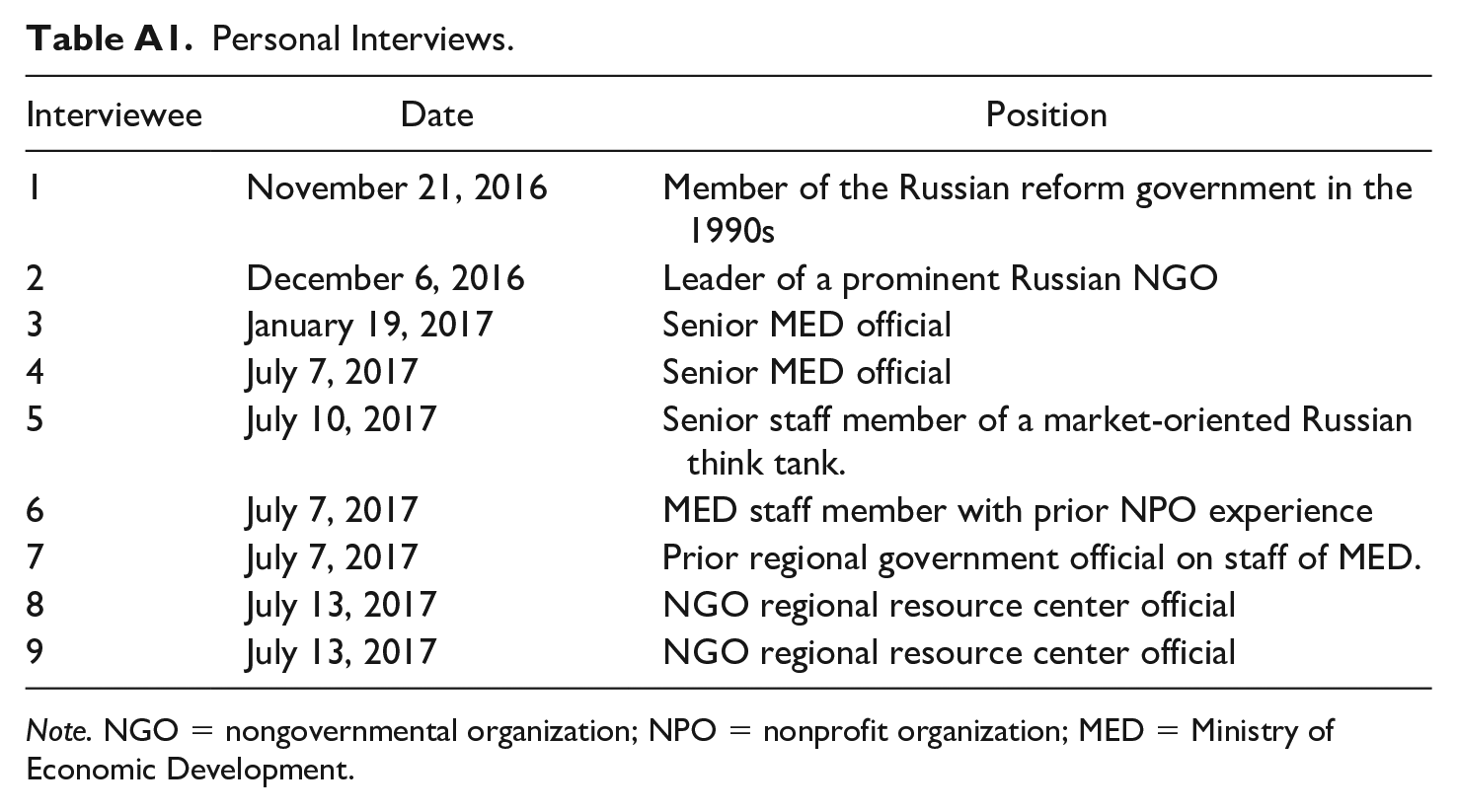
| Interviewee | Date | Position |
|---|---|---|
| 1 | November 21, 2016 | Member of the Russian reform government in the 1990s |
| 2 | December 6, 2016 | Leader of a prominent Russian NGO |
| 3 | January 19, 2017 | Senior MED official |
| 4 | July 7, 2017 | Senior MED official |
| 5 | July 10, 2017 | Senior staff member of a market-oriented Russian think tank. |
| 6 | July 7, 2017 | MED staff member with prior NPO experience |
| 7 | July 7, 2017 | Prior regional government official on staff of MED. |
| 8 | July 13, 2017 | NGO regional resource center official |
| 9 | July 13, 2017 | NGO regional resource center official |
Note. NGO = nongovernmental organization; NPO = nonprofit organization; MED = Ministry of Economic Development.
Declaration of Conflicting Interests
The author(s) declared no potential conflicts of interest with respect to the research, authorship, and/or publication of this article.
Funding
The author(s) received no financial support for the research, authorship, and/or publication of this article.
