



Abstract
While scholars have analyzed the emergence and characteristics of social enterprises, and their internal tensions between conflicting logics, we have little understanding of the dynamics at the interorganizational level between social enterprises. Based on an in-depth, qualitative study with work integration social enterprises in the secondhand clothes industry, we uncover the dynamics of simultaneous cooperation and competition. Our analysis shows that social enterprises simultaneously—rather than sequentially—engage in coopetitive actions at three levels of action: operational, stakeholder, and environmental interface. At each level, social enterprises engage in different coopetitive actions that do not easily fall under the commercial–social tension usually studied in the social entrepreneurship literature. Social and economic goals motivate both competition and cooperation, but we argue that this plays out differently at each level of coopetition. We conclude with implications for theory and practice.
Introduction
Social enterprises (henceforth, SEs) have seen steady growth since the 1970s, with a significant acceleration after the 2000s (Bosma et al., 2016). This increase has sparked much academic interest (Haigh et al., 2015), with scholars researching on SEs position at the boundaries between the nonprofit and for-profit sectors (Dees, 1998; Dees & Anderson, 2003) and the way they manage internally different institutional logics (Battilana et al., 2015; Pache & Santos, 2013; Skelcher & Smith, 2015; Smith & Lewis, 2011). While these are all important aspects, we still have little understanding of what is happening at the interorganizational level between SEs in the same industry. Do they compete or cooperate, or both? In which ways do they do so? In current theoretical discussions on SEs little attention has been paid to these questions. Research in the nonprofit sector has revealed that organizations with similar social missions can compete for resources from donors (Andreoni & Payne, 2003; Nikolova, 2015). Although nonprofits could support each other in the pursuit of social aims, this does not always ensure cooperative relationships. How does this play out among SEs?
Management literature has explored the dynamics of simultaneous competition and cooperation among business organizations, coining the concept of coopetition (Bengtsson & Kock, 2000). Even if coopetition has been analyzed in a variety of industries (Gast et al., 2015), there have been calls to study it among other types of organizations (Bengtsson et al., 2016). In this article, we argue that the concept of coopetition offers new insights into the relationships among SEs in the same industry. For this, we pursue a qualitative investigation using a unique nested case of a group of 15 SEs, established in 2002 by nonprofit organizations in the secondhand clothes sector. Since the beginning, the group has undergone a series of changes due to external shocks, such as shifts in funding priorities, and internal readjustments, such as efforts to scale operations.
Our research shows that competition and cooperation among SEs happen simultaneously, rather than sequentially, and throughout the development process of SEs, rather than at earlier or later stages. We expand the theoretical understanding of this phenomenon showing that SEs coopete at three different levels and that these dynamics do not correspond in a one-to-one way to the internal tension between social and commercial logics. Thus, we offer a complementary perspective to the usual way to study SEs as the combination or balancing of social and commercial goals (Battilana et al., 2015), as both goals, with some variation at different levels, lead SEs to develop competitive and cooperative behaviors.
The structure of the article is as follows. First, we review the literature used as a background for this study. Second, we describe our in-depth, qualitative approach emphasizing the research setting and data collection. Third, we present our findings and conceptual framework for interorganizational coopetition between SEs at three levels. Fourth, we discuss how our results contribute to current theoretical discussions on coopetition and SEs, including the relationship with the social and economic goals of SEs. Finally, we conclude acknowledging limitations and suggesting implications for practice.
Literature Review
SEs have been defined as organizations that “seek to solve social problems through business ventures. They combine the efficiency, innovation, and resources of a traditional for-profit firm with the passion, values, and mission of a not-for-profit organization” (Smith et al., 2013, p. 408). Several nonprofits have been drawn to develop SEs to gain autonomy (Fitzgerald & Shepherd, 2018). This process could increase competition for clients, funding, and government endorsement (Hardy et al., 2003), making them reexamine their core identity (Sharp, 2018). Previous research has emphasized the hybrid nature of SEs due to the combination of different logics: the commercial and the social welfare logic (Battilana & Dorado, 2010; Battilana & Lee, 2014; Siegner et al., 2018; Smith et al., 2013). Given this dual dimension, it might be expected that SEs would engage in coopetitive relationships; perhaps even more so than nonprofits or for-profits. Yet, these dynamics have been hardly studied. Perhaps, at first, one would expect the commercial dimension to lead to competitive behaviors, and the social one to collaborative ones. Nonetheless, there can be rivaling ways to understand the social goal of SEs and the commercial logic can also include collaborative behaviors. Thus, it is unclear whether there is a one-to-one correspondence between social and commercial logics, on the one hand, and cooperative and competitive behaviors, on the other.
Coopetitive relationships are defined as the simultaneous engagement in both cooperative and competitive behaviors between two or more actors (Bengtsson & Kock, 2000; Gnyawali & Park, 2009, 2011; Tsai, 2002). While competitive behaviors are based on divergent interests (e.g., to earn above-normal profits), cooperation is based on the convergent interest to achieve common, rather than individual goals (Padula & Dagnino, 2007). Regardless of whether they occur in horizontal or vertical relationships (Bengtsson & Kock, 2014), managing coopetition is a complex task because conflicting interests can lead to hostility between organizations and, simultaneously, organizations fear that excessive emphasis on common interests could undermine their autonomy. This complexity can be especially acute among organizations in the same field that create value from the same products and services. At the industry level, organizations can cooperate for various reasons: It can be costly to develop new tools or technologies alone, to enter new markets, or to compete with larger organizations. Several authors have shown that collaboration in terms of knowledge-sharing and resource pooling provides benefits to organization (Hong & Snell, 2015; Planko et al., 2019). Creating economies of scale and scope allows access to new resources, helps deal with uncertainty in the market and the external environment, and leads to the development of sector or industry standards (Gnyawali & Park, 2009). Yet, while doing this, the same organizations undoubtedly compete with each other. For example, as studied by Bengtsson and Kock (2000), firms in a coopetitive relationship share knowledge on some issues but hide from each other knowledge on other aspects. Tsai (2002) also examined the transfer of knowledge as a usual form of coopetition, and Luo et al. (2006) studied the effect of cross-functional coopetition on the performance of firms. Thus, while the fields of strategic management and entrepreneurship have devoted considerable attention to the practice of coopetition in several contexts and industries (Bouncken et al., 2015), some authors have called for more in-depth research into coopetitive dynamics in different industry contexts, uncovering novel elements (Gnyawali & Song, 2016). In line with this recommendation, this article explores coopetition in a different type of organization, such as SEs.
In the nonprofit literature, coopetition has been analyzed in relation to interactions between governmental organizations and NGOs (Najam, 2003) and between for-profit and nonprofit units within hospitals (Brown et al., 2017). Yet, there is little research on coopetition among SEs. This is surprising, as the mandate to balance social and financial goals could lead to both cooperative and competitive-oriented behaviors. One of the few exceptions is a recent article by Herbst (2019), who studies commercial and social marketing activities and shows the benefits for SEs of forging alliances with competitors. While this work provided empirical evidence of coopetition in SEs, the focus was on SEs working with different types of actors, rather than the interaction among several SEs. Now, the proliferation of SEs within and across different industries prompts to ask how they interact with each other, especially in the same industry and geographic region. Thus, our research question is: How do the interorganizational dynamics of coopetition work among SEs in the same industry? This inquiry can expand the discussion on social entrepreneurship by applying different conceptual perspectives, as encouraged by Mongelli et al. (2017), and by shedding light on how the dynamics of coopetition fit with actions taken by SEs to pursue economic and social goals.
Method
To address our research question, we engaged in an in-depth, qualitative research using a nested case study of 15 work integration social enterprises (WISEs) in the secondhand clothes sector in Catalonia, Spain. This methodological approach seemed the most appropriate for a new and poorly understood phenomenon (Eisenhardt, 1989), with multiple elements that evolve over time (Langley, 1999). As argued by Flyvbjerg (2006), among others, case studies are not at odds with generalizing findings, and hence we believe our study can advance our knowledge of the dynamics of coopetition in the field of SEs.
Research Context
Secondhand charity retail organizations collect used clothing and household items donated from individuals and organizations (e.g., Goodwill and Salvation Army in the United States and Canada, Oxfam in the United Kingdom and Europe). Although the activities of collection, sorting, and resale look very similar between organizations, the purpose can vary: providing a social service (e.g., work integration or cheaper clothes), preserving the environment (recycling), and raising awareness about a charitable cause (e.g., information centers or leaflets; Horne, 1998). Our research is based on a nested case study with multiple organizations in the secondhand clothing sector in Catalonia. They are united under the same brand name, and participate together in projects, but are distinct and separate organizations, with their own structure, financing, and missions. This setting allows us to study a relatively small ecosystem where different SEs engage in common activities, but are independent and compete in some respects. In fact, the articulated structure of the group and especially how it evolved over time facilitates the analysis of rich competitive and cooperative relations. Furthermore, the organizations under study made clear their apprehension about the entrance of new nonprofit and for-profit organizations in the same industry, which has seen rapid professionalization over the past 20 years.
Case Overview
The beginnings of the secondhand charity retail sector in Catalonia started in the 1980s when several nonprofits were founded to formalize the work done by parishes in collecting and distributing clothing to people in need. Some of the new organizations were founded by groups connected to the Catholic Church, such as Caritas, and others were secular initiatives aiming to contribute to social value by monetizing their activities. All of them combined secondhand clothes collection with the goal of helping socially excluded individuals transition into the labor market. They also aimed at being financially self-sufficient and, in some cases, growing in scale. The growth of WISEs in Catalonia spurred the formation of an association: the Inter-Sectoral Association of Recyclers and Social Enterprises of Catalonia (AIRES, in the Catalan acronym). AIRES was the first step for these organizations to come together and share insights about their activities. It was also a way to mobilize resources from private institutions, foundations, and European projects to improve the management and operations of the organizations, both individually and collectively.
The One World Foundation (Fundació Un Sol Món, in Catalan), established by a local bank to support social welfare programs, approached AIRES with an ambitious project: bringing the different WISEs devoted to secondhand clothing collection and retail under a common brand, even if they maintained their separate operations. Thus, in 2002, the Roba Amiga program was founded joining together 15 WISE organizations. It boosted the amount of textile waste managed, thereby advancing their common goals: (a) to create jobs for people at risk of social exclusion, (b) to decrease textile waste ending up in landfills, and (c) to sell clothes at affordable prices to people in need. With this joint effort, Roba Amiga achieved a leading position in the textile waste collection sector in Catalonia.
In 2008, the institutional setting changed substantially when the One World Foundation ceased funding the Roba Amiga program due to a change of strategic focus. Yet this foundation, concerned about the future of the program, pushed for the creation of a new organizational form. After a series of deliberations, the Roba Amiga Cooperative was established by five of the organizations involved in the original program. The remaining ones did not join the cooperative for various reasons, such as the desire to maintain their autonomy in decision making or frustration with how the cooperative was being formed. The goal of the Roba Amiga Cooperative was to further exploit synergies and increase the organizations’ efficiency and capacity to manage textile waste.
In 2011, the Roba Amiga Cooperative prepared a project for a new plant to sort, package and store secondhand clothes, which would considerably help scale its operations. Ultimately, two of the five organizations in the cooperative decided to pursue the project after receiving an award (in the form of a very beneficial loan for 1 million euros), and they established a new organization, which we translate as Roba Amiga Work Integration Social Enterprise (henceforth, RA-WISE). As of 2013, RA-WISE began operations in the new plant with increased capacity and infrastructure. Based on data collected, we developed a visual process map of the Roba Amiga case and critical events, displayed in Figure 1 (where the arrows indicate the sequence of events). In summary, this study is based on a group of 15 organizations involved in a donor-funded program, of which five formed a cooperative (when the donor left), of which two created a new WISE together (when the project for the new plant received funding).

Visual process map of Roba Amiga case development and critical moments.
Data Collection
Our primary source of data for this study was in-depth interviews, carried out by one author between May 2014 and June 2015. A total of 17 interviews were conducted with managers and employees at nine of the 15 organizations involved in Roba Amiga and one of the collective associations (interview matrix available as Online Appendix). Fourteen of the interviews were recorded and transcribed and the remaining were documented in field notes directly after (as permission to record was refused). They were semi-structured critical incident interviews, where interviewees were asked about moments of change in their organizations. This method is useful for the collection of retrospective data by inviting actors to recall what they did, felt, and thought at specific points in time (Butterfield et al., 2005; Flanagan, 1954).
In addition to the interview data, we also compiled documents from these organizations, such as annual reports, audit reports, webpages, and business plans. We complemented the data with archival sources such as news stories, a TV documentary, case studies (Arenas et al., 2015), and reports published by other entities (Fundació Un Sol Món, 2008; Koteles et al., 2013; Vernis & Iglesias, 2010). Two of the authors also visited the RA-WISE plant and had informal conversations there about the operations. This supplementary data were used to triangulate findings from the primary sources as well as to develop an understanding of the activities and a clear chronology of the events.
Data Analysis
The data analysis was carried out in three stages. First, we elaborated a narrative account of the evolution of organizational forms Roba Amiga underwent and the chronology of the major events that took place (Eisenhardt, 1989). The account included both a written document and a visual map (Langley, 1999; see Figure 1). Second, we used NVivo 10 to code the data in first-order themes, which were close to the data, and then aggregated them into second-order concepts, with higher levels of abstraction (Gioia et al., 2013). After several rounds of discussions, we grouped the second-order concepts into three theoretical dimensions (Gioia et al., 2013): operational interface, stakeholder interface, and environmental interface. The theoretical dimensions constitute the interorganizational levels of action ranging from more internal to more external with respect to the group of 15 organizations. Each level was comprised of two second-order concepts: one cooperation-dominated and one competition-dominated. The first level of action—operational interface—refers to the internal dynamics of exchanging resources and sharing knowledge while, simultaneously, competing for being ahead of the rest of the group in operational capacity and skills. Under the stakeholder interface level, which includes outward-oriented actions toward different interested parties, we grouped the effort for increasing the group’s overall reputation and the actions to ensure resources for the individual organization. The last level of action (environmental interface) is the most external level, including cooperative actions to influence the industry and broader public perceptions (promoting a shared identity of SEs as the legitimate type of organization in charge of secondhand clothing collection) and, simultaneously, competitive movements to new organizational forms. Figure 2 displays the data structure.
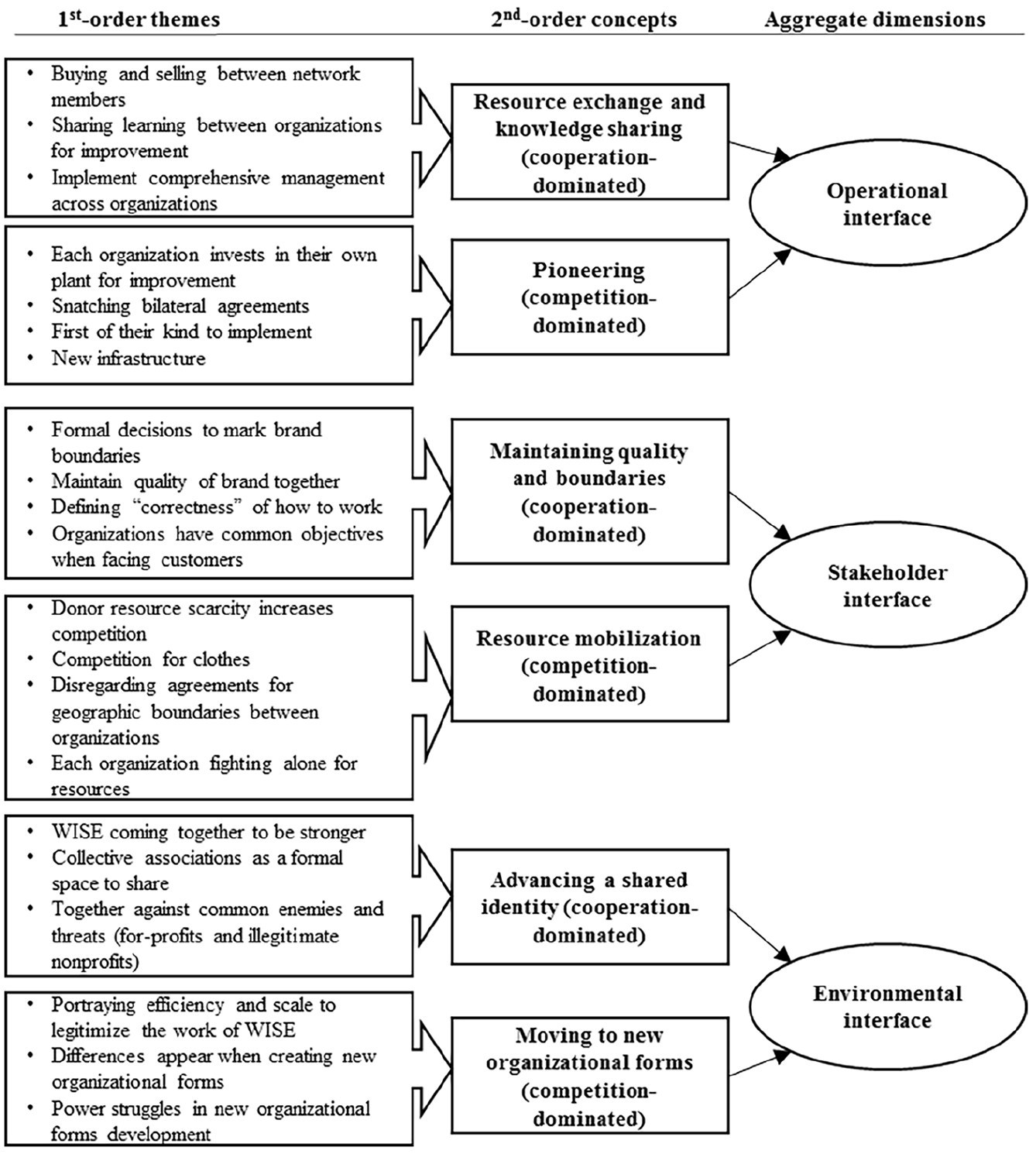
Data structure.
Findings
Our analysis of the data collected from the interviews as well as from reports and webpages uncovered a number of behaviors which were cooperation-oriented and others competition-oriented. This general situation was clearly expressed by the leader of one organization: “Competition has always existed to a greater or lesser degree but always within a framework of sharing, let’s call it the rules of the game” (SE-1). We found that these behaviors took place at three different levels of action: operational, stakeholder, and environmental interface. In this section, we examine the types of coopetitive actions, either cooperation-dominated or competition-dominated, at each level, illustrated with quotes from the interviews and from written documents. Additional support for our findings, with more representative quotes classified under the second-order categories and aggregate dimensions, is available as an Online Appendix. To preserve anonymity for the individuals and organizations, we use acronyms such as SE-1, SE-2, etc.
Operational Interface
The data pointed to cooperative and competitive actions at an operational level, which refer to efforts by member organizations to improve collection strategies, increasing yield with the secondhand items collected, and better serving their beneficiaries.
Resources exchange and knowledge sharing
The cooperation-dominated actions at this level consisted in sharing knowledge and establishing agreements to improve internal operations. Learning from other organizations allowed to develop in areas where the organization did not have the resources and capabilities to take action by itself. For example, one of the challenges of the collecting activity is that some clothes, due to their low quality, cannot be re-sold in stores, and, instead, are exported to less developed countries. Some organizations shared with others their experiences with exporters or even sold clothes to others who would then sell them to exporters. Beyond mere trading agreements, some organizations also expected other types of cooperative relationships: We’ve tried to come to an agreement with an organization in the cooperative, SE-1, who has said they want us to be part of the cooperative. We are selling them clothes, but we want a professional relationship that isn’t solely commercial but rather supportive. (SE-3)
Often, organizations wanted support to improve their management. While each was developing its own internal improvement strategies, they also learned from others to develop faster or decrease uncertainty regarding operational upgrades. Learning from organizations that are more advanced helps anticipate what steps to take next.
Working together is adding to joint knowledge . . . It is a great achievement to move forward when we get together, when we share. And this is what the Cooperative has done. . . In our case, we took advantage to structure the clothing, that is, we were able to mechanize part of the selection process with these opportunities. We added an elevated selection station, a bigger truck, and a baler. (SE-6)
The cooperative-oriented actions of exchanging resources and knowledge sharing require not only openness to other organizations but also structure; for example, meetings on a regular basis: We would really meet every month, and we made all the decisions, for example, implementing an IT test between all of us to unify the management. (SE-5)
In sum, by resource exchange and knowledge sharing, the different SEs relied on each other for decreasing risk and uncertainty and for complementing areas where some were more developed than others.
Pioneering
The analysis also uncovered competition-dominated actions at the operational level. Some organizations strived to be ahead of the rest in terms of infrastructure and efficiency to set standards for the others. This would position the organization as the reference or the central actor in the group. One way organizations displayed this desire for centrality was by being the first organization to try out a new process or technology. Consequently, they wanted to be recognized and benefit from it. For example, after building a new plant (near a town called Sant Esteve) thanks to the 1-million-euro loan, the RA-WISE organization members wanted other organizations to establish agreements with them to make the most out of their investment: I’d like SE-3 and SE-8 to make an agreement with the new plant in Sant Esteve and participate in it, in some way or another, and bring their clothing to the plant. Why? Because we have invested a million euros and it is written off quicker with more clothing coming in. (SE-5)
While staying ahead of the game could bring benefits as well as risks, it cannot be seen as a form of maintaining knowledge control (Bengtsson & Kock, 2014). Among the SEs in the program hiding knowledge from others was not possible, and, ultimately, the desire of some organizations to be pioneers was also seen as beneficial for the others: SE-1 . . . for quite a few years were really the spearhead of the cooperative, they were always ahead: they bought a press even before they had products or clients, two years before, but they had the press to be able to make bales . . . Instead of working cautiously, they preferred to be ahead of the rest. This worked out well for all of us because we also learned what they did right and what didn’t work. They were the first to start exporting and to make their selection process broader. (SE-4)
Thus, we find that coopetition on the operational level means simultaneous engagement in all these actions: while organizations benefit from sharing knowledge and by making agreements to improve the management of their facilities, they also try to increase their capacity and grow, and be the pioneers, the organization that all the others look up to for standards and as signaling the way forward. While there can be tensions, these two approaches are not necessarily contradictory. Now, whereas in for-profit organizations, the economic goals would motivate coopetition at this level, in the case of SEs both their economic and the social goals push them toward this dynamic. For SEs desire to improve their operations and increase their capacity to collect and select clothes to secure more positions for people in need of work integration.
Stakeholder Interface
The second level of action identified in the analysis refers to how the organizations dealt with their multiple stakeholders. Organizations in this study have a diverse set of stakeholders at different points of their value chain: People who donate clothing through the 1,500 containers on the streets, the customers of the 21 stores, the donors, and municipalities from whom they receive subsidies and permits to place the containers.
Maintaining quality and boundaries
At this level, we found cooperation-dominated actions that focus on ensuring quality standards and boundaries for the work of different organizations. The SEs in Roba Amiga heavily relied on different stakeholders to carry out their social mission and each SE contributed individually to the quality perception of the group as a collective. In the report from the One World Foundation, the goal of the first Roba Amiga program is stated as: To establish a common management system, that is, that everyone does things more or less in the same way, regarding the quality of the clothes, the selection, how it is managed, the storage, the shops . . . Unify the name of the shops, unify the image of the shops . . . Another project is to get the public administration more involved . . . (Fundació Un Sol Món, 2008, p. 101).
After the program was established, they continued working toward maintaining what had been achieved in terms of reputation of the common brand and showing that WISEs were able to do this type of job efficiently. One interviewee explains, What are we trying to do? We’re trying to help the rest of the member organizations no matter how small, because it is important for all of us, not just for our organization; but everyone should take care of the brand, do good service, have good conditions, have good maintenance, have stores in good shape, among others. Because anything that anyone does in Catalonia under the brand of Roba Amiga and isn’t in those conditions, affects us all. (SE-4)
All organizations are affected when one member does not maintain the agreed-upon levels of quality, such as the proper aspect and condition of the containers for collecting clothes. Overflowing containers could not only discourage donors of clothes but also upset municipal managers, who might not renew the contract to place them in public spaces. In addition to this aspect, they collaborated to establish geographical boundaries for the activity of each SE, on which, as we will see later, there can also be tensions. These spheres of cooperation were not always easy, because in the end each organization had a slightly different idea of how they wanted to be perceived. Some organizations emphasized their social mission and nonprofit character when approaching different stakeholders, while others used a business-like style, emphasizing high efficiency and yields.
Resource mobilization
At the stakeholder level of action, there can be competition due to the need to mobilize resources such as donations in kind, cash, and subsidies. Because SEs in Roba Amiga are in the same geographic region, these organizations compete for the same resources to varying degrees. Their activities depend primarily on collecting enough clothing to continue running a sustainable business. They compete due to the relative scarcity of this resource, as the quantity of clothes people give grows very slowly. As expressed forcefully by one of the members, It is competition: competition for clothes which, by extension, is competition in everything. (SE-1)
For the most part, the SEs in our study were able to agree on distributing municipalities and neighborhoods in and around Barcelona to get public contracts for the street collection containers, but sometimes they started to compete in areas that were supposedly assigned: Yesterday, [SE-4] called me on the phone in the afternoon and said, ‘I’ve seen that a public tender has come out for the collection of clothing for [your municipality]. Are you as SE-2 willing to work with us? . . . if you’re not willing to work with us, we as SE-4 will present an offer for the public tender.’ I told him, ‘Do whatever you want. I can’t guarantee that we’ll work together. I am interested in working with you because of your experience but don’t blackmail me saying that if I don’t work with you, you’ll apply on your own. So, look, do whatever you want!’ (SE-2)
In this episode, what started out looking like an attempt at collaboration actually became a source of competitive action. One organization saw the opportunity to expand their scope of action by working together with another organization in the group. The other organization perceived this practically as an aggression and a risk for its own interests, as some resources could be taken away. Consequently, it adopted a defensive position.
Another important source of revenue for these SEs came from the sale of secondhand clothing in stores. Location of stores could lead organizations to compete with each other. Some organizations described instances where one organization set up a store within a few blocks of another organization’s store: SE-6’s manager had a problem with the first manager of SE-5. And it continues to this day, in the sense that they don’t trust each other. These are things that drag on. SE-6 opened a store 200 meters away from us. They took a municipality of ours and tried to get another one in our zone. It is complicated but these things happen. Is there competition? Yes, but I don’t think it’s a bad thing. (SE-5)
Yet, another source of tension can happen precisely when things go too well for the organizations, as expressed in the Report prepared for the One World Foundation: Increased clothing created a situation of overproduction, which led to declines in wholesale prices and tensions between entities. Entities are partners and competitors at the same time, and this is difficult to balance. (Fundació Un Sol Món, 2008, p. 17)
In addition to clothes collection and stores, competition included resource mobilization in terms of subsidies and grants, which became an issue after the withdrawal of the main donor for the entire program (the One World Foundation) and when some organizations prepared a project to get financial support for a new plant. In sum, coopetition at the stakeholder interface level expresses a tension between competing to mobilize resources independently (or forming sub-groups) and collaborating to maintain the quality and outward image of the Roba Amiga brand, as well as establishing geographical boundaries. Organizations experienced this tension differently: some organizations like SE-2 would have preferred not to engage in competition for resources, whereas others like SE-5 saw some benefits to it insofar as it pushed everyone to be more proactive.
In contrast to the previous level, we notice here that while the economic logic of these SEs leads them both to cooperate and to compete, this is not so clear for the social logic. The social logic might turn out to be an obstacle for collaboration, even if this might seem surprising. In this level, collaboration amounted to giving a collective image of professionalism and efficiency in front of stakeholders, as well as to increasing the volume of activity; but some organizations feared that this compromised their social image with their stakeholders. Ultimately, this aspect of the dynamic of coopetition at this level might be due to different perceptions on the relationship between the two logics: some SEs consider the economic logic as clearly benefiting their social goals, while others view the former as potentially jeopardizing the latter.
Environmental Interface
The third level includes a tension between actions that are meant to advance a shared identity and those that lead to new organizational forms and norms. Insofar as these actions are related to actors beyond direct stakeholders, such as competitors and broader societal perceptions, we refer to this level as environmental interface. For the Roba Amiga group, the main external threat was posed by competition from an international nonprofit called Humana People to People, which members of the group did not recognize as a legitimate nonprofit, alleging low levels of transparency. Moreover, they feared the possible arrival of big for-profit organizations in the secondhand clothes collection field, as is the case in other countries. The coopetitive actions at this level aimed at addressing these concerns.
Advancing a shared identity
Confronted with other types of organizations involved in secondhand clothing, the SEs in Roba Amiga joined and became active members in collective associations to strengthen their common identity. As expressed by one interviewee: “What we share is the name Roba Amiga and also we share that we are all social organizations” (SE-5). Thanks to this effort, the Roba Amiga program “becomes recognized by the Administration and the general population. The impact on the internet is higher than that of Humana, for example” (Fundació Un Sol Món, 2008, p. 15). Thus, at the beginning, a collective association (AIRES) played an important role in promoting clothes collection by SEs following the WISE model in opposition to the for-profits and the main nonprofit competitor (Humana). The aim was to portray this model as the legitimate way to carry out secondhand clothing collection. It also provided structures and processes so that organizations had ways of resolving conflicts and of detecting them as they appeared, rather than after the fact. Participation in these collective associations benefited the whole group rather than only one organization individually.
In addition, a collective association at the national level, the Spanish Association of Social and Solidary Recyclers (AERESS), established the objective that social secondhand clothing organizations set up preferential bilateral agreements to buy and sell clothing before reaching out to for-profit firms or other types of (in their view, illegitimate) nonprofits. Each organization realized that together, strengthening their common identity as WISE in the secondhand clothing collection and retail business, they could influence the rules of the game by shaping societal perceptions. The strength gained through collective associations is one of the main motivations behind cooperating: “Over time what we’ve tried to do as member organizations is join together to be a little stronger” (SE-3). These actions go beyond operational internal improvements or interacting with direct stakeholders and impact the broader context. They can be seen as a way to deal with uncertainty in the larger competitive environment, as pointed out by the coopetition literature (Gnyawali & Park, 2009).
Moving to new organizational forms
At the environmental level, we also found competition-dominated actions in the creation of new organizational forms, which, unlike the collective associations, were more vertical in nature. This brought instability to the group of SEs. As mentioned earlier, some organizations wanted to build a new plant and form a more unified organization (which later became RA-WISE), but they faced resistance from other members of the group, who feared losing autonomy and preferred to continue with a loose association: We had meetings with the whole group . . . There was no consensus . . . Because SE-8 isn’t the same as SE-4, and SE-9 can’t compare with SE-3. Each one had its status, its nucleus of power. So, what happened? SE-3, which was the strongest at that time, stronger than the others, much more than SE-4 at that moment, wanted to continue using the brand Roba Amiga and wait a period of time to see . . . I think there were quite a number of disagreements between those who had a clear idea or wanted to be the main organization. (AIRES)
Finally, two organizations went ahead and created a joint venture under the name RA-WISE, which enabled them to build a new plant and grow considerably. In their opinion, the response to the possibility of new entrants (for-profits and “illegitimate” nonprofits) in the field of secondhand clothing was to intensify efficiency and growth. However, a new organizational form can institutionalize competitive relationships by creating an “us vs. them” mindset, as some organizations join while others opt out. Somewhat in contrast to the nonprofit “spirit” at the beginning of these SEs, the new arrangement adopted an enterprise-like approach by looking for economies of scale and joining organizations together under a common, more hierarchical structure. Other SEs had to resituate themselves with respect to the newly-formed joint venture. For example, SE-1 refused to integrate within RA-WISE, yet it wanted to retain influence over it, which was denied by the other two organizations (SE-4 and SE-5): What happened when this plant was started? [SE-1] wanted to have more participation here, shares, and leadership . . . But those who are the most involved here, who have money, integration employees, external image, and other issues invested in it, are the two organizations that have abandoned our activities where we were doing them before and brought them here. Logically, the final decisions, the final decision is ours, it can’t be what [SE-1] proposes . . . I originally proposed to them [to SE-1] that we build the new plant in the metropolitan area but close to them and that we share it. They thought it over and said no, they didn’t want to share their plant . . . (SE-4)
While there were disagreements between SE-1, on one hand, and SE-4 and SE-5, on the other; other organizations simply did not engage in this discussion. One of the motives for staying away was their desire to preserve the activity of work integration close to where the people who needed it lived, rather than moving to a new location farther away (about 40 km). This was perceived as giving up the local roots of the WISE.
In summary, in addition to the levels of operational interface and of stakeholder interaction, SEs engage in another important set of actions: they aim to shape the larger rules of the field by portraying the WISE model as the legitimate way to organize secondhand clothing collection and retail. This level includes cooperative actions, such as participating in collective associations that strengthen a shared identity based on a social mission, which benefited them in front of competitors, and more competitive actions, such as establishing new organizational forms focused on efficiency and growth. This last option led to the self-exclusion of those who prioritized rootedness in a particular territory and those who preferred slower growth. Thus, in this level, we see that both the social and the commercial logic can lead to cooperative-oriented behaviors in front of a complex external environment; but the social logic can prevent organizations from joining new initiatives that are more efficiency-oriented, thereby provoking a competitive dynamic. This might be based on different views about the social mission: advancing work integration in the original municipality the organization belongs to or doing so more generally.
While our analysis found that all SEs engaged in actions at the first two levels (operational and stakeholder), the third level (environmental) had higher engagement from the larger and more influential organizations in the group. As pointed out by the literature on coopetition, this enriches our understanding of the differences between smaller, more passive actors who tend to accept and play within the rules of the game and larger actors, who have the ambition of becoming market leaders, influencing and defining the rules of the game (Gnyawali & Park, 2011).
Discussion
This research responds to both Gnyawali and Song’s (2016) and Mongelli et al.’s (2017) calls for more in-depth research and the application of novel perspectives into, respectively, the phenomena of coopetition and of social entrepreneurship. Our analysis of how SEs interact with each other in a group of organizations devoted to the same activity lead us to make contributions around three main points: the three-level dynamic of coopetition among SEs, its interrelation with the hybrid nature of SEs, and the benefits of coopetition for SEs.
First, we have seen how coopetition among SEs takes place simultaneously at the operational, stakeholder, and external environmental levels. This complements previous theoretical discussions based on for-profit organizations which find coopetition separated in the value chain between upstream and downstream activities (Bengtsson & Kock, 2000). It also stands in contrast to the findings by Khavul et al. (2013) in the microfinance industry, which described the interorganizational field dynamics as separate phases in the development process of social entrepreneurship; that is, as a series of contested (i.e., competitive) and resettled (i.e., cooperative) phases. In our study, coopetitive relationships between SEs in the same field appear throughout the process, rather than sequentially, both through moments of external shocks, such as loss of donor funding, and through uncontested periods. We suggest that this is so because coopetition can occur at three different levels, as uncovered in our findings.
Second, one way to perceive the dynamic between cooperation and competition is as a tension. Yet, as Smith and Lewis (2011) and Smith et al. (2013) have shown, not all tensions are alike. While many studies have focused on the tension within SEs between their social and economic goals, due to their hybrid nature (Battilana & Lee, 2014; Battilana et al., 2015; Ebrahim et al., 2014; Pache & Santos, 2013; Siegner et al., 2018), our study focused on the cooperation–competition tension that occurs among SEs. Now, there are interactions between the two types of tensions, which manifest themselves in our findings. Perhaps contrary to what one might have expected, our research does not suggest a straightforward one-to-one correspondence according to which social goals lead to cooperation and economic goals to competition. SE’s social goal is, together with the economic one, what drives SEs to engage in coopetition, leading them to cooperate and compete simultaneously.
However, our analysis also suggests that the interaction between the two types of tensions (competition/cooperation, social goals/economic goals) varies depending on the level in which the coopetitive dynamic takes place. At the operational level, both social and environmental goals motivate cooperative-oriented behaviors in terms of knowledge exchange and to competitive-oriented behaviors in terms of differentiating oneself and pioneering technological advancements. At the level of interacting with direct stakeholders and with the broader external environmental the social logic seems to pose some obstacles to cooperation. This is so because different SEs can have different views on how to achieve social goals or on what their social goal really is. In our case, providing more opportunities for integration in the labor market could enter into conflict with the goal of staying rooted in the original municipal territory and serving needs locally. Moreover, the desire to keep all organizations together in relationships of mutual support could enter into conflict with trying out new organizational arrangements to pursue social and economic goals. In short, a peculiarity of the interrelations among SEs in the same field is that the two types of tensions unfold differently at different levels. In our view, the question how coopetitive dynamics relate to social and economic tensions opens an unexplored line of research that would help expand the current hybridity literature. Going beyond a straightforward correspondence between the two types of tensions, we suggest that in levels of activity where external actors become more relevant, either direct stakeholders or external groups such as competitors or public opinion at large, differences about the identity and image of SEs can become obstacles to cooperation and lead to more competitive-oriented actions.
Third, while the outcomes were not the initial focus of this article, our analysis points to the benefits of coopetition, as reported previously in other contexts (Bengtsson & Kock, 2000; Gnyawali & Park, 2011; Luo et al., 2006). It allows SEs to exploit their potential and improve their skills, at the operational level, as well as gain influence over direct stakeholders and over a wider audience at the environmental level to enhance their legitimacy and cultural acceptance. All these help advance, not only the economic goals, but also the SE’s social mission. More concretely, our analysis showed that cooperative-oriented actions among SEs, such as resource exchange and knowledge sharing, maintaining quality and boundaries, and advancing a shared identity, helped SEs pursue their economic goals, and not just the social goals. Similarly, competition-oriented actions helped the group of SEs advance their social goals, among other things because it pushed some organizations to innovate (through technologies and creating new organizations) and this led to increasing the possibilities to hire and train people excluded from the labor market (following the WISE model), aspects that amplified the reputation of the entire group of organizations. In this sense, the research complements the conclusions of a recent work by Herbst (2019), who showed that coopetition plays a fundamental role in achieving SE’s social and commercial objectives. Yet, while in Herbst’s study coopetition is between SEs and other types of actors in the value chain, in ours it is among SEs developing the same activity.
Conclusion
This study is an early attempt at understanding interorganizational coopetitive relationships among SEs. The analysis of a group of SEs that share a common brand allowed us to observe dynamics between organizations that interact with each other regularly and to identify three levels of coopetition. Despite the limitations inherent in this type of qualitative research, we believe that our findings about the levels of coopetition and the interrelation between these dynamics and the hybrid nature of SEs can be generalized to other types of SEs working in the same industry, even if they have less formal connections with each other than those of our case, as well as among nonprofits more generally, insofar as they are also concerned about economic goals and not just social ones. We see interesting prospects for future research to continue exploring these dynamics; for example, verifying through further qualitative and quantitative studies the levels of cooperation identified in this article in other fields and types of organizations, and analyzing whether more competitive or more cooperative relationships lead to beneficial outcomes for organizations or groups of organizations in the field of SEs and nonprofits. Moreover, in addition to data coming from reports, the primary data used in this study come from interviews. A possible limitation of our approach is that the majority of respondents were leaders of the organizations; this opens the possibility for future research to adopt a multilevel perspective within organizations, uncovering potential similarities and/or differences among, for instance, the views of employees and managers.
Finally, we consider our study to be relevant to practitioners and managers in the SE field or those considering embarking on this type of ventures. While the idea of a social goal might be usually associated with the assumption of friendliness, synergy, and cooperation among like-minded organizations, social entrepreneurs might benefit from understanding the dynamics of coopetition rather than neglecting it. In other words, our research shows that while the increase in the number of SEs might enhance overall positive social impact, this trend has important implications at the interorganizational level. The creation of more SEs could generate more competitive environments, but also more opportunities for cooperation. Such competition and cooperation can have beneficial outcomes; but managers of SEs should take into account—and scholars should further study—how the external dynamics of coopetition that result from this evolution unfold at different levels and interrelate with internal social–economic tensions. If SEs simply assume that they need to collaborate with organizations with similar goals to increase social impact, they may be surprised when they find themselves having to manage coopetition, at its different levels, rather than solely cooperation.
Supplemental Material
Appendixes – Supplemental material for Coopetition Among Social Enterprises: A Three-Level Dynamic Motivated by Social and Economic Goals
Supplemental material, Appendixes for Coopetition Among Social Enterprises: A Three-Level Dynamic Motivated by Social and Economic Goals by Daniel Arenas, Solange Hai and Chiara De Bernardi in Nonprofit and Voluntary Sector Quarterly
Footnotes
Acknowledgements
We would like the thank the reviewers and the editor for their support and constructive comments. We are also deeply grateful to all the interviewees and to the Institute for Social Innovation at ESADE.
Declaration of Conflicting Interests
The author(s) declared no potential conflicts of interest with respect to the research, authorship, and/or publication of this article.
Funding
The author(s) received no financial support for the research, authorship, and/or publication of this article.
Ethical Approval
All procedures performed in studies involving human participants were in accordance with the ethical standards of the institutional and/or national research committee and with the 1964 Helsinki Declaration and its later amendments or comparable ethical standards.
Informed Consent
Informed consent was obtained from all individual participants included in the study.

Supplemental Material
Supplemental material for this article is available online.
Author Biographies
References
Supplementary Material
Please find the following supplemental material available below.
For Open Access articles published under a Creative Commons License, all supplemental material carries the same license as the article it is associated with.
For non-Open Access articles published, all supplemental material carries a non-exclusive license, and permission requests for re-use of supplemental material or any part of supplemental material shall be sent directly to the copyright owner as specified in the copyright notice associated with the article.
