



Abstract
This article draws upon concepts of community resilience to explore the antecedents of community philanthropic organizations’ response to COVID-19. Although the pandemic is a global threat, responses have been local. We test a model of community resilience activation in the context of the emergence of local COVID-19 funds. We find that a philanthropic organization’s capacity to act in a crisis and respond to the needs of the community depends on the stock of community capitals and organizational capacity. The importance of economic, cultural, and political factors in predicting the emergence of a fund raises important questions about disparities in resilience along class and race lines and the role of political ideology in shaping perceptions of crises. Our research contributes to our understanding of community philanthropic organizations’ capacity to activate community resources during a crisis.
Introduction
Although the COVID-19 pandemic is a global threat, the World Health Organization underscores that “responses must be tailored to the local context” (World Health Organization Regional Office for Europe, 2020). Community philanthropic organizations (CPOs), public charities that raise and distribute resources within a geographic community, are important to such local crisis response. CPOs across the globe are not only rapidly raising and distributing resources but also serving as information hubs and referral centers and facilitating cross-sectoral collaboration (Giving Thought, 2020). In the United States, CPOs have established COVID-19 funds that channel community contributions to address needs emerging from the pandemic (see (i) in Web Appendix). As of May 30, 2020, community-based initiatives led and/or supported by more than 1020 CPOs had collectively raised $949 million and distributed almost $546 million in response to local COVID-19 (Community Foundations and United Ways, 2020).
Drawing upon concepts of community resilience and a resilience activation framework (Abramson et al., 2015), we argue that the launch of COVID-19 funds by CPOs activates community resilience. CPOs have long played important roles in disaster response (Bryson et al., 2006; Simo & Bies, 2007). Their capacity to activate community resilience, however, depends on internal organizational capacity and existing community capital. We ask what organizational and community antecedents are associated with CPO activation of community resilience during a crisis? Our dependent variable is establishment of a COVID-19 fund by a local United Way (UW) and/or community foundation (CF), two of the oldest CPO systems in the United States. As global public policy increasingly relies on CPOs to respond to the changing needs of local communities, findings from this research are critical to understanding CPOs’ role in activating community resilience during a crisis.
Activation of Community Resilience
A series of disasters over the past decades has spawned a large body of interdisciplinary research on resilience in individuals, organizations, and communities (see (ii) in Web Appendix). Drawing upon this literature, we define community resilience as the process by which a geographically defined area collectively uses and creates resources to adapt and thrive in an environment characterized by change, uncertainty, and unpredictability (Aldrich, 2012; Berkes & Ross, 2013; Magis, 2010; Williams et al., 2017). This definition emphasizes that resilience is not an outcome, endowment, or existing state, but rather a process by which capacities and endowments are enacted to enable adaptation. Unlike individual or organizational resilience, which center a focal actor, community resilience is a collective phenomenon whereby multiple actors cooperatively and strategically engage resources to enhance communal outcomes (Magis, 2010).
A growing body of research has explored the contextual antecedents of community resilience. Drawing upon the Community Capitals Framework (Emery & Flora, 2006), many models describe resilience as depending on the existence and capacity to activate a diverse range of community capitals. Abramson and colleagues (2015), for example, posit that community resilience activation occurs when agents initiate existing stocks of capital in the face of unexpected events. While Abramson et al. (2015) do not identify specific types of institutional actors, we posit that because of their role as anchor institutions (Perry & Mazany, 2014), CPOs may act as vital agents in “resilience activation.”
CPOs as Community Resilience Activators
Perry and Mazany (2014) describe CPOs as anchor organizations that help bring donors and local institutions together to define and shape collective interests within a geographic area. Not only do CPOs raise and distribute funds to grantees, but historically, they have taken on leadership roles coordinating local service delivery systems; acted as trusted sources of information on local resources and context; mobilized individuals to volunteer and donate; and convened partners across sectors to set priorities and design and implement the delivery of public services. While other private philanthropic organizations may be driven by the particularistic interests of donors or grant recipients, the mission and activities of CPOs are communal and not driven by the interests of an individual donor, grant recipient, or political party. However, consistent with the community resilience activation framework (Abramson et al., 2015) and other models (Magis, 2010), CPOs’ capacity to galvanize collective action and communal resources depends on existing community capital and their own internal capacity.
Community Capitals
Previous research identifies predisaster characteristics of communities that enhance community resilience, including human capital, social capital, economic capital, cultural capital, and political capital (Emery & Flora, 2006; Norris et al., 2008). These capitals reflect latent resources and capacities that can be activated during a crisis (Bebbington, 1990). Human capital refers to the skills and abilities of people within the community and affects access to information and understanding of systems necessary to take action (Emery & Flora, 2006). Social capital (the value that accrues from the connections within a community) increases sense of community, commitment to place, and facilitates the information sharing and trust that is necessary to rapidly come together in a crisis (Aldrich, 2012). Economic capital drives the financial resources that can be invested in community response; some evidence suggests that institutions may respond differently to the needs of the wealthy than to those of the poor (Aldrich, 2012). Cultural capital, often a reflection of race and ethnicity, offers a common way to understand issues and may shape preference for forms of collective action that enable resilience activation (Abramson et al., 2015). Thus, racial homogeneity may facilitate collective response to disaster (Aldrich, 2012; Hwang & Joo, 2020). Political capital reflects shared concepts of power and government including preferences for government versus private institutional response to community issues (Paarlberg et al., 2019).
Internal Organizational Capacity
At the organizational level, slack (Vogus & Sutcliffe, 2007) is associated with the capacity of an organization to mobilize resources in the face of a disaster (Berkes & Ross, 2013). Slack provides a buffer for unexpected events, allowing an organization to use existing human and financial resources to respond and withstand the stress of a crisis (Vogus & Sutcliffe, 2007).
Figure 1 summarizes the Community Resilience Activation Framework as adapted from Abramson et al. (2015).
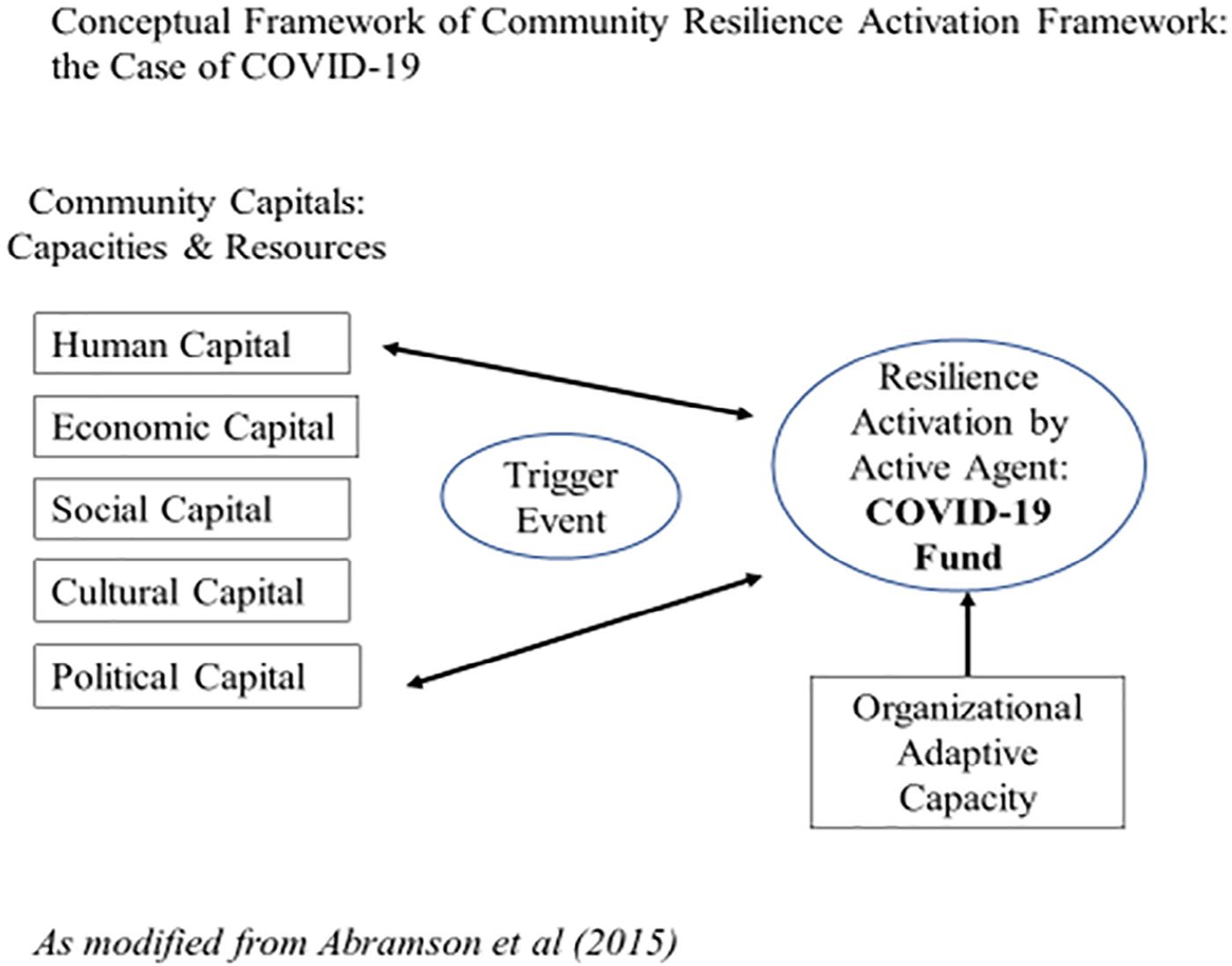
Conceptual framework.
Data and Methods
Our sample consists of UWs and CFs in the United States that have websites (n = 1,948). Our dependent variable—community resilience activation—is UW or CF (co-)launch of a COVID-19 response fund. Since March 22, 2020, the research team has been tracking the emergence of COVID-19 funds managed by CPOs. The team identified funds in a variety of ways, including listings maintained by philanthropic support organizations (e.g., the Council of Foundations, Giving Compass, United Way WorldWide). These institutional listings were supplemented by a search of the websites of the population of UWs and CFs. Through these combined strategies, the team identified 1,020 funds, with 244 co-managed by UWs and CFs. These funds were established specifically for COVID-19 response, are (co-)managed by the local CPO sometimes in cooperation with other community partners and have been funded by contributions from new and existing individual donors and philanthropic institutions (see (iii) in Web Appendix).
We include independent variables at the community and organization level. To identify community measures, we matched CPO mailing addresses to county (see (iv) in Web Appendix) characteristics to include measures of diverse capitals including county population with bachelors’ degree (human capital), median household income (economic capital), index of social capital, racial composition (cultural capital), and percent voting Republican (political capital). Our organization-level variables include total assets in 2018 (organizational capacity) and whether the fund managing organization is a UW or CF (organization type).
We control for number of COVID-19 cases in the county at the end of each month, as the severity of infection may affect the response (Aldrich, 2012). We control for number of recent disasters in the county because organizations in places that are prone to natural disasters may have learned to maintain systems and structures to facilitate crisis response (Alesch et al., 2001). Finally, we control for region and community population as regional culture and community size may shape social trust and sense of efficacy that facilitates collective action (Rapaport et al., 2018). Table 1 provides a descriptive summary of the data used in our model. As the independent variable is binary, we used logit analysis to examine the relationship between the existence of a COVID-19 fund and these organizational and community-level factors.
Descriptive Statistics.
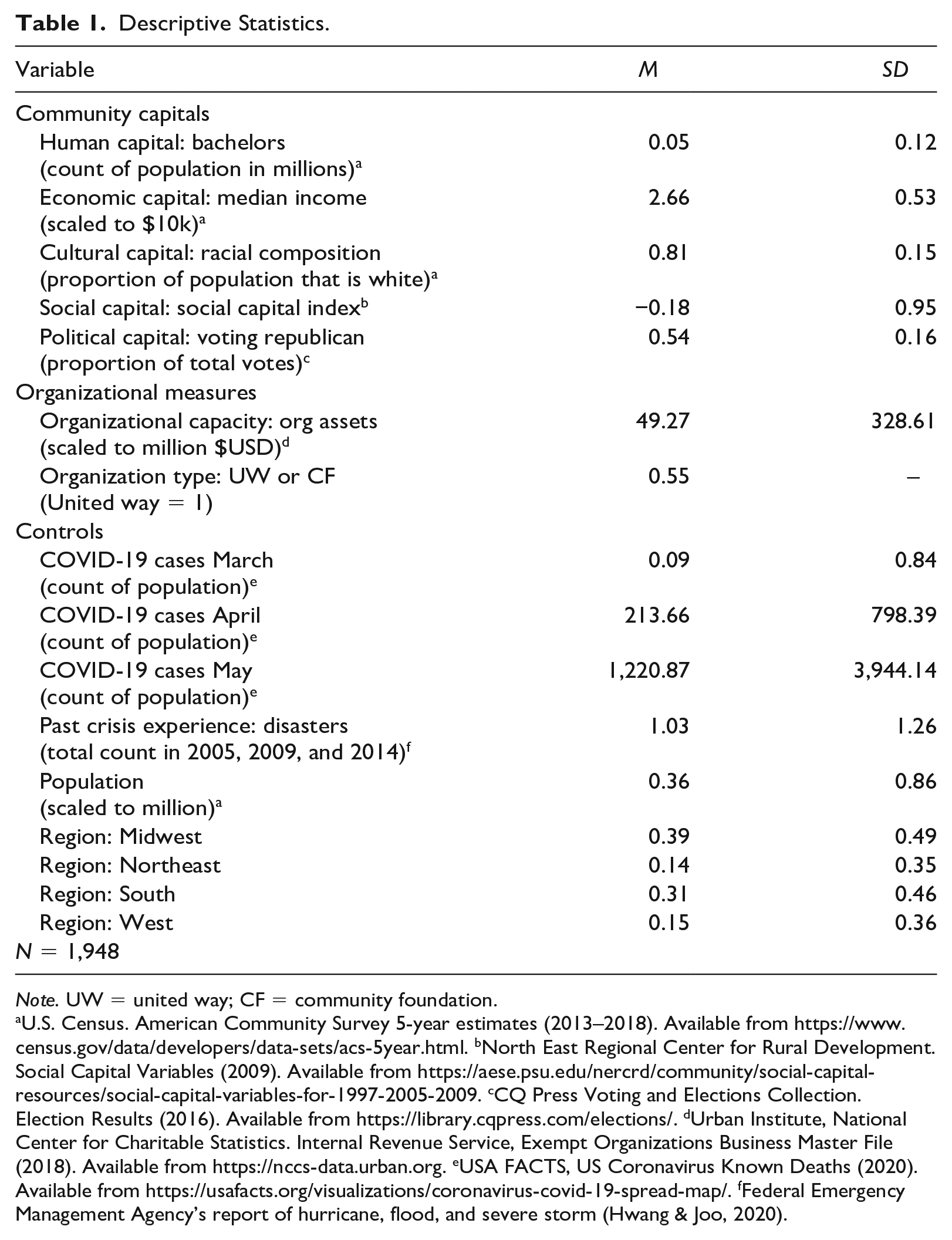
Note. UW = united way; CF = community foundation.
U.S. Census. American Community Survey 5-year estimates (2013–2018). Available from https://www.census.gov/data/developers/data-sets/acs-5year.html. bNorth East Regional Center for Rural Development. Social Capital Variables (2009). Available from https://aese.psu.edu/nercrd/community/social-capital-resources/social-capital-variables-for-1997-2005-2009. cCQ Press Voting and Elections Collection. Election Results (2016). Available from https://library.cqpress.com/elections/. dUrban Institute, National Center for Charitable Statistics. Internal Revenue Service, Exempt Organizations Business Master File (2018). Available from https://nccs-data.urban.org. eUSA FACTS, US Coronavirus Known Deaths (2020). Available from https://usafacts.org/visualizations/coronavirus-covid-19-spread-map/. fFederal Emergency Management Agency’s report of hurricane, flood, and severe storm (Hwang & Joo, 2020).
Results
As expected, both community and organizational-level factors are associated with the launch of a COVID-19 fund (see Table 2). At the community level, as median income (economic capital) and the percentage of white residents (cultural capital) increases, CPOs are more likely to launch COVID-19 funds. Furthermore, we find that as the percent voting Republican in 2016 (political capital) increases, the likelihood of launching a fund decreases, all else being equal. CPOs with larger organizational assets are more likely to launch COVID-19 funds. The count of previous disasters in the county is positively associated with the launch of a fund, suggesting that experience with previous crises shapes community resilience activation. We find no statistically significant results between fund establishment and education level (human capital), the social capital index or controls of county population and region.
Logit Analysis.
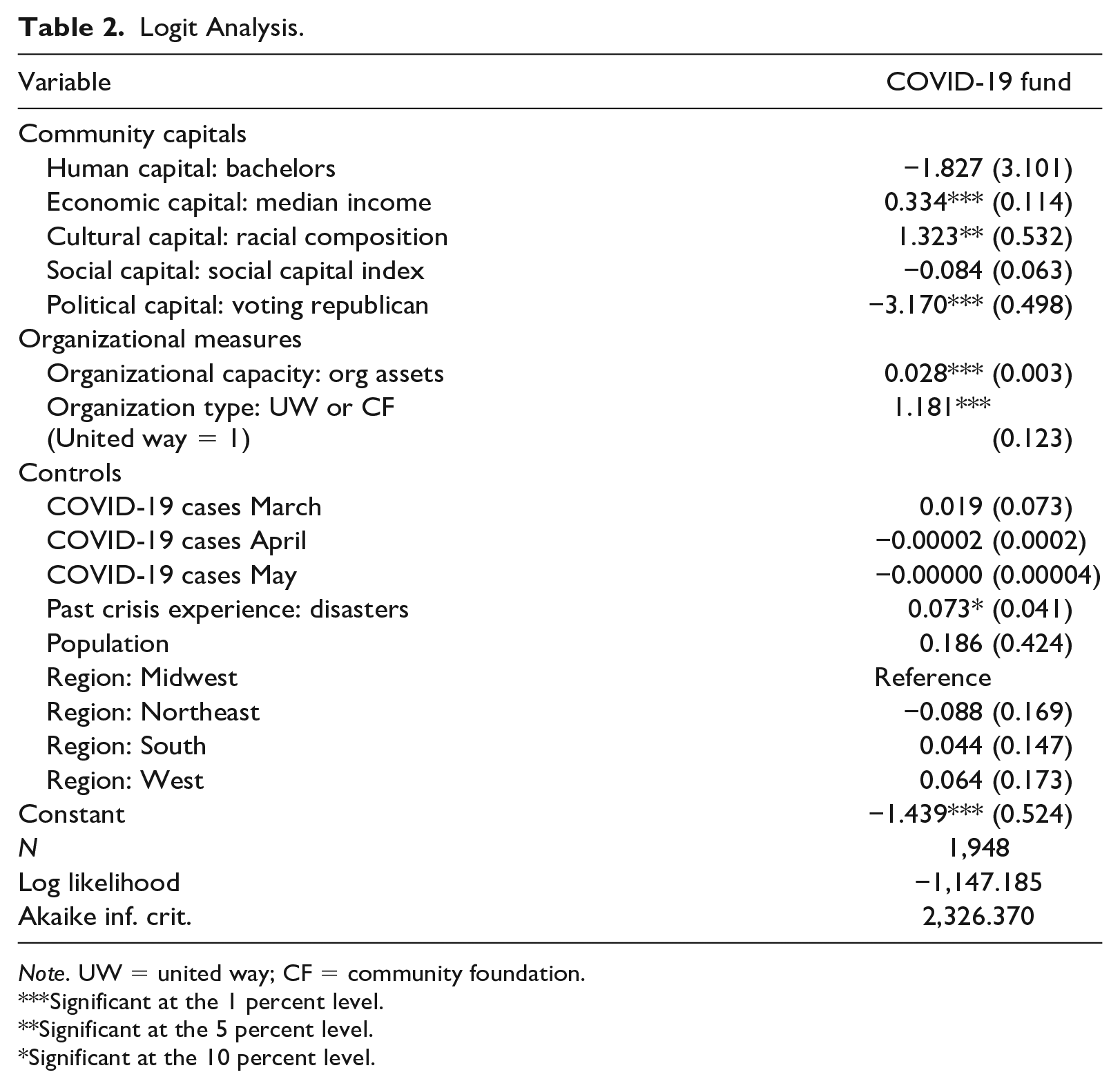
Note. UW = united way; CF = community foundation.
Significant at the 1 percent level.
Significant at the 5 percent level.
Significant at the 10 percent level.
Discussion
Our study contributes to understanding the community- and organizational-level antecedents of CPO launch of a COVID-19 fund, one indicator of community resilience activation. We extend the existing body of research by examining resilience in the context of CPOs, who play key roles as anchor organizations in galvanizing collective responses to address broad communal needs. While this preliminary analysis has limitations, these results raise important questions for future research.
CPOs play unique roles in their communities by fostering voluntary collective action that responds to communal needs in the face of a crisis. While such action supports resilience by leveraging existing and new resources, it also depends on the stock of community capital. Two findings warrant further discussion. First, our findings that the likelihood of fund launch increases with the “whiteness of the population” and community income, may reflect a preference of more racially diverse and lower-income communities to come together to act outside of institutional philanthropy. However, COVID-19 has devastated many communities of color and exacerbated health and financial disparities for low-income communities (Wright & Merritt, 2020). If CPO responses are concentrated in higher income, whiter communities, this may exacerbate existing racial and class disparities as racially and economically privileged communities are better able to activate in ways that promote community recovery and resilience. An extensive body of research suggests that while diversity broadens response strategies, it is also associated with reduced support for provision of public goods (Habyarimana et al., 2007) and voluntary contributions to those outside a donor’s identity group (Okten & Osili, 2004). Second, a robust finding of our study is that Republican political ideology is negatively related to CPO establishment of a COVID-19 fund (see (v) in Web Appendix). Emerging research suggests that the politization of COVID-19 in the United States may be shaping risk perception (Barrios & Hochberg, 2020) and, in turn, community resilience activation in response to the pandemic.
Our initial results highlight the conditions under which CPOs activate community resilience by launching a COVID-19 fund. However, our data fail to address several important questions. First, our operationalization of cultural capital as population proportion that is white is a blunt measure. Future research should use more nuanced measures of cultural capital to better understand its effects. We also do not know who benefits from COVID-19 funds. Will the initial response of local CPOs have long-term effects on the social and economic health of residents and local organizations? If so, how (and how equitably) are these benefits distributed across the community? Our results suggest the need to better understand how political ideology shapes crisis perception and the roles that CPOs play in supplementing and complementing local government action in a crisis. Finally, we measure resilience as a binary trait: organizations either have a fund or do not. We consider the establishment of a COVID-19 fund as an indicator of community resilience activation. Fund establishment suggests that CPOs contribute to community resilience activation by galvanizing financial capital to raise and distribute grants. However, anecdotally CPO’s are also connecting, convening, and facilitating other kinds of collective action. We need to understand the full range of CPO community resilience activation strategies and their implications for community outcomes.
Supplemental Material
NVSQ968155_Supplemental_Material_CLN – Supplemental material for Activating Community Resilience: The Emergence of COVID-19 Funds Across the United States
Supplemental material, NVSQ968155_Supplemental_Material_CLN for Activating Community Resilience: The Emergence of COVID-19 Funds Across the United States by Laurie E. Paarlberg, Megan LePere-Schloop, Marlene Walk, Jin Ai and Yue Ming in Nonprofit and Voluntary Sector Quarterly
Footnotes
Declaration of Conflicting Interests
The author(s) declared no potential conflicts of interest with respect to the research, authorship, and/or publication of this article.
Funding
The author(s) received no financial support for the research, authorship, and/or publication of this article.

Supplemental Material
Supplemental material for this article is available online.
Author Biographies
References
Supplementary Material
Please find the following supplemental material available below.
For Open Access articles published under a Creative Commons License, all supplemental material carries the same license as the article it is associated with.
For non-Open Access articles published, all supplemental material carries a non-exclusive license, and permission requests for re-use of supplemental material or any part of supplemental material shall be sent directly to the copyright owner as specified in the copyright notice associated with the article.
