



Abstract
This article provides a framework that defines politically active 501(c)(4)s organizations and describes a methodology for identifying them among more than 80,000 social welfare organizations. We estimate that approximately 15% of (c)(4)s likely pursue advocacy or political action, while most are engaged in unrelated activities. Understanding the distinctive features of the social welfare sector and the politically engaged organizations within it are essential tasks for nonprofit scholars, yet the methodological and empirical challenges are complex and significant. To date, there has been no systematic study of the nature and efficacy of these organizations. We create a multistage methodology that allows researchers to identify politically active (c)(4)s and to investigate subgroups focused on different policy issues and with different member groups. This article summarizes how we identify organizations and strategies needed to reveal whether an organization is engaged in political activities. We explain the approach we took and the challenges we encountered.
Background
What Are Social Welfare Organizations?
A 501(c)(4) social welfare organization is defined as, “An organization that is operated exclusively for the promotion of social welfare if it is primarily engaged in promoting in some way the common good and general welfare of the people of the community” (Treas. Reg. § 1.501(c)(4)-1(a)(2)(i) (as amended in 1990)). Social welfare organizations are permitted to engage in wide-ranging advocacy, lobbying, and some partisan electoral activities, but donors may not receive charitable deductions. Unlike 501(c)(3) public charities that are permitted to undertake only minimal lobbying and no partisan activities, 501(c)(4) organizations can conduct unlimited lobbying and partisan activities up to 49% of expenses.
The (c)(4) category of nonprofit organizations is not well-defined and is often mischaracterized as the “advocacy” sector. Researchers attempting to understand organizations that comprise the (c)(4) sector have found that most are not advocates, but a variety of membership and other types of organizations such as volunteer fire departments, camps, and parent–teacher associations (Colinvaux, 2018; Koulish, 2016; Krehely & Golladay, 2001; L. H. Mayer, 2018). Analysts describe it as a “messy no man’s land” (Aprill, 2018, p. 348) or a “dumping ground” (Koulish, 2016, p. 4) for organizations that do not qualify as (c)(3) public charities. Hill and Mancino (2002) give a history of (c)(4) organizations and link them to self-help, member-serving activities, and provision of member benefits, activities that may foreclose charitable status. Second only to charities in numbers, the ambiguous nature of these nonprofit organizations requires systematic investigation, yet researchers have wrestled to develop manageable approaches that yield accessible data sets to facilitate rigorous synthesis of the nature, characteristics, and impact of their activities. 1
Debunking the myths of what advocacy organizations do and how they are structured is another empirical challenge for nonprofit research. Scholars such as Almog-Bar and Schmid (2013), Andrews and Edwards (2004), Child and Grønbjerg (2007), Pekkanen et al. (2014), and Suárez (2020) have advanced the field’s understanding of nonprofit civic engagement and advocacy activities. Pekkanen and Smith (2014) identify the conceptual, definitional, and measurement challenges of studying advocacy. They suggest that greater precision is needed to understand the complicated domain of nonprofit advocacy, including clarity about organizational types, venues for action, the range of activities and targets, and appropriate impact measures (pp. 2–8). Suárez (2020) describes the advocacy roles of charitable nonprofits and posits that “many public charities no longer draw sharp distinctions among different forms of public engagement” including advocacy and social change activities and that “nonprofits that foster nonpolitical civic participation are extending those activities in political directions” (p. 498). These notable shifts in activities invite scholars to deeper investigation of the causes and consequences of changing roles and organizational forms.
Research on nonprofit advocacy points to the instrumental nature of (c)(4) organizations: the (c)(4) structure enables organizations to advocate and lobby without limit; organizations do not have to disclose donors and partisan activities are permissible up to 49% of activities or expenditures. These discussions explain how public charities can augment advocacy activities in conjunction with affiliated (c)(4)s and how using different organizational forms enable organizations to achieve civic or politically oriented missions. However, because little scholarship addresses how politically active (c)(4)s operate, our research centers attention on these organizations to expand the scope and depth of the literature on nonprofit advocacy. In sum, we estimate that approximately 15% of (c)(4) organizations likely pursue advocacy or political action.
Defining Politically Active Social Welfare Organizations
Politically active 501(c)(4) social welfare organizations occupy a particular niche in the nonprofit sector. While a 501(c)(3) charitable organization serves the public’s interests, the purpose of a (c)(4) organization is to serve the “social welfare,” which can mean serving the interests of its defined membership. However, “Where benefits are limited to its members, an organization must demonstrate clearly that making its services available only to a particular group benefits the community as a whole in order for the organization to be exempt under Section 501(c)(4)” (Internal Revenue Service, 1982). Furthermore, (c)(4)s may conduct unlimited lobbying and electoral campaign activities, as long as they are not the “primary” activities (Colinvaux, 2018). To be inclusive of various activities, organizational forms, and tactics and strategies (Leech, 2010), we use Pekkanen and Smith’s (2014) definition of advocacy: “the attempt to influence public policy, either directly or indirectly” (3). We adopt a similar approach to defining lobbying as (a) the direct paid lobbying activities to inform and influence policymakers of an organization’s position on legislation or administrative actions and (b) the indirect grassroots lobbying activities of an organization’s volunteer membership (pp. 6–7).
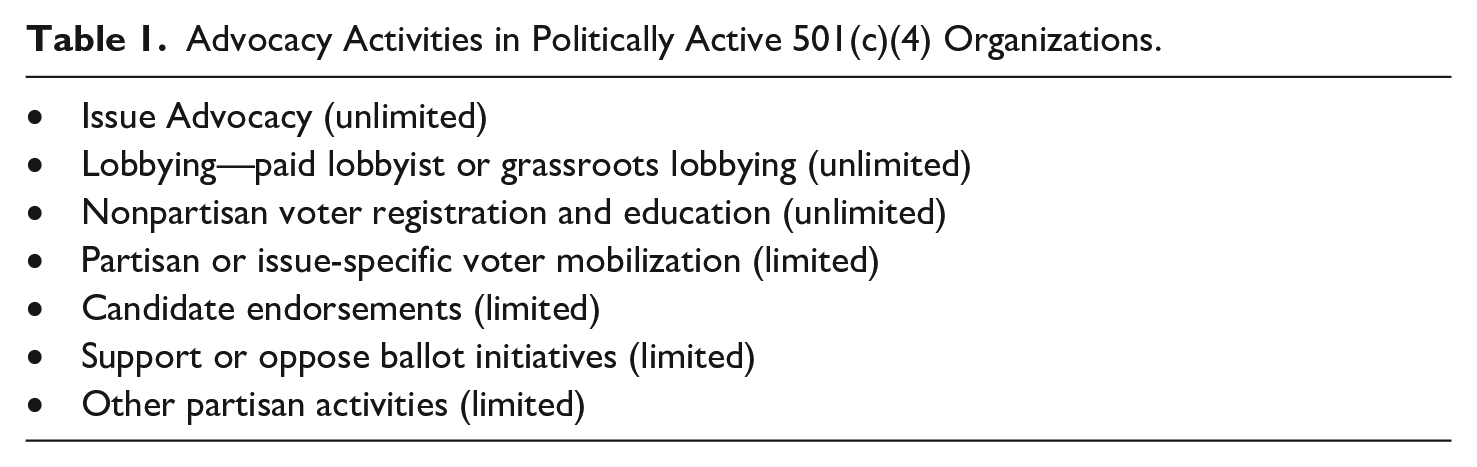
Politically active (c)(4) organizations engage in a combination of issue and policy advocacy, different types of lobbying, partisan support for candidates and ballot initiatives, and partisan voter education and mobilization (Table 1) (Pekkanen & Smith, 2014; Reid, 2006). Some organizations engage in these activities with a connected (c)(3) public charity, a political action committee, or both, although sometimes the (c)(4) is a free-standing entity (Fei & Gorovitz, 2018; Schadler, 2018; Suárez, 2020; Sugin, 2016). 2 Often they are aligned in formal and informal partnerships (alliances and coalitions) with national or state nonprofit organizations, unions, and associations.
Advocacy Activities in Politically Active 501(c)(4) Organizations.
The largest (c)(4) organizations include the AARP, National Rifle Association, Sierra Club, American Civil Liberties Union, and NAACP. These national entities have a large presence in federal policy circles and often have chapters or affiliates that support and cultivate local members’ civic engagement activities. Also included among politically active (c)(4) organizations are much smaller entities, often with income less than US$500,000 that conduct local or state policy advocacy and civic action around one or more specific issues. A key distinction is that the (c)(4) designation allows organizations to engage in partisan activities as long as such activities are not primary purpose. This distinction separates the organizations we focus on from those entities that engage in advocacy as part of their work as public charities, which are prohibited from partisan activities.
The Supreme Court’s 2010 Citizens United v. Federal Elections Commission decision resulted in increased corporate and union spending during elections and a larger role for outside nonprofit entities attempting to influence electoral outcomes (Boatright et al., 2016; Colinvaux, 2018). While conservative (c)(4) groups have captured attention for outspending liberal groups by using “dark money” strategies to influence elections (J. Mayer, 2016, pp. 247–250), evidence from case study research and the field of practice suggests that an expanding ecosystem of (c)(4) organizations exists, using policy advocacy and citizen action to achieve social welfare missions in low income and communities of color (Barsoum, 2019; Bolder Advocacy, 2020; Schadler, 2018; Post & Frank, 2019). 3
Research Scope
This article describes the multifaceted methodological approach we developed to identify organizations for analysis, the critical first step in investigating two questions of interest to nonprofit scholars: (a) What organizations make up the (c)(4) subset of politically active nonprofits? and (b) to what extent do they facilitate greater democratic engagement? This article addresses the first question by discussing the complex nature of the task, the multiple steps required, and the challenges we encountered. This work lays the foundation for our research on the second question that is the subject of other articles.
To address the gap in the literature we first must identify the number of (c)(4) organizations registered with the IRS that engage in political activities including advocacy, lobbying, grassroots and electoral organizing, and other activities that may be partisan in nature and that qualify as permissible for nonprimary purpose activities. This work will facilitate future research on the structure, function, and efficacy of politically active (c)(4) organizations, a nearly invisible part of the infrastructure of civil society. These methods allow researchers to identify and analyze (c)(4) subgroups focused on different policy issues, member types, and constituencies. It also allows scholars to differentiate organizations that are primarily advocates and those that are primarily service providers who also advocate.
Method
Identifying Politically Active 501(c)(4) Organizations
For those studying politically active social welfare organizations, the first task is to find the advocates within the more than 80,000 501(c)(4) organizations. Core files from the National Center for Charitable Statistics (NCCS) 4 at the Urban Institute would normally be the starting point for most quantitative nonprofit research because they include information from larger organizations that file the annual IRS Forms 990 and 990EZ. Those files include many more variables than the IRS Business Master File (BMF) 5 which includes all organizations that register with the IRS but has only a few variables, including contact information, filing year, assets, income, and the National Taxonomy of Exempt Entities (NTEE) classification. However, only 30% of (c)(4) organizations file IRS Forms 990 or 990EZ, which includes text descriptions of mission, programs and activities, and financial variables. Seventy percent of (c)(4) organizations are small enough that they are not required to file IRS Forms 990 or 990EZ and file the IRS 990N postcard with basic information.
Our research includes smaller organizations. Those organizations with income less than US$50,000 file the 990N postcard with only minimal variables found in the BMF. Slightly larger organizations (under $200,000 in gross income and less than $500,000 in assets) file Form 990EZ which has more variables but does not include all data fields in the complete Form 990. 6 We start with BMF data and add variables from IRS Forms 990 or 990EZ where available.
Ideally, one should be able to use NTEE classifications to identify politically active organizations. The NTEE Classification system includes alpha and numeric codes that are applied to all organizations that are fully classified. The 10 major categories have alpha codes, and decile- and centile-level codes are numeric. Decile-level codes indicate subcategories within major areas, centile codes (the third digit) identify specific types of organizations, and common codes specify types of organizational activities. 7 However, the NTEE system was designed primarily for public charities and has not been rigorously updated in recent years (Koulish, 2016). It is also problematic because of what Fyall et al. (2018) describe as limiting organizations to “mutually exclusive” activity categories (p. 678). Politically active organizations typically undertake multiple activities, and advocacy may not be their primary activity. Furthermore, because (c)(4)s have not been a major area of research, data files have not benefited from user feedback as is common with (c)(3) files.
To address the challenges of identifying politically active (c)(4) organizations, we conducted the research in three phases, applying what we learned in each part to the next one:
Part 1: Initial search in which we defined the scope of organizational types and activities and clarified keywords that indicate advocacy and political activity. We searched on organization titles in the BMF with seven keywords and used the NTEE Classification System to filter potential groups of advocacy and political organizations;
Part 2: Qualitative investigation and manual verification of one-quarter of resulting organizations. The qualitative inquiry included additional political activity variables not found in Forms 990 such as partisan candidates’ forums and ballot initiative campaigns;
Part 3: Textual keyword and content analysis of mission and program descriptions on available Forms 990 and 990EZ with expanded keywords and identification of advocacy activities on Schedules C (political campaign and lobbying activities) and R (related organizations). Part 3 integrates what was learned in Parts 1 and 2.
Through this process, we identified 12,166 organizations that are likely to engage in advocacy, lobbying, and other political activities. Part 1 builds on the methodology developed by Koulish (2016, pp. 15–29) to identify advocacy (c)(4) organizations. His report (2016) provides an overview of types and numbers of (c)(4) organizations classified by the NTEE system which he analyzes through an “advocacy screen.” Koulish identifies from the literature and validates keywords that are likely to be associated with advocacy. He combines keyword searches on organization titles with NTEE classification codes that are likely to include advocates, for example, the Civil Rights, Social Action and Advocacy category (NTEE R). This process was followed by manual validation that examined a subset of organizations by name, location, size, and program description, when available. Additional keywords were added, and the final screen included 9 keywords, 2 major NTEE categories, and 10 subcategories. To that was added whether the organization reported political activity on its Form 990 or paid more than 20% of total expenditures to external entities for lobbying (Koulish, 2016, pp. 18–20). Koulish identified a total of 2,168 organizations. We reviewed these methods and determined that we needed a more fine-grained methodology before we could implement a detailed qualitative analysis of programs, activities, and outcomes.
Research phases
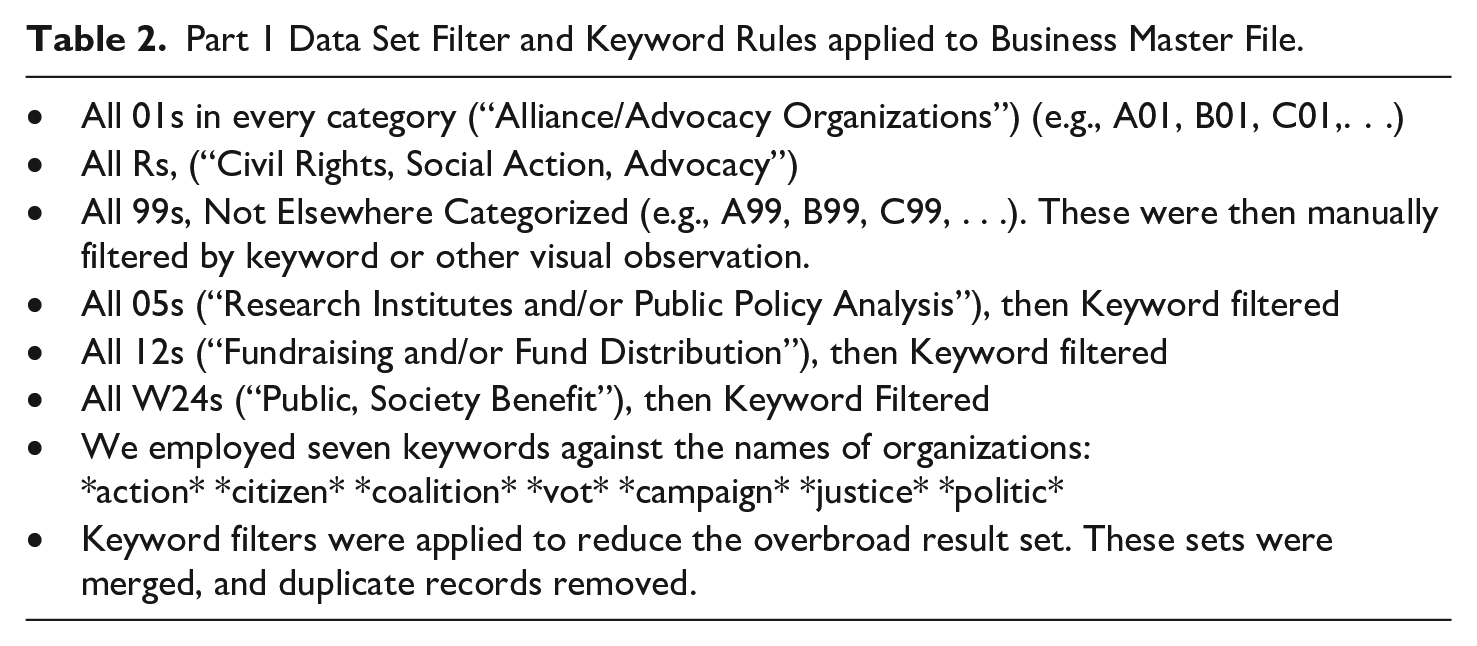
Part 1: We used a combination of seven keywords on all organizational names in the BMF and on NTEE classifications for advocacy organizations (NTEE R) and alliance / advocacy organizations (01) for filing years 2016 and 2018. From the approximately 80,000 registered 501(c)(4) organizations in the 2016 and 2018 BMF, we produced a data set of 4,503 organizations likely to be engaged in advocacy or civic action. Table 2 summarizes the filter and keyword rules applied to the BMF.
Part 1 Data Set Filter and Keyword Rules applied to Business Master File.
Part 2: We then conducted qualitative analysis on a geographically diverse sample of one-quarter of organizations identified in Part 1. We used websites, Forms 990, and other materials to assess the extent to which organizations engage in advocacy and political activities not reported on Form 990. We investigated whether organizations were “active” by looking for live websites, updated contact information for executive directors, staff and board members, current policy priorities, and reported membership. We also examined whether organizations engaged members in advocacy and civic action or if they appeared to be shell organizations. We looked for evidence of advocacy and issues campaigns, paid and grassroots lobbying, candidate endorsements, support for or opposition to ballot initiatives, and partisan voter engagement tactics. Determining if and how organizations engage members in political and civic action is not easily discernable from 990 data and this qualitative inquiry was necessary for understanding methodological opportunities and challenges. It was another way to manually verify keywords and identify additional criteria for inclusion and exclusion. As a result, we added four keywords to our analysis in the next phase and the identification of Schedules C and R.
While results from the search of the BMF were encouraging, the validity of using keywords against only organizational titles had not been tested. We could not be sure that the method captured advocacy organizations with generic titles that did not describe activities. We also could not verify that NTEE categories were capturing all or most of the advocacy organizations. The results of Part 1 and 2 revealed the limitations of the keywords search process across titles alone and demonstrated the need for expanded searches across missions and program activities that we conducted in Part Three.
Part 3: 8 Digitized data on program and mission statements are currently only available for larger organizations that file Forms 990 and 990EZ, and many groups we are interested in are too small to file those forms. However, we decided to use the advocacy keywords across mission statements and program descriptions to test the strength of the keyword and NTEE approaches. We incorporated what was learned in Part 1 and 2 about keywords and NTEE codes into the rules for Part 3. Organizations that filed Schedule C and Schedule R were also included. Schedule C indicates the organization’s involvement in political campaign and lobbying activities and schedule R includes information on related organizations, transactions with these organizations, and other partnerships in which the organization conducts significant activities.
Using the BMF and circa 2018 digitized data from IRS 501(c)(4) Forms 990 and 990 EZ, a five-step tiered analysis was conducted. This tiered analysis will allow us to test the additive and individual contributions of each criterion that we used to identify organizations using Forms 990 data:
Seven keywords were run across titles and subtitles in the BMF, and against mission statements and program activities for all (c)(4) organizations with digitized Form 990 and 990-EZ information. That resulted in 5,224 potential advocacy organizations.
Four additional keywords that we identified as potentially useful were run against the remaining organizations’ titles, subtitles, mission statements, and program activities resulting in 1,127 additional organizations.
We then added the remaining organizations with NTEE R adding 2,339 organizations and NTEE 01 which added 716 organizations.
In this step, we included organizations not captured previously that filed Schedule C (political campaigns and lobbing activities) and those that indicated related organizations in Schedule R. Organizations filing only Schedule C yielded 1,388 organizations, and only Schedule R yielded 1,035 organizations. Organizations filing both Schedules C and R added 325 organizations.
These four steps identified 12,154 unique organizations plus 12 organizations that were identified in Part 1 and manually verified for inclusion, bringing the total population to 12,166. These organizations were entered into a database with titles, addresses, websites, financial data, EIN numbers, NTEE codes, text descriptions of mission and program statements, and flags for Schedule C and R entries. Table 3 summarizes the rules applied in Part 3. 9
Part 3 Data Set Filter and Keywords.
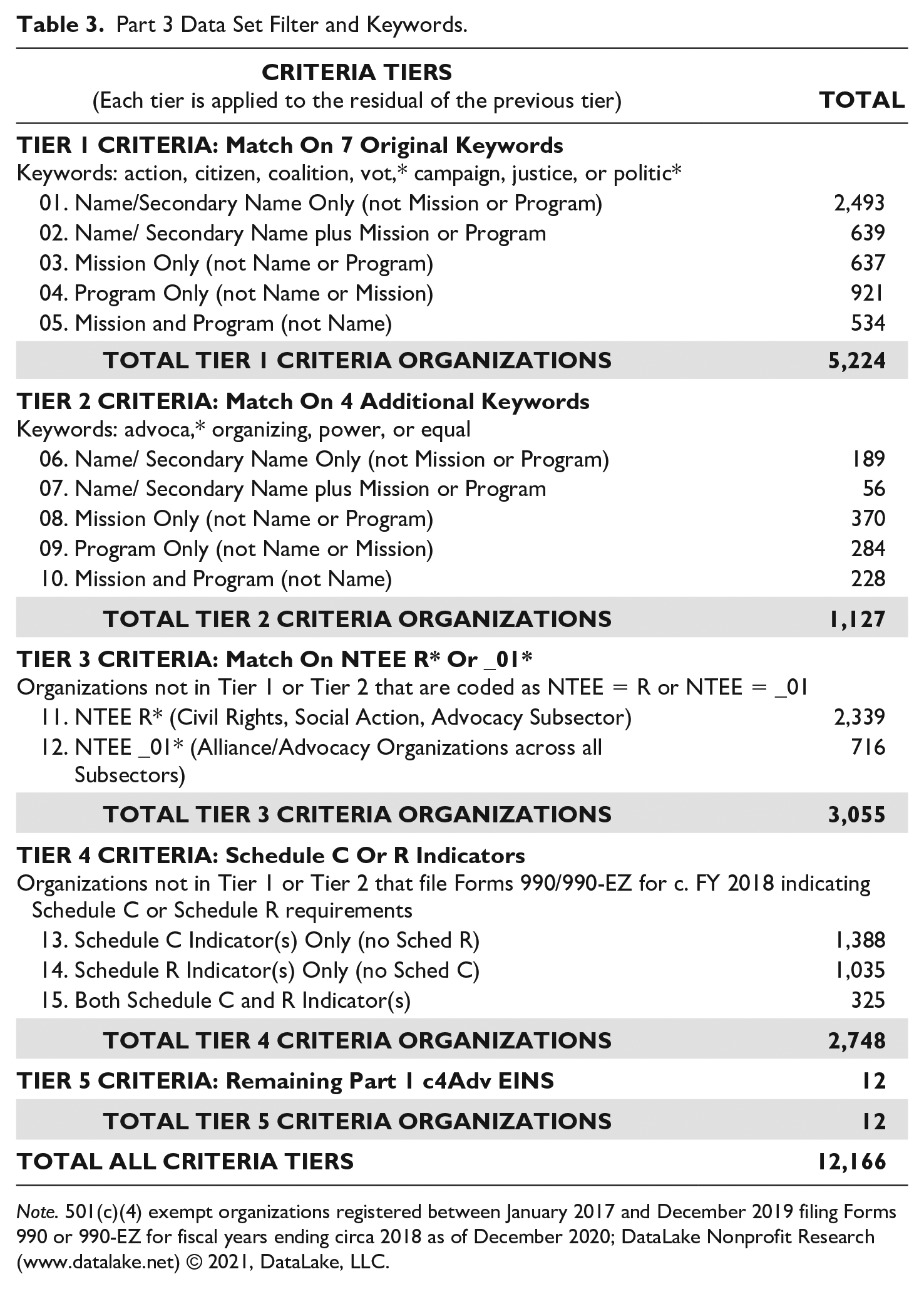
Note. 501(c)(4) exempt organizations registered between January 2017 and December 2019 filing Forms 990 or 990-EZ for fiscal years ending circa 2018 as of December 2020; DataLake Nonprofit Research (www.datalake.net) © 2021, DataLake, LLC.
The final step was to analyze organizations identified by each method independently to compare the methods and assess the utility of each. This step allowed us to compare organizations identified by each method alone, and to see how many methods identify each organization.
Discussion
Identifying politically active organizations among IRS registered 501(c)(4) organizations requires multiple steps. It is most difficult to identify small organizations with US$50,000 or less in gross receipts because the information they provide is minimal. For larger organizations required to file Forms 990 or 990EZ, mission and program information (if they completed those sections), and information on filing of Schedules C and R can be searched. Even so, among the 87,503 (c)(4) organizations, 58% (51,086) only filed the minimal Form 990N, and only 14,478 filed Forms 990 and 990EZ electronically. Approximately 65,700 organizations had no information available on missions and programs.
This lack of information means that keyword searches of missions and programs are limited as is information from schedules C and R. Of the 12,166 identified through the combined methods, 5,073 organizations did not file either Form 990 or Form 990EZ. Currently, identification of advocacy status for those organizations must rely on NTEE classifications, keyword analysis of titles, and manual verification.
NTEE Classifications
The inconsistencies and irregularities of the NTEE Classification system can be a limitation for analyses requiring systematic categorization of organizational data. However, because the NTEE code is a variable for organizations listed on the Business Master File, it is a necessary tool for analyses that include organizations below the threshold for filing Forms 990/990EZ, for organizations that file paper instead of digitized forms, and for those that omit information on mission and programs. We found that using NTEE advocacy codes requires cross-checking to identify miscoded organizations but that they do identify a broad set of advocacy organizations for further analysis.
Of the 12,166 potential advocacy organizations identified, 3,362 had only NTEE R (Civil Rights, Social Action and Advocacy) classification and 1,456 had only NTEE 01 (Alliance/ Advocacy) classification, and 420 organizations had both codes. These NTEE codes identified 43% (5,238) of the total organizations. Most were smaller non-filers, and only 1,573 filed Forms 990 or 990EZ and were thus available for analysis beyond keyword searches on titles.
Keywords
A challenge for researchers is verifying the utility and scope of the keywords. Keywords verified in past research are one resource, but manual confirmation and cross-checking are necessary. From the outset, we needed to use keywords on titles to capture small nonprofits that only file 990N and to account for those organizations that may not carry the appropriate NTEE classification. We identified from the literature and verified in earlier research the keywords to pinpoint the target organizations.
Running 11 keywords on organization titles and subtitles identified 2,582 potential advocacy organizations; only 19% (499) filed Forms 990 or 990EZ, indicating that almost 4 of 5 are among the smallest organizations. When the keywords were run against mission and program descriptions, an additional 3,769 organizations, mostly filers, were identified for a total of 6,351 potential advocacy organizations. Together, the 11 keywords in all permutations identified more than half of the 12,166 organizations. Keywords were present in 38% of NTEE R identified cases and in 52% of NTEE 01 identified cases.
Schedules C and R
To fully understand the strategies of politically active (c)(4)s, it is necessary to know the extent to which they use provisions for lobbying and related organizations. We included indicators of Schedule C where (c)(4)s are required to report political campaigns and lobbying activities with amounts. Schedule R is included because it indicates related organizations and partnerships that can signal whether the (c)(4) is connected to an issue-based (c)(3) that uses the (c)(4) for wider policy influence or a political action committee that allows for more engagement and influence in politics. These affiliations may enable greater participation and influence in the policy arena. Looking at organizations that completed Schedules C and R added 2,748 organizations not identified in Tiers 1 to 3. If an organization includes both Schedule R and Schedule C it indicates two important features: (a) the (c)(4) has a related organization (Schedule R) and may signal aspects of hybridity and (b) the repertoire of possible political activities expands (Schedule C). By identifying which organizations file either Schedule C or Schedule R or both Schedules C and R, researchers can understand the different arrangements and activities that may support the organizational mission.
The overlaps with keyword searches and NTEE codes reinforce the utility of combining multiple methods to produce a rich data set for further analysis. Schedules C and R provide additional lenses through which researchers can examine organizations’ political activities. Organizations identified by multiple methods tend to be larger and more likely to conduct advocacy activities, but the smallest organizations can only be identified through NTEE categories and keywords. To advance knowledge of smaller organizations, researchers need to employ additional analysis similar to the qualitative methods used in Part 2.
Including indicators for Schedules C and R added a significant number of organizations for analysis. While this expanded the data set, it also added larger organizations for which advocacy was not a primary activity including health organizations, housing facilities, senior centers, and local fire departments. Cross-checking and qualitative analysis are required for both the most and the least likely advocates and to verify the degree of advocacy and political activities for all organizations.
Summary of Methodological Challenges
Using IRS administrative data to study nonprofit organizations has an often-noted set of challenges. This study is no exception. In our effort to identify politically active (c)(4)s, we encountered data, classification, and keyword issues.
IRS Forms 990: Using IRS Forms 990 for research involves a series of steps to account for the vagaries inherent in the data. Researchers must ensure coverage of most organizations by scanning adjacent years “circa” for target data years resulting in data sets that include different filing years; recognize that data will be two to four years old; acknowledge missing and incomplete records, especially when using digitized records that exclude paper filers; and using methods that account for different amounts of data for different sizes of organizations. One of the key issues we faced in identifying smaller organizations is the limited available data.
NTEE Classifications: Because of the limitations of IRS data, NTEE codes not only are critical for identifying small organizations but also important for larger filers. The NTEE is a useful starting point, but organizations may be misclassified or have changed their focus. Some have plausible but unexpected classifications, and some organizations are not classified in a way that one can use to distinguish advocacy and nonadvocacy groups. Advocacy may not be their primary activity and thus is not reflected in the major classification. The use of keywords on titles and programs and missions, when available, provides a necessary cross-check on NTEE classifications. Future research must include an in-depth investigation of activities to determine whether and how they fit the profile of politically active (c)(4)s.
Keyword Analysis: Researchers should be aware of the challenges we encountered using keyword searches to identify politically active (c)(4) organizations. While it proved to be a useful technique, keyword searches on titles also may miss organizations that do not have descriptive or well-known titles. Using keywords on programs and missions is not possible for the smaller Form 990N filers because they do not provide that information. Even with validated keywords, data must be carefully cleaned to cull bad catches.
Within 3 to 5 years, digitized data files for all Forms 990 and 990EZ will be available, and keyword searches across text fields will be possible because of the Taxpayer First Act (2019) requirement that all Forms 990 must be submitted electronically for tax years ending in July 2020 and later, and for Form 990 EZ for tax years July 30, 2021, and later (Internal Revenue Service, 2021). More timely and higher quality data will be available for research.
Conclusion
Future Research on 501(c)(4) Organizations
Understanding the distinctive features of the 501(c)(4) sector and the characteristics of politically active organizations within it are essential tasks for nonprofit scholars, yet the methodological and empirical challenges are significant. This article explains the necessary first steps to develop a rigorous approach for addressing these challenges.
Using this data set, we now can provide a portrait of organizational type, financial status, and geography. We can analyze the data to understand what organizations do, how they are structured, who they serve, their successes and challenges, and their community context. This research is an important step forward for in-depth analyses of (c)(4) organizations and for identifying politically active groups, but it will take more fine-grained analyses to improve the data sets. In addition to investigating variables from Form 990 that will indicate political activity (such as lobbying), qualitative inquiry is needed to comprehensively examine variables not reported on Form 990, such as voter engagement activities, involvement in electoral campaigns, and approaches to membership recruitment and civic skills development. Scholars can also investigate different policy categories, such as organizations specializing in environmental or health policy. In addition to different types of organizations, researchers may study differences between local membership (c)(4) organizations versus state and national organizations. The data we now have include a range of organizational types with notable differences in the extent to which they perform politically oriented activities. Researchers can use the methods here to explore differences in the resources organizations devote to political activity.
Future research also can include web-scraping and social media analyses that would enable researchers to go more in-depth on activities. IRS Forms 1023 (Application for Recognition of [tax] Exemption) may also have indicators for understanding early-stage organizations. Geographic analyses can offer researchers a picture of which (c)(4)s are part of other advocacy ecosystems or policy action fields. Analyses of (c)(4) organizations in rural, urban, and suburban areas may yield insights about social capital building. Studies of how politically active nonprofits relate to other types of community nonprofits and unions will advance what we know about civic infrastructures, networks, and alliances. These areas for future research are much needed to advance knowledge of the subsector.
Our next steps include refining the data set to cross-check against websites and social media and use qualitative inquiries to hone our understanding of organizations that serve low-income communities and communities of color. The data set will be publicly available to other researchers once this next phase of refinement is completed.
Research Data
sj-docx-1-nvs-10.1177_08997640211066495 – Supplemental material for The Advocacy Universe: A Methodology to Identify Politically Active 501(C)(4) Organizations
Supplemental material, sj-docx-1-nvs-10.1177_08997640211066495 for The Advocacy Universe: A Methodology to Identify Politically Active 501(C)(4) Organizations by Margaret A. Post, Elizabeth T. Boris and Carol L. Stimmel in Nonprofit and Voluntary Sector Quarterly
Footnotes
Acknowledgements
The authors wish to thank the editors and anonymous reviewers for their feedback. We also gratefully acknowledge undergraduate research assistants, Emily Braddock, Penelope Kogan, and Payton Goodman.
Author Note
Carol L. Stimmel is now affiliated to Worcester Polytechnic Institute, Worcester, MA USA.
Declaration of Conflicting Interests
The author(s) declared no potential conflicts of interest with respect to the research, authorship, and/or publication of this article.
Funding
The author(s) received no financial support for the research, authorship, and/or publication of this article.

Notes
Author Biographies
References
Supplementary Material
Please find the following supplemental material available below.
For Open Access articles published under a Creative Commons License, all supplemental material carries the same license as the article it is associated with.
For non-Open Access articles published, all supplemental material carries a non-exclusive license, and permission requests for re-use of supplemental material or any part of supplemental material shall be sent directly to the copyright owner as specified in the copyright notice associated with the article.
