



Abstract
The article reviews a family of multilevel models that can be used to build general theories of the nonprofit sector that are still sensitive to variations in context. The comparative study of the nonprofit (or nongovernmental) sector presents formidable challenges to social scientists who are attempting to advance theory on the sector. Ostensibly, the goal is to model and test theories that are generalizable. Yet, as scholars study topics such as volunteerism, donations, governance, management, advocacy, accountability, and the like in different political, economic, and cultural contexts, they often find different patterns across cases. After reviewing the issues and introducing the idea that time (or more specifically events) can be thought of as context as well, we present an analytical approach for doing comparative research using the framework of hierarchical linear modeling.
Introduction
Although the goal of social science is to construct and test theories that are generalizable, scholars often encounter variation in the cultural, social, political, economic, and historical contexts in which human and organizational behaviors are embedded. This article offers an analytic strategy to model these contextual effects over time. We extend the extant literature by focusing on the impact of societal-level events as context. This includes elections, pandemics, recessions, terrorist attacks, wars, and a host of serendipitous happenings. Although it is a challenge to draw generalizations across a variety of contexts, it is not impossible (Stryker, 1996).
Although there are different methods to analyze longitudinal data (see Halaby, 2004; Verbeke et al., 2014), we explore the potential of two-piece multilevel hierarchical growth curve models (Raudenbush & Bryk, 2002). We are not the first in the field of nonprofit studies to use growth curve models or to assess the impact of events or happenings on nonprofit outcomes. Nonprofit researchers used growth curve models to explain changes in individual income (Shantz et al., 2019), volunteering (Kim & Jang, 2017), the survival of immigrant organizations (Vermeulen et al., 2016), and the growth/decline in nonprofit expenditures (Galaskiewicz et al., 2006). They have also looked at the impact of major events such as natural disasters and hosting a Super Bowl on corporate giving (Tilcsik & Marquis, 2013), the Kosovo war and Stockholm bombings on people’s trust (Geys & Qari, 2017; Kijewski & Freitag, 2018), and terrorist attacks on people’s volunteering and giving (Berrebi & Yonah, 2016; Beyerlein & Sikkink, 2008). However, we found no studies in the field of nonprofit studies that use growth curve models and study events or happenings. Our goal is to present an analytical strategy to do this. 1
To illustrate our approach, this article focuses on the proposition that people who join voluntary associations (VAs) should have higher levels of generalized trust than those who do not (Putnam, 1995, 2000). Hardin (2001) defined generalized trust as “trust in random others or in social institutions without grounding in specific prior or subsequent relationships with these others . . .” (p. 13). In simpler terms, it is trust in strangers. Paxton (2007) argued, “The most obvious way in which voluntary associations promote trust among their members is through the norms and social sanctions embedded in their social structures” (p. 50). This makes interaction more predictable and thus other group members more trustworthy. However, it is problematic how this translates into generalized trust. She argues that this happens if joiners can use their different memberships to build networks through which they diffuse trust across the community. Thus, those who belong to connected (or bridging) VAs will trust a broader array of people than those who belong to isolated (or bonding) VAs. Paxton (2007) and others (e.g., Delhey & Newton, 2003; Mewes, 2014; Park & Subramanian, 2012) have shown that levels of generalized trust are affected by national context as well. We extend this proposition by arguing that national context and key events can also help explain people’s willingness to trust strangers and when VAs might impact trust more.
To set the stage for our later discussion the article begins by contrasting inside-out and outside-in approaches to comparative research. The former refers to research that prioritizes unique conditions within national contexts; the latter refers to research that seeks to draw broad generalizations across national contexts, that is, context matters little. We then offer a third approach, formulating General but Contextually Sensitive (GCS) theories of generalized trust, that incorporates country-level characteristics into the model to explain variation across contexts. Finally, we extend the literature by suggesting how happenings and events can be studied along with individual- and country-level effects to explain variation in generalized trust. Throughout the article, we show how multilevel modeling can help us incorporate context into empirically testable theories.
Thinking About Context in Comparative Research 2
Both the strategic management and the public management (Meier et al., 2017; O’Toole & Meier, 2015) literatures have joined other social scientists in trying to understand how to better theorize contextual effects. Should researchers import theories formulated in the West to study behavior in non-Western societies, ignoring the local context, or should they gain a deep understanding of the local context and focus on local patterns? Tsui (2006) labeled the former outside-in theory and the latter inside-out theory. Li et al. (2012) labeled the latter indigenous theory. Whetten (2009) offered a different option. He argued that, if possible, context should be incorporated into our theories (see also Tsui et al., 2007). Whetten (2009) offered two approaches: contextualizing theory (that is, making theory more context sensitive) and theorizing about context (that is, identifying the effects of context on outcomes). Social origins theory is an exemplar of contextualizing theory and remains the gold standard for comparative research (Anheier, 2014; Anheier et al., 2020; Salamon & Anheier, 1998; Salamon et al., 2017).
Typically, context refers to culture, material conditions, geography, and societies’ political, social, and economic institutions (Tsui et al., 2007), but it can also refer to happenings or events. According to Griffin (1992), “An event . . . is a historically singular happening that takes place in a particular time and place and sequentially unfolds or develops through time” (p. 414). Griffin (1992) continued. One can study the temporal sequencing of events over time, for example, how different events lead to the beginnings/endings of wars; colligations of particular events or happening that as a whole represent some era or epoch, for example, the Great Depression; or the outcomes of some serendipitous event on people who experience it, for example, such as a hurricane or flood. Because these events (or collections of events) are often unique and unanticipated, our theories have difficulty predicting outcomes. Typically, we study a limited number of cases using a variety of methods, for example, event sequence analysis (Abbott, 1983), narrative analysis (Stryker, 1996), or qualitative comparative analysis (Ragin, 1987), and try to identify patterns and regularities. Although difficult to study, happenings or events can transform social structures and institutions and thus are worthy of study (Sewell, 1996).
Context-Specific Theories of Generalized Trust: Inside-Out Theories
The inside-out approach argues that one can explain patterns of behavior only by understanding the local context. That is, theories that explain how people behave in one context may be applicable in other contexts as well, but only really work in the context being studied. Li et al. (2012) labeled this indigenous research: the study of a unique local phenomenon or a unique element of a local phenomenon from a local perspective to understand its local relevance. Ideally, this may give us clues to understanding patterns in other cases, which are similar, but the focus is on understanding the case.
Our first hypothesis is that some variable, such as joining VAs, has different effects on individuals' trust depending on societal context and each country has a unique context that cannot be explained by a common factor (Hypothesis 1 [H1]). Essentially, comparative research would be a collection of distinct case studies. Equations 1-2 restate H1 in hierarchical linear modeling (HLM) notation.



where
The primary purpose of an indigenous nonprofit theory is to illustrate the unique developmental trajectory of some phenomenon as a result of the history and cultural tradition, political institutions, economic conditions, or historical events that are unique to that context. An example is Suárez and Marshall (2014), which proceeds inductively using data from international nongovernmental organizations (INGOs) and nongovernmental organizations (NGOs) in Cambodia to develop a typology of NGO capacity that is faithful to the Cambodian context but may not be useful in other settings. Another example is Kijewski and Freitag (2018) which studied the influence of civil conflicts in Kosovo on residents’ generalized trust. They emphasized that their research was distinct from research on places that are peaceful and stable. However, it does not follow that local patterns can never be replicated elsewhere. For instance, other countries have civil wars too. Thus, the task is to compare cases with similar and dissimilar contexts and see whether general patterns emerge across cases. In explaining generalized trust, for instance, scholars could start from some localities as a starting point and use the local patterns as building blocks to build theories that can be also applicable to similar contexts. Therefore, although generalizability is usually not the main goal of inside-out theorists, scholars may be able to apply their findings to similar cases at times.
Generalizable Theories of Generalized Trust: Outside-In Theories
In the extreme, outside-in theories argue that in every societal context studied, the same factors explain the same outcomes. A critique of the approach is that it often uses theories developed in the West to understand behaviors and patterns in the non-Western context (Barney & Zhang, 2009). Tsui (2006) called it a literature-driven approach in defining what to study in the non-Western context. If the goals of social science are to build theories that have scientific and practical utility, theories need to be tested in different contexts so that we learn their scope conditions. Thus, the distinguishing feature of the outside-in approach is not that the theories come from the west, but that the researcher attempts to take a general theory and see whether it works in different contexts.
We might hypothesize that joiners have higher levels of generalized trust regardless of context (Hypothesis 2 [H2]). That is, the effect is the same for all cases included in a study. Equations 4-6 describe H2 in HLM notation:



where
Paxton (2007) and Park and Subramanian (2012) found several factors that explained generalized trust across contexts, for example, education, employment, and age. However, it is more common to find effects significant in some contexts but not others. We use gender as an illustrative example. Paxton (2007) and Park and Subramanian (2012) found no significant effect of gender. Mewes (2014) used data from 16 European countries surveyed between 2002 and 2010 and found that females are consistently less trusting than males. Delhey and Newton (2003) compared several individual-level and national-level predictors of generalized trust in seven regions, namely, East and West Germany, Hungary, Slovenia, South Korea, Spain, and Switzerland between 1999 and 2001. They found that being a female lowers the level of generalized trust relative to a male in Switzerland, but it has no effect in other regions. Given the inconsistent findings regarding gender effects, perhaps national context matters. For example, Mewes (2014) also found that a “country’s level of gender equality in labour force participation mediates the association between gender and generalized trust” (p. 373).
Whetten (2009) argued that the purpose of testing theory across contexts is to locate its contextual boundary beyond which it may not be applicable. Once a theory survives this cross-contextual test, scholars have more confidence in stating that context plays a minimal role and the theory that they developed is generalizable. However, we believe, it is better to systematically incorporate context into our theories rather than to minimize its impact.
General but Context Sensitive (GCS) Theories of Generalized Trust
Whetten (2009) struggled with the issue of how to mesh context and theory. He writes, The term “context effects” is broadly defined as the set of factors surrounding a phenomenon that exert some direct or indirect influence on it—also characterized as explanatory factors associated with higher levels of analysis than those expressly under investigation (p. 31).
In other words, there are cross-level direct effects and cross-level interaction effects. Park and Subramanian (2012) found that ethno-racial homogeneity was positively associated with the average degree of generalized trust in a country, a cross-level direct effect. They also found that the positive effect of voluntary association membership on generalized trust weakens with higher levels of income inequality, a cross-level interaction effect.
Nonprofit scholars have brought context into play in several different ways. Using the language of multilevel analysis, we propose three approaches to model these contextual effects. First, we present a model where the Level 2 variable, for example, some characteristic of nations, is used to explain the average level of some outcome among lower-level units (random intercept model). Second, we present a model where the Level 2 variable is used to explain the effects of some Level 1 variable on an outcome (random intercept and random slope model). 4 Third, we present a model that incorporates events and time into the analysis to explain changes in an outcome over time (two-piece hierarchical growth curve model).
Cross-Level Effects—Random Intercept Models
A cross-level random intercept model has
In our model, the value of Y, the degree of generalized trust, on average, is contingent on the context, W, alone. Thinking about this in multilevel terms, our third hypothesis is that in contexts with strong institutional controls, the average level of trust among residents should be higher than in contexts with weak institutional controls (Hypothesis 3 [H3]):


where
Cross-Level Effects—Random Intercept and Random Slope Model
On top of the direct effect of a contextual variable (W) on the individual-level outcome (Y), a contextual variable can also modify the relationship between an individual-level regressor (X) and outcome (Y) (Whetten, 2009). Our fourth hypothesis is that trust among nonjoiners will be higher in contexts with strong institutional controls than in contexts with weak institutional controls (Hypothesis 4 [H4]). We also hypothesize that in contexts with weak institutional controls, joiners will have higher levels of generalized trust than nonjoiners (Hypothesis 5 [H5]). Finally, we hypothesize that in contexts with strong institutional controls, joining will have little effect on generalized trust (Hypothesis 6 [H6]). That is, VA memberships are more effective in weaker institutional contexts where it is more risky to trust strangers, but have little effect in strong institutional contexts. Equations 9-11 restate these hypotheses in HLM notation:



where
Figure 1 summarizes a possible empirical outcome of testing the model presented above. For example, we might find that being in an institutionally strong context,
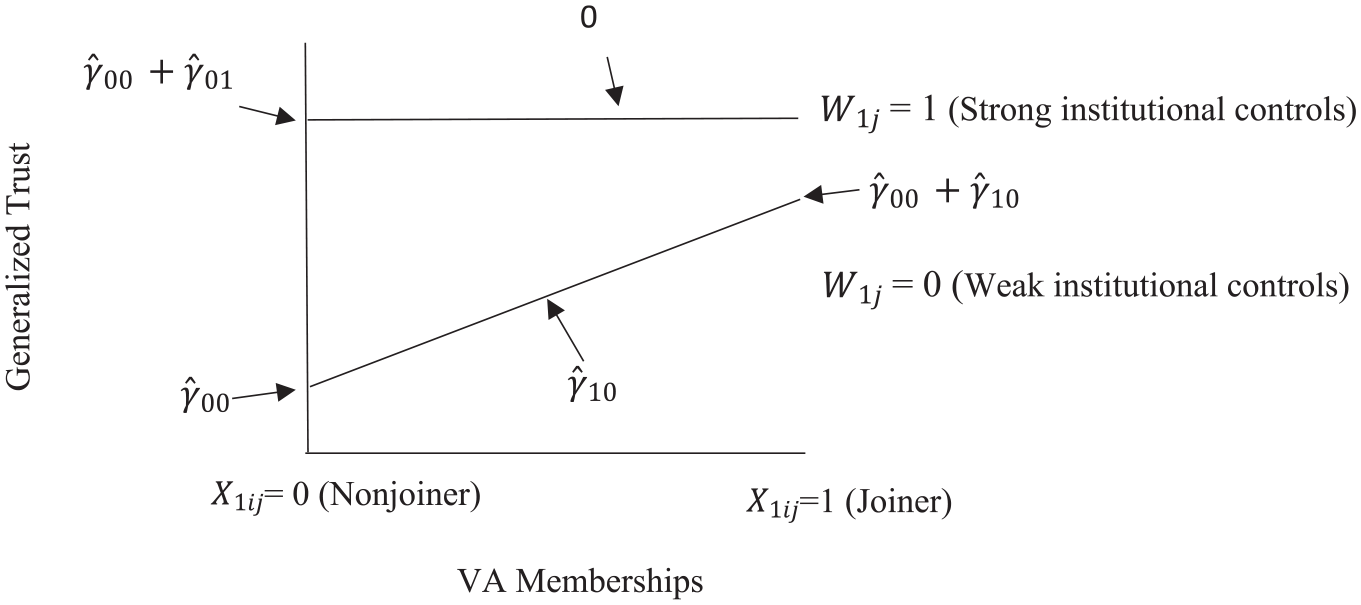
Illustrative example for Hypotheses 4, 5, and 6 (estimated effects).
Over Time Effects With Events as Context—Two-Piece Growth Curve Models
While random intercept and random slope models allow nonprofit scholars to theorize about and empirically test the direct and moderating effects of context on dependent variables of interest, they are static in the sense that these models ignore temporal variations in the effects of key variables (Bollen & Curran, 2006). Exogenous shocks such as natural disasters or other grand-scaled societal events, however, can often create a discontinuity in trajectories of social actors’ attitudes and behaviors. For example, public support for democracy in Europe declined dramatically during and after the Global Financial Crisis of 2008 due to deteriorating national economies and growing political interference from international organizations such as the International Monetary Fund (Armingeon & Guthmann, 2014).
In this section, we show how researchers can do cross-national longitudinal studies taking time and/or events into account. Our example examines how events as well as national context and individual characteristics can impact increases or decreases in generalized trust. We first offer a two-piece two-level model where individual’s generalized trust is measured at multiple points in time (Level 1) and personal factors are used to explain in(de)creases in trust before and after some exogenous shock (Level 2). The shock is modeled as a turning point in our time sequence. Next, we offer a two-piece three-level model. Observations of the individual at multiple time points are modeled at Level 1, individual characteristics are included at Level 2, and country-level variables are included at Level 3.
We theorize that VAs act to restore trust in the wake of a negative exogenous shock, but only under certain conditions. We can think of a shock like a recession, terrorist attack, natural disaster, or pandemic as a challenge to the social integration of nation-states as well as the global community. There is much research on the impact of disasters, and empirical findings are mixed. Some find that communities under threat come together and levels of social solidarity rise; others find that opportunists take advantage of the breakdown in social order and further their own interests at the expense of others (Quarantelli, 1987; Tierney, 2007). We argue that in times of crisis, VAs can be important integrative mechanisms. Thus, after some shock, being a joiner is going to be even more important in explaining generalized trust than before the shock. However, whether this happens or not depends on the national context, for example, whether there are strong or weak institutional controls.
Although there are many different types of shocks, we will focus on global recessions. First, based on our earlier arguments, we retest H4 to H6. At the time of the recession, nonjoiners in stronger institutional contexts will have higher levels of trust than nonjoiners in weaker institutional contexts (H4), while joiners will have higher levels of trust than nonjoiners in contexts with weaker institutional controls (H5). Finally, the difference in trust of joiners and nonjoiners would be less in contexts with strong institutional social controls (H6).
Second, recessions are often preceded by a bubble period of great optimism. Although joiners may be more trusting than nonjoiners in institutionally weak societies and have similar levels of trust in institutionally strong societies, the average rates of increase in generalized trust in the bubble period should be comparable for joiners and nonjoiners in institutionally strong and weak contexts (Hypothesis 7 [H7]).
Third, after the recession, the generalized trust of nonjoiners should decrease at a much slower rate in institutionally strong contexts compared with institutionally weak contexts (Hypothesis 8 [H8]). Fourth, after the recession, in institutionally weak contexts, joiners’ rates of decline would be more moderate than nonjoiners (Hypothesis 9 [H9]). This would be due to nonjoiners’ sense of vulnerability, not having organizational supports, and looking for help in their own networks. Finally, we expect that in institutionally strong contexts, the effects of joining on trust would be weaker (Hypothesis 10 [H10]). In sum, VA memberships can compensate for the uncertainty in contexts with weak institutional controls. Especially in bad times, they can expand people’s radius of trust and prevent them from reverting to tribalism. However, being in an institutionally secure context reduces the effect of joining on the rate of change in generalized trust in good and bad times. 6
We use a two-piece multilevel growth curve model (Raudenbush & Bryk, 2002) to study this complex set of effects. 7 Level 1 units of analysis are time points, t; Level 2 units of analysis are now individuals, i; and Level 3 units are countries, j. The easiest way to understand the complexities of this model is to be familiar with the full set of equations that link the different levels of analysis together (see the appendix). Note, in the appendix, Q denotes the number of regressors at Level 2 and S denotes the number of regressors at Level 3. In the example below, we use only one regressor each in the Level 2 and Level 3 models; thus, the variables and their coefficients are subscripted 1 instead of q or s. Because we intend to translate our verbal theory into a formal model certain effects are omitted that would be included in an empirical analysis. Also the signs for the dependent and independent variables in the equations correspond to our hypotheses as they have in our previous examples.
In our example of a two-piece model, we distinguish time points into two periods: prerecession and postrecession periods. Thus, in the Level 1 model, we fit three parameters, one for each period and one for the turning point (the year of the recession). Here are our hypothesized effects expressed at Level 1:

where
The following equations suggest how being a member of VAs matters. It takes the parameter estimates from the Level 1 model as the dependent variables and incorporates a person-level variable as a regressor. Given three parameters at Level 1, Level 2 model has three equations:



where
Our theory said that national context should modify some of these effects, so we add a third level to the model. The Level 3 model takes the parameter estimates from the Level 2 model and makes these the dependent variables (see Equations A1 through A10 in the appendix for the full model). As before,


Recall that in equations 10 and 11, we argued that context can increase the levels of generalized trust among nonjoiners and reduce the effect of joining on generalized trust as we move from institutionally weak to institutionally strong contexts (H4–H6). This is restated in Equations 16 and 17 where we look at the level of generalized trust at the time of the recession (when
Equation 17 tests whether the effect of joining on generalized trust at the time of the recession

Equation 18 is a test for H7:
The mean growth rate in generalized trust for nonjoiners in the prerecession period in country j


Finally, equations 19 and 20 address H8-H10. We argue that the decline in trust among nonjoiners should be less in institutionally strong contexts, joiners should have less decline in trust than nonjoiners in institutionally weak contexts, but joining should have little effect on trust in institutionally strong contexts. Equation 19 tests whether the average growth rate in trust for nonjoiners in the postrecession period is a function of
Equation 20 tests if joiners’ levels of trust decline at a much lower rate than nonjoiners in institutionally weak contexts (when
Figure 2 is a possible set of empirical results of our two-piece three-level growth curve model (Equations 12–20).
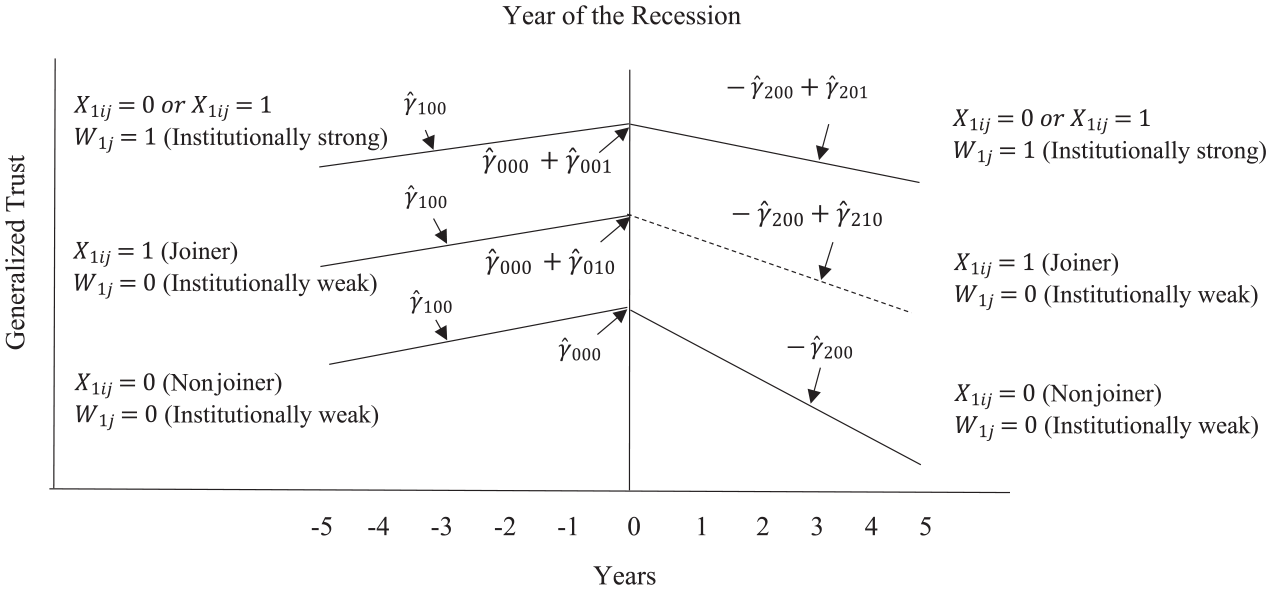
Illustrative example for Hypotheses 4 to 10 (estimated effects).
Looking at the period prior to the recession, we do not expect that context matters in explaining changes in trust over time.
Turning to the period after the recession,
Conclusion
Comparatists are often concerned that efforts to establish the credibility of generalizable theories of the nonprofit sector, what we called outside-in theories, are both futile and disingenuous. It is futile because it ignores contextual differences, and disingenuous because many of the topics, theories, and concepts come out of the West and can miss the realities in other settings. They are also concerned about context-specific research, what we called inside-out theories. Issues of local context are addressed; however, our knowledge about the sector in general is fragmented, as we only have a collection of case studies.
Similar to Tsui (2006), we see a role for both inside-out and outside-in approaches (see Figure 3). The former can be invaluable to build theory. They focus on idiosyncratic events, local institutions, and context-specific narratives, and findings may be applied to similar settings. For instance, China is often described as exceptional, but there are other one-party rule governments in the world, and many countries are influenced by Confucian traditions. So inside-out research can be used to build general but context-sensitive theories. Outside-in approaches are equally valuable. They focus on global events, universalistic principles, and context-free narratives. If we can find theories that are generalizable, it would advance our field. However, we can only discover these by showing that contextual effects are minimal. One may see inside-out research as the first step in theory building and outside-in research as the last step in confirming that a theory is applicable across a variety of contexts.

Summary of the contextualization discussion.
The paper borrowed from Whetten (2009) who described ways that the management literature has dealt with the problem of context and theory. We called this a General but Context-Sensitive (GCS) approach. The idea is to incorporate context into our theories. Variation in context could explain outcomes at Level 1 (e.g., individual attitudes). Context could modify Level 1 effects on Level 1 outcomes (e.g., depending upon context, individual-level variables affect outcomes differently), and events could modify the effects of Level 2 context on Level 1 outcomes (e.g., given some event, contextual effects may be mitigated or exacerbated).
We added to Whetten’s discussion in two ways. First, we showed how his contextual effects might be modeled using the framework of multilevel analysis and we give illustrations of nonprofit and voluntary action research that has used a context-sensitive approach to develop general theory. The added value of this family of models is that it makes our theorizing more precise and conscious of the various ways that context can matter. By expressing the relationships among our variables using equations such as we presented, our readers have a better idea of what our theories are trying to say and how we can test them.
Second, we introduced the idea that happenings or events should also be thought of as context and showed how two-piece hierarchical growth curve models can be used to capture the impact of events. As noted, lives and social systems change because of events that take place beyond the control of individuals. But it is often difficult to assess their impact empirically or to think about how national context may mitigate or exacerbate these effects. We argued that two-piece multilevel hierarchal linear growth models give us the tool to examine these phenomena and provided an example of how they could be applied. We believe that they allow the analyst to study patterns and behaviors that we have not been able to study before.
Lessons About Two-Piece Growth Curve Models
There are several issues to keep in mind when doing multi-level research (Paruchuri et al., 2018) and particularly multi-level two-piece growth curve models. One is that we should pay close attention to the turning point, when the analyst expects that the growth rate might change for some reason. In our example, this is captured in the coding of
A second issue is that national-level contextual effects are often endogenous, and simultaneity is often the cause. That is, the contextual variable is as much affected by the dependent variable as vice versa. In the case where individual-level behaviors or attitudes are at issue, self-selection can be a concern, that is, trusting people are attracted to countries with strong institutional social controls. Endogeneity can also be caused by omitted variables or measurement error. Doing analyses over time also can be problematic because contextual effects may be caused by factors happening earlier in time that go unmeasured. Events and happenings can also have endogeneity problems. While seemingly exogenous, that is, being unexpected events that just happen, they may be induced by local context. For example, a nation’s fiscal policies may contribute to global recessions and a country’s population density and position in the global transportation network can affect the severity of a pandemic. Thus, we should be cautious not to infer causality without a specific treatment effect built into the models.
A third concern is that measurement error is a major problem in doing comparative, cross-national analysis. For example, many of the contradictory findings on generalized trust may be due to validity issues, that is, the measurement of generalized trust across national and cultural contexts (Freitag & Bauer, 2013; Lundmark et al., 2016). The question used by Paxton (2007, p. 56) and others is the item from the World Values Survey, “Would you say that most people can be trusted or that you can’t be too careful in dealing with others?” However, the cross-national differences in trust may have less to do with the level of trust and more with the radius of trust (Fukuyama, 1999), a research direction that scholars of generalized trust are exploring (Delhey et al., 2011; Van Hoorn, 2014; Welch et al., 2007).
Future Directions
We see an important place for two-piece growth curve models in future research that aims to build General but Context-Sensitive (GCS) theories of generalized trust. Recently, nonprofit scholars have started to use hierarchical linear growth curve models to study changes of nonprofit activities and outcomes over time (Galaskiewicz et al., 2006; Kim & Jang, 2017; Shantz et al., 2019; Vermeulen et al., 2016). While still relatively scarce in the field, they have produced valuable insights suggesting the relevance of time as an important context to nonprofit theories. We believe the two-piece specification of growth curve models that we illustrated in this article can offer important extensions to this emerging body of work. By breaking an overall linear trajectory into two separate time components, the two-piece specification allows researchers to see how occurrences of societal events can change the developmental trajectories of nonprofit outcomes. In other words, the piecewise model specification enables scholars to account for potential discontinuities in outcomes by comparing key effects before and after the occurrence of some critical events, which is missing from the existing nonprofit studies using more general forms of linear growth curve models.
For example, these models can advance our understanding of volunteering. Kim and Jang (2017) found that the rates of change in religious attendance and volunteering are positively related, and according to Shantz et al. (2019), income growth of volunteers is higher than that of nonvolunteers over time but with faster growth for male than female volunteers. Although these two studies focus on the antecedent and consequence of volunteering, they are similar in terms of their model specifications that treat the relationship between volunteering outcomes and time as linear. How can our piecewise specification of growth curve models extend these findings?
One interesting direction that future research can take is to consider the time span of these studies: 1986–2002 in the study of Kim and Jang (2017) and 2001–2007 in Shantz et al. (2019). Wilson (2012) suggested that there are trends in volunteering that are influenced by events as well as cohort effects. What factors, for example, may weaken the relationship between religious attendance and volunteering? He cites school policies mandating community service in high schools and college admissions looking at volunteering as a credential for college entry. The rise of corporate volunteer programs can also account for increases in volunteering that are independent of religiosity.
Big events like national emergencies, for example, 9/11, natural disasters, pandemics, and recessions can also motivate people to help out (see Beyerlein & Sikkink, 2008). However, there may be contingencies. Wilson (2012) described various ways that contexts influence volunteering such as schools, neighborhoods, cities, states, regions, or countries. For example, the size of the nonprofit sector (Ballesteros & Gatignon, 2019; Rotolo & Wilson, 2012) or the capabilities of government relief efforts in a given region may matter. In communities with a stronger government and weaker nonprofit sector, people may not volunteer in a crisis and first-responders may take charge, whereas in communities with a smaller government and larger nonprofit sector, people volunteer. Thinking in terms of the models we outlined, an individual’s religious attendance (a Level 2 variable) may explain in(de)creases in volunteering prior to 9/11, but in the wake of 9/11, the relative strength of the communities’ government and nonprofit sectors (Level 3 variables) might affect patterns of volunteering.
Findings of Shantz et al. (2019) on the returns to volunteering may also be vulnerable to exogenous shocks. Their data were collected just before the Great Recession. In a period of economic growth, volunteering may be an effective way for employees to distinguish themselves from their co-workers. In the wake of the recession, the coupling of volunteering with incomes may be weakened because, in the wake of the recession, there may be an increase in volunteering but a decrease in earnings. Interestingly, Wiertz and Lim (2019) found that when people become unemployed, they are more likely to start volunteering and less likely to stop, thus decoupling volunteering and financial returns. Local contexts may also mitigate or exacerbate the effect of the recession on the volunteering-income correlation.
It should be clear that by revisiting prior studies using two-piece growth curve models, our primary goal is not to show their limitations, but rather to build on these excellent studies and develop a refined understanding of how the origins and consequences of trust or volunteering can change over time, particularly as a result of unanticipated societal events. The greater value of two-piece growth curve models to future research, relative to more general forms of these models, lies in their capacity to account for different contextual effects at the same time. For scholars working on General but Context-Sensitive (GCS) nonprofit theories, the task for future researchers is to explain not only temporal changes of key outcomes but also the direct or moderating influences of contexts on these changes.
Footnotes
Appendix
Acknowledgements
We acknowledge and thank those who commented on the paper and gave us references that proved to be very useful, including Jeremy Fiel, Brian Mayer, Marybel Perez, Robin Stryker, Anne Tsui, and the NVSQ editor and reviewers. Needless to say, any errors or oversights are the sole responsibility of the authors.
Authors’ Note
The first two authors contributed equally to this project. Their names are listed in reverse alphabetical order. This article is based on a lecture that they gave at the Plenary Session on Transferring Theories and Policies to the Asian Context: Lost in Transition, ARNOVA-Asia Conference, June 6–7, 2017, Beijing, PRC.
Declaration of Conflicting Interests
The author(s) declared no potential conflicts of interest with respect to the research, authorship, and/or publication of this article.
Funding
The author(s) disclosed receipt of the following financial support for the research, authorship, and/or publication of this article: ARNOVA-Asia paid for the accommodations of Joseph Galaskiewicz in Beijing for the June 6-7 meeting in 2017. Joseph Galaskiewicz paid for the summer salary of Yi Zhao from his university research funds in the summer of 2020.
