




Abstract
Advocacy, essential to the unique role of the nonprofit sector, is a term that suffers from a definitional morass that is both crowded and inconsistent, undermining research progress. This problem has been exacerbated by changes in our understanding of the wide variety of nonprofit and voluntary organizations involved in advocacy. To address construct clarity and help research bridge disciplinary silos, we present a framework that, while drawing clearer boundaries around the construct’s peripheries, integrates three major dimensions of organizational advocacy among nonprofits: goals, tactics, and motivations. This integrative framework focuses on the targets, contexts, and types of nonprofit actors associated with these dimensions, pointing to avenues for new lines of comparative research. We demonstrate how this framework can elucidate institutional change and advance the field by promoting new understandings of advocacy that better matches changing empirical reality.
What are scholars and practitioners talking about when they refer to advocacy? This term, central to understandings of the unique role and contributions of the nonprofit and voluntary sector, has unclear boundaries and is conceptualized inconsistently across literatures (Andrews & Edwards, 2004; Grønbjerg & Prakash, 2017; Hojnacki et al., 2012; Jenkins, 2006; Mosley, 2013; Salamon, 2002; Suárez & Hwang, 2008). Definitions of advocacy encompass civic engagement and political participation, social movement and issue awareness campaigns, and representational and interest-based claims, which means that there are no typical tactics, targets, motivations, or goals when it comes to advocacy (Guo & Musso, 2007; Han, 2016; Lu, 2018; MacIndoe, 2014; Minkoff, 2002; Mosley, 2011). As a result, scholars from different fields often talk past one another, discovering features of advocacy more well-known in a different field, and do not yet have a systematic way of comparing their findings across disciplines.
Recent research indicates that a growing variety of organizations engage in advocacy, including service-providing nonprofits, foundations, humanitarian and development organizations, and collaborative governance regimes (Fyall, 2016; Mosley, 2014; Mosley & Jarpe, 2019; Reckhow, 2013; Schmid et al., 2008; Suárez, 2020). Globalization, the ascendance of social media, rapid news, and policy cycles, growing distrust of government even in democratic systems, and demands for greater inclusion and cross-sector collaboration have all reshaped how and why nonprofits carry out advocacy (Brass et al., 2018; Dur & Mateo, 2016; Guo & Saxton, 2020; Guo & Zhang, 2014). Similarly, scholarly advances have shown that while nonprofit advocacy amplifies voices on the margins of society, regardless of their political persuasion, it also often enhances an organizational status quo, much like interest group behavior (Goss & Berry, 2018; Mosley, 2012; Prakash & Gugerty, 2010).
This portrait of the changing landscape of nonprofit advocacy shows that the range of advocacy activities and goals is larger than previously thought and that the types of nonprofits engaging in advocacy have come to encompass not just what scholars have conventionally considered to be “advocacy organizations” but also (un)conventional organizations and nonprofits whose primary mission is not advocacy. As a result, advocacy as a construct has been stretched thin, requiring conceptual tightening on the relationships among its constituent parts.
In this conceptual paper, we emphasize an important shift in scholarly focus from advocacy organizations to organizational advocacy, highlighting how advocacy activities are being carried out instead of what types of organizations are performing the activities. 1 We argue that disciplinary focus on advocacy organizations cannot capture the degree to which organizations of different types engage in advocacy. That said, we do not mean to suggest organizations are not important. To the contrary, organizations are the locus of collective civic action (Hwang & Suárez, 2019; Sampson et al., 2005). But reifying organizational types over organizational actions misses the core point: it is the expansion of advocacy beyond institutionalized organizational categories that should be a core focus of scholarship.
Although several reviews have attempted to bring greater coherence to this interdisciplinary area of study (e.g., Almog-Bar & Schmid, 2014; Lu, 2018; Pekkanen et al., 2014; Suárez, 2020), the field still lacks a comprehensive, yet discriminating, conceptual framework that aptly responds to the changed (and changing) landscape while capturing the dizzying array of actors, contexts, goals, and settings on the ground. Our goal is to produce an integrative framework that clarifies the construct’s ontology by drawing clearer boundaries around a diverse range of goals, tactics, and motivations and juxtaposes them in relation to one another. In doing so, we draw from multiple contexts and empirical foci: formal nonprofits and informal groups; policy and social change goals; democratic and authoritarian systems; and transnational and development contexts.
This framework addresses the varieties of ways that organizations pursue (or act to prevent) social change. It does so by mapping three core dimensions of organizational advocacy: (a) the degree to which activities are intended to achieve (or thwart) policy objectives and/or socio-cultural change; (b) the degree to which advocacy tactics (are intended to) influence targets directly (such as through lobbying) and/or through more indirect, diffuse activities; and (c) the degree to which activities are driven by instrumental and/or expressive motivations. Each dimension is analytically distinct and typically has been studied as a dichotomy, rather than a spectrum. Thus, activities on each end of a dimension have been treated as mutually exclusive—or carried out by distinctive types of organizations—and are usually studied in isolation. We question this approach, demonstrating that many organizational advocacy efforts span and move fluidly across these dimensions. Research has shown that nonprofit advocacy strategy often contains multiple goals and incorporates both direct and indirect tactics, frequently driven by both expressive and instrumental motivations (LeRoux & Goerdel, 2009; Nicholson-Crotty, 2007; Pekkanen & Smith, 2014; Prakash & Gugerty, 2010). Despite this knowledge, however, the field does not currently have a way of conceptually integrating these processes, which may be holding research back.
This article contributes to the literature by bringing these three analytically distinct dimensions together in one framework. Our goal is to improve the conceptualization of a broad umbrella construct of “advocacy” by putting the many efforts often associated with it in relation to one another. Moreover, we strive to improve the conceptualization of the components of advocacy (i.e., goals, tactics, motivations), to the degree they have been operationalized inconsistently in the literature (Clear et al., 2018; Grønbjerg & Prakash, 2017; Jenkins, 2006; Mosley, 2011; Nicholson-Crotty, 2009; Verschuere & De Corte, 2015). Importantly, by presenting goals, tactics, and motivation as continuums, we provide a roadmap for moving past categorical thinking that will significantly advance research and practice across the varied literatures discussing advocacy. Our juxtaposition of these three dimensions reveals important gaps in the literature as well, perhaps most notably a lack of research attention to nonprofit advocacy that targets private actors (Bartley & Child, 2014; Dodge, 2017; Jenkins, 2006).
In the following section, we discuss the major divisions in the field of organizational advocacy and explain how they impede scholarly advances. After our review of the extant literature and its limitations, we introduce our three-dimensional conceptual framework—which we present visually as a cube—and emphasize its relevance for bridging research boundaries. We conclude by demonstrating how our framework can advance knowledge and research on advocacy by developing a research agenda that can better link efforts to outcomes across diverse national contexts.
The Big Divisions in the Field of Organizational Advocacy: Who, Where, What, How, and Why
The literature on advocacy is robust but spread across multiple disciplines, including sociology, political science, nonprofit studies, social work, international development, public health, and more. As a result, advocacy research has analyzed diverse contexts and investigated multiple levels of analysis, often using different definitions for advocacy. In fact, not all of this research even discusses the object of study as “advocacy”—that word is not standard in research on interest groups or social movements, for example.
So, what is advocacy? At its broadest, advocacy “describes a wide range of individual and collective expression or action on a cause, idea, or policy” (Reid, 2000, p. 1). If we limit advocacy just to organizational approaches, one highly cited definition refers to it as “public interest claims either promoting or resisting social change that, if implemented, would conflict with the social, cultural, political, or economic interests or values of other constituencies or groups” in policy processes (Andrews & Edwards, 2004, p. 481). Other highly cited definitions range from the broad, “any attempt to influence the decisions of any institutional elite on behalf of a collective interest” (Jenkins, 2006, p. 267), to the straightforward, “the attempt to influence public policy” (Pekkanen et al., 2014, p. 3). These definitions encompass the activities of a wide variety of nonprofit organizations ranging from social movement organizations to interest groups (which can be nonprofit, see Berry, 1977) to service providing nonprofits and beyond.
These definitions suggest that advocacy is an umbrella concept that refers to a multitude of actions, carried out by a diverse array of actors, and in pursuit of a variety of goals. Importantly, it does not preclude any specific set of actors or interests. Despite this, much advocacy research is broken into divisions, creating unhelpful silos or dichotomies that, when subjected to closer scrutiny, simply do not hold up. Below, we detail how these silos reveal themselves in the literature and review research that demonstrates the utility of thinking about organizational advocacy as flexibly spanning multiple dimensions. We start with two silos that have shaped the current literature: who advocates and where organizational advocacy takes place. We then move on to three dimensions of advocacy practice that we argue should be seen as continuums rather than dichotomies: what organizational advocates are trying to achieve (their goals), how organizations carry out advocacy (their tactics), and why organizations are involved in advocacy (their motivations). We do not claim that all advocacy research reproduces these silos or false dichotomies and we are not the first to point out they can lead research to miss important overlaps that occur in ground-level advocacy practice (Andrews & Edwards, 2004; Davis et al., 2005; McFarland, 2010; Pekkanen et al., 2014; Sandfort, 2014). A likely cause is simply disciplinary convention—within each literature, different terms get reproduced, even though the phenomenon in question is empirically part of the same process.
Who Advocates?
Until quite recently, the vast majority of research has equated nonprofit advocacy engagement with advocacy organizations—particularly, interest groups and social movement organizations (Andrews & Edwards, 2004; Hojnacki et al., 2012; Jenkins, 2006). This makes sense as substantial research shows that the number of nonprofit interest groups in the United States began to grow dramatically in the 1960s (Berry, 1977). Similarly, social movements, both domestic and transnational, are having a renaissance, with globalization and social media, making it easier for people to connect and communicate (Armstrong & Bernstein, 2008; Bringel & McKenna, 2020). The study of interest groups has a robust tradition in the discipline of political science and the same is true of social movements in the discipline of sociology, which contributes to the proliferation of research on those forms, as well as their enduring silos.
While this work has yielded important insights, the different labels for advocacy organizations are a major source of ambiguity in the empirical literature (Andrews & Edwards, 2004; McFarland, 2010; Schoenefeld, 2021). Interest groups and social movement organizations are often incorporated as nonprofits, and even when social movement groups remain informal, they are clearly participants in a larger civil society, of which formal nonprofit organizations are just one part. In addition, the typical tactics and targets associated with interest groups (e.g., insider tactics targeting the elite) are also used by social movements, and the typical tactics and targets associated with social movements (outsider tactics targeting the general public as well as the elite) are used by some interest groups (Burstein, 1998; McAdam et al., 1996). The motivations of interest groups and social movement organizations are not mutually exclusive either. The concerns of social movement groups are not just broad or cultural, and interest groups are not limited to narrow or material incentives (Armstrong & Bernstein, 2008; Berry, 1977, 1979; McFarland, 1984).
More than just a problem of labels and terminology, the enduring focus on advocacy organizations in the disciplines constitutes a significant obstacle to advancing the field because it fails to capture advocacy carried out by “non-advocacy organizations.” The nonprofit studies literature in the United States has emphasized two primary roles or purposes of the sector, service-provision and advocacy, and these roles typically have been studied as distinctive organizational forms (Frumkin, 2005). This is also true in the international literature, which traditionally distinguishes development organizations and humanitarian groups from advocacy organizations (Brass et al., 2018; Prakash & Gugerty, 2010; Schmitz, 2012). An important new line of research, however, shows that this is a false dichotomy, and the bifurcation between “service” and “advocacy” does not reflect what many organizations on the ground report (Marwell & Brown, 2020; Smith & Grønbjerg, 2006).
Building on momentum from agenda setting work by Berry and Arons (2003) research has now demonstrated that many service providers engage in advocacy, and many organizations with an advocacy mission also provide services (Child & Grønbjerg, 2007; Fyall, 2016; Mosley, 2012). This blurring of organizational repertoires was first noted in relation to women’s groups and identity-based organizations that participated in the civil rights movement (Clemens, 1993; Goss, 2014; Minkoff, 2002) but a growing body of research on service-providing nonprofits indicates that engagement in advocacy is rather common, precipitated by changes in the institutional environments of nonprofits (Berry & Arons, 2003; Hwang & Suárez, 2019; LeRoux & Goerdel, 2009; Lu, 2018; Mosley, 2012; Suárez, 2020). In the United States, decentralization and the devolution of public services offer a partial explanation, as the “hollowing out” of the public sector politicized service-provision—creating incentives for charitable nonprofits to advocate in support of government contracts (Marwell, 2004; Marwell et al., 2020; Mosley, 2012; Smith & Lipsky, 1993). As a result, many service providers have become more formalized and strategic in their operations, including their engagement in advocacy (Hwang & Powell, 2009; Hwang & Suárez, 2019).
Similarly, new attention to this issue in the studies of philanthropy indicates that philanthropic foundations can also be quite assertive advocates (Goss & Berry, 2018; Reckhow, 2013; Tompkins-Stange, 2016). Research shows that foundations play important roles in defining social problems, setting the policy agenda, convening and supporting integrated campaigns, and facilitating policy diffusion. Distinctions between advocacy and service-provision have diminished at the international level as well, reflected in the emergence of rights-based approaches to development and in the growing involvement of international nongovernmental organizations (INGOs) in policy change (Kindornay et al., 2012; P. Nelson & Dorsey, 2003; Schmitz & Mitchell, 2016). Taken together, scholars’ growing attention to the ways that service provision and advocacy intersect suggests a major expansion to how we conceptualize nonprofit actorhood, identities, and roles (Bromley, 2020; Hwang & Colyvas, 2020; Sampson et al., 2005). Our framework is an attempt to help visualize and reinforce the value of thinking about advocacy outside the lens of organizational types. In short, advocacy is best conceived of as an organizational activity, not an organizational type.
Where Does Organizational Advocacy Take Place? Advocacy as a Global Phenomenon
Another enduring silo in the advocacy literature exists with respect to national versus international efforts to achieve change. Cross-national, comparative research has explored how global institutions, political systems (i.e., authoritarian, democratic), regime characteristics or polity types (i.e., corporatist, statist), and many other features of nation-states matter for the robustness of civil society, the policy influence of INGOs, modes of public service delivery, and the political behavior of citizens (Anheier et al., 2020; Fourcade & Schofer, 2016; Salamon & Anheier, 1998; Schofer & Longhofer, 2020). Many international nongovernmental organizations (INGOs) are recognized as “advocacy organizations.” Transnational advocacy campaigns have shaped social practices and spurred reform in many policy areas, demonstrating that they are consequential for national-level outcomes (Keck & Sikkink, 1998; Lang, 2013; Prakash & Gugerty, 2010).
In addition, polities vary in what sorts of advocacy activities are possible and appropriate and how permissive or restrictive they are in the advocacy activities organizations undertake, just as regulations associated with organizational form (i.e., public charity, foundation, informal social movement group) create variation within a country. Comparative analyses could help exploit these issues and advance our understanding of organizational advocacy as a concept and its varied meanings across contexts. The vast majority of research on organizational advocacy, however, still comes from democratic, Western countries (especially the United States). Even when considering the broad field of research on development NGOs, a recent review found that the literature focuses on a small number of large, politically salient countries, offering reinforcing evidence of the limited contextual variation in research on NGOs and organizational advocacy (Brass et al., 2018). Fortunately, the study of organizational advocacy in authoritarian and non-Western countries is growing (Brass, 2012; Guo & Zhang, 2014; Li et al., 2017; Yu et al., 2019), perhaps making possible comparative analyses of the nature of advocacy or the effect of democratization.
The cleavage between national and international contexts persists in divisions within disciplines as well as divisions across disciplines. Even if the context is a single nation-state, for instance, research involving INGOs is not well-integrated with the interest group literature and tends to be published in development, international security, or international studies journals (Brass et al., 2018; Cooley & Ron, 2002; Lewis, 2015; Wong, 2012). A partial explanation for the national–international siloing is that because most countries restrict the involvement of foreign organizations in formal politics, advocacy by INGOs often does not fit neatly into the conventional literature on interest groups (de Figueiredo & Richter, 2014; Hojnacki et al., 2012; Keck & Sikkink, 1998; Risse et al., 1999).
Yet, research on nonprofits (or NGOs) in countries beyond the United States and Europe indicates that organizational advocacy is quite common and a considerable overlap exists in the goals, tactics, and motivations associated with it (Cooley & Ron, 2002; Prakash & Gugerty, 2010; Risse et al., 1999; Schmitz, 2012). Scholarship could benefit from a framework suitable for studying advocacy across national contexts, which may not be as different as we imagine, and we need to dispense with the idea that organizational advocacy done in cross-national contexts or in different national contexts cannot inform one another. Our framework, therefore, provides a scaffolding for comparative analyses of the variety of advocacy activities, motivations, and goals across contexts.
To highlight the areas of overlap and foster conceptual clarity, we turn now to the dimensions that inform our framework: what organizational advocates are trying to achieve, how organizations carry out advocacy, and why organizations are involved in advocacy.
What Are Organizational Advocates Trying to Achieve? Policy Change and Social Change Goals
A key bifurcation we see in the existing advocacy literature is around goals: Are organizations pursuing influence in policy domains or in sociocultural spheres? Sometimes conflated with the difference between interest groups and social movements, policy change is the goal of trying to influence public policy or regulation, whereas social change is the goal of trying to shape public opinion, cultural meanings, or societal norms. A key difference between the two is that the state is not the exclusive target in the latter (Davis et al., 2005; Van Dyke et al., 2004; Walker et al., 2008; Weber et al., 2009).
In many instances, organizational advocacy has a straightforward and narrow policy goal, such as when a nonprofit petitions government to support increased funding for social services or when a community group speaks at a city council meeting to support placing a traffic light at a local intersection. Institutional change often involves the state’s coercive and regulatory capacity but can also entail professional authority and attempts to spread best practices and standards (DiMaggio & Powell, 1983). Many advocacy coalitions and social movements accordingly blend policy and social goals—examples include efforts to encourage people to recycle, vaccinate children, wear seatbelts, and drive only when sober (McCarthy & Wolfson, 1996; Weible & Carter, 2016). Nevertheless, organizational advocacy sometimes has a goal in which the state is not a target at all, such as when an organization protests against the investment practices of a university or encourages a boycott of a company with poor labor practices (Armstrong & Bernstein, 2008; Bartley & Child, 2014; Van Dyke et al., 2004). Research of this nature is rather limited in the nonprofit studies field, which has attended primarily to “the extent to which a nonprofit engages with government agencies to influence public policy” but there are clear lessons to be learned (Lu, 2018, p. 1231; see also Pekkanen et al., 2014).
By no means limited to reform initiatives or social movements involving multiple stakeholders, many organizations participate in both policy and social change advocacy. For example, a mental health provider may call for increased government support for mental health care access, but also work to reduce stigma. In the United States, the National Rifle Association, which is simultaneously an interest group and a membership organization, engages in policy work to limit new restrictions on gun ownership, but also works to promote and normalize the open carry of guns. An environmental organization may push for stronger regulation of carbon emissions, but also broadly promote the use of bicycles for transportation. Furthermore, research on social movements has shown that groups that start with modest social and behavioral change goals often grow into pursuing policy goals. The implication is that the distinction between policy and sociocultural change is another area in which what is happening on the ground is not best reflected by a categorical distinction. This aligns with recent arguments that sectoral distinctions have been overemphasized in our attempts to understand governance and society (Bromley & Meyer, 2017; Marwell & Brown, 2020).
Finally, a considerable overlap exists in the tactical repertoire for policy and social advocacy as organizations (should and do) tailor their activities to their institutional target (Walker et al., 2008). Take for example, the efforts over the years to secure the political, social, and economic rights of Black Americans. There have been a variety of organizational actors involved—from the Black Panthers to the National Association for the Advancement of Colored People (NAACP) to mutual aid societies—and their goals have been multiplex. The same organizations can count among their wins landmark legislative victories, such as the Civil Rights Act, and more socially focused efforts to change the way that Black people are seen and treated in the United States. Today, this has evolved into the Black Lives Matter movement, which has explicit policy goals and political demands, but also is a force for social change—empowering Black people to call out racist practices and asking White people to commit to antiracism more fully. Clearly the field needs to move on from the idea that policy change and social change goals can be clearly delineated.
How Do Organizations Carry Out Advocacy? Direct Versus Indirect Tactics
The tactics that organizations pursue to achieve their advocacy goals mark another major dimension in advocacy research. Organizations develop a variety of tactics in order to meet their goals; together, those goals and tactics comprise an organization’s advocacy strategy (L. K. Nelson & King, 2020). Strategy combines goals and tactics and serves as a basis for assessing advocacy effectiveness, which cannot be assessed by looking at just goals or tactics independently. This has been a major challenge for advocacy research over the years.
How to understand and categorize different kinds of tactics has a rich history, in social movement scholarship especially, and includes dichotomies such as insider/outsider, direct/indirect, collaborative/contentious, and others. We understand tactics not as categorical but as existing on a continuum and focus on the dimension that ranges from direct to indirect. We chose this dimension because we posit that the degree to which advocacy is contentious or collaborative, insider or outsider, locally oriented or otherwise is often organizationally embedded—it has more to do with the positioning of an organizational advocate and its particular style than it does with an activity (Buffardi et al., 2015; Davis et al., 2005; MacIndoe, 2014; Mosley, 2011; Verschuere & De Corte, 2015). We recognize that advocating as part of a coalition is a very common approach as well (de Figueiredo & Richter, 2014; Fyall & McGuire, 2015; LeRoux & Goerdel, 2009; Nicholson-Crotty, 2007, 2009). By focusing on the continuum of direct and indirect tactics, however, we aim our analytical energy at the activity itself. Put differently, advocacy coalitions—just like all other organizational forms that engage in advocacy—pursue activities that range from direct to indirect. The same is true for organizations that are advocacy specialists or generalists, and organizations that “venue shop” or focus their public policy efforts on one level of government (Buffardi et al., 2015).
Direct tactics include those where organizations engage their targets head on using direct communications, meetings, legal challenges, and the like (Bartley, 2007; Boris et al., 2014; de Figueiredo & Richter, 2014; Dur & Mateo, 2016; Mosley, 2012; Prakash & Gugerty, 2010; Young, 2010). Indirect approaches are diffuse and include tactics such as issuing policy reports, social media campaigns, and disruptive tactics like public protests and boycotts (Armstrong & Bernstein, 2008; Davis et al., 2005; McAdam et al., 1996; Minkoff, 1994, 1999; Sampson et al., 2005; Tarrow, 1978). Indirect tactics do not require direct confrontation with the target. This means that how advocacy is carried out contains a relational element—that is, who the advocacy is targeting. This is because you can only pursue a nonspecific target in indirect ways, but a specific target could be pursued in either direct or indirect ways. Traditionally, direct tactics like lobbying have been associated with interest groups and indirect tactics with social movements, though research has indicated that those divisions are not as clear cut as some assume (e.g., social movements also directly target the state) (Andrews & Edwards, 2004; Armstrong & Bernstein, 2008; L. K. Nelson & King, 2020).
It is important to emphasize that different tactics might be used in conjunction with one another, both through coordination and collaboration of different organizations but also by a single organization using a multipronged approach to achieve their goal. This allows them to take a multivocal approach to their advocacy, potentially pursuing a synergistic strategy. An organization might also choose one set of tactics over the other depending on the financial resources possessed by the organization, and their relationship to an engaged community of supporters; in this way both human and financial resources also affect strategy (Ganz, 2009). Tactics that directly involve affected constituents or their allies may be preferred by nonprofits that are trying to build a political base or promote shared understanding. Nonprofits that rely on expert knowledge and/or do not have mobilization goals may prefer direct tactics that involve personal persuasion, such as lobbying or providing public comment.
Why Are Organizations Involved in Advocacy? Instrumental Versus Expressive Motivations
Common assumptions about the motivations of nonprofits in pursuing advocacy mark yet another false dichotomy in advocacy research. Implicit in much advocacy research are postulations about what organizations are in it for, or why they are involved. Is nonprofit advocacy mostly just to protect the interests of the organization, through gaining it additional funds or legitimacy? Or is nonprofit advocacy a vital component of democratic practice, a place where people (including those living in nondemocratic contexts) come together to express their values and preferences?
A lot of the work in nonprofit studies assumes altruism and expressive motivations without critical exploration, which has led to a backlash of scholars now emphasizing the possibility of self-interest (Mananzala & Spade, 2008). A similar reckoning is occurring in the literature on transnational advocacy organizations, exemplified by the critique that this body of work has overemphasized the “principled” dimension of organizational mission (Cooley & Ron, 2002; Keck & Sikkink, 1998; Prakash & Gugerty, 2010; Risse et al., 1999). Even though transnational advocacy organizations can be principled and strategic, the call to examine advocacy organizations as firms has attuned research to management and the organization as the unit of analysis (Brass, 2016; Lang, 2013; Wong, 2012). These differences in motivation may be seen as that between “protecting your interests” (e.g., a private benefit) versus “fulfilling your duty” to advance a public benefit (Campbell, 2006) or the difference between a “logic of consequences” and a “logic of appropriateness” (March & Olsen, 1983).
In our framework, we label the poles of this motivational dimension instrumental and expressive. Instrumental advocacy springs from the desire to gain tangible benefits for the advocating organization or its constituents. Expressive advocacy flows from deeply held beliefs and without care regarding the material gain of the organization or its constituents. Despite giving labels to these poles, we argue that, despite rhetoric, categorical thinking is almost always likely to be inaccurate when it comes to motivations as most advocacy cannot be categorized clearly as one or the other. Organizations may seek material benefits while simultaneously expressing deep-seated beliefs (e.g., interest groups seeking to reduce tax rates for individuals). Organizations advocating for ostensibly expressive reasons (e.g., advancing social justice) may also have an instrumental motivation (e.g., increases in government contracts). It is unlikely that motivations are ever completely singular, and sorting between them is incredibly difficult. In addition, where organizations fall on this dimension is often more assumed, based on characteristics of the organization, rather than based on empirical reality.
It is also important to consider motivation as its own dimension as motivations cannot be uniformly inferred by looking at the goals, tactics, or strategy of a particular advocacy initiative. Either policy or social change could be in an organization’s self-interest, 2 and that interest could be pursued either with direct or indirect tactics. This is why motivations are hard to detect and often multiple. For example, a homeless shelter that is advocating for additional money for homeless services may be accused of self-interest (instrumental motivations) because the organization benefits as a recipient of those funds and is in competition with others for limited resources. Importantly, the homeless shelter may disagree, and point to their expressive motivations to help advance the health and dignity of all people—an important part of their mission. This advocacy could be supported by diverse tactics from meeting with lawmakers to holding rallies downtown, inviting people who are currently unhoused to share their stories to raise public awareness. This example shows that motivations often fall more in the middle of the continuum rather than at the ends, and that motivations cannot be attached in a blanket way to a choice of tactics or target.
Despite the difficulty in assessing motivation and the likelihood that most advocacy falls into a “both/and” category, we include it in our framework to emphasize that this is an empirical question and should not be assumed (LeRoux & Goerdel, 2009; Nicholson-Crotty, 2007). Right now, the literature reveals very little about how organizations differ in their motivation for advocacy. In fact, motivation has been left relatively unexplored, other than work demonstrating that advocacy motivations are not always expressive (Marwell, 2004; Mosley, 2012)—challenging a normative assumption often found in the literature on the nonprofit sector (Berry & Arons, 2003; Eikenberry & Kluver, 2004). Currently, there is no clear terminology to refer to motivational differences in nonprofit advocacy. By bringing this distinction around instrumental and expressive motivations into our framework, we hope to help scholars understand both the trajectory and the role of the nonprofit sector, its contribution to democratic processes, and clarify how motivation is or is not related to advocacy strategy as an empirical matter.
A New Conceptual Framework: Integrating Goals, Tactics, and Motivation
In an effort to advance this growing field of study, below, we elaborate a conceptual framework and mapping strategy that leverage new work on advocacy and break down existing silos and false dichotomies. Our framework brings together the three dimensions of advocacy in what we call the advocacy cube, on which goals, tactics, and motivation fall on a spectrum. Such cubes have been used previously to conceptualize democratic participation (Fung, 2006), the sustainability of innovations (Hansen et al., 2009) and other sociopolitical phenomena. This cube reflects the three dimensions of goals, tactics, and motivation because any organizational actor (the “who”), regardless of its institutional form and its activities, can be positioned along the three axes on the cube, as can advocacy taking place in different national and cross-national contexts (the “where”). The cube is visually depicted in Figure 1.
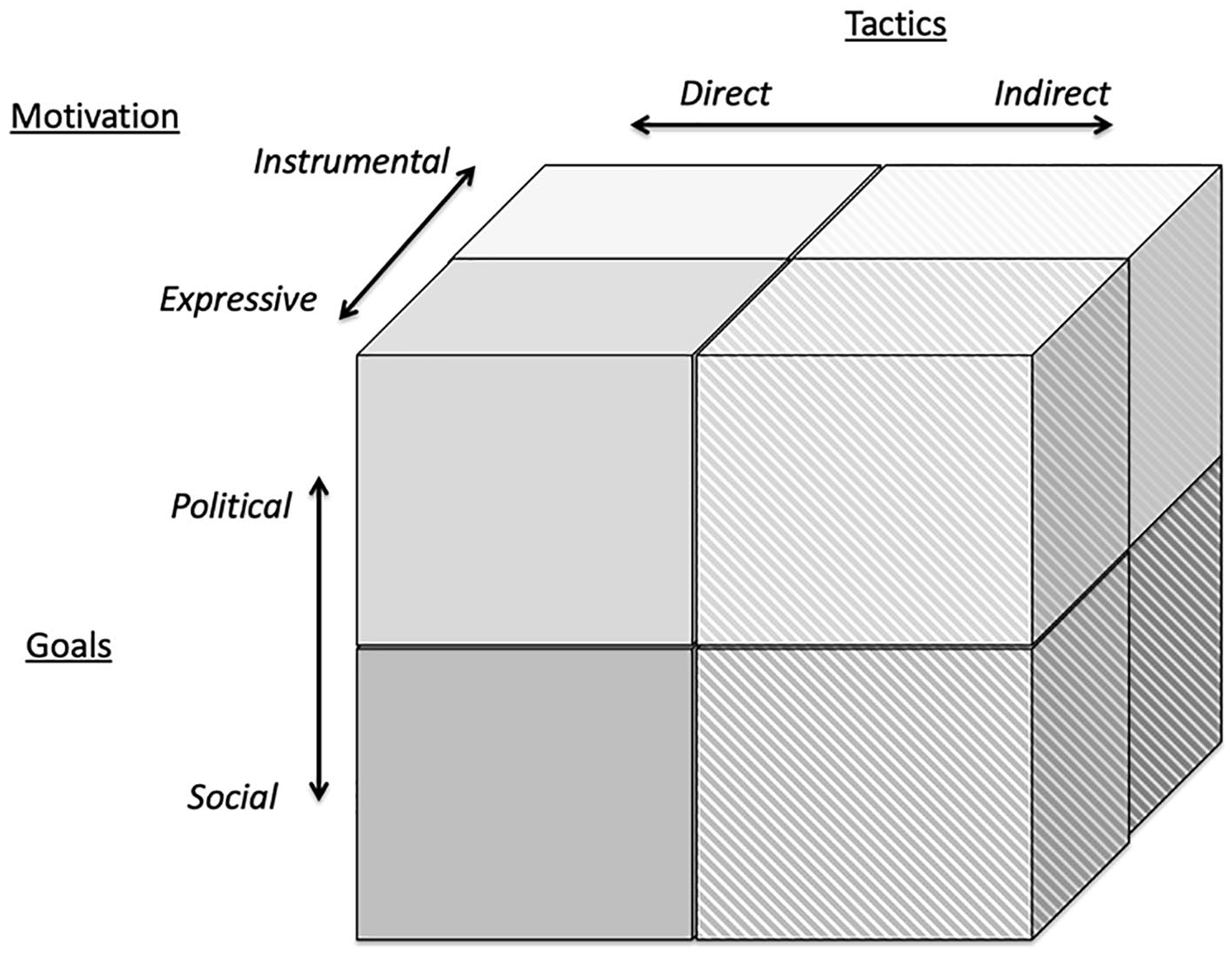
The advocacy cube.
The first dimension is the goal of the advocacy—with the poles represented by policy change, in which the state is the target, and sociocultural change, in which the general public (or a specific population) is the target. Targeting institutional elites outside the state (e.g., corporations, universities) may fall somewhere in the middle. The second dimension is tactics, which we see as falling on a continuum from those that are more direct in nature to those that are more indirect in nature. The third dimension is motivation, which addresses the differences in the beneficiaries of, and rationales for, advocacy claims, moving from fully instrumental to fully expressive.
A major contribution of this framework is that it maps and allows for comparisons of different kinds of organizational advocacy efforts (see Figure 2), and, by focusing on the activities of nonprofits, incorporates not just the advocacy of advocacy organizations but also of organizations that engage in advocacy as a secondary activity, such as service providers, foundations, and more. By mapping diverse advocacy activities onto this cube, we may be able to see more systemically the degree of difference among organizations and organizational types, as well as see what different types of organizations have in common when it comes to their advocacy.
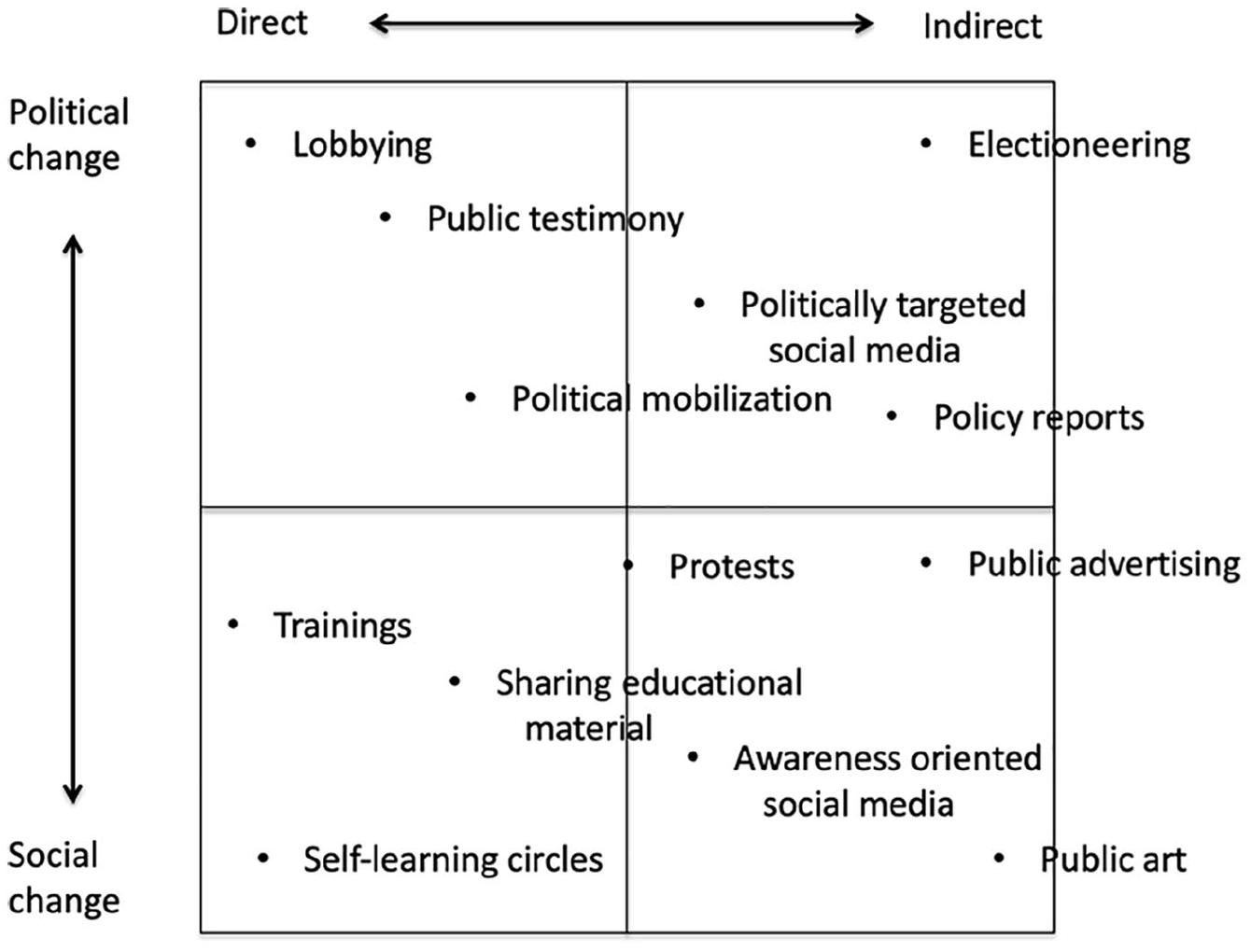
Mapping advocacy across the cube.
To demonstrate where certain tactics might fall on the cube, we offer several examples, seen in Figure 2. These same examples, undertaken in one instance may be more instrumental in nature while in another may be more expressive, so for ease of presentation, we show only the goal and tactical dimensions. They are mapped in an array to emphasize that these are not categorical “boxes” but rather dimensions where different activities fall in a range. “Participation in coalitions” is not listed as we see this as closer to an organizational form than an activity. All three dimensions of the cube are just as applicable to coalitions as they are to single organizations.
A second contribution of the cube is that it can flexibly capture the diversity of activities that constitute advocacy at various levels. Organizations can engage in several forms for advocacy simultaneously and/or over time, and each activity can be positioned along the three dimensions. When aggregated to the organizational level and tracked over time, the cube helps map an organizational portfolio of advocacy activities and its trajectory of change. For example, the cube links tactics and goals to capture an organization’s advocacy strategy (L. K. Nelson & King, 2020). This is important because if we focus only on tactics, to the exclusion of goals, or fail to include motivations in an overall assessment, we will fail to capture essential differences in how organizational differentiate themselves from one another, and what might lead to those different strategies (such as national context, policy field, or available resources). The framework, therefore, explicitly recognizes that organizational strategy—an interaction between goals and tactics—is dynamic and that a single nonprofit could be active in multiple locations in the cube and/or shift focus over time. Taking a longitudinal perspective, we could see an organization moving over time from the lower right quadrant, indicating a strategy that is primarily focused on influencing the larger public to the upper right quadrant, indicating that they have shifted their strategy toward influencing policymakers without deepening their relationship with them (a strategy shift that would be indicated by moving further left on the cube at the same time).
Another benefit is that mapping advocacy at the subsector (e.g., human services or environment) or the national level could reveal the contour of advocacy activities along the three axes, allowing for more meaningful comparative analyses. For instance, if we were to find that advocacy activities by international human rights groups typically fall into one quadrant and advocacy by domestically focused actors falls into another, that would be a revealing insight. Similarly, systematic differences in patterns of advocacy across national contexts would reveal much about the constitutive influences of national contexts. For instance, voter registration is often treated as an advocacy activity in the United States but is not even considered in countries where voting is mandatory (e.g., in Australia). Further, by seeing in what area of the cube a lot of advocacy is taking place, and by which organizations/actors, we can directly compare the advocacy landscape of different national contexts. For example, if we see a lot of advocacy in the lower left quadrant in authoritarian countries, as opposed to democratic ones, we can understand more about what might be effective or appropriate in those contexts. If we see advocacy in a single country moving from one quadrant to another, that might be revealing about changes in the political opportunity structure.
In sum, the cube helps capture the shape of the spread and its trajectory of change at various levels of contexts and can generate insights about the advocacy role of nonprofits and the broader contexts under examination.
What Is Not Advocacy: The Case of Civic Engagement
An additional contribution the framework makes is to establish boundaries for what is and what is not organizational advocacy, though the framework likely will not resolve or settle all existing debates. A potentially controversial aspect of the framework is that it excludes conventional civic engagement, which some may see as an advocacy tactic (Jenkins, 2006) but we argue is a different, albeit often closely related activity (Grønbjerg & Prakash, 2017; LeRoux, 2007; Suárez, 2009).
From a wide lens, promoting civic engagement means working “to make a difference in the civic life of our communities and developing the combination of knowledge, skills, values, and motivation to make that difference” (Ehrlich, 2000, p. vi). From a narrower lens, civic engagement entails “face-to-face participation in social groups by which individuals learn social trust, an important foundation for cooperation needed in a democracy” (McFarland, 2010, p. 50). Clarifying the relationship between civic engagement and advocacy is critical because many organizations inspire future activism by serving as “laboratories for citizenship” that teach and model democratic processes (Clemens, 2006; Han, 2016). Aligning with evidence that organizational advocacy is becoming more prevalent among nonprofit and voluntary organizations, “blended social action”—combining a civic engagement activity with a claim for change (e.g., advocacy)—is quite common (Sampson et al., 2005).
But even if civic engagement always served to reinforce democratic principles—and plenty of evidence indicates that it does not, nor is it always intended to do so—defining such activity as organizational advocacy is problematic (Dodge & Ospina, 2016; Lichterman & Eliasoph, 2014; Theiss-Morse & Hibbing, 2005). Our framework treats any effort to bring people together for a civic activity as organizational advocacy if it is done under a larger policy or social change goal. Many of the efforts by nonprofits to encourage volunteering and other forms of individual participation in community life are at best loosely coupled with the pursuit of policy reform or social change. If civic engagement is an advocacy tactic, then this would mean that we have to call many civically oriented nonprofit missions or activities (i.e., holding a food drive, celebrating Cinco de Mayo) advocacy, when that is almost certainly not the intention of organizers or participants.
In sum, civic engagement, as a form of social interaction, undergirds much—if not all—nonprofit activity. If civic participation means “public-spirited collective action that is not motivated by the desire to affect public policy” (Campbell, 2006, p. 16) then no such activities should be labeled as policy change advocacy. However, if such organizational activities do carry social and cultural change goals, then they are not merely civic engagement or participation—they should be labeled as advocacy.
Future Research Directions
This framework points to several openings for new lines of research. First, we have emphasized the shift in scholarly focus from advocacy organizations to organizational advocacy—that is, how advocacy activities are being carried out. In conceptualizing advocacy as an organizational activity and not as an organizational form, we raise questions for the burgeoning organizational literature on “hybrids” (Battilana & Lee, 2014; Beaton et al., 2020; Skelcher & Smith, 2015; Smith, 2010). The current trend in the literature to discuss nonprofits that participate in both service provision and advocacy as hybrid is emblematic of our point about the limitations of silos. We suggest that this focus on organizational forms or types can be misleading if it misinterprets advocacy as being primarily an organizational identity rather than organizational activity. We argue that service providers and other unconventional advocates are not becoming hybrid but engaging in advocacy prompted by mission-based, strategic, or opportunistic reasons. We should not assume that the playbook of organizational types is somehow fixed so that advocacy by nonadvocacy organizations needs to be explained as a departure, or something a new type of hybrid organization does. If the vast majority of nonprofits engage in advocacy at some point or another, is it reasonable to describe them all as hybrid? Our framework posits that research should focus on the degree to which organizations are flexible and adapting to changing institutional conditions.
Our framework also raises many new questions and offers a novel approach for studying persistent questions regarding advocacy goals and strategy. A new empirical question, for instance, would be to understand the factors that influence organizations to expand or contract their activities or shift their strategies to various positions in the cube over time. Another gap in the literature involves the social and cultural change goals of advocacy and the extent to which they align with policy change goals. Much of the research on social and cultural goals aligns with the study of social movements, yet many nonprofits pursue social and cultural change outside of movements, and even organizations that share a broad social movement goal (i.e., protect the environment) compete with one another to frame the aims of social and cultural change (Boscarino, 2015; Dodge, 2017). Novel research on the social and cultural goals of advocacy done by a wider variety of organizational advocates can make valuable contributions to the social movements literature by serving as a corrective to the current emphasis on coalitions and larger movements (Clemens & Minkoff, 2004). Greater attention to the social and cultural dimension of organizational advocacy could inform discussions about motivations as well—recognizing that competition can be as much a driver of activity as collaboration—and novel studies of this nature also could reveal how and when social and cultural goals become policy goals. The relationship between policy and social/cultural goals is another critical area for inquiry because the study of the policy process considers narratives, framing, and the social construction of beneficiaries, yet a gap exists in how these processes emerge and become relevant to policy processes (Dodge, 2017; Fyall, 2016; Weible & Carter, 2016).
Our framework also raises many questions about the relationship between tactics that are more direct and those that are more indirect. Just as policy change has tended to be the purview of interest group research and sociocultural change has been the domain of social movement research, research on direct and indirect tactics has followed the same pattern. As our framework indicates, however, the separation in focus does not reflect empirical reality. The vast majority of the social movement literature recognizes that “for movements to bring about institutionalized change, they need to enlist, co-opt, or influence elements of the professional class” (Zald, 2004, p. 30), meaning that policy entrepreneurship and direct tactics like lobbying eventually complement indirect tactics like protests. The literature on interest groups, moreover, has demonstrated that policy change is not limited to “iron triangles” and the associated imagery of elites formulating policy with limited citizen input, as many interest groups have generated pressure for policy reform by manufacturing citizen mobilization (Goldstein, 1999; Walker, 2014). How and when do social movements and interest groups come to adopt these different tactics?
Another promising direction for research would be to understand how different motivations affect strategy, or how strategies carried out by organizations working in coalition may be synergistic. More generally, by integrating motivation as a dimension, the framework draws attention to aspects of organizational advocacy that have received comparatively little attention, like the extent to which service-providing nonprofits change their advocacy motivations as they become more contract-dependent (Goss & Berry, 2018; Mosley, 2012). Although distinguishing instrumental and expressive motivations may not always be possible, especially given that the benefits of organizational advocacy frequently are material as well as symbolic (rather than one or the other), greater recognition of self-interest would serve as a balance to the prevailing focus on principled action in the national as well as in the international literature on NGOs (Cooley & Ron, 2002; Prakash & Gugerty, 2010).
Besides new research that considers the continuous aspects of each of the dimensions in our framework, the intersection of the three dimensions presents another promising area for scholarship on organizational advocacy. For example, the lack of research on direct and even indirect forms of social change advocacy is rather surprising, and how those tactics align with and differ from those used in policy change advocacy merits more attention (Davis et al., 2005; Van Dyke et al., 2004; Walker et al., 2008; Weber et al., 2009). Studies that investigate how (and under which conditions) organizational advocacy by nonprofit and voluntary organizations influences business practices is particularly uncommon, and research that compares such efforts to the efficacy of policy reform initiatives would be innovative and informative.
Finally, while treating advocacy as an activity that differs along several key dimensions can yield many important insights, an additional implication of our framework is that the data burden for novel advocacy research will be quite high. In the past, some studies of nonprofits in the United States have drawn primarily on the IRS Form 990, which provides information on lobbying expenditures (and some additional information for “h-electors” that choose not to be subject to the substantial expenditure test for lobbying) (Child & Grønbjerg, 2007; Nicholson-Crotty, 2007; Suárez & Hwang, 2008). Though studies of this nature continue to have value, we expect that significant advances in advocacy knowledge will come from research using more complex, nuanced data. In effect, the (sometimes) publicly available data that nonprofits report to their governments are just one—albeit critical—source for information. Developing a more holistic understanding of nonprofit advocacy and how it is evolving likely will require detailed, longitudinal organizational surveys, observations, and case studies that address the diversity of nonprofit strategies and motivations.
Conclusion
Organizations in the nonprofit and voluntary sector are critical players in the pursuit, achievement, and prevention of institutional change. Whether they act on their own, as formal or informal organizations, or in collaboration with others, perhaps as an interest group coalition or as part of a social movement, many organizations in the sector have integrated advocacy into their repertoire. The growing recognition of the prevalence of organizational advocacy, and the wide variety of organizations involved in it, undermine the distinction between “advocacy organizations” and other types of organizations in the nonprofit and voluntary sector.
In recognition of this ongoing trend, we have developed a framework that conceptualizes advocacy as an organizational activity that can be applied to diverse countries as well as to transnational or international contexts—rather than emphasizing “advocacy organizations” and differences in organizational form. The diversity of advocacy definitions, goals, and research domains has severely limited the commensurability of findings across studies and thus scholars’ ability to generalize about “what works.” We argue here that greater precision in the identification of goals, tactics, and motivations and how each is related to the others can lead to improvements in both research and practice. A key implication is that while advocacy may be defined broadly, we need to have a clearer understanding about the relationship between different approaches to advocacy.
Footnotes
Acknowledgements
The authors thank Nicole Marwell, Heather MacIndoe, Enrico Bellazzecca, and Michael Roy for their helpful comments on earlier drafts of this paper, and Chao Guo for his feedback throughout the publication process.
Declaration of Conflicting Interests
The author(s) declared no potential conflicts of interest with respect to the research, authorship, and/or publication of this article.
Funding
The author(s) disclosed receipt of the following financial support for the research, authorship, and/or publication of this article: H.H. acknowledges that his work on this paper was partially supported by funds from the Ministry of Education of the Republic of Korea and the National Research Foundation of Korea (NRF-2018S1A5A2A03030694).
