



Abstract
This article examines the uptake of social justice and climate change as focal issues among the largest U.S. environmental nonprofits. We use 2016 Internal Revenue Service (IRS) filings to identify 5,413 large environmental nonprofits of which 8% attend to issues of climate and 10% to issues of social justice. Larger organizations are more likely to attend to issues of climate change and social justice, as are groups founded more recently. Latent Dirichlet allocation (LDA) topic modeling of organizational mission statements and descriptions of major activities is used to assign groups to six distinct issue categories. Results highlight the divide between wildlife groups that are decidedly unlikely to attend to issues of either climate or justice, and the rest of the national environmental movement. Energy and natural resource groups, while strongly vested in climate issues, rarely attend to social justice. These findings have clear implications for climate and justice advocates seeking change in the environmental advocacy sector.
This article assesses an organizing question of this special issue and associated symposium: To what extent are environmental organizations focused on climate change? (Gazley & Prakash, 2021). In addressing this question, we broadly define environmental organizations as any registered nonprofit for whom environment protection or nature conservation is a primary organization purpose. We also extend the question, asking the extent to which environmental nonprofits also incorporate a central demand of today’s climate justice movement: that racial justice and social equity are integrally linked with the human response to a changing climate.
This research contributes to long-standing conversations about the extent to which environmental and conservation advocacy has a race and class problem. A large body of research has demonstrated that environmental justice (EJ) movements have been nurtured within communities of color and associated racial and ethnic rights and native American sovereignty movements, not the mainstream environmental movement (e.g., Bullard, 2008; Estes, 2019; Stretesky et al., 2011; Taylor, 1999, 2000). Indeed, national environmental nonprofits are often seen as racist organizations and obstacles to progress on issues of social equity (Sandler & Pezzullo, 2007). We make three contributions to the literature. First, we assess whether large environmental nonprofits in the United States attend to issues of climate change and social justice, singularly and in common. Second, we determine characteristics of individual organizations, and the issue niches in which they compete, which are associated with a focus on issues of climate and social justice. Third, we make a methodological contribution in highlighting the need for researchers to give great scrutiny in establishing criterion validity in the use of nonprofit National Taxonomy of Exempt Entities (NTEE) classification codes.
Data from Internal Revenue Service (IRS) 990 filings are used to obtain a sample of 5,413 large environmental nonprofits (spanning 78 distinct NTEE codes), including information on organizational age, size, structure, and financing. Of the environmental organizations in our sample, 8% attend to issues of climate and 10% to issues of social justice. Larger organizations are more likely to indicate a focus on both climate and justice issues, as are younger groups. Probabilistic topic modeling is applied to mission statements and descriptions of primary organizational activities to assign environmental nonprofits to one of six distinct issue niches, across which there are significant differences in uptake of climate and justice issues. Nonprofits focused on economic development, and to a lesser extent groups whose identity spans multiple categories, are particularly likely to do so. Wildlife groups are particularly unlikely to attend to either climate or EJ. While highly attuned to climate issues in their missions and top activities, Energy and Natural Resources groups are very unlikely to incorporate tenants of distributional justice.
Climate Change, Social Justice, and Environmental Nonprofits
For decades, the United Nations Intergovernmental Panel on Climate Change (IPCC) has warned of an impending climate crisis (IPCC, 2018). Climate change, defined as long-term shifts in global temperatures and regional weather patterns, presents a number of concrete hazards (e.g., severe storms, wildfires, and rising sea levels) that pose serious threats to global and local communities (IPCC, 2021). Nonprofit environmental organizations are widely seen as a key component responding to this unfolding climate crisis (Dolšak & Prakash, 2021; Pellow & Brulle, 2005). Nonprofits directly engage in climate mitigation and adaptation services (Kagan & Dodge, 2021). They promote attention to issues of both climate and social justice in government policy creation, implementation, and enforcement (if often to stilted effect; see Harrison, 2019). They pressure corporate actors by attempting to limit emissions at individual facilities (Grant & Vasi, 2017), promote carbon divestment (Ayling & Gunningham, 2017), and work collaboratively with private industry to build new food systems (Weber et al., 2008) and markets for alternative energy (Sine & Lee, 2009).
The extent to which environmental nonprofits are focused on climate change remains an open question, however, as is the extent to which they center associated issues of EJ. Taking justice into account means considering a broad range of racial, gender, and class-based inequalities in the distribution of environmental harms and amenities (Bullard, 2008; Pellow, 2017). Climate justice has intellectual roots in EJ and highlights how policy and market (in)action around issues of climate invariably distribute environmental and economic costs and benefits, often in ways that reproduce existing economic, political, and social inequalities (Dolšak & Prakash, 2021; Pellow & Brulle, 2005). In both the United States and cross-nationally, the costs of climate change disproportionately fall on marginalized populations.
A long-standing critique of mainstream environmental nonprofits has been their inattentiveness or even hostility to issues of racial equity and social justice, as more concerned with wildlife than human lives (Bullard, 2008; Edwards, 1995; Taylor, 2000). Assessments of racial progress within environmental nonprofits have focused on diversity in leadership and employee demographics. In an examination of 1,053 mainstream environmental organizations, Taylor (1999) found 83% of organizational presidents were male and membership was dominated by wealthy, educated White people. By contrast, among 331 EJ organizations, the membership was primarily people of color and low-income people, with a nearly even split between male and female leadership. In a 2014 report (Taylor, 2014), she finds that national environmental movement organizations (EMOs) made substantial strides in terms of the gender diversity of their workforce, largely due to increased participation of White women.
We seek to extend the scope of analysis beyond hiring practices to examine organizational policy agendas and missions. Systematic enumerations of state-level environmental groups conducted in the early 2000s found that organizations focused on racial justice issues were rare (Andrews & Edwards, 2005) or completely absent (Kempton et al., 2001). In a sample of national environmental social movement organizations, Johnson & Frickel (2011) found that less than 5% of them focused on EJ. We update this work, assessing to what extent issues of climate and justice are focal concerns of large environmental nonprofits in the United States.
There is good reason to think that the promulgation of climate and social justice issues may be mutually reinforcing. After the failed 2009 Copenhagen climate, the framing of climate change was overtaken by demands for climate justice (Della Porta & Parks, 2014), which has become a rallying point for a broad range of organizing where traditionally marginalized communities occupy central roles (Agyeman et al., 2016; Estes, 2019; Pellow & Brulle, 2005; Young, 2015). Nonprofits focused on climate and justice recognize the threats of both a changing climate and the inequities within its causes and possible solutions. Climate-justice–focused organizations promote climate policies that also address social inequities, such as affordable housing, green jobs, and renewable energy projects in traditionally disadvantaged communities, and access to public transportation (Mendez, 2020):
Organization Issue Agendas
Environmental nonprofits may be incentivized to graft a focus on climate onto existing organizational agendas both because of the urgency of the problem and because governments, corporations, and foundations have shifted environmental funding toward issues of climate change and EJ (Wendelbo, 2018). Growing resource pools provide incentives for existing organizations to adopt and/or reframe their work in terms of its relations to climate and social justice. Susan Buckingham (2017) describes this process in recalling how the Women’s Environmental Network (WEN) came to embrace climate change as a central organizing issue: Campaigning to address climate change in ways that empowered and benefited women would be a departure in WEN’s style and scope and was, in part, occasioned by the changes in a funding environment in which climate change-related activity was being prioritized. Eventually, WEN trustees and employees agreed, with a degree of reluctance, to reframe its work to take advantage of these changes. (p. 384)
Organizations that change core features, such as the issues they provide advocacy and services for, face significant risks in the form of potential disruptions to organizational routine and threats to organizational identity (Hannan & Freeman, 1984). Crafting a recognizable organizational identity that fits with established and recognizable categories for relevant audiences confers legitimacy that is critical to organizational success (Meyer & Rowan, 1977). Christopher Bosso (2005) describes how a legacy wildlife conservation group founded in 1901 to protect waterbirds (the National Audubon Society) was, by the late 1980s, pursuing a policy agenda that included not just birds and their habitats but also “pesticides, air pollution, population control, and international wildlife issues” (pp. 77–78). This was followed by discontent among, especially older, members who accused the leadership of neglecting the organization’s core mission and a severe financial slump in the early 1990s. A reemphasis of the organization’s categorical fit, as narrowly focused on conserving birds and their habitats, helped stabilize the National Audubon Society. Today, while it “continues to pursue a broad policy agenda within the boundaries of its strategic plan. . . [i]t has defined its position within its sector as much by what it will not do as anything else” (Bosso 2005, pp. 77–78).
Within a crowded organizational field, such as the environmental nonprofit sector, organizations engaging in intense competition for resources are generally rewarded for developing one of two strategies. Generalists, what Shaiko (1991) calls “full-service” environmental organizations (e.g., the Natural Resources Defense Council), span across the broad spectrum of prominent environmental issues. “Organizations with generalist forms face weaker constraints on the activities they can legitimately pursue. . . the codes about the range of activities that generalists can and should pursue are less constraining” (Hsu et al., 2009; see also Carroll, 1985 on this point).
A second organizational strategy, especially prominent in a crowded field such as the environmental nonprofit sector, is the pursuit of a narrow niche strategy (Aldrich, 2008; Carroll, 1985). Bosso (2005, p. 63) finds that roughly 20% of “environment and conservation” organizations are focused on a single wildlife species. A key aspect of a narrow niche-width strategy is maintaining a strong and easily identifiable organizational identity that confers legitimacy by fitting with relevant audiences’ (e.g., current, and potential members and funders) expectations and facilitating a clear understanding of “what” an organization is. Organizations that span unusual categories or adopt unusual combinations of features face significant obstacles to survival. In an analysis of U.S. environmental organizations, for example, Olzak & Johnson (2019) finds that a majority of organizations observed from 1970 to 2006 focus on a single issue (most often wildlife) and that organizations spanning multiple and distinct issue categories are significantly more likely to disband than are specialists. We expect significant variation in attention to climate and justice issues across relevant categories of environmental nonprofits.
The most basic, widely studied, and long-standing demarcation within the environmental movement is between wildlife/wildlands conservation organizations and a population of pollution and human health–focused groups that first emerged in the late 1960s and 1970s (Johnson & Frickel, 2011; Gottlieb, 2005; Mertig et al., 2002). While the population of pollution and human health–focused groups grew rapidly in number and size through the 1980s, coming to dominate the public face of the movement, organizations concerned primarily with resource and wildlife conservation (e.g., Ducks Unlimited, Boone and Crocket Club, and Trout Unlimited) remain both more numerous (Johnson & Frickel, 2011) and control larger resources on average (Johnson, 2008; Jenkins et al., 2017). One question we ask is the extent to which wildlife groups have been part of, or stood apart from, the larger environmental movements increasing focus on issues of climate change and social justice, given the typically more conservative political leanings of the conservation segment of the movement and the growing political divide in attitudes about the environment generally and climate change in particular
We also attend to an organizational feature that is often overlooked in social movements research but has received much attention in nonprofits literatures: the extent to which a registered nonprofit engages in service provision. The bulk of this activity is done in collaboration with government, relying heavily on government funding for operation (Gazley, 2008; Gazley & Brudney, 2007; Smith, 1993). Collaboration between government and nonprofits has become increasingly common, with nonprofits variously seen as supplementing or replacing government activities. Nonprofits that rely heavily on government funding are not generally incentivized toward pursuing political change. Mosley (2012), for example, finds that homeless service providers reliant on government funding are more likely to focus on brokerage activities designed to secure the continuation of resources and are relatively less likely to advocate for policy change or adopt controversial tactics or issue stances. A long tradition of research in social movements literature has documented the moderating effects and “channeling” of activities that a dependence on elite resources tends to have on movement organizations (Chewinski, Corrigall–Brown, 2020; INCITE! Women of Color Against Violence, 2007; Jenkins & Eckert, 1986).
Data Method
Data Sources and Sample
To assemble a sample of environmental nonprofit organizations, we turned to 2016 IRS 990 filings information available through the National Center for Charitable Statistics (NCCS) Core Financial Files (Urban Institute, 2016) and Open990.org (2016). 1 At the time of writing, this is the most recent year for which cleaned data are available from the Urban Institute. Both 501(c)(3) Public Charities and “other” 501(c) organizations are selected for analysis because relevant organizations are located across these classifications. The sample consists primarily of 501(c)(3) organizations (90.15%).
The NCCS Core files contain cleaned information on a wide variety of financial variables. The Open990 research project includes text fields, listing organizational missions and primary activities that are not available through the NCCS, but data are further restricted to nonprofits filing electronically. These groups are larger on average, with nearly all (98.2%) reporting more than US$50,000 in annual gross receipts. 2 Neither data set includes the large number of grassroots organizations that are presumably more likely to attend to issues of social justice and which may not even be formally registered with the IRS (Taylor, 1999).
The IRS assigns filing organizations an NTEE code that is roughly parallel to the North American Industry Classification System (NAICS). This nonprofit categorization system includes an “environment” code that is regularly used unquestioningly by analysts examining the sector (e.g., Brulle, 2000). Here, NTEE codes are used to guide the identification of environmental nonprofits, but we take the concept of criterion validity seriously in bounding the organizational population. Building on Singleton and Straits’ (2010) classic example that an operational definition of a feminist group should accurately categorize well-known feminist groups, such as the National Organization for Women, it was readily apparent that many prominent national environmental nonprofits were listed otherwise. Trout Unlimited, for example, is listed under “Recreation & Sports: fishing and hunting” and 350.org (a leading national anti-climate change organization) is classified as “Education; Special Interest.”
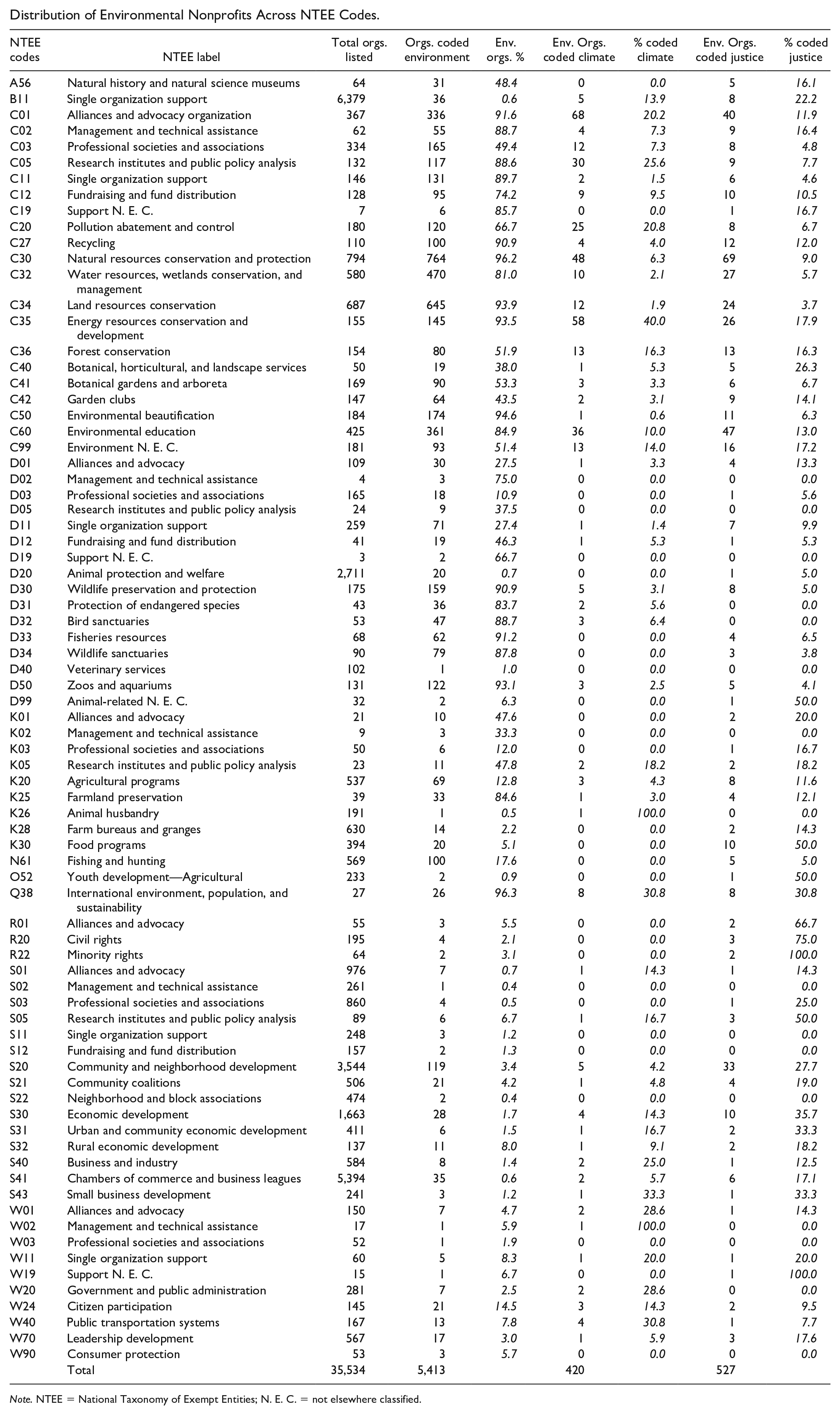
Aided by a series of keyword searches, the first author read through every organizational mission statement across 73 discreet NTEE codes to identify relevant organizations. We defined environmental nonprofits broadly, including strict conservationist and environmental protection organizations as well as garden clubs, natural history museums, zoos, and aquariums whose mission statements include reference to things such as resource and wildlife conservation; hunting clubs that include a focus on conservation efforts; civil rights and community coalitions attentive to environmental protection and/or conservation; nonprofits focused on sustainability issues within the food system or farmland preservation; a small number of trade and professional organizations that go beyond member services in their mission statements to highlight environmental improvement goals (e.g., the Organic Trade Association; U.S. Green Building Council); as well as a number of nonprofit organizations focused explicitly on working with producers to change environmental practices or establish green markets (e.g., Climate Action Reserve, Green Star). We did not include labor associations, memorial gardens, outdoor, and experiential education groups such as Outward Bound whose mission statements do not include a conservation or environmental protection focus, or business development associations and chambers of commerce (regardless of their claims to promoting environmental conservation or protection in a community). In total, we found that a little more than 19% of organizations listed under relevant “environmental protection” NTEE codes were misclassified, including a large number of trade and professional organizations (e.g., Oregon Forest Industries Council, Association of Energy Engineers), community land and housing trusts focused on providing affordable housing, for example, to the older adults; and assorted citizens organizations that are simply focused on other issues (e.g., Benevolent and Protective Order of the Elks, United Abolitionists). See Appendix A for a detailed list of the NTEE codes used to identify environmental nonprofits.
Dependent Variable
Our dependent variables are dichotomous measures of whether environmental nonprofits identify climate change and social justice as areas of focus. We applied modified sentiment analysis techniques to place environmental nonprofits in discreet categorical niches, using information from organizational mission statements and descriptions of primary activities. Mission statements are central to communicating organizational identity and legitimacy (Koch et al., 2015; Minkoff & Powell, 2006; Paxton et al., 2020, p. 591). Internal and external audiences alike encounter mission statements across a wide variety of formats. Pope et al. (2018) found that 91% of nonprofits displayed mission statements on their home page. Mission statements are reproduced throughout donation solicitations, newsletters, brochures, annual reports, posters, and even business cards (Fairhurst et al., 1997; Paxton et al., 2020). Most donors have encountered organizational mission statements prior to donating (Balsam & Harris, 2013) and the emotional sentiment of organizational mission statements is tied to the incidence of donations and volunteering (Paxton et al., 2020). Nonprofit organizations develop and adapt mission statements in a competitive process that indicates categorical fit and the narrowness, or breadth, of organizational identity.
To determine the extent to which environmental nonprofits attend to issues of climate and justice, we first assembled exhaustive lexicons using lists of words and word stems developed by the U.S. EPA (2021a, 2021b), Northeastern University’s Initiative for Energy Justice (Baker et al., 2019), the U.S. Global Change Research Program (2015), and previous text analysis literature (Boussalis & Coan, 2016; Willis, 2017; see Appendix B). Before adding a term to the lexicons, we manually searched to ensure that it existed in our data set and did not trigger false positives. Climate and justice lexicons were used to find single and double word matches across organization’s name, mission statement, and descriptions of top-two funded activities over the past year. 3 If matches returned, climate or justice were considered an area of interest for the organization.
A concern in using text from 990 filings is of a potential mismatch between these formal documents and what organizations actually do. Are there a large number of environmental nonprofits focused on climate change or social justice, but which do not indicate this in their 990 mission statements or descriptions of primary organizational activities? The risk of such false negatives appears reasonable. First, the amount of information provided in mission and organizational aims text fields is not trivial, as once was the case. 4
Second, as a check on the validity of our data, we reviewed the websites of 100 organizations that we did not identify as focused on climate change. Five out of these 100 organizations clearly indicate on their websites in September 2021 that they do substantially focus on climate. However, data analyzed here are from IRS forms filed in 2016. To verify the climate orientation of these organizations for the 2016 tax period, we obtained image “captures” of these organizational websites from 2015, available through Internet Archive’s digital archive of the world wide web (i.e., the Wayback Machine; Internet Archive, 2014). These image captures indicate that, in all five cases, the organizational refocusing around climate change occurred after analyses conducted here. The incidence of these cases suggests that the uptick of climate changes issues, at least, has been significant since 2016.
Independent Measures
We control for several theoretically relevant organizational characteristics, including organizational age, size, geographical scope, and lobbying activity. Organizational size is measured as total functional expenses (Calabrese & Ely, 2017) and total number of paid staff. 5 Geographic scope of operations is a central element in careful classifications of nonprofits (McCarthy, 2005), but not readily apparent in nonprofit filings. To determine geographic scope, we read through each entry in our sample and code its focus as local, state, regional, or national, using a combination of organizational names and mission statements. 6 A large majority of organizations indicate geographic scope in their name (e.g., “Klamath Lake Land Trust,” “Kansas Land Trust”) and most whose names are not indicative have explicit mission statements that make clear their intent to operate (e.g., for the benefit of a specific community or geographic region, or at the national level). When an organization’s name or mission description did not explicitly indicate a local, state, or regional focus, the organization was typically assumed to be national in scope. 7 Finally, we considered whether an organization reports either engaging in lobbying activity or paying any fees for lobbying services. Public advocacy and the encouragement of citizen involvement is both a fundamental role of nonprofits and controversial because it necessarily embroils nonprofits in activities that are inherently political. Organizations engaged in lobbying activities are, we expect, more likely to wade into overtly political issues such as climate change and EJ.
We draw from the rich financial data available in the NCCS to measure the extent to which a nonprofit provides public services that rely on government contracts or the sales of goods and services for support. This measure of “service provision income” (see Foster & Bradach, 2005; Segal & Weisbrod, 2002) accounts for government contracts, revenue derived from taxes and services, or facilities furnished by the government, as well as things such as school tuition, royalty holdings, and museum or zoo admissions. The sum of these revenues was divided by total revenue to estimate the extent to which organizations in our sample are dependent on government funding.
We performed Python-based topic modeling using the Latent Dirichlet allocation (LDA) algorithm to generate unique issue spaces for the organizations in our sample. The LDA algorithm is one of the most common algorithms used in topic modeling as it is approachable and interpretable (Silge & Robinson, 2017). The LDA algorithm treats each organization’s text statement as a mixture of topics, with each topic containing a mixture of words that co-occur (Silge & Robinson, 2017). The LDA assigns each word a probabilistic score for the topic it most likely belongs to, and then divides each organization’s statement into a proportion of topics based on word probabilities within each topic (Silge & Robinson, 2017; Tang, 2019). We deleted “stop words” to remove noise from the text data and ensure clear distinctions between topics.
We selected a five-topic model because it produced the most distinct, interpretable issue spaces for our sample. Labels were assigned to topics using the most salient words identified by the model (see Appendix C). Organizations whose language identified with less than 60% of all topics were placed in the “issue spanner” category. Descriptive information on all our variables is shown in Table 1.
Descriptive Statistics (N = 5,413).
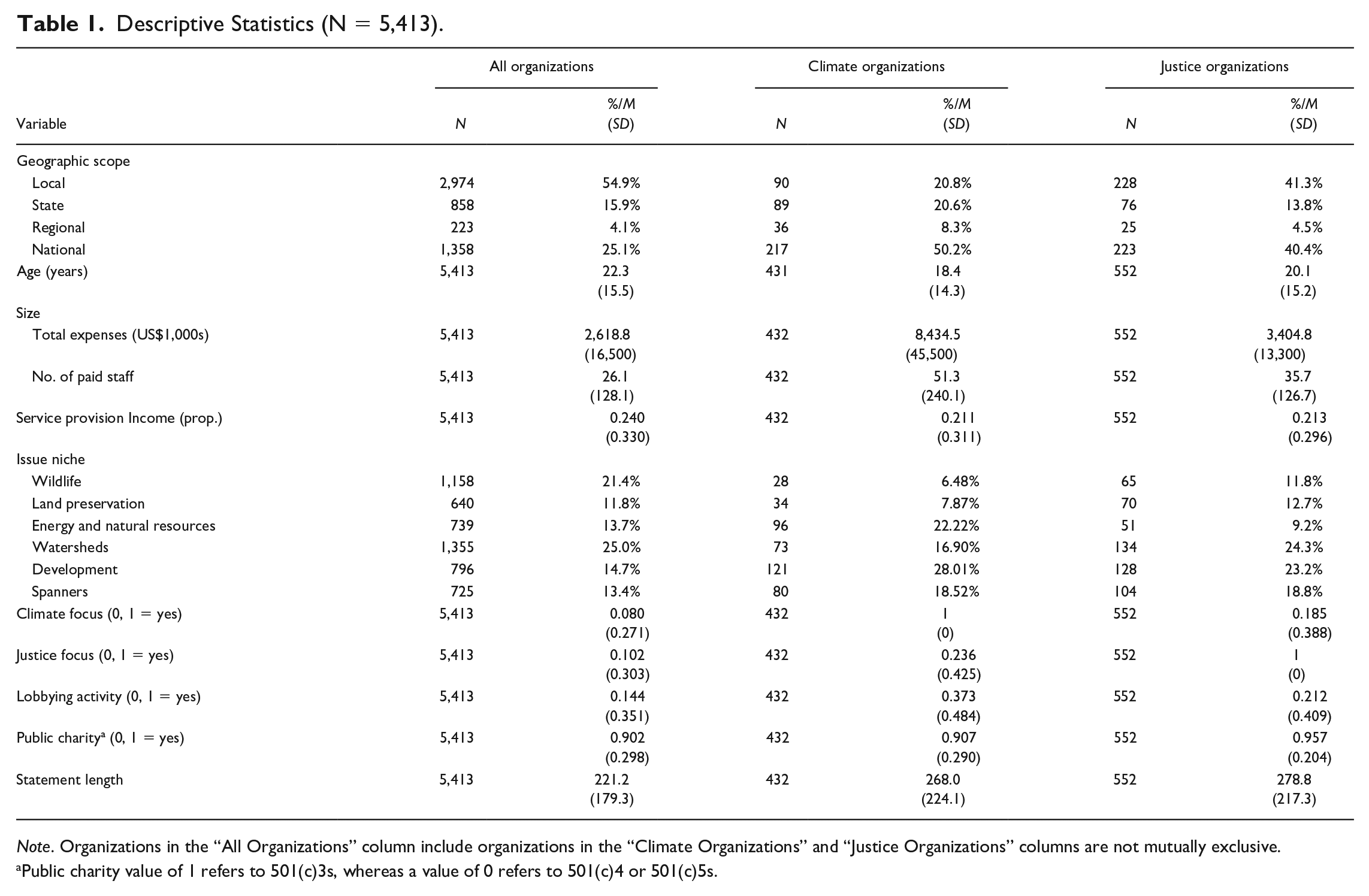
Note. Organizations in the “All Organizations” column include organizations in the “Climate Organizations” and “Justice Organizations” columns are not mutually exclusive.
Public charity value of 1 refers to 501(c)3s, whereas a value of 0 refers to 501(c)4 or 501(c)5s.
Results
Our first goal is to assess the extent to which large environmental nonprofits in the United States attend to issues of climate change and social justice, singularly and in common. Our second goal is to identify characteristics of environmental nonprofits that are associated with attention to these issues. Analysis begins with descriptive depictions of our prime measures of interest before moving to models regressing characteristics of organizations on the likelihood that a group reports a climate or justice focus.
We do not have data on the population of environmental nonprofits over time, including critically on the entry and exit of organizations from that population, and thus are unable to perform any type of proper organizational ecology (Hannan & Freeman, 1984) or new-institutionalist (Powell & DiMaggio, 1991) analysis. Information on founding dates can still, however, be informative for understanding change over time. Figure 1 shows the number of environmental nonprofits in our 2016 sample that indicate a focus on climate or justice, by organizational founding year, using a 3-year moving average to suppress yearly fluctuations in the data, and make over-time trends more apparent. About 24% of organizations in our sample are 10 years or younger, but 38% of groups focused on climate and 29% of groups focused on justice issues. It is safe to assume that the vast majority of these new entrants to the environmental nonprofit field have adopted climate and/or justice issues from the start. About 33% of organizations in our sample were established prior to or in 1990, the year of both the first IPCC-issued climate report and when EJ organizations posted an influential open letter calling out hiring practices of mainline environmental organizations (Gottlieb, 2005, pp. 260–261). Only 25% of all climate organizations and 27% of justice-focused organizations are founded prior to 1990. These groups have, presumably, largely grafted issues of climate and/or justice onto existing organizational foci. The 1990 to 2004 time period includes 43% of organizations in our sample, with 37% of those attending to climate and 43% of those attending to justice. Although we are unable to estimate the precise contribution of each mechanism of change, both population replacement (nonprofit births and deaths) and organizational change are clearly relevant to explaining the disjointed way in which environmental nonprofits have attended to issues of climate-justice.

Environment Organizations by Founding Year and by Focus (N = 5,413)
We next examine the relationship between the issue space an organization occupies and the presence of climate or justice language among our sample organizations, before moving to multivariate analyses. In Figure 2, topic modeling and t-distributed stochastic neighbor embedding (t-SNE) clustering (see Hinton & van der Maaten, 2008) are used to plot each organization within a two-dimensional issue space. Organizations are clustered based on their relation to others with similar issue spaces, and those that attend to climate change are darker (those that do not attend to climate issues are faded). Land preservation organizations are noticeably segmented, which may indicate issue space subdivisions for further exploration.
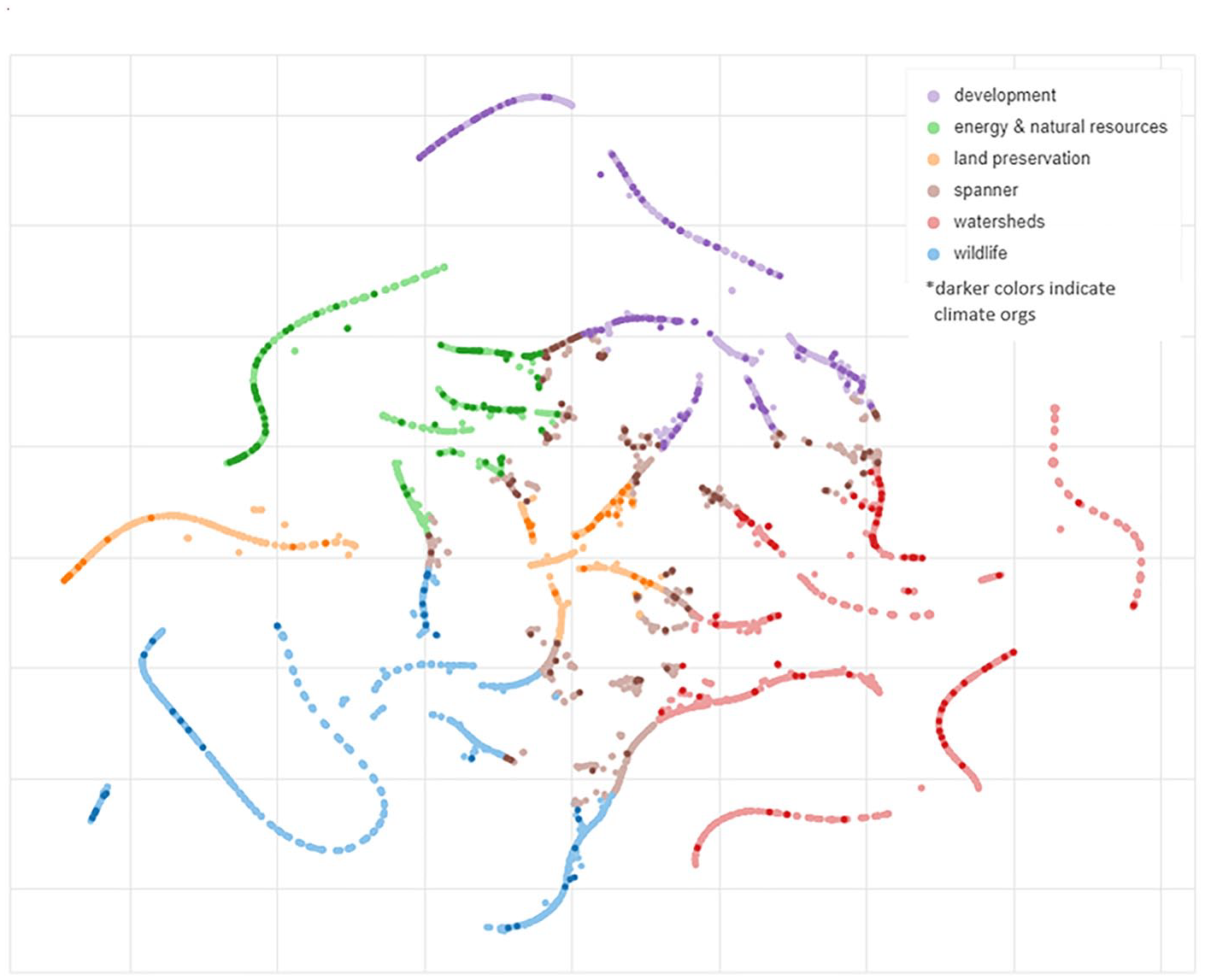
t-SNE Clustering of Organizations by Issue Space (N = 5,413)
Organizations within the economic development issue space are the most likely to focus on climate (15.2%), followed by those in the energy and natural resources (13%) and issue spanner (11%) categories. Wildlife groups are the least likely to identify climate as a focal concern (2.4%). Environmental nonprofits in the economic development (16.1%) and issue spanner (14.3%) categories are also the most likely to attend to issues of social justice. Energy and natural resources (6.9%) and, again, wildlife (5.6%) groups are the least likely.
Next, we use logistic regression, results of which are displayed in Table 2 as odds ratios, to predict an organization’s likelihood of focusing on climate (Models 1–3) and justice (Model 4). Ratios over 1 indicate an increased association and below 1 a decrease. The baseline Model 1 shows that local organizations are 76% less likely than national organizations, and state organizations are 23% less likely than national organizations, to focus on climate change. Each additional year of organizational age is associated with a 0.4% decreased likelihood of climate focus. Organizational size (expenses) is positively associated with a focus on climate change, and the share of an organization’s income that comes from service provision negatively so.
Logistic Regression Predicting Environmental Nonprofits Focus on Climate and Justice.

p < .1. **p < .05. ***p < .01.
Model 2 adds a variable indicating whether an organization has a justice focus. In support of H1, environmental nonprofits attending to social justice issues are 41.5% more likely to also attend to climate change. What regression models do not show, however, is that only a very small number of large environmental nonprofits (N = 102) attend to both climate and justice. In models (not shown, but available upon request) where attention to issues of both climate and justice is the dependent variable, results are similar but with the notable exception that “climate-justice” groups are even less likely to be present among groups in the wildlife or energy and natural resources niches. Only one “climate-justice” organization is located within the wildlife category. This organization, named GreenGoat, is focused on salvaging materials from residential construction projects and is misclassified in LDA topic modeling. Nearly a quarter of “climate-justice” organizations are part of the issue spanner category and nearly one third are in the economic development category. Climate-justice groups are also larger and more likely to be nationally focused (60% are) than groups focused on issues of climate or justice singularly.
Model 3, our full model, introduces organizational issue space as a predictor of attention to climate change. Model 4 is also a full model, but predicts environmental nonprofit’s likelihood of having a justice focus. While pseudo R2s for logistic regression should be interpreted with great caution, the results indicate that the predictive power of our model is considerably lower for the justice issues compared with climate. Still, most predictors (outside of issue niche) maintain significance and operate in similar ways.
Our second hypothesis is that environmental nonprofits pursuing a generalist strategy (category “spanners” in our coding parlance, the reference category in Table 3) will be more likely to attend to climate and justice issues than more narrowly focused organizations. This broad assertion is not supported by the data. Economic development and energy and natural resources groups are the most likely categories to focus on climate change, followed by category spanners (Model 3). Economic development groups, but not category spanners, are particularly likely to incorporate issues of justice (Model 4).
Means for 2016 Climate and Justice Focus, by Issue Space (N = 5,413).
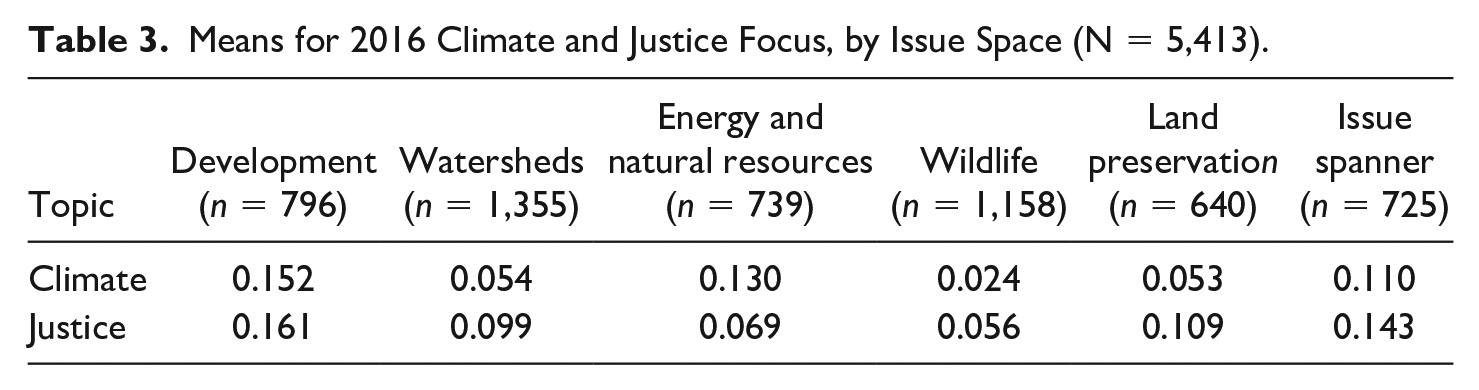
Our third hypothesis, that wildlife groups are particularly unlikely to attend to issues of climate or justice, receives strong support. The wildlife category is the least likely of any issue-space to contain organizations that focus on either climate change or social justice. Importantly, however, there is a stark divergence in how social justice is incorporated across these categories. Although we did not make an explicit hypothesis about this, energy and natural resource groups are remarkable for how unlikely they are to attend to issues of social justice, being roughly on a par with wildlife groups in how unlikely they are to do so. They are about half as likely to attend to issues of social justice as category spanners and 43% as likely as economic development groups. Finally, H4 also receives support. Environmental nonprofits that are significantly reliant on service provision income are less likely to attend to both issues of climate change (Model 3) and social justice (Model 4).
Discussion
Our key finding is in the patterned way that issues of climate and justice are distributed across distinct niches in the environmental nonprofit sector. Wildlife groups are the least likely category to attend to either of these issues. Many wildlife populations (e.g., polar bears, bees, and sea turtles) are at distinct risk due to a changing climate. Others offer potentially important mitigation strategies to a changing climate. In his book, Eager, for instance, Ben Goldfarb (2018) shows how reintroducing beavers in ecological landscapes can help fight drought, wildfires, and other negative impacts of climate change. There are objective ties, but the underinvestment in both climate change and social justice among wildlife groups is so notable that one of our reviewers asked, “Are they really even part of the environmental movement any longer?” Wildlife and natural resources groups helped launch the 1970s Golden Era of federal environmental policy development (Johnson, 2008; Gottlieb, 2005), but today appear distinct both in our work and in various network-based modeling strategies (see also Hoffman & Bertels, 2009).
Energy and natural resources groups, economic development groups, and category spanners are most likely to attend to climate change. Economic development groups and category spanners are also more likely to attend to issues of social justice, and to climate-justice in combination (more than half of the distinctly “climate-justice” focused groups are in these two niches). Energy and natural resources groups, although attentive to climate change, are decidedly unlikely to mention issues of social justice in mission statements or yearly aims. In this, we see echoes of what Basseches et al. (2021) conclude were two different climate movements pushing for climate policy in California; what they refer to as “justice-oriented” and “market-oriented” coalitions. The market-oriented climate coalition, what Carroll et al. (2020) identify as a “clean growth” project in Canada, represents an interlocking web of corporate, state, and civil society actors who work “to mobilize popular support and technical expertise on the climate issue in ways that. . . benefit dominant economic and business interests, and sideline the views of critical, transformative social-justice sectors of [the] environmental community” (p. 109). It is present, we think, primarily in our “energy” category that is highly attentive to the issue of climate change, but largely eschews a focus on social justice. Development and issue spanner categories represent the “justice-oriented” climate coalition and collectively account for 28% of environmental nonprofits in our overall sample, but contain 53% of groups that simultaneously indicate climate and justice as areas of concern.
This research also has methodological implications for the use of IRS data on nonprofit organizations. Specifically, we document the high degree of misclassification within NTEE codes that serve as the basis for most nonprofit analyses. We found that just more than 19% of organizations listed under relevant “environmental protection” NTEE codes were misclassified, and that only 74.5% of groups we identify as environmental nonprofits are classified as such in the NTEE coding scheme. Prior research regularly relies, with little to no scrutiny, upon NTEE codes to identify relevant populations of organizations. For the case of environmental nonprofits, we identify a source of bias (or at least noise) in the data on which that research is based. Future research should, we suggest, conduct robust checks for criterion validity to ensure that coding schemes accurately classify the organizations in their sample.
A primary limitation of our analyses is that we are unable to observe change within the population of environmental nonprofits over time. We do not observe organizational entry and exit into the population of EMOs, as would a proper organizational-ecology type analysis (Johnson & Frickel 2011; Hannan & Freeman, 1984). We are similarly unable to document the process by which other environmental nonprofits change and come to adopt issues of climate and justice. Data on founding dates are suggestive, however. Figure 1 shows environmental nonprofits in our 2016 sample, indicating that a focus on climate or justice is disproportionately founded in 2005 or after (and likely to have been established with this issue foci). Still, however, just over a quarter of climate and justice–focused organizations were founded prior to 1990 and it is highly likely that these issues were added to founding mission statements. In support of new-institutional ecology models of population change (Baum & Oliver, 1996), mechanisms of both categorical organizational change and new organizational foundings/disbandings are relevant to explaining the uptick in attention to issues of climate and justice among environmental nonprofits over time.
Our theory and review of the literature suggest an important role for external funders in shaping environmental nonprofits issue agendas. We find that environmental nonprofits reliant on funding from the state (service provision income) are less likely to focus on issues of climate and justice. Extensive research from the field of social movements has documented the ways in which foundation funding serves to channel forms of social movement and nonprofit advocacy (Chewinski, Corrigall–Brown, 2020; Jenkins & Eckert, 1986). Research on the nonprofit industrial complex similarly documents how a reliance on elite sources of funding serve to moderate activist goals (INCITE! Women of Color Against Violence, 2007). Although we are unable to test it directly, to the extent that external foundation and corporate funders similarly shape the substantive focus of large environmental nonprofits, our analyses imply that funders of wildlife groups have systematically underinvested in both climate and social justice. Funders in the clean energy space are clearly attentive to issues of climate but have largely eschewed energy justice in their theories of change. More research is needed on the relationship between sources of funding and nonprofit action on climate justice.
A second limitation is that we examine only the largest environmental nonprofits. We necessarily overlook the large number of local, smaller, and often semiformal organizations that are prominent in social movements research literatures. Large numbers of organizations relevant to social movement scholars, roughly 90% in case of the U.S. peace movement in 1998 (Edwards & Foley, 2003), are not the type of large formally registered nonprofit we capture here. In particular, our sample of formally registered and large environmental nonprofits is under-representative of today’s grassroots EJ movement anchored in communities of color. Our sample is, instead, tilted heavily toward mainstream environmental and nature/wildlife conservation organizations, along with a healthy dose of nonprofits with strong ties to industrial actors and professions. Finally, while IRS filings provide more textual data for analysis than other popular sources (e.g., Encyclopedia of Associations), the amount of text available is still limited. As a result, the issue categories we construct are not optimally stable.
Climate change compels a societal response, and environmental nonprofits play an important role in establishing and implementing political, corporate, and social reforms. A large volume of research in EJ has documented how reductions in aggregate pollution in the United States have come at the simultaneous cost of concentrating that pollution in highly unequal ways (see Harrison, 2019). Climate change threatens to accelerate these patterns, and the organized response to a changing climate offers the hope of rectifying them. It is encouraging that a quarter of organizations attending to climate issues also indicate they work on issues of social inequality, but at least in 2016, a powerful set of nonprofits that are active in climate policy were notably absent in doing so.
Conclusion
The first goal of this article was to assess the extent to which large environmental nonprofits in the United States attend to issues of climate change and social justice, singularly and in common. We find that, as of our 2016 data, among large U.S. environmental nonprofits nearly 8% attend to issues of climate and 10% to issues of justice (and that of these groups, one quarter attend to both climate and justice).
We find that younger organizations and larger ones are more likely to identify both climate and justice issues as central to their organizational mission. Findings also highlight the unique positionality of the wildlife and energy sectors of the environmental movements. Wildlife groups are decidedly unlikely to attend to either climate change or social justice issues. Furthermore, the energy sector is highly attentive to issues of climate, but decidedly unlikely to attend to issues of social justice. The nonprofit response to climate change—the preeminent environmental threat of our time—will have far-reaching implications for the state of humanity and the extent to which we live in a just world or not.
Footnotes
Appendix A
Distribution of Environmental Nonprofits Across NTEE Codes.
| NTEE codes | NTEE label | Total orgs. listed | Orgs. coded environment | Env. orgs. % | Env. Orgs. coded climate | % coded climate | Env. Orgs. coded justice | % coded justice |
|---|---|---|---|---|---|---|---|---|
| A56 | Natural history and natural science museums | 64 | 31 | 48.4 | 0 | 0.0 | 5 | 16.1 |
| B11 | Single organization support | 6,379 | 36 | 0.6 | 5 | 13.9 | 8 | 22.2 |
| C01 | Alliances and advocacy organization | 367 | 336 | 91.6 | 68 | 20.2 | 40 | 11.9 |
| C02 | Management and technical assistance | 62 | 55 | 88.7 | 4 | 7.3 | 9 | 16.4 |
| C03 | Professional societies and associations | 334 | 165 | 49.4 | 12 | 7.3 | 8 | 4.8 |
| C05 | Research institutes and public policy analysis | 132 | 117 | 88.6 | 30 | 25.6 | 9 | 7.7 |
| C11 | Single organization support | 146 | 131 | 89.7 | 2 | 1.5 | 6 | 4.6 |
| C12 | Fundraising and fund distribution | 128 | 95 | 74.2 | 9 | 9.5 | 10 | 10.5 |
| C19 | Support N. E. C. | 7 | 6 | 85.7 | 0 | 0.0 | 1 | 16.7 |
| C20 | Pollution abatement and control | 180 | 120 | 66.7 | 25 | 20.8 | 8 | 6.7 |
| C27 | Recycling | 110 | 100 | 90.9 | 4 | 4.0 | 12 | 12.0 |
| C30 | Natural resources conservation and protection | 794 | 764 | 96.2 | 48 | 6.3 | 69 | 9.0 |
| C32 | Water resources, wetlands conservation, and management | 580 | 470 | 81.0 | 10 | 2.1 | 27 | 5.7 |
| C34 | Land resources conservation | 687 | 645 | 93.9 | 12 | 1.9 | 24 | 3.7 |
| C35 | Energy resources conservation and development | 155 | 145 | 93.5 | 58 | 40.0 | 26 | 17.9 |
| C36 | Forest conservation | 154 | 80 | 51.9 | 13 | 16.3 | 13 | 16.3 |
| C40 | Botanical, horticultural, and landscape services | 50 | 19 | 38.0 | 1 | 5.3 | 5 | 26.3 |
| C41 | Botanical gardens and arboreta | 169 | 90 | 53.3 | 3 | 3.3 | 6 | 6.7 |
| C42 | Garden clubs | 147 | 64 | 43.5 | 2 | 3.1 | 9 | 14.1 |
| C50 | Environmental beautification | 184 | 174 | 94.6 | 1 | 0.6 | 11 | 6.3 |
| C60 | Environmental education | 425 | 361 | 84.9 | 36 | 10.0 | 47 | 13.0 |
| C99 | Environment N. E. C. | 181 | 93 | 51.4 | 13 | 14.0 | 16 | 17.2 |
| D01 | Alliances and advocacy | 109 | 30 | 27.5 | 1 | 3.3 | 4 | 13.3 |
| D02 | Management and technical assistance | 4 | 3 | 75.0 | 0 | 0.0 | 0 | 0.0 |
| D03 | Professional societies and associations | 165 | 18 | 10.9 | 0 | 0.0 | 1 | 5.6 |
| D05 | Research institutes and public policy analysis | 24 | 9 | 37.5 | 0 | 0.0 | 0 | 0.0 |
| D11 | Single organization support | 259 | 71 | 27.4 | 1 | 1.4 | 7 | 9.9 |
| D12 | Fundraising and fund distribution | 41 | 19 | 46.3 | 1 | 5.3 | 1 | 5.3 |
| D19 | Support N. E. C. | 3 | 2 | 66.7 | 0 | 0.0 | 0 | 0.0 |
| D20 | Animal protection and welfare | 2,711 | 20 | 0.7 | 0 | 0.0 | 1 | 5.0 |
| D30 | Wildlife preservation and protection | 175 | 159 | 90.9 | 5 | 3.1 | 8 | 5.0 |
| D31 | Protection of endangered species | 43 | 36 | 83.7 | 2 | 5.6 | 0 | 0.0 |
| D32 | Bird sanctuaries | 53 | 47 | 88.7 | 3 | 6.4 | 0 | 0.0 |
| D33 | Fisheries resources | 68 | 62 | 91.2 | 0 | 0.0 | 4 | 6.5 |
| D34 | Wildlife sanctuaries | 90 | 79 | 87.8 | 0 | 0.0 | 3 | 3.8 |
| D40 | Veterinary services | 102 | 1 | 1.0 | 0 | 0.0 | 0 | 0.0 |
| D50 | Zoos and aquariums | 131 | 122 | 93.1 | 3 | 2.5 | 5 | 4.1 |
| D99 | Animal-related N. E. C. | 32 | 2 | 6.3 | 0 | 0.0 | 1 | 50.0 |
| K01 | Alliances and advocacy | 21 | 10 | 47.6 | 0 | 0.0 | 2 | 20.0 |
| K02 | Management and technical assistance | 9 | 3 | 33.3 | 0 | 0.0 | 0 | 0.0 |
| K03 | Professional societies and associations | 50 | 6 | 12.0 | 0 | 0.0 | 1 | 16.7 |
| K05 | Research institutes and public policy analysis | 23 | 11 | 47.8 | 2 | 18.2 | 2 | 18.2 |
| K20 | Agricultural programs | 537 | 69 | 12.8 | 3 | 4.3 | 8 | 11.6 |
| K25 | Farmland preservation | 39 | 33 | 84.6 | 1 | 3.0 | 4 | 12.1 |
| K26 | Animal husbandry | 191 | 1 | 0.5 | 1 | 100.0 | 0 | 0.0 |
| K28 | Farm bureaus and granges | 630 | 14 | 2.2 | 0 | 0.0 | 2 | 14.3 |
| K30 | Food programs | 394 | 20 | 5.1 | 0 | 0.0 | 10 | 50.0 |
| N61 | Fishing and hunting | 569 | 100 | 17.6 | 0 | 0.0 | 5 | 5.0 |
| O52 | Youth development—Agricultural | 233 | 2 | 0.9 | 0 | 0.0 | 1 | 50.0 |
| Q38 | International environment, population, and sustainability | 27 | 26 | 96.3 | 8 | 30.8 | 8 | 30.8 |
| R01 | Alliances and advocacy | 55 | 3 | 5.5 | 0 | 0.0 | 2 | 66.7 |
| R20 | Civil rights | 195 | 4 | 2.1 | 0 | 0.0 | 3 | 75.0 |
| R22 | Minority rights | 64 | 2 | 3.1 | 0 | 0.0 | 2 | 100.0 |
| S01 | Alliances and advocacy | 976 | 7 | 0.7 | 1 | 14.3 | 1 | 14.3 |
| S02 | Management and technical assistance | 261 | 1 | 0.4 | 0 | 0.0 | 0 | 0.0 |
| S03 | Professional societies and associations | 860 | 4 | 0.5 | 0 | 0.0 | 1 | 25.0 |
| S05 | Research institutes and public policy analysis | 89 | 6 | 6.7 | 1 | 16.7 | 3 | 50.0 |
| S11 | Single organization support | 248 | 3 | 1.2 | 0 | 0.0 | 0 | 0.0 |
| S12 | Fundraising and fund distribution | 157 | 2 | 1.3 | 0 | 0.0 | 0 | 0.0 |
| S20 | Community and neighborhood development | 3,544 | 119 | 3.4 | 5 | 4.2 | 33 | 27.7 |
| S21 | Community coalitions | 506 | 21 | 4.2 | 1 | 4.8 | 4 | 19.0 |
| S22 | Neighborhood and block associations | 474 | 2 | 0.4 | 0 | 0.0 | 0 | 0.0 |
| S30 | Economic development | 1,663 | 28 | 1.7 | 4 | 14.3 | 10 | 35.7 |
| S31 | Urban and community economic development | 411 | 6 | 1.5 | 1 | 16.7 | 2 | 33.3 |
| S32 | Rural economic development | 137 | 11 | 8.0 | 1 | 9.1 | 2 | 18.2 |
| S40 | Business and industry | 584 | 8 | 1.4 | 2 | 25.0 | 1 | 12.5 |
| S41 | Chambers of commerce and business leagues | 5,394 | 35 | 0.6 | 2 | 5.7 | 6 | 17.1 |
| S43 | Small business development | 241 | 3 | 1.2 | 1 | 33.3 | 1 | 33.3 |
| W01 | Alliances and advocacy | 150 | 7 | 4.7 | 2 | 28.6 | 1 | 14.3 |
| W02 | Management and technical assistance | 17 | 1 | 5.9 | 1 | 100.0 | 0 | 0.0 |
| W03 | Professional societies and associations | 52 | 1 | 1.9 | 0 | 0.0 | 0 | 0.0 |
| W11 | Single organization support | 60 | 5 | 8.3 | 1 | 20.0 | 1 | 20.0 |
| W19 | Support N. E. C. | 15 | 1 | 6.7 | 0 | 0.0 | 1 | 100.0 |
| W20 | Government and public administration | 281 | 7 | 2.5 | 2 | 28.6 | 0 | 0.0 |
| W24 | Citizen participation | 145 | 21 | 14.5 | 3 | 14.3 | 2 | 9.5 |
| W40 | Public transportation systems | 167 | 13 | 7.8 | 4 | 30.8 | 1 | 7.7 |
| W70 | Leadership development | 567 | 17 | 3.0 | 1 | 5.9 | 3 | 17.6 |
| W90 | Consumer protection | 53 | 3 | 5.7 | 0 | 0.0 | 0 | 0.0 |
| Total | 35,534 | 5,413 | 420 | 527 |
Note. NTEE = National Taxonomy of Exempt Entities; N. E. C. = not elsewhere classified.
Appendix B
Appendix C
Issue Niche Topics With Examples.
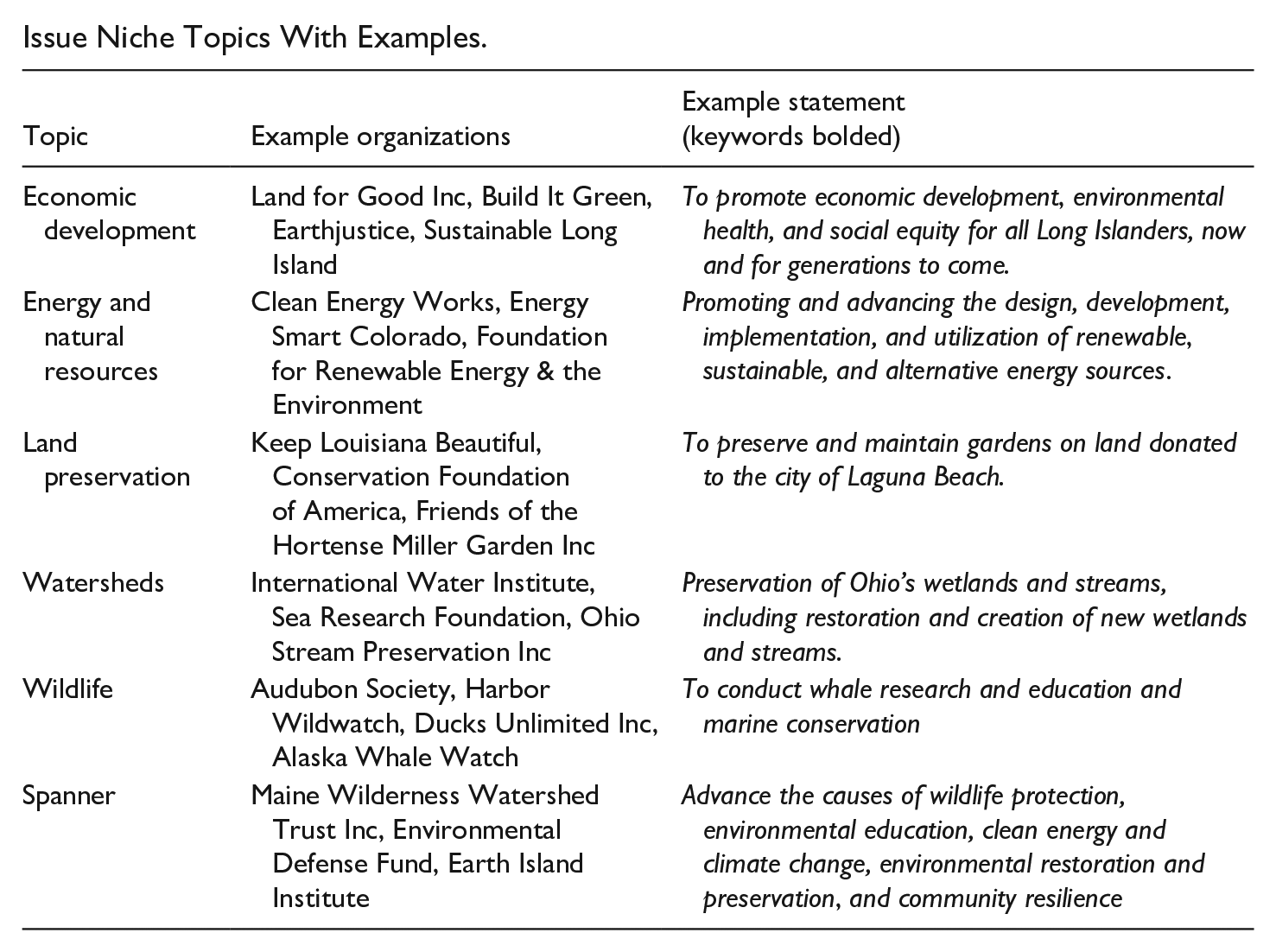
| Topic | Example organizations | Example statement |
|---|---|---|
| Economic development | Land for Good Inc, Build It Green, Earthjustice, Sustainable Long Island | To promote economic |
| Energy and natural resources | Clean Energy Works, Energy Smart Colorado, Foundation for Renewable Energy & the Environment | Promoting and advancing the design, development, implementation, and utilization of |
| Land preservation | Keep Louisiana Beautiful, Conservation Foundation of America, Friends of the Hortense Miller Garden Inc |
To preserve and maintain gardens on
|
| Watersheds | International Water Institute, Sea Research Foundation, Ohio Stream Preservation Inc |
Preservation of Ohio’s
|
| Wildlife | Audubon Society, Harbor Wildwatch, Ducks Unlimited Inc, Alaska Whale Watch |
To conduct
|
| Spanner | Maine Wilderness Watershed Trust Inc, Environmental Defense Fund, Earth Island Institute | Advance the causes of |
Acknowledgements
The authors would like to thank Avery St. Dizier for his assistance with the Python code for topic modeling and visualization. Thanks also to Aseem Prakash, Beth Gazley, Jennifer Kagan, and participants of the 2021 virtual conference on Climate Change and the Nonvoluntary Sector, as well as Jen Schwartz for feedback on earlier versions of the article.
Declaration of Conflicting Interests
The author(s) declared no potential conflicts of interest with respect to the research, authorship, and/or publication of this article.
Funding
The author(s) received no financial support for the research, authorship, and/or publication of this article.
