



Abstract
For most nonprofits, their effectiveness, sustainability, and survival all depend on the willingness of individuals to behave in prosocial ways, for example, by giving time, money, and/or resources to various organizations and causes. Scholars have, therefore, long sought to identify predictors of prosocial behaviors; and, one consistently significant variable in this quest has been prosocial role identity. Indeed, the strength of this identity, studies have shown, positively predicts participation in a variety of prosocial activities. Despite this significance, research on service-learning, a widely utilized pedagogical practice intended to prepare prosocially active and engaged citizens, has been largely disconnected from the literature on identity motivated behavior. Yet, this literature provides a strong conceptual foundation for understanding why, when, how, and for whom participation in service-learning will be associated with positive changes in prosocial identities—and, ultimately sustained participation in role-related prosocial behaviors. In this article, we connect these literatures and propose a model.
Introduction
Prosocial behavior, defined as “a broad category of actions” generally considered by society to be “beneficial to other people and to the ongoing political system” (Piliavin et al., 2002, p. 470), is important for nearly every nonprofit organization. Indeed, for the overwhelming majority of nonprofits, their effectiveness, sustainability, and survival are all dependent on the willingness of individuals to behave in prosocial ways—for example, by giving time, money, and/or resources to different nonprofit issues and causes. The magnitude of this importance is evident when considering the overall scale and significance of prosocial activities that take place in the nonprofit sector. In the United States, for instance, millions of Americans volunteer their time with nonprofits each year, and, in total, these individuals engage in billions of hours of volunteer service. The Independent Sector estimates that the collective value of these volunteers’ time is worth nearly US$200 billion (The Nonprofit Times, 2021).
Americans also donate hundreds of billions of dollars each year to the nonprofit sector (Giving USA, 2020)—collectively representing, by far, the largest source of the approximately half a trillion dollars in annual contributions the sector receives. Given the scale and significance of these prosocial behaviors, scholars (across a variety of disciplines) have long sought to identify factors that motivate individuals to behave in prosocial ways (e.g., Bekkers & Wiepking, 2011; Clary & Snyder, 1995, 1999); and, one consistently significant factor this research has shown is a prosocial role-identity, that is, a definition of one’s self in terms of a help-giving social role. The strength of this identity, studies have shown, is positively predictive of participation in a wide array of prosocial activities such as charitable giving, volunteering, and biological (e.g., blood and organ) donations (Chapman et al., 2020; Finkelstein et al., 2005; Grube & Piliavin, 2000; L. Lee et al., 1999; Marta et al., 2014; Masser et al., 2009).
Despite these findings, research on service-learning—one of the most, if not the most, widely utilized pedagogical practices in higher education intended to prepare prosocially active and engaged citizens—has been largely disconnected from the vast literature on identity-motivated behavior. This literature, however, provides a strong foundation for understanding why, when, how, and for whom participation in service-learning might be positively associated with prosocial identity changes—and, in turn, sustained participation in role-related prosocial behaviors. 1 Thus, in this article, we outline a model of service-learning and prosocial identity formation based on a conception of identity rooted in structural symbolic interactionism—specifically, Stryker’s identity theory (Serpe et al., 2020; Stryker, 1980/2002). 2
In the model, we frame service-learning experiences (SLEs) as proximate social structures (i.e., the immediate contexts where prosocial identities are activated (Merolla et al., 2012; Serpe & Stryker, 2011; Stryker et al., 2005) that allow students opportunities to adopt and/or enact identities associated with specific prosocial service roles while among a network of their peers (Merolla et al., 2012). Adoption and enactment of these identities (i.e., role-identities associated with a volunteer or a philanthropist), we argue, provides students with the internal and external verification needed to reinforce and strengthen the importance of these identities in their lives; and, we suspect that the magnitude of this verification either facilitates or inhibits students’ long-term commitments to active engagement in role-related prosocial behaviors.
Although we recognize the term philanthropy is commonly defined as “love of humankind” (Sulek, 2010); and, thus, can include myriad prosocial acts (including volunteering), in colloquial usage the term philanthropist (i.e., one who engages in philanthropy) is often used in reference to those who donate money to charitable organizations and causes (Sulek, 2010). As such, we use the term “philanthropist identity” to refer to students who adopt and/or enact an identity of someone who gives away money.
Moreover, we focus our model specifically on prosocial identity formation occurring through participation in SLEs during the college years since this period is often characterized by significant changes in identities. Indeed, although prosocial identity generally develops during adolescence (e.g., through parental socialization, mandatory service requirements, and religious involvement), the college years are a time for reflecting on, re-evaluating, and altering identities formed during earlier development (Parks, 1986). Brandenberger and Bowman (2015), for instance, conducted a longitudinal, multi-institutional study of U.S. college students (n = 14,000) and explored the extent to which college-level and precollege-level factors influenced three prosocial outcomes: charitable involvement, an ethic of caring, and a compassionate self-concept. They found that college-level factors, such as participation in active learning and service-learning, were among the strongest predictors of these outcomes, whereas precollege experiences—such as age, parental education, and high school grade point average—were less salient.
The remainder of our article proceeds as follows: First, we highlight characteristics of identities and we briefly review identity theory. We, then, outline our model by way of a detailed illustration. We conclude by proposing several areas for future research that we believe should allow for empirical testing and refinement of our model as well as greater theorizing about the overall usefulness of identity theory for understanding relationships between SLEs and students’ commitments to, and engagement in, different prosocial behaviors.
Review of Relevant Literature
Identities are self-definitions individuals apply to themselves based on either a role they occupy in society, group membership, and/or personal characteristics (Serpe et al., 2020; Stryker & Burke, 2000; Thoits, 2013). At any point in life, an individual can (and will) possess multiple identities; and, these identities can (and will) overlap and change over the life course. For example, at one point a person may simultaneously identify as a “mother,” a “woman,” a “firefighter,” and a “volunteer.” At a later point, however, this same person may identify as a “mother,” a “blood donor,” and a “social worker.”
According to identity theory, individuals cognitively organize their identities into hierarchies based on salience (Stryker, 1968; Thoits, 2012). The more salient an identity is to someone, the greater the likelihood will be that the individual will engage in behaviors associated with that identity (Serpe, 1987; Stryker, 1968). Although the concept of salience has often been used interchangeably with the related concept of importance (or, prominence; Serpe et al., 2020), there are important conceptual distinctions between the two (see Thoits, 2013). Namely, identity salience is based on probable behavior, while identity prominence is considered to be an individual’s internalized importance of an identity (Stets & Serpe, 2013). In our model, we focus on the concept of identity importance given that Brenner and colleagues (2014) have shown that importance precedes and predicts (the often less intuitive notion of) salience. Specifically, they show that high identity importance calls forth an identity for likely enactment.
Characteristics of Identities
For the most part, identities are highly malleable (Aaker & Akutsu, 2009). Research has demonstrated that remarkably minor influences (e.g., environmental cues and/or “primes”) can significantly alter the importance of an individual’s identity (Shih et al., 1999; Steele & Aronson, 1995). Identities are also highly context sensitive and can change across social contexts (Aaker & Akutsu, 2009; Merolla et al., 2012; Serpe & Stryker, 2011; Stryker et al., 2005; Thoits, 2013). Stryker and colleagues (e.g., Merolla et al., 2012; Serpe & Stryker, 2011; Stryker et al., 2005) have highlighted the nature of this sensitivity by specifying three social structures where identities are enacted: large, intermediate, and proximate. Large social structures represent macro constructs used for boundary formation (e.g., race, class, and gender), whereas intermediate social structures refer to networks of interactions that take place within localized settings (e.g., communities and schools). Proximate social structures are the closest structures to the individual and represent the immediate context (e.g., families and peer groups) where individuals carry out and enact their identities (Serpe & Stryker, 2011; Stryker et al., 2005). These structures have been shown to be important for the creation and maintenance of certain identities.
Merolla et al. (2012), for instance, examined identity outcomes associated with student participation in college-based science-training programs, which they conceptualized as proximate social structures. Their findings indicated that students’ interactions with one another while in this structure increased the salience of their science identities as well as their intentions to pursue scientific careers. Implicit in this finding is the idea that aspects of the proximate social structure—such as the homogeneity of those within the structure (i.e., science majors in Merolla et al.’s (2012) study) as well as any feedback received within the structure—may be important for identity formation.
Prosocial Identities
Prosocial identities are self-definitions of internalized prosocial roles (e.g., a “volunteer” identity). These identities represent components of the self-concept concerned with helping and contributing to known and/or unknown others (Grube & Piliavin, 2000). A large body of research has demonstrated the importance of prosocial identities for predicting participation in a variety of role-related prosocial behaviors (see Callero et al., 1987; Dovidio et al., 2017; Piliavin et al., 2002; see Charng et al., 1988; L. Lee et al., 1999; Masser et al., 2009, for research on blood and organ donations; see Finkelstein et al., 2005; Grube and Piliavin, 2000; Penner and Finkelstein, 1998; L. Lee et al., 1999; Marta et al., 2014; Reed et al., 2007; Thoits, 2012, 2013, for research on volunteering; and see L. Lee et al., 1999; Reed et al., 2007, for research on donations of money).
Research has also shown that individuals most likely to participate in ongoing prosocial behaviors are those who place greater importance on their prosocial identities (see Finkelstein et al., 2005; Marta et al., 2014). Marta et al. (2014), for instance, conducted a longitudinal study of young adult volunteers in northern Italy to understand why these young adults continued volunteering over an extended period of time. What they found was that not only was their identity as a volunteer directly associated with their intentions to engage in future volunteer activities, but the more they perceived that their participation was consistent with the expectations of a significant other (i.e., the more external verification they received in terms of their volunteer identity), the more they identified as a volunteer.
Prosocial Identities and Service-Learning
Although identity formation represents the core developmental task of adolescence (Erikson, 1968), the identity formation process continues well into early adulthood (Kohlberg, 1984). Arnett (2000), therefore, introduced the concept of emerging adulthood, which she defined as a period characterized by substantial life changes and identity exploration. For many emerging adults, college can be a formative environment that has a profound influence on the formation of their identities (Arnett, 2004). Indeed, Mayhew and Engberg (2011) have suggested that “Students of all ages often approach college with a developmental readiness for exploring and subsequently defining themselves in new ways” (p. 32); and, Serpe (1987) found that during the college year students often experience changes in prior commitments by entering into new social relationships that influence the salience of their identities. Perhaps not surprisingly, then, many college environments provide ample opportunities for students to explore their prosocial identities.
Generally, these opportunities for exploration occur through participation in service-learning. Service-learning is a pedagogy (and philosophy) intended to enrich student learning, teach civic responsibility, and strengthen communities (Celio et al., 2011; Tomkovick et al., 2008; Yorio & Ye, 2012). Considered to be a high impact pedagogical practice, service-learning provides students with opportunities to meaningfully enact, develop, and reflect on various identities (Astin et al., 2000; Eyler & Giles, 1999). Indeed, research has long demonstrated positive outcomes associated with service-learning (e.g., Celio et al., 2011; Tomkovick et al., 2008; Yorio & Ye, 2012) and has linked participation in service-learning to the formation of a number of identities, such as self-identity (e.g., Winans-Solis, 2014), ethnic identity (e.g., Petrov, 2013), civic and political identity (e.g., Iverson & James, 2013; Mitchell, 2015), professional identity (e.g., Beck et al., 2015; Keshwani & Adams, 2017), academic identity (e.g., Dukhan et al., 2008), and religious identity (e.g., Brookner, 2020; Rehnborg et al., 2008).
Dominant Forms of Service-Learning
Traditionally, the “service” in service-learning has been designed to occur in the form of volunteering. Mooney and Edwards (2001) have, therefore, suggested that “In its simplest form, service-learning entails student volunteering in the community for academic credit” (p. 181). In recent years, however, SLEs have also been designed to allow students opportunities to engage in the distribution of charitable funds—a pedagogical practice commonly referred to as experiential, or student, philanthropy (Li et al., 2019, 2020; McDougle et al., 2017; Xu et al., 2019).
Experiential philanthropy is intended to allow students an opportunity “to study social [issues] and nonprofit organizations and then make decisions about investing funds” into nonprofits working to address those issues (McDougle et al., 2017, p. 244). Ultimately, the pedagogy aims to not only improve students’ academic performance and broaden their capacity for civic activity but also provide them with an opportunity to serve as a philanthropic funding agent (i.e., a philanthropists) on behalf of their community (Xu et al., 2019). 3 Although volunteering and charitable giving are not the only forms of service-learning, these activities generally represent the dominant forms of service activity that take place in SLEs; and, both forms have been designed to occur in direct and indirect ways (see Figure 1 have). Direct SLEs require students to engage directly in contact with individuals and organizations that benefit from student service involvement—for example, directly volunteering with a nonprofit organization in the case of a volunteer-based SLE or directly awarding funding to a nonprofit in the case of a charitable giving-based SLE. Indirect SLEs require students to participate in a service project that addresses a community need, but they do not require direct contact with individuals or organizations. Indirect volunteer-based SLEs have included activities such as advocacy or research-based projects that are for the community or a nonprofit partner agency, but do not elicit direct contact with the community or agency (e.g., Connor-Linton, 1995). Indirect charitable giving-based SLEs often consist of the provision of student funding recommendations to foundations and other grant-making entities (e.g., Olberding, 2009; see Figure 1).
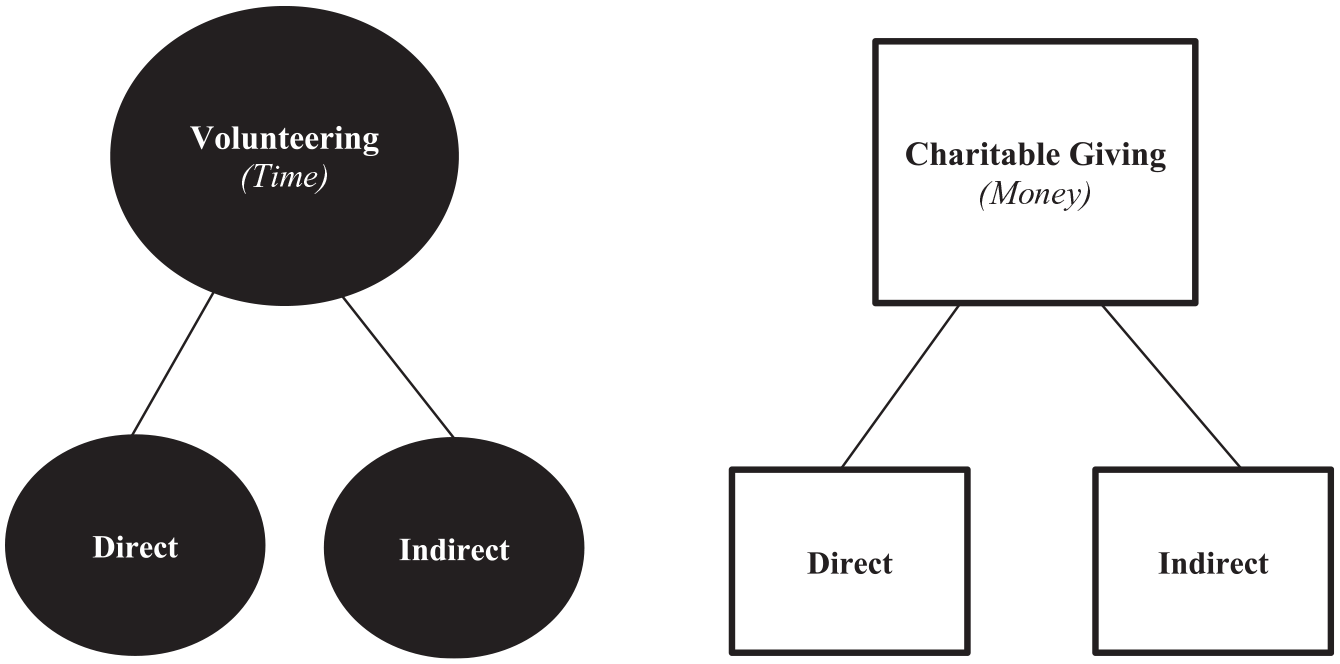
Forms of service in SLEs.
Service-Learning in Higher Education and Prosocial Identity Formation: A Model
Aaker and Akutsu (2009) have suggested that prosocial identities are behaviorally specific. In other words, these identities exist in relation to their associated prosocial role(s). For example, individuals can have a “volunteer” identity, a “philanthropist” identity, and/or a more general “giver” identity (i.e., an identity as a generally caring and helpful person); and, although these identities are related, each one is distinct.
In support of this idea, White et al. (2017) examined whether behaviorally specific prosocial identities versus a more general altruistic identity differentially influenced intentions to engage in prosocial activities among a sample of Australian college students. The findings from this study indicated that behaviorally specific prosocial identities were significant predictors of students’ intentions to volunteer their time, donate their money, and give their blood to charitable causes, while a broader altruistic prosocial identity did not predict students’ intentions to engage in any form of prosocial behavior. Thus, they concluded that when prosocial identities are linked to specific role-related prosocial behaviors, there will likely be greater intentions to engage in associated prosocial activities.
Despite this expectation and strong empirical support for identity-motivated behavior, research on service-learning has been largely disconnected from literature on identity theory. This literature, however, provides a strong conceptual foundation for understanding why, when, how, and for whom participation in different forms of service in an SLE will be associated with prosocial identity changes—and, ultimately, sustained participation in role-related prosocial behaviors. We illustrate this below.
An Illustrated Example
The importance of any prosocial identity will inevitably differ from one student to the next. Indeed, even students with the same prosocial identity (e.g., a “volunteer” identity) will vary in their personal evaluation of that identity’s importance. This will inevitably result in classrooms consisting of students with prosocial identities of varying importance.
Prosocial Identities of High Importance
Most students will enter into SLEs with some level of pre-established prosocial identities. As such, rather than an initial adoption of these identities, they will enact their already adopted identities. Some students, for example, before entering into the SLE will already consider one or more prosocial identities to be highly important. This is likely because these students have had, throughout the course of their lives, ample opportunities to engage in role-related prosocial activities (whether through their involvement in youth organizations, parental expectations, or other activities). Research has shown that frequent enactment of a role leads people to develop an identity that is consistent with that role (Charng et al., 1988; Marta et al., 2014; Piliavin et al., 2002; Thoits, 2013).
Participation in SLEs that align with students’ pre-SLE prosocial identities, then, should result in either the maintenance of these identities or an increase in the importance of these identities. Take, for example, a student who strongly identifies as, both, a volunteer and a philanthropist. Participation in either form of service during the course of an SLE (volunteer-based or charitable giving-based) should not only allow this student to internally verify the importance of these identities, but interactions with and feedback from their peers (as well as interactions with and feedback from their instructors and SLE organizational partners) should also provide this student with the external verification needed to reinforce and strengthen the importance of these identities. Serpe and colleagues (2020) have suggested that “An identity is verified when individuals perceive that others view them in the same way as they view themselves. Conversely, when individuals perceive that others view them differently than they view themselves, identity nonverification occurs and typically creates distress” (p. 15).
Prosocial Identities of Varying Importance
Other students will enter into SLEs with a highly important form of one prosocial identity and a developing (or even a previously nonexistent) form of another. Some students, for example, may have a volunteer identity that is more established (and, more personally important) than their philanthropist identity. This could be because these students have, throughout the course of lives, been provided with greater opportunities to volunteer their time with nonprofit organizations than to donate money. Thoits (2012) has suggested that “Theoretically an identity exists and can become important to a person only if it is performed at least occasionally” (p. 362). In this instance, then, although students may identify strongly as a “volunteer,” absent significant, substantial, and/or meaningful monetary giving opportunities, they will likely not identify as someone who donates money—that is, a philanthropist.
For these students, then, given the already high level of importance that they place on their volunteer identity, participation in a volunteer-based SLE, when internally and externally verified (or reinforced), should result in either the maintenance of this identity or perhaps even an increase in the importance of this identity. Participation in a charitable giving-based SLE, however, should allow these students an opportunity to adopt (in the case of a previously nonexistent identity) and enact the identity of a philanthropist. Presumably, this will then result in a process of identity exploration, ultimately leading them to assess and verify (both internally and externally) whether this identity is, in fact, reflective of self.
Prosocial Identities of Low Importance
There are other students who will enter into SLEs having had few meaningful pre-SLE prosocial experiences; and, these students will likely have pre-SLE prosocial identities that are of low importance. As such, engaging in SLEs should allow these students to explore—that is, enact and verify, both internally and externally—whether an identity associated with a specific prosocial service role is reflective of self. In some instances, this enactment and verification will lead to an increase in the importance of a particular prosocial identity. In other instances, however, enactment of a prosocial service role during the course of an SLE will not lead to identity verification; and, in these instances, students will likely maintain the low status of their pre-SLE prosocial identity or the identity may even become less important to the student than it initially was.
Previously Nonexistent Prosocial Identities
Although perhaps least likely of these scenarios, it is also plausible that some students will enter into SLEs having had no prior meaningful prosocial experiences. As such, these students will have pre-SLE prosocial identities that are nonexistent. For these students, then, engaging in SLEs should allow them to explore—that is, adopt, enact, and verify—identities associated with specific prosocial service roles. Some of these students, after adopting and enacting a specific prosocial identity will receive the verification needed (whether internally or externally) to alter the importance of this identity. Thus, the SLE will have positively influenced the formation of that student’s role-related prosocial identity. Other students, however, will either receive no verification or negative verification of the identity; and, in these instances, these students are likely to maintain the status of their previously nonexistent prosocial identity or they may reject the identity altogether.
Rejected Prosocial Identities
Although research suggests that students who enroll in service-learning courses tend to have more prosocial tendencies than those who do not (Holz & Pinnow, 2015), many colleges and universities have begun instituting service-learning requirements (Kolenko et al., 1996; Spring et al., 2008). As such, it is entirely possible that some students may participate in SLEs merely as a condition of degree completion. Thus, there is an additional possibility to consider.
Some students, regardless of their previous prosocial experiences, may have established a “not me” (or a rejected) prosocial identity (McCall, 2003). For these students, engaging in SLEs may actually reinforce their “not me” identity leading them to further rejection of the identity. This may be particularly true if students are required to perform a service role (e.g., volunteering) that they view as antithetical to who they are. However, some students with a “not me” identity, after adopting and enacting identities associated with a specific prosocial service role and receiving verification and positive reinforcements of their prosocial activities, will no longer view that “not me” identity as self-reflective. For these students, participation in SLEs will allow them to adopt new identities no longer reflective of their once rejected identities.
Model Summary
At this point, it should be evident that the form of service in SLEs likely represents an important consideration in students’ prosocial identity formation. Indeed, students may experience changes in the importance of their prosocial identities as a result of their participation in different forms of SLEs. A conceptual model of this relationship is presented in Figure 2.

A model of service-learning and prosocial identity formation.
Our model begins by focusing on the importance of students’ pre-SLE prosocial identities (1). The importance of any particular prosocial identity will, inevitably, vary by student and most students will enter into an SLE with some degree of an already established prosocial identity (whether positive or negative). The SLE experience (2) serves as the proximate social structure where students are able to adopt and enact identities associated with specific prosocial service roles—primarily volunteering or charitable giving (3) and these service roles that can be designed to occur either directly or indirectly (4). Ultimately, the adoption and enactment of an identity associated with a specific prosocial service role during the course of an SLE (i.e., while in the proximate social structure) allows for the internal and external verification needed for students to alter (whether positively or negatively) the importance of their pre-SLE prosocial identities (5). It is important to note here that our model assumes that students are rational actors. However, empirical tests of the model can confirm the accuracy, or not, of this assumption.
An Agenda for Future Research
Our model of service-learning and prosocial identity formation outlined here raises a number of important questions that we believe are ripe for exploration. These questions should lead to testable hypotheses that provide much needed insight into the relationship between SLEs and students’ long-term commitments to, and engagement in, different role-related prosocial behaviors.
Does Form or Type of Service Matter?
Perhaps the most obvious question emerging from this model is: Does form or type of service matter? That is, do different forms of service in SLEs (e.g., volunteering or donating), or different types of service (e.g., direct or indirect), differentially affect students’ prosocial identities? And, if so, at what intensity? The answers to these questions will be critical for the design of effective SLEs. If, for instance, participation in a specific form of SLE (whether volunteer-based or charitable giving-based) leads to greater increases in the importance of a specific prosocial identity, then when seeking to encourage behaviors associated with that identity, SLEs should be designed to incorporate role-related prosocial service activities.
Similarly, if participation in a specific type of SLE (whether direct or indirect) leads to greater increases in the importance of a specific prosocial identity, then when seeking to encourage behaviors associated with that identity, SLEs should be designed using the most role-influencing approach. It may be possible, for instance, that direct SLEs provide greater opportunities for students to gain feedback, thus resulting in greater verification of their prosocial identities (B. A. Lee et al., 2004). Indeed, Lersch (1997) has suggested that a disadvantage of indirect service-learning is the lack of one-on-one interaction with those who benefit directly from students’ efforts.
The accuracy of these alignments will be particularly important if students’ participation in one form or type of service affects—whether positively or negatively—how they view their identity associated with a different form or type of service. If, however, form and type of service are inconsequential (i.e., they are substitutable), then deciding whether SLEs should focus on having students volunteer their time or donate money, or whether they should be designed as direct or indirect experiences, will be less important than ensuring that they engage in prosocial service activities at all.
It is important to note here that the voluntary or required nature of SLEs could also influence the importance of a student’s prosocial identity. If, for instance, a student is required to perform a specific prosocial service role while participating in an SLE (e.g., volunteering) and they dislike the experience or perhaps even receive no verification from it, this could turn that student off from adopting the identity associated with that role (i.e., a volunteer identity) in the future.
To What Extent Are Effects Lasting?
Although studies have consistently provided strong evidence that service-learning in higher education has positive long-term effects on a variety of student outcomes, few studies have examined the temporality of these effects specifically on students’ identities. Thus, a key question that needs exploring is: To what extent are effects lasting?
Outside of higher education, studies have shown that participation in volunteer activities at one point in life can result in an increase in the importance of an individuals’ volunteer identity at a later point in life (see, for instance, Callero et al., 1987; Charng et al., 1988; Grube & Piliavin, 2000; L. Lee et al., 1999). It is plausible, then, that frequent enactment of a particular service role while participating in an SLE results in the development of a long-term self-concept (i.e., identity) consistent with that role (Marta et al., 2014; Thoits, 2013). There is some evidence to support this idea. Olberding (2012) examined students’ involvement in prosocial activities 1 to 10 years after taking an experiential philanthropy course and found that even up to a decade post-participation, students’ engagement in prosocial activities was higher than it was pre-SLE. Still, this is an area that would benefit from more research.
Are There Compensatory Influences or Residual Effects?
Another question that arises is: Are there compensatory influences or residual effects that occur as a result of students’ participation in SLEs with different forms and types of service? Inevitably, students will simultaneously be performing multiple roles and assuming multiple identities while participating in an SLE—for example, the student may be not only a student, but also an athlete and an employee. According to role theory, the presence or absence of different roles will influence how strongly a student identifies (or not) with a particular prosocial service role (Biddle, 2013).
Especially in the absence of roles and identities, students may adopt and enact new roles and identities (Lancee & Radl, 2014; Moen et al., 2000). Indeed, Van Ingen and Wilson (2017) found that as older adults began to lose productive roles in life (e.g., employee and spouse), their role identity as a volunteer increased in salience. This, they suggested, was likely a strategy used to compensate for role loss.
In emerging adulthood, this compensation strategy may be particularly pronounced since emerging adults are often, developmentally, at a stage of substantial identity shifts. Indeed, for the most part, this is a stage where people are no longer viewed as adolescents and they begin to develop (and be viewed as individuals with) more autonomous identities. Thus, an important consideration of this model is how the accumulation or loss of roles and identities during the college years increases or decreases the likelihood that students will be positively or negatively influenced by their participation in SLEs.
In addition to these potential compensatory influences, another area for future research is exploring the possibility of residual effects. One residual effect, for example, could be an increase in students’ mental and emotional well-being as a result of their participation in different forms and types of SLEs. Research has long shown positive associations between role-identities (such as a volunteer role-identity) and health (Ahrens & Ryff, 2006; Thoits, 2012, 2013); and Thoits (2003) has speculated that the strength of this relationship may be strongest for “voluntary” roles (e.g., friend, churchgoer) than for “obligatory” roles (e.g., parent, employee).
Recently, Konrath (2016) has also suggested that the act of giving money away could result in salubrious health outcomes by bringing about personal gratification and an increased sense of purpose and meaning in life—ultimately, lessening anxiety and depression. Thus, by inducing students to perform service roles through SLEs, there may be a number of health benefits that they reap—although possibly in different ways.
For Whom Does Form or Type of Service Matter?
Another question that emerges from this model is: For whom does form or type of service matter? For the most part, SLEs are considered to be transformative pedagogical experiences (Rosenberger, 2000). However, Jones et al. (2005) have suggested that “not all students are immediately, or gracefully, transformed” by them (p. 3). This may, in part, be attributable to who is undertaking the service and what form or type of service they are undertaking. Understanding who is most affected by form and type of service should allow researchers to test for moderation effects that can inform whether SLEs have a stronger or weaker influence on certain populations of students and under what conditions. If, for instance, volunteer-based SLEs are more likely to result in students from socially marginalized groups identifying as a volunteer, then instructors may choose to design SLEs in ways that optimize volunteer opportunities for these students.
This may be an especially important consideration with experiential philanthropy. For some students with marginalized identities, charitable giving can serve as a source of empowerment and agency (Riccio & Gardinier, 2016; Winans-Solis, 2014). Indeed, by providing students with the financial means to donate to organizations they believe in, experiential philanthropy allows these students to act as philanthropic decision makers. Ultimately, this could result in these students redefining their understanding of, and relationship to, broader philanthropic concepts, such as who and what philanthropists look like and what issues and causes philanthropists care about.
This raises another important “for whom” consideration: When the prosocial identity activated by the service activity in an SLE interacts with another important identity (e.g., racial or gender), to what extent does this interaction influence the importance of students’ prosocial identity? If, for instance, a female student with a pre-SLE volunteer identity of low importance, participates in a volunteer-based SLE at a local women’s shelter, to what extent (if at all) will she experience a greater (or lesser) change in the importance of her initially low volunteer identity than would an otherwise similar male student? Schervish and Havens (1997) found that many donors see themselves in “the needs and aspirations of others” (p. 236); and, Jackson and colleagues (1995) found that some donors donate out of a “sense of being connected with another or categorizing another as a member of one’s own group” (p. 74). As such, when students identify with the target(s) of service while participating in an SLE, this identification may lead to an increase in the importance of their prosocial identities.
Summary and Conclusion
We began this article by highlighting two realities. First, nonprofit organizations are highly dependent on prosocial behaviors. Indeed, these organizations need the support (financial, time, and resources) of an engaged citizenry to maintain their effectiveness, sustainability, and overall survival. Second, a long-standing goal of higher education has been to produce informed, active, and engaged citizens; and, service-learning has become a widely utilized pedagogy (and philosophy) for achieving this goal (Donahue & Mitchell, 2010). Thus, in this article, we drew upon a conceptualization of identity rooted in structural symbolic interactionism to develop a model of service-learning in higher education and prosocial identity formation.
In our model, we frame SLEs as proximate social structures (i.e., the immediate contexts where prosocial identities are adopted and enacted (Merolla et al., 2012; Serpe & Stryker, 2011; Stryker et al., 2005), and the basic premise of the model is that these structures provide students with opportunities to adopt (in some instances) and enact identities associated with specific prosocial service roles while among a network of their peers. This, we suggest, allows students to obtain internal and external verification of the importance of a particular role-related prosocial identity, which ultimately leads to their long-term commitment to and active engagement in different role-related prosocial behaviors. After providing an overview of the model, we concluded by outlining several areas for future research that we believe should provide greater insight into understanding why, when, how, and for whom participation in SLEs will be associated with changes in students’ prosocial identities.
One thing to note is that our model does not explain why adoption and enactment of prosocial identities within a proximate social structure (i.e., a network peers) matters. However, Merolla and colleagues’ (2012) findings on identity outcomes associated with student participation in college-based science-training programs provides some insight on aspects of the proximate social structure that could be important (e.g., the homogeneity of those within the structure as well as the feedback received). More recent research has provided additional clues. Specifically, in two well-powered experiments testing how donating to charity together with a peer—that is, collaborative giving—affects college students’ generosity, Proulx and colleagues (2022) found that although undergraduate students who engaged in collaborative giving donated no more than those who gave individually, these students believed that collaborative giving was more intrinsically rewarding. This intrinsic reward, they found, indirectly boosted donations.
Similar results have also been demonstrated among younger students by Sullivan and colleagues (2022) who found that adolescents were shown to behave selfishly when privately allocating monetary rewards for themselves and a peer in an incentive-compatible task. However, in the presence of their peers the adolescents became more altruistic. Taken together, these data seem to suggest that not only could homogeneity and feedback be important components of the proximate social structure, but for those within the structure it may be more intrinsically rewarding to engage in prosocial acts with others and in doing so this could lead to potential impacts on their generosity, that is, larger donations of money, energy, and/or time.
Footnotes
Declaration of Conflicting Interests
The author(s) declared no potential conflicts of interest with respect to the research, authorship, and/or publication of this article.
Funding
The author(s) received no financial support for the research, authorship, and/or publication of this article.
