



Abstract
Volunteers play a critical role in government and nonprofit organizations. Yet, volunteer management research has focused on universal prescriptions or a contingency perspective based on the needs of the organization rather than the volunteer. As volunteers are a finite resource, how can nonprofits retain their volunteers? We conduct a qualitative analysis of open-ended responses to explore how assessments of volunteer management vary across satisfaction levels as delineated by the Net Promoter Score (NPS) scale. We find evidence that the most satisfied volunteers may be important resources to volunteer programs for the insight and advice they offer as champions of the collective. We also observe patterns across satisfaction levels suggesting that volunteer satisfaction is linked to volunteer development. Our research offers the NPS, a commonly used feedback measure, as a valuable tool for volunteer management to measure volunteer satisfaction, to identify enthusiastic promoters, and to examine volunteer development.
Keywords
Volunteers need to be effectively managed to maximize the benefits to themselves and to the organizations they serve. Volunteer management research offers insights to managers seeking to lead more effective volunteer programs and has continued to evolve according to the needs of the organizations. Namely, scholars have recommended a conceptual shift from universal prescriptions grounded in traditional personnel management to those more contingent on organizational characteristics, the specific volunteer activities they host, and the unique client groups they serve (e.g., Brudney et al., 2019; Brudney & Sink, 2017; Hager & Brudney, 2015). Contingency frameworks have emerged to synthesize and advance volunteer management research but have yet to incorporate volunteer satisfaction literature which focuses on the experience and needs of volunteers themselves. As volunteers are a finite resource, where sustainable volunteer management ultimately benefits the organization (Brudney & Meijs, 2009), volunteer satisfaction is a key concern. And as volunteers take on more responsibilities and fill larger roles (e.g., Graff, 2002), the question of the volunteer experience becomes increasingly salient. Thus, is further evolution in order? What tools might help researchers and practitioners shift their focus to the volunteer experience? What can we learn about volunteer management by adopting the volunteer perspective?
To explore these questions, we analyze nearly 8,000 open-ended volunteer survey questions to search for patterns in the volunteer experience across satisfaction levels. Our primary instrument is the Net Promoter Score (NPS), a tool widely used by organizations to assess customer satisfaction (Reichheld, 2011, 2013), including those in the nonprofit sector (e.g., Burnham & Wong, 2018; Miller, 2021). Findings offer several notable implications for theory and practice. In practice, we recommend that volunteer managers utilize the NPS tool to compare differently satisfied volunteers more closely; this is the first step toward management practices contingent on the volunteer, rather than the organization. Our own use of the tool reveals that more satisfied volunteers may have developed a greater capacity or perspective needed to mentor and lead other volunteers, with clear practical benefits. This finding is one element of a broader theoretical contribution—a potential link between volunteer satisfaction and volunteer development. The primary implication is that the field of volunteer management may draw from other fields to continue its evolution toward more volunteer-centric management frameworks.
The following section reviews the literature on volunteer management, from universal prescriptions to a contingency perspective to a focus on volunteer satisfaction and retention. Then we outline our research context and methods, followed by our findings and discussion, and conclude with our implications for research and practice.
Volunteer Management Literature
Over the last half-century, volunteer management models have evolved from universal models to a contingency approach, while maintaining a focus on the organizational perspective. Volunteer management both as an area of study and a recognized profession dates to the work of Harriet Naylor (Ellis, 2000). Naylor (1967) advocated for government and nonprofit organizations to recognize volunteers as a human resource who, like employees, should be managed strategically. Many volunteer management models stem from Boyce’s (1971) ISOTURE model that stressed a strategic approach to volunteer management founded in principles adapted from the management literature. Over the years, this early work has been supplemented by additional recommendations for volunteer managers. From volunteer administration competencies (Council for Certification in Volunteer Administration [CCVA], 2015) to the volunteer resource management process (Connors, 2011), these models largely give universal prescriptions.
Together, this “one-size-fits-all” approach (Brudney & Meijs, 2014, p. 300), known as the “universal” (Brudney & Sink, 2017) or “traditional” (Brudney & Meijs, 2009) model, provides broad principles which are not reflective of service niche, internal structure, volunteer motivations, or any other organizational or volunteer characteristics. Universalists focus on recruiting volunteers and assigning roles which both fulfill their service motivations and meet organizational objectives in an efficient and effective manner (Brudney, 2016; Rochester, 1999). However, recent studies have called for volunteer management models which are tailored to the nonprofit organization, arguing that “one size” does not always “fit all” (Brudney & Meijs, 2014; Brudney et al., 2019; Hager & Brudney, 2015).
Several contingency frameworks have emerged, compiling management principles across a broad range of organizational factors: the roles of volunteers and their relationship with paid staff (Brudney, 2016; Rochester, 1999), the function of the organization and the extent to which it relies on volunteers (Meijs & Hoogstad, 2001), and the structure of the volunteer program and volunteers’ motivation for joining the organization (Brudney et al., 2019). Brudney and Sink (2017) combine these and other elements into their “Ratchet Model” of volunteer management. These contingency frameworks operate along major dimensions of organizational and programmatic characteristics.
In addition to models of volunteer management, scholars highlight targets managers can focus on to improve volunteer satisfaction, such as volunteer empowerment, support, efficacy, and group integration (Galindo-Kuhn & Guzley, 2002). Or volunteer satisfaction may contain its own sets of contingencies. Volunteers seeking to utilize a specific set of skills (e.g., firefighting) or serving a more vulnerable population (e.g., disaster relief or social work) require—and probably expect—leadership to treat them like formal employees with clearly defined job descriptions, hierarchies, and objectives (Brudney et al., 2019; Brudney & Sink, 2017). In addition, Smith and Grove (2017) note the need for special management support for long-term disaster relief workers, and Henderson and Sowa (2019) find that volunteer firefighters are most satisfied when they are granted a large amount of autonomy in their work. Leadership which prioritizes the growth and development of volunteers as individuals may be preferred in organizations where the volunteers are the focus (Schneider & George, 2011; Schreiner et al., 2018), while volunteers providing a specific, important public service may prefer leadership which prioritizes the organizational mission (Mayr, 2017; Schneider & George, 2011).
These findings offer volunteer managers more specific instruction on how to manage their unique volunteer groups. Despite these considerable developments, however, research rarely considers that even volunteers within the same organization have different needs, interests, skills, and perspectives (cf. Einolf & Yung, 2018). If volunteer managers heed calls for more diverse volunteer recruitment practices (e.g., Lin, 2001; Piatak, 2016; Piatak et al., 2019), the efficacy of management strategies designed for homogeneous volunteer cohorts may decline. Thus, adopting the volunteer perspective is a crucial step toward more impactful management theory and practice.
Data and Methods
To incorporate the volunteer perspective, this study analyzes responses from nearly 8,000 volunteers. In partnership with a national environmental nonprofit organization, we qualitatively analyze the open-ended responses from their administrative survey of volunteers. This study is set in the context of a national environmental nonprofit with nearly 600 groups across the United States. Like many national nonprofits, this federated model has great variation in local management practices across groups, yet all share a common mission. The nonprofit is a grassroots advocacy organization where volunteers are connected to and volunteer through a local group. Headquarters has a paid volunteer coordinator responsible for providing training, resources, and support to local groups across the nation. The local groups are led and run by volunteers who organize monthly meetings for volunteers to connect and discuss their activities to impact environmental policy, such as raising awareness on social media, writing op-eds, and building relationships with policymakers. This provides an ideal context to examine volunteer management as volunteers are serving in similar manners to advance the mission of the organization but are subject to variation in local chapter management.
Headquarters surveys all volunteers across groups to measure satisfaction. New volunteers are surveyed after 8 weeks and then again after 6 months. All volunteers are surveyed on an annual basis. This study uses 1 year of administrative data from October 2018 to September 2019 for a total of 7,968 responses. The response rate for new volunteers is 5.9% after 8 weeks and 4.2% after 6 months. The response rate for the annual survey of volunteers was 3.9% for this period. Anyone who signed up to be a volunteer is surveyed regardless of their level of engagement or activity.
Like in many organizations, the NPS is used to gauge satisfaction with an open-ended follow-up question. The NPS begins by asking the likelihood of recommending the organization to a friend on a scale of 0 to 10. Those scoring 0 to 6 are detractors, 7 and 8 are passively satisfied, and 9 and 10 are promoters. The NPS is the percentage of promoters minus the percentage of detractors, which is argued to align with financial performance (Reichheld, 2003, 2011). Despite debate on whether the NPS is the best single factor to determine customer loyalty and growth (e.g., Grisaffe, 2007; Pollack & Alexandrov, 2013), the NPS remains one of the most widely used feedback measures (Morgan et al., 2005).
As the NPS has been widely adopted, including among nonprofits (e.g., Burnham & Wong, 2018; Miller, 2021), we examine whether the NPS could be a useful measure for volunteer management. In examining the adoption of the NPS by the Boy Scouts of America, Burnham and Wong (2018) highlight several of the benefits of the NPS for nonprofits, such as a shift in focus from services to the constituent perspective, an internal benchmark tool to assess best practices across local groups, and a tool to modify management when paired with additional metrics or information. Limitations of the NPS are that it may ignore the passive group or fail to assess the reasoning behind respondent scores, such as in the context of assessing donor loyalty in the nonprofit sector (Schulman & Sargeant, 2013). As many organizations utilize the NPS, we examine how the volunteer experience varies across the full range of responses by analyzing the open-ended responses that follow the NPS prompt.
Volunteers are asked a single NPS question: “How likely are you to recommend [this organization] to a friend?” on a scale from 0 (not at all likely) to 10 (extremely likely). This is followed by a single open-ended question. Volunteers who respond 10 are asked the following: “We’re glad you’re enjoying [this organization]. What’s the most important thing for us to keep doing to keep you happy?” Volunteers who respond 9 or lower are asked the following: “What could [this organization] do to improve your experience?” Our findings are based on the analysis of the open-ended responses to these questions.
As a first step, we coded the open-ended responses for whether they touched on volunteer management practices and then coded by the type of volunteer management theme addressed in the response. The development of the codes was an iterative process as we began with codes drawn from the literature (e.g., Brudney, 2016; Connors, 2011; Eisner et al., 2009) and revised subtitles to reflect the data (see Appendix A for detail on coding categories and Appendices B-C for corresponding responses). Second, we divided open-ended responses across different types of volunteers based on their level of satisfaction (see Appendix B for grouping sizes). Following the organization’s categorization and as prescribed by Reichheld (2003, 2011), we examine detractors (those responding 0-6), passive volunteers (those responding 7 or 8), and promoters (those with an NPS score of 9). While the NPS literature stops at these three categories with promoters having an NPS of 9 or 10, we examine those with an NPS score of 10 as a separate category of enthusiastic promoters. Again, as the most satisfied members of our study, enthusiastic promoters were asked about the single factor that would keep them happy instead of what could be done to improve their experience.
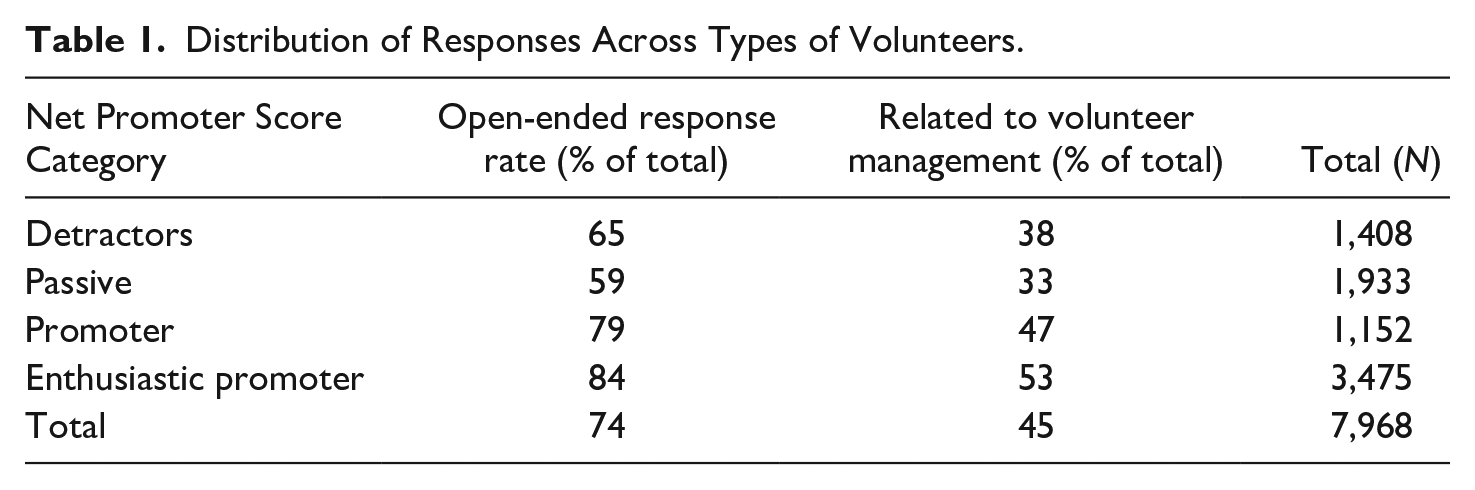
The purpose of this study is to build theory inductively from the case study. With the evolution of volunteer management theory to a contingency perspective, to what extent should volunteer management be tailored to the volunteer experience or do experiences vary across levels of satisfaction? To address this, we use pattern matching by comparing volunteer management best practices from the literature to insights from volunteers from their qualitative feedback (e.g., Huberman & Miles, 2002; Yin, 2014) to examine assessments of volunteer management across these four categories of volunteers—detractors, passive, promoters, and enthusiastic promoters. Table 1 below shows the distribution of the responses across these four volunteer groupings, where at least a third of each group provided insights on volunteer management.
Distribution of Responses Across Types of Volunteers.
Findings From the Volunteer Experience
From qualitative analysis of volunteer responses across levels of satisfaction, we illustrate nuances and patterns that could only come from the unique perspective of volunteers. Our findings are split into two sections. The first section compares the responses of volunteers at each level of satisfaction according to our three most frequently flagged management themes (see Appendices B and C): orientation, training, and resources; leadership; and engagement and tasks. These results reflect much of the established volunteer management literature, indicating that the NPS may be an accurate and useful tool for gauging volunteer satisfaction as well as exploring weak spots within volunteer programs. The second section highlights how more satisfied volunteers often identify critical management deficiencies and offer ideas for improvement, suggesting they possess a unique perspective.
Comparing Volunteer Responses According to Management Themes
Orientation, training, and resources
The process of orientating and training volunteers is well-established as an important precursor to successful volunteer activity (e.g., Boyce, 1971; Eisner et al., 2009; Hager & Brudney, 2004; Smith & Grove, 2017). Volunteers of all satisfaction levels discuss the quality of the training and orientation experience. Many detractors are frustrated by a “nebulous” or “vague” onboarding phase which leaves them with a poor understanding of next steps. Others, however, mention information overload, leading to feeling “overwhelmed” and “paralyzed by the amount of information,” and prefer to start with simple resources and a slower pace.
Passive volunteers express similar frustrations, calling for a stronger understanding of fundamental knowledge, but hint that a “well-run organization” and plenty of “good information” at their disposal fortify their experience. Promoters, perhaps describing what would elevate their satisfaction from “good” to “great,” also express a desire to get past the initial training phase, requesting that the organization “provide advanced [volunteers] with a more expansive focus” to serve a “wide variety of people.” Promoters and enthusiastic promoters commend “valuable,” “useful,” “exceptional,” and “inspirational” training curriculum. “You’re sharpening my sword and teaching me how to wield it,” writes another, illustrating the empowering nature of an effective volunteer training curriculum.
Leadership
Leadership influences volunteer satisfaction, commitment, and retention and should be shaped according to the needs and motivations of volunteers (Mayr, 2017; Schneider & George, 2011; Schreiner et al., 2018). A considerable number of volunteers describe the influence that leadership, good or bad, can have on the volunteer experience, where “some chapters languish while others thrive.”
Detractor and passive groups struggle with “domineering chapter heads” who prioritize their own agenda over the needs of the group, creating an environment in which there is inadequate “time devoted to questions, discussion, or learning” and where volunteers feel “muted and ignored.” Leaders also risk detracting from the volunteer experience by being disorganized and ineffective. Because many volunteers feel strongly about the cause they serve, they would like to see progress and tend to resent “poorly managed,” “uninteresting,” or “misdirected” meetings.
Promoters attribute their satisfaction to “communication,” personal “support and guidance,” and leaders who keep them “in the loop,” help “troubleshoot issues,” and foster a mentor/mentee relationship mediated by “interpersonal guidance,” confirming the importance of intentional leadership styles (Schneider & George, 2011; Schreiner et al., 2018). Also prevalent among enthusiastic promoters are requests for less oversight and greater autonomy. They prefer “leeway in achieving goals” and “room to do what they think is appropriate for them,” while warning against micromanagement. Despite reporting high satisfaction, enthusiastic promoters occasionally mention frustration with inflexible programs, suggesting that the most involved and committed members may need special allowances to stay engaged. One writes, “It disappoints and frustrates me that [the host organization] seems to discourage members from innovation and taking initiative when opportunities arise.” These findings are in line with previous work that shows that certain volunteers may appreciate more or less flexible leadership or management styles according to their identity (Brudney et al., 2019; Brudney & Sink, 2017; Einolf & Yung, 2018; Henderson & Sowa, 2019). Furthermore, the fact that volunteers still promote despite certain leadership failings indicates devotion to the mission and the broader organization, where the challenge lies in the difference in leadership quality and structures across the federated organization.
Engagement and tasks
Volunteer engagement has gained attention for its benefits to both volunteers—such as greater commitment and passion—and organizations—such as improved performance and decreased turnover (e.g., Gruman & Saks, 2011). The CCVA (2015) includes “plan for strategic volunteer engagement” as a core competency for volunteer administrators, and volunteers should be engaged through service opportunities that align with their interests, motivations, and skills (Einolf & Yung, 2018; Hager & Brudney, 2004; Maki & Snyder, 2017). We find that a considerable amount of volunteer feedback relates to how they are engaged by the organization and the specific tasks and service opportunities they have. Across groups, volunteers speak in a manner that indicates the universal importance of an engaging, action-oriented volunteer experience.
Many detractor and passive respondents describe their desire for a more immersive experience. They lament “feeling like an outsider who didn’t really know how to participate” and that “making new volunteers aware of how they can specifically help” would improve their satisfaction. The promoters’ comments begin to shift to a more positive tone, but the importance of ongoing engagement efforts persists. One appreciates that management “make[s] sure that I am involved in every way . . . it encourages me to continue volunteering.” Another notes that “keeping members (like me) engaged . . . would probably help to keep the momentum going from when I joined.” Enthusiastic promoters recommend things like “clear info and concrete suggestions to take action” and “useful tasks for each volunteer” as critical to their experience and the reason they joined in the first place.
We also find differences in engagement across volunteers: some are highly active and invested, while others are more casual and sporadic. When the organization fails to engage volunteers according to this classification—providing volunteers with opportunities and activities that align with their needs—certain members may suffer. Indeed, these characterizations appear as patterns across the range of satisfaction groupings. Detractors and passive groups are often frustrated by their inability to “plug in” and request “more quick and easy online options,” “more specific, practical advice on how I can help . . . from my desk,” and “simple and convenient” tasks. They suggest that managers “find ways to identify [the] skills that volunteers bring to the table” and help volunteers “get involved according to [their] interests and availability.”
Other promoters confirm the benefits of an individualized experience. One stated, “The flexibility of your organization is what I find the most helpful. With life being chaotic and demanding, it is really nice to be able to do this work in my spare time.” Enthusiastic promoters have high praise for tailored, “choose-your-own-adventure” activities, lauding “a range of levels of commitment” they can choose according to their preferred “method and time commitments” or their “comfort level or ability.”
From our comparisons of volunteer responses by satisfaction level, we find that volunteers of all satisfaction levels speak to similar management themes, yet less satisfied individuals complain of managers’ inadequacy where more satisfied individuals praise their competency. Thus, we find clear evidence that the NPS tool can diagnose where established volunteer management practices have failed or succeeded and help organizations tailor management according to the volunteers’ levels of engagement.
A Higher-Level Perspective: Satisfied Volunteers as Managerial Resources
From close analysis of our data emerges additional differences between volunteers of different satisfaction levels. The most satisfied respondents often use plural pronouns (not “I” but “we”), observe the problems their peers are having, and recommend certain adjustments to improve volunteers’ experiences and organizational performance more often than others. Less satisfied volunteers, in comparison, seem to be hindered by deficiencies in basic knowledge or insufficient opportunities. The following section illustrates these comments, suggesting that satisfaction may correspond to volunteer development.
Some detractors had a poor experience with the training and orientation process and felt they were “flapping in the wind.” In comparison, moderately satisfied groups requested more specific “specialized and technical” details “to have a meaningful discussion with others who want to understand.” Whereas the most satisfied volunteers think about the training and orientation process a bit differently, recognizing the development of their peers more often than personal issues. One finds that orientation has been successful because it “limits new members falling through the cracks.” Another calls for staff to “build confidence in the subject matter . . .You are all so knowledgeable and it’s likely hard to remember what you knew and didn’t know when you first started.” Others suggest greater resources for “newbies” and group efforts to help “ease [them] in.” Multiple volunteers stressed that newer members need time to “get up to speed,” suggesting a “buddy system” in which experienced members can “reassure and mentor” new recruits. These volunteers observe that some of their peers require extra support to find their “niche,” so mentors could help new volunteers navigate the onboarding process and find their place.
These patterns are also evident in the responses addressing leadership. Many detractors feel activities are a waste of time, “with no plans, actions, or tasks,” and passive volunteers feel that a lack of a “vetting process” for group leaders results in ineffective meetings. Instead of complaining about their own poor experience, however, the most satisfied volunteers observe how poor leadership discourages new member involvement and propose, for example, performance evaluation tools to identify “why [some] never returned” or a more central “policy on how chapters were run” to eliminate detrimental management practices. Indeed, the most satisfied individuals employ a different perspective on leadership; for example, one contends that success begins with “over-riding our own egos for the sake of the larger cause.” The grammar, priorities, and contributions of this group exemplify a higher-level perspective.
Volunteers also bring up broader organizational structure and communication issues and hint at issues common to federated organizations such as organizational identity (Brilliant & Young, 2004) and interorganizational conflicts (Meyer, 2021). While detractors are largely silent on this topic, more satisfied volunteers feel that the “national team is extremely removed from local teams,” and more centralized administration is needed “to convey strategy and help local groups figure out where they fit in the big picture.” Again, satisfied volunteers take on a more highly developed perspective of the organization.
Finally, volunteers comment on organizational culture and collaboration. Prevalent among the detractor group is the desire for a more inclusive or supportive atmosphere of peer-to-peer interaction, while more satisfied volunteers often praise the quality of interpersonal bonds formed within their peer groups. People volunteer for a variety of reasons, such as to make friends, learn new skills, or practice compassion (e.g., Clary et al., 1992). Enthusiastic promoters appear aware of these differences, observing a hierarchy of interest levels in their organization: those “just interested in news,” then “more active members” willing to serve with the help of “regular reminders,” and, finally, “the most active members,” those doing in-person outreach and community engagement. They highlight the social aspect of volunteering and the need to foster a sense of community.
However, detractors report a constant struggle with personal aspects of their service experience, finding that “the organization seems unconnected . . . just a group of individuals . . .” and “feel little connection to the group.” Another writes that “communication between groups appears nonexistent which [has] caused confusion and wasted time.” Similarly, passive volunteers find “coordination between local chapters and regional (and national) structures can be . . . almost non-existent.” Enthusiastic promoters, perhaps speaking from experience, strongly advocate for the benefits of building relationships on a national scale. The “teamwork and camaraderie” is “energizing and inspiring,” and nation-wide meetings “help[] me to feel connected to a much larger collective action. And more motivated to participate.” Another praises the organization’s structure because “it provides a cohesiveness that supports the chapters and then the chapters support the overall [efforts].” These individuals have reaped the benefits of large-scale collaboration and are better acquainted with their organization as a result.
From this second set of findings emerges the understanding that more satisfied volunteers have a broader perspective, have acquired more knowledge on their organization and the technical aspects of its mission, and can offer recommendations to sustain their own satisfaction and improve that of their peers.
Discussion
Based on an analysis of nearly 8,000 open-ended responses, we find that volunteers’ assessments of their experience vary across levels of satisfaction, as delineated by NPS groupings. Our findings carry three sets of implications: (a) managers might improve their capacity to lead volunteer programs by using the NPS to uncover the variations in satisfaction and their potential sources; (b) the most satisfied volunteers, enthusiastic promoters, may be a valuable resource for volunteer managers and leaders; and (c) volunteer satisfaction may be related to volunteer development, where addressing one may improve the other.
First, we argue that the NPS, a widely used feedback measure (Reichheld, 2003, 2011), could help shift managerial perspective from the organization to key stakeholder groups. For example, after leaders within the Boy Scouts of America adopted the tool, managers took on a more client-centric focus (Burnham & Wong, 2018). The NPS also offers a consistent measure of volunteer satisfaction, which has varied across the literature. 1 We find that the NPS shows that assessments of volunteer management vary across levels of volunteer satisfaction, highlighting the need for the contingency perspective to move beyond organizational considerations to take the needs of individual volunteers into account. While prescriptions for volunteer managers have evolved from the human resource management process (e.g., Boyce, 1971; Connors, 2011; Eisner et al., 2009) to contingency approaches (e.g., Brudney et al., 2019; Brudney & Sink, 2017; Hager & Brudney, 2015; Meijs & Hoogstad, 2001; Rochester, 1999), the contingencies often view volunteers within the same organization as homogeneous or simply cater to organizational characteristics and needs. We contend that such contingencies should expand beyond the organization and that managers tailor management practices to the needs of volunteers, even as recommended by volunteers themselves. Here, we show that the NPS, alongside open-ended survey responses, can communicate to volunteer managers where their efforts are effective and where they need improvement.
Second, the expertise and experience of volunteers themselves, which emerges from the more satisfied volunteers in our data, is another valuable resource for volunteer management. We show that the most satisfied volunteers—enthusiastic promoters—possess rich insights borne of their unique perspectives as established members of their organization. They observe the struggles of their peers due to inadequate training, information overload, and ineffective leadership and offer broad ideas for success (e.g., the right leadership style for their organization) as well as concrete recommendations (e.g., a buddy system for new members). In addition, these enthusiastic promoters mention that they prefer more flexibility and autonomy in their activities and sometimes feel stifled by management. This finding supports Einolf and Yung’s (2018) work on “super volunteers” and Henderson and Sowa’s (2019) work on volunteer firefighters, which prescribes specific management strategies and leader–volunteer relationships for specific cohorts of volunteers. Volunteer organizations should look to utilize tools like the NPS to determine which volunteers lack adequate support as well as to whom they can turn for valuable information from the volunteer perspective. By assessing volunteer satisfaction, volunteer managers and leaders can find those both in need of and best prepared to offer extra assistance. Those volunteers with greater expertise and a knack for leadership can help relieve pressures faced by the most under-resourced volunteer managers and leaders.
And third, we present a potential avenue for advancing volunteer management theory from the volunteer perspective. We find that (less) satisfied volunteers are often (less) experienced and (less) sophisticated, hinting at a potential link between volunteer satisfaction and volunteer development, from a focus on personal, individual needs to collective, organizational goals. Previous research has shown that volunteers are more satisfied when they are supported and empowered by their organization, see the results of their service, and become integrated into their volunteer group (e.g., Galindo-Kuhn & Guzley, 2002). These same elements are found in the organizational and social psychology literature as milestones in the individual development process; thus, we propose that more satisfied volunteers are so because they have been able to develop into impactful stewards of their organization’s mission. To elaborate, we draw upon Brewer and Gardner’s (1996) individual development process, where perspectives shift from the individual to the interpersonal to the collective (see also Sluss & Ashforth, 2007). The following links these three stages—along with other relevant concepts of human resource development—with our findings on volunteer satisfaction.
We begin with the individual level because “the individual self is the psychological home base” (Gaertner et al., 2002, p. 574), and individuals entering any organization should focus on basic personal skills as a first stage of development (Aristigueta & Denhardt, 2015). In our findings, less satisfied volunteers attribute their discontent to inadequate fundamental knowledge which hinders their ability to serve as effective volunteers and establish their own place within the organization. These individuals remain at the individual level of development.
To advance from the individual to the interpersonal identity, individuals must first possess fundamental technical knowledge (Aristigueta & Denhardt, 2015) and continue to refine their personal skills: identify weaknesses by working alongside others, build skills through support from more experienced peers and leaders, and assess themselves in light of the social norms of the organization (Gibson, 2004; Hezlett & McCauley, 2018; McCauley & Hezlett, 2001). At this level of development, our moderately satisfied volunteers request specific resources and skills, suggesting they have an idea of their interests within the organization and are beginning to form their identity; they realize the benefits of idea-sharing and collaboration across a larger network of volunteer groups; and they are working to “cultivate a personal vision” (Aristigueta & Denhardt, 2015, p. 567). Through interactions with others and challenging experiences, these individuals constantly readjust and reorganize their core knowledge base (Hezlett & McCauley, 2018). This process of self-refinement characterizes the interpersonal level, which is a necessary conceptual link between the individual and collective perspectives (Sluss & Ashforth, 2007).
Finally, the collective is where the most satisfied volunteers in our data exhibit a “personal vision” about what they can contribute to the organization. They are comfortable enough in their personal service roles to shift their view outward so that “their basic motivation is the welfare of the collective” (Sluss & Ashforth, 2007, p. 10). They evaluate their group’s performance and are keen observers of their surroundings, suggesting adjustments to improve the organization’s effectiveness as well as the experience of other, newer volunteers. Familiar with both the technical and social aspects of their volunteer organization, they have, in a sense, developed into champions of the collective welfare of their group and its mission.
At each stage of satisfaction—and, perhaps, development—volunteers clearly express the source of their satisfaction: basic knowledge and training, opportunities to apply their skills, and collaboration with others. Volunteer managers should provide these elements as well as practice effective leadership strategies which can connect volunteers to the impact of their work (Mayr, 2017) and inspire volunteers to adopt a collective identity (Kark & Shamir, 2002). To build on our findings, we urge nonprofit and voluntarism scholars to continue to adapt and clarify the work of other fields to research what volunteers need to develop in their organizations, to what extent these initiatives improve volunteer satisfaction, and how managers can facilitate that process in practice.
We acknowledge a few limitations to our research. In the interest of depth, this study focuses on a single case study organization with chapters with unique management practices and structures across the United States. Despite the potential for variability regarding local leadership, training, and other management practices, future research can build upon this study by examining the NPS in relation to volunteer satisfaction and management and assessing potential stages of volunteer development from a focus on the individual to interpersonal to collective. In addition, due to the nature of the administrative data, the overall response rates are low and skewed to enthusiastic promoters, although there is representation across levels of satisfaction and we use qualitative rather than quantitative methods. While this provides rich insights across the organization, the data are limited to the perspective of volunteers within this one environmental nonprofit organization. As such, volunteers may have skills, interests, or motivations that are unique to this organization or those like it, limiting our ability to generalize findings across different types of organizations.
Furthermore, because the data come from a grassroots environmental advocacy nonprofit, our findings on satisfaction, collective interests, and development may be driven by those with strong identification to a cause (Macduff et al., 2009; Rochester, 1999) and, therefore, preexisting collective interests. Future work should also examine differences in feedback among those who report a 9 or 10; the NPS typically has these grouped together as promoters, but our analysis found a sharp distinction between promoters (9) and enthusiastic promoters (10), perhaps in part due to the differently worded follow-up prompts.
Conclusion
Modern approaches to volunteer management are largely contingent on the mission or structure of the host organization rather than on volunteers. While these contingency frameworks are a necessary development away from more “universal” approaches, volunteer managers and researchers should consider the experiences of volunteers themselves. Thus, managers may tailor volunteer programs and practices not only to the needs of the organization but also to those of the volunteer. Our findings support the rationale behind such a shift as well as offer a practical volunteer management tool. Using the NPS, a simple, widely used question of how likely a volunteer is to recommend the organization to a friend on a scale of 1 to 10, nonprofits can group volunteers by levels of satisfaction—detractors, passive, promoters, and enthusiastic promoters. In doing so, managers may assess the effectiveness of volunteer management practices according to satisfaction levels.
Based on our analysis of open-ended responses from nearly 8,000 volunteers across the United States with different groups of a single national nonprofit, we found that enthusiastic promoters stood out as a potentially untapped resource and also observe a possible link between levels of satisfaction and volunteer development. Detractors seemed most focused on individual personal concerns, passives and promoters were largely preoccupied with interpersonal issues, and enthusiastic promoters consistently voiced concern for collective interests and the broader organization. The most supportive volunteers may be a valuable resource for volunteer managers and organizations, such as to serve as advocates, fundraisers, leaders, and mentors. These findings bridge existing volunteer management literature with organizational psychology literature and suggest that volunteer satisfaction and volunteer development may be conceptually linked. Considering the unique needs of volunteers in volunteer management may not only help with recruitment and retention but also develop volunteers into enthusiastic promoters who are dedicated to the mission of the organization and its collective interests.
Footnotes
Appendix
Coding Results by Satisfaction Level and Management Theme.

| Management theme | Detractor | Passive | Supporter | Enthusiastic supporter | Total | ||
|---|---|---|---|---|---|---|---|
| N | % | ||||||
| Engagement a | 184 | 163 | 120 | 408 | 875 | 25 | |
| Leadership a | 106 | 76 | 70 | 246 | 498 | 14 | |
| Task a | 76 | 101 | 65 | 167 | 409 | 12 | |
| Training a | 55 | 77 | 53 | 192 | 377 | 11 | |
| Resources a | 34 | 84 | 38 | 156 | 312 | 9 | |
| Recruitment | 16 | 36 | 22 | 74 | 148 | 4 | |
| Process | 19 | 36 | 12 | 32 | 99 | 3 | |
| External collaboration | 13 | 23 | 11 | 25 | 72 | 2 | |
| Internal collaboration | 4 | 14 | 10 | 31 | 59 | 2 | |
| Retention | 14 | 3 | 0 | 4 | 21 | 1 | |
| Recognition | 2 | 0 | 0 | 4 | 6 | 0 | |
| Continued contact b | 12 | 32 | 142 | 493 | 679 | 19 | |
| Total | N | 535 | 645 | 543 | 1,832 | 3,555 | – |
| % | 15 | 18 | 15 | 52 | – | 100 | |
Management themes addressed in our “Findings From the Volunteer Experience” section; these categories are the most frequently flagged themes and make up 69% of total responses (or 84% of responses exclusive of “Continued Contact”).
This category was not included in the analysis, as it consisted of responses indicating that the volunteer was completely satisfied with their volunteer experience and simply requested the status quo.
Declaration of Conflicting Interests
The author(s) declared the following potential conflicts of interest with respect to the research, authorship, and/or publication of this article: This manuscript was submitted and accepted under the previous NVSQ editorial team
Funding
The author(s) disclosed receipt of the following financial support for the research, authorship, and/or publication of this article: Many thanks to UNC Charlotte for the Faculty Research Grant to support this project.
