



Abstract
The voluntary and civil society sector plays important roles in climate policy, mitigation and adaptation, especially given the pervasive government and market failures in this policy domain. Does the quality and quantity of scholarship published in nonprofit-focused journals reflect the topic’s importance? This article reviews voluntary sector scholarship on climate issues and serves to introduce Nonprofit and Voluntary Sector Quarterly’s first organized collection of research on the voluntary sector and climate change. We begin by summarizing and commenting on the findings of a modified systematic literature review of past research on this subject. We then introduce the other five articles published in this symposium, place them in the context of past literature, and discuss their potential contributions to helping researchers expand the conversation and the knowledge on this topic in future work. Finally, we outline ideas and issues for future research.
Introduction
There is widespread scientific agreement that climate change is real and anthropogenic. A substantial literature examines different consequences of climate change, including both rapid and slow onset events such as rising sea levels, disappearing glaciers, the increasing severity and frequency of extreme weather events, uneven rainfall patterns, ocean acidification, and the emergence of new disease vectors. Many journals devoted to climate issues, several of them indexed on Scopus and Web of Science, have sprung up, including Nature Climate Change, Climatic Change, Climate Policy, Climate Action, PLoS Climate, and International Journal of Climate Change.
Scholars and experts have also observed that climate change’s impacts will be distributed unequally across countries, sectors, and communities (Dolšak & Prakash, 2022). Ten percent of the world’s population living adjacent to oceans and major estuaries will be especially vulnerable to rising ocean levels. Increases in the magnitude of natural disasters strain local emergency response capacity, which depends in part on charities. Both the primary and the secondary effects of climate change are predicted to fall most heavily on those with the least economic and social resilience (IPCC, 2007, 2014; Mastaler, 2011).
Climate change poses important questions for voluntary and civil society scholars studying advocacy and/or service delivery as well as cross-sector organizations involving governments, businesses, and nonprofits. Many environmental advocacy organizations have included climate issues in their agendas as have public health and social justice organizations. Some climate-focused advocacy groups are playing an important role in raising awareness, enhancing policy salience, and formulating policy at the local, regional, national, and global levels to reduce carbon emissions (Bies et al., 2013). These advocacy organizations, after some initial neglect (Pielke et al., 2007), are also urging governments to invest in climate adaptation (i.e., responding to climate change), especially in the context of marginalized communities. Service delivery organizations are active in both mitigation (such as popularizing renewable energy and promoting transportation options to reduce carbon emissions) and adaptation such as reducing the “urban heat island” effect, popularizing drip irrigation or drought resistance crops. Moreover, charities are already playing unrecognized but potentially crucial roles in providing food and shelter, health, housing, job training, and other economic support to households impacted by climate change.
Stepping back from a focus on organizations with environment-related missions, we make a larger argument here: the welfare of the nonprofit sector is inexorably intertwined with climate change. This is due to both the increased demand for social services due to climate change and the change in the physical and institutional context in which the voluntary sector operates. While as of now, only some voluntary organizations might be participating directly in climate action, all are potentially affected by climate change.
These facts reinforce the need for substantial knowledge generation about climate change’s impact on the voluntary sector as well as the sector’s response to different dimensions of the climate challenge. We are therefore delighted to introduce Nonprofit and Voluntary Sector Quarterly’s first organized symposium on climate change which features six research articles including this editorial introduction. Two of these articles—our own and that of Kagan and Dodge—offer systematic literature reviews which make an important contribution to the whole by summarizing from independent perspectives the nature of past scholarship on climate change and the voluntary sector. Specifically, we focus our inquiry on who has included voluntary sector actors in their climate change scholarship and how these roles have been characterized, while Kagan and Dodge are interested in the mechanisms through which voluntary sector actors influence the climate change policy discussion. We present our survey of the past literature in the following section and then introduce the other five featured articles and their contributions. We conclude by summarizing key lessons and identifying areas for future research.
Who’s (Not) Talking About Climate Change? A Review of Past Scholarship
We present a modified, streamlined systematic literature review (SLR) that provides an overview of the scholarship on the nonprofit sector and climate change. Because SLRs are motivated by explicit goals (Gazley, 2022), we assembled and analyzed a representative but non-exhaustive sample of scholarship of the voluntary sector literature through 2022 that can illuminate trends and patterns. We adopted a deliberately broad search strategy under the assumption that NVSQ readers will benefit from learning from all field journals where the research is being generated.
Our search for a relevant scholarship was based on three sources (Appendix). First is D.H. Smith’s (2013) list of 95 “altruistics” or “voluntaristics” journals. 1 To update this list to the present, we contacted both Smith and an international voluntary sector academic listserv (ARNOVA-L) to identify any additional new journals, which added ten journals to the search. Third, given that nonprofit topics, particularly those related to public policy such as climate change, are frequently published in public affairs journals, we added 42 journals drawn from the 2018 ISI Web of Knowledge “public administration” journal category that did not overlap with the Smith list. Then, 34 journals were removed (no peer-reviewed scholarship, not accessible via the Web, not accessible due to lack of subscription, or not published in English). Of the remaining 113 candidates, we selected 46 journals to achieve 40% coverage, automatically selecting journals representing major academic associations central to the field (e.g., NVSQ, NML, PAR, JPART, JPAM, and VOLUNTAS), and randomly selecting the remainder.
Each journal was screened for articles published through 2022 that included the keyword “climate change.” This search term was verified based on an error rate (potential for false negatives) calculation of 1%, which we estimate is the number of articles using another term for “climate change” (such as “global warming”) exclusive of the term “climate change,” of the approximately 14 million articles available in Google Scholar.
Coding
We downloaded articles into a database and visually scanned them for inclusion or exclusion in the analysis. Articles were coded under Climate Change as Framing Device (see Table 1) if the term “climate change” was used only briefly, in passing, to set up unrelated questions such as the nature of “wicked problems.” These articles were not analyzed further, but we include a count of the results to illustrate how prevalent this approach is in past research. Our interest is in a second kind of article, where climate change is treated empirically, as a focal point of the inquiry and where the data included nonprofit respondents or characteristics. 2 These comprise the 83 analyzed articles, where both climate change is the substantive issue area and the research focus includes the voluntary sector. To these articles, we applied a combination of open coding (thematic organization) and purposeful coding (geography covered, nature of the phenomenon studied).
Survey of Literature on Climate Change and Voluntary Sector.
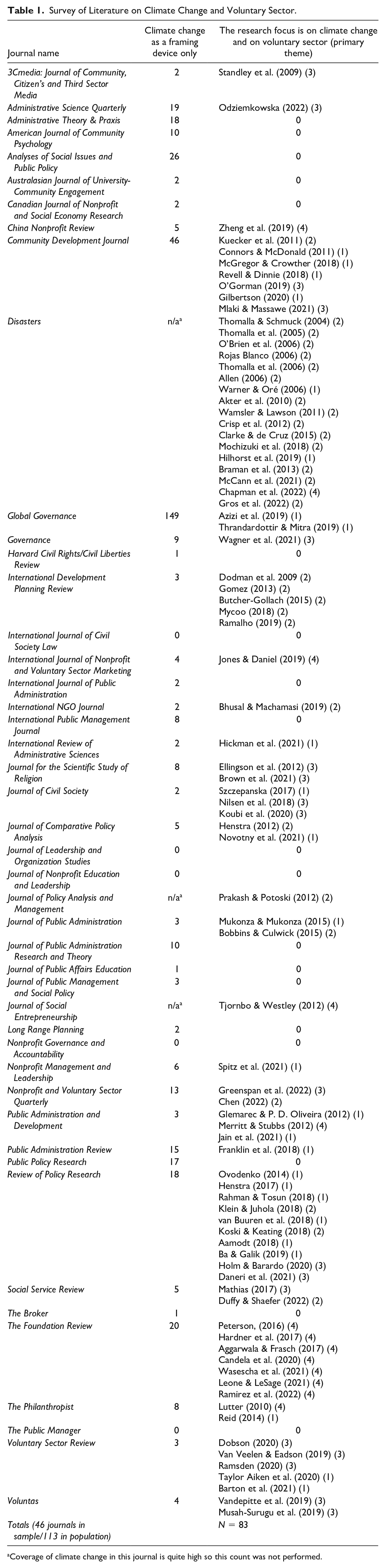
Coverage of climate change in this journal is quite high so this count was not performed.
There are limitations to this search strategy. First, the major search engines SCOPUS, Web of Science, and Google Scholar have not yet achieved global language coverage. This search therefore only includes English-language journal articles. Second, since these sources are also still accumulating scholarship and social sciences articles are not all online yet, this search was limited to what can be collected through online sources. In addition, a random sample may still produce erroneous conclusions, so we cannot generalize our findings to the entire literature on climate change and the voluntary sector. Also, we have omitted research books and unpublished (“gray”) literature. Finally, we deliberately restricted our search to the “usual suspects” in the voluntary sector, philanthropic, and public affairs journals given our main interest in summarizing knowledge within the voluntary sector research field. However, this choice means that we have excluded nongovernmental organization (NGO) or the voluntary sector research in other fields such as economics, sociology, and political science as well as climate-focused journals such as Nature-Climate, Climatic Change, Climate Action, and PLOS-Climate.
Analysis
The 83 articles identified by purposive selection are listed in Table 1. We offer two summary observations. First, the coverage of climate change appears to depend on the author and editorial discretion. Articles with this research focus can be found in usual suspects such as Disasters journal. However, when it comes to field journals, articles with a climate and voluntary sector focus can be found in journals such as the Review of Policy Research but not in similar quantity in equally broad journals such as the Journal of Policy Analysis and Management.
Second, about half the journals in our sample have yet to publish any content on the voluntary sector and climate change. These include many public administration journals where voluntary sector studies are covered but perhaps are not a priority as well as journals focused on planning, civil society governance and law, leadership, and public affairs education. We next turn to the content of the articles. Four related themes emerge: 3
Theme 1: Climate Mitigation and Adaptation Require a Multi-Sector Approach
Approximately 25 (30%) of the 83 articles explored “policy integration” or “governance integration” questions related to the growing call for collective approaches to mitigation and adaptation. These include work on the “new environmentalism” (e.g., Connors & McDonald, 2011), “green economy” (e.g., Mukonza & Mukonza, 2015), collective approaches to climate governance (e.g., Glemarec & Puppim de Oliveira, 2012), multi-sector climate adaptation policy (e.g., Henstra, 2017), and the role of non-state actors such as civil society institutions in implementing United Nation Sustainable Development Goals (SDGs) and in shaping “global normative frameworks” (e.g., Hickman et al., 2021; Jain et al., 2021; Szczepanska, 2017, p. 167). Two articles are also interested in critiquing voluntary sector participation in climate mitigation, such as conservation NGOs that generate moral hazards when they benefit from carbon offset programs (Gilbertson, 2021), or the legitimacy problems a global actor such as Greenpeace India encounters in the context of domestic politics (Thrandardottir & Mitra, 2019).
These articles cover the valuable practical ground for voluntary sector scholars interested in multi-sectoral policy intersections. Intellectually, they also challenge single-sector approaches and motivate us to view climate change adaptation as a crisis that demands a broader epistemological, disciplinary, and perhaps even ontological mindset if we are to study climate change as a multisector challenge. The boldest of these arguments finds empirical support for rejecting a government-centric approach to climate change adaptation policy altogether (Taylor Aiken et al., 2020), at least in some political economies, opening up more space for including voluntary sector actors in policy studies.
This body of literature, however, is also the most “top-down” in its perspective. It is not as interested in naming and differentiating among voluntary sector actors, or in addressing sector-specific outcomes, which limits the value it offers to capacity-building research. For example, this literature may overemphasize the role of leading nonprofit policy actors, particularly those operating transnationally, and may overlook emerging and marginalized actors. Furthermore, while this body of empirical work supports the helpful role of the voluntary sector in national and transnational policy discussions, where these actors may improve problem-solving (van Buuren et al., 2018), this work is less focused on the role of the sector in local policy implementation.
Theme 2: Voluntary Sector’s Role in Climate Mitigation and Adaptation
At the subnational level sits a body of research interested in the role of voluntary sector organizations in climate change adaptation and community resilience-building. Among the 27 articles we located (32%), the major two clusters focus on urban risk mitigation or on disaster response and recovery, but some articles address other topics such as the involvement of nonprofits in environmental regulation (Prakash & Potoski, 2012).
An adage sprinkled throughout this work is that “all adaptation is local,” so this body of work is a crucial part of the whole and certainly speaks directly to the place-based missions of many voluntary sector organizations. These scholars get practical, closely examining how intersectoral institutional relationships improve severe weather forecasting in West Africa (Braman et al., 2013) or in how high denial rates for FEMA assistance impose burdens on poor communities in South Carolina which the voluntary sector must then address (Duffy & Shaefer, 2022). Some of this work also addresses the need for professional integration, identifying, for example, the programming gap between general humanitarian aid and climate-related humanitarian aid (Clarke & de Cruz, 2014; McCann et al., 2021) or the gap between the emergency management/disaster risk reduction and climate adaptation practitioner communities (O’Brien et al., 2006; Thomalla et al., 2006). Some of the work also addresses barriers to voluntary sector integration in risk mitigation, such as Koski’s and Keating’s (2018, p. 691), caution to not view NGOs too much as “targets and tools” for public policy implementation without accounting for the capacity and perspectives of these organizations.
Our sense is that some of this research overemphasizes the “usual suspects” in voluntary sector disaster response (e.g., the Red Cross). In addition, while the strong focus on urban risk mitigation is appropriate (after all, most populations live and most voluntary sector organizations operate in urban areas), it tends to ignore rural communities, which have high vulnerabilities to climate issues and are often resource-disadvantaged, especially in developing countries.
Theme 3: The Voluntary Sector’s Role in Environmental Advocacy
Work in this cluster of 18 (22%) articles addresses voluntary organizations in local environmental politics (e.g., Daneri et al., 2021), environmental justice movements (Vandepitte et al., 2019), advocacy and litigation coalitions (Aamodt, 2018; Holm & Berardo, 2020; Nilsen et al., 2018), the role of religious and indigenous organizations in environmental conservation teaching and awareness (e.g., Brown et al., 2021; Ellingson et al., 2012; Mlaki & Massawe, 2019; Standley et al., 2009), nonprofit scientific institutions as brokers of credible climate change information (e.g., Wagner et al., 2021), and the role of voluntary organizations in participatory governance or as democracy-building, bottom-up actors in climate action (e.g., Greenspan et al., 2022; Van Veelen & Eadson, 2019). Two articles address advocacy organizations vis-à-vis the commercial sector (e.g., Odziemkowska, 2022; Spitz et al., 2021).
This work is valuable in describing how both success and challenges arise in climate organizing. Musah-Surugu et al. (2019), for example, criticize the absence of much “bottom-up” research on environmental organizations and find that in the Ghanian context, these organizations must use both direct service and advocacy to build local climate adaptation action, while Mathias (2017) uses an Indian case study to observe the limits on “outside-in” environmental organizing (i.e., by non-locals).
Critiques of advocacy strategies also appear. Dobson (2020) uses the term “integrative marginalisation” to observe how policymakers can simultaneously welcome environmental advocacy organizations into climate action discussions but remove them from decision-making. Finally, certainly, a concern for some scholars is the relative dearth of articles on climate justice advocacy.
Theme 4: The Role of Philanthropy in Climate Mitigation and Adaptation
This smallest cluster of 13 (16%) articles addresses philanthropy’s role in implementing United Nations SDGs, including “green growth,” “green finance,” and other forms of climate financing (e.g., Leone & LeSage, 2021; Merritt & Stubbs, 2012) and in adaptation and mitigation (e.g., Wasescha et al., 2021). The majority of this work addresses institutional action (foundations or government) but some research addresses individual donor behavior. We note here the important role that The Foundation Review, published by the Dorothy A. Johnson Center for Philanthropy at Grand Valley State University, plays in describing various foundation efforts in environmental sustainability and climate change adaptation.
Some of these articles address central and important questions of philanthropic capacity and strategy in the face of the climate crisis (Hardner et al., 2017; Jones & Daniel, 2019). One article examines the distribution of environmental grantmaking on a national (Canadian) scale (Lutter, 2010). As a whole, this group will be useful to scholars interested in institutionalized philanthropy’s approach to impact investing as well as foundations’ impact on climate justice movements.
Discussion
A few more observations are worth mentioning. We note first the youth of this body of research, where the majority was published in very recent years. We note as well the wonderful geographic diversity of these articles, which span six continents and multiple national contexts within each continent. This finding suggests that voluntary sector scholars looking for more geographic diversity in climate change scholarship should expand their literature searches, most especially to include community and international development journals.
We also note a few special issues and symposia devoted to climate change. For example, Disasters, Voluntary Sector Review, and the American Journal of Community Psychology published special issues on sustainability and/or climate change. These articles did not always address voluntary sector institutions by name but did address themes closely related to voluntary sector activity, including community organizing (Okvat & Zautra, 2011), climate activism (Culley & Angelique, 2010), coalition-building, and multilevel governance. These curated collections bring additional prominence to the topic in a way that individual articles cannot, so we welcome this trend and thank NVSQ for the opportunity to contribute its first special issue on the same topic, to which we now turn.
Introduction of the Symposium Articles
This symposium project began with a call for papers for an online conference on “Climate Change and the Voluntary Sector.” We issued a call for papers in December 2020 and received 34 submissions from scholars located in 12 countries. These submissions examined different types of voluntary sector organizations and worked with a range of methodological approaches. We short-listed 20 for the online conference in August 2021 as those that seemed most relevant to the journal’s focus and mission. All authors participated in peer-reviewing these conference papers. After the conference, in consultation with NVSQ editors, the guest editors identified 10 papers for submission to the journal while also providing written feedback to all authors and assisting with publication in other journals. Following the standard peer review process, we conferred with the NVSQ editors to select five articles for inclusion in this symposium. We are delighted to present these articles.
One distinctive (and, we hope, valuable) aspect of this symposium is that it includes two literature surveys undertaken by different groups of authors. We now turn to this second review article which examines how the voluntary sector is engaging with the climate crisis. “The Third Sector and Climate Change: A Literature Review and Agenda for Future Research and Action,” co-authored by Jennifer Kagan and Jennifer Dodge, starts with the observation that “third-sector organizations play a critical role in the climate crisis by advocating for policy change” (p. 2) in ways that instrumentally supplement the limited capacity of governments and markets. If climate change is a global “commons” problem, how have third-sector organizations participated either in advocating for climate regulations or in supplying tangible climate products and services? And how can this understanding of past scholarship build an agenda for future voluntary sector climate action?
Methodologically, Kagan and Dodge start with a deep dive into four key civil society journals (NVSQ, NML, NPF, and Voluntas) and eventually broaden the review to another 44 journals. In total, the paper reviews 68 articles on how voluntary sector organizations are responding to climate issues. Conceptually, it suggests that policy and service activities vary along two dimensions: (a) focusing on advocacy or implementation and (b) occurring within or outside government. Consequently, based on a 2X2 matrix, Kagan and Dodge identify four mechanisms by which nonprofits are addressing climate issues. It finds that 57% of the articles study policy advocacy within the government but only 9% study policy implementation (such as technology development or managing conservation easements) outside the government.
This analytic approach is nicely practical, helping us understand with more precision than we accomplish in our editorial literature review the mechanisms for voluntary sector influence and offering some ideas for future research into the most effective strategies. Both our review and that of Kagan and Dodge also independently note how voluntary sector action can be obscured in policy research even while this sector plays a key role in climate governance and serves as an essential actor in both climate change mitigation and adaptation. Kagan and Dodge raise the question of why scholars have taken this focus, specifically, why is the study of advocacy more pronounced than the study of direct service provision? One reason might be that because much of the climate debate focuses on mitigation, a global policy issue, the challenge is to motivate governments to enact policies. Hence, voluntary sector organizations are focused more in terms of climate advocacy as opposed to the delivery of climate services or products. Of course, in the economic development field, nonprofit scholars probably focus more on climate adaptation as opposed to mitigation because adaptation creates local public goods that directly impact local economic development.
While Kagan and Dodge note voluntary sector organizations emerge due to the twin failures of the market and state, might governments and service delivery nonprofits complement each other as well? The supplementary relationship (reflecting government failure) is expected to result in a negative association between the sizes of the government and nonprofit sectors while the complementary relationship would lead to a positive association. Moreover, while the supplementary relationship assumes that nonprofits and governments work in different niches, and thus do not collaborate, the complementary model emphasizes collaboration because governments and nonprofits work together.
Exploring the supplementary–complementary relationship is critical to understand why the salience of voluntary sector studies might vary in the climate field, a critical issue motivating this symposium. “Nonprofit Sector Size and the Breadth of Local Government Climate Actions: Exploring the Moderating Role of Collaboration,” co-authored by Yuan Cheng, Angela Park, and Rachel Kraus, explores whether government–nonprofit collaboration in urban climate governance moderates the association between the size of the environmental nonprofit sector and the number of local government climate actions. Drawing on a sample of 507 U.S. cities with populations of more than 20,000, it finds that only moderate levels of collaboration support the association between the number of environmental nonprofits in a city and the breadth of local government climate actions. This relationship does not hold when the level of collaboration is high, which suggests that at least from the municipal climate governance perspective, there are diminishing returns for governments when they collaborate with nonprofits. This raises an important question of whether higher levels of engagement with the nonprofit sector facilitate a higher level of policy action, or whether they cause policy deadlocks by creating multiple veto points.
Climate change could be viewed as a specific type of environmental challenge. If so, environmental organizations should take a leadership role to engage in climate issues. Yet, voluntary sector organizations face resource constraints that compel them to prioritize issues they should work on. Moreover, some organizations have specific niches; hence mission expansion could undermine their core competencies. Still, one might argue that all environmental organizations will probably embrace climate issues because climate change dominates the environmental policy agenda. “Adapted to Climate Change? Issue Portfolios of Environmental Non-governmental Organizations in the Americas,” by Jale Tosun and Emiliano Levario Saad examines variations among environmental organizations’ work on climate change issues. The article examines 293 environmental organizations based on 22 countries of North, Central, or South America. The environmental bona fides of these organizations are reflected in their affiliation with the International Union for Conservation of Nature.
Tosun and Levario Saad find that while generalist organizations tend to have a higher likelihood of tackling climate change issues in relation to specialist organizations, there are variations among the latter. Specifically, among specialist organizations, sustainability-focused organizations are more likely to tackle climate issues compared with the ones focused on conservation. These findings raise the question of whether mission expansion is more likely in generalists than specialists, and why some specialists are more willing to expand their missions to new areas. Future work should focus on the holdouts and what motivates them not to embrace climate issues.
Climate issues potentially compete for salience with other policy priorities, but at the same time, many climate challenges intersect with other policy concerns, especially concerning social justice. Under what conditions do environmental organizations ignore or coopt intersecting policy concerns? “Characteristics of Large Environmental Nonprofits That Identify Climate Change and Social Justice as Focal Concerns,” co-authored by Erik W. Johnson, Azdren Coma, and Sam Castonguay examines the uptake of social justice and climate change among the largest U.S. environmental organizations, as reflected in their mission statements.
Johnson et al. find that 8% of large environmental organizations identify climate as a focal issue and 10% identify social justice as a focal issue. Larger organizations as well as the ones that have emerged more recently (as opposed to legacy organizations) are most likely to work on both climate and social justice at once. Of course, there is variation in issue focus depending on the types of environmental issues these organizations work on. The authors find that consistent with Tosun and Levario Saad, wildlife groups are least likely to identify climate change and/or social justice as their focal issues. Energy and natural resources orgizations are the most likely category to identify climate and (along with wildlife groups) the least likely to focus on social justice
While previously we suggested how climate change might overlap with other policy domains, climate policy itself has multiple dimensions. Scholars typically identify two pillars of climate policy: mitigation and adaptation. By reducing greenhouse gas emissions, mitigation produces a global public good. It is, therefore, susceptible to a free-rider problem, which poses challenges for governments seeking to enact regulations to facilitate decarbonization. It should not come as a surprise that most voluntary sector organizations focus on climate advocacy to motivate governments (and, increasingly, firms as well) to enact policies that will support emission reductions via net zero emission targets (carbon capture, another mitigation mechanism, has yet to get traction).
The second dimension of climate policy pertains to adaptation, which tends to produce local public goods such as a more resilient community and hence faces fewer collective action problems (Dolšak & Prakash, 2018). Given its local focus, we expect local climate organizations that provide tangible products to be active in the adaptation field. But adaptation takes place in many ways, including reactive policies such as providing disaster relief and supporting long-term recovery, as well as proactive measures to shield the population, local infrastructure, and the ecological system from the effects of climate change. While many organizations work in these fields already, it is less clear if they view their work in terms of climate adaptation. Because if they do not, then both scholars and policymakers are undercounting the salience of disaster response in the climate field. And if they do (as the articles by Johnson et al., and Tosun and Levario Saad suggest), we need better ways to integrate and coordinate activities of voluntary sector organizations that have included climate change in their portfolios.
“Resilience in Recovery? Understanding the Extent, Structure, and Operations of Nonprofits Meant to Address Disaster Survivors’ Unmet Needs,” co-authored by Michelle Annette Meyer, Mason Alexander-Hawk, J. Carlee Purdum, Haley Yelle, Jordan Vick, Adrian Rodriguez Saul Romero, and Kenneth Anderson Taylor examines a specific category of service-delivery nonprofits: those engaged in long-term disaster discovery by undertaking tasks such as case management, constructing and repairing homes, paying medical and utility expenses, and coordinating child care/education/work needs. These long-term recovery groups (LTRGs) are more akin to social service organizations as opposed to climate advocacy organizations. This also means that their organizational cultures, ways of functioning, and repertoires are also likely to be different from traditional environmental organizations.
Meyer et al. examine 455 local groups and four state-wide groups that covered 649 counties in the United States for the period 2010–2019. This article captures LTRGs that are not registered charities and brings into focus crucial elements of community disaster recovery. Conceptually, the authors are interested in whether these groups position themselves as a supplementary response to government failure (providing services that FEMA does not cover) or as complementary to local government emergency services. They find both relationships occur. While LTRGs are more likely to operate in population centers with greater social vulnerability and greater racial diversity, some do integrate services with public agencies and they are geographically clustered around areas prone to flooding, especially coastal flooding.
The authors observe that, surprisingly, very few LTRGs include climate change in their mission or activity descriptions. This and their weak funding patterns suggest LTRGs do not (at least yet) view their role in climate response as a potentially permanent one. The need to link disaster response to climate adaptation is something our review and that of Kagan and Dodge also note. Meyer et al. suggest more research into whether and how LTRGs, with their distinctive understanding of community disaster vulnerability, can promote future adaptation and resilience-building.
Conclusion
In this editorial introduction, we have thematically analyzed the past voluntary sector literature related to climate change and introduced five new articles into this collective body of work. We use this final section of our introduction to discuss what this literature jointly accomplishes and to offer our thoughts on where future scholarship might address gaps and enrich our understanding of climate change as a voluntary sector issue.
An important takeaway from both literature reviews is that the scholarship on the voluntary sector and the scholarship on climate policy/climate response tends to operate in two separate domains, and the scholarship at the intersection of the two remains thin. It is more common to use “climate change” as a framing device to examine other large, collective action problems the voluntary sector takes on than it is to empirically or conceptually address the role of the voluntary sector in the context of climate change. It is also more common for scholars to conceptually differentiate voluntary organizations as advocacy actors from ones that provide climate-related services. Overall, we see research “integration” (across journals, across conceptual frameworks, and many other levels) to be the central imperative in future work.
In addition, we identify six areas for future research that emerge from this symposium. First, because climate change is already in motion and the Paris Agreement’s target of limiting global temperature increase to 1.5C in relation to pre-industrial levels is becoming difficult to achieve, the world needs to invest more in climate adaptation. The 2021 Glasgow Conference of Party Meeting acknowledged this reality and pledged billions of dollars of adaptation-focused aid. As adaptation tends to have a local focus (the second theme we identify in our review), the role of service delivery nonprofits will become more salient as they complement governmental efforts as well as step in when governmental efforts are inadequate. This need provides an excellent research opportunity to test different models of government-nonprofit relationships, especially in different global political and institutional contexts. Indeed, along with social and economic institutions, the nonprofit sector will need to adapt to climate change as well. What sort of institutional adaptation in terms of nonprofit mission, fund-raising, volunteering, and organizational communications to stakeholders might take place should be an exciting area for future research.
Second, climate change has important economic and social justice dimensions. As the severity and frequency of extreme weather events increase, the number of natural disasters increases as well. The National Oceanic and Atmospheric Administration (NOAA) reports that in the United States, the monetary damage from 285 disasters in the last three decades exceeds $1.875 trillion. 4 Looking beyond the United States, the 2022 floods in Pakistan have reminded the world of the vulnerability of low-income countries and poor communities to climate change. Yet, world opinion seems less mobilized by the slow onset events such as droughts and sea level rise than by quick onset events such as hurricanes and floods. The historical body of scholarship and the articles we introduce here make a compelling case for a “whole community,” social response to climate change. It is not clear if the level of voluntary sector mobilization follows a similar pattern, so we encourage scholars to consider addressing this research gap.
Third, climate policy is facing an unexpected challenge: pushback in rural areas to renewable energy projects. NGOs representing historically marginalized groups such as indigenous nations are leading some of these protests. The climate icon Greta Thunberg recently joined the indigenous Sami community in opposing wind farms in Norway. 5 This opposition cannot be subsumed as counter-mobilization by fossil fuel interests or climate deniers because these groups are not opposed to climate action per se but to renewable energy projects located in their territories. Some of the opposition is motivated by not-in-my-backyard dynamics, particularly in rural areas where landowners fear declines in property values. But in other instances, NGOs believe that new projects are violating sacred grounds, or hurting endangered and threatened species. Thus, future work should look at varieties of climate activism, moving beyond the simple dichotomy of the climate movement and counter-movement to incorporate the full diversity of perspectives.
Fourth, all voluntary sector organizations, whether in the environmental field or not, will need to expand their portfolio of activities to address climate change. Climate change is a problem accelerator and problem multiplier for many issues of concern to the voluntary sector. Refugee flows, economic dislocation, and health problems are linked to climate change. And any organization that does not believe its mission relates to climate change may still be forced to adjust its planning to account for the ways in which a warming planet will affect operations. Applying just one example, the vast global network of organizations serving people with intellectual and developmental disabilities is well known for its careful approach to emergency planning. 6 Is it planning differently now, for the greater impacts and unpredictability of natural disasters that climate change brings to its vulnerable populations? In other words, we suggest scholars who have traditionally not studied environmental issues will probably need to expand their scholarly repertoires. At the same time, climate science and policy scholars outside the voluntary sector field might consider the benefits of engaging with the related voluntary sector issues of economic development, social service provision, gender rights, environmental health, and social justice, to name just a few salient issue areas.
Fifth, climate change provides an opportunity for scholars to revisit various theories that explain the emergence, growth, and demise of the voluntary sector along with specific strategies the sector has adopted in different issue areas. One remarkable part of climate advocacy is youth mobilization as reflected in the global leadership of Thunberg and the important role of the Sunrise movement (a U.S.-based youth movement seeking vigorous climate action) in U.S. politics. 7 Thus, for advocacy scholars, climate issues represent a new area of research that has a high salience for young people, meaning newly formed organizations must be understood alongside legacy organizations. Moreover, with the advent of social media, especially among youth, online advocacy has become important (and we included several papers addressing social media use in the climate context in our aforementioned August 2021 conference). Future work could compare advocacy among traditional policy issues and the climate movement to examine similarities and differences in their tactics and how social and institutional contexts might shape them. Similarly, climate change will shape the population ecology of charities and philanthropies working on social service delivery. Might this allow existing organizations to repurpose themselves or are least expand their mission, or might this create a new cadre of charities and donors devoted to climate service delivery?
Finally, does the rise in the policy salience of climate change crowd out attention and resources devoted to other policy areas—and by implication the organizations working in these areas? The AIDS epidemic had a profound impact on the public health agenda, often crowding out other health issues. The same argument could be made in the context of COVID-19 as well. In the conservation field, disproportionate attention and resources are devoted to preserving the charismatic flora and fauna, often to the neglect of others. Thus, future research could examine if climate change expands or integrates resources devoted to the voluntary sector so that pressing societal needs are not neglected and do not crowd out resource flows to other issue areas. In this context, the role of private foundations will become important because they have often driven the agenda in the public health field (the so-called Gates Effect: McCoy et al., 2009) and to some extent K–12 education field as well. Thus, it will be important for scholars to monitor if the resource dependency of some parts of the voluntary sector on large foundations drives the climate agenda in specific directions.
Footnotes
Appendix
Data Availability Statement
Please contact authors directly about data availability.
Declaration of Conflicting Interests
The author(s) declared no potential conflicts of interest with respect to the research, authorship, and/or publication of this article.
Funding
The author(s) received no financial support for the research, authorship, and/or publication of this article.
