



Abstract
This article is a comprehensive empirical overview of environmental protection and conservation nonprofits’ discourse on social media. To what extent have these nonprofits framed climate change in their public discourse and how has it evolved over time? How do organizational characteristics and resources affect their social media behavior? To address our research questions, we use machine learning with texts—specifically topic modeling—to track the activity of 120 environmental nonprofits during a 14-year time span on X, formerly known as Twitter. Our analysis of more than 1.3 million tweets shows that climate change, although not closely aligned with the missions for more than half of the top tweeting organizations included in our sample, has consistently been a prevalent priority issue on their social media agendas for more than a decade. This heightened attention to climate change discourse by the environmental nonprofit sector denotes their uniform efforts to inspire government for climate action.
Introduction
As the threat of climate change becomes ominous, policy makers urge for immediate actions to reduce global warming and to minimize its impacts (Intergovernmental Panel on Climate Change [IPCC], 2022). Rising sea levels, extreme weather events, fluctuating precipitation patterns, and severe consequences of global temperature accelerations will particularly and disproportionately affect vulnerable communities across the globe (IPCC, 2022). These same communities are the very beneficiaries of the services that nonprofit organizations provide. Given the urgent need for immediate climate action and for finding sustainable climate solutions to avoid catastrophic ends (Gates, 2021), it is particularly important to study how climate change has impacted nonprofit organizations and how the voluntary sector is adapting due to various aspects of climate change (Gazley & Prakash, 2023; Kagan & Dodge, 2023).
This study explores the emergence and evolution of climate change discourse among environmental protection and conservation nonprofits’ (EPCN) issue agendas on social media. This is an important question to answer given the role of nonprofit organizations in public policymaking (Balassaiano & Chandler, 2010)—in particular through policy advocacy and lobbying (Fyall & McGuire, 2015; Prentice, 2018) via issue framing (Bies et al., 2013; Vu et al., 2021), civic engagement (Piatak & Mikkelsen, 2021), and mobilization functions (Greenspan et al., 2022). Mapping the discourse of EPCNs on social media is of importance for two reasons. First, as we know from the agenda-setting literature, policy decision-making processes are incomplete and are bounded by attention spans that drive why systematic agendas in the policy milieu may only focus on a certain number of issues at a time (Baumgartner & Jones, 2009; Jones, 1994, 2001). Consequently, learning about the discourse of EPCNs, which we argue determine their issue agendas on social media, will help us draw parallels with issues in political systemic agendas to discern associations between these issues and policy outcomes. Second, examining EPCNs’ social media—and, in particular, behavior on the platform formerly known as Twitter—as it pertains to climate issues is pertinent given the findings from extant research on the use of this platform for promoting issue attention and mobilization, framing policy debates, and eventually leading broad social change (Wu, 2022; Goldkind & McNutt, 2016; Guo & Saxton, 2020; Gupta et al., 2018; Lovejoy & Saxton, 2012). (We refer the platform as “Twitter” throughout the paper as opposed to its current name, X, since the tweets were all generated under the platform’s old name. This allows us to maintain consistency between how we refer to the platform and how tweets in our data refer to the platform.)
Inspired by the call for more research on the voluntary sector within the climate crisis context (Gazley & Prakash, 2021, 2023), the purpose of our study is to explore how EPCNs are addressing the growing threat of climate change in their social media discourse. Specifically, we ask, what are the prevalent topics on EPCN social media issue agendas? To what extent have EPCNs framed climate change in their public discourse and how has this discourse evolved over time? How do organizational characteristics and resources affect EPCNs’ social media behavior? We track the Twitter discourse of 120 EPCNs over the last decade through their published tweets by using machine learning—specifically a form of natural language processing known as topic modeling—to create a mapping of the topical issue agendas these organizations have been engaged with over time.
This article, while empirical and exploratory in nature, makes the following contributions to the literature. First, by analyzing the entire population of tweets by ECPNs for over a decade we are able to map their issue agendas in Twitter as it pertains to climate change and other important challenges (UN Environment Program, 2020). Second, through topic modeling of more than 1.3 million published tweets from EPCNs over a 14-year period, we discern the prevalence of climate change in EPCNs’ social media agendas. We then derive the proportion of discursive space consumed by climate change topics and track their temporal evolution conditioned by major environmental events. Finally, our study speaks to other important research on nonprofit social media advocacy by assessing EPCNs’ social media behavior in relation to their mission categories, organizational characteristics, allocated resources, and public engagement with their published tweets. Practically, this bird’s eye view depiction of ECPNs’ social media behavior may foster future theory-testing scholarship.
Nonprofit Advocacy Through Social Media
Nonprofit organizations play an important role in public policymaking by influencing various stages of the policymaking process through advocacy and lobbying (Balassaiano & Chandler, 2010; Fyall & McGuire, 2015; Prentice, 2018) and by providing space for civic engagement, assembly, and expression of diverse opinions (Skocpol & Fiorina, 2004; Warren, 2001). The invention of digital public space and advanced interactive technologies has created low-cost opportunities for social change (Goldkind & McNutt, 2016). In addition to the cost, extant research shows the use of social media in nonprofit advocacy has positive impacts for gaining support and increasing awareness (Guo & Saxton, 2020), creating opportunities for public engagement (Wu, 2022), and even fostering civic engagement offline for broader social change (Piatak & Mikkelsen, 2021). In particular, Lovejoy et al. (2012) find that organizations used Twitter to share information and seek instrumental support. Furthermore, Lovejoy and Saxton (2012) propose a hierarchical conceptualization of nonprofit social media engagement. The first layer in their typology is sharing information about organizational activities or events. The second layer is community building as organizations use this messaging strategy to engage in various interactions with their stakeholders. The third layer is action solicitation from the followers.
In their seminal work, Nonprofit Advocacy in Social Media Age, Guo and Saxton (2020) develop “an attention-based theory of nonprofit advocacy” (p.154). They view “attention as [an] intermediate goal and important resource” for organizations to address public policy issues, voice citizens’ concerns, or influence public opinion. Viewing social media attention as a resource for nonprofit advocacy, Guo and Saxton (2020) demonstrate how nonprofit advocacy organizations seek, sustain, and transform that attention into tangible outcomes.
At the same time, the agenda-setting literature has demonstrated that decision-making processes in public policy making are “. . .incomplete and driven by severe limits on their attention spans” (Baumgartner & Jones, 2009, p. xxiii). This is the reason that political systems may only focus on a certain number of issues at a time (Baumgartner & Jones, 2009; Jones, 1994, 2001). Prior to this stream of research, Anthony Downs’ (1972) “issue-attention cycle” describes how, in the environmental policy domain, the public gains and then loses interest in issues over time. Downs (1972) states that “public perception of most ‘crises’ in American domestic life does not reflect changes in real conditions as much as it reflects the operation of a systematic cycle of heightening public interest and then increasing boredom with major issues” (p. 39). Before testing Downs’ (1972) theory on the “issue-attention cycle,” Newig (2004, p. 153) clarifies that opinions reflect beliefs and preferences, whereas attention reflects relative priority and weight given to certain issues from the available universe of issues.
Consequently, from nonprofit and political systems perspectives, attention is an ultimate objective and precious resource that competing forces try to gain and maintain. Given this background, we first ask
Our motivation behind this question is to gauge an understanding of the range of issue areas EPCNs have been trying to attract attention over time. We do so by collecting every tweet (excluding retweets) originally published by these 120 EPCNs over a 14-year time period as a measure of attention to priority issues these organizations try to center on their social media platform.
Public Discourse, Issue Framing, and Policy Space
Nonprofits’ use of social media is beneficial for achieving their advocacy objectives primarily due to its breadth of reach and ease of usage. Gupta et al. (2018) studied the messaging strategies of competing pro- and anti-nuclear advocacy groups on Twitter and found that both groups used narrative elements to either contain or expand the scope of conflict surrounding competing policy positions. In addition to Twitter’s utility for quick and sprawling stakeholder engagement, the study by Gupta et al. (2018) also shows how the limited space feature on Twitter may prompt organizations to prioritize the usage of certain messaging elements over others. Another important contribution in nonprofit advocacy literature is the study by Wu and Xu (2023), which centers on nonprofits’ roles in leading or echoing online public discourse. They track diffusion in climate discourse on the flow of homogeneous ideas and agendas, rather than retweets, and find that climate obstruction nonprofits draw reciprocity in Twitter.
The framing control function of nonprofits (Bies et al., 2013; Vu et al., 2021) is effective both in online and offline settings. For example, Bies and colleagues (2013, p. 10) look into the influence of individual core beliefs apart from traditional demographic characteristics by building on Stern et al.’s (1999) “value-belief-norm” theory. They find that citizen trust is more important than individuals’ memberships in environmental organizations (Bies et al., 2013). This study uncovers the role nonprofit organizations’ discourse may play in framing attitudes and policy choices for the wider public—particularly in social movement type settings.
Thus, in using social media for advocacy purposes, it is not only important to consider “who is doing the speaking to determine ‘the attention they get’” (Guo & Saxton, 2020, p. 110) but also to reflect on how exactly that attention is used. So, the second question we explore in this study is
It is important to note here that when referring to the term “discourse” we do not intend to claim we are conducting discursive analysis in this article. Neither do we claim to extract value-laden ideologies nor nuanced linguistic tactics used by EPCNs. Following many other scholars in nonprofits studies (see i.e., Tosun & Levario Saad, 2023, p. 3 line 11; Wu & Xu, 2023, p. 2 line 34, p. 3, line 5), our usage of the term “discourse” in this article means “a formal discussion, conversation and exchange of ideas.” 1 With the recent increase of “transdisciplinary research” in organizational studies (Chouliaraki & Fairclough, 2010), the social sciences have taken a “discursive turn” as discourse in organizational studies is not only the study of textual elements but also “the shaping of social reality through language” (Alvesson & Karreman, 2000, p. 1126). For instance, social movement scholars refer to ways in which movement framing impacts political effectiveness (Benford & Snow, 2000). Snow et al. (1986) show that social movement framing occurs when policy actors communicate their take on the policy problem, its solution, or reasons why given course of action should be supported. Building on this literature and keeping in mind that the climate movement is a type of social movement, it is particularly important to take a historical stock of EPCNs climate change discourse. To wit, our third research question asks:
To answer this question, we map the entire population of the discursive field of EPCNs to assess what proportion of the space is populated by climate change–related tweets. Following Snow’s (2008, p. 20) definition of “discursive space,” we refer to the “total volume or amount of space available for talk, discussion,. . ..—whatever its form or context that is or can be bounded in time, and often in physical space as well.” Snow (2008) further elaborates that the discursive space can be a concrete newspaper column or media in general. We extend the application of this concept to Twitter to gauge how climate change impacts the social media behavior of nonprofit organizations. This question is particularly important to examine considering nonprofits’ role in framing levels of concern about climate change and affecting policy reactions to certain solutions. Nonprofits’ potential for influencing public opinion as it pertains to climate change is particularly enhanced, given our political polarization on this issue across partisan and ideological divides (Jenkins-Smith et al., 2020). In these capacities nonprofits primarily engage in public-serving or political activities by playing an intermediary role between policy elites, the scientific community, and citizens by translating scientific findings for public consumption in the policy agenda (Bies et al., 2013; Lück et al., 2016).
Organizational Characteristics and Nonprofit Social Media Advocacy
Despite its important role, many nonprofits have been hesitant to engage in policy advocacy for fear that this engagement might be considered as direct lobbying (Gen & Wright, 2020; Prentice, 2018; Vaughan & Arsneault, 2021). Other considerations and constraints for engaging in policy advocacy is lack of staff and resource allocation for main programmatic activities (BoardSource, 2021). Evidence from extant research shows that larger national nonprofits are more likely to engage in policy advocacy than smaller local organizations (Lu, 2018). In the context of social media advocacy, Guo and Saxton (2020, p. 9) discuss “the resource challenge” that nonprofit organizations face in connection to the “relevance challenge” for exerting their influence in Twitter. They find that size of an organization’s network is positively associated with the attention and influence they receive on social media (Guo & Saxton, 2020).
A related study looks into the representation of social justice and climate change issues in mission statements of the largest U.S. environmental organizations and finds that 8% of them identify climate and 10% of them social justice as central issues (Johnson et al., 2023). Younger and larger organizations attend to both issues (Johnson et al., 2023). Consistent with their expectations, they find that wildlife groups are less likely to attend to these issues (Johnson et al., 2023). The latter finding is consistent with another important study that examines environmental organizations based in 22 countries of North, Central, and South America (Tosun & Levario Saad, 2023). They find that generalist environmental organizations are more likely to attend to climate change issues than specialist organizations, whereas from the latter group, sustainability-focused organizations are more likely to address climate change issue than wildlife or conservation groups (Tosun & Levario Saad, 2023).
Building on previous research, our study particularly aims to examine the social media behavior of environmental nonprofits as it pertains to climate change–related discourse. We ask
We answer this question by examining the associations between EPCNs’ organizational characteristics and allocated resources with their social media behavior. We further explore what the level of public engagement (likes, replies, retweets, and quote-tweets) is with those climate change–related topical issues. While exploratory in nature, our study provides a historical account and interesting insights on EPCNs’ social media behavior over the last decade as it pertains to climate change and suggests a research agenda for further inferential investigation. Next, we overview our methodological approach to answer our four research questions.
Method
Our empirical strategy comprised several steps. First, we created a sample of EPCNs and collected their Twitter usernames through their official websites. Then, utilizing Twitter’s open application programming interface (API), and specifically the v2 endpoints, we scraped the tweets published by these nonprofits over the course of a decade (specifically, 2008 to 2021). Furthermore, we used a topic modeling technique for short texts (such as tweets) to analyze the content of those tweets. Finally, to categorize our sample of nonprofits into specialized subgroups and compare their broad purpose or “subject of concern” on environmental issues with their Twitter agenda, we collected the mission statements of these organizations from their websites. We coded those missions into broad environmental policy categories to analyze the extent to which they were associated with the climate issue foci articulated on their website and their Twitter accounts.
Sample of Nonprofits
We identified environmental protection and conservation nonprofit organizations via Charity Navigator (CN, 2021), an independent nonprofit organization that classifies and evaluates charities by the kinds of programs and services they provide. We elected to sample our EPCNs from the CN due to practicality as it also provides tools to easily subcategorize organizations by their size, purpose, and geographic scope of activity (CN, 2021). As of April 2021, CN listed 337 nonprofits under the environmental protection and conservation category. We used stratified sampling to ensure we had organizations of various sizes and scopes in our sample. Namely, we stratified organizations first by their size and then by their scope of activity and then randomly selected every other organization in those subcategories. We aimed to get 40% coverage of the total 337 nonprofits listed there, and our initial sample had 135 organizations. However, we later had to omit some organizations due to unverifiable Twitter handles or absence of Twitter accounts. All 120 EPCNs in our sample are registered under tax section 501 (c) (3) “public charities” of the Internal Revenue Code (Internal Revenue Service, 2021). Table 1 presents the frequency distribution of the size and scope of those organizations. We can see from the table that they cover a range of sizes (up to US$3.5M, US$3.5M–$13.5M, and US$13.5M) and geographic scope of activity (regional, national, and international).
Frequency Distributions of Sampled EPCNs by Their Size and Scope of Work.
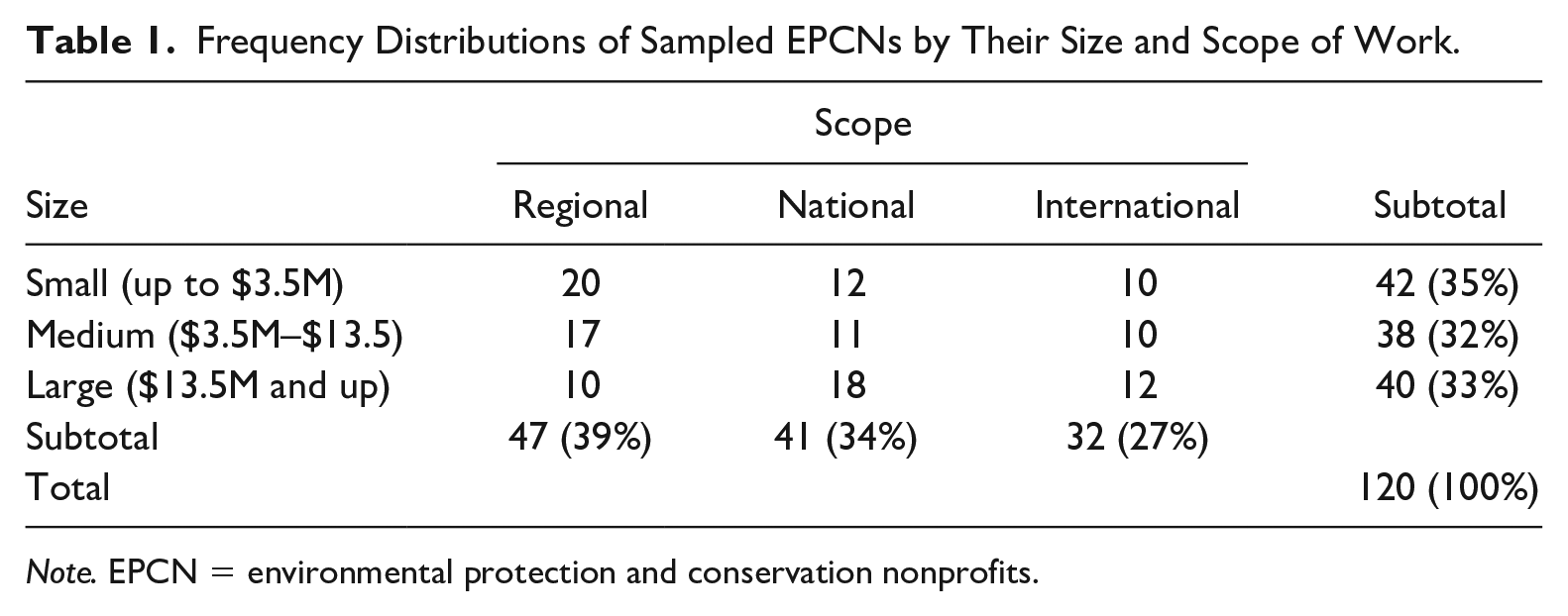
Note. EPCN = environmental protection and conservation nonprofits.
Sample of Tweets
We used Twitter’s Academic API and the academictwitteR package in R (Barrie & Ho, 2021) to scrape all tweets for the organizations from March 2008 to June 2021. After text preprocessing,
2
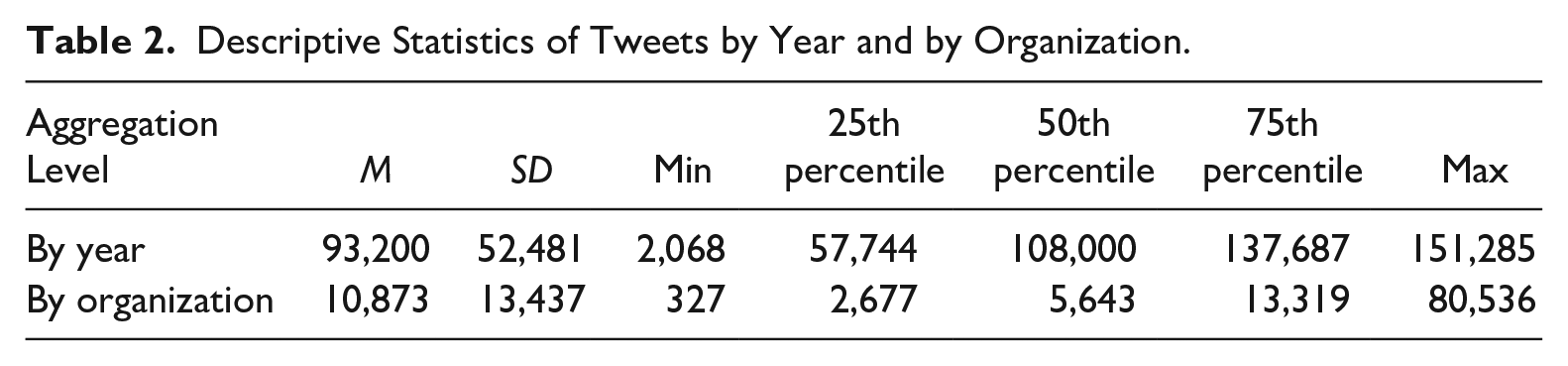
there were 1,304,807 public, non-deleted tweets (no retweets) in the analysis with 1,676 unique words/hashtags (also known as the “vocabulary”). Descriptive statistics for the tweets by year (14 years) and by organization (120 organizations) are provided in Table 2. The minimum number of tweets occurred in 2008; the maximum number of tweets occurred in 2017. The Center for Energy Efficiency and Renewable Technologies (with username @CEERT1) published the fewest tweets and the National Resources Council (
Descriptive Statistics of Tweets by Year and by Organization.
Variables of Interest
In line with extant literature to examine the association of organizational characteristics with nonprofits’ social media behavior, our variables of interest include the nonprofit’s age or year of establishment, size, scope of activity, and allocated resources. Organizational size is measured as the total functional expenses and was classified by CN into small (up to $3.5M), medium ($3.5M–$13.5M) and large ($13.5M; CN, 2021). Geographic scope of activity was classified as regional, national, and international (CN, 2021). Data on organizational resources were collected on both program expense and administrative expense ratios. The measure for program expense ratio reflects the percentage of total expenses a nonprofit spends on its mission-central programs and services. Dividing a charity’s average program expenses by its average total functional expenses yields this percentage (CN, 2021). The administrative expense ratio reflects what percent of its total budget a nonprofit spends on overhead, administrative staff, and associated costs and is determined by dividing a charity’s average administrative expenses by its average total functional expenses (CN, 2021). To measure social media engagement, we collected the count of likes, replies, retweets, and quote-tweets (Guo & Saxton, 2020) of nonprofits’ published tweets along with their year of joining Twitter, their number of followers, and the number of accounts they follow on Twitter. All public engagement counts are specific to the time at which the tweets were scraped.
Plan for Analysis
We used topic modeling to extract the latent themes—that is, “topics”—from the 1.3 million EPCN tweets. In contrast to conventional topic models that capture document-level word co-occurrence patterns, we employed an alternative algorithm optimized for short texts known as the biterm topic model (Yan et al., 2013). 3 We used biterm topic modeling (BTM) to identify 11 climate change–related topics (which we discuss in more detail in the Results section below).
After estimating and labeling the topics, we then explored the temporal evolution of the prevalence of those topics from early-2008 to mid-2021 (the earliest scraped tweet was published on February 29, 2008; the latest scraped tweet was published on June 16, 2021). Furthermore, we examined which EPCNs were more likely to tweet on a given topic. After that, we collected each EPCN’s mission statement from their websites and coded them by the stated purpose of the organization to compare their broad purpose on environmental issues as defined by their mission to their priority agenda on Twitter (as indicated by their derived tweet topics). Mission statement content was coded using the National Taxonomy of Exempt Entities subclassification system under code C (Environment) category developed by the National Center for Charitable Statistics (2019) at the Urban Institute. Table 3 presents the frequency of organizations in our sample by their mission category.
Frequency Distribution of EPCNs by Their Mission Categories.
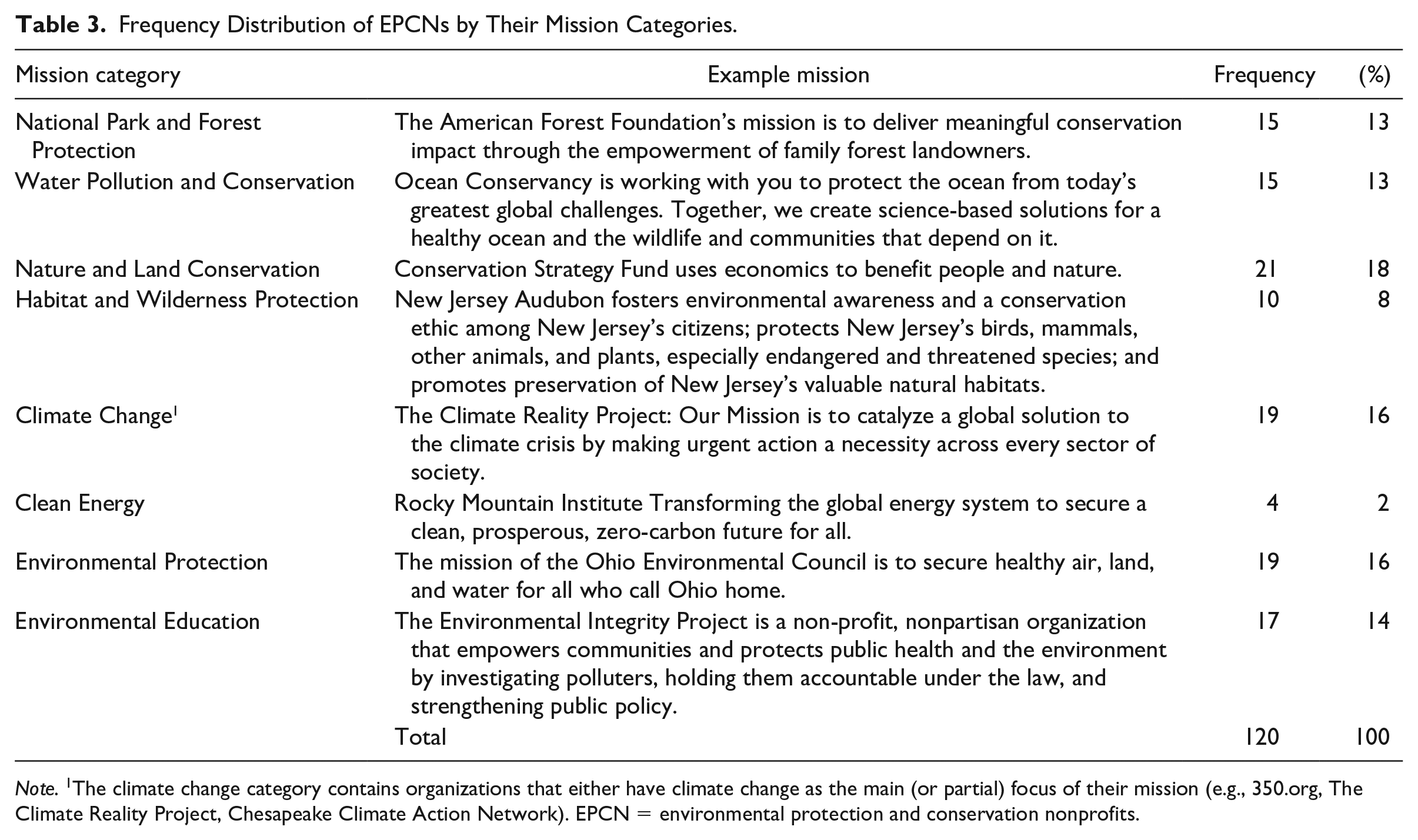
Note. 1The climate change category contains organizations that either have climate change as the main (or partial) focus of their mission (e.g., 350.org, The Climate Reality Project, Chesapeake Climate Action Network). EPCN = environmental protection and conservation nonprofits.
As we were interested in determining whether an EPCN states addressing climate change as part of their mission, we coded for whether the organizations in our sample had a “climate change” component or complete focus in their mission. All 16 organizations in Table 3 presented under the “climate change” code either had a mission that was completely dedicated to climate change issues or had a component in their mission aimed at climate change.
Finally, we ran correlation analyses to assess the association between EPCNs’ organizational characteristics (size, scope of activity, the number of followers, and number following) and allocated resources (program and administrative expenditures) with their social media behavior as well as their level of engagement with those topics (likes, replies, retweets, and quote-tweets).
Results
We first report the emergent topics from the tweets. Each topic is quantified as a probability distribution over the overall tweet vocabulary. As such, each of the 1,676 unique words in the analysis can be arrayed, per topic, from highest probability to lowest probability. The highest probability terms per topic can be used to interpret and “label” (i.e., make meaning out of) that topic. In what follows, we report the top 10 highest probability terms for each topic in Figure 1. As an example interpretation, consider topic #1, labeled as “Food Safety.” The highest probability term is “food.” That probability is 0.027. This means if one were to draw a word at random from the vocabulary weighted based on topic #1, there is a 2.7% chance that word would be “food.”
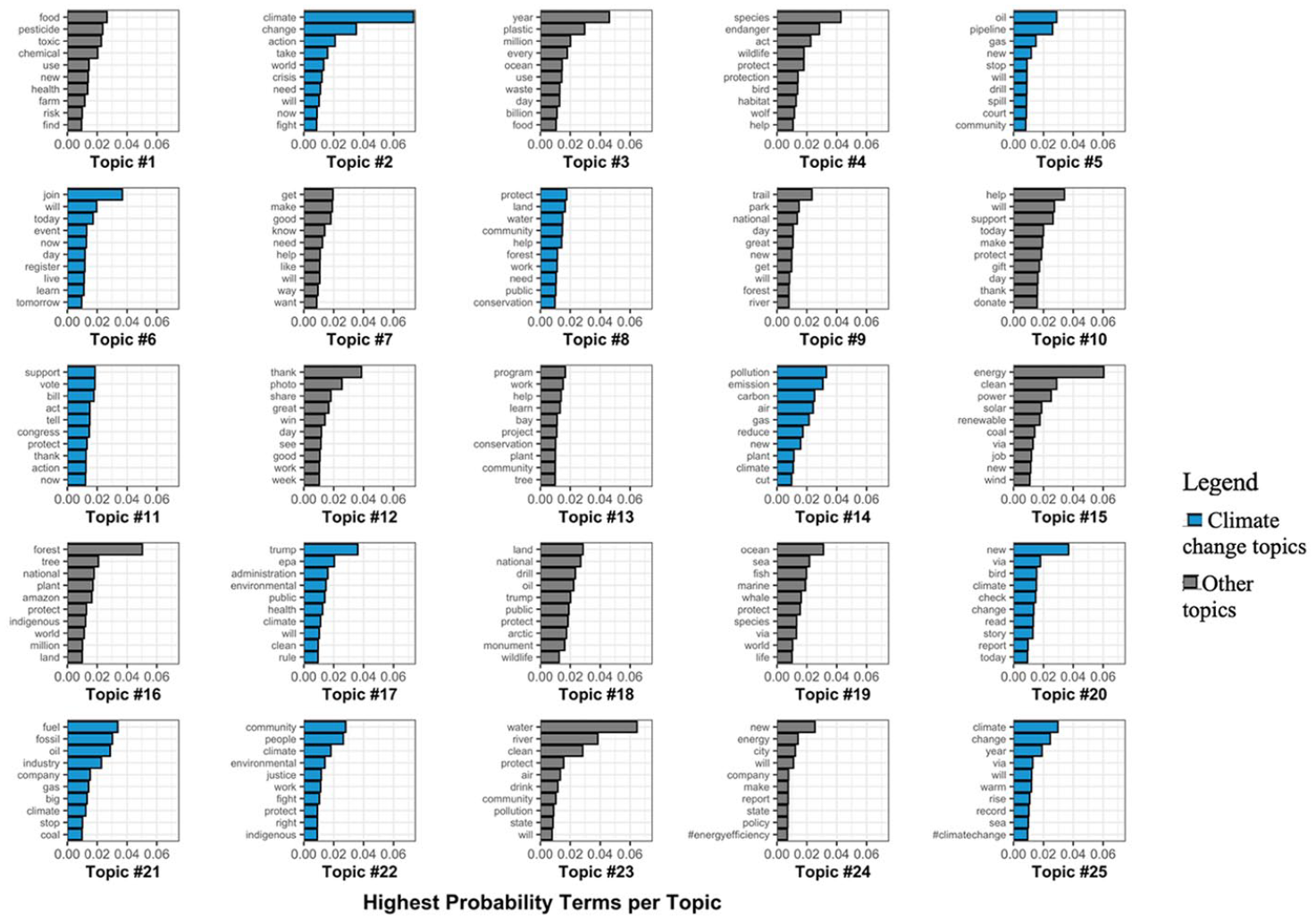
Ten Highest Probability Terms Per Topic.
After reporting the topics with their labels and key terms, we explore the extent an EPCN’s specific niche in environmental issues compared with their Twitter agenda. Furthermore, we track the temporal evolution of climate change discourse in EPCNs’ Twitter agendas over a 14-year time span, after which we assess the relationship of EPCNs’ organizational characteristics and resources with their social media behavior.
Emergent Topics in Tweets Published by EPCNs, 2008–2021
We estimated a series of biterm topic models with different numbers of topics and found that the 25-topic solution had the best statistical fit to the data in terms of mean exclusivity. 4 While the 25-topic solution was not the best in terms of mean semantic coherence (Mimno et al. 2011), it also had the best qualitative interpretability. Exclusivity is a measure of the extent to which a given topic tends to monopolize particular words; i.e., the extent to which a word tends to appear in one topic versus several topics (Bischof and Airoldi 2012). Our diagnostic tests (see Appendix A) indicated the 25-topic model solution had the best potential to generate meaningful topics that are distinctive from one another.
Overall, our analysis shows that there are 11 topics related to the subject of climate change (topics #2, 5, 6, 8, 11, 14, 17, 20, 21, 22, and 25). These topics are presented with blue bars in Figure 1 and makeup 44% of the overall derived topics. 5 Table 4 shows each topic with its corresponding number and the topic label deciphered based on key high-probability terms in that topic. 6
Emergent Biterm Topics.
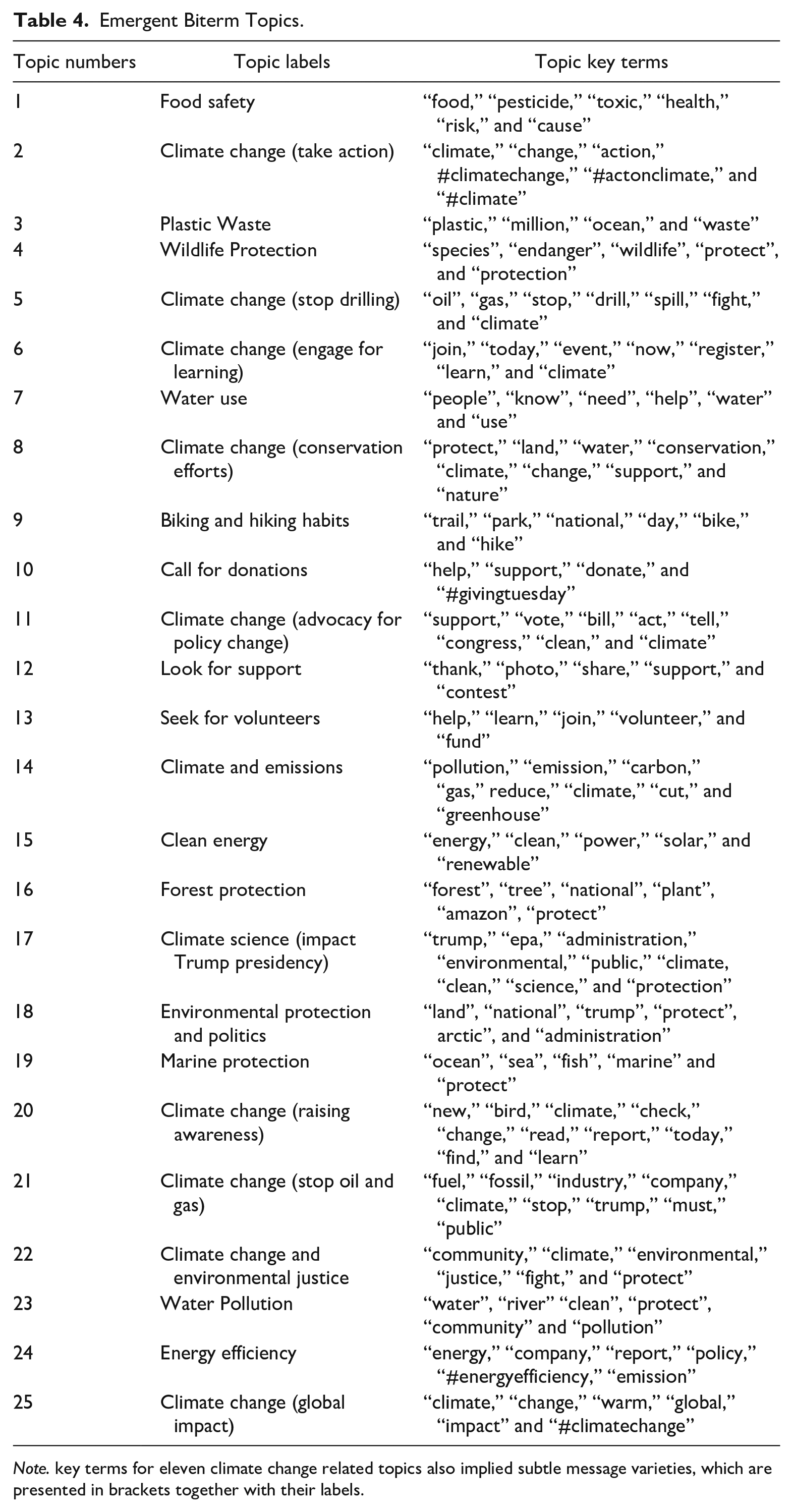
Note. key terms for eleven climate change related topics also implied subtle message varieties, which are presented in brackets together with their labels.
In addition, as Table 4 shows, topics #15 (“Clean Energy”) and #24 (“Energy Efficiency”) are related to clean energy and comprise 8% of the overall derived topics. Three topics (topics #10, 12, and 13) reflect attempts to engage with the public to look for support and comprise 12% of all of the emergent themes. Another set of three topics (topics #1, 3, and 9) engage with the public with an aim of educating them about certain issues or spreading healthy habits—like biking or recycling—and constitute 12% of the overall emergent themes. And finally, six different topics call for either general environmental protection (topic #18) or for attention to specific substantive areas (topics #4, 7, 16, 19, and 23). All these topics make up 24% of the entire emergent topics.
We also created a principal component analysis variable plot to evaluate our groupings of derived topics from published tweets in accordance with their semantic similarity in a two-dimensional plotting space (see Figure 2). The map is derived from a principal component analysis of the tweet-by-topic probability distribution. The plot supports our interpretation of the top probability terms in each topic. As we can see, for instance, Topics #15 and #24 (which relate to green energy) are grouped together with a green code, and climate change–related topics with a blue code. 7 In other words, topics that refer to the same general themes are clustered together in the space, as one would expect.

Principal Component Analysis Variable Plot.
Next, we examine whether nonprofits’ Twitter agendas are closely aligned with their missions.
How Does an EPCN’s Specific Niche on Environmental Issues Compare With Their Twitter Agenda?
In this section, we compare the extent to which an EPCN’s published tweets over this 14-year period reflect their organizational mission. Figure 3 below shows the top 10 organizations publishing tweets on each of the 11 climate change topics (i.e., the 10 organizations with the highest mean probability of engaging in the topic) irrespective of their missions. EPCNs that at least partially focus on climate change in their mission statements are highlighted in yellow. The figure shows that more than half of the organizations publishing tweets about climate change do not have it as a main (or partial) component of their mission. As a matter of fact, only 60% of EPCNs that focus at least partially on climate change in their missions are among the top tweeters about topics #2, 5, and 22; 50% for topic #25; 30% for topics #11 and 17; 20% for topic #14; and 10% for topics #6 and 21.

Top 10 Organizations by Mean Probability of Climate Change Tweet.
Next we present how those 11 climate change topics have evolved over time on these organizations’ Twitter agendas.
The Evolution of Climate Change–Related Tweets by EPCNs From 2008 to 2021
Figure 4 demonstrates that the evolution of climate change–related tweets published by EPCNs from March 2008 to June 2021 has overall increasing trends for six topics (Topics #5, 6, 8, 14, 21, and 22), noticeable fluctuations for three topics (Topics #2, 11, and 25) and an exceptional decreasing trend for Topic #20. While we will revisit these general trends in our discussion section, let’s make closer observations of certain topics that show stark particularities.

The Evolution of Climate Change Related Tweets by EPCNs From 2008 to 2021.
Topic #20—aimed at raising awareness for certain reports and other materials about the impact of climate change on birds—has been mostly discussed at the earliest stages of its emergence, from 2008 to 2010, and has been gradually decreasing in prevalence relative to the other topics in the analysis. Topic #2 shows extreme sensitivity to every milestone in environmental policy development over the last 14 years. If we recall, this topic is the most prominent of climate change-related topics that vividly calls for action and contains three climate change hashtags that appear as high probability terms. In line with the chronology of climate change policy developments, we notice a spike of tweets around 2015 when the Paris Agreement on climate change was singed (United Nations, 2016), another one around 2017 when President Trump announced the United States would exit from the Paris Agreement (NPR, 2017), a spike in 2019 when democrats proposed a Green New Deal to eliminate greenhouse gas emissions (H.Res.332–117th Congress (2021–2022), 2021], and a final spike in 2021 that might be connected with President Biden’s announcement on setting 2030 as a target date for greenhouse gas pollution reduction and on establishing U.S. leadership on clean energy technologies (The White House, 2021).
Similarly, Topic #25—calling for action to fight global climate change—shows sensitivity to the historical development of milestone events in the climate change policy domain but with less intensity compared with Topic #2. These fluctuations are also reflected in the temporal evolution of Topic #11, which is aimed at advocacy for policy change. The meaning derived from the key terms of this model “tell Congress to vote for a bill and protect our climate” might explain the spike noticed in 2017 in connection with former President Trump’s announcement on U.S. withdrawal from the Paris Accord (NPR, 2017). Topic #17—aimed at “advocating the executive branch and then President Trump for environmental protection and climate science”—shows a similar spike of tweets in 2017. In line with this finding, Topic #21—which called to halt fossil fuel emissions from the oil and gas industry, and includes “trump” as one of the top-twenty probability keywords—shows an increasing trend from 2017 and reflects a backlash reaction to President Trump’s decision on U.S. withdrawal from the Paris Accords (NPR, 2017).
Overall, the examination of the temporal evolution of climate change discourse shows consistency with the development of climate change–related environmental policy over that same time span. Next, we assess the association between EPCNs’ organizational characteristics and resources with their social media behavior.
How Are EPCNs’ Organizational Characteristics and Resources Related to Their Social Media Behavior?
We conducted a correlation analysis to assess the association between EPCNs’ organizational characteristics, allocated resources to their program, and administrative expenses with their social media behavior. As the correlation heatmap shows in Figure 5, EPCNs’ size, geographic scope of activity, number of published tweets, the number of followers and following, program and administrative expenses, and the level of engagement with those tweets are associated.
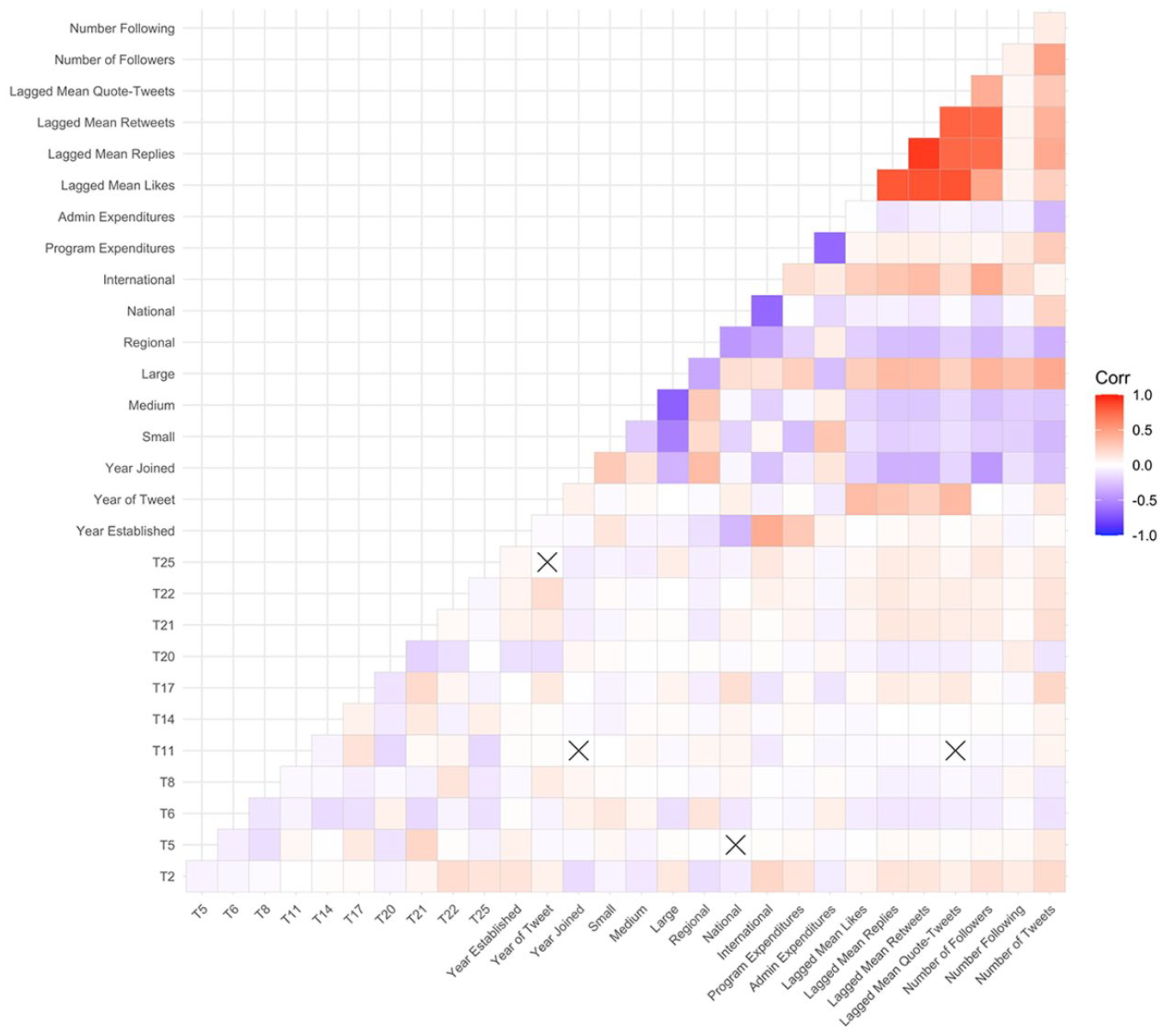
Correlation Heatmap.
In particular, smaller- and medium-sized organizations are less active in publishing tweets than larger organizations. Small- and medium-sized organizations also have fewer followers than larger EPCNs. This logically also affects the attention their published tweets get. We found low levels of engagement (likes, replies, retweets, and quote-tweets) with the tweets published by small- and medium-sized organizations compared to the ones published by larger EPCNs.
Similar to the size, the geographic scope of EPCNs’ activities is also associated with their social media behavior. Regional EPCNs are less active in publishing tweets, have less followers, and, thus, receive lower levels of engagement. On the contrary, national EPCNs are more active publishing tweets than international EPCNs, but have fewer followers, and their published tweets get lower levels of engagement than those of international EPCNs.
As mentioned earlier, we were also curious to test whether there is any association between organizations’ allocated resources—in particular their program and administrative expenses—with their social media behavior. We found program expense ratios to have a strong positive association with EPCNs’ number of published tweets while administrative expense ratios to have a strong negative association with the volume of published tweets. This relationship pattern is consistent across all other variables of engagement with the volume of published tweets; however, those relationships are weaker in magnitude.
In terms of nuanced message variations in the 11 climate change-related topics, we are able to detect that topics that were framed as calls for action to stop climate change (e.g., topic #2) or its global impacts (e.g., topic #25) have instigated higher levels of engagement than those topics that merely aimed to educate the public and raise awareness about the issue of climate change (e.g., topic #6, 8, and 20).
Discussion
Our first goal was to assess what the prevalent topics on EPCNs’ social media agendas are. To answer that question, we tracked the Twitter activity of 120 sustainability, wildlife protection, conservation, and climate change nonprofits over a 14-year time span and analyzed more than 1.3 million published tweets using biterm topic modeling. We found that more than half of the topics these organizations have discussed were about climate change and almost half of the sampled organizations were highly likely to tweet on at least one subject regarding climate change. Considering the selective and strategic nature of organizations to focus on certain issues rather than others due to limits of attention (Baumgartner & Jones, 2009), it is important to note that our longitudinal assessment shows that 44% of topical discourse among ECPNs on social media is directly related to climate change issues and 8% indirectly through discussions of energy efficiency and clean energy. Baumgartner and Jones’ (2009) explanation on the connection between issue definitions and agenda setting helps us contemplate on the “so what?” question. This heightened engagement with climate change–related topics by EPCNs underscores their attempts to push the government to climate action by, metaphorically speaking, trying to push these issues from their issue agendas on social media to political institutional agendas. Although the absence of a comprehensive climate action bill is known, this is an important implication to be tested in future research by parsing out how far these advocacy efforts have traveled to reach political systemic agendas.
Although we did not directly test the relationship between organizational mission and their engagement with climate change-related topics, we did sparce out the 11 climate change-related topics to see who the top tweeters on these topics are and juxtaposed this information with these nonprofits’ organizational missions. Our observation shows that EPCNs with climate change as their central or partial foci reflected through their missions have an equal frequency tweeting about climate change–related topics. This finding implies that EPCNs’ issue agendas on social media are not always reflective of their organizational missions. This makes us wonder about the implications of this social media behavior for these organizations’ human capital resources as well as social capital. As Guo and Saxton (2020) state, nonprofits’ resources allocated to human capital affect the relevance of their Twitter messaging. This, in turn, may also affect the social capital nonprofits accumulate based on the engagement networks their Twitter activity generates. This is one of the reasons Guo and Saxton (2020) recommend nonprofits adopt strategic messaging techniques on social media. While climate change is unarguably one of the biggest environmental issues society faces, it is not the only one. Our study complements other important research in this domain (Johnson et al., 2023; Tosun & Levario Saad, 2023) by showing that the other two environmental priorities—biodiversity and air pollution—get disproportional attention on EPCNs’ social media agendas.
From the temporal evolution of the climate change discourse of EPCNs over the 14-year time span, we generally observe high levels of volatility across time. This finding, in line with Snow’s (2008) claim about temporality and how the stream of events impacts a discursive field, suggests that EPCNs’ tweets have been reactionary and sensitive to specific events and times in the history of environmental policy. However, a closer examination of the temporal evolution of each climate change–related topic confirms Downs’s (1972) seminal “Issue-Attention Cycle” explanation, except for Topic #2. While the results section of this article goes into more detail in describing these findings, for moving forward, it is important to note that further scholarship is needed to explore the interrelationship between media, public, and government attention cycles, and the extent of the role of Twitter in each of these three. We think such analysis will be successful in parsing out the role EPCNs may play as democracy-building bottom-up actors in climate action—a role that an important study by Greenspan et al. (2022, p. 634) states will shift our focus from “policy process to policy outputs.”
Our final objective was to assess the associations between EPCNs’ organizational characteristics and allocated resources with their social media behavior. In line with prior research in traditional policy domains, we found that, within the social media advocacy context, EPCNs’ organizational size, geographic scope of activity, program and administrative expenses, as well as social media-specific variables (year joined the platform, number of published tweets, followers, etc.) are associated with their social media behavior. While our analysis showed positive associations between program expenses and social media behavior, the study does not identify the substantive direction of these EPCNs’ programs and their link to the organizations’ missions. This question requires further investigation and the results of our analysis should be interpreted with this limitation in mind. Another outlet for further investigation is to assess the extent these characteristics translate into capacities for nonprofits to play a role in policy outcomes through social media advocacy.
We selected breadth over depth in this research, as our aim was to cast a bird’s eye view on nonprofits’ social media discourse longitudinally as it pertains to climate change. Despite the interesting insights provided earlier, we recognize that the choice of this research design comes with a number of limitations. First and foremost, this study does not capture EPCNs’ use of other channels of social media. It also does not take into account the use of other forms of media by EPCNs for achieving their advocacy objectives.
Another limitation of this study is the lack of deeper message-level analysis, similar to an important study conducted by (Wu, 2022) and Wu and Xu (2023). From our results, we are only able to notice nuanced message subtleties in framing (e.g., direct appeals to the public to act, to advocate for action, or to raise awareness regarding various aspects of climate change). Key terms for these topics showed that all topics were framed with a rhetoric of urgency, crisis, and imminent catastrophe for human health and the environment; however, the ones that included language attuned to mobilization to act rather than raise awareness drew higher level of engagement on Twitter.
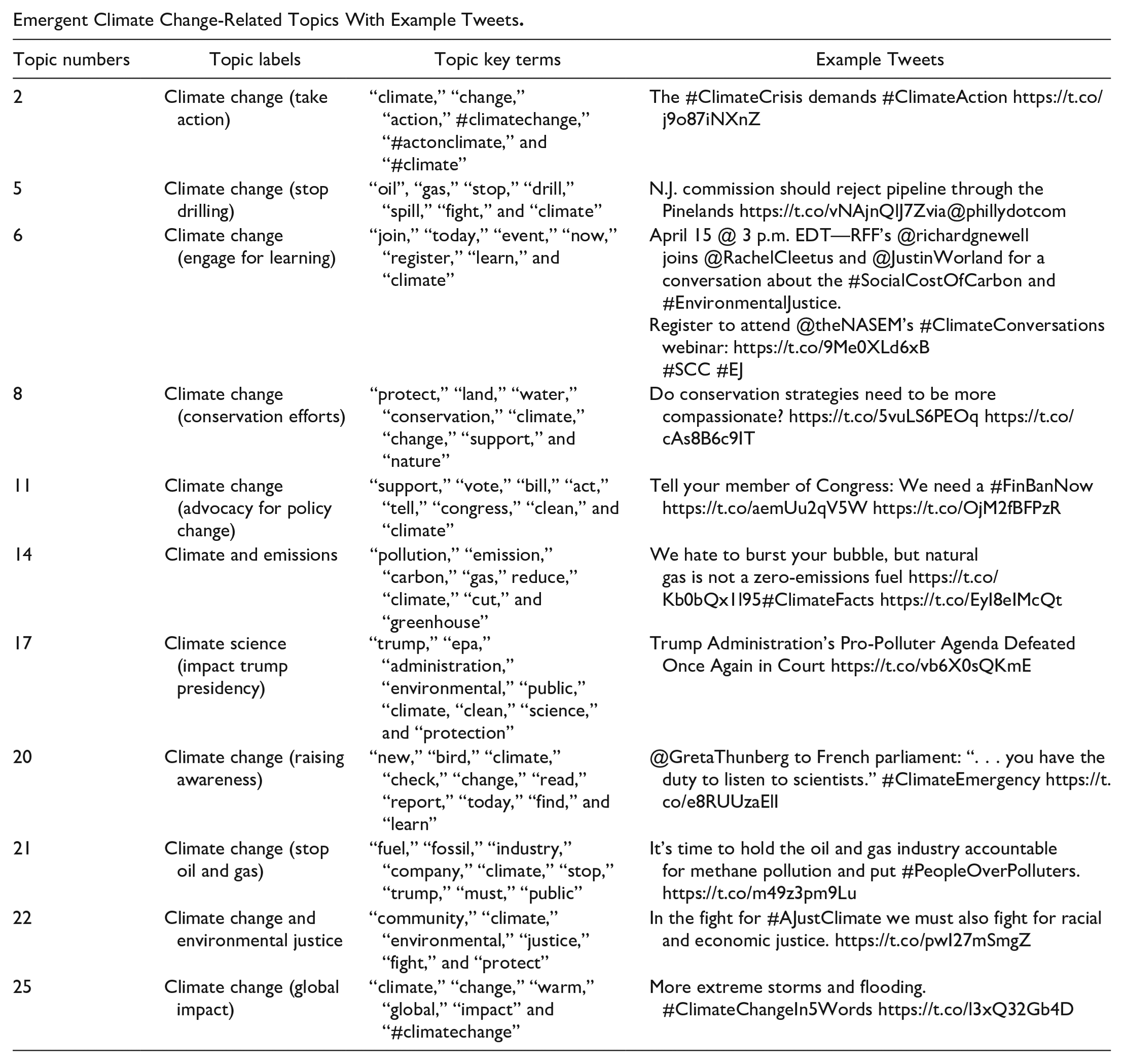
This article is a comprehensive empirical overview of environmental protection and conservation nonprofit discourse on social media over a 14-year time span. While the choice of this research design is descriptive and exploratory in nature, it allows us to map the landscape of public discourse of 120 EPCNs on social media to identify trends that we hope will contribute to further theory generation and inferential analysis in the areas identified above. In addition, this study may serve as a reference for scholars interested in these topics to easily identify from this population the subset of tweets they’d like to sample for analysis. For example, if a scholar is interested in the issue of climate change and environmental justice, from Table 4 they can identify topic #22 and from Figure 4 they can observe that these tweets were at their peak in 2019. They can then focus their data collection efforts on that subsection of tweets. In this regard, our study may contribute to creating more efficient and accessible research processes in this domain. As a matter of fact, with recent changes in ownership, leadership, and management of X (formerly Twitter), this historical account of ECPN behavior on Twitter may be considered a valuable by-product of this research.
Conclusion
The objective of this article was to assess the extent to which environmental protection and conservation nonprofits in the United States have attended to issues of climate change on social media—in particular on Twitter (now X). After analyzing over 1.3 million tweets published by our select 120 environmental nonprofits over 14-year time span, we first identified the prevalent topics on these organizations’ issue agendas. We found that 44% of tweets published by these EPCNs are related to climate change. We further observed that EPCNs with and without a climate change focus in their mission tweet with equal frequency about climate change-related topics. Smaller and medium-sized organizations, as well as regional EPCNs, are less active in publishing tweets and have fewer followers—the latter of which logically affects the attention their tweets get relative to larger organizations. National nonprofits and those with higher program expenses are more active in publishing tweets. Our findings also highlight the coupling between the thematic evolution of tweets from 2008 to 2021 with major policy milestones within the environmental policy domain.
It is our hope that this exploratory mapping will serve as a springboard for future theory-driven research on the relationships between climate change discourse, organizational characteristics, and public engagement on social media.
Footnotes
Appendix A
Appendix B
Emergent Climate Change-Related Topics With Example Tweets.
| Topic numbers | Topic labels | Topic key terms | Example Tweets |
|---|---|---|---|
| 2 | Climate change (take action) | “climate,” “change,” “action,” #climatechange,” “#actonclimate,” and “#climate” | The #ClimateCrisis demands #ClimateAction https://t.co/j9o87iNXnZ |
| 5 | Climate change (stop drilling) | “oil”, “gas,” “stop,” “drill,” “spill,” “fight,” and “climate” | N.J. commission should reject pipeline through the Pinelands https://t.co/vNAjnQlJ7Zvia@phillydotcom |
| 6 | Climate change (engage for learning) | “join,” “today,” “event,” “now,” “register,” “learn,” and “climate” | April 15 @ 3 p.m. EDT—RFF’s @richardgnewell joins @RachelCleetus and @JustinWorland for a conversation about the #SocialCostOfCarbon and #EnvironmentalJustice. Register to attend @theNASEM’s #ClimateConversations webinar: https://t.co/9Me0XLd6xB #SCC #EJ |
| 8 | Climate change (conservation efforts) | “protect,” “land,” “water,” “conservation,” “climate,” “change,” “support,” and “nature” | Do conservation strategies need to be more compassionate? https://t.co/5vuLS6PEOq https://t.co/cAs8B6c9IT |
| 11 | Climate change (advocacy for policy change) | “support,” “vote,” “bill,” “act,” “tell,” “congress,” “clean,” and “climate” | Tell your member of Congress: We need a #FinBanNow https://t.co/aemUu2qV5W https://t.co/OjM2fBFPzR |
| 14 | Climate and emissions | “pollution,” “emission,” “carbon,” “gas,” reduce,” “climate,” “cut,” and “greenhouse” | We hate to burst your bubble, but natural gas is not a zero-emissions fuel https://t.co/Kb0bQx1l95#ClimateFacts https://t.co/EyI8eIMcQt |
| 17 | Climate science (impact trump presidency) | “trump,” “epa,” “administration,” “environmental,” “public,” “climate, “clean,” “science,” and “protection” | Trump Administration’s Pro-Polluter Agenda Defeated Once Again in Court https://t.co/vb6X0sQKmE |
| 20 | Climate change (raising awareness) | “new,” “bird,” “climate,” “check,” “change,” “read,” “report,” “today,” “find,” and “learn” | @GretaThunberg to French parliament: “. . . you have the duty to listen to scientists.” #ClimateEmergency https://t.co/e8RUUzaElI |
| 21 | Climate change (stop oil and gas) | “fuel,” “fossil,” “industry,” “company,” “climate,” “stop,” “trump,” “must,” “public” | It’s time to hold the oil and gas industry accountable for methane pollution and put #PeopleOverPolluters. https://t.co/m49z3pm9Lu |
| 22 | Climate change and environmental justice | “community,” “climate,” “environmental,” “justice,” “fight,” and “protect” | In the fight for #AJustClimate we must also fight for racial and economic justice. https://t.co/pwI27mSmgZ |
| 25 | Climate change (global impact) | “climate,” “change,” “warm,” “global,” “impact” and “#climatechange” | More extreme storms and flooding. #ClimateChangeIn5Words https://t.co/l3xQ32Gb4D |
Acknowledgements
The authors thank Beth Gazley, Aseem Prakash, and Viviana Wu and the participants of the Climate Change and Voluntary Sector Conference for their insightful feedback on an earlier draft of this manuscript. Sincere appreciation also goes to the NVSQ Editors Jaclyn Piatak, Joanne Carman, Susan Phillips, and the anonymous reviewers for their editorial support and helpful comments.

Declaration of Conflicting Interests
The author(s) declared no potential conflicts of interest with respect to the research, authorship, and/or publication of this article.
Funding
The author(s) received no financial support for the research, authorship, and/or publication of this article.