




Abstract
This article investigates participatory environmental management in rural China. It first summarizes the extent, role and key drivers of public participation in environmental politics in China. It then investigates main scenarios of interaction between the Chinese public and the state, in order to assess the array of possibilities for political participation in environmental matters. This comparative study of public participation in environmental management focuses on grass-roots initiatives that point to increasing public enthusiasm for policymaking processes. The article concludes that participatory practices have impacted significantly upon environmental governance by facilitating implementation and bettering policy and, to a certain extent, legitimizing the discretion of environmental protection agencies. The article also indicates that grass-roots deliberative participation has successfully achieved its goal of improving the provision of social services and public goods. While the government’s initial approach was to improve policy implementation without triggering political contestation, at grass-roots level this strategy has created a sense of political awareness.
It is generally accepted that public participation is vital for environmental management. Although definitions vary, public participation in this context is taken to mean the active involvement of multiple actors, both state and non-state, in negotiating consensual management strategies for resolving environmental problems within specific institutions and on various levels. There is a multitude of studies on practices employed in different locations, including the United States, 1 Australia, 2 the European Union, 3 and developing countries. 4 Research has been extended to cover collaboration in different policy subsectors, including forests, 5 rural development, 6 environmental justice, 7 and land use planning. 8
Previous research has linked participatory governance to democratization, better environmental decision-making, and improved policy implementation. Research has also yielded substantial empirical knowledge on the advantages and disadvantages of participatory policymaking across countries and policy areas. However, while studies have shed light on non-state actor involvement in the Western world and in democratic developing countries, we know little about public participation in authoritarian regimes.
One country where research on participation is of particular interest is China. Historically, environmental management in China has been characterized by a top–down, technocratic and exclusionary approach primarily involving state actors and state-owned companies. It is suggested that this agency-led form of management has been modified by more recent policy initiatives through the creation of new, multiactor institutions and collaborative approaches on a regional scale. However, there is no systematic evaluation of the outcome of public participation. It is apparent that in the Chinese context there is a close interplay between political participation, environmental movements and state practices. 9
Rural residents’ attitudes toward participation in environmental governance are varied. From the perspective of self-governance, it is argued that people living in rural areas value the opportunity to participate in community affairs. 10 At the same time, it is noted that rural residents are constrained by their economic circumstances in their response to deteriorating environmental conditions. Spurred on by various political causes, some Chinese rural residents have begun to channel their discontent into movements, particularly in instances where cadres violate popular notions of equity, fairness or justice. 11 Issues linked to land and the environment have been the greatest drivers of social movements in rural areas. However, the outcomes of public involvement do not always lead to positive consequences. 12 As with their counterparts in Western contexts, it was observed that Chinese villagers favour the economic use of natural resources when they live in close spatial proximity to them. 13 Hence, systematic evaluation is needed to understand rural public participation.
This article contributes to an emerging research agenda, and it investigates participatory environmental management in rural China. Appreciating that political participation and environmental activism are dynamic, this article develops an analytical framework to explore the quality of public participation in environmental governance. By focusing on government-directed participatory practices, this article answers the following questions: what is the nature of public participation in rural China’s environmental governance?; how do such practices affect policy outputs?; and what are the political implications of such practices? The next section summarizes the extent, role and key drivers of public participation in environmental politics in China. Then a framework for evaluation is introduced, after which the methodology and data sources used are discussed. This is followed by an in-depth discussion of public participation in environmental governance in China in light of a case study on waste management. The case study is assessed according to the aforementioned framework. The final section presents a number of conclusions.
The politics of participation: Rationale, application, and outcomes
This section examines interactions between the Chinese public and the state and it assesses the array of possibilities for political participation on environmental matters.
Rationale of the Chinese government
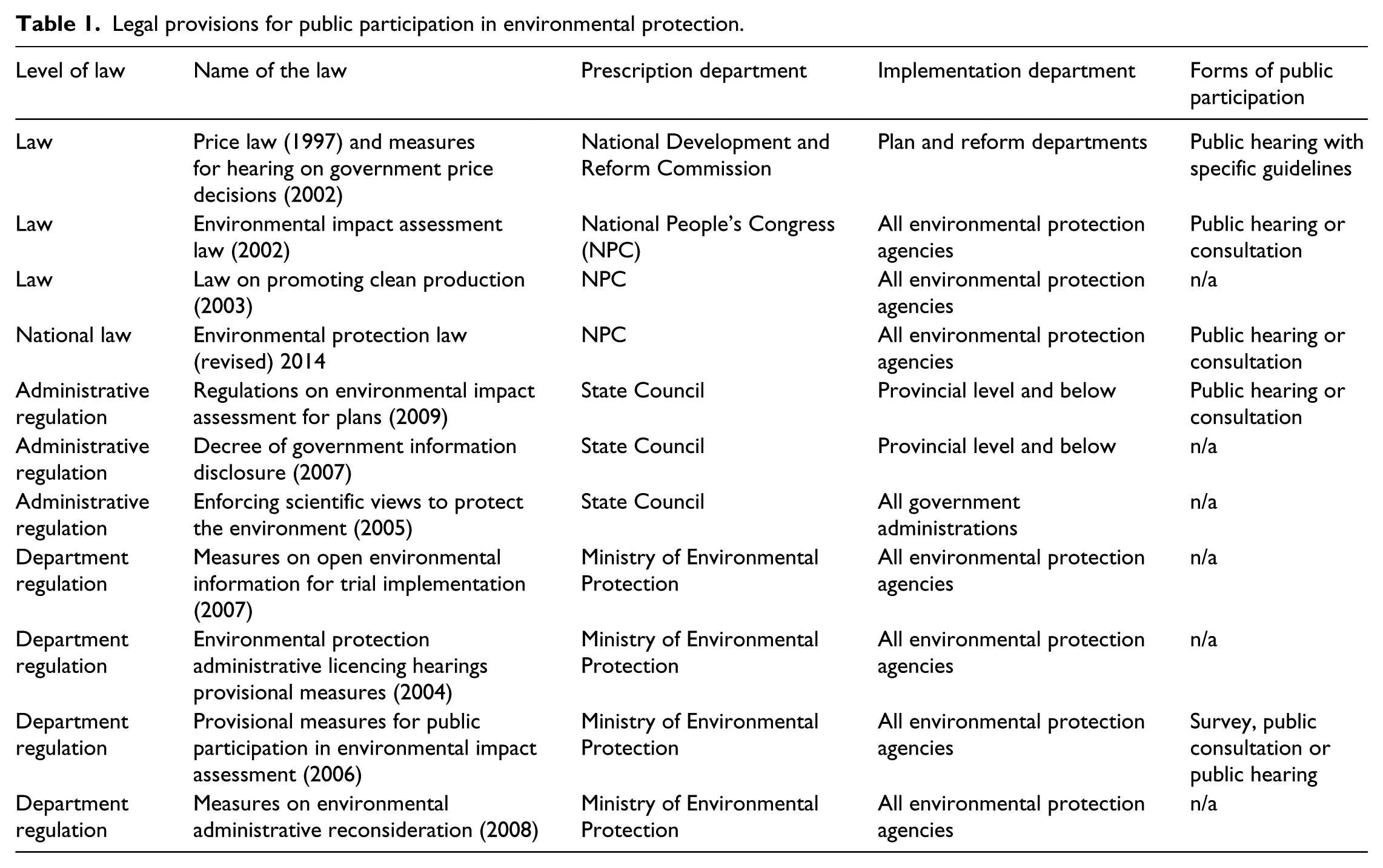
China’s environmental governance is characterized by legal frameworks that aim to involve the public. Although government departments dominate China’s environmental management, formal and informal arrangements involving the public in policymaking are not a recent development. Early forms of public involvement in environmental management included setting up environmental hotlines, call-in shows and exposés on local pollution violations. These approaches were adopted at a time when environmental awareness among the public was rather low and environmental education was initiated by the government in a top–down approach. In recent years, rising enthusiasm for involvement in environmental protection has been recognized by the central political authorities, and there has been an increase in environmental legislation and policy regulations which entitle the public to participate in policy formation (see Table 1).
Legal provisions for public participation in environmental protection.
It has been noted that the Chinese government’s attitude towards public participation varies depending on the issue at hand. 14 In areas where the authorities adopt a more open attitude, a relatively high level of public participation can be achieved. Increasingly, more substantial initiatives from the government have been observed. Case studies have indicated that the government is more likely to involve the public in certain policy areas of the environment than in others, such as in forestry management (which often involves land use planning) 15 and water management. 16 When the government’s attitude is more open, norms and rules are set up to ensure that high-quality policy discussions take place. In addition, strong government departments ensure that legal documentation enabling public participation is implemented. One clear example of the Chinese government’s depoliticized strategy is illustrated in the case of policymaking on climate change. Bruce Gilley argues that there is hardly any public participation in Chinese policymaking and implementation. 17 Public participation represents only a slight institutional adjustment, which effectively allows the authoritarian government to realize green objectives. This arrangement is characterized by the involvement of high-ranking officials and political elites, but not that of the general public whose role is limited to accepting official discourse and complying with state policies. 18
Additionally, the option to participate is subject to the vagaries of local state politics, for it is here that most government schemes are developed. In some cases, local officials lack knowledge of public participation policy or the resources to implement it. 19 At other times, they are simply against the idea of public participation in their work, perhaps fearful that such extra scrutiny might uncover local malpractice. Indeed, in parts of China where international impact is less visible, only limited attempts are made to involve the public, if at all. 20 Moreover, legal regulations are often found to be weakly enforced, and violated or manipulated. 21 In fact industries sometimes receive help from local environmental officials to avoid legislation, or at least secure their non-interference. 22 For instance, large construction projects may be approved at a local level, despite those projects potentially entailing substantial environmental impacts that ought to be assessed and approved by higher authorities. 23
It has been suggested that the underlying motivation of the Chinese government is to enhance its legitimacy through promoting public participation; such token gestures do not entail substantial efforts to promote an effective participatory agenda. 24 Instead of involving the public in setting the agenda and formulating policy programmes, public participation usually takes place at the very end of the policy formation process, when decisions have already been made. These decisions are often found to be unfavourable or not wanted by members of the public who may be affected.
Government-initiated public participation
In democratic societies, public participation can be seen to serve various political rationales, including improving policy decisions, realizing democratic values and stimulating policy implementation. In the Chinese political system with party-state control, there is a tendency among state authorities to fear the disruption that social movements can cause. 25 Hence, public participation is more likely to constitute a depoliticized strategy. Current research shows that environmental governance is characterized by depoliticized strategies that discourage genuine public participation. 26 In order to streamline policy effectiveness, government officials might prefer to exclude unwelcome non-state actors from participatory arenas, while at the same time include supportive participants, utilizing their knowledge, resources and engagement and cooperating with them.
According to researchers, the underlying motivation of the Chinese government is to enhance its legitimacy through promoting public participation. Such token gestures hardly promote an effective participatory agenda. 27 One approach in government-initiated participatory practice is to involve non-state actors only in the policy implementation phase, by means of assimilation and co-optation into governmental interests. This strategy aims to improve the quality of implementation. Co-opting participatory design is characterized by policy goals that have been decided high up in the political hierarchy, and steered by well-framed political agendas, biased discussion, and policy decisions that lack any substance. Public participation relies on discursive mechanisms, which gives the impression that the decision-making process meets the criteria of fairness, legitimacy and equality. In this way, participants will accept the outcome of a decision-making process, even when this means that they have failed to achieve their own political goals, because the process is perceived to be fair and legitimate. 28 This strategy depoliticizes issues so that they are removed from the sphere of political contestation, and presented as goals based on societal consent. These can then be decided without further deliberation. This approach intentionally keeps individuals and organizations out of the political arena, driving them back towards their non-political private lives or organizational core businesses. If individuals are included, they are assigned a purely non-political role as information providers. At the same time, issues may be taken out of a political framework and presented as merely technical or scientific problems, which require quite different approaches compared to those within a framework of political argument.
Public attitude and participation
Rural residents have varying attitudes toward environmental governance. Their actions also differ – and this difference gives rise to dynamic political behaviour that reflects their environmental activism, ranging from inaction or irresponsible behaviour to pro-active environmental action. 29
A group of scholars suggest that non-response is the most common public attitude towards political participation in environmental issues in China today. Public passivity here can be complex, and typically reflects location-specific considerations. In part, it may reflect traditional fears of a coercive response from the state if public input deviates from the expected path. Nowadays, it may also reflect a genuinely non-committal attitude on the part of the public. Individuals are often found to be incapable of contributing to policymaking, because of low levels of literacy or insufficient environmental awareness or knowledge. 30 According to Hong Dayong and Lu Chuntian, individuals’ environmental awareness is affected by contextual factors including income, level of education and the extent of industrialization. 31 Rural residents score lower than urban dwellers and they show significantly lower environmental awareness. Indeed, urban dwellers appear to be more enthusiastic and willing to participate in policymaking. 32 Urban environmental protests tend to be more effective than rural protests, even if the latter go through the same formal mechanisms, including complaints and legal suits. 33
Another factor affecting villagers’ low level of involvement is trust in government. In such a political culture, political authorities assume responsibilities in environmental management, including knowledge transfer and information dissemination. The Chinese government dominates all aspects of environmental management and adoption of green technologies. Without the government actively communicating with villagers, the Chinese population in general shows little concern for green products and services, hence the low levels of participation in green consumption practices. 34 As indicated in a recent survey, despite rising environmental awareness, many people are unwilling to make the required changes to live a greener lifestyle. 35
Surprisingly, inaction has yet to receive the in-depth treatment that scholars have accorded to other attitudes. It may be that inaction can be hard to discern. In many rural areas, as well as in areas away from major cities and coastal regions, no response may be the only sensible response in a context of local political and economic oppression. Here, just cause is hardly sufficient for environmental mobilization. 36 Indeed, apparent quiescence may change quickly over area and time, underlining the need for detailed ethnographic work for which political ecology is renowned.
Institutionalized behaviour
At the same time, a very limited level of public involvement is achieved 37 through formal institutions and channels. 38 The public, represented by the National People’s Congress and the local People’s Congress, is theoretically given the power of involvement in decision-making. Within China’s environmental policymaking infrastructure, institutional arrangements (including the National People’s Congress and the Chinese People’s Political Consultative Conference) are crucial for articulating and coordinating public interests. Although attention given to the environment in economic policy reports has also grown rapidly, representatives of these political bodies have been found to only sporadically represent public concerns in local or national policy decision-making. 39
In institutionalized participatory activities, the public is most likely to get involved in policymaking without any prior attachments to political bodies. One of the most widely adopted mechanisms in China is the filing of complaints (信访) about environmental problems to the Ministry of Environmental Protection; this same mechanism is also used to resolve other civic disputes. Thus, the public can resolve environmental pollution problems through the formal dispute resolution and environmental complaint systems, both of which serve as an institutional channel through which the public’s grievances can be addressed and court judgements challenged.
Environmental activism is one of the fields in which the state provides scope for expression; 40 growing public activism ranges from voluntary groups to online activism. The realm of civil society in rural China is considered weak, 41 where there is fairly little distinction between the state and the family (if one is to take autonomous organizations as an indicator). Moreover, methods of protest have been rather peaceful, including mobilizing public opinion and using media campaigns (as well as formal channels available through individual leaders’ political status) to submit legal bills to the National People’s Congress. 42 In some regions, there are environmental groups that are influential in national or urban areas. However, considering that only a small number of NGOs work in a country comprising a total of 600,000 villages, those that have access to independent voluntary groups are few. 43 These organizations possess more resources to generate influence, mobilize public opinion, and start media campaigns. 44
In general, the performance of state institutions that represent public interests is found to be weak. 45 Rural issues are given even less attention. Rural environmental interests have rarely been represented through institutional channels at the national level, because of villagers’ limited capacity for articulation. In the absence of institutional channels, NGOs and voluntary groups step in to articulate villagers’ environmental interests. 46 However, ENGOs (environmental NGOs) and other groups may represent interests different from those voiced by the villagers themselves. 47 Even if environmental groups are willing to work with villagers, local officials may find them threatening, and choose not to work with them. 48 Within China’s environmental policy discussion and decision-making arena, there are only a few influential urban-based social groups. Other interest groups include those representing the interests of private enterprises. 49
Conceptualizing and evaluating public participation
The Chinese authorities appear divided on the issue of involving the public in environmental governance. This division is also reflected in the public’s varying participation in different activities. In this article, public participation refers to the active involvement of multiple non-state actors in the negotiation of consensual management strategies aimed at resolving environmental problems.
In order to understand participation in China, it is important to identify the dynamics of the Chinese public’s responses. Inaction is characterized as token involvement by the public. It is distinguished from pro-active environmental action, which is likely to lead to social and economic change.
The relationship between state and society in China is a complex one. Rural residents have become more active in political participation, increasingly aware of their involvement in community affairs. Along with growing awareness of individuals’ political rights, many have recognized that they must go through institutional channels to defend their environmental rights. Lawful claims are based on rights that have been granted to them. These rights include the right to complain, 50 judicial relief and legal measures of public administrative litigations. 51 Chinese scholars, such as Yu Jianrong, have argued that this trend represents a visible political movement that is often oriented towards local government, usually county authorities. Self-organized village associations collectively represent their members’ interests. 52 These often receive support from fellow villagers as well as legal professionals, public intellectuals and NGOs. 53 It is argued that these bottom–up initiatives have extended the boundaries of existing rules and institutions to encompass rights that have not been clearly formulated. 54
The first hypothesis of this study is that the more opportunity there is for discussion, the more likely it is that pro-environmental behaviours will include ‘experiments and institutional arrangements reflecting the practice of participation of concerned citizens’. 55 This differs from a passive attitude, or the inaction that often occurs after political mobilization.
One indicator of pro-environmental behaviour is individuals’ level of involvement in the content of collective decisions. This may be passive participatory behaviour that comes as a result of political mobilization. Deliberation can be seen as political communication in which ‘individuals reflect on their preferences and are open to preference change’. 56 To measure the extent of meaningful participatory behaviours, the term ‘deliberative capacity’ is adopted, referring to the level of participation, namely, authentic, inclusive, and consequential. 57 Authentic participation is reflected in participants’ voluntary involvement in environmental action. Inclusive participation relates to the plurality achieved in this process when multiple interests are incorporated. Consequential participation refers to the impact of decisions in the policy process. Although deliberation may occur, the subsequent recommendations must have an impact upon collective decisions. Among these three criteria, consequential participation signifies substantial participation, which would make formal deliberation more likely. It suggests that empowerment has been achieved.
The hypothesis here is that the three types of deliberative capacity are not equally important – authentic and inclusive deliberative capacity are of greater significance than consequential deliberative capacity in promoting behavioural change.
Chinese cultural tradition encourages individual citizens to develop personal networks as an informal mechanism for participating in politics. 58 Therefore, individuals’ perception of formal institutions in China is found to differ in comparison to Western Europe or North America. Environmental activists tend to be more inclined to make use of personal networks to mobilize movements. Such practice is particularly prevalent in places where the conventional Chinese culture of personal networking still prevails, and used less frequently where the local culture has diverged from those traditional norms. 59 This type of political communication probably implies that the process of participation is more significant than the participation itself.
It is recognized that individual Chinese citizens place strong trust in their government. Such a tendency is undergoing changes in instances when community involvement is of increasing importance to decision-making. In the transition from the system of people’s communes to community governance, it was found that increased trust and a sense of civility played a significant role in the management of collectives (including water service and irrigation management 60 and property rights reform). 61 Where environmental governance is concerned, citizens have placed strong trust in political authorities. 62 This may be partly due to limited knowledge or capacity. Little deliberative capacity has been developed, and the consequential dimension of participation is the least well-established in the realm of environmental governance.
Methodology
There is little systematic evaluation of China’s public participatory agenda. At the same time, rural environmental governance is increasingly being challenged, particularly at grass-roots level. Little systematic research has been carried out to examine the rural participatory agenda. In order to explore the practices and outcomes of participation in waste management, as part of a broader initiative to improve the living environment in rural China, the author carried out a study in Yanhe village in Wushan county, Hubei Province. This study examines how grass-roots initiatives with the support of the Wushan county government have actively promoted public involvement to improve the local environment. The dynamics indicate increasing public enthusiasm for policymaking processes.
A longitudinal study was conducted to investigate changes in participatory practices in Yanhe village. Ten years of observation followed from a project which began in 2003. The goal of this long-term observation was to clearly distinguish voluntary participatory behaviour (inaction in this case) resulting from short-term behavioural change mobilized by the authorities. Inaction might evolve into public involvement in local environmental management. It could also be motivated by self-interests or influenced by the political environment, which is constantly changing. In rural society, the development of sustained voluntary public participation usually takes a long time before it becomes institutionalized. Longitudinal observation is therefore necessary for understanding rural participatory practices.
Local environmental governance has hardly changed in the 10 years from 2003 to 2013. The local authorities in Wushan county continued to play a significant role. There was, moreover, no dramatic or sudden development of environmental activism in Wushan county. These factors more or less ensured constant contextual conditions for a valid comparison over a period of time.
Socio-material foundation – namely the required technological innovation and infrastructural development – plays a role in behavioural change. 63 Lacking this foundation, individuals are likely to show passive behaviour with regard to decision-making and involvement in environmental issues. 64 In this study, the selected village is located in a county that enjoys some degree of social and cultural development. Economically, Yanhe village enjoys a medium level of income in comparison with the national average.
Environmental resources spatially transcend administrative jurisdiction and may become sources of conflict between different jurisdictions. The most suitable level of jurisdiction for achieving public participation is debatable. Which is more effective for the promotion of environmental welfare: a participatory agenda based on multilevel inclusive participation or on an administrative scale? 65 The issue of waste management is a suitable topic for study because of the scale of jurisdiction. Public participation is examined at the level of the village.
The selection of Yanhe village is based on original Chinese-language documentary material. A large number of Chinese media reports from state-owned and private sector publications were collected and analysed. Two field trips to China were conducted. During these trips, interviews and informal discussions were held between the author and figures fundamental to the research, including members of the public, journalists, NGOs and officials. In 2003 the author was involved in the launching of a local public participation mobilization project organized by Green Cross (绿十字), based on which she conducted participatory research. In 2005, the author carried out follow-up research to investigate the outcomes of the project. Second-hand data from Renmin University (which conducted a survey on ecological attitudes and perceptions in the countryside in Hubei, Wushan county) were also examined. 66 This study, though conducted on a small scale, provided indicative findings to aid our understanding of changes in the behaviour of residents.
One limitation of the research reported here lies in the small sample size. The findings from this single case study are not representative of rural public participation in China’s environmental governance. The strength of the comparison lies in the fact that there is sufficient representation of the main variables, allowing us to understand the particularity and complexity in rural residents’ environmental participatory behaviour and the involvement of village committees. Therefore, longitudinal study provides opportunities for us to gain a further understanding of the complexity of rural peasants’ rationale and the outcomes of their involvement in environmental governance.
Empirical findings
Yanhe village is located in Wushan county in Hubei Province. Its population of 910 people live in 225 households, with an average annual household income of RMB 2000–2600. Managing the rural living environment has been one of the policy targets of the Wushan county government. In particular, the reduction and management of ‘three types of waste’ (三废), including domestic garbage, waste water, and waste from livestock husbandry, were areas of concern because of poor compliance. To improve the living environment, the national government provided subsidies for building facilities to produce biogas and improve waste management.
At the beginning of 2003, Green Han River (绿色汉江), an urban ENGO based in Xiangyang, introduced Beijing-based Green Cross to Yanhe village. The latter ENGO carried out a public education initiative on waste management in the village. Green Cross was enthusiastic about working with village committees and township and county governments on the issue of waste management. The Wushan county government was confident about the project, and became closely involved in the process; it even provided financial subsidies for the project. The Yanhe village committee played a coordinating role and brought together villagers and Green Cross. Three institutions, Green Cross, Yanhe village and Wushan county, were represented by Sun Jun, Min Hongyan, and Yu Baojun, respectively. All three individuals proved invaluable throughout the whole project, and the good personal relationships between them were key to the success of project development.
Before the arrival of Green Cross, Yanhe villagers were rather indifferent to national policy initiatives, and they had a low level of enthusiasm for any improvement to their living environment. The initiative was initially perceived to be a project that would not benefit them economically, and consequently neither the villagers nor the cadres were interested in getting involved. In the words of one respondent:
What is waste recycling? Villagers do not understand it, neither do the cadres. Misunderstanding among cadres proves to be the largest obstacle in promoting such policies. …Cadres think only about economic growth, and waste recycling does not directly benefit them economically.
67
When Green Cross came on the scene, this passive attitude was prevalent. Understanding that he would be seen as an outsider, Sun conducted 10 face-to-face meetings and made various informal visits to village households. As a mild reformer, he was strongly convinced that the project required the involvement of government officials. Indeed, the village committee cadres and country officials that accompanied the Green Cross team helped villagers to accept the ENGO’s vision. During those interactions, Green Cross members became acquainted with the local issues, and they were able to incorporate villagers’ concerns into the project plan. The involvement of senior members of the community was also encouraging. Their discussions with Green Cross disclosed local knowledge of the traditional way of sorting waste. They also provided insight into local cultural attachments to tea plantations, including local songs. Practical difficulties were addressed. Villagers in Yanhe eventually became enthusiastic about recycling and sorting waste; they understood that recycling would positively impact households. More specifically, their understanding of national policy improved. They came to learn of the benefits of waste management, and improving water treatment systems, pig pits and cooking environments and how these could be powered by low carbon energy sources (such as biogas). In-depth discussion led villagers to better appreciate how they could benefit economically from improving the living environment.
The prospect of developing tourism appealed to the villagers, and this gave them a strong incentive to change their lifestyle. Rather than suggesting the idea of waste recycling as a theory, in the interactive sessions, Green Cross educated the villagers on the benefits – including an improved living environment and the prospect of economic gain. The presence of officials also confirmed government support, and a potential transfer of power to villages. 68 With the approval of county officials and the village committee cadres, rules were put in place to supervise individual household recycling. These included setting up recycling facilities and designating certain individuals to enforce correct recycling procedures. According to a survey conducted after the scheme was set up, social cohesion improved; there were better family relationships, more respect toward members in the community, greater self-respect and so on. 69 Domestic livelihoods were also improved. The concerns of Yanhe villagers were affirmed by the county government which publicized regulations that identified waste management as an essential part of the local political agenda. 70 In 2003 and 2004 alone, Yanhe village saw an increase in villagers turning to renewable energy sources, and a slightly higher percentage of villagers committed to installing biogas and other facilities promoted by the national government, which at the start entailed more expenses and extra work. In the few years after the tea gardens were renovated, ceremonial platforms were constructed and Yanhe village welcomed larger numbers of urban tourists. More villagers were then willing to commit to building biogas facilities.
Normative assessment
Empirical findings of this research reveal practices and patterns of the public participatory agenda concerning environmental policies. The hypotheses presented earlier have been confirmed. To varying degrees, different types of deliberation were realized in public participation (see Table 2). Yanhe villagers have shown voluntary participatory practices; their participation was no longer passive: deliberative capacity in the village has increased. Different levels of citizen cooperation were also observed, correlating with the level of pro-active environmental behaviour exhibited.
Longitudinal comparison of the level of deliberation in Yanhe village, 2003–13.
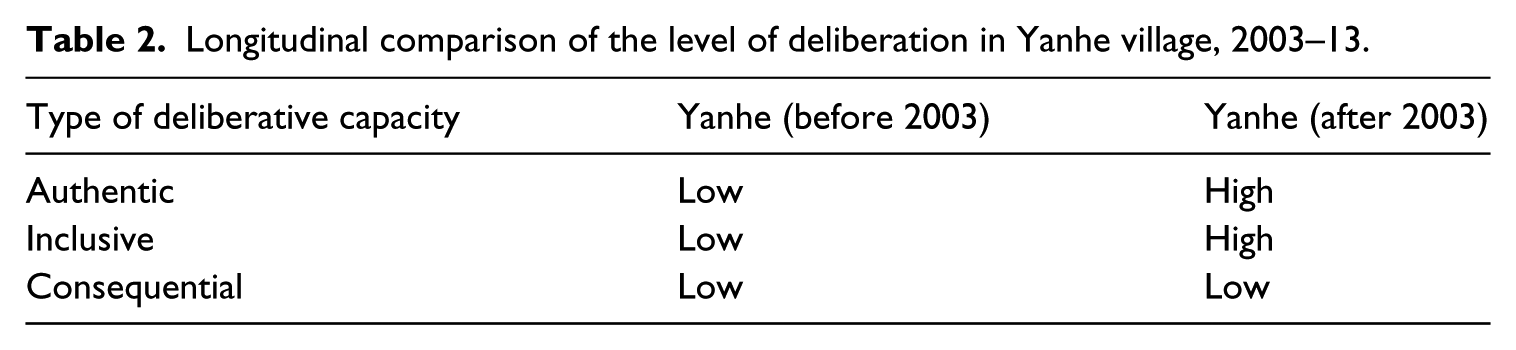
After 2003, high levels of deliberation were achieved in almost all dimensions. Face-to-face meetings guaranteed a relatively high level of reciprocal communication between government officials and participants. Most of the villagers participated voluntarily in the process. Various meetings and consultations also led to collective decisions that would have an impact on government decisions. Such activities were a strong contrast with past policy implementation, when villagers lacked the knowledge and technical support to undertake green technologies. However, because Green Cross’s project to mobilize local participation was faced with uncertainty, which meant that the villagers and village committee could not be sure of its duration and continuity, Green Cross did not demand formal decisions on waste management. So the village committee requested material resources and policy support from the government. Yanhe village’s deliberative practices proved a significant factor in explaining participants’ behavioural shift from inaction to engagement. In comparison to the situation before 2003, there was significant progress in the building of deliberative capacity in the period after 2003.
The findings reported here support the earlier-mentioned hypotheses. Results from Yanhe village show that, not unlike European or North American developments, a rural participatory agenda results in positive outcomes. Deliberation provides an opportunity for residents to work together. The more deliberative capacity is built, the more positive the outcomes from participatory practice. In Yanhe, after 2003, residents’ personal relationships and mutual trust improved as a result of solving collective concerns. This can be seen as a sign that citizen cooperation has improved. In addition, Yanhe village scored differently on the three types of deliberative capacity in the period under study; there was little progress in consequential participation. In societies where guanxi is considered significant (that is, more important than in Western industrialized democracies), key figures play a pivotal role in mobilizing environmental activism and impacting on public participation.
Discussion
Faced with increasing environmental degradation, the Chinese authorities have made efforts to improve governance. This can be seen as part of the broader public administrative reform that aims at creating more scientific policies and bettering decision-making. Despite the government’s depoliticized strategy, at grass-roots level it is countered by rights-based political participation that seeks empowerment. Such participatory practice has impacted on environmental governance significantly by facilitating implementation and bettering policy and, to some degree, legitimizing the discretion of environmental protection agencies.
Where the outcomes of participation are concerned, participants have provided some contribution to policymaking (bottom–up knowledge and local experiences were utilized in the issue of waste recycling). Such processes can hardly succeed without the government’s involvement. In Yanhe village, aside from the village committee (which represents the villagers’ interests), the involvement of the county government was vital. The presence of county government officials made it easier for the villagers to accept Green Cross and the knowledge and skills they had to offer. The more deliberative participation is facilitated, the stronger the sense of citizenship among villagers. They are thereby more likely to change from inaction to engaging in participatory behaviours.
In comparison to multilateral governance, which involves the active involvement of multiple actors, this case study highlights learning and deliberating as key features in the participatory agenda. The activity of learning is not a one-way process in which participants passively receive information. Forums for face-to-face communication allowed in-depth discussion of villagers’ and other concerns. Green Cross was not only an ENGO that provided knowledge, time and previous experience of working with government, it also opened up avenues and brought opportunities and a negotiating space for deliberative practices between the village committee, local officials and villagers.
The longitudinal study reported here indicates that grass-roots deliberative participation successfully achieved its goal of improving the provision of social services and public goods. 71 In comparison to public participation in Western societies (which may involve political values, inclusion and power transfer), the Chinese case illustrates that public participation can functionally serve the government’s interests without involving democratic values. Such practices are also referred to as authoritarian deliberation, where government rationale is characterized by token gestures that aim to improve specific policies or programmes. 72 Nevertheless, this mechanism shows that public participation encourages the emergence of civic values (characterized by community participation) and may trigger broader political reform programmes that could lead to democratization. 73 The empirical findings reported here show that despite the government’s initial approach to improve policy implementation without the intention of triggering political contestation, this strategy implemented at grass-roots level has promoted a sense of political citizenship. It should also be noted that high costs are incurred with the development and practice of public deliberation, including organizing meetings, facilitating learning and establishing rules. Government officials would thus have to invest a large amount of time and finance. In other words, public involvement relies heavily on government organization. Such high transaction costs might deter government authorities. If its intention is to mobilize policy implementation, which may require similar transaction costs, from a cost–benefit perspective deliberation may not be a good choice. This explains why successful public participation initiatives are more often found at grass-roots level, particularly when local political authorities are actively involved.