




Abstract
This article experiments with collage to explore the visual representation of black people in Brazilian media, popular culture and politics, examining how these representations constitute statements regarding dynamics of racial domination. The work proposes that the introduction of disruptive elements into the very images that objectify the black body could create the necessary conditions for a valuable criticism of how blackness is disposed within the nation’s formation. The articulation with black studies in visual culture and performance, black feminism, African diaspora and post-colonial theories intends to develop analytical frames to examine the interconnection between the representational process of ‘stereotyping’, symbolic violence and anti-black ideologies in the context of the national formation narratives. Methodologically, the articulation of these fields of inquiry intends to provide tools able to highlight and disrupt the regimes of racial representation circulating in Brazilian popular culture.
Introduction
This article engages with theories of visual representation in the field of black cultural studies and cultural critics, black feminisms, African diaspora theories, and post- colonial studies to discuss the processes through which the visual representation of black people in Brazil emerges as stereotype in a vast spectrum of popular culture. The process of ‘stereotyping’ works to reduce, to essentialize, to naturalize and to fix the racial (and gendered) ‘other’ at the same time that it works to exercise power upon subjugated groups (Hall, 1996, 1997; see also Bhabha, 2004; Mercer, 1994).
The experiment presented in this article suggests that cultural practices and regimes of representation (Hall, 1997) can be reconfigured and assume new significance through the critical action of cultural agents interested in rupturing the gaze that objectifies the black body to its purposes of pleasure, profit and punishment (Hartman, 1997). How can we, black people, use the same images that objectify us to highlight the racial ideology behind them? The work of artists such as Rene Cox, Adrian Piper, Fattimah Tuggar, Marlon Riggs and Robbie McCauley, and of scholars such as Nicole Fleetwood, Jayna Brown, Daphne Brooks and Patrick E. Johnson proposed that the field of visual representation and performance can create spaces for contestation of racial stereotyping. The experience of these artists and authors provides methodological apparatuses to approach the problematic of the presence of blackness in the visual field. In this regard, this article’s dialogue with black studies in performance intends to promote a movement of appropriation of the representational narrative concerning the representation of the black being. My hypothesis is that the introduction of disruptive new visual elements into the ‘stereotyping’ images of blackness can work as a strategy to dismember the fetishistic gaze that celebrates the process of stereotyping blackness and black people. The ‘stereotyping’ regime of racial representation conceals the celebration of black subalternity while simultaneously affirming its desire for a continuity of position in the racial distribution of the nation. Specifically, I seek to reappropriate these celebratory images by forcing them to expose the continuity of a black subaltern position inside the nation.
The first section of this article, ‘Uses of blackness in a tropical paradise’, contextualizes the role of blackness in the nation’s foundational narrative and situates key politics directed at dealing with the ‘black problem’ in Brazil. First considered a social problem in the post-slavery period, the black presence (a folkloric idea of black people) was invited to participate in the narrative of the new nation, a nation where people were not concerned with (racial) purity; instead, this would be a nation where all people mix without fear of racial impurity to achieve the ideal of a ‘Brazilian race’ that would be, of course, more light than dark in skin tone. The section also seeks to situate the contemporary context of black cultural goods commodification in the city of Rio de Janeiro. This process of appropriation or reduction of black cultural production to low-status practices is now paralleled with the militarization of favelas (townships) and the growing process of gentrification accelerated by two mega-events: the 2014 World Cup and the 2016 Olympic Games.
‘Representing the black in popular culture’ introduces images of black people and of blackness gathered from several sources during my preliminary fieldwork in Rio de Janeiro (June to July 2011). The images are grouped according to the themes with which they are concerned. These themes delimit aspects of racial representation regarding the disposition of black bodies according to the gender, age, historic moment and cultural function of these black persons, figures or legends.
The section ‘Blackness under control’ reintroduces the same images discussed in the previous section and utilizes collages, juxtapositions, repetitions and other digital manipulations to illuminate the hidden forces of ‘stereotyping’ practices: to naturalize and reinforce the subjugated status of black people in Brazil. In this attempt there is no movement to romanticize blackness or to try to empower black figures, persons or characters. This would be a simplistic inversion from negative to positive representations of black people that cannot be sustained when confronted with the regulatory power of the white supremacist gaze. As soon as this gaze emerges blackness is automatically framed as the other, whether exotic, brutish or dangerous. At the same time, this shift from a ‘negative’ to a ‘positive’ representation of black life often engenders another series of fixations and monolithic constructions (Hall, 1996, 1997; Keeling, 2007; Mercer and Julien, 1994). Rather, my experiment with these images intends to provoke strangeness, rupture and recognition. Strangeness regarding the naturalness of the representation; rupture in the narrative of the ‘truth’ about black people that each image carries; and recognition of the structures of domination that underpin them.
Uses of blackness in a tropical paradise
Blackness in Brazil has always been represented in variegated ways: blacks contributed to the nation’s foundation (Freyre, 2002: 301), but the large population of blacks could only hinder the nation’s development (Rodrigues, 1976; Nascimento, 2003: 61). Blacks have physical vigour and rhythm (DaMatta, 1991), but they lack intellectual skills. Blackness represents the wonder of sexual vigour, but blacks tend to be immoral and dysfunctional (Nascimento, 2003: 60 and 71). Blacks slide into criminality more often than whites (Rodrigues, 1957). Some of these assertions were made almost a century ago; however, we can verify that the ideas they support are still reproduced in popular culture today through the circulation of images and stereotypes that reinforce the naturalization of these assertions. The dualities in these representations obscure the abyssal distance that exists between white (and light-skinned mestizo) and black experience in the nation. The dominant narrative in Brazil wants to rely on the ideology of racial democracy. As a result, despite efforts being made by black movements and by black women’s movements to bring discussions on race and the effects of racism and sexism to the fore in the wider public realm (Bairros, 1994; Carneiro, 1999; Gonzalez and Halsenbag, 1982), discussions on and/or about race remain taboo (Twine, 1998; Vargas, 2004). In general, the strategy used to silence the denunciation of racial democracy’s fallacy is to label the politics of black activists as ‘reverse racism’ (Caldwell, 2007; Nascimento, 2003; Ratts and Rios, 2010).
Black activists often adopt traditional cultural practices such as samba music, Carnival and capoeira in their attempts to assure dignity and collective mobilization (Fundacao Cultural Palmares, 2011; Hanchard, 1999; Lopes and Nascimento, 1987; Luz, 2000; Ratts and Rios, 2010). On the other hand, this celebration of black heritage is frequently utilized in Brazil to demonstrate the plausibility of the racial democracy narrative (Fry, 2006; Kamel, 2006; Maggie, 2004). 1 According to this perspective, black cultural heritage is one of the pillars of national foundation and provides definite proof that there are no real racial divisions as in the US and South Africa: almost all Brazilians are racially mixed, and almost all like to party at Carnival.
However, one simply needs to look at Law Decree 7967 from 1945, regarding the regulation of immigration, to verify the inconsistency of the racial democracy narrative. According to this decree, the country had ‘the need to preserve and develop, in the ethnic composition of the population, the more desirable characteristics of its European ancestry’.
In addition to the influx of European immigrants, the investment in the internal process of interbreeding was based in the belief that Brazilians would become progressively lighter skinned over the years. This ‘new race’ advocated by the anthropologist Gilberto Freyre from the 1940s to the 1960s presupposed the strong sexual attraction between white men and the enslaved black women (and progressively with the light-skinned enslaved or free women) that, since the colonial period, is a mark of Brazilian racial relations:
… mixed blood were almost ever the result of the union between the best masculine element—the White men from the big houses—with the best feminine element from the slavehouse—the most beautiful Negro women and Mulatas, the healthier and fresher ones. (Freyre, 2002: 448)
The ideology of mestizage based upon the patriarchal sexual appropriation of the women from the dominated group aimed to improve the genetics of the population:
Instead of considering the offspring of slave-owners with slave women as socially dangerous beings congregating the vices from the two extremes, Charles Comte considers them (mixed race people) free from the inconveniences of both classes, and they constitutes a happy half-term. (Freyre, 2002: 448)
The celebration of mestizage took the place of the eugenics project championed by politicians, intellectuals and scientists such as Nina Rodrigues, Arthur Ramos, and Silvio Romero during the early 1900s. In this new politics, blacks would be assimilated in a new racial mixture whose phenotypic will become lighter through the infusion of white genetic material. As part of that project, a memory of Africa, through its culture and folklore, was to take the place of the physical and political existence of people of African descent. This biopolitics project was unmasked by figures such as the black sociologist Edison Carneiro during the 1930s to the 1950s, and by the activist, playwright and politician Abdias Nascimento since the 1960s. After the foundation of the Unified Black Movement in 1978, several other scholars, activists and artists worked to denounce the character of Brazilian racism and the dynamics of appropriation and fixation of the Afro-Brazilian culture as a folklorical, naïve and hyper-sexualized ensemble of practices. As the filmmaker Joel Zito Araújo states, this misuse of Afro-Brazilian culture disguised as a celebration of African heritage is a mechanism of cultural expropriation that alienates Afro-Brazilians from their process of identity formation (2000).
Cities like Rio de Janeiro and São Salvador are widely known through their engagement with representations of black Brazilian culture such as samba music, samba schools, traditional Afro-Brazilian food, capoeira and carnival parades. The Brazilian tourism industry is organized around these products plus the luxurious beaches.
Contrary to these idyllic representations of an exuberant and exotic Afro-Brazilian culture, the high rates of urban violence, poverty, residential segregation and murders committed by police are testament to the level of segregation and racism that remain under the surface in most parts of the tourist-centred cities (Vargas, 2005). In 2005, Rio de Janeiro’s governor declared a war on drugs (Secretary of Security, 2005) and since then the state police and the national army have been patrolling the favelas—predominantly black spaces—under the pretext of a mission to capture drug dealers. The weapons and vehicles used in these operations are those employed in war. The high number of fatalities has been cause for criticism and has resulted in mobilization to political action in several segments of society. In 2007 alone, the police killed 1,330 people who were allegedly resisting imprisonment (Human Rights Watch, 2009). The people killed by the police are predominantly black, young, male and poor (Waiselfisz, 2010). The latest project designed for the favelas is the occupation of these ‘risk areas’ by the army. The benefit of these political initiatives that create a permanent state of exception (Agamben, 2005) has been questioned in communities where claims of abusive use of force by policemen are numerous.
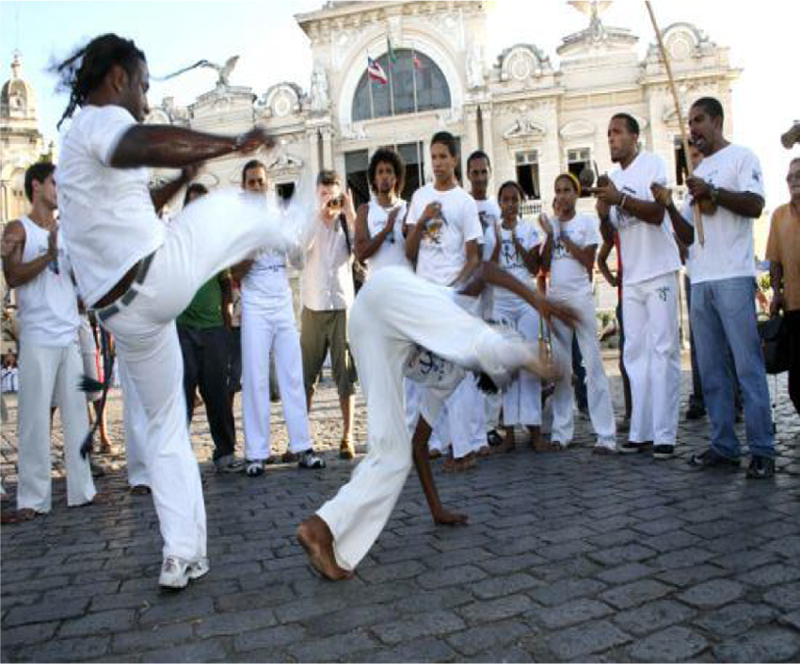


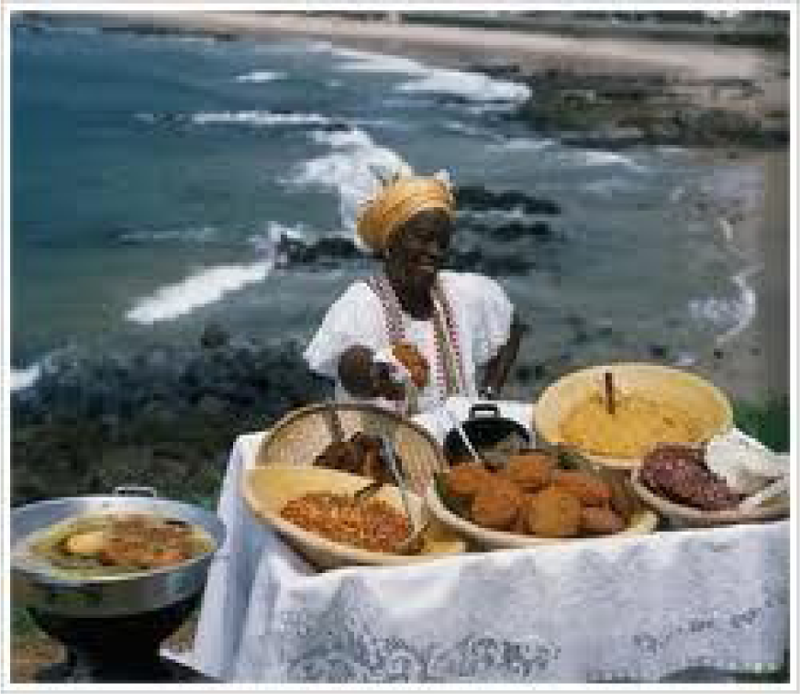


Preliminary fieldwork carried out in June 2011 also demonstrated that expressive black Brazilian culture constitutes a profitable commodity in the tourism-driven city of Rio de Janeiro. With the advent of the ‘pacification’ of the favelas through military occupation, a growing number of foreign tourists and middle class Brazilians have begun to tour the favelas in greater numbers, with the intent of consuming black music and dance. This now shared space results in the creation of a hyper-racialized and oppressive dynamic: as tourists are nonchalantly listening to samba music and touring the neighbourhood, the favela’s residents are continuously watched and restricted by the military police.
Representing blackness in popular culture
Drawing from several sources, such as advertisements for tourist packages on the internet, virtual forums of humour, popular craft fairs, TV shows, museums, newspapers, cartoons and so on, it is possible to identify how blacks and blackness are perceived in the imaginary and in the daily life of Brazilian society. The next set of images brings some of these representations to the fore.
The Mulata
Each year, right before Carnival begins, a young black woman appears in the main TV network Rede Globo’s announcement. She is called ‘ Mulata Globeleza’ (GloBeauty Mulata). In 1993, Hans Donner, an Austrian-Brazilian designer, created the Carnival advertisement using body paint on the nude body of the most famous ‘Mulata Globeleza’, Valéria Valenssa, who later became his wife. Since then, all the ‘Mulatas Globeleza’ appear dancing naked with some part of their body painted.
It is essential to make some comments regarding the exhibition of black women’s bodies by white men in a highly touristic country, especially when we take into consideration the uses of these bodies in the process of nation formation. According to Brazilian scholar Denise Ferreira, the discursive rhetoric of the ‘racial democracy’ myth implies the sexual objectification of black women and the exploitation of their reproductive labour to create the ‘Brazilian race’. As Ferreira observes:
Even if he (Freyre) also takes some time numbering the non-determinant ‘African cultural influences’—cuisine, folklore, etc.—that the Portuguese colonizer received from his (enslaved) black mammie and from his young black pals, to Freyre the only relevant contribution received from the Africans was the body of the slave woman. (Ferreira Da Silva, 2006: 76)

Playing the voluptuous, lustful and always ready to undress female is almost the only space for a young black Brazilian woman in the media. The few black actresses on the main TV channels are repeatedly depicted in the same way (Ribeiro, 2010). The recurrence of the representation of the undressed mulata is so evocative of the place imagined for black women in the narrative of the nation that the famous cartoonist Ziraldo used the same image in his attempt to express disdain for recent debates around the racist thought present in the literary work of Monteiro Lobato.
In 2010, the Federal Council of Education presented a report concerning the literature of Monteiro Lobato, one of the most well-known writers in Brazil, whose work is mainly aimed at children. The report stated that Lobato’s book Caçadas de Pedrinho should have a note explaining the context in which the author wrote and warn readers about the racist statements made by the author towards his black characters. The intention was to avoid elementary school teachers introducing the work to children without a previous contextualization—without previous excuse—for the disrespectful descriptions and terms Lobato uses to refer to the black characters ‘Auntie Anastácia’, the housemaid, and the elderly ‘Uncle Barnabé’, who appears in the narratives of ‘O Sítio do Pica-Pau Amarelo’ as the superstitious storyteller. 2 Lobato lived between 1882 and 1942 and, for at least a period of his life, he engaged in the eugenics movement in Brazil. Lobato believed that Brazil would never attain progress because of the ‘inferior races’ that constituted its population. 3 Despite all the evidence showing the racist nature of Monteiro Lobato’s thought and work, several social agents vigorously attacked the report, accusing it of propagating censorship of Brazilian literature. 4
Ziraldo, an admirer of Lobato, declared that he did not believe that Brazilians are racist and drew an image of the writer Monteiro Lobato embracing a mulata to prove that in Brazil, even if someone declares himself racist, at his very core he has some kind of relationship with black people.
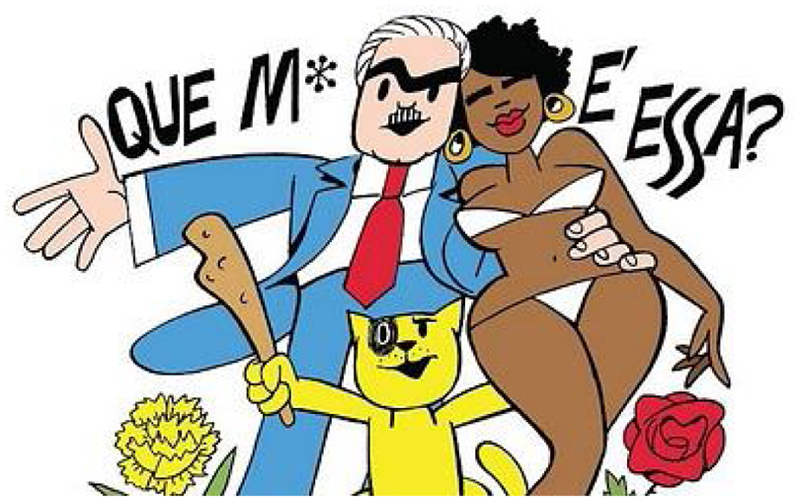
Zilraldo cartoon ‘Que Merda é Essa?’ in http://www.kaosenlared.net/noticia/brasil-ziraldo-que-merda-essa
The mulata, the body apparently always ready to consent, is at the side of a self-declared racist man; however, she smiles with her eyes closed. This is the way Ziraldo chose to reinscribe the narrative of racial democracy. Behind the drawing Ziraldo wrote: ‘What shit is that?’ referring to the report and the action organized by black Brazilian organizations in its support. In addition, Ziraldo declared, ‘Racism without hate is not racism.’ He was suggesting that in Brazil there is no ‘real’ racism because there are no demonstrations of hate against blacks. 5 Even with more than 1,300 police killing of blacks in one year, Brazilian whites seem to not look at these deaths as a process of racial extermination.
The black saints and their bluest eyes
Image 7 represents the Catholic saint São Benedito. According to the narrative, he was a medieval African priest whose charity and humbleness gave him the status of a saint. In Brazil he is considered the protector of children and of black people. In many statues São Benedito is represented with blue eyes and holding a white child.
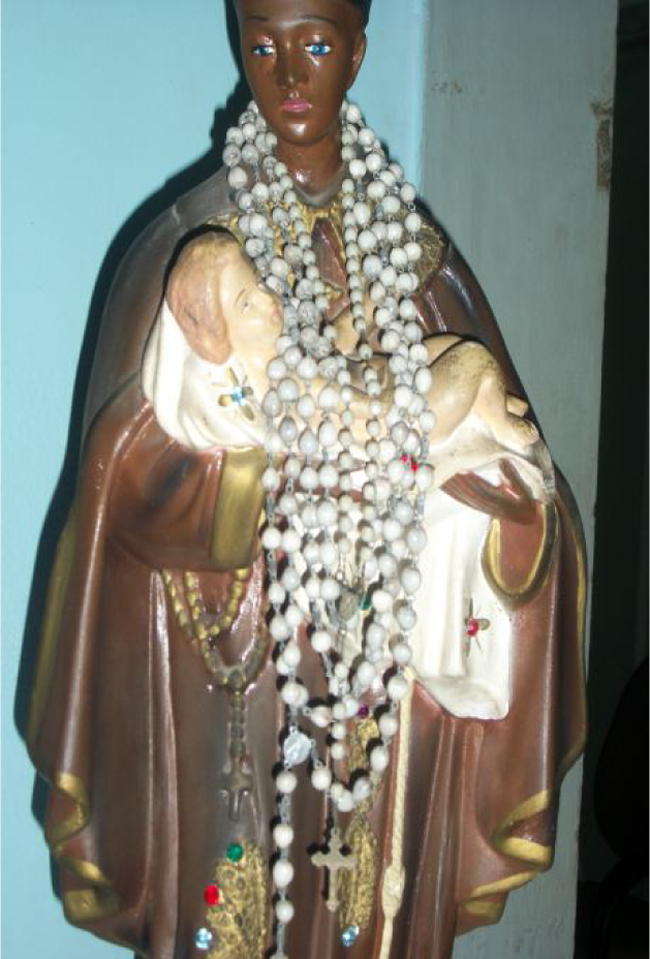
São Benedito photographed by Maria Andrea Soares at Nossa Senhora do Rosário church, Rio de Janeiro, June 2011.
Next to this we see a representation of ‘Slave Anastácia’. There is no concrete evidence of her actual existence, but according to oral tradition, she was a princess who was sold to a cruel owner. The man tried to convince her to become his mistress, but she refused and was raped and forced to wear an iron face-mask and an iron collar. Even without official recognition by the Vatican, Anastácia is venerated in Brazilian popular Catholicism as well as in Umbanda. 6 Some of the stories about Anastácia say that she forgave her master and his family before she died from the infection she got as a consequence of the iron collar.
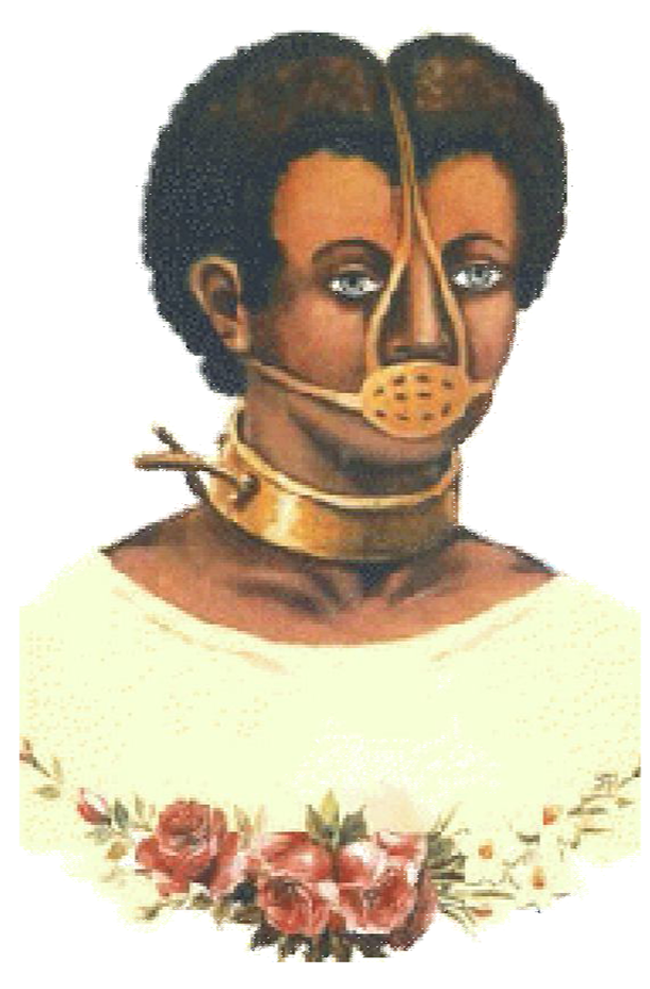
Slave Anastácia in http://www.centroanastacia.com/quemanastacia.htm
Strikingly, in popular descriptions of Anastácia, each time people describe her beauty they emphasize that she had blue eyes—as if to be beautiful and black is an unthinkable combination, and for this contradiction to be conciliated she had to have blue eyes in order to minimize her Africanness. Two popular expressions in Brazil help to clarify why good saints should have blue eyes. The first states that there are really good black people, so good that people (less often, I hope!) say these blacks have ‘white souls’. The other expression says, ‘The eyes are the mirror of the soul.’ That is exactly what the blue eyes of Anastácia and São Benedito represent: they are considered blacks with white souls, a soul that is revealed in their blue eyes, imprisoned under their dark skins. But with these eyes they can still see the world through a white gaze. Frank Wilderson, mentioning Franz Fanon’s psychoanalytical work, refers to this obsession with whiteness as ‘hallucinatory whiteness’, 7 a neurosis afflicting black people, an imposed ideal of whiteness to be achieved because as a black person, one cannot be safe in his/her own body schema.
It is also striking that, contrary to the lustful mulata, Anastácia is the virtuous princess who refused to have sex with her owner and the price for this refusal was her death. It is this image of suffering that is celebrated along with her capacity to forgive the white family.
Craftworks
The next picture is from a statue I photographed in the ‘São Cristóvão Fair’ held weekly as a display of Brazilian northeastern culture in the city of Rio de Janeiro. At this fair there are several pavilions selling pottery sculptures. Many of these sculptures show women engaged in activities considered feminine such as sewing, feeding poultry and carrying baskets on their heads.
The only statues that showed pregnant women were the black ones, and all of them are depicted with a face showing consternation. Why should the young black woman be unhappy with her pregnancy? Her youth and the fact that she does not have a wedding ring on her left hand indicates that the young black woman made a mistake by having sex without being married, and now she is pregnant. This representation is problematic in several ways: it reinforces the notion that black women are sexually loose and that they irresponsibly become pregnant; it restates the sexist idea that only women are responsible for birth control. But here I am interested in the black pregnancy as problem as the reproduction of the ‘black problem’ idea—a large number of blacks is a problem in attaining national progress. This reading of the image makes sense in the context of recent statements made by a Brazilian state representative promoting a defamatory campaign towards black women. Sérgio Cabral, Rio de Janeiro’s governor, recently declared himself in favour of the legalization of abortion in Brazil. According to him, the rate of childbirth in the favelas,
… [h]as everything to do with violence. The number of children per mother in Lagoa Rodrigo de Freitas, Tijuca, Meier and Copacabana is the same as in Sweden. Now compare with Rocinha. The birth rate in Rocinha is the same as in Zambia, Gabon. This [birth rate] is a factory producing criminal people. (G1, n.d.)

statue of a pregnant Black woman photographed by Maria Andrea Soares at the São Cristóvão fair, Rio de Janeiro, July 2011.
The governor believes that curbing the number of births in poor black communities is a security measure to assure the social order. In addition, he compares what he believes to be acceptable rates of childbirth, represented by middle class (white) neighbourhoods (Lagoa Rodrigo de Freitas, etc.)with people in the ‘nice’ spaces of European countries (Sweden). Then he compares birth rates in the favelas (‘Now compare with Rocinha) with African countries (Zambia, Gabon). The governor directly opposes the civilized (European, middle class) neighbourhoods to undesirable African parameters.
Mythical creatures
Popular culture in Brazil is rich with stories and tales about mystical creatures. Many of these tales tell the history of the nation’s foundation and represent how each race ‘contributes’ to or operates in the creation of Brazil. The next images introduce two of these mythic beings portrayed as black children.

The first image represents ‘Saci Pererê,’ a trickster represented by a one-legged black boy who smokes a pipe and wear a magical red hat. According to folklorist Câmara Cacudo, tales about ‘Saci’ were popular in agrarian areas of Brazil from the late 18th century. 8 Apparently ‘Saci’ was a mythical figure of southern indigenous groups who migrated to the northeast and gained ‘African’ elements: the original indigenous boy gave way to a black boy or teenager who lost his leg in a capoeira fight (Cascudo, 2000). He is mischievous, funny and even treacherous. ‘Saci Pererê’ travels in whirlwinds, he scares horses in the road, he likes to tie people’s hair while they are sleeping and he likes to hide people’s things.
Image 11 shows the ‘Negrinho do Pastoreio’ (black herdsboy) from the southern Brazilian legend of a black enslaved boy who was violently whipped by his owner after losing a herd of horses. Through the intervention of a miracle provided by the Virgin Mary, ‘Negrinho’ finds the herd. But he is whipped and finally buried alive in an anthill as punishment for having lost a horse race. After his death the ‘Negrinho do Pastoreio’ appears to the slave-owner riding a white horse and guiding the herd. This return of the former slave boy, now sanctified through his death, elevates him to the category of a miraculous being capable of helping people to find lost things.

‘Negrinho do Pastoreio’ in http://www.google.com/search?client=safari&rls=en&q=negrinho+do+pastoreio+images&ie=UTF-8&oe=UTF-8
Three main themes emerge from the representations: the first concerns the dehumanization of black children through the demonization of the ‘Saci Pererê’ character: depicted in a liminal stage between childhood and puberty, he lives among adults, annoying them with his tricks. He is addicted to his pipe and in most representations he is racially stereotyped with staring eyes and a big nose and lips. Dehumanization also occurs in relation to the configuration of his body that, although mutilated, is not worthy of empathy. It is funny, not sad, that he jumps around on his only leg. The second theme concerns the representation of a black child who is afraid and in danger: ‘Negrinho do Pastoreio’, murdered by his master. The black child’s death becomes a reason for devotion, and the ant-devoured black body turns into a symbol of miracle and redemption. This story reintroduces the same idea present in Anastácia’s narrative: blacks die at the hands of whites, and yet they are able to forgive and help their masters. Their sacrificial deaths are celebrated as proof of blacks’ good character, they are here ‘doing the work of dying’ (Frank Wilderson in Hartman and Wilderson, 2003: 197) for the good of their white master, who stands in for the good of the nation. The third theme concerns the oppositional disposition of these children’s bodies: ‘Saci’ is a trickster, while ‘Negrinho do Pastoreio’ is a good entity. ‘Saci’ smokes a pipe—a practice founded in certain indigenous rites, thus, a pagan practice. According to the popular tradition, ‘Negrinho’ asks for candles to help people find things. The candles have a strong association with the Catholic rite to which ‘Negrinho’ is closely related through the Virgin Mary’s interventions. She transforms the boy’s tears into candle flames to illuminate the fields, then helps ‘Negrinho’ to find the herd. She delivers him from death. Whereas ‘Saci Pererê’ is between childhood and puberty visiting people and animals while they sleep (carrying a hint of sexual danger), ‘Negrinho do Pastoreio’ is depicted as an angelic child who did not offer resistance or even try to run away when he was beaten. ‘Negrinho’ carried out all the forced labour demanded of him. ‘Saci’, the devil, rides the natural element to move according to his will that in general is to disturb people. While he hides things, ‘Negrinho’ finds them. The latter dies, but ‘we’ still can rely on him, while the former who fights (‘Saci’ lost his leg in a capoeira fight) and stands, ‘we’ cannot trust.
This set of images exemplifies the dynamics of race and gender representations that operate in the national imaginary as the ‘natural’ character of black Brazilians. The politics of racial representation attend to the specific interests and needs of control over populations considered undesirable, inferior or threatening. Stuart Hall, writing on the use of images in configuring the racial ‘other,’ observes that:
Each image carries its own, specific meaning. But at the broader level of how ‘difference’ and ‘otherness’ is being represented in a particular culture at any one moment, we can see similar representational practices and figures being repeated, with variations, from one text or site of representation to another … We may describe the whole repertoire of imagery and visual effects through which ‘difference’ is represented at any one historical moment as a regime of representation. (1997: 232)
These visual dis-positions of blackness and of blacks must be read as a strategy of political and social control, as Homi Bhabha stresses:
But surely there is another scene of colonial discourse in which the native or Negro meets the demand of colonial discourse; where the subverting ‘split’ is recoverable within a strategy of social and political control. It is recognizably true that the chain of stereotypical signification is curiously mixed and split, polymorphous and perverse, an articulation of multiple belief. The black is both savage (cannibal) and yet the most obedient and dignified servant (the bearer of the food); he is the embodiment of rampant sexuality and yet innocent as a child, he is mystical, primitive, simple-minded and yet the most worldly and accomplished liar … (2004: 82)
Scholar Patricia Hill Collins in Black Feminist Thought, argues that the repertoire of stereotypical representations of black women operate as ‘controlling images’ that either confirm the dominance of the white group, or relive national anxieties regarding slavery, segregation, miscegenation and rape. However, ‘controlling images’ do not only maintain these ‘ethnic notions’ 9 among whites; controlling images also operate to naturalize behaviour within the dominated group. A large percentage of Anastácia and São Benedito devotees are black people proud of the saints’ blue eyes—a kind of ‘yes we can’ at the level of metaphysics or genetics—just as there are potentially a million black girls dreaming about being the next Globeleza. And another million giving their contribution to the nation in bare flesh.
Blackness under control
Departing from Hartman’s statement that ‘in this instance the infamous propensity of the negro for mimicry and imitation is tantamount to insurgency’ (1997: 41), I investigate the transformative potential of radically reading representations of blackness. By a radical reading of blackness, I mean the use of a politics of representation that critically engages with the circulating themes and discourses to extract from them different meanings that question the regulatory regimes that produce not only racial inequality, but also the cognitive and symbolic mechanisms that produce the black being as the locus of inhumanity.
Scholars such as Darieck Scott, Hortense Spillers, Patricia Hill Collins, Ruth Gilmore, Angela Gilmann, Jared Sexton, Tavia N’yongo and Frank Wilderson theorize that deviance and ‘decay’ are attached to black existence. This existence is apprehended as excessive and aberrant, or better: this existence is apprehended as an excessive lacking of humanity in its b+lack state of being. The academic tradition on diaspora studies regarding the subjective process of perceiving oneself as the ‘other’ in the white man’s lens—was a central aspect of DuBois’s work and also in the work of the Martinique-born French psychiatrist, philosopher and activist Frantz Fanon. Fanon’s reflections on the process of subjectification of the black man has been one of the central intellectual influences in works on blackness in visual culture, philosophy, psychoanalysis, queer studies and literary criticism. Spillers’s critique of Fanon’s male hetero-normative gaze offers a provocative reflection on how gaze—even when is produced by a black man imposes a fixity over the object ‘blackness’ (Spillers, 2003). In the Fanonian gaze, black women’s subjectivities are once more situated as zones of absence. This absence of subjectivity turns black women into sexual and phobic projections. To relieve the anxiety of the phobic view of the ‘Negress’, society needs to ‘pornotrope’ her corporeal schema, transforming black women into ‘excessive flesh’ (Hartman, 1997; Holland, 2000; McKittrick, 2006; Spillers, 2000). 10
Some scholars and artists see in the hyper-visibility of blackness a strategy to defy the patriarchal and hetero-normative paradigms of civilization and society that position blacks as lustful, deviant and abject flesh. The hyper-visibility advocated in the works of artists such as Adrian Piper, E. Patrick Johnson and Robbie McCauley creates a field for contestation of the regimes of distribution undergone by black gendered bodies within the boundaries of the nation under the law of the state (Alexander, 1997; Bowles, 2011; Fleetwood, 2011; James, 1999; Johnson, 2003; McCauley, 1989; McKittrick, 2006).
With the next group of images I perform a questioning of the process of ‘stereotyping’ blacks in Brazil. I reintroduce the images I have discussed, but insert in them elements that modify the images’ original meanings. I engage hyper-visibility through the use of the collage, repetition and juxtaposition to achieve an effect of grotesque. To clarify, my approach to the grotesque as a concept differs from the Bakhtinian sense of the exacerbation of the sensuous world and the expenditure of physical energy as an irreverent, even outrageous, celebration of life and its instinctual aspects, working even as a form of resistance of the subordinated social classes (Bakhtin and Iswolsky, 1984). My use of grotesque refers more to Homi Bhabha and Achille Mbembe’s deployment of grotesque as mimicry. According to Bhabha, ‘Mimicry emerges as the representation of a difference that is itself a process of disavowal’ (1994: 86) and it legitimates the colonial authority upon the ‘other’. To Mbembe, ‘the grotesque and the obscene are two essential characteristics that identify postcolonial regimes of subordination’ (2001: 101). Since the original images correspond to the colonial and post-colonial process of othering the black, thus being a mimicry, hyper-visibility in my experiment consists in the mimicry of the (dominant gaze) mimicry.
What happens when we radicalize the representations of blackness and point to the oppressive schema underneath them? What if we introduce new elements into the reified representations that objectify the black body? Maybe then we will make visible what have been rendered invisible—the white supremacist and colonial gaze which profit from our exposure to violence and subjugation.
Then the naked black female’s flesh, previously marked as excessive, will show the chains that, since the slave markets, she has been held in to be seen and evaluated. The circulation of old references, the chains, to the actual image of the ‘Mulata Globeleza’ allows us to think in terms of the common fate of black women in the diaspora: the sexualized object to which Robbie McCauley refers in Sally’s Rape (1989). This rearticulation of a past in which black enslaved women were exposed to white eyes in the slave markets and raped in the houses and fields still makes sense in a world where black women endure harsh living conditions. The inscription of Freyre’s words of celebration of sexual miscegenation over the Mulata Globeleza’s’body reveals the man in the anthropologist as a pornotroping (Spillers, 2010) gaze distributing black female flesh according to the regimes of work demanded by slavery and post-slavery. Grotesque is revealed. She who is celebrated as a Carnival diva, in the next season is the same flesh drawn at the side of a respectable racist old man.

photo collage ‘Global Chains’, image 5 plus: fragment of ‘Escrava Anastacia’ sculpture photographed by Maria Andrea Soares at Nossa Senhora do Rosário church, Rio de Janeiro, June 2011; plus chains.
Just as the image of the body of a black woman did not spontaneously jump but was drawn into the Ziraldo cartoon, many black women have not willingly participated in the creation of the mixed ‘Brazilian race’. Instead of celebrating miscegenation Brazilian people should be concerned with our past of coercion and sexual violence.
With this image I propose to confront the misconception that the rape and sexual exploitation of black women was consensual miscegenation. When Freyre states that the Portuguese colonizer ‘pleasantly started to mix himself with the colored women at their first contact’ (2002: 37), he is actually sanctioning rape as the pillar of the Brazilian formation. As Hartman points out, the enslaved do not have the right to consent or to deny anything. The principle of being a slave is to be subjected to the will of the master, and any attempt to escape subjugation is a criminal offence on the part of the slave:
… the law’s selective recognition of slave humanity nullified the captive’s ability to give consent or act as agent and, at the same time, acknowledge the intentionality and agency of the slave but only as it assumed the form of criminality. (1997: 80)

photo collage ‘Lobato in a democracy’, image 6 plus: fragment of Anastácia mask; image 2; ‘Caveirão’ in http://www.google.com/imgres?imgurl=http://4.bp.blogspot.com/_eMPEt9XdDSc/Ryhz1zV6TCI/AAAAAAAAA2M/i36HcYL9mQw/s400/caveirao2.jpg; and policeman with body in http://www.estadao.com.br/noticias/cidades,onu-inicia-investigacao-sobre-violencia-policial-no-brasil,74601,0.htm

In not recognizing the status of the sexual relations among masters and enslaved women as sexual crime, the national discourse embraces an ideology in which black women were (and are) always willing to have sexual contact with their masters. It is for this reason that I overlapped the image of Anastácia upon the faces of both black women in the collage: first I added the image of the ‘Baiana do Acarajé’ in one of Lobato’s hands. She represents the black servants, cooks and former slaves who worked in the kitchens of the big house; in the present she represents the ‘aunties’ selling traditional religious food to the tourists and serving as model for stereotypical characters in Brazilian literature. She and the Mulata carry the mask because they have no right to disagree with how they are depicted. If they could talk, their voices would not be heard by Lobato, Ziraldo, or Freyre, anyway.
To endorse Hartman’s statement that the black being under the slavery was recognized as a person only through his criminal agency, I added the images of the ‘Caveirão’ (a military vehicle used in the occupation of favelas) on the right and upon the cat’s face I pasted the fragment of a sand statue I photographed in Copacabana beach. This statue shows the enjoyment the foreign tourists can have in Rio de Janeiro; here, it is defending the ideals of white supremacy. On the left I overlapped images of police killing in Rio de Janeiro’s favelas in reference to the war-like rates of murders committed by military police in Brazil from 2003 to 2011.
In regard to Ziraldo’s claim—or provocation—that Lobato’s writing is not racist, the question could be asked: how is it possible to deny the racism of a self-declared eugenicist by humiliating black women? Is it possible say ‘what shit is this (of calling us, white Brazilians, racists)?’’ by showing Our flesh as an available commodity always ready to serve the masters in the kitchens and in the beds, while our brothers and sons kill our brothers and sons to protect the master’s civilization? Is our silence the pillar of the Brazilian fallacy of racial equality?
The body depicted almost or totally naked, celebrated in its exuberance and vigour, is the same female body that is blamed for irresponsibly reproducing criminals. In the presence of Rio de Janeiro governor’s speech, the figure of a statue showing a worried black pregnant woman assumes new dimensions. If the popular imaginary thinks about black women’s pregnancy as an irresponsible act of sexual promiscuity, the statements made by this state representative make us think that the national project demands the restriction of black births. In overlapping several images of the statues I want to propose a different scenario in which the governor is being watched by a community of black pregnant women shocked by a state representative expressing such genocidal views.
According to Brazilian anthropologist Sonia Santos, working with the black women’s organization Criola, the rates of maternal mortality among black women is seven times higher than among white women (Santos, 2008: 382). Black women have less access to pre-natal exams, and are more often mistreated by doctors, nurses and other health agents in the public service. The rates of high blood pressure, hypertension and sickle cell anaemia are also more elevated among black women, as are the rates of HIV infection (Santos, 2008: 383).
Sonia Santos also points out the massive investment by the Brazilian state from the late 1970s to the early 1990s in the sterilization of black women. According to Sonia this practice,
… needs be understood as part of a set of policies that have exerted a disproportionate pressure upon black women’s reproductive rights and betrays intrinsic racist and sexist views about black women’s sexuality. (2008: 144)

photo collage ‘Pregnant women listening the state’, image 9 plus: Governor Sérgio Cabral in http://www.google.com/search?client=safari&rls=en&q=sergio+cabral+governador&ie=UTF-8&oe=UTF-8
Looking into this panorama, Sérgio Cabral’s statement could be read as an official demand for black genocide – a return to Nina Rodrigues’s and Monteiro Lobato’s beliefs in eugenics. Black pregnant women certainly have reason to be worried—though not necessarily about what the sculptor of the pregnant statue thought.
All black familial ties seem to be categorized as weak, dysfunctional, inappropriate and insufficient. However, popular understanding is willing to embrace the ideal of black devoted servant or of the benevolent saint capable to sacrifice him/herself to protect the white master. While São Benedito’s devotees celebrate his humility, over 23,000 children, the vast majority black, are in the streets without access to health or education or protection. In this collage, São Benedito, who has a heart big enough to take care of the white child in his arms, turns his back on his own kind. His blue eyes allowed him to move forward from blackness.
While people think about Saci Pererê as a rural legend or a literary folk figure, thousands of black children living in precarious conditions get addicted to drugs like glue and crack cocaine. I would like to think about the impact that the systematic repetition of notions of blackness as deficient, deviant and unable to achieve total humanity have upon how the average population perceives the living conditions of disenfranchised black children. While the demonization of the black character, the ‘annoying prankster’, circulates in mass media and in virtual spaces such as Wikipedia, it mirrors real existing conditions: the black kid was already haunted by ‘Saci’ even before he had sniffed his first bottle of glue.

photo collage ‘São Benedito looking to the Future’, image 7 plus homeless children in http://br.kindernothilfe.org/criancas_em_situacao_de_rua.html

photo collage ‘Annoying Pranksters’ image 10 plus child sniffing glue in http://br.kindernothilfe.org/criancas_em_situacao_de_rua.html
Such physical and symbolic violence, along with the permanent state of surveillance and human rights abuse (Amparo Alves, 2009; Cano and Ribeiro, 2007; Rocha, 2010), challenges recent attempts to revitalize the racial democracy narrative (Fry and Maggie, 2007; Maggie, 2004). These works deny the pervasive nature of Brazilian racism, and accuse black activists and intellectuals of planting the seeds of a reverse racism. They target, mainly, debates around the adoption of affirmative action and quota criteria in public universities. While these authors are concerned that the adoption of affirmative action based on race/skin color criterion would create racial antagonisms in a country that is working to achieve equality, they have not convinced me (and other millions of blacks) that the lethal violence inflicted upon black communities has nothing to do with an already existent system of racial privilege.
The 2009 Human Rights Watch report announced that Brazilian police were responsible for the deaths of 5,000 young black males between the years of 2003 and 2007. Contrary to what Peter Fry and Yvonne Maggie’s book Divisões Perigosas: Políticas Raciais no Brasil Contemporâneo (Dangerous Divisions: Racial Politics in Contemporary Brazil) suggests, there is no more dangerous division than the flagrant difference between the life experience of black youth and white youth in Brazil (Flauzina, 2008; Vargas, 2011).
In Image 17, this body (or bodies) never sunbathed on Copacabana’s beach. I brought him and his executioner here. Maybe even when this young black man was alive he never swam at the beach. This is a nice beach. It is featured in airline brochures as one of the most famous places to tour in Brazil. Favela residents do not usually go there, unless they go to work. Also, the blacks and near-white members of military police do not kill other blacks in front of foreign and upper-middle class eyes. However, all the corpses back there on the corners of the favelas lay there to ensure that this beach and its nice neighbourhoods are safe for tourists and for those Brazilians who not only can afford it, but for those who look like someone able to peacefully walk in upper class spaces without being under some type of surveillance. Someone to whom nobody will shout out: ‘Look, a negro!’ (Fanon, 1967).

photo collage ‘Mixture or Massacre?’, image 1, plus policeman with body; plus ‘Caveirão’
He and those other people like him, and other girls, and aunties, and mammies, and mulatas and uncles do not operate as full citizens of any ‘democracy’. And ‘Look, they are so beautiful!’ ‘Their’ cultural contributions were valuable and after all, one day, the world will be thankful for the ‘negro’ ‘contributions’—look to the mitochondrial Eve! 11 Two hundred thousand hundred years and Sinéad O’Connor still remembers the contribution of her emblackened flesh to humanity. 12
The manipulative dynamics of visual representation and political discourse presented here reinforce the naturalization of black suffering and social disenfranchisement. Black presence and its cultural products are often patronizingly characterized as folkloric, naïve or bestial, ‘options’ framed by the western binary primitive–civilized. The circulation, reproduction and rearticulation of ‘stereotyping’ practices conceal and justify anti-black institutional and para-institutional necro-politics (Mbembe, 2003).
Conclusion: the emergence of the disruptive gaze
Fred Moten’s In the Break offers a sophisticated analysis of black radical arts, situating them beyond any possible western categorization and theorization. The break, represented by syncope and by disruptive semiotic operations in text, music, speech, movement and photography, is the space of the incomprehensible that transcends the rationality of all modern theories—namely, Marxism, psychoanalysis, philosophy and semiotics—and goes where the meaning of black suffering surpasses the content of the discourse. The break represents a sexual cut that recatches the eros castrated by the black ontological condition of enslaved being. As Moten states: ‘Black Art, which is to say Black Life, which is to say Black (Life Against) Death, which is to say Black Eros, is the ongoing production of a performance, the ongoing production of a performance: rupture and collision’ (2003: 209). Engaging with this standpoint, I experimented here with the idea of break as an operation of interrupting the image’s rhetoric to determine what kinds of ruptures and collisions could possibly be created in the normalized paradigms of racial representation in Brazil.

The aesthetics of a black radical reading of the world as an anti-black institution (Wilderson, 2011) implies the need for an alternate symbolic structure capable of conveying the uniqueness of the black condition. Echoing Wilderson (2012) I believe that black cultural agents have to look for semiotic tools that are able to enhance the agency of cultural production. The alignment of Hartman’s categories of insurgency and mimicry with Moten’s category of disruption could create this alternate symbolic structure that enables the eruption of a radical performance of blackness as a cognitive radicalization. This cognitive radicalization will create conditions for a different grammar to conceptualize, to reflect and to inform black political existence. An existence that is mediated by the ‘afterlife of slavery’, the continuity of the legal apparatuses, the para-legal deployment of violence and the cognitive/moral mapping that sustained racial slavery and still defines the politics of surveillance, distribution and rearrangement of black bodies into the nation state (Sexton, 2011). If as Lélia Gonzalez—a black Brazilian women who fought as social scientist, as feminist, and as activist—if as she affirmed black populations in Brazil undergo a permanent state of psychological and material domination (1982: 15), I understand that we, a whole new generation of activists, intellectuals, scholars and black Brazilians inside and outside academia should seek to decolonize our experience and our cognitive tools of apprehension of the world and of ourselves in the world.