



Abstract
This article investigates the multivalued random dynamics generated by solution operators of fractional random reaction–diffusion–advection equations driven by superlinear colored noise on unbounded domains. The equations under consideration exhibit non-Lipschitz continuous nonlinear drift and diffusion terms, which lead to the non-uniqueness of solutions and hence generate multivalued random dynamical systems. Our goals are to demonstrate: (i) the existence of solutions for fractional reaction–diffusion–advection equations driven by superlinear colored noise on unbounded domains; and (ii) the existence and uniqueness of pullback random attractors for these systems. The measurability of the random attractors is demonstrated using a method that relies on the weak upper semicontinuity of the solutions. The asymptotic compactness of solution operators is obtained by employing Ball’s approach to energy equations in order to address the non-compactness of Sobolev embeddings on the entire space.
Keywords
Introduction
In this article, we investigate the random attractors for multivalued random dynamics of fractional random reaction–diffusion–advection equations driven by superlinear colored noise on the entire space

Reaction–diffusion–advection models are extensively employed to elucidate the diverse aspects of population dynamics. In this framework, the entire space
Colored noise is utilized to approximate the Wiener process, effectively addressing the challenges posed by the non-differentiability of the sample paths. From a practical perspective, accounting for random influences in systems using colored noise is more rational, given that random fluctuations in complex systems often exhibit some degree of correlation (as noted by Anishchenko et al. (2007), Chen et al. (2021), Caraballo et al. (2023), Gu et al. (2020), Gu & Wang (2019, 2020, 2018), and Ridolfi et al. (2011)). Recent investigations, such as those by Chen et al. (2023), Freitas (2024), and Wang et al. (2023a), have delved into the long-term dynamics of the multivalued partial differential equations subjected to colored noise.
Random attractors are essential tools for understanding the dynamic behavior of dynamical systems (see Carvalho et al., 2012; Crauel et al., 1997; Caraballo et al., 1998, 2004, 2012; Freitas et al., 2018; Kloeden, 2011; Li et al., 2015, 2024; She et al., 2022; Wang, 1999; Wang & Li, 2019; Wang & Wang, 2020a, 2020b; Wang, 2021). Multivalued random dynamical systems more accurately capture the phenomenon of non-uniqueness by describing multiple possible evolutions of the system’s state, helping to better understand the long-term behavior and multiple steady states of uncertain systems. Extensive studies have been conducted on the random attractors of multivalued random dynamical systems, as evidenced by Caraballo et al. (2003), Caraballo et al. (2008), Caraballo et al. (2010), Cintra et al. (2024), Li et al. (2019), Wang & Wang (2015), and Xu & Caraballo (2023). Notably, random attractors for SPDEs with the standard Laplacian operator (
Throughout this article, we assume that the nonlinear drift term
The article is structured as follows. In Section 2, we review some known results on random attractors, colored noise, and the fractional Laplacian operator for multivalued non-autonomous random dynamical systems. Section 3 is dedicated to demonstrating the weak upper semicontinuity and measurability of the solutions. Additionally, we define a multivalued non-autonomous random dynamical system for (1.1). In Section 4, we derive uniform estimates of solutions and prove the existence and uniqueness of pullback random attractors.
For the convenience of readers, it is necessary to review some fundamental results on the pullback random attractors, colored noise, and the fractional Laplacian operator for multivalued non-autonomous random dynamical systems, as described by Di Nezza et al. (2012) and Gu & Wang (2020).
Pullback Attractors for Multivalued Non-Autonomous Random Dynamical Systems
Consider two metric spaces
Let
Let
A multivalued mapping
Let
A family

The result of existence of pullback random attractors is stated as follows (see Gu & Wang (2020); Wang (2017)).
Let Then
To characterize the colored noise used in this article, we define a probability space


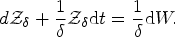


Let If Every Given
Let









In this section, we establish a multivalued non-autonomous cocycle for the fractional reaction–diffusion–advection equation driven by superlinear colored noise:





We will look for the solutions of (3.1) and (3.2) in the following sense.
Given


To demonstrate the existence of solution for equations (3.1) and (3.2) as defined in Definition 3.1, we approximate the entire space



Let





Since a solution to


Suppose For problems (3.1) and (3.2) defined on the unbounded domain Step (i). Uniform estimates for the solutions of (3.8)–(3.10). By (3.8) and using the Remark 3.2, we obtain
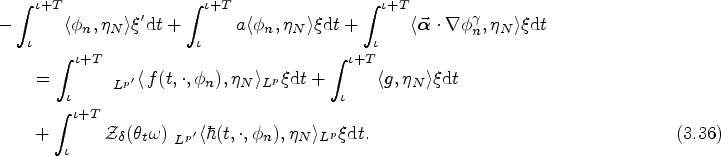
Step (ii). Existence of solutions of problems (3.1) and (3.2). By applying a diagonal process from (3.20) to (3.23), we conclude that there exists Now, given To prove the continuity of Next, we demonstrate that








































The subsequent uniform estimate of solutions to (3.1) and (3.2) within a finite time interval is crucial for proving the weak and strong upper semicontinuity of solutions.
Suppose that

From the energy equalities (3.14) and (3.3), we have that








In this subsection, we discuss the weak and strong continuity of solutions to (3.1) and (3.2).
Suppose that
(i) If (i) Due to

















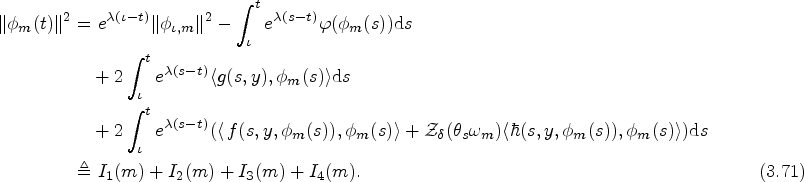







Suppose that


Since
We now define a multivalued non-autonomous random dynamical system for the given problems (3.1) and (3.2). In what follows, for Suppose that assumptions For each For every t For every t (a) For each


From now on, we denote by


In this subsection, we derive uniform estimates of the solutions to (3.1) and (3.2) in
Then for every


Integrating (3.56) over (


In this subsection, we prove the
Suppose that assumptions
From Lemma 4.1 (with s = 0), we infer that









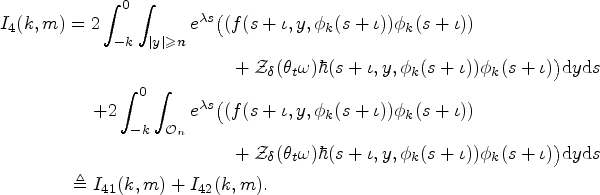




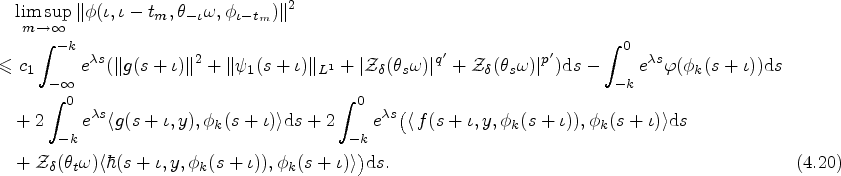


As an immediate consequence of Lemma 4.2, we have the
Under the assumptions of Lemma
Given

Suppose that assumption By Lemma 4.1 and Gu & Wang (2020: Lemma 4.2) we can verify that

Let
The proof follows a similar approach to that of Gu & Wang (2020) by employing Lemmas 2.7 and 3.6, and hence we do not repeat that.
We are now in a position to establish and prove the main result on the existence of a
Suppose that assumptions
Since the multivalued cocycle
The above result also applies to problems

The above result also applies to problems


Footnotes
Acknowledgements
This work was supported by National Natural Science Foundation of China (No. 12301299), the Guiyang City Science and Technology Plan Project (No. [2024]2-17), Natural Science Research Project of Guizhou Provincial Department of Education (Nos. QJJ[2023]011; QJJ[2024]322), the Young Elite Scientist Sponsorship Program by GAST(GASTYESS202403), the Foundation of National Key Laboratory of Computational Physics (SYSQN2024-18), and the research fund of Qiankeheping-tairencai-YSZ[2022]002.
Declaration of Conflicting Interests
The author(s) declared no potential conflicts of interest with respect to the research, authorship, and/or publication of this article.
Funding
The author(s) received no financial support for the research, authorship and/or publication of this article.