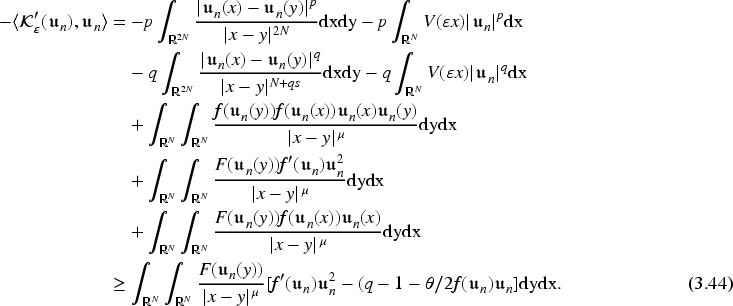
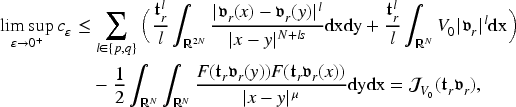
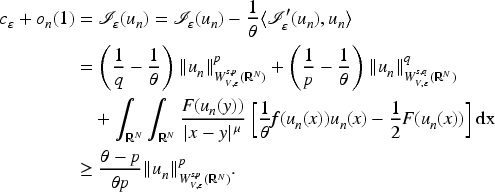
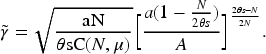
In this paper, we study the fractional Choquard equation in
where is a positive parameter, The nonlinear function has an exponential growth at infinity and the potential function is continuous in and satisfies suitable natural conditions. Using the Ljusternik–Schnirelmann category theory and variational methods, we establish multiplicity and concentration of positive solutions for small values of the parameter .
The paper deals with semiclassical ground state solutions of the fractional double phase equation in , with a Choquard reaction,
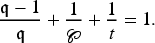
where is small positive parameter, , , , the continuous potential is bounded from below by , the nonlinearity has an exponential critical growth at infinity, and is the fractional -Laplace operator which is defined by
for (up to a normalization constant in the integral), where , and is the ball with center radius
Let us state the assumptions on and .
is a continuous function satisfying
when either or When the potential is required to be of class , which was first introduced by Rabinowitz in Rabinowitz (1992).
is a continuous differentiable function such that for all For each , , with
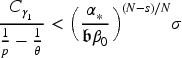
there exist two positive numbers , and , with , such that
There exists large enough such that for all where is a constant in the condition.
The function is strictly increasing on
When , Equation () reduces to a typical elliptic equation,
where is nonlinear reaction, which has been extensively studied in applied sciences such as physics, biophysics, plasma physics, chemical reaction design and so on. Just as an example, that equations arise from the general one–component reaction–diffusion problem
Here denotes a concentration of one or more chemical substances, say one, describes a local reaction term related to source and loss processes, while is the diffusion coefficient, where have a power law dependency. The hypothesis that just a difference in diffusion coefficients of components could be enough to destabilize the homogeneous solution was put forward by Turing in Turing (1952) by studying the problem of biological morphogenesis. In most cases, is of polynomial type with variable coefficients, but for the Liouville–Bratu–Gelfand model as well as for the Frank–Kamenetsky model has exponential growth at infinity. For further physical examples we refer also to Antontsev and Shmarev (2006); Benci et al. (2000); Cherfil and Il’yasov (2004) and the references therein. The multiple phases equation comes from the studying of Born-Infeld equation (Bonheure et al., 2016; Born & Infeld, 1933; Brézis & Lieb, 1983) that are models in electromagnetism, electrostatics and electrodynamics as a model based on a modification of Maxwell Lagrangian density
When , Equation () reduces to the fractional Choquard equation involving the fractional -Laplace, that is
where is a small parameter, typically the Planck constant, is a primitive function of the nonlinear reaction . A solution of the Equation (1.4) as is said to be semi-classical. In the physical meaning, the semi-classical solution as should correspond to solutions of Equation (1.4) and the critical points of potential which controls the classical dynamics. We see that if is a solution of Equation (1.4) and then the function is a solution of
If is a critical point of and , then we expect that should converge to a solution of the following equation
The first result about semi-classical solutions is given by Floer and Weinstein in Floer and Weinstein (1986). A special form of Equation (1.4) is
where is a nonlinear reaction and an antiderivative of In the case Equation (1.6) appears in the theory of the Bose-Einstein condensation and it is used to describe the finite-range many body interactions between particles. Up to now, there are many results on the above equations, concerning existence, behaviour, concentration, and sign-changing of weak solutions. In 2016, Alves et al. Alves et al. (2016) studied the concentration solutions of (1.6), when , has exponential growth and satisfies some suitable conditions. However, they did not study the multiple solutions. In Equation (1.6), when we get the following Choquard equation
where is the Riesz potential defined for each point by
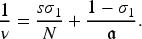
is the Gamma function and is a potential function. When , and Equation (1.7) reduces to the Choquard-Pekar type equation
The double phase problem with -growth conditions initially considered is also related to problems arising from nonlinear elasticity. Let be a bounded domain of , , with smooth boundary, be a regular displacement and be its Jaobian matrix of order associated to the deformation gradient. Then the total energy is expressed by where is quasiconvex function with respect to second variable. We consider the minimization of on some sets or spaces and the properties of the solution of that problem. In Zhikov (1986, 1995), Zhikov described the nature of certain phenomena for arising in nonlinear elasticity and introduced some different model functionals, connected with the Lavrentiev phenomena. In Equation (1.2), when has Choquard reaction, Zhang et al. (2023) established multiplicity and concentration solution for the double phase equation in
where the action is a differentiable function and the potential is a continuous function satisfying the condition In 2023, Ambrosio in Ambrosio (2024) first studied existence of multiple solutions and concentration of the -fractional Choquard equation in
where , , , is the fractional -Laplacian operator, and has subcritical growth. The potential function is bounded from below by and there exists a bounded set such that Using the penalization method, the Ljusternik–Schnirelmann theory and variational methods, Ambrosio obtained the existence, multiplicity and concentration of solutions of (1.10). In 2023, Molica Bisci et al. (2019) extended the results of Zhang et al. (2023) to the fractional Choquard Equation (1.10), where satisfies the condition
Before stating the main results of the paper, let us recall that in Equation () and some notations. For the fractional Sobolev space is defined as
which is equipped with the norm
As is shown in Pucci et al. (2015), the fractional Sobolev space , , is a uniformly convex Banach space.
Fix and endow with the norm
Clearly, the two norms and are equivalent on
From now on assume that condition holds. For each we denote by the completion of with norm
The proof of Lemma 10 of Pucci et al. (2015) shows, mutatis mutandis, that also , , is a uniformly convex Banach space, so that is a reflexive Banach space. Condition and Theorem 6.9 in Di Nezza et al. (2012) give that the embedding is continuous for any .
In a similar way, the space is defined. The natural solution space of Equation () is
equipped with the norm
From the above definitions, assumption and the fact that , it is easily seen that the embeddings
are continuous. Hence for all there exists the best constant , that is,
so that
The change of variable reduces Equation () into the equivalent equation in
which is variational and the (weak) solutions of () satisfy the following definition.
Set if for any we have
then is called a weak solution of ().
We denote by the category of a set with respect to a set . It is the least integer such that where , , is a closed and contractible set of We set and if there is no integer with above property. We refer the readers to (Willem, 1996, Chapter 5) for more details on the Ljusternik–Schnirelmann theory. Let
and for
The first result is stated as follows:
Assume that and holds. Then for any there exists such that Equation () has at least positive (weak) solutions for any satisfying Futhermore, let be a solution and is the global maximum of , then, up to a subsequence, and
Suppose that satisfies the condition in the case and satisfies the conditions . Let be a solution of Equation (), which exists by Theorem 1.1, and let be its global maximum. Then converges strongly in to a ground state solution of the following problem
As , Equation () reduces to the double phase Choquard equation, involving the -Laplacian, that is
For Equation (1.13), we assume that since the Trudinger–Moser inequality is available and optimal when Then the condition is replaced by
is a continuous differentiable function such that for all For each , , with
and there exist two positive constants , and , with is the volume of the unit sphere in such that
where .
By arguments as Theorems 1.1 and 1.2, we get the following results for Equation (1.13), respectively.
Suppose that the conditions and hold. Then for any there exists such that Equation (1.13) has at least positive (weak) solutions for any Furthermore, let be a solution and is its global maximum, then, up to a subsequence, and
Assume that satisfies condition in the case and , hold. If is a solution of Equation (1.13), which exists by Corollary 1.3, and is its global maximum, then converges strongly in to a ground state solution of
and there exist such that for all
To the best of our knowledge, it is the first time that Equations () and (1.13) are studied with Trudinger–Moser nonlinearities. In the proofs of Corollaries 1.3 and 1.4, we use Lemma 2.2 instead of Lemma 2.1. Let us emphasize that the present work is totally different from the papers of Ambrosio (2024) and of Zhang et al. (2023). Indeed, the cited works deal with the subcritical growth and with the local case. Thus, is available. The present paper treats the case so that is not embedded into Furthermore, the general condition produces lack of compactness. To overcome this difficulty, we use the fractional Trudinger–Moser inequality in every step. This is the main difference with Ambrosio (2024); Zhang et al. (2023). In addition, the papers (Ambrosio, 2024; Zhang et al., 2023) do not treat the limit of ground state solutions as .
Another main difficulty we encounter is the loss of compactness of the Palais–Smale sequences related to the underlying functionals associated to Equations () and (). In order to apply the Ljusternik–Schnirelmann category theory, we have to establish some tools and technical results presented from Sections 2 to 5.
The plan of the paper is the following: in Section 2, we are interested in considering the autonomous parametric Equation () associated to Equation (). Next, Section 3 deals with the auxiliary Equation () for which the Palais–Smale condition holds for its energy functional. Then, useful tools to establish a multiplicity result are presented and applied to the auxiliary Equation () to get multiple solutions. In Section 4, we prove the existence of ground state solution of the auxiliary Equation () and the concentration of solutions. In Section 5 we complete the proof of Theorem 1.1. Finally, Section 6 presents the exponential decay estimates of the solutions of Equation (1.13).
The Autonomous Equation
Fix . In this sequel, we study the following autonomous Equation (), connected with Equation (), that is
We denote by the energy functional associated to Equation () as follows
where
Here is the Banach space, with the norm
We also endow with the equivalent norm
Thus, is a uniformly convex Banach space and so is also a reflexive Banach space. Theorem 6.9 of Di Nezza et al. (2012) guarantees that the embeddings
are continuous. Hence, for all there exists the best constant given by
This implies that
For later purposes and for the sake of completeness, let us present the next useful celebrated results.
Since the embeddings are continuous for all then (2.10) implies that
for small enough. Let
We claim that there exists so small that
Clearly, is continuous in and then there exists such that for all , with We take even smaller, if necessary, so that satisfies (2.8). This shows the claim. Hence for all , with . This completes the proof.□
for all Taking and large enough, we conclude the proof.□
Lemmas 2.4 and 2.5 show that verifies the geometric conditions of the Mountain Pass Theorem, so that there exists a Palais–Smale sequence for at level , say briefly , that is,
where , are given in , (1.1), while and finally is a suitable constant. If there exists such that
then
as .
If the conditions , hold, then Equation () has a nontrivial nonnegative (weak) solution.
From Lemmas 2.4 and 2.5, we see that satisfies the geometric condition of Mountain Pass Theorem. Hence, there exists a sequence , that is satisfying (2.13).
First, we prove that is a bounded sequence in and up to a subsequence, we may assume that is strongly convergent in From (2.13), we have
for some Because and are invariant by translation, we have
Since for all , then is also bounded in and
Hence, choosing a subsequence if necessary, we may assume that there exists such that in in for all and , and a.e. in . Clearly, (2.29) implies that
Hence, . Arguing as in the proof of Lemma 13 of Thin et al. (2024), we get that and is a ground state solution of Equation ().□
On the Certain Equation
Using the transformation Equation () is rewritten as follows
To study Equation (), we deal with the energy functional given by
By conditions and the functional is well defined on and of class . Moreover, the critical points of are exactly the (weak) solutions of Equation (). Associated to the energy functional , we denote the Nehari manifold by
where
for any .
First, we give the compactness lemma as follows:
If holds in the case , then is compactly embedded into for all
By Lemma 4 of Thin (2020), condition implies that the embeddings
are continuous for all . We first show that is compactly embedded into . Let be a sequence in such that weakly in , then weakly in . Therefore, we only have to prove this lemma in the case when weakly in . Then weakly in and By Lemma 4 of Thin (2020), we see that strongly in as We claim that strongly in . Since , then as due to condition . Then for any there exists such that for all . Since in then there exists such that for all Thus for all we get
Therefore, strongly in , since is a bounded sequence in For any choose such that then there exists such that
Combining (3.1) and (3.2), we get in for all , since is a bounded sequence in . In conclusion, we get strongly in for all . We finish the proof of Lemma 3.1.□
Suppose that the conditions , , and hold. Then there is a real number such that
for all satisfying Using the Hardy–Littlewood–Sobolev inequality and , we have
By the conditions and for any and there exists such that
for all . Using inequality (3.4) and the arguments of the proof of Lemma 2.4, there exists a constant such that for all and small enough, the following inequality holds
By a contradiction, there exists a sequence verifying as Applying (3.6) to all , with large enough, we get
Taking so large that and is sufficiently small, we have
First, we show that for each , there exists uniquely such that . Fix , we indicate , . Lemma 3.2 shows that for all small enough and for sufficiently large. Therefore, is attained at some and by the Fermat’s theorem, we get that and . We know that if and only if
Condition yields that and are increasing in . Suppose that for each there exist , , with , such that , then we have
This obvious contradiction shows that is unique.
Put and . Clearly,
Thus, .
For fixed , we have for large enough via Lemma 3.2. Therefore, there exists large enough such that for all . We denote by as for all . Hence
This implies that
Next we prove that Indeed, we only need show that every curve has to intersect with Otherwise, if then either or for all Now, for all
The Trudinger–Moser inequality ensures that, when is small enough,
Consequently, the case for all cannot happen. Now, we prove that the case for all cannot occur either.
From assumption we have
Therefore, we get for all
The definition of and the continuity of in give that when is chosen near . This contradicts with (3.11) as near 1. Hence and so , as required.□
Arguing as in the proof of Lemma 10 of Sun et al. (Liang et al., 2024), we have the following result.
Assume that , , and hold, and we denote by . Let be a sequence in which converges weakly to in and satisfying
where is a constant near 1. Then, putting
;
for any , with .
Assume that , and hold, and we denote by . Let be a sequence for such that in and
where is a constant near 1. Then one of two following statements holds
in , or
there exist constants and a sequence and such that
By the condition we get that any sequence of must be bounded in . By a contradiction, if does not hold, then by arguing as in the proof of Lemma 2.8, we have in for . Proceeding as in the proof of Lemma 2.9, from conditions and we have
The fact that as implies that in . This completes the proof of Lemma 3.4.□
Suppose that holds in the case and that , , and are satisfied. Give a sequence of which converges weakly to and satisfying inequality (3.13) for a suitable constant .
If in , then , where is defined by
where is energy function associated to equation
Fix a sequence of as in the statement. Let be a sequence such that where
Let us start by showing the following claim.
.
By a contradiction that there exists and up to subsequence of , for all we have
We see that is a bounded sequence in due to the condition . Thus, as , and we have
as . Remind that where is Nehari manifold associated with problem (), we get
The two above equalities give as that
By the assumption for any there exists a constant such that
Noting that the embedding is continuous, and is a bounded sequence in , then there is such for all . Noting that in , , the continuity of and (3.15) give the existence of a suitable constant such that
Since does not coverge weakly to in , then from Lemma 3.4, there exist a sequence and numbers such that
Put and . Clearly, is also a bounded sequence in . Hence, as Using the argument of the proof of Lemma 10 of Thin (2022), and the fact that for all by , we get
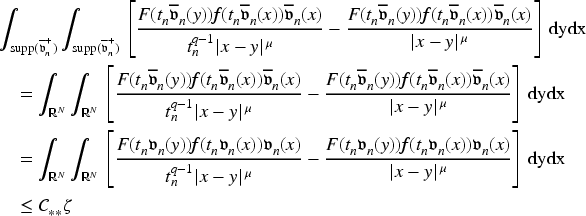
as , namely in . Then, in . Put . Since is invariant by translations, we get
It implies that is a bounded sequence in . Then there exists such that for a subsequence, still denoted by itself, in and almost everywhere in . Arguing as above and using the Fatou’s lemma, we get
Thus, . From (3.17) and the fact that in , we deduce that
Therefore, by the Severini-Egorov theorem there exists a subset , and a number such that , the sequence converges uniformly to in and a.e. in . The fact that uniformly in implies that for a.e. and all large enough. From (3.15) and (3.16), we obtain
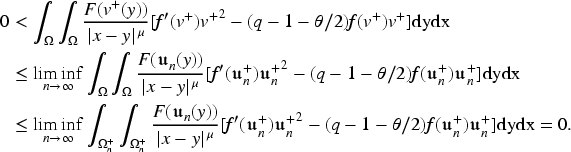
for any . This inequality, condition , which gives that the functions and are increasing function in , the Fatou lemma, (3.14), and the fact that in by imply that
for any and large enough. This is impossible, letting . Thus, Claim 1 is proved.
Let us divide the next proof in two cases.
Case 1.. Choosing a subsequence if necessary, still denoted by itself, we may assume that . Remind that as and , and we get as
Let us compute
Using the condition (3.15), (3.16) and the facts that in and
we get
and so, as
where is a suitable constant. Similarly, as
We see that
due to the boundedness of the sequence in From (3.13) verified by and from the fact that the function is increasing in and the arguments of the proof of Lemma 3.3, we get
thanks to condition . Letting in the above inequality, we get that . This completes the proof of Lemma 3.5.□
Let and and hold. Let ( be a sequence of satisfying (3.12). Assume that if and that if Then has a strongly convergent subsequence in
Fix a sequence as in the statement. First, we investigate the case . We see that is a bounded sequence in via the condition . Therefore, up to a subsequence, there exists such that
Proceeding as in the proof of Proposition 2.1, we have . We denote by . Using Lemma 3.3, we get
which combined with Lemma 3.5 gives that in , that is in
Next, we investigate the case Then we have the embedding compact for any via Lemma 3.1. Hence, in for any Condition and the arguments of the proof of Lemma 3.3 give that
Moreover, using the Vitali’s theorem and the arguments of the proof of Lemma 3.3, we show that
Together with (3.31), (3.32) and the fact that we get
This implies that in and completes the proof.□
Suppose that the conditions and and hold. Let be a sequence for constrained to , which satisfies (3.12) for a suitable constant . Suppose that if and that if . Then has a strongly convergent subsequence in .
Suppose that is a sequence of constrained to that is,
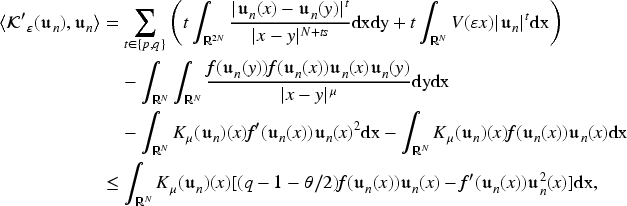
Hence, as , since is a bounded sequence in by (3.12). Proposition 3.1 gives that
Thus, up to subsequences, still denoted by , there are nonnegative numbers , and a function such that (3.26) is satisfied and
Since we get
We now investigate the case then by Lemma 3.1, we can suppose that in for all along a subsequence if necessary. By and we see that there exist and such that in
Moreover, by the assumption (3.12), inequality (3.35) and the Vitali theorem, proceeding as in the proof of Lemma 3.3, we get
Since in by , then (3.38) implies that Conversely, we get which is a contradiction. By the method of Lagrange multipliers, there exists a real sequence such that
Since then there exists such that for all where nontrivial is so small that uniformly in by the Severini-Egoroff theorem. Thus, for all and large enough. Hence for all large enough. Applying again, we deduce that
In what follows, we consider the case in . If , then there exists such that . Hence,
From the definition of by arguments as Proposition 3.1, there exists such that for all Then, (3.43) implies that and there exists such that on with From (3.40), we have
Proceeding as in the first part of the proof of the first case, we prove that (3.41) holds. Otherwise, by the Fatou lemma and (3.44), we get
thanks to condition . This is the obvious required contradiction and proves that (3.41) holds.
Finally, we consider the case then (3.33) implies that in . Proceeding as in the proof of Lemma 3.4, we see that there exists a sequence and constants such that
Put for all . Since the norm in and the integrals are invariant under translation, we have for all . Hence is a bounded sequence in . Consequently, there is a subsequence and a function such that (3.26) holds along and in . From (3.45), we obtain . We see that
Proceeding as in the case , we get a contradiction.
Hence, we have
and so (3.39) implies that as Therefore, is actually a sequence of in , satisfying (3.12). Hence the conclusion is a direct consequence of Lemma 3.6.□
Under the assumptions of Lemma 3.7, the critical points of constrained on are critical points of in
We use the key property for all . To this aim, it is enough to follow the proof of Lemma 3.7. We omit the details here and refer readers to the proof of Proposition 2.1 of Figueiredo et al. (2018). This completes the proof of Corollary 3.1.□
Existence of a Ground State Solution
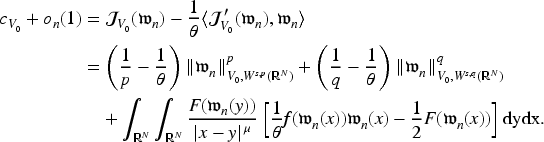
In this section, we study the existence of a ground state solution of Equation (), that is a critical point of in , such that . In what follows, we are interested in the energy function
associated to the equation
We remind that Nehari manifold associated with is given by
By arguments as Proposition 3.2, we get
Now we are ready to present the main result of the section.
Assume that and hold. Then there exists such that for all , Equation () has a ground state solution.
We choose a function satisfying on and on For each we denote by where is a ground state solution of Equation () given in Proposition 2.1. For each function there is a real number such that , and we have
For any we get
Thus, we deduce
From (4.1), we see that the set is bounded for all as . Indeed, if as for some , then condition yields
which contradicts (4.1). Thus, fixed , we can assume that as Hence, we get
thanks to the Vitali and the Lebesgue dominated convergence theorems and that has compact support. From the fact that and in as , as is shown in the proof of Lemma 2.2 of Ambrosio and Isernia (2018), the condition gives that as . Hence, we obtain
As in the proof of Lemma 2.7, we get that . For any sequence of in ,
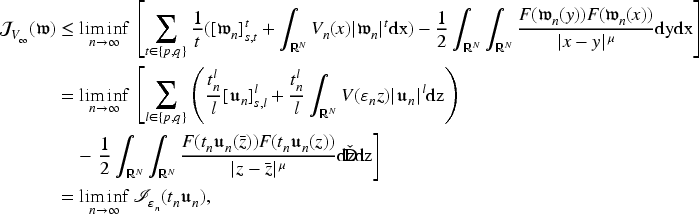
Lemma 3.2 shows that satisfies all geometric condition of Moutain Pass Theorem. From (4.7), we have when then by Lemma 3.6, we see that satisfies the condition. Hence, has a critical point with level which is a weak solution of Equation ().□
Let and hold. Let and be a sequence of ground state solutions of Equation . Then there exists a sequence such that, up to a subsequence, say , with , the sequence converges to some , where is defined in (1.12). Furthermore, the translated sequence has a subsequence strongly convergent to a ground state solution of Equation () in .
Let be a sequence of solutions of Equation , which exists thanks to Theorem 4.1 taking . Then, by
Recall that . Hence, for every , there exists such that
for all
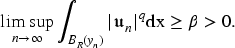
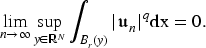
We claim that there exist a sequence and positive numbers and such that
Otherwise, for any
Lemma 2.8 gives that in for all Taking sufficiently large, we get
for a suitable constant and near Condition and the proof of Lemma 3.4 imply that
Since we see that
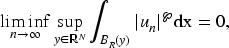
as . Thus, as . This contradicts Proposition 3.1. Hence the claim (4.8) is proved.
Set , . Then each is a solution of the equation in
with associated energy functional
Theorem 4.1 implies that .
The sequence is bounded.
Otherwise, up to a subsequence, still denoted by , such that . By the boundedness of , up to a subsequence, we may suppose that . Since is a uniformly continuous on for any , then we have
as on .
The norm in is invariant under the change of variable , so that (4.9) holds along , where and is a suitable constant near when is large enough. From Lemma 4 of Thin (2022), for any we have for
as .
Next, we claim that
Since is a bounded sequence in then up to a subsequence, there exists such that weakly in and a.e. in . From (4.8), we have . By for any and there exists such that
strongly in . As is shown in Claim 1, we see that . We assert that
The Brézis–Lieb lemma and (4.20) imply that strongly in By the Fatou’s lemma, we have
Assume by contradiction that either
or
Now, as
Condition and the Fatou lemma give
This obvious contradiction implies that
Combining (4.21) and (4.22), we get the assertion (4.20).
is a ground state solution of Equation ().
Clearly, is a solution of (). Hence,
On the other hand, the Fatou lemma and the fact that by Claim 2 imply that
Hence and is a ground state solution of Equation ().
Multiplicity of Solutions to Problem
The main result of the section is equivalent with Theorem 1.1 and it is stated as follows:
Suppose that the conditions and hold. Then for any there exists such that for any Equation () has at least nontrivial nonnegative solutions. Let be a solution and be its global maximum, then
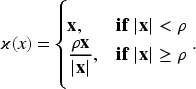
Before giving the proof of Theorem 5.1, let us introduce some notations and useful preliminary results. Fix . Let be a ground state solution of Equation , so that and Let be a smooth nonincreasing cut-off function in such that if and if . For and any , we define
and is given by when satisfies
We see that has compact support in for any
The function is such that
Assume that the assertion does not hold. Thus, there is a real number a sequence and such that
where is defined in (2.1). We claim that . Let us first show that, up to a subsequence, as . Otherwise, up to a subsequence, . Since and are increasing in , and since in and for all big enough, we obtain
For any let be such that Let be the function defined by
Next, we define the barycenter map given by
The map satisfies the following limit
The proof is similar to that of Lemma 14 of Thin (2022), so that we refer to Thin (2022) for details. This completes the proof of Lemma 5.2.□
Let and satisfy as . Then there exists a sequence such that the sequence has a subsequence which strongly converges in . Furthermore, up to a subsequence,
Let the sequences and be as in the statement. Since and then we have
Thus, there exists a constant
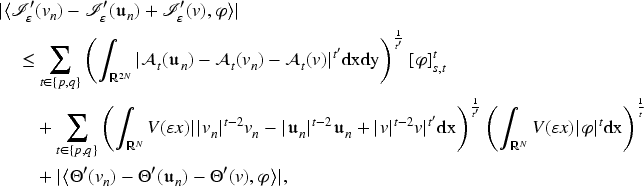
for all . Using (3.3) and the embedding is continuous, we get that is bounded in .
Now, we claim that there exists a sequence such that
for some constants , . Otherwise, for any
Thus, Lemma 2.8 shows that strongly in , . Taking large enough as in (2.26), we get
for a suitable constant and near . Hence, Lemma 2.9 shows that
Since , we obtain that as . This contradicts Proposition 3.1. Therefore, (5.6) holds.
We denote . Since is kept by translation, also is a bounded sequence in . Then, up a subsequence if necessary, there is such that weakly in , almost everywhere in and in for any and any . Hence, (5.6) gives that .
We denote by the positive real number satisfying that and set . Hence, using the transformation and the invariance of integrals by using that change of variable, we get
as . Then we get . From the condition and , there is a constant satisfying for all . We prove that strongly in . Otherwise, if in , then weakly in . This is a contradiction with weakly in . Hence, the claim is proved and there exists such that for all Therefore, we have
which implies that for all Therefore, choosing a subsequence if necessary, we may suppose that .
We show that Otherwise, and strongly in . This will lead to the fact that it is a contradiction with . Hence, and up to a subsequence, we have weakly in and almost everywhere in . Proceeding as in the proof of Lemma 2.7, we get that . Now we prove that
Applying the Brézis–Lieb lemma and (5.7), we get that strongly in . The Fatou lemma yields that
We assume either
or
Clearly, as
Thus, condition and the Fatou lemma show that
This obvious contradiction shows that
Combining (5.8) and (5.9), we get (5.7). Because as then we have in as .
We claim that has a subsequence, still denoted by , such that . Otherwise, if is not bounded, then up to a subsequence, we have . First, we study the case . Note that and using the change of variable , we deduce
Applying the Fatou lemma, the Lebesgue dominated convergence theorem and the fact that in we deduce that
which is impossible. Hence, is bounded in the case
Let us consider the case . From the fact that strongly in , condition the changes of variables and we have
where , . Thus,
which is impossible. Hence is also bounded in the case .
In conclusion, up to a subsequence, . If then . Proceeding as in the proof of (5.10), we get a contradiction. Hence as required.□
We denote by the positive function such that as . Let
Lemma 5.2 shows that as . Hence for any and so for any . Moreover, we have the next result.
For any
Since the proof is similar to Lemma 16 of Thin (2022), we omit the details.□
Suppose that the conditions and hold. Denote by a nontrivial nonnegative solution in of
where and If is a bounded sequence in verifying (4.9) for a suitable constant and if strongly in , then each and there exists such that for all . Furthermore
Therefore, taking as a test function in (5.11) and using (5.13), we have
Using (5.12), the fact that , and proceeding as in the proof of Lemma 3.15 of Ambrosio and Isernia (2018), we have . Since the embeddings , , are continuous, there exists a constant such that
On the other hand, the boundedness of in and Lemma 2.6 guarantee that there exists such that
Condition implies that . Hence, for any there exists such that
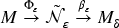
By Lemmas 5.1 and 5.4, for each there exists such that the following diagram
is well-defined for any . Using Lemma 5.2 and we can take small enough if necessary, we deduce that
for all , for some function satisfying uniformly in , and for all . Hence, we have a homotopy between and the inclusion map via , with . By (Benci & Cerami, 1994, Lemma 4.3) (see also Cingolani & Lazzo, 2000, Lemma 2.2), we deduce that
For any we see that verifies the condition. Hence, we can apply the Lusternik-Schnirelmann theory of critical points (see the monograph Willem, 1996, Theorem 5.20) for the functional to see that it has at least critical points on . Corollary 3.1 guarantees that has at least critical points in .
Let be a solution of then is a solution of the Equation (5.11). Moreover, there exists , such that, up to a subsequence, strongly in and by Lemma 5.3.
We claim that there exists such that for all large enough. Indeed, (5.6) in the proof of Lemma 5.3 gives
for all large enough. Hence, we take . Since strongly in then we get that uniformly in by Lemma 5.5.
Assume that is a global maximum point of then from Lemma 5.5, there exists such that for all . Therefore, the maximum point of is given by Furthermore, Equation () admits a nontrivial nonnegative solution Thus the maximum points of and of satisfy . We deduce that
This completes the proof.□
Proof of Theorem 1.2.
We know that is a nontrivial nonnegative solution of Equation (). Setting
Then Lemma 4.1 guarantees that converges strongly to in and is a ground state solution of the equation
This completes the proof.□
Proof of Corollaries 1.3 and 1.4
Corollary 1.3 comes from Theorem 1.1 when . Then we only have to give the proof of Corollary 1.4. There is a only different point about the exponential decay estimate between Theorem 1.2 and Corollary 1.4. We shall give the details of it. Lemma 5.5 reduces as to the next result.
Suppose that the conditions and hold and let be a nontrivial nonnegative solution of the equation
where and If is a bounded sequence in verifying
where is a suitable constant and strongly in , then and there exists such that for all . Furthermore,
Proof of Corollary 1.4.
Since uniformly in , then assumption and Lemma 2.6, as , provide the existence of a number such that
and large enough. Condition implies that
for all .
Proceeding as in the proof of Theorem 1.1 of Ambrosio and Repovs (2021), we set where , satisfy and for all . Then, for all we have
Let . Using the Simon inequality
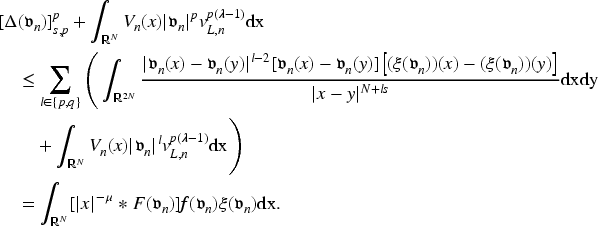
and choosing as a test function for Equations (6.4) and (6.5), we get
Therefore, . This means that
We assume that is the global maximum point of Then, by Lemma 6.1 and (6.2), we can take in (6.3) large enough such that for all . Hence, is the maximum point of and . Assume that is a nontrivial nonnegative solution of
then Equation (1.13) admits a nontrivial nonnegative solution . Setting . Then by Lemma 4.1, as , the sequence converges strongly to some in . Moreover, is a ground state solution of the equation
Furthermore, for large enough. Thus, we have
where . This,
for all and any . Hence we get
for all and . We finish the proofs of Corollary 1.4.□
Footnotes
Declaration of Conflicting Interests
The authors declared no potential conflicts of interest with respect to the research, authorship, and/or publication of this article.
Funding
The authors received the following financial support for the research, authorship and/or publication of this article: S. Liang was supported by the Science and Technology Development Plan Project of Jilin Province, China (No. YDZJ202201ZYTS582), the Young outstanding talents project of Scientific Innovation and entrepreneurship in Jilin (No. 20240601048RC), the National Natural Science Foundation of China (No. 12371455), Natural Science Foundation of Changchun Normal University (No. CSJJ2023004GZR) and the Innovation and Entrepreneurship Talent Funding Project of Jilin Province (No. 2023QN21). P. Pucci is a member of the Gruppo Nazionale per l’Analisi Matematica, la Probabilità e le loro Applicazioni (GNAMPA) of the Istituto Nazionale di Alta Matematica (INdAM) and this research is under the auspices of INdAM. The research results of Thin Van Nguyen are supported by Thang Long University under project with the name “Nevanlinna theory and Kirchhoff-Schrodinger-Hardy type problems for the fractional p-Laplacian” and grant number: 01/2020/STS01.
Data Availability
Data sharing not applicable to this article as no datasets were generated or analysed during the current study.
References
1.
Adimurthi, YangY. (2010). An interpolation of Hardy inequality and Trudinger–Moser inequality in and its applications. International Mathematics Research Notices, 13, 2394–2426.
2.
AlvesC. O. (2016). Investigating the multiplicity and concentration behaviour of solutions for a quasi-linear Choquard equation via the penalization method. Proceedings of the Royal Society of Edinburgh Section A: Mathematics, 146, 23–58.
3.
AlvesC. O.AmbrosioV.IserniaT. (2019). Existence, multiplicity and concentration for a class of fractional - Laplacian problems in . Communications on Pure and Applied Analysis, 18(4), 2009–2045.
4.
AlvesC. O.CassaniD.TarsiC.YangM. (2016). Existence and concentration of ground state solutions for a critical nonlocal Schrödinger equation in . The Journal of Differential Equations, 261, 1933–1972.
5.
AlvesC. O.GaoF.SquassinaM.YangM. (2017). Singularly perturbed critical Choquard equations. The Journal of Differential Equations, 263, 3943–3988.
6.
AmbrosioV. (2022a). Fractional -Schrödinger equations with critical and supercritical growth. Applied Mathematics and Optimization, 86(3), 31.
7.
AmbrosioV. (2022b). A strong maximum principle for the fractional -Laplacian operator. Applied Mathematics Letters, 126, 107813.
8.
AmbrosioV. (2024). Multiple concentrating solutions for a fractional -Choquard equation. Advanced Nonlinear Studies, 24(2), 510–541.
9.
AmbrosioV.IserniaT. (2018). Multiplicity and concentration results for some nonlinear Schrödinger equations with the fractional -Laplace. Discrete and Continuous Dynamical Systems, 38, 5835–5881.
10.
AmbrosioV.IserniaT. (2021). Multiplicity of positive solutions for a fractional -Laplacian problem in . Journal of Mathematical Analysis and Applications, 501(1), 124487.
11.
AmbrosioV.RădulescuV. D. (2020). Fractional double-phase patterns: Concentration and multiplicity of solutions. Journal de Mathematiques Pures et Appliquees, 142, 101–145.
12.
AmbrosioV.RepovsD. (2021). Multiplicity and concentration results for a -Laplacian problem in . The Zeitschrift für Angewandte Mathematik und Physik, 72, 33.
13.
AntontsevS. N.ShmarevS. I. (2006). Elliptic equations and systems with nonstandard growth conditions: Existence, uniqueness and localization properties of solutions. Nonlinear Analysis, 65, 722–755.
14.
BenciV.CeramiG. (1994). Multiple positive solutions of some elliptic problems via Morse theory and the domain topology. Calculus of Variations and Partial Differential Equations, 2, 29–48.
15.
BenciV.D’AveniaP.FortunatoD.PisaniL. (2000). Solitons in several space dimensions: Derrick’s problem and infinitely many solutions. Archive for Rational Mechanics and Analysis, 154, 297–324.
16.
BonheureD.d’AveniaP.PomponioA. (2016). On the electrostatic Born-Infeld equation with extended charges. Communications in Mathematical Physics, 346, 877–906.
17.
BornM.InfeldL. (1933). Foundations of the new field theory. Nature, 132, 1004.
18.
BrézisH.LiebE. (1983). A relation between pointwise convergence of functions and convergence of functionals. Proceedings of the American Mathematical Society, 88, 486–490.
19.
ChenS.FiscellaA.PucciP.TangX. (2020a). Coupled elliptic systems in RN with (p,N) Laplacian and critical exponential nonlinearities. Nonlinear Analysis, 201, 112066. Special Issue on the occasion of the 85th birthday of Professor Shair Ahmad.
20.
ChenS.LiL.YangZ. (2020b). Multiplicity and concentration of nontrivial nonnegative solutions for a fractional Choquard equation with critical exponent. Revista de la Real Academia de Ciencias Exactas Fisicas y Naturales Serie A-Matematicas (RACSAM), 114, 35. Paper No. 33.
21.
ChenS.ShuM.TangX.WenL. (2022). Planar Schrödinger-Poisson system with critical exponential growth in the zero mass case. The Journal of Differential Equations, 327, 448–480.
22.
CherfilL.Il’yasovV. (2004). On the stationary solutions of generalized reaction diffusion equations with -Laplacian. Communications on Pure and Applied Analysis, 1(4), 1–14.
23.
CingolaniS.LazzoM. (2000). Multiple positive solutions to nonlinear Schrödinger equation with competing potential. The Journal of Differential Equations, 160, 118–138.
24.
CingolaniS.TanakaK. (2019). Semi-classical states for the nonlinear Choquard equations: Existence, multiplicity and concentration at a potential well. Revista Matemática Iberoamericana, 35, 1885–1924.
25.
ClementeR.AlbuquerqueJ. C. D.BarbozaE. (2021). Existence of solutions for a fractional Choquard-type equation in with critical exponential growth. The Zeitschrift für Angewandte Mathematik und Physik, 72, 16.
26.
de S. BöerE.MiyagakiO. H.PucciP. (2022). Existence and multiplicity results for a class of Kirchhoff-Choquard equations with a generalized sign-changing potential. Atti della Reale Accademia dei Lincei, Rendiconti Lincei-Matematica e Applicazioni, 33, 651–675. Special Issue: dedicated to the memory of Professor Antonio Ambrosetti.
27.
Di NezzaE.PalatucciG.ValdinociE. (2012). Hitchhiker’s guide to the fractional Sobolev spaces. Bulletin des Sciences Mathématiques, 136, 521–573.
28.
DouX.HeX.RădulescuV. D. (2024). Multiplicity of positive solutions for the fractional Schrödinger-Poisson system with critical nonlocal term. The Bulletin of Mathematical Sciences, 14(2), 56. Paper No. 2350012.
29.
FigueiredoG. M.Molica BisciG.ServadeiR. (2018). The effect of the domain topology on the number of solutions of fractional Laplace problems. Calculus of Variations and Partial Differential Equations, 57, 1–24.
30.
FloerA.WeinsteinA. (1986). Non spreading wave packets for the cubic Schrödinger equation with a bounded potential. The Journal of Functional Analysis, 69, 397–408.
31.
FröhlichH. (1937). Theory of electrical breakdown in ionic crystal. Proceedings of the Royal Society of Series A, 160(901), 230–241.
32.
FröhlichH. (1954). Electrons in lattice fields. Advances in Physics, 3, 325–361.
33.
HoK. P. (2024). Two-weight norm inequalities for rough fractional integral operators on Morrey spaces. Opuscula Mathematica, 44(1), 67–77.
34.
JonesK. R. W. (1995). Newtonian quantum gravity. Australian Journal of Physics, 48, 1055–1081.
35.
LanJ.HeX.MengY. (2023). Normalized solutions for a critical fractional Choquard equation with a nonlocal perturbation. Advances in Nonlinear Analysis, 12(1), 40. Paper No. 20230112.
36.
LiQ.YangZ. (2016). Multiple solutions for a class of fractional quasi-linear equations with critical exponential growth in . Complex Variables and Elliptic Equations, 61, 969–983.
37.
LiangS.SunX.RadulescuV. D.NguyenT. V. (2024). Multiplicity and concentration of solutions to the fractional Choquard equation involving exponential growth, Submitted.
38.
LiebE. H. (1976/77). Existence and uniqueness of the minimizing solution of Choquard’s nonlinear equation. Studies in Applied Mathematics (Cambridge, Mass.), 57, 93–105.
39.
LiebE.LossM. (2001). Analysis. American Mathematical Society. Graduate Students Mathematics 14.
40.
LionsP. L. (1980). The Choquard equation and related questions. Nonlinear Analysis, Theory, Methods & Applications, 4, 1063–1072.
41.
LiuZ.RadulescuV.TangC.ZhangJ. (2022). Another look at planar Schrödinger-Newton systems. The Journal of Differential Equations, 328, 65–104.
42.
LiuS.YangJ.SuY. (2024). Regularity for critical fractional Choquard equation with singular potential and its applications. Advances in Nonlinear Analysis, 13(1), 36. Paper No. 20240001.
43.
MengY.HeX. (2023). Multiplicity of concentrating solutions for Choquard equation with critical growth. Journal of Geometric Analysis, 33, 29.
44.
Molica BisciG.ThinN. V.RădulescuV. D. (2019). Concentration phenomena for fractional double phase equations with Choquard reaction, Preprint.
45.
Molica BisciG.ThinN. V.VilasiL. (2022). On a class of nonlocal Schrödinger equations with exponential growth. Advances in Differential Equations, 27, 571–610.
46.
MorozI. M.PenroseR.TodP. (1998). Spherically-symmetric solutions of the Schrödinger-Newton equations. Classical Quantum Gravity, 15, 2733–2742.
47.
MorozV.SchaftingenJ. V. (2017). A guide to the Choquard equation. Journal of Fixed Point Theory and Applications, 19, 773–13.
48.
MukherjeeT.PucciP.XiangM. (2022). Combined effects of singular and exponential nonlinearities in fractional Kirchhoff problems. Discrete and Continuous Dynamical Systems, 42, 163–187.
49.
PariniE.RufB. (2018). On the Moser-Trudinger inequality in fractional Sobolev-Slobodeckij spaces. Atti della Accademia Nazionale dei Lincei Matematica e Applicazioni, 29, 315–319.
50.
PekarS. I. (1954). Untersuchung über die Elektronentheorie der Kristalle. Akademie Verlag.
51.
PenroseR. (1996). On gravity’s role in quantum state reduction. General Relativity and Gravitation, 28, 581–600.
52.
PucciP.XiangM.ZhangB. (2015). Multiple solutions for nonhomogeneous Schrödinger-Kirchhoff type equations involving the fractional -Laplacian in . Calculus of Variations and Partial Differential Equations, 54, 2785–2806.
53.
RabinowitzP. (1992). On a class of nonlinear Schrödinger equations. The Zeitschrift für Angewandte Mathematik und Physik, 43, 270–291.
54.
SinghG. (2017). Nonlocal perturbations of the fractional Choquard equation. Advances in Numerical Analysis, 8, 694–706.
55.
SuY.WangL.ChenH.LiuS. (2020). Multiplicity and concentration results for fractional Choquard equations: Doubly critical case. Nonlinear Analysis, 198, 111872.
56.
ThinN. V. (2020). Singular Trudinger–Moser inequality and fractional -Laplace equation in . Nonlinear Analysis, 196, 111756.
57.
ThinN. V. (2022). Multiplicity and concentration of solutions to a fractional -Laplace problem with exponential growth. Annales Fennici Mathematici, 47, 603–639.
58.
ThinN. V. (2022). Multiplicity and concentration of solutions to a fractional -Laplace problem with exponential growth. Journal of Mathematical Analysis and Applications, 506, 125667.
TuringA. M. (1952). The chemical basis of morphogenesis. Philosophical Transactions of the Royal Society of London. Series B, 237, 37–72.
61.
WillemM. (1996). Minimax theorems. Birkhäuser.
62.
XiangM.MaY.YangM. (2024). Normalized homoclinic solutions of discrete nonlocal double phase problems. The Bulletin of Mathematical Sciences, 14(2), 18. Paper No. 2450003.
63.
YeH. (2015). The existence of least energy nodal solutions for some class of Kirchhoff equations and Choquard equations in . Journal of Mathematical Analysis and Applications, 431, 935–954.
64.
YeF.YuS.TangC. L. (2024). Limit profiles and the existence of bound-states in exterior domains for fractional Choquard equations with critical exponent. Advances in Nonlinear Analysis, 13(1), 33. Paper No. 20240020.
65.
ZhangC. (2019). Trudinger–Moser inequalities in fractional Sobolev-Slobodeckij spaces and multiplicity of weak solutions to the fractional-Laplacian equation. Advanced Nonlinear Studies, 19, 197–217.
66.
ZhangJ.LüW.LouZ. (2021). Multiplicity and concebtration behavior of solutions of the critical Choquard equation. Applicable Analysis, 100, 167–190.
67.
ZhangW.ZhangJ.RădulescuV. D. (2023). Concentrating solutions for singularly perturbed double phase problems with nonlocal reaction. The Journal of Differential Equations, 347, 56–103.
68.
ZhikovV. V. (1986). Averaging of functionals of the calculus of variations and elasticity theory. Izvestiya Akademii Nauk SSSR. Seriya Matematicheskaya, 50, 675–710. English translation in Math. USSR, Izv. 29 (1987) 33–66.
69.
ZhikovV. V. (1995). On Lavrentiev’s phenomenon. Russian Journal of Mathematical Physics, 3, 249–269.